
Pulsartronic SFG60 - Sphygmomanometer Magic Care - Free user manual and instructions
Find the device manual for free Pulsartronic SFG60 Magic Care in PDF.


| Product Type | Upper Arm Blood Pressure Monitor |
| Brand | Magic Care |
| Model | Pulsartronic SFG60 |
| Measurement Method | Oscillometric |
| Measurement Range (Blood Pressure) | 20-280 mmHg (Systolic/Diastolic) |
| Measurement Range (Pulse) | 30-200 beats/min |
| Accuracy (Blood Pressure) | ±3 mmHg |
| Accuracy (Pulse) | ±5% |
| Cuff Size | 22-42 cm |
| Display | Large LCD display with date and time |
| Memory | 2x120 memories (2 users) |
| Power Source | 4x AAA batteries (1.5V) or AC adapter (6V DC, 600mA) |
| Dimensions | Approx. 140 x 110 x 60 mm |
| Weight | Approx. 350 g (without batteries) |
| Additional Functions | WHO classification indicator, arrhythmia detection, average value calculation |
| Cleaning and Maintenance | Clean with a soft dry cloth; do not use solvents |
| Safety Features | Auto shut-off, low battery indicator, CE marked |
| Accessories Included | Cuff, instruction manual, batteries, storage case |
| Repairability | Professional repair only; no user-serviceable parts |
| Warranty | 2 years from date of purchase |
Frequently Asked Questions - Pulsartronic SFG60 Magic Care
User questions about Pulsartronic SFG60 Magic Care
0 question about this device. Answer the ones you know or ask your own.
Ask a new question about this device
Download the instructions for your Sphygmomanometer in PDF format for free! Find your manual Pulsartronic SFG60 - Magic Care and take your electronic device back in hand. On this page are published all the documents necessary for the use of your device. Pulsartronic SFG60 by Magic Care.
USER MANUAL Pulsartronic SFG60 Magic Care
GB The warranty terms here specified are valid only in Italy for Italian residents. In all other countries, the warranty will be provided by the local dealer that sold you the unit, in accordance with the applicable laws.
Distribuito da:
FLAEM NUOVA S.p.A.
Via Colli Storici, 221
natural_image
Simple icon of a person pointing at a white rectangle, no text or symbols presentMAGICCARE
IL VERO BENESSERE
HEALTHCARE AT HOME

SFIGMOMANOMETRO DA BRACCIO
ARM BLOOD PRESSURE MONITOR

PULSARTRONIC
GESTIONE DEI DATI....11

Start
•
Stop
natural_image
Simple line drawing of a person seated at a desk, no text or symbols presentMISURAZIONE
GESTIONE DEI DATI
natural_image
Simple diagram with three black dots arranged horizontally inside a rectangular frame (no text or symbols)line
| Pressure-induced strain (mmHg) | Participants in Grade 1 (count) | Participants in Grade 2 (count) | Participants in Grade 3 (count) | |---|---|---|---| | 120 | 80 | 80 | 80 | | 130 | 85 | 85 | 85 | | 140 | 90 | 90 | 90 | | 150 | 95 | 95 | 95 | | 160 | 100 | 100 | 100 | | 170 | 105 | 105 | 105 | | 180 | 110 | 110 | 110 || Pressione(mm Hg) \ Livello | OttimaleNormale | Ipertensione | ||||
| G1 | G2 | G3 | ||||
| SYS | <120 | 120-129 | 130-139 | 140-159 | 160-179 | ≥180 |
| DIA | <80 | 80-84 | 85-89 | 90-99 | 100-109 | ≥110 |
natural_image
Line drawing of a person sitting on a table with a bandage, no text or symbols presentnatural_image
Diagram of a handheld device with a coiled cable and magnified inset showing the tip (no text or symbols)Adattatore
Tipo: UE08WCP-060100SPA
Ingresso: 100\~240V, 50\~60Hz,400mA
Uscita: 6V—1A
Indirizzo: Zone A. No.105. Dongli Road, Torch Development District.
Zhongshan 528437 Guangdong China
Guangdong Transtek Medical Electronics Co., Ltd. Zona A, No.105, Dongli Road, Torch Development District, Zhongshan, 528437, Guangdong, China EC REP MDSS - Medical Device Safety Service GmbH Schiffgraben 41, 30175 Hannover, Germany
Table of Contents
INTRODUCTION....26
- General Description
• Safety Information
• LCD Display Signa
• Monitor Components
BEFORE YOU START....30
• The Choice of Power Supply
• Installing and Replacing the Batteries
• Measure Principle
- Setting Date, Time and Measurement Unit
MEASUREMENT....33
- Tie the Cuff
• Start the Measurement
DATA MANAGEMENT....35
- Recall the Records
- Delete the Records
INFORMATION FOR USER....37
- Tips for measurement
- Maintenances
ABOUT BLOOD PRESSURE....39
• What are systolic pressure and diastolic pressure?
• What is the standard blood pressure classification?
• Why does my blood pressure fluctuate throughout the day?
• Why do I get a different blood pressure at home compared to the hospital?
• Is the result the same if measuring on the right arm?
TROUBLESHOOTING 41
SPECIFICATIONS....42
AUTHORIZED COMPONENT 43
CONTACT INFORMATION....43
COMPLIED EUROPEAN STANDARDS LIST....44
EMC GUIDANCE....45
INTRODUCTION
INTRODUCTION
♥ General Description
Thank you for selecting PULSATRONIC arm type blood pressure monitor (TMB-1112). The monitor features blood pressure measurement, pulse rate measurement and the result storage. The design provides you with two years of reliable service.
Readings taken by the TMB-1112 are equivalent to those obtained by a trained observer using the cuff and stethoscope auscultation method.
This manual contains important safety and care information, and provides step by step instructions for using the product.
Read the manual thoroughly before using the product.
Features:
- 93mm×61mm Digital LCD display
• Maximum 60 records
• Measuring during inflation technology
♥ Safety Information
The signs below might be in the user manual, labeling or other component. They are the requirement of standard and using.
 |
CAUTION
This device is intended for adult use only.
This device is intended for no-invasive measuring and monitoring of arterial blood pressure. It is not intended for use on extremities other than the arm or for functions other than obtaining a blood pressure measurement.
Do not confuse self-monitoring with self-diagnosis. This unit allows you to monitor your blood pressure. Do not begin or end medical treatment without asking a physician for treatment advice. If you are taking medication, consult your physician to determine the most appropriate time to measure your blood pressure. Never change a prescribed medication without consulting your Physician.
When the device was used to measure patients who have common arrhythmias such as atrial or ventricular premature beats or atrial fibrillation, the best result may occur with deviation. Please consult your physician about the result.
If the cuff pressure exceeds 40 kPa (300 mmHg), the unit will automatically deflate. Should the cuff not deflate when pressures exceeds 40 kPa (300 mmHg), detach the cuff from the arm and press the START/STOP button to stop inflation.
The equipment is not AP/APG equipment and not suitable for use in the presence of a flammable anesthetic mixture with air of with oxygen or nitrous oxide.
The operator shall not touch output of batteries /adapter and the patient simultaneously. To avoid measurement errors, please avoid the condition of strong electromagnetic field radiated interference signal or electrical fast transient/burst signal.
The user must check that the equipment functions safely and see that it is in proper working condition before being used.
This device is contraindicated for any female who may be suspected of, or is pregnant. Besides providing inaccurate readings, the effects of this device on the fetus are unknown.
Manufacturer will make available on request circuit diagrams, component parts list etc.
This unit is not suitable for continuous monitoring during medical emergencies or operations. Otherwise, the patient's arm and fingers will become anaesthetic, swollen and even purple due to a lack of blood.
Please use the device under the environment which was provided in the user manual. Otherwise, the performance and lifetime of the device will be impacted and reduced.
During use, the patient will be in contact with the cuff. The materials of the cuff have been tested and found to comply with requirements of ISO 10993-5:2009 and ISO 10993-10:2010. It will not cause any potential sensitization or irritation reaction.
Please use ACCESSORIES and detachable partes specified/ authorised by MANUFACTURE. Otherwise, it may cause damage to the unit or danger to the user/patients.
The device doesn't need to be calibrated within the two years of reliable service.
Please dispose of ACCESSORIES, detachable parts, and the ME EQUIPMENT according to the local guidelines.
If you have any problems with this device, such as setting up, maintaining or using, please contact the SERVICE PERSONNEL. Don't open or repair the device by yourself.
Please report to us if any unexpected operation or events occur.
Please use the soft cloth to clean the whole unit. Don't use any abrasive or volatile cleaners.
INTRODUCTION INTROD
♥ LCD display signal

| SYMBOL | DESCRIPTION | EXPLANATION |
 | Systolic blood pressure | High pressure result |
 | Diastolic blood pressure | Low pressure result |
| Pul/min | Pulse per minute Beats per minute, BPM | |
 | Deflating CUFF air is exhausting of deflating | |
 | Memory | The displayed measurement values is from the memory. |
 | kPa | Measurement Unit of the blood pressure |
 | mmHg | Measurement Unit of the blood pressure |
 | Low battery | Batteries are low and need to be replaced |
 | Irregular heartbeat | Irregular heartbeat detection |
 | Grade The grade of the blood pressure | |
 | Current Time | Year/Month/Day, Hour/Minute |
♥ Monitor Components
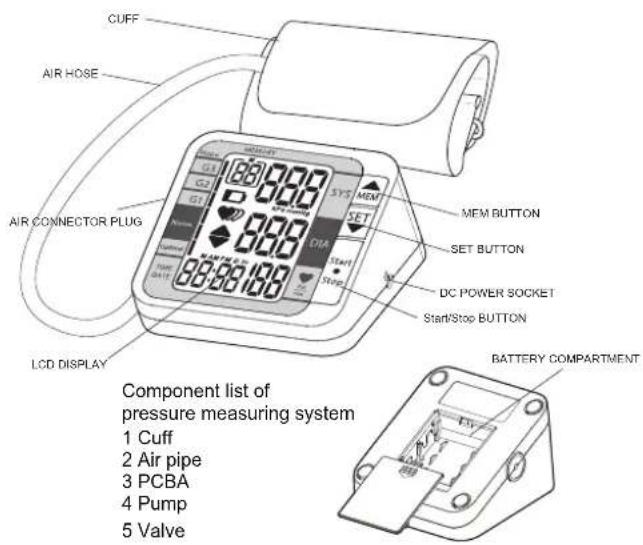
♥ List
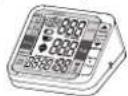
- Blood Pressure Monitor (TMB-1112)
- 4×AA alkaline batteries

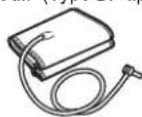
2.Cuff (Type BF applied part) (22cm\~32cm)
4.User manual
BEFORE YOU START BEF
♥ The Choice of Power Supply
- Battery powered mode: 6VDC 4×AA alkaline batteries
- AC adaptor powered mode: 6V == 1A (Please only use the recommended AC adaptor model). (Not Included)
Please unplug the adaptor to depart from the using utility power.
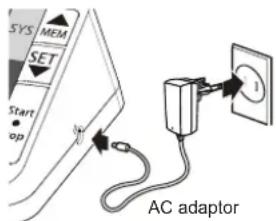
CAUTION
In order to get the best effect and protect your monitor, please use the right battery and special power adaptor which complies with CE safety standard.
♥ Installing and Replacing the Batteries
• . Slide off the battery cover.
• . Install the batteries by matching the correct polarity, as shown.
- . Replace the cover.

natural_image
Diagram of a battery pack with two batteries and internal components (no text or symbols)Replace the batteries whenever the below happen
•The Lo+ shows
•The display dims
•The display does not light up
CAUTION
- Remove batteries if the device is not likely to be used for some time.
- The old batteries are harmful to the environment, do not dispose with other daily trash.
- Remove the old batteries from the device and follow your local recycling guidelines.
- Do not dispose of batteries in fire. Batteries may explode or leak.
♥ Measurement Principle
This product uses the Oscillometric Measuring method to detect blood pressure. Before every measurement, the unit establishes a "zero pressure" equivalent to the air pressure. Then it starts inflating the arm cuff, meanwhile, the unit detects pressure oscillations generated by beat-to-beat pulsatile, which is used to determine the systolic and diastolic pressure, and also pulse rate.
The device also compares the longest and the shortest time intervals of detected pulse waves to mean time interval then calculates standard deviation. The device will display a warning signal with the reading to indicate the detection of irregular heartbeat when the difference of the time intervals is over 25%.
Setting Date, Time and Measurement Unit
It is important to set the clock before using your blood pressure monitor, so that a time stamp can be assigned to each record that is stored in the memory. (The setting range of the year :2000—2050 time:24 H)
- When the monitor is off, hold pressing "SET" button about 3 seconds to enter the mode for year setting.


- Press "MEM" button to change the [YEAR]. Each press will increase the numeral by one in a cycling manner.


- When you get the right year, press "SET" button to set down and turn to next step.


BEFORE YOU START MEA
-
Repeat steps 2 and 3 to set the [MONTH] and [DAY].
-
Repeat steps 2 and 3 to set the [HOUR] and [MINUTE].

- Repeat steps 2 and 3 to set the [UNIT].


- After setting the unit, the LCD will display "dOnE" and then turn off.

♥ Tie the cuff
-
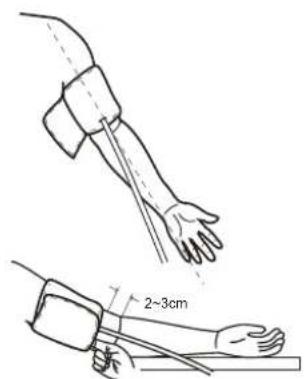
Tie the cuff on your upper arm, then position the tube off-center toward the inner side of arm in line with the little finger. Or position the artery mark over the main artery (on the inside of your arm). Note: Locate the main artery by pressing with 2 fingers approximately 2cm above the bend of your elbow on the inside of your left arm. Identify where the pulse can be felt the strongest. This is your main artery.
-
The cuff should be snug but not too tight. You should be able to insert one finger between the cuff and your arm.
-
Sit comfortably with your tested arm resting on a flat surface.
- Rest for 5 minutes before measuring. - Wait at least 3 minutes between measurements. This allows your blood circulation to recover. - For a meaningful comparison, try to measure under similar conditions. For example, take daily measurements at approximately the same time, position of upper arm, or as directed by a physician.

natural_image
Simple line drawing of a person sitting at a table with a bandage and cup (no text or symbols)MEASUREMENT
DATA MANAGEMENT
♥ Start the Measurement
- When the monitor is off, press "Start/Stop" button to turn on the monitor, and it will finish the whole measurement.

LCD display

Adjust the zero.

Inflating and measuring. Display and save the results.
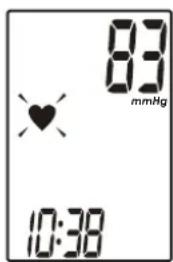
- Press "Start/Stop" button to power off, otherwise it will turn off within 1 minute.


♥ Recall the Records
- When the monitor is off, please press "MEM" button to show the latest record.

- Press "MEM" button or "SET" button to get the record you want.

The date and time of the record will be shown alternately.

CAUTION
The most recent record (1) is shown first. Each new measurement is assigned to the first (1) record. All other records are pushed back one digit (e.g., 2 becomes 3, and so on), and the last record (60) is dropped from the list.
DATA MANAGEMENT
INFORMATION FOR USER
♥ Delete the Records
If you did not get the correct measurement, you can delete all results by following steps below.
- Hold pressing "MEM" button about 3 seconds when the monitor is off, the flash display "dEL ALL" will show.


- Press "SET" button to confirm deleting and the monitor will display "dEL dOnE" and then turn off.

Note: To exit out of delete mode without deleting any records, press "START/STOP" button before pressing "SET" button to confirm any delete commands.

- If there is no record, the right display will show.

natural_image
Simple diagram with three black dots arranged horizontally inside a rectangular frame (no text or symbols)♥ Tips for Measurement
Measurements may be inaccurate if taken in the following circumstances.

Immediate measurement after dinner or drinking

Immediate measurement after tea, coffee, smoking

Immediate measurement after taking a bath

When talking or moving your fingers

In a very cold environment

When you want to discharge urine

In a electromagnetic fields when you have an arrhythmia

INFORMATION FOR USER
ABOUT BLOOD PRESSURE
♥ Maintenance
In order to get the best performance, please follow the instructions below.

Put in a dry place and avoid the sunshine

Avoid intense shaking and collisions

Using wet cloths to remove dirt
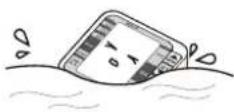
Avoid touching water, clean it with a dry cloth in case.
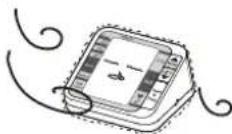
Avoid dusty and unstable temperature environment
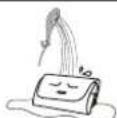
Do not attempt to clean the reusable cuff with water and never immerse the cuff in water.
♥ What are systolic pressure and diastolic pressure?
When ventricles contract and pump blood out of the heart, the blood pressure reaches its maximum value in the cycle, which is called systolic pressure. When the ventricles relax, the blood pressure reaches its minimum value in the cycle, which is called diastolic pressure.

♥ What is the standard blood pressure classification?
The blood pressure classification published by World Health Organization (WHO) and International Society of Hypertension (ISH) in 1999 is as follows:
CAUTION
Only a physician can tell your normal BP range. Please contact a physician if your measuring result falls out of the range. Kindly note that only a physician could tell whether your blood pressure value has reached a dangerous point.

line
| Systolic blood pressure (mmHg) | Dystolic blood pressure (mmHg) | |---|---| | 120 | 85 | | 130 | 90 | | 140 | 95 | | 150 | 100 | | 160 | 105 | | 170 | 110 | Grade 1 hypertension (mean) | | Grade 2 hypertension (moderate) | | Bungroup hypertension | | High-normal blood pressure | | Normal blood pressure | | Optimal blood pressure || Blood Pressure (mm Hg)\Level | Optimal | Norm | Hypertension | |||
| G1 | G2 | G3 | ||||
| SYS | <120 | 120-129 | 130-139 | 140-159 | 160-179 | ≥180 |
| DIA | <80 | 80-84 | 85-89 | 90-99 | 100-109 | ≥110 |
♥ Irregular Heartbeat Detector
An irregular heartbeat is detected when a heartbeat rhythm varies while the unit is measuring the systolic and diastolic blood pressure. During each measurement, this equipment records the heartbeat intervals and works out the standard deviation. If the calculated value is larger than or equal to 15, the irregular heartbeat symbol appears on the symbol when the measurement results are displayed.
CAUTION
The appearance of the IHB icon indicates that a pulse irregularity consistent with an irregular heart-beat was detected during measurement. Usually this is NOT a cause for concern. However, if the symbol appears often, we recommend you seek medical advice. Please note that the device does not replace a cardiac examination, but serves to detect pulse irregularities at an early stage.
ABOUT BLOOD PRESSURE
TROUBLESHOOTING
♥ Why does my blood pressure fluctuate throughout the day?
- Individual blood pressure varies multiple times everyday. It is also affected by the way you tie your cuff and your measurement position, so please take the measurement under the same conditions.
- If the person takes medicine, the pressure will vary more.
- Wait at least 3 minutes for another measurement.
♥ Why do I get a different blood pressure at home compared to the hospital?
The blood pressure is different even throughout the day due to weather, emotion, exercise etc. Also, there is the "white coat" effect, which means blood pressure usually increases in clinical settings.
♥ Is the result the same if measuring on the right arm?
It is ok for both arms, but there will be some different results for different people. We suggest you measure the same arm every time.

natural_image
Simple line drawing of a person sitting at a desk with a clock showing 8 o'clock (no text or symbols on the figure or background)What you need to pay attention to when you measure your blood pressure at home:
If the cuff is tied properly.
If the cuff is too tight or too loose.
If the cuff is tied on the upper arm.
If you feel anxious.
Taking 2-3 deep breaths before beginning will be better for measuring.
Advice: Relax yourself for 4-5 minutes until you calm down.

natural_image
Line drawing of a person sitting on a table with a bandaged arm (no text or symbols)This section includes a list of error messages and frequently asked questions for problems you may encounter with your blood pressure monitor. If the products not operating as you think it should, check here before arranging for servicing.
| PROBLEM | SYMPTOM | CHECK THIS REMEDY | |
| No power | Display will not light up. | Batteries are exhausted. | Replace with new batteries |
| Batteries are inserted incorrectly. | Insert the batteries correctly | ||
| AC adaptor is inserted incorrectly. | Insert the AC adaptor tightly | ||
| Low batteries | Display is dim or showD+Lo | Batteries are low. | Replace with new batteries |
| Error message | E 1 shows The cuff is not secure. | Refasten the cuff and then measure again. | |
| E 2 shows The cuff is very light | Readjust the cuff ,not too loose or too tight and then measure again. | ||
| E 3 shows | The pressure of the cuff is excess. | Relax for a moment and then measure again. | |
| E10 or E11 shows | The monitor detected motion,talking or the pluse is too poor while measuring. | Relax for a moment and then measure again. | |
| E20 shows | The measurement process does not detect the pulse signal. | Loosen the clothing on the arm and then measure again | |
| E21 shows | The treatment of the measurement failed. | Relax for a moment and then measure again. | |
| EExx,shows on the display. | A calibration error occurred. | Retake the measurement. If the problem persists, contact the retailer or our customer service department for further assistance.Refer to the warranty for contact information and return instructions. | |
SPECIFICATIONS
AUTHORIZED COMPONENT
| Power supply | Battery powered mode:6VDC 4*AA alkaline batteriesAC adaptor powered mode:6V = 1A(Please only use the recommended AC adaptor model).(Not Included) |
| Display mode | Digital LCD V.A.93mm×61mm |
| Measurement mode Oscillographic testing mode | |
| Measurement range | Rated cuff pressure:0kPa - 40kPa (0mmHg-300mmHg)Measurement pressure: 5.3kPa-30.7kPa(40mmHg-230mmHg)pulse value: (40-199) beat/minute |
| Accuracy | Pressure:5°C-40°C within±0.4kPa(3mmHg)pulse value:±5% |
| Normal working condition | Temperature:5°C to 40°CRelative humidity: ≤85%RHAtmospheric pressure: 86kPa to 106kPa |
| Storage & transportation condition | Temperature:-20°C-60CRelative Humidity: 10%RH-93%RHAtmospheric Pressure: 50kPa-106 kPa |
| Measurement perimeter of the upper arm | About 22cm~32cm |
| Weight | Approx.395g(Excluding the dry cells) |
| External dimensions | Approx.140mm×120mm×70mm |
| Attachment | 4×AA alkaline batteries,user manual |
| Mode of operation | Continuous operation |
| Degree of protection | Type BF applied part |
| Protection against ingress of water | IP21 It means the device could protect against solid foreign objects of 12.5 mm and greater, and Protect against vertically falling water drops |
| Software Version V01 | |
WARNING: No modification of this equipment is allowed.
♥ Authorized Component
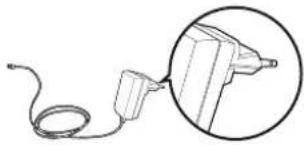
- please use the authorized adapter.(Not Included)
natural_image
Diagram of a handheld device with a coiled cable and connector, shown in an inset circle (no text or symbols)Adapter
Type: UE08WCP-060100SPA
Input: 100\~240V, 50\~60Hz,400mA
Output: 6V=1A
(Conforms to UL certificate)
♥ Contact Information
Manufactured by: Guangdong Transtek Medical Electronics Co., Ltd.
Company: Guangdong Transtek Medical Electronics Co., Ltd.
Address: Zone A, No.105, Dongli Road, Torch Development District,
Zhongshan.528437.Guangdong.China
Authorized European Representative:
Company: MDSS - Medical Device Safety Service GmbH
Address: Schiffgraben 41, 30175 Hannover, Germany
COMPLIED EUROPEAN STANDARDS LIST
EMC GUIDANCE
♥ Complied European Standards List
| Risk management | EN ISO 14971:2012 Medical devices - Application of risk management to medical devices |
| Labeling | EN 380:2008 Symbols for use in the labelling of medical devices |
| User manual | EN 1041:2008 Information supplied by the manufacturer of medical devices |
| General Requirements for Safety | EN 606D1-1:2006 Medical electrical equipment - Part 1: General requirements for basic safety and essential performanceEN 606D1-1-11:2010 Medical electrical equipment - Part 1-11: General requirements for basic safety and essential performance - Collateral standard. Requirements for medical electrical equipment and medical electrical systems used in the home healthcare environment |
| Electromagnetic compatibility | EN 606D1-1-2:2007 Medical electrical equipment - Part 1-2: General requirements for basic safety and essential performance - Collateral standard. Electromagnetic compatibility - Requirements and tests |
| Performance requirements | EN ISO 81080-1:2012 Non-invasive sphygmomanometers - Part 1: Requirements and test methods for non-automated measurement typeEN 1060-3:1997-A2:2009 Non-invasive sphygmomanometers - Part 3: Supplementary requirements for electro-mechanical blood pressure measuring systems |
| Clinical investigation | EN 1060-4:2004 Non-invasive sphygmomanometers - Part 4: Test procedures to determine the overall system accuracy of automated non-invasive sphygmomanometers |
| Usability | EN 606D1-1-6:2010 Medical electrical equipment - Part 1-6: General requirements for basic safety and essential performance - Collateral standard. UsabilityEN 62368:2006 Medical devices - Application of usability engineering to medical devices |
| Software life-cycle processes | EN 623D4:2006/AC: 2008 Medical device software - Software life-cycle processes |
♥ EMC Guidance
Table 1 Guidance and MANUFACTURER's declaration – ELECTROMAGNETIC EMISSIONS- for all ME EQUIPMENT and ME SYSTEMS
| Guidance and manufacturer's declaration – electromagnetic emissions | ||
| The device is intended for use in the electromagnetic environment specified below. The customer or the user of the device should assure that it is used in such an environment. | ||
| Emissions test Electromagnetic Emission - guidance | ||
| RF emissionsCISPR 11 | Group 1 | The device uses RF energy only for its internal function. Therefore, its RF emissions are very low and are not likely to cause any interference in nearby electronic equipment. |
| RF emissionsCISPR 11 | Class 8 | |
| Harmonic emissionsIEC 61000-3-2 | Not applicable | |
| Voltage fluctuations/flicker emissions IEC61000-3-3 | Not applicable | |
EMC GUIDANCE EMC GU
Table 2 Guidance and MANUFACTURER's declaration – electromagnetic IMMUNITY – for all ME EQUIPMENT and ME SYSTEMS
| Guidance and manufacturer's declaration - electromagnetic immunity | |||
| The device is intended for use in the electromagnetic environment specified below.The customer or the user of the device should assure that it is used in such an environment. | |||
| IMMUNITY test | IEC 60601 test level | Compliance level | Electromagnetic environment guidance |
| Electrostatic discharge (ESD)IEC 61000-4-2 | ± 6 kV contact ± 8 kV air | ± 6 kV contact ± 8 kV air | Floors should be wood, concrete or ceramic tile. If floors are covered with synthetic material, the relative humidity should be at least 30%. |
| Electrical fast transientburstIEC 61000-4-4 | ± 2 kV torpower supply lines ± 1 kV for input/output lines | ± 2 kV for power supply lines | Mains power quality should be that of a typical commercial or hospital environment. |
| Surge IEC 61000-4-5 | ± 1 kV line(s) to line(s) ± 2 kV line(s) to earth | ± 1 kV line(s) to line(s) | Mains power quality should be that of a typical commercial or hospital environment. |
| Voltage dips, short interruptions and voltage variations on power supply input linesIEC 61000-4-11 | <5% U _T (>95% dip in U _T )for 0.5 cycle40% U _T (60% dip in U _T )for 5 cycles70% U _T (30% dip in U _T )for 25 cycles<5% U _T (>95% dip in U _T )for 5 s | <5% U _T (>95% dip in U _T )for 0.5 cycle40% U _T (60% dip in U _T )for 5 cycles70% U _T (30% dip in U _T )for 25 cycles<5% U _T >95% dip in U _T )for 5 s | Mains power quality should be that of a typical commercial or hospital environment. If the user of the device requires continued operation during power means interruptions, it is recommended that the device be powered from an uninterruptible power supply or a battery. |
| Power frequency (30/80 Hz) magnetic fieldIEC 61000-4-8 | 3A/m | 3A/m | Power frequency magnetic fields should be at swals characteristics of a typical location in a typical commercial or hospital environment |
| NOTE U_T is the a.u. mains voltage prior to application of the test level. | |||
Table 4 Guidance and MANUFACTURER's declaration – electromagnetic IMMUNITY – for ME EQUIPMENT and ME SYSTEMS that are not LIFE-SUPPORTING
| Guidance and manufacturer's declaration - electromagnetic immunity | |||
| The device is intended for use in the electromagnetic environment specified below The customer or the user of the device should assure that it is used in such an environment. | |||
| IM/MUNITY test | IEC 60801 TEST LEVEL | Compliance level | Electromagnetic environment -guidences |
| Conducted RF IEC 61000-4-8Radiated RF IEC 61000-4-3 | 3 Vrms150 MHz to 80 MHz3 Vrms80 MHz to 2.5 GHz | 3 Vrms3 Vrms | Portable and mobile RF communications equipment should be used no closer to any part of the device, including cables, then the recommended separation distance calculated from the equation applicals to the frequency of the transmitter.Recommended separation distance d = 1.167 d = 1.167 80 MHz to 800 MHz - 400% to 2.6 GHzwhere P_th the maximum output power rating of the transmitter in walls (W) according to the transmitter manufacturer and d is the recommended separation distance in metres (m).Field strengths from fixed RF transmitters, as determined by an electromagnetic site survey. Should be less than the compliance level in each frequency range, k interference may occur in the vicinity of equipment marked with the following symbol.[IMAGE] |
| NOTE 1 At 80 MHz and 800 MHz, the higher frequency range applies.NOTE 2 These guidelines may not apply in all situations. Electromagnetic propagation is affected by absorption and reflection from structures, objects and people. | |||
| ^a Field strengths from fixed transmitters, such as base stations for radio (cellular / cordless) telephones and land mobile radios, amateur radio, AM and FM radio broadcast and TV broadcast cannot be predicted theoretically with accuracy. To assess the electromagnetic environment due to fixed RF transmitters, on electromagnetic site survey should be considered. If the measured field strength in the location in which the device is used exceeds the applicative RF compliance level above, the device should be observed to verify normal operation. If abnormal performance is observed, additional measures may be necessary, such as re-orienting or refocating the device. ^b Over the frequency range 150 kHz to 80 MHz, field strength should be less than 3V/m. | |||
EMC GUIDANCE
Table 6 Recommended separation distances between portable and mobile
RF communications equipment and the ME EQUIPMENT or ME SYSTEM –
for ME EQUIPMENT and ME SYSTEMS that are not LIFE-SUPPORTING
| Recommended separation distances between portzials and mobile RF communications equipment and the device. | |||
| The device is intended for use in an electromagnetic environment in which radiated RF disturbances are controlled. The customer or the user of the device can help prevent electromagnetic interference by maintaining a minimum distance between portable and mobile RF communications equipment (transmitters) and the device as recommended below, according to the maximum output power or the communications equipment. | |||
| Rated maximum output power of transmitter (W) | Separation distance according to frequency of transmitter (m) | ||
| 160 kHz to 80 MHz, 80 d = 1.167√P | MHz to 800 MHz, 800 MHz to 2.5 GHz √P-d1.17 | 37 d = 2.333√P | |
| 0.01 | 0.117 0.117 | 0.233 | |
| 0.1 | 0.369 | 0.369 | 0.738 |
| 1 | 1.167 | 1.167 | 2.333 |
| 10 | 3.590 | 3.690 | 7.378 |
| 100 | 11.67 | 11.67 | 23.33 |
| For transmitters rated at a maximum output power not listed above, the recommended separation distance of in metres (in) can be estimated using the equation applicable to the frequency of the transmitter, where P is the maximum output power rating of the transmitter in walls (W) according to the transmitter manufacturer.NOTE 1 At 80MHz and 800MHz, the separation distance for the higher frequency range applies.NOTE 2 These guidelines may not apply in all situations. Electromagnetic propagation is affected by absorption and reflection from structures, objects and people. | |||
C€0123

Guangdong Transtek Medical Electronics Co., Ltd.
Zone A, No.105 ,Dongli Road. Torch Development District,
Zhongshan,528437,Guangdong,China

MDSS - Medical Device Safety Service GmbH
Schiffgraben 41, 30175 Hannover, Germany


- MAGICCARE
- MISURAZIONE
- GESTIONE DEI DATI
- Table of Contents
- INTRODUCTION
- ♥ General Description
- ♥ Safety Information
- CAUTION
- INTRODUCTION INTROD
- ♥ List
- BEFORE YOU START BEF
- ♥ The Choice of Power Supply
- ♥ Installing and Replacing the Batteries
- ♥ Measurement Principle
- Setting Date, Time and Measurement Unit
- BEFORE YOU START MEA
- ♥ Tie the cuff
- MEASUREMENT
- DATA MANAGEMENT
- ♥ Start the Measurement
- ♥ Recall the Records
- INFORMATION FOR USER
- ♥ Delete the Records
- ♥ Tips for Measurement
- ABOUT BLOOD PRESSURE
- ♥ Maintenance
- ♥ What are systolic pressure and diastolic pressure?
- ♥ What is the standard blood pressure classification?
- ♥ Irregular Heartbeat Detector
- TROUBLESHOOTING
- ♥ Why does my blood pressure fluctuate throughout the day?
- ♥ Why do I get a different blood pressure at home compared to the hospital?
- ♥ Is the result the same if measuring on the right arm?
- SPECIFICATIONS
- AUTHORIZED COMPONENT
- ♥ Authorized Component
- ♥ Contact Information
- COMPLIED EUROPEAN STANDARDS LIST
- EMC GUIDANCE
- ♥ EMC Guidance
- EMC GUIDANCE EMC GU
- C€0123
Brand : Magic Care
Model : Pulsartronic SFG60
Category : Sphygmomanometer