SG380 - Générateur de signaux RF SRS - Free user manual and instructions
Find the device manual for free SG380 SRS in PDF.


| Product Type | RF Signal Generator |
| Brand | SRS (Stanford Research Systems) |
| Model | SG380 |
| Frequency Range | 1 MHz to 2.5 GHz |
| Frequency Resolution | 0.001 Hz |
| Output Power Range | -110 dBm to +13 dBm |
| Modulation Types | AM, FM, PM, Pulse, Sweep, I/Q |
| Phase Noise | < -120 dBc/Hz at 1 GHz, 10 kHz offset |
| Dimensions (W x H x D) | 17.0 x 3.5 x 17.5 inches (432 x 89 x 445 mm) |
| Weight | 12.5 lbs (5.7 kg) |
| Power Supply | AC 100-240 V, 50/60 Hz, 60 W max |
| Display | Color TFT LCD, 5.7 inch |
| Interfaces | GPIB, RS-232, Ethernet, USB, Option: Rubidium frequency standard |
| Operating Temperature | 0°C to 50°C |
| Storage Temperature | -20°C to 70°C |
| Humidity | < 95% RH, non-condensing |
| Maintenance & Cleaning | Clean with soft, dry cloth. Avoid solvents. |
| Safety | Use grounded outlet. Do not operate with covers removed. |
| Spare Parts & Repairability | Contact SRS support for parts and repair information. |
| Warranty | Standard one-year warranty |
Frequently Asked Questions - SG380 SRS
User questions about SG380 SRS
0 question about this device. Answer the ones you know or ask your own.
Ask a new question about this device
Download the instructions for your Générateur de signaux RF in PDF format for free! Find your manual SG380 - SRS and take your electronic device back in hand. On this page are published all the documents necessary for the use of your device. SG380 by SRS.
USER MANUAL SG380 SRS
RF Signal Generators
SG382 (DC to 2.025 GHz)
SG384 (DC to 4.050 GHz)
SG386 (DC to 6.075 GHz)
User Manual
text_image
STANFORD RESEARCH SYSTEMS MODEL SG384 DC to 4.05 GHz SIGNAL GENERATOR 4.050 000 000 000 000 OUTPUTS DC to 62.5 MHz OFFS W/O 950 MHz to 4.05 GHz AC H/D 410 & SHG (BEAR) —● MODULATION ON OFF AM FM SPM SWEEP LTM PLASE NOISE HQ OUTPUTS EXT MOD TYPE MOD FCN SELECT / ADJUST PREF PHASE AMPL. MOD RATE MOD DEV DC OFFS MOD DEBT MOD DEBT MOD DEBT MOD DEBT MOD DEBT MOD DEBT MOD DEBT MOD DEBT MOD DEBT MOD DEBT MOD DEBT MOD DEBT MOD DEBT MOD DEBT MOD DEBT MOD DEBT MOD DEBT MOD DEBT MOD DEBT MOD DEBT MOD DEBT MOD DEBT MOD DEBT MOD DEBT MOD DEBT MOD DEB MOD DEB MOD DEB MOD DEB MOD DEB MOD DEB MOD DEB MOD DEB MOD DEB MOD DEB MOD DEB MOD DEB MOD DEB MOD DEB MOD DEB MOD DEB MOD DEB MOD DEB MOD DEB MOD DEB MOD DEB MOD DEB MOD DEB MOD DEB MOD DEB MOD DEC MOD DEC MOD DEC MOD DEC MOD DEC MOD DEC MOD DEC MOD DEC MOD DEC MOD DEC MOD DEC MOD DEC MOD DEC MOD DEC MOD DEC MOD DEC MOD DEC MOD DEC MOD DEC MOD DEC MOD DEC MOD DEC MOD DEC MOD DEC MOD DEC MOD DECE MOD DECE MOD DECE MOD DECE MOD DECE MOD DECE MOD DECE MOD DECE MOD DECE MOD DECE MOD DECE MOD DECE MOD DECE
text_image
NSRSStanford Research Systems
Certification
Stanford Research Systems certifies that this product met its published specifications at the time of shipment.
Warranty
This Stanford Research Systems product is warranted against defects in materials and workmanship for a period of one (1) year from the date of shipment.
Service
For warranty service or repair, this product must be returned to a Stanford Research Systems authorized service facility. Contact Stanford Research Systems or an authorized representative before returning this product for repair.
Model numbers
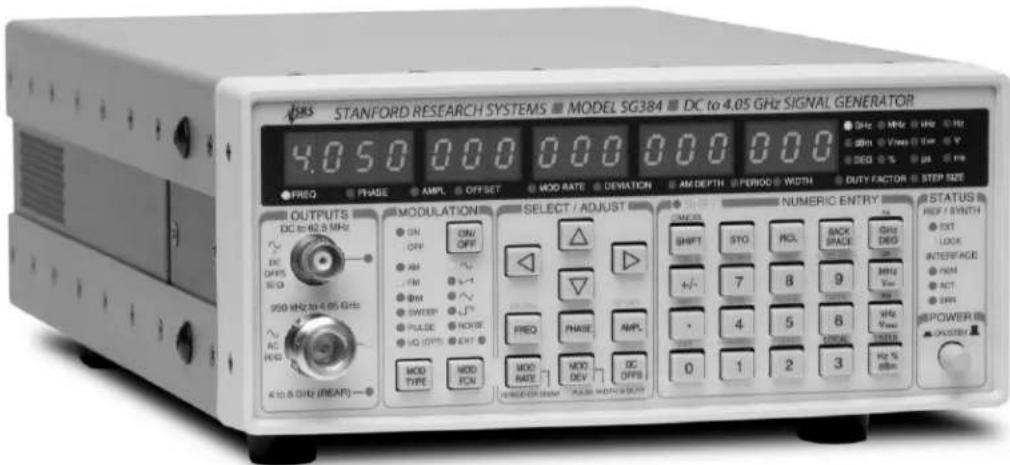
This document is the User Manual for three models in the SG380 series of RF Signal Generators. The SG382, SG384 and SG386 provide front panel outputs of frequencies up to 2.025 GHz, 4.050 GHz and 6.075 GHz respectively.
Information in this document is subject to change without notice.
Copyright © Stanford Research Systems, Inc., 2012, 2017, 2019, 2021. All rights reserved.
Stanford Research Systems, Inc.
1290-C Reamwood Avenue
Sunnyvale, California 94089
Phone: (408) 744-9040
Fax: (408) 744-9049
www.thinkSRS.com
Printed in the U.S
Contents
Contents i
Safety and Preparation for Use vii
Symbols You May Find on SRS Products viii
Specifications ix
Typical Waveforms xviii
Typical Spectra xx
Quick Start Instructions 1
Introduction 3
Feature Overview 3
Front-Panel Overview 4
Parameter and Units Display 4
Main Output 5
BNC Output 5
Type-N Output 5
Indicators 5
Modulation Modes 6
Parameter Selection and Adjustment 7
Display Navigation 7
Numeric Entry and Secondary Parameters 8
Stepping Up and Down 8
Step Size 9
Store and Recall Settings 9
Secondary Functions 10
Cancel 11
Power and Status 11
Status Indicators 11
REF / SYNTH 11
INTERFACE 11
POWER 12
Rear-Panel Overview 13
AC Power 13
Timebase 13
10 MHz IN 13
10 MHz OUT 13
Remote Interfaces 14
GPIB 14
RS-232 14
Ethernet 14
Modulation 14
IN 14
Table of Contents ii
OUT 14
Rear-Panel Optional Outputs 15
Option 1: Clock Outputs 15
Option 2: 8 GHz Frequency Doubler 15
Option 3: I/Q Modulator 15
Operation 17
Introduction 17
Power-On 17
Setting Parameters 17
Frequency 18
Phase 18
Rel Phase 19
Amplitude and Power 20
DC Offset 21
RF ON/RF OFF 22
Modulation and Sweeps
Introduction 23
Modulation Section 24
Modulation On/Off 24
Modulation Type 24
Modulation Function 24
Modulation Rate 25
Modulation Deviation 25
Modulation Waveform Generator, Inputs and Outputs 26
Linear Modulation 26
Pulse Modulation 26
Linear Noise Modulation 27
Pulse Noise Modulation 27
Modulation Output 27
Amplitude Modulation 28
Setting up Amplitude Modulation: 28
Amplitude Modulation Example 29
Frequency Modulation 29
Setting up Frequency Modulation: 31
Frequency Modulation Example 32
Phase Modulation 33
Setting up Phase Modulation: 33
Phase Modulation Example 34
Pulse and Blank Modulation 35
Setting up Pulse Modulation: 35
Pulse Modulation Example 36
Phase Continuous Frequency Sweeps 38
Setting up Frequency Sweeps: 39
I/Q Modulation (Option 3) 40
Setting up External IQ Modulation: 41
Setting up Internal Noise IQ Modulation: 42
IQ Noise Modulation Example 42
Secondary (Shift) Parameters 43
Table of Contents iii
| REL Φ=0 43 | |
| PRBS 43 | |
| STEP SIZE 43 | |
| Timebase 44 | |
| NET 44 | |
| TCP/IP Configuration Methods 44 | |
| TCP/IP Based Remote Interfaces 45 | |
| Link Speed 45 | |
| Reset the TCP/IP Interface 45 | |
| GPIB 46 | |
| GPIB Address 46 | |
| Reset the GPIB Interface | 46 |
| RS-232 | 47 |
| RS-232 Configuration | 47 |
| Reset the RS-232 Interface | 47 |
| DATA | 47 |
| STATUS | 48 |
| TCP/IP Status 48 | |
| Error Status | 48 |
| Instrument Status | 49 |
| Self Test | 49 |
| LOCAL | 49 |
| INIT | 49 |
| CAL | 49 |
| Factory Default Settings | 50 |
| Remote Programming | 53 |
| Introduction | 53 |
| Interface Configuration | 53 |
| GPIB | 54 |
| RS-232 | 54 |
| LAN | 54 |
| Network Security | 55 |
| Front-Panel Indicators | 56 |
| Command Syntax | 56 |
| Parameter Conventions | 57 |
| Numeric Conventions | 57 |
| Abridged Index of Commands | 58 |
| Detailed Command List | 60 |
| Common IEEE-488.2 Commands | 60 |
| Status and Display Commands | 63 |
| Signal Synthesis Commands | 65 |
| Modulation Commands | 68 |
| List Commands | 74 |
| Interface Commands | 76 |
| Status Byte Definitions | 78 |
| Serial Poll Status Byte | 78 |
| Standard Event Status Register | 79 |
Table of Contents iv
Instrument Status Register 79
List Mode 80
List Instrument States 80
Enables/Disables 81
Modulation List States 82
Examples 83
Error Codes 84
Execution Errors 84
Query Errors 85
Device Dependent Errors 85
Parsing Errors 86
Communication Errors 87
Other Errors 87
Example Programming Code 88
SG380 Series Operation Verification 93
Overview 93
Equipment Required 93
SG380 Series Self Test 94
Output Power Tests 94
BNC Output Power Test 94
Type-N Output Power Test 95
Frequency Synthesis Tests 97
Frequency Generation Tests 97
Modulation Output Test 98
Modulation Input Test 99
Timebase Calibration 100
SR620 Configuration 101
Timebase Calibration Test 101
Calibration 102
Option Board Verifications 102
Option 1: Clock Output Test 102
Option 2: RF Doubler Test 104
Option 2: DAC Output Test 105
Option 3: IQ Modulation 106
Conclusions 106
Circuit Description 107
Overview 107
Block Diagram 108
Detailed Circuit Description 110
Front-Panel Display 110
Front-Panel Display EMI Filter 111
Motherboard 111
Timebases 111
LF DDS and 19 MHz Reference 112
Table of Contents v
Microcontroller and Interface 113
Modulation Processor 114
Modulation ADC and DACs 115
RF DDS 116
RF Block and Rear-Panel Options Interface 117
Power Conditioning 118
Motherboard to RF Block Jumper 118
RF Output Block 118
RF Synthesizer 119
RF Dividers and Selectors 120
RF I/Q Modulator, Amplifiers and Attenuators 121
RF Output Attenuators 122
BNC Output 122
Power Supply 123
Rear-Panel Options 124
Clock Output (Options 1) 124
RF Doubler (Option 2) 125
I/Q Modulator (Option 3) 126
Timebase Options 126
Appendix A : Rational Approximation Synthesis 127
Phase Lock Loop Frequency Synthesizers 127
Phase Noise 128
Increasing Frequency Resolution 129
A Note on Fractional-N Synthesis 129
About YIG Oscillators 129
A New Approach 130
An Example 131
Elimination of Error 132
Conclusion 132
Appendix B : Parts List 133
Appendix C : Schematic Diagrams 153
Revisions 183
Safety and Preparation for Use
Line Voltage
The instruments operate from a 90 to 132 V AC or 175 to 264 V AC power source having a line frequency between 47 and 63 Hz. Power consumption is less than 90 VA total. In standby mode, power is turned off to the main board. However, power is maintained at all times to the installed timebase. Units with the standard ovenized quartz oscillator or the optional rubidium timebase will consume less than 15 VA and 25 VA, respectively, in standby mode.
Power Entry Module
A power entry module, labeled AC POWER on the back panel of the instrument, provides connection to the power source and to a protective ground.
Power Cord
The unit is shipped with a detachable, three-wire power cord for connection to the power source and protective ground.
The exposed metal parts of the box are connected to the power ground to protect against electrical shock. Always use an outlet which has a properly connected protective ground. Consult with an electrician if necessary.
Grounding
BNC shields are connected to the chassis ground and the AC power source ground via the power cord. Do not apply any voltage to the shield.
Line Fuse
The line fuse is internal to the instrument and may not be serviced by the user.
Operate Only with Covers in Place
To avoid personal injury, do not remove the product covers or panels. Do not operate the product without all covers and panels in place.
Serviceable Parts
There are no user serviceable parts. Refer service to a qualified technician.
Symbols You May Find on SRS Products
| Symbol | Description |
 | Alternating Current |
 | Caution – risk of electrical shock |
 | Frame or Chassis terminal |
 | Caution – refer to accompanying document |
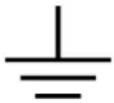 | Earth (ground) terminal |
 | Battery |
 | Fuse |
| boost | Power On |
 | Power Off |
 | Power Standby |
Specifications
Frequency Setting ( f_c )
Frequency ranges
BNC output DC to 62.5 MHz
Type-N output
SG382 950 kHz to 2.025 GHz
SG384 950 kHz to 4.050 GHz
SG386 950 kHz to 6.075 GHz
SMA rear-panel (Opt 2)
SG384 4.050 GHz to 8.100 GHz
SG386 6.075 GHz to 8.100 GHz
Frequency resolution 1 μHz at any frequency
Switching speed < 8 ms (to within 1 ppm)
Frequency error < (10^-18 + timebase error) × f_C
Frequency stability < 1:10 -^11 (1 second Allan variance)
Front-Panel Type-N Output (50 Ω load)
Frequency range
SG382 950 kHz to 2.025 GHz
SG384 950 kHz to 4.050 GHz
SG386 950 kHz to 6.075 GHz
Output power
SG382 +16.5 dBm to -110 dBm (1.5 V RMS to 0.7 V_RMS )
SG384 +16.5 dBm (-3.50 dB/GHz above 3 GHz) to -110 dBm
SG386 +16.5 dBm (-3.25 dB/GHz above 4 GHz) to -110 dBm
Power resolution 0.01 dBm
Power accuracy ±1 dB (±2 dB above 4 GHz and above +5 dBm or below -100 dBm)
Output coupling 50 Ω, AC
User load 50 Ω
VSWR <1.6
Reverse protection 30 V _DC , +25 dBm RF
Front-Panel BNC Output (50 Ω load)
Frequency range DC to 62.5 MHz
Amplitude
Full specs 1.00 to 0.001 V RMS (+13 dBm to -47 dBm)
Derated specs 1.00 to 1.25 V RMS (+14.96 dBm)
Offset ± 1.50V_DC
Maximum excursion ±1.817 V (amplitude + offset)
Amplitude resolution <1 %
Amplitude accuracy ±5 %
Offset resolution 5 mV
Harmonics <-40 dBc
Spurious <-75 dBc
Output coupling DC, 50 Ω ±2 %
User load 50 Ω
Reverse protection ±5 V_DC
Specifications x
Spectral Purity of the RF Output Referenced to 1 GHz ^(1)
Sub harmonics None (No doublers are used below 4 GHz.)
Harmonics <−25 dBc with +7 dBm on Type-N output
Spurious
Within 10 kHz of carrier < -65 dBc
More than 10 kHz from carrier < -75 dBc
Phase noise
Offset from carrier Phase Noise (typical)
10 Hz -80 dBc/Hz
1 kHz -102 dBc/Hz
20 kHz
SG382 & SG384 -116 dBc/Hz
SG386 -114 dBc/Hz
1 MHz
SG382 & SG384 -130 dBc/Hz
SG386 -124 dBc/Hz
Residual FM 1 Hz rms, typical, over 300 Hz to 3 kHz bandwidth
Residual AM 0.006 % rms, typical, over 300 Hz to 3 kHz bandwidth
(1) Spurs, phase noise and residual FM scale by 6 dB/octave to other carrier frequencies
Phase Setting of Front-Panel Outputs
Phase range ±360°
Phase resolution
DC to 100 MHz 0.01°
100 MHz to 1 GHz 0.1°
1 GHz to 8.1 GHz 1.0^
Internal Modulation Source
Waveforms Sine, ramp, saw, square, pulse, noise
Sine THD -80 dBc (typical at 20 kHz)
Ramp linearity <0.05 % (1 kHz)
Rate
SG382 & SG384
f c ≤ 62.5 MHz 1 μHz to 500 kHz
f c > 62.5 MHz 1 μHz to 50 kHz
SG386
f c ≤ 93.75 MHz 1 μHz to 500 kHz
f c > 93.75 MHz 1 μHz to 50 kHz
Rate resolution 1 μHz
Rate error < 1:2^31 + timebase error
Noise function White Gaussian noise, RMS = DEV / 5
Noise bandwidth 1 μHz < ENBW < 50 kHz
Pulse generator period 1 μs to 10 s
Pulse generator width 100 ns to 9999.9999 ms
Pulse timing resolution 5 ns
Pulse noise function PRBS length 2^5 to 2^19 . Bit period (100 + n· 5) ns
100 ns to 10 s in 5 ns steps
Specifications xi
Modulation Waveform Output
Output impedance 50 Ω (for reverse termination)
User load Unterminated 50 Ω coax
AM, FM, M ± 1 V for ± full deviation
Pulse/Blank "Low" = 0 V, "High" = 3.3 V
Connector Rear-panel BNC
DC
External Modulation Input
Modes AM, FM, ΦM, Pulse and Blank
Unmodulated level 0 V input for unmodulated carrier
AM, FM, M ±1 V input for ± full deviation
Modulation bandwidth >100 kHz
Modulation distortion < -60 dB
Input impedance 100 kΩ
Input Coupling AC (4 Hz high pass) or DC
Input offset <500 V
Pulse/Blank threshold +1 V_DC
Connector Rear-panel BNC
Frequency Modulation
Frequency deviation
Minimum 0.1 Hz
Maximum
SG382 & SG384
f_C≤ 62.5MHz Smaller of f_C or (64 MHz - f_C )
62.5MHz < f_c≤ 126.5625MHz 1MHz
126.5625 MHz < f_c≤ 253.1250MHz 2MHz
253.1250 MHz < f_c ≤ 506.25 MHz 4 MHz
506.25 MHz < f_c≤ 1.0125GHz 8MHz
1.0125 GHz < f_c ≤ 2.025 GHz 16 MHz
2.025 GHz < f_C≤ 4.050 GHz (SG384) 32 MHz
4.050GHz < f_c≤ 8.100GHz (Opt 2) 64MHz
SG386
f_C≤ 93.75MHz Smaller of fC or (96 MHz- fC
93.75MHz < f_C≤ 189.84375MHz 1MHz
189.84375 MHz < f_c ≤ 379.6875 MHz 2 MHz
379.6875 MHz < f_C≤ 759.375MHz 4MHz
759.375 MHz < f_c≤ 1.51875GHz 8MHz
1.51875 GHz < f_C ≤ 3.0375 GHz 16 MHz
3.0375 GHz < f_c≤ 6.075GHz 32MHz
6.075GHz < f_c≤ 8.100GHz (Opt 2) 64MHz
Frequency Modulation (continued)
Deviation resolution 0.1 Hz
Deviation accuracy
SG382 & SG384
f c ≤ 62.5 MHz < 0.1 %
f c > 62.5 MHz <3 %
SG386
f c ≤ 93.75 MHz <0.1 %
fc > 93.75 MHz < 3 % ]
Modulation source Internal or external
Modulation distortion < -60 dB (f C = 100MHz , f_M = 1kHz , f_D = 1kHz )
Ext FM carrier offset <1:1000 of deviation
Modulation bandwidth
SG382 & SG384
f c ≤ 62.5 MHz 500 kHz
f c > 62.5 MHz 100 kHz
SG386
f c ≤ 93.75 MHz 500 kHz
f C > 93.75MHz 100kHz
Phase Continuous Frequency Sweeps
Frequency span
0.1 Hz to entire sweep range
Sweep ranges
SG382 & SG384
DC to 64 MHz
59.375 to 128.125 MHz
118.75 to 256.25 MHz
237.5 to 512.5 MHz
475 to 1025 MHz
950 to 2050 MHz
1900 to 4100 MHz (SG384)
3800 to 8200 MHz (Opt. 2 only)
SG386
DC to 96 MHz
89.0625 to 192.1875 MHz
178.125 to 384.375 MHz
356.25 to 768.75 MHz
712.5 to 1537.5 MHz
1425 to 3075 MHz
2850 to 6150 MHz
5950 to 8150 MHz (Opt. 2 only)
Deviation resolution 0.1 Hz
Internal or external
Sweep source
<0.1 Hz + (deviation / 1000)
Sweep distortion
<1:1000 of deviation
Sweep offset
Triangle, ramps, or sine up to 120 Hz
Sweep function
Specifications xiii
Phase Modulation
Deviation 0 to 360°
Deviation resolution
$$ \mathrm{DC} < \mathrm {f_ {c}} \leq 1 0 0 \mathrm{MHz} 0. 0 1 ^ {\circ} $$
$$ 1 0 0 \mathrm{MHz} < \mathrm{f} _ {\mathrm{C}} \leq 1 \mathrm{GHz} 0. 1 ^ {\circ} $$
$$ f _ {\mathrm{c}} > 1 \mathrm{GHz} 1. 0 ^ {\circ} $$
Deviation accuracy
SG382 & SG384
$$ f \quad c \leq 62.5 \text{MHz} < 0.1\% $$
$$ f _ {c} > 62.5 \mathrm{MHz} < 3 \% $$
SG386
$$ f \quad c \leq 93.75 \text{MHz} < 0.1\% $$
$$ f _ {c} > 93.75 \mathrm{MHz} < 3 \% $$
Modulation source
Internal or external
Modulation distortion
$$ < - 6 0 \mathrm{dB} \left(\mathrm{f} _ {\mathrm{C}} = 1 0 0 \mathrm{MHz}, \mathrm{f} _ {\mathrm{M}} = 1 \mathrm{kHz}, \Phi_ {\mathrm{D}} = 5 0 ^ {\circ}\right) $$
Modulation bandwidth
SG382 & SG384
$$ f \quad c \leq 6 2. 5 \mathrm{MHz} \quad 5 0 0 \mathrm{kHz} $$
$$ f \quad c > 6 2. 5 \mathrm{MHz} \quad 1 0 0 \mathrm{kHz} $$
SG386
$$ \mathrm{f} \quad \mathrm{c} \leq 9 3. 7 5 \mathrm{MHz} \quad 5 0 0 \mathrm{kHz} $$
$$ \mathrm{f} \quad \mathrm{c} > 9 3. 7 5 \mathrm{MHz} \quad 1 0 0 \mathrm{kHz} $$
Amplitude Modulation
Range 0 to 100% (Decreases above +7 dBm output)
Resolution 0.1%
Modulation source Internal or external
Modulation distortion (f_M = 1kHz, Depth = 50%)
$$ \mathrm{f} _ {\mathrm{C}} \leq 62.5 \mathrm{MHz}, \text {BNC output} < 1 \% $$
$$ \mathrm {f_ {C} > 62.5 MHz, Type - N output < 3 \% typical} $$
Modulation bandwidth >100 kHz
Pulse/Blank Modulation
Pulse mode Logic "high" turns BNC and RF on
Blank mode Logic "high" turns BNC and RF off
On/Off ratio
BNC output 70 dB
Type-N output
$$ f _ {\mathrm{c}} < 1 \mathrm{GHz} \quad 5 7 \mathrm{dB} $$
$$ 1 \mathrm{GHz} \leq \mathrm{f} \quad \mathrm{c} < 4 \mathrm{GHz} 4 0 \mathrm{dB} $$
$$ f \quad c \geq 4 \mathrm{GHz} \quad 3 5 \mathrm{dB} $$
Pulse feed-through 10 % of carrier for 20 ns at turn-on (typical)
Turn on/off delay 60 ns
RF rise/fall time 20 ns
Modulation source Internal or external pulse
External I/Q Modulation (Option 3)
Modulated output Front-panel Type-N only (+10 dBm max)
Frequency Range Carrier frequencies above 400 MHz
I/Q inputs 50 Ω, ±0.5 V, (rear BNCs)
I or Q input offset < 500 V
I/Q full scale (I ^2 + Q^2)^1/2 = 0.5 V
Carrier suppression >40 dBc (>35 dBc above 4 GHz)
Modulation bandwidth 200 MHz
Square Wave Clock Outputs (Option 1)
Differential clocks Rear-panel SMAs drive 50 Ω loads
Frequency range DC to 4.05 GHz
Transition time <35 ps (20 % to 80 %)
Jitter (f_c > 62.5MHz) 300 fs rms(typical, 1kHz to 5MHz BW at 1GHz )
Jitter (f_c≤ 62.5MHz) < 10^-4 U.I. (1 kHz to 5 MHz or f/2 BW)
Amplitude 0.4 to 1.0 V _PP
Offset ±2 V_DC
Amplitude & Offset resolution 5 mV
Amplitude & Offset accuracy ±5 %
Output coupling DC, 50 Ω ± 2 %
Compliance ECL, PECL, RSECL, CML & LVDS
RF Doubler Output (Option 2)
Output Rear-panel SMA
Frequency range (SG384) 4.050 to 8.10 GHz
Frequency range (SG386) 6.075 to 8.10 GHz
RF amplitude
4.05 to 7 GHz -10 dBm to +13 dBm
7 to 8.10 GHz -10 dBm to +7 dBm
Overrange +16.5 dBm
Sub harmonic (fC / 2)
f_c<6.5 GHz <-25 dBc typical
f_c=8.1 GHz<-12 dBc typical
Mixing products (2f C and 3f C / 2) <−20 dBc
Harmonics (n × fC) <−25 dBc
Spurious (8 GHz) <-55 dBc (>10 kHz offset)
Phase noise (8 GHz) -98 dBc/Hz at 20 kHz offset, typical
Amplitude resolution 0.01 dBm
Amplitude accuracy
4.05 to 6.5 GHz ±1 dB
6.5 to 8.10 GHz ±2 dB
Modulation modes FM, M, and Sweeps
Output coupling AC, 50 Ω
Reverse protection 30 V _DC , +25 dBm RF
DC Bias Source (comes with Option 2)
Output Rear-panel SMA
Voltage range ±10 V
Offset voltage <20 mV
DC accuracy ±0.2 %
DC resolution 5 mV
Output resistance 50 Ω
Current limit 20 mA
Timebase Input
Frequency 10 MHz, ±2 ppm
Amplitude 0.5 to 4 V
PP (-2 dBm to +16 dBm)
Input impedance 50 Ω, AC coupled
Timebase Output
Frequency 10 MHz, sine
Source 50 Ω, DC transformer coupled
Amplitude 1.75 V
PP ± 10 % (8.8 ± 1 ~dBm)
Standard OCXO Timebase
Oscillator type Oven controlled, 3
^rd OT, SC-cut crystal
Stability <0.002 ppm (0 to 45°C)
Aging
<0.05 ppm/year
Rubidium Timebase (Option 4)
Oscillator type Oven controlled, 3
^rd OT, SC-cut crystal
Physics package
Rubidium vapor frequency discriminator
Stability <0.0001 ppm (0 to 45°C)
Aging
<0.001 ppm/year
Computer Interfaces (all are standard)
Ethernet (LAN)
10/100 Base-T. TCP/IP & DHCP default.
GPIB
IEEE-488.2
RS-232 4.8k-115.2k baud, RTS/CTS flow
General
Line power
<90 W, 90 to 264 V _AC , 47 to 63 Hz with PFC
EMI Compliance
FCC Part 15 (Class B), CISPR-22 (Class B)
Dimensions
8.5'' × 3.5'' × 13'' (W × H × D)
Weight
<10 lbs
Warranty
One year on parts and labor
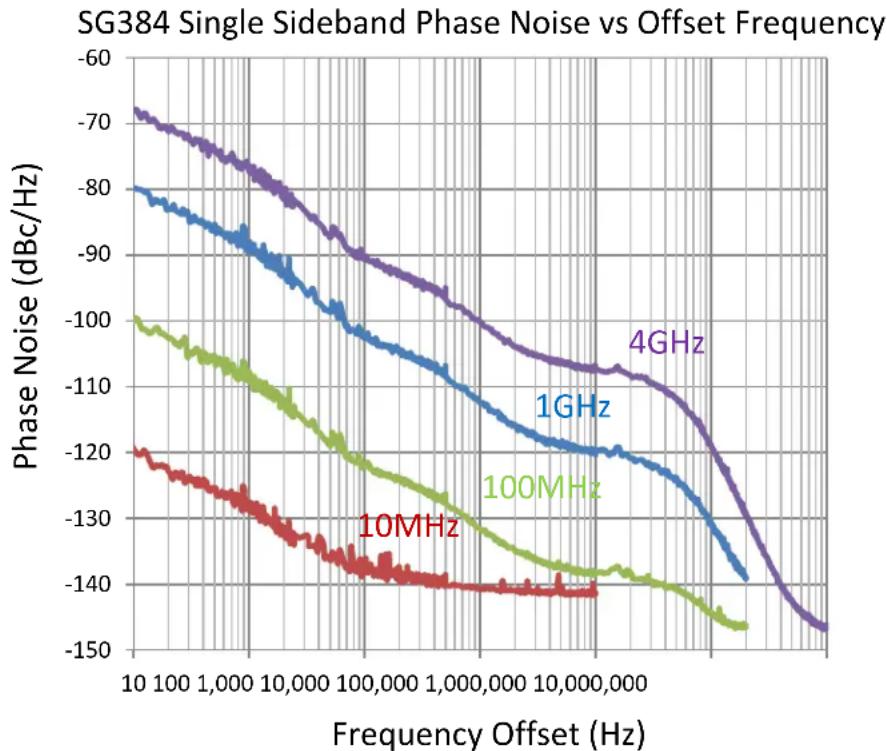

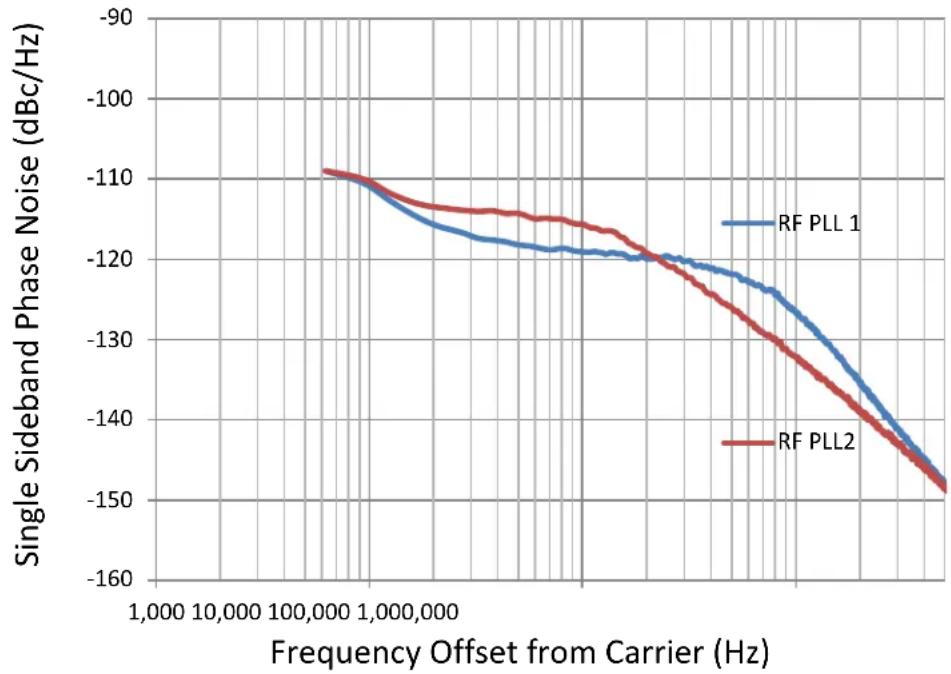
Phase Noise Spectra vs RF PLL Modes
To change the PLL mode, refer to the front panel CAL menu. See page 49 for more details. PLL 1 is the default setting.
SG384 Phase Noise at 1 GHz vs RF PLL Mode

line
| Frequency Offset from Carrier (Hz) | RF PLL 1 | RF PLL 2 | | ---------------------------------- | -------- | -------- | | 1,000 | -95.0 | -95.0 | | 10,000 | -105.0 | -105.0 | | 100,000 | -110.0 | -110.0 | | 1,000,000 | -115.0 | -115.0 | | 10,000,000 | -125.0 | -130.0 | | 100,000,000 | -145.0 | -145.0 |SG386 Phase Noise at 1 GHz vs RF PLL Mode
line
| Frequency Offset from Carrier (Hz) | RF PLL 1 | RF PLL 2 | | ---------------------------------- | -------- | -------- | | 1,000 | -110 | -110 | | 10,000 | -115 | -115 | | 100,000 | -120 | -120 | | 1,000,000 | -125 | -125 | | 10,000,000 | -135 | -135 | | 100,000,000 | -145 | -145 | | 1,000,000,000 | -150 | -150 |Typical Waveforms
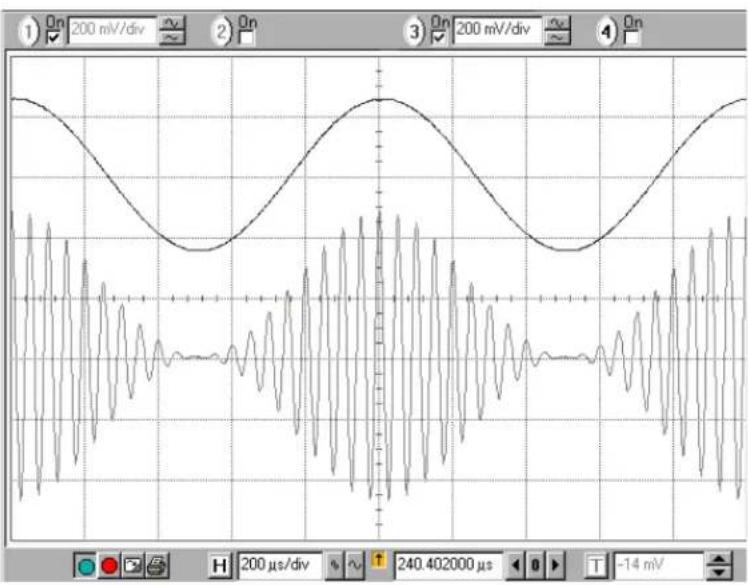
Amplitude Modulation
Waveform 1 is a 20 kHz carrier being amplitude modulated by a 1 kHz sine wave. The top trace is the rear panel Modulation output, while the bottom trace is the front-panel BNC output:
Setup:
Frequency 20 kHz
Amplitude BNC 1 V PP
Offset BNC 0 V
Modulation
Type AM
Function Sine
Rate 1 kHz
Depth 100%
ON
line
| Time (μs) | Voltage (mV) | |-----------|--------------| | 0 | 200 | | 1 | 150 | | 2 | 100 | | 3 | 50 | | 4 | 0 |Waveform 1: AM Modulation
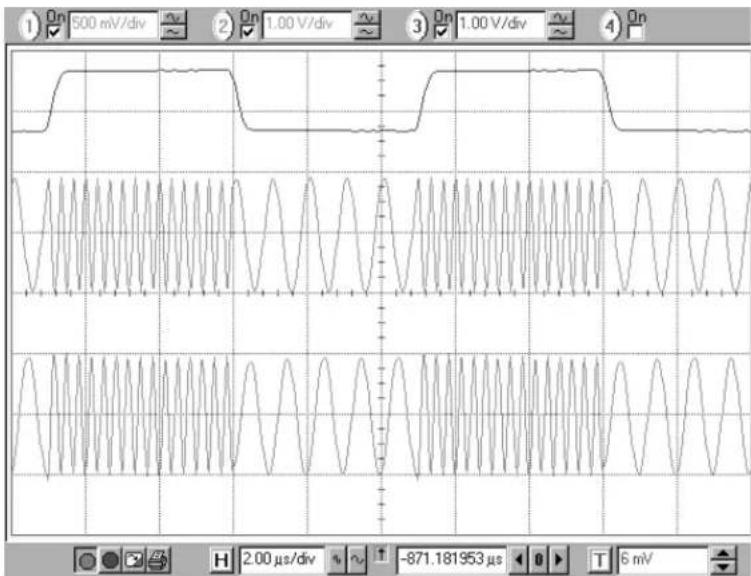
FSK (Frequency Shift Keying)
In Waveform 2 the internal modulator is set to FM between 1 MHz and 3 MHz with a 100 kHz square wave. The top trace is the rear panel Modulation output, while the middle and bottom traces are the front panel BNC and Type-N outputs.
Setup:
Frequency 2 MHz
Amplitude
BNC 1 V PP
Type-N 2 V PP
Modulation
Type FM
Function Square
Rate 100 kHz
Deviation 1 MHz
On
line
| Time (μs) | Voltage (mV) | |-----------|--------------| | 0 | 500 | | 1 | 1.00 | | 2 | 6 | | 3 | 1.00 | | 4 | 6 |Waveform 2: FSK Modulation
Typical Operating Characteristics xix
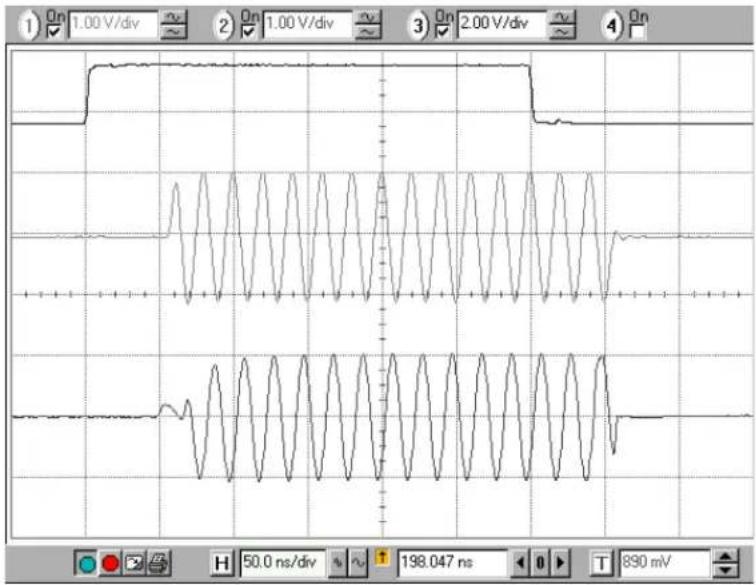
Pulse Modulated Outputs
Waveform 3 is a 50 MHz carrier being pulse modulated with a 1 MHz, 300 ns pulse waveform. The upper trace is the timing signal with the middle trace being the BNC output, and the lower trace being the RF output. There are delays of 50 ns in the gating circuitry as shown.
Setup:
Frequency 50 MHz
Amplitude
Type-N 2 V PP
BNC 2 V PP
Modulation
Type Pulse
Function Square
Period 1 μs
Duty Factor 30%
ON
line
| Time (ns) | Voltage (V) | | --------- | ----------- | | 0 | 1.00 | | 1 | 1.00 | | 2 | 1.00 | | 3 | 2.00 | | 4 | 890 |Waveform 3: Pulse Modulated Output
Differential Clock Outputs (Option 1)
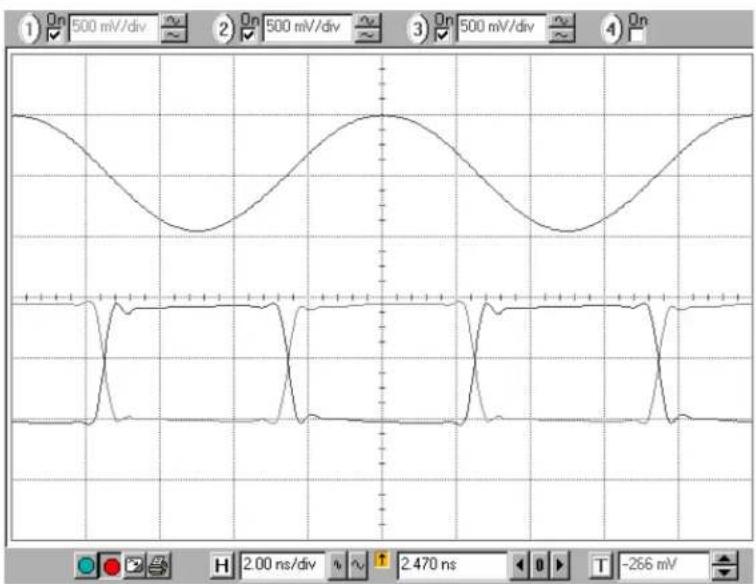
Waveform 4 shows the optional rear panel clock outputs with the frequency set to 100 MHz. The top trace is front panel Type-N output with the differential clock outputs depicted by the lower traces. The displayed transition times are limited by the 1.5 GHz bandwidth of the oscilloscope.
Setup:
Frequency 100 MHz
Amplitude
Type-N 1 V PP
Clock 1 V PP
Offset Clock 0 V
Modulation Off
line
| Time (ns) | Current (mV) | | --------- | ------------ | | 0 | 500 | | 1 | 480 | | 2 | 460 | | 3 | 480 | | 4 | 500 |Waveform 4: Clock Outputs
Typical Spectra
The following spectra show typical frequency domain performance for the SG380 series signal generators:
Unmodulated Carrier
Waveform 5 shows a direct measurement taken on a spectrum analyzer with a 200 kHz span and 100 Hz RBW. The noise floor of the spectrum analyzer dominates over most of the 200 kHz span.
Setup:
Frequency 1 GHz
Amplitude Type-N 0 dBm
Modulation OFF
Spectrum Analyzer set for:
Center Frequency 1 GHz
Span 200 kHz
Resolution BW 100 Hz

line
| Frequency Range | Value | | --------------------- | --------- | | CF 1.00000 GHz | 10.00 dB | | Res BW 100.000 Hz | 10.00 dB | | Span 200.000 kHz | 10.00 dB | | Points 8741 | 10.00 dB |Waveform 5: Unmodulated 1 GHz Output
Frequency Modulation with Modulation Index of 2.40477
Waveform 6 depicts a 50 MHz carrier frequency modulated at a rate of 10 kHz and a deviation of 24.0477 kHz, for a modulation index = 2.40477 . The carrier amplitude is proportional to the Bessel function J_0() and has its first zero at 2.40477, and thus suppresses the carrier.
Setup:
Frequency 50 MHz
Amplitude Type-N 0 dBm
Amplitude BNC 0 dBm
Modulation
Type FM
Function Sine
Rate 10 kHz
Dev 24.04 kHz
ON

line
| Frequency (MHz) | Value | | --------------- | ----- | | 50.0000 | 1 |Waveform 6: 50 MHz with FM Carrier Suppressed
I/Q Modulation (Option 3) by an Internal Noise Source
Option 3 allows I/Q modulation for output frequencies from 400 MHz to 6.075 GHz. Two signal sources may be used for modulation: the external I & Q inputs or an internal noise generator. The external I & Q inputs are on the rear panel. The internal noise generator has adjustable noise
bandwidth from 1 Hz to 50 kHz. Waveform 7 is a 1 GHz carrier being modulated by the internal noise generator with 1 kHz noise bandwidth.
Setup:
Frequency 1 GHz
Amplitude
Type-N -10 dBm
Modulation
Type I/Q
Function Noise
Dev (ENBW) 1.0 kHz
ON

line
| Parameter | Value | | --------------- | --------- | | CF | 1.00000 | | Res BW | 100.000 | | Points | 559 |Waveform 7: I/Q Modulation using internal noise source
Frequency offset of 1 kHz, 100% AM at 5 kHz
An unmodulated carrier at the spectrum analyzer's reference frequency (1 GHz in this case) appears as a single dot in the I/Q plane. When the carrier frequency is offset, the single dot moves in a circle about the center of the I/Q plane. The pattern shown in Waveform 8 occurs when the carrier amplitude is modulated with 100% depth at a rate of five times the carrier
offset frequency (creating five lobes). The symmetry of the lobes indicates that there is no residual phase distortion (AM to M conversion) in the amplitude modulator. The narrow line of the trajectory is indicative of low phase and amplitude noise.
Setup:
Frequency 1.000001 GHz
Amplitude
Type-N 0 dBm
Modulation
Type AM
Function Sine
Rate 5.0 kHz
Depth 100 %
ON

line
| I/Ω Polar | Value | | --------- | --------- | | Q | 0.00 V | | Q Origin | 0.00 V |Waveform 8: I/Q Polar plot of offset carrier with AM
Quick Start Instructions
This is intended to help the first time users get started with the RF Signal Generator and to help verify its functionality.
Connect the rear panel AC power to the AC mains (90 to 264 V _AC , 47 to 63 Hz). Then:
- Push the power button "in" to turn on the unit.
a. The model number will be briefly displayed
b. Then the firmware version and unit serial number
c. The unit will recall the its last operating state and begin operation
It is important to realize that the SG380 series signal generators resume operating with the same settings which were active when the unit was last turned off. There is a simple way to preset the instrument to a default state without changing any of the stored settings or the communications configuration: Notice that there is a “shifted function” above each key in the NUMERIC ENTRY portion of the key pad. To initialize the unit to its default settings, in the NUMERIC ENTRY section:
- Press the [SHIFT] key
a. The SHIFT LED will turn "on" - Press the number [0] (whose shifted function is "INIT")
a. The display shows" init. PrESS EntEr" - Press the "ENTER" key (lowest, rightmost key [Hz % dBm])
a. The instrument will be set to its default state
The default setting displays the frequency (10 MHz) and sets the AMPL of the BNC and Type-N outputs to 0 dBm (1 mW into 50 Ω or 0.63 V PP). Two green LEDs indicate that both the BNC and the Type-N outputs are active, and another LED shows that the modulation is “OFF”. The “LOCK” LED in the REF/SYNTH section should be “ON” (as should the “EXT” LED if the unit is connected to an external 10 MHz reference.)
Connect the front panel outputs to an oscilloscope. The oscilloscope timebase should be set for 50 ns/div and vertical sensitivity 200 mV/div with DC coupling and 50 Ω input impedance. The displayed cycle period should be 100 ns (2 divisions) and the displayed amplitude should be 630 mV PP. (The displayed amplitude will be twice that if the oscilloscope input is not set for 50 Ω.)
Here are some things to try:
- Change the frequency to 5 MHz by pressing [5] then [MHz V_PP]
- Press the SELECT [◀] key six times to select the 1 MHz digit
- Press the ADJUST [] key to increase the frequency
- Press the [AMPL] key to display the power at the Type-N output
- Press the ADJUST [] key to increase the power by 1 dB
- Press the [AMPL] key again to display the power at the BNC output
- Press the [MHz V_PP] key to change the units from dBm to V_PP .
- Press the ADJUST [Δ] key to increase amplitude by 0.100 V
Introduction
Feature Overview
The SG380 series of RF Signal Generators consists of three models. Each instrument is based on a new frequency synthesis technique which provides low phase noise, agile modulation, fast settling and virtually infinite frequency resolution. (See Appendix A for details on the Rational Approximation Frequency Synthesis technique.)
Each of the generators has two front panel outputs with overlapping frequency ranges. The frequency resolution is 1 Hz at all frequencies. The front panel BNC output spans DC to 62.5 MHz. The BNC output is DC coupled with an adjustable DC offset and provides sine wave outputs from 1 mV_RMS to 1 V_RMS .
The front panel Type-N connector provides outputs from 950 kHz to 2.025 GHz (for the SG382), or 4.050 GHz (for the SG384), or 6.075 GHz (for the SG386). This AC coupled output can provide power from -110 dBm to +16.5 dBm. A rear panel option extends the frequency range of the SG384 or SG386 to 8.1 GHz.
The SG380 generators have extensive modulation capabilities. The front panel outputs can be amplitude, frequency, phase or pulse modulated by internally generated waveforms (sines, ramps, triangles, pulse and noise) or by external sources. A rear panel option allows carrier frequencies above 400 MHz to be IQ modulated by external sources with more than 100 MHz of bandwidth.
The user interface provides single-key access to the most commonly adjusted synthesizer parameters (frequency, amplitude, phase, modulation rate and modulation deviation.) In addition, there are three standard communication interfaces (GPIB, RS-232 and LAN) which allow for all instrument parameters to be remotely controlled.
To assist in the development of high speed digital devices, a rear panel option provides differential clock outputs from DC to 4.05 GHz. These SMA outputs have 35 ps transition times and can be set to standard logic levels including ECL, PECL, RSECL, CML and LVDS.
The accuracy, stability and low phase noise of the SG380 series is supported by two outstanding timebases. The standard timebase uses a 3^rd overtone, SC-cut ovenized 10 MHz resonator. In addition to its remarkable stability ( <0.002 ppm 0^ to 45^ ), and low aging ( <0.05 ppm/yr ), this oscillator is responsible for the low phase noise close to carrier (-80 dBc/Hz at 10 Hz offset from a 1 GHz carrier) and its short term stability (1:10 ^11 1s root Allan variance).
An optional rubidium timebase reduces the frequency aging to <0.001 ppm/yr. This timebase (a SRS PRS10 rubidium frequency standard) also improves the frequency stability to <0.0001 ppm over 0^ to 45^ C.
The 10 MHz output from the internal timebase is made available on a rear panel BNC connector. The user can also provide a 10 MHz timebase via a rear panel external timebase input.
Front-Panel Overview

text_image
Parameter Display Units Display STANFORD RESEARCH SYSTEMS MODEL SG384 DC to 4.05 GHz SIGNAL GENERATOR 4050 000 000 000 000 000 GHz MHz kHz Hz dBm VREF V DEG % μs ms OUTPUTS DC to 62.5 MHz ON ON/OFF AM ~ FM ~ M ~ SWEEP ~ PULSE NOISE HQ(OPT) EXT MOD MOD TYPE MOD FCN SELECT / ADJUST RF ON FREQ PHASE AMPL MOD MODEV DC OFFS PULSE PERIOD PULSE WITH OR DUTY SHIFT CANCEL SHIFT STO RCL BACK CAL REL0 ~0 PRBS STEP SIZE ns +/- 7 8 9 μs NET CPB RS-232 DATA MHz INIT TIMEBASE STATUS LOCAL ENTER 0 1 2 3 Hz % Shift Key Unit Keys Power and Status Main Outputs Modulation Modes Parameter Selection and Adjustment Numeric Entry and Secondary Parameters Power and StatusFigure 1: The SG384 Front Panel
The front panel operation of each SG380 series RF Signal Generator is virtually the same, with the only substantial difference being the model number and the maximum operating frequency.
The front panel is divided into seven sections: Parameter Display, Units Display, OUTPUTS, MODULATION, SELECT/ADJUST, NUMERIC ENTRY, and STATUS.
The power switch is located in the lower right corner of the front panel. Pushing the switch enables power to the instrument. Pushing the switch again places the instrument in standby mode, where power is enabled only to the internal timebase.
Parameter and Units Display
The front panel has a sixteen digit display showing the value of the currently displayed parameter. The LEDs below the display indicate which parameter is being viewed. Error messages may also appear in the display, briefly.
The Units Display highlights the units associated with a parameter. Note that a given parameter may have multiple views. For example, the RF output amplitude may be viewed in units of dBm, V_RMS , or V_PP .
Main Output
These are the synthesizer's main signal outputs. Two types of connectors are provided due to the bandwidths covered by the instrument.

text_image
OUTPUTS DC to 62.5 MHz DC OFFS 50 Ω 950 kHz to 4.05 GHz AC 50 Ω 4 to 8 GHz (REAR) BNC N-Type Doubler Indicator (SG384 Option 2) Output Status LEDsBNC Output
Signals on this connector are active for frequency settings between DC and 62.5 MHz. The amplitude may be set independently for levels from 1 mV_RMS to 1 V_RMS (-47 dBm to 13 dBm). Increase amplitude setting of 1.25 V_RMS (14.96 dBm) are allowed with relaxed signal specifications. Additionally, the BNC output may be offset by ± 1.5 V_DC , however non-zero offsets will reduce the maximum amplitude setting. The BNC output is protected against externally applied voltages of up to ± 5 V .
Type-N Output
Signals on this connector are active for frequency settings between 950 kHz and 2.025 GHz, 4.050 GHz, or 6.075 GHz (for the SG382, SG384 and SG386 respectively). The output power may be set from -110 dBm to 16.5 dBm (0.7 V RMS to 1.5 V RMS ). The maximum output power is reduced by 3.50 dB/GHz above 3 GHz for the SG384, or by 3.25 dB/GHz above 4 GHz for the SG386. The Type-N output is protected against externally applied voltages of up to 30 V _DC and RF powers up to +25 dBm.
Indicators
Three LEDs are used to indicate which of the outputs are active: BNC, Type-N, and the 4 to 8 GHz (REAR) Doubler. (There is no doubler option available for the SG382). The Doubler LED is lit only when Option 2 is installed and when the frequency is greater than 4.05 GHz (for the SG384) or above 6.075 GHz (for the SG386).
Modulation Modes
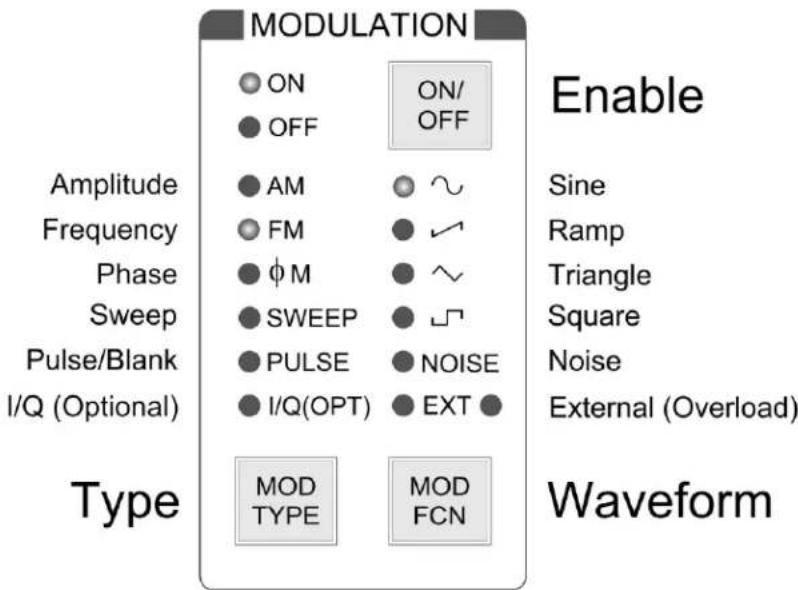
The Modulation section displays the present modulation state and enables the user to control both the type and function of the modulation.
The [ON/OFF] key enables modulation.
The [MOD TYPE] key allows selection of the type of modulation (via the ADJUST and keys). The types of modulation available are AM, FM, M, Sweep, and Pulse. IQ modulation from an internal noise generator, or from external sources, is available as an option.
The [MOD FCN] key allows the selection of the modulation waveform (via the ADJUST and keys). The available waveforms include sine, ramp, triangle, square wave, and noise.
The rear panel external modulation input can also be used in AM, FM, M or Pulse modulations. When the external source is selected, the signal level is monitored. If the external source exceeds operational limits the overload LED turns on and remains on until the condition is removed.
text_image
MODULATION ON OFF AM FM φM SWEEP PULSE I/Q(OPT) ON/OFF ~ ✓ ~ ~ √ NOISE EXT MOD TYPE MOD FCN Enable Sine Ramp Triangle Square Noise External (Overload) Waveform Amplitude Frequency Phase Sweep Pulse/Blank I/Q (Optional) TypeParameter Selection and Adjustment
flowchart
graph TD
    A["Select Keys"] --> B["Shift"] Enable RF Outputs
    B --> C["RF ON"]
    C --> D["FREQ"]
    C --> E["PHASE"]
    C --> F["AMPL"]
    C --> G["MOD RATE"]
    G --> H["PULSE WIDTH OR DUTY"]
    C --> I["MOD DEV"]
    I --> J["DC OFFS"]
    B --> K["Adjust Keys"]
    K --> L["Select / ADJUST"]
    L --> M["Adjust Keys"]
    M --> N["Main Parameter Keys"]
Display Navigation
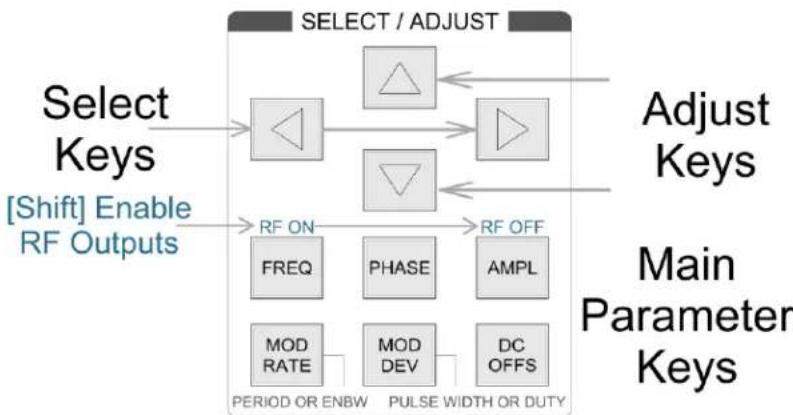
The SELECT/ADJUST section determines which main parameter is shown on the front panel display. The six basic displays for viewing and modifying instrument settings are shown in Table 1. Each display is activated by pressing the correspondingly labeled key.
Table 1: Main Parameter Keys
| Label | Value Shown in Main Display When Pressed |
| FREQ | Frequency (fc) |
| PHASE | Phase |
| AMPL | Amplitude – sequences through outputs |
| DC OFFS | Offset – sequences through the outputs |
| MOD RATE | Modulation Rate (Pulse Period or ENBW) |
| MOD DEV | Modulation Deviation (Pulse Width or Duty) |
For Parameter menus with multiple items, repeatedly pressing the Parameter key allows cycling through all of its parameters. For example, in the default configuration multiple key presses of the [AMPL] key will cycle through the various available outputs BNC, Clock, and Type-N.
Some of the parameters will have a blinking digit (the cursor). The cursor indicates which digit will be modified when the ADJUST and keys are pressed. The SELECT and keys allow adjusting the cursor for the desired resolution. The step size may also set using a shifted function and a numeric entry (to set channel spacing, for example.)
Numeric Entry and Secondary Parameters
text_image
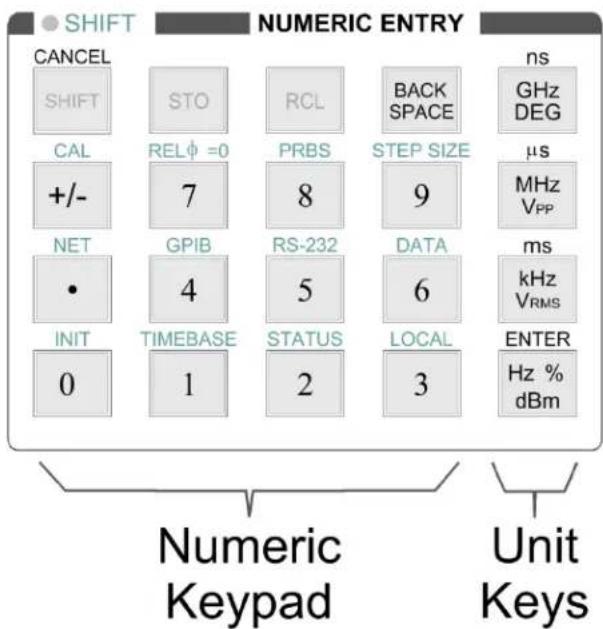
SHIFT CANCEL SHIFT CAL +/- NET • INIT 0 STO RELφ =0 7 GPIB 4 TIMEBASE 1 RCL PRBS 8 RS-232 5 STATUS 2 BACK SPACE 9 STEP SIZE DATA 6 LOCAL 3 ns GHz DEG μs MHz Vpp ms kHz VRMS ENTER Hz % dBm Numeric Keypad Unit KeysThis section is used for changing the currently displayed numeric parameter directly. A parameter is entered numerically and completed by pressing any of the unit keys. Corrections can be made using the BACK SPACE or the entire entry may be aborted by pressing the CANCEL key.
For example, to set the frequency to 1.0001 GHz, press the [FREQ] key followed by the key sequence of [1][•][0][0][0][1][GHz].
This section also allows access to secondary (or “Shifted”) functions. The secondary functions are listed above the key in light blue text. A secondary function is accessed by first pressing the SHIFT key (indicated by the SHIFT LED being on) followed by pressing the desired secondary function key.
For example, to set the incremental value for frequency to 12 kHz press [FREQ] [SHIFT] [9 (STEP SIZE)], followed by the sequence [1] [2] [kHz].
Numeric or SHIFT entries may be CANCELed at any time by pressing the SHIFT key.
Stepping Up and Down
Most instrument settings can be stepped up or down by a programmed amount. The blinking digit identifies the current cursor position and step size. The cursor shows the digit that will change if the parameter is incremented or decremented via the ADJUST keys. Pressing the ADJUST () key causes the displayed parameter to increment (decrement).
Step Size
Pressing the ADJUST and keys increments or decrements the value of the selected digit on the numeric display (to change the selected digit use the SELECT and keys). To view the step size use SHIFT [9] (STEP SIZE).
The step size can be changed using the numeric keypad followed by the appropriate unit. To set the step size to an arbitrary value use SHIFT [9] and enter the desired step size followed by the appropriate unit type. For example, to change the frequency's step size to 1.25 MHz, first press [Shift] then [9] followed by 1.25 and finally the [MHz] unit key. When the cursor is changed to another digit (using the SELECT ◀ or ▷ keys) the step size returns to its default value.
Store and Recall Settings
The [STO] and [RCL] keys are for storing and recalling instrument settings, respectively. Instrument settings include modulation configuration and all associated step sizes. Up to nine different instrument settings may be stored in the locations 1 to 9. To save the current settings to location 5, press the keys [STO], [5], [ENTER], sequentially. To recall instrument settings from location 5, press the keys [RCL], [5], [ENTER] sequentially. Note: the INIT key is used to recall default instrument settings. See Default Factory Settings in the Operations chapter for additional details.
Secondary Functions
text_image
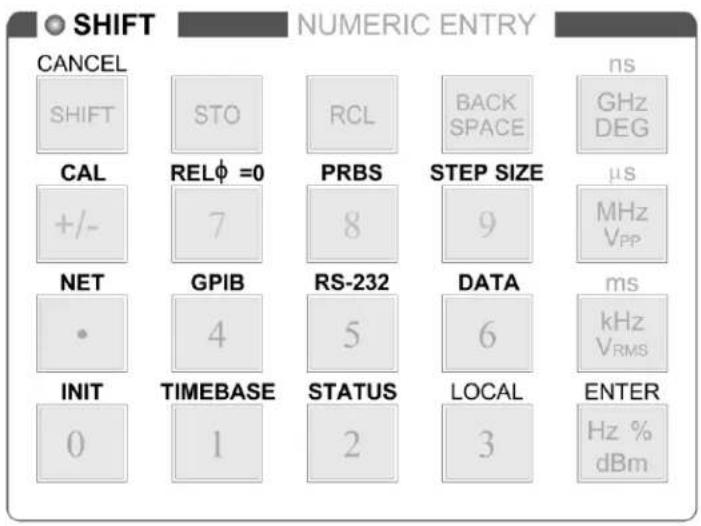
SHIFT NUMERIC ENTRY CANCEL SHIFT STO RCL BACK SPACE ns GHz DEG CAL RELφ =0 PRBS STEP SIZE μs +/- 7 8 9 MHz Vpp NET GPIB RS-232 DATA ms kHz VRMS INIT TIMEBASE STATUS LOCAL ENTER Hz % dBmMany of the keys in the NUMERIC ENTRY section have secondary (or SHIFT) functions associated with them. The secondary functions are listed above the keys. The [5] key, for example, has RS-232 above it. The meaning of the secondary functions is summarized in Table 2.
Table 2: Secondary Functions
| Label | Primary Key | Function Description |
| CAL | +/- | Adjust the timebase, and selects the PLL filter mode |
| REL Φ=0 | 7 | Defines the current phase to be 0 degrees and displays phase |
| PRBS | 8 | Allows access to the length of the Pseudo-Random Binary Sequence generator |
| STEP SIZE | 9 | Set the incremental value used by the ADJUST keys |
| NET | • | Configure the Ethernet interface |
| GPIB | 4 | Configure the GPIB interface |
| RS-232 | 5 | Configure the RS-232 interface |
| DATA | 6 | Display the most recent data received over any of the remote interfaces |
| INIT | 0 | Load default instrument settings |
| TIMEBASE | 1 | Displays the installed timebase and its status |
| STATUS | 2 | View TCP/IP (Ethernet), error, or instrument status, as well as running Self-Test |
| LOCAL | 3 | Go to local. Enables front panel keys if in remote mode. |
A more detailed description of each of the secondary functions is given in the Secondary Functions section of the Operation chapter.
The secondary functions can only be accessed when the shift mode is active, which is indicated by SHIFT LED in the main display. The SHIFT mode can be toggled on and off by pressing the [SHIFT] key. For example, to configure the PRBS length, press [SHIFT] [8] to access the PRBS secondary function.
For menu items with multi-parameter settings, the SELECT ◀ and ▷ keys allow selection of the various menu items. The ADJUST △ and ▽ keys may be used to modify a parameter. For example, the first option in the NET menu is TCPIP ENABLE/DISABLE. Use the ADJUST △ and ▽ keys to change the setting as desired. Then press SELECT ▷ to move to the next option which is DHCP ENABLE/DISABLE. Continue pressing the SELECT ▷ until all TCPIP settings have been configured as desired.
Cancel
The [SHIFT] key also functions as a general purpose CANCEL key. Any numeric entry, which has not been completed, can be canceled by pressing the [SHIFT] key. Because of the dual role played by the SHIFT key, the user may have to press [SHIFT] twice to reactivate SHIFT mode. The first key press cancels the current action, and the second key press re-activates SHIFT mode.
Power and Status
The Power and Status section encompass the power switch and displays the status of the timebase and remote interface(s):
Status Indicators

text_image
STATUS REF / SYNTH EXT LOCK INTERFACE REM ACT ERR POWER ON/STBYREF / SYNTH
In the upper right portion of the front panel are two groups of LED indicators. The upper group is labeled REF / SYNTH and indicates the status of the internal timebase. The EXT LED indicates that the instrument has detected an external 10 MHz reference at the timebase input BNC on the rear panel. If detected, the instrument will attempt to lock its internal clock to the external reference.
The LOCK LED indicates that unit has locked its internal frequency synthesizer at the requested frequency. Normally this LED will only extinguish momentarily when the frequency changes or an external timebase is first applied to the rear input. If the LED stays off, it indicates that the signal generator may be unable to lock to the external timebase. This is most commonly caused by the external frequency being offset by more than 2 ppm from 10 MHz.
INTERFACE
The lower group of LED indicators is labeled INTERFACE. These LEDs indicate the current status of any active remote programming interface (Ethernet, RS-232, or GPIB).
The REM (remote) LED turns on when the unit is placed in remote mode by one of the remote interfaces. In this mode, all the front panel keys are disabled and the instrument can only be controlled via the remote interface. The user can return to normal, local mode
by pressing the [3] key (also labeled [LOCAL]). The ACT (activity) LED flashes when a character is received or sent over one of the interfaces. This is helpful when troubleshooting communication problems. If a command received over the remote interface fails to execute due to either a parsing error or an execution error, the ERR (error) LED will turn on. Information about the error is available in the STATUS secondary display.
POWER
The power switch has two positions: STANDBY (button out) and ON (button in).
In STANDBY mode, power is only supplied to the internal timebase and the power consumption will not exceed 25 watts. In ON mode, power is supplied to all circuitry but the power consumption will not exceed 90 watts.
Rear-Panel Overview
text_image
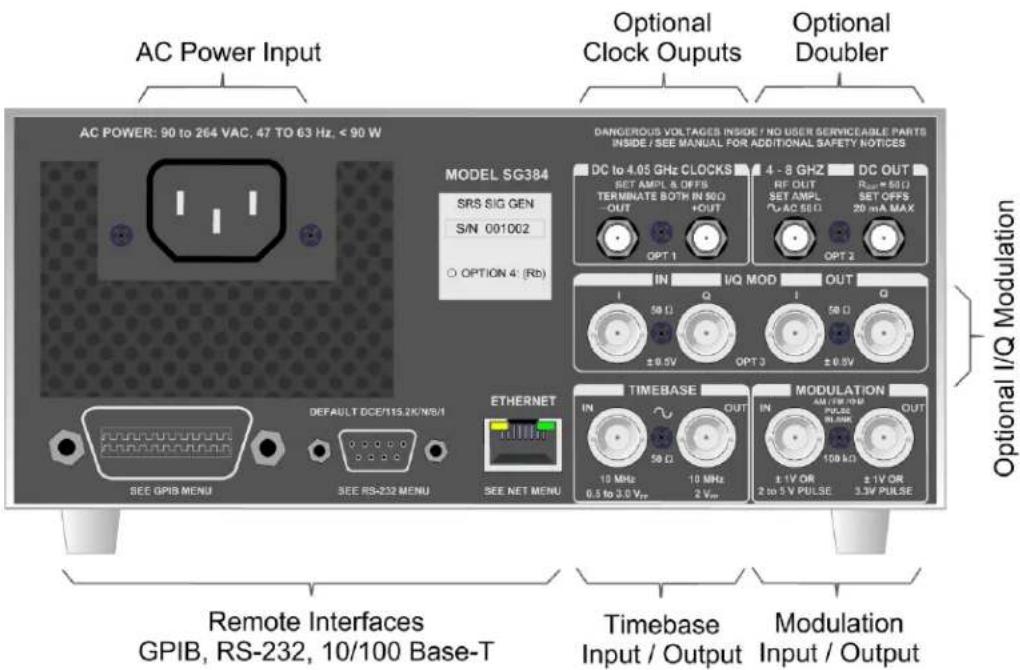
AC Power Input AC POWER: 90 to 264 VAC, 47 TO 63 Hz, < 90 W MODEL SG384 SRS SIG GEN S/N 001002 OPTION 4 (Rb) DANGEROUS VOLTAGES INSIDE / NO USER SERVICEABLE PARTS INSIDE / SEE MANUAL FOR ADDITIONAL SAFETY NOTICES DC to 4.05 GHz CLOCKS SET AMPL & OFFS TERMINATE BOTH IN 50Ω -OUT +OUT OPT 1 4 - 8 GHz RF OUT SET AMPL 2 AC 55Ω OPT 2 DC OUT Run = 60Ω SET OFFS 20 mA MAX IN I/Q MOD OUT Q ± 0.5V OPT 3 ± 0.5V TIMEBASE OUT IN INT/M/REF PULSE IN RAIN 100 kΩ ± 1V OR ± 1V OR 2 to 5 V PULSE 3.3V PULSE MODULATION OUT INT/M/REF PULSE IN RAIN ± 1V OR ± 1V OR 2 to 5 V PULSE 3.3V PULSE Optional Clock Outputs Optional Doubler Optional I/Q Modulation Remote Interfaces GPIB, RS-232, 10/100 Base-T Timebase Input / Output Modulation Input / OutputFigure 2: The SG384 Rear Panel
The rear panel provides connectors for AC power, remote computer interfaces, external frequency references, and various additional options.
AC Power
Connect the unit to a power source through the power cord provided with the instrument. The center pin is connected to the chassis so that the entire box is earth grounded. The unit will operate with an AC input from 90 to 264 V, and with a frequency of 47 to 63 Hz. The instrument requires 90W and implements power factor correction. Connect only to a properly grounded outlet. Consult an electrician if necessary.
Timebase
10 MHz IN
This input accepts an external 10 MHz reference. The external reference should be accurate to at least 2 ppm, and provide a signal of no less than 0.5 V PP while driving a 50 Ω impedance. The instrument automatically detects the presence of an external reference, asserting the front panel EXT LED, and locking to it if possible. If the unit is unable to lock to the reference, the LOCK LED is turned off.
10 MHz OUT
The instrument also provides a 10MHz output for referencing other instrumentation to the internal high stability OCXO or optional Rubidium Timebase.
Remote Interfaces
The instruments support remote control via GPIB, RS-232, or Ethernet. A computer can perform any operation that is accessible from the front panel. Programming the instrument is discussed in the Remote Programming chapter. Please refer to the respective Remote Programming Configuration section before attempting to communicate with the signal generators via any computer interface.
GPIB
The signal generators have a GPIB (IEEE-488) communications port for communications over a GPIB bus. The instruments support the IEEE-488.1 (1978) interface standard. It also supports the required common commands of the IEEE-488.2 (1987) standard.
RS-232
The RS-232 port uses a standard 9 pin, female, subminiature-D connector. It is configured as a DCE and supports baud rates from 4.8 kb/s to 115 kb/s. The remaining communication parameters are fixed at 8 Data bits, 1 Stop bit, No Parity, with RTS/CTS configured to support Hardware Flow Control.
Ethernet
The Ethernet uses a standard RJ-45 connector to connect to a local area network (LAN) using standard Category-5 or Category-6 cable. It supports both 10 and 100 Base-T Ethernet connection and a variety of TCP/IP configuration methods.
Modulation
IN
External modulation is applied to this input. The input impedance is 100 k with a selectable input coupling of either DC or AC (4 Hz roll off).
For analog modulations (AM, FM, M ), a signal of ±1 V will produce a full scale modulation of the output (depth for AM or deviation for FM and M ). It supports bandwidths of 100 kHz and introduces distortions of less than -50 dB.
For Pulse/Blank modulation types, this input is used as a discriminator that has a fixed threshold of +1 V.
OUT
This output replicates the modulation waveform and has a 50 Ω reverse termination. When using the internal source for AM, FM, and ΦM, it provides a waveform determined by the function and rate settings with an amplitude of ±1 V PP into a high impedance. During external analog modulation, this output mirrors the modulation input.
For Pulse modulation, the output is a 3.3V logic waveform that coincides with the gate signal.
Rear-Panel Optional Outputs
Two rear panel options are available on the SG382: a high speed clock outputs and IQ modulator inputs for the Type-N output. In addition, a frequency doubler for extending the frequency output to 8.1 GHz is available for the SG384 and SG386.
Option 1: Clock Outputs
The clock outputs provide a digital representation of the synthesized signal for frequencies up to 4.05 GHz on a pair of SMA type connectors. The outputs are differential signals with transition times of 35 ps (20 % to 80 %). They are adjustable for amplitudes from 0.40 to 1.00 V, offsets of ±2 V, with a resolution of 5 mV. The amplitude and offsets are set with the front panel AMPL and DC OFFS keys.
For frequencies above 62.5 MHz (93.75 MHz for the SG386), the jitter on the clock signals will be less than 300 fs with a measurement bandwidth of 5 kHz to 5 MHz. For frequencies below 62.5 MHz (93.75 MHz for the SG386) the rms jitter will be less than 0.01 % × U.I (Unit Interval).
Option 2: 8 GHz Frequency Doubler
This option extends the frequency range to 8.1 GHz with power levels of up to 16.5 dBm. A DC output port is available for providing biasing of external circuits. Both of these signals use SMA type connectors.
RF OUT
This output is operational for frequencies from 4.05 to 8.1 GHz (on the SG384) or 6.075 GHz to 8.1 GHz (on the SG386). This output is AC coupled and is adjustable over a range of -10 to +16.5 dBm. The frequency is set with the front panel FREQ key and the amplitude is set with the front panel AMPL key. The RF output supports FM, M, and SWEEP modulation.
DC OUT
This output provides DC voltage which is settable over a ± 10 V range with 5 mV of resolution. Output currents should be limited to ± 20 mA. The output voltage is set via the front panel DC OFFS key.
Option 3: I/Q Modulator
This option allows I/Q modulation on the front panel Type-N RF output for output frequencies above 400 MHz. Either an external source or the internal noise source may be selected via the MOD FCN key in the front panel MODULATION section.
I/Q IN
These inputs accept signals of ±0.5 V, corresponding to full scale modulation, and have 50 input impedances. Both inputs support signal bandwidths from DC to 100 MHz.
I/Q OUT
These outputs duplicate the I/Q modulation waveforms (internally or externally). All I/Q signals utilize BNC connectors located on the rear panel.
Operation
Introduction
The previous chapter provided an overview of the instrument's features. This section describes the setting of the frequency, phase, amplitude, offset as well as the details of modulation, storing and recalling setups, and configuration of the computer interfaces.
Power-On
At power on, the unit will briefly display the model number followed by the firmware version and the unit serial number. When power on initialization has completed, the instrument will recall the last operational settings from nonvolatile memory.
The instrument continuously monitors front panel key presses and will save the current instrument settings to nonvolatile memory after approximately five seconds of inactivity. To prevent the nonvolatile memory from wearing out, the unit will not automatically save instrument settings that change due to commands executed over the remote interface. The remote commands *SAV (*RCL) may be used to explicitly save (recall) instrument settings over the remote interface, if desired. (See the Remote Programming section for more information about these commands.)
The signal generator can be forced to revert to factory default settings. This is accomplished by power cycling the unit with the [BACK SPACE] depressed. All instrument settings, except for the remote interface configurations, will be set back to their default values. All calibration bytes will be reset to the values set at the most recent calibration. See the Factory Default Settings section for a list of default settings.
Setting Parameters
The SELECT/ADJUST section determines which parameter is shown in the main front panel display. The six keys for selecting the display of the main instrument settings are shown in Table 3. Each display is activated by pressing the corresponding labeled key.
Table 3: Main Display Parameters
| SELECT Key | Displayed Value |
| FREQ | Frequency (carrier or center frequency if modulating) |
| PHASE | Phase of BNC or Type-N outputs |
| AMPL | Amplitude or Power – Type-N, BNC, Clock, Doubler |
| DC OFFS | Offset – BNC, Clock, Rear DC Output |
| MOD RATE | Modulation Rate, Pulse Period or noise bandwidth |
| MOD DEV | Modulation Deviation, Pulse Width or Duty Factor |
Frequency
Pressing [FREQ] displays the output frequency and turns on the FREQ LED. The frequency may be entered in any of the following units: GHz, MHz, kHz, or Hz. For example, to set the frequency to 5 MHz press the [FREQ] key then press [5] [MHz]. The frequency resolution is 1 Hz at all frequencies. The units for the displayed frequency may be changed by pressing the desired unit key. For example, to change the display from units of MHz to Hz simply press the [Hz] key.
The frequency setting determines which outputs may be active at any given time. The green LED next to the front panel outputs indicate which outputs are enabled. (The output is also “off” if its amplitude is set below the minimum amplitude for the output.) None of the outputs operate across the entire frequency range. Table 4 shows the frequency ranges for each output connector for all models in the series.
Table 4: Frequencies of Operation
| Model | SG382 | SG384 | SG386 |
| Front BNC | DC-62.5 MHz | DC-62.5 MHz | DC-62.5 MHz |
| Type-N | 950 kHz to 2.025 GHz | 950 kHz to 4.050 GHz | 950 kHz to 6.075 GHz |
| Rear SMA Clocks | DC to 2.025 GHz | DC to 4.05 GHz | DC to 4.05 GHz |
| Rear SMA Doubler | Not available | 4.05 to 8.10 GHz | 6.075 to 8.10 GHz |
Phase
Pressing [PHASE] displays the output's phase and turns on the display PHASE LED.
The phase is displayed in degrees and is adjustable over ±360^ . If the phase adjustment exceeds 360^ , the phase is displayed modulo 360^ . The displayed phase is set to 0^ whenever the output frequency is changed.
The phase resolution depends upon the current setting of the frequency. For the frequencies up to 100 MHz the phase resolution is 0.01^ , with reduced resolution for higher frequencies. Table 5 shows the phase resolution verses frequency:
Table 5: Phase Resolution
| Frequency Range | Phase Resolution |
| DC to 100 MHz | 0.01^ |
| 100 MHz to 1 GHz | 0.1^ |
| 1 GHz to 8.1 GHz | 1.0^ |
Rel Phase

In many situations it is useful to be able to define the present phase setting as 0^ . The REL =0 function ([SHIFT] [7] keys) will “REL” the phase display to zero without any change of the output’s phase.
When you change the phase setting, you change the phase of all outputs from the synthesizer. This sometimes makes it difficult to see that you have done anything at all.
Phase adjustments are usually only made when there are more than one signal source in a measurement situation. For example, if you have two RF synthesizers, each connected to the same external 10 MHz timebase and set to the same frequency, you will be able to see their relative phase by viewing them simultaneously on an oscilloscope or by applying them both to a mixer and measuring the mixer's IF output.
You can also see phase changes (for frequencies which are a multiple of 10 MHz) by viewing the signal on an oscilloscope while triggering the oscilloscope from the rear panel 10 MHz timebase output.
You can also see the phase adjustment by viewing the RF signal on a polar display of a vector signal analyzer. (It will be important that the vector signal analyzer and the RF synthesizer share the same timebase.)
Amplitude and Power
Pressing [AMPL] displays the output amplitude or power and turns on the “AMPL” LED.
The amplitude has a value for each of the installed outputs, and repeated pressing of [AMPL] sequences through the amplitude for each output (Type-N, BNC, Clock, and RF Doubler). Note however, that only those outputs that are active for the current frequency setting will be accessible. If an output is set below its minimum value it will be disabled. This is indicated on the display as “off” and by extinguishing the LED which is next to the output.
All amplitudes (except for clock) may be displayed in units of dBm, V_RMS , or V_PP , with clock being restricted to V_PP . All stated values assume a load termination of 50 . Output amplitudes will (approximately) double if not terminated.
The units used for the displayed power or amplitude may be changed with a single key press. For example, if the Type-N output power is displayed as 0.00 dBm, pressing the [V_RMS] key will display 0.224 V_RMS and pressing the [V_PP] key will display 0.632 V_PP .
Table 6 lists the range for the various units of the outputs:
Table 6: Output Power Ranges
| Output | Power | Amplitude (VRMS) | Amplitude (VPP) |
| Front Type-N(1)(2) | -110 dBm → +16.5 dBm | 0.707 μ → 1.50 VRMS | 2 μ → 4.24 VPP |
| Front BNC(3) | -47 dBm → +13 dBm | 0.001 → 1.000 VRMS | .0028 → 2.82 VPP |
| Rear Doubler(4) | -10 dBm → +13 dBm | 0.0707 → 1.000 VRMS | 0.200 → 2.82 VPP |
| Rear Clocks | N.A. | N.A. | 0.40 VPP → 1.00 VPP |
(1) For the SG384 the maximum power is reduced by 3.50 dB/GHz above 3 GHz. (The maximum power available at 4 GHz is 13 dBm.)
(2) For the SG386 the maximum power is reduced by 3.25 dB/GHz above 4 GHz. (The maximum power available at 6 GHz is 10 dBm.)
(3) The AMPL of the BNC may be set as high as 1.25 V_RMS (+14.96 dBm) , with reduced distortion specifications, provided that the BNC DC offset is set to 0 V.
(4) The maximum specified power from the rear panel SMA doubler output is reduced to +7 dBm above 7 GHz. Over range power up to 16.5 dBm may be achieved at lower frequencies.
DC Offset
Pressing [DC OFFS] displays output offset voltages and turns on the display OFFSET LED.
On the front panel, only the BNC output has a settable DC offset. The Type-N RF output is AC coupled and so has no DC offset setting.
There are two rear panel options which also use DC offset settings: The DC offset on the differential clock outputs (Option 1) and the DC OUT bias source (which is included with Option 2, the RF doubler).
All three DC offsets are accessed by pressing the [DC OFFS] key repeatedly. The DC offsets for the front panel BNC, the rear panel differential clock outputs, and the rear panel DC OUT bias source are always accessible and active (independent of the frequency setting).
All DC offsets are displayed in V_DC . Table 7 gives the DC offset range for the various outputs:
Table 7: Offset Range
| Output | DC Offset Range |
| Type-N | N/A |
| BNC | ±1.5V |
| Rear DC Offset | ±10V |
| Clock | ±2V |
The BNC output will support offsets up to 1.5V. The BNC's output is very linear over ±1.9V while driving a 50 load. To maintain low distortion of AC signals in the presence of a DC offset it is necessary to reduce the amplitude of the AC signal. The output provides 13 dBm (2.828 V PP ) at no offset, and is reduced linearly to 0 dBm (0.632 V PP ) for offsets of ±1.5V . Table 8 shows the allowed amplitude (or power settings) for the BNC output for various DC offsets:
Table 8: BNC Output vs. DC Offset
| BNC DC Offset | Max Output (VPP) | Max Output (VRMS) | Max Output (dBm) |
| 0.00 V | 2.83 VPP | 1.00 VRMS | 13.01 dBm |
| ±0.25 V | 2.46 VPP | 0.871 VRMS | 11.81 dBm |
| ±0.50 V | 2.10 VPP | 0.741 VRMS | 10.41 dBm |
| ±0.75 V | 1.73 VPP | 0.612 VRMS | 8.75 dBm |
| ±1.00 V | 1.37 VPP | 0.483 VRMS | 6.69 dBm |
| ±1.25 V | 0.998 VPP | 0.353 VRMS | 3.97 dBm |
| ±1.50 V | 0.634 VPP | 0.224 VRMS | 0.02 dBm |
RF ON/RF OFF
These are shifted functions of the [FREQ] and [AMPL] keys, respectively. Press the [SHIFT] key (which lights the SHIFT LED) followed by the [AMPL] key to turn the RF "off", and press the [SHIFT] key followed by the [FREQ] key to turn the RF "on".
The RF ON and RF OFF key presses cause a momentary display of “rf on” / “rf off” on the main display, and the status LEDs for the outputs are set or cleared accordingly.

The [RF OFF] turns off all RF outputs, while setting the clock output to a static “off” state (+OUT to “low”, -OUT to “high”). When an output is selected that is “off” the display will indicate the off status. For example, selecting the Type-N amplitude would display “ntype off” on the main display.
The [SHIFT] [RF ON] returns all RF outputs to their previously active levels.
Modulation and Sweeps
Introduction
This section describes the instrument's modulation capabilities. The SG380 series signal generators have powerful and flexible built-in modulation functions, capable of AM, FM, M, frequency sweeps, Pulse, and I/Q modulation.
The modulation waveform may be an internally generated sine wave, square wave, pulse, ramp, triangle, noise, or, may be externally sourced via a rear panel BNC input. A rear panel BNC connector outputs the modulation waveform with a full scale range of ±1.00 V.
In addition, signal generators with Option 3 have wideband I-Q modulation. The rear panel BNC I-Q modulation inputs and outputs have >100 MHz bandwidth, ±0.5 V full scale range, and 50 Ω impedance.
Modulation Section
This section controls the modulation of the front panel Type-N and BNC outputs and can provide FM, M, Sweep modulation for the optional rear panel doubler output to 8.10 GHz. The modulation is turned “on” or “off”, and the modulation type (AM, FM, etc.), and the modulation function (sine, ramp, etc.), are selected in this section.
Modulation On/Off
The [ON/OFF] key toggles the modulation on/off and the current state is reflected by the MODULATION ON/OFF LEDs. Make sure that modulation is “OFF” if you want a CW (unmodulated) output for the signal generator. If the signal generator ever manifests “unexpected behavior” check the modulation status: Unintentionally enabling the modulation will give unexpected results.

Modulation Type
The [MOD TYPE] key allows the selection of which type of modulation will be applied to the synthesizer's output. The ADJUST keys are used to select the desired modulation type and the current selection is indicated with an LED. The types of modulation available are AM, FM, M, Sweep, and Pulse. Optional I/Q modulation is also available if Option 3 is installed.

Modulation Function
The [MOD FCN] key selects one of the various functions used as the modulation waveform. The ADJUST keys are used to select the desired modulation function. The current selection is indicated with an LED.
For all modulation types the rear panel external modulation source may be used. When Option 3 is installed, the I/Q modulation supports separate inputs for the I and Q signals.
Not all modulation types support all modulation functions. Table 9 shows which modulation types support which functions:
Table 9: Modulation Type vs. Function
| Type\Function | Sine | Ramp | Triangle | Square | Noise | External |
| AM / FM / ΦM | √ | √ | √ | √ | √ | √ |
| Sweep | √ | √ | √ | √ | ||
| Pulse | √ | √ | √ | |||
| I/Q (Optional) | √ | √ |
Modulation Rate

The [MOD RATE] and [MOD DEV] keys are paired in operation and their parameters depend upon the current modulation type and function settings.
Pressing [MOD RATE] displays the modulation rate associated with the current modulation type and turns on either the MOD RATE (for AM/FM/PM and sweep) or the PERIOD (for pulse/blank) LEDs.
For the standard (AM/FM/ M) and sweep modulation types, this parameter is the frequency of the applied modulation waveform. The allowable range depends on both the type of modulation and the frequency selected.
For pulse modulation, this selects the period of the pulses which modulate the carrier. The pulse period is settable in 5ns increments from 1 s to 10 s.
For I/Q noise modulation (available with Option 3) this key sets the equivalent noise bandwidth (ENBW) of the internal generated noise source. The ENBW may be set from 1 Hz to 500 kHz.
Modulation Deviation

Pressing [MOD DEV] displays the deviation of the current modulation function. Depending on the modulation type, either the MOD DEV, AM DEPTH, WIDTH, or DUTY FACTOR is displayed.
During AM modulation, the AM depth is displayed and corresponds to the peak percentage of the output envelope deviation. For example, if the amplitude is set to 1 V_PP and the AM DEPTH is set for 50%, the amplitude envelope would span from 0.5 V to 1.5 V.
During FM and sweep modulations, the deviation corresponds to the peak frequency excursion applied to the carrier. For example, if the carrier is set to 1.1 MHz and the deviation is set to 0.1 MHz, the carrier will span between 1 MHz and 1.2 MHz.
During M modulation, the deviation corresponds to the peak phase excursion applied to the carrier. For example, if the deviation is set to 10^ , then the carrier's phase deviation will span ± 10^ .
During pulse/blank modulation, deviation allows the pulse width or duty factor to be changed. This parameter may be either a time (“t on” for pulse or “t_off” for blank) or a duty factor. For example, for a 1 s pulse period, a width of 500 ns or a duty factor of 50% would be equivalent, and result in the output being on for 50% of the 1 s period.
Modulation Waveform Generator, Inputs and Outputs
The instrument's modulation capabilities include both internal and external modulation sources. The modulating waveform is replicated on the rear panel Modulation Output connector.
Linear Modulation
For AM / FM / M, and Sweep, the modulation source can be either the internal generator or the rear panel external modulation input.
The internal modulation source is capable of generating sine, ramps, triangular, or square waves, at frequencies of up to 500 kHz. The instrument limits the modulation rate to 50 kHz for carrier frequencies above 62.5 MHz (93.75 MHz for the SG386).
The rear panel external modulation input supports bandwidths of 500 kHz, but the modulation bandwidth is limited to 100 kHz for greater than 62.5 MHz (93.75 MHz for the SG386). The sensitivity is set such that a 1 V signal results in a full scale deviation (depth) in the output. For example: in M , if the deviation is set for 10^ , applying a level of -1 V produces a -10^ shift; applying 0 V produces no shift; and applying +1 V produces a 10^ shift.
When modulation is enabled using an internal source, the rear panel modulation output will provide a waveform of the selected function with a full scale range of ±1 V. When external modulation is selected the modulation output tracks the applied signal.
Pulse Modulation
There are two modes of pulse modulation: Pulse and Blank. The mode is shown in the main display and is selected with the ADJUST keys after [MOD TYPE] is pressed.
In Pulse Mode, the RF signal is turned “on” by the internally generated or externally applied signal. In Blank Mode, the RF signal is turned “off” by the internally generated or externally applied signal.
The internal pulse modulation source is a digital waveform whose period and “on” time is settable from 1 s to 10 s with 5 ns of adjustability. The period of the digital waveform is set via the [MOD RATE] key. The “on” time (for Pulse Mode) or “off” time (for Blank Mode) is set via the [MOD DEV] keys.
When an external input is selected the rear panel external modulation input is set for a threshold of 1V. The resulting signal is used in place of the internal source.
In Pulse and Blank Modes, the modulation output is a 3.3 V logic signal, which tracks the pulse waveform.
Linear Noise Modulation
For AM, FM and M , the noise source is pseudo random additive white Gaussian noise (AWGN). The bandwidth of the noise is set by the [MOD RATE] and the RMS deviation is set by the [MOD DEV].
The peak deviation will be about five times the set RMS deviation. This forces limits on the maximum allowed deviation corresponding to one fifth of the non-noise counterparts. For example, at a carrier frequency of 500 MHz the maximum FM deviation for a sine wave function is limited to 4 MHz, and so the maximum deviation for noise modulation is limited to 800 kHz.
For linear modulation, the rear panel output will provide 200mVRMS that will be band limited to the selected modulation rate. Again, the peak deviation will be five times this, or ± 1VPP .
Pulse Noise Modulation
For pulse modulation, the noise source is a Pseudo Random Bit Sequence (PRBS). The bit period is set by the [MOD RATE]. The PRBS supports bit lengths of 2, for 5 ≤ n ≤ 19 which correspond to a noise periodicity from 31 to 524287 periods. The bit length n is set via the [Shift] [PRBS or 8] key.
During pulse PRBS modulation, the rear panel output will be a 3.3V_PP waveform with a duty factor equal to 2^n / 2 / 2^n - 1 (approximately 50% ).
Modulation Output
A rear panel BNC provides a copy of the modulation function with ± 1 V full scale range. This output will be a sine, ramp, triangle, square wave, pulse or noise depending on the selected internal modulation function.
When an external source is applied to the modulation input it will be bandwidth limited, digitized, and reproduced at the modulation output. The transfer function has a bandwidth of about 1 MHz and a latency of about 950 ns.
The modulation output is a useful source even when the RF capabilities of the instrument are not required. The sine output is exceptionally clean, with a spur-free dynamic range typically better than -80 dBc. It can be used as a pulse generator with 5 ns timing resolution, or a PRBS generator. It is a very convenient noise source, with adjustable ENBW from 1 Hz to 500 kHz.
The modulation output has a 50 source impedance (to reverse terminate reflections from the user's load) but the output should not be terminated into 50 .
Amplitude Modulation
The amplitude modulation can use either the internal modulation generator or an external source. The internal modulator can generate sine, ramp, triangle, square, or noise waveforms. Amplitude modulation is not applied to the optional rear panel doubler output or to the rear panel clock outputs.
Setting up Amplitude Modulation:

Modulation Type
Press the [MOD TYPE] key and use the ADJUST △ ∇ keys to select AM.
Modulation Function
Press the [MOD FCN] key and use the ADJUST keys to select the desired modulation function (sine, ramp, triangle, square, noise or external).

Modulation Rate
For internally generated modulation functions, pressing [MOD RATE] displays the modulation rate and turns on the MOD RATE LED. The value may be set using the SELECT/ADJUST arrow keys or via a numeric entry and one of the [MHz] [kHz] or [Hz] unit keys.
The internal modulation supports rates of 50 kHz for £ above 62.5 MHz (93.75 MHz for the SG386) or 500 kHz for £ less than or equal to 62.5 MHz (93.75 MHz for the SG386). The Modulation rate supports 1 Hz of resolution at all frequencies.
External modulation supports bandwidths of 100 kHz.

Modulation Depth
Press [MOD DEV] to display and set the AM modulation depth, which also lights the AM DEPTH LED. The value may be set using the numeric entry and [%] unit keys, or using the SELECT/ADJUST arrow keys. This value has a range of zero to 100% with a 0.1% resolution.
A modulation depth of X percent will modulate the amplitudes by ± X percent. As an example, if the amplitude is set for 224 mV RMS (0 dBm), with a modulation depth of 50%, the resulting envelope would traverse 112 to 336 mV RMS .
NOTE: The outputs are limited to 1 V_RMS (+13 dBm) . If the modulation is increased such that the peak envelope would exceed this limit, the amplitude will be automatically reduced, and the screen will momentarily display “output reduced”.
Modulation On/Off
Press the [ON/OFF] key to turn the modulation "ON".
Amplitude Modulation Example
Illustrated below is an example of amplitude modulation. A 20 kHz carrier, with amplitude of 1 V_PP into 50 , is being amplitude modulated by an internally generated sine wave. The modulation rate is 1 kHz and the modulation depth is 100%.
Two traces are shown below. The upper trace is the 1 kHz modulation waveform (from the rear panel Modulation Output BNC), offset up two divisions. The lower trace is the modulated carrier (from the front panel BNC output), offset down one division.
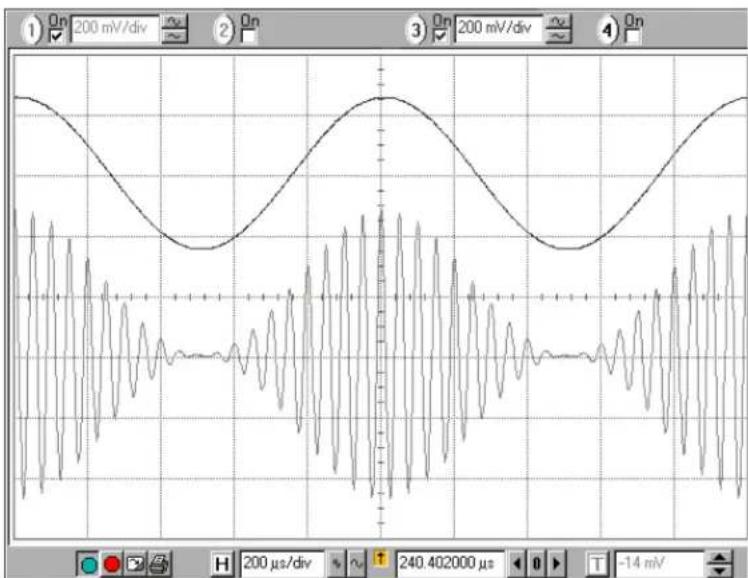
line
| Time (μs) | Voltage (mV) | |-----------|--------------| | 0 | 200 | | 1 | 150 | | 2 | 100 | | 3 | 50 | | 4 | 0 |Waveform 9: Amplitude modulation of a 20kHz carrier
Frequency Modulation
The internal modulation generator or an external source may be used to modulate the frequency outputs from the front panel BNC, Type-N and (optional) rear panel RF doubler output. The internal modulator can generate sine, ramp, triangle, square, or noise waveforms.
During FM, the output frequency traverses ± MOD DEV at the specified MOD RATE. For example, if the frequency is set for 1000 MHz (1 GHz), and the modulation rate and deviation are set for 10 kHz and 1 MHz, respectively, then the output will traverse from 1000 MHz, up to 1001 MHz, down to 999 MHz, and back to 1000 MHz at a rate of 10 kHz (a period of 100 s).
The FM modulation parameters are dependent upon the frequency setting. Table 10 and Table 11 list the FM parameters as a function of frequency. All frequency bands span octaves except for the first band. The internal FM rates correspond to the upper range that the internal function generator supports. The external bandwidth is defined as the -3 dB response referenced to the external modulation source. For the bands 2 to 8, the rates and bandwidths are similar. However, the deviation increases by a factor of two, from 1 to 64 MHz, for octaves 2 through 8.
The first band has unique FM capabilities in that it allows setting the deviation of the carrier frequency to the nearest band edge. If the carrier is set on the upper edge of 62.5 MHz, the deviation is allowed to be set to 1.5 MHz (5 % of f _c ). This range also supports a wider internal rate and bandwidth of 500 kHz.
For example, if the frequency is set for 100 kHz, the deviation may be set from zero to 100 kHz.
Table 10: FM Modulation vs. Frequency for SG382 and SG384
| Frequency Range | Internal FM Rate. 1 μHz to: | External FM Bandwidth DC (or 4 Hz for AC) to: | FM Deviation |
| DC ⇔ 62.5 MHz | 500 kHz | 500 kHz | Smaller of fc or 64 MHz-fc |
| 62.5 MHz ⇔ 126.5625 MHz | 50 kHz | 100 kHz | 1 MHz |
| 126.5625 MHz ⇔ 253.125 MHz | 50 kHz | 100 kHz | 2 MHz |
| 253.125 MHz ⇔ 506.25 MHz | 50 kHz | 100 kHz | 4 MHz |
| 506.25 MHz ⇔ 1.0125 GHz | 50 kHz | 100 kHz | 8 MHz |
| 1.0125 GHz ⇔ 2.025 GHz | 50 kHz | 100 kHz | 16 MHz |
| 2.025 GHz ⇔ 4.050 GHz (SG384) | 50 kHz | 100 kHz | 32 MHz |
| 4.050 GHz ⇔ 8.100 GHz (Opt 2) | 50 kHz | 100 kHz | 64 MHz |
Table 11: FM Modulation vs. Frequency for SG386
| Frequency Range | Internal FM Rate. 1 μHz to: | External FM Bandwidth DC (or 4 Hz for AC) to: | FM Deviation |
| DC ⇔ 93.75 MHz | 500 kHz | 500 kHz | Smaller of f_c or 96 MHz- f_c |
| 93.75 MHz ⇔ 189.84375 MHz | 50 kHz | 100 kHz | 1 MHz |
| 189.84375 MHz ⇔ 379.6875 MHz | 50 kHz | 100 kHz | 2 MHz |
| 379.6875 MHz ⇔ 759.375 MHz | 50 kHz | 100 kHz | 4 MHz |
| 759.375 MHz ⇔ 1.51875 GHz | 50 kHz | 100 kHz | 8 MHz |
| 1.51875 GHz ⇔ 3.0375 GHz | 50 kHz | 100 kHz | 16 MHz |
| 3.0375 GHz ⇔ 6.075 GHz | 50 kHz | 100 kHz | 32 MHz |
| 6.075 GHz ⇔ 8.100 GHz (Opt 2) | 50 kHz | 100 kHz | 64 MHz |
Setting up Frequency Modulation:

Modulation Type
Press the [MOD TYPE] key and use the ADJUST keys to select FM.
Modulation Function
Press the [MOD FCN] key and use the ADJUST keys to select the desired modulation function (sine, ramp, triangle, square, noise or external).

Modulation Rate
Press [MOD RATE] to display the modulation rate. The value may be set using the SELECT/ADJUST arrow keys or via a numeric entry and one of the [MHz] [kHz] or [Hz] unit keys.
Internal modulation supports rates of 50 kHz for f_c above 62.5 MHz (93.75 MHz for the SG386) or 500 kHz for f_c less than or equal to 62.5 MHz (93.75 MHz for the SG386), with 1 Hz of resolution.
External modulation supports bandwidths of 100 kHz.
Modulation Deviation
Press [MOD DEV] to display and set the FM deviation, which also turns on the DEVIATION LED. The value may be set using numeric entry and [MHz] [kHz] or [Hz] unit keys, or the SELECT/ADJUST arrow keys.
The deviation has a range that is dependent on carrier frequency band.
There are seven octaves above the lowest frequency range of DC to 62.5 MHz. The first octave (62.5 to 125 MHz) supports deviation of 1 MHz, with each succeeding octave doubling the deviation, thus achieving a 64 MHz of deviation at the 4 to 8 GHz octave (if the optional doubler is installed.)
NOTE: If the frequency is changed, the deviation may be adjusted as necessary to maintain limits imposed by the new frequency setting.

Modulation On/Off
Press the [ON/OFF] key to turn the modulation "ON".
Frequency Modulation Example
Shown below is a 2 MHz carrier being frequency modulated by a 100 kHz square wave with a 1 MHz deviation. In this example of Frequency Shift Keying (FSK) the carrier frequency is being rapidly switched between 1 MHz and 3 MHz.
The top trace is from the rear panel Modulation Output BNC which shows the 100 kHz modulating waveform. The middle trace is the front panel BNC output, whose amplitude was set to 1 Vp. The bottom trace is from the front panel Type-N output, whose amplitude was set to 2 Vpp.
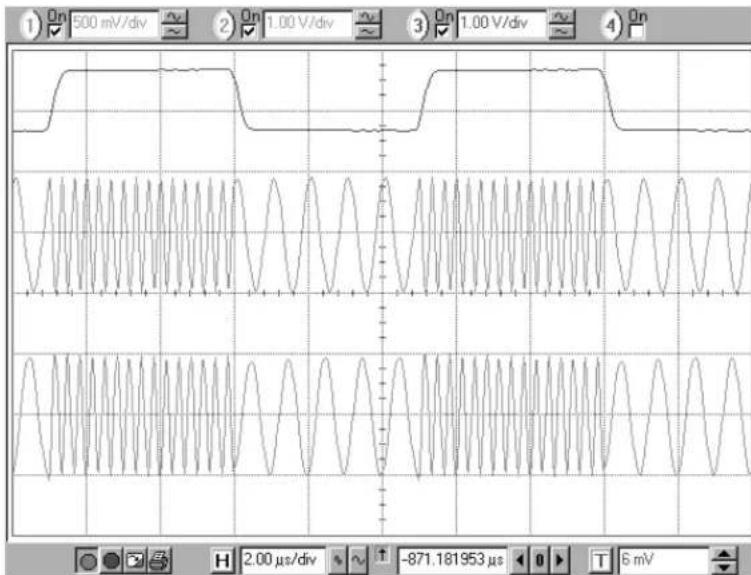
line
| Time (μs) | Voltage (mV) | |-----------|--------------| | 0 | 500 | | 2 | 1.00 | | 4 | 1.00 |Waveform 10: FSK Modulation
Phase Modulation
The phase modulation can use either the internal modulation generator or an external source. The internal modulator can generate sine, triangle, ramp, square, or noise waveforms.
The phase of the output traverses the specified deviation at the modulation rate. For example, with a frequency of 1000 MHz (1 GHz), and modulation rate and deviation set to 10 kHz and 45 degrees, respectively, the output will be a fixed frequency with its phase traversing ±45 degrees at a 10 kHz rate.
The optional rear panel doubler output can also be phase modulated.
Setting up Phase Modulation:

Modulation Type
Press the [MOD TYPE] key and use the ADJUST keys to select M .
Modulation Function
Press the [MOD FCN] key and use the ADJUST keys to select the desired modulation function (sine, ramp, triangle, square, noise or external).

Modulation Rate
Press [MOD RATE] to display the modulation rate. The value may be set using the SELECT/ADJUST arrow keys or via a numeric entry and [MHz] [kHz] or [Hz] unit keys.

Modulation Deviation
Press [MOD DEV] to display and set the M deviation, which turns on the DEVIATION LED. The value may be set using the numeric entry and the [DEG] unit key.
The phase deviation resolution depends on the frequency setting. For frequencies below 100 MHz, the phase deviation resolution is 0.01^ . For frequencies between 100 MHz and 1 GHz the resolution is reduced to 0.1^ , and is 1^ for frequencies above 1 GHz.
For frequencies less than or equal to 62.5 MHz (93.75 MHz for the SG386) the accuracy of the phase deviation is 0.1 %. For frequencies above 62.5 MHz (93.75 MHz for the SG386) the accuracy is reduced to 3 %.

Modulation On/Off
Press the [ON/OFF] key to turn the modulation "ON".
Phase Modulation Example
Shown below is the frequency spectrum of a 0 dBm, 50 MHz carrier, being phase modulated by a 10 kHz sine with a deviation of 137.78^ . Here, the modulation index, = phase deviation = 137.78^ × 2 / 360^ = 2.40477 radians. For phase modulation by a sine, the carrier amplitude is proportional to the Bessel function J_0() , which has its first zero at 2.40477, which suppresses the carrier to below -88 dB.
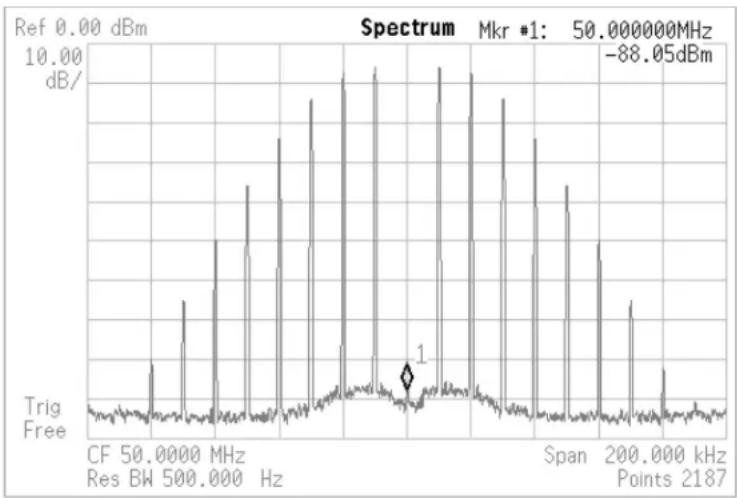
line
| Frequency (MHz) | Amplitude (dB) | | --------------- | -------------- | | 50.0000 | ~10.00 | | 500.000 | ~10.00 | | 2187 | ~10.00 |Waveform 11: Spectrum of Phase Modulated 50 MHz Carrier
Pulse and Blank Modulation
Pulse modulation includes both pulse and blank modulation of the front panel BNC and Type-N outputs. Pulse and blank modulation are logical complements of each other—pulse modulation enables the output when the pulse waveform is “true”, while blank modulation disables the output. The functions supported are square, noise (Pseudo Random Binary Sequence — PRBS), and external.
For internal square wave function the instrument has a 32-bit timing generator clocked by a 200 MHz source. This allows the period to be set from 1 s to 10 s with 5 ns resolution. The pulse duration can then be set from 100 ns up to the full period (less 100 ns). The internal generated pulse waveform is available at the rear panel Modulation Output BNC.
For pulse (blank) modulation, the output is turned on (off) when the source is at logic “high”. Pulse modulation is not applied to the optional doubler output.
Setting up Pulse Modulation:

Modulation Type
Press the [MOD TYPE] key and use the ADJUST keys to select PULSE or BLANK.

Modulation Function
Press the [MOD FCN] key and use the ADJUST keys to select the desired modulation function (pulse, noise or external). If external, then CMOS logic levels applied to the rear panel modulation input control the pulse or blanking of the outputs. (See details on PRBS modulation below.)

Pulse Period
Press [MOD RATE] to display the pulse modulation period for the internal source. The value may be set using the SELECT/ADJUST arrow keys or via numeric entry plus one of the [ns] [μs] [ms] [enter] unit keys.

Pulse Width or Duty Factor
Press [MOD DEV] to display and set the pulse width of the internal source, which also turns on either the WIDTH or DUTY FACTOR LED. The value may be set using numeric entry and [ns] [μs] [ms] [enter] or [%] unit keys, or the SELECT/ADJUST arrow keys.

Modulation On/Off
Press the [ON/OFF] key to turn the modulation "ON".
Pulse Modulation Example
The waveforms below show the front panel BNC and Type-N outputs for a pulse modulated carrier frequency of 50 MHz. The internal pulse modulator was set to 1 s period, with a 300 ns “on” time (or a 30% duty cycle).
The output amplitudes were set to 2V_PP into 50 . The top trace is the rear panel Modulation Output signal. The middle trace is the BNC output. The bottom trace is the Type-N output. Both traces show about 50 ns latency in their response to the gating signal. The Type-N output also shows some gate feed-though at the leading edge if the signal.

line
| Time (ns) | Voltage (V) | | --------- | ----------- | | 0 | 1.00 | | 1 | 1.00 | | 2 | 1.00 | | 3 | 1.00 | | 4 | 1.00 |Waveform 12: Pulse modulated 50 MHz carrier
More about PRBS Noise Modulation
When the noise function is selected for pulse modulation, the modulation source is a pseudo random binary sequence (PRBS) generator. The PRBS is used to gate the Type-N and BNC outputs.
The period of the PRBS may be set from 100 ns to 10 s, with 5 ns resolution via the [MOD RATE] key. The default PRBS period is 1 kHz. At the default setting, the RF output would be set “on” or “off”, randomly, every millisecond.
The default PRBS run length is 9 bits and so the PRBS pattern repeats after 2^-9-1=511 periods. The PRBS run length can be changed from 5 to 19 bits for repeat cycles between 31 and 524,287 periods.
To modify the PRBS run length:
Press the [Shift] key followed by the [PBRS(8)] key to display the PRBS run length (in bits). Press the ADJUST keys or enter a number, N, between 5 and 19 followed by the ENTER key. The PRBS will repeat after 2^N-1 cycles.
The PRBS is available at the rear panel Modulation Output BNC. The source is 0 to 3.3 V with 50 source impedance. The output should not be terminated into 50 .
Phase Continuous Frequency Sweeps
Frequency sweeps allow the traversing of an entire frequency band. The sweep modulation may use the internal sine, triangle, or ramp waveforms or an external modulation source. Sweep rates of up to 120 Hz and sweep ranges from 10 Hz up to an entire frequency band are supported with resolutions of 1 Hz.
Frequency sweeps can require the instrument's RF VCO to sweep through an entire octave. For the sweep to be phase continuous the RF VCO PLL must remain in “LOCK” during the sweep. This is why the maximum sweep rate is limited to 120 Hz and why the frequency slew rate is internally limited for the ramp function. The slew rate of external modulation sources should also be limited if a phase continuous sweep is required.
The RF Synthesizers have eight frequency bands as shown in Tables below:
Table 12: Sweep Frequency Bands for the SG382 and SG384
| Band | Frequency |
| 1 | DC ⇒ 64 MHz |
| 2 | 59.375 ⇒ 128.125 MHz |
| 3 | 118.75 ⇒ 256.25 MHz |
| 4 | 237.5 ⇒ 512.5 MHz |
| 5 | 475 ⇒ 1025 MHz |
| 6 | 950 ⇒ 2050 MHz |
| 7 (SG384) | 1900 ⇒ 4100 MHz |
| 8 (Option 2) | 3800 ⇒ 8200 MHz |
Table 13: Sweep Frequency Bands for the SG386
| Band | Frequency |
| 1 | DC ⇒ 96 MHz |
| 2 | 89.0625 ⇒ 192.1875 MHz |
| 3 | 178.125 ⇒ 384.375 MHz |
| 4 | 356.25 ⇒ 768.75 MHz |
| 5 | 712.5 ⇒ 1537.5 MHz |
| 6 | 1425 ⇒ 3075 MHz |
| 7 | 2850 ⇒ 6150 MHz |
| 8 (Option 2) | 5950 ⇒ 8150 MHz |
Setting up Frequency Sweeps:

Modulation Type
Press the [MOD TYPE] key and use the ADJUST keys to select SWEEP.
Modulation Function
Press the [MOD FCN] key and use the ADJUST keys to select either sine, ramp, triangle or external modulation function.

Sweep Rate
Press [MOD RATE] to display the modulation rate. This value may be set using the SELECT/ADJUST arrow keys or via numeric entry followed by [Hz] unit key. The Rate may be set from 1 Hz to 120 Hz with a resolution of 1 Hz.

Sweep Deviation
Press [MOD DEV] to display and set to the Sweep deviation. This turns on the 'DEVIATION' LED. The value may be set using numeric entry plus one of the hertz unit keys, or the SELECT/ADJUST arrow keys. The deviation may be set to sweep an entire band or any part thereof.
Modulation On/Off
Press the [ON/OFF] key to turn the modulation "ON".
I/Q Modulation (Option 3)
This option extends the signal generator's standard modulation suite with In-phase/Quadrature (IQ) modulation capabilities. This allows modulation of the front panel Type-N output for frequencies above 400 MHz and supports modulation bandwidths of over 100 MHz. I/Q modulation is not applied to the rear panel doubler option or BNC outputs.
To avoid output amplifier compression, the maximum output power setting is +10 dBm during I/Q modulation. This guarantees that the modulator output does not exceed the full scale output of the amplifier when both I&Q are at full scale.
This option provides four BNC connectors on the rear panel. One pair is used for the external inputs, while the second pair provides outputs of the I/Q waveforms. For external operation, the input signals are replicated on the outputs. For internally generated noise modulation, the baseband noise waveform is available on the I output with the Q output being held at zero.
The inputs are terminated with 50 , and support a signal bandwidth from DC to 100 MHz. A ± 500 mV level on either input produces full scale output (full scale determined by the amplitude setting). Any combination of I and Q input levels that when added in quadrature have a level of 500 mV will likewise result in full-scale output.
Figure 3 depicts the relationship between I and Q levels when added in quadrature and the resulting output magnitude

text_image
Circle with 500 mV corresponding to a full-scale output Mag = √I² + Q² The output is instantaneously set by: Mag / (500mV) • Amplitude SettingFigure 3: IQ Relationship
The inputs are designed to allow full-scale modulation. Each input is monitored and if either exceeds 525 mV (105 %) the front panel EXT overload LED is turned on and remains on until the condition is removed.
When the noise function is selected the instrument produces a spectral output with a rectangular profile. The width of the profile is determined by the ENBW setting and may range from 1 Hz to 50 kHz.
There are two ways to operate the IQ modulator: From the rear panel, user supplied, I&Q inputs or from an internal generated noise source (which is only applied to the I modulation input). IQ modulation operates only for carrier frequencies above 400 MHz.
Setting up External IQ Modulation:
Note that Option 3 must be installed.

Modulation Type
Press the [MOD TYPE] key and use the ADJUST keys to select I/Q (OPT).
Modulation Function
Press the [MOD FCN] key and use the ADJUST keys to select EXT.

Modulation Rate
When the external modulation function is selected there is no rate parameter and the unit displays the message “rate etrn”.

Fixed Modulation Deviation
When the external modulation function is selected, there is no corresponding deviation parameter. The unit displays the message “dev predefined”. (The scale is fixed at ±0.5V providing full scale on the I or Q outputs).
User modulation waveforms should be applied to the rear panel I & Q BNC inputs. The sources should be able to provide ±500 mV full scale into a 50 load. The front panel red EXT LED will indicate an overload if the inputs exceed about ±525 mV.
Modulation On/Off
Press the [ON/OFF] key to turn the modulation "ON".
Setting up Internal Noise IQ Modulation:
Note that Option 3 must be installed)

Modulation Type
Press the [MOD TYPE] key and use the ADJUST keys to select I/Q (OPT).

Modulation Function
Press the [MOD FCN] key and use the ADJUST keys to select NOISE..

Modulation Effective Noise Bandwidth (ENBW)
Press the [MOD RATE] to display the noise modulation equivalent noise bandwidth (ENBW). The value may be set using the SELECT/ADJUST arrow keys or via a numeric entry completed with one of the [Hz] unit keys. The baseband noise function is available on the rear panel I-OUT BNC.

Fixed Modulation Deviation
Pressing [MOD DEV] displays the message “crest fact. 14 dB”. The crest factor is fixed, and indicates that the ratio of the peak value to RMS value of the noise waveform is 14 dB (or 5×). This factor is not adjustable.
Modulation On/Off
Press the [ON/OFF] key to turn the modulation "ON".
IQ Noise Modulation Example
The RF output is being amplitude modulated by a bipolar noise signal applied to the I-channel only. In the frequency domain the output will appear as a flat band of noise centered on the carrier frequency with brick-wall filtered skirts. The width of the noise around the carrier frequency is twice the ENBW.
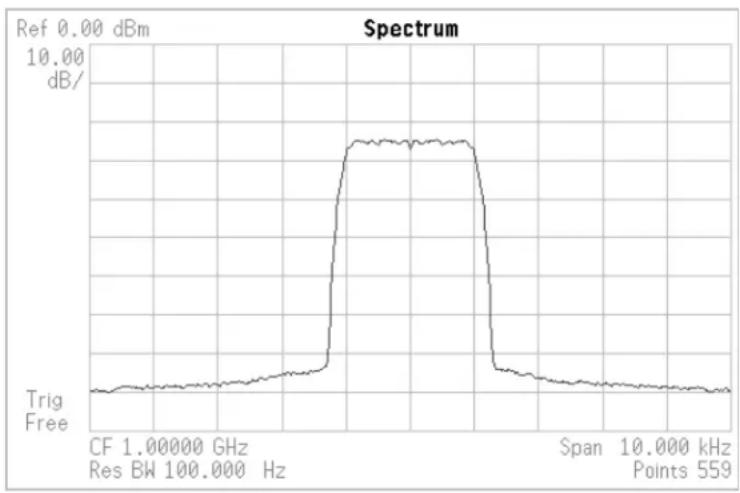
line
| Parameter | Value | | --------------- | --------- | | Ref 0.00 dBm | 10.00 dB/ | | CF 1.00000 GHz | ~0.5 | | Res BW 100.000 Hz | ~0.5 | | Span 10.000 kHz | ~0.5 | | Points 559 | ~0.5 |Waveform 13: Spectrum of I/Q modulation by internal noise source.

Secondary (Shift) Parameters
The shifted keys are used to access parameters or functions that are less frequently required. Table 14 gives a summary of the keys.
Table 14: Shifted Key Functions
| Label | Primary Key | Function Description |
| NET | • | Configure Ethernet interface |
| CAL | +/- | Adjust the timebase, and selects the PLL filter mode |
| INIT | 0 | Load default instrument settings |
| TIMEBASE | 1 | Displays the timebase configuration |
| STATUS | 2 | View TCP/IP (Ethernet), error, or instrument status, as well as running Self-Test |
| LOCAL | 3 | Go to local. Enables front panel keys if the unit is in remote mode. |
| GPIB | 4 | Configure GPIB interface |
| RS-232 | 5 | Configure RS-232 interface |
| DATA | 6 | Display the most recent data received over any remote interface |
| REL Φ=0 | 7 | Defines the current phase to be 0 degrees and displays phase parameter (of 0) |
| PRBS | 8 | Allows access to the parameters associated with the Pseudo-Random Binary Sequence generator |
| STEP SIZE | 9 | Set the incremental value used by the ADJUST keys |
Some of the keys in the Numeric Entry section of the front panel have secondary functions associated with them. The names of these functions are printed above the key. For example, the [4] key has the label "RS-232" in light blue text above it.
REL Φ=0
[SHIFT] [7] sets the phase display to 0^ . The phase of the output is not changed.
PRBS
[SHIFT] [8] allows setting of the PRBS (pseudo-random binary sequence) bit length (from 5 to 19) for pulse modulation with noise.
STEP SIZE
[SHIFT] [9] allows setting of the STEP SIZE for the ADJUST and keys for any displayed parameter (such as frequency, phase, amplitude, modulation rate, etc.) (The default step size is ±1 at the blinking digit.)
Timebase
[SHIFT] [1] shows the installed timebase. This can be the standard ovenized crystal oscillator (OCXO) or an optional rubidium oscillator.
Table 15: Timebase Status Menu
| Parameter | Example Display | Description |
| Oscillator | ‘Osc. ovenized’ | Indicates which type of timebase is installed. |
| Rb lock | ‘Rb stable’ | If a rubidium timebase is installed, this item indicates if the rubidium has stabilized. |
NET
The NET menu, [SHIFT] [.], enables the user to configure the TCP/IP based remote interfaces (the IP address, subnet mask, and default router). To see the current TCP/IP parameters use the STATUS menu. Before connecting the instrument to your LAN, check with your network administrator for the proper configuration of devices on your network.
The NET menu (summarized in Table 16) has several options. Press the SELECT ◀ and ▷ keys to cycle through the options. Use the ADJUST △ and ▽ keys to change an option. Use the numeric keypad to enter an IP address when appropriate. Note that changes to the TCP/IP configuration do not take effect until the interface is reset or power is cycled.
Table 16: NET Menu Options for TCP/IP Configuration
| Parameter | Example Display | Description |
| TCP/IP | ‘TCPIP enabled’ | Enable or disable all TCP/IP access |
| DHCP | ‘DHCP enabled’ | Enable or disable the DHCP client to automatically obtain an appropriate TCP/IP configuration from a DHCP server |
| Static IP | ‘Static IP enabled’ | Enable or disable a static IP configuration. |
| IP | ‘IP 192.168.0.5’ | IP address to use if static IP is enabled. |
| Subnet | ‘Subnet 255.255.0.0’ | Subnet mask to use if static IP is enabled. |
| Default gateway | ‘Def Gty 192.168.0.1’ | Default gateway or router to use for routing packets not on the local network if static IP is enabled |
| Bare socket interface | ‘Bare enabled’ | Enable or disable raw socket access on TCP/IP port 5025. |
| Telnet interface | ‘Telnet enabled’ | Enable or disable telnet access on TCP/IP port 5024. |
| VXI-11 Interface | ‘Net instr enabled’ | Enable or disable the VXI-11 net instrument remote interface. |
| Link speed | ‘Speed 100 Base-T’ | Set the Ethernet link speed. |
| Reset | ‘Reset no’ | Select ‘Reset yes’ and press ‘ENTER’ to reset the TCP/IP interface to use the latest TCP/IP configuration settings. |
TCP/IP Configuration Methods
In order to function properly on an Ethernet based local area network (LAN), the unit needs to obtain a valid IP address, a subnet mask, and a default gateway or router address.
There are three methods for obtaining these parameters: DHCP, Auto-IP, and Static IP. Check with your network administrator for the proper method of configuration of instruments on your network.
If the DHCP client is enabled, the unit will try to obtain its TCP/IP configuration from a DHCP server located somewhere on the local network. If the Auto-IP protocol is enabled, the unit will try to obtain a valid link-local IP configuration in the 169.254.x.x address space. If the static IP configuration is enabled, the unit will use the given TCP/IP configuration. When all three methods are enabled, the TCP/IP configuration will be determined in the following order of preference: DHCP, Auto-IP, and static IP. Given that Auto-IP is virtually guaranteed to succeed, it should be disabled if a static IP configuration is desired.
Please see the Status details on page 48 for details on viewing the TCP/IP address obtained via DHCP or Auto-IP methods.
TCP/IP Based Remote Interfaces
Three TCP/IP based remote interfaces are supported: raw socket, telnet, and VXI-11 net instrument. Raw socket access is available on port 5025. Telnet access is available on port 5024. The VXI-11 interface enables IEEE 488.2 GPIB-like access to the unit over TCP/IP. It enables controlled reads and writes and the ability to generate service requests. Most recent VISA instrument software libraries support this protocol.
Link Speed
The physical Ethernet layer supports 10 Base-T and 100 Base-T link speeds. The default link speed is set to 100 Base-T, but it can be set to 10 Base-T.
Reset the TCP/IP Interface
Note that changes to the TCP/IP configuration do not take effect until the TCP/IP interface is either reset or the instrument is power cycled. To reset the TCP/IP interface, navigate through the NET menu options until “reset no” is displayed. Press the ADJUST key to display “reset yes” and then press ENTER. Any active connections will be aborted. The TCP/IP stack will be re-initialized and configured using the latest configuration options.
GPIB
The GPIB menu enables the user to configure the GPIB remote interface. The GPIB menu has several options. Press the SELECT ◀ and ▷ keys to cycle through the options. Use the ADJUST △ and ▽ keys to change an option. Note that changes to the GPIB configuration do not take effect until the interface is reset or the instrument is power cycled. The GPIB menu parameters are summarized in Table 17:
Table 17: GPIB Menu Options
| Parameter | Example Display | Description |
| GPIB | ‘GPIB enabled’ | Enable or disable all GPIB access |
| Address | ‘Address 27’ | GPIB address |
| Reset | ‘Reset no’ | Select ‘reset yes’ and press ‘ENTER’ to reset the GPIB interface. |
GPIB Address
In order to communicate properly on the GPIB bus, the signal generator must be configured with a unique address. Use the Address menu option to set the unit's GPIB address. Then reset the interface to make sure the new address is active.
Reset the GPIB Interface
Note that changes to the GPIB configuration do not take effect until the GPIB interface is either reset or the instrument is power cycled. To reset the GPIB interface, navigate through the GPIB menu options until “reset no” is displayed. Press the ADJUST △ key to display “reset yes” and press ENTER.
RS-232
The RS-232 menu enables the user to configure the RS-232 remote interface. The RS-232 menu has several options. Press the SELECT ◀ and ▷ keys to cycle through the options. Use the ADJUST △ and ▽ keys to change an option. Note that changes to the RS-232 configuration do not take effect until the interface is reset or the instrument is power cycled. The RS-232 menu parameters are summarized in Table 18.
Table 18: RS-232 Menu Options
| Parameter | Example Display | Description |
| RS-232 | ‘RS-232 enabled’ | Enable or disable all RS-232 access |
| Baud rate | ‘Baud 11500’ | The baud rate to use for RS-232 connections |
| Reset | ‘Reset no’ | Select ‘yes’ and press ‘ENTER’ to reset the RS-232 interface. |
RS-232 Configuration
In order to communicate properly over RS-232, the instrument and the host computer both must be configured to use the same configuration. The following baud rates are supported: 115200 (default), 57600, 38400, 19200, 9600, and 4800. The rest of the communication parameters are fixed at 8 data bits, 1 stop bit, no parity, and RTS/CTS hardware flow control.
Use the baud rate menu option to set the unit's baud rate. Then reset the interface to make sure the new baud rate is active.
Reset the RS-232 Interface
Note that changes to the RS-232 configuration do not take effect until the RS-232 interface is either reset or the instrument is power cycled. To reset the RS-232 interface, navigate through the RS-232 menu options until “reset no” is displayed. Press the ADJUST key display “reset yes” and press ENTER.
DATA
The DATA function enables the user to see the hexadecimal ASCII characters received by the instrument from the most recently used remote interface. This functionality is useful when trying to debug communication problems. Use the ADJUST and keys to scroll through the data. The decimal point indicates the last character received.
STATUS
The STATUS function enables the user to view status information. The instrument has four status menus: TCP/IP status, error status, instrument status, and self test. Use the ADJUST and keys to select the desired status. Then press the SELECT and keys to view each item of status.
TCP/IP Status
TCP/IP status contains status information on the current IP configuration. Table 19 summarizes the TCP/IP status information.
Table 19: TCP/IP Status Menu
| Parameter | Example Display | Description |
| Ethernet mac address | ‘Phy Adr 00.19.b3.02.00.01’ | This is the Ethernet mac address assigned to this unit at the factory. |
| Link status | ‘Connected’ | Indicates if the Ethernet hardware has established a link to the network. |
| IP address | ‘IP 192.168.0.5’ | The current IP address. |
| Subnet mask | ‘Subnet 255.255.0.0’ | The current subnet mask. |
| Default gateway | ‘Def Gty 192.168.0.1’ | The current default gateway or router. |
Error Status
The error status menu enables the user to view the number and cause of execution and parsing errors. Table 20 summarizes the error status items. See section Error Codes on page 84 for a complete list of error codes.
Table 20: Error Status Menu
| Parameter | Example Display | Description |
| Error count | ‘Error cnt 1’ | Indicates the number of errors detected. |
| Error code | ‘111 Parse Error’ | Provides the error number and description of the error. |
When an error is generated the front panel error LED is turned on. The ERR LED remains on until the status is interrogated, the unit is re-initialized using INIT, or the unit receives the remote command *CLS.
Instrument Status
The instrument status menu enables the user to view the instrument configuration including reports rear panel options.
Table 21: Instrument Status Menu
| Parameter | Example Display | Description |
| Serial Number | ‘Serial 001013’ | Unit serial number |
| Version | ‘Version 1.00.10A’ | Firmware version |
| Options | ‘Option 3 yes’ | Indicates which rear options, if any, are installed. |
Self Test
The instrument self test runs a series of tests to check the operation of the unit. It tests communication to various peripherals on the motherboard including the GPIB chip, the PLL chips, the DDS chips, the octal DACs, the FPGA, and the serial EEPROM. If errors are encountered, they will be reported on the front-panel display when detected. The errors detected are stored in the instrument error buffer and may be accessed via the error status menu after the self test completes. See section Error Codes on page 84 for a complete list of error codes.
LOCAL
When the unit is in remote mode, the REM LED is highlighted and front-panel instrument control is disabled. Pressing the [3] (LOCAL) key re-enables local front-panel control.
INIT
Executing the INIT function forces the instrument to default settings. This is equivalent to a Recall 0 or executing the *RST remote command. See Factory Default Settings on page 50 for a list of the unit's default settings.
CAL
This accesses the internal timebase user calibration parameter or the RF PLL Noise Mode setting. The user calibration parameter allows adjustment of the timebase over a range of ±2 ppm (10 MHz ±20 Hz).
The RF PLL Mode has two settings RF PLL 1 and 2. RF PLL1 optimizes the noise floor of the output within 100 kHz of the carrier. This is the default setting.
RF PLL 2 optimizes the noise floor of the output for offset greater than 100 kHz from carrier. See Phase Noise Spectra vs RF PLL Modes on page xvii of the Specifications for more spectra showing the different characteristics of the two PLL modes.
Factory Default Settings
The factory default settings are listed in Table 22. Factory default settings may be restored by power cycling the unit with the [BACK SPACE] key depressed. This forces all instrument settings except for communication parameters to the factory defaults. It is similar to the INIT secondary function and the *RST remote command, which also reset the unit to factory default settings. However the Factory Reset also performs these additional actions:
- Resets *PSC to 1
- Forces nonvolatile copies of *SRE and *ESE to 0.
- Resets all stored settings from 1 to 9 back to default settings
Table 22: Factory Default Settings
| Parameter | Value | Step Size |
| Display | Frequency | |
| Frequency | 10 MHz | 1 Hz |
| Phase | 0 Degrees | 1 Degree |
| Amplitude (BNC, NTYPE, Doubler) | 0 dBm | 1 dBm |
| 0.224 V_RMS | 0.1 V_RMS | |
| 0.632 V_PP | 0.1 V_PP | |
| Amplitude (Clock Option) | 0.4 V_PP | 0.1 V_PP |
| Offset (BNC, Clock, Rear DAC) | 0 V | 0.1 V |
| RF PLL Filter Mode | 1 | |
| Modulation On/Off | Off | |
| Modulation Type | FM | |
| Modulation Function (AM/FM/PM) | Sine | |
| Modulation Function (Sweep) | Triangle | |
| Modulation Function (Pulse/Blank) | Square | |
| Modulation Function (I/Q) | External | |
| Modulation Rate (AM/FM/PM) | 1 kHz | 1 kHz |
| Modulation Rate (Sweep) | 100 Hz | 10 Hz |
| Modulation Input Coupling | DC | |
| AM Depth | 50 % | 10 % |
| FM Deviation | 1 kHz | 1 kHz |
| PM Deviation | 10 Degrees | 10 Degrees |
| Sweep Deviation | 1 MHz | 1 MHz |
| AM RMS Noise Depth | 10 % | 10 % |
| FM RMS Noise Deviation | 1 kHz | 1 kHz |
| PM RMS Noise Deviation | 10 Degrees | 10 Degrees |
| Pulse/Blank Period | 1000 μs | 100 μs |
| Pulse/Blank Width | 1 μs | 0.1 μs |
| PRBS Length | 9 | |
| PRBS Period | 1 μs | 0.1 μs |
The factory default settings of the various communications interfaces are listed in Table 23. The unit may be forced to assume its factory default communication settings by power cycling the unit with the [NET(.)] key depressed.
Table 23: Factory Default Settings for Communications Parameters
| Parameter | Setting |
| RS-232 | Enabled |
| RS-232 Baud Rate | 115200 |
| GPIB | Enabled |
| GPIB Address | 27 |
| TCP/IP | Enabled |
| DHCP | Enabled |
| Auto-IP | Enabled |
| Static IP | Enabled |
| IP | 0.0.0.0 |
| Subnet Mask | 0.0.0.0 |
| Default Gateway | 0.0.0.0 |
| Bare (Raw) Socket Interface at TCP/IP port 5025 | Enabled |
| Telnet Interface at TCP/IP port 5024 | Enabled |
| VXI-11 Net Instrument Interface | Enabled |
| Ethernet Speed | 100 Base-T |
Remote Programming
Introduction
The instrument may be remotely programmed via the GPIB interface, the RS-232 serial interface, or the LAN Ethernet interface. Any host computer interfaced to the instrument can easily control and monitor its operation.
Interface Configuration
All of the interface configuration parameters can be accessed via the front panel through shifted functions dedicated to the interface. Table 24 identifies the shifted functions that are used to configure each interface.
Table 24: Interface Configuration
| Shifted Function | Interface Configuration |
| NET [•] | LAN, TCP/IP interface |
| GPIB [4] | GPIB 488.2 interface |
| RS-232 [5] | RS-232 serial interface |
Each interface's configuration is accessed by pressing [SHIFT] followed by one of the interface keys ([NET], [GPIB], or [RS-232]). Once a given interface configuration is activated, parameters for the interface are selected by successive SELECT ▷ key presses. For example, pressing [SHIFT], [RS-232] activates the RS-232 configuration. The first menu item is RS-232 Enable/Disable. Pressing SELECT ▷ moves the selection to RS-232 baud rate.
Once a parameter is selected, it is modified by pressing the ADJUST and keys. The only exception to this is for selections that require an internet address, such as static IP address, network mask, and default gateway address. In this case the address is modified by entering the new address with the numeric keys and pressing [ENTER].
All interfaces are enabled by default, but each interface may be disabled individually if desired. Any modifications made to an interface do not take effect until the interface is reset or the unit is power cycled.
GPIB
The IEEE 488 standard port is used for communicating over GPIB. The port is located on the rear panel of the unit. The configuration parameters for the GPIB interface are shown in Table 25.
Table 25: GPIB Configuration
| Interface Parameter | Default | Meaning |
| GPIB Enable/Disable | Enabled | Enable or disable the interface |
| GPIB Address (0-30) | 27 | Primary GPIB address. |
| Reset interface (Yes/No) | No | Force a reset of the interface. |
Any changes made will not take effect until the interface is reset or the unit is power cycled.
RS-232
An RS-232 communications port is also standard. The port is located on the rear panel of the unit. The configuration parameters for the RS-232 interface are shown in Table 26.
Table 26: RS-232 Configuration
| Interface Parameter | Default | Meaning |
| RS-232 enable/disable | Enabled | Enable or disable the interface |
| Baud rate (4800-115200) | 115200 | RS-232 baud rate |
| Reset interface (yes/no) | No | Force a reset of the interface. |
The RS-232 interface connector is a standard 9 pin, type D, female connector configured as a DCE (transmit on pin 2, receive on pin 3). The factory default communication parameters are set to: 115200 baud rate, 8 data bits, 1 stop bit, no parity, RTS/CTS hardware flow control. All of these communication parameters are fixed except for the baud rate. Any changes made to the interface configuration will not take effect until the interface is reset or the unit is power cycled.
LAN
A rear panel RJ-45 connector may be used to connect the instrument to a 10/100 Base-T Ethernet LAN. Before connecting the instrument to your LAN, check with your network administrator for the proper method of configuration of networked instruments on your network. The TCP/IP configuration options for the LAN interface are shown in Table 27.
Table 27: LAN Configuration
| Interface Parameter | Default | Meaning |
| TCP/IP Enable/Disable | Enabled | Enable or disable all TCP/IP based interfaces. |
| DHCP Enable/Disable | Enabled | Enable or disable automatic network configuration via DHCP. |
| Auto-IP Enable/Disable | Enabled | Enable or disable automatic network configuration in the 169.254.x.x internet address space if DHCP fails or is disabled. |
| Static IP Enable/Disable | Enabled | Enable manual configured network configuration in the event that the automatic configuration fails or is disabled. |
| IP Address | 0.0.0.0 | Static IP address to use when manual configuration is active. |
| Subnet Address | 0.0.0.0 | Network mask to use when manual configuration is active. The network mask is used to determine which IP addresses are on the local network. |
| Default Gateway | 0.0.0.0 | Default gateway or router to use when manual configuration is active. The gateway is the IP address that packets are sent to if the destination IP address is not on the local network. |
| Bare Socket Enable/Disable | Enabled | Enable or disable raw socket access to the instrument via TCP port 5025. |
| Telnet Enable/Disable | Enabled | Enable or disable access via telnet at TCP port 5024. |
| Net Instr. Enable/Disable | Enabled | Enable or disable access via VXI-11 net instrument protocols. |
| Ethernet Speed 10/100 | 100 Base-T | Ethernet physical layer link speed. |
| Reset interface (Yes/No) | No | Force a reset of the interface. |
Both automatic and static network configuration is supported. When more than one configuration is enabled, the instrument selects network configuration parameters with the following priority: DHCP, Auto-IP, and finally Manual. Since Auto-IP will virtually always succeed, it should be disabled if static configuration is desired. Any changes made to the interface configuration will not take effect until the interface is reset or the unit is power cycled.
Network Security
Network security is an important consideration for all TCP/IP networks. Please bear in mind that the unit does NOT provide security controls, such as passwords or encryption, for controlling access. If such controls are needed, you must provide it at a higher level on your network. This might be achieved, for example, by setting up a firewall and operating the instrument behind it.
Front-Panel Indicators
To assist in programming, there are three front panel indicators located under the INTERFACE section: REM, ACT, and ERR. The REM LED is on when the instrument is in remote lock out. In this mode, the front panel interface is locked out and the instrument can only be controlled via the remote interface. To go back to local mode, the user must press the LOCAL key, [3]. The ACT LED serves as an activity indicator that flashes every time a character is received or transmitted over one of the remote interfaces.
The ERR LED will be highlighted when a remote command fails to execute due to illegal syntax or invalid parameters. The user may view the cause of errors from the front panel by pressing the keys [SHIFT], [STATUS], sequentially. Next press ADJUST △ until the display reads “Error Status”. Finally, press SELECT ▷ successively, to view the total error count followed by the individual errors. The error codes are described in section Error Codes on page 84.
Command Syntax
All commands use ASCII characters, are 4-characters long, and are case-insensitive. Standard IEEE-488.2 defined commands begin with the ‘*’ character followed by 3 letters. Instrument specific commands are composed of 4 letters.
The four letter mnemonic (shown in capital letters) in each command sequence specifies the command. The rest of the sequence consists of parameters.
Commands may take either set or query form, depending on whether the '?' character follows the mnemonic. Set only commands are listed without the '?' query only commands show the '?' after the mnemonic, and query optional commands are marked with a '(?)'.
Parameters shown in { } and [ ] are not always required. Parameters in { } are required to set a value, and are omitted for queries. Parameters in [ ] are optional in both set and query commands. Parameters listed without any surrounding characters are always required.
Do NOT send () or {} or [] or spaces as part of the command.
The command buffer is limited to 768 bytes, with 25 byte buffers allocated to each of up to 3 parameters per command. If the command buffer overflows, both the input and output buffers will be flushed and reset. If a parameter buffer overflows, a command error will be generated and the offending command discarded.
Commands are terminated by a semicolon, a
Aside from communication errors, commands may fail due to either syntax or execution errors. Syntax errors can be detected by looking at bit 5 (CME) of the event status register (*ESR?). Execution errors can be detected by looking at bit 4 (EXE) of the event status register. In both cases, an error code, indicating the specific cause of the error, is appended
to the error queue. The error queue may be queried with the LERR? command. Descriptions of all error codes can be found in the section Error Codes, starting on page 84.
Parameter Conventions
The command descriptions use parameters, such as i, f, and v. These parameters represent integers or floating point values expected by the command. The parameters follow the conventions summarized in Table 28.
Table 28: Command Parameter Conventions
| Parameter | Meaning | |
| i, j, k | An integer value | |
| f | A floating point value representing a frequency in Hz. | |
| p | A floating point value representing a phase in degrees. | |
| t | A floating point value representing time in seconds. | |
| v | A floating point value representing voltage in volts. | |
| u | An identifier of units. Allowed units depend on the type as identified below: | |
| Type | Allowed Units | |
| Amplitude | ‘dBm’, ‘rms’, ‘Vpp’ | |
| Frequency | ‘GHz’, ‘MHz’, ‘kHz’, or ‘Hz’ | |
| Time | ‘ns’, ‘us’, ‘ms’, or ‘s’ | |
Numeric Conventions
Floating point values may be decimal ('123.45') or scientific ('1.2345e2'). Integer values may be decimal ('12345') or hexadecimal ('0x3039').
Abridged Index of Commands
Common IEEE-488.2 Commands
| *CAL? | Page 60 | Run auto calibration routine |
| *CLS | Page 60 | Clear Status |
| *ESE(?){i} | Page 60 | Standard Event Status Enable |
| *ESR? | Page 60 | Standard Event Status Register |
| *IDN? | Page 60 | Identification String |
| *OPC(?) | Page 60 | Operation Complete |
| *PSC(?){i} | Page 61 | Power-on Status Clear |
| *RCL i | Page 61 | Recall Instrument Settings |
| *RST | Page 61 | Reset the Instrument |
| *SAV i | Page 61 | Save Instrument Settings |
| *SRE(?){i} | Page 61 | Service Request Enable |
| *STB? | Page 62 | Status Byte |
| *TRG | Page 62 | Trigger a delay |
| *TST? | Page 62 | Self Test |
| *WAI | Page 62 | Wait for Command Execution |
Status and Display Commands
| DISP(?){i} | Page 63 | Display |
| INSE(?){i} | Page 63 | Instrument Status Enable |
| INSR? | Page 63 | Instrument Status Register |
| LERR? | Page 64 | Last Error |
| OPTN? i | Page 64 | Installed Options |
| ORNG? [i] | Page 64 | Output Over Range |
| TEMP? | Page 64 | Temperature of the RF block |
| TIMB? | Page 64 | Timebase |
Signal Synthesis Commands
| AMPC(?){v} | Page 65 | Amplitude of Clock |
| AMPH(?){v}[u] | Page 65 | Amplitude of HF (RF Doubler) |
| AMPL(?){v}[u] | Page 65 | Amplitude of LF (BNC Output) |
| AMPR(?){v}[u] | Page 65 | Amplitude of RF (Type-N Output) |
| ENBC(?){i} | Page 66 | Enable Clock |
| ENBH(?){i} | Page 66 | Enable HF (RF Doubler) |
| ENBL(?){i} | Page 66 | Enable LF (BNC Output) |
| ENBR(?){i} | Page 66 | Enable RF (Type-N Output) |
| FREQ(?){f}[u] | Page 66 | Frequency |
| NOIS(?){i} | Page 66 | Noise Mode of RF PLL Loop Filter |
| OFSC(?){v} | Page 66 | Offset of Clock |
| OFSD(?){v} | Page 66 | Offset of Rear DC |
| OFSL(?){v} | Page 67 | Offset of LF (BNC Output) |
| PHAS(?){p} | Page 67 | Phase |
| RPHS | Page 67 | Rel Phase |
Modulation Commands
| ADEP(?){d} | Page 69 | AM Modulation Depth |
| ANDP(?){d} | Page 69 | AM Noise Modulation Depth |
| COUP(?){i} | Page 69 | Modulation Coupling |
| FDEV(?){f}[u] | Page 69 | FM Deviation |
| FNDV(?){f}[u] | Page 69 | FM Noise Deviation |
| MFNC(?){i} | Page 70 | Modulation Function for AM/FM/ΦM |
| MODL(?){i} | Page 70 | Modulation Enable |
| PDEV(?){p} | Page 70 | ΦM Deviation |
| PDTY(?){d} | Page 70 | Pulse/Blank Duty Factor |
| PFNC(?){i} | Page 70 | Pulse Modulation Function |
| PNDV(?){p} | Page 71 | ΦM Noise Deviation |
| PPER(?){t}[u] | Page 71 | Pulse/Blank Period |
| PRBS(?){i} | Page 71 | PRBS Length for Pulse/Blank Modulation |
| PWID(?){t}[u] | Page 71 | Pulse/Blank Width |
| QFNC(?){i} | Page 71 | IQ Modulation Function |
| RATE(?){f}[u] | Page 72 | Modulation Rage for AM/FM/ΦM |
| RPER(?){t}[u] | Page 72 | PRBS Period for Pulse/Blank Modulation |
| SDEV(?){f}[u] | Page 72 | Sweep Deviation |
| SFNC(?){i} | Page 72 | Sweep Modulation Function |
| SRAT(?){f}[u] | Page 72 | Modulation Sweep Rate |
| TYPE(?){i} | Page 73 | Modulation Type |
List Commands
| LSTC? i | Page 74 | List Create |
| LSTD | Page 74 | List Delete |
| LSTE(?){i} | Page 74 | List Enable |
| LSTI(?){i} | Page 74 | List Index |
| LSTP(?) i {,} | Page 74 | List Point |
| LSTR | Page 75 | List Reset |
| LSTS? | Page 75 | List Size |
Interface Commands
| EMAC? | Page 76 | Ethernet MAC Address |
| EPHY(?){i} | Page 76 | Ethernet Physical Layer Configuration |
| IFCF(?)i{,j} | Page 76 | Interface Configuration |
| IFRS i | Page 77 | Interface Reset |
| IPCF? i | Page 77 | Active TCP/IP Configuration |
| LCAL | Page 77 | Go to Local |
| LOCK? | Page 77 | Request Lock |
| REMT | Page 77 | Go to Remote |
| UNLK? | Page 77 | Release Lock |
| XTRM i{,j,k} | Page 77 | Interface Terminator |
Detailed Command List
Common IEEE-488.2 Commands
\*CAL? Auto calibration
This command currently does nothing and returns 0.
\*CLS Clear Status
Clear Status immediately clears the ESR and INSR registers as well as the LERR error buffer.
\*ESE(?){i} Standard Event Status Enable
Set (query) the Standard Event Status Enable register {to i}. Bits set in this register cause ESB (in STB) to be set when the corresponding bit is set in the ESR register.
\*ESR? Standard Event Status Register
Query the Standard Event Status Register. Upon executing a *ESR? query, the returned bits of the *ESR register are cleared. The bits in the ESR register have the following meaning:
Bit Meaning
0 OPC - operation complete
1 Reserved
2 QYE - query error
3 DDE - device dependent error
4 EXE - execution error
5 CME - command error
6 Reserved
7 PON - power-on
Example
*ESR? A return of '176' would indicate that PON, CME, and EXE are set.
\*IDN? Identification String
Query the instrument identification string.
Example
*IDN? Returns a string similar to ‘Stanford Research Systems, SG384, s/n004025, ver1.00.0B’
\*OPC(?) Operation Complete
The set form sets the OPC flag in the ESR register when all prior commands have completed. The query form returns '1' when all prior commands have completed, but does not affect the ESR register.
\*PSC(?){i} Power-on Status Clear
Set (query) the Power-on Status Clear flag {to i}. The Power-on Status Clear flag is stored in nonvolatile memory in the unit, and thus, maintains its value through power-cycle events.
If the value of the flag is 0, then the Service Request Enable and Standard Event Status Enable Registers (*SRE, *ESE) are stored in non-volatile memory, and retain their values through power-cycle events. If the value of the flag is 1, then these two registers are cleared upon power-cycle.
Example
*PSC 1 Set the Power-on Status Clear to 1.
*PSC? Returns the current value of Power-on Status Clear.
\*RCL i Recall Instrument Settings
Recall instrument settings from location i. The parameter i may range from 0 to 9. Locations 1 to 9 are for arbitrary use. Location 0 is reserved for the recall of default instrument settings.
Example
*RCL 3 Recall instruments settings from location 3.
\*RST Reset the Instrument
Reset the instrument to default settings. This is equivalent to *RCL 0. It is also equivalent to pressing the keys [SHIFT], [INIT], [ENTER on the front panel. See Factory Default Settings on page 50 for a list of default settings.
Example
*RST Resets the instrument to default settings
\*SAV i Save Instrument Settings
Save instrument settings to location i. The parameter i may range from 0 to 9. However, location 0 is reserved for current instrument settings. It will be overwritten after each front panel key press.
Example
*SAV 3 Save current settings to location 3.
\*SRE(?){i} Service Request Enable
Set (query) the Service Request Enable register {to i}. Bits set in this register cause the SG384 to generate a service request when the corresponding bit is set in the STB register.
\*STB? Status Byte
Query the standard IEEE 488.2 serial poll status byte. The bits in the STB register have the following meaning:
Bit Meaning
0 INSB - INSR summary bit
1 Reserved
2 Reserved
3 Reserved
4 MAV - message available
5 ESB - ESR summary bit
6 MSS - master summary bit
7 Reserved
Example
*STB? A return of ‘113’ would indicate that INSB, MAV, ESB, and MSS are set. INSB indicates that an enabled bit in INSR is set. MAV indicates that a message is available in the output queue. ESB indicates that an enabled bit in ESR is set. MSS reflects the fact that at least one of the summary enable bits is set and the instrument is requesting service.
\*TRG Trigger
When the instrument is configured for list operation, this command initiates a trigger. Instrument settings at the current list index are written to the instrument and the index is incremented to the next list entry.
\*TST? Self Test
Runs the instrument self test and returns 0 if successful. Otherwise it returns error code 17 to indicate that the self test failed. Use the LERR? command to determine the cause of the failure.
\*WAI Wait for Command Execution
The instrument will not process further commands until all prior commands including this one have completed.
Example
*WAI Wait for all prior commands to execute before continuing.
Status and Display Commands
DISP(?){i} Display
Set (query) the current display value {to i}. The parameter i selects the display type.
i Display
0 Modulation Type
1 Modulation Function
2 Frequency
3 Phase
4 Modulation Rate or Period
5 Modulation Deviation or Duty Cycle
6 RF Type-N Amplitude
7 BNC Amplitude
8 RF Doubler Amplitude
9 Clock Amplitude
10 BNC Offset
11 Rear DC Offset
12 Clock Offset
Example
DISP 2 Show carrier frequency
INSE(?){i} Instrument Status Enable
Set (query) the Instrument Status Enable register {to i}. Bits set in this register cause INSB (in STB) to be set when the corresponding bit is set in the INSR register.
INSR? Instrument Status Register
Query the Instrument Status Register. Upon executing a INSR? query, the returned bits of the INSR register are cleared. The bits in the INSR register have the following meaning:
Bit Meaning
0 20MHZ_UNLK - 20 MHz PLL unlocked.
1 100MHZ_UNLK - 100 MHz PLL unlocked.
2 19MHZ_UNLK - 19 MHz PLL unlocked.
3 1GHZ_UNLK - 1 GHz PLL unlocked.
4 4GHZ_UNLK - 4 GHz PLL unlocked.
5 NO_TIMEBASE - installed timebase is not oscillating.
6 RB_UNLOCK – the installed Rubidium oscillator is unlocked.
7 Reserved
8 MOD_OVLD - external modulation overloaded.
9 IQ_OVLD - external IQ modulation overloaded.
10-15 Reserved
Example
INSR? A return of '257' would indicate that an external modulation overload was detected and the 20 MHz PLL came unlocked.
LERR? Last Error
Query the last error in the error buffer. Upon executing a LERR? query, the returned error is removed from the error buffer. See the section Error Codes later in this chapter for a description of the possible error codes returned by LERR?. The error buffer has space to store up to 20 errors. If more than 19 errors occur without being queried, the 20^th error will be 254 (Too Many Errors), indicating that errors were dropped.
OPTN? i Installed Options
Query whether option i is installed. Returns 1 if it is installed, otherwise 0. The parameter i identifies the option.
i Option
1 Rear clock outputs
2 RF doubler and DC outputs
3 IQ modulation inputs and outputs
4 Rubidium timebase
ORNG? [i]
Output Over Range (New in firmware v1.10)
Query whether output i is over its specified range. The instrument returns one if the given output is over range, otherwise 0. The parameter i identifies the output as follows:
i Output
0 BNC output
1 Type-N outputs
2 Rear RF doubler output
If omitted, i defaults to 1.
TEMP? Temperature
Query the current temperature of the RF output block in degrees C.
TIMB? Timebase
Query the current timebase. The returned value identifies the timebase.
Value Meaning
0 Crystal timebase
1 OCXO timebase
2 Rubidium timebase
3 External timebase
Signal Synthesis Commands
Signal synthesis commands enable the user to set the frequency, amplitude, and phase of the outputs. Basic configuration can be achieved by following the steps as outlined in Table 29.
Table 29: Basic Signal Configuration
| Action | Relevant Commands |
| Set frequency | FREQ |
| Set amplitude | AMPL, AMPR, AMPC, AMPH |
| Set offset | OFSL, OFSC, OFSD |
| Adjust phase | PHAS, RPHS |
All of these commands are described in detail below.
AMPC(?){v} Amplitude of Clock
Set (query) the amplitude of the rear clock output {to v} in V_pp . Unlike the other amplitude commands, units are always V_pp .
AMPH(?){v}[u] Amplitude of HF (RF Doubler)
Set (query) the amplitude of the rear RF doubler {to v}. If omitted, units default to dBm.
Example
AMPH -5.0 Set the rear RF doubler amplitude to -5.0 dBm. AMPH 0.1 RMS Set the rear RF doubler amplitude to 0.1 V rms. AMPH? Query the rear RF doubler amplitude in dBm. AMPH? VPP Query the rear RF doubler amplitude in V pp.
AMPL(?){v}[u] Amplitude of LF (BNC Output)
Set (query) the amplitude of the low frequency BNC output {to v}. If omitted, units default to dBm.
Example
AMPL -1.0 Set the BNC output amplitude to -1.0 dBm.
AMPL 0.1 RMS Set the BNC output amplitude to 0.1 V_rms .
AMPL? Query the BNC output amplitude in dBm.
AMPR(?){v}[u] Amplitude of RF (Type-N Output)
Set (query) the amplitude of the Type-N RF output {to v}. If omitted, units default to dBm.
Example
AMPR -3.0 Set the Type-N RF output amplitude to -3.0 dBm.
AMPR 0.1 RMS Set the Type-N RF output amplitude to 0.1 V_rms .
AMPR? Query the Type-N RF output amplitude in dBm.
ENBC(?){i} Enable Clock
Set (query) the enable state of the rear clock output {to i}. If i is 0, the clock output is stopped in a low state. If i is 1, the clock is enabled and oscillating at the carrier frequency. Note that the query returns the current state of the output. It may return 0 even if a 1 was sent if the output is not active at the current frequency (i.e. F_carrier > 4.05 GHz).
ENBH(?){i} Enable HF (RF Doubler)
Set (query) the enable state of the rear RF doubler output {to i}. If i is 0, the RF doubler is disabled and turned off. If i is 1, the rear RF doubler is enabled and operating at the programmed amplitude for the output. Note that the query returns the current state of the output. It may return 0 even if a 1 was sent if the output is not active at the current frequency (i.e. F_carrier < 4.05 GHz).
ENBL(?){i} Enable LF (BNC Output)
Set (query) the enable state of the low frequency BNC output {to i}. If i is 0, the BNC output is disabled and turned off. If i is 1, the rear RF doubler is enabled and operating at the programmed amplitude for the output. Note that the query returns the current state of the output. It may return 0 even if a 1 was sent if the output is not active at the current frequency (i.e. F_carrier > 62.5 MHz ).
ENBR(?){i} Enable RF (Type-N Output)
Set (query) the enable state of the Type-N RF output {to i}. If i is 0, the Type-N RF output is disabled and turned off. If i is 1, the Type-N RF output is enabled and operating at the programmed amplitude for the output. Note that the query returns the current state of the output. It may return 0 even if a 1 was sent if the output is not active at the current frequency (i.e. F_carrier < 950 kHz ).
FREQ(?){f}[u] Frequency
Set (query) the carrier frequency {to f}. If omitted, units default to Hz.
Example
FREQ 100e6 Set the frequency to 100 MHz.
FREQ 100 MHz Also sets the frequency to 100 MHz.
FREQ ? Returns the current frequency in Hz.
FREQ? MHz Returns the current frequency in MHz
NOIS(?){i} Noise Mode of RF PLL Loop Filter
Set (query) the RF PLL loop filter mode for the instrument.
i RF PLL Mode ____
0 Mode 1—minimize noise at small offsets from carrier.
1 Mode 2—minimize noise at large offsets from carrier.
This command is identical to changing the PLL mode from the front panel via the shifted CAL function.
OFSC(?){v} Offset of Clock
Set (query) the offset voltage of the rear clock output {to v} in volts.
OFSD(?){v} Offset of Rear DC
Set (query) the offset voltage of the rear DC output {to v} in volts.
OFSL(?){v} Offset of LF (BNC Output)
Set (query) the offset voltage of the low frequency BNC output {to v} in volts.
PHAS(?){p} Phase
Set (query) the phase of the carrier{to p}. The phase will track to ±360^ , but it may only be stepped by 360^ in one step. Thus, if the phase is currently 360^ , setting the phase to -90^ will fail because the phase step is larger than 360^ . On the other hand, setting the phase to 370^ will succeed but the reported phase will then be 10^ .
Example
PHAS 90.0 Set the phase to 90 degrees. PHAS -10.0 Set the phase to -10 degrees.
RPHS Rel Phase
Make the current phase of the carrier 0^ .
Modulation Commands
Modulation commands enable the user to configure different type of modulations of the carrier. Basic configuration can be achieved by following the steps outlined in Table 30.
Table 30: Basic Modulation Configuration
| Modulation | Configuration | Relevant Commands |
| On/Off | Enable modulation | MODL |
| External | AC/DC input coupling | COUP |
| AM | Select AM modulation | TYPE 0 |
| Modulation function | MFNC | |
| Mod. rate / Noise bandwidth | RATE | |
| Deviation | ADEP, ANDP | |
| FM | Select FM modulation | TYPE 1 |
| Modulation function | MFNC | |
| Mod. rate / Noise bandwidth | RATE | |
| Deviation | FDEV, FNDV | |
| ΦM | Select ΦM modulation | TYPE 2 |
| Modulation function | MFNC | |
| Mod. rate / Noise bandwidth | RATE | |
| Deviation | PDEV, PNDV | |
| Sweep | Select frequency sweep | TYPE 3 |
| Modulation function | SFNC | |
| Modulation rate | SRAT | |
| Deviation | SDEV | |
| Pulse/Blank | Select pulse/blank mod. | TYPE 4 or TYPE 5 |
| Modulation function | PFNC | |
| Pulse period | PPER | |
| Pulse width | PWID or PDTY | |
| PRBS period | RPER | |
| PRBS length | PRBS | |
| IQ | Select IQ modulation | TYPE 6 |
| Modulation function | QFNC | |
| Noise bandwidth | RATE |
All of these commands are described in detail below.
ADEP(?){d} AM Modulation Depth
Set (query) the AM modulation depth {to d} in percent.
Note: see ANDP command if noise is the selected modulation function.
Example
ADEP 90.0 Set the depth to 90 %.
ADEP? Query the current depth in percent.
ANDP(?){d} AM Noise Modulation Depth
Set (query) the AM noise modulation depth {to d} in percent. The value controls the rms depth of the modulation, not the peak deviation as the ADEP command does.
Note: see ADEP command for all modulation functions other than noise.
Example
ANDP 10.0 Set the rms noise depth to 10 %.
ANDP? Query the current rms noise depth in percent.
COUP(?){i} Modulation Coupling
Set (query) the coupling of the external modulation input {to i}. If i is 0, the input is AC coupled. If i is 1, the input is DC coupled. This setting has no affect on the input if pulse modulation is active. In that case the coupling is always DC.
FDEV(?){f}[u] FM Deviation
Set (query) the FM deviation {to f}. If omitted, units default to Hz.
Note: see FNDV command if noise is the selected modulation function.
Example
FDEV 10e3 Set the FM deviation to 10 kHz.
FDEV? Query the current FM deviation in Hz.
FDEV 1 kHz Set the FM deviation to 1 kHz.
FNDV(?){f}[u] FM Noise Deviation
Set (query) the FM noise deviation {to f}. If omitted, units default to Hz. The value controls the rms deviation of the modulation, not the peak deviation as the FDEV command does.
Note: see FDEV command for all modulation functions other than noise.
Example
FNDV 10e3 Set the rms FM noise deviation to 10 kHz.
FNDV? Query the current rms FM noise deviation in Hz.
FNDV 1 kHz Set the rms FM noise deviation to 1 kHz.
MFNC(?){i} Modulation Function for AM/FM/ΦM
Set (query) the modulation function or AM/FM/ M {to i}. The parameter i may be set to one of the following values:
i Modulation Function
0 Sine wave
1 Ramp
2 Triangle
3 Square
4 Noise
5 External
Note: see SFNC, PFNC, and QFNC commands for sweeps, pulse/blank, and IQ modulations respectively.
MODL(?){i} Modulation Enable
Set (query) the enable state of modulation {to i}. If i is 0, modulation is disabled. If i is 1, modulation is enabled. This command may fail if the current modulation type is not allowed at current settings. For example, pulse modulation is not allowed at frequencies where the RF doubler is active.
PDEV(?){p} ΦM Deviation
Set (query) the M deviation {to p } in degrees.
Note: see PNDV command if noise is the selected modulation function.
Example
PDEV 45.0 Set the M deviation to 45.0 degrees.
PDEV? Query the current M deviation.
PDTY(?){d} Pulse/Blank Duty Factor
Set (query) the duty factor for pulse/blank modulation {to d} in percent. This value controls pulse modulation when the selected waveform is square (see PFNC). Use PWID? to determine the actual pulse width in time.
Example
PDTY 10 Set the duty factor to 10 %.
PDTY? Query the current duty factor.
PFNC(?){i} Pulse Modulation Function
Set (query) the modulation function for pulse/blank modulation {to i}. The parameter i may be set to one of the following values:
i Modulation Function
3 Square
4 Noise (PRBS)
5 External
Note: see MFNC, SFNC, and QFNC commands for AM/FM/ M, sweeps, and IQ modulations respectively.
PNDV(?){p} ΦM Noise Deviation
Set (query) the M noise deviation {to p} in degrees. The value controls the rms deviation of the modulation, not the peak deviation as the PDEV command does.
Note: see PDEV command for all modulation functions other than noise.
Example
PNDV 10.0 Set the rms M noise deviation to 10.0 degrees.
PNDV? Query the current rms M noise deviation.
PPER(?){t}[u] Pulse/Blank Period
Set (query) the pulse/blank modulation period {to t}. If omitted, units default to seconds. This value controls pulse modulation when the selected waveform is square (see PFNC).
Example
PPER 1e-3 Set the pulse period to 1 ms.
PPER? Query the current pulse period in seconds.
PRBS(?){i} PRBS Length for Pulse/Blank Modulation
Set (query) the PRBS length for pulse/blank modulation {to i}. The parameter i may range from 8 to 19. It defines the number of bits in the PRBS generator. A value of 8, for example, means the generator is 8 bits wide. It will generate a sequence of pseudo random bits which repeats every 2^8-1 bits. This value controls pulse modulation when the selected waveform is noise (see PFNC).
Example
PRBS 10 Set the PRBS length to 10.
PRBS? Query the current PRBS length.
PWID(?){t}[u] Pulse/Blank Width
Set (query) the pulse/blank modulation width (duty cycle) {to t}. If omitted, units default to seconds. This value controls pulse modulation when the selected waveform is square (see PFNC).
Example
PWID 1e-6 Set the pulse width to 1 s.
PWID? Query the current pulse width in seconds.
QFNC(?){i} IQ Modulation Function
Set (query) the modulation function for IQ modulation {to i}. The parameter i may be set to one of the following values:
| i | Modulation Function |
| 4 | Noise |
| 5 | External |
Note: see MFNC, SFNC, and PFNC commands for AM/FM/ M, sweeps, and pulse/blank modulations respectively.
RATE(?){f}[u] Modulation Rate for AM/FM/ΦM
Set (query) the modulation rate for AM/FM/ M {to f}. If omitted, units default to Hz. This command also controls the noise bandwidth for AM/FM/ M and IQ modulation if a noise function is selected for the given type of modulation.
Note: use the SRAT command to control the sweep rates.
Example
RATE 400 Set the modulation rate to 400 Hz.
RATE 10 kHz Set the rate to 10 kHz.
RATE? Query the current rate in Hz.
RATE? kHz Query the current rate in kHz.
RPER(?){t}[u] PRBS Period for Pulse/Blank Modulation
Set (query) the PRBS period for pulse/blank modulation{to t}. If omitted, units default to seconds. This value controls pulse modulation when the selected waveform is noise (see PFNC).
Example
RPER 1e-3 Set the bit period to 1 ms.
RPER? Query the current bit period in seconds.
SDEV(?){f}[u] Sweep Deviation
Set (query) the deviation for sweeps {to f}. If omitted, units default to Hz. The limits for sweep deviations are controlled by the edges of the band within which the synthesizer is operating. Sweep deviations may be as large as 1 GHz in the 2 to 4 GHz band.
Example
SDEV 100e6 Set the sweep deviation to 100 MHz.
SDEV? Query the current sweep deviation in Hz.
SDEV 1 MHz Set the sweep deviation to 1 MHz.
SFNC(?){i} Sweep Modulation Function
Set (query) the modulation function for sweeps {to i}. The parameter i may be set to one of the following values:
i Modulation Function
0 Sine wave
1 Ramp
2 Triangle
5 External
Note: see MFNC, PFNC, and QFNC commands for AM/FM/ M, pulse/blank, and IQ modulations respectively.
SRAT(?){f}[u] Modulation Sweep Rate
Set (query) the modulation rate for sweeps {to f}. If omitted, units default to Hz. Note: use the RATE command to control the modulation rate of AM/FM/ M.
Example
SRAT 10
Set the sweep rate to 10 Hz.
SRAT?
Query the current rate in Hz.
TYPE(?){i} Modulation Type
Set (query) the current modulation type {to i}. The parameter i may be set to one of the following values:
i Modulation Type
0 AM
1 FM
2 ΦΜ
3 Sweep
4 Pulse
5 Blank
6 IQ (if option 3 is installed)
Example
TYPE 2 Set the modulation type to phase modulation.
List Commands
For detailed information on creating and defining lists, see the section List Mode later in this chapter. Basic steps for using lists are summarized in Table 31.
Table 31: Basic List Configuration
| Action | Relevant Commands |
| Create list | LSTC |
| Set instrument state for each list entry | LSTP |
| Enable list | LSTE |
| Trigger list | *TRG or GPIB bus trigger |
| Delete list | LSTD |
All of these commands are described in detail below.
LSTC? i List Create
Create a list of size i. If successful, 1 is returned, otherwise 0 is returned. The list is initialized to the no change state.
Example
LSTC? 20 Create a list of size 20. Returns 1 if successful, otherwise 0.
LSTD List Delete
Delete the current list and free any memory dedicated to it.
Example
LSTD Destroy a previously created list.
LSTE(?){i} List Enable
Set (query) the list enable state {to i}. If i is 1, the list is enabled. If i is 0 it is disabled. A list must be enabled before it can be triggered.
Example
LSTE 1 Enable a previously created list.
LSTE? Query the current enable state of the list.
LSTI(?){i} List Index
Set (query) the current list index pointer {to i}. The list index identifies the entry whose state will be loaded into the instrument upon the next valid trigger.
Example
LSTI 10 Set the list index to 10. LSTI? Query the current list index.
LSTP(?) i {,} List Point
Set (query) the instrument state stored in entry i of the list {to
Example
LSTP 5, 100e6,N,N,N,N,N,N,N,N,N,N,N,N,N,N,N Set list entry 5 in the list to change the frequency to 100 MHz but leave all other settings unchanged.
LSTP? 5 Query instrument state stored in list entry 5.
LSTR List Reset
Reset the list index to zero.
LSTS? List Size
Query the current list size. This is the size requested when the list was created with the LSTC? command.
Interface Commands
EMAC? Ethernet MAC Address
Query the Ethernet MAC address.
EPHY(?){i} Ethernet Physical Layer Configuration
Set (query) the Ethernet link speed {to i}. The parameter i may be one of the following:
i Link Speed
0 10 Base T
1 100 Base T
Example
EPHYS 1 Configure link for 100 Base T operation.
IFCF(?)i{,j} Interface Configuration
Set (query) interface configuration parameter i {to j}. The parameter i may be one of the following:
i Configuration Parameter
0 RS-232 Enable/Disable
1 RS-232 Baud Rate
2 GPIB Enable/Disable
3 GPIB Address
4 LAN TCP/IP Enable/Disable.
5 DHCP Enable/Disable
6 Auto-IP Enable/Disable
7 Static IP Enable/Disable
8 Bare Socket Enable/Disable
9 Telnet Enable/Disable
10 VXI-11 Net Instrument Enable/Disable
11 Static IP Address
12 Subnet Address/Network Mask
13 Default Gateway
Set j to 0 to disable a setting and 1 to enable it. Valid RS-232 baud rates include 4800, 9600, 19200, 38400, 57600, and 115200. Valid GPIB addresses are in the range 0–30. Parameters 10–12 require an IP address in the form ‘a.b.c.d’ where each letter is a decimal integer in the range 0–255.
Example
IFCF 6,0 Disable Auto-IP
IFCF 1,19200 Set RS-232 baud rate to 19200
IFCF 3,16 Set primary GPIB address to 16
IFCF 11,192.168.10.5 Set IP address to 192.168.10.5
IFCF 12,255.255.255.0 Set network mask to 255.255.255.0
IFCF 13,192.168.10.1 Set default gateway to 192.168.10.1
IFRS i Interface Reset
Reset interface i. The parameter i identifies the interface to reset:
i Interface
0 RS-232
1 GPIB
2 LAN TCP/IP
When an interface is reset all connections on that interface are reset to the power-on state.
IPCF? i Active TCP/IP Configuration
Query active TCP/IP configuration parameter i. The parameter i may be one of the following:
i Configuration
0 Link
1 IP Address
2 Subnet Address/Network Mask
3 Default Gateway
The link parameter indicates whether the unit is physically connected to the LAN/Ethernet network. A value of 1 indicates the unit is connected. The rest of the parameters indicate the current TCP/IP configuration that was selected by the appropriate configuration process: DHCP, Auto-IP, or Static IP.
LCAL Go to Local
Go back to local control of the instrument. This enables the front panel key pad for instrument control. This command is only active on raw socket, telnet and RS-232 connections. The other interfaces have built in functionality for implementing this functionality.
LOCK? Request Lock
Request the instrument lock. The unit returns 1 if the lock is granted and 0 otherwise. When the lock is granted, no other instrument interface, including the front panel interface, may alter instrument settings until the lock is released via the UNLK command.
REMT Go to Remote
Enable remote control of the instrument. In this mode, the front panel key pad is disabled, so that control of the instrument can only occur via the remote interface. This command is only active on raw socket, telnet and RS-232 connections. The other interfaces have built in functionality for implementing this functionality.
UNLK? Release Lock
Release the instrument lock previously acquired by the LOCK? command. Returns 1 if the lock was released, otherwise 0.
XTRM i{,j,k} Interface Terminator
Set the interface terminator that is appended to each response to i, j, k. The default terminator is 13, 10, which is a carriage return followed by a line feed.
Status Byte Definitions
The instrument reports on its status by means of the serial poll status byte and two event status registers: the standard event status (*ESR) and the instrument event status (INSR). These read-only registers record the occurrence of defined events inside the unit. If the event occurs, the corresponding bit is set to one. Bits in the status registers are latched. Once an event bit is set, subsequent state changes do not clear the bit. All bits are cleared when the registers are queried, with a *ESR?, for example. The bits are also cleared with the clear status command, *CLS. The bits are not cleared, however, with an instrument reset (*RST) or a device clear.
Each of the unit's event status registers has an associated enable register. The enable registers control the reporting of events in the serial poll status byte (*STB). If a bit in the event status register is set and its corresponding bit in the enable register is set, then the summary bit in the serial poll status byte (*STB) will be set. The enable registers are readable and writable. Reading the enable registers or clearing the status registers does not clear the enable registers. Bits in the enable registers must be set or cleared explicitly. To set bits in the enable registers, write an integer value equal to the binary weighted sum of the bits you wish to set.
The serial poll status byte (*STB) also has an associated enable register called the service request enable register (*SRE). This register functions in a similar manner to the other enable registers, except that it controls the setting of the master summary bit (bit 6) of the serial poll status byte. It also controls whether the unit will issue a request for service on the GPIB bus.
Serial Poll Status Byte
| Bit | Name | Meaning |
| 0 | INSB | An unmasked bit in the instrument status register (INSR) has been set. |
| 1 | Reserved | |
| 2 | Reserved | |
| 3 | Reserved | |
| 4 | MAV | The interface output buffer is non-empty |
| 5 | ESB | An unmasked bit in the standard event status register (*ESR) has been set. |
| 6 | MSS | Master summary bit. Indicates that the instrument is requesting service because an unmasked bit in this register has been set. |
| 7 | Reserved |
The serial poll status byte may be queried with the *STB? command. The service request enable register (*SRE) may be used to control when the instrument asserts the request-for-service line on the GPIB bus.
Standard Event Status Register
| Bit | Name | Meaning |
| 0 | OPC | Operation complete. All previous commands have completed. See command *OPC. |
| 1 | Reserved | |
| 2 | QYE | Query error occurred. |
| 3 | DDE | Device dependent error occurred. |
| 4 | EXE | Execution error. A command failed to execute correctly because a parameter was invalid. |
| 5 | CME | Command error. The parser detected a syntax error. |
| 6 | Reserved | |
| 7 | PON | Power on. The unit has been power cycled. |
The standard event status register may be queried with the *ESR? command. The standard event status enable register (*ESE) may be used to control the setting of the ESB summary bit in the serial poll status byte.
Instrument Status Register
| Bit | Name | Meaning |
| 0 | 20MHZ_UNLK | The 20 MHz PLL has come unlocked. |
| 1 | 100MHZ_UNLK | The 100 MHz PLL has come unlocked. |
| 2 | 19MHZ_UNLK | The 19 MHz PLL has come unlocked. |
| 3 | 1GHZ_UNLK | The 1 GHz PLL has come unlocked. |
| 4 | 4GHZ_UNLK | The 4 GHz PLL has come unlocked. |
| 5 | NO_TIMEBASE | An installed optional timebase is not oscillating. |
| 6 | RB_UNLK | An installed Rubidium timebase is unlocked. |
| 7 | Reserved | |
| 8 | MOD_OVLD | An external modulation overload was detected. |
| 9 | IQ_OVLD | An external IQ modulation overload was detected. |
| 10-15 | Reserved |
The instrument status register may be queried with the INSR? command. The instrument status enable register (INSE) may be used to control the setting of the INSB summary bit in the serial poll status byte.
List Mode
The instrument supports a powerful list mode, only available via the remote interface, which enables the user to store a list of instrument states in memory and quickly switch between states by sending GPIB bus triggers or the *TRG command.
List Instrument States
At the heart of the list configuration is the instrument state which should be loaded upon the reception of each valid trigger. The instrument state is downloaded to the unit via the command: LSTP i {,
Also listed in the table are related, non-list, commands that also change the given instrument state. For example, frequency is the first parameter. Entering a value here would change the carrier frequency to the given value just as the FREQ command would do.
The parameter for each state is set with a floating point value or integer in the default units as specified by the related commands. For example, entering a 100e6 in the first position would set the frequency to 100 MHz.
Although, all parameters in
$$ < \text { All unchanged } > = N, N, N, N, N, N, N, N, N, N, N, N, N, N $$
This is the default for all entries when a list is created. To change just one item, simply specify that one item and leave all others unchanged. For example, to only change the BNC output amplitude use the following state:
$$ < \text { BNC ampl }: - 2 \mathrm{dBm} > = \mathrm{N}, \mathrm{N}, - 2. 0 0, \mathrm{N}, \mathrm{N}, \mathrm{N}, \mathrm{N}, \mathrm{N}, \mathrm{N}, \mathrm{N}, \mathrm{N}, \mathrm{N}, \mathrm{N} $$
Performing scans of frequency or amplitude consists of storing successive instrument list states in which only the frequency is changed, or only the amplitude is changed, respectively. To scan frequency and amplitude simultaneously, simply specify both frequency and amplitude for each state. For example, to change the frequency to 10 MHz and the BNC output to -2 dBm use the following state:
$$ < \text { Freq. and BNC ampl } > = 1 0 e 6, N, - 2. 0 0, N, N, N, N, N, N, N, N, N, N $$
If a given setting happens to be invalid when the triggered state occurs, the parameter will be ignored. This might happen, for instance, if one tries to enable pulse modulation with the frequency set to 7 GHz.
Table 32: List State Definitions
| Position | Instrument State | Related Commands |
| 1 | Frequency | FREQ |
| 2 | Phase | PHAS |
| 3 | Amplitude of LF (BNC output) | AMPL |
| 4 | Offset of LF (BNC output) | OFSL |
| 5 | Amplitude of RF (Type-N output) | AMPR |
| 6 | Front panel display | DISP |
| 7 | Enables/Disables | |
| Bit 0: Enable modulation | MODL | |
| Bit 1: Disable LF (BNC output) | ENBL | |
| Bit 2: Disable RF (Type-N output) | ENBR | |
| Bit 3: Disable Clock output | ENBC | |
| Bit 4: Disable HF (RF doubler output) | ENBH | |
| 8 | Modulation type | TYPE |
| 9 | Modulation function | |
| AM/FM/ ΦM | MFNC | |
| Sweep | SFNC | |
| Pulse/Blank | PFNC | |
| IQ | QFNC | |
| 10 | Modulation rate | |
| AM/FM/ΦM modulation rate | RATE | |
| Sweep rate | SRAT | |
| Pulse/Blank period | PPER, RPER | |
| 11 | Modulation deviation | |
| AM | ADEP, ANDP | |
| FM | FDEV, FNDV | |
| ΦM | PDEV, PNDV | |
| Sweep | SDEV | |
| Pulse/Blank | PWID | |
| 12 | Amplitude of clock output | AMPC |
| 13 | Offset of clock output | OFSC |
| 14 | Amplitude of HF (RF doubler output) | AMPH |
| 15 | Offset of rear DC | OFSD |
Enables/Disables
The enables/disables setting at position 7 in the state list is different from the others in that multiple commands are aggregated into one value and the polarities of the disables are opposite to that of their corresponding commands. Modulation enable is assigned to bit 0. The output disables are assigned to bits 1 to 4. The enable/disables value is then calculated as the binary weighted sum of all the bits.
For example, to enable modulation and disable the clock and RF doubler outputs, we need to set bits 0, 3, and 4. The binary weighted sum is given as 2^0 + 2^3 + 2^4 = 1 + 8 + 16 = 25 . Thus, a value of 25 in position 7 would enable the modulation and disable the clock and RF doubler outputs.
Modulation List States
Virtually all modulation parameters may be specified as part of a list state, but not simultaneously. In order to compress the size of the list, many parameters share the same position as indicated in Table 19. Thus, in order to untangle which parameters are being specified, the modulation type must be specified. Furthermore, if modulation rate or deviation is specified, then both the modulation type and modulation function must also be specified.
For example, to set AM sine wave modulation depth to 25 %, specify the list state as follows:
Similarly, to set FM sine wave modulation deviation to 100 kHz, specify the list state as follows:
Specify a frequency sweep of 100 MHz at a 10 Hz rate with a 750 MHz carrier and modulation enabled as follows:
Specify pulse modulation with a 1 ms period and 10 s width as follows:
Note that although the modulation type and modulation function must usually be specified together, the modulation itself need not necessarily be enabled. Thus, one could configure the modulation in one list entry and enable it in another entry.
Examples
Example 1: Scan frequency from 100 MHz to 1 GHz in 100 MHz steps.
| LSTC? 10 |
| LSTP 0,100e6,N,N,N,N,N,N,N,N,N,N,N,N,N,N,N,LSTP 1,200e6,N,N,N,N,N,N,N,N,N,N,N,N,N,N,LSTP 2,300e6,N,N,N,N,N,N,N,N,N,N,N,N,N,N,LSTP 3,400e6,N,N,N,N,N,N,N,N,N,N,N,N,N,N,LSTP 4,500e6,N,N,N,N,N,N,N,N,N,N,N,N,N,N,LSTP 5,600e6,N,N,N,N,N,N,N,N,N,N,N,N,N,LSTP 6,700e6,N,N,N,N,N,N,N,N,N,N,N,N,N,LSTP 7,800e6,N,N,N,N,N,N,N,N,N,N,N,N,N,LSTP 8,900e6,N,N,N,N,N,N,N,N,N,N,N,N,N,LSTP 9,1000e6,N,N,N,N,N,N,N,N,N,N,N,N,N,N,LSTE 1 |
Example 2: Scan RF Type-N output from 10 dBm to -10 dBm in 5 dBm steps.
| LSTC? 5 |
| LSTP 0,N,N,N,N,10.0,N,N,N,N,N,N,N,N,N,N,LSTP 1,N,N,N,N,5.0,N,N,N,N,N,N,N,N,N,N,LSTP 2,N,N,N,N,0.0,N,N,N,N,N,N,N,N,N,LSTP 3,N,N,N,N,-5.0,N,N,N,N,N,N,N,N,N,N,LSTP 4,N,N,N,N,-10.0,N,N,N,N,N,N,N,N,N,N,LSTE 1 |
Example 3: Configure pulse modulation with 1 ms period and scan the width from 100 s to 900 s in 100 s steps.
| LSTC? 9 |
| LSTP 0,N,N,N,N,N,N,1,4,3,1e-3,100e-6,N,N,N,N |
| LSTP 1,N,N,N,N,N,N,N,4,3,N,200e-6,N,N,N,N |
| LSTP 2,N,N,N,N,N,N,N,4,3,N,300e-6,N,N,N,N |
| LSTP 3,N,N,N,N,N,N,N,4,3,N,400e-6,N,N,N,N |
| LSTP 4,N,N,N,N,N,N,N,4,3,N,500e-6,N,N,N,N |
| LSTP 5,N,N,N,N,N,N,4,3,N,600e-6,N,N,N,N |
| LSTP 6,N,N,N,N,N,N,4,3,N,700e-6,N,N,N,N |
| LSTP 7,N,N,N,N,N,N,4,3,N,800e-6,N,N,N,N |
| LSTP 8,N,N,N,N,N,N,4,3,N,900e-6,N,N,N,N |
| LSTE 1 |
Example 4: Configure AM modulation at1 kHz rate and scan the depth from 25 % to 100 % in 25 % steps.
| LSTC? 4 |
| LSTP 0,N,N,N,N,N,N,1,0,0,1e3,25,N,N,N,N |
| LSTP 1,N,N,N,N,N,N,N,0,0,N,50,N,N,N,N |
| LSTP 2,N,N,N,N,N,N,N,0,0,N,75,N,N,N,N |
| LSTP 3,N,N,N,N,N,N,N,0,0,N,100,N,N,N,N |
| LSTE 1 |
Error Codes
The instrument contains an error buffer that may store up to 20 error codes associated with errors encountered during power-on self tests, command parsing, or command execution. The ERR LED will be highlighted when a remote command fails for any reason. The errors in the buffer may be read one by one by executing successive LERR? commands. The user may also view the errors from the front panel by pressing the keys [SHIFT], 'STATUS', sequentially, followed by ADJUST △ until the display reads 'Error Status.' Finally, press SELECT ▷ successively to view the error count and individual errors. The errors are displayed in the order in which they occurred. The ERR LED will go off when all errors have been retrieved.
The meaning of each of the error codes is described below.
Execution Errors
0 No Error
No more errors left in the queue.
10 Illegal Value
A parameter was out of range.
11 Illegal Mode
The action is illegal in the current mode. This might happen, for instance, if the user tries to turn on IQ modulation with the 'MODL 1' command and the current frequency is below 400 MHz.
12 Not Allowed
The requested action is not allowed because the instrument is locked by another interface.
13 Recall Failed
The recall of instrument settings from nonvolatile storage failed. The instrument settings were invalid.
14 No Clock Option
The requested action failed because the rear clock option is not installed.
15 No RF Doubler Option
The requested action failed because the rear RF doubler option is not installed.
16 No IQ Option
The requested action failed because the rear IQ option is not installed.
17 Failed Self Test
This value is returned by the *TST? command when the self test fails.
Query Errors
30 Lost Data
Data in the output buffer was lost. This occurs if the output buffer overflows or if a communications error occurs and data in output buffer is discarded.
32 No Listener
This is a communications error that occurs if the unit is addressed to talk on the GPIB bus, but there are no listeners. The unit discards any pending output.
Device Dependent Errors
40 Failed ROM Check
The ROM checksum failed. The firmware code is likely corrupted.
42 Failed EEPROM Check
The test of EEPROM failed.
43 Failed FPGA Check
The test of the FPGA failed.
44 Failed SRAM Check
The test of the SRAM failed.
45 Failed GPIB Check
The test of GPIB communications failed.
46 Failed LF DDS Check
The test of the LF DDS communications failed.
47 Failed RF DDS Check
The test of the RF DDS communications failed.
48 Failed 20 MHz PLL
The test of the 20 MHz PLL failed.
49 Failed 100 MHz PLL
The test of the 100 MHz PLL failed.
50 Failed 19 MHz PLL
The test of the 19 MHz PLL failed.
51 Failed 1 GHz PLL
The test of the 1 GHz PLL failed.
52 Failed 4 GHz PLL
The test of the top octave PLL failed.
53 Failed DAC
The test of the internal DACs failed.
Parsing Errors
110 Illegal Command
The command syntax used was illegal. A command is normally a sequence of four letters, or a '*' followed by three letters.
111 Undefined Command
The specified command does not exist.
112 Illegal Query
The specified command does not permit queries
113 Illegal Set
The specified command can only be queried.
114 Null Parameter
The parser detected an empty parameter.
115 Extra Parameters
The parser detected more parameters than allowed by the command.
116 Missing Parameters
The parser detected missing parameters required by the command.
117 Parameter Overflow
The buffer for storing parameter values overflowed. This probably indicates a syntax error.
118 Invalid Floating Point Number
The parser expected a floating point number, but was unable to parse it.
120 Invalid Integer
The parser expected an integer, but was unable to parse it.
121 Integer Overflow
A parsed integer was too large to store correctly.
122 Invalid Hexadecimal
The parser expected hexadecimal characters but was unable to parse them.
126 Syntax Error
The parser detected a syntax error in the command.
127 Illegal Units
The units supplied with the command are not allowed.
128 Missing Units
The units required to execute the command were missing.
Communication Errors
170 Communication Error
A communication error was detected. This is reported if the hardware detects a framing, or parity error in the data stream.
171 Over run
The input buffer of the remote interface overflowed. All data in both the input and output buffers will be flushed.
Other Errors
254 Too Many Errors
The error buffer is full. Subsequent errors have been dropped.
Example Programming Code
The following program can be used as sample code for communicating with the instrument over TCP/IP. The program is written in the C++ language and should compile correctly on a Windows based computer. It could be made to work on other platforms with minor modifications. In order to use the program, you will need to connect the unit to your LAN and configure it with an appropriate IP address. Contact your network administrator for details on how to do this. To identify the unit's current IP address from the front panel press [SHIFT], [STATUS], then repeat press until the 'tcp ip status' menu appears. Finally press the [] [] to sequence to the 'ip' address.
Copy the program into a file named "sg_ctrl.cpp". To avoid typing in the program manually, download the electronic version of this manual from the SRS website (www.thinksrs.com). Select the program text and copy/paste it into the text editor of your choice. Compile the program into the executable "sg_ctrl.exe". At the command line type something like the following:
sg_ctrl 192.168.0.5
where you will replace "192.168.0.5" with the IP address of the unit. You should see the something like the following:
Connection Succeeded
Stanford Research Systems, SG384, s/n001013, ver1.00.10A
Closed connection
The program connects to the unit at the supplied IP address sets several parameters and then closes. If successful, the frequency should be set to 50 MHz and the amplitudes of Type-N and BNC outputs will be set to -10 and -5 dBm, respectively.
/* sg_ctrl.c : Sample program for controlling the SG384 via TCP/IP */
#include "Winsock2.h"
#include <stdio.h>

/* prototypes */
void init_tcpip(void);
int sg_connect(unsigned long ip);
int sg_close(void);
int sg_write(char *str);
int sg_write_bytes(const void *data, unsigned num);
int sg_read(char *buffer, unsigned num);

SOCKET sSG384;    /* sg384 tcpip socket */
unsigned sg_timeout = 6000;    /* Read timeout in milliseconds */

int main(int argc, char * argv[])
{
    char buffer[1024];

    /* Make sure ip address is supplied on the command line */
    if (argc < 2) {
    printf("Usage: sg_ctrl IP_ADDRESS\n");
    exit(1);
    }

    /* Initialize the sockets library */
    init_tcpip();

    /* Connect to the sg384 */
    if (sg_connect(inet_addr(argv[1])) ) {
    printf("Connection Succeeded\n");

    /* Get identification string */
    sg_write("*idn?\n");
    if (sg_read(buffer,sizeof(buffer)) )
    printf(buffer);
    else
    printf("Timeout\n");
    /* Reset instrument */
    sg_write("*rst\n");
    /* Set frequency to 50 MHz */
    sg_write("freq 50e6\n");
    /* Set amplitude of Type-N output to -10 dBm */
    sg_write("ampr -10.0\n");
    /* Set amplitude of BNC output to -5 dBm */
    sg_write("ampl -5.0\n");
    /* Make sure all commands have executed before closing connection */
    sg_write("*opc?\n");
    if (!sg_read(buffer,sizeof(buffer)) )
    printf("Timeout\n");
    /* Close the connection */
    if (sg_close())
    printf("Closed connection\n");
    else
    printf("Unable to close connection");
    }
    else
    printf("Connection Failed\n");

return 0;
}
void init_tcpip(void)
{
    WSADATA wsadata;
    if (WSAStartup(2, &wsadata) != 0) {
    printf("Unable to load windows socket library\n");
    exit(1);
    }
}

int sg_connect(unsigned long ip)
{
    /* Connect to the sg384 */
    struct sockaddr_in intrAddr;
    int status;

    sSG384 = socket(AF_INET,SOCK_STREAM,0);
    if (sSG384 == INVALID_SOCKET)
    return 0;

    /* Bind to a local port */
    memset(&intrAddr,0,sizeof(intrAddr));
    intrAddr.sin_family = AF_INET;
    intrAddr.sin_port = htons(0);
    intrAddr.sin_addr.S_un.S_addr = htonl(INADDR_ANY);
    if (SOCKET_ERROR == bind(sSG384,(const struct sockaddr *)&intrAddr,sizeof(intrAddr))) {
    closesocket(sSG384);
    sSG384 = INVALID_SOCKET;
    return 0;
    }

    /* Setup address for the connection to sg on port 5025 */
    memset(&intrAddr,0,sizeof(intrAddr));
    intrAddr.sin_family = AF_INET;
    intrAddr.sin_port = htons(5025);
    intrAddr.sin_addr.S_un.S_addr = ip;
    status = connect(sSG384,(const struct sockaddr *)&intrAddr,sizeof(intrAddr));
    if (status) {
    closesocket(sSG384);
    sSG384 = INVALID_SOCKET;
    return 0;
    }
    return 1;
}

int sg_close(void)
{
    if (closesocket(sSG384) != SOCKET_ERROR)
    return 1;
    else
    return 0;
}

int sg_write(char *str)
{
    /* Write string to connection */
    int result;

    result = send(sSG384,str,(int)strlen(str),0);
    if (SOCKET_ERROR == result)
    result = 0;
    return result;
}
int sg_write_bytes(const void *data, unsigned num)
{
    /* Write string to connection */
    int result;

    result = send(sSG384, (const char *)data, (int)num, 0);
    if ( SOCKET_ERROR == result )
    result = 0;
    return result;
}

int sg_read(char *buffer, unsigned num)
{
    /* Read up to num bytes from connection */
    int count;
    fd_set_setRead, overwrite, 도 Except;
    TIMEVAL tm;

    /* Use select() so we can timeout gracefully */
    tm.tv_sec = sg_timeout / 1000;
    tm.tv_usec = (sg_timeout % 1000) * 1000;

    FD_ZERO(&setRead);
    FD_ZERO(&ReadWrite);
    FD_ZERO(&setExcept);
    FD_SET(sSG384, &setRead);
    count = select(0, &setRead, &setWrite, &setExcept, &tm);
    if ( count == SOCKET_ERROR ) {
    printf("select failed: connection aborted\n");
    closesocket(sSG384);
    exit(1);
    }
    count = 0;
    if ( FD_ISSET(sSG384, &setRead) ) {
    /* We've received something */
    count = (int)recv(sSG384, buffer, num - 1, 0);
    if ( SOCKET_ERROR == count ) {
    printf("Receive failed: connection aborted\n");
    closesocket(sSG384);
    exit(1);
    }
    else if (count ) {
    buffer[count] = '\0';
    }
    else {
    printf("Connection closed by remote host\n");
    closesocket(sSG384);
    exit(1);
    }
    }
    return count;
}
SG380 Series Operation Verification
Overview
The operation of a SG380 series RF signal generator may be evaluated by running a series of tests designed to measure the accuracy of its inputs and outputs and comparing the results with their associated specifications. While the verification tests presented here are not as extensive as the tests performed at the factory, one can nevertheless have confidence that a unit that passes these tests is functioning properly and within specification.
The verification tests can be divided into three broad categories: output driver tests, frequency synthesis tests, and timebase calibration tests. A brief test procedure for each of the option boards is also included. The output driver tests are designed to test the integrity and accuracy of the front panel outputs by measuring the output power of the BNC and Type-N outputs. The frequency synthesis tests verify the overall frequency generation at various points in the spectrum from DC to 6 GHz. Lastly, the timebase calibration tests evaluate the accuracy and stability of the installed timebase.
Please allow the instrument under test to warm up for 1 hour before testing it to a specification.
Equipment Required
In addition to the SG380 series RF signal generator under test, the following equipment will be required to carry out the performance tests:
• Agilent U2004A power meter: 9 kHz to 6 GHz
• Agilent E4440A PSA Spectrum Analyzer
• Agilent DSO-X-2014A oscilloscope
• Agilent 34410A DVM
• SRS DS345 function generator
• SRS FS725 rubidium frequency standard
• SRS SR620 time interval counter
Equivalent equipment may be substituted as desired as long as they have similar or superior specifications. Standard BNC and shielded SMA and Type-N cables will be required to connect the test equipment to the SG380 series generators. Additionally accessories required include 50 terminators and various adapters.
SG380 Series Self Test
The SG380 series RF signal generators include a self test that checks the functional operation of many important internal components. If any of the tests fail, the unit will briefly display “Failed” after the test.
The SG380 series self test may be executed from the front panel by performing the following steps:
- Press the keys [SHIFT], [0], and [Hz] to reset the instrument to default settings.
- Press the keys [SHIFT], [2], ADJUST [△], and [Hz] to run the self test.
The self test may also be run by sending the commands *RST;*TST? over a remote interface. If the unit passes it will return 0 over the remote interface. If it fails, it will return 17. Further information about the specific tests that failed may be accessed from the front panel by pressing the keys [SHIFT], [2] and pressing ADJUST [△] until the display reads "Error Status." Press SELECT [▷] successively to view each error code. The error codes are detailed in the Remote Programming section of the operation manual.
Output Power Tests
The output power tests are intended to test the integrity of the SG380 series output blocks. They test the output power of the front panel BNC and Type-N outputs at various frequencies.
BNC Output Power Test
The BNC output power test requires the setup shown in Figure 4. The power meter plus adapter should be connected directly to the BNC output with no intervening cable.

text_image
Agilent U2004A Power Meter BNC to Type-N Adapter SG38X BNC Type-NFigure 4: BNC output power test setup
To verify the integrity of the BNC output, perform the following procedures:
- Before attaching the power meter to the SG380 series unit under test, calibrate and zero the power meter.
- Attach the power meter to the SG380 series unit under test.
- Set the calibration frequency for the power meter to the test frequency given in Table 33.
- On the SG380 series generator, press the keys [SHIFT], [0], and [Hz] to reset the instrument to default settings.
-
Press [FREQ] to select frequency. Then enter the test frequency given in Table 33.
-
Press [AMPL] until the display shows "bnc". Then enter the power setting given in Table 33.
- Record the power reported by the power meter. Verify that it is within the stated limits.
- Repeat step 3 followed by steps 5 through 7 for each frequency and power setting in Table 33.
Table 33: Power level requirements for the BNC output
| Frequency | Power Setting (dBm) | Measured Power (dBm) | Limits (dB) |
| 10 MHz | 10.0 | ±2 | |
| 5.0 | ±2 | ||
| 0.0 | ±2 | ||
| -5.0 | ±2 | ||
| -10.0 | ±2 | ||
| 50 MHz | 10.0 | ±2 | |
| 5.0 | ±2 | ||
| 0.0 | ±2 | ||
| -5.0 | ±2 | ||
| -10.0 | ±2 |
Type-N Output Power Test
The Type-N output power test requires the setup shown in Figure 5. The power meter should be attached directly to the Type-N output of the SG380 series unit under test with no intervening cable

flowchart
graph LR
    A["Agilent U2004A\nPower Meter"] --> B["SG38X"]
    B --> C["BNC\nType-N"]
Figure 5: Type-N output power test setup
To verify the integrity of the Type-N output perform the following procedures:
- Before attaching the power meter to the SG380 series unit under test, calibrate and zero the power meter.
- Attach the power meter to the SG380 series unit under test.
- Set the calibration frequency for the power meter to the test frequency given in Table 34.
- On the SG380 series generator, press the keys [SHIFT], [0], and [Hz] to reset the instrument to default settings.
- Press [FREQ] to select frequency. Then enter the test frequency given in Table 34.
-
Press [AMPL] until the display shows “ntype”. Then enter the power setting given in Table 34.
-
Record the power reported by the power meter. Verify that it is within the stated limits.
- Repeat step 3, followed by steps 5 through 7 for each frequency and power setting in Table 34.
Table 34: Power level requirements for the Type-N output
| Frequency | Power Setting (dBm) | Measured Power (dBm) | Limits (dB) |
| 50 MHz | 10.0 | ±2 | |
| 5.0 | ±2 | ||
| 0.0 | ±2 | ||
| -5.0 | ±2 | ||
| -10.0 | ±2 | ||
| 100 MHz | 10.0 | ±2 | |
| 5.0 | ±2 | ||
| 0.0 | ±2 | ||
| -5.0 | ±2 | ||
| -10.0 | ±2 | ||
| 250 MHz | 10.0 | ±2 | |
| 5.0 | ±2 | ||
| 0.0 | ±2 | ||
| -5.0 | ±2 | ||
| -10.0 | ±2 | ||
| 500 MHz | 10.0 | ±2 | |
| 5.0 | ±2 | ||
| 0.0 | ±2 | ||
| -5.0 | ±2 | ||
| -10.0 | ±2 | ||
| 1000 MHz | 10.0 | ±2 | |
| 5.0 | ±2 | ||
| 0.0 | ±2 | ||
| -5.0 | ±2 | ||
| -10.0 | ±2 | ||
| 2000 MHz | 10.0 | ±2 | |
| 5.0 | ±2 | ||
| 0.0 | ±2 | ||
| -5.0 | ±2 | ||
| -10.0 | ±2 | ||
| 4000 MHz | 10.0 | ±2 | |
| 5.0 | ±2 | ||
| 0.0 | ±2 | ||
| -5.0 | ±2 | ||
| -10.0 | ±2 | ||
| 6000 MHz | 10.0 | ±2 | |
| 5.0 | ±2 | ||
| 0.0 | ±2 | ||
| -5.0 | ±2 | ||
| -10.0 | ±2 |
The measurements at 4000 MHz only apply to the SG384 and SG386. The measurements at 6000 MHz only apply to the SG386.
Frequency Synthesis Tests
Basic functionality of the SG380 series generators is verified by testing the generation of several specific frequencies from DC to 6 GHz.
Frequency Generation Tests
Frequency generation tests verify that basic frequency synthesis of the device under test is operating correctly. This is accomplished by measuring the output frequency of the SG380 series generator at several specific frequencies from DC to 6 GHz. The specific frequencies selected in the test guarantee that all crystals within the device under test are functioning properly and that all phase locked loops are locked and stable. The Agilent E4440A PSA spectrum analyzer is used to verify frequency synthesis. This test requires the setup shown in Figure 6.

flowchart
graph LR
    A["Agilent E4440A Spectrum Analyzer"] -->|Ext Ref IN| B["SG38X"]
    A -->|10 MHz OUT| B
    B --> C["BNC"]
    B --> D["Type-N"]
Figure 6: Setup for frequency generation tests.
To verify the frequency generation of the device under test perform the following procedures:
- Connect the equipment as shown in Figure 6
- Verify that the spectrum analyzer is locked to the 10 MHz external reference frequency.
- Align the spectrum analyzer by pressing the keys [System], [Alignment], [Align All Now].
- On the SG380 series generator, press the keys [SHIFT], [0], and [Hz] to reset the instrument to default settings.
- Press [AMPL] until the display shows "ntype". Then press [0], [dBm] to set the amplitude to 0 dBm.
- Press [FREQ] to select frequency. Then enter the test frequency given in Table 35.
- Verify that the measured frequency is within the limits given in Table 35.
- Repeat steps 6 and 7 for all the frequencies given in Table 35
Note that frequencies above 2025 MHz do not apply to the SG382. Similarly, frequencies above 4050 MHz do not apply to the SG384. All test frequencies apply to the SG386.
Table 35: Test frequencies for frequency synthesis
| Test Freq. (MHz) | Measured Freq. (MHz) | Limit (Hz) |
| 50 | ±2 | |
| 99 | ±2 | |
| 177 | ±2 | |
| 250 | ±2 | |
| 333 | ±2 | |
| 498 | ±2 | |
| 723 | ±2 | |
| 1000 | ±2 | |
| 1522 | ±2 | |
| 2013 | ±2 | |
| 2845 | ±2 | |
| 3350 | ±2 | |
| 3999 | ±2 | |
| 4650 | ±2 | |
| 5319 | ±2 | |
| 6000 | ±2 |
Modulation Output Test
This is test verifies the operation of the modulation engine and the modulation output. It does not test to any specifications. This test requires the setup shown in Figure 7
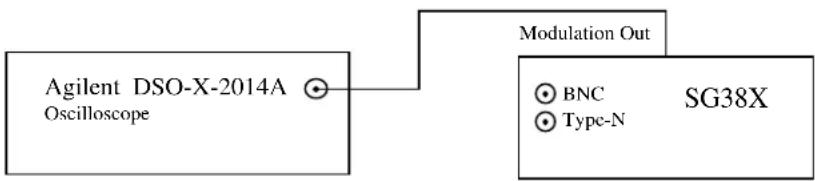
flowchart
graph LR
    A["Agilent DSO-X-2014A Oscilloscope"] --> B["Modulation Out"]
    B --> C["BNC"]
    B --> D["Type-N"]
    B --> E["SG38X"]
Figure 7: Setup for modulation output test.
To verify the operation of the modulation output, use the following procedure:
- Connect the equipment as shown in Figure 7.
- Set the scope to trigger on Ch 1, rising edge
- Set the vertical scale to 500 mV/div
- Set the timebase to 500 us/div
- On the SG380 series generator, press the keys [SHIFT], [0], and [Hz] to reset the instrument to default settings.
- Press [MOD FCN] and then press ADJUST [] two times. The display should read “func triangle.”
- Press [ON/OFF] to turn the modulation on.
The waveform on the scope should look similar to that shown in Figure 8. It should be a 1 kHz triangle wave centered about 0 V with a peak to peak deviation of 2 V. Verify that the waveform has no discontinuities.

line
| Time (s) | Amplitude (s) | |----------|---------------| | 0.0 | 0.5 | | 1.0 | 2.5 | | 2.0 | 0.5 | | 3.0 | 2.5 | | 4.0 | 0.5 | | 5.0 | 2.5 | | 6.0 | 0.5 | | 7.0 | 2.5 | | 8.0 | 0.5 | | 9.0 | 2.5 | | 10.0 | 0.5 | | 11.0 | 2.5 | | 12.0 | 0.5 | | 13.0 | 2.5 | | 14.0 | 0.5 | | 15.0 | 2.5 | | 16.0 | 0.5 | | 17.0 | 2.5 | | 18.0 | 0.5 | | 19.0 | 2.5 | | 20.0 | 0.5 | | 21.0 | 2.5 | | 22.0 | 0.5 | | 23.0 | 2.5 | | 24.0 | 0.5 | | 25.0 | 2.5 | | 26.0 | 0.5 | | 27.0 | 2.5 | | 28.0 | 0.5 | | 29.0 | 2.5 | | 30.0 | 0.5 | | 31.0 | 2.5 | | 32.0 | 0.5 | | 33.0 | 2.5 | | 34.0 | 0.5 | | 35.0 | 2.5 | | 36.0 | 0.5 | | 37.0 | 2.5 | | 38.0 | 0.5 | | 39.0 | 2.5 | | 40.0 | 0.5 | | 41.0 | 2.5 | | 42.0 | 0.5 | | 43.0 | 2.5 | | 44.0 | 0.5 | | 45.0 | 2.5 | | 46.0 | 0.5 | | 47.0 | 2.5 | | 48.0 | 0.5 | | 49.0 | 2.5 | | 50.0 | 0.5 | | 51.0 | 2.5 | | 52.0 | 0.5 | | 53.0 | 2.5 | | 54.0 | 0.5 | | 55.0 | 2.5 | | 56.0 | 0.5 | | 57.0 | 2.5 | | 58.0 | 0.5 | | 59.0 | 2.5 | | 60.0 | 0.5 | | 61.0 | 2.5 | | 62.0 | 0.5 | | 63.0 | 2.5 | | 64.0 | 0.5 | | 65.0 | 2.5 | | 66.0 | 0.5 | | 67.0 | 2.5 | | 68.0 | 0.5 | | 69.0 | 2.5 | | 70.0 | 0.5 | | 71.0 | 2.5 | | 72.0 | 0.5 | | 73.0 | 2.5 | | 74.0 | 0.5 | | 75.0 | 2.5 | | 76.0 | 0.5 | | 77.0 | 2.5 | | 78.0 | 0.5 | | 79.0 | 2.5 | | 80.0 | 0.5 | | 81.0 | 2.5 | | 82.0 | 0.5 | | 83.0 | 2.5 | | 84.0 | 0.5 | | 85.0 | 2.5 | | 86.0 | 0.5 | | 87.0 | 2.5 | | 88.0 | 0.5 | | 89.0 | 2.5 | | 90.0 | 0.5 | | 91.0 | 2.5 | | 92.0 | 0.5 | | 93.0 | 2.5 | | 94.0 | 0.5 | | 95.0 | 2.5 | | 96.0 | 0.5 | | 97.0 | 2.5 | | 98.0 | 0.5 | | 99.0 | 2.5 | | Auto | - |Figure 8: Modulation output waveform.
Modulation Input Test
This is test verifies the operation of the modulation engine and modulation input. It does not test to any specifications. This test requires the setup shown in Figure 9

flowchart
graph TD
    A["DS345 Function Generator"] -->|Function| B["Mod Out"]
    C["Agilent DSO-X-2014A Oscilloscope"] -->|Mod Out| B
    B -->|Mod In| D["SG38X"]
    D -->|BNC Type-N| B
Figure 9: Setup for modulation input test.
To verify the operation of the modulation input, use the following procedure:
- Connect the equipment as shown in Figure 9.
- Set the scope to trigger on Ch 1, rising edge
- Set the vertical scale to 500 mV/div
- Set the timebase to 500 us/div
- Reset the DS345 to default settings by pressing [SHIFT], [RCL]
- Set the DS345 for triangle waves by pressing FUNCTION [▽] twice.
- Set the DS345 for a 1 Vpp output by pressing the keys [AMPL], [1], [Vpp].
-
On the SG380 series generator, press the keys [SHIFT], [0], and [Hz] to reset the instrument to default settings.
-
Select external modulation by pressing [MOD FCN] and then pressing ADJUST [▽] until the “EXT” LED is highlighted. The display should read “func etrn. ac dc”
-
Press [ON/OFF] to turn the modulation on.
The waveform on the scope should look similar to that shown in Figure 10. It should be a 1 kHz triangle wave centered about 0 V with a peak to peak deviation of 2 V. Verify that the waveform has no discontinuities.

line
| Time (s) | Amplitude | |----------|---------| | 0.0 | 1 | | 1 | 0 | | 2 | 3 | | 3 | 0 | | 4 | 3 | | 5 | 0 | | 6 | 3 | | 7 | 0 | | 8 | 3 | | 9 | 0 | | 10 | 3 | | 11 | 0 | | 12 | 3 | | 13 | 0 | | 14 | 3 | | 15 | 0 | | 16 | 3 | | 17 | 0 | | 18 | 3 | | 19 | 0 | | 20 | 3 | | 21 | 0 | | 22 | 3 | | 23 | 0 | | 24 | 3 | | 25 | 0 | | 26 | 3 | | 27 | 0 | | 28 | 3 | | 29 | 0 | | 30 | 3 | | 31 | 0 | | 32 | 3 | | 33 | 0 | | 34 | 3 | | 35 | 0 | | 36 | 3 | | 37 | 0 | | 38 | 3 | | 39 | 0 | | 40 | 3 | | 41 | 0 | | 42 | 3 | | 43 | 0 | | 44 | 3 | | 45 | 0 | | 46 | 3 | | 47 | 0 | | 48 | 3 | | 49 | 0 | | 50 | 3 | | 51 | 0 | | 52 | 3 | | 53 | 0 | | 54 | 3 | | 55 | 0 | | 56 | 3 | | 57 | 0 | | 58 | 3 | | 59 | 0 | | 60 | 3 | | 61 | 0 | | 62 | 3 | | 63 | 0 | | 64 | 3 | | 65 | 0 | | 66 | 3 | | 67 | 0 | | 68 | 3 | | 69 | 0 | | 70 | 3 | | 71 | 0 | | 72 | 3 | | 73 | 0 | | 74 | 3 | | 75 | 0 | | 76 | 3 | | 77 | 0 | | 78 | 3 | | 79 | 0 | | 80 | 3 | | 81 | 0 | | 82 | 3 | | 83 | 0 | | 84 | 3 | | 85 | 0 | | 86 | 3 | | 87 | 0 | | 88 | 3 | | 89 | 0 | | 90 | 3 | | 91 | 0 | | 92 | 3 | | 93 | 0 | | 94 | 3 | | 95 | 0 | | 96 | 3 | | 97 | 0 | | 98 | 3 | | 99 | 0 | | Auto | -1 |Figure 10: Modulation input test waveform.
Timebase Calibration
The accuracy of the internal timebase may be tested against a house reference if it is known that the house reference has a superior stability and accuracy than the timebase installed in the SG380 series generator. Use the setup shown in Figure 11 to test the accuracy of the timebase.
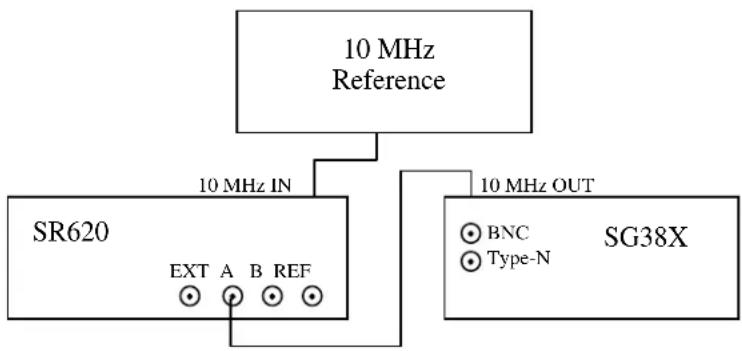
flowchart
graph TD
    A["10 MHz Reference"] --> B["SR620"]
    A --> C["SG38X"]
    B --> D["EXT A B REF"]
    C --> E["BNC"]
    C --> F["Type-N"]
    style A fill:#f9f,stroke:#333
    style B fill:#ccf,stroke:#333
    style C fill:#cfc,stroke:#333
Figure 11: Setup for timebase calibration
The accuracy and stability of the SG380 series timebase depends on the type of timebase installed. An optional timebase, if installed, can be identified on the rear panel of SG380 series generator under the serial number with the label “Rubidium Timebase”
If the standard OCXO timebase is installed, an FS725 Rb frequency standard may be used as the 10 MHz reference. If a rubidium timebase is installed, a cesium based reference will be required as a reference.
SR620 Configuration
Use the following procedure to set up the SR620:
- With the power off hold down the [CLR] button in the DISPLAY section and turn the power on. This resets the SR620 to default settings.
- Press [SEL] in the CONFIG section until "CAL" is flashing
- Press [SET] in the CONFIG section until "cloc Source" is displayed
- Press SCALE[△] in the SCOPE AND CHART section until “cloc Source rear” is displayed
- Press MODE [▽] button until the selected mode is FREQ.
- Press [SEL] in the CONFIG section until "OUT" is flashing
- Press [SET] in the CONFIG section until "Gate Scale" is displayed
- Press SCALE[△] in the SCOPE AND CHART section until 100 is displayed.
- Press the DISPLAY [] to return to the normal display
- Press the GATE/ARM [△] button once to set the gate to 10 s
- If a rubidium timebase is installed in the SG380 series generator, press the GATE/ARM [] button once more to set the gate to 100 s
- Press the SAMPLE SIZE [▽] button three times to set the sample size to 1.
- Turn the trigger level knob above the channel A input counter clockwise until AUTO is highlighted.
- Press the channel A [INPUT] button once to switch to 50 Ω termination.
Timebase Calibration Test
It is critical that the timebase be fully warmed up before measurements are taken. Allow at least 1 hour of warm-up for installed timebase to stabilize.
Record the timebase frequency reported by the SR620. Compare it to the stated one-year accuracy shown in Table 36 for the installed timebase.
Table 36: Timebase calibration test
| Timebase | Freq. (MHz) | Measured Freq. (MHz) | Limit (Hz) |
| Standard | 10 | ±0.5 | |
| Opt 4: Rubidium | 10 | ±0.01 |
Calibration
The SG380 series internal timebase may be calibrated from the front panel using the measurements taken above. The process is iterative. Use the following procedure to calibrate the internal timebase:
- Press [SHIFT], [+/-] to activate the CAL secondary function. Then press Press the SELECT [▷] until the display shows “tcal.”
- Press the ADJUST [] and [] keys to adjust the timebase frequency up or down respectively.
- Measure the new frequency with the SR620.
- Repeat steps 2 and 3 until the desired frequency accuracy is achieved.
Option Board Verifications
The SG380 series RF signal generators may be outfitted with up to 3 options installed on the rear panel. Option 1 provides clock outputs. Option 2 provides an RF doubler for RF out to 8 GHz. Option 3 provides external IQ modulation capability.
Option 1: Clock Output Test
This test verifies the operation of option-1 clock outputs. This test requires the setups shown in Figure 12 and Figure 14. The first test merely demonstrates overall operation. The second test verifies calibration of the outputs.
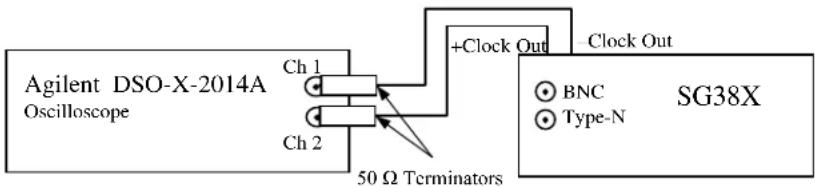
text_image
Agilent DSO-X-2014A Oscilloscope Ch 1 Ch 2 +Clock Out Clock Out 50 Ω Terminators BNC Type-N SG38XFigure 12: Clock output operation test.
To verify overall operation of the option 1 clock outputs, use the following procedure:
- Connect the equipment as shown in Figure 12.
- Set the scope to trigger on Ch 1, rising edge
- Set the vertical scale to 200 mV/div for both Ch 1 and Ch 2.
- Set the timebase to 20 ns/div
- On the SG380 series generator, press the keys [SHIFT], [0], and [Hz] to reset the instrument to default settings.
The waveform on the scope should look similar to that shown in Figure 13. It should be a 10MHz square wave centered about 0V with a peak to peak deviation of 0.4V . Verify that the waveform has 50% duty cycle and that the two waveforms are 180^ out of phase. Please note that this scope is not fast enough to resolve the actual transition times of the clock outputs. A much higher bandwidth scope would be required for that measurement.
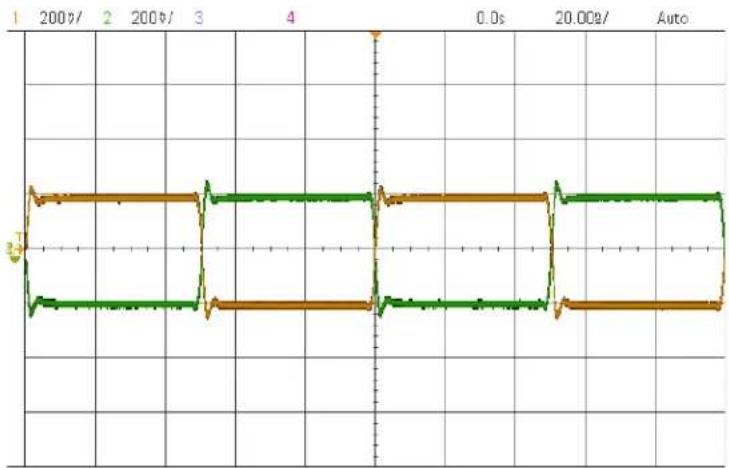
Figure 13: Clock output waveform.
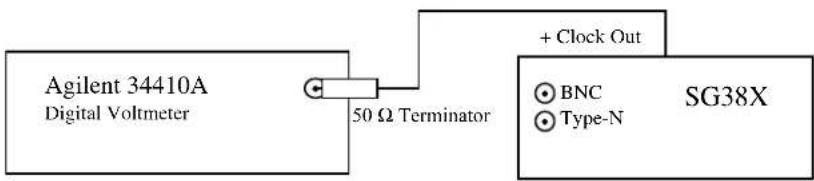
text_image
Agilent 34410A Digital Voltmeter 50 Ω Terminator + Clock Out BNC Type-N SG38XFigure 14: Clock output level test.
To verify calibration of the option 1 clock outputs, use the following procedure:
- Connect the equipment as shown in Figure 14.
- On the SG380 series generator, press the keys [SHIFT], [0], and [Hz] to reset the instrument to default settings.
- Press the keys [FREQ], [1], and [Hz] to set the frequency to 1 Hz.
- Press the key [AMPL] until the display shows "cloc."
- Press [0], [.], [4], [Vpp] to set the amplitude the first entry in Table 37
- Record and verify the output levels meet the limits specified in Table 37
- Repeat steps 5 and 6 for the other amplitudes given in Table 37.
Table 37: Amplitude level requirements for the option 1 clock outputs
| Set Ampl. (Vpp) | Level (V) | Measured Level (V) | Limits (V) |
| 0.400 | -0.200 | ±0.05 | |
| +0.200 | ±0.05 | ||
| 1.000 | -0.500 | ±0.05 | |
| +0.500 | ±0.05 |
Option 2: RF Doubler Test
This test verifies the signal generation of the option-2 RF doubler. It uses the Agilent E4440A spectrum Analyzer to verify the frequency generation of the doubler. This test requires the setup shown in Figure 15.

flowchart
graph TD
    A["Agilent E4440A\nSpectrum Analyzer"] --> B["Opt 2 RF"]
    B --> C["SG38X\nBNC\nType-N"]
    B --> D["10 MHz OUT"]
    A -->|Ext Ref IN| A
Figure 15: RF doubler frequency test.
To verify the frequency generation of the option-2 RF under test perform the following procedures:
- Connect the equipment as shown in Figure 15
- Verify that the spectrum analyzer is locked to the 10 MHz external reference frequency.
- Align the spectrum analyzer by pressing the keys [System], [Alignment], [Align All Now].
- On the SG380 series generator, press the keys [SHIFT], [0], and [Hz] to reset the instrument to default settings.
- Press [FREQ] to select frequency. Then enter the test frequency given in Table 38. Note that for the SG386, only frequencies above 6 GHz apply.
- Verify that the measured frequency is within the limits given in Table 38.
- Repeat steps 6 and 7 for all the frequencies given in Table 38
Note that frequencies above 2025 MHz do not apply to the SG382. Similarly, frequencies above 4050 MHz do not apply to the SG384. All test frequencies apply to the SG386
Table 38: Test frequencies for option 2 frequency synthesis
| Test Freq. (MHz)1 | Measured Freq. (MHz) | Limit (Hz) |
| 4000 | ±2 | |
| 4500 | ±2 | |
| 5000 | ±2 | |
| 5500 | ±2 | |
| 6000 | ±2 | |
| 6500 | ±2 | |
| 7000 | ±2 | |
| 7500 | ±2 | |
| 8000 | ±2 |
^1 Test frequencies less than or equal to 6 GHz do not apply to the SG386
Option 2: DAC Output Test
This test verifies the operation of the option-2 DAC output. This test requires the setup shown in Figure 16.
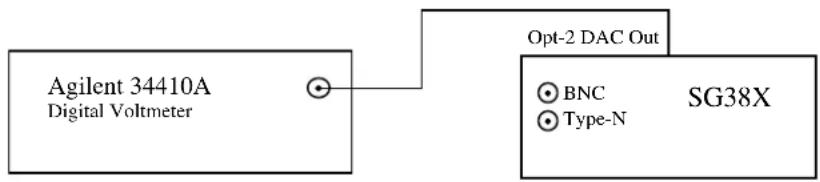
flowchart
graph LR
    A["Agilent 34410A<br>Digital Voltmeter"] --> B["Opt-2 DAC Out"]
    B --> C["BNC"]
    B --> D["Type-N"]
    C --> E["SG38X"]
    D --> E
Figure 16: Option-2 DAC output test.
To verify the operation of the option-2 DAC output, perform the following procedures:
- Connect the equipment as shown in Figure 16
- On the SG380 series generator, press the keys [SHIFT], [0], and [Hz] to reset the instrument to default settings.
- Press [DC OFFS] successively until the display reads "rear dc."
- Enter the test voltage given in Table 39.
- Verify that the measured voltage is within the limits given in Table 39.
- Repeat steps 4 and 5 for all the voltages given in Table 39
Table 39: Test voltages for option 2 DAC output
| Set Voltage (V) | Measured Voltage (V) | Limit (V) |
| -10.0 | ±0.02 | |
| -5.0 | ±0.02 | |
| 0.0 | ±0.02 | |
| 5.0 | ±0.02 | |
| 10.0 | ±0.02 |
Option 3: IQ Modulation
This test verifies the operation of the option-3 IQ modulator. This test requires the setup shown in Figure 17

flowchart
graph LR
    A["Agilent E4440A Spectrum Analyzer"] -->|Ext Ref IN| B["SG38X"]
    B -->|1 MHz OUT| C["BNC"]
    B -->|1 MHz OUT| D["Type-N"]
Figure 17: Option 3 IQ modulator test.
To verify the operation of the IQ modulator use the following procedure:
- Connect the equipment as shown in Figure 17
- Verify that the spectrum analyzer is locked to the 10 MHz external reference frequency.
- Align the spectrum analyzer by pressing the keys [System], [Alignment], [Align All Now].
- On the SG380 series generator, press the keys [SHIFT], [0], and [Hz] to reset the instrument to default settings.
- Press [FREQ], [1], [GHz] to set the frequency to 1 GHz
- Press [TYPE] and then press ADJUST [] until the IQ (Opt) LED is highlighted. The display should read “iq.”
- Press [DC OFFS] successively until the display reads "bnc"
- Press [0], [.], [5], [Vpp] to set the DC offset to 0.5 V.
- Measure the amplitude of the 1 GHz signal on the Agilent spectrum analyzer.
- Press [ON/OFF] to enable external IQ modulation.
- Measure the amplitude of the 1 GHz signal on the Agilent spectrum analyzer.
- Disconnect the BNC cable from the rear panel I input.
- Measure the amplitude of the 1 GHz signal on the Agilent spectrum analyzer.
The difference between the values recorded in step 9 and step 11 should be less than 1 dB. The difference between the values recorded in step 11 and step 13 should be greater than 40 dB.
Conclusions
The tests described in this document are designed to test the basic functionality of the unit. They are not intended to be a substitute for the complete performance test which is performed at the factory. Nevertheless, one can have reasonable confidence that instruments that pass the tests described in this document are operating correctly. As always, if an instrument fails to pass a test, verify that the setup has been duplicated correctly, and that the individual procedures have been followed as specified. Instruments that have failed to meet specifications may be returned to SRS for repair.
Circuit Description
Overview
There are three RF Signal Generators in the SG380 Series: The SG382 (DC to 2.025 GHz), the SG384 (DC to 4.050 GHz) and the SG386 (DC to 6.075 GHz).
Each signal generator has extensive modulation capabilities including AM, FM, M , Sweeps, Pulse, and (optional) IQ modulation. The units' low phase noise (-116 dBc/Hz at 20 kHz offset at 1 GHz) and high resolution (1 Hz at all frequencies) are provided by a unique synthesis technique that allows essentially zero channel spacing together with a high phase comparison frequency without the noise or spurs associated with conventional fractional-N synthesis.
Several options improve or extend the performance of the Signal Generators. Option 1 provides complimentary clock outputs with 35 ps transition times. Option 2 is a frequency doubler that provides a rear panel SMA output up to 8.1 GHz (available on the SG384 and SG386). Option 3 provides high bandwidth, rear panel I/Q modulation inputs. Option 4 improves the timebase accuracy with a rubidium oscillator.
The three models (SG382, SG384 and SG386) share a common design approach. All units use the same power supply and motherboard (which includes timebase and frequency references, DDS synthesizers, VCXO filters, modulation generator, and computer interfaces).
The RF Block for the SG382 and SG384 is identical, using a 1900 MHz to 4100 MHz VCO and digital dividers to synthesize RF frequencies. The top octave is not used (or calibrated) in the SG382, whose maximum frequency is 2.025 GHz.
The RF Block for the SG386 is different from that used in the SG382 and SG384. The VCO in the SG386 covers from 3 GHz to 6 GHz, and the output amplifier uses a pHEMT gain block instead of the InGaP gain block which is used in the SG382 and SG384.
For brevity, the circuit description which follows will refer to the SG384. Differences between the units will be detailed as required.
Block Diagram
(Schematic 1: Block Diagram)
Important sections of the instrument, and the interconnections between them, are illustrated in the block diagram. We will follow the RF signal path first, and then we will discuss the various support functions.
The RF path starts in the upper left corner with the Timebase and ends in the lower right corner with the Output Amplifiers and Attenuators. The timebase consists of a 20 MHz VCXO that is phase locked to an internal OCXO, to an internal rubidium timebase (Option 4), or to an external 10 MHz reference. A 100 MHz VCXO is phase locked to the 20 MHz timebase. The 100 MHz is divided by four to provide 25 MHz to the CPU and FPGA. The 100 MHz is also the sample clock for a 48-bit DDS (here after referred to as the LF DDS). The frequency resolution of the LF DDS is extended to 64 bits via the FSK pin of the LF DDS. The output frequency of the instrument is proportional to the frequency output of this LF DDS and so this establishes the instrument's frequency resolution.
The output of the LF DDS cannot serve directly as the reference for the RF synthesizer because spurs on the LF DDS output would appear on the RF output, increased in magnitude by 6 dB per octave between the LF DDS output and the instrument's RF output. Hence, one of three VCXOs is used to filter the LF DDS output to remove the spurs. Two of the VCXOs can be tuned by ±100 ppm (around 19.5541 MHz or 19.6617 MHz), while the third VCXO can be tuned by ±10 ppm around 19.607843 MHz (collectively referred to hereafter as 19+ MHz VCXO). These frequencies were chosen to maximize the phase comparison frequency in the RF synthesizer's PLL, as well as optimizing performance at canonical frequencies. The LF DDS is programmed to operate in one of these three ranges and the corresponding VCXO is phase locked to the LF DDS. The output of the phase locked VCXO, whose frequency can now be set with 64 bits of resolution, becomes the timebase for the RF synthesizer.
The selected 19+ MHz VCXO is multiplied up by ×51 to a frequency near 1 GHz by the PLL synthesizer in the RF Reference / Baseband DDS section of the block diagram. The 1 GHz output serves as the sample clock to a 32-bit DDS (hereafter referred to as the RFDDS). The output of the RFDDS becomes the reference frequency for the RF synthesizer. The RFDDS is programmed to divide by an integer when it is used as a reference for an unmodulated RF output. Dividing by an integer eliminates DDS spurs, as the DDS repeats the exact same sequence for every cycle of its divided output and so “spurs” collect together as harmonics which do not cause clock jitter or spurious frequency outputs. When generating frequency or phase modulated outputs the RFDDS provides agile modulation of the RF reference frequency via the 16-bit words from the FPGA modulation processor, which are updated at 125 MHz.
The output of the 1 GHz, 32-bit, RFDDS is filtered and passed differentially to the RF synthesizer in the RF Block to serve as the PLL frequency reference, f_ref . A wideband VCO (1900-4100 MHz for the SG382 and SG384, or 3 GHz to 6 GHz for the SG386) is divided by N and phase locked to the reference divided by R, to produce and output a frequency of f_ref × N / R . The output of this synthesizer clocks binary dividers to provide square wave outputs in the 5 octaves below the RF VCO frequency. The square waves are low-pass filtered to provide sine wave outputs over the same frequency range. An RF multiplexer selects one of the sine waves, or the original reference sine wave (in the case that the RF output is less than 62.5 MHz (less than 93.75 MHz for the SG386), as the
source to the RF output stages. Another RF multiplexer selects the corresponding square wave to serve as the source for the rear panel clock and doubler options.
The selected RF sine wave is passed to the RF Output Amplifiers and Attenuators block. An I/Q modulator is inserted into the signal path when I/Q modulation is being used, otherwise the RF output is passed directly to a series of RF attenuators and amplifiers which provide an output amplitude range from -107 dBm to +16.5 dBm. A voltage variable attenuator is used to provide amplitude modulation. The amplified and attenuated RF sine wave, in the frequency range of 950 kHz to 2, 4 or 6 GHz, is output via the front panel type-N connector.
There is another signal path for output signals between dc and 62.5 MHz (93.75 MHz for the SG386). The 32-bit RFDDS on the mother board provides signals in this range directly. The differential signals are passed to the output block and can be amplified or attenuated to a range from 1mV_rms to 1V_rms and offset with a dc voltage. The amplified and offset output is passed out the front panel BNC connector via 50 .
There are several modulation paths. As previously described, frequency and phase modulation is provided by the FPGA via the RFDDS's parallel port. The source for the modulation waveform can be a table in the FPGA, data stored in a larger memory external to the FPGA, or up-sampled and digitally filtered data streaming from an ADC which digitizes the rear panel modulation input. An analog copy of the modulation waveform is output via a rear panel BNC.
Analog signals to provide I/Q modulation can originate from a table in the FPGA, or data stored in a larger memory external to the FPGA, up-sampled to 125 MHz, digitally filtered, and output via dual 14-bit DACs. I/Q modulation can also be provided directly via rear panel BNC inputs (Option 3). Copies of the I&Q modulation waveforms can be output via rear panel BNCs (Option 3).
Amplitude modulation can originate from a table in the FPGA, data stored in a larger memory external to the FPGA, or up-sampled data streaming from an ADC which digitizes the rear panel modulation input. RF outputs above 62.5 MHz (93.75 MHz for the SG386) are amplitude modulated via a voltage variable attenuator in the RF output stages. Outputs below 62.5 MHz (93.75 MHz for the SG386) are amplitude modulated via the 16-bit parallel port on the RFDDs. An analog copy of the modulation waveform is output via a rear panel BNC.
A Coldfire™ microcontroller is used to control all aspects of the instrument's operation and to interface to external computers via the Ethernet, GPIB or RS-232. The microcontroller also responds to front panel key presses and updates front panel displays.
The front panel display is fully static (there is one latched bit per display segment or indicator lamp.) This approach eliminates the possibility of a display refresh spur in the RF output. The front panel display is written to and read from serially when a change is made or a key is pressed.
The system power supply is enclosed in a separate enclosure within the instrument for safety and shielding. A universal input power supply converts the line voltage to +24 V _oc which is always present to provide power to the OCXO or optional rubidium timebase. An inverter operates to provide ±15, ±5, and +3.3 V when the unit is switched “on” to power the rest of the instrument.
Detailed Circuit Description
Several sub-assemblies will be described:
- The front panel display
- The front panel display EMI filter
- The mother board
- The RF synthesizer
- The RF output amplifiers and attenuators
- The power supply
- Option 1 (high speed clock outputs)
- Option 2 (4-8 GHz RF output)
- Option 3 (I/Q modulation inputs & outputs)
- Option 4 (Rubidium Timebase)
Front-Panel Display
(Schematic 2: Front Panel Display)
The front panel consists of 16 seven-segment displays, 47 LED lamps, and 33 key conductive rubber keypads. The front panel display is fully static in that there is one latched bit for each LED segment or lamp. Data is written to the display serially via the SPI (Serial Peripheral Interface Bus). When a key is pressed, the input to the corresponding latch is pulled high, and a KEYPRESS interrupt is sent to the CPU. Key press data is latched when the CPU responds with a -CS_FRONT. As data is being written to the display, latched key press data is also read back over the SPI.
The lamp currents (which set brightness) are equal to the +3.3 V supply, minus the \~2 V LED voltage, divided by resistance of the current limiting network (100 Ω). The LED display segment current (which sets segment brightness) is equal to +3.3 V supply, minus the \~1.5 V LED voltage, minus the 0.7 V base-emitter voltage of Q1A (for example), divided by resistance of the current limiting network (680 Ω). The intensity of a digit can be increased by turning on the other transistor in the pair (Q1B, for example) by setting Q7 of U43 low and asserting –INTENSIFY, which will cause the voltage on the common anode of U16 to increase by about 0.6 V.
Front-Panel Display EMI Filter
(Schematic 3: Display EMI Filter)
The Front panel Display is shielded from the main box via a metal panel. The SPI interface and power connections are filtered by a separate PCB. These help to eliminate EMI and reduce the display interference in the main system's sensitive electronics.
Motherboard
The motherboard is the large PCB nearest to and approximately the same size as the bottom cover of the instrument. There are eight pages of schematics for the motherboard. Circuits include 10 MHz & 20 MHz timebases, three 19+ MHz VCXOs, Coldfire CPU with Ethernet, GPIB, and RS-232 interfaces, FPGA modulation processor, modulation DACs and external modulation ADC, 1 GHz VCO, an RF reference DDS, and interfaces to the RF Block and the rear panel options.
Timebases
(Schematic 4: Mother Board 1, Frequency Refs)
The timebase reference is a 20 MHz VCXO consisting of the 3^rd overtone crystal, Y100, and the Colpitts oscillator, Q100. The crystal is designed to operate with a 20 pF load which is the series combination of C110, the tank L103/C111, and the varactor D100. To provide gain, both C110 and the parallel combination of L103 & C111 must have a capacitive reactance. The L103/C111 tank has an inductive reactance below 8.9 MHz which prevents the oscillator from operating at the fundamental frequency of the crystal. The crystal is operated just above its series resonance, and so has an inductive reactance that resonates with the load capacitance. The operating frequency is controlled by the dc voltage applied to the varactor.
The oscillator's circulating current is cascoded into the emitter of Q101 through to the collector, which is held at dc ground by L105 and amplitude limited by the dual Schottky, U105. The output is amplified and buffered by the low noise amplifier, U107, which provides a (nearly) square wave output with amplitude of about 2.4 Vpp at 20 MHz. This signal is ac coupled and converted to a 3.3 V CMOS level square wave by U114, which is powered by a low noise source, U112.
The 20 MHz square wave can be phase locked to an external timebase reference or to an internal OCXO or optional rubidium oscillator by the PLL synthesizer, U106. The 10 MHz RF input to the PLL synthesizer is selected by the multiplexer U109. Another multiplexer, U103, improves isolation between the internal OCXO or rubidium reference and the external timebase reference.
The presence of an internal reference is detected by the diodes U100 and the corresponding peak detection circuit. The presence of an external reference is detected by the diodes U104 and the corresponding peak detection circuit. The CPU operates the multiplexers to select the external reference whenever it is available, the internal OCXO or rubidium next, or a fixed programming voltage to adjust the 20 MHz VCXO as a last resort.
The PLL synthesizer's charge pump output is conditioned by the loop filter U110B. The loop filter has a bandwidth of about 140Hz . The multiplexer U108 selects between the
charge pump output (when the PLL is active) or a fixed programming voltage, CAL_VCO (when no better reference is available). A lock detect signal is provided to the CPU.
The 20 MHz is divided by two by U115, which drives transformer T100 differentially. The output of the transformer is low pass filtered (with a notch at 30 MHz) to provide the 10 MHz sine wave timebase output on a rear panel BNC.
A 100 MHz VCXO, U119, is phase locked to the 20 MHz reference by U116, a CMOS PLL frequency synthesizer. The differential outputs from the VCXO are used to clock a 48-bit DDS, and converted to CMOS logic levels and divided by 4 to generate 25 MHz clocks for the CPU and FPGA sections.
LF DDS and 19 MHz Reference
(Schematic 5: Mother Board 2, 19 MHz Ref)
The singular purpose of this page of schematics is to produce a low noise “19MHZ_REF” square wave which serves as the reference frequency for the rest of the RF synthesizer chain. A DDS (hereafter referred to as the LF DDS) is used to provide a frequency reference of 19 MHz and a resolution of 1:10^18 . Spurs and noise outside of the PLL loop bandwidth are rejected from the DDS output by phase locking a narrowband VCXO to the LF DDS. Spurs at all frequencies are reduced by applying a PRBS (pseudo-random binary sequence) to the FSK (frequency-shift key) input of the LF DDS with a repetition rate of about 98 kHz.
There are three nearly identical VCXOs. Each uses a crystal resonator in a Colpitts oscillator. The middle VCXO (19.607843 MHz) uses a ^1 overtone crystal and so has less phase noise and a narrower tuning range than the other VCXOs. The configuration of the middle VCXO is identical to the 20 MHz timebase described above. The circulating oscillator current is cascoded into the emitter of Q204. The collector load (L204 and back-to-back Schottky diodes U204) shape the signal current into a nearly square wave with no dc offset.
One of the three VCXOs is selected to be phase locked to the LF DDS. The selected VCXO has its output amplifier (U209, U210 or U211) enabled. An output multiplexer (U206, U207 or U208) connects the selected VCXO output to the input of U213, which shapes the selected signal into a CMOS level square wave.
The 100 MHz timebase serves as the clock to a LF DDS (U215) which is programmed to generate frequencies over three ranges: 19.5541 MHz±100ppm, 19.607843 MHz ±10 ppm and 19.6617 MHz ±100 ppm. The frequency resolution of the 48-bit LF DDS is extended to 64-bits by toggling between two frequency tuning words with a duty cycle that has 16 bits of resolution. The differential output of the LF DDS is transformer coupled to a low pass filter (L217-222 and C252-254) that has a cutoff frequency of 24 MHz.
Spurs and broadband noise are rejected from the output of the LF DDS by phase locking one of three VCXOs to the LF DDS output. The selected VCXO is phase locked by a CMOS PLL synthesizer, U217. One of two loop filters is used: U216A, a loop filter with 400 Hz bandwidth, is used when the selected VCXO is one of the fundamental mode oscillators. U216B, a loop filter with 200 Hz bandwidth, is used when the 3^rd overtone oscillator is selected.
Microcontroller and Interface
(Schematic 6: Mother Board 3, CPU)
A Coldfire™ MCF52235 microcontroller is used to control the instrument and to interface to external computers via Ethernet, GPIB or RS-232. The microcontroller uses a 32-bit data path, has 256k of program flash ROM, 32k of RAM, an octal 12-bit ADC, and operates at 60 MHz from a 25 MHz clock input.
The microcontroller's ADCs are used to detect various PLL lock states, detect 10 MHz references, measure the control voltages applied to various VCOs, sense RF block temperature, measure the detected RF output, and measure miscellaneous systems voltages.
One of the microcontroller's UARTs is translated to RS-232 levels by U311 and made available on the rear panel for control by remote computers. The microcontroller's Ethernet controller is connected directly to a RJ-45 connector, U302, which is accessible on the rear panel to connect the instrument to a local area network. An 8-bit bidirectional port is used to interface the microcontroller to a GPIB controller, U316, whose connector is also on the instrument's rear panel.
The microcontroller's SPI (serial peripheral interface bus) is expanded to 16 ports by the decoders U308 and U309. The eight devices which are selected by U309 (PLL synthesizers, RF and Option control) are designated as “quiet” SPI devices. The SPI data and clock signals are only presented to these devices when one in the group is being addressed. Doing so reduces crosstalk disturbances which can add spurs to RF outputs. The AND gates in U312 gate “off” the QSCK and QMOSI signals unless the U309 decoder is enabled.
SPI devices include:
0) Idle, 1) spare, 2) FPGA modulation processor, 3) 19 MHz DDS, 4) RF DDS, 5) cal ROM flash, 6) front panel display, 7) miscellaneous control bits, 8) 20 MHz PLL, 9) 100 MHz PLL, 10) 19 MHz PLL, 11) 1 GHz PLL, 12) 4 GHz PLL, 13) RF block control, 14) Option 1&2 control, 15) system DAC.
Modulation Processor
(Schematic 7: Mother Board 4, Modulation Processor)
A Xilinx XC3S400A in a 320-pin BGA is used as a modulation processor in the SG384. The FPGA is attached to two large memories via a 16-bit data bus. The E28F320J3D75A, U402, is a Numonyx 32 MBit flash MEMORY which is used to store FPGA configurations and user arbitrary waveforms. The CY62167DV30, U400, is a Cypress 16 MBit, 55 ns static RAM used to store and play modulation waveforms.
Several FPGA configurations are stored in the flash MEMORY. Each configuration allows the FPGA to perform a variety of modulation tasks depending on the instrument configuration. For example, when EXT FM is selected, the FPGA reads digitized data from the ADC (U502) which digitizes the rear panel modulation input, then offsets, scales, and up-samples that data, and applies the result to the RF DDS's (U605) parallel input to frequency modulate the RF synthesizer's frequency reference. Another example: When the instrument is set to provide a wide span frequency ramp (Sweep, triangle, with a set modulation rate and modulation deviation) the FPGA is configured as a DDS to provide addresses that walk though a ramp of frequency values at a precise rate and provides interpolated frequency values to the parallel input of the RF DDS (U605). The FPGA will also control the values on the data bus LVL_DAC[0..13] which controls the analog signals ±RF_ATTN so as to level the amplitude of the RF output during the frequency sweep. A final example (this is a hardware provision for a future product): A user provided I/Q modulation pattern can be loaded into the static RAM. Data pairs are read from the RAM at a precise symbol rate, interpolated and up-sampled to about 125 MSPS, digitally filtered (by a root-raised cosine filter, for example), and the result applied to the dual 14-bit DAC (U513). The analog outputs from the dual DAC are filtered and applied differentially to the I/Q modulator in the RF block.
The FPGA has three clock sources whose use depends on the FPGA configuration. The PDCLK (which originates at RF DSS, U605, operating at the RF DDS frequency/4 or about 250 MHz) is used whenever the FPGA provides data to the RF DDS's parallel port. Timing is very critical in this case. The parallel data to the FPGA must arrive within a ±1 ns window with respect to the PDCLK. One of the FPGA's DCMs (Digital Clock Managers) is used to adjust the phase of the parallel output data to meet this timing requirement. The FPGA is able to measure the timing relationship between the PDCLK and the LSB of the parallel data (MD0) via IP_L32N and IP_L32P (at the upper right-hand corner of U401 on sheet 4 of 8.
The SYNC_CLK is used as the FPGA clock source when the FPGA is controlling the modulation via the profile inputs on the RF DDS (U605). Changes to the profile pins must arrive within a ± 1 ns window with respect to the SYNC_CLK. One of the FPGA's DCMs (Digital Clock Managers) is used to adjust the phase of the parallel output data to meet this timing requirement. The FPGA is able to measure the timing relationship between the SYNC_CLK and the LSB of the parallel data (MD0) via IP_L32N and IP_L28N (at the upper right-hand corner of U401 on sheet 4 of 8.
The ±25 MHZ_FPGA source is used as the FPGA clock for pulse and blanking modulation. A DCM is used to multiply the 25 MHz clock to 200 MHz to provide 5 ns resolution for the pulse or blanking period and width. The FPGA can blank the RF and baseband outputs via the differential LVDS signals ± RF_BLANK and ± BB_BLANK.
The FPGA is initially programmed via the SPI from the CPU. Configurations are uploaded to the FPGA and stored in the flash ROM during system programming at the factory. A 6-pin JTAG connector, J400, allows direct access to the FPGA for development purposes.
Modulation ADC and DACs
(Schematic 8: Mother Board 5, Modulation ADC / DACs)
There is a rear panel modulation input BNC, J500, which allows user supplied signals to modulate amplitude, frequency, or phase of the SG384 outputs. The same input can also be used for pulse and blank modulation.
In EXT PULSE or EXT BLANK modulation modes, the rear panel modulation input is discriminated by U501 to provide a digital input, EXT_TRIG, to the FPGA. Depending on the operating mode and frequency, the FPGA will use EXT_TRIG to control ±RF_BLANK and/or ±BB_BLANK to pulse or blank the signal generator's outputs.
For EXT AM, FM or M , the rear panel modulation input is limited by D501 & D502, buffered by U500A, ac or dc coupled through U503, and low-pass filtered by a 1 MHz, 5^th order, Bessel filter (L503/L504/C511-C514). The filtered signal is buffered by U504 and digitized by U502, a 12-bit ADC operating at about 31.25 MSPS. The data from the DAC is provided to the FPGA on the 12-bit parallel data bus, ADC[0..11]. The data is offset, scaled (and linearized in the case of amplitude modulation of RF outputs) and upsampled to modulate the amplitude, frequency or phase of the signal generator outputs.
There are four high speed (125 MSPS), high resolution (14-bit) DACs that are controlled by the FPGA. The DACs have several purposes:
- To mimic the modulation waveform on the rear panel modulation output BNC. 2. To level the RF amplitude during sweeps. 3. To level the baseband output during sweeps, or, to provide the I-component for I/Q modulation. 4. To level the doubler output during sweeps, or, to provide the Q-component for I/Q modulation.
All of the DACs have a similar configuration. The clock to each DAC is resynchronized to the PDCLK (from U605) to minimize sample jitter. The data to the DACs is loaded in parallel from the FPGA. The differential outputs are filtered by a Bessel low-pass filter (fc = 1 MHz for two of the DACs and fc = 10 MHz for the I/Q DACs). The filter outputs are buffered by differential line drivers with a fixed gain of ×2 and a 49.9 Ω source impedance.
RF DDS
(Schematic 9: Mother Board 6, RF Reference)
The RF DDS has two functions: To provide a reference frequency to the RF synthesizer (located in the RF block), or, in the case that the output is below 62.5 MHz (93.75 MHz for the SG386), to synthesize the output directly. The RF DDS is an AD9910 (U605), which integrates a 1 GSPS NCO with a 14-bit DAC. The SFDR of the part is better than -65 dBc for output frequencies below 100 MHz. This is quite adequate for direct outputs (below 62.5 MHz) but would be unsatisfactory when multiplied up to higher frequencies. (For example, a spur would increase in magnitude by 40 dB when a reference is “multiplied” up from 40 MHz to 4 GHz.)
There is a neat trick to eliminate DDS spurs: If the DDS is programmed to divide by an integer, then the output will sample the exact same DAC levels on each cycle, and so each cycle will be the same as the others. Fourier tells us that a repetitive waveform can be represented by a fundamental sine and its harmonics; hence a repetitive waveform has only a fundamental and harmonics but no spurs. This is easily seen when observing a DDS output on a spectrum analyzer. As the FTW (Frequency Tuning Word) approaches a value that corresponds to division by an integer all of the spurs gather up to fit beneath either the fundamental or its harmonics.
The requirement to divide by an integer requires further thought. For a 32-bit DDS, one cycle or 360^ corresponds to 2^32 = 4,294,967,296 in the phase accumulator. Division by an integer is simple if the integer is a power of 2. For example, to divide by 16 the FTW would be 4,294,967,296/16 = 268,435,456. However, to divide by 10, the FTW would be 4,294,967,29.6. Since the FTW must be an integer, there will be a truncation error of 0.6 bits per sample, a corresponding frequency error, and spurs in the output.
To fix this (in the case of division by 10) the DDS would be programmed to use a FTW of 429,496,729 for 9 sample clocks and 429,496,735 for 1 sample clock. Doing so accumulates exactly 2^32 in the phase accumulator after 10 sample clocks and so provides exact division by 10 with no spurs. This trick allows the RF DDS to generate a reference frequency for the RF synthesizer that has no significant spurs and so can be “multiplied” by the RF synthesizer without adding spurs to the RF output.
The clock to the RF DDS comes from a 1 GHz VCO which is phase locked to ×51 the selected 19+ MHz reference to provide precision clock rates in the ranges of 997.259 MHz ±100 ppm, 1,000.000 MHz ±10 ppm, or 1002.7467 MHz ±100 ppm. The charge pump output from the PLL synthesizer, U604, is filtered by U603, a low-noise, high bandwidth op-amp. The loop bandwidth is about 6 kHz.
The RF DDS is programmed to divide by an integer between 10 and 50 to provide output frequencies between 20 MHz and 100 MHz. The differential outputs are filtered and buffered before being sent to the RF Block to serve as the reference frequency input to the RF synthesizer.
The RF DDS has a 16-bit parallel port to allow for agile amplitude, frequency and phase modulation. The data is passed to the RF DDS from the FPGA modulation processor. The data on the parallel input, which is synchronized to the PDCLK, can directly modulate the amplitude or phase, or may be scaled and added to the FTW for FM. The DDS may also be rapidly modulated via the profile input ports, in which case the data is synchronized to the SYNC_CLK.
The data presented to the parallel port can only be used to modulate one parameter. In the case of frequency sweeps below 62.5 MHz (93.75 MHz for the SG386), the parallel data provides frequency tuning data to the RF DDS. A separate path is used to amplitude level low frequency sweeps: The differential ±BB_LEVEL signal converted to a single-ended signal by U600 and used to level the amplitude of the RF_DDS synthesizer as seen at the front panel BNC output.
RF Block and Rear-Panel Options Interface
(Schematic 10: Mother Board 7, Interface)
The common mode voltage on the differential output from the RF DDS is eliminated by U700, which integrates the difference between the common mode output voltage and ground. The integrated voltage is applied to the 100 terminations so as to eliminate the common mode voltage.
The differential DAC output is then filtered by a Chebyshev low-pass (L700, 701, 706, 707, etc) with a cutoff frequency of 150 MHz. The output of the filter is terminated and buffered by the differential amplifier, U702. A multiplexer, U701, passes the filtered RF DDS output to the RF block as either ±RF_REF (when the set frequency is above 62.5 MHz or 93.75 MHz for the SG386) or ±BB_OUT (when the set frequency is below 62.5 MHz or 93.75 MHz for the SG386).
The connector, J701, is used to pass signals between the motherboard and the rear panel options. Option 1 provides clock outputs at the set frequency. The RF signal required for this function comes directly from the RF block via an SMA cable, but power supplies and control signals (for controlling the amplitude and offset of the clock outputs) are provided via J701.
Option 2 provides a doubler to output a signal from 4 GHz (6 GHz for the SG386) to 8 GHz on a rear panel SMA connector. The RF signal required for this function comes directly from the RF block via an SMA cable, but power supplies and control signals (for controlling the amplitude of the doubler output) are provided via J701. Option 2 also provides a DC bias output on a rear panel SMA connector.
Option 3 provides rear panel analog inputs that can be used to directly modulate the I/Q modulator. The multiplexers U705 and U708 select between the internal I/Q modulation sources or the external I/Q modulation sources (which are provided by Option 3). This option also provides rear panel analog outputs which are copies of the I/Q modulation.
Power Conditioning
(Schematic 11: Mother Board 8, Power Supplies)
An enclosed power supply is used to provide regulated power to the motherboard via the large header, J800. Whenever the unit is plugged into the line, the un-switched +24 V will be present. This supply is used to maintain power to the timebase (an OCXO or an optional rubidium oscillator) even when the front panel power button is “off”. When the unit is switched “on” the other supplies ( ±15 , ±5 , +3.3V) become active. The inverter that generates those other supply voltages is operated at exactly 100 kHz, synchronized by the 100 ns wide, 200 kHz PS_SYNC pulses sourced from the CPU, U300.
The grounds and power supplies are all filtered and bypassed as they come onto the motherboard. In addition, there are several regulators which provide other voltages used in the system: +20, +8.5, +3.00 (which is used as a voltage reference throughout the system), +2.5, +1.8, +1.2, and -8.5 V.
An interrupt signal, -PWR_IRQ, is generated if the +24 V supply falls below +22 V or if the power switch is turned to “off”. This interrupt tell the CPU to “stand down” (in particular to not start new writes to memory) as the power supplies are about to turn “off”.
Motherboard to RF Block Jumper
(Schematic 12: Mother Board to RF Jumper)
This card provides the interface as well as filtering the signals to minimize any interference that could impair the signal quality. Single ended control signals implement a single order RC filter; differential signals implement a common mode choke; finally, power lines implement an LC filter.
RF Output Block
The RF Output Block refers to the milled aluminum block (and its covers) which house the type-N and BNC connectors which present the main front panel outputs of the instrument. This block establishes solid RF grounds, shields the enclosed circuitry from magnetic flux generated by the power supply and from RF signals generated by the motherboard, as well as reducing the EMI from and the susceptibility of the enclosed circuitry.
There are two circuit boards inside the RF block. Facing from the front of the instrument, the PCB on the right holds the RF synthesizer and provides connections to the motherboard via a 34-pin jumper board. The PCB on the left connects to the RF synthesizer and amplifies or attenuates the signal from the RF synthesizer. Signals on the type-N connector cover an amplitude range from -107 dBm to +13 dBm for signals from 950 kHz to 2.025, 4.050, or 6.075 GHz. The output board also provides outputs on the BNC with an amplitude range from 1 mV_rms to 1 V_rms from dc to 62.5 MHz (93.75 MHz for the SG386).
RF Synthesizer
(Schematic 13: SG384 Synthesizer 1, 2-4 GHz and Control) (Schematic 15: SG386 Synthesizer 1, 3-6 GHz and Control)
Control signals, frequency references, and power supplies are passed from the motherboard via a small jumper board to the RF synthesizer on J101. Many of the control signals flow through to the output amplifier/attenuator board via J100. The ±8.5 V power supplies are re-regulated to ±5 _SYN supplies by U100 and U111. Differential blanking signals, ± RF_BLANK and ± BB_BLANK are converted to CMOS levels by U117 and U118. Serial SPI data is clocked into the shift registers U112 and U113 to provide various control signals.
For output frequencies below 62.5 MHz (93.75 MHz for the SG386) the RF DDS direct output, ±BB_OUT, is used as the source frequency output. The differential signals are passed to the output board for conditioning before being applied to the output BNC connector. The differential signals are also buffered by U119 to provide sine wave outputs for type-N connector and discriminated by U120 to provide square wave outputs for the rear panel Option 1 & Option 2.
The RF synthesizer consists of a 1900-4100 MHz VCO (3 GHz to 6 GHz for the SG386), U105, which is phase locked by U107 to the RF reference ( ± RF_REF) from the motherboard. The differential RF reference is transformer coupled into the 100 MHz Butterworth low-pass filter (L102, C125 & C126) which is terminated by R116. The 3 MP reference is ac coupled into the PLL synthesizer's reference input into via C123. The charge pump output of the PLL synthesizer is conditioned by the loop filter, U104. The loop bandwidth is about 100 kHz for the typical phase comparison frequency of 25 MHz. The bandwidth of the loop filter, which is set to be roughly proportional to the phase comparison frequency, is adjustable by the switches U108A-D.
The output of the RF VCO is ac coupled into a high speed PECL fanout, U106. There are two sets of outputs from U106. The first output, ± TOP_OCT, is the differential top octave output for the frequency synthesizer. The other output is used as feedback to the PLL synthesizer and to control the 50/50 symmetry of the top octave output.
The symmetry control is maintained by the differential integrator, U109. If +TOP_OCT spends more time high than -TOP_OCT, the inverting input to the integrator will ramp up, causing the non-inverting output of the integrator to ramp down, reducing the dc voltage at the non-inverting input of the fanout buffer, causing +TOP_OCT to ramp down, returning the symmetry of ±TOP_OCT to 50/50.
RF Dividers and Selectors
(Schematic 14: SG384 Synthesizer 2, Dividers and LPF) (Schematic 16: SG386 Synthesizer 2, Dividers and LPF)
The ±TOP_OCT PECL signals are fanned out by U200. Both outputs of the fanout are source-terminated with 50 Ω and can be made active by grounding the string of three series 50 Ω resistors on the open emitter outputs. (Pulling up these resistors to +3.3V turns “off” the corresponding open-emitter output.)
For outputs between 2 GHz and 4 GHz (3 GHz and 6 GHz for the SG386), -EN_RF0 is set low, enabling the top-half of the fanout U200. One of the differential outputs is selected by the RF multiplexer, U216, to drive the rear panel Option 1 & Option 2 via J201 (the SMA connector in the side of the RF Block). The other differential output of the fanout is used for the top octave output. This signal is given some high frequency pre-emphasis by the stubbed attenuator (R205-207), amplified by U201, then low-pass filtered by U202 (to remove the harmonics of the square wave) to provide a 2 GHz-4 GHz sine wave for RF multiplexer, U211, which passes the sine wave to the output amplifier/attenuator board via the RF feed-thru, J200.
For outputs in the five octaves below the RF VCO, the control line -EN_1ST_DIV is set low, enabling the bottom half of the fanout, U200. (The top half is disabled by setting -EN_RF0 high.) This also enables the digital divider, U206, which will provide outputs via the gate U205 for outputs between 1 GHz and 2 GHz (1.5 GHz and 3 GHz for the SG386). Other dividers (U209, 212, 215, 218) are enabled for lower octaves. As before, each differential square wave source has a 50 source impedance, with one-half of the differential pair being passed directly to the RF multiplexer, U216, while the other half is low-pass filtered to provide a sine to the other RF multiplex, U211. Unused dividers are disabled to eliminate sub-harmonic distortion.
The RF multiplexers (U211 & U216) are non-reflective multiplexers and so unselected inputs are terminated via 50 Ω to ground. These RF multiplexers operate with a VEE of -5 V DC and so it is necessary to translate the control signals to swing between ground and -5 V DC . A triple 1:2 analog switch, U213, is used to translate CMOS control signals to the 0 V/ -5V levels.
RF I/Q Modulator, Amplifiers and Attenuators
(Schematic 17: SG384 Output 1, Attenuation & Controls) (Schematic 20: SG386 Output 1, Attenuation & Controls)
The PCB on the left side of the RF Block I/Q modulates, amplitude modulates, amplifies, and attenuates the selected RF signal before passing it out the front panel connectors. This PCB receives power, control and differential modulation signals from the RF synthesizer PCB via J101. The selected RF signal is passed from the RF synthesizer to this PCB via the RF feed-thru, J100.
The signal path toward the type-N connector begins at J100. If the carrier frequency is between 400 MHz and 4.05 GHz (6 GHz for the SG386), the signal at J100 may be multiplexed to the I/Q modulator, U110. If the signal is outside of this range, or if I/Q modulation is not enabled, the SPDT switches, U103 and U104, bypass the I/Q modulator.
The carrier signal is ac coupled into the I/Q modulator via C116. The modulator converts the input signal into two phase-shifted square waves, I & Q. The each square wave can be amplitude modulated the corresponding differential modulation inputs, ±I_MOD and ±Q_MOD. The amplitude modulated components are summed together and appear at the RF output. The RF output is attenuated (to match its input carrier level), given high frequency pre-emphasis (via the stubs in the pi-attenuator legs) and low pass filtered (to remove harmonics) and directed back into the RF signal path by the SPDT switch, U104.
Two RF voltage variable attenuators (VVA), U111 & U112, are used to amplitude level or amplitude modulate the RF signal. The attenuation is controlled by a dc voltage applied to the V1 input of each VVA. The attenuation increases as V1 becomes more negative. The attenuation characteristic is not linear, which requires compensation to the control voltage, especially for deep amplitude modulation.
The attenuator control voltage is sourced from ± RF_ATTN, which is converted to a single-ended voltage by U114 and low-pass filtered (for noise reduction) by L106 and C128. These attenuators are used to provide attenuation between the digital attenuator steps and to correct for the differential non-linearity of the digital attenuators. They are also used to amplitude level sweeps and for amplitude modulation.
The first of three RF gain blocks is U109. The gain of this amplifier is +15 dB. It is an ac amplifier which requires a dc current bias be applied to its output. It is important that the dc bias network be high impedance over the operating range (1 MHz to 6 GHz) and that it not have any significant resonances. This is achieved with three series inductors, with staggered self resonant frequencies, and with parallel damping resistors. This method is used on all the gain blocks in the signal chain.
The output from the first gain block is ac coupled into the first of five digital attenuators, U107. The digital attenuators are controlled in 0.5 dB steps from 0 dB to 31.5 dB. They are powered from +5 V and are controlled by the SPI interface. The power supplies and SPI signals are filtered from stage-to-stage to reduce signal and noise feed-through.
RF Output Attenuators
(Schematic 18: SG384 Output 2, RF Stage)
(Schematic 21: SG386 Output 2, RF Stage)
To achieve an amplitude dynamic range of 120 dB (from -107 dBm to +13 dBm) over 6 GHz requires extraordinary care in the design, layout and grounding of the circuit. In particular, it is important that there be no signal paths which “go around” the intended signal path. For example, if -100 dB of a signal can go around the attenuator chain via a control line or power line, then the effective attenuation range will be limited.
RF grounding is reestablished in each of the four stages shown on Sheet 2 of 3, with both the power supplies and serial control lines being filtered at each stage before being passed to the next. Physically, the circuit layout is within a series of “rooms”, with good ground connections, and shielded from other parts of the circuit by the milled aluminum block.
The RF signal chain continues with the output of the attenuator on the previous page being applied to the first attenuator, U201, on the next page. The signal chain continues with an amplifier, two attenuators, another amplifier, and a final output attenuator. The final amplifier, U206, has higher gain and can provide more output power than the other gain blocks. It also requires more bias current.
BNC Output
(Schematic 19: SG384 Output 3, BNC)
(Schematic 22: SG386 Output 3, BNC)
The differential outputs, ± BB_OUT, are passed from the RF DDS on the motherboard to the output board via the RF synthesizer board. These differential signals can be blanked by the dual differential switches U301 & U302 by BB_BLANK_CTL.
±BB_OUT are converted to a single-ended signal by U303, whose output is low-pass filtered (to reduce noise bandwidth and reduce high frequency spurs) by L303, C305 & C306. The signal is then attenuated by the digitally controlled attenuator, U304, which can provide 0 to 31 dB of attenuation in 1 dB steps. (Finer steps are provided by the RF DDS, whose amplitude can be set with 16-bit of resolution.) A fixed 30 dB of attenuation is provided by R302/306/307 under the control of the switch U305. The high bandwidth switches, U301, U302 and U305, are operated from ±3 V, and so their control lines are level shifted by U100 and U101 to ±3 V.
An output amplifier, U300B, buffers the attenuator output and provides a gain of × 3 . A final output driver, U300A, sums in an offset voltage, BB_OFFSET, and drives the output BNC via a 49.9 resistor. The BNC output is sampled for measurement by the CPU via the filtered signal BB_MON.
Power Supply
(Schematic 23: Power Supply)
The power supply for the unit is contained in a separate shielded enclosure. The unit accommodates universal input voltages (90-264 V_AC , 47-63 Hz) and provides a variety of dc voltages to the motherboard (+24, +15, +5, +3.3, -5, -15 V.) The unit will lock its dc-dc converter to a 200 kHz sync signal provided by the motherboard. The unit also has a thermostatically controlled fan whose speed increases with increasing temperature.
An OEM power supply (CUI Inc VSBU-120-24) provides up to 5 A at +24 V from the line voltage input. This power supply is “on” whenever the line voltage is present, supplying +24 V to the motherboard to power the timebase (either the standard ovenized crystal or optional rubidium oscillator.) The +24 V supplied to the motherboard is filtered by L1 & C1 to remove ripples from the OEM power supply. The OEM supply also provides +24 V for a dc-dc converter to generate the other regulated voltages used in the system. The dc-dc converter and fan are “on” only when the front panel power button is pressed “in”.
The dc-dc converter is disabled when the -DISABLE (pin 8 on the motherboard interface) is held low. When -DISABLE is released the switching power supply controller, U7, generates complementary square waves at about 100kHz to drive the MOSFETs (Q2 & Q3) into conduction during alternate half-cycles. The MOSFETs drive the primary of a transformer. The secondary voltages are rectified, filtered, and regulated to provide the +15, +5, +3.3, -5, \& -15V system voltages.
The regulated outputs have Schottky diodes on their outputs which prevent the power supplies from being pulled to the wrong polarity by loads which are connected to other supplies with opposite polarities. This is most important during start-up and to avoid SCR action in CMOS ICs in the case that one of the supplies should fail.
A thermostatic fan speed control helps to regulate the operating temperature of the entire instrument. This circuit uses an LM45 (10mV/deg C) as a temperature sensor. The output from the temperature sensor is offset, multiplied, and limited to a 0-15 V range. This voltage is driven a 12 V medium speed fan via the emitter follower, Q1.
Rear-Panel Options
There are three options that extend the performance of the instrument. All rear panel options interface to the mother board via the Option Jumper PCB (Schematic 24: Rear Panel Option Jumper).
Clock Output (Options 1)
(Schematic 25: Option #1 Clock Outputs)
These options are located on small boards attached to the rear panel and connected to the motherboard by a small vertical board which supplies power and control signals. The SPI is used to transfer serial data to a quad DAC and an octal shift register. A square wave at the RF frequency comes to the option PCB directly from the RF block via a coax cable with SMA connectors. This signal is the source for the rear panel clock and doubler outputs.
The RF square wave is terminated and fanned out by U110. One differential pair is used to drive the RF doubler and the other provides a clock to a laser diode driver, U109, which in turn drives the rear panel differential clock outputs.
The clock outputs have adjustable amplitude and offset which are controlled by two 12-bit DACs in U100. Since the power supply rails for the laser diode need to move with respect to ground as the offset is changed, the RF inputs need to be ac coupled. However, since the clocks need to work down to dc, the levels need to be dc restored after the ac coupling. The signal is ac coupled via C113 & C114 and the four transistors, Q102A&B and Q103A&B, provide the dc restoration. Gains and time constants are set so that all the parts work together as a high speed level shifter.
The laser diode driver switches a constant current source between the ± OUT. The magnitude of this current source (and so the amplitude of the clock output) is adjusted by the voltage at the MODSET input. This voltage is set by the AMPL_CTL output from the DAC, level shifted by the current mirror, U101B and Q100A&B.
The offset of the clock output is controlled by V_HIGH, which has been offset and scaled by U101A from the DAC output OFFS_CTL. The pull-up resistors for ± OUT are connected to a potential equal to 2.33× V_HIGH as sourced by the regulator U106. The regulator only works properly when sourcing current, which would be a problem for negative offsets. The transistor pair Q104A&B assure that the regulator will source current by turning “on” for negative offsets.
The ± OUT from the laser diode driver are coupled to the rear panel clock outputs via a -8.5 dB attenuator (R113-R121) which also allows for the insertion of an output offset. The layout is important to maintain high bandwidth as the transition times of the clock outputs are about 35 ps or 12 GHz. The clock outputs are sensed by R117 and R111 and offset, scaled, filtered and returned to the motherboard's CPU's ADC via the multiplexer, U105. This allows the microcontroller to do a system check on power-up as well as course offset and amplitude calibration.
RF Doubler (Option 2)
(Schematic 26: Option #2 4-8 GHz Doubler)
The rear panel Option 2 can provide RF sine wave outputs from 4.05 GHz (6.075 GHz for the SG386) to 8.10 GHz with amplitudes from +7 dBm to -20 dBm. When enabled (by asserting EN_DBL), the RF gain blocks are biased “on”, enabling the RF output.
The signal path starts with the RF differential square wave, ± RF. The +RF is low-pass filtered (to remove the square waves odd harmonics) and ac coupled into the gain block U205. The gain block increases the signal by 15 dB to drive the doubler, U209, which is a passive doubler with about 16 dB of insertion loss. The output of the doubler is ac coupled into the voltage variable attenuator (VVA), U210, whose attenuation level is controlled by the voltage applied to its V1 input.
The differential signal, ± DBL_LEVEL is converted to a single-ended signal by U213, whose output is low-pass filtered by L210 and C226, and applied to the VVA's control input. The VVA is used to set output levels with higher resolution than allowed by the digital attenuator which follows, and to level output amplitudes during sweeps.
The output of the VVA is ac coupled into the gain block U206, which provides about 12 dB of gain. The output of that amplifier is ac coupled into the digital attenuator, U211, whose attenuation can be set in 0.5 dB steps from 0 dB to 31.5 dB. The attenuator is controlled by 6 bits from a shift register (U216) which is operating between 0 V and -5 V to level shift the control bits to the proper level for the digital attenuator. Serial data, clock and register strobe are level shifted from CMOS levels to 0 V & -5 V by the triple 2:1 analog switch, U215. Serial data out of the shift register is level shifted by R229 & R230 and buffered by U214 to return the data loop to the CPU for testing purposes.
The output from the digital attenuator is ac coupled into the gain block U207, which provides about 12 dB of gain. The output from this gain block is ac coupled to the SMA output connector, J201. The RF is detected by U204, at the final gain block for power-on testing and to calibrate the differential non-linearity of the digital attenuator.
Option 2 also provides a ± 10V_DC bias output on a rear panel SMA connector via a 50 resistor. This output is controlled by the DAC output DC_OUT which may be set from the front panel. User loads should not exceed 20mA on this output.
I/Q Modulator (Option 3)
(Schematic 27: Option #3 I/Q Modulator)
Option 3 provides for rear panel I/Q modulation inputs. These inputs allow the user to modulate the amplitudes of the in-phase and quadrature components of RF carriers between 400 MHz and 6.075 GHz with analog signals.
The I & Q channels use the same circuit configuration. The quadrature component, ±0.5 V or 1 Vpp, is applied to the rear panel BNC connector, J2. The input signal is terminated into 50 by the parallel combination of the 52.3 input termination in parallel with the 1125 input impedance to the differential amplifier U4. The differential outputs drive a differential transmission line returning to the motherboard via 49.9 resistors and J4.
Overloads are detected at the output of the differential amplifier by the fast window comparator, U2A&B. If an overload is detected at either the I or Q inputs, the differential signal ± OVLD_I/Q will be asserted and passed to the motherboard via J4 for detection by the CPU.
This option also provides rear panel I/Q modulation outputs. The modulation signals may originate from the rear panel modulation input (Option 3) or from the internal, dual, arbitrary modulation generator (to be implemented in future products). The modulation signals from the motherboard, ±I_OUT and ±Q_OUT are received by U1 and U5 and converted to single-ended signals which drive the BNC outputs via 49.9 Ω resistors. These outputs are intended to drive 50 Ω loads to ±0.5 V or 1 Vpp.
Timebase Options
(Schematic 28: Timebase Adaptor Interface)
The standard timebase is an OCXO (SRS p/n SC-10-24-1-J-J-J-J). A rubidium frequency standard (SRS p/n PRS10) may be ordered as Option 4. Both timebases are held by the same mechanical bracket and connected to the system using the same adapter PCB.
The adapter PCB schematic is quite simple: J1 is the connector to the OCXO option, J2 is the connector to the rubidium option, and J3 is the connector to the main PCB. The op amp U1 is used to scale the 0-4.095 V DC frequency calibration voltage (CAL_OPT) to 0-10 V DC for the OCXO or 0-5 V _DC for the rubidium. The logic inverter, U2, is used to invert the logic levels for the RS-232 communication between the microcontroller on the main PCB and the PRS10 rubidium frequency standard.
Appendix A : Rational Approximation Synthesis
The SG380 Series RF synthesizers use a new approach to synthesizer design that provides low phase noise outputs with virtually infinite frequency resolution and agile modulation characteristics. The technique is called Rational Approximation Frequency Synthesis. Some details of the technique will help users to understand the performance capabilities of the instruments.
Phase Lock Loop Frequency Synthesizers
Phase lock loop (PLL) frequency synthesizers are a cornerstone technology used in every modern communication device and signal generator. The classical PLL block diagram is shown in Diagram 1.
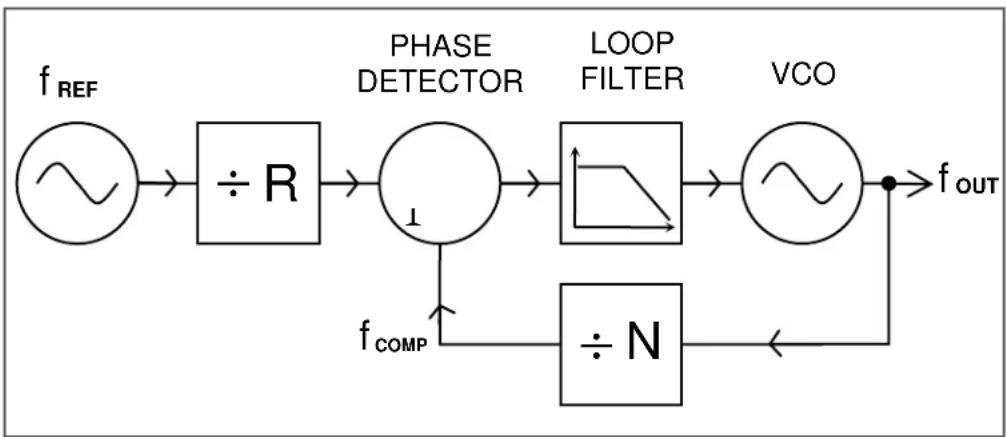
flowchart
graph LR
    A["f_REF"] --> B["÷ R"]
    B --> C["PHASE DETECTOR"]
    C --> D["LOOP FILTER"]
    D --> E["VCO"]
    E --> F["f_OUT"]
    G["f_COMP"] --> C
    H["÷ N"] --> E
Diagram 1: Classical "Integer-N" PLL Frequency Synthesizer
The purpose of the PLL synthesizer is to generate precise output frequencies that are locked to a reference frequency. As shown in Fig 1, the reference frequency, f_REF , is divided by the integer R and the voltage controlled oscillator (VCO) output, f_OUT , is divided by the integer N. A phase detector compares the phase of the divided frequencies. The phase detector output is low-pass filtered and used to control the frequency of the VCO so that f_OUT / N is equal to f_REF / R , hence f_OUT = N × f_REF / R .
A numerical example will help to illustrate the operation and design trade-offs of the PLL. Suppose f_REF = 10 MHz and R = 1000. If N = 10,000 then the output frequency, f_OUT = N × f_REF / R = 100 MHz . As N is changed from 10,000 to 10,001 to 10,002__T will change from 100.00 MHz to 100.01 MHz to 100.02 MHz. This PLL synthesizer has a phase comparison frequency, and a channel spacing, of f_REF / R = 10 kHz .
Phase Noise
Diagram 2 shows a typical phase noise plot for a 100 MHz PLL synthesizer. The phase noise plot shows the noise power in a 1 Hz sideband as a function of frequency offset from the carrier. There are three dominate sources of phase noise: The reference, the phase detector, and the VCO. The frequency reference dominates the noise close to the carrier but falls off quickly at large offsets. The phase detector noise floor is relatively flat vs. frequency but decreases with increasing phase comparison frequency. In fact, the phase detector noise decreases by about 10 dB / decade, hence is about 30 dB lower for phase comparisons at 10 MHz vs. 10 kHz. Finally, the VCO phase noise will dominate at offset frequencies beyond the loop bandwidth. A high phase comparison frequency, hence low R & N divisors, is required for a low phase noise design.
In a properly designed PLL the output noise tracks the reference at low offsets, matches the phase detector noise at intermediate offsets, and is equal to the VCO noise at offsets beyond the PLL loop bandwidth. Careful attention to the loop filter design is also required to achieve the total noise characteristic shown in Diagram 2.
In addition to broadband noise there will be discrete spurious frequencies in the phase noise spectrum. A dominant spur is often seen at the phase comparison frequency. It is easier to reduce this spur in a filter when the phase comparison frequency is high.

line
| FREQUENCY OFFSET FROM CARRIER | REF PHASE NOISE | VCO PHASE NOISE | TOTAL NOISE (fc = 10kHz) | PHASE DET NOISE (fc = 10kHz) | TOTAL NOISE (fc = 10MHz) | PHASE DET NOISE (fc = 10MHz) | | ------------------------------ | --------------- | --------------- | ------------------------ | ---------------------------- | ------------------------ | ---------------------------- | | 10 | -50 | -50 | -50 | -50 | -50 | -50 | | 1M | -150 | -150 | -150 | -150 | -150 | -150 |Diagram 2: Typical Phase Noise Spectrum for a 100 MHz PLL Frequency Synthesizer
Increasing Frequency Resolution
A frequency resolution of 10 kHz, or channel spacing of 10 kHz, is adequate in many communications applications but a higher resolution is desired in test and measurement applications. The simplest way to increase the frequency resolution is to increase the value of the R divider. In the above example, if R were increased from 1000 to 10,000 the frequency resolution (channel spacing) would be increased from 10 kHz to 1 kHz. However, there are several serious drawbacks to this strategy. As the R divider is increased the phase comparison frequency is decreased leading to higher phase detector noise, a reduction in the loop bandwidth, and increased settling times. Increasing R will achieve high frequency resolution at the cost of a noisy output that takes a long time to settle.
A Note on Fractional-N Synthesis
Another strategy to increase resolution without decreasing the phase comparison frequency is to use a Fractional-N synthesizer. In these synthesizers the value of N is modulated so that its average value can be a non-integer. If N averages to 10,000.1 then the output frequency, f_OUT = N × f_REF / R = 100.001 MHz . The frequency resolution has been improved to 1 kHz. However, modulating the N value creates spurs in the VCO output. Dithering techniques are able to spread most of the spur energy into broadband noise, but the remaining noise and spurs is problematic in some applications.
About YIG Oscillators
One work-around to the trade-off between high resolution and reduced phase comparison frequency (and so higher phase noise) is to use a YIG oscillator. YIGs are extremely good VCOs due to the extremely high Q of their resonator which consists of a sub-millimeter yttrium-iron-garnet sphere tuned by a magnetic field. However, YIGs have their drawbacks including high power, slow tuning, susceptibility to environmental magnetic fields, and high cost. The SG380 Series of RF synthesizers achieve YIG performance from electrically tuned VCOs by arranging a very high phase comparison frequency.
A New Approach
A new approach to synthesizer design provides high frequency resolution, fast settling, and low phase noise. This new approach is called Rational Approximation Frequency Synthesis. (A rational number is a number which is equal to the ratio of two integers.) The approach has been overlooked as it relies on some surprising results of rather quirky arithmetic which abandons neat channel spacing in exchange for a much better performing PLL synthesizer.
Once again, a numerical example will be useful. Suppose we want to use our PLL synthesizer to generate 132.86 MHz. We could do that by setting R = 1000 and N = 13,286. With f_REF = 10 MHz we have f_OUT = N × f_REF / R = 132.86 MHz. The phase comparison frequency is 10 kHz and so the PLL loop bandwidth, which is typically 1 / 20 of the phase comparison frequency, would be only about 500 Hz.
There's another way to synthesize 132.86 MHz (or at least very close to it.) Suppose we set R = 7 and N = 93. Then _UT = N × f_REF / R = 132.857142 MHz , which is only 21.5 ppm below the target frequency (Hence the term "Rational Approximation". Of course, increasing the reference frequency by 21.5 ppm will produce the target frequency exactly, as will be described.) Momentarily suspending the question of the general applicability of this approach, the positive benefit is clear: The phase comparison frequency is now 10 MHz / 7 = 1.42 MHz which is 142 times higher than that provided by the classical PLL with a 10 kHz channel spacing. This allows a PLL bandwidth which is also 142 times wider. The higher comparison frequency of this PLL will provide faster settling, lower phase noise, and an easily removed reference spur which is 1.42 MHz away from the carrier.
Several questions arise.
- Is this approach generally applicable, that is, can small values for R & N always be found to produce an output close to any desired frequency?
- Is there a method to find the smallest values for R & N?
- Can the output frequency be made exact (not just "close to") the desired frequency.
The answer to all three questions is “Yes”. Details are well illustrated by a real-world example.
An Example
Diagram 3 shows a PLL synthesizer that can generate outputs anywhere in the octave between 2 GHz and 4 GHz. Lower frequencies are easily generated by binary division of this output. This example uses an Analog Devices dual-modulus PLL frequency synthesizer, the ADF4108. A dual modulus N counter is a high-speed divider which divides by a prescaler value, P, or by P+1 under the control of two registers named A & B. The dual modulus N-divider adds a bit of numerical quirkiness as there are restrictions on the allowed values for A & B as detailed in Diagram 3. The ADF4108 also requires that the phase comparison frequency be less than 104 MHz. The reference frequency input in this example is 200 MHz.
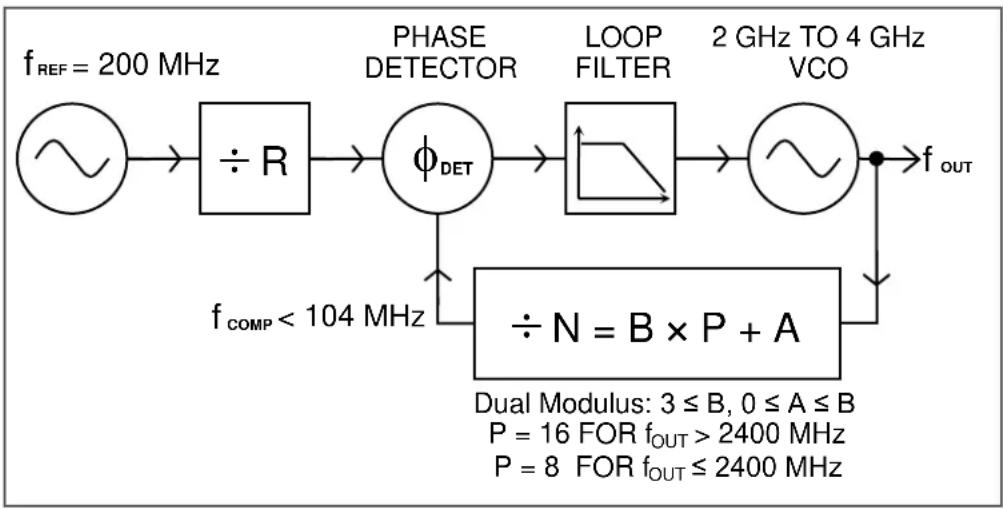
flowchart
graph LR
    A["f_REF = 200 MHz"] --> B["÷ R"]
    B --> C["φ_DET"]
    C --> D["LOOP FILTER"]
    D --> E["f_OUT"]
    F["f_COMP < 104 MHz"] --> C
    G["÷ N = B × P + A"] --> C
    H["Dual Modulus: 3 ≤ B, 0 ≤ A ≤ B\nP = 16 FOR f_OUT > 2400 MHz\nP = 8 FOR f_OUT ≤ 2400 MHz"] --> I
    I --> J["f_OUT"]
Diagram 3: A Rational Approximation Frequency Synthesizer
One curious aspect of Rational Approximation Frequency Synthesis is that it is not obvious how to choose the values for R & N. There are mathematical techniques for rational fraction approximation however brute enumeration of the possibilities may also be used. For example, R & N can be found by starting with the lowest allowed value for R and testing to see if there is an allowed value for N which gives a result, _UT = N × f_REF / R , which is within some error band (say, ±100 ppm) of the desired frequency. Luckily, these computational requirements are modest. The required calculations can be performed on a typical microcontroller in under a millisecond.
The largest phase comparison frequencies are achieved when there are many numeric choices available to improve the chance that a particular ratio of integers can be found which will be within the error band of the desired result. This is done three ways. First, allow a large error band. (An error band of ±100 ppm is typical because a fundamental mode crystal oscillator, which is used to clean-up the reference source, can be tuned over ±100 ppm.) Second, use a high frequency reference oscillator. Third, provide a second reference, detuned slightly from the first, to provide additional numeric choices.
To ascertain how well Rational Approximation Frequency Synthesis works for the example in Diagram 3, a computer program was written to compute the R & N values for 10,000 random frequencies in the octave band between 2 GHz and 4 GHz. Using a single reference source at 200 MHz, and an allowed error band of ±100 ppm, the average phase comparison frequency was 9.79 MHz and the worst case phase comparison frequency was 400 kHz.
When a second reference frequency was available (at 201.6 MHz, as determined by trial and error while searching for the highest worst-case phase comparison frequency) the average phase comparison frequency increased to 12.94 MHz and the worse case phase comparison frequency increased to 2.35 MHz (a six-fold increase.)
Elimination of Error
Rational Approximation Frequency Synthesis provides a fast settling, low phase noise, and spur-free output, but with a troubling “error band” of typically ±100 ppm. To eliminate this error it will be necessary to provide a low noise reference that is tunable over ±100 ppm with very high resolution. A VCXO phase locked with narrow bandwidth to a DDS source may be used for this reference. A 48-bit DDS provides a frequency resolution of 1:2×10^-14 and the VCXO effectively removes all of the DDS spurs.
A tunable reference source is shown in Diagram 4. A 10 MHz timebase is multiplied in the DDS to 100 MHz. The DDS is programmed to generate an output within ±100 ppm of 18.1818 MHz. The VCXO is phase locked to the DDS output with a 100 Hz bandwidth. The clean 18.1818 MHz VCXO output is used as a source for an 11× multiplier to produce a 200 MHz reference tunable over ±100 ppm with a frequency resolution of 1:2×10^-14 . This tunable frequency reference is used as the reference for the Rational Approximation Frequency Synthesizer, eliminating the error band inherent in the technique.
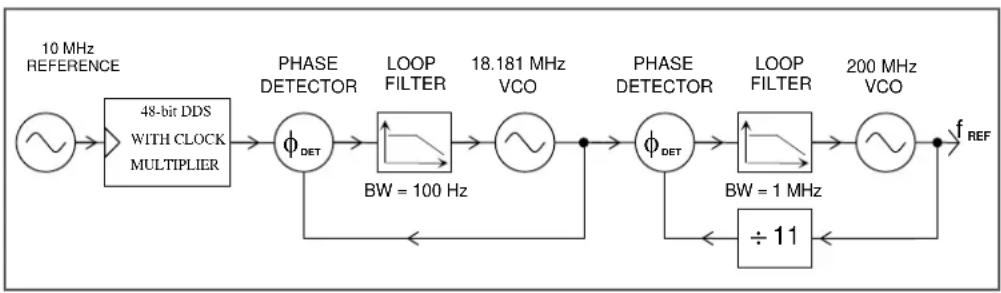
flowchart
graph LR
    A["10 MHz REFERENCE"] --> B["48-bit DDS WITH CLOCK MULTIPLIER"]
    B --> C["φ_DET"]
    C --> D["LOOP FILTER"]
    D --> E["18.181 MHz VCO"]
    E --> F["φ_DET"]
    F --> G["LOOP FILTER"]
    G --> H["200 MHz VCO"]
    H --> I["f_REF"]
    F --> J["BW = 1 MHz"]
    J --> K["÷ 11"]
    K --> F
    style A fill:#f9f,stroke:#333
    style H fill:#f9f,stroke:#333
Diagram 4: Tunable ( ± 100 ppm) 200 MHz Reference
Conclusion
A new method for the operation of classical integer-N PLL frequency synthesizers has been described. The method, Rational Approximation Frequency Synthesis, allows for operation at much higher phase comparison rates than the classical approach. The higher phase comparison rates allow wider PLL bandwidth to provide faster settling, lower phase noise, and spur-free outputs with virtually infinite frequency resolution.
Appendix B : Parts List
Front Display (Assemblies 320 & 321)
Ref Value Description SRS P/N
| C1 | 4.7U - 16V X5R Ceramic, 16V, 1206, X5R 5-00611 | ||
| C2 | 0.1U | Capacitor, 0603, X7R | 5-00764 |
| C3 | 0.1U | Capacitor, 0603, X7R | 5-00764 |
| C4 | 0.1U | Capacitor, 0603, X7R | 5-00764 |
| C5 | 0.1U | Capacitor, 0603, X7R | 5-00764 |
| C6 | 0.1U | Capacitor, 0603, X7R | 5-00764 |
| C7 | 0.1U | Capacitor, 0603, X7R | 5-00764 |
| C8 | 0.1U | Capacitor, 0603, X7R | 5-00764 |
| C9 | 0.1U | Capacitor, 0603, X7R | 5-00764 |
| C10 | 0.1U | Capacitor, 0603, X7R | 5-00764 |
| C11 | 0.1U | Capacitor, 0603, X7R | 5-00764 |
| D1 | GREEN | LED, T-3/4, 2mm | 3-00424 |
| D2 | GREEN | LED, T-3/4, 2mm | 3-00424 |
| D4 | GREEN | LED, T-3/4, 2mm | 3-00424 |
| D3 | GREEN | LED, T-3/4, 2mm | 3-00424 |
| D5 | GREEN | LED, T-3/4, 2mm | 3-00424 |
| D6 | GREEN | LED, T-3/4, 2mm | 3-00424 |
| D7 | GREEN | LED, T-3/4, 2mm | 3-00424 |
| D8 | GREEN | LED, T-3/4, 2mm | 3-00424 |
| D9 | RED | LED, T-3/4, 2mm | 3-00425 |
| D10 | GREEN LED, T-3/4, 2mm | 3-00424 | |
| D11 | GREEN LED, T-3/4, 2mm | 3-00424 | |
| D12 | GREEN LED, T-3/4, 2mm | 3-00424 | |
| D13 | GREEN LED, T-3/4, 2mm | 3-00424 | |
| D14 | GREEN LED, T-3/4, 2mm | 3-00424 | |
| D15 | GREEN LED, T-3/4, 2mm | 3-00424 | |
| D16 | GREEN LED, T-3/4, 2mm | 3-00424 | |
| D17 | GREEN LED, T-3/4, 2mm | 3-00424 | |
| D18 | GREEN LED, T-3/4, 2mm | 3-00424 | |
| D19 | GREEN LED, T-3/4, 2mm | 3-00424 | |
| D20 | GREEN LED, T-3/4, 2mm | 3-00424 | |
| D21 | GREEN LED, T-3/4, 2mm | 3-00424 | |
| D22 | GREEN LED, T-3/4, 2mm | 3-00424 | |
| D23 | GREEN LED, T-3/4, 2mm | 3-00424 | |
| D24 | GREEN LED, T-3/4, 2mm | 3-00424 | |
| D25 | GREEN LED, T-3/4, 2mm | 3-00424 | |
| D26 | GREEN LED, T-3/4, 2mm | 3-00424 | |
| D27 | GREEN LED, T-3/4, 2mm | 3-00424 | |
| D28 | GREEN LED, T-3/4, 2mm | 3-00424 | |
| D29 | GREEN LED, T-3/4, 2mm | 3-00424 | |
| D30 | GREEN LED, T-3/4, 2mm | 3-00424 | |
| D31 | GREEN LED, T-3/4, 2mm | 3-00424 | |
| D32 | GREEN LED, T-3/4, 2mm | 3-00424 | |
| D33 | GREEN LED, T-3/4, 2mm | 3-00424 | |
| D34 | GREEN LED, T-3/4, 2mm | 3-00424 | |
| D35 | GREEN LED, T-3/4, 2mm | 3-00424 | |
| D36 | GREEN LED, T-3/4, 2mm | 3-00424 | |
| D37 | GREEN LED, T-3/4, 2mm | 3-00424 | |
| D38 | GREEN LED, T-3/4, 2mm | 3-00424 | |
| D39 | GREEN LED, T-3/4, 2mm | 3-00424 | |
| D40 | GREEN LED, T-3/4, 2mm | 3-00424 | |
| D41 | GREEN LED, T-3/4, 2mm | 3-00424 | |
| D42 | GREEN LED, T-3/4, 2mm | 3-00424 | |
| D43 | GREEN LED, T-3/4, 2mm | 3-00424 | |
| D44 | GREEN LED, T-3/4, 2mm | 3-00424 | |
| D45 | GREEN LED, T-3/4, 2mm | 3-00424 | |
| D46 | GREEN LED, T-3/4, 2mm | 3-00424 | |
| D47 | RED | LED, T-3/4, 2mm | 3-00425 |
| JP1 | 9 PIN | Connector | 1-01308 |
| PC1 | SG385 F/P | Fabricated component | 7-02099 |
| Q1 | MBT3906DW1 | Dual PNP Transistor | 3-01419 |
| Q2 | MBT3906DW1 | Dual PNP Transistor | 3-01419 |
| Q3 | MBT3906DW1 | Dual PNP Transistor | 3-01419 |
| Q4 | MBT3906DW1 | Dual PNP Transistor | 3-01419 |
| Q5 | MBT3906DW1 | Dual PNP Transistor | 3-01419 |
| Q6 | MBT3906DW1 | Dual PNP Transistor | 3-01419 |
| Q7 | MBT3906DW1 | Dual PNP Transistor | 3-01419 |
| Q8 | MBT3906DW1 | Dual PNP Transistor | 3-01419 |
| Q9 | MBT3906DW1 | Dual PNP Transistor | 3-01419 |
| Q10 | MBT3906DW1 | Dual PNP Transistor | 3-01419 |
| Q11 | MBT3906DW1 | Dual PNP Transistor | 3-01419 |
| Q12 | MBT3906DW1 | Dual PNP Transistor | 3-01419 |
| Q13 | MBT3906DW1 | Dual PNP Transistor | 3-01419 |
| Q14 | MBT3906DW1 | Dual PNP Transistor | 3-01419 |
| Q15 | MBT3906DW1 | Dual PNP Transistor | 3-01419 |
| Q16 | MBT3906DW1 | Dual PNP Transistor | 3-01419 |
| R1 | 49.9K | Resistor, 0603, Thin Film | 4-02320 |
| R2 | 20.0K | Resistor, 0603, Thin Film | 4-02282 |
| R3 | 499 | Resistor, 0603, Thin Film | 4-02128 |
| R4 | 499 | Resistor, 0603, Thin Film | 4-02128 |
| R5 | 100 | Resistor, 0603, Thin Film | 4-02061 |
| R6 | 100 | Resistor, 0603, Thin Film | 4-02061 |
| RN1 | 8 X 680 | Resistor network | 4-02531 |
| RN2 | 8 X 680 | Resistor network | 4-02531 |
| RN3 | 8 X 680 | Resistor network | 4-02531 |
| RN4 | 8 X 680 | Resistor network | 4-02531 |
| RN5 | 8 X 680 | Resistor network | 4-02531 |
| RN6 | 8 X 680 | Resistor network | 4-02531 |
| RN7 | 8 X 680 | Resistor network | 4-02531 |
| RN8 | 8 X 680 | Resistor network | 4-02531 |
| RN9 | 8 X 680 | Resistor network | 4-02531 |
| RN10 | 8 X 680 | Resistor network | 4-02531 |
| RN11 | 8 X 680 | Resistor network | 4-02531 |
| RN12 | 8 X 680 | Resistor network | 4-02531 |
| RN13 | 8 X 680 | Resistor network | 4-02531 |
| RN14 | 8 X 680 | Resistor network | 4-02531 |
| RN15 | 8 X 680 | Resistor network | 4-02531 |
| RN16 | 8 X 680 | Resistor network | 4-02531 |
| RN17 | 8X100 | Resistor network | 4-02497 |
| RN18 | 8X100 | Resistor network | 4-02497 |
| RN19 | 8X100 | Resistor network | 4-02497 |
| RN20 | 8X100 | Resistor network | 4-02497 |
| RN21 | 8X100 | Resistor network | 4-02497 |
| RN22 | 8X100 | Resistor network | 4-02497 |
| RN23 | 8 X 680 | Resistor network | 4-02531 |
| RN24 | 8 X 680 | Resistor network | 4-02531 |
| RN25 | 10KX4D | Resistor network | 4-00912 |
| RN26 | 10KX4D | Resistor network | 4-00912 |
| RN27 | 10KX4D | Resistor network | 4-00912 |
| RN28 | 10KX4D | Resistor network | 4-00912 |
| RN29 | 10KX4D | Resistor network | 4-00912 |
| RN30 | 10KX4D | Resistor network | 4-00912 |
| RN31 | 10KX4D | Resistor network | 4-00912 |
| RN32 | 10KX4D | Resistor network | 4-00912 |
| RN33 | 10KX4D | Resistor network | 4-00912 |
| U1 | HDSP-A101 | Seven Segment Display | 3-00290 |
| U2 | HDSP-A101 | Seven Segment Display | 3-00290 |
| U3 | HDSP-A101 | Seven Segment Display | 3-00290 |
| U4 | HDSP-A101 | Seven Segment Display | 3-00290 |
| U5 | HDSP-A101 | Seven Segment Display | 3-00290 |
| U6 | HDSP-A101 | Seven Segment Display | 3-00290 |
| U7 | HDSP-A101 | Seven Segment Display | 3-00290 |
| U8 | HDSP-A101 | Seven Segment Display | 3-00290 |
| U9 | HDSP-A101 | Seven Segment Display | 3-00290 |
| U10 | HDSP-A101 | Seven Segment Display | 3-00290 |
| U11 | HDSP-A101 | Seven Segment Display | 3-00290 |
| U12 | HDSP-A101 | Seven Segment Display | 3-00290 |
| U13 | HDSP-A101 | Seven Segment Display | 3-00290 |
| U14 | HDSP-A101 | Seven Segment Display | 3-00290 |
| U15 | HDSP-A101 | Seven Segment Display | 3-00290 |
Parts List 134
| U16 | HDSP-A101 Seven Segment Display 3-00290 | ||
| U17 | 74HC595ADT Shift Register/Latch 3-00672 | ||
| U18 | 74HC595ADT Shift Register/Latch 3-00672 | ||
| U19 | 74HC595ADT Shift Register/Latch 3-00672 | ||
| U20 | 74HC595ADT Shift Register/Latch 3-00672 | ||
| U21 | 74HC595ADT Shift Register/Latch 3-00672 | ||
| U22 | 74HC595ADT Shift Register/Latch 3-00672 | ||
| U23 | 74HC595ADT Shift Register/Latch 3-00672 | ||
| U24 | 74HC595ADT Shift Register/Latch 3-00672 | ||
| U25 | 74HC595ADT Shift Register/Latch 3-00672 | ||
| U26 | 74HC595ADT Shift Register/Latch 3-00672 | ||
| U27 | 74HC595ADT Shift Register/Latch 3-00672 | ||
| U28 | 74HC595ADT Shift Register/Latch 3-00672 | ||
| U29 | 74HC595ADT Shift Register/Latch 3-00672 | ||
| U30 | 74HC595ADT Shift Register/Latch 3-00672 | ||
| U31 | 74HC595ADT Shift Register/Latch 3-00672 | ||
| U32 | 74HC595ADT Shift Register/Latch 3-00672 | ||
| U33 | 74LVC3G34DCTR Triple non-inverting buffer 3-01852 | ||
| U34 | 74LVC2G08DCT Single 2-input AND gate 3-01656 | ||
| U35 | 74LVC2G04 Dual inverting buffer 3-01968 | ||
| U36 | 74HC595ADT Shift Register/Latch 3-00672 | ||
| U37 | 74HC595ADT Shift Register/Latch 3-00672 | ||
| U38 | 74HC595ADT Shift Register/Latch 3-00672 | ||
| U39 | 74HC595ADT Shift Register/Latch 3-00672 | ||
| U40 | 74HC595ADT Shift Register/Latch 3-00672 | ||
| U41 | 74HC595ADT Shift Register/Latch 3-00672 | ||
| U42 | 74HC595ADT Shift Register/Latch 3-00672 | ||
| U43 | 74HC595ADT Shift Register/Latch 3-00672 | ||
| U44 | 74LVC1G125DBV Single tri-state buffer 3-01886 | ||
| U45 | 74HC165 Shift register, PI/SO 3-01969 | ||
| U46 | 74HC165 Shift register, PI/SO 3-01969 | ||
| U47 | 74HC165 Shift register, PI/SO 3-01969 | ||
| U48 | 74HC165 Shift register, PI/SO 3-01969 | ||
| U49 | 74HC165 Shift register, PI/SO 3-01969 | ||
| U50 | ADCMP371 Comparator 3-01970 | ||
| Z0 | PS300-40 Fabricated component 7-0021 | ||
| Z1 | SG385,FR CHASSI Fabricated component 7-02106 | ||
| Z2 | SG385 KEYPAD Fabricated component 7-0211 | ||
| Z3 | SG385 LEXAN Fabricated component 7-0211 | ||
| Z4 | SIM-PCB S/N Label 9-01570 | ||
| Z5 | 4-40X1/4PF Hardware 0-00150 | ||
| R2 | 49.9 | Resistor, 0603, Thin Film | 4-02032 |
| R3 | 49.9 | Resistor, 0603, Thin Film | 4-02032 |
| R4 | 49.9 | Resistor, 0603, Thin Film | 4-02032 |
| R5 | 49.9 | Resistor, 0603, Thin Film | 4-02032 |
| R6 | 49.9 | Resistor, 0603, Thin Film | 4-02032 |
| R7 | 49.9 | Resistor, 0603, Thin Film | 4-02032 |
| R8 | 49.9 | Resistor, 0603, Thin Film | 4-02032 |
| R9 | 49.9 | Resistor, 0603, Thin Film | 4-02032 |
| R10 | 49.9 | Resistor, 0603, Thin Film | 4-02032 |
| R11 | 49.9 | Resistor, 0603, Thin Film | 4-02032 |
| R12 | 49.9 | Resistor, 0603, Thin Film | 4-02032 |
| R14 | 49.9 | Resistor, 0603, Thin Film | 4-02032 |
| R13 | 49.9 | Resistor, 0603, Thin Film | 4-02032 |
| Z0 SIM-PCB S/N | Label | 9-01570 | |
Motherboard
(Assemblies 322 & 323)
| Ref | Value | Description | SRS P/N |
| C100 | 1000P | Capacitor, 0603, NPO | 5-00740 |
| C101 | 0.1U | Capacitor, 0603, X7R | 5-00764 |
| C102 | 0.1U | Capacitor, 0603, X7R | 5-00764 |
| C103 | 10P | Capacitor, 0603, NPO | 5-00692 |
| C104 | 0.1U | Capacitor, 0603, X7R | 5-00764 |
| C105 | .47U | CAP, 1206, X7R | 5-00527 |
| C106 | 1000P | Capacitor, 0603, NPO | 5-00740 |
| C107 | .47U | CAP, 1206, X7R | 5-00527 |
| C108 | .01U | Capacitor, 0603, X7R | 5-00752 |
| C109 | .01U | Capacitor, 0603, X7R | 5-00752 |
| C110 | 47P | Capacitor, 0603, NPO | 5-00708 |
| C111 | 470P | Capacitor, 0603, NPO | 5-00732 |
| C112 | .01U | Capacitor, 0603, X7R | 5-00752 |
| C113 | 0.1U | Capacitor, 0603, X7R | 5-00764 |
| C114 | 10P | Capacitor, 0603, NPO | 5-00692 |
| C115 | .01U | Capacitor, Metal film 5-00052 | |
| C116 | 1000P | Capacitor, 0603, NPO | 5-00740 |
| C117 | 100P | Capacitor, 0603, NPO | 5-00716 |
| C118 | 0.1U | Capacitor, 0603, X7R | 5-00764 |
| C119 | 1.0U | Capacitor, Metal film 5-00245 | |
| C120 | 1000P | Capacitor, 0603, NPO | 5-00740 |
| C121 | 0.1U | Capacitor, 0603, X7R | 5-00764 |
| C122 | .22U | Capacitor, Metal film 5-00057 | |
| C123 | 0.1U | Capacitor, 0603, X7R | 5-00764 |
| C124 | .047U | Capacitor, Metal film 5-00054 | |
| C125 | 0.1U | Capacitor, 0603, X7R | 5-00764 |
| C126 | 0.1U | Capacitor, 0603, X7R | 5-00764 |
| C127 | .01U | Capacitor, 0603, X7R | 5-00752 |
| C128 | 0.1U | Capacitor, 0603, X7R | 5-00764 |
| C129 | .47U | CAP, 1206, X7R | 5-00527 |
| C130 | .47U | CAP, 1206, X7R | 5-00527 |
| C131 | .47U | CAP, 1206, X7R | 5-00527 |
| C132 | 39P | Capacitor, 0603, NPO | 5-00706 |
| C133 | 1000P | Capacitor, 0603, NPO | 5-00740 |
| C134 | .47U | CAP, 1206, X7R | 5-00527 |
| C135 | 0.1U | Capacitor, 0603, X7R | 5-00764 |
| C136 | 1000P | Capacitor, 0603, NPO | 5-00740 |
| C137 | 330P | Capacitor, 0603, NPO | 5-00728 |
| C138 | 330P | Capacitor, 0603, NPO | 5-00728 |
| C139 | 100P | Capacitor, 0603, NPO | 5-00716 |
| C140 | 330P | Capacitor, 0603, NPO | 5-00728 |
| C141 | .047U | Capacitor, Metal film 5-00054 | |
| C142 | 0.1U | Capacitor, 0603, X7R | 5-00764 |
| C143 | 0.1U | Capacitor, 0603, X7R | 5-00764 |
| C144 | 1000P | Capacitor, 0603, NPO | 5-00740 |
| C200 | 0.1U | Capacitor, 0603, X7R | 5-00764 |
| C201 | 0.1U | Capacitor, 0603, X7R | 5-00764 |
| C202 | 0.1U | Capacitor, 0603, X7R | 5-00764 |
| C203 | 0.1U | Capacitor, 0603, X7R | 5-00764 |
| C204 | .01U | Capacitor, 0603, X7R | 5-00752 |
| C205 | 0.1U | Capacitor, 0603, X7R | 5-00764 |
| C206 | .01U | Capacitor, 0603, X7R | 5-00752 |
| C207 | 0.1U | Capacitor, 0603, X7R | 5-00764 |
| C208 | .01U | Capacitor, 0603, X7R | 5-00752 |
| C209 | .01U | Capacitor, 0603, X7R | 5-00752 |
| C210 | .01U | Capacitor, 0603, X7R | 5-00752 |
| C211 | .01U | Capacitor, 0603, X7R | 5-00752 |
| C212 | 47P | Capacitor, 0603, NPO | 5-00708 |
Front Display EMI Filter (Assembly 324)
| Ref | Value | Description | SRS P/N |
| C1 | 1000P | Capacitor, 0603, NPO | 5-00740 |
| C2 | 1000P | Capacitor, 0603, NPO | 5-00740 |
| C3 | 1000P | Capacitor, 0603, NPO | 5-00740 |
| C4 | 22P | Capacitor, 0603, NPO | 5-00700 |
| C5 | 22P | Capacitor, 0603, NPO | 5-00700 |
| C6 | 22P | Capacitor, 0603, NPO | 5-00700 |
| C7 | 22P | Capacitor, 0603, NPO | 5-00700 |
| C8 | 22P | Capacitor, 0603, NPO | 5-00700 |
| C9 | 22P | Capacitor, 0603, NPO | 5-00700 |
| C10 | 22P | Capacitor, 0603, NPO | 5-00700 |
| C11 | 22P | Capacitor, 0603, NPO | 5-00700 |
| C12 | 22P | Capacitor, 0603, NPO | 5-00700 |
| C13 | 22P | Capacitor, 0603, NPO | 5-00700 |
| C14 | 22P | Capacitor, 0603, NPO | 5-00700 |
| C15 | 22P | Capacitor, 0603, NPO | 5-00700 |
| C16 | 22P | Capacitor, 0603, NPO | 5-00700 |
| C17 | 22P | Capacitor, 0603, NPO | 5-00700 |
| J2 | 9 PIN R/A T-H | Connector | 1-01302 |
| J3 | 9P FEM/T-H | Connector | 1-01303 |
| L1 | 2506031517Y0 | Inductor BEAD 0603 | 6-00759 |
| L2 | 2506031517Y0 | Inductor BEAD 0603 | 6-00759 |
| L3 | 2506031517Y0 | Inductor BEAD 0603 | 6-00759 |
| L4 | 2506031517Y0 | Inductor BEAD 0603 | 6-00759 |
| L5 | 2506031517Y0 | Inductor BEAD 0603 | 6-00759 |
| PCB1 | SG385 F/P FLTER Fabricated component | 7-02208 | |
| R1 | 49.9 | Resistor, 0603, Thin Film | 4-02032 |
Parts List 135
| C213 47P Capacitor, 0603, NPO 5-00708 | C333 0.1U Capacitor, 0603, X7R 5-00764 |
| C214 47P Capacitor, 0603, NPO 5-00708 | C334 0.1U Capacitor, 0603, X7R 5-00764 |
| C215 .01U Capacitor, 0603, X7R 5-00752 | C335 0.1U Capacitor, 0603, X7R 5-00764 |
| C216 .022U Capacitor, 0603, X7R 5-00756 | C336 100P Capacitor, 0603, NPO 5-00716 |
| C217 .01U Capacitor, 0603, X7R 5-00752 | C337 100P Capacitor, 0603, NPO 5-00716 |
| C218 220P Capacitor, 0603, NPO 5-00724 | C400 0.1U Capacitor, 0603, X7R 5-00764 |
| C219 470P Capacitor, 0603, NPO 5-00732 | C401 0.1U Capacitor, 0603, X7R 5-00764 |
| C220 220P Capacitor, 0603, NPO 5-00724 | C402 .01U Capacitor, 0603, X7R 5-00752 |
| C221 0.1U Capacitor, 0603, X7R 5-00764 | C403 .01U Capacitor, 0603, X7R 5-00752 |
| C222 0.1U Capacitor, 0603, X7R 5-00764 | C404 .01U Capacitor, 0603, X7R 5-00752 |
| C223 0.1U Capacitor, 0603, X7R 5-00764 | C406 .01U Capacitor, 0603, X7R 5-00752 |
| C224 0.1U Capacitor, 0603, X7R 5-00764 | C407 .01U Capacitor, 0603, X7R 5-00752 |
| C225 0.1U Capacitor, 0603, X7R 5-00764 | C409 .01U Capacitor, 0603, X7R 5-00752 |
| C226 0.1U Capacitor, 0603, X7R 5-00764 | C410 .01U Capacitor, 0603, X7R 5-00752 |
| C227 1000P Capacitor, 0603, NPO 5-00740 | C412 .01U Capacitor, 0603, X7R 5-00752 |
| C228 1000P Capacitor, 0603, NPO 5-00740 | C413 .01U Capacitor, 0603, X7R 5-00752 |
| C229 1000P Capacitor, 0603, NPO 5-00740 | C414 .01U Capacitor, 0603, X7R 5-00752 |
| C230 0.1U Capacitor, 0603, X7R 5-00764 | C415 0.1U Capacitor, 0603, X7R 5-00764 |
| C231 0.1U Capacitor, 0603, X7R 5-00764 | C416 0.1U Capacitor, 0603, X7R 5-00764 |
| C232 0.1U Capacitor, 0603, X7R 5-00764 | C417 .01U Capacitor, 0603, X7R 5-00752 |
| C233 0.1U Capacitor, 0603, X7R 5-00764 | C419 .01U Capacitor, 0603, X7R 5-00752 |
| C234 .47U CAP, 1206, X7R 5-00527 | C420 .01U Capacitor, 0603, X7R 5-00752 |
| C235 .47U CAP, 1206, X7R 5-00527 | C421 .01U Capacitor, 0603, X7R 5-00752 |
| C236 0.1U Capacitor, 0603, X7R 5-00764 | C422 .01U Capacitor, 0603, X7R 5-00752 |
| C237 .01U Capacitor, Metal film 5-00052 | C424 .01U Capacitor, 0603, X7R 5-00752 |
| C238 10UF / 6.3V Capacitor, 0609 5-00657 | C427 .01U Capacitor, 0603, X7R 5-00752 |
| C239 0.1U Capacitor, 0603, X7R 5-00764 | C429 .01U Capacitor, 0603, X7R 5-00752 |
| C240 0.1U Capacitor, 0603, X7R 5-00764 | C430 .01U Capacitor, 0603, X7R 5-00752 |
| C241 0.1U Capacitor, 0603, X7R 5-00764 | C431 .01U Capacitor, 0603, X7R 5-00752 |
| C242 0.1U Capacitor, 0603, X7R 5-00764 | C432 .01U Capacitor, 0603, X7R 5-00752 |
| C243 0.1U Capacitor, 0603, X7R 5-00764 | C433 .01U Capacitor, 0603, X7R 5-00752 |
| C244 0.1U Capacitor, 0603, X7R 5-00764 | C434 .01U Capacitor, 0603, X7R 5-00752 |
| C245 0.1U Capacitor, 0603, X7R 5-00764 | C437 .01U Capacitor, 0603, X7R 5-00764 |
| C246 10UF / 6.3V Capacitor, 0610 5-00657 | C438 .01U Capacitor, 0603, X7R 5-00764 |
| C247 .39U - PP Polypropylene, 63V, SMD 5-00837 | C439 .01U Capacitor, 0603, X7R 5-00764 |
| C248 100P Capacitor, 0603, NPO 5-00716 | C440 .01U Capacitor, 0603, X7R 5-00764 |
| C249 .01U Capacitor, Metal film 5-00052 | C500 .01U Capacitor, 0603, X7R 5-00764 |
| C250 56P Capacitor, 0603, NPO 5-00710 | C501 .01U Capacitor, 0603, X7R 5-00764 |
| C251 .01U Capacitor, Metal film 5-00052 | C502 .01U Capacitor, 0603, X7R 5-00764 |
| C252 220P Capacitor, 0603, NPO 5-00724 | C503 .01U Capacitor, 0603, X7R 5-00764 |
| C253 220P Capacitor, 0603, NPO 5-00724 | C504 .01U Capacitor, 0603, X7R 5-00764 |
| C254 120P Capacitor, 0603, NPO 5-00718 | C505 2.2UF 16V /0603 Ceramic 16V, 0603, X5R 5-00656 |
| C255 56P Capacitor, 0603, NPO 5-00710 | C506 .01U Capacitor, 0603, X7R 5-00764 |
| C256 .39U - PP Polypropylene, 63V, SMD 5-00837 | C507 2.7P Capacitor, 0603, NPO 5-00677 |
| C258 .047U Capacitor, Metal film 5-00054 | C508 .01U Capacitor, 0603, X7R 5-00764 |
| C259 .047U Capacitor, Metal film 5-00054 | C509 18P Capacitor, 0603, NPO 5-00698 |
| C260 0.1U Capacitor, 0603, X7R 5-00764 | C510 .39U - PP Polypropylene, 63V, SMD 5-00837 |
| C261 0.1U Capacitor, 0603, X7R 5-00764 | C511 100P Capacitor, 0603, NPO 5-00716 |
| C300 .22U / 16V Capacitor, 0603, X7R 5-00836 | C512 330P Capacitor, 0603, NPO 5-00728 |
| C301 0.1U Capacitor, 0603, X7R 5-00764 | C513 1000P Capacitor, 0603, NPO 5-00740 |
| C302 0.1U Capacitor, 0603, X7R 5-00764 | C514 330P Capacitor, 0603, NPO 5-00728 |
| C303 .22U / 16V Capacitor, 0603, X7R 5-00836 | C515 2.2UF 16V /0603 Ceramic 16V, 0603, X5R 5-00656 |
| C304 .22U / 16V Capacitor, 0603, X7R 5-00836 | C516 .01U Capacitor, 0603, X7R 5-00764 |
| C305 .22U / 16V Capacitor, 0603, X7R 5-00836 | C517 1UF 16V /0603 Ceramic 16V, 0603, X5R 5-00661 |
| C306 .22U / 16V Capacitor, 0603, X7R 5-00836 | C518 1UF 16V /0603 Ceramic 16V, 0603, X5R 5-00661 |
| C307 .22U / 16V Capacitor, 0603, X7R 5-00836 | C519 .01U Capacitor, 0603, X7R 5-00764 |
| C308 4.7UF / 50V X5R Capacitor, 1206, X7R 5-00807 | C520 .01U Capacitor, 0603, X7R 5-00764 |
| C309 0.1U Capacitor, 0603, X7R 5-00764 | C521 .01U Capacitor, 0603, X7R 5-00764 |
| C310 .22U / 16V Capacitor, 0603, X7R 5-00836 | C522 .01U Capacitor, 0603, X7R 5-00764 |
| C311 0.1U Capacitor, 0603, X7R 5-00764 | C523 1000P Capacitor, 0603, NPO 5-00740 |
| C312 .22U / 16V Capacitor, 0603, X7R 5-00836 | C524 6800P Capacitor, 0603, X7R 5-00750 |
| C313 100P Capacitor, 0603, NPO 5-00716 | C525 .01U Capacitor, 0603, X7R 5-00764 |
| C314 0.1U Capacitor, 0603, X7R 5-00764 | C526 .01U Capacitor, 0603, X7R 5-00764 |
| C315 0.1U Capacitor, 0603, X7R 5-00764 | C527 .01U Capacitor, 0603, X7R 5-00764 |
| C316 0.1U Capacitor, 0603, X7R 5-00764 | C528 .01U Capacitor, 0603, X7R 5-00764 |
| C317 4.7UF / 50V X5R Capacitor, 1206, X7R 5-00807 | C529 1000P Capacitor, 0603, NPO 5-00740 |
| C318 0.1U Capacitor, 0603, X7R 5-00764 | C530 6800P Capacitor, 0603, X7R 5-00750 |
| C319 0.1U Capacitor, 0603, X7R 5-00764 | C531 .01U Capacitor, 0603, X7R 5-00764 |
| C320 0.1U Capacitor, 0603, X7R 5-00764 | C532 1000P Capacitor, 0603, NPO 5-00740 |
| C321 0.1U Capacitor, 0603, X7R 5-00764 | C533 6800P Capacitor, 0603, X7R 5-00750 |
| C323 0.1U Capacitor, 0603, X7R 5-00764 | C534 .01U Capacitor, 0603, X7R 5-00764 |
| C324 0.1U Capacitor, 0603, X7R 5-00764 | C535 .01U Capacitor, 0603, X7R 5-00764 |
| C325 0.1U Capacitor, 0603, X7R 5-00764 | C536 1000P Capacitor, 0603, NPO 5-00740 |
| C326 0.1U Capacitor, 0603, X7R 5-00764 | C537 6800P Capacitor, 0603, X7R 5-00750 |
| C327 0.1U Capacitor, 0603, X7R 5-00764 | C538 .01U Capacitor, 0603, X7R 5-00764 |
| C328 0.1U Capacitor, 0603, X7R 5-00764 | C539 .01U Capacitor, 0603, X7R 5-00764 |
| C329 0.1U Capacitor, 0603, X7R 5-00764 | C540 100P Capacitor, 0603, NPO 5-00716 |
| C330 0.1U Capacitor, 0603, X7R 5-00764 | C541 680P Capacitor, 0603, NPO 5-00736 |
| C331 0.1U Capacitor, 0603, X7R 5-00764 | C542 .01U Capacitor, 0603, X7R 5-00764 |
| C332 .01U Capacitor, 0603, X7R 5-00752 | C543 .01U Capacitor, 0603, X7R 5-00764 |
Parts List 136
| C544 0.1U Capacitor, 0603, X7R 5-00764 | C723 0.1U Capacitor, 0603, X7R 5-00764 |
| C545 100P Capacitor, 0603, NPO 5-00716 | C724 0.1U Capacitor, 0603, X7R 5-00764 |
| C546 680P Capacitor, 0603, NPO 5-00736 | C725 0.1U Capacitor, 0603, X7R 5-00764 |
| C547 0.1U Capacitor, 0603, X7R 5-00764 | C800 4.7UF / 50V X5R Capacitor, 1206, X7R 5-00807 |
| C548 0.1U Capacitor, 0603, X7R 5-00764 | C801 1000P Capacitor, 0603, NPO 5-00740 |
| C549 0.1U Capacitor, 0603, X7R 5-00764 | C802 4.7UF / 50V X5R Capacitor, 1206, X7R 5-00807 |
| C550 0.1U Capacitor, 0603, X7R 5-00764 | C803 0.1U Capacitor, 0603, X7R 5-00764 |
| C551 100P Capacitor, 0603, NPO 5-00716 | C804 4.7UF / 50V X5R Capacitor, 1206, X7R 5-00807 |
| C552 680P Capacitor, 0603, NPO 5-00736 | C805 0.1U Capacitor, 0603, X7R 5-00764 |
| C553 0.1U Capacitor, 0603, X7R 5-00764 | C806 4.7UF / 50V X5R Capacitor, 1206, X7R 5-00807 |
| C554 0.1U Capacitor, 0603, X7R 5-00764 | C807 .01U Capacitor, 0603, X7R 5-00752 |
| C555 100P Capacitor, 0603, NPO 5-00716 | C808 4.7UF / 50V X5R Capacitor, 1206, X7R 5-00807 |
| C556 680P Capacitor, 0603, NPO 5-00736 | C809 0.1U Capacitor, 0603, X7R 5-00764 |
| C557 0.1U Capacitor, 0603, X7R 5-00764 | C810 4.7UF / 50V X5R Capacitor, 1206, X7R 5-00807 |
| C558 0.1U Capacitor, 0603, X7R 5-00764 | C811 0.1U Capacitor, 0603, X7R 5-00764 |
| C559 0.1U Capacitor, 0603, X7R 5-00764 | C812 4.7UF / 50V X5R Capacitor, 1206, X7R 5-00807 |
| C600 0.1U Capacitor, 0603, X7R 5-00764 | C813 0.1U Capacitor, 0603, X7R 5-00764 |
| C601 0.1U Capacitor, 0603, X7R 5-00764 | C814 10UF / 6.3V Capacitor, 0615 5-00657 |
| C602 1000P Capacitor, 0603, NPO 5-00740 | C815 0.1U Capacitor, 0603, X7R 5-00764 |
| C603 4.7UF / 50V X5R Capacitor, 1206, X7R 5-00807 | C816 4.7UF / 50V X5R Capacitor, 1206, X7R 5-00807 |
| C604 4.7UF / 50V X5R Capacitor, 1206, X7R 5-00807 | C817 0.1U Capacitor, 0603, X7R 5-00764 |
| C605 .01U Capacitor, 0603, X7R 5-00752 | C818 1000P Capacitor, 0603, NPO 5-00740 |
| C606 .01U Capacitor, 0603, X7R 5-00752 | C819 0.1U Capacitor, 0603, X7R 5-00764 |
| C607 0.1U Capacitor, 0603, X7R 5-00764 | C820 10UF / 6.3V Capacitor, 0616 5-00657 |
| C608 10UF / 6.3V Capacitor, 0611 5-00657 | C821 0.1U Capacitor, 0603, X7R 5-00764 |
| C609 0.1U Capacitor, 0603, X7R 5-00764 | C822 2200P Capacitor, 0603, X7R 5-00764 |
| C610 0.1U Capacitor, 0603, X7R 5-00764 | C823 0.1U Capacitor, 0603, X7R 5-00764 |
| C611 0.1U Capacitor, 0603, X7R 5-00764 | C824 0.1U Capacitor, 0603, X7R 5-00764 |
| C612 0.1U Capacitor, 0603, X7R 5-00764 | C825 10UF / 6.3V Capacitor, 0617 5-00657 |
| C613 0.1U Capacitor, 0603, X7R 5-00764 | C826 0.1U Capacitor, 0603, X7R 5-00764 |
| C614 0.1U Capacitor, 0603, X7R 5-00764 | C827 4.7UF / 50V X5R Capacitor, 1206, X7R 5-00807 |
| C615 0.1U Capacitor, 0603, X7R 5-00764 | C828 0.1U Capacitor, 0603, X7R 5-00764 |
| C616 10UF / 6.3V Capacitor, 0612 5-00657 | C829 .01U Capacitor, 0603, X7R 5-00752 |
| C617 0.1U Capacitor, 0603, X7R 5-00764 | C830 0.1U Capacitor, 0603, X7R 5-00764 |
| C619 .047U Capacitor, Metal film 5-00054 | C831 10U/T16 SMD TANTALUM, C-Case 5-00471 |
| C620 4.7UF / 50V X5R Capacitor, 1206, X7R 5-00807 | C832 0.1U Capacitor, 0603, X7R 5-00764 |
| C621 10UF / 6.3V Capacitor, 0613 5-00657 | C833 4.7UF / 50V X5R Capacitor, 1206, X7R 5-00807 |
| C622 0.1U Capacitor, 0603, X7R 5-00764 | D100 MMBV609 DUAL VARACTER 3-00803 |
| C623 0.1U Capacitor, 0603, X7R 5-00764 | D101 BAV99 DUAL SERIES DIODE 3-00896 |
| C624 0.1U Capacitor, 0603, X7R 5-00764 | D200 MMBV609 DUAL VARACTER 3-00803 |
| C625 0.1U Capacitor, 0603, X7R 5-00764 | D201 MMBV609 DUAL VARACTER 3-00803 |
| C626 0.1U Capacitor, 0603, X7R 5-00764 | D202 MMBV609 DUAL VARACTER 3-00803 |
| C627 0.1U Capacitor, 0603, X7R 5-00764 | D500 MMBZ5222BLT1G 2.5V Zener 3-02013 |
| C628 0.1U Capacitor, 0603, X7R 5-00764 | D501 BAV99 DUAL SERIES DIODE 3-00896 |
| C629 10UF / 6.3V Capacitor, 0614 5-00657 | D502 BAV99 DUAL SERIES DIODE 3-00896 |
| C630 0.1U Capacitor, 0603, X7R 5-00764 | D503 MMBZ5222BLT1G 2.5V Zener 3-02013 |
| C631 100P Capacitor, 0603, NPO 5-00716 | D504 BAV99 DUAL SERIES DIODE 3-00896 |
| C632 0.1U Capacitor, 0603, X7R 5-00764 | D800 RED LED, T1 Package 3-00011 |
| C633 .9U - PP Polypropylene, 63V, SMD 5-00837 | J100 26-48-1101 Connector 1-01057 |
| C634 .01U Capacitor, Metal film 5-00052 | J101 73100-0195 Panel Mount BNC 1-01158 |
| C635 .01U Capacitor, Metal film 5-00052 | J102 73100-0195 Panel Mount BNC 1-01158 |
| C636 10P Capacitor, 0603, NPO 5-00692 | J300 26 PIN Connector 1-01178 |
| C637 .0033U Capacitor, Metal film 5-00050 | J301 DEKL-9SAT-E 9 Pin D-Sub Connector 1-01031 |
| C638 10P Capacitor, 0603, NPO 5-00692 | J302 9 PIN Connector 1-01247 |
| C639 100P Capacitor, 0603, NPO 5-00716 | J303 IEEE488/STAND. Connector, IEEE488 1-00160 |
| C640 100P Capacitor, 0603, NPO 5-00716 | J400 TSW-106-08-G-S Connector 1-01146 |
| C641 4.7UF / 50V X5R Capacitor, 1206, X7R 5-00807 | J500 73100-0195 Panel Mount BNC 1-01158 |
| C700 0.1U Capacitor, 0603, X7R 5-00764 | J501 73100-0195 Panel Mount BNC 1-01158 |
| C701 0.1U Capacitor, 0603, X7R 5-00764 | J700 34 PIN Connector 1-01256 |
| C702 0.1U Capacitor, 0603, X7R 5-00764 | J701 25 PIN Connector 1-01255 |
| C703 0.1U Capacitor, 0603, X7R 5-00764 | J800 10M156(LONG) Header, 10 Pins 1-00555 |
| C704 0.1U Capacitor, 0603, X7R 5-00764 | L100 22UH-SMT Inductor,1210, Ferrite 6-00659 |
| C705 0.1U Capacitor, 0603, X7R 5-00764 | L101 2506031517YO Inductor BEAD 0603 6-00759 |
| C706 0.1U Capacitor, 0603, X7R 5-00764 | L102 2A / 1806 BEAD SMD 1806 6-00744 |
| C707 2.7P Capacitor, 0603, NPO 5-00677 | L103 .68UH Inductor, Fixed, SMT 6-00988 |
| C708 18P Capacitor, 0603, NPO 5-00698 | L104 2506031517YO Inductor BEAD 0603 6-00759 |
| C709 7.5P Capacitor, 0603, NPO 5-00689 | L105 6.8UH -1210 Inductor,1210, Ferrite 6-00667 |
| C710 0.1U Capacitor, 0603, X7R 5-00764 | L106 2506031517YO Inductor BEAD 0603 6-00759 |
| C711 2.7P Capacitor, 0603, NPO 5-00677 | L107 6.8UH -1210 Inductor,1210, Ferrite 6-00667 |
| C712 18P Capacitor, 0603, NPO 5-00698 | L108 2506031517YO Inductor BEAD 0603 6-00759 |
| C713 7.5P Capacitor, 0603, NPO 5-00689 | L109 2506031517YO Inductor BEAD 0603 6-00759 |
| C714 0.1U Capacitor, 0603, X7R 5-00764 | L110 2506031517YO Inductor BEAD 0603 6-00759 |
| C715 100P Capacitor, 0603, NPO 5-00716 | L111 .68UH Inductor, Fixed, SMT 6-00988 |
| C716 0.1U Capacitor, 0603, X7R 5-00764 | L112 2506031517YO Inductor BEAD 0603 6-00759 |
| C717 0.1U Capacitor, 0603, X7R 5-00764 | L200 22UH-SMT Inductor,1210, Ferrite 6-00659 |
| C718 0.1U Capacitor, 0603, X7R 5-00764 | L201 22UH-SMT Inductor,1210, Ferrite 6-00659 |
| C719 0.1U Capacitor, 0603, X7R 5-00764 | L202 22UH-SMT Inductor,1210, Ferrite 6-00659 |
| C720 0.1U Capacitor, 0603, X7R 5-00764 | L203 6.8UH -1210 Inductor,1210, Ferrite 6-00667 |
| C721 0.1U Capacitor, 0603, X7R 5-00764 | L204 6.8UH -1210 Inductor,1210, Ferrite 6-00667 |
| C722 0.1U Capacitor, 0603, X7R 5-00764 | L205 6.8UH -1210 Inductor,1210, Ferrite 6-00667 |
Parts List 137
| L206 22UH -SMT Inductor,1210, Ferrite 6-00659 | L711 2506031517Y0 Inductor BEAD 0603 6-00759 | ||||
| L207 .68UH Inductor, Fixed, SMT 6-00988 | L712 2506031517Y0 Inductor BEAD 0603 6-00759 | ||||
| L208 22UH -SMT Inductor,1210, Ferrite 6-00659 | L800 2A / 1806 | BEAD SMD 1806 | 6-00744 | ||
| L209 2506031517Y0 Inductor BEAD 0603 6-00759 | L801 2A / 1806 | BEAD SMD 1806 | 6-00744 | ||
| L210 2506031517Y0 Inductor BEAD 0603 6-00759 | L802 2A / 1806 | BEAD SMD 1806 | 6-00744 | ||
| L211 2506031517Y0 Inductor BEAD 0603 6-00759 | L803 2A / 1806 | BEAD SMD 1806 | 6-00744 | ||
| L212 2506031517Y0 Inductor BEAD 0603 6-00759 | L804 2A / 1806 | BEAD SMD 1806 | 6-00744 | ||
| L213 2506031517Y0 Inductor BEAD 0603 6-00759 | L805 2A / 1806 | BEAD SMD 1806 | 6-00744 | ||
| L214 2506031517Y0 Inductor BEAD 0603 6-00759 | L806 2A / 1806 | BEAD SMD 1806 | 6-00744 | ||
| L215 2506031517Y0 Inductor BEAD 0603 6-00759 | L807 2A / 1806 | BEAD SMD 1806 | 6-00744 | ||
| L216 2506031517Y0 Inductor BEAD 0603 6-00759 | L808 2506031517Y0 Inductor BEAD 0603 6-00759 | ||||
| L217 0.33uH Fixed inductor | 6-01011 | PC1 SG385 M/B | Fabricated component | 7-02098 | |
| L218 0.33uH Fixed inductor | 6-01011 | Q100 MMBT5179 | MMBR5179, NPN | 3-00808 | |
| L219 0.33uH Fixed inductor | 6-01011 | Q101 MMBTH81LT1 UHF PNP Transistor | 3-00809 | ||
| L220 0.33uH Fixed inductor | 6-01011 | Q200 MMBT5179 | MMBR5179, NPN | 3-00808 | |
| L221 0.33uH Fixed inductor | 6-01011 | Q201 MMBT5179 | MMBR5179, NPN | 3-00808 | |
| L222 0.33uH Fixed inductor | 6-01011 | Q202 MMBT5179 | MMBR5179, NPN | 3-00808 | |
| L300 2506031517Y0 Inductor BEAD 0603 6-00759 | Q203 MMBTH81LT1 UHF PNP Transistor | 3-00809 | |||
| L301 2506031517Y0 Inductor BEAD 0603 6-00759 | Q204 MMBTH81LT1 UHF PNP Transistor | 3-00809 | |||
| L302 2506031517Y0 Inductor BEAD 0603 6-00759 | Q205 MMBTH81LT1 UHF PNP Transistor | 3-00809 | |||
| L303 2506031517Y0 Inductor BEAD 0603 6-00759 | Q800 MMBT5179 | MMBR5179, NPN | 3-00808 | ||
| L304 2506031517Y0 Inductor BEAD 0603 6-00759 | R100 1.00K | Resistor, 0603, Thin Film | 4-02157 | ||
| L305 2506031517Y0 Inductor BEAD 0603 6-00759 | R101 4.99K | Resistor, 0603, Thin Film | 4-02224 | ||
| L307 2506031517Y0 Inductor BEAD 0603 6-00759 | R102 1.00K | Resistor, 0603, Thin Film | 4-02157 | ||
| L308 2506031517Y0 Inductor BEAD 0603 6-00759 | R103 1.00K | Resistor, 0603, Thin Film | 4-02157 | ||
| L309 2506031517Y0 Inductor BEAD 0603 6-00759 | R104 10.0K | Resistor, 0603, Thin Film | 4-02253 | ||
| L310 2506031517Y0 Inductor BEAD 0603 6-00759 | R105 1.00K | Resistor, 0603, Thin Film | 4-02157 | ||
| L400 2506031517Y0 Inductor BEAD 0603 6-00759 | R106 100 | Resistor, 0603, Thin Film | 4-02061 | ||
| L402 2506031517Y0 Inductor BEAD 0603 6-00759 | R107 30.1 | Resistor, 0603, Thin Film | 4-02011 | ||
| L403 2506031517Y0 Inductor BEAD 0603 6-00759 | R108 100K | Resistor, 0603, Thin Film | 4-02349 | ||
| L404 2506031517Y0 Inductor BEAD 0603 6-00759 | R109 1.00K | Resistor, 0603, Thin Film | 4-02157 | ||
| L405 2506031517Y0 Inductor BEAD 0603 6-00759 | R110 10 | Resistor, 0603, Thin Film | 4-01965 | ||
| L406 2506031517Y0 Inductor BEAD 0603 6-00759 | R111 100K | Resistor, 0603, Thin Film | 4-02349 | ||
| L407 2506031517Y0 Inductor BEAD 0603 6-00759 | R112 10.0K | Resistor, 0603, Thin Film | 4-02253 | ||
| L408 2506031517Y0 Inductor BEAD 0603 6-00759 | R113 10 | Resistor, 0603, Thin Film | 4-01965 | ||
| L500 2506031517Y0 Inductor BEAD 0603 6-00759 | R114 24.9 | Resistor, 0603, Thin Film | 4-02003 | ||
| L501 2506031517Y0 Inductor BEAD 0603 6-00759 | R115 1.00K | Resistor, 0603, Thin Film | 4-02157 | ||
| L502 2506031517Y0 Inductor BEAD 0603 6-00759 | R116 10.0K | Resistor, 0603, Thin Film | 4-02253 | ||
| L503 10UH Inductor,1210, Ferrite 6-00684 | R117 1.00K | Resistor, 0603, Thin Film | 4-02157 | ||
| L504 22UH -SMT Inductor,1210, Ferrite 6-00659 | R118 10.0K | Resistor, 0603, Thin Film | 4-02253 | ||
| L505 2506031517Y0 Inductor BEAD 0603 6-00759 | R119 1.00K | Resistor, 0603, Thin Film | 4-02157 | ||
| L506 2506031517Y0 Inductor BEAD 0603 6-00759 | R120 10.0K | Resistor, 0603, Thin Film | 4-02253 | ||
| L507 2506031517Y0 Inductor BEAD 0603 6-00759 | R121 200 | Resistor, 0603, Thin Film | 4-02090 | ||
| L508 2506031517Y0 Inductor BEAD 0603 6-00759 | R122 249 | Resistor, 0603, Thin Film | 4-02099 | ||
| L509 6.8UH -1210 Inductor,1210, Ferrite 6-00667 | R123 499 | Resistor, 0603, Thin Film | 4-02128 | ||
| L510 6.8UH -1210 Inductor,1210, Ferrite 6-00667 | R124 30.1 | Resistor, 0603, Thin Film | 4-02011 | ||
| L511 2506031517Y0 Inductor BEAD 0603 6-00759 | R125 4.99K | Resistor, 0603, Thin Film | 4-02224 | ||
| L512 2506031517Y0 Inductor BEAD 0603 6-00759 | R126 10.0K | Resistor, 0603, Thin Film | 4-02253 | ||
| L513 6.8UH -1210 Inductor,1210, Ferrite 6-00667 | R127 10.0K | Resistor, 0603, Thin Film | 4-02253 | ||
| L514 6.8UH -1210 Inductor,1210, Ferrite 6-00667 | R128 49.9K | Resistor, 0603, Thin Film | 4-02320 | ||
| L515 2506031517Y0 Inductor BEAD 0603 6-00759 | R129 49.9K | Resistor, 0603, Thin Film | 4-02320 | ||
| L516 2506031517Y0 Inductor BEAD 0603 6-00759 | R130 100 | Resistor, 0603, Thin Film | 4-02061 | ||
| L517 2506031517Y0 Inductor BEAD 0603 6-00759 | R131 49.9K | Resistor, 0603, Thin Film | 4-02320 | ||
| L518 2506031517Y0 Inductor BEAD 0603 6-00759 | R132 10.0K | Resistor, 0603, Thin Film | 4-02253 | ||
| L519 .68UH Inductor,Fixed, SMT 6-00988 | R133 10.0K | Resistor, 0603, Thin Film | 4-02253 | ||
| L520 .68UH Inductor,Fixed, SMT 6-00988 | R134 10.0K | Resistor, 0603, Thin Film | 4-02253 | ||
| L521 2506031517Y0 Inductor BEAD 0603 6-00759 | R135 100 | Resistor, 0603, Thin Film | 4-02061 | ||
| L522 2506031517Y0 Inductor BEAD 0603 6-00759 | R136 100 | Resistor, 0603, Thin Film | 4-02061 | ||
| L523 .68UH Inductor,Fixed, SMT 6-00988 | R137 10.0K | Resistor, 0603, Thin Film | 4-02253 | ||
| L524 .68UH Inductor,Fixed, SMT 6-00988 | R138 100 | Resistor, 0603, Thin Film | 4-02061 | ||
| L525 2506031517Y0 Inductor BEAD 0603 6-00759 | R139 1.00K | Resistor, 0603, Thin Film | 4-02157 | ||
| L600 2506031517Y0 Inductor BEAD 0603 6-00759 | R140 10.0K | Resistor, 0603, Thin Film | 4-02253 | ||
| L601 2506031517Y0 Inductor BEAD 0603 6-00759 | R141 4.99K | Resistor, 0603, Thin Film | 4-02224 | ||
| L602 2506031517Y0 Inductor BEAD 0603 6-00759 | R142 10.0K | Resistor, 0603, Thin Film | 4-02253 | ||
| L604 2506031517Y0 Inductor BEAD 0603 6-00759 | R143 30.1 | Resistor, 0603, Thin Film | 4-02011 | ||
| L605 2506031517Y0 Inductor BEAD 0603 6-00759 | R144 30.1 | Resistor, 0603, Thin Film | 4-02061 | ||
| L606 2506031517Y0 Inductor BEAD 0603 6-00759 | R145 100 | Resistor, 0603, Thin Film | 4-02061 | ||
| L607 15ONH Fixed inductor | 6-00989 | R146 100 | Resistor, 0603, Thin Film | 4-02061 | |
| L608 15ONH Fixed inductor | 6-00989 | R147 49.9 | Resistor, 0603, Thin Film | 4-02032 | |
| L700 15ONH Fixed inductor | 6-00989 | R148 49.9 | Resistor, 0603, Thin Film | 4-02032 | |
| L701 15ONH Fixed inductor | 6-00989 | R149 24.9 | Resistor, 0603, Thin Film | 4-02003 | |
| L702 2506031517Y0 Inductor BEAD 0603 6-00759 | R150 24.9 | Resistor, 0603, Thin Film | 4-02003 | ||
| L703 2506031517Y0 Inductor BEAD 0603 6-00759 | R200 4.99K | Resistor, 0603, Thin Film | 4-02224 | ||
| L704 2506031517Y0 Inductor BEAD 0603 6-00759 | R201 1.00K | Resistor, 0603, Thin Film | 4-02157 | ||
| L705 2506031517Y0 Inductor BEAD 0603 6-00759 | R202 2.00K | Resistor, 0603, Thin Film | 4-02186 | ||
| L706 15ONH Fixed inductor | 6-00989 | R203 1.00K | Resistor, 0603, Thin Film | 4-02157 | |
| L707 15ONH Fixed inductor | 6-00989 | R204 4.99K | Resistor, 0603, Thin Film | 4-02224 | |
| L708 2506031517Y0 Inductor BEAD 0603 6-00759 | R205 1.00K | Resistor, 0603, Thin Film | 4-02157 | ||
| L709 2506031517Y0 Inductor BEAD 0603 6-00759 | R206 1.0. K | Resistor, 0603, Thin Film | 4-02253 | ||
| L710 2506031517Y0 Inductor BEAD 0603 6-00759 | R207 1.0. K | Resistor, 0603, Thin Film | 4-02253 | ||
Parts List 138
| R208 10.0K Resistor, 0603, Thin Film 4-02253 | R314 100 Resistor, 0603, Thin Film 4-02061 |
| R209 100 Resistor, 0603, Thin Film 4-02061 | R500 10.0K Resistor, 0603, Thin Film 4-02253 |
| R210 100 Resistor, 0603, Thin Film 4-02061 | R501 1.00K Resistor, 0603, Thin Film 4-02157 |
| R211 100 Resistor, 0603, Thin Film 4-02061 | R502 49.9K Resistor, 0603, Thin Film 4-02320 |
| R212 1.00K Resistor, 0603, Thin Film 4-02157 | R503 10.0K Resistor, 0603, Thin Film 4-02253 |
| R213 1.00K Resistor, 0603, Thin Film 4-02157 | R504 100 Resistor, 0603, Thin Film 4-02061 |
| R214 1.00K Resistor, 0603, Thin Film 4-02157 | R505 49.9K Resistor, 0603, Thin Film 4-02320 |
| R215 10.0K Resistor, 0603, Thin Film 4-02253 | R506 49.9 Resistor, 0603, Thin Film 4-02032 |
| R216 10.0K Resistor, 0603, Thin Film 4-02253 | R507 49.9K Resistor, 0603, Thin Film 4-02320 |
| R217 10.0K Resistor, 0603, Thin Film 4-02253 | R508 200 Resistor, 0603, Thin Film 4-02090 |
| R218 100K Resistor, 0603, Thin Film 4-02349 | R509 49.9 Resistor, 0603, Thin Film 4-02032 |
| R219 1.00K Resistor, 0603, Thin Film 4-02157 | R510 100K Resistor, 0603, Thin Film 4-02349 |
| R220 100K Resistor, 0603, Thin Film 4-02349 | R511 249 Resistor, 0603, Thin Film 4-02099 |
| R221 1.00K Resistor, 0603, Thin Film 4-02157 | R512 100 Resistor, 0603, Thin Film 4-02061 |
| R222 100K Resistor, 0603, Thin Film 4-02349 | R513 100 Resistor, 0603, Thin Film 4-02061 |
| R223 1.00K Resistor, 0603, Thin Film 4-02157 | R514 49.9 Resistor, 0603, Thin Film 4-02032 |
| R224 10 Resistor, 0603, Thin Film 4-01965 | R515 49.9 Resistor, 0603, Thin Film 4-02032 |
| R225 10 Resistor, 0603, Thin Film 4-01965 | R516 49.9 Resistor, 0603, Thin Film 4-02032 |
| R226 10 Resistor, 0603, Thin Film 4-01965 | R517 53.6 Resistor, 0603, Thin Film 4-02035 |
| R227 100K Resistor, 0603, Thin Film 4-02349 | R518 49.9 Resistor, 0603, Thin Film 4-02032 |
| R228 100K Resistor, 0603, Thin Film 4-02349 | R519 499 Resistor, 0603, Thin Film 4-02128 |
| R229 100K Resistor, 0603, Thin Film 4-02349 | R520 402 Resistor, 0603, Thin Film 4-02119 |
| R230 24.9 Resistor, 0603, Thin Film 4-02003 | R521 49.9 Resistor, 0603, Thin Film 4-02032 |
| R231 10 Resistor, 0603, Thin Film 4-01965 | R522 53.6 Resistor, 0603, Thin Film 4-02035 |
| R232 24.9 Resistor, 0603, Thin Film 4-02003 | R523 49.9 Resistor, 0603, Thin Film 4-02032 |
| R233 24.9 Resistor, 0603, Thin Film 4-02003 | R524 49.9 Resistor, 0603, Thin Film 4-02032 |
| R234 24.9 Resistor, 0603, Thin Film 4-02003 | R525 2.00K Resistor, 0603, Thin Film 4-02186 |
| R235 24.9 Resistor, 0603, Thin Film 4-02003 | R526 49.9 Resistor, 0603, Thin Film 4-02032 |
| R236 10.0K Resistor, 0603, Thin Film 4-02253 | R527 49.9 Resistor, 0603, Thin Film 4-02032 |
| R237 10.0K Resistor, 0603, Thin Film 4-02253 | R528 53.6 Resistor, 0603, Thin Film 4-02035 |
| R238 10.0K Resistor, 0603, Thin Film 4-02253 | R529 49.9 Resistor, 0603, Thin Film 4-02032 |
| R239 1.00K Resistor, 0603, Thin Film 4-02157 | R530 10KX4D Network, DIP, Isolated 4-00912 |
| R240 1.00K Resistor, 0603, Thin Film 4-02157 | R531 49.9 Resistor, 0603, Thin Film 4-02032 |
| R241 1.00K Resistor, 0603, Thin Film 4-02157 | R532 53.6 Resistor, 0603, Thin Film 4-02035 |
| R242 45.3 Resistor, 0603, Thin Film 4-02028 | R533 49.9 Resistor, 0603, Thin Film 4-02032 |
| R243 45.3 Resistor, 0603, Thin Film 4-02028 | R534 53.6 Resistor, 0603, Thin Film 4-02035 |
| R244 45.3 Resistor, 0603, Thin Film 4-02028 | R535 10.0K Resistor, 0603, Thin Film 4-02253 |
| R245 249 Resistor, 0603, Thin Film 4-02099 | R536 45.3 Resistor, 0603, Thin Film 4-02028 |
| R246 499 Resistor, 0603, Thin Film 4-02128 | R537 45.3 Resistor, 0603, Thin Film 4-02028 |
| R247 249 Resistor, 0603, Thin Film 4-02099 | R538 49.9 Resistor, 0603, Thin Film 4-02032 |
| R248 499 Resistor, 0603, Thin Film 4-02128 | R539 53.6 Resistor, 0603, Thin Film 4-02035 |
| R249 249 Resistor, 0603, Thin Film 4-02099 | R540 2.00K Resistor, 0603, Thin Film 4-02186 |
| R250 499 Resistor, 0603, Thin Film 4-02128 | R541 49.9 Resistor, 0603, Thin Film 4-02032 |
| R251 10.0K Resistor, 0603, Thin Film 4-02253 | R542 53.6 Resistor, 0603, Thin Film 4-02035 |
| R252 100K Resistor, 0603, Thin Film 4-02349 | R543 45.3 Resistor, 0603, Thin Film 4-02028 |
| R253 20.0K Resistor, 0603, Thin Film 4-02282 | R544 45.3 Resistor, 0603, Thin Film 4-02028 |
| R254 10.0K Resistor, 0603, Thin Film 4-02253 | R545 49.9 Resistor, 0603, Thin Film 4-02032 |
| R255 2.80K Resistor, 0603, Thin Film 4-02200 | R546 53.6 Resistor, 0603, Thin Film 4-02035 |
| R256 1.00K Resistor, 0603, Thin Film 4-02157 | R547 2.00K Resistor, 0603, Thin Film 4-02186 |
| R257 200 Resistor, 0603, Thin Film 4-02090 | R548 2.00K Resistor, 0603, Thin Film 4-02186 |
| R258 49.9K Resistor, 0603, Thin Film 4-02320 | R549 1.00K Resistor, 0603, Thin Film 4-02157 |
| R259 200 Resistor, 0603, Thin Film 4-02090 | R550 499 Resistor, 0603, Thin Film 4-02128 |
| R260 10.0K Resistor, 0603, Thin Film 4-02253 | R551 100 Resistor, 0603, Thin Film 4-02061 |
| R261 100 Resistor, 0603, Thin Film 4-02061 | R600 49.9 Resistor, 0603, Thin Film 4-02032 |
| R262 200 Resistor, 0603, Thin Film 4-02090 | R601 49.9 Resistor, 0603, Thin Film 4-02032 |
| R263 4.99K Resistor, 0603, Thin Film 4-02224 | R602 1.00K Resistor, 0603, Thin Film 4-02157 |
| R264 4.99K Resistor, 0603, Thin Film 4-02224 | R603 1.00K Resistor, 0603, Thin Film 4-02157 |
| R265 200 Resistor, 0603, Thin Film 4-02090 | R604 10.0K Resistor, 0603, Thin Film 4-02253 |
| R266 4.02K Resistor, 0603, Thin Film 4-02215 | R605 1.00K Resistor, 0603, Thin Film 4-02157 |
| R267 100K Resistor, 0603, Thin Film 4-02349 | R606 100 Resistor, 0603, Thin Film 4-02061 |
| R268 49.9K Resistor, 0603, Thin Film 4-02320 | R607 10.0K Resistor, 0603, Thin Film 4-02253 |
| R269 10.0K Resistor, 0603, Thin Film 4-02253 | R608 30.1 Resistor, 0603, Thin Film 4-02011 |
| R270 20.0K Resistor, 0603, Thin Film 4-02282 | R609 10.0K Resistor, 0603, Thin Film 4-02253 |
| R271 10.0K Resistor, 0603, Thin Film 4-02253 | R610 100 Resistor, 0603, Thin Film 4-02061 |
| R272 49.9 Resistor, 0603, Thin Film 4-02032 | R611 1.00K Resistor, 0603, Thin Film 4-02157 |
| R273 49.9 Resistor, 0603, Thin Film 4-02032 | R612 100 Resistor, 0603, Thin Film 4-02061 |
| R300 12.1K Resistor, 0603, Thin Film 4-02261 | R613 357 Resistor, 0603, Thin Film 4-02114 |
| R301 100 Resistor, 0603, Thin Film 4-02061 | R614 20.0K Resistor, 0603, Thin Film 4-02282 |
| R302 100 Resistor, 0603, Thin Film 4-02061 | R615 1.00K Resistor, 0603, Thin Film 4-02157 |
| R303 1.00K Resistor, 0603, Thin Film 4-02157 | R616 1.00K Resistor, 0603, Thin Film 4-02061 |
| R304 1.00K Resistor, 0603, Thin Film 4-02157 | R617 4.99K Resistor, 0603, Thin Film 4-02224 |
| R305 1.00K Resistor, 0603, Thin Film 4-02349 | R618 1.00K Resistor, 0603, Thin Film 4-02061 |
| R306 10.0K Resistor, 0603, Thin Film 4-02253 | R619 49.9K Resistor, 0603, Thin Film 4-02320 |
| R307 10.0K Resistor, 0603, Thin Film 4-02253 | R620 20.0K Resistor, 0603, Thin Film 4-02282 |
| R308 10.0K Resistor, 0603, Thin Film 4-02253 | R621 10.0K Resistor, 0603, Thin Film 4-02253 |
| R309 49.9 Resistor, 0603, Thin Film 4-02032 | R700 100 Resistor, 0603, Thin Film 4-02061 |
| R310 49.9 Resistor, 0603, Thin Film 4-02032 | R701 357 Resistor, 0603, Thin Film 4-02114 |
| R311 10.0K Resistor, 0603, Thin Film 4-02253 | R702 4.99K Resistor, 0603, Thin Film 4-02224 |
| R312 100 Resistor, 0603, Thin Film 4-02061 | R703 100 Resistor, 0603, Thin Film 4-02061 |
| R313 100 Resistor, 0603, Thin Film 4-02061 | R704 45.3 Resistor, 0603, Thin Film 4-02028 |
Parts List 139
| R705 100 Resistor, 0603, Thin Film 4-02061 | U208 | 74LVC1G3157DBVR | SPDT Analog Switch | 3-02015 | ||
| R706 4.99K Resistor, 0603, Thin Film 4-02224 | U209 | ADA4860-1YRJZ | Current FB Op-amp | 3-02003 | ||
| R707 45.3 Resistor, 0603, Thin Film 4-02028 | U210 | ADA4860-1YRJZ | Current FB Op-amp | 3-02003 | ||
| R708 715 Resistor, 0603, Thin Film 4-02143 | U211 | ADA4860-1YRJZ | Current FB Op-amp | 3-02003 | ||
| R709 100 Resistor, 0603, Thin Film 4-02061 | U212 | 74HCT4053PW | Triple 2:1 Analog MPX | 3-01997 | ||
| R710 357 Resistor, 0603, Thin Film 4-02114 | U213 | 74LVC1GX04DCKR | Crystal driver | 3-01998 | ||
| R711 1.00K Resistor, 0603, Thin Film 4-02157 | U214 | LP59005D-3.3 | Low noise regulator | 3-01784 | ||
| R712 1.00K Resistor, 0603, Thin Film 4-02157 | U215 | AD9852AST | 200 MSPS DDS | 3-01122 | ||
| R713 10.0K Resistor, 0603, Thin Film 4-02253 | U216 | ADTL082ARMZ | Dual JFET Op amp 3-02006 | |||
| R714 49.9 Resistor, 0603, Thin Film 4-02032 | U217 | ADF4002BRUZ | RF PLL Synthesizer | 3-01755 | ||
| R715 49.9 Resistor, 0603, Thin Film 4-02032 | U218 | TSSA623157DGS Dual SPDT Analog switch | 3-02017 | |||
| R716 10.0K Resistor, 0603, Thin Film 4-02253 | U300 | MCF52235CAL60 | Coldfire CPU | 3-01676 | ||
| R717 49.9 Resistor, 0603, Thin Film 4-02032 | U301 | 74HCT4051PW | 8:1 Analog MPX | 3-01996 | ||
| R718 49.9 Resistor, 0603, Thin Film 4-02032 | U302 | J1011F21PNL | Connector | 1-01292 | ||
| R719 20.0K Resistor, 0603, Thin Film 4-02282 | U303 | 74HCT4051PW | 8:1 Analog MPX | 3-01996 | ||
| R720 10.0K Resistor, 0603, Thin Film 4-02253 | U304 | 74HCT4051PW | 8:1 Analog MPX | 3-01996 | ||
| R800 10.0K Resistor, 0603, Thin Film 4-02253 | U305 | 74LVC3G04DCTR | Triple inverter | 3-01999 | ||
| R801 100K Resistor, 0603, Thin Film 4-02349 | U306 | 65LVDS2DBV | LVDS Receiver | 3-01770 | ||
| R802 1.00K Resistor, 0603, Thin Film 4-02157 | U307 | TLV2371DBVR | Single R-R Op Amp | 3-02016 | ||
| R803 15.8K Resistor, 0603, Thin Film 4-02272 | U308 | 74LVC138APWT | 1:8 Decoder 3-01779 | |||
| R804 100K Resistor, 0603, Thin Film 4-02349 | U309 | 74LVC138APWT | 1:8 Decoder 3-01779 | |||
| R805 150K Resistor, 0603, Thin Film 4-02366 | U310 | M25PE20VMN6TP | 2Mbit serial flash | 3-01768 | ||
| R806 49.9K Resistor, 0603, Thin Film 4-02320 | U311 | ADM3202ARUZ | RS232 Interface driver | 3-01757 | ||
| R807 10.0K Resistor, 0603, Thin Film 4-02253 | U312 | 74LVC2G08DCT | Single 2-input AND gate | 3-01656 | ||
| R808 10.0K Resistor, 0603, Thin Film 4-02253 | U313 | 65LVDS2DBV | LVDS Receiver | 3-01770 | ||
| R809 1.50K Resistor, 0603, Thin Film 4-02174 | U314 | 74LVC1G125DBV | Single tri-state buffer | 3-01886 | ||
| R810 124 Resistor, 0603, Thin Film 4-02070 | U315 | 74LVC3G04DCTR | Triple inverter | 3-01999 | ||
| R811 1.00K Resistor, 0603, Thin Film 4-02157 | U316 | TNT4882-BQ | GPIB | 3-01019 | ||
| R812 715 Resistor, 0603, Thin Film 4-02143 | U317 | 74HC595ADT | Shift Register/Latch | 3-00672 | ||
| R813 825 Resistor, 0603, Thin Film 4-02149 | U318 | 74LVC245APWR | Octal transceiver | 3-01777 | ||
| R814 1.00K Resistor, 0603, Thin Film 4-02157 | U319 | 74HC595ADT | Shift Register/Latch | 3-00672 | ||
| R815 200 Resistor, 0603, Thin Film 4-02090 | U320 | LTC2620CGN | Octal 12-Bit DAC | 3-01185 | ||
| R816 124 Resistor, 0603, Thin Film 4-02070 | U321 | 74LVC2G08DCT | Single 2-input AND gate | 3-01656 | ||
| R817 1.00K Resistor, 0603, Thin Film 4-02157 | U322 | 74HC595ADT | Shift Register/Latch | 3-00672 | ||
| R818 715 Resistor, 0603, Thin Film 4-02143 | U323 | 74LVC3G04DCTR | Triple inverter | 3-01999 | ||
| RN100 10KX4D Resistor network | 4-00912 | U324 | DS1816R-20 | 3.3V Reset, Open Drain | 3-02084 | |
| RN101 10KX4D Resistor network | 4-00912 | U400 | CY62167DV30LL-5 | 16 Mbit SRAM | 3-02007 | |
| RN103 8x150 OHM | Resistor network | 4-02506 | U401 | XC3S400A-4FG320 | Xilinx FGPA | 3-02018 |
| RN104 4x47 OHM | Resistor network | 4-02505 | U402 | TE28F320J3D75-8 | 32 Mbit Flash | 3-02009 |
| RN300 100Kx4D 5% | Resistor network | 4-01704 | U403 | 74LVC1G3157DBVR | SPDT Analog Switch | 3-02015 |
| RN301 100Kx4D 5% | Resistor network | 4-01704 | U404 | 74LVC1G3157DBVR | SPDT Analog Switch | 3-02015 |
| RN302 4x47 OHM | Resistor network | 4-02505 | U405 | 74LVC1G3157DBVR | SPDT Analog Switch | 3-02015 |
| RN303 10KX4D Resistor network | 4-00912 | U406 | 74LVC1G125DBV | Single tri-state buffer | 3-01886 | |
| RN304 10KX4D Resistor network | 4-00912 | U407 | 74LVC1G3157DBVR | SPDT Analog Switch | 3-02015 | |
| RN400 4x100 ohm | Resistor network | 4-02503 | U408 | 74LVC1G125DBV | Single tri-state buffer | 3-01886 |
| RN700 10KX4D Resistor network | 4-00912 | U500 | OPA2354AIDGKR | 100 MHZ R-R Op Amp | 3-02014 | |
| RN701 2.2KX4D | Resistor network | 4-02462 | U501 | TLV3501ADBVT | Fast R-R Comparator | 3-01782 |
| SW800 DPDT | Switch | 2-00023 | U502 | LTC2227CUH | 12-bit, 40 MSPS ADC | 3-02012 |
| T100 TC4-1T | Transformer SMD | 6-00767 | U503 | 74LVC1G3157DBVR | SPDT Analog Switch | 3-02015 |
| T200 TC4-1T | Transformer SMD | 6-00767 | U504 | AD8131ARMZ | Differential Amplifier | 3-02001 |
| U100 MMBD352L | DUAL SCHOTTKY DIODE | 3-00538 | U505 | 74AUC1G74DCUR | Single D-type Flip-flop | 3-01774 |
| U101 LM321MF/NOPB | Single Op Amp | 3-02010 | U506 | 74LVC1G3157DBVR | SPDT Analog Switch | 3-02015 |
| U102 LP5900SD-3.3 | Low noise regulator | 3-01784 | U507 | AD8130ARM | Differential Amplifier | 3-02000 |
| U103 74LVC1G3157DBVR | SPDT Analog Switch | 3-02015 | U508 | AD8131ARMZ | Differential Amplifier | 3-02001 |
| U104 MMBD352L | DUAL SCHOTTKY DIODE | 3-00538 | U509 | DAC5672AIPFB | Dual 14-bit DACs | 3-02008 |
| U105 MMBD352L | DUAL SCHOTTKY DIODE | 3-00538 | U510 | AD8131ARMZ | Differential Amplifier | 3-02001 |
| U106 ADF4002BRUZ | RF PLL Synthesizer | 3-01755 | U511 | 74AUC1G74DCUR | Single D-type Flip-flop | 3-01774 |
| U107 ADA4860-1YRJZ | Current FB Op-amp | 3-02003 | U512 | 74HCT4053PW | Triple 2:1 Analog MPX | 3-01997 |
| U108 74LVC1G3157DBVR | SPDT Analog Switch | 3-02015 | U513 | DAC5672AIPFB | Dual 14-bit DACs | 3-02008 |
| U109 74LVC1G3157DBVR | SPDT Analog Switch | 3-02015 | U514 | TSSA623157DGS Dual SPDT Analog switch | 3-02017 | |
| U110 ADTL082ARMZ | Dual JFET Op amp 3-02006 | U515 | AD8131ARMZ | Differential Amplifier | 3-02001 | |
| U111 MMBD352L | DUAL SCHOTTKY DIODE | 3-00538 | U516 | TSSA623157DGS Dual SPDT Analog switch | 3-02017 | |
| U112 LP5900SD-3.3 | Low noise regulator | 3-01784 | U517 | AD8131ARMZ | Differential Amplifier | 3-02001 |
| U113 LP5900SD-3.3 | Low noise regulator | 3-01784 | U518 | 74AUC1G74DCUR | Single D-type Flip-flop | 3-01774 |
| U114 74LVC1GX04DCKR | Crystal driver | 3-01998 | U600 | AD8130ARM | Differential Amplifier | 3-02000 |
| U115 74LVC2G74DCTR | Single D-FLOP | 3-01867 | U601 | TPS7A4901DGN | LDO ADJ Regulator | 3-02179 |
| U116 ADF4002BRUZ | RF PLL Synthesizer | 3-01755 | U603 | AD797AR | Low Noise OPAMP | 3-01426 |
| U118 TLV2371DBVR | Single R-R Op Amp | 3-02016 | U604 | ADF4108BCPZ | RF PLL Synthesizer | 3-02004 |
| U119 100.000MHZ | VCXO | 6-00760 | U605 | AD9910BSVZ | 1 GSPS DDS 3-02002 | |
| U120 74LVC2G74DCTR | Single D-FLOP | 3-01867 | U606 | 1GHZ | Fixed inductor | 6-00990 |
| U121 74LVC2G74DCTR | Single D-FLOP | 3-01867 | U700 | ADA4860-1YRJZ | Current FB Op-amp | 3-02003 |
| U122 65LVDS2DBV | LVDS Receiver | 3-01770 | U701 | TSSA623157DGS Dual SPDT Analog switch | 3-02017 | |
| U200 LM321MF/NOPB | Single Op Amp | 3-02010 | U702 | LMH6552MAX | 1 GHz Diff Amp | 3-02011 |
| U201 LM321MF/NOPB | Single Op Amp | 3-02010 | U703 | LM321MF/NOPB | Single Op Amp | 3-02010 |
| U202 LM321MF/NOPB | Single Op Amp | 3-02010 | U704 | LM321MF/NOPB | Single Op Amp | 3-02010 |
| U203 MMBD352L | DUAL SCHOTTKY DIODE | 3-00538 | U705 | TSSA623157DGS Dual SPDT Analog switch | 3-02017 | |
| U204 MMBD352L | DUAL SCHOTTKY DIODE | 3-00538 | U706 | AD8131ARMZ | Differential Amplifier | 3-02001 |
| U205 MMBD352L | DUAL SCHOTTKY DIODE | 3-00538 | U707 | LM321MF/NOPB | Single Op Amp | 3-02010 |
| U206 74LVC1G3157DBVR | SPDT Analog Switch | 3-02015 | U708 | TSSA623157DGS Dual SPDT Analog switch | 3-02017 | |
| U207 74LVC1G3157DBVR | SPDT Analog Switch | 3-02015 | U709 | AD8131ARMZ | Differential Amplifier | 3-02001 |
Parts List 140
| U710 | TLV2371IDBVR Single R-R Op Amp 3-02016 | ||
| U800 | LM393 Dual Comparator, SO-8 3-00728 | ||
| U801 | LP2951CMM LP2951C, ADJ Regulator 3-01415 | ||
| U802 | LP3878SD-ADJ ADJ Positive Regulator 3-01764 | ||
| U803 | LM317D2T ADJ Positive Regulator 3-01473 | ||
| U804 | LP3878SD-ADJ ADJ Positive Regulator 3-01764 | ||
| U805 | ADR443ARMZ 3V Voltage reference 3-02005 | ||
| U806 | LP3878SD-ADJ ADJ Positive Regulator 3-01764 | ||
| U807 | LM337D2T Neg ADJ regulator 3-01481 | ||
| U808 | LD1086D2T33TR REG POS LDO 3.3V 3-02086 | ||
| Y100 | 20,000,000HZ 3RD OT, AT Cut, HC49U 6-00643 | ||
| Y200 | 19.5541 MHZ Fund, AT Cut, HC49U 6-00822 | ||
| Y201 | 19.607843 MHZ 3RD OT, AT Cut, HC49U 6-00823 | ||
| Y202 | 19.6617 MHZ Fund, AT Cut, HC49U 6-00824 | ||
| Z0 | SG385 BRACKET Fabricated component 7-02113 | ||
| Z1 | SG385 TOP EMI S Fabricated component 7-02211 | ||
| Z2 | SG385 BOT.EMI S Fabricated component 7-02212 | ||
| Z3 | SIM-PCB S/N Label 9-01570 | ||
| Z4 | SHEET Hardware 0-00140 | ||
| Z5 | 4-40X1/4PP Hardware 0-00187 | ||
| Z6 | BUMPER Hardware 0-00271 | ||
| Z7 | 1.5 WIRE Wire 0-00772 | ||
| Z8 | 1/2 CUSTOM Wire 0-01259 | ||
| Z300 | CEM-1203(42) Sounder 6-00730 | ||
| RF Block Assembly 343 | |||
| Ref | Value Description SRS P/N | ||
| Z0 | 4-40X1/4PP Hardware 0-00187 | ||
| Z1 | 4-40X3/16PP Hardware 0-00241 | ||
| Z2 | 2-56X3/16 HEX Hardware 0-00764 | ||
| Z3 | 1/2 CUSTOM Wire 0-01259 | ||
| Z4 | 18-8 STAINL Hardware 0-01346 | ||
| Z5 | 18-8 SS SHIM, . Hardware 0-01351 | ||
| Z6 | REAR MOUNT JACK SMA, Rear Mount 1-00248 | ||
| Z7 | 73100-0195 Panel Mount BNC 1-01158 | ||
| Z8 | 172117 Connector 1-01265 | ||
| Z9 | SG385 RF BLOCK Fabricated component 7-02108 | ||
| Z10 | SG385 LEFT COVR Fabricated component 7-02109 | ||
| Z11 | SG385 RT COVER Fabricated component 7-02110 | ||
| Z12 | SG384 EMI ABSOR Fabricated component 7-02280 | ||
RF Synthesizer for SG382 and SG384 (Assembly 327)
| Ref | Value | Description | SRS P/N |
| C100 | .01U | Capacitor, 0603, X7R | 5-00752 |
| C101 | 4.7U - 16V X5R | Ceramic, 16V, 1206, X5R | 5-00611 |
| C102 | 1000P | Capacitor, 0603, NPO | 5-00740 |
| C103 | .47UF 16V /0603 | Cap, 16V, 0603, X5R | 5-00659 |
| C104 | 10UF / 6.3V | Capacitor, 0603 | 5-00657 |
| C105 | 10UF / 6.3V | Capacitor, 0605 | 5-00657 |
| C106 | 10UF / 6.3V | Capacitor, 0607 | 5-00657 |
| C107 | 1000P | Capacitor, 0603, NPO | 5-00740 |
| C108 | 0.1U | Capacitor, 0603, X7R | 5-00764 |
| C109 | .47UF 16V /0603 | Cap, 16V, 0603, X5R | 5-00659 |
| C110 | 0.1U | Capacitor, 0603, X7R | 5-00764 |
| C111 | 0.1U | Capacitor, 0603, X7R | 5-00764 |
| C112 | .47UF 16V /0603 | Cap, 16V, 0603, X5R | 5-00659 |
| C113 | 0.1U | Capacitor, 0603, X7R | 5-00764 |
| C114 | 0.1U | Capacitor, 0603, X7R | 5-00764 |
| C115 | 4.7U - 16V X5R | Ceramic, 16V, 1206, X5R | 5-00611 |
| C116 | 0.1U | Capacitor, 0603, X7R | 5-00764 |
| C117 | 100P | Capacitor, 0603, NPO | 5-00716 |
| C118 | 0.1U | Capacitor, 0603, X7R | 5-00764 |
| C119 | 0.1U | Capacitor, 0603, X7R | 5-00764 |
| C120 | 470P | Capacitor, 0603, NPO | 5-00732 |
| C121 | 100P | Capacitor, 0603, NPO | 5-00716 |
| C122 | 100P | Capacitor, 0603, NPO | 5-00716 |
| C123 | 1000P | Capacitor, 0603, NPO | 5-00740 |
| C124 | 0.1U | Capacitor, 0603, X7R | 5-00764 |
| C125 | 470P | Capacitor, 0603, NPO | 5-00732 |
| C126 | 15P | Capacitor, 0603, NPO | 5-00696 |
| C127 | 15P | Capacitor, 0603, NPO | 5-00696 |
| C128 | 0.1UF - PPS | CAP 0.1U FILM SMD0805 | 5-00845 |
| C129 | 100P | Capacitor, 0603, NPO | 5-00716 |
| C130 | 22P | Capacitor, 0603, NPO | 5-00700 |
| C131 | 100P | Capacitor, 0603, NPO | 5-00716 |
| C132 | 1UF 16V /0603 | Ceramic 16V, 0603, X5R | 5-00661 |
| C133 | 1UF 16V /0603 | Ceramic 16V, 0603, X5R | 5-00661 |
| C134 | .01U | Capacitor, 0603, X7R | 5-00752 |
| C135 | 1UF 16V /0603 | Ceramic 16V, 0603, X5R | 5-00661 |
| C136 | 1UF 16V /0603 | Ceramic 16V, 0603, X5R | 5-00661 |
| C137 | 1000P | Capacitor, 0603, NPO | 5-00740 |
| C138 | 0.1U | Capacitor, 0603, X7R | 5-00764 |
| C139 | 0.1U | Capacitor, 0603, X7R | 5-00764 |
| C140 | 0.1U | Capacitor, 0603, X7R | 5-00764 |
| C141 | 0.1U | Capacitor, 0603, X7R | 5-00764 |
| C142 | 0.1U | Capacitor, 0603, X7R | 5-00764 |
| C143 | 0.1U | Capacitor, 0603, X7R | 5-00764 |
| C144 | 0.1U | Capacitor, 0603, X7R | 5-00764 |
| C145 | 22P | Capacitor, 0603, NPO | 5-00700 |
| C146 | 0.1U | Capacitor, 0603, X7R | 5-00764 |
| C147 | 1P | Capacitor, 0603, NPO | 5-00668 |
| C200 | 0.1U | Capacitor, 0603, X7R | 5-00764 |
| C201 | 1000P | Capacitor, 0603, NPO | 5-00740 |
| C202 | 0.1U | Capacitor, 0603, X7R | 5-00764 |
| C203 | 100P | Capacitor, 0603, NPO | 5-00716 |
| C204 | 100P | Capacitor, 0603, NPO | 5-00716 |
| C205 | 100P | Capacitor, 0603, NPO | 5-00716 |
| C206 | 100P | Capacitor, 0603, NPO | 5-00716 |
| C207 | 100P | Capacitor, 0603, NPO | 5-00716 |
| C208 | 1000P | Capacitor, 0603, NPO | 5-00740 |
| C209 | 0.1U | Capacitor, 0603, X7R | 5-00764 |
| C210 | 0.1U | Capacitor, 0603, X7R | 5-00764 |
| C211 | 0.1U | Capacitor, 0603, X7R | 5-00764 |
| C212 | 0.1U | Capacitor, 0603, X7R | 5-00764 |
| C213 | 0.1U | Capacitor, 0603, X7R | 5-00764 |
| C214 | 1000P | Capacitor, 0603, NPO | 5-00740 |
| C215 | 100P | Capacitor, 0603, NPO | 5-00716 |
| C216 | 100P | Capacitor, 0603, NPO | 5-00716 |
| C217 | 100P | Capacitor, 0603, NPO | 5-00716 |
| C218 | 1000P | Capacitor, 0603, NPO | 5-00740 |
| C219 | 100P | Capacitor, 0603, NPO | 5-00716 |
| C220 | 1000P | Capacitor, 0603, NPO | 5-00740 |
| C221 | 0.1U | Capacitor, 0603, X7R | 5-00764 |
| C222 | 0.1U | Capacitor, 0603, X7R | 5-00764 |
| C223 | 0.1U | Capacitor, 0603, X7R | 5-00764 |
| C224 | .01U | Capacitor, 0603, X7R | 5-00752 |
| C225 | 1000P | Capacitor, 0603, NPO | 5-00740 |
| C226 | .01U | Capacitor, 0603, X7R | 5-00752 |
| C227 | 0.1U | Capacitor, 0603, X7R | 5-00764 |
| C228 | 0.1U | Capacitor, 0603, X7R | 5-00764 |
| C229 | .01U | Capacitor, 0603, X7R | 5-00752 |
| C230 | .01U | Capacitor, 0603, X7R | 5-00752 |
| C231 | .01U | Capacitor, 0603, X7R | 5-00752 |
| C232 | 0.1U | Capacitor, 0603, X7R | 5-00764 |
| C233 | 0.1U | Capacitor, 0603, X7R | 5-00764 |
| C234 | 0.1U | Capacitor, 0603, X7R | 5-00764 |
| C235 | .01U | Capacitor, 0603, X7R | 5-00752 |
| C236 | .01U | Capacitor, 0603, X7R | 5-00752 |
| C237 | 0.1U | Capacitor, 0603, X7R | 5-00764 |
| C238 | 0.1U | Capacitor, 0603, X7R | 5-00764 |
| C239 | .01U | Capacitor, 0603, X7R | 5-00752 |
| C240 | .01U | Capacitor, 0603, X7R | 5-00752 |
| C241 | 0.1U | Capacitor, 0603, X7R | 5-00764 |
| C242 | .01U | Capacitor, 0603, X7R | 5-00752 |
| D100 | BAV99WT1 | DIODE DUAL Series | 3-02099 |
| D101 | BAV99WT1 | DIODE DUAL Series | 3-02099 |
| D102 | BAV99WT1 | DIODE DUAL Series | 3-02099 |
| J100 | 24 PIN | Connector | 1-01269 |
| J101 | 34 PIN | Connector | 1-01272 |
| J200 | 1 PIN | Connector | 1-01268 |
| J201 | 1 PIN RECEPT | Connector | 1-01326 |
| L100 | 2506031517YO | Inductor BEAD 0603 | 6-00759 |
| L101 | 2506031517YO | Inductor BEAD 0603 | 6-00759 |
| L102 | 270NH Fixed inductor | 6-00784 | |
| L103 | 2506031517YO | Inductor BEAD 0603 | 6-00759 |
| L104 | 2506031517YO | Inductor BEAD 0603 | 6-00759 |
| L105 | 2506031517YO | Inductor BEAD 0603 | 6-00759 |
| L106 | 2506031517YO | Inductor BEAD 0603 | 6-00759 |
Parts List 141
| L107 | 2506031517Y0 | Inductor BEAD 0603 | 6-00759 |
| L109 | 2506031517Y0 | Inductor BEAD 0603 | 6-00759 |
| L110 | 2506031517Y0 | Inductor BEAD 0603 | 6-00759 |
| L200 | 22NH Inductor SMD 22nH | 6-00999 | |
| L201 | 2506031517Y0 | Inductor BEAD 0603 | 6-00759 |
| L202 | 22NH Inductor SMD 22nH | 6-00999 | |
| L203 | 2506031517Y0 | Inductor BEAD 0603 | 6-00759 |
| L204 | 2506031517Y0 | Inductor BEAD 0603 | 6-00759 |
| L205 | 2506031517Y0 | Inductor BEAD 0603 | 6-00759 |
| L206 | 2506031517Y0 | Inductor BEAD 0603 | 6-00759 |
| L207 | 2506031517Y0 | Inductor BEAD 0603 | 6-00759 |
| L208 | 2506031517Y0 | Inductor BEAD 0603 | 6-00759 |
| L209 | 2506031517Y0 | Inductor BEAD 0603 | 6-00759 |
| L210 | 2506031517Y0 | Inductor BEAD 0603 | 6-00759 |
| PC1 | SG385 RF SYNTH Fabricated component 7-02100 | ||
| R100 | 4.02K Resistor, 0603, Thin Film | 4-02215 | |
| R101 | 2.32K Resistor, 0603, Thin Film | 4-02192 | |
| R102 | 100 | Resistor, 0603, Thin Film | 4-02061 |
| R103 | 1.00K Resistor, 0603, Thin Film | 4-02157 | |
| R104 | 1.00K Resistor, 0603, Thin Film | 4-02157 | |
| R105 | 49.9K Resistor, 0603, Thin Film | 4-02320 | |
| R106 | 10.0K Resistor, 0603, Thin Film | 4-02253 | |
| R107 | 10.0K Resistor, 0603, Thin Film | 4-02253 | |
| R108 | 100 | Resistor, 0603, Thin Film | 4-02061 |
| R109 | 10.0K Resistor, 0603, Thin Film | 4-02253 | |
| R110 | 1.00K Resistor, 0603, Thin Film | 4-02157 | |
| R111 | 1.00K Resistor, 0603, Thin Film | 4-02157 | |
| R112 | 499 | Resistor, 0603, Thin Film | 4-02128 |
| R113 | 200 | Resistor, 0603, Thin Film | 4-02090 |
| R114 | 100 | Resistor, 0603, Thin Film | 4-02061 |
| R115 | 49.9 | Resistor, 0603, Thin Film | 4-02032 |
| R116 | 100 | Resistor, 0603, Thin Film | 4-02061 |
| R117 | 4.99K Resistor, 0603, Thin Film | 4-02224 | |
| R118 | 499 | Resistor, 0603, Thin Film | 4-02128 |
| R119 | 1.00K Resistor, 0603, Thin Film | 4-02157 | |
| R120 | 1.00K Resistor, 0603, Thin Film | 4-02157 | |
| R121 | 1.00K Resistor, 0603, Thin Film | 4-02157 | |
| R122 | 1.00K Resistor, 0603, Thin Film | 4-02157 | |
| R123 | 499 | Resistor, 0603, Thin Film | 4-02128 |
| R124 | 1.00K Resistor, 0603, Thin Film | 4-02157 | |
| R125 | 249 | Resistor, 0603, Thin Film | 4-02099 |
| R126 | 100 | Resistor, 0603, Thin Film | 4-02061 |
| R127 | 49.9 | Resistor, 0603, Thin Film | 4-02032 |
| R128 | 100 | Resistor, 0603, Thin Film | 4-02061 |
| R129 | 100 | Resistor, 0603, Thin Film | 4-02061 |
| R130 | 604 | Resistor, 0603, Thin Film | 4-02136 |
| R131 | 124 | Resistor, 0603, Thin Film | 4-02070 |
| R132 | 100 | Resistor, 0603, Thin Film | 4-02061 |
| R133 | 604 | Resistor, 0603, Thin Film | 4-02136 |
| R134 | 590 | Resistor, 0603, Thin Film | 4-02135 |
| R135 | 499 | Resistor, 0603, Thin Film | 4-02128 |
| R136 | 10.0K Resistor, 0603, Thin Film | 4-02253 | |
| R137 | 200 | Resistor, 0603, Thin Film | 4-02090 |
| R138 | 301 | Resistor, 0603, Thin Film | 4-02107 |
| R139 | 200 | Resistor, 0603, Thin Film | 4-02090 |
| R140 | 604 | Resistor, 0603, Thin Film | 4-02136 |
| R141 | 75 | Resistor, 0603, Thin Film | 4-02049 |
| R142 | 750 | Resistor, 0603, Thin Film | 4-02145 |
| R143 | 750 | Resistor, 0603, Thin Film | 4-02145 |
| R144 | 4.99K Resistor, 0603, Thin Film | 4-02224 | |
| R200 | 22.1 | Resistor, Thin Film, MELF | 4-00958 |
| R201 | 49.9 | Resistor, 0603, Thin Film | 4-02032 |
| R202 | 150 | Resistor, 0603, Thin Film | 4-02078 |
| R203 | 150 | Resistor, 0603, Thin Film | 4-02078 |
| R204 | 49.9 | Resistor, 0603, Thin Film | 4-02032 |
| R205 | 10 | Resistor, 0603, Thin Film | 4-01965 |
| R206 | 24.9 | Resistor, 0603, Thin Film | 4-02003 |
| R207 | 24.9 | Resistor, 0603, Thin Film | 4-02003 |
| R208 | 49.9 | Resistor, 0603, Thin Film | 4-02032 |
| R209 | 1.00K Resistor, 0603, Thin Film | 4-02157 | |
| R210 | 49.9 | Resistor, 0603, Thin Film | 4-02032 |
| R211 | 2.00K Resistor, 0603, Thin Film | 4-02186 | |
| R212 | 49.9 | Resistor, 0603, Thin Film | 4-02032 |
| R213 | 150 | Resistor, 0603, Thin Film | 4-02078 |
| R214 | 150 | Resistor, 0603, Thin Film | 4-02078 |
| R215 | 150 | Resistor, 0603, Thin Film | 4-02078 |
| R216 | 150 | Resistor, 0603, Thin Film | 4-02078 |
| R217 | 49.9 | Resistor, 0603, Thin Film | 4-02032 |
| R218 | 49.9 | Resistor, 0603, Thin Film | 4-02032 |
| R219 | 1.00K Resistor, 0603, Thin Film | 4-02157 | |
| R220 | 1.00K Resistor, 0603, Thin Film 4-02157 | ||
| R221 | 2.00K Resistor, 0603, Thin Film 4-02186 | ||
| R222 | 2.00K Resistor, 0603, Thin Film 4-02186 | ||
| R223 | 49.9 | Resistor, 0603, Thin Film 4-02032 | |
| R224 | 100 | Resistor, 0603, Thin Film 4-02061 | |
| R225 | 750 | Resistor, 0603, Thin Film 4-02145 | |
| R226 | 49.9 | Resistor, 0603, Thin Film 4-02032 | |
| R227 | 49.9 | Resistor, 0603, Thin Film 4-02032 | |
| R228 | 100 | Resistor, 0603, Thin Film 4-02061 | |
| R229 | 49.9 | Resistor, 0603, Thin Film 4-02032 | |
| R230 | 49.9 | Resistor, 0603, Thin Film 4-02032 | |
| R231 | 100 | Resistor, 0603, Thin Film 4-02061 | |
| R232 | 200 | Resistor, 0603, Thin Film 4-02090 | |
| R233 | 100 | Resistor, 0603, Thin Film 4-02061 | |
| R234 | 2.00K Resistor, 0603, Thin Film 4-02186 | ||
| R235 | 49.9 | Resistor, 0603, Thin Film 4-02032 | |
| R236 | 49.9 | Resistor, 0603, Thin Film 4-02032 | |
| R237 | 49.9 | Resistor, 0603, Thin Film 4-02032 | |
| R238 | 100 | Resistor, 0603, Thin Film 4-02061 | |
| R239 | 100 | Resistor, 0603, Thin Film 4-02061 | |
| R240 | 49.9 | Resistor, 0603, Thin Film 4-02032 | |
| R241 | 200 | Resistor, 0603, Thin Film 4-02090 | |
| R242 | 49.9 | Resistor, 0603, Thin Film 4-02032 | |
| R243 | 150 | Resistor, 0603, Thin Film 4-02078 | |
| R244 | 150 | Resistor, 0603, Thin Film 4-02078 | |
| R245 | 49.9 | Resistor, 0603, Thin Film 4-02032 | |
| R246 | 49.9 | Resistor, 0603, Thin Film 4-02032 | |
| RN100 | 27x4 | Resistor network | 4-02508 |
| T100 | TC1-1T SMT Transformer SMD | 6-00671 | |
| U100 | LP3878SD-ADJ | ADJ Positive Regulator | 3-01764 |
| U101 | LP5900SD-3.3 | Low noise regulator | 3-01784 |
| U102 | LP3878SD-ADJ | ADJ Positive Regulator | 3-01764 |
| U103 | LP5900SD-3.3 | Low noise regulator | 3-01784 |
| U104 | AD797AR | Low Noise OPAMP | 3-01426 |
| U105 | DCMO190410-5 | VCO 2-4 GHz | 6-01002 |
| U106 | ADCLK925BCPZ | 2:1 PECL Buffer | 3-02026 |
| U107 | ADF4108BCPZ | RF PLL Synthesizer | 3-02004 |
| U108 | DG411DVZ-T | Quad SPST Analog Switch | 3-02035 |
| U109 | TLV271DBVR | Single R-R Op Amp | 3-02048 |
| U110 | MC7805CDTG | 5V Voltage regulator | 3-02041 |
| U111 | MC79M05CDTG | 5V Voltage regulator | 3-02042 |
| U112 | 74HC595ADT | Shift Register/Latch | 3-00672 |
| U113 | 74HC595ADT | Shift Register/Latch | 3-00672 |
| U114 | 74LVC2G08DCT | Single 2-input AND gate | 3-01656 |
| U115 | LM45CIM3 | Centigrade Temp Sensor 3-00775 | |
| U116 | 74LVC2G04 | Dual inverting buffer | 3-01968 |
| U117 | 65LVDS2DBV | LVDS Receiver | 3-01770 |
| U118 | 65LVDS2DBV | LVDS Receiver | 3-01770 |
| U119 | AD8131ARMZ | Differential Amplifier | 3-02001 |
| U120 | TLV3501AIDBVT | Fast R-R Comparator | 3-01782 |
| U200 | ADCLK925BCPZ | 2:1 PECL Buffer | 3-02026 |
| U201 | HMC311SC70E RF Gain Block 3-02098 | ||
| U202 | LFCN-3800 | FILTER LP 3.8GHz | 6-00996 |
| U203 | 74LVC3G34DCTR | Triple non-inverting buffer | 3-01852 |
| U204 | LFCN-2000 | FILTER LP 2GHz | 6-00995 |
| U205 | MC100EP05 | 2-Input PECL AND gate | 3-02039 |
| U206 | HMC361S8G | DC-10 GHz Divide-by-two | 3-02033 |
| U207 | 74LVC3G34DCTR | Triple non-inverting buffer | 3-01852 |
| U208 | LFCN-900 | FILTER LP 900MHz | 6-00998 |
| U209 | MC100EP32DTR2G | PECL 4 GHz Divide-by-two | 3-02085 |
| U210 | LFCN-400 | FILTER LP 400MHz | 6-00997 |
| U211 | HMC322LP4 | SP8T Non-reflective MPX | 3-02031 |
| U212 | MC100EP32DTR2G | PECL 4 GHz Divide-by-two | 3-02085 |
| U213 | 74HCT4053PW Triple 2:1 Analog MPX | 3-01997 | |
| U214 | LFCN-180 | FILTER LP 180MHz | 6-00994 |
| U215 | MC100EP32DTR2G | PECL 4 GHz Divide-by-two | 3-02085 |
| U216 | HMC322LP4 | SP8T Non-reflective MPX | 3-02031 |
| U217 | LFCN-80 | FILTER LP 80MHz | 6-01010 |
| U218 | MC100EP32DTR2G | PECL 4 GHz Divide-by-two | 3-02085 |
| Z0 | SIM-PCB S/N | Label | 9-01570 |
RF Synthesizer for SG386 (Assembly 333)
Ref Value Description SRS P/N
| C100 .01U Capacitor, 0603, X7R 5-00752 | |||
| C101 | 4.7U - 16V X5R | Ceramic, 16V, 1206, X5R | 5-00611 |
| C102 | 1000P | Capacitor, 0603, NPO | 5-00740 |
| C103 | .47UF 16V /0603 | Cap, 16V, 0603, X5R | 5-00659 |
| C104 | 10UF / 6.3V | Capacitor, 0604 | 5-00657 |
| C105 | 10UF / 6.3V | Capacitor, 0606 | 5-00657 |
| C106 | 10UF / 6.3V | Capacitor, 0608 | 5-00657 |
| C107 | 1000P | Capacitor, 0603, NPO | 5-00740 |
| C108 | 0.1U | Capacitor, 0603, X7R 5-00764 | |
| C109 | .47UF 16V /0603 | Cap, 16V, 0603, X5R | 5-00659 |
| C110 | 0.1U | Capacitor, 0603, X7R 5-00764 | |
| C111 | 0.1U | Capacitor, 0603, X7R 5-00764 | |
| C112 | .47UF 16V /0603 | Cap, 16V, 0603, X5R | 5-00659 |
| C113 | 0.1U | Capacitor, 0603, X7R 5-00764 | |
| C114 | 0.1U | Capacitor, 0603, X7R 5-00764 | |
| C115 | 4.7U - 16V X5R | Ceramic, 16V, 1206, X5R | 5-00611 |
| C116 | 0.1U | Capacitor, 0603, X7R 5-00764 | |
| C117 | 100P | Capacitor, 0603, NPO | 5-00716 |
| C118 | 0.1U | Capacitor, 0603, X7R 5-00764 | |
| C119 | 0.1U | Capacitor, 0603, X7R 5-00764 | |
| C120 | 100P | Capacitor, 0603, NPO | 5-00716 |
| C121 | 47P | Capacitor, 0603, NPO | 5-00708 |
| C122 | 100P | Capacitor, 0603, NPO | 5-00716 |
| C123 | 1000P | Capacitor, 0603, NPO | 5-00740 |
| C124 | 0.1U | Capacitor, 0603, X7R 5-00764 | |
| C125 | 47P | Capacitor, 0603, NPO | 5-00708 |
| C126 | 15P | Capacitor, 0603, NPO | 5-00696 |
| C127 | 15P | Capacitor, 0603, NPO | 5-00696 |
| C128 | .0047U | SMD PPS Film | 5-00450 |
| C129 | 100P | Capacitor, 0603, NPO | 5-00716 |
| C130 | 22P | Capacitor, 0603, NPO | 5-00700 |
| C131 | 100P | Capacitor, 0603, NPO | 5-00716 |
| C132 | 1UF 16V /0603 | Ceramic 16V, 0603, X5R | 5-00661 |
| C133 | 1UF 16V /0603 | Ceramic 16V, 0603, X5R | 5-00661 |
| C134 | .01U Capacitor, 0603, X7R 5-00752 | ||
| C135 | 1UF 16V /0603 | Ceramic 16V, 0603, X5R | 5-00661 |
| C136 | 1UF 16V /0603 | Ceramic 16V, 0603, X5R | 5-00661 |
| C137 | 1000P | Capacitor, 0603, NPO | 5-00740 |
| C138 | 0.1U | Capacitor, 0603, X7R 5-00764 | |
| C139 | 0.1U | Capacitor, 0603, X7R 5-00764 | |
| C140 | 0.1U | Capacitor, 0603, X7R 5-00764 | |
| C141 | 0.1U | Capacitor, 0603, X7R 5-00764 | |
| C142 | 0.1U | Capacitor, 0603, X7R 5-00764 | |
| C143 | 0.1U | Capacitor, 0603, X7R 5-00764 | |
| C144 | 0.1U | Capacitor, 0603, X7R 5-00764 | |
| C145 | 22P | Capacitor, 0603, NPO | 5-00700 |
| C146 | 0.1U | Capacitor, 0603, X7R 5-00764 | |
| C147 | 1P | Capacitor, 0603, NPO | 5-00668 |
| C148 | 10P | Capacitor, 0603, NPO | 5-00692 |
| C149 | 10P | Capacitor, 0603, NPO | 5-00692 |
| C203 | 100P | Capacitor, 0603, NPO | 5-00716 |
| C205 | 100P | Capacitor, 0603, NPO | 5-00716 |
| C206 | 100P | Capacitor, 0603, NPO | 5-00716 |
| C208 | 1000P | Capacitor, 0603, NPO | 5-00740 |
| C210 | 0.1U | Capacitor, 0603, X7R 5-00764 | |
| C211 | 0.1U | Capacitor, 0603, X7R 5-00764 | |
| C212 | 0.1U | Capacitor, 0603, X7R 5-00764 | |
| C214 | 1000P | Capacitor, 0603, NPO | 5-00740 |
| C215 | 100P | Capacitor, 0603, NPO | 5-00716 |
| C216 | 100P | Capacitor, 0603, NPO | 5-00716 |
| C217 | 100P | Capacitor, 0603, NPO | 5-00716 |
| C218 | 1000P | Capacitor, 0603, NPO | 5-00740 |
| C219 | 100P | Capacitor, 0603, NPO | 5-00716 |
| C220 | 1000P | Capacitor, 0603, NPO | 5-00740 |
| C221 | 0.1U | Capacitor, 0603, X7R 5-00764 | |
| C222 | 0.1U | Capacitor, 0603, X7R 5-00764 | |
| C223 | 0.1U | Capacitor, 0603, X7R 5-00764 | |
| C224 | .01U Capacitor, 0603, X7R 5-00752 | ||
| C226 | .01U Capacitor, 0603, X7R 5-00752 | ||
| C227 | 0.1U | Capacitor, 0603, X7R 5-00764 | |
| C228 | 0.1U | Capacitor, 0603, X7R 5-00764 | |
| C229 | .01U Capacitor, 0603, X7R 5-00752 | ||
| C230 | .01U Capacitor, 0603, X7R 5-00752 | ||
| C231 | .01U Capacitor, 0603, X7R 5-00752 | ||
| C232 | 0.1U | Capacitor, 0603, X7R 5-00764 | |
| C233 | 0.1U | Capacitor, 0603, X7R 5-00764 | |
| C234 | 0.1U | Capacitor, 0603, X7R 5-00764 | |
| C235 | .01U Capacitor, 0603, X7R 5-00752 | ||
| C236 | .01U Capacitor, 0603, X7R 5-00752 | ||
| C237 | 0.1U | Capacitor, 0603, X7R 5-00764 | |
| C238 | 0.1U | Capacitor, 0603, X7R 5-00764 | |
| C239 | .01U Capacitor, 0603, X7R 5-00752 | ||
| C240 | .01U Capacitor, 0603, X7R 5-00752 | ||
| C241 | 0.1U | Capacitor, 0603, X7R 5-00764 | |
| C242 | .01U Capacitor, 0603, X7R 5-00752 | ||
| C243 | 100P | Capacitor, 0603, NPO | 5-00716 |
| C244 | 0.1U | Capacitor, 0603, X7R 5-00764 | |
| C245 | 1000P | Capacitor, 0603, NPO | 5-00740 |
| C246 | 1000P | Capacitor, 0603, NPO | 5-00740 |
| C247 | 1000P | Capacitor, 0603, NPO | 5-00740 |
| C248 | 1000P | Capacitor, 0603, NPO | 5-00740 |
| C249 | 1000P | Capacitor, 0603, NPO | 5-00740 |
| C251 | 100P | Capacitor, 0603, NPO | 5-00716 |
| C252 | 0.1U | Capacitor, 0603, X7R 5-00764 | |
| C253 | 0.1U | Capacitor, 0603, X7R 5-00764 | |
| C254 | 1000P | Capacitor, 0603, NPO | 5-00740 |
| C255 | 0.1U | Capacitor, 0603, X7R 5-00764 | |
| D100 | BAV99WT1 | DIODE DUAL Series | 3-02099 |
| D101 | BAV99WT1 | DIODE DUAL Series | 3-02099 |
| D102 | BAV99WT1 | DIODE DUAL Series | 3-02099 |
| J100 | 24 PIN | Connector | 1-01269 |
| J101 | 34 PIN | Connector | 1-01272 |
| J200 | 1 PIN | Connector | 1-01268 |
| J201 | 1 PIN RECEPT | Connector | 1-01326 |
| L100 | 2506031517Y0 | Inductor BEAD 0603 | 6-00759 |
| L101 | 2506031517Y0 | Inductor BEAD 0603 | 6-00759 |
| L102 | 270NH Fixed inductor | 6-00784 | |
| L103 | 2506031517Y0 | Inductor BEAD 0603 | 6-00759 |
| L104 | 2506031517Y0 | Inductor BEAD 0603 | 6-00759 |
| L105 | 2506031517Y0 | Inductor BEAD 0603 | 6-00759 |
| L106 | 2506031517Y0 | Inductor BEAD 0603 | 6-00759 |
| L107 | 2506031517Y0 | Inductor BEAD 0603 | 6-00759 |
| L109 | 2506031517Y0 | Inductor BEAD 0603 | 6-00759 |
| L110 | 2506031517Y0 | Inductor BEAD 0603 | 6-00759 |
| L204 | 2506031517Y0 | Inductor BEAD 0603 | 6-00759 |
| L205 | 2506031517Y0 | Inductor BEAD 0603 | 6-00759 |
| L206 | 2506031517Y0 | Inductor BEAD 0603 | 6-00759 |
| L207 | 2506031517Y0 | Inductor BEAD 0603 | 6-00759 |
| L208 | 2506031517Y0 | Inductor BEAD 0603 | 6-00759 |
| L209 | 2506031517Y0 | Inductor BEAD 0603 | 6-00759 |
| L210 | 2506031517Y0 | Inductor BEAD 0603 | 6-00759 |
| L211 | 2506031517Y0 | Inductor BEAD 0603 | 6-00759 |
| L212 | 5.6NH | Fixed inductor | 6-00771 |
| M1 | 2-56X3/16 HEX | Hardware | 0-00764 |
| M2 | 2-56X3/16 HEX | Hardware | 0-00764 |
| M3 | 2-56X3/16 HEX | Hardware | 0-00764 |
| M4 | 2-56X3/16 HEX | Hardware | 0-00764 |
| M5 | 2-56X3/16 HEX | Hardware | 0-00764 |
| PC1 | SG386 RF Synthe | Fabricated component | 7-02292 |
| Q100 | MMBT3906LT1 PNP Transistor 3-00580 | ||
| R100 | 4.02K Resistor, 0603, Thin Film | 4-02215 | |
| R101 | 2.32K Resistor, 0603, Thin Film | 4-02192 | |
| R102 | 100 | Resistor, 0603, Thin Film | 4-02061 |
| R103 | 1.00K Resistor, 0603, Thin Film | 4-02157 | |
| R104 | 1.00K Resistor, 0603, Thin Film | 4-02157 | |
| R105 | 49.9K Resistor, 0603, Thin Film | 4-02320 | |
| R106 | 10.0K Resistor, 0603, Thin Film | 4-02253 | |
| R107 | 10.0K Resistor, 0603, Thin Film | 4-02253 | |
| R108 | 100 | Resistor, 0603, Thin Film | 4-02061 |
| R109 | 10.0K Resistor, 0603, Thin Film | 4-02253 | |
| R110 | 1.00K Resistor, 0603, Thin Film | 4-02157 | |
| R111 | 1.00K Resistor, 0603, Thin Film | 4-02157 | |
| R112 | 499 | Resistor, 0603, Thin Film | 4-02128 |
| R113 | 200 | Resistor, 0603, Thin Film | 4-02090 |
| R114 | 100 | Resistor, 0603, Thin Film | 4-02061 |
| R115 | 49.9 | Resistor, 0603, Thin Film | 4-02032 |
| R116 | 100 | Resistor, 0603, Thin Film | 4-02061 |
| R117 | 2.00K Resistor, 0603, Thin Film | 4-02186 | |
| R118 | 249 | Resistor, 0603, Thin Film | 4-02099 |
| R119 | 4.02K Resistor, 0603, Thin Film | 4-02215 | |
Parts List 143
| R120 | 1.00K Resistor, 0603, Thin Film | 4-02157 |
| R121 | 1.00K Resistor, 0603, Thin Film | 4-02157 |
| R122 | 1.00K Resistor, 0603, Thin Film | 4-02157 |
| R123 | 2.00K Resistor, 0603, Thin Film | 4-02186 |
| R124 | 1.00K Resistor, 0603, Thin Film | 4-02157 |
| R125 | 1.00K Resistor, 0603, Thin Film | 4-02157 |
| R126 | 499 Resistor, 0603, Thin Film | 4-02128 |
| R127 | 49.9 Resistor, 0603, Thin Film | 4-02032 |
| R128 | 100 Resistor, 0603, Thin Film | 4-02061 |
| R129 | 100 Resistor, 0603, Thin Film | 4-02061 |
| R130 | 604 Resistor, 0603, Thin Film | 4-02136 |
| R131 | 124 Resistor, 0603, Thin Film | 4-02070 |
| R132 | 100 Resistor, 0603, Thin Film | 4-02061 |
| R133 | 604 Resistor, 0603, Thin Film | 4-02136 |
| R134 | 590 Resistor, 0603, Thin Film | 4-02135 |
| R135 | 499 Resistor, 0603, Thin Film | 4-02128 |
| R136 | 10.0K Resistor, 0603, Thin Film | 4-02253 |
| R137 | 200 Resistor, 0603, Thin Film | 4-02090 |
| R138 | 301 Resistor, 0603, Thin Film | 4-02107 |
| R139 | 200 Resistor, 0603, Thin Film | 4-02090 |
| R140 | 604 Resistor, 0603, Thin Film | 4-02136 |
| R141 | 75 Resistor, 0603, Thin Film | 4-02049 |
| R142 | 750 Resistor, 0603, Thin Film | 4-02145 |
| R143 | 750 Resistor, 0603, Thin Film | 4-02145 |
| R144 | 4.99K Resistor, 0603, Thin Film | 4-02224 |
| R145 | 68.1K Resistor, 0603, Thin Film | 4-02333 |
| R205 | 1000P Capacitor, 0603, NPO | 5-00740 |
| R219 | 1.00K Resistor, 0603, Thin Film | 4-02157 |
| R220 | 1.00K Resistor, 0603, Thin Film | 4-02157 |
| R223 | 49.9 Resistor, 0603, Thin Film | 4-02032 |
| R224 | 100 Resistor, 0603, Thin Film | 4-02061 |
| R228 | 100 Resistor, 0603, Thin Film | 4-02061 |
| R229 | 49.9 Resistor, 0603, Thin Film | 4-02032 |
| R230 | 49.9 Resistor, 0603, Thin Film | 4-02032 |
| R231 | 100 Resistor, 0603, Thin Film | 4-02061 |
| R232 | 200 Resistor, 0603, Thin Film | 4-02090 |
| R233 | 100 Resistor, 0603, Thin Film | 4-02061 |
| R234 | 2.00K Resistor, 0603, Thin Film | 4-02186 |
| R235 | 49.9 Resistor, 0603, Thin Film | 4-02032 |
| R236 | 49.9 Resistor, 0603, Thin Film | 4-02032 |
| R237 | 49.9 Resistor, 0603, Thin Film | 4-02032 |
| R238 | 100 Resistor, 0603, Thin Film | 4-02061 |
| R239 | 100 Resistor, 0603, Thin Film | 4-02061 |
| R240 | 49.9 Resistor, 0603, Thin Film | 4-02032 |
| R241 | 200 Resistor, 0603, Thin Film | 4-02090 |
| R242 | 49.9 Resistor, 0603, Thin Film | 4-02032 |
| R243 | 150 Resistor, 0603, Thin Film | 4-02078 |
| R244 | 150 Resistor, 0603, Thin Film | 4-02078 |
| R245 | 49.9 Resistor, 0603, Thin Film | 4-02032 |
| R246 | 49.9 Resistor, 0603, Thin Film | 4-02032 |
| R248 | 1000P Capacitor, 0603, NPO | 5-00740 |
| R250 | 24.9 Resistor, 0603, Thin Film | 4-02003 |
| R251 | 24.9 Resistor, 0603, Thin Film | 4-02003 |
| R252 | 49.9 Resistor, 0603, Thin Film | 4-02032 |
| R253 | 49.9 Resistor, 0603, Thin Film | 4-02032 |
| R254 | 49.9 Resistor, 0603, Thin Film | 4-02032 |
| R255 | 24.9 Resistor, 0603, Thin Film | 4-02003 |
| R256 | 24.9 Resistor, 0603, Thin Film | 4-02003 |
| R257 | 24.9 Resistor, 0603, Thin Film | 4-02003 |
| R258 | 1.00K Resistor, 0603, Thin Film | 4-02157 |
| R259 | 1.00K Resistor, 0603, Thin Film | 4-02157 |
| R260 | 249 Resistor, 0603, Thin Film | 4-02099 |
| R261 | 10 Resistor, 0603, Thin Film | 4-01965 |
| RN100 | 27x4 | Resistor network |
| RN200 | 8x50 | Resistor network |
| RN201 | 8x50 | Resistor network |
| RN202 | 8x50 | Resistor network |
| T100 | TC1-1T SMT | Transformer SMD |
| U100 | LP3878SD-ADJ | ADJ Positive Regu |
| U101 | LP5900SD-3.3 | Low noise regulat |
| U102 | LP3878SD-ADJ | ADJ Positive Regu |
| U103 | LP5900SD-3.3 | Low noise regulat |
| U104 | OPA827AID | OP AMP LOW NO |
| U105 | DCYS300600-5 | VCO 3-6 GHz |
| U107 | ADF4108BCPZ | RF PLL Synthesize |
| U108 | DG411DVZ-T | Quad SPST Analo |
| U109 | TLV271DBVR | Single R-R Op Am |
| U110 | MC7805CDTG | 5V Voltage regula |
| U111 | MC79M05CDTG | 5V Voltage regula |
| U112 | 74HC595ADT | Shift Register/Lat |
| U113 | 74HC595ADT | Shift Register/Latch | 3-00672 |
| U114 | 74LVC2G08DCT | Single 2-input AND gate | 3-01656 |
| U115 | LM45CIM3 | Centigrade Temp Sensor 3-00775 | |
| U116 | 74LVC2G04 | Dual inverting buffer | 3-01968 |
| U117 | 65LVDS2DBV | LVDS Receiver | 3-01770 |
| U118 | 65LVDS2DBV | LVDS Receiver | 3-01770 |
| U119 | AD8131ARMZ | Differential Amplifier | 3-02001 |
| U120 | TLV3501AIDBVT | Fast R-R Comparator | 3-01782 |
| U121 | ADCLK944BCPZ | Quad PECL Fanout | 3-02182 |
| U201 | SKY65013-92LF | RF Gain Block 3-02043 | |
| U202 | LFCN-6000 | FILTER LP 6GHz | 6-01026 |
| U203 | 74LVC3G34DCTR | Triple non-inverting buffer | 3-01852 |
| U204 | LFCN-2850 | RF LOW PASS FILTER | 6-01050 |
| U206 | HMC361S8G | DC-10 GHz Divide-by-two | 3-02033 |
| U207 | 74LVC3G34DCTR | Triple non-inverting buffer | 3-01852 |
| U208 | LFCN-1400 | RF LOW PASS FILTER | 6-01049 |
| U209 | MC100EP32DTR2G | PECL 4 GHz Divide-by-two | 3-02085 |
| U210 | LFCN-630 | RF LOW PASS FILTER | 6-01048 |
| U211 | HMC322LP4 | SP8T Non-reflective MPX | 3-02031 |
| U212 | MC100EP32DTR2G | PECL 4 GHz Divide-by-two | 3-02085 |
| U213 | 74HCT4053PW | Triple 2:1 Analog MPX | 3-01997 |
| U214 | LFCN-320 | RF LOW PASS FILTER | 6-01047 |
| U215 | MC100EP32DTR2G | PECL 4 GHz Divide-by-two | 3-02085 |
| U216 | HMC322LP4 | SP8T Non-reflective MPX | 3-02031 |
| U217 | LFCN-120 | RF LOW PASS FILTER | 6-01046 |
| U218 | MC100EP32DTR2G | PECL 4 GHz Divide-by-two | 3-02085 |
| U219 | 74LVC3G34DCTR | Triple non-inverting buffer | 3-01852 |
| U220 | LFCN-6000 | FILTER LP 6GHz | 6-01026 |
| U221 | SKY65013-92LF | RF Gain Block 3-02043 | |
| U222 | ADCLK925BCPZ | 2:1 PECL Buffer | 3-02026 |
RF Output for SG382 and SG384. (Assembly 328)
| Ref | Value | Description | SRS P/N |
| C100 | 0.1U | Capacitor, 0603, X7R | 5-00764 |
| C101 | 0.1U | Capacitor, 0603, X7R | 5-00764 |
| C102 | 1UF 16V /0603 | Ceramic 16V, 0603, X5R | 5-00661 |
| C103 | 4.7U - 16V X5R | Ceramic, 16V, 1206, X5R | 5-00611 |
| C104 | 4.7U - 16V X5R | Ceramic, 16V, 1206, X5R | 5-00611 |
| C105 | 1UF 16V /0603 | Ceramic 16V, 0603, X5R | 5-00661 |
| C106 | 0.1U | Capacitor, 0603, X7R | 5-00764 |
| C107 | 0.1U | Capacitor, 0603, X7R | 5-00764 |
| C108 | 0.1U | Capacitor, 0603, X7R | 5-00764 |
| C109 | 10P Capacitor, 0603, NPO 5-00692 | ||
| C110 | 33P Capacitor, 0603, NPO 5-00704 | ||
| C111 | 100P | Capacitor, 0603, NPO 5-00716 | |
| C112 | 100P | Capacitor, 0603, NPO 5-00716 | |
| C113 | .01U | SM0603, COG 5-00869 | |
| C114 | .01U | SM0603, COG 5-00869 | |
| C115 | 0.1U | Capacitor, 0603, X7R | 5-00764 |
| C116 | 2200P Capacitor, 0603, X7R | 5-00744 | |
| C117 | 0.1U | Capacitor, 0603, X7R | 5-00764 |
| C118 | .01U | SM0603, COG 5-00869 | |
| C119 | .01U | SM0603, COG 5-00869 | |
| C120 | 2200P Capacitor, 0603, X7R | 5-00744 | |
| C121 | 1000P Capacitor, 0603, NPO 5-00740 | ||
| C122 | 1000P Capacitor, 0603, NPO 5-00740 | ||
| C123 | 0.1U | Capacitor, 0603, X7R | 5-00764 |
| C124 | 1000P Capacitor, 0603, NPO 5-00740 | ||
| C125 | 0.1U | Capacitor, 0603, X7R | 5-00764 |
| C126 | 0.1U | Capacitor, 0603, X7R | 5-00764 |
| C127 | 0.1U | Capacitor, 0603, X7R | 5-00764 |
| C128 | .01U | SM0603, COG 5-00869 | |
| C129 | 0.1U | Capacitor, 0603, X7R | 5-00764 |
| C130 | 0.1U | Capacitor, 0603, X7R | 5-00764 |
| C131 | 0.1U | Capacitor, 0603, X7R | 5-00764 |
| C132 | 0.1U | Capacitor, 0603, X7R | 5-00764 |
| C133 | 0.1U | Capacitor, 0603, X7R | 5-00764 |
Parts List 144
| C200 1UF 16V /0603 Ceramic 16V, 0603, X5R 5-00661 | L211 .47UH - SMT Inductor, 1210, Iron 6-00650 | |||||||
| C201 1UF 16V /0603 Ceramic 16V, 0603, X5R 5-00661 | L212 82nH INDUCTOR 82NH 6-01009 | |||||||
| C202 1UF 16V /0603 Ceramic 16V, 0603, X5R 5-00661 | L213 82nH INDUCTOR 82NH 6-01009 | |||||||
| C203 1UF 16V /0603 Ceramic 16V, 0603, X5R 5-00661 | L300 2506031517Y0 Inductor BEAD 0603 6-00759 | |||||||
| C204 1UF 16V /0603 Ceramic 16V, 0603, X5R 5-00661 | L301 2506031517Y0 Inductor BEAD 0603 6-00759 | |||||||
| C205 1UF 16V /0603 Ceramic 16V, 0603, X5R 5-00661 | L302 2506031517Y0 Inductor BEAD 0603 6-00759 | |||||||
| C206 1UF 16V /0603 Ceramic 16V, 0603, X5R 5-00661 | L303 150NH Fixed inductor 6-00989 | |||||||
| C207 1UF 16V /0603 Ceramic 16V, 0603, X5R 5-00661 | L304 2506031517Y0 Inductor BEAD 0603 6-00759 | |||||||
| C208 0.1U Capacitor, 0603, X7R 5-00764 | L305 150NH Fixed inductor 6-00989 | |||||||
| C209 0.1U Capacitor, 0603, X7R 5-00764 | PC1 SG385 RF OUTPUT Fabricated component 7-02101 | |||||||
| C210 0.1U Capacitor, 0603, X7R 5-00764 | R100 1.00K Resistor, 0603, Thin Film 4-02157 | |||||||
| C211 0.1U Capacitor, 0603, X7R 5-00764 | R102 100 Resistor, 0603, Thin Film 4-02061 | |||||||
| C212 .01U SM0603, COG 5-00869 | R103 100 Resistor, 0603, Thin Film 4-02061 | |||||||
| C213 .01U SM0603, COG 5-00869 | R104 649K Resistor, 0603, Thin Film 4-02427 | |||||||
| C214 .01U SM0603, COG 5-00869 | R105 49.9 Resistor, 0603, Thin Film 4-02032 | |||||||
| C215 .01U SM0603, COG 5-00869 | R106 49.9 Resistor, 0603, Thin Film 4-02032 | |||||||
| C216 .01U SM0603, COG 5-00869 | R107 499 Resistor, 0603, Thin Film 4-02128 | |||||||
| C217 100P Capacitor, 0603, NPO 5-00716 | R108 100 Resistor, 0603, Thin Film 4-02061 | |||||||
| C218 100P Capacitor, 0603, NPO 5-00716 | R109 100 Resistor, 0603, Thin Film 4-02061 | |||||||
| C220 1UF 16V /0603 Ceramic 16V, 0603, X5R 5-00661 | R110 100 Resistor, 0603, Thin Film 4-02061 | |||||||
| C224 390P Capacitor, 0603, NPO 5-00730 | R111 100 Resistor, 0603, Thin Film 4-02061 | |||||||
| C225 390P Capacitor, 0603, NPO 5-00730 | R112 100 Resistor, 0603, Thin Film 4-02061 | |||||||
| C226 390P Capacitor, 0603, NPO 5-00730 | R113 100 Resistor, 0603, Thin Film 4-02061 | |||||||
| C227 390P Capacitor, 0603, NPO 5-00730 | R114 100 Resistor, 0603, Thin Film 4-02061 | |||||||
| C228 1000P Capacitor, 0603, NPO 5-00740 | R115 100 Resistor, 0603, Thin Film 4-02061 | |||||||
| C229 1000P Capacitor, 0603, NPO 5-00740 | R116 49.9 Resistor, 0603, Thin Film 4-02032 | |||||||
| C300 0.1U Capacitor, 0603, X7R 5-00764 | R117 499 Resistor, 0603, Thin Film 4-02128 | |||||||
| C301 0.1U Capacitor, 0603, X7R 5-00764 | R118 499 Resistor, 0603, Thin Film 4-02128 | |||||||
| C302 0.1U Capacitor, 0603, X7R 5-00764 | R119 499 Resistor, 0603, Thin Film 4-02128 | |||||||
| C303 0.1U Capacitor, 0603, X7R 5-00764 | R120 1.00K Resistor, 0603, Thin Film 4-02157 | |||||||
| C304 0.1U Capacitor, 0603, X7R 5-00764 | R121 499 Resistor, 0603, Thin Film 4-02128 | |||||||
| C305 33P Capacitor, 0603, NPO 5-00704 | R122 1.00K Resistor, 0603, Thin Film 4-02157 | |||||||
| C306 33P Capacitor, 0603, NPO 5-00704 | R124 499 Resistor, 0603, Thin Film 4-02128 | |||||||
| C307 0.1U Capacitor, 0603, X7R 5-00764 | R125 20.0K Resistor, 0603, Thin Film 4-02282 | |||||||
| C308 0.1U Capacitor, 0603, X7R 5-00764 | R126 10.0K Resistor, 0603, Thin Film 4-02253 | |||||||
| C309 0.1U Capacitor, 0603, X7R 5-00764 | R127 17.8 Resistor, 0603, Thin Film 4-01989 | |||||||
| C310 100P Capacitor, 0603, NPO 5-00716 | R128 301 Resistor, 0603, Thin Film 4-02107 | |||||||
| C311 1000P Capacitor, 0603, NPO 5-00740 | R129 301 Resistor, 0603, Thin Film 4-02107 | |||||||
| C312 0.1U Capacitor, 0603, X7R 5-00764 | R130 499 Resistor, 0603, Thin Film 4-02128 | |||||||
| C313 33P Capacitor, 0603, NPO 5-00704 | R131 499 Resistor, 0603, Thin Film 4-02128 | |||||||
| C314 33P Capacitor, 0603, NPO 5-00704 | R132 49.9 Resistor, 0603, Thin Film 4-02032 | |||||||
| CN100 4X0.1uF cap net 4 x 0.1uf 5-00842 | R133 49.9 Resistor, 0603, Thin Film 4-02032 | |||||||
| CN200 4X0.1uF cap net 4 x 0.1uf 5-00842 | R134 4.02K Resistor, 0603, Thin Film 4-02215 | |||||||
| CN201 4X0.1uF cap net 4 x 0.1uf 5-00842 | R135 4.02K Resistor, 0603, Thin Film 4-02215 | |||||||
| CN202 4X0.1uF cap net 4 x 0.1uf 5-00842 | R136 4.02K Resistor, 0603, Thin Film 4-02215 | |||||||
| CN203 4X0.1uF cap net 4 x 0.1uf 5-00842 | R137 4.02K Resistor, 0603, Thin Film 4-02215 | |||||||
| CN204 4-100PF cap net 4 x 100pf 5-00843 | R138 49.9 Resistor, 0603, Thin Film 4-02032 | |||||||
| CN205 4-100PF cap net 4 x 100pf 5-00843 | R139 49.9 Resistor, 0603, Thin Film 4-02032 | |||||||
| CN206 4-100PF cap net 4 x 100pf 5-00843 | R140 100 Resistor, 0603, Thin Film 4-02061 | |||||||
| CN207 4-100PF cap net 4 x 100pf 5-00843 | R141 49.9 Resistor, 0603, Thin Film 4-02032 | |||||||
| D100 BAV99WT1 DIODE DUAL Series 3-02099 | R142 49.9 Resistor, 0603, Thin Film 4-02032 | |||||||
| D200 BAV99WT1 DIODE DUAL Series 3-02099 | R143 24.9 Resistor, 0603, Thin Film 4-02003 | |||||||
| D201 BAV99WT1 DIODE DUAL Series 3-02099 | R144 2.00K Resistor, 0603, Thin Film 4-02186 | |||||||
| D202 BAV99WT1 DIODE DUAL Series 3-02099 | R145 4.02K Resistor, 0603, Thin Film 4-02215 | |||||||
| D203 BAV99WT1 DIODE DUAL Series 3-02099 | R146 1.00K Resistor, 0603, Thin Film 4-02157 | |||||||
| D204 FLZ5V6B DIODE ZENER 5.6V 3-02080 | R147 10.0K Resistor, 0603, Thin Film 4-02253 | |||||||
| J100 1 PIN Connector 1-01267 | R148 100 Resistor, 0603, Thin Film 4-02061 | |||||||
| J101 24 PIN Connector 1-01270 | R149 100K Resistor, 0603, Thin Film 4-02349 | |||||||
| L100 2506031517YO Inductor BEAD 0603 6-00759 | R150 100K Resistor, 0603, Thin Film 4-02349 | |||||||
| L101 2506031517YO Inductor BEAD 0603 6-00759 | R151 100 Resistor, 0603, Thin Film 4-02061 | |||||||
| L102 33UH - SMT Inductor, 1210, Ferrite 6-00654 | R200 49.9 Resistor, 0603, Thin Film 4-02032 | |||||||
| L103 .47UH - SMT Inductor, 1210, Iron 6-00650 | R201 49.9 Resistor, 0603, Thin Film 4-02032 | |||||||
| L104 82nH INDUCTOR 82NH 6-01009 | R202 24.9 Resistor, 0603, Thin Film 4-02003 | |||||||
| L105 2506031517YO Inductor BEAD 0603 6-00759 | R203 24.9 Resistor, 0603, Thin Film 4-02003 | |||||||
| L106 1.8uH Fixed inductor 6-01004 | R204 499 Resistor, 0603, Thin Film 4-02128 | |||||||
| L107 2506031517YO Inductor BEAD 0603 6-00759 | R205 499 Resistor, 0603, Thin Film 4-02128 | |||||||
| L108 2506031517YO Inductor BEAD 0603 6-00759 | R206 499 Resistor, 0603, Thin Film 4-02128 | |||||||
| L109 2506031517YO Inductor BEAD 0603 6-00759 | R207 499 Resistor, 0603, Thin Film 4-02128 | |||||||
| L110 2506031517YO Inductor BEAD 0603 6-00759 | R208 499 Resistor, 0603, Thin Film 4-02128 | |||||||
| L200 22NH Inductor SMD 22nH 6-00999 | R209 499 Resistor, 0603, Thin Film 4-02128 | |||||||
| L201 2506031517YO Inductor BEAD 0603 6-00759 | R210 20.0K Resistor, 0603, Thin Film 4-02282 | |||||||
| L202 22NH Inductor SMD 22nH 6-00999 | R211 20.0K Resistor, 0603, Thin Film 4-02282 | |||||||
| L203 2506031517YO Inductor BEAD 0603 6-00759 | R212 10.0K Resistor, 0603, Thin Film 4-02253 | |||||||
| L204 22NH Inductor SMD 22nH 6-00999 | R213 20.0K Resistor, 0603, Thin Film 4-02282 | |||||||
| L205 2506031517YO Inductor BEAD 0603 6-00759 | R214 4.99K Resistor, 0603, Thin Film 4-02224 | |||||||
| L206 22NH Inductor SMD 22nH 6-00999 | R215 4.99K Resistor, 0603, Thin Film 4-02224 | |||||||
| L207 2506031517YO Inductor BEAD 0603 6-00759 | R216 1.50K Resistor, 0603, Thin Film 4-02174 | |||||||
| L208 33UH - SMT Inductor,1210, Ferrite 6-00654 | R217 499 Resistor, 0603, Thin Film 4-02128 | |||||||
| L209 33UH - SMT Inductor,1210, Ferrite 6-00654 | R218 499 Resistor, 0603, Thin Film 4-02128 | |||||||
| L210 .47UH - SMT Inductor,1210, Iron 6-00650 | R224 2.00K Resistor, 0603, Thin Film 4-02186 | |||||||
Parts List 145
| R225 | 2.00K Resistor, 0603, Thin Film 4-02186 | ||
| R300 | 604 Resistor, 0603, Thin Film 4-02136 | ||
| R301 | 49.9 Resistor, 0603, Thin Film 4-02032 | ||
| R302 | 768 Resistor, 0603, Thin Film 4-02146 | ||
| R303 | 301 Resistor, 0603, Thin Film 4-02107 | ||
| R304 | 499 Resistor, 0603, Thin Film 4-02128 | ||
| R305 | 49.9 / 1W Surface mount, Power 4-02510 | ||
| R306 | 53.6 Resistor, 0603, Thin Film 4-02035 | ||
| R307 | 24.9 Resistor, 0603, Thin Film 4-02003 | ||
| R308 | 604 Resistor, 0603, Thin Film 4-02136 | ||
| R309 | 49.9 Resistor, 0603, Thin Film 4-02032 | ||
| R310 | 49.9 Resistor, 0603, Thin Film 4-02032 | ||
| R311 | 100 Resistor, 0603, Thin Film 4-02061 | ||
| R312 | 10.0K Resistor, 0603, Thin Film 4-02253 | ||
| R313 | 10.0K Resistor, 0603, Thin Film 4-02253 | ||
| R314 | 2.00K Resistor, 0603, Thin Film 4-02186 | ||
| R315 | 301 Resistor, 0603, Thin Film 4-02107 | ||
| R316 | 1.00K Resistor, 0603, Thin Film 4-02157 | ||
| R317 | 10.0K Resistor, 0603, Thin Film 4-02253 | ||
| R318 | 10.0K Resistor, 0603, Thin Film 4-02253 | ||
| R319 | 10.0K Resistor, 0603, Thin Film 4-02253 | ||
| R320 | 1.00K Resistor, 0603, Thin Film 4-02157 | ||
| R321 | 100K Resistor, 0603, Thin Film 4-02349 | ||
| R322 | 100K Resistor, 0603, Thin Film 4-02349 | ||
| R323 | 750 Resistor, 0603, Thin Film 4-02145 | ||
| R324 | 100 Resistor, 0603, Thin Film 4-02061 | ||
| R325 | 100 Resistor, 0603, Thin Film 4-02061 | ||
| RN100 | 742C083151J | Resistor array, 4x150 | 4-02454 |
| RN200 | 742C083151J | Resistor array, 4x152 | 4-02454 |
| RN201 | 742C083151J | Resistor array, 4x154 | 4-02454 |
| RN202 | 742C083151J | Resistor array, 4x156 | 4-02454 |
| U100 | 74HCT4053PW | Triple 2:1 Analog MPX | 3-01997 |
| U101 | 74HCT4053PW | Triple 2:1 Analog MPX | 3-01997 |
| U102 | LT3080 | LDO POS Adj regulator | 3-02036 |
| U103 | HMC270MS8GE | SPDT Non-reflect Switch | 3-02030 |
| U104 | HMC270MS8GE | SPDT Non-reflect Switch | 3-02030 |
| U105 | HMC270MS8GE | SPDT Non-reflect Switch | 3-02030 |
| U106 | HMC270MS8GE | SPDT Non-reflect Switch | 3-02030 |
| U107 | HMC624LP4 | RF Atten dig 31.5dB | 3-02082 |
| U109 | SKY65014-92LF | RF Gain Block | 3-02044 |
| U110 | ADL5375-05ACPZ | I-Q RF Modulator | 3-02028 |
| U111 | HMC346MS8G | VC RF atten | 3-02032 |
| U112 | HMC346MS8G | VC RF atten | 3-02032 |
| U113 | TLV2372IDGK | Dual RRIO CMOS Op-Amp | 3-01434 |
| U114 | AD8130ARM | Differential Amplifier | 3-02000 |
| U115 | 74HC595ADT | Shift Register/Latch | 3-00672 |
| U116 | 74LVC1G125DBV | Single tri-state buffer | 3-01886 |
| U117 | TLV2372IDGK | Dual RRIO CMOS Op-Amp | 3-01434 |
| U200 | LT2630CSC6-HZ8 | DAC Serial 8-bit | 3-02083 |
| U201 | HMC624LP4 | RF Atten dig 31.5dB | 3-02082 |
| U202 | HMC624LP4 | RF Atten dig 31.5dB | 3-02082 |
| U203 | HMC624LP4 | RF Atten dig 31.5dB | 3-02082 |
| U204 | HMC624LP4 | RF Atten dig 31.5dB | 3-02082 |
| U205 | SKY65014-92LF | RF Gain Block | 3-02044 |
| U206 | SKY65017 RF Gain Block | 3-02045 | |
| U300 | OPA2695IDR | 1 GHZ CFB Op amp | 3-02089 |
| U301 | TS5A623157DGS | Dual SPDT Analog switch | 3-02017 |
| U302 | TS5A623157DGS | Dual SPDT Analog switch | 3-02017 |
| U303 | AD8130ARM | Differential Amplifier | 3-02000 |
| U304 | DAT-31 | RF Step attenuator | 3-02050 |
| U305 | 74LVC1G3157 | SPST Analog switch | 3-02046 |
| U306 | TLV2371IDBVR | Single R-R Op Amp | 3-02016 |
| Z0 | SIM-PCB S/N | Label | 9-01570 |
RF Output for SG386 (Assembly 334)
| Ref | Value | Description | SRS P/N |
| C100 | 0.1U | Capacitor, 0603, X7R | 5-00764 |
| C101 | 0.1U | Capacitor, 0603, X7R | 5-00764 |
| C102 | 1UF 16V /0603 | Ceramic 16V, 0603, X5R | 5-00661 |
| C103 | 4.7U - 16V X5R | Ceramic, 16V, 1206, X5R | 5-00611 |
| C104 | 4.7U - 16V X5R | Ceramic, 16V, 1206, X5R | 5-00611 |
| C105 | 1UF 16V /0603 | Ceramic 16V, 0603, X5R | 5-00661 |
| C106 | 0.1U | Capacitor, 0603, X7R | 5-00764 |
| C107 | 0.1U | Capacitor, 0603, X7R | 5-00764 |
| C108 | 0.1U | Capacitor, 0603, X7R | 5-00764 |
| C109 | 10P Capacitor, 0603, NPO | 5-00692 | |
| C110 | 33P Capacitor, 0603, NPO | 5-00704 | |
| C111 | 100P Capacitor, 0603, NPO | 5-00716 | |
| C112 | 100P Capacitor, 0603, NPO | 5-00716 | |
| C113 | 0.1U | Capacitor, 0603, X7R | 5-00764 |
| C114 | .01U | SM0603, COG | 5-00869 |
| C115 | 0.1U | Capacitor, 0603, X7R | 5-00764 |
| C116 | 2200P | Capacitor, 0603, X7R | 5-00744 |
| C117 | 0.1U | Capacitor, 0603, X7R | 5-00764 |
| C118 | .01U | SM0603, COG | 5-00869 |
| C119 | .01U | SM0603, COG | 5-00869 |
| C120 | 2200P | Capacitor, 0603, X7R | 5-00744 |
| C121 | 1000P | Capacitor, 0603, NPO | 5-00740 |
| C122 | 1000P | Capacitor, 0603, NPO | 5-00740 |
| C123 | 0.1U | Capacitor, 0603, X7R | 5-00764 |
| C124 | 1000P | Capacitor, 0603, NPO | 5-00740 |
| C125 | 0.1U | Capacitor, 0603, X7R | 5-00764 |
| C126 | 0.1U | Capacitor, 0603, X7R | 5-00764 |
| C127 | 0.1U | Capacitor, 0603, X7R | 5-00764 |
| C128 | .01U | SM0603, COG | 5-00869 |
| C129 | 0.1U | Capacitor, 0603, X7R | 5-00764 |
| C130 | 0.1U | Capacitor, 0603, X7R | 5-00764 |
| C131 | 0.1U | Capacitor, 0603, X7R | 5-00764 |
| C132 | 0.1U | Capacitor, 0603, X7R | 5-00764 |
| C133 | 0.1U | Capacitor, 0603, X7R | 5-00764 |
| C200 | 1UF 16V /0603 | Ceramic 16V, 0603, X5R | 5-00661 |
| C201 | 1UF 16V /0603 | Ceramic 16V, 0603, X5R | 5-00661 |
| C202 | 1UF 16V /0603 | Ceramic 16V, 0603, X5R | 5-00661 |
| C203 | 1UF 16V /0603 | Ceramic 16V, 0603, X5R | 5-00661 |
| C204 | 1UF 16V /0603 | Ceramic 16V, 0603, X5R | 5-00661 |
| C205 | 1UF 16V /0603 | Ceramic 16V, 0603, X5R | 5-00661 |
| C206 | 1UF 16V /0603 | Ceramic 16V, 0603, X5R | 5-00661 |
| C207 | 1UF 16V /0603 | Ceramic 16V, 0603, X5R | 5-00661 |
| C208 | 0.1U | Capacitor, 0603, X7R | 5-00764 |
| C209 | 0.1U | Capacitor, 0603, X7R | 5-00764 |
| C210 | 0.1U | Capacitor, 0603, X7R | 5-00764 |
| C211 | 0.1U | Capacitor, 0603, X7R | 5-00764 |
| C212 | .01U | SM0603, COG | 5-00869 |
| C213 | .01U | SM0603, COG | 5-00869 |
| C214 | .01U | SM0603, COG | 5-00869 |
| C215 | .01U | SM0603, COG | 5-00869 |
| C216 | .01U | SM0603, COG | 5-00869 |
| C217 | 100P Capacitor, 0603, NPO | 5-00716 | |
| C218 | 100P Capacitor, 0603, NPO | 5-00716 | |
| C220 | 1UF 16V /0603 | Ceramic 16V, 0603, X5R | 5-00661 |
| C224 | 390P Capacitor, 0603, NPO | 5-00730 | |
| C225 | 390P Capacitor, 0603, NPO | 5-00730 | |
| C226 | 390P Capacitor, 0603, NPO | 5-00730 | |
| C227 | 390P Capacitor, 0603, NPO | 5-00730 | |
| C228 | 1000P | Capacitor, 0603, NPO | 5-00740 |
| C229 | 1000P | Capacitor, 0603, NPO | 5-00740 |
| C250 | .01U | SM0603, COG | 5-00869 |
| C251 | .01U | SM0603, COG | 5-00869 |
| C252 | .01U | SM0603, COG | 5-00869 |
| C253 | .01U | SM0603, COG | 5-00869 |
| C254 | .01U | SM0603, COG | 5-00869 |
| C255 | .01U | SM0603, COG | 5-00869 |
| C300 | 0.1U | Capacitor, 0603, X7R | 5-00764 |
| C301 | 0.1U | Capacitor, 0603, X7R | 5-00764 |
| C302 | 0.1U | Capacitor, 0603, X7R | 5-00764 |
Parts List 146
| C303 0.1U Capacitor, 0603, X7R 5-00764 | R105 49.9 | Resistor, 0603, Thin Film | 4-02032 | |||
| C304 0.1U Capacitor, 0603, X7R 5-00764 | R106 49.9 | Resistor, 0603, Thin Film | 4-02032 | |||
| C305 33P Capacitor, 0603, NPO 5-00704 | R107 499 | Resistor, 0603, Thin Film | 4-02128 | |||
| C306 33P Capacitor, 0603, NPO 5-00704 | R108 100 | Resistor, 0603, Thin Film | 4-02061 | |||
| C307 0.1U Capacitor, 0603, X7R 5-00764 | R109 100 | Resistor, 0603, Thin Film | 4-02061 | |||
| C308 0.1U Capacitor, 0603, X7R 5-00764 | R110 100 | Resistor, 0603, Thin Film | 4-02061 | |||
| C309 0.1U Capacitor, 0603, X7R 5-00764 | R111 100 | Resistor, 0603, Thin Film | 4-02061 | |||
| C310 100P Capacitor, 0603, NPO 5-00716 | R112 100 | Resistor, 0603, Thin Film | 4-02061 | |||
| C311 1000P Capacitor, 0603, NPO 5-00740 | R113 100 | Resistor, 0603, Thin Film | 4-02061 | |||
| C312 0.1U Capacitor, 0603, X7R 5-00764 | R114 100 | Resistor, 0603, Thin Film | 4-02061 | |||
| C313 33P Capacitor, 0603, NPO 5-00704 | R115 100 | Resistor, 0603, Thin Film | 4-02061 | |||
| C314 33P Capacitor, 0603, NPO 5-00704 | R116 49.9 | Resistor, 0603, Thin Film | 4-02032 | |||
| CN100 4X0.1uF | cap net 4 x 0.1uf | 5-00842 | R117 499 | Resistor, 0603, Thin Film | 4-02128 | |
| CN200 4X0.1uF | cap net 4 x 0.1uf | 5-00842 | R118 499 | Resistor, 0603, Thin Film | 4-02128 | |
| CN201 4X0.1uF | cap net 4 x 0.1uf | 5-00842 | R119 499 | Resistor, 0603, Thin Film | 4-02128 | |
| CN202 4X0.1uF | cap net 4 x 0.1uf | 5-00842 | R120 1.00K | Resistor, 0603, Thin Film | 4-02157 | |
| CN203 4X0.1uF | cap net 4 x 0.1uf | 5-00842 | R121 499 | Resistor, 0603, Thin Film | 4-02128 | |
| CN204 4-100PF | cap net 4 x 100pf | 5-00843 | R122 1.00K | Resistor, 0603, Thin Film | 4-02157 | |
| CN205 4-100PF | cap net 4 x 100pf | 5-00843 | R124 499 | Resistor, 0603, Thin Film | 4-02128 | |
| CN206 4-100PF | cap net 4 x 100pf | 5-00843 | R125 20.0K | Resistor, 0603, Thin Film | 4-02282 | |
| CN207 4-100PF | cap net 4 x 100pf | 5-00843 | R126 10.0K | Resistor, 0603, Thin Film | 4-02253 | |
| D100 BAV99WT1 | DIODE DUAL Series | 3-02099 | R127 17.8 | Resistor, 0603, Thin Film | 4-01989 | |
| D200 BAV99WT1 | DIODE DUAL Series | 3-02099 | R128 301 | Resistor, 0603, Thin Film | 4-02107 | |
| D201 BAV99WT1 | DIODE DUAL Series | 3-02099 | R129 301 | Resistor, 0603, Thin Film | 4-02107 | |
| D202 BAV99WT1 | DIODE DUAL Series | 3-02099 | R130 499 | Resistor, 0603, Thin Film | 4-02128 | |
| D203 BAV99WT1 | DIODE DUAL Series | 3-02099 | R131 499 | Resistor, 0603, Thin Film | 4-02128 | |
| D204 FLZ5V6B | DIODE ZENER 5.6V | 3-02080 | R132 49.9 | Resistor, 0603, Thin Film | 4-02032 | |
| J100 1 PIN Connector | 1-01267 | R133 49.9 | Resistor, 0603, Thin Film | 4-02032 | ||
| J101 24 PIN | Connector | 1-01270 | R134 4.02K | Resistor, 0603, Thin Film | 4-02215 | |
| J200 172117 | Connector | 1-01265 | R135 4.02K | Resistor, 0603, Thin Film | 4-02215 | |
| J300 73100-0195 | Panel Mount BNC | 1-01158 | R136 4.02K | Resistor, 0603, Thin Film | 4-02215 | |
| L100 2506031517Y0 | Inductor BEAD 0603 | 6-00759 | R137 4.02K | Resistor, 0603, Thin Film | 4-02215 | |
| L101 2506031517Y0 | Inductor BEAD 0603 | 6-00759 | R138 49.9 | Resistor, 0603, Thin Film | 4-02032 | |
| L102 33UH - SMT | Inductor,1210, Ferrite | 6-00654 | R139 49.9 | Resistor, 0603, Thin Film | 4-02032 | |
| L103 .47UH - SMT | Inductor, 1210, Iron | 6-00650 | R140 100 | Resistor, 0603, Thin Film | 4-02061 | |
| L104 82nH INDUCTOR 82NH | 6-01009 | R141 49.9 | Resistor, 0603, Thin Film | 4-02032 | ||
| L105 2506031517Y0 | Inductor BEAD 0603 | 6-00759 | R142 49.9 | Resistor, 0603, Thin Film | 4-02032 | |
| L106 1.8uH | Fixed inductor | 6-01004 | R143 24.9 | Resistor, 0603, Thin Film | 4-02003 | |
| L107 2506031517Y0 | Inductor BEAD 0603 | 6-00759 | R144 2.00K | Resistor, 0603, Thin Film | 4-02186 | |
| L108 2506031517Y0 | Inductor BEAD 0603 | 6-00759 | R145 4.02K | Resistor, 0603, Thin Film | 4-02215 | |
| L109 2506031517Y0 | Inductor BEAD 0603 | 6-00759 | R146 1.00K | Resistor, 0603, Thin Film | 4-02157 | |
| L110 2506031517Y0 | Inductor BEAD 0603 | 6-00759 | R147 10.0K | Resistor, 0603, Thin Film | 4-02253 | |
| L200 22NH | Inductor SMD 22nH | 6-00999 | R148 100 | Resistor, 0603, Thin Film | 4-02061 | |
| L201 2506031517Y0 | Inductor BEAD 0603 | 6-00759 | R149 100K Resistor, 0603, Thin Film | 4-02349 | ||
| L202 22NH | Inductor SMD 22nH | 6-00999 | R150 100K Resistor, 0603, Thin Film | 4-02349 | ||
| L203 2506031517Y0 | Inductor BEAD 0603 | 6-00759 | R151 100 | Resistor, 0603, Thin Film | 4-02061 | |
| L204 22NH | Inductor SMD 22nH | 6-00999 | R202 24.9 | Resistor, 0603, Thin Film | 4-02003 | |
| L205 2506031517Y0 | Inductor BEAD 0603 | 6-00759 | R203 24.9 | Resistor, 0603, Thin Film | 4-02003 | |
| L206 22NH | Inductor SMD 22nH | 6-00999 | R205 499 | Resistor, 0603, Thin Film | 4-02128 | |
| L207 2506031517Y0 | Inductor BEAD 0603 | 6-00759 | R207 499 | Resistor, 0603, Thin Film | 4-02128 | |
| L209 33UH - SMT | Inductor,1210, Ferrite | 6-00654 | R209 499 | Resistor, 0603, Thin Film | 4-02128 | |
| L211 .47UH - SMT | Inductor, 1210, Iron | 6-00650 | R210 20.0K | Resistor, 0603, Thin Film | 4-02282 | |
| L213 82nH INDUCTOR 82NH | 6-01009 | R211 20.0K | Resistor, 0603, Thin Film | 4-02282 | ||
| L250 33UH - SMT | Inductor,1210, Ferrite | 6-00654 | R213 20.0K | Resistor, 0603, Thin Film | 4-02282 | |
| L251 33UH - SMT | Inductor,1210, Ferrite | 6-00654 | R214 4.99K | Resistor, 0603, Thin Film | 4-02224 | |
| L300 2506031517Y0 | Inductor BEAD 0603 | 6-00759 | R215 4.99K | Resistor, 0603, Thin Film | 4-02224 | |
| L301 2506031517Y0 | Inductor BEAD 0603 | 6-00759 | R216 1.50K | Resistor, 0603, Thin Film | 4-02174 | |
| L302 2506031517Y0 | Inductor BEAD 0603 | 6-00759 | R217 499 | Resistor, 0603, Thin Film | 4-02128 | |
| L303 150NH | Fixed inductor | 6-00989 | R218 499 | Resistor, 0603, Thin Film | 4-02128 | |
| L304 2506031517Y0 | Inductor BEAD 0603 | 6-00759 | R224 2.00K | Resistor, 0603, Thin Film | 4-02186 | |
| L305 150NH | Fixed inductor | 6-00989 | R225 2.00K | Resistor, 0603, Thin Film | 4-02186 | |
| M100 2-56X3/16 HEX | Hardware | 0-00764 | R250 12.4 | Resistor, 0603, Thin Film | 4-01974 | |
| M101 2-56X3/16 HEX | Hardware | 0-00764 | R251 12.4 | Resistor, 0603, Thin Film | 4-01974 | |
| M102 2-56X3/16 HEX | Hardware | 0-00764 | R252 12.4 | Resistor, 0603, Thin Film | 4-01974 | |
| M103 2-56X3/16 HEX | Hardware | 0-00764 | R253 12.4 | Resistor, 0603, Thin Film | 4-01974 | |
| M200 2-56X3/16 HEX | Hardware | 0-00764 | R254 20.0K | Resistor, 0603, Thin Film | 4-02282 | |
| M201 2-56X3/16 HEX | Hardware | 0-00764 | R255 20.0K | Resistor, 0603, Thin Film | 4-02282 | |
| M202 2-56X3/16 HEX | Hardware | 0-00764 | R300 604 | Resistor, 0603, Thin Film | 4-02136 | |
| M203 2-56X3/16 HEX | Hardware | 0-00764 | R301 49.9 | Resistor, 0603, Thin Film | 4-02032 | |
| M204 2-56X3/16 HEX | Hardware | 0-00764 | R302 768 | Resistor, 0603, Thin Film | 4-02146 | |
| M205 2-56X3/16 HEX | Hardware | 0-00764 | R303 301 | Resistor, 0603, Thin Film | 4-02107 | |
| M206 2-56X3/16 HEX | Hardware | 0-00764 | R304 499 | Resistor, 0603, Thin Film | 4-02128 | |
| M207 2-56X3/16 HEX | Hardware | 0-00764 | R305 49.9 / 1W | Surface mount, Power | 4-02510 | |
| M208 2-56X3/16 HEX | Hardware | 0-00764 | R306 53.6 | Resistor, 0603, Thin Film | 4-02035 | |
| M209 2-56X3/16 HEX | Hardware | 0-00764 | R307 24.9 | Resistor, 0603, Thin Film | 4-02003 | |
| PC1 PCB for RF Outp | PCB for RF Output. | 7-02293 | R308 604 | Resistor, 0603, Thin Film | 4-02136 | |
| R100 1.0OK Resistor, 0603, Thin Film | 4-02157 | R309 49.9 | Resistor, 0603, Thin Film | 4-02032 | ||
| R102 100 Resistor, 0603, Thin Film | 4-02061 | R310 49.9 | Resistor, 0603, Thin Film | 4-02032 | ||
| R103 100 Resistor, 0603, Thin Film | 4-02061 | R311 100 | Resistor, 0603, Thin Film | 4-02061 | ||
| R104 649K Resistor, 0603, Thin Film | 4-02427 | R312 10.0K | Resistor, 0603, Thin Film | 4-02253 | ||
Parts List 147
| R313 10.0K Resistor, 0603, Thin Film 4-02253 | C14 | 2.2P | Capacitor, 0603, NPO | 5-00675 | |||
| R314 2.00K Resistor, 0603, Thin Film 4-02186 | C15 | 2.2P | Capacitor, 0603, NPO | 5-00675 | |||
| R315 301 Resistor, 0603, Thin Film 4-02107 | C16 | 2.2P | Capacitor, 0603, NPO | 5-00675 | |||
| R316 1.00K Resistor, 0603, Thin Film 4-02157 | C17 | 2.2P | Capacitor, 0603, NPO | 5-00675 | |||
| R317 10.0K Resistor, 0603, Thin Film 4-02253 | C18 | 2.2P | Capacitor, 0603, NPO | 5-00675 | |||
| R318 10.0K Resistor, 0603, Thin Film 4-02253 | C19 | 2.2P | Capacitor, 0603, NPO | 5-00675 | |||
| R319 10.0K Resistor, 0603, Thin Film 4-02253 | C20 | 2.2P | Capacitor, 0603, NPO | 5-00675 | |||
| R320 1.00K Resistor, 0603, Thin Film 4-02157 | C21 | 2.2P | Capacitor, 0603, NPO | 5-00675 | |||
| R321 100K Resistor, 0603, Thin Film 4-02349 | C22 | 2.2P | Capacitor, 0603, NPO | 5-00675 | |||
| R322 100K Resistor, 0603, Thin Film 4-02349 | C23 | 2.2P | Capacitor, 0603, NPO | 5-00675 | |||
| R323 750 Resistor, 0603, Thin Film 4-02145 | C24 | 2.2P | Capacitor, 0603, NPO | 5-00675 | |||
| R324 100 Resistor, 0603, Thin Film 4-02061 | C25 | 2.2P | Capacitor, 0603, NPO | 5-00675 | |||
| R325 100 Resistor, 0603, Thin Film 4-02061 | C26 | 2.2P | Capacitor, 0603, NPO | 5-00675 | |||
| RN100 742C083151J Resistor array, 4x151 4-02454 | C27 | 2.2P | Capacitor, 0603, NPO | 5-00675 | |||
| RN200 742C083151J Resistor array, 4x153 4-02454 | C28 | 2.2P | Capacitor, 0603, NPO | 5-00675 | |||
| RN201 742C083151J Resistor array, 4x155 4-02454 | C29 | 2.2P | Capacitor, 0603, NPO | 5-00675 | |||
| RN202 742C083151J Resistor array, 4x157 4-02454 | C30 | 2.2P | Capacitor, 0603, NPO | 5-00675 | |||
| U100 74HCT4053PW | Triple 2:1 Analog MPX | 3-01997 | C31 | 2.2P | Capacitor, 0603, NPO | 5-00675 | |
| U101 74HCT4053PW | Triple 2:1 Analog MPX | 3-01997 | C32 | 2.2P | Capacitor, 0603, NPO | 5-00675 | |
| U102 LT3080 | LDO POS Adj regulator | 3-02036 | C33 | 2.2P | Capacitor, 0603, NPO | 5-00675 | |
| U103 HMC270MS8GE | SPDT Non-reflect Switch | 3-02030 | C34 | 2.2P | Capacitor, 0603, NPO | 5-00675 | |
| U104 HMC270MS8GE | SPDT Non-reflect Switch | 3-02030 | C35 | 2.2P | Capacitor, 0603, NPO | 5-00675 | |
| U105 HMC270MS8GE | SPDT Non-reflect Switch | 3-02030 | C36 | 2.2P | Capacitor, 0603, NPO | 5-00675 | |
| U106 HMC270MS8GE | SPDT Non-reflect Switch | 3-02030 | C37 | 2.2P | Capacitor, 0603, NPO | 5-00675 | |
| U107 HMC624LP4 | RF Atten dig 31.5dB | 3-02082 | C38 | 2.2P | Capacitor, 0603, NPO | 5-00675 | |
| U109 SKY65014-92LF | RF Gain Block | 3-02044 | C39 | 2.2P | Capacitor, 0603, NPO | 5-00675 | |
| U110 ADL5375-05ACPZ | I-Q RF Modulator | 3-02028 | C40 | 2.2P | Capacitor, 0603, NPO | 5-00675 | |
| U111 HMC346MS8G | VC RF atten | 3-02032 | C41 | 2.2P | Capacitor, 0603, NPO | 5-00675 | |
| U112 HMC346MS8G | VC RF atten | 3-02032 | C42 | 2.2P | Capacitor, 0603, NPO | 5-00675 | |
| U113 TLV2372IDGK | Dual RRIO CMOS Op-Amp | 3-01434 | C43 | 2.2P | Capacitor, 0603, NPO | 5-00675 | |
| U114 AD8130ARM | Differential Amplifier 3-02000 | C44 | 2.2P | Capacitor, 0603, NPO | 5-00675 | ||
| U115 74HC595ADT Shift Register/Latch | 3-00672 | C45 | 2.2P | Capacitor, 0603, NPO | 5-00675 | ||
| U116 74LVC1G125DBV | Single tri-state buffer 3-01886 | C46 | 2.2P | Capacitor, 0603, NPO | 5-00675 | ||
| U117 TLV2372IDGK | Dual RRIO CMOS Op-Amp | 3-01434 | C47 | 2.2P | Capacitor, 0603, NPO | 5-00675 | |
| U200 LT2630CSC6-HZ8 | DAC Serial 8-bit | 3-02083 | C48 | 2.2P | Capacitor, 0603, NPO | 5-00675 | |
| U201 HMC624LP4 | RF Atten dig 31.5dB | 3-02082 | C49 | 2.2P | Capacitor, 0603, NPO | 5-00675 | |
| U202 HMC624LP4 | RF Atten dig 31.5dB | 3-02082 | C50 | 2.2P | Capacitor, 0603, NPO | 5-00675 | |
| U203 HMC624LP4 | RF Atten dig 31.5dB | 3-02082 | C51 | 2.2P | Capacitor, 0603, NPO | 5-00675 | |
| U204 HMC624LP4 | RF Atten dig 31.5dB | 3-02082 | C52 | 2.2P | Capacitor, 0603, NPO | 5-00675 | |
| U250 SKY65014-92LF | RF Gain Block | 3-02044 | C53 | .01U | Capacitor, 0603, X7R | 5-00752 | |
| U251 SKY65014-92LF | RF Gain Block | 3-02044 | C54 | .01U | Capacitor, 0603, X7R | 5-00752 | |
| U252 HMC788LP2E | RF Gain Block | 3-02168 | C55 | .01U | Capacitor, 0603, X7R | 5-00752 | |
| U300 OPA2695IDR | 2 GHZ CFB Op amp | 3-02089 | C56 | .01U | Capacitor, 0603, X7R | 5-00752 | |
| U301 TS5A623157DGS Dual SPDT Analog switch | 3-02017 | C57 | .01U | Capacitor, 0603, X7R | 5-00752 | ||
| U302 TS5A623157DGS Dual SPDT Analog switch | 3-02017 | C58 | .01U | Capacitor, 0603, X7R | 5-00752 | ||
| U303 AD8130ARM Differential Amplifier | 3-02000 | C59 | .01U | Capacitor, 0603, X7R | 5-00752 | ||
| U304 DAT-31 RF Step attenuator | 3-02050 | C60 | .01U | Capacitor, 0603, X7R | 5-00752 | ||
| U305 74LVC1G3157 SPST Analog switch | 3-02046 | J1 | 34 PIN | Connector | 1-01275 | ||
| U306 TLV2371IDBVR Single R-R Op Amp | 3-02016 | J2 | 34 PIN | Connector | 1-01275 | ||
Motherboard to RF Block Jumper PCB (Assembly 329)
| Ref | Value | Description | SRS P/N |
| C1 | 2.2P | Capacitor, 0603, NPO | 5-00675 |
| C2 | 2.2P | Capacitor, 0603, NPO | 5-00675 |
| C3 | 2.2P | Capacitor, 0603, NPO | 5-00675 |
| C4 | 2.2P | Capacitor, 0603, NPO | 5-00675 |
| C5 | 2.2P | Capacitor, 0603, NPO | 5-00675 |
| C6 | 2.2P | Capacitor, 0603, NPO | 5-00675 |
| C7 | 2.2P | Capacitor, 0603, NPO | 5-00675 |
| C8 | 2.2P | Capacitor, 0603, NPO | 5-00675 |
| C9 | 2.2P | Capacitor, 0603, NPO | 5-00675 |
| C10 | 2.2P | Capacitor, 0603, NPO | 5-00675 |
| C11 | 2.2P | Capacitor, 0603, NPO | 5-00675 |
| C12 | 2.2P | Capacitor, 0603, NPO | 5-00675 |
| C13 | 2.2P | Capacitor, 0603, NPO | 5-00675 |
| C14 | 2.2P | Capacitor, 0603, NPO | 5-00675 |
| C15 | 2.2P | Capacitor, 0603, NPO | 5-00675 |
| C16 | 2.2P | Capacitor, 0603, NPO | 5-00675 |
| C17 | 2.2P | Capacitor, 0603, NPO | 5-00675 |
| C18 | 2.2P | Capacitor, 0603, NPO | 5-00675 |
| C19 | 2.2P | Capacitor, 0603, NPO | 5-00675 |
| C20 | 2.2P | Capacitor, 0603, NPO | 5-00675 |
| C21 | 2.2P | Capacitor, 0603, NPO | 5-00675 |
| C22 | 2.2P | Capacitor, 0603, NPO | 5-00675 |
| C23 | 2.2P | Capacitor, 0603, NPO | 5-00675 |
| C24 | 2.2P | Capacitor, 0603, NPO | 5-00675 |
| C25 | 2.2P | Capacitor, 0603, NPO | 5-00675 |
| C26 | 2.2P | Capacitor, 0603, NPO | 5-00675 |
| C27 | 2.2P | Capacitor, 0603, NPO | 5-00675 |
| C28 | 2.2P | Capacitor, 0603, NPO | 5-00675 |
| C29 | 2.2P | Capacitor, 0603, NPO | 5-00675 |
| C30 | 2.2P | Capacitor, 0603, NPO | 5-00675 |
| C31 | 2.2P | Capacitor, 0603, NPO | 5-00675 |
| C32 | 2.2P | Capacitor, 0603, NPO | 5-00675 |
| C33 | 2.2P | Capacitor, 0603, NPO | 5-00675 |
| C34 | 2.2P | Capacitor, 0603, NPO | 5-00675 |
| C35 | 2.2P | Capacitor, 0603, NPO | 5-00675 |
| C36 | 2.2P | Capacitor, 0603, NPO | 5-00675 |
| C37 | 2.2P | Capacitor, 0603, NPO | 5-00675 |
| C38 | 2.2P | Capacitor, 0603, NPO | 5-00675 |
| C39 | 2.2P | Capacitor, 0603, NPO | 5-00675 |
| C40 | 2.2P | Capacitor, 0603, NPO | 5-00675 |
| C41 | 2.2P | Capacitor, 0603, NPO | 5-00675 |
| C42 | 2.2P | Capacitor, 0603, NPO | 5-00675 |
| C43 | 2.2P | Capacitor, 0603, NPO | 5-00675 |
| C44 | 2.2P | Capacitor, 0603, NPO | 5-00675 |
| C45 | 2.2P | Capacitor, 0603, NPO | 5-00675 |
| C46 | 2.2P | Capacitor, 0603, NPO | 5-00675 |
| C47 | 2.2P | Capacitor, 0603, NPO | 5-00675 |
| C48 | 2.2P | Capacitor, 0603, NPO | 5-00675 |
| C49 | 2.2P | Capacitor, 0603, NPO | 5-00675 |
| C50 | 2.2P | Capacitor, 0603, NPO | 5-00675 |
| C51 | 2.2P | Capacitor, 0603, NPO | 5-00675 |
| C52 | 2.2P | Capacitor, 0603, NPO | 5-00675 |
| C53 | .01U | Capacitor, 0603, X7R | 5-00752 |
| C54 | .01U | Capacitor, 0603, X7R | 5-00752 |
| C55 | .01U | Capacitor, 0603, X7R | 5-00752 |
| C56 | .01U | Capacitor, 0603, X7R | 5-00752 |
| C57 | .01U | Capacitor, 0603, X7R | 5-00752 |
| C58 | .01U | Capacitor, 0603, X7R | 5-00752 |
| C59 | .01U | Capacitor, 0603, X7R | 5-00752 |
| C60 | .01U | Capacitor, 0603, X7R | 5-00752 |
| J1 | 34 PIN | Connector | 1-01275 |
| J2 | 34 PIN | Connector | 1-01275 |
| L1 | Choke, Common M | Common Mode Choke | 6-01019 |
| L2 | Choke, Common M | Common Mode Choke | 6-01019 |
| L3 | Choke, Common M | Common Mode Choke | 6-01019 |
| L4 | Choke, Common M | Common Mode Choke | 6-01019 |
| L5 | 2506031517Y0 | Inductor BEAD 0603 | 6-00759 |
| L6 | Choke, Common M | Common Mode Choke | 6-01019 |
| L7 | Choke, Common M | Common Mode Choke | 6-01019 |
| L8 | Choke, Common M | Common Mode Choke | 6-01019 |
| L9 | 2506031517Y0 | Inductor BEAD 0603 | 6-00759 |
| L10 | 2506031517Y0 | Inductor BEAD 0603 | 6-00759 |
| L11 | 2506031517Y0 | Inductor BEAD 0603 | 6-00759 |
| L12 | 2506031517Y0 | Inductor BEAD 0603 | 6-00759 |
| L13 | 2506031517Y0 | Inductor BEAD 0603 | 6-00759 |
| PCB1 | SG385 MB TO RF | Fabricated component | 7-02104 |
| R1 | 100 | Resistor, 0603, Thick Film | 4-01845 |
| R2 | 100 | Resistor, 0603, Thick Film | 4-01845 |
| R3 | 100 | Resistor, 0603, Thick Film | 4-01845 |
| R4 | 100 | Resistor, 0603, Thick Film | 4-01845 |
| R5 | 100 | Resistor, 0603, Thick Film | 4-01845 |
| R6 | 100 | Resistor, 0603, Thick Film | 4-01845 |
| R7 | 100 | Resistor, 0603, Thick Film | 4-01845 |
| R8 | 100 | Resistor, 0603, Thick Film | 4-01845 |
| R9 | 100 | Resistor, 0603, Thick Film | 4-01845 |
| R10 | 100 Resistor, 0603, Thick Film | 4-01845 | |
| R11 | 100 Resistor, 0603, Thick Film | 4-01845 | |
| Z0 | SIM-PCB S/N | Label | 9-01570 |
Option 1&2 : Clocks and Doubler (Assembly 332)
Ref Value Description SRS P/N
| C100 | 0.1U | Capacitor, 0603, X7R | 5-00764 |
| C101 | 0.1U | Capacitor, 0603, X7R | 5-00764 |
| C102 | 0.1U | Capacitor, 0603, X7R | 5-00764 |
| C103 | 0.1U | Capacitor, 0603, X7R | 5-00764 |
| C104 | 0.1U | Capacitor, 0603, X7R | 5-00764 |
| C105 | 0.1U | Capacitor, 0603, X7R | 5-00764 |
| C106 | 0.1U | Capacitor, 0603, X7R | 5-00764 |
| C107 | 1000P | Capacitor, 0603, NPO | 5-00740 |
| C108 | 1000P | Capacitor, 0603, NPO | 5-00740 |
| C109 | 0.1U | Capacitor, 0603, X7R | 5-00764 |
| C110 | 0.1U | Capacitor, 0603, X7R | 5-00764 |
| C111 | 0.1U | Capacitor, 0603, X7R | 5-00764 |
| C112 | 1000P | Capacitor, 0603, NPO | 5-00740 |
| C113 | 1000P | Capacitor, 0603, NPO | 5-00740 |
| C114 | 1000P | Capacitor, 0603, NPO | 5-00740 |
| C116 | 100P | Capacitor, 0603, NPO | 5-00716 |
| C117 | 100P | Capacitor, 0603, NPO | 5-00716 |
| C118 | 4.7UF / 50V X5R | Capacitor, 1206, X7R | 5-00807 |
| C119 | 4.7UF / 50V X5R | Capacitor, 1206, X7R | 5-00807 |
| C120 | 1000P | Capacitor, 0603, NPO | 5-00740 |
| C121 | 0.1U | Capacitor, 0603, X7R | 5-00764 |
| C122 | 0.1U | Capacitor, 0603, X7R | 5-00764 |
| C123 | 0.1U | Capacitor, 0603, X7R | 5-00764 |
| C124 | 0.1U | Capacitor, 0603, X7R | 5-00764 |
| C125 | 1000P | Capacitor, 0603, NPO | 5-00740 |
| C126 | 1000P | Capacitor, 0603, NPO | 5-00740 |
| C127 | 1000P | Capacitor, 0603, NPO | 5-00740 |
| C128 | 220P | Capacitor, 0603, NPO | 5-00724 |
| C129 | 0.1U | Capacitor, 0603, X7R | 5-00764 |
| C130 | 0.1U | Capacitor, 0603, X7R | 5-00764 |
| C131 | 1000P | Capacitor, 0603, NPO | 5-00740 |
| C200 | 1000P | Capacitor, 0603, NPO | 5-00740 |
| C202 | 0.1U | Capacitor, 0603, X7R | 5-00764 |
| C203 | 0.1U | Capacitor, 0603, X7R | 5-00764 |
| C204 | 0.1U | Capacitor, 0603, X7R | 5-00764 |
| C205 | 0.1U | Capacitor, 0603, X7R | 5-00764 |
| C207 | 0.1U | Capacitor, 0603, X7R | 5-00764 |
| C208 | 0.1U | Capacitor, 0603, X7R | 5-00764 |
| C209 | 0.1U | Capacitor, 0603, X7R | 5-00764 |
| C211 | 0.1U | Capacitor, 0603, X7R | 5-00764 |
| C212 | 0.1U | Capacitor, 0603, X7R | 5-00764 |
| C213 | 0.1U | Capacitor, 0603, X7R | 5-00764 |
| C216 | 100P | Capacitor, 0603, NPO | 5-00716 |
| C217 | 100P | Capacitor, 0603, NPO | 5-00716 |
| C218 | 10P | Capacitor, 0603, NPO | 5-00692 |
| C219 | 10P | Capacitor, 0603, NPO | 5-00692 |
| C220 | 10P | Capacitor, 0603, NPO | 5-00692 |
| C221 | 10P | Capacitor, 0603, NPO | 5-00692 |
| C222 | 10P | Capacitor, 0603, NPO | 5-00692 |
| C223 | 0.1U | Capacitor, 0603, X7R | 5-00764 |
| C224 | 0.1U | Capacitor, 0603, X7R | 5-00764 |
| C225 | 0.1U | Capacitor, 0603, X7R | 5-00764 |
| C226 | 4700P | Capacitor, 0603, X7R | 5-00748 |
| C227 | 1000P | Capacitor, 0603, NPO | 5-00740 |
| C228 | 0.1U | Capacitor, 0603, X7R | 5-00764 |
| C229 | 0.1U | Capacitor, 0603, X7R | 5-00764 |
| C230 | 1000P | Capacitor, 0603, NPO | 5-00740 |
| C231 | 0.1U | Capacitor, 0603, X7R | 5-00764 |
| C232 | 0.1U | Capacitor, 0603, X7R | 5-00764 |
| C233 | 1000P | Capacitor, 0603, NPO | 5-00740 |
| C234 | 100P | Capacitor, 0603, NPO | 5-00716 |
| D100 | BAT54S | Dual schottky diode, series | 3-00945 |
| J100 | 15 PIN | Connector | 1-01264 |
| J101 | BULKHEAD JACK | SMA PCB Launch | 1-00550 |
| J102 | SMA, VERTICAL | Connector | 1-01271 |
| J103 | BULKHEAD JACK | SMA PCB Launch | 1-00550 |
| J200 | BULKHEAD JACK | SMA PCB Launch | 1-00550 |
| J201 | BULKHEAD JACK | SMA PCB Launch | 1-00550 |
| L100 | 2506031517YO | Inductor BEAD 0603 | 6-00759 |
| L101 | 2506031517Y0 | Inductor BEAD 0603 | 6-00759 |
| L102 | 2506031517Y0 | Inductor BEAD 0603 | 6-00759 |
| L103 | 2506031517Y0 | Inductor BEAD 0603 | 6-00759 |
| L104 | 2506031517Y0 | Inductor BEAD 0603 | 6-00759 |
| L105 | 2506031517Y0 | Inductor BEAD 0603 | 6-00759 |
| L106 | 2506031517Y0 | Inductor BEAD 0603 | 6-00759 |
| L107 | 82nH | INDUCTOR 82NH | 6-01009 |
| L108 | .47UH - SMT | Inductor, 1210, Iron | 6-00650 |
| L200 | 2506031517Y0 | Inductor BEAD 0603 | 6-00759 |
| L201 | 2506031517Y0 | Inductor BEAD 0603 | 6-00759 |
| L202 | 2506031517Y0 | Inductor BEAD 0603 | 6-00759 |
| L203 | 120NH Fixed inductor | 6-00991 | |
| L204 | 22NH | Inductor SMD 22nH | 6-00999 |
| L205 | 22NH | Inductor SMD 22nH | 6-00999 |
| L206 | 33NH | Fixed inductor | 6-00992 |
| L207 | 5.6NH | Fixed inductor | 6-00771 |
| L208 | 5.6NH | Fixed inductor | 6-00771 |
| L209 | 2506031517Y0 | Inductor BEAD 0603 | 6-00759 |
| L210 | 3.9UH | Fixed inductor | 6-01003 |
| L211 | 2506031517Y0 | Inductor BEAD 0603 | 6-00759 |
| L212 | 2506031517Y0 | Inductor BEAD 0603 | 6-00759 |
| PC1 | SG385 OPT.1 & 2 | Fabricated component | 7-02102 |
| Q100 | MBT3906DW1 | Dual PNP Transistor | 3-01419 |
| Q101 | MMBT3906LT1 | PNP Transistor | 3-00580 |
| Q102 | MBT3906DW1 | Dual PNP Transistor | 3-01419 |
| Q103 | MBT3904DW1T1 | Dual NPN | 3-01154 |
| Q104 | MBT3904DW1T1 | Dual NPN | 3-01154 |
| Q105 | BSP52T1G | NPN Darlington | 3-02101 |
| Q106 | BSP52T1G | NPN Darlington | 3-02101 |
| R100 | 15.0K | Resistor, 0603, Thin Film | 4-02270 |
| R101 | 10.0K | Resistor, 0603, Thin Film | 4-02253 |
| R102 | 10.0K | Resistor, 0603, Thin Film | 4-02253 |
| R103 | 10.0K | Resistor, 0603, Thin Film | 4-02253 |
| R104 | 1.33K | Resistor, 0603, Thin Film | 4-02169 |
| R105 | 100 | Resistor, 0603, Thin Film | 4-02061 |
| R106 | 453 | Resistor, 0603, Thin Film | 4-02124 |
| R107 | 1.00K | Resistor, 0603, Thin Film | 4-02157 |
| R108 | 100 | Resistor, 0603, Thin Film | 4-02061 |
| R109 | 1.00K | Resistor, 0603, Thin Film | 4-02157 |
| R110 | 1.00K | Resistor, 0603, Thin Film | 4-02157 |
| R111 | 10.0K | Resistor, 0603, Thin Film | 4-02253 |
| R113 | 110 | Resistor, 0603, Thin Film | 4-02065 |
| R114 | 110 | Resistor, 0603, Thin Film | 4-02065 |
| R115 | 110 | Resistor, 0603, Thin Film | 4-02065 |
| R116 | 110 | Resistor, 0603, Thin Film | 4-02065 |
| R117 | 10.0K | Resistor, 0603, Thin Film | 4-02253 |
| R118 | 49.9 | Resistor, 0603, Thin Film | 4-02032 |
| R119 | 49.9 | Resistor, 0603, Thin Film | 4-02032 |
| R120 | 56.2 | Resistor, 0603, Thin Film | 4-02037 |
| R121 | 56.2 | Resistor, 0603, Thin Film | 4-02037 |
| R122 | 75 | Resistor, 0603, Thin Film | 4-02049 |
| R123 | 75 | Resistor, 0603, Thin Film | 4-02049 |
| R124 | 499 | Resistor, 0603, Thin Film | 4-02128 |
| R125 | 499 | Resistor, 0603, Thin Film | 4-02128 |
| R126 | 1.00K | Resistor, 0603, Thin Film | 4-02157 |
| R127 | 1.00K | Resistor, 0603, Thin Film | 4-02157 |
| R128 | 301 | Resistor, 0603, Thin Film | 4-02107 |
| R129 | 124 | Resistor, 0603, Thin Film | 4-02070 |
| R130 | 24.9 /0.75W | Surface mount, Power | 4-02512 |
| R131 | 100 | Resistor, 0603, Thin Film | 4-02061 |
| R132 | 100 | Resistor, 0603, Thin Film | 4-02061 |
| R133 | 133 | Resistor, 0603, Thin Film | 4-02073 |
| R134 | 133 | Resistor, 0603, Thin Film | 4-02073 |
| R135 | 10.0K | Resistor, 0603, Thin Film | 4-02253 |
| R136 | 10.0K | Resistor, 0603, Thin Film | 4-02253 |
| R137 | 1 | Resistor, 0603, Thick Film | 4-01407 |
| R138 | 10 | Resistor, 0603, Thin Film | 4-01965 |
| R139 | 200 | Resistor, 0603, Thin Film | 4-02090 |
| R140 | 200 | Resistor, 0603, Thin Film | 4-02090 |
| R141 | 499 | Resistor, 0603, Thin Film | 4-02128 |
| R142 | 499 | Resistor, 0603, Thin Film | 4-02128 |
| R143 | 100 | Resistor, 0603, Thin Film | 4-02061 |
| R144 | 100 | Resistor, 0603, Thin Film | 4-02061 |
| R145 | 1.50K | Resistor, 0603, Thin Film | 4-02174 |
| R146 | 499 | Resistor, 0603, Thin Film | 4-02128 |
| R147 | 4.99K | Resistor, 0603, Thin Film | 4-02224 |
| R148 | 10.0K | Resistor, 0603, Thin Film | 4-02253 |
| R149 | 10.0K | Resistor, 0603, Thin Film | 4-02253 |
| R200 | 1.00K | Resistor, 0603, Thin Film | 4-02157 |
| R201 | 49.9 / 1W | Surface mount, Power | 4-02510 |
Parts List 149
| R202 | 6.98K Resistor, 0603, Thin Film | 4-02238 | |
| R203 | 6.98K Resistor, 0603, Thin Film | 4-02238 | |
| R204 | 2.00K Resistor, 0603, Thin Film | 4-02186 | |
| R205 | 2.00K Resistor, 0603, Thin Film | 4-02186 | |
| R208 | 10.0K Resistor, 0603, Thin Film | 4-02253 | |
| R210 | 10 Resistor, 0603, Thin Film | 4-01965 | |
| R211 | 37.4 Resistor, 0603, Thin Film | 4-02020 | |
| R214 | 499 Resistor, 0603, Thin Film | 4-02128 | |
| R215 | 499 Resistor, 0603, Thin Film | 4-02128 | |
| R216 | 499 Resistor, 0603, Thin Film | 4-02128 | |
| R217 | 10.0K Resistor, 0603, Thin Film | 4-02253 | |
| R218 | 49.9 Resistor, 0603, Thin Film | 4-02032 | |
| R219 | 499 Resistor, 0603, Thin Film | 4-02128 | |
| R220 | 2.00K Resistor, 0603, Thin Film | 4-02186 | |
| R221 | 2.00K Resistor, 0603, Thin Film | 4-02186 | |
| R222 | 49.9 Resistor, 0603, Thin Film | 4-02032 | |
| R223 | 499 Resistor, 0603, Thin Film | 4-02128 | |
| R224 | 49.9 Resistor, 0603, Thin Film | 4-02032 | |
| R225 | 49.9 Resistor, 0603, Thin Film | 4-02032 | |
| R226 | 2.00K Resistor, 0603, Thin Film | 4-02186 | |
| R227 | 1.00K Resistor, 0603, Thin Film | 4-02157 | |
| R228 | 499 Resistor, 0603, Thin Film | 4-02128 | |
| R229 | 1.00K Resistor, 0603, Thin Film | 4-02157 | |
| R230 | 1.00K Resistor, 0603, Thin Film | 4-02157 | |
| R231 | 100 Resistor, 0603, Thin Film | 4-02061 | |
| R232 | 4.02K Resistor, 0603, Thin Film | 4-02215 | |
| R233 | 249 Resistor, 0603, Thin Film | 4-02099 | |
| RN100 | 1.0KX4D Network, DIP, Isolated | 4-00910 | |
| RN101 | 8x50 | Resistor array, 4x50 | 4-02513 |
| RN200 | 8X100 | Resistor array, 8x10⁴ | 4-02497 |
| U100 | LTC2624 | Quad 12-bit DAC | 3-02037 |
| U101 | ADTL082ARMZ | Dual JFET Op amp | 3-02006 |
| U102 | 74LVC1G1S7GW | Single 2-Input MPX | 3-01766 |
| U103 | 74HCT595PW | 8-Bit Shift register | 3-02169 |
| U105 | 74HCT4051PW | 8:1 Analog MPX | 3-01996 |
| U108 | ADTL082ARMZ | Dual JFET Op amp | 3-02006 |
| U109 | MAX3942 | 10 GBPS Laser diode driver | 3-02038 |
| U110 | ADCLK925BCPZ | 2:1 PECL Buffer | 3-02026 |
| U111 | LM337T THICK | POS ADJ voltage regulator | 3-02063 |
| U112 | ADA4860-1YRJZ | Current FB Op-amp | 3-02003 |
| U113 | LM45CIM3 | Centigrade Temp Sensor | 3-00775 |
| U114 | TLV271DBVR | Single R-R Op Amp | 3-02048 |
| U115 | 74LVC1G3157 | SPST Analog switch | 3-02046 |
| U200 | LM7171AIM | High speed opamp | 3-00819 |
| U201 | TLV2372IDGK | Dual RRIO CMOS Op-Amp | 3-01434 |
| U202 | TS5A3166DBVR | SPST Analog switch | 3-02049 |
| U203 | TS5A3166DBVR | SPST Analog switch | 3-02049 |
| U205 | SKY65015-92LF | RF Gain Block | 3-02167 |
| U206 | SKY65013-92LF | RF Gain Block | 3-02043 |
| U207 | HMC788LP2E | RF Gain Block | 3-02168 |
| U208 | LFCN-3800 | FILTER LP 3.8GHz | 6-00996 |
| U209 | HMC189MS8 | Passive RF Doubler | 3-02029 |
| U210 | HMC346MS8G | VC RF atten | 3-02032 |
| U211 | HMC424LP3 | DC-13 GHz 6-bit atten | 3-02034 |
| U212 | TLV271DBVR | Single R-R Op Amp | 3-02048 |
| U213 | AD8130ARM | Differential Amplifier | 3-02000 |
| U214 | 74LVC1G125DBV | Single tri-state buffer | 3-01886 |
| U215 | 74HCT4053PW | Triple 2:1 Analog MPX | 3-01997 |
| U216 | 74HCT595PW | 8-Bit Shift register | 3-02169 |
| Z0 | 4-40X1/4PP | Hardware | 0-00187 |
| Z1 | 1-32, #4 SHOULD | Hardware | 0-00231 |
| Z2 | TO-220 | Hardware | 0-00243 |
| Z3 | SG385 BRACKET | Fabricated component | 7-02111 |
| Z4 | SIM-PCB S/N | Label | 9-01570 |
Option 3: Rear panel I/Q BNCs (Assembly 335)
| Ref | Value | Description | SRS P/N |
| C1 | 0.1U | Capacitor, 0603, X7R | 5-00764 |
| C2 | 0.1U | Capacitor, 0603, X7R | 5-00764 |
| C3 | 0.1U | Capacitor, 0603, X7R | 5-00764 |
| C4 | 0.1U | Capacitor, 0603, X7R | 5-00764 |
| C5 | 0.1U | Capacitor, 0603, X7R | 5-00764 |
| C6 | 0.1U | Capacitor, 0603, X7R | 5-00764 |
| C7 | 0.1U | Capacitor, 0603, X7R | 5-00764 |
| C8 | 0.1U | Capacitor, 0603, X7R | 5-00764 |
| C9 | 0.1U | Capacitor, 0603, X7R | 5-00764 |
| C10 | 0.1U | Capacitor, 0603, X7R | 5-00764 |
| C11 | 0.1U | Capacitor, 0603, X7R | 5-00764 |
| C12 | 0.1U | Capacitor, 0603, X7R | 5-00764 |
| C13 | 0.1U | Capacitor, 0603, X7R | 5-00764 |
| J1 | 73100-0195 | Panel Mount BNC | 1-01158 |
| J2 | 73100-0195 | Panel Mount BNC | 1-01158 |
| J3 | 73100-0195 | Panel Mount BNC | 1-01158 |
| J4 | 15 PIN | Connector | 1-01264 |
| J5 | 73100-0195 | Panel Mount BNC | 1-01158 |
| L1 | 2506031517Y0 | Inductor BEAD 0603 | 6-00759 |
| L2 | 2506031517Y0 | Inductor BEAD 0603 | 6-00759 |
| L3 | 2506031517Y0 | Inductor BEAD 0603 | 6-00759 |
| L4 | 2506031517Y0 | Inductor BEAD 0603 | 6-00759 |
| L5 | 2506031517Y0 | Inductor BEAD 0603 | 6-00759 |
| L6 | 2506031517Y0 | Inductor BEAD 0603 | 6-00759 |
| L7 | 2506031517Y0 | Inductor BEAD 0603 | 6-00759 |
| L8 | 2506031517Y0 | Inductor BEAD 0603 | 6-00759 |
| L9 | 2506031517Y0 | Inductor BEAD 0603 | 6-00759 |
| L10 | 2506031517Y0 | Inductor BEAD 0603 | 6-00759 |
| L11 | 2506031517Y0 | Inductor BEAD 0603 | 6-00759 |
| L12 | 2506031517Y0 | Inductor BEAD 0603 | 6-00759 |
| PCB1 | SG385 OPT.3 | Fabricated component | 7-02103 |
| R1 | 49.9 | Resistor, 0603, Thin Film | 4-02032 |
| R2 | 2.00K | Resistor, 0603, Thin Film | 4-02186 |
| R3 | 2.00K | Resistor, 0603, Thin Film | 4-02186 |
| R4 | 2.00K | Resistor, 0603, Thin Film | 4-02186 |
| R5 | 2.00K | Resistor, 0603, Thin Film | 4-02186 |
| R6 | 49.9 | Resistor, 0603, Thin Film | 4-02032 |
| R7 | 49.9 | Resistor, 0603, Thin Film | 4-02032 |
| R8 | 1.37K | Resistor, 0603, Thin Film | 4-02170 |
| R9 | 1.00K | Resistor, 0603, Thin Film | 4-02157 |
| R10 | 1.15K Resistor, 0603, Thin Film | 4-02163 | |
| R11 | 2.00K Resistor, 0603, Thin Film | 4-02186 | |
| R12 | 2.00K Resistor, 0603, Thin Film | 4-02186 | |
| R13 | 1.15K Resistor, 0603, Thin Film | 4-02163 | |
| R14 | 10.0K Resistor, 0603, Thin Film | 4-02253 | |
| R15 | 49.9 Resistor, 0603, Thin Film | 4-02032 | |
| R16 | 49.9 Resistor, 0603, Thin Film | 4-02032 | |
| R17 | 52.3 Resistor, Thin Film, MELF | 4-00994 | |
| R18 | 24.9 Resistor, 0603, Thin Film | 4-02003 | |
| R19 | 49.9 Resistor, 0603, Thin Film | 4-02032 | |
| R20 | 1.15K Resistor, 0603, Thin Film | 4-02163 | |
| R21 | 49.9 Resistor, 0603, Thin Film | 4-02032 | |
| R22 | 49.9 Resistor, 0603, Thin Film | 4-02032 | |
| R23 | 1.37K Resistor, 0603, Thin Film | 4-02170 | |
| R24 | 1.00K Resistor, 0603, Thin Film | 4-02157 | |
| R25 | 2.00K Resistor, 0603, Thin Film | 4-02186 | |
| R26 | 2.00K Resistor, 0603, Thin Film | 4-02186 | |
| R27 | 2.00K Resistor, 0603, Thin Film | 4-02186 | |
| R28 | 2.00K Resistor, 0603, Thin Film | 4-02186 | |
| R29 | 1.15K Resistor, 0603, Thin Film | 4-02163 | |
| R30 | 2.00K Resistor, 0603, Thin Film | 4-02186 | |
| R31 | 2.00K Resistor, 0603, Thin Film | 4-02186 | |
| R32 | 1.15K Resistor, 0603, Thin Film | 4-02163 | |
| R33 | 10.0K Resistor, 0603, Thin Film | 4-02253 | |
| R34 | 49.9 Resistor, 0603, Thin Film | 4-02032 | |
| R35 | 49.9 Resistor, 0603, Thin Film | 4-02032 | |
| R36 | 52.3 Resistor, Thin Film, MELF | 4-00994 | |
| R37 | 24.9 Resistor, 0603, Thin Film | 4-02003 | |
| R38 | 1.15K Resistor, 0603, Thin Film | 4-02163 | |
| R39 | 21.5K Resistor, 0603, Thin Film | 4-02285 |
Parts List 150
| R40 21.5K Resistor, 0603, Thin Film 4-02285 | |||
| R41 21.5K Resistor, 0603, Thin Film 4-02285 | |||
| R42 21.5K Resistor, 0603, Thin Film 4-02285 | |||
| R5 2.00K Resistor, 0603, Thin Film 4-02186 | |||
| R6 49.9 Resistor, 0603, Thin Film 4-02032 | |||
| R7 49.9 Resistor, 0603, Thin Film 4-02032 | |||
| R8 1.37K Resistor, 0603, Thin Film 4-02170 | |||
| R9 1.00K Resistor, 0603, Thin Film 4-02157 | |||
| U1 AD8130ARM Differential Amplifier 3-02000 | |||
| U2 TLV3502AIDR R-R Comapartor | 3-02019 | ||
| U3 74LVC32AD Quad 2-Input OR gate | 3-01087 | ||
| U4 AD8131AR Diff Amp | 3-01129 | ||
| U5 AD8130ARM Differential Amplifier 3-02000 | |||
| U6 65LVDS1DBV LVDS Driver | 3-01769 | ||
| U7 TLV3502AIDR R-R Comapartor | 3-02019 | ||
| U8 AD8131AR Diff Amp | 3-01129 | ||
| Z0 4-40X3/16PP Hardware | 0-00241 | ||
| Z1 1/2 CUSTOM Wire | 0-01259 | ||
| Z2 SG385 BRACKET Fabricated component | 7-02112 | ||
| Z3 SIM-PCB S/N Label | 9-01570 | ||
Power Supply (Assemblies 337 & 338)
| Ref | Value | Description | SRS P/N |
| C1 | 820UF | Electrolytic, 50V, T/H 5-00844 | |
| C2 | 10U/T35 | SMD TANTALUM, D-Case | 5-00319 |
| C3 | 330U HIGH RIPPL Capacitor, High Ripple | 5-00516 | |
| C4 | 10U/T35 | SMD TANTALUM, D-Case | 5-00319 |
| C5 | 1000P | Capacitor, Ceramic, 1kV | 5-00143 |
| C6 | 10U/T35 | SMD TANTALUM, D-Case | 5-00319 |
| C7 | 330U HIGH RIPPL Capacitor, High Ripple | 5-00516 | |
| C8 | 10U/T35 | SMD TANTALUM, D-Case | 5-00319 |
| C9 | 1000P | Capacitor, Ceramic, 1kV | 5-00143 |
| C10 | .1U | Capacitor, X7R, 1207 | 5-00299 |
| C11 | 330U HIGH RIPPL Capacitor, High Ripple | 5-00516 | |
| C12 | 10U/T35 | SMD TANTALUM, D-Case | 5-00319 |
| C13 | 1000P | Capacitor, Ceramic, 1kV | 5-00143 |
| C14 | .1U | Capacitor, X7R, 1208 | 5-00299 |
| C15 | 330U HIGH RIPPL Capacitor, High Ripple | 5-00516 | |
| C16 | 10U/T35 | SMD TANTALUM, D-Case | 5-00319 |
| C17 | .001U | SMD PPS Film | 5-00442 |
| C18 | 820UF | Electrolytic, 50V, T/H 5-00844 | |
| C19 | 1000P | Capacitor, Ceramic, 1kV | 5-00143 |
| C20 | .01U | Capacitor, X7R, 1206 | 5-00298 |
| C21 | 330U HIGH RIPPL Capacitor, High Ripple | 5-00516 | |
| C22 | 10U/T35 | SMD TANTALUM, D-Case | 5-00319 |
| C23 | 1000P | Capacitor, Ceramic, 1kV | 5-00143 |
| D1 | RED | LED, T1 Package | 3-00011 |
| D2 | ES2D | Diode, SMB, Fast | 3-02090 |
| D3 | MBRS230LT3G | DIODE Schottky | 3-02091 |
| D4 | ES2D | Diode, SMB, Fast | 3-02090 |
| D5 | ES2D | Diode, SMB, Fast | 3-02090 |
| D6 | MBRS230LT3G | DIODE Schottky | 3-02091 |
| D7 | ES2D | Diode, SMB, Fast | 3-02090 |
| D8 | ES2D | Diode, SMB, Fast | 3-02090 |
| D9 | MBRS230LT3G | DIODE Schottky | 3-02091 |
| D10 | ES2D | Diode, SMB, Fast | 3-02090 |
| D11 | ES2D | Diode, SMB, Fast | 3-02090 |
| D12 | MBRS230LT3G | DIODE Schottky | 3-02091 |
| D13 | ES2D | Diode, SMB, Fast | 3-02090 |
| D14 | ES2D | Diode, SMB, Fast | 3-02090 |
| D15 | MBRS230LT3G | DIODE Schottky | 3-02091 |
| D16 | ES2D | Diode, SMB, Fast | 3-02090 |
| J1 | 4 PIN, WHITE | Header, Polarized | 1-00260 |
| J2 | HEADER10 | Header, 10 Pins | 1-00554 |
| J3 | 2 PIN, WHITE | Header, Polarized | 1-00473 |
| L1 | 10 UH / SMT | INDUCTOR 10U 2.5A | 6-01016 |
| L2 | 10 UH / SMT | INDUCTOR 10U 2.5A | 6-01016 |
| L3 | 10 UH / SMT | INDUCTOR 10U 2.5A | 6-01016 |
| L4 | 10 UH / SMT | INDUCTOR 10U 2.5A | 6-01016 |
| L5 | 10 UH / SMT | INDUCTOR 10U 2.5A | 6-01016 |
| L6 | 10 UH / SMT | INDUCTOR 10U 2.5A | 6-01016 |
| L7 | 10 UH / SMT | INDUCTOR 10U 2.5A | 6-01016 |
| PCB1 | SG385 P/S PCB | Fabricated component | 7-02205 |
| Q1 | PZT3904 | NPN Transistor | 3-01664 |
| Q2 | IRF530/IRF532 | N Channel MOSFET | 3-00283 |
| Q3 | IRF530/IRF532 | N Channel MOSFET | 3-00283 |
| R1 | 7.50K Resistor, Thin Film, MELF | 4-01201 | |
| R10 | 49.9 Resistor, Thin Film, MELF | 4-00992 | |
| R11 | 0.15 OHM /2W | Shunt, 3008 Size | 4-02530 |
| R2 | 121 | Resistor, Thin Film, MELF | 4-01029 |
| R3 | 100K | Resistor, Thin Film, MELF | 4-01309 |
| R4 | 2.00K Resistor, Thin Film, MELF | 4-01146 | |
| R5 | 1.33K Resistor, Thin Film, MELF | 4-01129 | |
| R6 | 49.9 Resistor, Thin Film, MELF | 4-00992 | |
| R7 | 1.00K Resistor, Thin Film, MELF | 4-01117 | |
| R8 | 49.9 Resistor, Thin Film, MELF | 4-00992 | |
| R9 | 7.50K Resistor, Thin Film, MELF | 4-01201 | |
| RN1 | 100Kx4D 5% | Network, DIP, Isolated | 4-01704 |
| RN2 | 100Kx4D 5% | Network, DIP, Isolated | 4-01704 |
| T1 | DG645/SG385 | Transformer | 6-00765 |
| U1 | LM358 | Dual op amp | 3-00773 |
| U2 | LM45CIM3 | Centigrade Temp Sensor | 3-00775 |
| U3 | LM1085IT-ADJ | POS ADJ voltage regulator | 3-02111 |
| U4 | LM2990T-15 | LDO Negative regulator | 3-01787 |
| U5 | UA78L12ACPK | REG LIN POS 12V | 3-02092 |
| U6 | LM1085IT-5.0/NO | Positive +5V Regulator | 3-02112 |
| U7 | 3525A | IC Switcher | 3-00919 |
| U8 | LM2990T-5 | LDO Negative regulator | 3-01789 |
| U9 | LM1085IT-3.3/NO | Positive +3.3 V Regulator | 3-02093 |
| Z0 | 13 PIN, ORANGE | Connector, 13 Pins | 1-00601 |
| Z1 | 2 PIN, 24AWG | Non board mount | 1-00472 |
| Z2 | 4-40 KEP | Hardware | 0-00043 |
| Z3 | 36154 | Hardware | 0-00084 |
| Z4 | 10-32 KEP | Hardware | 0-00160 |
| Z5 | 6-32X1/2RP | Hardware | 0-00167 |
| Z6 | 4-40X1/4PP | Hardware | 0-00187 |
| Z7 | 4-40X3/8PF | Hardware | 0-00208 |
| Z8 | 6-32X1/4PP | Hardware | 0-00222 |
| Z9 | 1-32, #4 SHOULD | Hardware | 0-00231 |
| Z10 | TO-220 | Hardware | 0-00243 |
| Z11 | 10-32X1/2PP | Hardware | 0-00493 |
| Z12 | 4-40X5/16PF | Hardware | 0-00589 |
| Z13 | 2-520184-2 | Hardware | 0-00634 |
| Z14 | 4GREEN W/YELL | Wire | 0-01014 |
| Z15 | KDE1205PHV2 | Fan | 0-01181 |
| Z16 | 3 BLACK | Wire | 0-01191 |
| Z17 | 3 RED | Wire | 0-01192 |
| Z18 | 10 WHITE | Wire | 0-01231 |
| Z19 | 10 BLACK | Wire | 0-01238 |
| Z20 | FN9222R-3-06 | Power entry module | 0-01333 |
| Z21 | AFM03 | Silicone fan mount | 0-01335 |
| Z22 | SILICONE TUBING | Hardware | 0-01345 |
| Z23 | 5 PIN, 18AWG/OR | Non board mount | 1-00033 |
| Z24 | 4 PIN, 18AWG/OR | Non board mount | 1-00259 |
| Z25 | 120W - 24V | OEM Power supply, +24V | 6-01017 |
| Z26 | SG385 P/S ENCLO | Fabricated component | 7-02198 |
| Z27 | SG385 P/S COVER | Fabricated component | 7-02199 |
| Z28 | SG385 INSULATOR | Fabricated component | 7-02200 |
| Z29 | SG385 SPACER BL | Fabricated component | 7-02207 |
OCXO Timebase (Assembly 605)
Ref Value Description SRS P/N
| J1 SSW-107-01-S-S Connector 1-01078 | |||
| J3 09-52-3101 Connector 1-01058 | |||
| PC1 | CG635 TIMEBASE | Fabricated component | 7-01586 |
| R1 | 3.01K | Resistor, Metal Film | 4-00176 |
| R2 | 2.00K | Resistor, Metal Film | 4-00158 |
| R3 | 3.01K | Resistor, Metal Film | 4-00176 |
| R4 | 12.1K | Resistor, Metal Film | 4-00148 |
| U1 LM358 Dual OpAmp 3-00508 | |||
| Z0 | 6-32 KEP | Hardware | 0-00048 |
| Z1 | 4-40X1/4PP | Hardware | 0-00187 |
| Z2 | 3403 | Hardware | 0-01090 |
| Z3 | 26-48-1101 | Connector | 1-01057 |
| Z4 | SC10-24V - CG | Crystal Oscillator | 6-00079 |
| Z5 | CG635, OPT | Fabricated component | 7-01614 |
Option 4: Rubidium Timebase (Assembly 607)
Ref Value Description SRS P/N
| J1 SSW-107-01-S-S Connector 1-01078 | |||
| J3 09-52-3101 Connector 1-01058 | |||
| PC1 | CG635 TIMEBASE | Fabricated component | 7-01586 |
| R1 | 3.01K | Resistor, Metal Film | 4-00176 |
| R2 | 2.00K | Resistor, Metal Film | 4-00158 |
| R3 | 3.01K | Resistor, Metal Film | 4-00176 |
| R4 | 12.1K | Resistor, Metal Film | 4-00148 |
| U1 LM358 Dual OpAmp 3-00508 | |||
| Z0 | 6-32 KEP | Hardware | 0-00048 |
| Z1 | 4-40X1/4PP | Hardware | 0-00187 |
| Z2 | 3403 | Hardware | 0-01090 |
| Z3 | 26-48-1101 | Connector | 1-01057 |
| Z4 | SC10-24V - CG | Crystal Oscillator | 6-00079 |
| Z5 | CG635, OPT | Fabricated component | 7-01614 |
Main Chassis Kit (Assembly 336)
Ref Value Description SRS P/N
| J1 25 PIN | Connector 1-01277 | ||
| J2 15 PIN | Connector 1-01276 | ||
| J3 15 PIN | Connector 1-01276 | ||
| Z0 | 9-PIN | Connector | 1-01309 |
| Z1 | 132360 | Connector | 1-01334 |
| Z2 | 141-14SM+ | Connector | 1-01335 |
| Z3 | DG535-36 | Fabricated component | 7-00122 |
| Z4 | SG385 MB TO RP | Fabricated component | 7-02105 |
| Z5 | SG385 RR CHASSI | Fabricated component | 7-02107 |
| Z6 | SG385 COVER PLT | Fabricated component | 7-02114 |
| Z7 | SG, OPT.COVR | Fabricated component | 7-02134 |
| Z8 | SG385 TOP COVER | Fabricated component | 7-02167 |
| Z9 | SG385 BOT. COVE | Fabricated component | 7-02168 |
| Z10 | SG385 EMI SHIEL | Fabricated component | 7-02169 |
| Z11 | SG385 BAR RF BL | Fabricated component | 7-02170 |
| Z12 | SG385 LEXAN | Fabricated component | 7-02171 |
| Z13 | SG385 CRYSTAL S | Fabricated component | 7-02197 |
| Z14 | SG385 S/N LABEL Label | 9-01641 | |
| Z15 | 4-40X3/16 M/F | Hardware | 0-00079 |
| Z16 | 4-40X1/4PF | Hardware | 0-00150 |
| Z17 | RIGHT FOOT | Hardware | 0-00179 |
| Z18 | LEFT FOOT | Hardware | 0-00180 |
| Z19 | 6-32X3/8PP | Hardware | 0-00185 |
| Z20 | 4-40X1/4PP | Hardware | 0-00187 |
| Z21 | F0104 | Hardware | 0-00189 |
| Z22 | REAR FOOT | Hardware | 0-00204 |
| Z23 | 4-40X3/16PP | Hardware | 0-00241 |
| Z24 | 8-32X1/4PF | Hardware | 0-00242 |
| Z25 | 10-32X3/8 | Hardware | 0-00248 |
| Z26 | 6-32X7/16 PP | Hardware | 0-00315 |
| Z27 | 6-32X1/2FP BLK | Hardware | 0-00492 |
| Z28 | 554043-1 | Hardware | 0-00500 |
| Z29 | 4-40X3/8PF UNDR | Hardware | 0-00835 |
| Z30 | 6-32X1/4 BLACK | Hardware | 0-01212 |
| Z31 | 10-32 x 3/8 | Hardware | 0-01331 |
| Z32 | 4-40 x 1/8 UNDE | Hardware | 0-01334 |
| Z33 | FOOT PLUG | Hardware | 0-01352 |
| Z4 | SG385 MB TO RP | Fabricated component | 7-02105 |
| Z5 | SG385 RR CHASSI | Fabricated component | 7-02107 |
| Z6 | SG385 COVER PLT | Fabricated component | 7-02114 |
| Z7 | SG, OPT.COVR | Fabricated component | 7-02167 |
| Z8 | SG385 TOP COVER | Fabricated component | 7-02168 |
| Z9 | SG385 BOT. COVE | Fabricated component | |
Appendix C : Schematic Diagrams
Schematic 1: Block Diagram
Schematic 2: Front Panel Display
Schematic 3: Display EMI Filter
Schematic 4: Mother Board 1, Frequency Refs
Schematic 5: Mother Board 2, 19 MHz Ref
Schematic 6: Mother Board 3, CPU
Schematic 7: Mother Board 4, Modulation Processor
Schematic 8: Mother Board 5, Modulation ADC / DACs
Schematic 9: Mother Board 6, RF Reference
Schematic 10: Mother Board 7, Interface
Schematic 11: Mother Board 8, Power Supplies
Schematic 12: Mother Board to RF Jumper
Schematic 13: SG384 Synthesizer 1, 2-4 GHz and Control
Schematic 14: SG384 Synthesizer 2, Dividers and LPF
Schematic 15: SG386 Synthesizer 1, 3-6 GHz and Control
Schematic 16: SG386 Synthesizer 2, Dividers and LPF
Schematic 17: SG384 Output 1, Attenuation & Controls
Schematic 18: SG384 Output 2, RF Stage
Schematic 19: SG384 Output 3, BNC
Schematic 20: SG386 Output 1, Attenuation & Controls
Schematic 21: SG386 Output 2, RF Stage
Schematic 22: SG386 Output 3, BNC
Schematic 23: Power Supply
Schematic 24: Rear Panel Option Jumper
Schematic 25: Option #1 Clock Outputs
Schematic 26: Option #2 4-8 GHz Doubler
Schematic 27: Option #3 I/Q Modulator
Schematic 28: Timebase Adaptor Interface
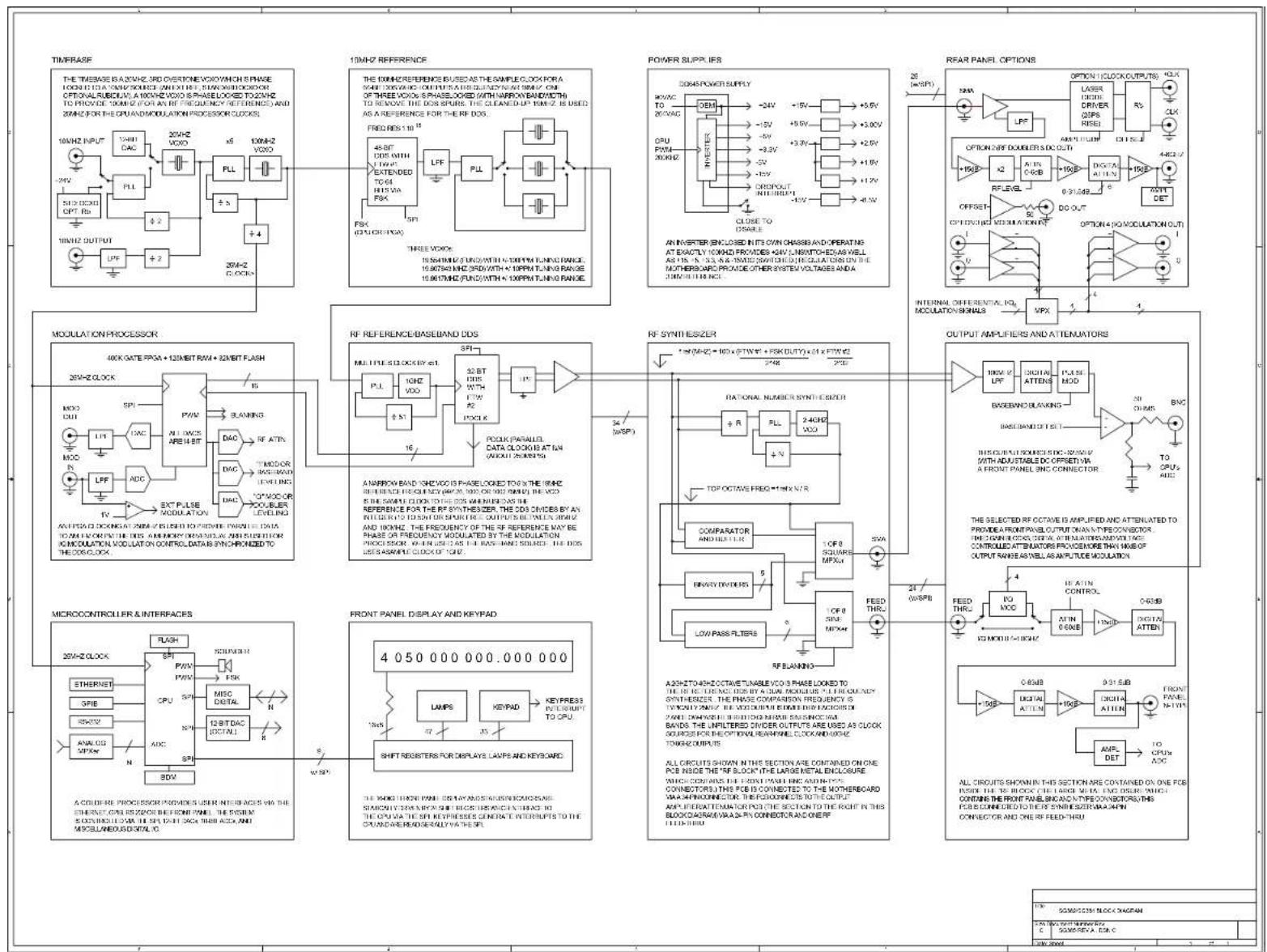

natural_image
Blank white image with no visible content, text, or symbols
natural_image
Blank white image with no visible content, text, or symbols
natural_image
Blank white image with no visible content, text, or symbols
natural_image
Blank white image with no visible content, text, or symbols
natural_image
Blank white image with no visible content, text, or symbols
natural_image
Blank white image with no visible content, text, or symbols
natural_image
Blank white image with no visible content, text, or symbols
natural_image
Blank white image with no visible content, text, or symbols
natural_image
Blank white image with no visible content, text, or symbols
natural_image
Blank white image with no visible content, text, or symbols
natural_image
Blank white image with no visible content, text, or symbols
natural_image
Blank white image with no visible content, text, or symbols
natural_image
Blank white image with no visible content, text, or symbols
natural_image
Blank white image with no visible content, text, or symbols.
natural_image
Blank white image with no visible content, text, or symbols
natural_image
Blank white image with no visible content, text, or symbols
natural_image
Blank white image with no visible content, text, or symbols
natural_image
Blank white image with no visible content, text, or symbols
natural_image
Blank white image with no visible content, text, or symbols
natural_image
Blank white image with no visible content, text, or symbols
natural_image
Blank white image with no visible content, text, or symbols
natural_image
Blank white image with no visible content, text, or symbols
natural_image
Blank white image with no visible content, text, or symbols
natural_image
Blank white image with no visible content, text, or symbols
natural_image
Blank white image with no visible content, text, or symbols
natural_image
Blank white image with no visible content, text, or symbols
natural_image
Blank white image with no visible content, text, or symbols
natural_image
Blank white image with no visible content, text, or symbols
natural_image
Blank white image with no visible content, text, or symbols
natural_image
Blank white image with no visible content, text, or symbols
natural_image
Blank white image with no visible content, text, or symbols
natural_image
Blank white image with no visible content, text, or symbols
natural_image
Blank white image with no visible content, text, or symbols


text_image
Electrical schematic diagram of a multi-pin integrated circuit with labeled components and connections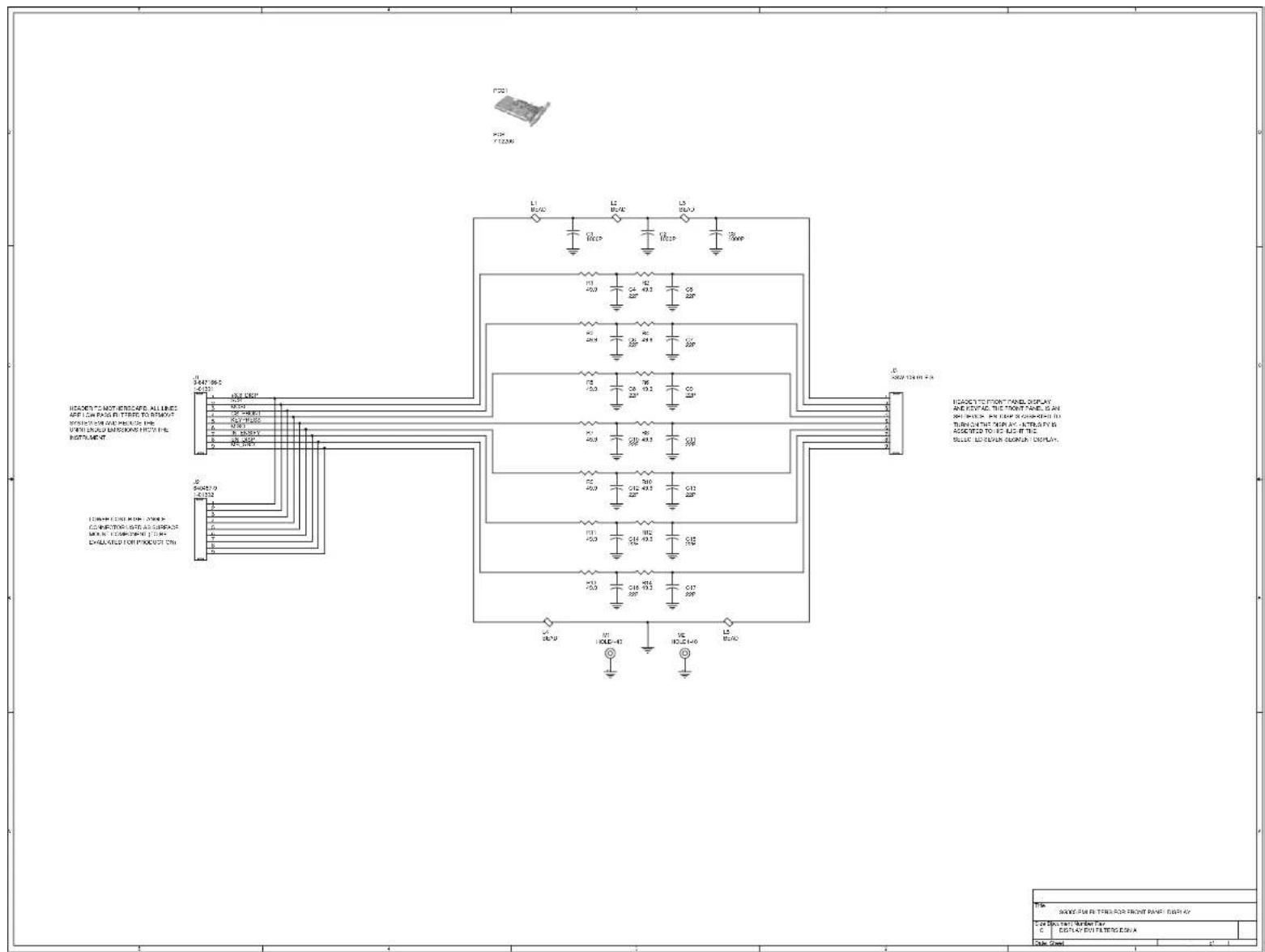
text_image
722M P251 P258 712M L1 R1/40 L2 R2/40 L3 R3/3 200V C1 R1/20 C2 R2/2 C3 R3/1 C4 R4/1 C5 R5/1 C6 R6/1 C7 R7/1 C8 R8/1 C9 R9/1 C10 R10/1 C11 R11/1 C12 R12/1 C13 R13/1 C14 R14/1 C15 R15/1 C16 R16/1 C17 R17/1 C18 R18/1 C19 R19/1 C20 R20/1 C21 R21/1 C22 R22/1 C23 R23/1 C24 R24/1 C25 R25/1 C26 R26/1 C27 R27/1 C28 R28/1 C29 R29/1 C30 R30/1 C31 R31/1 C32 R32/1 C33 R33/1 C34 R34/1 C35 R35/1 C36 R36/1 C37 R37/1 C38 R38/1 C39 R39/1 C40 R40/1 C41 R41/1 C42 R42/1 C43 R43/1 C44 R44/1 C45 R45/1 C46 R46/1 C47 R47/1 C48 R48/1 C49 R49/1 C50 R50/1 C51 R51/1 C52 R52/1 C53 R53/1 C54 R54/1 C55 R55/1 C56 R56/1 C57 R57/1 C58 R58/1 C59 R59/1 C60 R60/1 C61 R61/1 C62 R62/1 C63 R63/1 C64 R64/1 C65 R65/1 C66 R66/1 C67 R67/1 C68 R68/1 C69 R69/1 C70 R70/1 C71 R71/1 C72 R72/1 C73 R73/1 C74 R74/1 C75 R75/1 C76 R76/1 C77 R77/1 C78 R78/1 C79 R79/1 C80 R80/1 C81 R81/1 C82 R82/1 C83 R83/1 C84 R84/1 C85 R85/1 C86 R86/1 C87 R87/1 C88 R88/1 C89 R89/1 C90 R90/1 C91 R91/1 C92 R92/1 C93 R93/1 C94 R94/1 C95 R95/1 C96 R96/1 C97 R97/1 C98 R98/1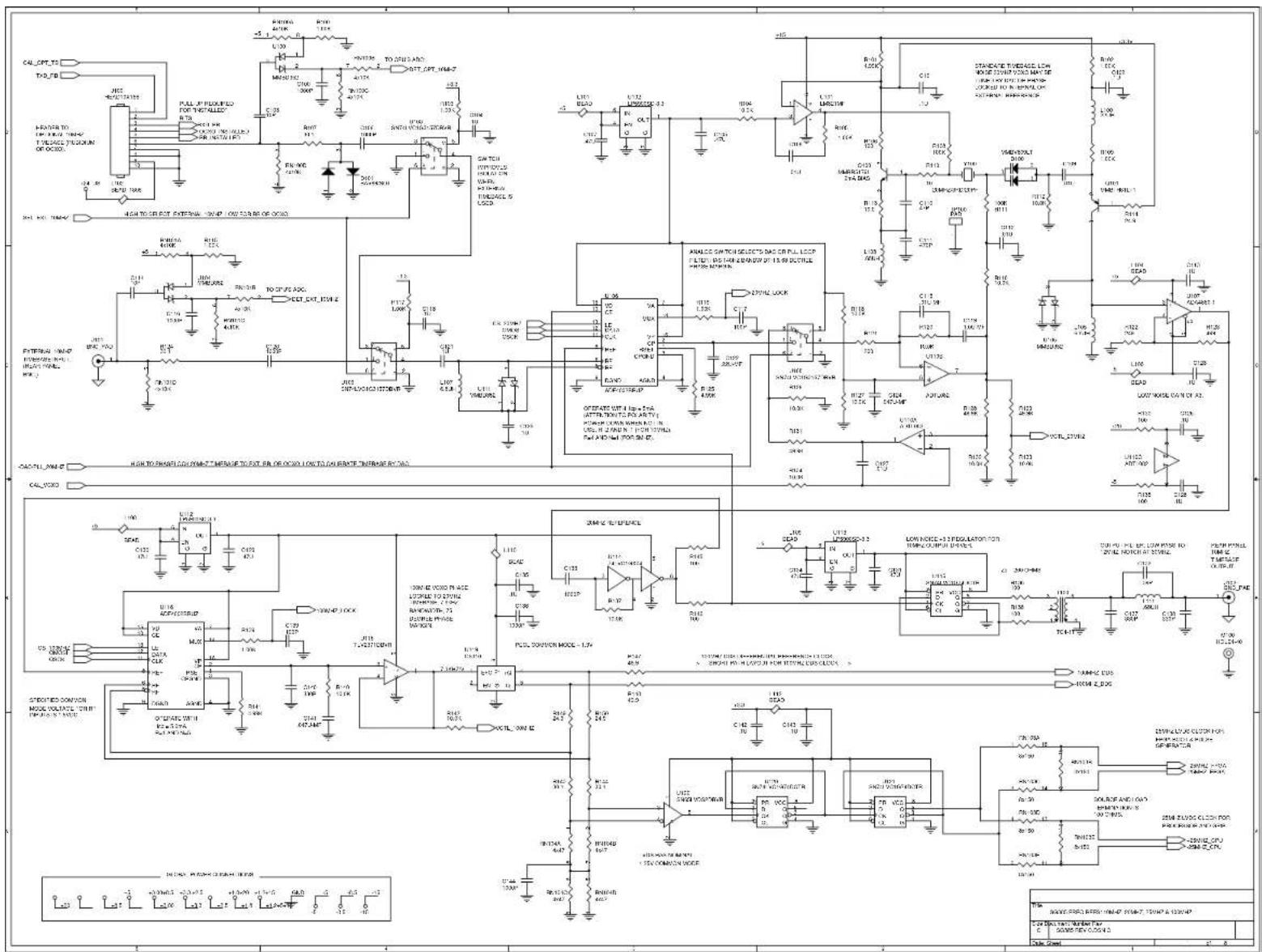
text_image
Electrical schematic diagram with labeled components, ICs, and signal paths for a power supply or control circuit.
text_image
Electrical schematic diagram with multiple circuit components, voltage regulators, and component labels in Chinese.
text_image
Electrical schematic diagram with labeled components, ICs, resistors, capacitors, and wiring connections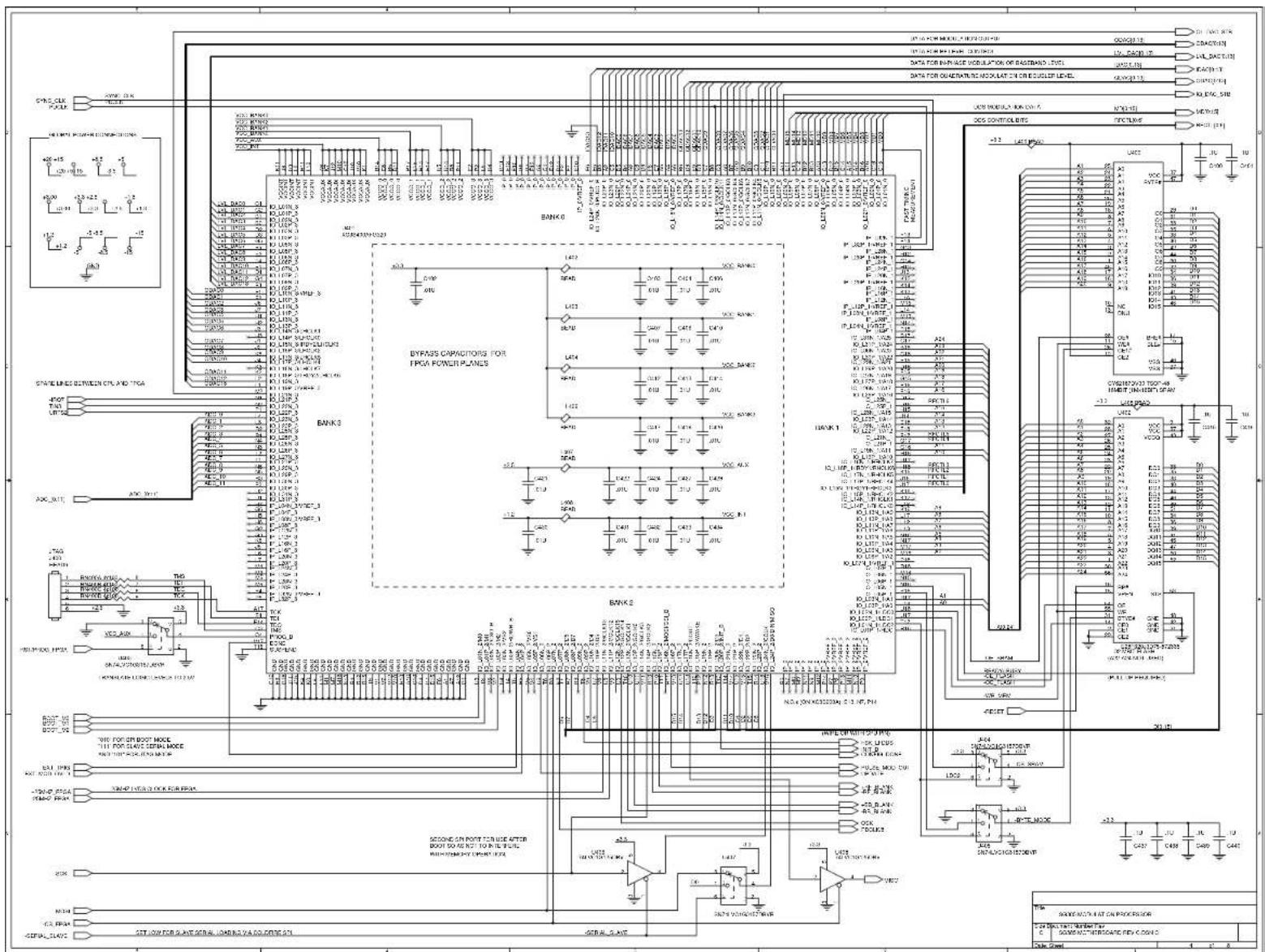
text_image
Electrical schematic diagram of a power supply circuit with labeled components, ICs, and wiring connections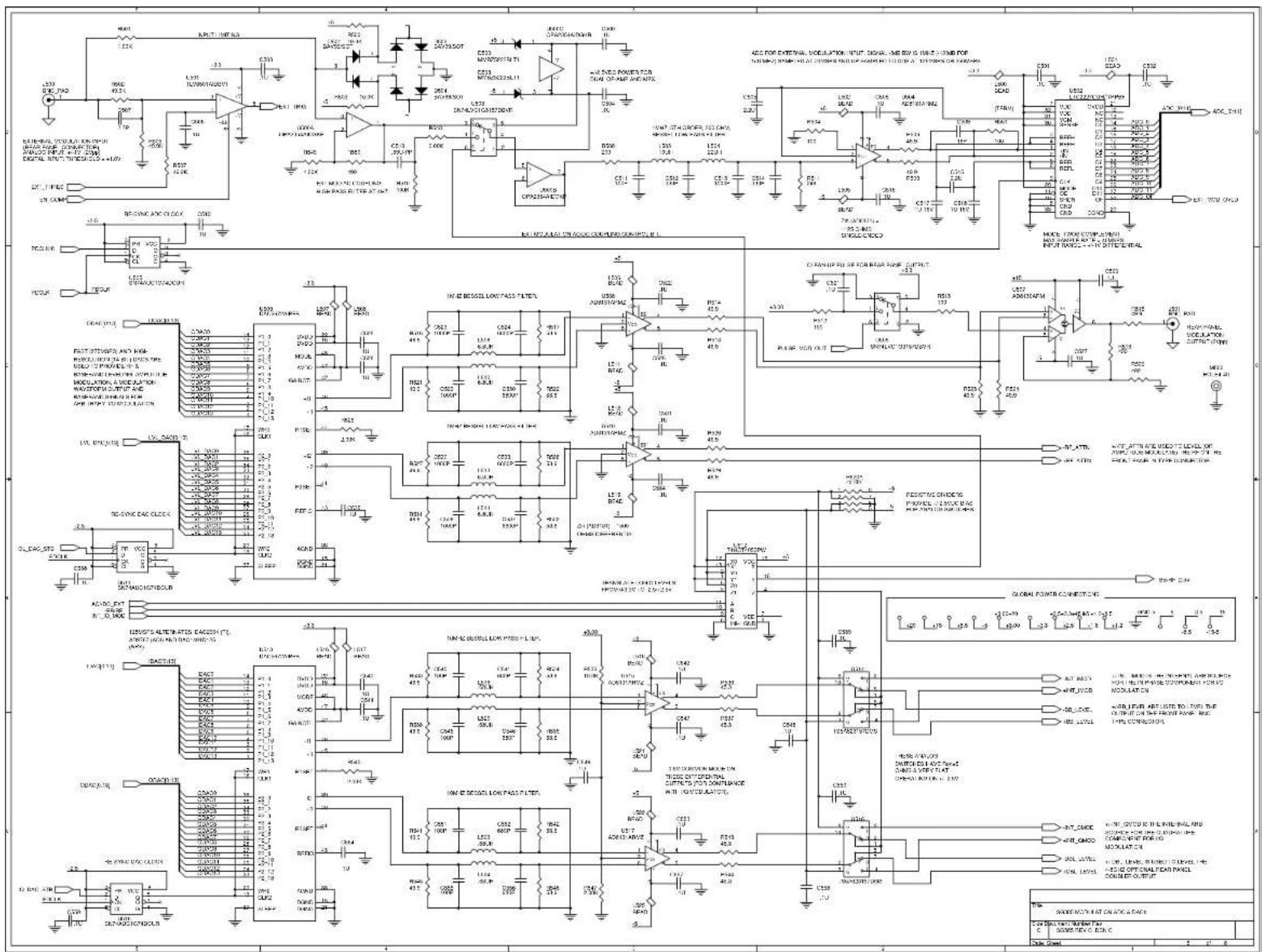
text_image
Electrical schematic diagram of a power supply circuit with labeled components and connections
text_image
Electrical schematic diagram with component labels, traces, and Chinese explanatory text on the upper left.
text_image
LED/ULF INPUT SWITCH R2000 MP 1.25V CNTFS CONTINENT GND 4.5V DC 400V_126C 80V 1.21A 300V 4.27A 300V 1.21A 300V 4.27A 300V 1.21A 300V 4.27A 300V 1.21A 300V 4.27A 300V 1.21A 300V 4.27A 300V 1.21A 30V 1.21A 30V 1.21A 30V 1.21A 30V 1.21A 30V 1.21A 30V 1.21A 30V 1.21A 30V 1.21A 30V 1.21A 30V 1.21A 400V_126C 290V LEVELS: 2.9V FORED, 2.9V FORED. 400V_126C 400V_126C 400V_126C 400V_126C 400V_126C 400V_126C 400V_126C 400V_126C 400V_126C 400V_126C 400V_126C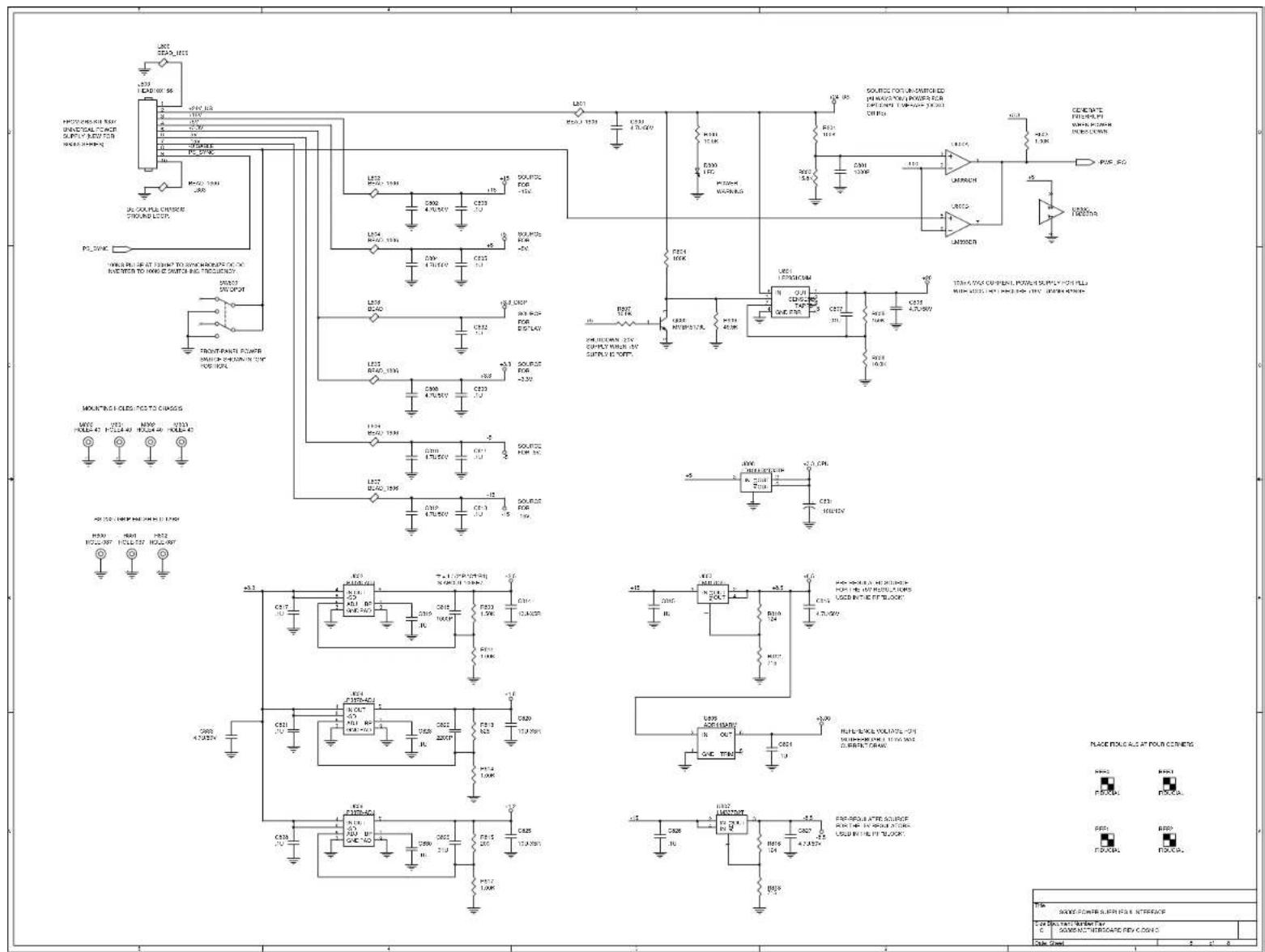
text_image
LCC STAGS_LFE3 +257 LEAD_001 56 +257 LEAD_002 +257 LEAD_003 +257 LEAD_004 +257 LEAD_005 +257 LEAD_006 +257 LEAD_007 +257 LEAD_008 +257 LEAD_009 +257 LEAD_010 +257 LEAD_011 +257 LEAD_012 +257 LEAD_013 +257 LEAD_014 +257 LEAD_015 +257 LEAD_016 +257 LEAD_017 +257 LEAD_018 +257 LEAD_019 +257 LEAD_020 +257 LEAD_021 +257 LEAD_022 +257 LEAD_023 +257 LEAD_024 +257 LEAD_025 +257 LEAD_026 +257 LEAD_027 +257 LEAD_028 +257 LEAD_029 +257 LEAD_030 +257 LEAD_031 +257 LEAD_032 +257 LEAD_033 +257 LEAD_034 +257 LEAD_035 +257 LEAD_036 +257 LEAD_037 +257 LEAD_038 +257 LEAD_039 +257 LEAD_040 +257 LEAD_041 +257 LEAD_042 +257 LEAD_043 +257 LEAD_044 +257 LEAD_045 +257 LEAD_046 +257 LEAD_047 +257 LEAD_048 +257 LEAD_049 +257 LEAD_050 +257 LEAD_051 +257 LEAD_052 +257 LEAD_053 +257 LEAD_054 +257 LEAD_055 +257 LEAD_056 +257 LEAD_057 +257 LEAD_058 +257 LEAD_059 +257 LEAD_060 +257| Title | ||
| SARAY POWER SUPPLY INTERFACE | ||
| Code C | SARAY NUMBER TAT | |
| SARAY NETHERGARD REV C.004 C | ||
| Color Color | # # # | |
text_image
1.0V/1.0V/1.0V 2.0V/1.0V/1.0V 3.0V/1.0V/1.0V 4.0V/1.0V/1.0V 5.0V/1.0V/1.0V 6.0V/1.0V/1.0V 7.0V/1.0V/1.0V 8.0V/1.0V/1.0V 9.0V/1.0V/1.0V 10.0V/1.0V/1.0V 11.0V/1.0V/1.0V 12.0V/1.0V/1.0V 13.0V/1.0V/1.0V 14.0V/1.0V/1.0V 15.0V/1.0V/1.0V 16.0V/1.0V/1.0V 17.0V/1.0V/1.0V 18.0V/1.0V/1.0V 19.0V/1.0V/1.0V 20.0V/1.0V/1.0V 21.0V/1.0V/1.0V 22.0V/1.0V/1.0V 23.0V/1.0V/1.0V 24.0V/1.0V/1.0V 25.0V/1.0V/1.0V 26.0V/1.0V/1.0V 27.0V/1.0V/1.0V 28.0V/1.0V/1.0V 29.0V/1.0V/1.0V 30.0V/1.0V/1.0V 31.0V/1.0V/1.0V 32.0V/1.0V/1.0V 33.0V/1.0V/1.0V 34.0V/1.0V/1.0V 35.0V/1.0V/1.0V 36.0V/1.0V/1.0V 37.0V/1.0V/1.0V 38.0V/1.0V/1.0V 39.0V/1.0V/1.0V 40.0V/1.0V/1.0V 41.0V/1.0V/1.0V 42.0V/1.0V/1.0V 43.0V/1.0V/1.0V 44.0V/1.0V/1.0V 45.0V/1.0V/1.0V 46.0V/1.0V/1.0V 47.0V/1.0V/1.0V 48.0V/1.0V/1.0V 49.0V/1.0V/1.0V 50.0V/1.0V/1.0V 51.0V/1.0V/1.0V 52.0V/1.0V/1.0V 53.0V/1.0V/1.0V 54.0V/1.0V/1.0V 55.0V/1.0V/1.0V 56.0V/1.0V/1.0V 57.0V/1.0V/1.0V 58.0V/1.0V/1.0V 59.0V/1.0V/1.0V 60.0V/1.0V/1.0V 61.0V/1.0V/1.0V 62.0V/1.0V/1.0V 63.0V/1.0V/1.0V 64.0V/1.0V/1.0V 65.0V/1.0V/1.0V 66.0V/1.0V/1.0V 67.0V/1.0V/1.0V 68.0V/1.0V/1.0V 69.0V/1.0V/1.0V 70.0V/1.0V/1.0V 71.0V/1.0V/1.0V 72.0V/1.0V/1.0V 73.0V/1.0V/1.0V 74.0V/1.0V/1.0V 75.0V/1.0V/1.0V 76.0V/1.0V/1, 2, 3, 4, 5, 6, 7, 8, 9, 12, 23, 34, 45, 56, 67, 78, 89, 9A, 9B, 9C, 9D, 9E, 9F, 9G, 9H, 9I, 9J, 9K, 9L, 9M, 9N, 9O, 9P, 9Q, 9R, 9S, 9T, 9U, 9W, 9X, 9Y, 9Z, 9A, 9B, 9C, 9D, 9E, 9F, 9G, 9H, 9I, 9J, 9K, 9L, 9M, 9N, 9O, 9P, 9Q, 9R, 9S, 9T, 9U, 9W, 9X, 9Y, 9P, 9Q, 9R, 9S, 9T, 9U, 9W, 9X, 9Y, 9Z, 9A, 9B, 9C, 9D, 9E, 9F, 9G, 9H, 9I, 9J, 9K, 9L, 9M, 9N, 9A, 9B, 9C, 9D, 9E, 9F, 9G, 9H, 9I, 9J, 9K, 9L, 9M, 9N, 9A, 9B, 9C, 9D, 9E, 9F, 9G, 9H, 9I, 9J, 9M, 9N, 9A, 9B, 9C, 9D, 9E, 9F, 9G, 9H, 9I, A B C D E F G H I N T M N T M N T M N T M N T M N T M N T M N T M N T M N T M N T M N T M N T M N T M N T M N T M N T M N T M N T M N T M N T M N T M N T M N T M N T M N T M N T M N T M N T M N T M N T M N T M N T M N T M M N T M N T M N T M N T M N T M N T M N T M N T M N T M N T M N T M N T M N T M N T M N T M N T M N T M N T M N T M N T M N T M N T M N T M N T M N T M N T M N T M N T M N T M N T M N T M N T M N THONG KONG, JIYUEN BAAND BETWEEN MOTI EFOBANO AND IT BLOCK.
| Title | |||
| SPECIALTY, NOVEMBER AND THOMBOOD TO BE RICHEN | |||
| Date: 01/03/2014 | |||
| Date: 01/03/2014 | |||
| Date: 01/03/2014 | |||
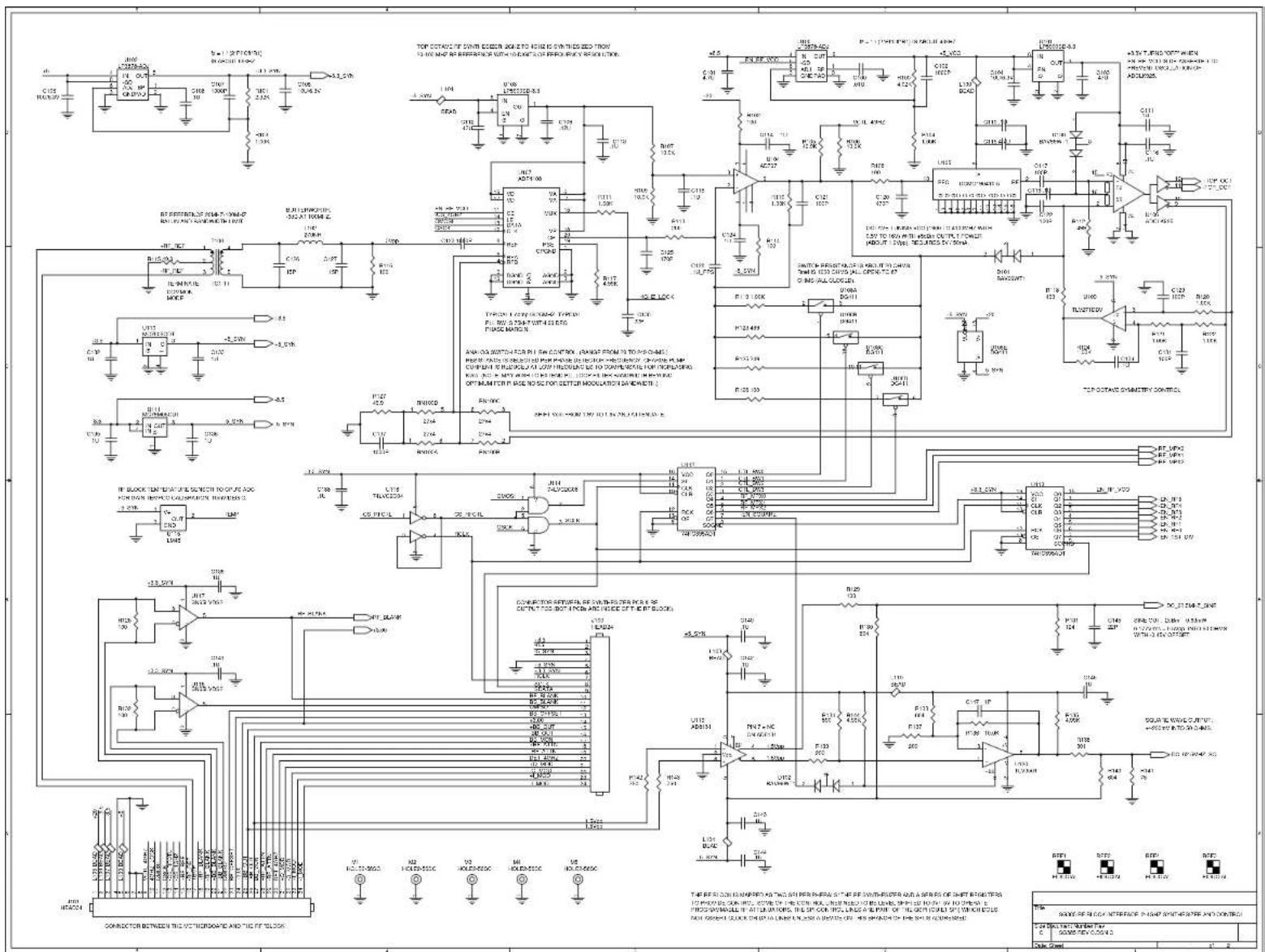
text_image
Electrical schematic diagram of a power supply circuit with labeled components, ICs, resistors, capacitors, and connections.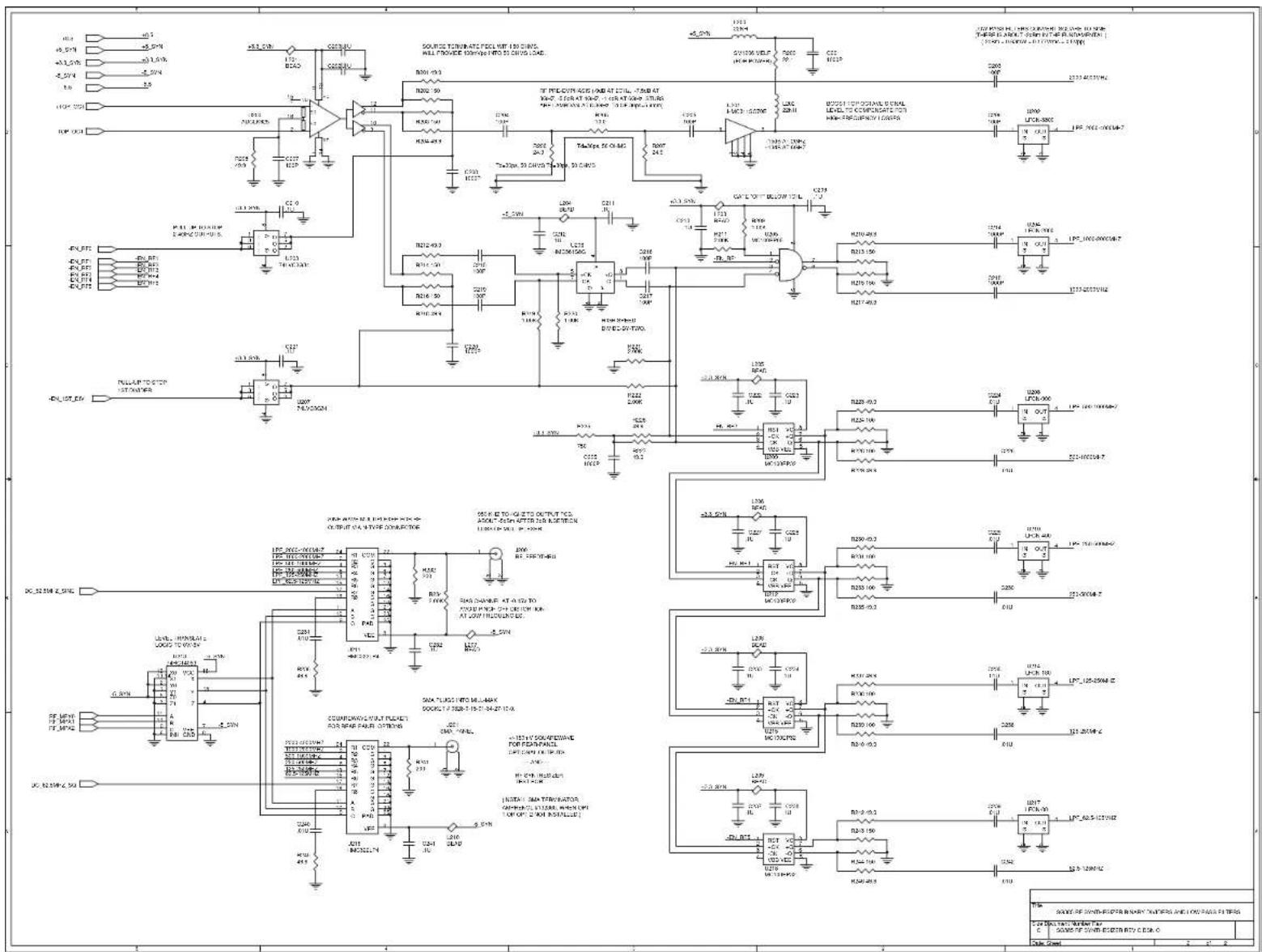
text_image
Electrical schematic diagram with component labels and connections, including ICs, resistors, capacitors, and power supply lines.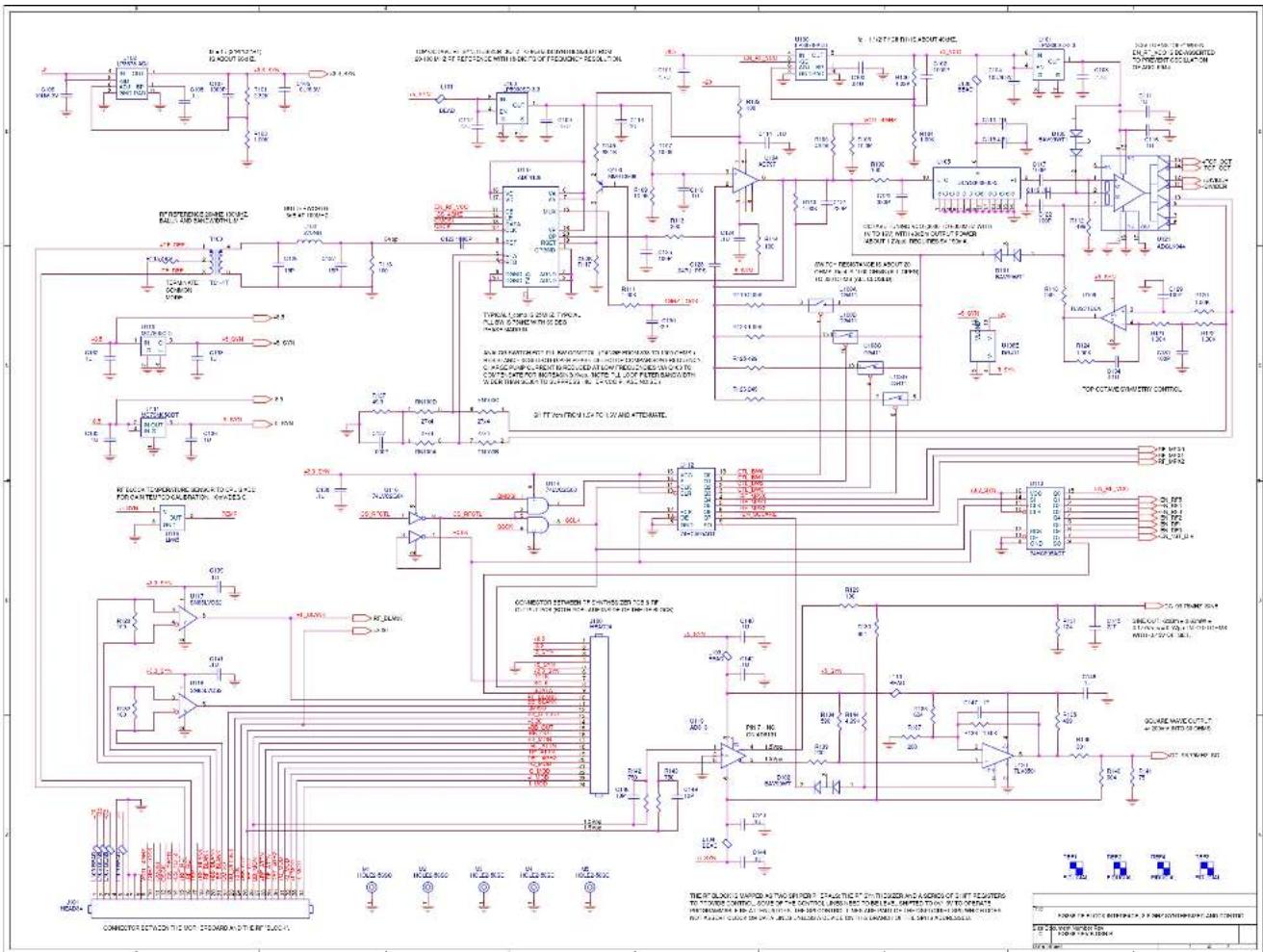
text_image
Electrical schematic diagram with component labels and wiring connections, including capacitors, transistors, inductors, and a highlighted circuit block.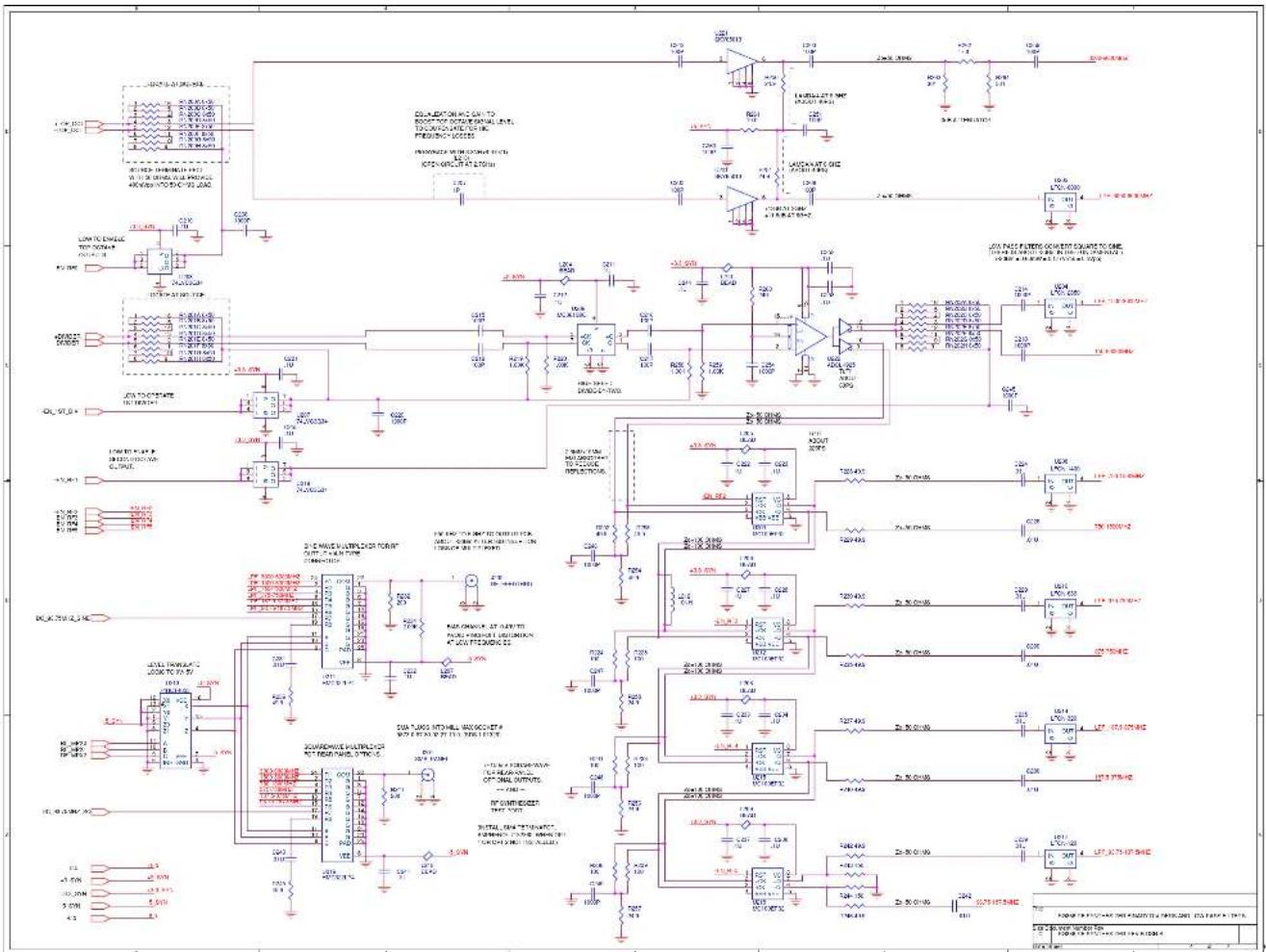
text_image
Electrical schematic diagram with labeled components, traces, and wiring connections for a power supply or control circuit.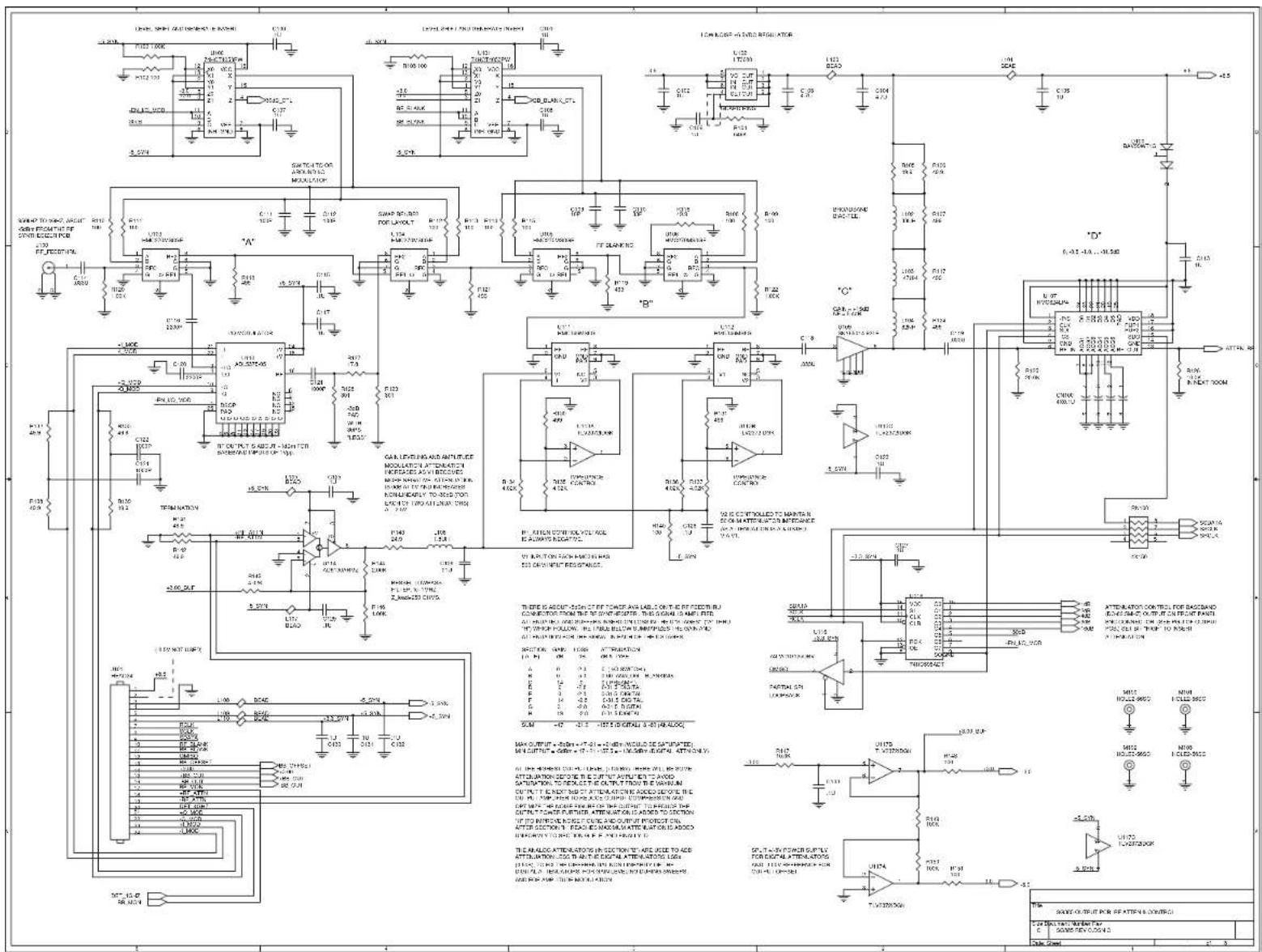
text_image
Electrical schematic diagram with component labels, values, and Chinese annotations for electronic circuitry or signal processing.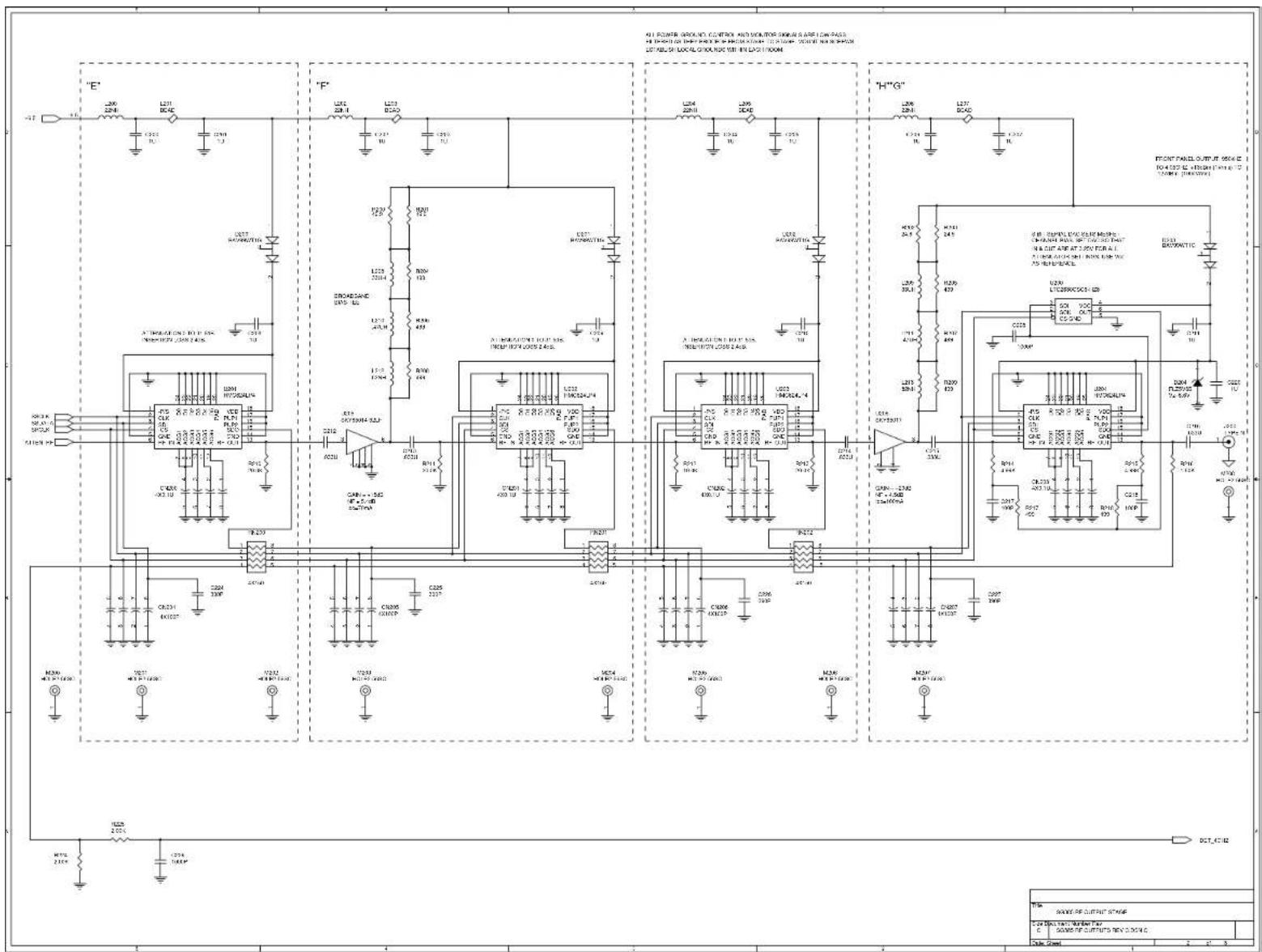
text_image
Electrical schematic diagram of a multi-channel power supply circuit with labeled components and connections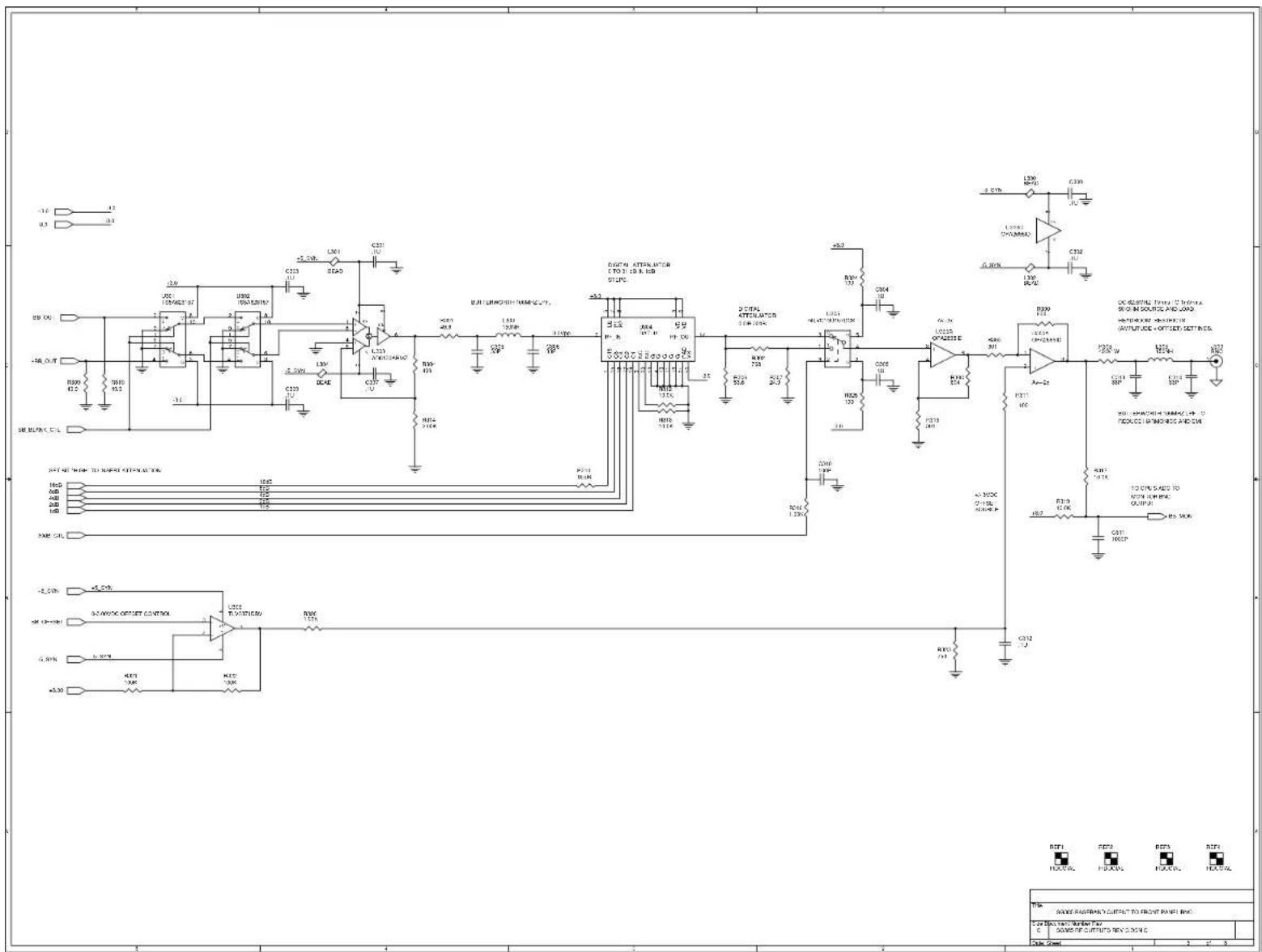
text_image
Electrical schematic diagram with labeled components, ICs, resistors, capacitors, and connections for a power supply or circuit analysis system.| TITLE | ||
| SANDY RASSFRAK'S OUTPUT TO FRONT PANEL RING | ||
| COW DUCT, TENT NUMBER TAYC | SCORE OF OUTPUTS REV 0.024 C | |
| Color Sheet | 3 -1 -3 | |

text_image
Electrical schematic diagram with labeled components, traces, and wiring connections for a power supply or circuit analysis system.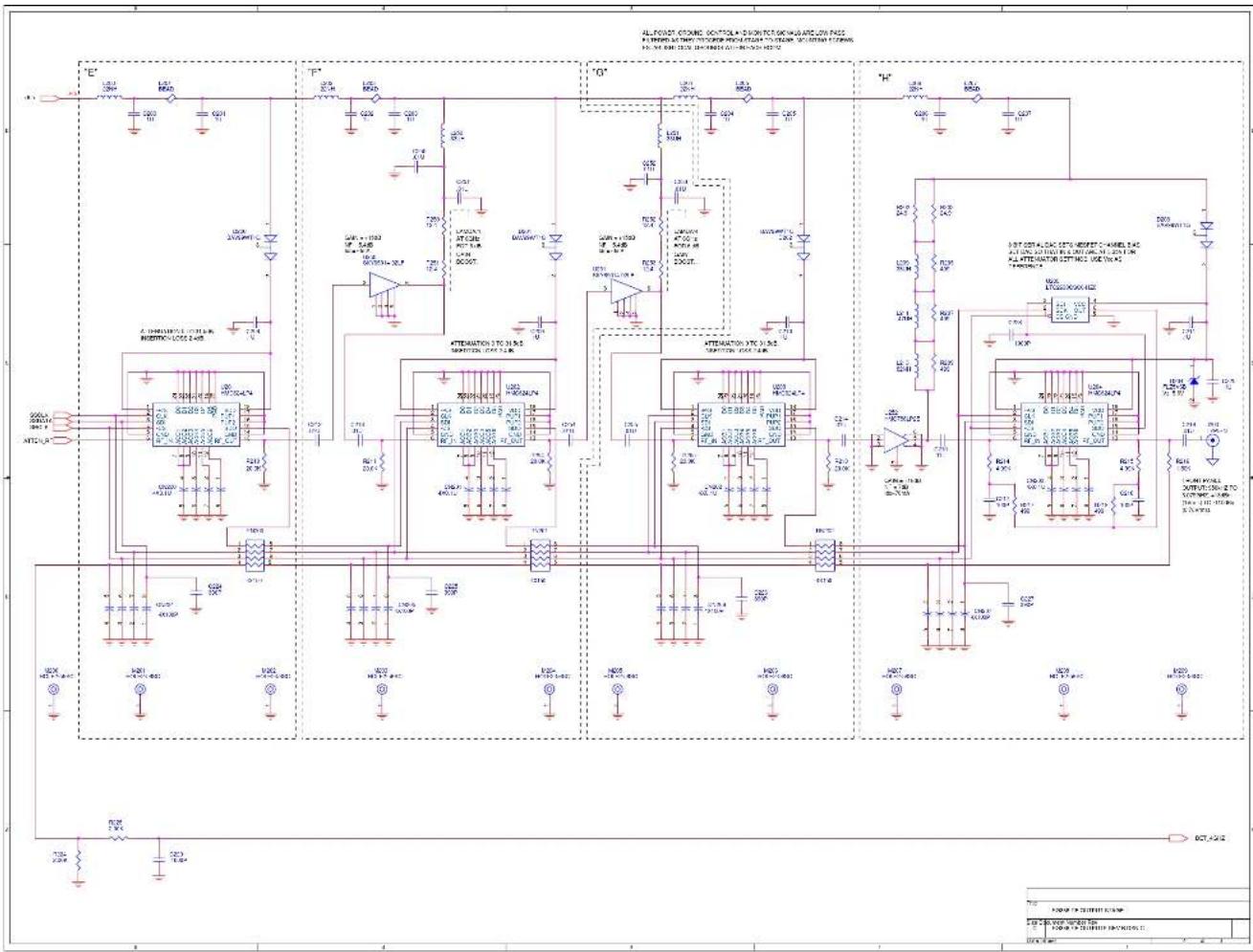
text_image
ALL POINT CTORING SWITCH/CALE SWITCH/CALE SWITCH A POWER AS TRANSFER PERECEUT ROLLAR SWITCH/CALE SWITCH IN THE BANETRONE (0-120V) 425V 72 E' F' O' H C L G L L L L L L L L L L L L L L L L L L L L L L L L L L L L L L L L L L L L L L L L L L L L L L L L L L ATC-LA 6.00V 100Ω 1.0V 1.0V 1.0V 1.0V 1.0V 1.0V 1.0V 1.0V 1.0V 1.0V 1.0V 1.0V 1.0V 1.0V 1.0V 1.0V 1.0V 1.0V 1.0V 1.0V 1.0MΩ 6.00V 100Ω 1.0V 1.0V 1.0V 1.0V 1.0V 1.0V 1.0V 1.0V 1.0V 1.0V 1.0V 1.0V 1.0V 1.0V 1.0V 1.0V 1.0V 1.5V 6.00V 100Ω 1.0V 1.0V 1.0V 1.0V 1.0V 1.0V 1.0V 1.0V 1.0V 1.0V 1.0V 1.0V 1.0V 1.5V 6.00V 100Ω 1.0V 1.0V 1.0V 1.5V 2.5V 3.5V 4.5V 5.5V 6.5V 7.5V 8.5V 9.5V 10.5V 11.5V 12.5V 13.5V 14.5V 15.5V 16.5V 17.5V 18.5V 22.5V 6.00V 100Ω 1.0V 1.0V 1.0V 2.5V 3.5V 4.5V 5.5V 6.5V 7.5V 8.5V 9.5V 10.5V 11.5V 12.5V 13.5V 14.5V 22.5V 6.00V 100Ω 1.0V 1.0V 2.5V 3.5V 4.5V 5.5V 6.5V 7.5V 8.5V 9.5V 10.5V 11.5V 12.5V 13.5V 14.5V 22.5V 6.00V 100Ω 1,2,3,4,5,6,7,8,9,10,12,14,16,24,36,48,64,76,88,98,12,24,36,48,64,76,88,98,12,24,36,48,64,76,88,98,12,24,36,48,64,76,88,98,12,24,36,48,64,76,88,98,98,98,98,98,98,98,98,98,98,98,98,98,98,98,98,98,98,98,98,98,98,98,98,98,98,98,98,98,98,98,98,98,97, ATTENATION: TCI & LAC SFPPTON: TCIC TELK TELK TELK TELK TELK TELK TELK TELK TELK TELK TELK TELK TELK TELK TELK TELK TELK TELK TELK TELK TELK TELK TELK TELK TELK TELK TELK TELK TELK TELK TELK TELK TELK TELK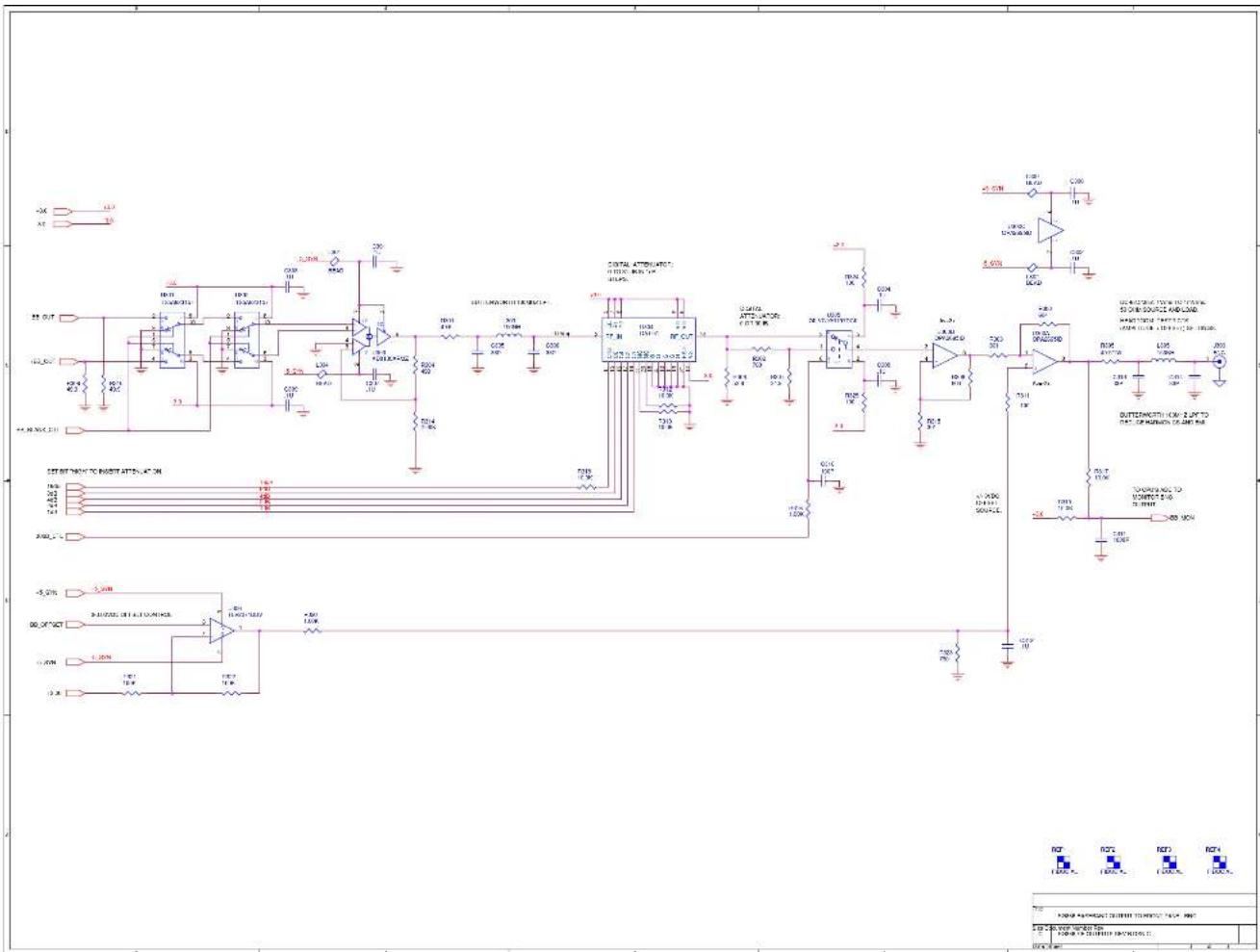
text_image
Electrical circuit diagram with labeled components, ICs, resistors, capacitors, and measurement instruments
text_image
CONDUCTOR TO NOT ENDCARD LTD. 10V VOLTAGE ARE FREED FOR EN (120V) 15V (120V) 15V (120V) 15V LUT. 10V VOLTAGE ARE FREED FOR EN (120V) 15V (120V) 15V (120V) 15V CONDUCTOR LTD. 10V VOLTAGE ARE FREED FOR EN (120V) 15V (120V) 15V (120V) 15V LUT. 10V VOLTAGE ARE FREED FOR EN (120V) 15V (120V) 15V (120V) 15V CONDUCTOR TO NOT ENDCARD LTD. 10V VOLTAGE ARE FREED FOR EN (120V) 15V (120V) 15V (120V) 15V CONDUCTOR TO NOT ENDCARD LTD. 10V VOLTAGE ARE FREED FOR EN (120V) 15V (120V) 15V (120V) 15V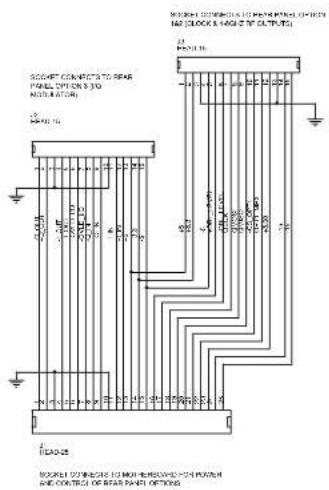
text_image
SUPPORT CONNECT TO SPIN PANEL SWITCH (30 NATIONAL) SUPPORT SUPPORT SWITCH TO 50% PANE (100% OFF) SUPPORT SWITCH TO 50% PANE (100% OFF) SUPPORT SWITCH TO 50% PANE SUPPORT SWITCH TO 50% PANE SUPPORT SWITCH TO 50% PANE SUPPORT SWITCH TO 50% PANE SUPPORT SWITCH TO 50% PANE SUPPORT SWITCH TO 50% PANE SUPPORT SWITCH TO 50% PANE SUPPORT SWITCH TO 50% PANE SUPPORT SWITCH TO 50% PANE SUPPORT SWITCH TO 50% PANE TODANCE| Sr. No. | SALAD, PHEKPHOR, VENIPE, OPLCNS | ||
| Sr. D### H### T##s Inc. | A##P##, S##N## | ||
| Date: 2014 | S | ||

text_image
Electrical schematic diagram of a power supply circuit with labeled components, ICs, and wiring connections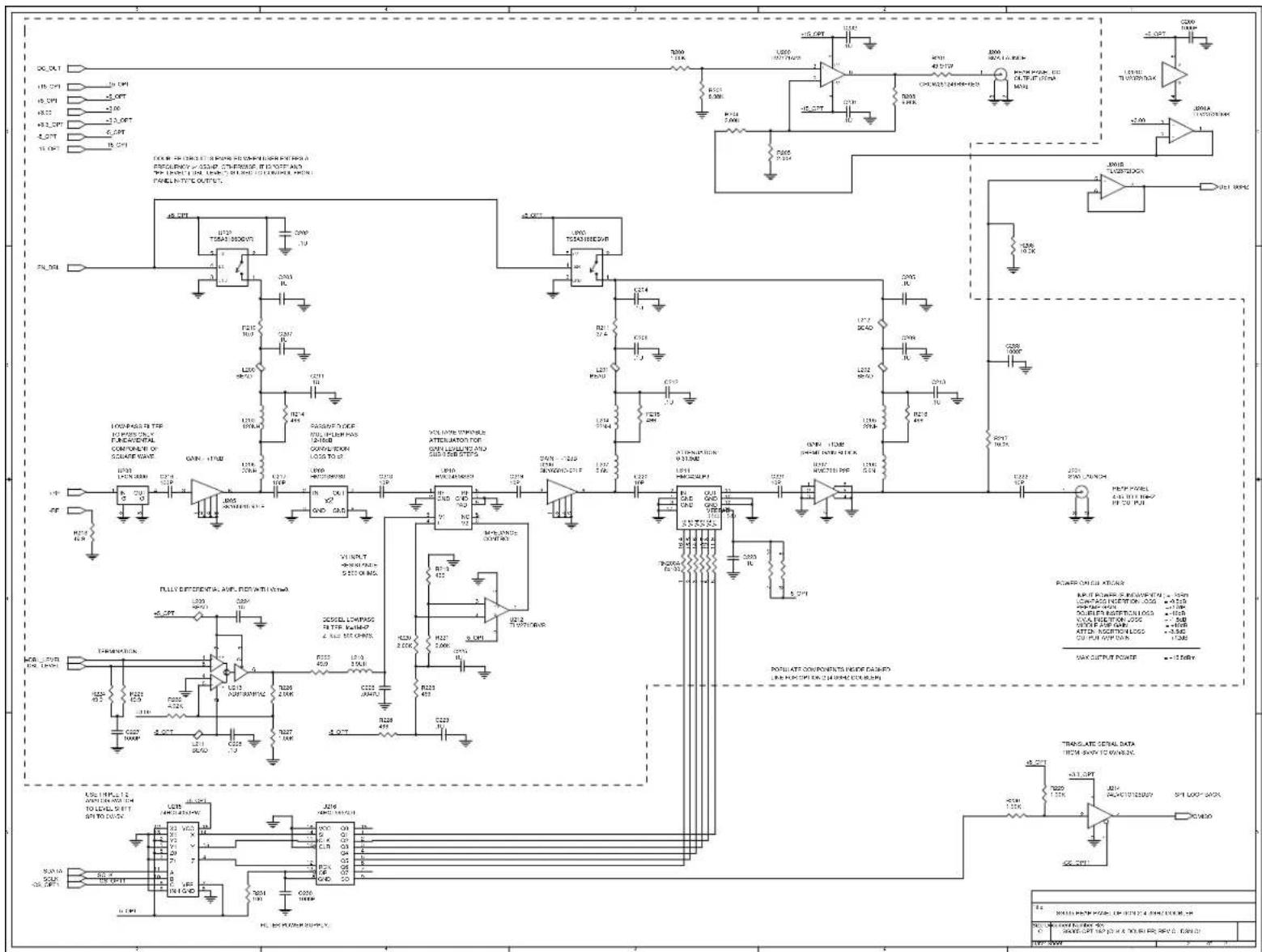
text_image
Electrical schematic diagram with labeled components, ICs, and signal paths for electronic circuit analysis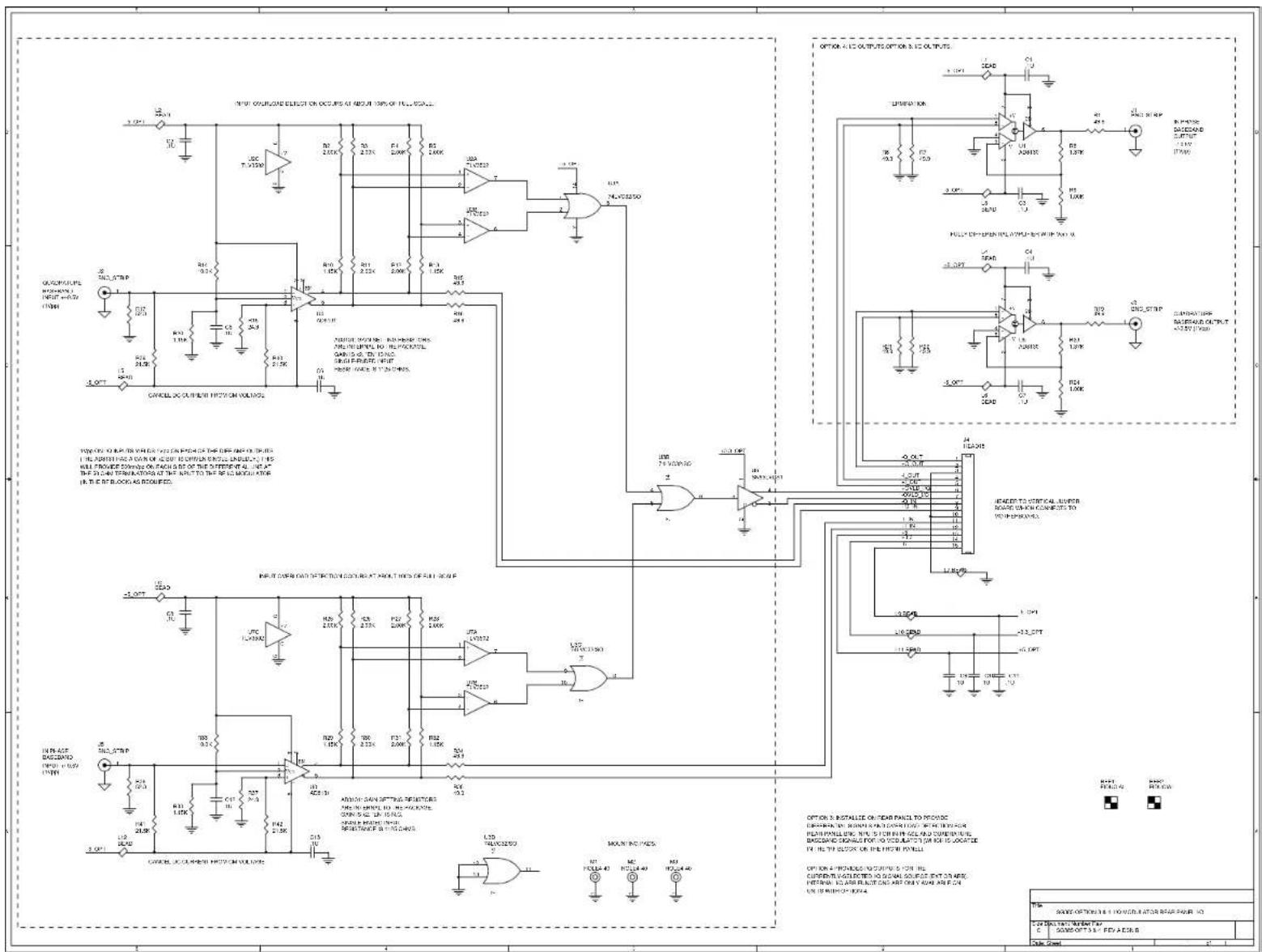
text_image
OFF-OUTRUNS SELECT ON OCCLES OF REACH ITEMS OF FLU.2012 3.0V 7.4V 2.6V 2.0V 2.0V 2.0V 2.0V 2.0V 2.0V 2.0V 2.0V 2.0V 2.0V 2.0V 2.0V 2.0V 2.0V 2.0V 2.0V 2.0V 2.0V 2.0V 2.0V 2.5V 2.5V 2.5V 2.5V 2.5V 2.5V 2.5V 2.5V 2.5V 2.5V 2.5V 2.5V 2.5V 2.5V 2.5V 2.5V 2.5V 2.5V 2.5V 2.5V 2.0V 7.4V 1.8V 1.8V 1.8V 1.8V 1.8V 1.8V 1.8V 1.8V 1.8V 1.8V 1.8V 1.8V 1.8V 1.8V 1.8V 1.8V 1.8V 1.8V 1.8V 1.8V 1.5V 7.4V 1.8V 1.8V 1.8V 1.8V 1.8V 1.8V 1.8V 1.8V 1.8V 1.8V 1.8V 1.8V 1.8V 1.8V 1.8V 1.8V 1.8V 1.8V 1.5V 7.9V 1.8V 1.8V 1.8V 1.8V 1.8V 1.8V 1.8V 1.8V 1.8V 1.8V 1.8V 1.8V 1.8V 1.8V 1.8V 1.8V 1.8V 1.8V 1.8V 1.6V 7.9V 1.8V 1.8V 1.8V 1.8V 1.8V 1.8V 1.8V 1.8V 1.8V 1.8V 1.8V 1.8V 1.8V 1.8V 1.8V 1.8V 1.8V 1.6V 7.9V 1.6W 1.6W 1.6W 1.6W 1.6W 1.6W 1.6W 1.6W 1.6W 1.6W 1.6W 1.6W 1.6W 1.6W 1.6W 1.6W 1.6W 1.6W| Title | ||
| SANSY OPTION 1 & 1 HOODULATOR REAR PWR NO | ||
| Low Document Number ForC | SANSY OPTION 2 FEV A CEN B | |
| Code Sheet | a' | |