ManualGo.com
 XAV-701HD - Car stereo SONY - Free user manual and instructions
Find the device manual for free XAV-701HD SONY in PDF.


Download the instructions for your Car stereo in PDF format for free! Find your manual XAV-701HD - SONY and take your electronic device back in hand. On this page are published all the documents necessary for the use of your device. XAV-701HD by SONY.
USER MANUAL XAV-701HD SONY
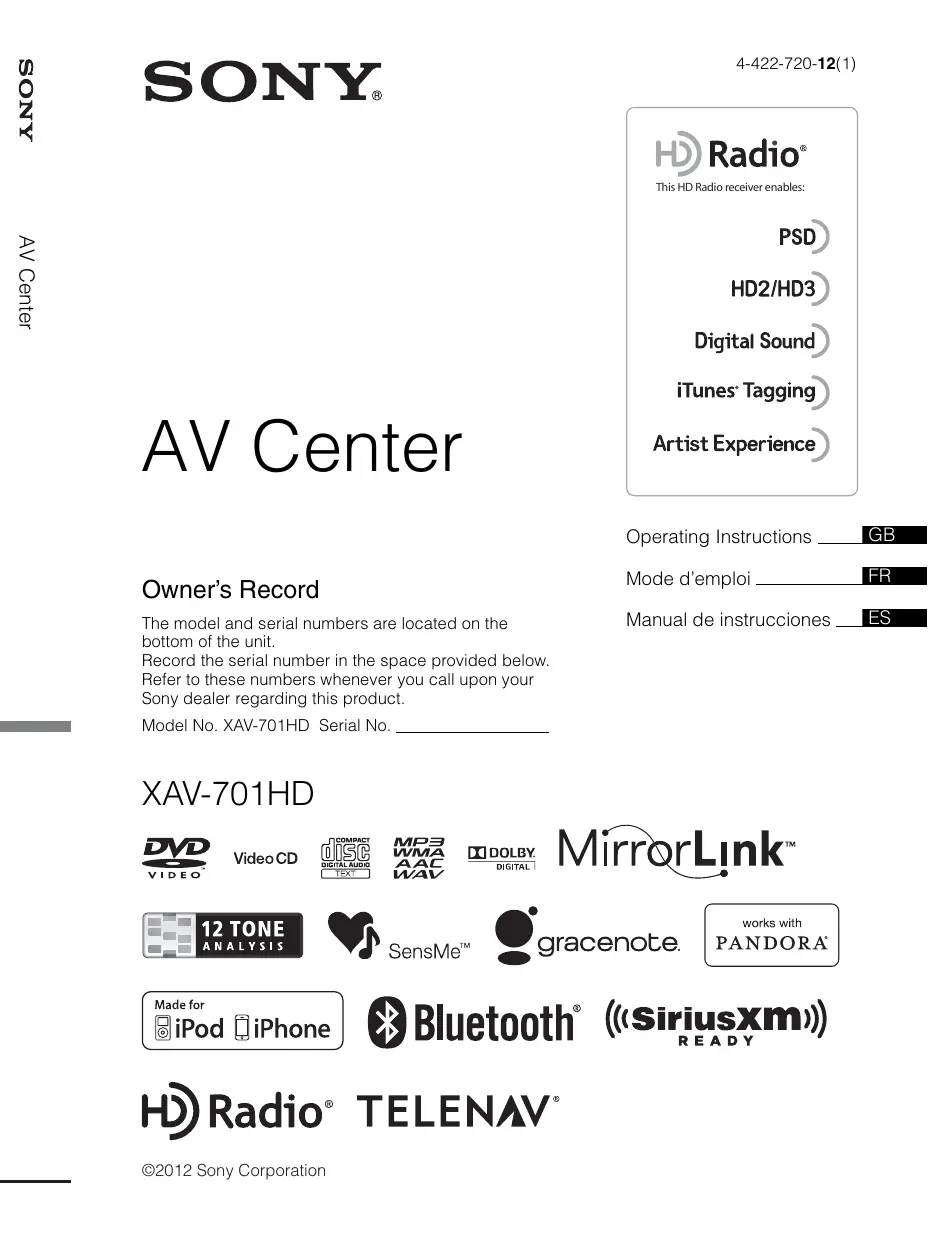
This HD Radio receiver enables:
Owner’s Record The model and serial numbers are located on the bottom of the unit. Record the serial number in the space provided below. Refer to these numbers whenever you call upon your Sony dealer regarding this product. Model No. XAV-701HD Serial No.
©2012 Sony Corporation
Operating Instructions
FR Be sure to install this unit in the dashboard of the car for safety. For installation and connections, refer to the supplied
“Installation/Connections” guide.
To prevent fire or shock hazard, do not expose the unit to rain or moisture. To avoid electrical shock, do not open the cabinet. Refer servicing to qualified personnel only.
CAUTION The use of optical instruments with this product will increase eye hazard. As the laser beam used in this CD/DVD player is harmful to eyes, do not attempt to disassemble the cabinet. Refer servicing to qualified personnel only.
FOR UNITED STATES CUSTOMERS. NOT APPLICABLE IN CANADA, INCLUDING IN THE PROVINCE OF QUEBEC.
POUR LES CONSOMMATEURS AUX ÉTATS-UNIS. NON APPLICABLE AU CANADA, Y COMPRIS LA PROVINCE DE QUÉBEC. This equipment has been tested and found to comply with the limits for a Class B digital device, pursuant to Part 15 of the FCC Rules. These limits are designed to provide reasonable protection against harmful interference in a residential installation. This equipment generates, uses, and can radiate radio frequency energy and, if not installed and used in accordance with the instructions, may cause harmful interference to radio communications. However, there is no guarantee that interference will not occur in a particular installation. If this equipment does cause harmful interference to radio or television reception, which can be determined by turning the equipment off and on, the user is encouraged to try to correct the interference by one or more of the following measures: – Reorient or relocate the receiving antenna. – Increase the separation between the equipment and receiver. – Connect the equipment into an outlet on a circuit different from that to which the receiver is connected. – Consult the dealer or an experienced radio/TV technician for help. You are cautioned that any changes or modifications not expressly approved in this manual could void your authority to operate this equipment.
This device complies with Part 15 of the FCC Rules and Industry Canada licence-exempt RSS standard(s). Operation is subject to the following two conditions: (1) this device may not cause harmful interference, and (2) this device must accept any interference received, including interference that may cause undesired operation of the device.
This transmitter must not be co-located or operated in conjunction with any other antenna or transmitter.
Under Industry Canada regulations, this radio transmitter may only operate using an antenna of a type and maximum (or lesser) gain approved for the transmitter by Industry Canada. To reduce potential radio interference to other users, the antenna type and its gain should be so chosen that the equivalent isotropically radiated power (e.i.r.p.) is not more than that necessary for successful communication.
This equipment complies with FCC/IC radiation exposure limits set forth for an uncontrolled environment and meets the FCC radio frequency
(RF) Exposure Guidelines in Supplement C to OET65 and RSS-102 of the IC radio frequency (RF) Exposure rules. This equipment has very low levels of RF energy that it deemed to comply without maximum permissive exposure evaluation (MPE). But it is desirable that it should be installed and operated keeping the radiator at least 20 cm or more away from person’s body (excluding extremities: hands, wrists, feet and ankles). For the State of California, USA only Perchlorate Material – special handling may apply, See www.dtsc.ca.gov/hazardouswaste/perchlorate Perchlorate Material: Lithium battery contains perchlorate Warning if your car’s ignition has no ACC position Be sure to set the Auto Off function (page 51). The unit will turn off automatically in the set time when no source is selected, which prevents battery drainage. If you do not set the Auto Off function, press and hold (SOURCE/OFF) until the display disappears each time you turn the ignition off.
To cancel the demonstration (Demo) display, see page 51.
Notes on USB playback
Handsfree Calling and Audio
Streaming — Bluetooth function
Selecting the sound quality — EQ7 . . . . . . . . 45 Customizing the equalizer curve — EQ7 Tune . . . . . . . . . . . . . . . . . . . . . . . 45 Adjusting the sound characteristics . . . . . . . . 46 Optimizing sound for the listening position — Intelligent Time Alignment . . . . . . . . . . . . 46 Calibrating the listening position — Intelligent Time Alignment Tune . . . . . 47
• Comply with your local traffic rules, laws and regulations. • While driving – Do not watch or operate the unit, as it may lead to distraction and cause an accident. Park your car in a safe place to watch or operate the unit. – Do not use the setup feature or any other function which could divert your attention from the road. – When backing up your car, be sure to look back and watch the surroundings carefully for your safety, even if the rear view camera is connected. Do not depend on the rear view camera exclusively. • While operating – Do not insert your hands, fingers or foreign object into the unit, as it may cause injury or damage to the unit. – Keep small articles out of the reach of children. – Be sure to fasten seatbelts to avoid injury in the event of a sudden movement of the car. Preventing an accident Pictures appear only after you park the car and set the parking brake. If the car starts moving during video playback, the picture is automatically switched to the background screen after displaying the caution below. “Video blocked for your safety.” The monitor connected to the REAR OUT is active while the car is in motion. The picture on the display is switched to the background screen, but audio source can be heard. Do not operate the unit or watch the monitor while driving.
Notes on installation
• We recommend this unit should be installed by a qualified technician or service personnel. – If you try to install this unit by yourself, refer to the supplied “Installation/Connections” guide and install the unit properly. – Improper installation may cause battery drain or a short circuit. • If the unit does not work properly, check the connections first, referring to the supplied “Installation/Connections” guide. If everything is in order, check the fuse. • Protect the unit surface from damage. – Do not expose the unit surface to chemicals, such as insecticide, hair spray, insect repellent, etc. – Do not leave rubber or plastic materials in contact with the unit for a long time. Otherwise, the finish of the unit may be impaired, or deformation may occur. • When installing, be sure to fix securely. • When installing, be sure to turn the ignition off. Installing the unit with the ignition on may cause battery drain or a short circuit. • When installing, be sure not to damage any car parts such as pipes, tubes, fuel tank or wiring by using a drill, as it may cause a fire or an accident.
Manufactured under license from Dolby Laboratories. Dolby and the double-D symbol are trademarks of Dolby Laboratories. Microsoft, Windows, Windows Vista and Windows Media and logos are trademarks or registered trademarks of Microsoft Corporation in the United States and/or other countries. This product contains technology subject to certain intellectual property rights of Microsoft. Use or distribution of this technology outside of this product is prohibited without the appropriate license(s) from Microsoft. “DVD VIDEO,” “DVD-R,” “DVD-RW,” “DVD+R,” and “DVD+RW” are trademarks. The Bluetooth word mark and logos are owned by the Bluetooth SIG, Inc. and any use of such marks by Sony Corporation is under license. Other trademarks and trade names are those of their respective owners.
ZAPPIN is a trademark of Sony Corporation.
12 TONE ANALYSIS and its logo are trademarks of Sony Corporation. “WALKMAN” and “WALKMAN” logo are registered trademarks of Sony Corporation.
SensMe and the SensMe logo are trademarks or registered trademarks of Sony Ericsson
Mobile Communications AB.
Music recognition technology and related data are provided by Gracenote®. Gracenote is the industry standard in music recognition technology and related content delivery. For more information, please visit www.gracenote.com.
CD, DVD, Blu-ray Disc, and music and videorelated data from Gracenote, Inc., copyright © 2000 to present Gracenote. Gracenote Software, copyright © 2000 to present Gracenote. One or more patents owned by Gracenote apply to this product and service. See the Gracenote website for a non-exhaustive list of applicable Gracenote patents. Gracenote, CDDB, MusicID, MediaVOCS, the Gracenote logo and logotype, and the “Powered by Gracenote” logo are either registered trademarks or trademarks of Gracenote in the United States and/or other countries. iPhone, iPod, iPod classic, iPod nano, and iPod touch are trademarks of Apple Inc., registered in the U.S. and other countries. Apple, Macintosh and iTunes are trademarks of Apple Inc., registered in the U.S. and other countries. MirrorLink™ and the MirrorLink Logo are certification marks of the Car Connectivity Consortium LLC. Unauthorized use is strictly prohibited.
THIS PRODUCT IS LICENSED UNDER THE MPEG-4 VISUAL PATENT PORTFOLIO LICENSE FOR THE PERSONAL AND NONCOMMERCIAL USE OF A CONSUMER FOR DECODING MPEG-4 VIDEO THAT WAS ENCODED BY A CONSUMER ENGAGED IN A PERSONAL AND NON-COMMERCIAL ACTIVITY AND/OR WAS OBTAINED FROM A VIDEO PROVIDER LICENSED BY MPEG LA TO PROVIDE MPEG-4 VIDEO. NO LICENSE IS GRANTED OR SHALL BE IMPLIED FOR ANY OTHER USE. ADDITIONAL INFORMATION INCLUDING THAT RELATING TO PROMOTIONAL, INTERNAL AND COMMERCIAL USES AND LICENSING MAY BE OBTAINED FROM MPEG LA, LLC. SEE HTTP://WWW.MPEGLA.COM THIS PRODUCT IS LICENSED UNDER THE AVC PATENT PORTFOLIO LICENSE FOR THE PERSONAL AND NON-COMMERCIAL USE OF A CONSUMER TO
(i)ENCODE VIDEO IN COMPLIANCE WITH THE AVC STANDARD (“AVC VIDEO”) AND/OR (ii)DECODE AVC VIDEO THAT WAS ENCODED BY A CONSUMER ENGAGED IN A PERSONAL AND NON-COMMERCIAL ACTIVITY AND/OR WAS OBTAINED FROM A VIDEO PROVIDER LICENSED TO PROVIDE AVC VIDEO. NO LICENSE IS GRANTED OR SHALL BE IMPLIED FOR ANY OTHER USE. ADDITIONAL INFORMATION MAY BE OBTAINED FROM MPEG LA, L.L.C. SEE HTTP://WWW.MPEGLA.COM THIS PRODUCT IS LICENSED UNDER THE AVC PATENT PORTFOLIO LICENSE AND VC-1 PATENT PORTFOLIO LICENSE FOR THE PERSONAL AND NON-COMMERCIAL USE OF A CONSUMER TO DECODE VIDEO IN COMPLIANCE WITH THE AVC STANDARD (“AVC VIDEO”) AND/OR THE VC-1 STANDARD (“VC-1 VIDEO”) THAT WAS ENCODED BY A CONSUMER ENGAGED IN A PERSONAL AND NONCOMMERCIAL ACTIVITY AND/OR WAS OBTAINED FROM A VIDEO PROVIDER LICENSED TO PROVIDE AVC VIDEO AND/OR VC-1 VIDEO. NO LICENSE IS GRANTED OR SHALL BE IMPLIED FOR ANY OTHER USE. ADDITIONAL INFORMATION MAY BE OBTAINED FROM MPEG LA, L.L.C. SEE HTTP://WWW.MPEGLA.COM Pandora, the Pandora logo, and the Pandora trade dress are trademarks or registered trademarks of Pandora Media, Inc., used with permission.
Android is a trademark of Google Inc. Use of this trademark is subject to Google Permissions.
BlackBerry® is the property of Research In Motion Limited and is registered and/or used in the U.S. and countries around the world. Used under license from Research In Motion Limited.
SiriusXM subscriptions and Connect Tuner are sold separately. www.siriusxm.com.
Sirius, XM and all related marks and logos are trademarks of Sirius XM Radio Inc. and its subsidiaries. All other marks and logos are the property of their respective owners. All rights reserved.
HD Radio Technology manufactured under license from iBiquity Digital Corporation. U.S. and Foreign Patents. HD Radio™ and the HD,
HD Radio, and “Arc” logos are proprietary trademarks of iBiquity Digital Corp. Telenav® and Telenav logo are registered trademark or trademark of Telenav, Inc.
All other trademarks are trademarks of their respective owners.
This product uses NCM driver software which is licensed to Sony by MCCI corporation.
Notes on Bluetooth function
Caution IN NO EVENT SHALL SONY BE LIABLE FOR ANY INCIDENTAL, INDIRECT OR CONSEQUENTIAL DAMAGES OR OTHER DAMAGES INCLUDING, WITHOUT LIMITATION, LOSS OF PROFITS, LOSS OF REVENUE, LOSS OF DATA, LOSS OF USE OF THE PRODUCT OR ANY ASSOCIATED EQUIPMENT, DOWNTIME, AND PURCHASER’S TIME RELATED TO OR ARISING OUT OF THE USE OF THIS PRODUCT, ITS HARDWARE AND/OR ITS SOFTWARE.
Safe and efficient use Changes or modifications to this unit not expressly approved by Sony may void the user’s authority to operate the equipment. Please check for exceptions, due to national requirement or limitations, in usage of Bluetooth equipment before using this product. Driving Check the laws and regulations on the use of cellular phones and handsfree equipment in the areas where you drive. Always give full attention to driving and pull off the road and park before making or answering a call if driving conditions so require. Connecting to other devices When connecting to any other device, please read its user guide for detailed safety instructions. Radio frequency exposure RF signals may affect improperly installed or inadequately shielded electronic systems in cars, such as electronic fuel injection systems, electronic antiskid (antilock) braking systems, electronic speed control systems or air bag systems. For installation or service of this device, please consult with the manufacturer or its representative of your car. Faulty installation or service may be dangerous and may invalidate any warranty that may apply to this device. Consult with the manufacturer of your car to ensure that the use of your cellular phone in the car will not affect its electronic system. Check regularly that all wireless device equipment in your car is mounted and operating properly. Emergency calls This Bluetooth car handsfree and the electronic device connected to the handsfree operate using radio signals, cellular, and landline networks as well as user-programmed function, which cannot guarantee connection under all conditions. Therefore do not rely solely upon any electronic device for essential communications (such as medical emergencies). Remember, in order to make or receive calls, the handsfree and the electronic device connected to the handsfree must be switched on in a service area with adequate cellular signal strength. Emergency calls may not be possible on all cellular phone networks or when certain network services and/or phone features are in use. Check with your local service provider.
This product contains software that Sony uses under a licensing agreement with the owner of its copyright. We are obligated to announce the contents of the agreement to customers under requirement by the owner of copyright for the software. For details on software licenses, see page 52.
Notice on GNU GPL/LGPL applied software
This product contains software that is subject to the following GNU General Public License (hereinafter referred to as “GPL”) or GNU Lesser General Public License (hereinafter referred to as “LGPL”). These establish that customers have the right to acquire, modify, and redistribute the source code of said software in accordance with the terms of the GPL or LGPL displayed on this unit. The source code for the above-listed software is available on the Web. To download, please access the following URL then select the model name “XAV-701HD.” URL: http://www.sony.net/Products/Linux/ Please note that Sony cannot answer or respond to any inquiries regarding the content of the source code.
Playable discs and file types
This unit can play various video/audio discs. The following chart helps you to check if a disc is supported by this unit, as well as what functions are available for a given disc type. Disc symbol in manual
*1 Audio files can also be stored.
*2 Video files can also be stored. Note “DVD” may be used in these Operating Instructions as a general term for DVD VIDEOs, DVD-Rs/DVD-RWs, and DVD+Rs/DVD+RWs.
The following chart shows the supported file types and their symbols.
Available functions differ depending on the format. The format symbols below appear in these Operating Instructions next to the description of functions available for their corresponding file types. Format symbol in manual
WMA audio file AAC audio file WAVE audio file Xvid video file WMV video file MPEG-4
AVC (H.264 baseline) video file
For details on compression formats, see page 61. Note Even compatible discs may not be playable on this unit, depending on their recording condition.
Location and function of controls
For details, see the pages listed below. A Disc slot page 20 (located behind the front panel) B VOLUME –/+*1 buttons C DSPL/M.OFF button Press to change display items. Press and hold to turn off the monitor and the button illumination. To turn back on, touch anywhere on the display. D Reset button page 15 E Display/touch panel F Receptor for the remote commander G HOME/ATT button Press to open HOME menu. Press and hold to attenuate the sound.
Press to turn on the power/change the source: “Tuner” (HD Radio), “Telenav,” “Pandora,” “MirrorLink™,” “SXM,*2” “iPod,” “USB Music,” “USB Video,” “Disc,” “BT Audio” (Bluetooth Audio), “AUX” (Auxiliary equipment). Press and hold for 1 second to exit the source. Press and hold for more than 2 seconds to turn off. I Z (Eject)/TILT button page 20, 48 Press and hold to adjust the monitor angle. *1 There is a tactile dot to the right of the VOLUME + button. *2 If a SiriusXM Connect Tuner is connected, the connected device (“SXM”) will active on the display.
B ZONE × ZONE C TAG D Bluetooth status indications page 37 E Clock page 16 F “ZONE × ZONE” key Touch to activate Zone × Zone.
Touch to open HOME Option menu. The items in the Home Option menu are as follows: “Icon Priority” Displays the icon depending on the frequency of use: “Default,” “Frequency Used.” “Background Theme”*1 Changes the Background Theme: “Default,” “User.” “Icon View” Changes the display of icons: “2D Mode,” “3D Mode.*2” “Touch Effect” Displays a light trail where you have touched the display: “ON,” “OFF.” To return to the Home screen, touch
H Source select keys
Touch to change the source: “Tuner” (HD Radio), “Telenav,” “Pandora,” “MirrorLink™,” “SXM,*3” “Phone,” “iPod”, “USB Music,” “USB Video,” “USB Photo,” “Disc,” “BT Audio,” “Navigation,*4” “Rear Camera,” “AUX” (Auxiliary equipment), “Settings”. *1 Available after setting a photo file as a wallpaper while the “USB Photo” source is selected. *2 Select 2D/3D Mode to display icons in 2D/3D. In 3D Mode, you can operate by drawing icons back and forth. *3 If a SiriusXM Connect Tuner is connected, the connected device (“SXM”) will active on the display. *4 If the navigation module (not supplied) is connected, the Navigation source icon on the Home screen becomes active. Tip Touch and hold anywhere on the screen to display the menu item list.
RM-X271 Remote Commander
• The remote commander can be used to operate the audio controls. For menu operations, use the touch panel. • For details, see the pages listed below. • Remove the insulation film before use (page 16).
F EQ (Equalizer) button
Press to select an equalizer curve from 7 music types (“Xplod”/“Vocal”/“Edge”/ “Cruise”/“Space”/“Gravity”/“Custom”/ “OFF”). G Number buttons page 24 Tuner: Press to receive stored stations. Press and hold to store stations. Disc: Press to locate a title/chapter/track. H CLEAR button Press to delete an entered number. I Z×Z (Zone × Zone) button page 35 Press to activate Zone × Zone. J ATT (Attenuate) button Press to attenuate the sound. To cancel, press again. K u (Play/Pause) button
Press to exit the source/stop the source. Press and hold to turn off. B DSPL button Press to change display items. C MONITOR OFF button Press to turn off the monitor and the button illumination. To turn back on, press again. D POSITION button Press to switch the listening position (“Front L”/“Front R”/“Front”/“All”/“Custom”/ “OFF”). E O (Return) button Press to return to the previous display/return to the menu on a VCD*1.
Tuner/SXM: Press to tune to stations automatically. Press and hold to find a station manually. Press to search the stored contents automatically (SXM). Disc*2/USB/iPod: Press to skip a chapter/track/scene/file. Press and hold momentarily to reverse/ fast-forward video. Press and hold to reverse/fast-forward a track. Bluetooth Audio*3: Press to skip a track. Press and hold to reverse/fast-forward a track. Pandora: Press to skip a track. M DVD playback setting buttons (AUDIO): Press to change the audio language/format. (For a VCD, to change the audio channel.) (SUBTITLE): Press to change the subtitle language. (ANGLE): Press to change the viewing angle. (TOP MENU): Press to open the top menu on a DVD. (MENU): Press to open the menu on a disc.
Press to enter ZAPPIN™ mode. O </M/m/, (Cursor)/ENTER buttons page 18, 20 Tuner/SXM: Press to tune to stations automatically. Press and hold to find a station manually. Disc(DVD): Press to control the menu on a DVD. P SRC (SOURCE) button Press to turn on/change the source: “Tuner” (HD Radio), “Telenav,” “Pandora,” “MirrorLink™,” “SXM,” “iPod,” “USB Music,” “USB Video,” “Disc,” “BT Audio” (Bluetooth Audio), “AUX” (Auxiliary equipment).
Before operating the unit for the first time, or after replacing the car battery or changing the connections, you must reset the unit. Press the reset button (page 12) with a pointed object, such as a ballpoint pen. Note Pressing the reset button will erase the clock setting and some stored contents.
Performing initial settings
After resetting, the display for the initial settings appears.
Press to select the radio band (FM/AM)/ select an auxiliary device (AUX1/AUX2)*4. R VOL (VOLUME) +/– buttons *1 When playing with PBC functions. *2 Operation differs depending on the disc (page 21). *3 Operation differs depending on the connected Bluetooth device. *4 When two auxiliary devices are used. Note The remote commander will not operate when the unit is turned off and the display has disappeared. Press (SOURCE/OFF) on the main unit, or insert a disc to activate the unit and enable operation via the remote commander.
Touch “No” on the demo setting display.
Touch “Subwoofer” to set the subwoofer connection status.
Set to “ON” if a subwoofer is connected, or “OFF” if not.
Touch “Listening Position” to set the listening position.
Set to “Front L” if your listening position is front left, or “Front R” if front right. To return to the Initial Setting, touch .
Touch “Language” to set the display language.
Move the scrollbar up and down, then select the desired language (English/Français/ Español/Português/Русский/Nederlands/ Deutsch/Italiano). To return to the Initial Setting, touch .
The setting is complete.
This setting can then be further configured in the setting menu.
• For details on setting the subwoofer connection status, see page 54. • For details on setting the listening position, see “Optimizing sound for the listening position — Intelligent Time Alignment” on page 46.
• For details on setting the character encoding, see page 51.
• For details on setting the display language, see page 51. Note Some characters may not be displayed correctly, depending on the language/country/region.
Program Service Data: Contributes to the superior user experience of HD Radio
Technology. Presents song name, artist, station IDs, HD2/ HD3 Channel Guide, and other relevant data streams.
The clock uses a 12-hour indication.
Press (HOME), then touch “Settings.”
Set the hour and minute.
For example, to set to 8:30, touch “0830.”
Touch , then touch “Clock Adjust.”
The setting display appears.
The setting is complete.
To delete an entered number, touch “Clear.”
To return to the previous display, touch .
Preparing the remote commander
Before using the remote commander for the first time, remove the insulation film.
Adjacent to traditional main stations are extra local FM channels. These HD2/HD3 Channels provide new, original music as well as deep cuts into traditional genre.
Digital, CD-quality sound. HD Radio
Technology enables local radio stations to broadcast a clean digital signal. AM sounds like today’s FM and FM sounds like a CD.
iTunes® Tagging provides you the opportunity to discover a wide range of content and the means to “tag” that content for later review and purchase from the iTunes® Store.
Visual information related to content being played on your HD Radio receiver, such as
Album Art, historical photographs, still art from live broadcasts, among other related content. For more information, visit the following website: http://www.hdradio.com/
Listening to the radio
Press (HOME), then touch “Tuner.”
The radio reception display appears.
Touch the current band.
The band list appears.
Touch the desired band (“FM1,” “FM2,”
“FM3,” “AM1,” or “AM2”).
To tune automatically
Touch / . Scanning stops when the unit receives a station. Repeat this procedure until the desired station is received. For operations during HD Radio reception, see “About FM Multicasting” (page 18). To tune manually Touch / repeatedly until the desired frequency is received. To skip frequencies continuously, touch and hold / .
Touch to register the preset item.
4 Touch to change Visualizer, which contains the following items: Gate/Balloon/Glow/Animal/Graffiti/Ink/ Random/OFF 5
Touch to display the HD Radio play display.
Touch to delete all the iTunes tags registered (page 19).
Touch to tune automatically. For operations during HD Radio reception, see “About FM Multicasting” (page 18).
Touch to tune manually. Touch and hold to continuously skip frequencies.
Touch to select stations. Touch and hold to store the currently displayed frequency in a preset.
Touch to display the HD Radio play operation display.
Touch to register the tag to the track currently played (page 19).
Play operation display: 1
Play display (HD Radio reception only):
Touch to display the list for selecting the main/supplemental program (only when digital broadcast is being received) (page 18).
* Cannot select during an analogue radio reception.
Touch to open the band list.
Reception indications
Play operation display:
The unit stores the first six available stations in the preset list (“1” to “6”).
To return to the playback screen, touch
While receiving the station that you want to store, touch
, then touch a number in the list (“1” to “6”).
To return to the playback screen, touch
E F Play display (HD Radio reception only):
If you try to store another station to the same number, the previously stored station will be replaced.
G Receiving stored stations
Touch the desired number (“1” to “6”).
About FM Multicasting
Some FM HD Radio stations provide a main program and supplemental program(s) (up to 7) at the same frequency.
H A Current source icon*
B Band name C Frequency/status D Station name/Program type E Station logo F Preset number G Album artwork* H Track name, Artist name, Album name, Genre* * Does not appear during an analogue radio reception.
Storing and receiving stations
Caution When tuning to stations while driving, use Best Tuning Memory (BTM) to prevent an accident.
Press (HOME), then touch “Tuner.”
Select the desired band (“FM1,” “FM2,” “FM3,” “AM1,” or “AM2”).
. BTM display appears.
Selecting a program from the list
During main program reception, touch
Touch the desired program.
Searching a program automatically
During main program reception, touch
The iTunes Tag button on this unit allows you to tag songs you like that are broadcast by HD Radio stations. Information about these tagged songs is stored by the receiver and transferred to your iPod. When you connect your iPod to your computer, iTunes automatically presents songs in a new Tagged playlist so you can preview, buy, and download them.
Using iTunes Tagging
You can save the name of a song broadcast on an HD Radio station to this unit with a few easy steps. After transferring the song information to the connected iPod using this unit, sync your iPod to your computer. These songs will show up in a “Tagged” playlist in iTunes, enabling easy preview or purchase of songs. For details on iTunes Tagging and the latest iTunes Tagging compatible models, check the iTunes website at - http://www.apple.com/itunes/ For details on purchasing a song using “Tagged” information, check the iTunes website at http://www.apple.com/support/itunes/
Retrieving song information
“TAG” appears when song information is broadcast on an HD Radio station. 1 Press “TAG.”
1 Place your iPod on the connector of the unit.
The unit automatically starts transferring saved song information. The “TAG” indicator flashes during the transfer. If an iPod is inserted into the unit during tagged song retrieval, the unit immediately starts transferring the data to the iPod, after the data is saved. Once the unit completes transferring tagged song information to the iPod, the saved data will be erased from the unit. Notes • Do not remove the iPod during the transfer. The unit cannot transfer song information if the iPod is removed. • If the connected iPod does not support for iTunes Tagging, song information will not be transferred, even after this unit saves the data, and the error message will appear in the display. • If the connected iPod does not have enough free space in the memory, song information will not be transferred, even after this unit saves the data, and the error message appears in the display.
Deleting tagged song information
You can delete all tagged song information before transferring to iPod.
The unit starts retrieving song information.
After retrieving the song information, the unit starts saving the data, and the completion message of tag registration appears.
1 Press (HOME), then touch “Tuner.”
2 Touch . The confirmation display for deleting the tag appears. 3 Touch “Delete.” To cancel deletion, touch “Cancel.” Note Song information once deleted cannot be restored.
• If the song information is not included in the HD Radio station broadcast, the error message appears. • It takes up to 10 seconds to retrieve song information. • If “TAG” is touched immediately after the beginning of a song, the unit may retrieve the information of the previously broadcast song as well as the current song. • If “TAG” is touched just before the end of a song, the unit may retrieve the information of the next song, in addition to the current song. • The maximum number of tagged songs that you can save to this unit is 50. If you touch “TAG” when 50 tagged songs are already saved, an error message will appear in the display and song information will not be retrieved.
Transferring retrieved song information
You can transfer song information retrieved and saved to an iPod using this unit. For details on compatible iPod models, see “About iPod” on page 63.
Touch the display if the playback controls are not displayed.
Depending on the disc, some operations may be different or restricted.
Refer to the operating instructions supplied with your disc.
Press Z on the main unit.
The front panel opens automatically.
Insert the disc (label side up).
The front panel closes automatically, then playback starts.
If the DVD menu appears
Touch the item in the DVD menu.
You can also use the menu control panel, which can be displayed by touching outside of the DVD menu. Touch B/V/v/b to move the cursor, then touch “ENTER” to confirm. If the menu control panel does not appear by touching the display, use the remote commander.
A DVD is divided into several sections, which make up a picture or music feature. These sections are called “titles.” When you play a DVD that contains several titles, you can select a desired title using the DVD’s top menu. For DVDs that allow you to select items such as subtitle/sound language(s), select these items using the DVD menu.
Press and hold (SOURCE/OFF) for 1 second.
Discs in DTS format are not supported. The sound is not output if the DTS format is selected.
Press Z on the main unit.
The front panel opens automatically, then the disc is ejected.
Press Z on the main unit to close the front panel.
The front panel closes automatically after the caution alarm sounds.
Touch to list up tracks/video files. (page 25)
If the disc contains multiple file types, only the selected file type (audio/video) can be played. For details on how to select the file type, see “Selecting a file type” on page 25.
Touch to change Visualizer, which contains the following items: Gate/Balloon/Glow/Animal/Graffiti/Ink/ Random/OFF 3
Touch to skip a chapter/track/scene file.
Playback indications
Touch the display if the indications are not displayed. For audio discs, some indications are always displayed during playback.
A Touch and hold momentarily to reverse/ fast-forward the video; and then repeatedly to switch the speed (× 2 t
× 12 t × 120 t × 2 …)*1. To cancel, touch u. Touch and hold to reverse/fast-forward the audio track. During pause, touch and hold down > to play the video in slow motion. To cancel, release the key. 5
Touch to pause/resume play after pause.
Touch to open the DVD control menu, which contains the following items. • “Top Menu”: Touch to open the top menu on the DVD.*2 • “Menu”: Touch to open the menu on the disc.*2 • : Touch repeatedly to select the audio language/format. (page 22)*2 • : Touch repeatedly to turn off/select the subtitle language.*2*3 • : Touch repeatedly to change the viewing angle.*2 7
(DVD VIDEO playback only)
Touch to open the option menu. • CSO (Center Speaker Organizer) (page 47) • DVD Audio Level (page 23)
Touch to change the audio channel. (page 23) *1 The speed depends on the format or the recording method. *2 Availability depends on the disc. *3 When the 4-digit input prompt appears, input the language code (page 73) for the desired language.
A Current source icon, format, chapter/title number*1, audio format*3
B Playback status, elapsed playback time C Track/artist/album name*1*5 File/folder name*6 D Current source icon, format, track (file) number*2, playback status, elapsed playback time*4
*1 Indications differ depending on the content.
*2 When playing a VCD with PBC functions (page 22), “PBC” appears. *3 DVD only. *4 During VCD playback with PBC functions, no indication appears. *5 CD/MP3/WMA/AAC only. *6 Xvid/MPEG-4 only.
Using PBC (playback control) functions
The PBC menu interactively assists with operations while a PBC-compatible VCD is played.
Start playing a PBC-compatible VCD.
The PBC menu appears.
Press the number buttons on the remote commander to select the desired item, then press (ENTER).
Configuring audio settings
Note Discs in DTS format are not supported. The sound is not output if the DTS format is selected.
Changing the audio language/ format
The audio language can be changed if the disc is recorded with multilingual tracks. You can also change the audio format when playing a disc recorded in multiple audio formats (e.g., Dolby Digital).
During playback, touch the screen.
Touch repeatedly until the desired audio language/format appears.
The audio language menu appears.
Follow the instructions in the menu for interactive operations.
To return to the previous display, press O on the remote commander.
Playing without PBC functions
Press (HOME), then touch “Settings.”
Move the scrollbar up and down, then touch “Video CD PBC” to set to “OFF.”
Start playing a VCD.
The PBC menu does not appear during playback.
. The source setting menu appears.
• The items on the menu, and operation procedures differ depending on the disc. • During PBC playback, the track number, playback item, etc., do not appear on the playback display. • Resume playback is unavailable during playback with PBC.
The audio language switches among the available languages.
When the 4-digit input prompt appears, input the language code (page 73) for the desired language. When the same language is displayed two or more times, the disc is recorded in multiple audio formats. * The format name and channel numbers appear as follows: Example: Dolby Digital 5.1 ch Rear channel × 2
Front channel × 2 + Center channel × 1
Changing the audio channel
When playing a VCD, you can listen to both the right and left channel, only the right channel, or only the left channel via both the right and left speakers. The options are indicated below.
Repeat and shuffle play
During playback, touch “Repeat” or “Shuffle” repeatedly until the desired option appears.
Repeat or shuffle play starts.
“Stereo”: Standard stereo sound (default)
“1/Left”: Left channel sound (monaural) “2/Right”: Right channel sound (monaural)
The repeat options and switching order of each disc/format are indicated below.
During playback, touch repeatedly until the desired audio channel appears.
“OFF”: Returns to normal play mode.
“Chapter”: Repeats the current chapter. “Title”: Repeats the current title.
You may not be able to change the audio setting depending on the disc. Tips • Operation via the remote commander by pressing (AUDIO) repeatedly is also available. • The audio channels can be changed by pressing AUDIO on the remote commander when VCD is selected.
You can adjust the audio output level for a DVD recorded in Dolby Digital format, to reduce the volume level differences between discs.
During playback, touch
Touch “DVD Audio Level.”
Touch –/+ repeatedly to adjust the output level. The output level is adjustable in single steps, between –10 and +10.
To close the play menu, touch
“All”: Repeats all tracks on the disc.
“Track”: Repeats the current track. “All”: Repeats all tracks on the disc. “Track”: Repeats the current track. “Album”: Repeats the current album (folder).
Adjusting the audio output level
“All”: Repeats all video files on the disc.
“Movie”: Repeats the current video file. “Album”: Repeats the current album (folder).
The shuffle options and switching order of each disc/format are indicated below.
“OFF”: Returns to normal play mode.
“Title”: Plays chapters in the current title in random order. “OFF”: Returns to normal play mode. “Disc”: Plays tracks in the current disc in random order. “OFF”: Returns to normal play mode. “Album”: Plays tracks/video files in the current album (folder) in random order.
*1 Available only when playing a version 1.0/1.1 VCD, or a version 2.0 VCD without PBC functions.
*2 Excluding a DVD-R/DVD-R DL/DVD-RW in VR mode.
You can directly locate a desired point by specifying the title number, chapter number, etc.
During playback, press the number buttons on the remote commander to enter an item (track, title, etc.) number, then press (ENTER).
Playback starts from the beginning of the selected point.
The search items for a disc/format are as follows:
DVD: Title or chapter*1 VCD*2/CD/MP3/WMA/AAC: Track Xvid/MPEG-4: Movie *1 The search item depends on the setting. *2 Available only when playing a VCD without PBC functions.
Setting the search item (DVD only)
You can set the search item (title or chapter) for DVD playback.
Press (HOME), then touch “Settings.”
Touch “DVD Direct Search” to set to
“Chapter” or “Title.” The setting is complete.
. The source setting menu appears.
To return to the previous display, touch
Listing up tracks/video files —
Selecting a track/video file
Connect the USB device to the USB port.
Press (HOME), then touch “USB Music.”
You can list up albums/folders/tracks/video files, and select a desired one to play.
This function is convenient especially for the disc in MP3/WMA/AAC/Xvid/MPEG-4 format containing many albums/tracks, etc.
During playback, touch
. The list of categories or files from the currently played item appears.
To move to the upper level, touch
. To move to the top level, touch . To scroll the list, move the scrollbar up and down.
Touch to list up track files.
If the disc contains multiple file types, only the selected file type (audio/video) can be played.
The playback priority order of file type is initially set to audio, video (e.g., if the disc contains audio and video files, only audio files are played). You can select the file type to list up, then select the desired file to play. Touch
Touch to search for a track by listening to track passages. (page 34) Touch to change to the screen with Visualizer.
During playback, touch
Selecting a file type
Touch the desired item.
to select the file type.
Touch to skip a track file. Touch and hold to reverse/fast-forward the audio track.
Touch the desired file.
Playback of the selected file starts.
Touch to play a track file. Touch to pause playback.
To change the setting menu (Normal playback screen only)
. The menu list appears.
The options are indicated below.
Selects the playback on time for the ZAPPIN function: “6 sec.,” “15 sec.,” “30 sec..” “Update database” Searches for music files and adds them to the database.
Selecting music files
During playback (Normal playback screen only), touch
. The list of categories or files from the currently played item appears. To scroll the list, move the scrollbar up and down.
Touch the desired item.
To return to the Playback screen, touch
Selecting songs from the library
While the list screen appears, touch
. The menu list appears.
Select the desired item.
You can search by the following items. “All songs,” “Albums,” “Artists,” “Genres,” “Release year,” “Recently added,” “Playlists,” “Folders.” The selected list appears.
Touch the desired item.
“About Music player”
Displays the application version.
To change the Visualizer settings
. The normal playback screen will change to the playback screen with Visualizer.
. The menu list appears.
. The Visualizer list appears.
Select the following items:
Gate/Balloon/Glow/Animal/Albums/ Graffiti/Ink/Random
Repeat and shuffle play
During playback, touch “Repeat” or “Shuffle” repeatedly until the desired option appears.
Repeat or shuffle play starts.
The repeat options are as follows:
: Repeats the current group.
: Repeats the current music file. : Returns to normal play mode.
Enjoying music according to your mood — SensMe™
Sony’s unique “SensMe™ channels” feature automatically group tracks by channel or mood, and allow you to enjoy music intuitively.
Installing “Media Go” to your computer
Software (“Media Go”) is required to enable the SensMe™ function on this unit.
Download “Media Go” software from the support site on the back cover.
Follow the on-screen instructions to complete the installation.
The shuffle options are as follows:
: Plays music files in the current group in random order. : Returns to normal play mode.
Transferring tracks to the USB device using “Media Go”
The playback screen with Visualizer is not available with repeat and shuffle play.
To enable the SensMe™ function on this unit, tracks need to be analyzed and transferred to the registered USB device using “Media Go.”
Connect the registered USB device to your computer.
For “WALKMAN,” connect via MTP mode.
For USB devices other than “WALKMAN,” connect via MSC mode.
“Media Go” starts automatically. If a message appears, follow the on-screen instructions to proceed.
Drag and drop tracks from Windows
Explorer or iTunes, etc., to “Media Go.” The analysis and transfer of tracks starts.
Channel list x Basic channels
Plays tracks according to the music type. “Energetic”: Plays up-tempo and high-energy music. “Emotional”: Plays ballads. “Lounge”: Plays jazz and easy listening music. “Dance”: Plays rhythm, rap and R & B music. “Extreme”: Plays loud and powerful music. “Upbeat”: Plays cheerful and uplifting music. “Relax”: Plays calm and relaxing music.
For details on operations, refer to the Help of
“Mellow”: Plays soft and slow-tempo music.
The track analysis by 12 TONE ANALYSIS may take time, depending on the computer environment.
Not only audio files but also image or video files can be transferred using “Media Go.” For details, refer to the Help of “Media Go.”
Playing tracks in channels
— SensMe™ channels “SensMe™ channels” automatically group tracks into channels by their tunes. You can select and play a channel that fits your mood, activity, etc.
Connect a USB device set up for the
Press (HOME), then touch “USB Music.”
Plays all analyzed tracks in random order.
“SensMe™ channels” playback controls and indications
Flick the channel list left or right.
Playback of the first track in the current channel starts from the track’s most melodic or rhythmical section*. * May not be detected correctly.
“Morning,” “Daytime,” “Evening,”
Touch the desired channel.
Playback of tracks in the selected channel starts.
• Depending on the track, it may not be detected correctly or may be grouped in a channel not suited to the track’s mood. • If the connected USB device contains many tracks, it may take time for “SensMe™ channels” to start, due to data reading.
D E F G A To scroll the list and select another channel.
B Indicates the current channel. C Option key D Indicates the album artwork display*. E Indicates the elapsed playback time, track name and artist name. F To pause/resume play after pause. G To skip a track. * The recommended size is from 240 × 240 to 960 × 960 pixels.
Tracks are played in random order. The order will vary with each channel selection.
Selecting an album by cover art
While the list screen appears, touch
Touch the cover art of the album you want to play.
Connect the USB device to the USB port.
Press (HOME), then touch “USB Video.”
To change the setting menu
. The menu list appears.
The options are indicated below.
Touch the display if the playback controls are not displayed. 1
Selects the playback on time for the ZAPPIN function: “6 sec.,” “15 sec.,” “30 sec..” “Update database” Searches for music files and adds them to the database. “About Music player” Displays the application version. 3 4 5 4 3
To change the album display format
(while selecting “Albums” from Library)
. The menu list appears.
, then select “List view” or “Grid view.”
Touch to list up video files.
To change the cover art sort order
(Cover art view only)
. The menu list appears.
Touch , then select “Sort by album,” or “Sort by artist.”
To return to the playback screen, touch
Touch to skip a track file. / Touch and hold momentarily to fastforward the video; and then repeatedly to switch the speed (× 1.5 t × 10 t × 30 t × 100)*. Touch and hold momentarily to reverse the video; and then repeatedly to switch the speed (× 10 t × 30 t × 100)*. To cancel, touch
Touch to skip up/down a track. During pause, touch to skip forwards 15 sec. During pause, touch to skip back10 sec. Touch and hold to reverse/fast-forward the video track.
Selecting video files
Touch to play a track file.
During playback, touch
. The list of categories or files from the currently played item appears. To scroll the list, move the scrollbar up and down.
Touch the desired item.
Touch to pause playback.
* The speed depends on the format or the recording method. Tip You can change the playing speed dynamically by dragging the screen of the video file left or right.
To return to the Playback screen, touch
To change the album display format
While the list screen appears, touch
. The options are indicated below.
During playback, touch
The menu list appears.
The audio option list appears.
Displays video files as a grid.
Select the desired item.
Displays video files as a list.
During playback, touch
The menu list appears.
To view detailed information, move the scrollbar up and down.
Displays video files as angled graphics.
To change the video list sort order
During playback, touch
The menu list appears.
. The menu list appears.
Touch , then “Oldest first,” “Newest first,” “A to Z,” or “Z to A.”
To change the Settings
To change the settings
During playback, touch
The menu list appears.
The options are indicated below.
Adjusts the video display: “Normal mode,” “Full mode,” “Off.” “Update database” Searches for video files and adds them to the database. “About Video player” Displays the application version. To return to the playback screen, touch “Cancel.”
. The menu list appears.
The options are indicated below.
Adjusts the video display: “Normal mode,” “Full mode,” “Off.” “Update database” Searches for video files and adds them to the database. “About Video player” Displays the application version. To return to the playback screen, touch “Cancel.”
Connect the USB device to the USB port.
During playback, touch
The menu list appears.
Press (HOME), then touch “USB Photo.”
. The slideshow starts.
Touch “All pictures,” or “Folders,” then select the picture or folders.
Touch the display if the playback controls are not displayed. 1
During playback, touch
The menu list appears.
To remove the picture
During playback, touch
The menu list appears.
During playback, touch
The menu list appears.
To view detailed information, move the scrollbar up and down.
Touch to list up photo files. 2 Touch to open the option menu. 3
Touch to skip a photo file. Touch and hold to reverse/fast-forward the photo file.
Touch to start slideshow. Touch the screen to stop the slideshow. 5
Rotate the photo file to the left.
Rotate the photo file to the right.
You can reverse/fast-forward a photo file by flicking the photo list left or right.
To change the settings
During playback, touch
The menu list appears.
The options are indicated below.
“Slideshow interval settings”
Adjusts the time interval: “0.5 sec.” “20.0 sec..” “Play continuously” Sets continuous playback (slideshow). “Update database” Searches for picture files and adds them to the database. “About Photo viewer” Displays the application version. To return to the playback screen, touch “Cancel.”
To change the settings
Selecting photo files
During playback, touch
. The list of categories or files from the currently played item appears. To move to the upper level, touch . To scroll the list, move the scrollbar up and down. Touch the desired item. Playback starts.
. The slideshow starts.
The options are indicated below.
“Slideshow interval settings”
Adjusts the time interval: “0.5 sec.” “20.0 sec..”
Searches for picture files and adds them to the database.
While the list screen appears, touch
. The menu list appears.
Sets continuous playback (slideshow).
. The options are indicated below.
“About Photo viewer”
Displays the application version. To return to the playback screen, touch “Cancel.”
Displays photo files as a grid.
Displays photo files as a list. : Cover art view Displays photo files as angled graphics. : Date view (All pictures only) Displays photo files in order of date. : Expanded view (Folders only) Displays folders, below which are displayed subfolders, and any photo file images that are contained.
During playback, touch
The menu list appears.
. The slideshow starts.
To change the Photo list sort order
. The menu list appears.
Touch , then “Oldest first,” “Newest first,” “A to Z,” or “Z to A.”
Notes on USB playback
• MSC (Mass Storage Class) can be used. • Compatible codecs are MP3 (.mp3), WMA (.wma), AAC/HE-AAC (.m4a), JPEG (.jpg), Xvid (.avi/.xvid), and MPEG-4 (.mp4). • Backup of data in a USB device is recommended. Notes • During USB Video playback, if the playback is intermittent: – Press (HOME) or launch the System settings. – During the USB Photo, (Navigation), etc. • Connect the USB device after starting the engine. Depending on the USB device, malfunction or damage may occur if it is connected before starting the engine. • A large-sized file or many files may take time to start playing. • This unit does not recognize multiple MSC devices. • The signal of USB Video or USB Photo playback is not output from the video output terminal (rear).
For details on the compatibility of your iPod, see “About iPod” on page 63 or visit the support site on the back cover. In these Operating Instructions, “iPod” is used as a general reference for the iPod functions on the iPod and iPhone, unless otherwise specified by the text or illustrations. Note This unit does not recognize multiple iPods.
Reduce the volume on this unit.
If the iPod is turned off, turn it on.
Connect the iPod to the USB port.
Use the supplied USB connection cable RC300IPCV. A connection process indicator appears on the iPod screen*, then playback starts from the item last played. If an iPod is already connected, to start playback, touch “iPod.”
To disconnect the USB device
Stop playback, then disconnect. Do not disconnect during playback, as data in the USB device may be damaged. Notes on use • Do not use USB devices so large or heavy that they may fall down due to vibration, or cause a loose connection. • Do not leave a USB device in a parked car, as malfunction may result. • This unit cannot recognize USB devices via a USB hub. • Be sure to use the USB cable supplied with the device if a cable is needed when making a USB connection. Notes on playback • Select “USB Music,” “USB Video,” or “USB Photo” depending on the file type of USB device. • Displayed indications will differ, depending on the USB device, recorded format and settings. For details, visit the support site on the back cover. • A folder/file name of up to 254 bytes can be recognized. • The maximum number of displayable music files is as follows: – files (tracks): 10,000 • It may take time for playback to begin, depending on the amount of recorded data. • DRM (Digital Rights Management) files may not be played. • During playback or reverse/fast-forward of a VBR (Variable Bit Rate) MP3/WMA/AAC file, elapsed playing time may not display accurately. • Playback of a lossless compression file is not supported.
* May not appear in the case of an iPod touch or iPhone being connected, when the iPod was last played using Passenger App Control, or when the Telenav Touch Panel Control is performed.
Adjust the volume on this unit.
• If an iPod touch or iPhone is connected to this unit, a display recommending application installation may appear on this unit. • The signal of iPod video playback is not output from the video output terminal (rear).
About playback controls and indications
You can control iPod playback in the same way as disc playback. For details, see “Playback controls” on page 20. For details on playback indications, see “Playback indications” on page 21.
Press and hold (SOURCE/OFF) for 1 second.
To disconnect the iPod
Stop playback, then disconnect. Do not disconnect during playback, as data in the iPod may be damaged.
To enter ZAPPIN mode
For details on this procedure, see “Searching for a track by listening to track passages —
ZAPPIN™” on page 34.
When the iPod currently playing is connected to the dock connector, the mode of this unit changes to resuming mode and playback starts in the mode set by the iPod. In resuming mode, repeat/shuffle play are not available. Caution for iPhone When you connect an iPhone via USB, telephone volume is controlled by the iPhone itself. In order to avoid emitting sudden loud sound after a call, do not increase the volume on the unit during a call. Note This unit cannot recognize an iPod via a USB hub. Tips • When the ignition key is turned to the ACC position with the unit on, the iPod will be recharged. • If the iPod is disconnected during playback, “No Device” appears on the display of the unit.
Selecting a file type
You can select the file type to list up, then select the desired file to play.
During playback, touch
to select the file type.
Touch the desired file.
Playback of the selected file starts. To return to the Playback screen, touch
Selecting the play mode
You can set one of the following play modes. For audio playback “Track,” “Album,” “Artist,” “Genre,” “Playlist,” “Podcast”* * May not appear depending on iPod setting.
Listing up tracks/video files —
List Selecting a track/video file You can list up albums/folders/tracks/video files, and select a desired one to play.
During playback, touch
. The list of categories or files from the currently played item appears.
Same as audio playback, but display item depends on the iPod.
During playback, touch
Touch the desired play mode.
To start playback, touch the desired item(s) in the list. To scroll the list, move the scrollbar up and down.
Repeat and shuffle play
To move to the upper level, touch
. To scroll the list, move the scrollbar up and down. To search files by alphabetical order, touch . To return to the top screen, touch .
Touch the desired item.
During playback, touch “Repeat” or “Shuffle” repeatedly until the desired option appears.
Repeat or shuffle play starts.
The repeat options are as follows:
“All”: Repeats all tracks in the iPod.
“Track”: Repeats the current track. “Album”/“Podcast”/“Artist”/“Playlist”/ “Genre”*: Repeats the current item of the selected play mode.
“All”: Repeats all video files in the iPod.
“Track”: Repeats the current video. “Group”*: Repeats the current item of the selected play mode.
Searching for a track by listening to track passages
The shuffle options are as follows:
“OFF”: Returns to normal play mode.
“Album”/“Podcast”/“Artist”/“Playlist”/ “Genre”*: Plays tracks of the selected play mode in random order. “Device”: Plays all tracks in an iPod in random order.
While playing short track passages from a USB device or an iPod in sequence, you can search for a track you want to listen to.
This function is convenient, for example, when searching for a track in shuffle or shuffle repeat mode.
* Differs depending on the selected play mode.
Note Displayed options may not conform to actual operation.
Operating an iPod directly
— Passenger App Control
During audio playback, touch “ZAP.”
In the case of USB Music, ZAP mode starts from the currently playing track. The most melodic or rhythmical sections of tracks are played. Those passages are played for the set time.
Tracks need to be analyzed by 12 TONE ANALYSIS. “ZAP” touched.
You can directly operate an iPod connected to this unit.
During playback, touch
The playback section of each track in ZAPPIN mode.
In the case of iPod, ZAP mode starts from a passage in the next track.
Deactivating the Passenger App
Control During “Passenger App Control”, touch screen, then “Cancel” button. The play mode changes to resuming mode. Notes • App image and Video can only be displayed on this unit while the parking brake is applied. • App and Video are only controllable from iPhone and iPod. • Apps compatible with Passenger App Control are limited. • To output video to this unit, you need to activate the video output of the iPod. • The volume can be adjusted only by this unit. • The repeat and shuffle settings will be off if the Passenger App Control mode is canceled.
The playback section of each track in ZAPPIN mode.
Touch “ZAP” when a track you want to listen to is played.
In the case of USB Music, playback returns to normal from the current position until the end of the track. In the case of iPod, the selected track plays from the beginning.
To search for a track via ZAPPIN mode again, repeat steps 1 and 2.
Tips • You cannot select the track passage to play. • You can select the playback time. Touch , then select the playback on time for the ZAPPIN function: “6 sec.,” “15 sec.,” “30 sec..”
Controlling applications on your smartphone — MirrorLink™
This function duplicates the smartphone’s display on the in-car display, so you can control applications on your smartphone with the bigger screen. Only a smartphone compatible with the MirrorLink™ function can be used.
Connect your smartphone and the unit via USB cable.
Press (HOME), then touch
“MirrorLink™.” The smartphone’s display appears on the incar display. Touch and control applications in the same way as you do on your smartphone.
For your safety, when the parking brake is not engaged, some smartphone screen content may not be displayed on AVC.
Controlling applications on your iPhone — Telenav® GPS App
Telenav’s navigation on your iPhone makes finding and getting to your destination faster, easier, and more convenient than ever before. Now you can use Telenav® GPS with your Sony® receiver. Simply connect your Telenav® GPS to the car and see directions on your receiver screen while hearing them over the car speakers.
Connect your iPhone to the USB port.
Press (HOME), then touch “Telenav.”
The display of the Telenav application appears on the display of the unit, and the touch panel operation enables you to control the application on your iPhone.
Launch the Telenav application on the iPhone.
The Telenav function is only available on iPhone 4S and iPhone 4, and downloading the Telenav app to your iPhone is required.
Enjoying different sources in front and rear — Zone × Zone
You can simultaneously enjoy different sources in the front and rear of the car. Selectable sources for this unit (front) and the rear monitor (rear) are indicated below.
Rear: Disc inserted in this unit.
Press (HOME) on the main unit.
Touch “ZONE × ZONE” to activate Zone × Zone. To operate the source in the front, use the touch panel and buttons on the main unit. To operate the source in the rear, use the remote commander.
You can also activate/deactivate Zone × Zone by pressing (Z x Z) on the remote commander.
To deactivate Zone × Zone
Touch “ZONE × ZONE” again in the HOME menu. Notes • Once (SOURCE/OFF) on the main unit or remote commander is pressed, Zone × Zone is deactivated. • While Zone × Zone is activated, the following buttons on the remote commander become inactive: (SRC), (MODE), (ATT), (VOL) +/–, (CLEAR), number buttons. • While Zone × Zone is activated, you can only operate rear DVD playback by the remote commander. • While Zone × Zone is activated, the following are deactivated. – EQ7 (page 45) – Balance/Fader/Subwoofer (page 53) – Intelligent Time Alignment (page 46) – CSO (page 47) – HPF, LPF (page 54) – Rear Bass Enhancer (page 47)
Changing the color of buttons
—Dynamic Color Illuminator Dynamic Color Illuminator allows you to change the color of the buttons on the main unit to match the car’s interior. You can select from 12 preset colors, customized color and 5 preset patterns. x Preset colors “Red,” “Amber,” “Medium Amber,” “Yellow,” “White,” “Light Green,” “Green,” “Light Blue,” “Sky Blue,” “Blue,” “Purple,” “Pink.” x Preset patterns “Rainbow,” “Ocean,” “Sunset,” “Forest,” “Random.”
Press (HOME), then touch “Settings.”
Touch , and move the scrollbar up and down, then touch “Key Illumination.”
Move the scrollbar up and down to select the desired preset color, then press it.
Customizing the button color —
Custom Color You can register a customized color for the buttons.
Press (HOME), then touch “Settings.”
Move the scrollbar up and down to select “Custom,” then press “Tune >.”
Move the scrollbar left and right or press +/– to adjust the color range of
“R” (red), “G” (green), or “B” (blue). Adjustable color range: “0” – “63.” You can set the color while observing the button illumination.
Touch , and move the scrollbar up and down, then touch “Key
Using Gesture Command
You can perform frequently-used operations by drawing the following command stroke on the reception/playback display. Do this
Radio reception: seek forward stations.
Draw a horizontal line DVD/VCD playback:
(left to right) skip forward a chapter/track. (The same as >.) Xvid/MPEG-4/audio playback: skip forward a file/track. (The same as >.) Pandora® playback: skip a track. (The same as >.) Radio reception: seek backward stations. (The same as ..)
Draw a horizontal line DVD/VCD playback:
(right to left) skip backward a chapter/track. (The same as ..) Xvid/MPEG-4/audio playback: skip backward a file/track. (The same as ..)
Radio reception: receive stored stations (go forward).
Draw a vertical DVD/VCD/Xvid/MPEG-4 line playback: (upwards) fast-forward the video. Audio playback: skip forward an album (folder). Pandora® playback: Thumbs up. (The same as .) Radio reception: receive stored stations (go backward). Draw a vertical DVD/VCD/Xvid/MPEG-4 line playback: (downwards) reverse the video. Audio playback: skip backward an album (folder). Pandora® playback: Thumbs down. (The same as .)
Handsfree Calling and Audio
Streaming — Bluetooth function
Before using the Bluetooth function
Basic procedure of the Bluetooth function 1 Pairing When connecting Bluetooth devices for the first time, mutual registration is required. This is called “pairing.” This registration (pairing) is required only for the first time, as this unit and the other devices will recognize each other automatically from the next time.
Bluetooth status indications
None: Bluetooth signal is off. Lit: Bluetooth signal is on. None: No device is connected for audio streaming. Flashing: Connection is in progress. Lit: A device is connected. None: No cellular phone is connected for handsfree calling. Flashing: Connection is in progress. Lit: A cellular phone is connected. Indicates the signal strength status of the connected cellular phone. Indicates the remaining battery status of the connected cellular phone. None: No unread SMS messages Lit: Unread SMS message(s)
If you delete the device registration from this unit, you need to perform pairing again.
After pairing is made, connect this unit and the Bluetooth device. Depending on the device, connection is automatically made along with the pairing.
Installing the microphone
To capture your voice during handsfree calling, you need to install the microphone (supplied). For details on how to connect the microphone, refer to the supplied “Installation/Connections” guide.
3 Handsfree calling/audio streaming
You can make/receive a handsfree call, or listen to audio through this unit.
Pairing is required only the first time you connect to a Bluetooth device (cellular phone, etc.).* For details, refer to the manual of the Bluetooth device. * If you delete the device registration from this unit, you need to perform pairing again. Tip You can pair up to 9 devices.
Searching from the Bluetooth device
The procedure to search for this unit from the other Bluetooth device is explained below.
Press (HOME), then touch “Settings.”
Touch “Bluetooth Connection,” then set the signal to “ON.”
The Bluetooth signal of this unit is activated.
This unit is ready to be detected by the other Bluetooth device.
Touch , and move the scrollbar up and down.
Operate the Bluetooth device to search for this unit.
A device list appears on the display of the device. This unit is displayed as “Sony Automotive.”
If passkey* input is required on the display of the device, input “0000.”
This unit and the Bluetooth device memorize each other’s information, and when pairing is made, this unit is ready for connection to the device.
* Passkey may be called “passcode,” “PIN code,” “PIN number,” “password,” etc., depending on the
Bluetooth device. Notes • While connecting to a Bluetooth device, this unit cannot be detected from another device. To enable detection, disconnect the current connection. • It may take time to search or connect. • Depending on the device, the connection confirmation display may appear before inputting the passkey. • The time limit for inputting the passkey differs depending on the device. • This unit cannot be connected to a device that supports only HSP (Head Set Profile).
When the ignition is turned to on with the Bluetooth signal activated, this unit searches for the last-connected Bluetooth device, and connection is made automatically if possible. This chapter explains how to connect manually to registered Bluetooth devices. Before starting, be sure to activate the Bluetooth signal both on this unit (page 43) and the other Bluetooth device.
To connect from the other Bluetooth device
Operate the other Bluetooth device to connect to this unit. When connection is made successfully, or appears at the top of the display.
Operate the Bluetooth device to connect to this unit.
Bluetooth device name appears and connection is complete. “ ” or “ ” appears when the connection is made.
If connection is made during audio streaming, noise may occur over playback sound. Tip You can connect a cellular phone for audio streaming if it supports A2DP (Advanced Audio Distribution Profile).
Once the unit is connected to the cellular phone, you can make/receive handsfree calls by operating this unit.
The unit stores the last 20 calls, allowing you to select one quickly from the list.
Press (HOME), then touch “Phone.”
The Bluetooth Phone display appears.
. The call history list appears. To scroll the list, move the scrollbar up and down.
Touch the desired item in the list.
The contact confirmation display appears.
. The call is made and the calling display appears until the other party answers.
By dialing a phone number
Press (HOME), then touch “Phone.”
The Bluetooth Phone display appears.
You can store up to 6 contacts in the preset dial. For details on how to store, see “Preset dial” on page 42.
The number input display appears.
Touch the number keys to enter the phone number, then touch
. To delete an entered number, touch . The call is made and the calling display appears until the other party answers.
Press (HOME), then touch “Phone.”
The Bluetooth Phone display appears.
Touch the number in the list (“1” to
“6”). The contact confirmation display appears.
. The call is made and the calling display appears until the other party answers.
By the voice dial function
For details on how to manage the phonebook data, see “Phonebook management” on page 41.
You can make a call using the voice tag stored on the connected cellular phone.
Press (HOME), then touch “Phone.”
The Bluetooth Phone display appears.
Press (HOME), then touch “Phone.”
The Bluetooth Phone display appears.
The phonebook appears.
Select the desired contact.
1 In the name list, touch the name of the contact. 2 In the number list, touch the phone number. To search the desired contact by alphabetical order, touch , then select alphabet. The contact confirmation display appears.
. The call is made and the calling display appears until the other party answers.
You can also browse the phonebook of the connected cellular phone on this unit and make a call (page 41).
Say the voice tag stored on the cellular phone.
Your voice is recognized, then the call is made. The calling display appears until the other party answers.
By the redial function
Press (HOME), then touch “Phone.”
The Bluetooth Phone display appears.
. The call is made and the calling display appears until the other party answers.
• Say the voice tag in the same way as you stored it on the cellular phone. • If the voice dial function is activated on the connected cellular phone, it may not work via this unit.
• Do not use the voice dial function on the cellular phone while it is connected to this unit.
• Noises such as the engine running may interfere with sound recognition. In order to improve recognition, operate under conditions where noise is minimized. • Voice dial may not work depending on the recognition specification of the cellular phone. For details, visit the support site on the back cover.
Depending on the cellular phone, connection may be cut off when call transfer is attempted.
To adjust the volume for the other party
Touch repeatedly to return to the previous displays.
To adjust the talker’s voice volume
Press (VOLUME) +/– while making a call. The level of the talker’s voice volume will be stored into memory, independently from the regular volume level.
With the unit connected to the cellular phone, you can receive a call in any status (except for MirrorLink™ mode).
To adjust the ringtone volume
Press (VOLUME) +/– while receiving a call. The level of ringtone volume will be stored into memory, independently from the regular volume level.
The ringtone and talker’s voice are output only from the front speakers. Tips • You can set to answer a call automatically (page 42). • You can set to use the ringtone of the cellular phone or this unit (page 42).
Operations during a call
To adjust the talker’s voice volume Press (VOLUME) +/– during a call. The level of the talker’s voice volume will be stored into memory, independently from the regular volume level.
To send DTMF (Dual Tone Multiple
Frequency) tones Touch
, then the required number keys.
To transfer the current call to the cellular phone
. To transfer back to the handsfree call, touch again.
Touch “Low,” “Middle,” or “High” to adjust the level.
Phonebook management
Browsing a phonebook
You can browse its phonebook data. You can also make a call to a contact.
You can store up to 500 contacts in the phonebook.
Notes • Prior to disposal or changing ownership of your car with this unit still installed, be sure to erase all the phonebook data in this unit to prevent possible unauthorized access, by doing any of the following: – Delete the phonebook data by initializing (page 43). – Press the reset button. – Disconnect the power supply lead. • Downloaded phonebook data from a cellular phone cannot be overwritten by subsequent data. However, some data (name, etc.), may be duplicated as a result. • Phonebook data may be lost if this unit is damaged.
Press (HOME), then touch “Phone.”
The Bluetooth Phone display appears.
The phonebook appears.
Select the desired contact.
1 In the name list, touch the name of the contact. 2 In the number list, touch the phone number. To search the desired contact by alphabetical order, touch , then select alphabet. The contact confirmation display appears.
Selecting phonebook data
You can select the phonebook data of a cellular phone, or the internal data on this unit.
Press (HOME), then touch “Phone.”
The Bluetooth Phone display appears.
Select the desired contact from the phonebook, then touch .
Deleting phonebook data
, then “Phonebook Select.”
To return to the previous display, touch
Storing phonebook data (When
“Internal” has been selected from “Phonebook Select”) You can send phonebook data from the connected cellular phone and receive it on this unit.
Press (HOME), then touch “Phone.”
The Bluetooth Phone display appears.
, then “Receive Phonebook.” This unit is ready for receiving phonebook data.
Send the phonebook data by operating the connected cellular phone.
When receiving is complete, Bluetooth device name appears and the phonebook data is stored on this unit.
To delete all phonebook data on this unit
Press (HOME), then touch “Phone.”
The Bluetooth Phone display appears.
The phonebook appears.
The confirmation display appears.
All phonebook data is deleted.
To delete an individual contact from the phonebook
Follow steps 1 to 2 above.
The confirmation display appears.
The contact is deleted from the phonebook.
Select the contact to delete.
In the name list, touch the name of the contact. To search the desired contact by alphabetical order, touch , then select alphabet.
Call data management
Deleting call history You can delete the items in the call history.
To delete all items in the call history
Press (HOME), then touch “Phone.”
The Bluetooth Phone display appears.
. The call history list appears.
The confirmation display appears.
All items in the call history are deleted.
You can store contacts in the phonebook or call history into the preset dials.
To store from the phonebook
The Phone option menu can be configured in
Press (HOME), then touch “Phone.”
Touch the desired item in the list and configure the setting.
The items in the Phone option menu are as follows:
. The Phone option menu appears.
Uses the ringtone of this unit or the connected cellular phone: “Internal,” “Cellular.” “Auto Answer”*1 Answers an incoming call automatically. – “OFF”: to not answer automatically. – “3 sec”: to answer automatically after 3 seconds. – “10 sec”: to answer automatically after 10 seconds. “Phonebook Select” Browses the phonebook data on this unit or cellular phone: “Internal,” “Cellular.”
Press (HOME), then touch “Phone.”
The Bluetooth Phone display appears.
The phonebook appears.
Select the contact to store in the preset dial.
Sends phonebook data from the connected cellular phone. When receiving is complete, Bluetooth device name appears.
1 In the name list, touch the name of the contact.
“Background Visualizer”
Sets Background Visualizer: “ON,” “OFF.”
2 In the number list, touch the phone number.
To search the desired contact by alphabetical order, touch , then select alphabet. The contact confirmation display appears.
Touch “Preset,” then the desired preset number (“1” to “6”).
The contact is stored to the selected preset number.
To change the registration of the preset dial
Follow the procedure above and overwrite a registered preset dial.
*1 Cannot be configured during a handsfree call.
*2 Depending on the cellular phone, this unit’s ringtone may be output even if set to “Cellular.”
During a handsfree call, the items in the Phone option menu are as follows:
“Speech Quality” (Echo Canceller/Noise Canceller Mode) Reduces echo and noise during a call. For normal use, set to “Mode 1.” If the outgoing sound quality is unsatisfactory, set to “Mode 2.” “MIC Gain” (page 40) Adjusts the microphone volume for the other party: “Low,” “Middle,” “High.”
Listening to a Bluetooth device via this unit
General Settings about
Bluetooth The Bluetooth settings can be configured in “General Settings.”
If the other device supports A2DP (Advanced
Audio Distribution Profile), you can listen to the playback sound via this unit.
Touch , and move the scrollbar up and down.
The Bluetooth setting menu appears.
Connect this unit and the Bluetooth device (page 38).
Touch the desired item in the list and configure the setting.
Reduce the volume on this unit.
Operate the other Bluetooth device to start playback.
Adjust the volume on this unit.
Press (HOME), then touch “BT Audio.”
The Bluetooth Audio display appears.
During disconnection to the last-connected device, touch “Reconnect” to search for the last-connected Bluetooth device. If the problem is not solved, touch “BT Settings,” then set the signal to “ON.” Touch “Pairing >” to enter the Paring mode. For details on the procedure of the Paring, see page 38.
Operating a Bluetooth device with this unit
The items in the Bluetooth setting menu are as follows:
“Bluetooth Connection”* Activates the Bluetooth signal: “ON,” “OFF.” Touch “Pairing >” to enter the Paring mode. “Bluetooth Initialize”* Initializes all Bluetooth-related settings. Touch “Initialize” to confirm. “Bluetooth Initialize” deletes all Bluetoothrelated settings such as phonebook data, call history, preset dial, history of connected Bluetooth devices, etc. * Cannot be configured during a handsfree call. Note For details on the setting of other Bluetooth devices, refer to their respective manuals.
If the other device supports AVRCP (Audio
Video Remote Control Profile), you can control playback via this unit. Operations can be performed in the same way as disc playback (page 20), except for the following: Do this
reduce the volume level differences between this unit and the other Bluetooth device. The level is adjustable in single steps, between –8 and +18.
• The available operation differs depending on the Bluetooth device. Perform unavailable operations on the Bluetooth device. • Depending on the Bluetooth device, it may be necessary to touch u twice to start/pause the playback. • During audio streaming, some indications such as track name, etc., may not appear on this unit.
Pandora® internet radio
Pandora® internet radio is available to stream music through your Android, BlackBerry phones and iPhone. You can control Pandora® on a connected device from this unit. Download the latest version of the Pandora® application and obtain more information from www.pandora.com For details on usable devices, visit the support site on the back cover. Notes • Certain Pandora® service functions may not be available. • You can control Pandora® via the Bluetooth function on Android and BlackBerry phones only. • You can also operate Pandora® from an iPhone connected via USB. • The Pandora® service is only available in the U.S.
Before connecting the mobile device or iPhone, turn down the volume of the unit.
To connect the mobile device via the Bluetooth function
Connect this unit and the mobile device via the Bluetooth function
Launch the Pandora® application on the mobile device.
Press (HOME), then touch “Pandora.”
To connect the iPhone
Press (HOME), then touch “Pandora.”
Connect this unit and iPhone.
To pause playback, touch u. To resume playback, touch again.
To skip a track, touch >. Notes • You cannot skip back to the previous track. • Pandora® limits the number of skips allowed.
“Thumbs Up” or “Thumbs Down” feedback allows you to personalize stations to suit your preference.
During playback, touch
During disconnection to the last-connected device, touch “Reconnect” to search for the last-connected Bluetooth device. If the problem is not solved, touch “BT Settings,” then set the signal to “ON.” Touch “Pairing >” to enter the Paring mode. For details on the procedure of the Paring, see page 38.
During playback, touch
During playback, touch
“Volume Level Adjust.”
, then touch +/– in the
The station list allows you to easily select a desired station.
During playback, touch
The station list appears.
Touch the desired station name.
To change the sorting order, touch or .
To scroll the list, move the scrollbar up and down.
Shuffle mode allows you to randomly shuffle playback between multiple stations. Edit your Shuffle station selections on the device before connection.
The track or artist currently being played can be bookmarked and stored in your Pandora® account.
Adjusting the volume level
, then “Bluetooth connection for Android or Blackberry*.” Playback starts. * When the mobile device is connected, the device number may appear. Make sure that the same numbers are displayed (e.g., 123456) in this unit and the mobile device, then touch “OK” on this unit and confirm on the mobile device.
Launch the Pandora® application on the iPhone.
During playback, touch or in “Bookmark.”
A new station can be created based on the track or artist being played. It will be accessible from your Pandora® account immediately.
Selecting the sound quality
During playback, touch or in “Station.”
Pandora® limits the number of stations per account.
Stations can be deleted from the station list in order to make room for new stations.
During playback, touch
The station list appears.
In the station list, touch .
The delete mode will be activated and checkboxes will be shown next to station names.
You can select an equalizer curve from 7 music types (“Xplod,” “Vocal,” “Edge,” “Cruise,”
“Space,” “Gravity,” “Custom,” or “OFF”).
During reception/playback, press
(HOME), then touch “Settings.”
The sound setting menu appears.
Touch the desired equalizer curve.
The setting is complete.
Check the stations to be deleted and press “Delete.”
A confirmation box will show “OK” to confirm deletion.
To cancel the equalizer curve, select “OFF.”
To return to the previous display, touch . Note During USB Video playback, you cannot operate the sound adjustment while listening.
Customizing the equalizer curve
— EQ7 Tune The EQ7 “Custom” curve allows you to make your own equalizer settings. You can adjust the level of 7 different bands: 63 Hz, 160 Hz, 400 Hz, 1 kHz, 2.5 kHz, 6.3 kHz, and 16 kHz.
During reception/playback, press
(HOME), then touch “Settings.”
Set the equalizer curve to other than “OFF.”
Touch “Custom,” then “Tune >.”
The tuning display appears.
Touch +/– of each frequency to adjust their levels.
The level is adjustable in single steps, between –8 and +8. To restore the factory-set equalizer curve, touch “Reset.”
The setting is complete.
Optimizing sound for the listening position
— Intelligent Time Alignment
Other equalizer types are also adjustable.
Adjusting the sound characteristics
The sound balance between left and right speakers (“Balance”) and front and rear speakers (“Fader”) can be adjusted to your preference. You can also adjust the volume level of the subwoofer if it is connected.
During reception/playback, press
(HOME), then touch “Settings.”
The sound setting menu appears.
Touch “Balance/Fader/Subwoofer.”
The setting display appears.
The unit can change the localization of sound by delaying the sound output from each speaker to suit your position, and simulate a natural sound field with the feeling of being in the center of it wherever you sit in the car.
The options for “Listening Position” are indicated below.
“Front L” (1): Front left
“Front R” (2): Front right “Front” (3): Center front “All” (4): In the center of your car “Custom”: Precisely calibrated position (page 47) “OFF”: No position set
You can also set the approximate subwoofer position from your listening position if:
– the subwoofer is connected and “Subwoofer” is set to “ON” (page 54). – the listening position is set to “Front L,” “Front R,” “Front,” or “All.”
Touch B/V/v/b to adjust the balance/ fader.
The level is adjustable in single steps between –15 and +15 (Balance)/–15 and +15 (Fader). Touch +/– to adjust the volume level of the subwoofer. This setting is adjustable only when a subwoofer is connected and “Subwoofer” is set to “ON” (page 54). The level is adjustable in single steps, between –6 and +6.
To return to the previous display, touch
During reception/playback, press
(HOME), then touch “Settings.”
The sound setting menu appears.
Touch “Listening Position.”
The setting display appears.
Touch “Front L,” “Front R,” “Front,” or
Set the subwoofer position.
If you select “Front L,” “Front R,” “Front,” or “All” in step 4 above, you can set the subwoofer position. Touch “Near,” “Normal,” or “Far.” The setting is complete.
To customize the listening position, touch
“Custom >.” If you want to restore the default setting, touch “Reset.” To cancel Intelligent Time Alignment, select “OFF.” To return to the previous display, touch .
Calibrating the listening position
— Intelligent Time Alignment Tune You can precisely calibrate your listening position from each speaker so that the sound delay reaches the listener more correctly. Before starting, measure the distance between your listening position and each speaker.
During reception/playback, press
(HOME), then touch “Settings.”
, then “Listening Position.”
The setting display appears.
Touch +/– of each speaker to set the distance between your listening position and the speakers.
The distance is adjustable in 2 cm (13/16 in) steps, between 0 and 400 cm (0 and 13 1/10 ft). Touch “OK.” The setting is complete.
To restore the default setting, touch “Reset.”
To return to the previous display, touch . Note The setting is applied only after “OK” is touched.
Speaker configuration and volume setup
Creating a virtual center speaker — CSO To fully enjoy surround sound, it is preferable to have 5 speakers (front left/right, rear left/right, center) and 1 subwoofer. CSO (Center Speaker Organizer) allows you to create a virtual center speaker even though a real center speaker is not connected.
During DVD playback, touch the display.
. The Disc Option menu appears.
Touch “CSO (Center Speaker
Organizer).” The options appear.
Touch “CSO1,” “CSO2,” or “CSO3.”
The setting is complete.
To cancel CSO, touch “OFF” in step 4.
To return to the previous display, touch
“CSO (Center Speaker Organizer)” is effective only when “Multi Channel Output” is set to “Multi” (page 56), as it is effective only for playback of multichannel sources.
Using rear speakers like subwoofers — Rear Bass
Enhancer Rear Bass Enhancer enhances the bass sound by applying the low pass filter setting (page 53) to the rear speakers. This function allows the rear speakers to work like a pair of subwoofers if one is not connected.
During reception/playback, press
(HOME), then touch “Settings.”
The sound setting menu appears.
Move the scrollbar up and down, then touch “RBE (Rear Bass Enhancer).”
Touch “RBE1,” “RBE2,” or “RBE3.”
The setting is complete.
To cancel RBE, touch “OFF” in step 4.
To return to the previous display, touch
Adjusting the speaker volume
You can adjust the volume level of each connected speaker.
The adjustable speakers are “Front R” (Front Right), “Front L” (Front Left), “Surround L” (Rear Left), “Surround R” (Rear Right) and “Subwoofer*.”
Adjusting the monitor angle
* Adjustable only when a subwoofer is connected and
“Subwoofer” is set to “ON” (page 54).
While no source is selected, press
(HOME), then touch “Settings.”
The sound setting menu appears.
Move the scrollbar up and down, then touch “4.1ch Speaker Level.”
The setting display appears.
Press and hold Z on the main unit.
Touch / to adjust the angle. The adjustment is stored. The monitor retains the angle even after the front panel is opened and closed.
To return to the previous display, touch
Touch the desired item, then +/– to adjust the level.
Repeat this step to adjust each speaker’s volume. To restore the default setting, touch “Reset.”
To return to the previous display, touch
You can adjust the monitor angle for best viewing.
Touch panel calibration
Touch panel calibration is required if the touching position does not correspond with the proper item.
Press (HOME), then touch “Settings.”
Move the scrollbar up and down, then touch “Touch Panel Adjust.”
The setting display appears.
Touch the targets in sequence.
The calibration is complete.
The general setting menu appears.
To cancel calibration, touch “Cancel.”
Adjusting the picture
— Picture EQ You can adjust the picture to suit the interior brightness of the car. The options are indicated below. “Dynamic”: Vivid picture with bright, clear colors. “Standard”: Standard picture. “Theater”: Brightens the monitor; suitable for darkly-lit movies. “Sepia”: Applies a sepia tone to the picture. “Custom 1,” “Custom 2”: User-adjustable settings (page 49).
During video playback, press (HOME), then touch “Settings.”
. The Visual Settings menu appears.
Touch the desired option.
To return to the previous display, touch
Selecting the aspect ratio
• This setting is available only when the parking brake is set. • This setting is not available for USB Video.
You can change the screen aspect ratio.
The options are indicated below.
Customizing the picture
“Normal”: Picture with 4:3 aspect ratio (regular picture).
The options “Custom 1” and “Custom 2” of
Picture EQ allow you to make your own picture setting by adjusting the picture tones.
During video playback, press (HOME), then touch “Settings.”
, then “Picture EQ.”
Touch “Custom 1 >” or “Custom 2 >.”
The setting display appears.
“Wide”: Picture with 4:3 aspect ratio enlarged to the left and right edges of the screen, with overflowing parts of the top and bottom cut off to fill the screen.
“Full”: Picture with 16:9 aspect ratio.
“Zoom”: Picture with 4:3 aspect ratio enlarged to the left and right edges of the screen.
Touch “Warm,” “Normal,” or “Cool” to select “Color Tone.”
Touch +/– of “Brightness” and “Color” to adjust their levels.
To return to the previous display, touch
Note The picture of the rear view camera cannot be adjusted.
During video playback, press (HOME), then touch “Settings.”
. The screen setting menu appears.
Touch the desired option.
To return to the previous display, touch
• This setting is available only when the parking brake is set. • The screen aspect ratio of the rear view camera cannot be changed. • When you change the screen aspect of USB Video, enter the option menu of USB Video. (page 29)
Basic setting operation
The setting menu includes the following categories.
You can set items in the menu via the following procedure.
For example, when setting the Key Illumination:
Press (HOME), then touch “Settings.”
The setting menu appears.
Touch , and move the scrollbar up and down, then touch “Key
Illumination.” The general setting display appears.
Move the scrollbar up and down to select the desired preset color, then press it.
The setting is complete.
To return to the previous display, touch
Touch “Settings” c c the desired item c the desired option. For details on this procedure, see “Basic setting operation” on page 50. For details, see the pages listed below. “z” indicates the default setting. Item
To change the Navigation mode.
L-Nav, Navigation Only
Clock Adjust (page 16)
To select the display language.
Characters (z), Russian Characters, Simplified Chinese, Traditional Chinese, Korean Characters, Thai Characters
To select the character encoding.
Auto OFF To deactivate the Auto Off Shuts off automatically after a function. desired time when no source is 30 sec, 30 min, To select the desired time. selected.
To activate the demonstration.
OFF To deactivate the demonstration.
To activate the operation sound.
OFF To deactivate the operation sound.
Rotary Commander Changes the operative direction of rotary commander Reverse controls.
To use in the factory-set position.
Any status To use on the right side of the steering column.
(12 preset colors, customized color and 5 preset patterns)
To change the color of the buttons.
Activates the video input from Normal (z) the connected rear view camera. Reverse
Rear View Camera Setting –
To deactivate the input.
To display the picture from the rear view camera when the back lamp lights up.
To display the picture from the rear view camera when the shift lever is set to the R
(reverse) position. –
Changes the color system according to the connected monitor. (SECAM is not supported.)
Bluetooth Connection
ON To search from the
Bluetooth Initialize*
To initialize the Bluetooth settings.
To update the Firmware version.
Open Source Licenses
To display the software licenses.
* “Bluetooth Initialize” deletes all Bluetooth-related settings such as phonebook data, call history, preset dial, history of connected Bluetooth devices, etc.
Touch “Settings” c c the desired item c the desired option. For details on this procedure, see “Basic setting operation” on page 50. For details, see the pages listed below. “z” indicates the default setting. Item
To cancel the equalizer curve.
Edge, Cruise, Space, Gravity, Custom
To select the equalizer curve; customize the equalizer curve.
To adjust the level.
To adjust the volume level of the subwoofer.
(Available only when “Subwoofer” is set to “ON.”)
Listening Position (page 46) Front L (z)
Sets the listening position and Front R subwoofer position.
During reception/ playback
During reception/ playback
To set to front left.
To set to front right.
To set to center front.
To set to the center of your car.
OFF To not set the listening position.
To select the subwoofer position. (Available only when “Subwoofer” is set to
“ON,” and the listening position is set to “Front L,” “Front R,” “Front,” or “All.”)
To precisely calibrate the listening position
RBE (Rear Bass Enhancer) OFF (z),
RBE1, RBE2, (page 47) RBE3 Uses rear speakers like subwoofers.
During reception/ playback
Selects the cut-off frequency of the front/rear speakers (HPF) and subwoofer (LPF).
To select the cut-off frequency. (Available only when “Subwoofer” is set to
To not cut out the frequencies.
To select the cut-off 60 Hz, 80 Hz, frequency. 100 Hz, 120 Hz Subwoofer Phase: Normal (z), Reverse
During reception/ playback
To select the subwoofer phase. (Available only when “Subwoofer” is set to
Subwoofer Sets the subwoofer connection status.
To set the connection status to on.
OFF To set the connection status to off.
Touch “Settings” c c the desired item c the desired option. For details on this procedure, see “Basic setting operation” on page 50. For details, see the pages listed below. “z” indicates the default setting. Item
Changes the display brightness.
OFF To deactivate the dimmer.
To dim the display automatically when you turn lights on. (Available only when the illumination control lead is connected.)
(–5 ~ +5) Dimmer Level Sets the brightness level when z: 0 the dimmer is activated.
To select the level. Any status
To select the picture Standard, quality. Theater, Sepia Custom 1, Custom 2
To customize the picture quality.
To select the screen aspect ratio.
During video playback
During video playback
*1 This setting is available only when the parking brake is set.
*2 When you change the screen aspect of USB Video, enter the option menu of USB Video. (page 29)
Touch “Settings” c c the desired item c the desired option. For details on this procedure, see “Basic setting operation” on page 50. For details, see the pages listed below. “z” indicates the default setting. Item
(page 24) Sets the search item for DVD direct search play.
To search for a chapter.
To search for a title.
To change the disc’s menu Chinese, language. German, French, Italian, Spanish, Portuguese, Dutch, Danish, Swedish, Finnish, Norwegian, Russian, Other
To change the soundtrack Chinese, language. German, French, Italian, Spanish, Portuguese, Dutch, Danish, Swedish, Finnish, Norwegian, Russian, Other
To change the subtitle Chinese, language recorded on the German, disc. French, Italian, Spanish, Portuguese, Dutch, Danish, Swedish, Finnish, Norwegian, Russian, Other
DVD Subtitle Language
Audio DRC Makes the sound clear when the volume is low. Only for a
DVD* conforming to Audio DRC (Dynamic Range Control).
To select the standard setting.
To obtain the feeling of being at a live performance.
To output in 4.1 channels.
To downmix to 2 channels.
* Excluding DVD-R/DVD-R DL/
Multi Channel Output
Switches the method of outputting multi channel sources.
Monitor Type Selects an aspect ratio suitable for the connected monitor. (The screen aspect ratio of this unit also changes.)
Depending on the disc, “4:3
Letter Box” may be selected automatically instead of “4:3 Pan Scan,” and vice versa.
To display a wide picture.
Suitable when connecting to a wide-screen monitor or a monitor with a wide mode function. To display a wide picture with bands on the upper and lower positions of the screen. Suitable when connecting to a 4:3 screen monitor.
To display a wide picture on the entire screen and automatically cut off the portions that do not fit.
(For DVD-R/DVD-R DL/ DVD-RW in VR mode only)
To play titles as they were originally recorded.
To play an edited playlist.
To play a VCD with PBC functions.
OFF To play a VCD without
To store the resume settings in memory for up to 5 video* discs.
* DVD VIDEO/VCD/Xvid/
To not store the resume settings in memory.
Resume playback is available only for the current disc in the unit.
To activate the parental lock.
To deactivate the parental lock.
To reduce the number of presses required to change sources. Check any unused sources in the Source skip screen. (pages 12, 15)
During SiriusXM tuner reception
SiriusXM Connect Tuner
Using Optional Equipment
Auxiliary audio/video equipment
You can connect up to 2 optional devices, such as a portable media player, game console, etc., to the AUX1 IN and AUX2 IN terminals on the unit.
Selecting an auxiliary device
Press (HOME), then touch “AUX.”
The AUX playback display appears.
Touch “AUX1” or “AUX2” to select the device.
Operate via the portable device itself.
By connecting an optional SiriusXM Connect
Tuner, you can use the features and functions of the SiriusXM satellite radio (SiriusXM subscriptions sold separately). For more details on services, visit the following web site: http://www.siriusxm.com/
Press (HOME), then touch “SXM.”
Selecting Channel List or Category
. The Channel List appears on the display.
Touch the desired channel. To scroll the list, touch V/v.
Adjusting the volume level
Be sure to adjust the volume for each connected device before playback.
The volume level is common to “AUX1” and “AUX2.”
. The Category List appears on the display.
Touch the desired category. To scroll the list, touch V/v.
Reduce the volume on the unit.
Press (HOME), then touch “AUX.”
The AUX playback display appears.
Touch to open the menu, then touch “Adjust Input Level.”
Select the number that you want to store.
Set your usual listening volume on the unit.
Touch –/+ repeatedly to adjust the level.
The level is adjustable in single steps, between –8 and +18.
Stores up to 90 minutes of broadcast content in the memory of the SiriusXM Connect Tuner. You can perform operations on that stored content, such as playing back music.
to enter the Preset Edit
Setting the type of device
By setting the type (video or audio) of each connected device, the background screen can be switched accordingly.
Press (HOME), then touch “AUX.”
Touch “Audio” or “Video.”
The setting is complete.
Touch to open the menu, then touch “AUX1 Input” or “AUX2 Input.”
To return to the previous display, touch
2 1 3 1 Touch to skip to the next/previous content. Touch and hold to reverse/fast-forward the contents. 2 Touch to pause/resume play after pause. 3 Touch to locate to the current content being broadcast.
You can save the name of a song broadcast from a SiriusXM channel to this unit with a few easy steps. For details, see “iTunes Tagging” (page 18).
Some SiriusXM channels contain content that is not suitable for children. You can enable a parental control passcode for these channels.
On the Source Settings (page 56), move the scrollbar up and down to select “SXM Parental Control.”
Enter the passcode, then touch “OK.”
To unblock the channels, enter the passcode.
Changing the passcode
Select “SXM Parental Control” on the
Source Settings, then enter your current passcode to unlock the parental control.
Rear view camera settings
You can display setting items on the picture from the rear view camera to assist operation. This setting is available only when: – “Camera Input” is set to “Normal” or “Reverse” (page 52). – the parking brake is applied.
Press (HOME), then touch “Settings.”
Move the scrollbar up and down, then touch “Rear View Camera Setting.”
The setting items appear.
Displaying marker lines
. again to hide the marker lines.
Select “SXM Parental Control” on the
Source Settings again, then enter new passcode.
Displaying the SiriusXM Radio ID
During playback, touch
Enter “000,” then touch “OK.”
By connecting the optional rear view camera to the CAMERA terminal, you can display the picture from the rear view camera. The picture from the rear view camera appears when: – the back lamp lights up (or the shift lever is set to the R (reverse) position). – you press (HOME) then touch “Rear Camera.”* – you press (DSPL) repeatedly.*
2 Select the line to edit.
Touch , or corresponding to the line to edit. 3 Edit the line. To increase the length, touch B b. To reduce the length, touch bB. To adjust the position, touch V or v. To restore the default setting, touch “Reset.” To return to the previous display, touch
* The marker lines you edit in Rear view camera settings do not appear.
Note When backing up your car, watch the surroundings carefully for safety. Do not depend on the rear view camera exclusively. Tip Even if a rear view camera is connected, you can set the unit to not display the picture from a rear view camera by deactivating the camera input (page 52).
Additional Information
• Do not expose discs to direct sunlight or heat sources such as hot air ducts, nor leave it in a car parked in direct sunlight.
• Before playing, wipe the discs with a cleaning cloth from the center out. Do not use solvents such as benzine, thinner, commercially available cleaners. • This unit is designed to play discs that conform to the Compact Disc (CD) standard. DualDiscs and some of the music discs encoded with copyright protection technologies do not conform to the Compact Disc (CD) standard, therefore, these discs may not be playable by this unit. • Discs that this unit CANNOT play – Discs with labels, stickers, or sticky tape or paper attached. Doing so may cause a malfunction, or may ruin the disc. – Discs with non-standard shapes (e.g., heart, square, star). Attempting to do so may damage the unit. – 8 cm (3 1/4 in) discs.
• Cool off the unit beforehand if your car has been parked in direct sunlight.
• Power antenna (aerial) extends automatically.
Moisture condensation
Should moisture condensation occur inside the unit, remove the disc and wait for about an hour for it to dry out; otherwise the unit will not operate properly.
To maintain high sound quality
Do not splash liquid onto the unit or discs.
• Do not wet the LCD panel or expose it to liquids. This may cause a malfunction.
Note on playback operations of DVDs and VCDs
• Do not press on the LCD panel as doing so can distort the picture or cause a malfunction (i.e., the picture may become unclear, or the LCD panel may be damaged).
• Do not touch other than with the finger, as it may damage or break the LCD panel. • Clean the LCD panel with a dry soft cloth. Do not use solvents such as benzine, thinner, commercially available cleaners, or antistatic spray. • Do not use this unit outside the temperature range 5 – 45 ºC (41 – 113 ºF). • If your car was parked in a cold or hot place, the picture may not be clear. However, the monitor is not damaged, and the picture will become clear after the temperature in your car becomes normal. • Some stationary blue, red or green dots may appear on the monitor. These are called “bright spots,” and can happen with any LCD. The LCD panel is precision-manufactured with more than 99.99% of its segments functional. However, it is possible that a small percentage (typically 0.01%) of the segments may not light up properly. This will not, however, interfere with your viewing.
Some playback operations of DVDs and VCDs may be intentionally set by software producers. Since this unit plays DVDs and VCDs according to the disc contents the software producers designed, some playback features may not be available. Also, refer to the instructions supplied with the DVDs or
Notes on DATA CDs and DATA DVDs
• Some DATA CDs/DATA DVDs (depending on the equipment used for its recording, or the disc condition) may not play on this unit. • Finalization is required for some discs (page 61). • The unit is compatible with the following standards. For DATA CDs – ISO 9660 level 1/level 2 format, Joliet/Romeo in the expansion format – Multi Session For DATA DVDs – UDF Bridge format (combined UDF and ISO 9660) – Multi Border • The maximum number of: – folders (albums): 256 (including root and empty folders). – files (tracks/videos) and folders contained in a disc: 2,000 (if a folder/file names contain many characters, this number may become less than 2,000). – displayable characters for a folder/file name: 64 (Joliet/Romeo).
Notes on finalizing discs
The following discs are required to be finalized to play on this unit.
• DVD-R/DVD-R DL (in video mode/VR mode) • DVD-RW in video mode • DVD+R/DVD+R DL • CD-R • CD-RW The following discs can be played without finalization. • DVD+RW – automatically finalized. • DVD-RW in VR mode – finalization not required. For details, refer to the manual supplied with the disc.
WMA*1 files meeting the following requirements can be played. Playback is not be guaranteed for all WMA files meeting the requirements.
Notes on Multi Session CDs/Multi
Border DVDs This unit can play Multi Session CDs/Multi Border DVDs under the following conditions. Note that the session must be closed and the disc must be finalized. • When CD-DA (Compact Disc Digital Audio) is recorded in the first session: The unit recognizes the disc as CD-DA and only CD-DA of the first session is played, even if another format (e.g., MP3) is recorded in other sessions. • When CD-DA is recorded other than in the first session: The unit recognizes the disc as a DATA CD or DATA DVD, and all CD-DA sessions are skipped. • When an MP3/WMA/AAC/Xvid/MPEG-4 is recorded: Only the sessions containing the selected file type (audio/video)* are played (if CD-DA or other data exists in other sessions, they are skipped). * For details on how to select the file type, see page 25.
Playback order of MP3/WMA/AAC/
Xvid/MPEG-4 files MP3/WMA/AAC/ Xvid/MPEG-4
(album) MP3/WMA/AAC/ Xvid/MPEG-4 file (track/ video)
• Media File format: ASF file format • File extension: .wma • Bit rate: 64 to 192 kbps (Supports variable bit rate (VBR)) • Sampling frequency *2: 44.1 kHz
• Media File format: ASF file format • File extension: .wma • Bit rate: 64 to 192 kbps (Supports variable bit rate (VBR)) *4 • Sampling frequency *2: 44.1 kHz
MP3 files meeting the following requirements can be played. Playback is not be guaranteed for all MP3 files meeting the requirements. Codec for Disc • Media File format: MP3 (MPEG-1 Layer3) file format • File extension: .mp3 • Bit rate: 48 to 192 kbps (Supports variable bit rate (VBR)) • Sampling frequency *2: 32, 44.1, 48 kHz
• Media File format: MP3 (MPEG-1 Layer3) file format • File extension: .mp3 • Bit rate: 32 to 320 kbps (Supports variable bit rate (VBR)) *4 • Sampling frequency *2: 32, 44.1, 48 kHz
AAC*3 files meeting the following requirements can be played. Playback is not be guaranteed for all AAC files meeting the requirements. Codec for Disc • Media File format: MP4 file format • File extension: .mp4, .m4a, • Bit rate: 40 to 320 kbps (Supports variable bit rate (VBR)) • Sampling frequency *2: 44.1, 48 kHz
• Media File format: MP4 file format • File extension: .mp4, .m4a, .3gp • Bit rate: 48 to 288 kbps (Supports variable bit rate (VBR)) *4 • Sampling frequency *2: 8, 11.025, 12, 16, 22.05, 24, 32, 44.1, 48 kHz
About Linear PCM files
Linear PCM files meeting the following requirements can be played. Playback is not be guaranteed for all Linear PCM files meeting the requirements. Codec for MSC • • • •
Media File format: Wave-Riff file format
File extension: .wav Bit rate: 1,411 kbps Sampling frequency *2: 44.1 kHz
HE-AAC files meeting the following requirements can be played. Playback is not be guaranteed for all HE-AAC files meeting the requirements. Codec for MSC • • • •
Media File format: MP4 file format
File extension: .mp4, .m4a, .3gp Bit rate: 32 to 144 kbps *4 Sampling frequency *2: 8, 11.025, 12, 16, 22.05, 24, 32, 44.1, 48 kHz
About AVC (H.264/AVC) files
AVC (H.264/AVC) files meeting the following requirements can be played. Playback is not be guaranteed for all AVC (H.264/AVC) files meeting the requirements. Codec for MSC • • • • • • •
Media File format: MP4 file format
File extension: .mp4, .m4v Profile: Baseline Profile/Main Profile Level: 3.1 Bit rate: Max. 14 Mbps Frame rate: Max. 30 fps (30p/60i) Resolution: Max. 1,280 × 720 *5
MPEG-4 files meeting the following requirements can be played. Playback is not be guaranteed for all MPEG-4 files meeting the requirements. Codec for Disc • • • • • •
Media File format: MP4 file format
File extension: .mp4 Profile: Simple Profile Bit rate: Max. 10Mbps on DVD, 7Mbps on CD Frame rate: Max. 30 fps (30p/60i) Resolution: Max. 720 × 576 pixel
Media File format: MP4 file format
File extension: .mp4, .m4v Profile: Simple Profile Bit rate: Max. 12 Mbps
• Frame rate: Max. 30 fps (30p/60i)
• Resolution: Max. 1,280 × 720 *5 • • • • • •
Media File format: MP4 file format
File extension: .mp4, .m4v Profile: Advanced Simple Profile Bit rate: Max. 8 Mbps Frame rate: Max. 30 fps (30p/60i) Resolution: Max. 720 × 576 *5
Xvid files meeting the following requirements can be played. Playback is not be guaranteed for all Xvid files meeting the requirements. Codec for Disc • • • • • •
Media File format: Xvid file format
File extension: .avi, .xvid Profile: Advanced Simple Profile Bit rate: Max. 10 Mbps on DVD, 7 Mbps on CD Frame rate: Max. 30 fps (30p/60i) Resolution: Max. 720 × 576 *5
Media File format: Xvid file format
File extension: .avi, .xvid Profile: Advanced Simple Profile Bit rate: Max. 8 Mbps Frame rate: Max. 30 fps (30p/60i) Resolution: Max. 720 × 576 *5
About Windows Media files
Windows Media files meeting the following requirements can be played. Playback is not be guaranteed for all Windows Media files meeting the requirements. Codec for MSC Video 9 *1*6 • • • • •
Media File format: ASF file format
File extension: .wmv Bit rate: Max. 20 Mbps Frame rate: Max. 30 fps (30p/60i) Resolution: Max. 1,280 × 720 *5
JPEG*7 files meeting the following requirements can be played. Playback is not be guaranteed for all JPEG files meeting the requirements. Codec for MSC • Media File format: Compatible with DCF 2.0/Exif 2.21 file format • File extension: .jpg, .jpeg • Profile: Baseline Profile • Number of pixels: Max. 6,048 × 4,032 pixels (24,000,000 pixels) *1 Copyright protected WMA/WMV files cannot be played back.
*2 Sampling frequency may not correspond to all encoders.
*3 Copyright protected AAC-LC files cannot be played back. *4 Non-standard bit rates or non-guaranteed bit rates are included depending on the sampling frequency. *5 These numbers indicate the maximum resolution of playable video, and do not indicate the player’s display resolution. The display resolution is 800 × 480. *6 Some WMV files can be played back only by transferring using Windows Media Player. *7 Some photo files cannot be played back, depending on their file formats.
• You can connect to the following iPod models. Update your iPod devices to the latest software before use. Made for – iPod touch (4th generation) – iPod touch (3rd generation) – iPod touch (2nd generation) – iPod classic – iPod nano (6th generation) – iPod nano (5th generation) – iPod nano (4th generation) – iPod nano (3rd generation) – iPod nano (2nd generation)*1 – iPod nano (1st generation)*1*2 – iPhone 4S – iPhone 4 – iPhone 3GS – iPhone 3G *1 iTunes Tagging is not available for iPod nano 1st or 2nd generation models. *2 Passenger App Control is not available for iPod nano (1st generation).
• “Made for iPod,” and “Made for iPhone” mean that an electronic accessory has been designed to connect specifically to iPod or iPhone respectively and has been certified by the developer to meet
Apple performance standards. Apple is not responsible for the operation of this device or its compliance with safety and regulatory standards. Please note that the use of this accessory with iPod or iPhone may affect wireless performance.
About Bluetooth function
What is Bluetooth technology? • Bluetooth wireless technology is a short-range wireless technology that enables wireless data communication between digital devices, such as a cellular phone and a headset. Bluetooth wireless technology operates within a range of about 10 m (about 33 feet). Connecting two devices is common, but some devices can be connected to multiple devices at the same time.
• You do not need to use a cable for connection since Bluetooth technology is a wireless technology, neither is it necessary for the devices to face one another, such is the case with infrared technology. For example, you can use such a device in a bag or pocket.
• Bluetooth technology is an international standard supported by millions of companies all over the world, and employed by various companies worldwide.
On Bluetooth communication
• Bluetooth wireless technology operates within a range of about 10 m. Maximum communication range may vary depending on obstacles (person, metal, wall, etc.) or electromagnetic environment. • The following conditions may affect the sensitivity of Bluetooth communication. – There is an obstacle such as a person, metal, or wall between this unit and Bluetooth device. – A device using 2.4 GHz frequency, such as a wireless LAN device, cordless telephone, or microwave oven, is in use near this unit. • Because Bluetooth devices and wireless LAN (IEEE802.11b/g) use the same frequency, microwave interference may occur and result in communication speed deterioration, noise, or invalid connection if this unit is used near a wireless LAN device. In such as case, perform the following. – Use this unit at least 10 m away from the wireless LAN device. – If this unit is used within 10 m of a wireless LAN device, turn off the wireless LAN device. – Install this unit and Bluetooth device as near to each other as possible. • Microwaves emitting from a Bluetooth device may affect the operation of electronic medical devices. Turn off this unit and other Bluetooth devices in the following locations, as it may cause an accident. – where inflammable gas is present, in a hospital, train, airplane, or petrol station – near automatic doors or a fire alarm • This unit supports security capabilities that comply with the Bluetooth standard to provide a secure connection when the Bluetooth wireless technology is used, but security may not be enough depending on the setting. Be careful when communicating using Bluetooth wireless technology. • We do not take any responsibility for the leakage of information during Bluetooth communication. • Connection with all Bluetooth devices cannot be guaranteed. – A device featuring Bluetooth function is required to conform to the Bluetooth standard specified by Bluetooth SIG, and be authenticated. – Even if the connected device conforms to the above mentioned Bluetooth standard, some devices may not be connected or work correctly, depending on the features or specifications of the device.
– While talking on the phone handsfree, noise may occur, depending on the device or communication environment.
• Depending on the device to be connected, it may require some time to start communication.
• Using the Bluetooth device may not function on cellular phones, depending on radio wave conditions and location where the equipment is being used. • If you experience discomfort after using the Bluetooth device, stop using the Bluetooth device immediately. Should any problem persist, consult your nearest Sony dealer. If you have any questions or problems concerning your unit that are not covered in these Operating Instructions, consult your nearest Sony dealer.
When replacing the fuse, be sure to use one matching the amperage rating stated on the original fuse. If the fuse blows, check the power connection and replace the fuse. If the fuse blows again after replacement, there may be an internal malfunction. In such a case, consult your nearest Sony dealer.
Insert both release keys simultaneously until they click.
Replacing the lithium battery of the remote commander Under normal conditions, the battery will last approximately 1 year. (The service life may be shorter, depending on the conditions of use.) When the battery becomes weak, the range of the remote commander becomes shorter. Replace the battery with a new CR2025 lithium battery. Use of any other battery may present a risk of fire or explosion. + side up
Hook facing inwards.
Pull the release keys to unseat the unit.
Slide the unit out of the mounting.
Notes on the lithium battery • Keep the lithium battery out of the reach of children. Should the battery be swallowed, immediately consult a doctor. • Wipe the battery with a dry cloth to assure a good contact. • Be sure to observe the correct polarity when installing the battery. • Do not hold the battery with metallic tweezers, otherwise a short-circuit may occur.
WARNING Battery may explode if mistreated.
Do not recharge, disassemble, or dispose of in fire.
FOR UNITED STATES CUSTOMERS. NOT APPLICABLE IN CANADA, INCLUDING IN THE PROVINCE OF QUEBEC. POUR LES CONSOMMATEURS AUX ÉTATS-UNIS. NON APPLICABLE AU CANADA, Y COMPRIS LA PROVINCE DE QUÉBEC.
AUDIO POWER SPECIFICATIONS CEA2006 Standard
Power Output: 17 Watts RMS 4 at 4 Ohms < 1% THD+N SN Ratio: 80 dBA (reference: 1 Watt into 4 Ohms)
Display type: Wide LCD color monitor Dimensions: 7.0 in System: TFT active matrix Number of pixels: 1,152,000 pixels (800 × 3 (RGB) × 480) Color system: PAL/NTSC/SECAM/PAL-M/PAL-N automatic select
FM Tuning range: 87.5 – 107.9 MHz Antenna (aerial) terminal: External antenna (aerial) connector Intermediate frequency: 25 kHz Usable sensitivity: 9 dBf Selectivity: 75 dB at 400 kHz Signal-to-noise ratio(stereo): 77dB (Conventional broadcast) 78dB (HD Radio broadcast) Separation at 1 kHz: 50 dB (Conventional broadcast) 78 dB (HD Radio broadcast) Frequency response: 20 – 15,000 Hz (Conventional broadcast) 20 – 20,000 Hz (HD Radio broadcast)
AM Tuning range: 530 – 1,710 kHz
Antenna (aerial) terminal: External antenna (aerial) connector Intermediate frequency: 9,115 kHz or 9,125 kHz/5 kHz
Sensitivity: 26 µV DVD/CD Player section
Signal-to-noise ratio: 120 dB Frequency response: 10 – 20,000 Hz Wow and flutter: Below measurable limit Harmonic distortion: 0.01% Region code: Labeled on the bottom of the unit
Interface: USB (High-speed)
Maximum current: 1 A Wireless Communication
Communication System: Bluetooth Standard version 2.1 + EDR Output: Bluetooth Standard Power Class 2 (Max. +4 dBm) Maximum communication range: Line of sight approx. 10 m (33 ft)*1 Frequency band: 2.4 GHz band (2.4000 – 2.4835 GHz) Modulation method: FHSS Compatible Bluetooth Profiles*2: A2DP (Advanced Audio Distribution Profile) 1.2 AVRCP (Audio Video Remote Control Profile) 1.3 HFP (Handsfree Profile) 1.5 PBAP (Phone Book Access Profile) OPP (Object Push Profile) *1 The actual range will vary depending on factors such as obstacles between devices, magnetic fields around a microwave oven, static electricity, reception sensitivity, antenna’s performance, operating system, software application, etc. *2 Bluetooth standard profiles indicate the purpose of Bluetooth communication between devices.
Power amplifier section
Outputs: Speaker outputs Speaker impedance: 4 – 8 ohms Maximum power output: 52 W × 4 (at 4 ohms)
Outputs: Video output terminal (rear) Audio output terminals (front/rear) Audio output terminal (Z×Z) Subwoofer output terminal Power antenna (aerial)/Power amplifier control terminal (REM OUT) Inputs: Illumination control terminal SiriusXM input terminal Remote controller input terminal Antenna (aerial) input terminal Parking brake control terminal Microphone input terminal Reverse input terminal Speed input terminal Camera input terminal AUX audio input terminals AUX video input terminals Component Video input terminal (for iPod/iPhone) USB port Power requirements: 12 V DC car battery (negative ground (earth)) Dimensions: Approx. 178 × 100 × 185 mm (7 1/8 × 4 × 7 3/8 in) (w/h/d) Mounting dimensions: Approx. 182 × 111 × 160 mm (7 1/4 × 4 3/8 × 6 3/8 in) (w/h/d) Mass: Approx. 2.4 kg (5 lb 5 oz) Supplied accessories: Parts for installation and connections (1 set) Microphone Remote Commander: RM-X271 USB and Component Video connection cable for iPod/iPhone: RC-300IPCV
Optional accessories/equipment:
Mobile monitor: XVM-B62
Rear View Camera: XA-R800C Navigation Module: XA-NV100T Your dealer may not handle some of the above listed accessories. Please ask the dealer for detailed information.
US and foreign patents licensed from Dolby
Laboratories. MPEG Layer-3 audio coding technology and patents licensed from Fraunhofer IIS and Thomson. Design and specifications are subject to change without notice.
The region system is used to protect software copyrights. The region code is located on the bottom of the unit, and only DVDs labeled with an identical region code can be played on this unit. DVDs labeled ALL can also be played. If you try to play any other DVD, the message “Disc playback prohibited by region code.” will appear on the monitor screen. Depending on the DVD, no region code may be labeled even though playing the DVD is prohibited by area restrictions.
The following checklist will help you remedy problems you may encounter with your unit. Before going through the checklist below, check the connection and operating procedures. If the problem is not solved, visit the support site on the back cover.
Stored stations and correct time are erased.
The fuse has blown. The unit makes noise when the position of the ignition is switched. The leads are not matched correctly with the car’s accessory power connector. The display disappears from/does not appear on the monitor. • The dimmer is set to “ON” (page 55). • The display disappears if you press and hold (SOURCE/OFF). t Press (SOURCE/OFF) on the unit until the display appears. • “M.OFF” is set to on and the Monitor Off function is activated (page 12). t Touch anywhere on the display to turn the display back on. The display does not respond to your touch correctly. • Touch one part of the display at a time. If two or more parts are touched simultaneously, the display will not operate correctly. • Calibrate the touch panel of the display (page 48). • Touch the pressure sensitive panel firmly. The Auto Off function does not operate. The unit is turned on. The Auto Off function activates after turning off the unit. t Exit the source. The menu items cannot be selected. Unavailable menu items are displayed in gray. USB Music, USB Video, AUX, BT Audio and Pandora cannot be selected as the source. Some sources are not displayed on the Source select screen. t Remove the check mark from the source item you cannot select (page 57). The monitor angle cannot be adjusted. The monitor was opened while the unit was being reset. t Be sure to close the front panel before you reset the unit.
No power is being supplied to the unit. • Check the connection or fuse. • If the unit is turned off and the display disappears, it cannot be operated with the remote commander. t Turn on the unit. The power antenna (aerial) does not extend. The power antenna (aerial) does not have a relay box. There is no beep sound. • The beep sound is canceled (page 51). • An optional power amplifier is connected and you are not using the built-in amplifier. The contents of the memory have been erased. • The reset button has been pressed. t Store again into the memory. • The power supply lead or battery has been disconnected or it is not connected properly.
The stations cannot be received. The sound is hampered by noises. The connection is not correct. t Connect an REM OUT lead (blue/white striped) or accessory power supply lead (red) to the power supply lead of a car’s antenna (aerial) booster (only when your car has built-in radio antenna (aerial) in the rear/side glass). t Check the connection of the car antenna (aerial). t If the auto antenna (aerial) will not extend, check the connection of the power antenna (aerial) control lead. Preset tuning is not possible. • Store the correct frequency in the memory. • The broadcast signal is too weak.
Automatic tuning is not possible.
The broadcast signal is too weak. t Perform manual tuning. Sound skips or repeats. This may happen while this unit switches from analog signal to digital signal or vice versa, because the radio station does not synchronize the signal.
RDS PTY displays “None.”
• The current station is not an RDS station. • RDS data has not been received. • The station does not specify the program type.
There is no picture/picture noise occurs. • A connection has not been made correctly. • Check the connection to the connected equipment, and set the input selector of the equipment to the source corresponding to this unit. • The disc is defective or dirty. • Installation is not correct. t Install the unit at an angle of less than 45° in a sturdy part of the car. • The parking cord (light green) is not connected to the parking brake switch cord, or the parking brake is not applied. The picture does not fit in the screen. The aspect ratio is fixed on the DVD. There is no picture/picture noise occurs in the rear monitor. • A source/mode which is not connected is selected. If there is no input, no picture appears in the rear monitor. • The color system setting is incorrect. t Set the color system to “PAL” or “NTSC” according to the connected monitor (page 52). • The picture of the rear view camera is displayed on this unit. t No picture appears in the rear monitor if the picture of the rear view camera is displayed on this unit.
There is no sound/sound skips/sound cracks. • A connection has not been made correctly. • Check the connection to the connected equipment, and set the input selector of the equipment to the source corresponding to this unit. • The disc is defective or dirty. • Installation is not correct. t Install the unit at an angle of less than 45° in a sturdy part of the car. • The MP3 file sampling rate is not 32, 44.1, or 48 kHz. • The WMA file sampling rate is not 32, 44.1, or 48 kHz. • The AAC file sampling rate is not 44.1 or 48 kHz. • The MP3 file bit rate is not 48 to 192 kbps. • The WMA file bit rate is not 64 to 192 kbps. • The AAC file bit rate is not 40 to 320 kbps. • The unit is in pause/reverse/fast-forward mode. • The settings for the outputs are not made correctly. • The DVD output level is too low (page 23). • The volume is too low. • The ATT function is activated. • The format is not supported (such as DTS). t Check if the format is supported by this unit (page 11). Sound is noisy. Keep cords and cables away from each other.
The disc cannot be loaded. • Another disc is already loaded. • The disc has been forcibly inserted upside down or in the wrong way. The disc does not play. • The disc is defective or dirty. • The disc is not playable. • The DVD is not playable due to the region code. • The disc is not finalized (page 61). • The disc format and file version are incompatible with this unit (page 11, 60). • Press Z to remove the disc. MP3/WMA/AAC/Xvid/MPEG-4 files do not play. • Recording was not performed according to the ISO 9660 level 1 or level 2 format or the Joliet or Romeo expansion format (DATA CD), or the UDF Bridge format (DATA DVD) (page 60). • The file extension is incorrect (page 61). • Files are not stored in MP3/WMA/AAC/Xvid/ MPEG-4 format. • If the disc contains multiple file types, only the selected file type (audio/video) can be played. t Select the appropriate file type using the list (page 25). MP3/WMA/AAC/Xvid/MPEG-4 files take longer to play than others. The following discs take a longer time to start playback. – a disc recorded with a complicated tree structure. – a disc recorded in Multi Session/Multi Border. – a disc to which data can be added.
The disc does not start playing from the beginning.
Resume playback or multi-disc resume playback (page 57) has taken effect. Certain functions cannot be performed. Depending on the disc, you may not be able to perform operations such as stop, search, or repeat/shuffle play. For details, refer to the manual supplied with the disc. The soundtrack/subtitle language or angle cannot be changed. • Use the DVD menu instead of the direct selection button on the remote commander (page 20). • Multilingual tracks, multilingual subtitles, or multiangles are not recorded on the DVD. • The DVD prohibits changing. The operation buttons do not function. The disc will not eject. Press the reset button (page 15).
Items cannot be played via a USB hub. This unit cannot recognize USB devices via a USB hub. Items cannot be played. Reconnect the USB device. The USB device takes longer to play. The USB device contains large-sized files or files with a complicated tree structure. The sound is intermittent. • The sound may be intermittent at a high bit rate of more than 320 kbps. • During USB Video playback, if the playback is intermittent: – Press (HOME) or launch the System settings. – During the USB Photo, (Navigation), etc.
The other Bluetooth device cannot detect this unit.
• Set “Signal” to “ON” (page 43). • While connecting to a Bluetooth device, this unit cannot be detected from another device. Disconnect the current connection and search for this unit from the other device. The disconnected device can be reconnected by selecting from the list of registered devices. Connection is not possible. Check the pairing and connection procedures in the manual of the other device, etc., and perform the operation again. The name of the detected device does not appear. Depending on the status of the other device, it may not be possible to obtain the name. There is no ringtone. • Raise the volume while receiving a call. • Depending on the connecting device, the ringtone may not be sent properly. t Set “Ringtone” to “Internal” (page 42).
The talker’s voice volume is low.
Raise the volume during a call. The other party says that the volume is too low or high. Adjust the “MIC Gain” level (page 40). Echo or noise occurs during call conversations. • Reduce the volume. • “Speech Quality” is set to “Mode 1.” t Set “Speech Quality” to “Mode 2” (page 42). • If ambient noise other than the phone call sound is loud, try reducing this noise. t Shut the window if road noise is loud. t Lower the air conditioner if the air conditioner is loud. The phone sound quality is poor. Phone sound quality depends on reception conditions of the cellular phone. t Move your car to a place where you can enhance the cellular phone’s signal if the reception is poor. The volume of the connected Bluetooth device is low or high. Volume level will differ depending on the Bluetooth device. t Reduce the volume level differences between this unit and the Bluetooth device (page 43). No sound is output during audio streaming. The connected Bluetooth device is paused. t Cancel pause of the Bluetooth device. The sound skips during audio streaming. • Reduce the distance between the unit and the Bluetooth device. • If the Bluetooth device is stored in a case which interrupts the signal, remove the case while using the device. • Several Bluetooth devices or other devices which emit radio waves are used nearby. t Turn off the other devices. t Increase the distance from the other devices. • The playback sound stops momentarily when this unit is connecting to a cellular phone. This is not a malfunction. You cannot control the connected Bluetooth device during audio streaming. Check that the connected Bluetooth device supports AVRCP. Some functions do not work. Check that the connecting device supports the functions in question. The name of the other party does not appear when a call is received. • The other party is not stored in the phonebook. t Add the other party to the phonebook (page 41). • The calling phone is not set to send the phone number. A call is answered unintentionally. • The connecting phone is set to start a call automatically. • “Auto Answer” of this unit is set to “3 sec” or “10 sec” (page 42).
Pairing failed due to time out.
Depending on the connecting device, the time limit for pairing may be short. Try completing the pairing within the time by setting a single digit passkey. The Bluetooth function cannot be operated. Exit the source by pressing and holding (SOURCE/OFF) for 1 second, then turn on the unit. No sound is output from the car speakers during a handsfree call. If the sound is output from the cellular phone, set the cellular phone to output the sound from the car speakers.
Error displays/messages
An error occurred. You will be returned to the playback screen. Visualizer is not operating due to an internal error. t Change to another source, then select USB Music. Bluetooth Connection Error An error has occurred between this unit and the BT phone. t Check the BT signal is set to ON for this unit or the BT phone. t Try pairing again. t Reconnect the BT phone. Bluetooth device is not found. • The unit cannot detect a connectable Bluetooth device. t Check the Bluetooth setting of the connecting device. • No device is in the list of registered Bluetooth device. t Perform pairing with a Bluetooth device (page 38). Busy now… Please try again. The unit is busy. t Wait for a moment and try again. Call Data Error An error has occurred while accessing phonebook data via PBAP or call history from the BT phone. t Reconnect the BT phone. Cannot display folders beyond this level. Place songs no more than eight folders deep. While browsing contents, a level beyond eight was selected. t This unit can display folders a maximum of eight folders deep. Transfer contents beyond this level. Cannot read. • The unit cannot read the data due to some problem. • The data is damaged or corrupted. • The disc is corrupted. • The disc is incompatible with this unit. • The disc is not finalized. Database error encountered. A database error was encountered due to a problem. t Change to another source, then select USB Music.
Database update couldn’t be completed.
Database update was canceled due to a problem. t Try to update the database again. Data Listing Error An error has occurred while displaying phonebook data via PBAP or call history from the BT phone. t Reconnect the BT phone. Delete failed. Video contents cannot be deleted due to a problem. t Try to delete it again. Otherwise, delete it using a PC, etc. Disc Error • The disc is dirty or inserted upside down. t Clean or insert the disc correctly. • A blank disc has been inserted. • The disc cannot play due to a problem. t Insert another disc. • The disc is not compatible with this unit. t Insert a compatible disc. • Press Z to remove the disc. Disc playback prohibited by region code. The DVD’s region code differs from the unit’s region code. Error - Please select ‘Bluetooth Initialize’ from the General Settings menu. A memory error has occurred. t Initialize the Bluetooth setting (page 43). Handsfree device is not available. A cellular phone is not connected. t Connect a cellular phone (page 38). High Temperature Error An error has occurred due to a high temperature. t Lower the temperature. iPod video cable reconnected. Reconnect the USB cable. The iPod video cable is unplugged and plugged. t Unplug the USB cable, then plug it in again. New firmware not found. • There is no firmware update available in the USB memory. t Try to update to the latest version of firmware. • The firmware file is damaged or corrupted. t Rewrite the file in the USB memory. No audio, confirm smartphone compatibility. • The sound adjustment of the smartphone is incorrect. t Check the smartphone’s sound adjustment. • The smartphone is not compatible with MirrorLink™. t Check the smartphone’s compatibility with MirrorLink™ (page 35). No Device iPod is selected as source without an iPod connected. A USB connection cable with iPod connected has been removed during playback. t Be sure to connect the USB connection cable and the iPod securely. No Playable Data • The disc does not contain playable data. • The iPod has no playable data. t Insert a music or video file into the iPod.
No Navigation Signal
• Navigation is not connected with this unit. t Check the connection with this unit and Navigation. • Navigation is not operating correctly. t Check the Navigation is operating correctly. Offset There may be an internal malfunction. t Check the connection. If the error indication remains on the display, consult your nearest Sony dealer. Output connection failure. (Displays until any button is pressed.) The connection of speakers/amplifiers is incorrect. t See the supplied “Installation/Connections” guide to check the connection. Overcurrent caution on USB. The USB device is overloaded. t Disconnect the USB device, then change the source by pressing (SOURCE/OFF). t Indicates that the USB device is out of order, or an unsupported device is connected. Playback has stopped because an error occurred. Playback of video contents stopped due to a problem. t Select another source, then select USB Video. Reestablish your smartphone connection. • The smartphone is not connected with this unit. t Check the connection between this unit and the smartphone. • The smartphone is turned off. t Check the power supply of the smartphone. • The smartphone is not compatible with MirrorLink™. t Check the smartphone’s compatibility with MirrorLink™ (page 35). Remove failed. Photo contents cannot be deleted due to a problem. t Try to delete it again. Otherwise delete it by using PC, etc. Screen content blocked while vehicle in motion. MirrorLink™ is being operated while driving. t Some MirrorLink™ functions are restricted while driving. Set wallpaper failed. • The file is damaged or corrupted. t Select another photo. • The file size is too large. t Minimize the size of the picture, then try again. Smartphone Connection Error • The smartphone is not connected with this unit. t Check the connection between this unit and the smartphone. • The smartphone is turned off. t Check the power supply of the smartphone. • The smartphone is not compatible with MirrorLink™. t Check the smartphone’s compatibility with MirrorLink™ (page 35).
The application will quit because an error occurred.
An internal error has occurred. t Change to another source, then select USB Music. The playback list is empty. The playlist contains unplayable files. t Check if any contents in the USB application are playable. The sound in DTS format is not audible. Discs in DTS format are not supported. Sound is not output if the DTS format is selected. t DTS formatted discs are not playable on this unit. Use a compatible disc format (page 11). USB device not supported For details on the compatibility of your USB device, visit the support site on the back cover. USB hub not supported USB hubs are not supported on this unit. “ ” The character cannot be displayed with the unit. For HD Radio operation: Linking The reception of supplemental program become poor. t Move to an area with better reception. t Select the other stations with better receptions. For iTunes Tagging operation: Internal memory full. Connect iPod to transfer tags. iTunes tags cannot be registered due to insufficient memory. t After connecting iPod, transfer the iTunes tags to iPod to secure the memory of the unit. iTunes tag already stored. An iTunes tag already registered is attempted to register again. iTunes tag delete failed. An iTunes tag cannot be deleted due to a problem. t Try to delete it again. iTunes tag failed. An iTunes tag cannot be registered due to a problem. t Try to register it again. For Telenav® operation: No Video Signal The video connection cable of iPod is not connected to the unit, or no video signal is being output. t Make sure iPod and the unit are securely connected.
Please launch Telenav application on mobile device.
• Telenav application on the iPhone is not launched. t Install the Telenav application (if not instaled), then launch the application. • iPhone is not connected to the unit with the connection cable. t Connect iPhone and the unit securely with the connection cable. • Telenav application on the iPhone is running in the background. t Activate the application on the iPhone. • iPhone and the unit cannot communicate properly due to a problem. t Disconnect the cable, and connect it again. t Close the Telenav application on iPhone, then launch it again. For Pandora® internet radio operation: Allow connection? Check number on mobile device. Check the number on your mobile device. If the number is correct, touch “OK” to allow the connection. Already bookmarked A station already bookmarked is attempted to bookmark again. API Version Error The API versions differ. t Select a source other than “Pandora,” then select the Pandora® source again. Application error on mobile device. Do not check the mobile device while driving. If your mobile device has a problem, make sure your car is parked in a safe place. t Check other operations on your mobile device, then launch the Pandora® application again. t Select a source other than “Pandora,” then select the Pandora® source again. Bookmark Error Bookmarking a track or artist failed. t Try bookmarking again. Cannot connect Pandora due to poor reception. The mobile network signal is poor. t Move to an area with better reception. Cannot skip. Skip (Next) is prohibited for the current content. t Wait until the commercial ends. t Pandora® limits the number of skips allowed. Wait until the next track begins, or select another station on the list. Invalid Login The mobile device has not logged in to Pandora®. t Try logging in again. No Station There is no station on your Pandora® account. t Create a station on your mobile device. t Select a source other than “Pandora,” then select the Pandora® source again.
An error occurred while using Pandora®. t Disconnect, then reconnect the mobile device with this unit. (For a USB device, unplug and plug into the device again. For a Bluetooth device, disconnect and connect the device again.) t Launch the Pandora® application again from the mobile device. Pandora original licensing restricted. Use the service is being attempted outside the US. t Pandora® service license has been granted in the US only. Please disconnect and reconnect to sync device. An error has occurred between this unit and the mobile device. t Disconnect then reconnect the mobile device with this unit. (For USB device, unplug and plug into the device again. For a Bluetooth device, disconnect and connect the device again.) Please launch Pandora application on mobile device and touch “Connect”. The Pandora® application has not been launched. t Launch Pandora® on your mobile device, then touch “Connect.” Server Error The Pandora® server may have a problem. t Select a source other than “Pandora,” then select the Pandora® source again. Station does not exist. The condition of the mobile device has changed between compiling the station list and selecting from the list. t Wait until the station list refreshes. Thumbs Up/Down Error Thumbs Up/Down feedback failed. t Try Thumbs Up/Down again. For SiriusXM operation: Channel Locked The selected channel is locked by the parental control function. Channel not included in current subscription. The subscription to the active channel has been terminated. t Check the subscription of SiriusXM channel map. Channel not subscribed.Call Sirius XM to subscribe. There is no subscription to the selected channel. t Process the subscription in SiriusXM. Check SXM antenna. The antenna (aerial) is not being used properly. t Make sure the antenna (aerial) is connected and being used properly.
The SiriusXM Connect tuner is not functioning properly. t Disconnect the SiriusXM Connect tuner, and connect it again. Channel Not Available The active channel has become unavailable. t Check the SiriusXM channel map. Invalid Parental Code Passcode input failed. t Check that the passcode has been entered correctly. No Signal The service is stopped due to a signal interruption. t Move to another area with better reception. t Unplug the SiriusXM tuner, then plug it in again. Requested channel not available. • The active channel has become unavailable. • The selected channel is not available. t Check the SiriusXM channel map. SXM instant playback buffer exceeded. The point attempted to play back has not been stored yet. t Wait until the desired point of contents stored.
If these solutions do not help improve the situation, consult your nearest Sony dealer.
If you take the unit to be repaired because of disc playback trouble, bring the disc that was used at the time the problem began.
Language code list The language spellings conform to the ISO 639: 1988 (E/F) standard. Code
1028 1032 1039 1044 1045 1051 1052 1053 1057 1059 1060 1061 1066
Abkhazian Afrikaans Amharic Arabic Assamese Aymara Azerbaijani Bashkir Byelorussian Bulgarian Bihari Bislama Bengali; Bangla Tibetan Breton Catalan Corsican Czech Welsh Danish German Bhutani Greek English Esperanto Spanish Estonian Basque Persian Finnish Fiji Faroese French Frisian
1186 1194 1196 1203 1209 1217 1226 1229 1233 1235 1239 1245 1248 1253 1254 1257 1261 1269 1283 1287 1297 1298 1299 1300 1301 1305 1307 1311 1313 1326 1327 1332 1334
Scots Gaelic Galician Guarani Gujarati Hausa Hindi Croatian Hungarian Armenian Interlingua Interlingue Inupiak Indonesian Icelandic Italian Hebrew Japanese Yiddish Javanese Georgian Kazakh Greenlandic Cambodian Kannada Korean Kashmiri Kurdish Kirghiz Latin Lingala Laothian Lithuanian Latvian; Lettish Malagasy
1349 1350 1352 1353 1356 1357 1358 1363 1365 1369 1376 1379 1393 1403 1408 1417 1428 1435
Macedonian Malayalam Mongolian Moldavian Marathi Malay Maltese Burmese Nauru Nepali Dutch Norwegian Occitan (Afan)Oromo Oriya Punjabi Polish Pashto; Pushto Portuguese Quechua RhaetoRomance Kirundi Romanian Russian Kinyarwanda Sanskrit Sindhi Sangho SerboCroatian Singhalese Slovak Slovenian
1508 1509 1511 1512 1513 1514 1515 1516 1517 1521 1525 1527 1528 1529 1531 1532 1534 1535 1538 1539 1540 1543 1557 1564 1572 1581 1587 1613 1632 1665 1684 1697
Shona Somali Albanian Serbian Siswati Sesotho Sundanese Swedish Swahili Tamil Telugu Tajik Thai Tigrinya Turkmen Tagalog Setswana Tonga Turkish Tsonga Tatar Twi Ukrainian Urdu Uzbek Vietnamese Volapük Wolof Xhosa Yoruba Chinese Zulu
1070 1079 1093 1097 1103 1105 1109 1130 1142 1144 1145 1149 1150 1151 1157 1165 1166 1171 1174 1181
1463 1481 1482 1483 1489 1491 1495 1498 1501 1502 1503 1505 1506
30 minutes, 60 minutes
Licences open source
Abkhazian Afrikaans Amharic Arabic Assamese Aymara Azerbaijani Bashkir Byelorussian Bulgarian Bihari Bislama Bengali; Bangla Tibetan Breton Catalan Corsican Czech Welsh Danish German Bhutani Greek English Esperanto Spanish Estonian Basque Persian Finnish Fiji Faroese French Frisian
1186 1194 1196 1203 1209 1217 1226 1229 1233 1235 1239 1245 1248 1253 1254 1257 1261 1269 1283 1287 1297 1298 1299 1300 1301 1305 1307 1311 1313 1326 1327 1332 1334
Scots Gaelic Galician Guarani Gujarati Hausa Hindi Croatian Hungarian Armenian Interlingua Interlingue Inupiak Indonesian Icelandic Italian Hebrew Japanese Yiddish Javanese Georgian Kazakh Greenlandic Cambodian Kannada Korean Kashmiri Kurdish Kirghiz Latin Lingala Laothian Lithuanian Latvian; Lettish Malagasy
1349 1350 1352 1353 1356 1357 1358 1363 1365 1369 1376 1379 1393 1403 1408 1417 1428 1435
Macedonian Malayalam Mongolian Moldavian Marathi Malay Maltese Burmese Nauru Nepali Dutch Norwegian Occitan (Afan)Oromo Oriya Punjabi Polish Pashto; Pushto Portuguese Quechua RhaetoRomance Kirundi Romanian Russian Kinyarwanda Sanskrit Sindhi Sangho SerboCroatian Singhalese Slovak Slovenian
1508 1509 1511 1512 1513 1514 1515 1516 1517 1521 1525 1527 1528 1529 1531 1532 1534 1535 1538 1539 1540 1543 1557 1564 1572 1581 1587 1613 1632 1665 1684 1697
Shona Somali Albanian Serbian Siswati Sesotho Sundanese Swedish Swahili Tamil Telugu Tajik Thai Tigrinya Turkmen Tagalog Setswana Tonga Turkish Tsonga Tatar Twi Ukrainian Urdu Uzbek Vietnamese Volapük Wolof Xhosa Yoruba Chinese Zulu
1070 1079 1093 1097 1103 1105 1109 1130 1142 1144 1145 1149 1150 1151 1157 1165 1166 1171 1174 1181
1463 1481 1482 1483 1489 1491 1495 1498 1501 1502 1503 1505 1506
Toque “Delantero I”, “Delantero D”,
“Delantero”, o “Todo”.
Shona Somali Albanian Serbian Siswati Sesotho Sundanese Swedish Swahili Tamil Telugu Tajik Thai Tigrinya Turkmen Tagalog Setswana Tonga Turkish Tsonga Tatar Twi Ukrainian Urdu Uzbek Vietnamese Volapük Wolof Xhosa Yoruba Chinese Zulu
1070 1079 1093 1097 1103 1105 1109 1130 1142 1144 1145 1149 1150 1151 1157 1165 1166 1171 1174 1181
Abkhazian Afrikaans Amharic Arabic Assamese Aymara Azerbaijani Bashkir Byelorussian Bulgarian Bihari Bislama Bengali; Bangla Tibetan Breton Catalan Corsican Czech Welsh Danish German Bhutani Greek English Esperanto Spanish Estonian Basque Persian Finnish Fiji Faroese French Frisian
Scots Gaelic Galician Guarani Gujarati Hausa Hindi Croatian Hungarian Armenian Interlingua Interlingue Inupiak Indonesian Icelandic Italian Hebrew Japanese Yiddish Javanese Georgian Kazakh Greenlandic Cambodian Kannada Korean Kashmiri Kurdish Kirghiz Latin Lingala Laothian Lithuanian Latvian; Lettish Malagasy
1463 1481 1482 1483 1489 1491 1495 1498 1501 1502 1503 1505 1506
Macedonian Malayalam Mongolian Moldavian Marathi Malay Maltese Burmese Nauru Nepali Dutch Norwegian Occitan (Afan)Oromo Oriya Punjabi Polish Pashto; Pushto Portuguese Quechua RhaetoRomance Kirundi Romanian Russian Kinyarwanda Sanskrit Sindhi Sangho SerboCroatian Singhalese Slovak Slovenian
If you have any questions or for the latest support information on this product, please visit the web site below:
If you have any questions/problems regarding this product, try the following:
Read Troubleshooting in these
Operating Instructions.
Note: Stored data may be erased.
Please contact (U.S.A. only);
Call 1-800-222-7669 URL http://www.SONY.com
http://www.sony.net/
Sony Corporation Printed in Thailand