
ER 405 - Egg cooker Rommelsbacher - Free user manual and instructions
Find the device manual for free ER 405 Rommelsbacher in PDF.


| Product Type | Egg Cooker |
| Brand | Rommelsbacher |
| Model | ER 405 |
| Capacity | 1 – 7 eggs |
| Power Consumption | 400 W |
| Voltage | 220–240 V ~ 50/60 Hz |
| Hardness Settings | Time-regulated: 6–19 minutes (soft, core-soft, hard) |
| Water Volume per Use | 125 ml (measuring cup full to brim) |
| Acoustic Signal | Cyclic signal when cooking cycle ends |
| Egg Piercer | Integrated into measuring cup underside |
| Accessories Included | Egg tray, cover, measuring cup with piercer |
| Cord Storage | Yes, at bottom of unit |
| Housing Material | Plastic (based on typical construction) |
| Heating Bowl | Metal with non-stick coating (likely) |
| Safety Features | Steam vent on cover, lid lift away from face, manual switch-off |
| Cleaning | Hand wash cover, egg tray, measuring cup; wipe housing with damp cloth |
| Descaling | Recommended regularly with vinegar solution |
| Intended Use | Domestic only, not for commercial use |
| Weight | Approx. 0.7 kg (estimated) |
| Dimensions (W x D x H) | Approx. 20 x 15 x 18 cm (estimated) |
Frequently Asked Questions - ER 405 Rommelsbacher
User questions about ER 405 Rommelsbacher
0 question about this device. Answer the ones you know or ask your own.
Ask a new question about this device
Download the instructions for your Egg cooker in PDF format for free! Find your manual ER 405 - Rommelsbacher and take your electronic device back in hand. On this page are published all the documents necessary for the use of your device. ER 405 by Rommelsbacher.
USER MANUAL ER 405 Rommelsbacher
natural_image
Abstract geometric pattern with vertical lines inside a circle (no text or symbols)ROMMELSBACHER
natural_image
Black-and-white photo of a Rommelsbacher steamer with eggs in a metal tray, accompanied by plates of bread and egg dropers (no text or symbols visible on main objects)ER 400 - ER 405/R
Eierkocher
Egg boiler
Produktbeschreibung / Product description
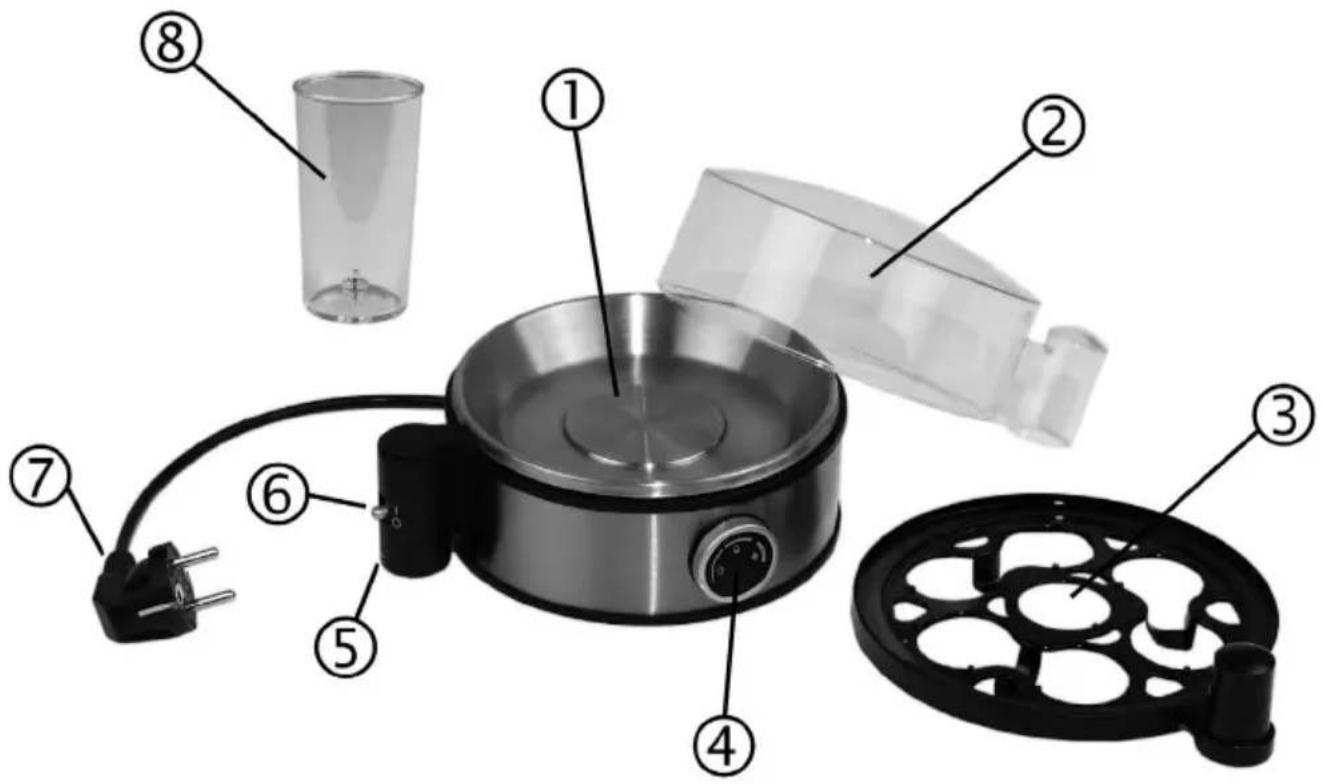
Scope of supply....10
Packing material 10
For your safety 11
Prior to initial use....12
Interesting facts 12
Operating the appliance.... 13
Filling the heating bowl 13
Filling the egg tray 13
Setting the degree of hardness 13
Switching the appliance on and off....14
Taking the eggs out....14
Disposal of remaining water 15
Cleaning and maintenance 15
Cleaning the appliance 15
Descaling the appliance 15
Einleitung

natural_image
Close-up of a circular black button with white and gray markings, no visible text or symbols.natural_image
Close-up of a black cylindrical device with a circular button labeled 'I/O' and two arrows pointing downward (no text or symbols on the device itself)We are pleased you decided in favour of this premium egg boiler and would like to thank you for your confi dence. Its easy operation will certainly fi ll you with enthusiasm as well. To make sure you can enjoy using this appliance for a long time, please read through the
following notes carefully and observe them. Keep this instruction manual safely. Hand out all documents to third persons when passing on the appliance. Thank you very much.
Intended use
The appliance is designed for boiling eggs (domestic use only). Other uses or modifications of the appliance are not intended and harbour considerable risks. For damage arising from not intended use, the manufacturer does not assume liability. The appliance is not designed for commercial use.
Technical data
Only connect the appliance to an isolated ground receptacle installed according to regulations. The rated voltage must comply with the details on the rating label. Only connect to alternating current!
Nominal voltage: 220–240 V\~ 50/60 Hz
Nominal power: 400 W
Quantity of eggs: 1 - 7 eggs
Time regulated hardness setting: 6 - 19 minutes
Scope of supply
Check the scope of supply for completeness as well as the soundness of the product and all components (see product description page 2) immediately after unpacking.
Packing material
Do not simply throw the packing material away but recycle it.
Deliver paper, cardboard and corrugated cardboard packing to collecting facilities. Also plastic packing material and foils should be put into the intended collecting basins.
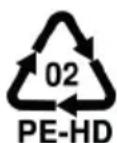
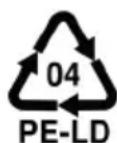
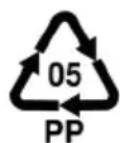
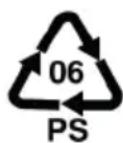
In the examples for the plastic marking PE stands for polyethylene, the code figure 02 for PE-HD, 04 for PE-LD, PP for polypropylene, PS for polystyrene.

Warning: Read all safety advices and instructions. Non-observance of the safety advices and instructions may cause electric shock, fire and/or bad injuries.
- Packing material like e. g. foil bags should be kept away from children.
- Always keep children under 8 away from the product and the power cord.
- Children from the age of 8 must be supervised when cleaning or maintaining the appliance.
- Children from the age of 8 and persons not having the knowledge or experience in operating the appliance or having handicaps of physical, sensorial or mental nature must not operate the appliance without supervision or instruction by a person, responsible for their safety. Never leave the appliance unattended during operation.
- Children should be supervised in order to ensure that they do not play with the appliance.
- Use 125 ml of water for each boiling process. Do not operate the boiler without water.
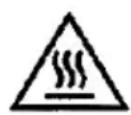
- During operation, the appliance is getting hot. Mind the hazard of burns when touching the appliance or the hot eggs and mind the hazard of scalding by hot steam.
- Lift the cover slowly, turned away from you, and let the steam escape to the back.
- Do not bend over the appliance during operation. Always use oven gloves when handling the cover or the egg tray.
- In case there is some residual water left in the heating bowl, let the appliance cool down before draining it.
• Overfilling the heating bowl might cause boiling water to splash out during operation!
- Attention when handling the measuring cup. There is a pointed needle at its underside.
- Do not at all operate this unit with an external timer or a separate telecontrol system.
- Place the appliance on a stable and even surface and do not operate it in the vicinity of sources of heat (oven, gas flame etc.) or in explosive environments, where inflammable liquids or gases are located.
- Mind to keep a sufficient distance to walls and cupboards in order to avoid damage caused by the rising steam.
- Prior to each use, check the appliance and the accessories for soundness, it must not be operated if it has been dropped or shows visible damage. In these cases, the power supply must be disconnected and the appliance has to be checked by a specialist.
- Never immerse the appliance and the plug in water for cleaning.
- Pull the mains plug after each use. Never let the cable hang down over the edge of the work surface so that the appliance cannot be pulled down accidentally.
- Keep the power cord away from hot surfaces, sharp edges and mechanical forces. Check the power cord regularly for damage and deteriorations. Damaged or entangled cords increase the risk of an electric shock.
- For disconnecting the appliance from the mains, only pull the plug and never the cord.
- This electrical appliance complies with the relevant safety standards. In case of signs of damage to the appliance or the power cord, unplug the appliance immediately. Repairs may be effected by authorised specialist shops only. Improper repairs may result in considerable dangers for the user.
- Improper use and disregard of this instruction manual will void all warranty claims.
Prior to initial use
For a start, please clean the appliance as well as all accessories. For more detailed information please refer to "Cleaning and maintenance".
Interesting facts
- Eggs store a significant amount of valuable proteins, which are easy to digest and can be exploited by humans for almost 100 %. The egg yolk even contains more protein than the egg white and also the fat is mainly in the yolk.
- Eggs furthermore contain the fat-soluble vitamins D, E, K and particularly vitamin A; also the water-soluble B-vitamins and various mineral nutrients. The discredited cholesterol is only stored in the yolk; cholesterol performs important tasks in the human body and is therefore essential.
- As persons with diabetes or with a lipo-metabolic disorder have endogenous problems to self-regulate their cholesterol level, they should not eat more than 3 eggs per week.
- To give a better orientation for consumers, eggs are classified in EU-standardized quality and size classes.
– Quality class:
° A = domestic consumption
° B = food industry
- Weight class:
° XL = very large, 73 g and more
° L = large, 63 g to 73 g
° M = medium, 53 g to 63 g (standard)
° S = small, 53 g and less
- Boiled eggs are classified – depending on the boiling time – in hard boiled, core-soft boiled and soft boiled eggs. 'Hard' and 'core-soft' refer to the state of the yolk, whereas 'soft' refers to the state of the egg white.
Operating the appliance

Attention: During operation, the appliance is getting hot.
Mind the hazard of burns when touching the appliance or the hot eggs and mind the hazard of scalding by the hot steam escaping!
Filling the heating bowl
- Fill the included measuring cup with cold water, always full to the brim (125 ml).
- Then carefully pour the complete contents of the cup into the heating bowl. Mind that no water spills over the rim.
Filling the egg tray
- Place the egg tray on the appliance. See to a correct fitting of the egg tray.
- Before placing the eggs, pierce them at their dull end with the egg piercer (at the underside of the measuring cup) in order to prevent the eggs from bursting.
- Place the eggs on the egg tray with the pierced dull end to the top.
- Put the cover on the appliance. Mind the correct fitting of the cover and see to it that the steam outlet on the top of the cover is not blocked or covered.
Setting the degree of hardness
The appliance features a time regulated hardness control. For perfect boiling results it is imperative to stick to the following parameters:
- the electronic control is based on eggs of weight class 'M' (standard egg)
- the water volume must always be 125 ml (measuring cup full to the brim)
- when using bigger or smaller eggs, the electronic control must be adjusted correspondingly
NOTE: Mind that the degree of hardness of an egg is rated very differently. Thus, take the settings of the electronic control as a basis and try out by your own. The very variable setting possibilities will enable you to find your individually preferred degree of hardness.
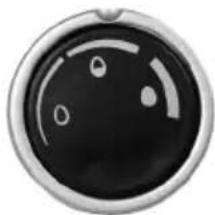
The regulation of the degree of hardness is divided into 3 sections:
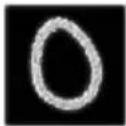
soft boiled eggs boiling time 6 - 9 minutes
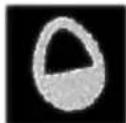
core-soft boiled eggs boiling time 9 - 14 minutes
hard boiled eggs boiling time 14 – 19 minutes
natural_image
Close-up of a circular black button with metallic rim and small white markings (no text or symbols visible)- First, select the desired degree of hardness. Within this selected range also set the amount of eggs to be boiled.
NOTE: For cooking 1 egg, select the start section of the respective hardness degree. For 4 eggs select the middle and for 7 eggs the end section of the respective hardness degree.
- Set the control knob to the desired position. The bulge on the knob serves as a mark.
Example for the cooking of soft boiled eggs:
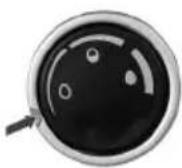
soft boiled 1 egg
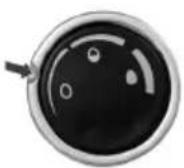
soft boiled 3 eggs
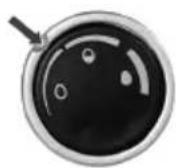
soft boiled 7 eggs
Switching the appliance on and off
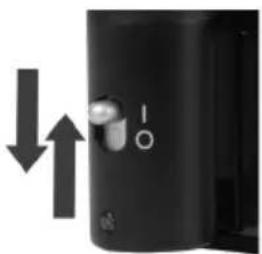
natural_image
Close-up of a black door handle with a circular button labeled 'I' and an arrow pointing downward (no text or symbols on the door itself)- Connect the mains plug to the socket. Any cord length not needed can be stored in the cord storage at the bottom of the unit.
- Sliding the ON/OFF switch upwards to position 'I' makes the time regulated cooking process to start.
- The pilot lamp lights and a short signal tone sounds.
-
Once the set boiling time has been reached, there is a cyclic acoustic signal sounding until the appliance is switched off.
-
For switching the appliance off slide the ON/OFF switch downward to '0' position.
• The pilot lamp goes out.
• Always disconnect the unit from the mains once the boiling process has finished.
Taking the eggs out
NOTE: For taking the eggs out always use e. g. oven gloves to protect your hands from the hot steam.
- Cautiously lift the cover, turned away from you, and let the steam escape to the back. Also watch the condense water which was collected inside of the cover.
- Take out the eggs carefully, either each egg separately or the complete egg tray with all the boiled eggs in one.
• Afterwards put the eggs under or in cold water in order to avoid any post-boiling.
Disposal of remaining water
After the appliance has cooled down dispose the remaining water from the heating bowl.
Cleaning and maintenance

Attention: Always unplug the appliance before cleaning and decalcification! Always let the appliance cool down before cleaning or decalcification! Never immerse the appliance and the plug in water or clean them under running water!
Cleaning the appliance
- Clean the appliance with a damp tissue and wipe it dry.
- Clean the cover, the egg tray and the measuring cup in hot water with some dishwashing detergent. Before the next use, all parts must be completely dry.
- Do not use any abrasives or solvents!
- Never use a steam jet appliance for cleaning!
Descaling the appliance
We recommend decalcifying the appliance in regular intervals. Limescale leads to a loss of energy and might, under particular circumstances, even affect the lifespan of the unit. The intensity of limescale depends on the water hardness degree.
- Slight scale deposits in the heating bowl may be removed by wiping it with a cloth moistened with some vinegar essence.
- In case of more stubborn scale deposits pour some vinegar thinned with water directly into the heating bowl and let it rest for a while until the scale comes off. Then wipe out the bowl thoroughly and dry it afterwards.
- Do not heat the appliance during the descaling process.
NOTE: Damages caused by non-observance of our decaling directives are not covered by warranty.
- ROMMELSBACHER
- Einleitung
- Intended use
- Technical data
- Scope of supply
- Packing material
- Prior to initial use
- Interesting facts
- Operating the appliance
- Attention: During operation, the appliance is getting hot.
- Mind the hazard of burns when touching the appliance or the hot eggs and mind the hazard of scalding by the hot steam escaping!
- Filling the heating bowl
- Filling the egg tray
- Setting the degree of hardness
- Switching the appliance on and off
- Taking the eggs out
- Disposal of remaining water
- Cleaning and maintenance
- Cleaning the appliance
- Descaling the appliance
Brand : Rommelsbacher
Model : ER 405
Category : Egg cooker