ZWE-9176 X - Dishwasher Mastercook - Free user manual and instructions
Find the device manual for free ZWE-9176 X Mastercook in PDF.


| Product Type | Freestanding Dishwasher |
| Brand | Mastercook |
| Model | ZWE-9176 X |
| Width | 60 cm |
| Depth | 60 cm |
| Height | 85 cm |
| Net Weight | 50 kg |
| Power Supply | 220-240 V, 50 Hz, 10 A |
| Energy Class | A+ |
| Number of Place Settings | 12 |
| Wash Programs | Eco, Intensive, Rapid, 60°C, 40°C, Half-Load, Glass |
| Noise Level | 49 dB |
| Water Consumption | 12 L per cycle |
| Energy Consumption | 1.05 kWh per cycle |
| Drying System | Condensation drying |
| Control Panel | Electronic buttons with LED display |
| Salt and Rinse Aid Indicator | Yes |
| Adjustable Upper Basket | Yes |
| Child Lock | Yes |
| Flood Protection | AquaStop system |
| Filter Type | Self-cleaning triple filter |
| Maintenance | Clean filter monthly, descale every 3 months |
| Spare Parts Availability | Yes, through Mastercook service centers |
| Manual Language | English, Polish |
Frequently Asked Questions - ZWE-9176 X Mastercook
User questions about ZWE-9176 X Mastercook
0 question about this device. Answer the ones you know or ask your own.
Ask a new question about this device
Download the instructions for your Dishwasher in PDF format for free! Find your manual ZWE-9176 X - Mastercook and take your electronic device back in hand. On this page are published all the documents necessary for the use of your device. ZWE-9176 X by Mastercook.
USER MANUAL ZWE-9176 X Mastercook
You have just acquired a Mastercook dishwasher and we would like to thank you.
We have invested all our dedication and know-how in this appliance so that it would best meet your needs. With innovation and performance, we designed it to be always easy to use.
In the Mastercook product range, you will also find a wide choice of ovens, microwaves, cooking hobs, ventilation hoods, cookers, washing machines, driers, fridges and freezers, that you can coordinate with your new Mastercook dishwasher.
Visit our website www.mastercook.pl where you will find all of our products, as well as useful and complementary information.
Mastercook
As part of our commitment to constantly improving our products, we reserve the right to make changes to them based on technical advances to their technical and functional features and appearance.

Warning:
Before installing and using your appliance, please carefully read this Guide to Installation and Use, which will allow you to quickly familiarise yourself with its operation.
www.mastercook.pl

1/ FOR THE USER'S ATTENTION
- Safety instructions ____ 4
- Protection of the environment 5
• Economical, environmentally friendly washing ____ 5
2/ DESCRIPTION OF YOUR APPLIANCE
- General presentation of the dishwasher 6
- Presentation of the control panel ____ 7
3/ INFORMATION
- The water hardness 8
4/ ACTIONS BEFORE FIRST USE
- Measure the water hardness and select the detergent ____ 9
- Hardness table 9
5/ DETERGENT PRODUCTS AND SETTING THE WATER SOFTENER
- For traditional products ____ 10
- For multi-purpose products ____ 11
6/ LOADING THE REGENERATING SALT 12
7/ LOADING THE RINSING PRODUCT 13
8/ YOUR DISHWASHER'S EQUIPMENT
- The lower basket ____ 14
• The upper basket 15
• The cutlery basket ____ 16
9/ THE DISHWASHER'S SAFETY SYSTEMS 17
10/ WASHING PROGRAMMES 18
11/PROGRAMMING 19
12/ CLEANING YOUR APPLIANCE
- Cleaning the waste filters 21
13/ IF OPERATING ANOMALIES OCCUR ____ 23
14/ AFTER-SALES SERVICE 28
15/ INDICATIONS FOR THE TESTING LABORATORIES ____ 58

Important :
Keep this user's manual with your appliance. If the appliance is sold or transferred to someone else, ensure that the manual is with it. Please take note of these instructions before installing and using your appliance. They have been drawn up for your own and other people's safety.
• SAFETY INSTRUCTIONS
- Installation
- When you receive your appliance, unpack it or have it unpacked immediately. Check that it has not suffered any damage during transport. Express any reservations in writing on the delivery note, of which you keep a copy. Never connect up a damaged machine. If your appliance is damaged, please contact your dealer.
- Before proceeding to connect up your machine, please refer to the instructions in your Installation Guide.
- Your dishwasher must be kept disconnected from the mains supply throughout the whole of the installation process.
- The electrical connection details on your appliance's description plate must comply with those for the mains supply.
- The socket must still be accessible once your appliance has been installed.
- Do not alter or attempt to alter the appliance's characteristics. This could put you at risk.
- If your installation has to be altered, only entrust the electrical and plumbing work to a qualified electrician or plumber respectively.
- Your appliance is designed for normal domestic use. Do not use it for industrial or commercial purposes or for any other purpose than that for which it has been designed.
- Your appliance is designed to be used for household and similar applications such as:
- staff kitchenettes in shops, offices and other professional environments,
- farmhouses,
- use by guests at hotels, motels and other residential-type facilities,
• bed and breakfast type facilities.
- The dishwasher's walls must not be pierced under any circumstances.
- Children's safety
- This appliance is not intended for use by young children or infirm persons unless they have been adequately supervised by a responsible person to ensure that they can use the appliance safely.
- This appliance must only be used by adults. Ensure that children do not touch it and do not use it as a toy. Ensure that they do not operate the appliance's controls.
- Keep young children away from the appliance when it is operating.
- Detergents contain irritant and abrasive substances. These products can have caustic effects on the eyes, the mouth or the throat. They can be extremely dangerous if ingested. Avoid any contact with the skin and the eyes. Ensure that the appliance's detergent container is empty at the end of the washing cycle.
- Place detergents out of children's reach and do not put any detergent in the machine until just before you start the washing programme.
– The water in your dishwasher is not drinking water; this is why children must not go near the appliance when its door is open. - Do not let your children play or sit on the door when it is open.
- Once you have unpacked your appliance, place the packaging out of children's reach.
- Keep all the packaging materials (e.g. plastic bags, polystyrene, etc.) out of children's reach because they can be dangerous for children (ie. risk of suffocation).
- Use
- This appliance is not intended for use by persons (including children) with reduced physical, sensory or mental capabilities, or lack of experience and knowledge, unless they have been given supervision or instruction concerning use of the appliance by a person responsible for their safety.
- When machine is running, do not open door. This may provoke steam leakage or splattering of water.
- Only use products specially designed for your dishwasher (water softening salt, detergent and rinsing products).
- As far as possible, avoid opening the dishwasher's door when it is operating, and in particular during the heating phases, because scalding steam may escape or you may be splashed with hot water. The machine is fitted
with a safety system that immediately blocks the dishwasher's operation if the door is opened.
- Never use chemical solvents in your appliance because these could cause an explosion.
- Always close your appliance's door after loading or removing your items.
- Do not lean or sit on your appliance's door when it is open.
- You are strongly advised to disconnect the machine after use and turn off the water supply.
- Unplug your machine before carrying out any technical work on it.
- Avoid placing your machine immediately next to a cooking or heating appliance to prevent any risk of heat damage;
- Do not place any items in your machine, which are not certified as dishwasher safe.
- If you have removed an item before the end of the washing programme, it is important to rinse it carefully to remove any residual washing products.
- If your appliance breaks down, never attempt to repair it yourself. Any repairs made by non-qualified personnel can cause significant damage or lack of control.
- The machine complies with applicable safety regulations. Any repairs should be carried out by qualified technicians. Repairs or changes that do not conform may be dangerous for the users. In case of replacement, only use original parts.
- If the machine malfunctions due to other causes than those mentioned in this booklet, disconnect the machine (remove the plug) or break the circuit concerned and contact after-sales service.
• ENVIRONMENTAL PROTECTION
This appliance's packaging material is recyclable. Help recycle it and protect the environment by dropping it off in the municipal receptacles provided for this purpose.
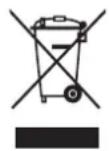
Your appliance also contains a great amount of recyclable material. It is marked with this label to indicate that in countries that are a members of the European Union the used appliances should not be mixed with other waste. This way, the appliance recycling organised by your manufacturer will be done under the best possible conditions, in compliance with European Directive 2002/96/EC on Waste Electrical and Electronic Equipment. Contact your town hall or your retailer for the used appliance collection points closest to your home.
We thank you doing your part to protect the environment.
• ECONOMICAL, ENVIRONMENTALLY FRIENDLY WASHING
- Remove any food residue from your crockery (bones, pips, etc.)
- Do not pre-wash your items by hand (useless waste of water).
- Utilise your dishwasher's capabilities to the full for an economical, environmentally friendly wash.
- Always select a washing programme suitable for the crockery type and how dirty they are.
- Avoid overdosing with detergent, regenerating salt and rinsing liquid. Follow the recommendations in this guide (pages 36-37-38-39-40-41) and the instructions on the product packs.
- Ensure that the water softener is correctly set (see page 38).
• GENERAL PRESENTATION OF THE DISHWASHER
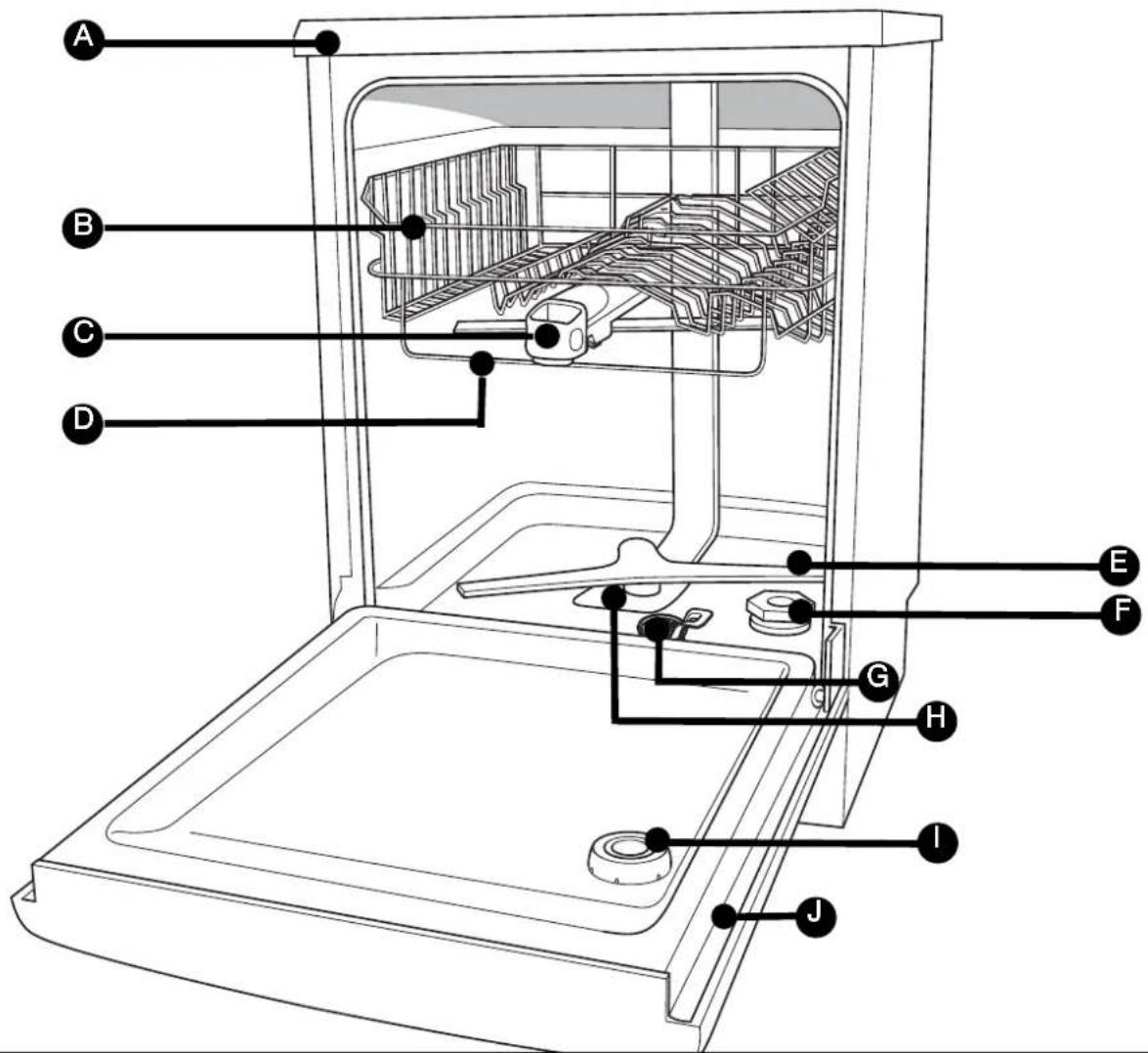
Fig. 01
A Removable top
B Upper basket
© Washing products dispenser
D Anti-blocking gauge wire
E Lower sprinkler arm
F Regenerating salt tank
G Waste filter
H Main filter
Rinsing product dispenser
J Description plate (After-Sales Ref)

Advice:
This user's guide is applicable to several models. There may be some slight differences
in the details and the equipment between your appliance and the descriptions provided here.
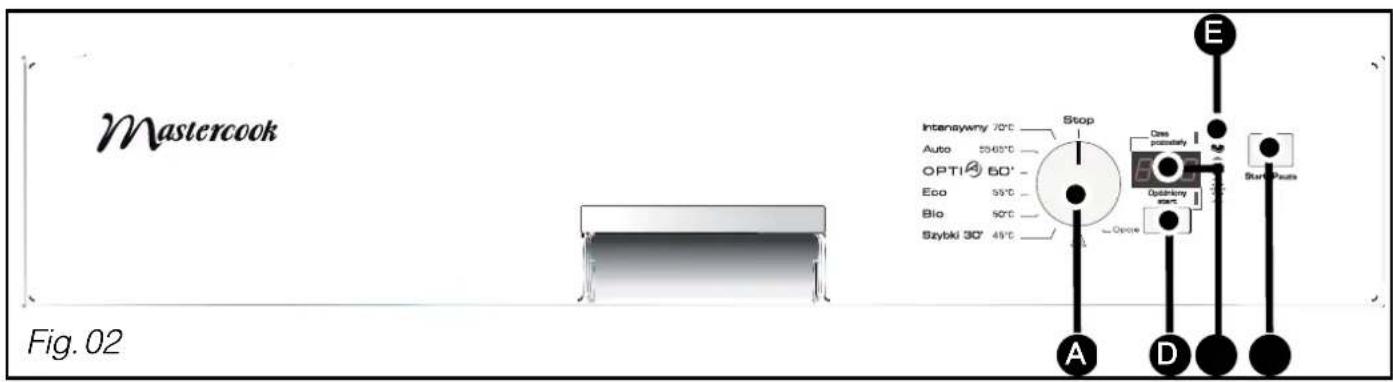
• PRESENTATION OF THE CONTROL PANEL
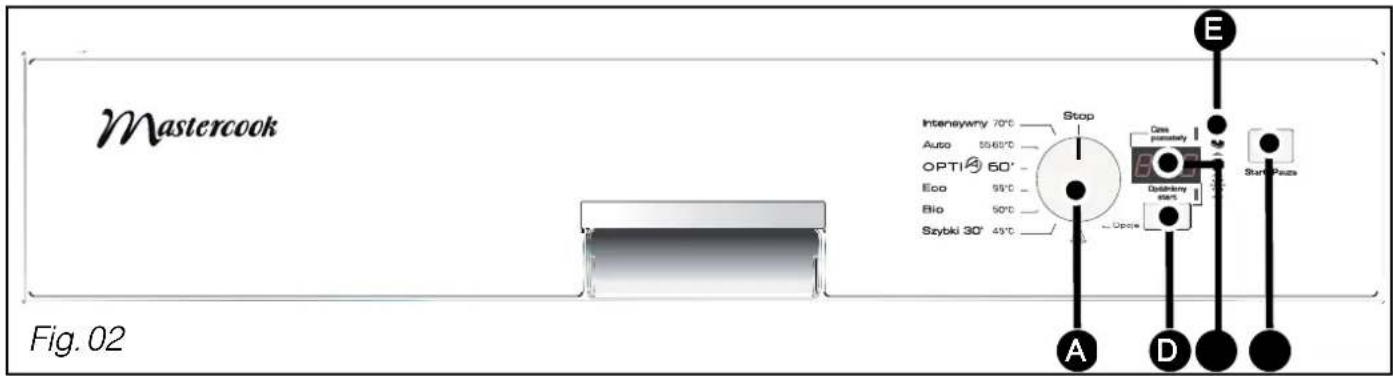
A Programme selector: 3 functions:
- Choosing a programme: Turn the selector to make your programme choice.
- Opcje (Set): Turn the selector to the "Set" position to access the softener settings. (Refer to chapter 5 / Detergents and setting the softener).
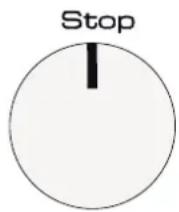
- Stop: Turn the selector to the "Stop" position when the programme has finished.
B Opóźniony start (Delayed start):
- Choice of delayed-start washing:
- Set the water softener,
© The screen shows the programme's length and time remaining until it ends, the delayed start, and the water softener setting.
Start / Pauza : Press this button to confirm your programme. Holding down the button for 3 seconds cancels the programme.
The indicator lights:
Multipurpose products:
lit; indicates that your dishwasher is set to use "2, 3 4-in-1" pellets.
Salt:
When lit, this indicates a lack of regenerating salt.
Rinsing liquid:
When lit, this indicates a lack of rinsing product.

Important:
For your dishwasher to provide impeccable washing and drying results with no marks, you must set it correctly using the water softening system, which uses regenerating salt.
• THE WATER HARDNESS
- Lime: rainwater filtering through the ground picks up mineral salts; some minerals are found in solid form commonly termed lime. This reduces the washing detergent's performance, furs up the dishwasher and leaves white marks on the crockery.
The more lime there is in the water, the more the water is called "hard".
Use the most suitable products for the level of water hardness in your town.
There are several types of products; how to choose:
For impeccable results, preferably use a combination of traditional products:
① Washing detergent to clean the crockery perfectly (powder, liquid or standard tablets).
② Regenerating salt to enable your dishwasher's water softener to operate correctly.
③ Rinsing liquid to assist drying and to eliminate marks from water droplets.

Important:
Never use washing-up liquid.
For ease of use and only in certain water hardness conditions < 25°F, multi-purpose products may make the use of rinsing liquid or salt unnecessary.
- “Two-in-one” products contain detergents, rinsing liquid or an agent acting as the salt.
- “Three-in-one” products contain detergents, rinsing liquid and an agent acting as the salt.
- “Four-in-one” products also contain additives that prevent wear on poor quality glasses and /or prevent the risks of the stainless steel corroding.

Important:
Follow the instructions for using the multi-purpose product and the recommendations on the pack.

NB:
If in any doubt, please contact the detergent manufacturer if the crockery is very wet at the end of the programme or if chalky deposits appear.
- MEASURE THE WATER HARDNESS AND SELECT THE TYPE OF DETERGENT: TRADITIONAL OR MULTI-PURPOSE
First of all, in one simple action, you can test the lime content in your water using the testing strip supplied with your dishwasher or you can contact your local water utility to find out how hard your water is.
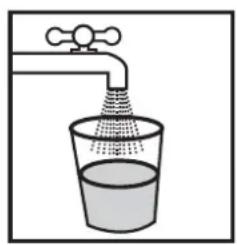
- Turn on the tap and let the water run for a few minutes.
- Fill a glass with water.
- Take the testing strip out of its casing and immerse it for 3 seconds.
- Wait 1 minute, shake the strip and look at the colours to find out how hard your water is.
natural_image
Simple line drawing of a faucet dispensing water into a glass with a bucket (no text or symbols)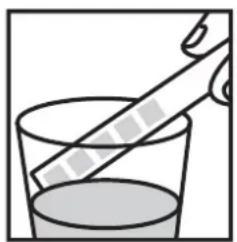
natural_image
Illustration of a pipette being poured into a glass with liquid (no text or symbols)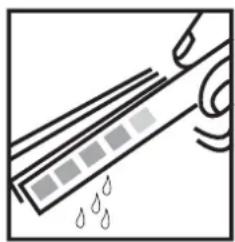
natural_image
Illustration of a hand holding a ruler with liquid droplets falling (no text or symbols)- HARDNESS TABLE
| Test strip | □□□□□ | ■□□□□ | ■■□□□ | ■■□□ | ■■□□ | ■■□□ | |||||||||||||||||||||||||||||||||||||||||||||||||||||||||||||||||||||||||||||||||||||||||
| Hardness | 0-10°F 10 | -18°F 18-25 | °F 25-40°F 4 | 0-55°F 55-70°F | >70°F | ||||||||||||||||||||||||||||||||||||||||||||||||||||||||||||||||||||||||||||||||||||||||||
| Water | Soft | Slightly hard | Slightly hard | Hard Hard | Very hard | ||||||||||||||||||||||||||||||||||||||||||||||||||||||||||||||||||||||||||||||||||||||||||
| Water softening and use of salt | Optional | Essential if using traditional products | Essential if using traditional products | Mandatory | Mandatory Mandatory Mandatory Mandatory Mandatory Mandatory Mandatory Mandatory Mandatory Mandatory Mandatory Mandatory Mandatory Mandatory Mandatory Mandatory Mandatory Mandatory Mandatory Mandatory Mandatory Mandatory Mandatory Mandatory Mandatory Mandatory Mandatory Mandatory Mandatory Mandatory Mandatory Mandatory Mandatory Mandatory Mandatory Mandatory Mandatory Mandatory Mandatory Mandatory Mandatory Mandatory Mandatory Mandatory Mandatory Mandatory Mandatory Mandatory Mandatory Mandatory Mandatory Mandatory Mandatory Mandatory Mandatory Mandatory Mandatory Mandatory Mandatory Mandatory Mandatory Mandatory Mandatory Mandatory Mandatory Mandatory Mandatory Mandatory Mandatory Mandatory Mandatory Mandatory Mandatory Mandatory Mandatory Mandatory Mandatory Mandatory Mandatory Mandatory Mandatory Mandatory Mandatory Mandatory Mandatory Mandatory Mandatory Mandatory Mandatory Mandatory Mandatory Mandatory Mandatory Mandatory Mandatory Mandatory Mandatory Mandatory Mandatory Mandatory Mandatory Temporary Mandatory Mandatory Mandatory Mandatory Mandatory Mandatory Mandatory Mandatory Mandatory Mandatory Mandatory Mandatory Mandatory Mandatory Mandatory Mandatory Mandatory Mandatory Mandatory Mandatory Mandatory Mandatory Mandatory Mandatory Mandatory Mandatory Mandatory Mandatory Mandatory Mandatory Mandatory Mandatory Mandatory Mandatory Mandatory Mandatory Mandatory Mandatory Mandatory Mandatory Mandatory Mandatory Mandatory Mandatory Mandatory Mandatory Mandatory Mandatory Mandatory Mandatory Mandatory Mandatory Mandatory Mandatory Mandatory Mandatory Mandatory Mandatory Mandatory Mandatory Mandatory Mandatory Mandatory Mandatory Mandatory Mandatory Mandatory Mandatory Mandatory Mandatory Mandatory Mandatory Mandatory Mandatory Mandatory Mandatory Mandatory Mandatory Mandatory Mandatory Mandatory Mandatory Mandatory Mandatory Mandatory Mandatory Mandatory Mandatory Mandatory Mandatory Mandatory Mandatory Mandatory Mandatory Mandatory Mandatory Mandatory Mandatory Mandatory Routine Mandatory Mandatory Mandatory Mandatory Mandatory Mandatory Mandatory Mandatory Mandatory Mandatory Mandatory Mandatory Mandatory Mandatory Mandatory Mandatory Mandatory Mandatory Mandatory Mandatory Mandatory Mandatory Mandatory Mandatory Mandatory Mandatory Mandatory Mandatory Mandatory Mandatory Mandatory Mandatory Mandatory Mandatory Mandatory Mandatory Mandatory Mandatory Mandatory Mandatory Mandatory Mandatory Mandatory Mandatory Mandatory Mandatory Mandatory Mandatory Mandatory Mandatory Mandatory Mandatory Mandatory Mandatory Mandatory Mandatory Mandatory Mandatory Mandatory Mandatory Mandatory Mandatory Mandatory Mandatory Mandatory Mandatory Mandatory Mandatory Mandatory Mandatory Mandatory Mandatory Mandatory Mandatory Mandatory Mandatory Mandatory Mandatory Mandatory Mandatory Mandatory Mandatory Mandatory Mandatory Mandatory Mandatory Mandatory Mandatory Mandatory Mandatory Mandatory Mandatory Mandatory Mandatory Mandatory Mandatory Mandatory Mandatory Mandatory Sunny Magenta Magenta Magenta Magenta Magenta Magenta Magenta Magenta Magenta Magenta Magenta Magenta Magenta Magenta Magenta Magenta Magenta Magenta Magenta Magenta Magenta Magenta Magenta Magenta Magenta Magenta Magenta Magenta Magenta Magenta Magenta Magenta Magenta Magenta Magenta Magenta Magenta Magenta Magenta Magenta Magenta Magenta Magenta Magenta Magenta Magenta Magenta Magenta Magenta Magenta Magena Magenta Magenta Magenta Magenta Magenta Magenta Magenta Magenta Magenta Magenta Magenta Magenta Magenta Magenta Magenta Magenta Magenta Magenta Magenta Magenta Magenta Magenta Magenta Magenta Magenta Magenta Magenta Magenta Magenta Magenta Magenta Magenta Magenta Magenta Magenta Magenta Magenta Magenta Magenta Magenta Magenta Magenta Magenta Magenta Magenta Magenta Magenta Magenta Magenta Magera Magenta Magenta Magenta Magenta Magenta Magenta Magenta Magenta Magenta Magenta Magenta Magenta Magenta Magenta Magenta Magenta Magenta Magenta Magenta Magenta Magenta Magenta Magenta Magenta Magenta Magenta Magenta Magenta Magenta Magenta Magenta Magenta Magenta Magenta Magenta Magenta Magenta Magenta Magenta Magenta Magenta Magenta Magenta Magenta Magenta Magenta Magenta Magenta Magenta Magerta Magenta Magenta Magenta Magenta Magenta Magenta Magenta Magenta Magenta Magenta Magenta Magenta Magenta Magenta Magenta Magenta Magenta Magenta Magenta Magenta Magenta Magenta Magenta Magenta Magenta Magenta Magenta Magenta Magenta Magenta Magenta Magenta Magenta Magenta Magenta Magenta Magenta Magenta Magenta Magenta Magenta Magenta Magenta Magenta Magenta Magenta Magenta Magenta Magenta Maga Magenta Magenta Magenta Magenta Magenta Magenta Magenta Magenta Magenta Magenta Magenta Magenta Magenta Magenta Magenta Magenta Magenta Magenta Magenta Magenta Magenta Magenta Magenta Magenta Magenta Magenta Magenta Magenta Magenta Magenta Magenta Magenta Magenta Magenta Magenta Magenta Magenta Magenta Magenta Magenta Magenta Magenta Magenta Magenta Magenta Magenta Magenta Magenta Magenta Magertina Magenta Magenta Magenta Magenta Magenta Magenta Magenta Magenta Magenta Magenta Magenta Magenta Magenta Magenta Magenta Magenta Magenta Magenta Magenta Magenta Magenta Magenta Magenta Magenta Magenta Magenta Magenta Magenta Magenta Magenta Magenta Magenta Magenta Magenta Magenta Magenta Magenta Magenta Magenta Magenta Magenta Magenta Magenta Magenta Magenta Magenta Magenta Magenta Magenta Magerata Magenta Magenta Magenta Magenta Magenta Magenta Magenta Magenta Magenta Magenta Magenta Magenta Magenta Magenta Magenta Magenta Magenta Magenta Magenta Magenta Magenta Magenta Magenta Magenta Magenta Magenta Magenta Magenta Magenta Magenta Magenta Magenta Magenta Magenta Magenta Magenta Magenta Magenta Magenta Magenta Magenta Magenta Magenta Magenta Magenta Magenta Magenta Magenta Magenta Mageria Magenta Magenta Magenta Magenta Magenta Magenta Magenta Magenta Magenta Magenta Magenta Magenta Magenta Magenta Magenta Magenta Magenta Magenta Magenta Magenta Magenta Magenta Magenta Magenta Magenta Magenta Magenta Magenta Magenta Magenta Magenta Magenta Magenta Magenta Magenta Magenta Magenta Magenta Magenta Magenta Magenta Magenta Magenta Magenta Magenta Magenta Magenta Magenta Magenta Magredra Magenta Magenta Magenta Magenta Magenta Magenta Magenta Magenta Magenta Magenta Magenta Magenta Magenta Magenta Magenta Magenta Magenta Magenta Magenta Magenta Magenta Magenta Magenta Magenta Magenta Magenta Magenta Magenta Magenta Magenta Magenta Magenta Magenta Magenta Magenta Magenta Magenta Magenta Magenta Magenta Magenta Magenta Magenta Magenta Magenta Magenta Magenta Magenta Magenta Magema Magenta Magenta Magenta Magenta Magenta Magenta Magenta Magenta Magenta Magenta Magenta Magenta Magenta Magenta Magenta Magenta Magenta Magenta Magenta Magenta Magenta Magenta Magenta Magenta Magenta Magenta Magenta Magenta Magenta Magenta Magenta Magenta Magenta Magenta Magenta Magenta Magenta Magenta Magenta Magenta Magenta Magenta Magenta Magenta Magenta Magenta Magenta Magenta Magenta Magenna Magenta Magenta Magenta Magenta Magenta Magenta Magenta Magenta Magenta Magenta Magenta Magenta Magenta Magenta Magenta Magenta Magenta Magenta Magenta Magenta Magenta Magenta Magenta Magenta Magenta Magenta Magenta Magenta Magenta Magenta Magenta Magenta Magenta Magenta Magenta Magenta Magenta Magenta Magenta Magenta Magenta Magenta Magenta Magenta Magenta Magenta Magenta Magenta Magenta Magenteria Magenta Magenta Magenta Magenta Magenta Magenta Magenta Magenta Magenta Magenta Magenta Magenta Magenta Magenta Magenta Magenta Magenta Magenta Magenta Magenta Magenta Magenta Magenta Magenta Magenta Magenta Magenta Magenta Magenta Magenta Magenta Magenta Magenta Magenta Magenta Magenta Magenta Magenta Magenta Magenta Magenta Magenta Magenta Magenta Magenta Magenta Magenta Magenta Magenta Magerala Magerala | □□□□□□ | ■□□□□□ | ■■□□□□ | ■■□□□□ | ■■□□□□ | ■■□□□□ | ■■□□□□ | ■■□□□□ | ■■□□□□ | ■■□□□□ | ■■□□□□ | ■■□□□□ | ■■□□□□ | ■■□□□□ | ■■□□□□ | ■■□□□□ | ■■□○□□□□ | ■■□□□□□ | ■■□□□□□ | ■■□□□□□ | ■■□□□□□ | ■■□□□□□ | ■■□□□□□ | ■■□□□□□ | ■■□□□□□ | ■■□□□□□ | ■■□□□□□ | ■■□□□□□ | ■■□□□□□ | ■■□□□□○□□□□□ | ■■□□□□□ | ■■□□□□□ | ■■□□□□□ | ■■□□□□□ | ■■□□□□□ | ■■□□□□□ | ■■□□□□□ | ■■□□□□□ | ■■□□□□□ | ■■□□□□□ | ■■□□□□□ | ■■□□□○□□□□□ | ■■□□□□□ | ■■□□□□□ | ■■□□□□□ | ■■□□□□□ | ■■□□□□□ | ■■□□□□□ | ■■□□□□□ | ■■□□□□□ | ■■□□□□□ | ■■□□□□□ | ■■□□□□□ | ■□□□□□□ | ■■□□□□□ | ■■□□□□□ | ■■□□□□□ | ■■□□□□□ | ■■□□□□□ | ■■□□□□□ | ■■□□□□□ | ■■□□□□□ | ■■□□□□□ | ■■□□□□□ | ■■□□□□□ | ■■□□□ □□□□□ | ■■□□□□□ | ■■□□□□□ | ■■□□□□□ | ■■□□□□□ | ■■□□□□□ | ■■□□□□□ | ■■□□□□□ | ■■□□□□□ | ■■□□□□□ | ■■□□□□□ | ■■□□□□□ | ■■□□□□ □□□□□ | ■■□□□□□ | ■■□□□□□ | ■■□□□□□ | ■■□□□□□ | ■■□□□□□ | ■■□□□□□ | ■■□□□□□ | ■■□□□□□ | ■■□□□□□ | ■■□□□□□ | ■■□□□□□ | ■ ■ □ □ □ □ □ □ □ □ □ □ □ □ □ □ □ □ □ □ □ □ □ □ □ □ □ □ □ □ □ □ □ □ □ □ □ □ □ □ □ □ □ □ □ □ □ □ □ □ □ □ ▢ □ □ □ □ □ □ □ □ □ □ □ □ □ □ □ □ □ □ □ □ □ □ □ □ □ □ □ □ □ □ □ □ □ □ □ □ □ □ □ □ □ □ □ □ □ □ □ □ □ △ □ □ □ □ □ □ □ □ □ □ □ □ □ □ □ □ □ □ □ □ □ □ □ □ □ □ □ □ □ □ □ □ □ □ □ □ □ □ □ □ □ □ □ □ □ □ □ □ □ ▨ □ □ □ □ □ □ □ □ □ □ □ □ □ □ □ □ □ □ □ □ □ □ □ □ □ □ □ □ □ □ □ □ □ □ □ □ □ □ □ □ □ □ □ □ □ □ □ □ □ ▦ □ □ □ □ □ □ □ □ □ □ □ □ □ □ □ □ □ □ □ □ □ □ □ □ □ □ □ □ □ □ □ □ □ □ □ □ □ □ □ □ □ □ □ □ □ □ □ □ □ ▤ □ □ □ □ □ □ □ □ □ □ □ □ □ □ □ □ □ □ □ □ □ □ □ □ □ □ □ □ □ □ □ □ □ □ □ □ □ □ □ □ □ □ □ □ □ □ □ □ □ ▲ □ □ □ □ □ □ □ □ □ □ □ □ □ □ □ □ □ □ □ □ □ □ □ □ □ □ □ □ □ □ □ □ □ □ □ □ □ □ □ □ □ □ □ □ □ □ □ □ □ ▩ □ □ □ □ □ □ □ □ □ □ □ □ □ □ □ □ □ □ □ □ □ □ □ □ □ □ □ □ □ □ □ □ □ □ □ □ □ □ □ □ □ □ □ □ □ □ □ □ □ ▣ □ □ □ □ □ □ □ □ □ □ □ □ □ □ □ □ □ □ □ □ □ □ □ □ □ □ □ □ □ □ □ □ □ □ □ □ □ □ □ □ □ □ □ □ □ □ □ □ □ ▚ □ □ □ □ □ □ □ □ □ □ □ □ □ □ □ □ □ □ □ □ □ □ □ □ □ □ □ □ □ □ □ □ □ □ □ □ □ □ □ □ □ □ □ □ □ □ □ □ □ ▧ □ □ □ □ □ □ □ □ □ □ □ □ □ □ □ □ □ □ □ □ □ □ □ □ □ □ □ □ □ □ □ □ □ □ □ □ □ □ □ □ □ □ □ □ □ □ □ □ □ ▥ □ □ □ □ □ □ □ □ □ □ □ □ □ □ □ □ □ □ □ □ □ □ □ □ □ □ □ □ □ □ □ □ □ □ □ □ □ □ □ □ □ □ □ □ □ □ □ □ □ ■ □ □ □ □ □ □ □ □ □ □ □ □ □ □ □ □ □ □ □ □ □ □ □ □ □ □ □ □ □ □ □ □ □ □ □ □ □ □ □ □ □ □ □ □ □ □ □ □ □ ▷ □ □ □ □ □ □ □ □ □ □ □ □ □ □ □ □ □ □ □ □ □ □ □ □ □ □ □ □ □ □ □ □ □ □ □ □ □ □ □ □ □ □ □ □ □ □ □ □ □ ▽ □ □ □ □ □ □ □ □ □ □ □ □ □ □ □ □ □ □ □ □ □ □ □ □ □ □ □ □ □ □ □ □ □ □ □ □ □ □ □ □ □ □ □ □ □ □ □ □ □ ▼ ▼ ▼ ▼ ▼ ▼ ▼ ▼ ▼ ▼ ▼ ▼ ▼ ▼ ▼ ▼ ▼ ▼ ▼ ▼ ▼ ▼ ▼ ▼ ▼ ▼ ▼ ▼ ▼ ▼ ▼ ▼ ▼ ▼ ▼ ▼ ▼ ▼ ▼ ▼ ▼ ▼ ▼ ▼ ▼ ▼ ▼ ▼ ▼ ▼ ▸ ▼ ▼ ▼ ▼ ▼ ▼ ▼ ▼ ▼ ▼ ▼ ▼ ▼ ▼ ▼ ▼ ▼ ▼ ▼ ▼ ▼ ▼ ▼ ▼ ▼ ▼ ▼ ▼ ▼ ▼ ▼ ▼ ▼ ▼ ▼ ▼ ▼ ▼ ▼ ▼ ▼ ▼ ▼ ▼ ▼ ▼ ▼ ▼ ▼ ▴△ MAGenta MAGenta MAGenta MAGenta MAGenta MAGenta MAGenta MAGenta MAGenta MAGenta MAGenta MAGenta MAGenta MAGenta MAGenta MAGenta MAGenta MAGenta MAGenta MAGenta MAGenta MAGenta MAGenta MAGenta MAGenta MAGenta MAGenta MAGenta MAGenta MAGenta MAGenta MAGenta MAGenta MAGenta MAGenta MAGenta MAGenta MAGenta MAGenta MAGenta MAGenta MAGenta MAGenta MAGenta MAGenta MAGenta MAGenta MAGenta MAGenta MAGenta MAGagenta MAGagenta MAGagenta MAGagenta MAGagenta MAGagenta MAGagenta MAGagenta MAGagenta MAGagenta MAGagenta MAGagenta MAGagenta MAGagenta MAGagenta MAGagenta MAGagenta MAGagenta MAGagenta MAGagenta MAGagenta MAGagenta MAGagenta MAGagenta MAGagenta MAGagenta MAGagenta MAGagenta MAGagenta MAGagenta MAGagenta MAGagenta MAGagenta MAGagenta MAGagenta MAGagenta MAGagenta MAGagenta MAGagenta MAGagenta MAGagenta MAGagenta MAGagenta MAGagenta MAGagenta MAGagenta MAGagenta MAGagenta MAGagenta MAGagenta MAG magenta MAGagenta MAGagenta MAGagenta MAGagenta MAGagenta MAGagenta MAGagenta MAGagenta MAGagenta MAGagenta MAGagenta MAGagenta MAGagenta MAGagenta MAGagenta MAGagenta MAGagenta MAGagenta MAGagenta MAGagenta MAGagenta MAGagenta MAGagenta MAGagenta MAGagenta MAGagenta MAGagenta MAGagenta MAGagenta MAGagenta MAGagenta MAGagenta MAGagenta MAGagenta MAGagenta MAGagenta MAGagenta MAGagenta MAGagenta MAGagenta MAGagenta MAGagenta MAGagenta MAGagenta MAGagenta MAGagenta MAGagenta MAGagenta MAGagenta |
natural_image
Simple horizontal line with a downward arrow, no text or symbols present
natural_image
Simple horizontal line with a downward arrow at the center (no text or symbols)![Possible use of traditional products ① ① [P or or] + S + R -or ② Multi-purpose ②](/content/2026/05/1026530/images/f860b2059fe277c8f068d61faf39886fb86676409ed3c6a51e950115f6b0381e.jpg)
![Use only of traditional products ① [P or L or ] + S + R](/content/2026/05/1026530/images/cfaaf7b94e5c35289ed2c28a4feda630b3dc54f5b005d1ec197e34c4bcf17895.jpg)
① Traditional products: P : Powder detergent or L : Liquid detergent or single tablet
+ S : Regenerating Salt + R : Rinsing product
② Multi-purpose products: Multi-purpose tablets
• FOR TRADITIONAL PRODUCTS
- Your machine must be specially adjusted to use traditional products.
- Proceed as follows to set the water softener on the control panel:
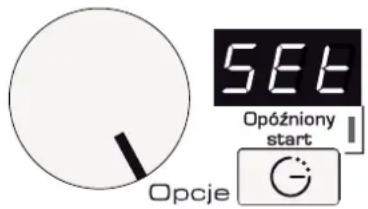
- Turn the selector to the "Opcje" position. The screen now displays SEE to indicate that you are in the setting mode.
- Press the "opóźniony start" button ⏻. The screen now displays the setting (factory setting of H4).
- To change this setting (according to the hardness of the water) continue to press the "opóźniony start" button. The setting changes every time you press the button. Consult the table below.
- The setting is automatically validated when you exit "Opcje", namely, when the selector is in the programme or Stop position.
It is very important to set the water softener correctly.
- If the setting is too low, there is the risk of chalky marks appearing.
- if the setting is too high, there is the risk of causing clouding of the glasses.
If you relocate, adjust the water softener setting as required.
• Traditional tablets
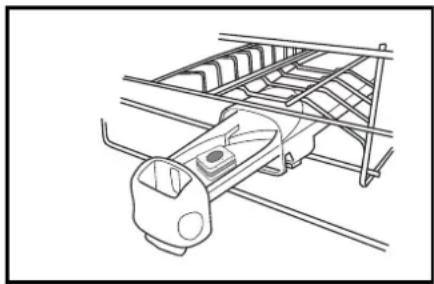
Non-multipurpose tablets should be placed in the external compartment (Fig 04) or, for optimum performance, pull out the dispenser drawer and lay the tablet inside (Fig 05).
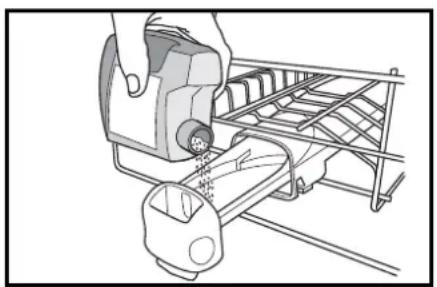
- Powders or liquids (Fig 03)
Fill at least up to the minimum mark for slightly dirty crockery and to the maximum mark for dirty crockery. If the crockery is very dirty and for programmes with a pre-wash we recommend that you add 5g of detergent (a dessert spoonful) into your dishwasher's tub in accordance with the programmes table.

Important:
Keep these products out of children's reach and away from dampness.
Only use products specially designed for dishwashers.
natural_image
Line drawing of a hand pouring liquid into a container on a metal rack (no text or symbols)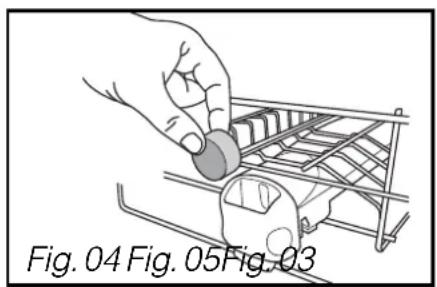
natural_image
Illustration of a hand placing a coin into a grid-like structure (no text or symbols)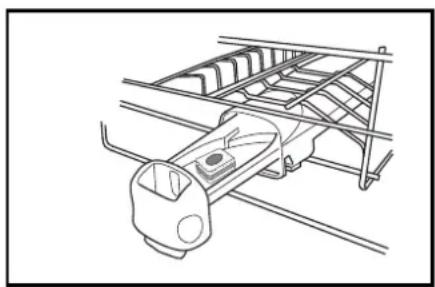
natural_image
Line drawing of a train on tracks with overhead railings (no text or symbols)• FOR MULTI-PURPOSE PRODUCTS: OPTION
- Your appliance can be specially set to use multi-purpose if the water hardness is < 25ircF or < 2,5 mmol/l .

Advice:
To provide better coverage of the wide range of multi-purpose products available, your dishwasher's "4-in-1" option has two possible settings, accessible via the "Set" button.
“Extra Dry” improves the drying results in the event of reduced performance from the “2-in-1”, “3-in-1” or “4-in-1” types of multi-purpose product.
"Sparkling Clean" enables you to prioritise the sparkle of your crockery whatever the type of multi-purpose product used.
- Proceed as follows to adjust the water softener on the control panel:
- Turn the selector to the "Opcje" position. The screen now displays SEE to indicate that you are in the setting mode.
- Press the "opóźniony start" button ⚫. The screen now displays the setting (factory setting of H4).
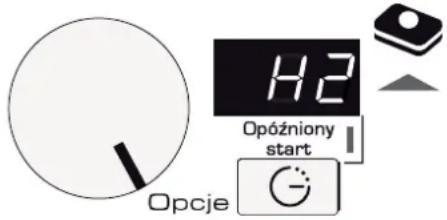
- To use multipurpose tablets you must select setting H0 or H1 or H2, according to the hardness of the water.
– To change this setting (according to the hardness of the water) continue to press the “opóźniony start” button. The setting changes every time you press the button.

: (light off) deactivates the "TABS" function.

: (light on) activates the "TABS" function with the setting "Extra Dry".

: (flashing light) activates the "TABS" function with the setting "Sparkling Clean".
- The setting is automatically validated when you exit "Opcje", namely, when the selector is in the programme or Stop position.
L- The setting selected will be applied automatically; the "TABS" light will come on.
 | Testing strip | □□□□□ | ■□□□□ | ■■□□□ | |||
| Hardness | 0-10°F 10-18°F 18-25°F | ||||||
| 0-1 mmol/l 1 | -1.8 mmol/l | 1.8-2.5 mmol/l | |||||
| Multi-purpose products Function Deactivated |  |  |  |  |  |  | |
| Multi-purpose products “Extra Dry” |  |  |  |  |  |  | |
| Multi-purpose products “Sparkling Clean” |  |  |  |  |  |  | |

Important :
The multi-purpose products setting enables you to deactivate the rinsing and salt warning lights only on HÜ and "TABS".
- Loading multi-purpose tablets
To make loading the detergent easier, the distributor is located on the front of the upper basket; it is compatible with all the products recommended for your dishwasher.
- Place the tablet in the external compartment (Fig 04 on previous page) or, for optimum operation, pull out the distributor's drawer and lay the tablet there. (Fig 05 on previous page).
- Close the distributor.
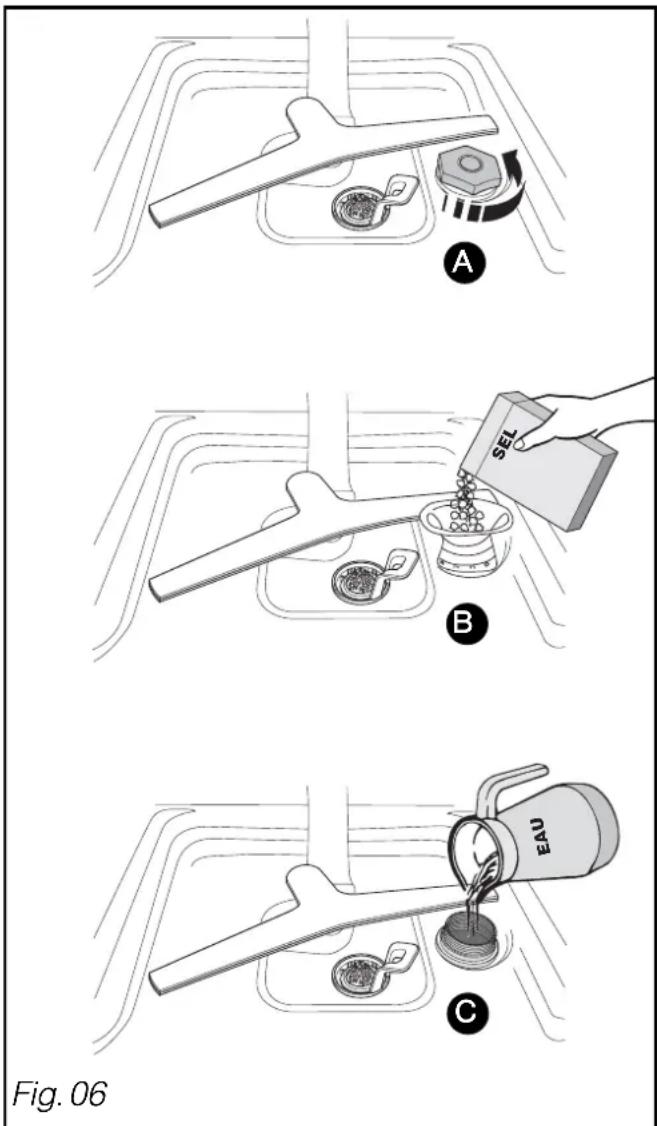
- Loading the regenerating salt (Fig. 06)

Important :
Only use special dishwasher regenerating salt. Do not use table salt or any type of cooking salt: this could damage your appliance's water softener.
A Unscrew and remove the stopper on the salt tank.
B Fill the tank with regenerating salt specially designed for dishwashers.
© Use the funnel supplied with your dishwasher. The first time, top up with water up to the rim of the tank.
- Regenerating salt indicator :
This illuminates when salt must be added. After the tank has been filled with regenerating salt, the indicator light may remain lit until the salt has dissolved sufficiently, usually after one cycle (of if the tank has not been filled completely; for example, when first putting the machine into service using the sample).
This can be deactivated as indicated in the paragraph “For multi-purpose products” setting table.

Important :
If the salt overflows when filling the tank, to avoid oxidization of the tub it is advisable to remove the salt crystals or to run a Soaking programme.
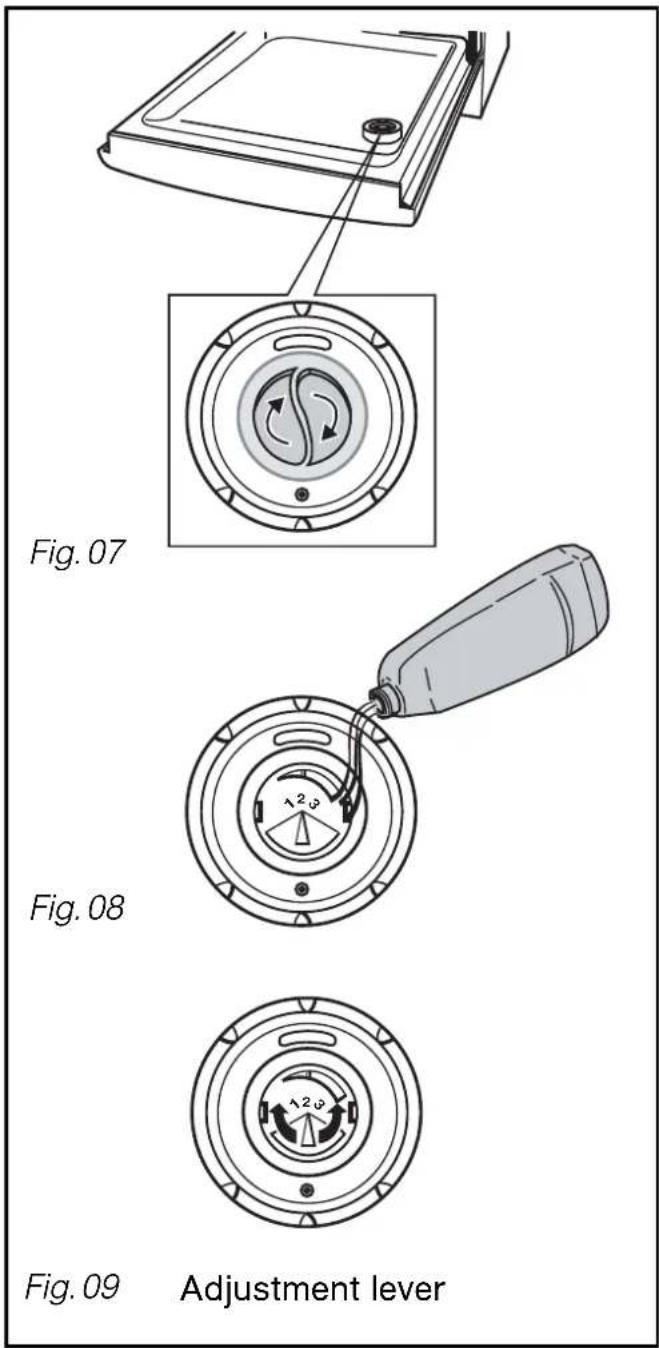
• The rinsing product (Fig. 07)

Important :
Only use a rinsing product designed for dishwashers. The rinsing product ensures your items shine and are well dried.

When first putting the machine into service, fill the tank until the level is flush with the top of the adjustment lever. Pour in at least all the rinsing product provided.
The original setting is 2.
After several cycles and if drying is incomplete or there are stains, we recommend increasing the setting by turning the knob (fig 07 Ⓒ) to position 3.
- Close completely.

Tip:
Position 1 reduces the amount of rinsing product needed and may be sufficient for your use.

Checking the level of rinsing liquid
This lights when rinsing liquid must be added. This can be deactivated as indicated in the paragraph "For multi-purpose products" setting table.

Important:
If any rinsing liquid overflows onto the door when filling the container, sponge away the excess to avoid foam forming.

Very important :
Items not suitable for washing in a dishwasher
- Wooden cutting boards,
- Stainless steel utensils or plastic utensils that are not heat-resistant,
- Copper or pewter items,
- Glued crockery and cutlery,
- Cutlery with wooden, horn or mother-of-pearl handles,
- Antique or hand-painted porcelain.
When purchasing crockery, glasses or cutlery, ensure that it is dishwasher-safe.
• THE LOWER BASKET
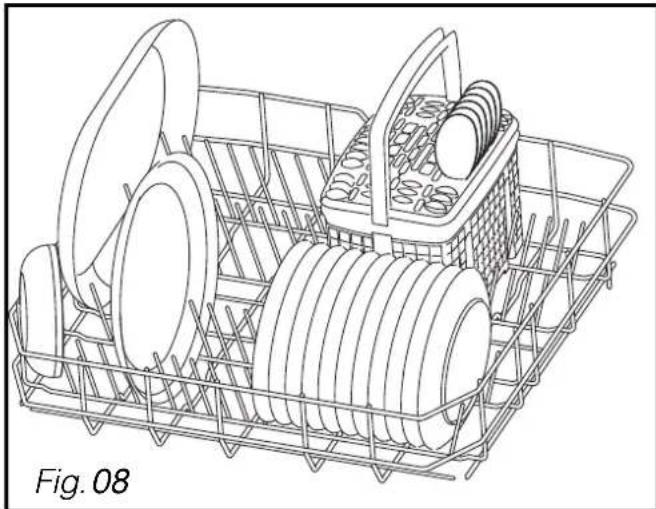
Arrange your items so that the water can circulate freely and spray over all the utensils.
Place large diameter dishes and pans at the sides.
Do not intersperse, jam together or superimpose flat plates and concave dishes (Fig. 08).
The folding spikes make it easier to arrange your large dishes (Fig. 09) (depending on the model).

Advice :
When you re-insert the lower basket, ensure that nothing catches on the upper basket's gauge wire to avoid blocking the rotor.
Unloading your items
First of all empty the lower basket to avoid drips from the upper basket falling onto the lower basket.
natural_image
Line drawing of a cleaning rack with multiple circular components and a basket (no text or symbols)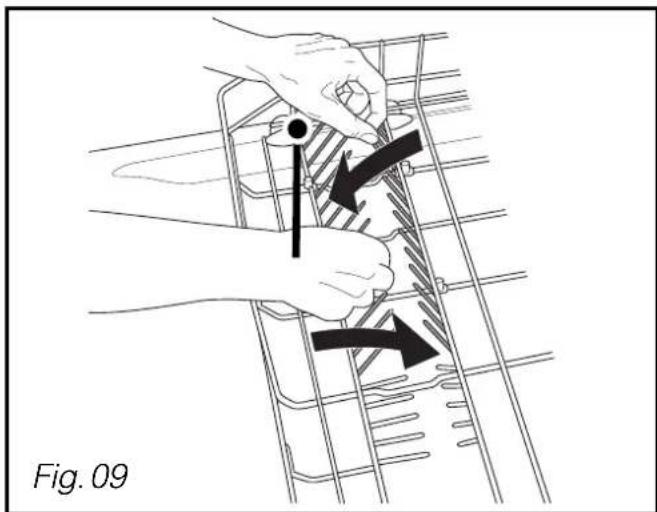
natural_image
Diagram showing hands adjusting a mechanical component with arrows indicating motion (no text or symbols)• THE UPPER BASKET
This basket is particularly designed to take: glasses, cups, ramekins, small salad bowls, bowls, saucers, etc...
Arrange your items methodically to save on space (arranging glasses, cups or bowls together, etc.)
You can also arrange cups, ladles, etc. on the retractable supports (Fig. 10)

Advice :
Position the cavities of glasses, cups wls facing downwards.
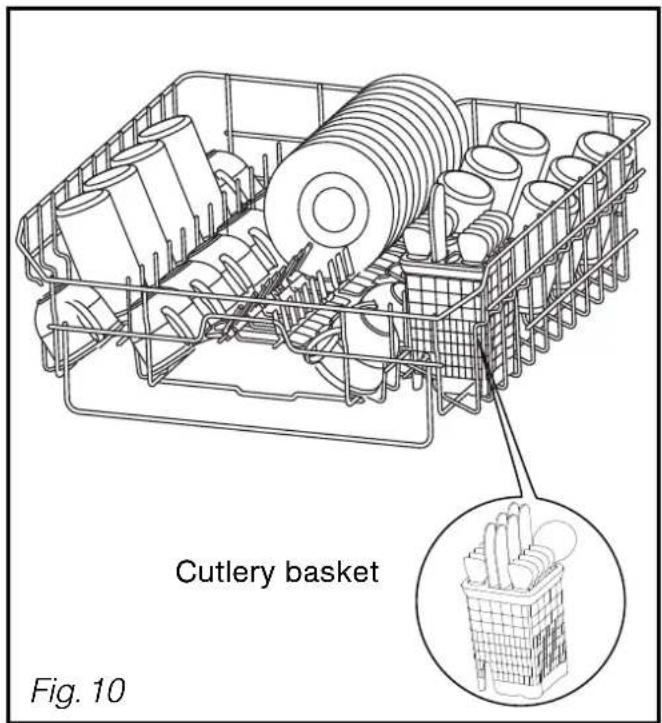
- Adjusting the height of the upper basket (depending on the model)
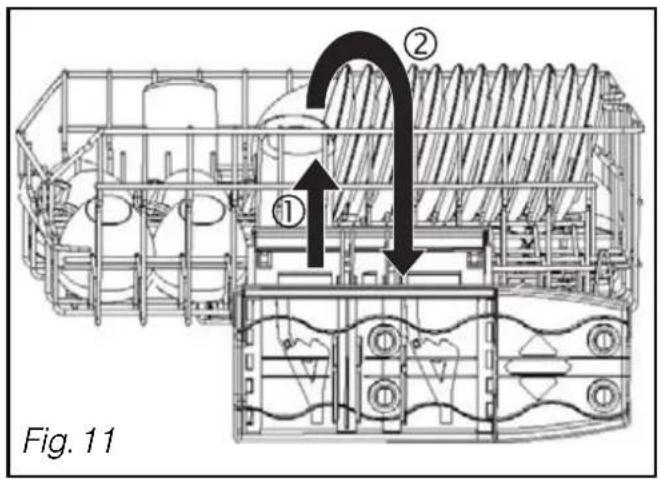
For large dishes to be loaded in the lower basket, the upper basket must be set in to high position. This can be done with the basket fully loaded (Fig. 11)
① Setting in HIGH POSITION :
Gently raise your basket on each side until it engages.
② Setting in LOW POSITION :
Raise your basket completely on both sides to unlock it and then lower it to the low position.

Important :
Check that the two slides are set to the
same height and the basket is horizontal.
• THE CUTLERY BASKET
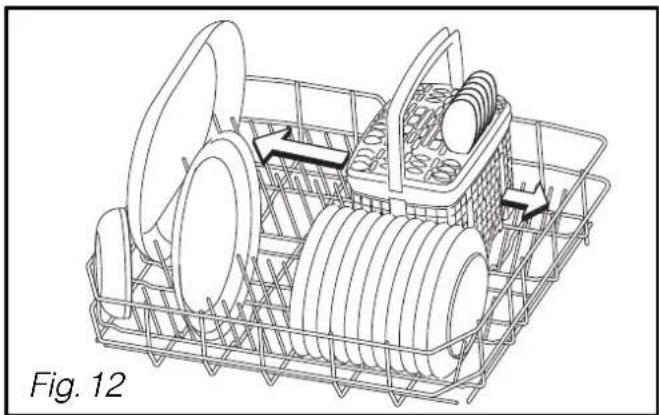
The cutlery basket slides to allow for modulable loading.
It can be placed anywhere in the lower basket. You can therefore make a variety of loads depending on the items (Fig. 12).
If your cutlery items or your dishes are too large, alter the height setting for the upper basket (if it can be adjusted, depending on the model).
natural_image
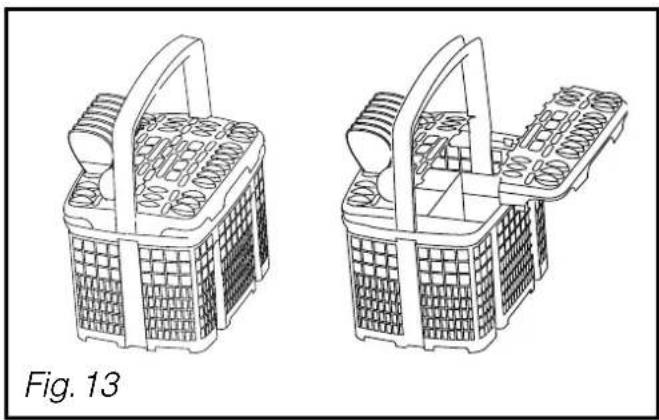
Line drawing of a kitchen appliance basket with multiple compartments and a handle, labeled Fig. 12 (no text or symbols on the diagram itself)Movable grills are available for if you wish to load your cutlery in an orderly manner (Fig. 13).
For optimum washing and drying, use these separation grills partially or totally.
Point the handles on the cutlery downwards.
natural_image
Line drawing of two woven basket designs, one with handle and one with handle, labeled Fig. 13 (no text or symbols on the baskets themselves)
Important :
For safety reasons, we recommend
that you place knives with pointed ends with the point facing downwards in the cutlery basket (to avoid the risk of an accident).
Long-bladed knives and other sharp kitchen utensils must be placed flat in the upper basket.
Avoid washing cutlery with horn handles in your dishwasher.
Separate silverware from other metals using the separation grill.
• Door not closed properly
The screen flashes when the door is not closed or not closed properly.
- Programme access lock
During the programme, access to the programme selector is automatically protected against possible operation. It unlocks automatically at the end of the programme when you open the door or if you cancel the programme.
- Anti-overflow system
This system automatically activates the drain pump if the water level in the tub reaches an abnormal height.
- Anti-leak system
This system interrupts the water supply if a leak is detected under the appliance.

Remark:
To unlock, hold down the Start/Pauza button for three seconds.
• PROGRAMMES TABLE
| Type of items: - porcelain, pans, cutlery, glasses, etc. | Mixed | Delicate | Mixed |
| Quantity, type and amount of food residue. | Pre-washVery short cycle (with no detergent) for rinsing and re-dampening the items while waiting for a wash expected the following day or even the day after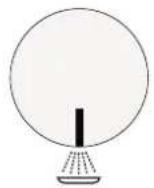 | Very short 30-minute wash specially designed for a small amount of daily items with a limited amount of non-greasy residue, not dried on[Szybki 30'45°C] | Normally dirty, i.e. a normal amount of sticky and greasy residue.A longer programme because it saves on energy.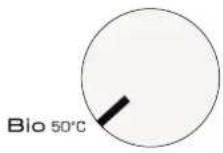 |
| Programmes |  | 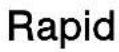 | 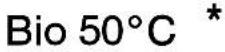 |
| Programme sequence | Cold pre-wash | ||
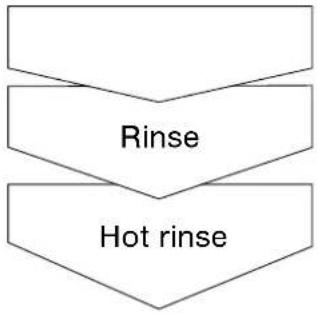 | 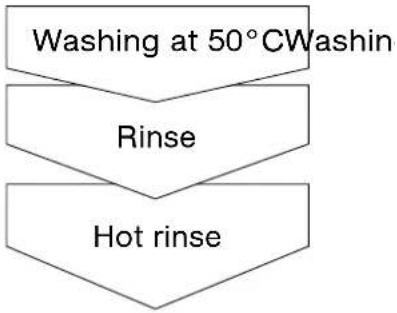 | ||
| As an indication only: | |||
| Duration in min. | 15' | 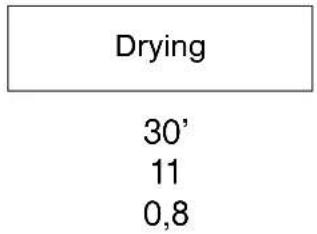 | 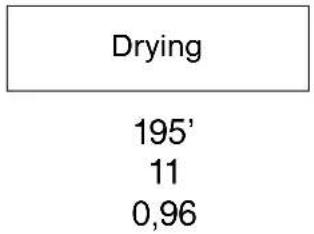 |
| Water (l.) | 4,5 | ||
| Energy (kWh) | 0,02 |
These values refer:
- to normal usage conditions with separated products (detergents, salt, rinsing product).
- only to multifunction product usage conditions
They may vary depending on the load, the water temperature, the softener setting, the presence of rinsing product and the supply voltage.
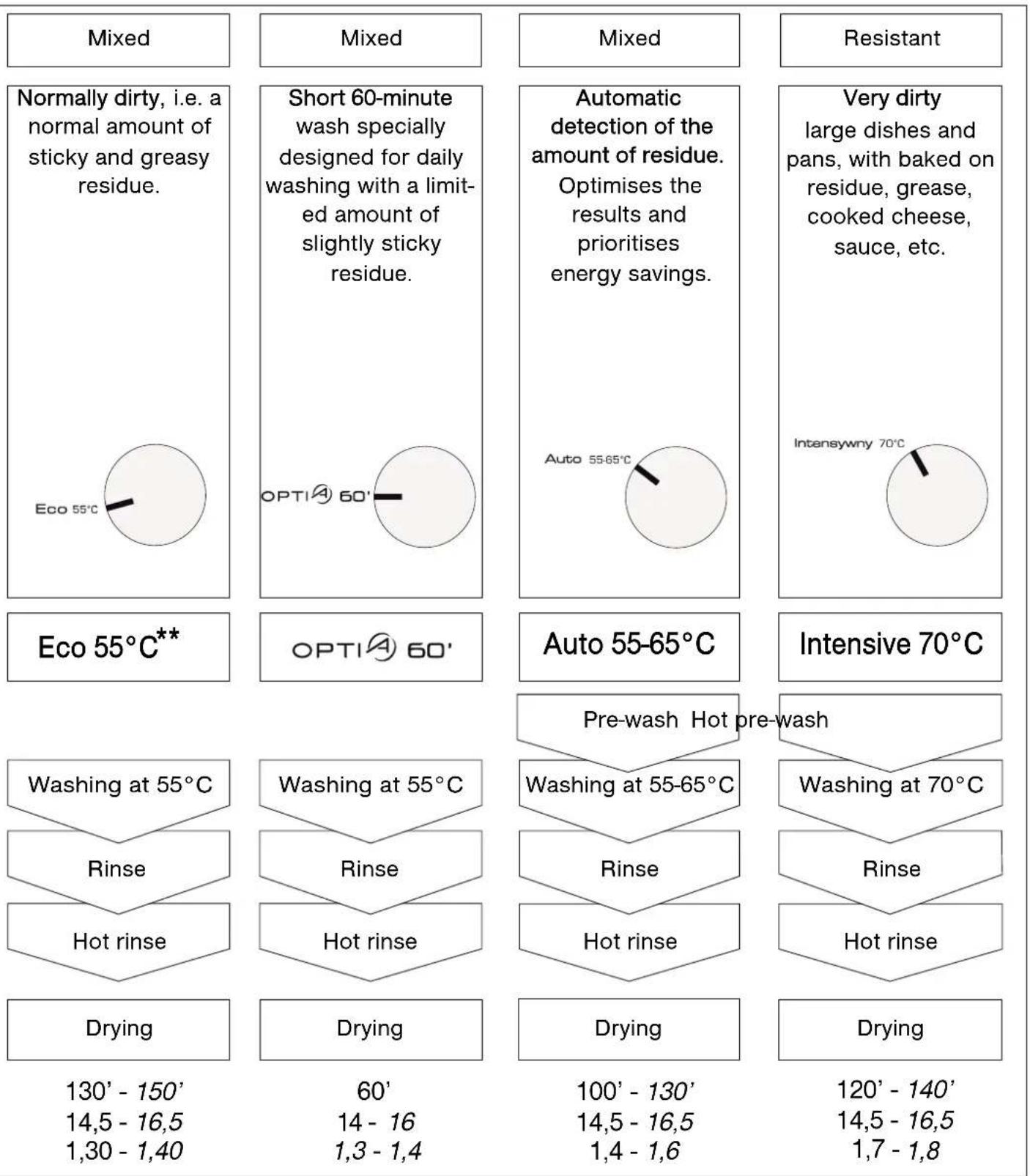
other
| Category | Value | |---|---| | Mixed | 130' - 150' | | Mixed | 14,5 - 16,5 | | Mixed | 1,30 - 1,40 | | Mixed | 60' | | Mixed | 14 - 16 | | Mixed | 1,3 - 1,4 | | Mixed | 100' - 130' | | Mixed | 14,5 - 16,5 | | Mixed | 1,4 - 1,6 | | Resistant | 120' - 140' | | Resistant | 14,5 - 16,5 | | Resistant | 1,7 - 1,8 | | Very dirty large dishes and pans, with baked on residue, grease, cooked cheese, sauce, etc. | Intensywny 70°C | | Eco 55°C** | | | Short 60-minute wash specially designed for daily washing with a limited amount of slightly sticky residue. OPTI® 60' | | | Automatic detection of the amount of residue. Optimises the results and prioritises energy savings. Auto 55-65°C | | | Auto 55-65°C | Intensive 70°C | | Washing at 55°C | | | Washing at 55°C | Pre-wash Hot pre-wash | | Washing at 55-65°C | | | Washing at 55-65°C | Washing at 70°C | | Rinse | | | Rinse | | | Rinse | Hot rinse | | Hot rinse | | | Hot rinse | Hot rinse | | Drying | | | Drying | | | Drying | | | Drying | DryingRecommended programme:


Advice:
Consult the Programmes table on the preceding pages to determine the programme you need for the type of items, the quantity and the amount of food residue.
• Immediate programme start
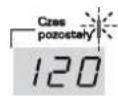
Select the programme by turning the selector A. The screen displays the length of the programme selected.
Press the "Start" button, De programme begins.
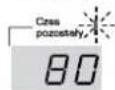
The "Remaining Time" light comes on.
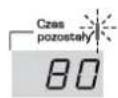
The screen displays the amount of time remaining until the end of the programme while the programme is in progress.
Programme length
Programme time remaining
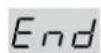
End of programme

• Delayed programme start

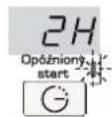
You can programme a delayed start by pressing the "opóźniony start" button B Every time you press the button, you advance one hour (1 hr to 12 hrs).
Confirm by pressing "Start" D.
The screen counts down the hours until the programme starts.
Waiting for delayed start
Programme time remaining
End of programme
- Switching off the appliance
When the program has finished, turn the selector to the "Stop" position. A.
- Cancelling a programme
Hold down the "Start/Pauza" Duttonfor a few seconds; the programme stops and the "Remaining Time" light goes out. You can then reprogramme.

Remarks:
The door's electrical safety system can cause the indicator lights to illuminate briefly when the door is opened or closed. This phenomenon does not affect your machine's operation.
If required, and particularly after the water softener has been reset, the programme may start with three minutes of resin regeneration. This is a silent operation.
- CLEANING THE WASTE FILTERS
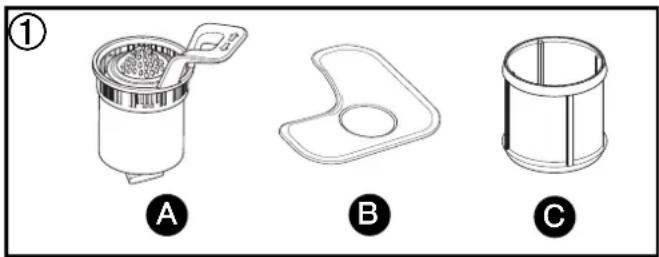
The filtration system consists of several elements:
A - The waste filter.
B - The large main filter.
© - The micro filter.
The filters are located in the centre of the tub and must be washed regularly to obtain optimum washing results.
- Actions :
① Before removing the filters, remove any waste on the large main filter B with a sponge so that the waste does not block the sprinkler arms. Orient the rotor D as shown in the drawing. (Fig. 14)
② Loosen the waste filter a quarter of a turn and then remove it A.
③ Remove the main filter B.
④ Remove the micro filter screen Ⓒ.
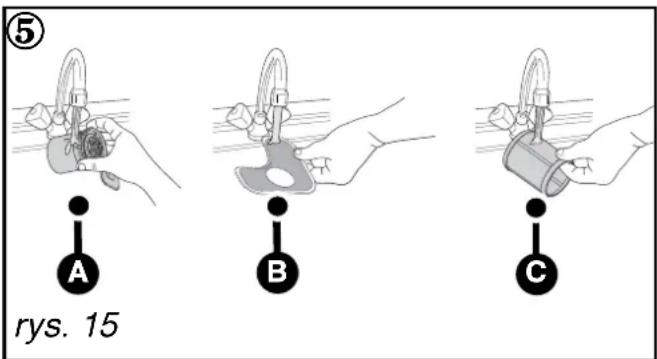
⑤ Carefully clean filters A, B and C under running water. (Fig. 15)
Reinstallation:
Proceed in reverse order, inserting filters ©
and B and thA

Important :
Remember to lock the waste filter in
A place by pushing it in fully and turning it a quarter turn.
natural_image
Three technical line drawings of mechanical components labeled A, B, and C (no text or symbols on the diagrams themselves)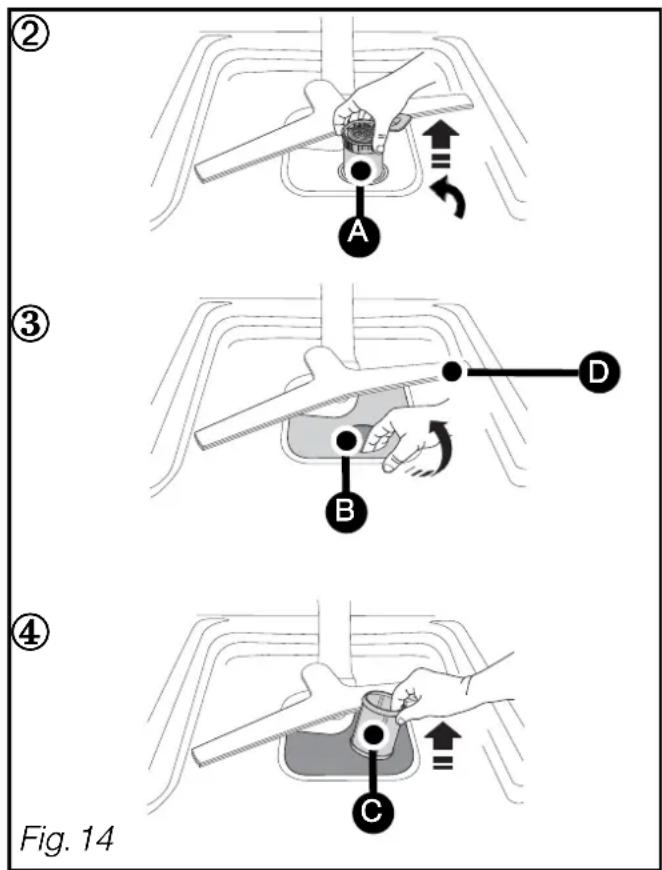

- Periodically
Every 3 or 4 months, in order to remove any deposits, run a special maintenance programme, without any items in the machine, using a commercially available special dishwasher cleaning product.

Important :
Keep this product out of children's reach.
- Prolonged stoppage
Clean your dishwasher completely and then unplug it from the electricity supply and close the water tap. Protect your machine from potential frosts

Advice :
Do not use abrasive powders, metal sponges and alcohol-based or thinner-based products. Use a cloth or a sponge.
If you are moving house, run a soaking programme first of all, in order to avoid any water escaping.
• SUMMARY OF THE FAULTS
| d01 : water supply fault (tap) | d07 : overflow / anti-leak fault |
| d02 : draining fault | d08 : sprinkling distribution fault |
| d03 : heating fault | d11 : pressure sensor fault |
| d04 : temperature fault | d12 : filling fault (water inlet detection system) |
| d05 : faulty motor | d13 : faulty heating |
| d06 : faulty motor | d14 : installation fault:incorrect drainage connection or inadequate flow rate and tap. |

Tip:
If one of the above faults occurs and you need to call a repair man, remember to tell him
the message displayed (d01, d02..) as this information will help him.
- WHEN FIRST PUTTING INTO SERVICE
| Problem Possible causes What to do? | ||
| The door falls heavily when opened (integratable model) | - Door springs not tensioned enough to compensate for the weight of the panel. | - Tighten the two tensioning screws accessible in the bot-tom section above the front feet. |
| The door does not stay horizontal when open or returns too quickly (integratable model) | - Door springs tensioned too much.- No wooden panel. | - Loosen the two tensioning screws accessible in the bot-tom section above the front feet- Fit a wooden panel on the appliance (chipboard panel in temporary) and adjust the springs. |
| The door catches when closing | - Appliance not stable- Door not centred on the tub | - Adjust the feet.- Re-centre by adjusting the rear feet. |
| The upper basket does not stay in the high position | - Poor manipulation (the basket is being pulled upwards too quickly) | - Act more progressively (see instructions), one side and then the other. |
| Small leak around or under the appliance (move the appliance to locate the leak better) | - Leak from the tap.- Leak from the appliance.(Cf. table fault d07). | - Check that a seal is fitted and retighten the nut.- Close the water tap and call a technician. |
| Small leak at the door | - Appliance not stable or not level- Door not centred on the tub. | - Adjust the feet.- Re-centre by adjusting the rear feet. |
• THE INDICATOR LIGHTS
| Problem Possible causes What to do? | ||
| The salt light does not go out - No salt or an insufficient quantity of salt in the tank to trigger the float. | - Refill the tank and wait for the cycle to end. If you have soft water that requires no salt, the light is constantly lit. | |
| The lights all light up one after the otherA light flashes and the programme does not start | - Wrong programme.- Programme selector wrongly positioned (between two notches) | - Cancel the current programming by holding down the Start button for 3 seconds and then re-programme.- Reposition the selector on a programme. |
• RELATING TO PROGRAMMING, DISPLAY
| Problem Possible causes What to do? | ||
| The cycle lasts too long - IThe en | energy-saving program-mes last longer because the agitation and drying times are longer to compensate for the lower washing and drying tem-peratures | - Use these programmes preferably at night when it is not so important how long the pro-gramme lasts or when it ends. |
| The appliance trips the circuit breaker | - Insufficient amperage to sup-ply all the appliances being operated simultaneously.- Internal fault in the appliance. | - Check the socket's amperage (10A minimum) and the meter's capacity.- Call a technician. |
| The appliance does not start - No | - Tap closed. (Cf. table fault d01).- Water supply hose kinked.- Selection error or programme blocked.- Start button pressed too long (>2").- Appliance in Safety mode (anti-leak). (Cf. table fault d07). | - Check the socket and the fuse- Check the tap is open.- Check the hose line is OK.- Cancel by holding down Start for 3" and re-programme.- Just press Start briefly to start the programme.- Call a technician. |
| Problem Possible causes What to do ? | ||
| The appliance will not restart - Door opened during a washing cycle. | - Wait for the time delay for resuming the cycle to end (controlled internally by the appliance). | |
| The appliance does not drain (Cf. table fault d02). | - The cover has not been removed from the sink's U-bend.- Drain hose kinked.- Filters totally blocked.- Pump blocked. | - Remove the cover.- Check the drain hose line behind the machine is OK.- Remove and clean the filters and the drain.- Initiate a Soaking programme If the fault persists, call a technician. |
| The appliance will no longer function (Cf. table, fault 14). | - Installation of non-compliant drainage system: drainage too low down or pipe pushed too far in.- Siphoning: the appliance is emptying as the same time as it is filling up. | - Adhere to the drainage tube installation dimensions. |
• POOR WASHING RESULTS
| Problem Possible causes What to do ? | ||
| Food traces, deposits, “sand grains” in the glasses | - Items poorly arranged (masked by another larger item or situated underneath it, items nested or jammed together).- Upper rotor blocked by cutlery or a dish etc.- Filter poorly locked and lifting during washing.- Micro filter screen clogged.- One or more holes in the rotor blocked. | - Arrange the items properly. Use the most appropriate areas and accessories for each type of item (see instructions).- Check that the rotor rotates freely (gauge wire). Set the basket in the high position if necessary.- Check the filter’s facing and that the filter is locked in place (push it in fully, turning it to the right).- Remove all, the filters and clean them (in warm water), including the micro filter’s screen (once a month).- Remove the rotor by turning the lever a quarter of a turn and clean it under the tap (do not use any tool that could damage the holes). Re-install the rotor. |
| Traces of grease - Detergent dose | too low; inefficient detergent ; stale product.- Inappropriate programme (temperature too low; duration too short). | -Increase the dose ; try another detergent.- Select a programme with a higher temperature. |
• POOR WASHING RESULTS...
| Problem Possible | causes What to do? | |
| White marks (identify what type) | - Chalky film (removable with vinegar).- Traces of salt (items have a salty taste). | - Check that there is salt in the tank (light unlit = OK).- Check the water hardness at the tap and that the water softener is set correctly. Adjust it to a higher level if necessary.- Water too hard for using a “4-in-1” detergent without the addition of salt.Check that the stopper on the salt container is closed correctly. |
| White marks (identify what type) | - Glass cloudy because water too soft (cannot be removed). | - Check the water hardness at the tap and that the water softener is set correctly. Some detergents in pellet form are more aggressive to glasses and decorations (change the product and use a protective product if necessary). |
| Coloured marks (tea, wine, coffee) | - Items poorly arranged- Detergent dose too low; inefficient detergent- Programme temperature too low.- If you use a multifunction product. | - Turn the cavities in the items towards the jets.- Increase the dose; try another detergent.- Select a more suitable programme with a higher temperature.- Use the “4-in-1” option (depending on the model). |
| Streaks or dried droplets on glasses | - Lack or insufficient amount of rinsing product.- Rinsing product out-of-date or inefficient.- If you use a multifunction product. | - Check the indicator light and fill the tank completely. Adjust the dispensing unit to a higher position if necessary.- Use a recent product (a good product dilutes easily and foams in cold water).- Use the “4-in-1” option with a setting prioritizing drying (parametering from the menu - depending on the model). |
| Dried-on marks on glasses, dullness. | - If you use a multifunction product. | - Use the “4-in-1” option with a setting prioritizing brilliance (parametering from the menu - depending on the model). |
• POOR OPERATION
| Problem Possible causes What to do? | ||
| Constant fillingA lot of waste on the large filter at the end of the cycle. | - (Cf. table fault d012). Drain hole situated too low for the appliance.- The filters and drain outlets are blocked with too much residue. | - Drain wand fallen on the floor.- Remove and clean the filters and the bottom of the drain outlets. Remove large residue from the plates before putting them in the machine. |
| Traces of rust on stainless steel | - Quality of the stainless steel not dishwasher-safe (knives in particular) | - Use “special dishwasher-safe” cutlery.- Check that the stopper on the salt container is closed correctly. |
• POOR DRYING RESULTS
| Problem Possible causes What to do? | ||
| A lot of droplets on the glasses. | - Lack or insufficient amount of rinsing product.- The dose has not been distributed.- Positioning of the items. | - Check the indicator light and fill the tank completely.- If the tank is not empty after approximately 60 washings, call a technician.- To alleviate the phenomenon, arrange the items to restrict water retention as much as possible. Leave the door ajar for a few minutes, if possible |
| Droplets on plastic items, Tefal coatings, etc. | - These insulating items have a low calorific mass. | - Arrange them preferably in the upper basket. |
| Poorer drying on rapid programmes | - On rapid programmes, the drying temperature and drying period are reduced to cut down the duration of the cycle as much as possible. | - Select a rapid programme carefully or leave the door ajar for a few minutes. |
| Condensation on the wall of the inside door or the tub. | - Condensation may form on the walls, particularly after the appliance has cooled down (sound insulation increases the phenomenon) | |
• INTERVENTION WORK
Any intervention work on your appliance must be performed by a qualified professional approved by the manufacturer. When you call, please mention the full reference for your appliance (model, type and serial number). This information is shown on the description plate (see Fig. 16)
ORIGINAL PARTS
When maintenance is being carried out, ask for only certified original spare parts to be used.
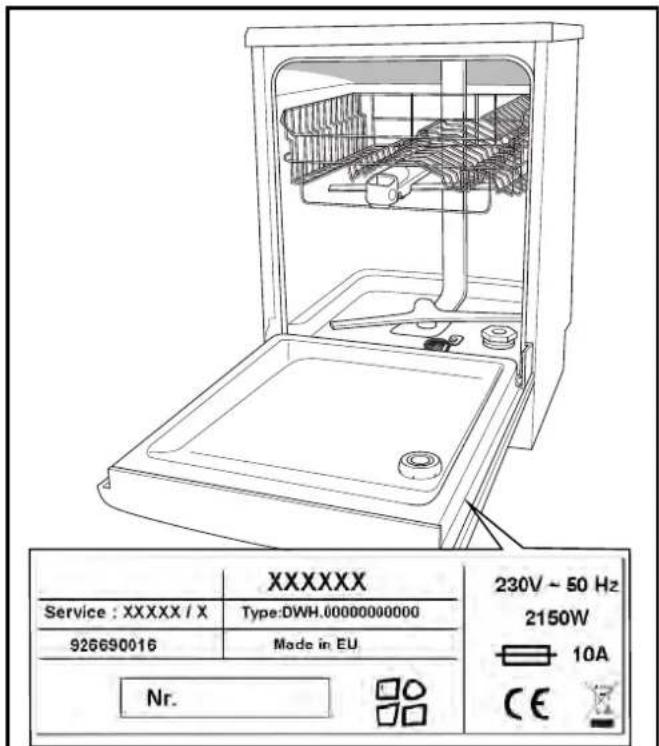
Fig. 16
Mastercook
Szanowny Kliencie, Szanowna Klientko,
rys. 01
natural_image
Simple line drawing of a faucet dispensing liquid into a bucket (no text or symbols)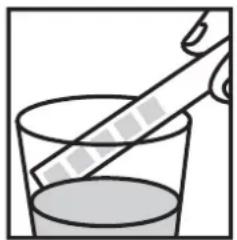
natural_image
Simple line drawing of a pipette stirring liquid in a glass (no text or symbols)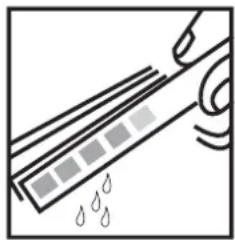
natural_image
Illustration of a hand holding a tool with droplets falling, no text or symbols present• TABELA TWARDOŚCI WODY
natural_image
Simple horizontal line with a downward arrow at the end (no text or symbols)
natural_image
Simple horizontal line with a downward arrow at the center (no text or symbols)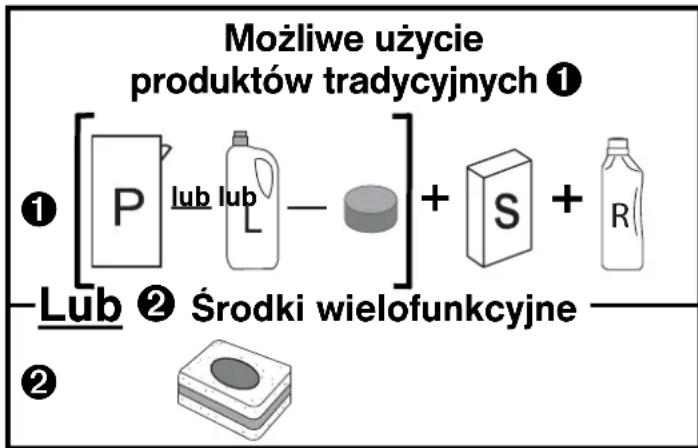
natural_image
Illustration of a hand pouring liquid into a container using a tool (no text or symbols visible)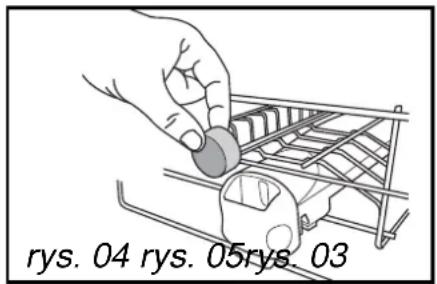
natural_image
Technical line drawing of a train or vehicle suspension system with tracks and a vehicle (no text or symbols)- DLA WIELOFUNKCYJNYCH ŚRODKÓW DO ZMYWANIA: OPCJA
natural_image
Line drawing of a cleaning rack with multiple circular components and a basket (no text or symbols)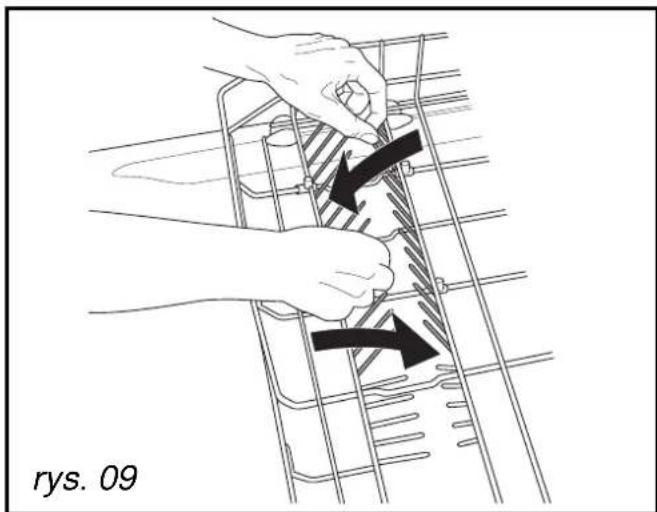
• GÓRNY KOSZ
natural_image
Line drawing of a kitchen appliance basket with multiple dish units and a drawer, labeled 'rys. 12' (no text or symbols on the diagram itself)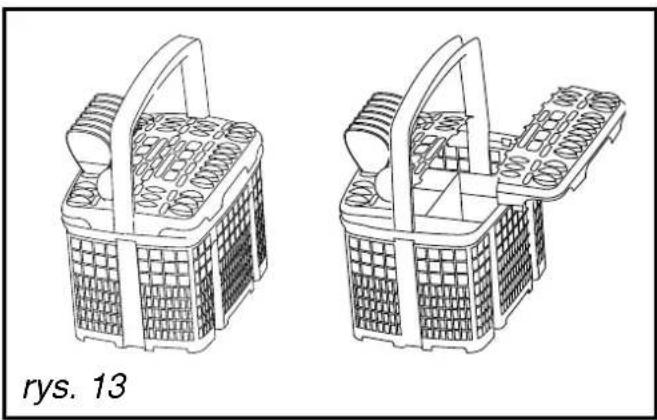
natural_image
Two wireframe basket designs with grid patterns, no text or symbols presentOPTI® 60'
Mycie w 55°C
Płukanie
Płukanie na gorąco
Suszenie
130' - 150'
14,5 - 16,5
1,30 - 1,40
Mycie w 55°C
Płukanie
Płukanie na gorąco
Suszenie
60'
14 - 16
1,3 - 1,4
Mieszany
natural_image
Three technical line drawings of kitchen utensils: a filter, a tray, and a cylindrical container (no text or symbols)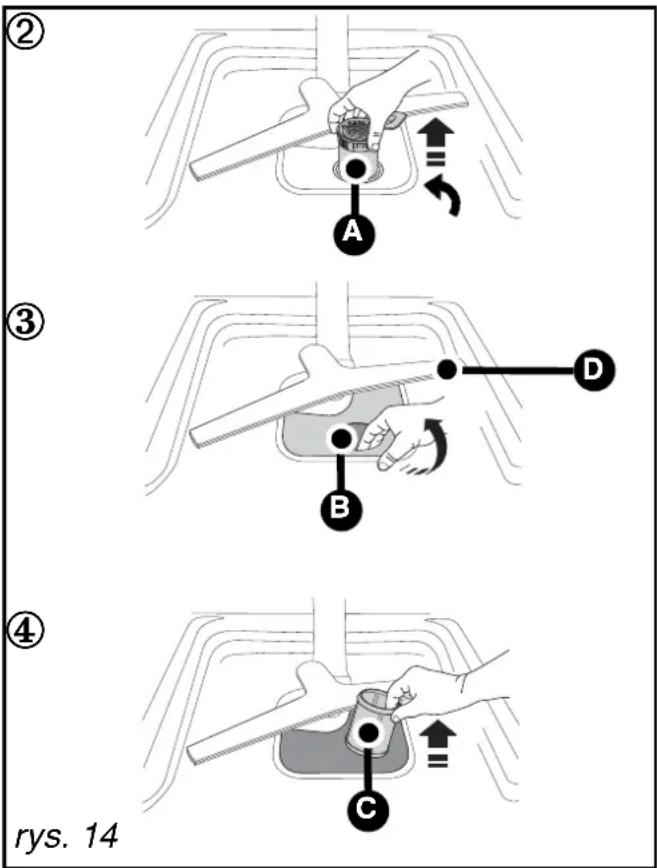
- Okresowo
• Details common to all models
-Washing capacity 13 standard place settings
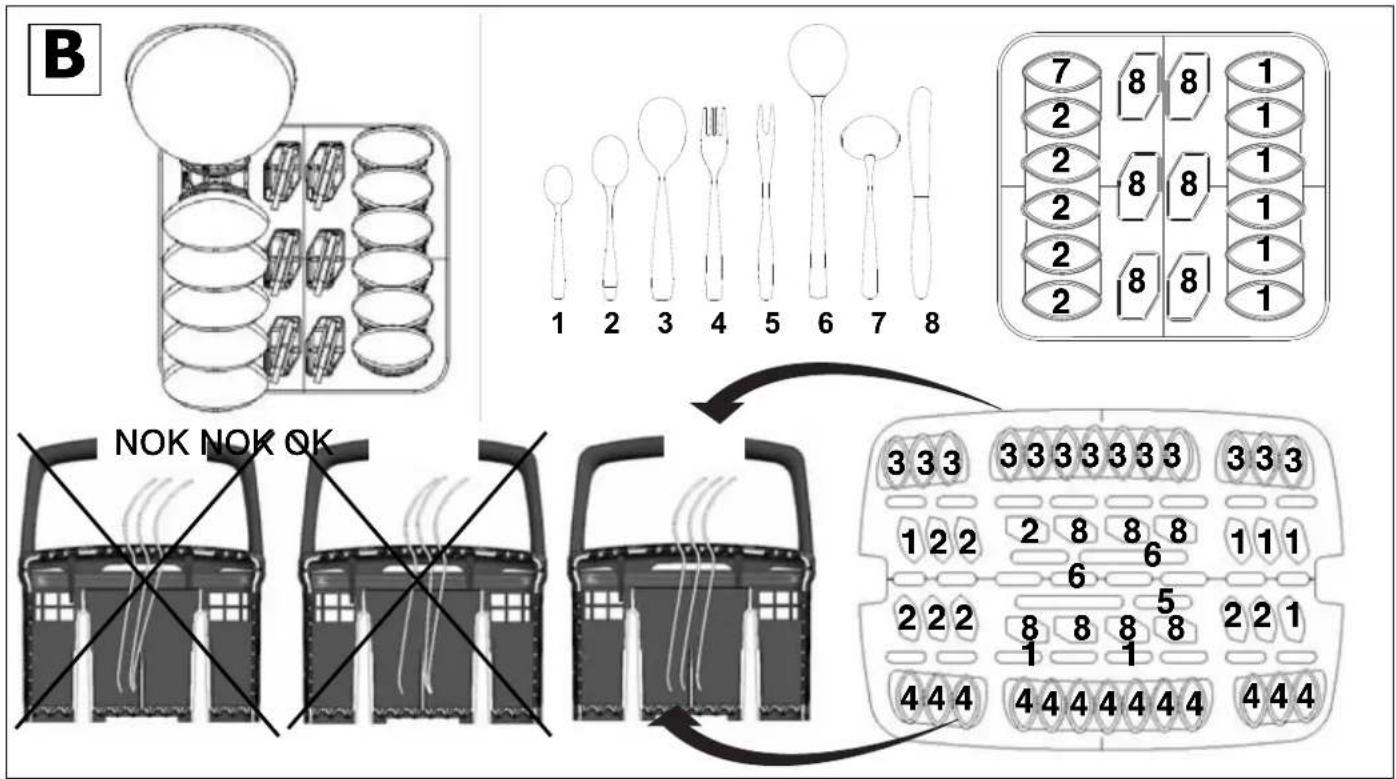
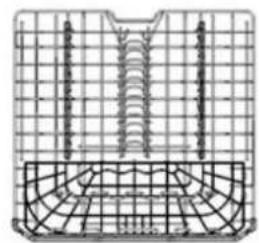
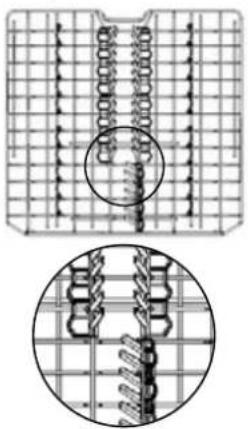
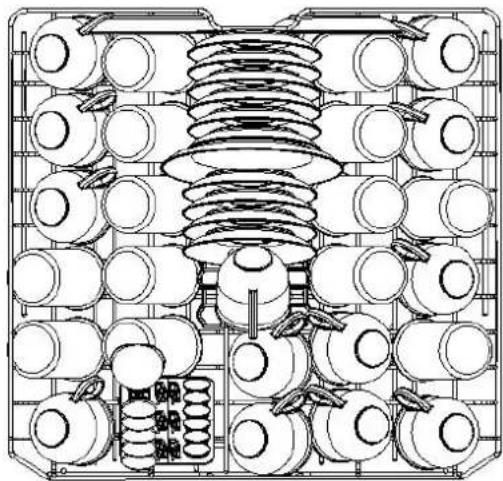
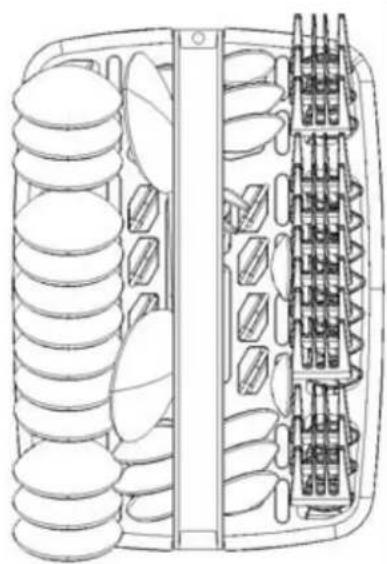
- Arrangement of the items - Figs. A-B-C; see above and next page
- Loading as per the indications on next page, without side shelves
- Setting for upper basket ---- Low position
- Setting for rinsing product distributor ----3
- Adjusting the water softener 1.8 - 2.5 mmol/l
(See § 5 "detergent products and adjusting the water softener" for details).
For detailed information on the comparison tests regarding the level of soiling, the types of crockery and cutlery, etc., contact the equipment manufacturer before commencing the tests.
• Tests to Standard EN 50242
- Recommended programme ---- see Programmes table
- Dosage of detergent 32.5 g of detergent B
• Tests according to the mixed IEC 436/DIN 44990 method
- Recommended programme ---- see Programmes table
- Dosage of detergent 5 + 27.5 g of detergent C
NB: When conducting tests using a multi-function tablet: Setting for hardness < 2.5 mmol/l (See § 5 for details)
- Check that the water softener is correctly set for the water hardness
– Pull out the detergent distribution drawer and place the tablet in the interior compartment.
• Built in or full built in model: Measuring the noise level in accordance with Standard EN60704-2-3
- Align the plinth on the housing unit with the door panel.
e: egg/oeuf
m: meat/viande
s: spinach/épinards
A
natural_image
Technical diagram of a screw fastener assembly with grid background (no text or labels)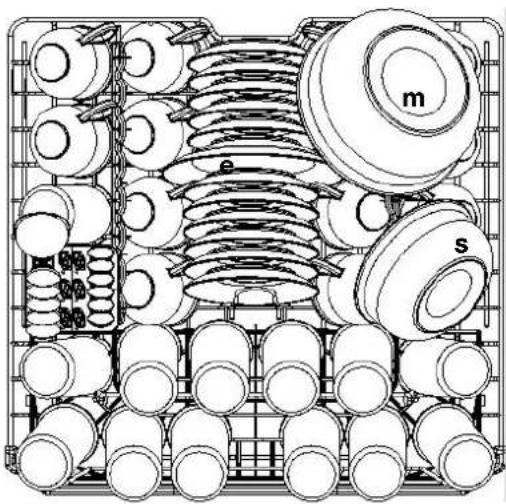
natural_image
Technical line drawing of a mechanical assembly with multiple components and no visible text or symbols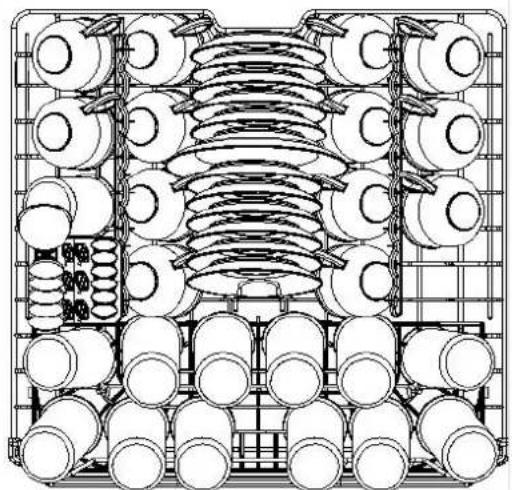
natural_image
Technical line drawing of a mechanical assembly with multiple cylindrical components and spring-like elements (no text or symbols)A
natural_image
Technical diagram showing a mechanical component with internal springs and a magnified inset (no text or labels)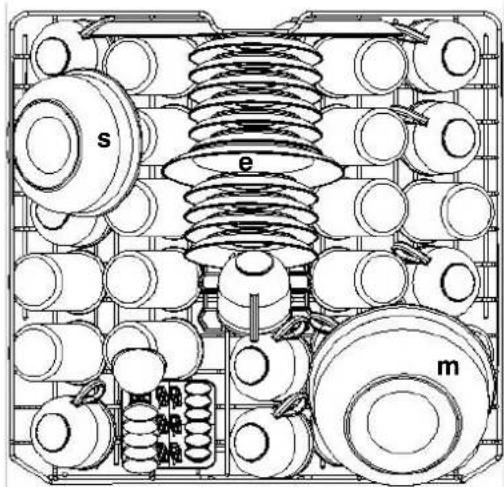
natural_image
Technical line drawing of a mechanical assembly with multiple circular components and a central spring (no text or symbols)C
natural_image
Technical line drawing of a mechanical component with internal gears and shafts (no text or symbols)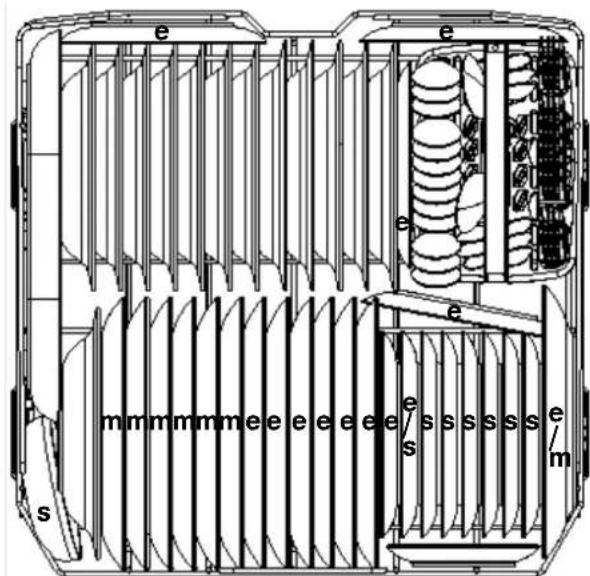
FAGOR MASTERCOOK
A FAOKE GROUP COMPANY
- Mastercook
- Warning:
- 1/ FOR THE USER'S ATTENTION
- 2/ DESCRIPTION OF YOUR APPLIANCE
- 3/ INFORMATION
- 4/ ACTIONS BEFORE FIRST USE
- 5/ DETERGENT PRODUCTS AND SETTING THE WATER SOFTENER
- 6/ LOADING THE REGENERATING SALT 12
- 7/ LOADING THE RINSING PRODUCT 13
- 8/ YOUR DISHWASHER'S EQUIPMENT
- 9/ THE DISHWASHER'S SAFETY SYSTEMS 17
- Important :
- • SAFETY INSTRUCTIONS
- - Installation
- - Children's safety
- - Use
- • ENVIRONMENTAL PROTECTION
- • ECONOMICAL, ENVIRONMENTALLY FRIENDLY WASHING
- • GENERAL PRESENTATION OF THE DISHWASHER
- Advice:
- • PRESENTATION OF THE CONTROL PANEL
- A Programme selector: 3 functions:
- B Opóźniony start (Delayed start):
- The indicator lights:
- Multipurpose products:
- Salt:
- Rinsing liquid:
- Important:
- • THE WATER HARDNESS
- For impeccable results, preferably use a combination of traditional products:
- For ease of use and only in certain water hardness conditions < 25°F, multi-purpose products may make the use of rinsing liquid or salt unnecessary.
- NB:
- - MEASURE THE WATER HARDNESS AND SELECT THE TYPE OF DETERGENT: TRADITIONAL OR MULTI-PURPOSE
- - HARDNESS TABLE
- • FOR TRADITIONAL PRODUCTS
- • Traditional tablets
- - Powders or liquids (Fig 03)
- • FOR MULTI-PURPOSE PRODUCTS: OPTION
- - Proceed as follows to adjust the water softener on the control panel:
- - Loading multi-purpose tablets
- - Place the tablet in the external compartment (Fig 04 on previous page) or, for optimum operation, pull out the distributor's drawer and lay the tablet there. (Fig 05 on previous page).
- - Regenerating salt indicator :
- • The rinsing product (Fig. 07)
- Tip:
- Checking the level of rinsing liquid
- Very important :
- • THE LOWER BASKET
- Advice :
- • THE UPPER BASKET
- - Adjusting the height of the upper basket (depending on the model)
- ① Setting in HIGH POSITION :
- ② Setting in LOW POSITION :
- • THE CUTLERY BASKET
- • Door not closed properly
- - Programme access lock
- - Anti-overflow system
- - Anti-leak system
- Remark:
- • PROGRAMMES TABLE
- • Immediate programme start
- • Delayed programme start
- Confirm by pressing "Start" D.
- - Switching off the appliance
- - Cancelling a programme
- Remarks:
- - CLEANING THE WASTE FILTERS
- - Actions :
- Reinstallation:
- - Periodically
- - Prolonged stoppage
- • POOR OPERATION
- • POOR DRYING RESULTS
- • INTERVENTION WORK
- ORIGINAL PARTS
- - DLA WIELOFUNKCYJNYCH ŚRODKÓW DO ZMYWANIA: OPCJA
- • GÓRNY KOSZ
- Mieszany
- - Okresowo
- • Details common to all models
- • Tests to Standard EN 50242
- • Tests according to the mixed IEC 436/DIN 44990 method
- • Built in or full built in model: Measuring the noise level in accordance with Standard EN60704-2-3
- FAGOR MASTERCOOK
Brand : Mastercook
Model : ZWE-9176 X
Category : Dishwasher