
MW 602 - Microwave DELONGHI - Free user manual and instructions
Find the device manual for free MW 602 DELONGHI in PDF.


| Product Type | Microwave Oven |
| Brand | DeLonghi |
| Model | MW 602 |
| Capacity | 20 liters |
| Power Output | 700 W |
| Power Consumption | 1050 W |
| Dimensions (W x D x H) | 440 x 350 x 260 mm |
| Weight | 10.5 kg |
| Power Levels | 5 levels (including defrost) |
| Timer | Up to 60 minutes |
| Defrost Function | Yes, by weight or time |
| Turntable | Glass turntable (diameter 245 mm) |
| Interior Light | Yes |
| Door Type | Side-opening with safety interlock |
| Control Type | Rotary knobs |
| Display | None (no digital display) |
| Child Lock | No |
| Cleaning | Wipe interior with damp cloth; avoid abrasives |
| Installation | Freestanding, ensure ventilation gaps |
| Voltage | 230 V / 50 Hz |
| Accessories | Glass turntable, turntable ring, user manual |
Frequently Asked Questions - MW 602 DELONGHI
User questions about MW 602 DELONGHI
0 question about this device. Answer the ones you know or ask your own.
Ask a new question about this device
Download the instructions for your Microwave in PDF format for free! Find your manual MW 602 - DELONGHI and take your electronic device back in hand. On this page are published all the documents necessary for the use of your device. MW 602 by DELONGHI.
USER MANUAL MW 602 DELONGHI
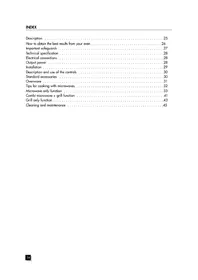
Important safeguards 27
Technical specification 28
Electrical connections 28
Output power 28
Installation 29
Description and use of the controls 30
Standard accessories 30
Ovenware 31
Tips for cooking with microwaves 32
Microwave only function 33
Combi microwave + grill function .....41
Grill only function 43
Cleaning and maintenance ....45

DESCRIPTION
A Grill element B Control panel C Microwave outlet cover D Turntable spindle E Inside of door F Wire rack G Turntable H Turntable support
| What do I want to do? | What function should I choose? | Instruction s page | Quantity/t ime table page | ||
| Defrost | Microwave only | 34 | 35 | ||
| Keep food warm | Microwave only | 34 | |||
| Soften chocolate/icingMelt butter and soften cheese | Microwave only | 33 | 37 |  | |
| 33 | 37 | ||||
| Cook desserts, cakes and pastries | 40 | 40 | |||
| Cook stews, chicken breast | Microwave only | 33 | 35 | ||
| Cook fruit, vegetables, rice, soup, fish | Microwave only | 33 | 35 | ||
| 38 | 39 | ||||
| Reheat pre-cooked or frozen foods | 33 | 37 | |||
| Cook all types of roast meat, poultry, kebabs and potatoes rapidlyB rown dishes (eg. lasagne, au gratin vegetables, macaroni cheese) | Combi microwave + grill | COMBI 1 COMBI 2 COMBI 3 | 41 | 42 |  |
| T raditionally grill hamburgers, chops, frankfurters, sausages, toast etc. | Grill only | 43 | 44 |  | |
Read these instructions carefully and keep for future reference. NB:
This oven has been designed to defrost, heat and cook food in the home.
It must never be used for other purposes, modified or tampered with in any way.
1) WARNING: If the door or door seals are damaged, do not use the appliance until it has been repaired by a qualified service engineer (trained by the manufacturer or by the dealer's Customer Service).
2) WARNING: It is hazardous for anyone other than a qualified service engineer to carry out any service or repair operation involving the removal of a cover which gives protection against exposure to microwave energy.
3) WARNING: Liquids and other foods must not be heated in sealed containers since they are liable to explode.

Eggs in their shell and whole hard-boiled eggs should not be heated in microwave ovens since they may explode even after microwave heating has ended.
4) WARNING: The appliance is not intended for use by young children or infirm persons. Young children should be supervised to ensure that they do not play with the appliance.

Only allow children to use the oven without supervision when adequate
instructions have been given so that the child is able to use the oven in a safe way and understands the hazards of improper use.
5) WARNING: when operating in combi mode, the oven becomes extremely hot. Do not allow children to use it without adult supervision.

6) Do not tamper with the safety devices in an attempt to operate the oven with the door open.
7) Do not operate the oven if objects of any kind become lodged between the front panel of the oven and the door.

Always keep the inside of the door (E) clean, using a damp cloth and non-abrasive detergents.
Do not allow dirt or remains of food to accumulate between the front panel of the oven and the door.
8) Do not operate the oven if the power cable or plug are damaged, as this may be the cause of electric shock.
If the power cable is damaged, it must be replaced by the manufacturer, an authorised technical service centre or a qualified electrician in order to avoid all risk.
9) If smoke comes out of the oven, switch off and unplug immediately. Keep the door closed to stifle any flames.
10) Use utensils suitable for use in microwave ovens only.
To avoid overheating and the consequent risk of fire, you should check the oven when cooking food in disposable containers made of plastic, cardboard or other inflammable materials and when heating small quantities of food.
11) Never place the turntable in water after it has been heated for a long time.
The resulting thermal shock would break the turntable.
12) When cooking in "MICROWAVE ONLY" and "COMBI MICROWAVE" functions, you must NEVER
preheat the oven (without containing food). NEVER operate it when empty as sparks could be produced.
13) Before using the oven, make sure the utensils and containers chosen are suitable for microwave oven use (see the section "Ovenware").
14) The appliance becomes hot when in operation.
Never touch the grill elements inside the oven.
15) When heating liquids (water, coffee, milk, etc.), a delayed action may cause the contents to boil over unexpectedly with a risk of scalds.
To avoid this, you should place a heat-resistant plastic spoon or glass rod in the container before starting to heat liquids.
Always take extreme care when handling the container.
16) Do not heat spirits with a high alcohol content, or large quantities of oil. Both types of liquid are flammable!
17) The contents of feeding bottles and baby food jars should be stirred or shaken and the temperature checked before consumption, in order to avoid burns.
It is also advisable to stir or shake the food to ensure even heat distribution.
When using commercial bottle sterilisers, ALWAYS make sure that the container is filled with the quantity of water specified by the manufacturer before starting heating.
18) Failure to clean the oven properly could result in damage to the surfaces.
This could reduce the working life of the oven and make it hazardous to use.
NB: When the oven is used for the first time, a "new" smell and a small amount of smoke may be produced for the first 10 minutes or so.
This is normal and due to the protective substances applied to the grill element.


TECHNICAL SPECIFICATION
External dimensions (LxHxD): 510x320x400
Internal dimensions (LxHxD): 330x212x330
Weight: 15.5 kg.
Turntable diameter: 31.5 cm
Oven bulb: 20 W
Microwave power: 900W (IEC705)
For further data, consult the rating plate on the back of the appliance.
This appliance conforms to EC directives 89/336 and 92/31 on Electromagnetic Compatibility and EC directive no. 1935/2004 of 27/10/2004 on materials intended for contact with food.
ELECTRICAL CONNECTIONS
Connect the appliance to a socket with a minimum current rating of 16A only.
Make sure the main switch in your home has a minimum rating of 16A to avoid it tripping unexpectedly during operation of the oven.
Before using the appliance, make sure the
mains supply voltage corresponds to the voltage indicated on the rating plate and that the socket is efficiently earthed. The manufacturer declines all liability for failure to follow this instruction.
1) Unpack the oven and remove the protective packaging containing the turntable (G) and its support (H).
Check that the turntable spindle (D) is fitted correctly into the recess in the centre of the turntable.
2) Clean the inside of the oven with a soft, damp cloth.
3) Make sure the oven has not been damaged during transport and above all that the door opens and closes perfectly.
4) Place the appliance on a stable surface at least 85 cm from the ground and out of the reach of children as the glass door may become extremely hot during cooking.

5) When positioning the oven on the worktop, always leave a
gap of about 10 cm between the oven and the walls at the back and sides and at least 30 cm above the oven (fig. 1).
6) Do not block the air intake vents. In particular, never place anything on top of the oven and make sure the air and steam outlet vents (on the top, bottom and rear of the appliance) are ALWAYS FREE (figs. 2 and 3).

air outlet
7) Place the turntable support (H) in the centre of the circular housing and rest the turntable (G) on top. The spindle (D) must be inserted into the housing in the centre of the turntable.
8) Position the oven in such a way that the power plug and socket are easily accessible.

air outlet fig. 3
9) DO NOT remove the transparent film on the inner surface of the door!

![graph TD A["POWER LEVEL"] --> B["PROGRAMME SELECTOR KNOB"] B --> C["TURN THE KNOB TO THE REQUIRED POWER/FUNCTION"] D["TIMER KNOB"] --> E["THIS KNOB INITIATES ALL COOKING OPERATIONS"]](/content/2026/05/1026379/images/231c86f06df8d28ff10a51b7accd9fd047b31813603e72c48a1f987157ddef90.jpg)
STANDARD ACCESSORIES

Grill only function for all types of grilled food.

Use the turntable at all times for all functions.
In microwave only and combi with microwave functions, any glass (preferably Pyrex), ceramic, china or terracotta ovenware may be used provided it has no metal decorations or parts (e.g. gold paint decorations, metal handles, feet etc.).
Heat resistant plastic containers can also be used, but only for "microwave only" cooking. If you are in doubt as to the suitability of a particular container, carry out this simple test - place the empty container in the oven for 30 seconds at maximum power (microwave only mode).
If the container remains cold or heats up only slightly, it is suitable for microwave cooking. If it becomes very hot (or sparks are produced), the container is not suitable.
When heating food for brief periods, paper napkins, cardboard trays or disposable plastic plates can be used as a base.
The shape and size must allow correct rotation.
When using large rectangular containers which are not able to turn inside the cavity, block rotation of the turntable (G) by extracting the spindle (D) from its housing.
Remember that in these conditions, for best results, the food must be stirred or the container turned around a number of times during cooking.
Metal, wood, cane and crystal glass containers are not suitable for microwave cooking.
Remember that microwaves heat the food, not the ovenware. Food can therefore be cooked directly on the serving plate, thus avoiding using and cleaning saucepans.
Remember that heat may be transferred from the food to the plate. You may therefore have to use an oven glove to take it out of the oven.
All standard ovenware may be used in the "grill only" function (see table).
| Glass | Pyrex | Pyroceram | Terracotta | Tinfoil | Plastic | Paper or cardboard* | Metal containers | |
| Microwave only | YES | YES | YES | YES | NO | YES | YES | NO |
| Combi microwave + grill | NO | YES | YES | YES | NO | NO | NO | NO |
| Grill only | NO | YES | YES | YES | YES | NO | NO | YES |
* If the heating time is too long, it may catch fire.

Microwaves are a form of electromagnetic radiation. They occur in nature in the form of light waves (e.g. sunlight). In the oven, these waves penetrate food from all directions to heat water, fat and sugar molecules.
This generates heat very quickly in the food itself only. The container warms up only as a result of heat spreading from the food.
In microwave cooking, food does not stick to the dish. You can therefore use very little fat and in some cases no fat at all.
As it is low in fat, microwave cooking is considered to be healthy.
Microwave cooking also involves lower temperatures than traditional cooking. It therefore dehydrates foods less, destroys less of their nutritional value and retains more original flavour.
Basic rules for microwave cooking
1) When you refer to the cooking tables later in this manual, remember that you must increase or reduce cooking time to match the volume of food you are cooking. Always respect standing time, in other words, the length of time you must leave food to "rest" after cooking. Standing time ensures that food is served at an even temperature throughout.
The temperature of meat, for example, can rise between 5°C and 8°C (approx. 9°F to 15°F) during standing time.
Food can be left to stand inside or outside the oven.
2) Always mix or stir food several times during cooking. This not only ensures even temperature distribution but also reduces cooking time.
3) Food should also be turned over during cooking.
4) Pierce foods with skins, shells or peel (e.g. apples, potatoes, tomatoes, frankfurters, fish, etc.) with a fork at several points to allow steam to escape from inside. This prevents these foods from exploding inside the oven (see fig. 4).

5) If you are cooking a number of portions of the same type of food (e.g. boiled potatoes), arrange the portions in a ring around the outside of an ovenproof dish to ensure they cook evenly (see fig. 5).
6) The lower the temperature at which food is placed in the oven, the longer the cooking time required. Food placed in the oven at room temperature will cook sooner than food coming directly from the refrigerator.

7) Always place dishes and containers in the middle of the turntable.
fig. 5
8) It is perfectly normal for condensation to form inside the oven and near the air outlet vents.
To reduce condensation, cover food with clear film, wax paper, a Pyrex lid or just a plate.
Foods with a high water content (e.g. greens and vegetables) cook better when covered. Covering food also helps keep the inside of the oven clean.
Use clear film made specifically for microwave ovens.
This function can be used to:
- Keep food warm .... page 34
- Defrost ....page 34
- Heat up . . . . . . . . . . . . . . . . . . . . . . . . . . . . . . . . . . . . . . . . . . . . . page 36
• Cook stew, white meat, fruit, vegetables, rice, soup, fish . . . . . . . . . . . . . . . . . . . . . . . . . . . . . . . . . . . . . . . . . . . . . . . . . . . . . . . . . . . . . . . . . page 38 • Cook cakes, desserts and fruit ..... page 40
Place the food in a container suitable for microwave cooking and position it in the middle of the turntable.
Note: The oven should not be preheated.


Select the required power level by turning the programme selector knob.


Set the required cooking time by turning the timer knob clockwise.


At the end of the set time, a beep indicates the end of cooking.

Operation can be interrupted at any time by turning the timer knob to the "0" position. The cooking time can also be varied while the oven is in operation by turning the timer knob forwards or backwards.
During cooking, you can check progress by opening the door and inspecting the food.
This interrupts operation, which recommences when the door is closed.
This mode is recommended for all types of food.
It enables cooked or heated food to be kept warm without becoming dry or sticking to the cooking container.
Set the programme selector knob to the 🔒 position and cover the food with a plate or clear film to keep it warm until served.
If you prefer, you can keep the food warm directly on the serving plate (covered).
USING THE MICROWAVE ONLY FUNCTION TO DEFROST
- Frozen foods in plastic bags, film, or oven-ready containers can be placed directly in the oven. Check first that there are no metal objects like staples or ties.
- Certain foods, like vegetables and fish, do not need to be fully defrosted before cooking.
- Foods in meat and other sauces defrost quicker and more evenly if they are stirred, turned and/or separated occasionally.
- During defrosting, meat, fish and fruit lose liquid. Always place these foods in a bowl to defrost.
- You are recommended to divide meat and place individual pieces in separate bags when freezing. This will save you valuable time during preparation.
- Always use caution when following the times given on frozen food packs as they are not always correct. You are recommended to use slightly shorter defrosting times than those given. Defrosting time depends on the degree of freezing.
Defrosting times
| Type | Quantity | Programme selector knob | Timer knob (minutes) | Notes | Standing time (minutes) |
| MEAT | |||||
| • Roasts (pork, beef, veal, etc.) | 1 kg | *δ | 35 - 40 | 20 | |
| • Steaks, chops, slices | 200 gr | " | 9 - 11 | 5 | |
| • Casserole, goulash | 500 gr | " | 20 - 22 | 10 | |
| • M in ce | 500 gr | " | 18 - 20 | (*) | 15 |
| • M in ce | 250 gr | " | 8 - 10 | 10 | |
| • Hamburgers | 200 gr | " | 10 - 12 | 10 | |
| • S a u s a g e s | 300 gr | " | 12 - 14 | 10 | |
| POULTRY | |||||
| • Duck, turkey | 1,5 kg | " | 45 - 50 | At the end of standing time, wash under hot water to remove any residual ice. | 20 |
| • Whole chicken | 1,5 kg | " | 45 - 50 | 20 | |
| • Chicken pieces | 500 gr | " | 20 - 22 | 10 | |
| • Chicken breasts | 300 gr | " | 19 - 21 | 10 | |
| VEGETABLES | Frozen vegetables do not require defrosting before cooking | ||||
| FISH | |||||
| • Fillets | 300 gr | " | 12 - 14 | 7 | |
| • Slices | 400 gr | " | 13 - 15 | 7 | |
| • Whole | 500 gr | " | 19 - 21 | 7 | |
| • Shrimps/prawns | 400 gr | " | 13 - 15 | 7 | |
| DAIRY PRODUCTS | |||||
| • Butter | 250 gr | " | 8 - 10 | Remove any aluminium foil and pieces of metal. | 10 |
| • Cheese | 250 gr | " | 9 - 11 | Do not fully defrost cheese. Respect standing time. | 15 |
| • C r e a m | 200 ml | " | 11 - 13 | Remove cream from the container and place on a plate. | 5 |
| FRUIT | |||||
| • Strawberries, plums, cherries, blackcurrants, apricots | 500 gr | " | 18 - 20 | Mix 2 - 3 times. | 10 |
| • Raspberries | 300 gr | " | 11 - 13 | Mix 2 - 3 times. | 10 |
| • Blackberries | 250 gr | " | 9 - 11 | Mix 2 - 3 times. | 6 |
DEFROSTING BREAD
To obtain warm fragrant bread, set maximum microwave power level (30 seconds for every 100 g of bread approximately). When the bread is just soft to the touch, set the GRILL only function for 3-4 minutes.
Place the bread directly on the turntable.
(*) These indications are suitable for performing the minced meat defrosting test according to standard no. 60705, paragraph 13.3 (see page 2).
Turn the food being cooked over halfway through the set cooking time.
Rest the food to be defrosted directly on the turntable.
Further information, including on other performance tests according to standard no. 60705, is given in the table on page 2.
When used to heat up food, your microwave oven shows off its usefulness and efficiency to the full. With respect to traditional methods, a microwave saves you time and, therefore, also electricity.
- You are recommended to heat food (particularly if frozen) to a temperature of at least 70°C (it must be piping hot!). You will not be able to eat the food at once as it will be too hot, but complete sterilisation will be guaranteed. • Always follow these rules for reheating cooked or frozen foods:
- remove the food from metal containers;
- Cover the food with clear film (use microwave resistant film) or greaseproof paper. This keeps the flavour in and the oven clean. You can even use an overturned plate to cover food.
- if possible, mix or turn frequently to make the heating process quicker and more even.
- use extreme caution when following times indicated on packaging. Remember that in certain conditions, these times may have to be increased;
- Frozen food must be defrosted before heating starts. The lower the initial temperature of the food, the longer the time required for heating.
- Food and beverages may be heated for short periods in paper or plastic containers. However, if the cooking time is too long, these containers may distort.

Heating times
| Type | Quantity | Programme selector knob | Timer knob | Notes |
| SOFTENING | ||||
| Chocolate/icingButter | 100 gr50 -70 gr | [TAAS] | 5 - 60.7"-0.12" | Put on a plate. Mix the icing once |
| FOOD AT REFRIGERATOR TEMPERATURE (5/8°C) TO 20/30°C | ||||
| YoghurtBaby's bottle | 125 gr240 gr | " " | 0.12"-0.17"0.35"-0.40" | Remove the metal foilHeat the bottle without teat and mix immediately after heating to ensure an even temperature. Check the temperature of the contents before consuming.If the milk is at room temperature, shorten the time indicated slightly. If you use powdered milk, mix well as residual powder could catch fire. Use pre-sterilised milk. |
| PRECOOKED FOOD AT REFRIGERATOR TEMPERATURE (INITIAL TEMP. 5/8°C) TO ABOUT 70°C C | ||||
| Convenience packs of lasagne or filled pastaConvenience packs of meat with rice and/or vegetablesConvenience packs of fish and/or vegetablesPlate of meat and/or vegetablesPlate of pasta, cannelloni or lasagnePlate of fish and/or rice | 400 gr400 gr300 gr400 gr400 gr300 gr | " " " " " " " " " " " " " " " " " " " " " " " " " " " " " " " " " " " " " " " " " " " " " " " " " " " " " " " " " " " " " " " " " " " " " " " " " " " " " " " " " " " " " " " " " " " " " " " " " " " " " | 6 - 86 - 85 - 77 - 87 - 86 - 8 | Packs of all types of commercially-available precooked food to be heated to a temperature of 70°C. Remove the food from any metal container and place it directly on the serving dish. Always cover for best results.Portions of all types of precooked food to be heated to a temperature of 70°C.The food should be placed directly on the serving plate. Always cover with an upturned plate or clear film. |
| FROZEN FOOD TO BE HEATED/COOKED (INITIAL TEMP. -18°/-20°C) TO ABOUT 70°C C | ||||
| Convenience packs of lasagne or filled pastaConvenience packs of meat with rice and/or vegetablesConvenience packs of pre-cooked fish and/or vegetablesConvenience packs of uncooked fish and/or vegetablesPlate of meat and/or vegetablesPlate of pasta, cannelloni or lasagnePlate of fish and/or rice | 400 gr400 gr300 gr300 gr400 gr400 gr300 gr | " " " " " " " " " " " " " " " " " " " " " " " " " " " " " " " " " " " " " " " " " " " " " " " " " " " " " " " " " " " " " " " " " " " " " " " " " " " " " " " | 8 - 107 - 85 - 710 - 128 - 109 - 116 - 8 | For convenience packs of all types of frozen pre-cooked foods to be reheated to 70°C. Reheat/cook in the package. If the package is metal, remove the food and place it directly on the serving dish. Increase cooking time by a few minutes.Remove uncooked food from its packaging and place it in a microwave resistant dish.Portions of all types of frozen precooked food to be heated to a temperature of 70°C.Place the frozen food directly on the serving plate and cover with an upturned plate or Pyrex dish. Make sure the centre is hot. If possible mix the food. |
| BEVERAGES AT REFRIGERATOR TEMPERATURE (5/8°C) TO ABOUT 70°C | ||||
| 1 cup of water1 cup of milk1 cup of coffee1 bowl of broth | 180 cc150 cc100 cc300 cc | " " " " " " " " " " " " " " " " " " " " " " " " " " " " " " " " " " " " " " " " " " " " " " " " " " " " " " " " " " " " " " " " " " " " " " " " " " " " " " " " " " " " " " " " " " " " " " " " " " “ | 1'.30" - 21 - 1'.30"1 - 1'.30"1 - 1'.30"3 - 4 | All drinks must be stirred at the end of heating to distribute the temperature evenly.When cooking broth, you should cover it with an upturned plate. |
| BEVERAGES AT ROOM TEMPERATURE (20°/30°C) TO ABOUT 70°C | ||||
| 1 cup of water1 cup of milk1 cup of coffee1 bowl of broth | 180 cc150 cc100 cc300 cc | " " " " " " " " " " " " " " " " " " " " " " " " " " " " " " " " " " " " " " " " " " " " " " " " " " | 1 - 1'.30"0'.30" - 10'.30" - 12 - 3 | All drinks must be stirred at the end of heating to distribute the temperature evenly.When cooking broth, you should cover it with an upturned plate. |
SOUPS AND RICE
- Soups and minestrones in general can be made with less water because very little water is lost through evaporation in microwave ovens.
Add salt at the end of cooking or during standing time because salt has a dehydrating effect.
- Note that the time required to cook rice (or pasta) in a microwave oven is more or less the same as required to cook it traditionally on the stove.
The advantage of preparing a risotto in a microwave lies in the fact that it does not require continual stirring (two to three times is enough).
Place all the ingredients in a microwave-safe dish and cover with plastic wrap. For 300g of rice, you need 750g of broth and cook at maximum microwave power for 12-15 minutes.
The rice does not stick to the bottom of the container, and since you can use a soup tureen or other container suitable for bringing to the table, you don't necessarily have to transfer it to a serving plate.
MEAT
When cooking meat using only the microwave function, cover it with microwave-safe clear film. This helps distribute the heat evenly and prevents the food from becoming dry and stringy.
This function can be used to cook stews, goulash, chicken breast, etc.
To cook roasts, kebabs, etc., use the combi function.
FISH
Fish cooks quickly and with excellent results. Season to taste with a little butter or oil (not necessary).
Cover with clear film. Cut the skin before cooking. Arrange fillets evenly.
Cooking fish with egg and breadcrumbs is not recommended.
VEGETABLES
Vegetables retain more of their natural color and nutritional value when cooked in a microwave oven compared to traditional cooking methods.
Wash and peel vegetables before cooking.
Large vegetables should be cut into even pieces.
For every 500g of vegetables, add about five dessertspoons of water (fibrous vegetables require more water). Always cover vegetables with clear film.
Stir at least once halfway through the cooking time. Add salt only at the end of cooking.
Cooking time
| Type Quantity | Programme selector knob | Timer knob (minutes) | Notes | Standing time (minutes) | |
| FISH | |||||
| • Fillets | 300 gr | (A445) | 4 - 6 | Cover with film | 2 |
| • Slices | 300 gr | " | 5 - 7 | Cover with film | 2 |
| • Whole | 500 gr | " | 8 - 10 | Cover with film | 2 |
| • Whole | 250 gr | " | 4 - 6 | Cover with film | 2 |
| • Slices | 400 gr | " | 5 - 7 | Cover with film | 2 |
| • Shrimps/prawns | 500 gr | " | 5 - 7 | Cover with film | 2 |
| VEGETABLES | |||||
| • Asparagus | 500 gr | (5003) | 9 - 11 | Cut into 2 cm pieces | 4 |
| • Artichokes | 300 gr | " | 10 - 12 | Use of artichoke bottoms is preferable. | 4 |
| • Green beans | 500 gr | " | 11 - 13 | Cut into pieces. | 4 |
| • Broccoli | 500 gr | " | 7 - 9 | Divide into individual florets | 4 |
| • Brussels sprouts | 500 gr | " | 7 - 9 | Leave whole. | 4 |
| • White/green cabbage | 500 gr | " | 7 - 9 | Cut into strips. | 4 |
| • Red cabbage | 500 gr | " | 7 - 9 | Cut into strips. | 4 |
| • Carrots | 500 gr | " | 9 - 11 | Cut into equal sized pieces. | 4 |
| • Cauliflower | 500 gr | " | 11 - 13 | Divide into florets. | 4 |
| • Celery | 500 gr | " | 7 - 9 | Divide into pieces. | 4 |
| • Aubergines | 500 gr | " | 6 - 8 | Dice. | 4 |
| • Leaks | 500 gr | " | 6 - 8 | Cut into strips. | 4 |
| • Champignon mushrooms | 500 gr | " | 6 - 8 | Leave whole. No water required. | 4 |
| • Onions | 250 gr | " | 5 - 7 | Whole of a similar size. No water required | 4 |
| • Spinach | 300 gr | " | 6 - 8 | Wash and drain first. Cover. | 4 |
| • Peas | 500 gr | " | 10 - 12 | 4 | |
| • Fennel | 500 gr | " | 12 - 14 | Cut into quarters | 4 |
| • Peppers | 500 gr | " | 9 - 11 | Cut into pieces | 4 |
| • Potatoes | 500 gr | " | 8 - 10 | Cut into equal sized pieces | 4 |
| • Courgettes | 500 gr | " | 7 - 9 | Leave whole | 4 |
| MEAT | |||||
| • Goulash | 1,5 kg | " | 40 - 44 | Cook uncovered and mix 2-3 times. | 10 |
| • Chicken breasts | 500 gr | SS | 10 - 12 | Add salt at end of cooking. | 3 |
| • Meat loaf | 900 gr | " | 18 - 20 | (*) | 5 |
NB: The cooking times given here are purely indicative. Increase or reduce them to suit the weight and starting temperature of foods, and, in the case of vegetables, their consistency and fibre content.
(*) These indications are suitable for performing the minced meat cooking test according to standard no. 60705, paragraph 12.3.3. Cover the container with clear film for microwave use. Further information, including on other performance tests according to standard no. 60705, is given in the table on page 2.
CAKES, DESSERTS AND FRUIT
At low power, cakes rise much more than with traditional cooking.
As they do not form a crust, the surface should preferably be garnished with cream or icing (chocolate for example). Keep covered after cooking as they tend to become dry faster than those cooked in a traditional oven.
If cooked with the peel, fruit should be pierced and kept covered. It is important to observe the standing time (3 - 5 minutes).
Cooking times for cakes, desserts and fruit
| Type/quantity | Programme selector knob | Timer knob (minutes) | Standing time (minutes) | Comments and tips |
| Walnut cake (700 gr) | 15 - 18 | 5 | Can be accompanied by any type of cream. | |
| Viennese cake (850 gr) | " | 17 - 22 | 5 | Fill with jam. |
| Pineapple cake (800 gr) | " | 15 - 20 | 5 | The pineapple slices can be spread on the bottom of the cake tin or cut into pieces and worked into the dough. |
| Apple cake (1000 gr) | " | 17 - 22 | 5 | The apples are used as surface decoration. |
| Coffee cake (750 gr) | " | 15 - 18 | 5 | Excellent filled with a cream. |
| Zabaglione | 2 - 4 | 3 | Mix with a whisk every 30 mins. | |
| Cooked pears (300 gr) | 4 - 6 | 3 | Cut the pears into quarters. | |
| Cooked apples (300 gr) | " | 5 - 7 | 3 | Cut the apples into slices. |
| Egg custard (750 gr) | " | 11 - 14 | 5 | These indications are suitable for performing the cooking tests according to standard no. 60705, paragraph 12.3.1. |
| Spunge cake (475 gr) | " | 4 - 6 | 5 | These indications are suitable for performing the cooking tests according to standard no. 60705, paragraph 12.3.2.Further information, including on other performance tests according to standard no. 60705, is given in the table on page 2. |
This function can be used to:
• Cook all types of roast meat, poultry, kebabs and potatoes rapidly ..... page 42 - Brown dishes (eg. lasagne, au gratin vegetables, macaroni cheese) . . . . . . page 42
START UP THE OVEN IN THE MICROWAVE + GRILL FUNCTION

Place the food in a container suitable for microwave cooking and position on the turntable.


Turn the programme selector knob to one of the three positions available (COMBI 1-2-3)


Set the required cooking time by turning the timer knob clockwise.


At the end of the set time, a beep indicates the end of cooking.

This function is ideal for all dishes requiring browning.
You should, however, bear the following in mind:
- Never add condiments in general (add just half a glass of water to keep meat moist).
- Turn roasts and large pieces of meat over halfway through cooking.
- If during cooking the top surface becomes sufficiently brown before the end of the time set, turn the programme selector knob to the ⚪ position to complete cooking of the inside of the food with microwave only. To control cooking of the food, open the oven door.
Opening the door interrupts operation of the microwave and grill.
To resume cooking, just close the door.
- In combi cooking with grill, the oven should not be preheated or used without food.
Cooking time
| Type | Quantity | Programme selector knob | Timer knob (minutes) | Notes | Standing time (mins) |
| Lasagne | 1100 gr | COMBI 3 | 25 - 30 | Times with raw pasta. If the pasta is precooked, cook using the combi function until it has reached the required degree of browning. | 5 |
| Gnocchi (potato dumplings) | 600 gr | COMBI 1 | 20 - 25 | Avoid piling up excessively. | 5 |
| M acaroni cheese | 1500 gr | COMBI 1 | 20 - 25 | Boil the pasta separately befo-rehand. | 5 |
| Cauliflower in béchamel sauce | 1000 gr | COMBI 1 | 25 - 30 | Times with 500 g of raw cauli-flower. If the cauliflower is pre-cooked, cook using the combi func-tion until it has reached the requi-red degree of browning. | 5 |
| Gratin tomatoes | 800 gr | COMBI 1 | 25 - 30 | Ideally of equal size. | 5 |
| Stuffed peppers | 1400 gr | COMBI 3 | 25 - 30 | Preferably the short broad kind. | 5 |
| Aubergines alla parmigiana | 1300 gr | COMBI 3 | 20 - 25 | Aubergines can be fried or grilled beforehand. | 5 |
| Roast potatoes | 750 gr | COMBI 2 | 40 - 45 | Mix 2-3 times | 5 |
| Au gratin potatoes | 1100 gr | COMBI 3 | 30 - 35 | (*) | 5 |
| Roasts (pork, beef) | 1000 gr | COMBI 2 | 65 - 75 | Leave a little fat to avoid excessive drying.Turn after 35 to 40 minutes | 10 |
| Meat loaf (these instructions do not refer to test 12.3.3. of standard no. 60705 for which you should see the table on page 2). | 800 gr | COMBI 3 | 30 - 35 | Mix 500 g of minced beef with egg, ham, breadcrumbs, etc.Turn over halfway through the cooking time. | 10 |
| Whole chicken | 1200 gr | COMBI 2 | 65 - 75 | (**) | 10 |
| Kebabs | 600 gr | COMBI 2 | 35 - 40 | Turn over halfway through the cooking time. | 10 |
| Lamb | 1000 gr | COMBI 2 | 55 - 65 | Turn over halfway through the cooking time. | " |
| Turkey in pieces | 1000 gr | COMBI 2 | 65 - 75 | Turn over halfway through the cooking time. | " |
| Duck | 1500 gr | COMBI 2 | 75 - 85 | Turn over halfway through the cooking time. | " |
(*) These indications are suitable for performing the cooking tests according to standard no. 60705, paragraph 12.3.4. Further information, including on other performance tests according to standard no. 60705, is given in the table on page 2. (**) These indications are suitable for performing the cooking tests according to standard no. 60705, paragraph 12.3.6. Further information, including on other performance tests according to standard no. 60705, is given in the table on page 2. 2.
This function can be used for:
• All types of traditional grilling, for example, hamburgers, chops, frankfurters, toast, etc. page 43
Place the food to be grilled on the high wire rack.


Turn the programme selector knob to the position.


Set the required cooking time by turning the timer knob clockwise.


At the end of the set time, a beep indicates that cooking is finished.
Note: Turn the food over halfway through the cooking time.

This function can be used to prepare all types of tasty grilled food.
Turn all dishes over halfway through the cooking time, as the grill element radiates heat from the top part of the oven only.
When you open the door to check cooking, always use oven gloves.
Always close the door again when you have finished checking cooking.
Cooking times
| Type | Quantity | Programme selector knob | Timer knob (minutes) | Notes |
| V eal or pork chops | 2 | ▼▼▼ | 22 - 27 | Turn over after 16 min. |
| S a u s a g e s | 3 | " | 28 - 32 | Always prick.If thick, they are best cut in half.Turn over after 15 min. |
| Hamburgers | 3 | " | 28 - 32 | Turn over after 15 min. |
| Courgettes | 6 strips | " | 12 - 15 | 1 cm thick strips.Turn over after 16 min. |
| T o a s t | 4 slices | " | 7 - 8 | Trim the edges well.Turn over after 4-5 min. |
Before cleaning or maintenance, always unplug the appliance from the mains socket and wait for the oven to cool down.
Cleaning
To keep your appliance in optimum condition, clean the door and the inside and outside of the oven regularly with a damp cloth and neutral soap or liquid detergent. Always keep the microwave outlet cover (C) free from grease or splashes of fat.
Do not use abrasives, steel wool, or sharp metal utensils to clean the outside of the oven. Do not allow water or liquid detergent to penetrate the air and steam outlet vents on the top of the appliance.
The use of alcohol, steel wool, abrasive detergents, or ammonia-based detergents to clean internal surfaces and in particular the door is not recommended, in order to avoid scratches and lines.
Always keep the inside of the door clean to ensure that it closes properly. Make sure that dirt and food residues do not build up between the door and the front panel of the oven.
Never steam clean the inside of the oven.
Clean the air intakes on the back of the oven regularly to ensure they are not obstructed with dust and dirt.


From time to time, remove the turntable (G) and support (H) for cleaning. Also clean the bottom of the oven.
Wash the turntable and support with water and neutral soap (they can be washed in a dishwasher).
Never plunge the hot turntable into cold water. The sudden change in temperature could cause it to crack.
The turntable motor is sealed.
However, when cleaning the bottom of the oven, make sure the water does not penetrate under the turntable spindle (D).

Troubleshooting...
If your appliance malfunctions, contact our technical support service. However, it is worth carrying out the following simple controls first.
| problem cause/ remedy | |
| The appliance does not work | The door is not closed properly.The plug is not correctly inserted.No current to socket (check the household fuse).The knobs are not set correctly |
| Condensation on the cooking surface and inside the oven | When foods containing water are cooked, it is quite normal for the steam generated to condense into water inside the oven and on the work surface beneath. |
| Sparks inside the oven | Never turn the oven on without food when using microwave or combi functions.When using microwave functions, do not use metal containers or bags or packs with metal staples. |
| The food does not heat up sufficiently | Select the correct cooking mode or increase cooking time.The food was not completely defrosted before cooking. |
| The food burns | Select the correct cooking mode or reduce cooking time. |
| The food does not cook evenly | Stir food during cooking. Bear in mind that food cooks better when cut into even-sized pieces.T urntable rotation has not been switched on. |
If the oven light malfunctions, you can continue using the appliance without problems.
To replace the bulb, contact an authorised service centre.


- DESCRIPTION
- TECHNICAL SPECIFICATION
- ELECTRICAL CONNECTIONS
- STANDARD ACCESSORIES
- BASIC RULES FOR MICROWAVE COOKING
- THIS FUNCTION CAN BE USED TO
- USING THE MICROWAVE ONLY FUNCTION TO DEFROST
- DEFROSTING BREAD
- SOUPS AND RICE
- MEAT
- FISH
- VEGETABLES
- COOKING TIME
- CAKES, DESSERTS AND FRUIT
- START UP THE OVEN IN THE MICROWAVE + GRILL FUNCTION
- CLEANING
- TROUBLESHOOTING
Brand : DELONGHI
Model : MW 602
Category : Microwave