Body Fat Scale 95908 - Body Balance Visage - Free user manual and instructions
Find the device manual for free Body Fat Scale 95908 Visage in PDF.


| Product Type | Body Fat Scale |
| Brand | Visage |
| Model | 95908 |
| Dimensions (approx) | 30 x 30 x 2.5 cm |
| Weight | 2.5 kg |
| Power Source | 2 x CR2032 batteries |
| Maximum Capacity | 180 kg / 400 lb |
| Measurement Technologies | Bioelectrical Impedance Analysis (BIA) |
| Measurements | Weight, Body Fat %, BMI, Muscle Mass, Bone Mass, Water %, Visceral Fat |
| Display | LCD with blue backlight |
| Platform Material | Tempered glass |
| User Profiles | Up to 10 |
| Auto On/Off | Yes |
| Unit Selection | kg, lb, st |
| Low Battery Indicator | Yes |
| Overload Indicator | Yes |
| Cleaning | Wipe with damp cloth; do not immerse |
| Safety Precautions | Use on hard, flat surface; not recommended for pregnant women or persons with pacemakers |
| Spare Parts | Replaceable batteries (CR2032); no other user-serviceable parts |
Frequently Asked Questions - Body Fat Scale 95908 Visage
User questions about Body Fat Scale 95908 Visage
0 question about this device. Answer the ones you know or ask your own.
Ask a new question about this device
Download the instructions for your Body Balance in PDF format for free! Find your manual Body Fat Scale 95908 - Visage and take your electronic device back in hand. On this page are published all the documents necessary for the use of your device. Body Fat Scale 95908 by Visage.
USER MANUAL Body Fat Scale 95908 Visage
natural_image
Digital kitchen scale with digital display showing 5.00, no text or symbols on the device itself
natural_image
Black oval digital balance scale with white adjustment knobs and a digital display showing 15.00 (no text or symbols on the device itself)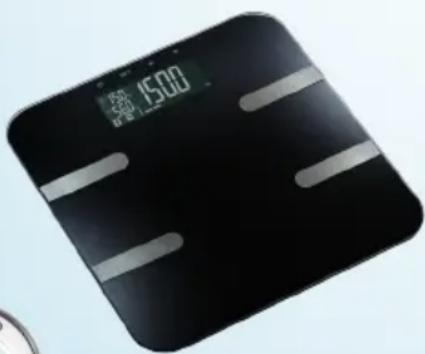

natural_image
White digital balance scale with a digital display showing 1500 units (no text or symbols on the device itself)English......06
Español ..... 23

Contents
Overview ....3
Use....4
Package contents/device parts......6
General information....7
Reading and storing the user manual ......7
Explanation of symbols 7
Safety 8
Proper use....8
Safety instructions....8
First use....11
Checking the body fat scale and package contents......11
Removing the protective foils and cleaning the body fat scale....11
Setting your personal data....12
Operation....12
Measuring your body weight.... 14
Performing a body analysis....14
Interpreting the measurements 14
Cleaning and maintenance.... 16
Changing the batteries....17
Storage 18
Troubleshooting....19
Technical data 20
Disposal....20
Disposing of the packaging 20
Disposing of the body fat scale.... 20

flowchart
graph TD
    A["Component 1"] --> B["Central Device"]
    C["Component 2"] --> B
    B --> D["Output"]
D

E

F

G

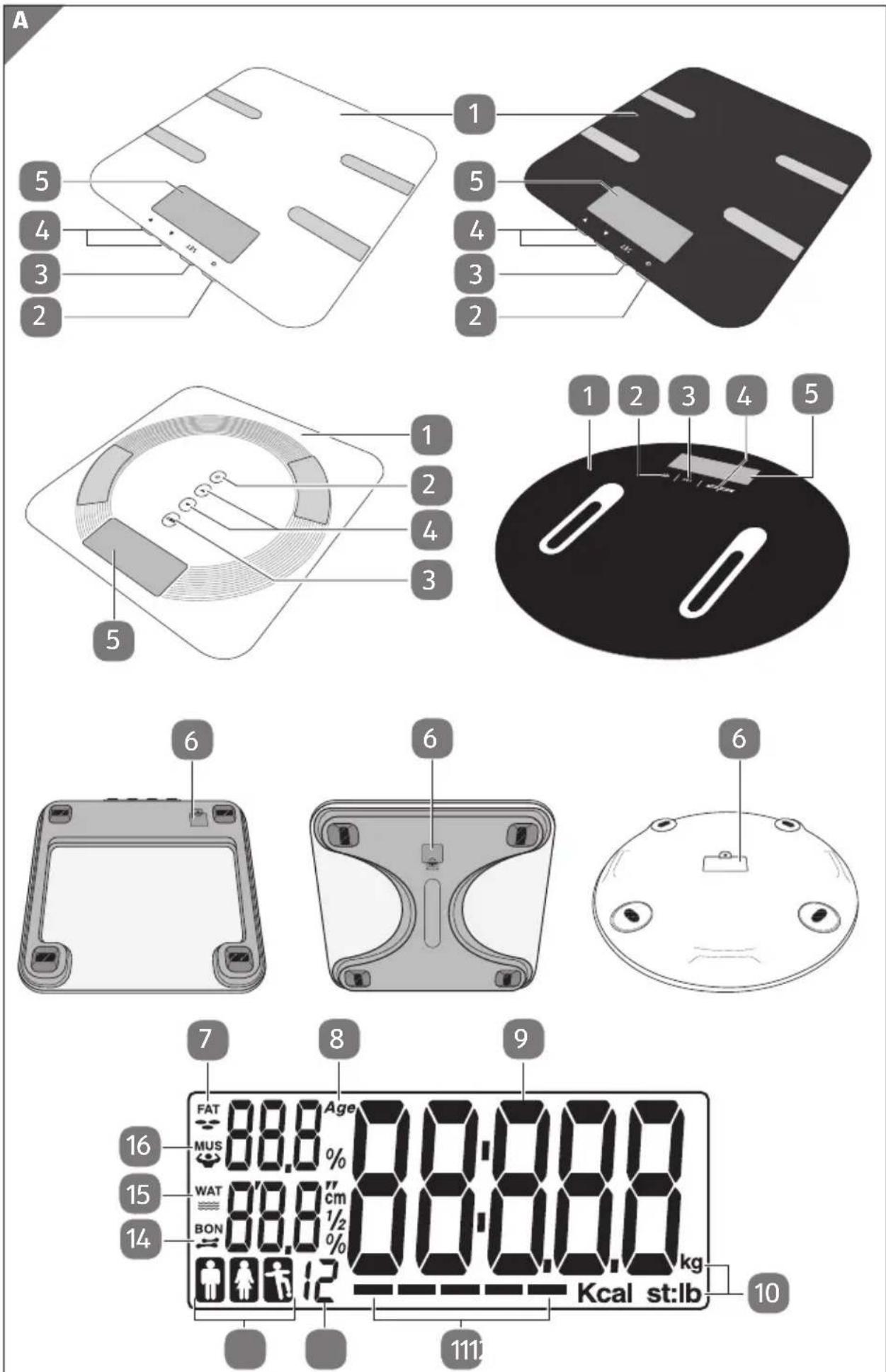
Package contents/device parts
1 Standing surface
2 On/Off button
3 "SET" button
4 Arrow buttons
5 Display
6 Battery compartment (back side)
7 Body fat percentage reading
8 Age reading
9 Weight/required calories reading
10 Unit of measure reading (kg/lb/st:lb)
11 Body analysis reading
12 Memory slot reading
13 Gender/athlete mode reading
14 Bone mass reading
15 Body water percentage reading
16 Muscle percentage reading
Notice:
Fig. A only shows three of the available models as examples.
Fig. B only shows one of the available models as an example.
General information
Reading and storing the user manual

This user manual accompanies this body fat scale and contains important information on setup and handling.
Before using the body fat scale, read the user guide carefully.
This particularly applies to the safety instructions. Failure to do so
may result in personal injury or damage to the body fat scale. When abroad, you must also observe country-specific guidelines and laws.
Store the user manual for further use. Make sure to include this user manual when passing the body fat scale on to third parties.
Explanation of symbols
The following symbols and signal words are used in this user manual, on the body fat scale or on the packaging.

WARNING!
This signal symbol/word designates a hazard with moderate risk, which may result in death or severe injury if not avoided.

CAUTION!
This signal symbol/word designates a hazard with low risk, which may result in minor or moderate injury if not avoided.
NOTICE!
This signal word warns of possible damage to property.

This symbol provides you with useful additional information on handling and use.
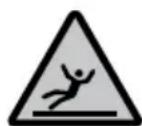
If you step onto the standing surface with wet feet or if the standing surface itself is wet, there is a risk of slipping.
Safety
Proper use
The body fat scale is exclusively designed for determining your body weight, the percentage of water and fat in your body as well as muscle and bone mass. It is exclusively intended for private use and is not suitable for commercial or medical application.
Only use the body fat scale as described in this instruction manual. Using it in any other way is deemed improper and may result in damage to property or even personal injury. The body fat scale is not a children's toy.
The manufacturer or vendor cannot be held liable for damages incurred through improper or incorrect use.
Safety instructions

WARNING!
Risk of injury!
If you use the body fat scale improperly, there is an increased risk of injury.
- Do not use the body fat scale if it exhibits visible damages or the battery has leaked.
- Do not open the housing; instead, have a qualified professional perform repairs. Contact a qualified repair shop for this. Liability and warranty claims are waived in the event of repairs performed by the user or incorrect operation.
- Only parts that comply with the original device data may be used for repairs. This body fat scale contains electrical and mechanical parts, which are essential for providing protection against sources of danger.
- Do not immerse the body fat scale in water or other liquids.
- Only use the body fat scale in indoor areas. Do not operate it in the rain.
- Never store the body fat scale so that there is a risk of falling into a bath tub or washbasin.
- Make sure that children do not insert any objects into the housing.
- Do not put more than 400 lbs (180 kg) onto the body fat scale. The safety glass could break and cause injuries.

WARNING!
Danger for children and persons with impaired physical, sensory or mental capacities (e.g., partially disabled persons, older persons with reduced physical and mental capacities) or lack of experience and knowledge (e.g., older children).
- If they are supervised or have been instructed on how to safely use the body fat scale and have understood the risks associated with operating it, this body fat scale may be used by children ages eight and over as well as persons with impaired physical, sensory or mental capacities, or those lacking experience and knowledge. Children may not play with the body fat scale. Cleaning and user maintenance must not be performed by unsupervised children.
- Keep children under the age of eight away from the body fat scale.
- Make sure that children do not play with the plastic wrapping. They may get caught in it when playing and suffocate.

WARNING!
Health hazard!
If children or animals swallow the batteries, this poses a serious health hazard.
- Store batteries so that they are not accessible for children and animals.
- Immediately dispose of used and leaky batteries in accordance with applicable regulations.
- If you suspect a battery to have been swallowed, seek immediate medical attention.

WARNING!
Risk of explosion!
If you do not handle the battery properly, there is an increased risk of explosion hazard.
- Do not expose the batteries to excessive heat such as from sunshine, fire and the like.
- Only replace the battery by a battery of the same type.
- Ensure that the batteries are inserted the right way round, i.e. observe the polarity (+ and -).
- Always replace all batteries in a battery compartment at the same time.
NOTICE!
Risk of damage!
If you do not handle the body fat scale properly, you may damage it.
- Place the body fat scale on a level, dry and sufficiently stable surface.
- Never expose the body fat scale to high temperatures (heaters etc.) or to the effects of the weather (rain etc.). Never fill the housing with liquid.
- Stop using the body fat scale if the housing exhibits cracks or breaks or is deformed. Only replace damaged parts with corresponding original spare parts.
- Avoid any deep discharge of the batteries as this may reduce their service life.
- Do not step on the standing surface with two or more persons.
- Do not step on the standing surface if you are wearing shoes. This may damage the glass surface of the body fat scale.
First use
Checking the body fat scale and package contents
NOTICE!
Risk of damage!
If you are not cautious when opening the packaging with a sharp knife or other pointed object, you may quickly damage the body fat scale.
- For this reason, be very careful when opening it.
- Take the body fat scale out of the packaging.
- Check to make sure that all parts are included (see Fig. A).
- Check whether the body fat scale or individual parts are damaged. If this is the case, do not use the body fat scale. Contact the manufacturer via the service address indicated on the warranty card.
Removing the protective foils and cleaning the body fat scale
Remove any leftover packaging from the body fat scale. Proceed as follows:
-
Pull the protective foil out of the battery compartment 6 by the tab to activate the body fat scale.
-
Clean the body fat scale (see chapter "Cleaning and maintenance").
Setting your personal data
Set the personal data in order to display the percentage of body water, body fat, muscle and bone mass. You do not have to set your personal data if you only want to weigh yourself.
You can save 12 different data records. They include:
- gender,
- height (cm/in),
- athlete mode,
- desired unit of measure (kilogram (kg), pound (lb) or stones (st:lb)).
- age,
Select the athlete mode if you are an athlete and perform more than 10 hours of intense exercise every week and have a resting pulse of under 60 beats per minute.
- Use the On/Off button 2 to switch the body fat scale on.
- Push the "SET" button 3.
The memory slot "1" will appear on the display 5.
- Use the arrow buttons 4 to select the desired memory slot and confirm your selection with the "SET" button.
- Then use the arrow buttons to make the desired selection when asked for the aforementioned personal data; confirm each selection with the "SET" button.
The body fat scale will then display the set personal data. The weight reading "0" will appear on the display (see Fig. E).
You can now use the body fat scale and all its functions.
Operation
WARNING!
Risk of slipping!
If the body fat scale or your feet are wet or you have applied lotion to them, you could slip on the body fat scale and injure yourself.
- Make sure that your feet are not wet and that you have not applied lotion to them.
- If there is water on the standing surface of the body fat scale, wipe it dry before you use the body fat scale.

CAUTION!
Risk of injury!
If you do not use the body fat scale properly, there is an increased risk of injury.
- Do not use the body fat scale
- if you are pregnant,
- if have a pacemaker,
- if you are ill or have a fever,
- if your legs are swollen or you have an edema,
• for children under 6 years of age.

Tips for the measurement process
- If you perform an analysis of your body directly after a meal, higher measurements may be displayed.
- Women may experience fluctuations in the measurements in connection with their menstrual cycle.
- If e.g. you have lost a significant amount of body water as the result of illness or physical exertion, the measurements may be falsified. Wait at least 8 hours before you perform the body analysis.
-
The measurements may vary or be falsified if you
-
suffer from osteoporosis,
• undergo dialysis treatment,
• take cardiovascular medications,
• have thick calluses on the soles of your feet,
• are an athlete or body builder,
• are under 17 years of age, - are an athlete and perform more than 10 hours of intense exercise on a weekly basis and have a resting pulse of less than 60 beats per minute. If this is the case, use the athlete mode.
- We recommend performing a body analysis in the morning after you get up. This will provide you with the most reliable measuring results.
- Do not perform a body analysis if you have just taken a bath. Otherwise, the body water percentage will be too high and the body fat percentage will be too low.
Measuring your body weight
You can use the body fat scale without having to enter personal data. In this case, only your body weight will be measured. To use the other functions, please enter your personal data (see chapter "Setting your personal data").
- Activate the body fat scale by stepping on the standing surface 1.
- Step off of the standing surface before the reading on the display blinks and "0" appears on the display.
- Set the desired unit of measure by pushing the "SET" button 3 until the desired unit of measure appears on the display 5.
You only have to perform this step the first time you use the body fat scale. Afterwards, the unit of measure will be automatically saved. - Step on the standing surface. Your weight in the previously set unit of measure will appear on the display (see Fig. D).
If you do not push any of the buttons for approx. 10 seconds, the body fat scale will automatically deactivate.
Performing a body analysis
- Use the On/Off button 2 to switch the body fat scale on.
- Wait until the weight reading "0" appears on the display 5.
- Use the arrow buttons 4 to select the desired memory slot (see Fig. E).
- Step barefoot onto the standing surface 1 and make sure your feet touch the metal plates on the standing surface.
Your body weight will appear on the display in the preset unit of measure. - If you remain on the standing surface, the readings for body water, body fat, required calories as well as muscle and bone mass will be calculated automatically and shown for approximately 3 seconds (see Fig. F and G).
The sum of the measurements may exceed 100 % as there is water stored in body fat and muscles. Body fat and muscle mass are also measured in the process.
The measurements will be performed several times. Then the body fat scale will automatically deactivate.
Interpreting the measurements
The following tables will help you to properly assess the measurements shown.
Body water

- If you lose 5% of your body water, your physical energy may decline by 20 to 30%. You should therefore drink at least 70.4 fl oz of water every day.
- Athletes generally have a higher percentage of body water.
- The percentage of body water decreases with age.
The adult human body is made up of approx. 60 % water.
If the percentage of body fat increases, the percentage of body water decreases. This is because body water is stored outside the fat cells of the body and fatty tissue generally has a very low percentage of water.
| Women (%) Men (%) | |
| Children > 58 > 60 | |
| Adults > 52 > 58 | |
| Athletes > 56 > 60 |
Body fat

- Consult a physician if your body fat is too high or too low.
A high or very high body fat percentage increases the risk of illnesses like diabetes, heart disease and high blood pressure. A low body fat percentage increases the risk of metabolic disorders. The subcutaneous fatty tissue and the body create fat stores to protect internal organs and safeguard metabolic functions.
- The body fat percentage increases with age.
- If you would like to reduce your weight, you must build more muscle at the same time. We need muscles in order to burn excess energy or fat stores.
Women
| Age (years) | Low body fat percentage (%) | Normal body fat percentage (%) | Elevated body fat percentage (%) | Excessively elevated body fat percentage (%) |
| 6 to 12 < 7 | 7 to 19 19 to 25 | >25 | ||
| 13 to 19 | <20 | 20 to 31 | 31 to 37 | >37 |
| 20 to 39 | <21 | 21 to 32 | 32 to 38 | >38 |
| 40 to 59 | <23 | 23 to 34 | 34 to 40 | >40 |
| 60 to 79 | <25 | 25 to 36 | 36 to 42 | >42 |
| Athlete | 12 to 25 |
Men
| Age (years) | Low body fat percentage (%) | Normal body fat percentage (%) | Elevated body fat percentage (%) | Excessively elevated body fat percentage (%) |
| 6 to 12 < 7 | 7 to 18 18 to 25 | >25 | ||
| 13 to 19 < | 8 8 to 19 19 to 25 | >25 | ||
| 20 to 39 < | 9 9 to 20 20 to | 26 >26 | ||
| 40 to 59 < | 11 11 to 22 22 to | 28 >28 | ||
| 60 to 79 | <13 | 13 to 24 | 24 to 30 | >30 |
| Athlete | 3 to 15 |
Muscle mass
Muscles are the basis for our physical fitness and ensure that a certain body temperature level is maintained.
Energy turnover takes place in the muscles for the most part.
| Age (years) | Women (%) | Men (%) |
| 6 to 12 | >36 | >40 |
| 13 to 79 | >30 | >34 |
| Athlete | >38 | >42 |
Body analysis
One to five bars will appear under the weight reading on the display.
| Underweight | |
| Slight underweight | |
| Normal weight | |
| Overweight | |
| Excessive overweight |
Cleaning and maintenance
Clean and maintain the body fat scale at regular intervals and as needed.
NOTICE!
Risk of damage!
If you do not clean the body fat scale properly, you may damage it.
- Do not use any aggressive cleaners, sharp or metallic cleaning utensils such as knives, hard putty knives or similar. They could damage the surfaces.
- Make sure that no water penetrates the housing.
- Never attempt to clean the body fat scale by immersing it in water and do not use a steam cleaner to clean it.
-
Do not place the body fat scale in the dishwasher.
-
Use a damp cloth to wipe off the body fat scale.
-
Dry off the body fat scale thoroughly.
Changing the batteries
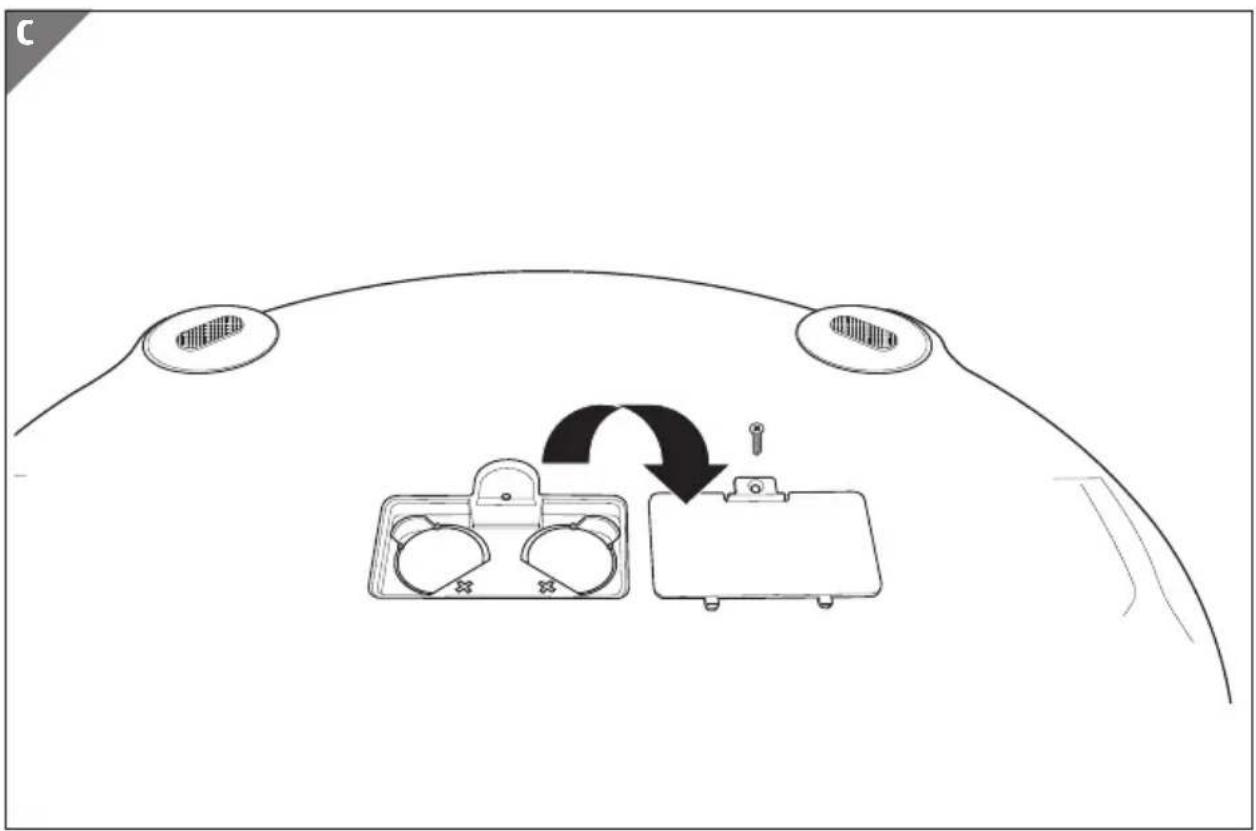
If the message “Lo” appears on the display, replace the inserted battery (button cell) as follows (see Fig. B):
- Carefully turn the body fat scale over.
- Use a Philips screwdriver to loosen the screw on the battery compartment cover 6.
- Take the cover of the battery compartment off.
- Take the inserted battery out of the compartment and dispose of it in accordance with applicable regulations (see chapter "Disposing of the body fat scale").
- Insert a new battery of the same type in the battery compartment. Make sure the polarity is correct ("+" side is facing up).
- Put the cover back on the battery compartment so that it locks into place.
- Use the Philips screwdriver and tighten the screw on the cover of the battery compartment.
You have successfully replaced the battery.

The round version requires two batteries and the battery compartment cover does not contain a screw (see Fig. C).
Storage
CAUTION!
Risk of leaked battery liquid and risk of damage!
If you store the body fat scale with the battery inserted for a prolonged period of time, the battery may leak and permanently damage the body fat scale. The battery liquid (electrolyte) is corrosive.
- Store the battery separately if you do not use the body fat scale for a prolonged period of time. Store the battery so that it is not accessible for children.
- Do not remove the battery liquid with bare hands. Do not allow battery liquid to come into contact with skin, eyes and mucus membranes. Use conventional rinsing gloves. If, however, your skin does come into contact with battery liquid, immediately wash your hands with plenty of water and, if necessary, consult a physician.
-
Wipe up the leaked battery liquid with a damp cloth. You can wash the used cloth and reuse it or dispose of it with household garbage.
-
Use the On/Off button 2 to switch off the body fat scale.
- Clean the body fat scale (see chapter "Cleaning and maintenance").
- Take the inserted battery out of the battery compartment 6 and store it in accordance with applicable regulations.
- Store the body fat scale in a dry, clean area. We recommend using the original packaging for this purpose.
Troubleshooting
NOTICE!
Risk of damage!
If you do not use the body fat scale properly, you may damage it.
- Do not open the housing; instead, have a qualified professional perform repairs. Contact a qualified repair shop for this. Liability and warranty claims are waived in the event of repairs performed by the user or incorrect operation.
Some malfunctions may be caused by minor faults, which you can resolve yourself. Follow the instructions in the following table for this.
If it is not possible to rectify the fault in this way, contact our customer service team. Do not repair the body fat scale yourself.
| Problem Possible cause Troubleshooting | ||
| The body fat scale does not turn on. | The battery was incorrectly inserted or not inserted at all or the battery is empty. | Change the battery (see chapter “Cleaning and maintenance”). |
| The protective foil on the battery compartment has not yet been removed. | Pull the strap on the protective foil to remove it from the battery compartment 6. | |
| The settings cannot be changed. | If there is weight on the standing surface, you cannot make any settings. | Remove the weight from the standing surface 1. |
Technical data
Model: 95908
Measurable percentage: Body fat percentage: 3 to 50 %
Body water percentage: 25 to 75 %
Muscle mass: 25 to 75 %
Bone mass: 1 to 15 %
Age limit: 6 to 100 years
Height limit: 31.5 in to 87.6 in (80 cm to 220 cm)
Weight
- rectangular version: approx. 3.5 lbs. (1.6 kg)
- round version: approx. 3.5 lbs. (1.6 kg)
Dimensions
- rectangular version: approx. 12.2 × 11.8 in (31 × 30 cm)
- round version: approx. 13 in (33 cm)
Battery type
- rectangular version: 1× Lithium button cell battery (CR 2032), 3 V, direct voltage
- round version: 2× Lithium button cell battery (CR 2032), 3 V, direct voltage
Max. load: 180 kg / 400 lbs.
Measurement accuracy: Measurement of the body weight in 100 g / 0.2 lbs;
Percentage of body water, body fat and muscle mass are measured in 0.1% increments
Memory slots: 12
Automatic activation: Yes
Product code: 95908
Disposal
Disposing of the packaging
- Sort the packaging before you dispose of it. Dispose of paperboard and cardboard with the recycled paper service and wrappings with the appropriate collection service.
Disposing of the body fat scale
- Should the body fat scale no longer be capable of being used at some point in time, dispose of it in accordance with the regulations in force in your city or state.
- Please ensure your recycling information applies to local regulations and the EPA recommendations (www.epa.gov).
Batteries and rechargeable batteries may not be disposed of with household waste!
As the end user you are required by law to bring all batteries and rechargeable batteries, regardless whether they contain harmful substances* or not, to a collection point run by the city, county, or state, or to a retailer, so that they can be disposed of in an environmentally friendly manner.
*labeled with: Cd = cadmium, Hg = mercury, Pb = lead
Contenido
Conjunto....3
Uso....4
- Contents
- Package contents/device parts
- Notice:
- General information
- Reading and storing the user manual
- Explanation of symbols
- Safety
- Proper use
- Safety instructions
- WARNING!
- Risk of injury!
- Danger for children and persons with impaired physical, sensory or mental capacities (e.g., partially disabled persons, older persons with reduced physical and mental capacities) or lack of experience and knowledge (e.g., older children).
- Health hazard!
- Risk of explosion!
- NOTICE!
- Risk of damage!
- First use
- Checking the body fat scale and package contents
- Removing the protective foils and cleaning the body fat scale
- Setting your personal data
- Operation
- Risk of slipping!
- CAUTION!
- Tips for the measurement process
- Measuring your body weight
- Performing a body analysis
- Interpreting the measurements
- Body water
- Body fat
- Muscle mass
- Body analysis
- Cleaning and maintenance
- Changing the batteries
- Storage
- Risk of leaked battery liquid and risk of damage!
- Troubleshooting
- Technical data
- Disposal
- Disposing of the packaging
- Disposing of the body fat scale
- Batteries and rechargeable batteries may not be disposed of with household waste!
- Contenido
Brand : Visage
Model : Body Fat Scale 95908
Category : Body Balance