
BX500CI - Server APC - Kostenlose Bedienungsanleitung
Finden Sie kostenlos die Bedienungsanleitung des Geräts BX500CI APC als PDF.


| Produkttyp | USV (Unterbrechungsfreie Stromversorgung) |
| Modell | BX500CI |
| Marke | APC |
| Eingangsspannung | 230 V AC (nominal) |
| Eingangsfrequenz | 45-65 Hz |
| Ausgangsleistung | 500 VA / 300 W |
| Ausgangsspannung bei Batteriebetrieb | 230 V AC |
| Transferzeit | 6 ms (50 Hz), 5 ms (60 Hz) |
| Überspannungsschutz | 273 Joule |
| Batterietyp | Versiegelte Blei-Säure-Batterie |
| Batterielebensdauer | 2-5 Jahre |
| Ladezeit | 10 Stunden |
| Abmessungen (H x B x T) | 18,55 cm x 11,5 cm x 21,3 cm |
| Gewicht | 5,1 kg |
| Garantie | 2 Jahre |
| Hersteller | Schneider Electric |
| Statusanzeigen | LED und akustische Alarme |
| Automatische Spannungsregelung | Ja |
| Ersatzteile | Batterie nicht vom Benutzer austauschbar, Service erforderlich |
| Sicherheitshinweise | Vor direkter Sonneneinstrahlung, übermäßiger Hitze und Feuchtigkeit schützen |
Häufig gestellte Fragen - BX500CI APC
Benutzerfragen zu BX500CI APC
0 Frage zu diesem Gerät. Beantworten Sie die, die Sie kennen, oder stellen Sie Ihre eigene.
Eine neue Frage zu diesem Gerät stellen
Laden Sie die Anleitung für Ihr Server kostenlos im PDF-Format! Finden Sie Ihr Handbuch BX500CI - APC und nehmen Sie Ihr elektronisches Gerät wieder in die Hand. Auf dieser Seite sind alle Dokumente veröffentlicht, die für die Verwendung Ihres Geräts notwendig sind. BX500CI von der Marke APC.
BEDIENUNGSANLEITUNG BX500CI APC
by Schneider Electric

Place and Power On

Place the Back-UPS to avoid:
- Direct sunlight
- Excessive heat
- Excessive moisture

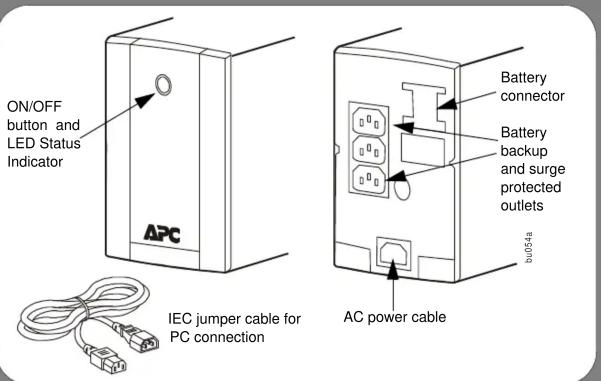
Connect the battery by pulling the battery connector handle down, and then pushing it into the unit.


Plug the Back-UPS BX500CI power cord directly into a wall outlet; not into a surge protector or power strip.

Press the ON/OFF button to turn on the unit.
The green LED status indicator confirms that the Back-UPS is on and ready to provide protection.
The Back-UPS should charge for at least 10 hours to ensure sufficient runtime. The unit is being charged whenever it is connected to AC power, whether the unit is turned ON or OFF.

Status Indicators
| LED Status Indicator | Audible Alarm | Condition |
| On | Off | On-line- UPS is supplying conditioned AC power to the load |
| On (Off during 4 beeps) | 4 beeps repeated every 30 seconds | On-Battery- Back-UPS is supplying battery power |
| Flashing | Rapid Beeping (every 1/2 second) | Low Battery Warning- The UPS has 1.5 minutes of remaining battery power |
| Flashing | Constant tone | Bad Battery Detected- Battery needs to be charged, or is at end of life. |
| Off | Short beep every 4 seconds | Low Battery Shutdown- During On Battery operation the battery power was almost completely exhausted |
| Off | Constant Tone | On Battery Overload- Connected equipment requires more power than provided by the Back-UPS battery. |
| On | Constant Tone | On Line Overload- The power drawn by the connected equipment exceeds the power capacity of the battery backup |
| Flashing | Chirp every 2 seconds | Charger Warning - Back-UPS has experienced an internal problem, but continues to power the load. Contact Schneider Electric IT (SEIT) Technical Support. |
| Off | Constant Tone | Charger Fault- Back-UPS has an internal problem, and is no longer powering the load. Contact SEIT Technical Support |
Troubleshooting and Service
- Consult the Troubleshooting from the APC by Schneider Electric Web site, www.apc.com.
- If the problem persists, contact Schneider Electric IT (SEIT) Customer Support through the APC by Schneider Electric Web site, www.apc.com.
a. Note the model number and serial number and the date of purchase. The model and serial numbers are located on the rear panel of the unit and are available through the LCD display on select models.
b. Call SEIT Customer Support and a technician will attempt to solve the problem over the phone. If this is not possible, the technician will issue a Returned Material Authorization Number (RMA#).
c. If the unit is under warranty, the repairs are free.
d. Service procedures and returns may vary internationally. Refer to the APC by Schneider Electric Web site for country specific instructions.
- Prepare to troubleshoot the problem over the phone. If this is not successful, and the unit is still under warranty, the Technical Support Representative will provide all necessary information to return the unit for replacement.

Adjust Transfer Voltage and Sensitivity Settings
Automatic Voltage Regulation boosts the AC voltage when it drops below safe levels. This allows the equipment plugged into the unit to operate during low voltage conditions, conserving the battery power in the event of a power cut.
The Back-UPS will switch to battery power if the input voltage level becomes too low for the Automatic Voltage Regulation to compensate, or if the AC power is distorted.
If the Back-UPS switches to battery power too frequently or too infrequently, adjust the transfer voltage and sensitivity settings:
- Ensure the Back-UPS is off. Plug it into AC power.
- Press and hold the ON/OFF button until the LED repeatedly flashes. The unit is now in Program Mode.
- Release the button. The LED will flash once, twice, or three times per second, indicating the current setting.
- Press the ON/OFF button within two seconds to change the setting. Each time the button is pressed, the LED will flash at a different rate: once, twice, or three times per second, indicating the new setting. Continue pressing the button until the desired setting is reached. If the button is not pressed within five seconds, the Back-UPS will exit the Program Mode.
- To exit Program Mode, release the button and wait for the LED to stop flashing.
Transfer Voltage and Sensitivity Settings
| LED Flashing | Voltage Sensitivity Setting | Input Voltage Range (for AC Operation) | Usage |
| Once per second | Low | 155 - 280 | The Back-UPS will switch to battery power less often. Use with equipment that is not sensitive to low or high level voltage levels or minor voltage waveform distortions. |
| Twice per second | Medium (factory default) | 160 -280 | Default, use in normal conditions. |
| Three times per second | High | 165 - 270 | The Back-UPS will switch to battery power during any small fluctuation in voltage. Use with equipment that is sensitive to low or high level voltage levels or minor voltage waveform distortions. |

Specifications
| Input Voltage | / Frequency 230 VAC nominal / 45-65 Hz | |
| Brownout Transfer / Over-voltage Transfer | 160 ±8% VAC, typical / 280 VAC, typical | |
| Output UPS C | Capacity (total) 500 VA / 300 W | |
| Voltage On Battery 230 Vac rms | ||
| Frequency - On Battery 50 Hz, 60 Hz ±1 Hz | ||
| Transfer Time 50 Hz: 6ms typical, 10ms maximum 60 Hz: 5ms typical, 8ms maximum | ||
| Protection and Filter | AC Surge Protection 273 joules | |
| AC Input | Resettable circuit breaker | |
| Battery | Type (maintenance-free) | Sealed, lead-acid battery |
| Average Life | 2 - 5 years depending on the number of discharge cycles and environmental temperature | |
| Typical Recharge Time | 10 Hours | |
| Physical | Net Weight | 5.1 kg |
| Dimensions (H x W x D) | 18.55 cm x 11.5 cm x 21.3 cm | |
Battery Replacement
The battery in the Back-UPS BX500CI is not user-replaceable. Contact SEIT Technical Support for a list of authorized service centers near you.
Warranty
Register your product on-line. http://warranty.apc.com
The standard warranty is two (2) years from the date of purchase. SEIT standard procedure is to replace the original unit with a factory reconditioned unit. Customers who must have the original unit back due to the assignment of asset tags and set depreciation schedules must declare such a need at first contact with an SEIT Technical Support representative. SEIT will ship the replacement unit once the defective unit has been received by the repair department, or cross-ship upon the receipt of a valid credit card number. The customer pays for shipping the unit to SEIT. SEIT pays ground freight transportation costs to ship the replacement unit to the customer.
APC by Schneider Electric IT Customer Support Worldwide
For country specific customer support, go to the APC by Schneider Electric Web site, www.apc.com.



Marke : APC
Modell : BX500CI
Kategorie : Server