
NV-EX3B - Camcorder PANASONIC - Kostenlose Bedienungsanleitung
Finden Sie kostenlos die Bedienungsanleitung des Geräts NV-EX3B PANASONIC als PDF.


| Produkttyp | Camcorder (Digitalkamera-Videorekorder) |
| Marke | Panasonic |
| Modell | NV-EX3B |
| Abmessungen (B x H x T) | ca. 92 x 86 x 168 mm (ohne Objektivring) |
| Gewicht | ca. 580 g (ohne Zubehör und Kassette) |
| Stromversorgung | Lithium-Ionen-Akku (7,2 V), Netzteil (Gleichstrom 7,2 V) |
| Bildsensor | 1/4-Zoll-CCD, ca. 680.000 Pixel |
| Objektiv | Panasonic, 10-fach optischer Zoom, 30-fach digitaler Zoom |
| Bildschirm | 2,5-Zoll-LCD-Farbmonitor |
| Sucher | Elektronischer Sucher (EKT) mit Farbdisplay |
| Kassettenformat | Mini-DV (Digital Video Cassette) |
| Videosystem | PAL/CCIR (Optionales NTSC via Einstellung) |
| Fokus | Autofokus (AF) / Manuell (MF) |
| Belichtung | Auto (AE) / Manuell (ME) mit Programmautomatiken |
| Weissabgleich | Auto (AWB) / Manuell (MWB) mit Speicher |
| Bildstabilisierung | Elektronische Bildstabilisierung (EIS) |
| Speicherkarte | SD/MMC-Karte (für Standbilder) |
| Anschlüsse | USB, FireWire (DV-Buchse), AV (Composite, S-Video), Kopfhörer, Mikrofon |
| Mikrofon | Integriertes Mikrofon (Stereo) |
| Wartung und Reinigung | Reinigen Sie das Objektiv mit einem weichen, trockenen Tuch; LCD-Schutzfolie verwenden; Kontakte regelmäßig prüfen |
| Sicherheitshinweise | Nicht in direkter Sonne lagern; Akku nicht kurzschließen; Gerät vor Feuchtigkeit schützen |
| Ersatzteile und Reparatur | Ersatzakkus und Netzteil erhältlich; Service nur durch autorisierte Panasonic-Werkstätten |
Häufig gestellte Fragen - NV-EX3B PANASONIC
Benutzerfragen zu NV-EX3B PANASONIC
0 Frage zu diesem Gerät. Beantworten Sie die, die Sie kennen, oder stellen Sie Ihre eigene.
Eine neue Frage zu diesem Gerät stellen
Laden Sie die Anleitung für Ihr Camcorder kostenlos im PDF-Format! Finden Sie Ihr Handbuch NV-EX3B - PANASONIC und nehmen Sie Ihr elektronisches Gerät wieder in die Hand. Auf dieser Seite sind alle Dokumente veröffentlicht, die für die Verwendung Ihres Geräts notwendig sind. NV-EX3B von der Marke PANASONIC.
BEDIENUNGSANLEITUNG NV-EX3B PANASONIC
Panasonic
Digital Video Camera
Operating Instructions
NV-EX3B
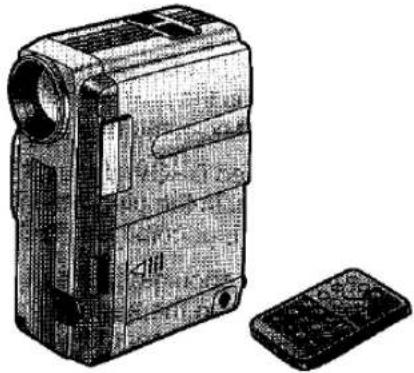
natural_image
Illustration of a vintage digital camera with a flat case and a rectangular device beside it (no visible text or symbols)Model No. NV-EX3B
natural_image
Interior view of a formal dining area with ornate metal furniture and decorative wall panels (no visible text or symbols)Mini DY PAL
Before use, please read these instructions completely.
Dear Customer, We would like to take this opportunity to thank you for purchasing this Panasonic Movie Camera. Please read these Operating Instructions carefully and keep them handy for future reference.
Information for Your Safety
Movie Camera
●The rating plate is on the bottom side of the Movie Camera.
AC Adaptor
●The rating plate is on the bottom side of the AC Adaptor.
- As this AC Adaptor gets hot during use, operate it in a well-ventilated place; do not use it in a tight enclosure.
Caution for AC Mains Lead
For your safety, please read the following text carefully.
This appliance is supplied with a moulded three-pin mains plug for your safety and convenience.
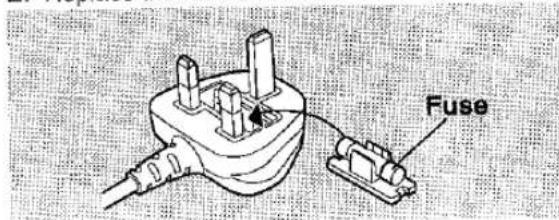
A 5-ampere fuse is fitted in this plug. Should the fuse need to be replaced, please ensure that the replacement fuse has a rating of 5 amperes and it is approved by ASTA or BSI to BS1362.
Check for the ASTA mark Ⓜ or the BSI mark ⚙ on the body of the fuse.
If the plug contains a removable fuse cover, you must ensure that it is refitted when the fuse is replaced.
If you lose the fuse cover, the plug must not be used until a replacement cover is obtained.
A replacement fuse cover can be purchased from your local Panasonic Dealer.
IF THE FITTED MOULDED PLUG IS UNSUITABLE FOR THE SOCKET OUTLET IN YOUR HOME, THE FUSE SHOULD BE REMOVED AND THE PLUG CUT OFF AND DISPOSED OF SAFELY.
THERE IS A DANGER OF SEVERE ELECTRICAL SHOCK IF THE CUT OFF PLUG IS INSERTED INTO A 13-AMPERE SOCKET.
If a new plug is to be fitted, please follow the wiring code described below.
If in any doubt, please consult a qualified electrician.
IMPORTANT
The wires in this mains lead are coloured in accordance with the following code:
Blue: Neutral
Brown: Live
As the colours of the wires in the mains lead of this appliance may not correspond with the coloured markings identifying the terminals in your plug, proceed as follows:
The wire which is coloured BLUE must be connected to the terminal in the plug which is marked with the letter N or coloured BLACK.
The wire which is coloured BROWN must be connected to the terminal in the plug which is marked with the letter L or coloured RED.
Under no circumstances should either of these wires be connected to the earth terminal of the three pin plug, marked with the letter E or the Earth Symbol .
Before Use
Remove the Connector Cover as follows.
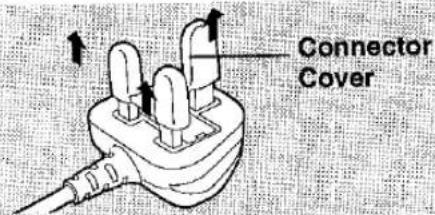
■ How to replace the Fuse
- Remove the Fuse Cover with a screwdriver.
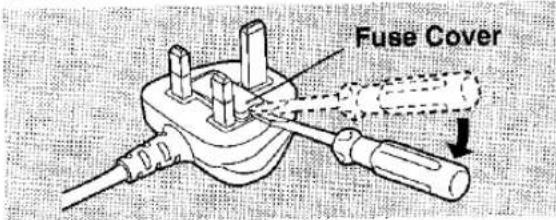
- Replace the fuse and attach the Fuse Cover.
WARNING
To reduce the risk of fire or shock hazard and annoying interference, use only the recommended accessories and do not expose this equipment to rain or moisture. Do not remove the cover (or back); there are no user serviceable parts inside. Refer servicing to qualified service personnel.
■ Carefully observe copyright laws. Recording of pre-recorded tapes or discs or other published or broadcast material for purposes other than your own private use may infringe copyright laws. Even for the purpose of private use, recording of certain material may be restricted.
Contents—Basic Operations
Check List for the Standard Accessories ..... 3
Controls and Functions 4
The 3 Types of Power Supply.... 6
1) Supplying Power from an AC Mains Socket 6
2) Supplying Power from the Cigarette Lighter Socket in a Car 6
3) Supplying Power with the Battery 8
Inserting the Cassette 10
Using the Viewfinder.... 12
Using the LCD Monitor 12
Attaching the Hand Strap 14
Attaching the Hand Grip 14
Recording (Filming) 16
Checking If the Picture Is Recorded ..... 18
Recording Backlit Scenes.... 18
Recording Yourself 20
Focusing on the Subject Manually 20
Enlarging Your Subject or Widening the Recording Angle 22
Using the Movie Camera as a Digital Still Camera 22
Recording in the Cinema Mode 26
Recording with Minimised Camera Shake .... 26
Viewing the Just Recorded Scenes on the Movie Camera 28
Searching for a Scene That You Want to Play Back 28
Playing Back in Slow Motion.... 30
Playing Back Still Pictures and Advancing Them One by One.... 30
Playing Back on a TV 32
After Use 32
Contents—Advanced Operations
Viewing Recorded Scenes During Recording Pause 34
Searching for the End of the Recorded Part on a Cassette 34
Searching for the Beginning of Recorded Scenes Marked with Index Signal 36
Starting to Record with Gradually Appearing Picture and Sound.... 38
Ending the Recording of a Scene with Gradually Disappearing Picture and Sound 38
Recording in Special Situations 40
Recording with Special Effects 42
Recording with Natural Colours 52
Adjusting the White Balance Manually ..... 52
Adjusting the Shutter Speed Manually ..... 54
Adjusting the Iris (F Number) Manually ..... 54
Playing Back with Special Effects.... 56
Enlarging the Playback Picture 66
Adding New Sound on a Recorded Cassette 68
Remote Controller....70
Contents—Options/Editing
Copying onto an S-VHS (or VHS) Cassette ... 74
Copying with the Help of an Editing Controller....76
Using the Movie Camera with a Video Printer 78
Using the Movie Camera with a Computer .... 80
Optional Accessories 81
Contents—Miscellaneous/Care of Unit
Using the Menu Screen 82
Menu Functions 84
Adjusting the LCD Monitor/Viewfinder 89
Setting the Date and Time 90
Cautions for Use 92
Glossary 96
Indications on the LCD Monitor/in the Viewfinder 100
Specifications 103
Before Requesting Service (Problems & Solutions) 104
Index....106
Check List for the Standard Accessories
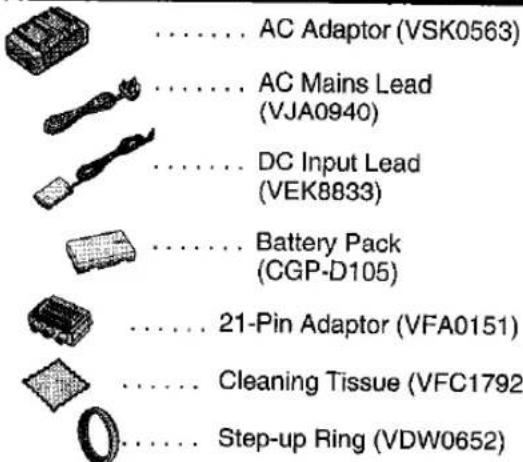
- For purchasing additional Battery Packs, see the list of optional accessories on p. 81.
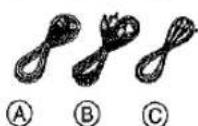
Ⓐ AV Cable Phono-M3 (VJA1028)
⑧ AV Cable Phono-Phono (VJA0788)
© S-Video Cable (VJA0658)
![Headphone Conversion Adaptor (VFA0292) Hand Strap (VYC0777) Lens Cap Holder for Hand Strap (VGQ5094) Hand Grip (VYK9230) Remote Controller (VEQ2289) Button-Type Battery (CR2025) Output Terminal Box [AV ONE TOUCH STATION] (VSK0568)](/content/2026/05/794594/images/3060d5942003880945c8f82ca93e6f007320a0275ebca9791bfdeb2b39c4d16c.jpg)
Controls and Functions
For more details, see the pages indicated in brackets.
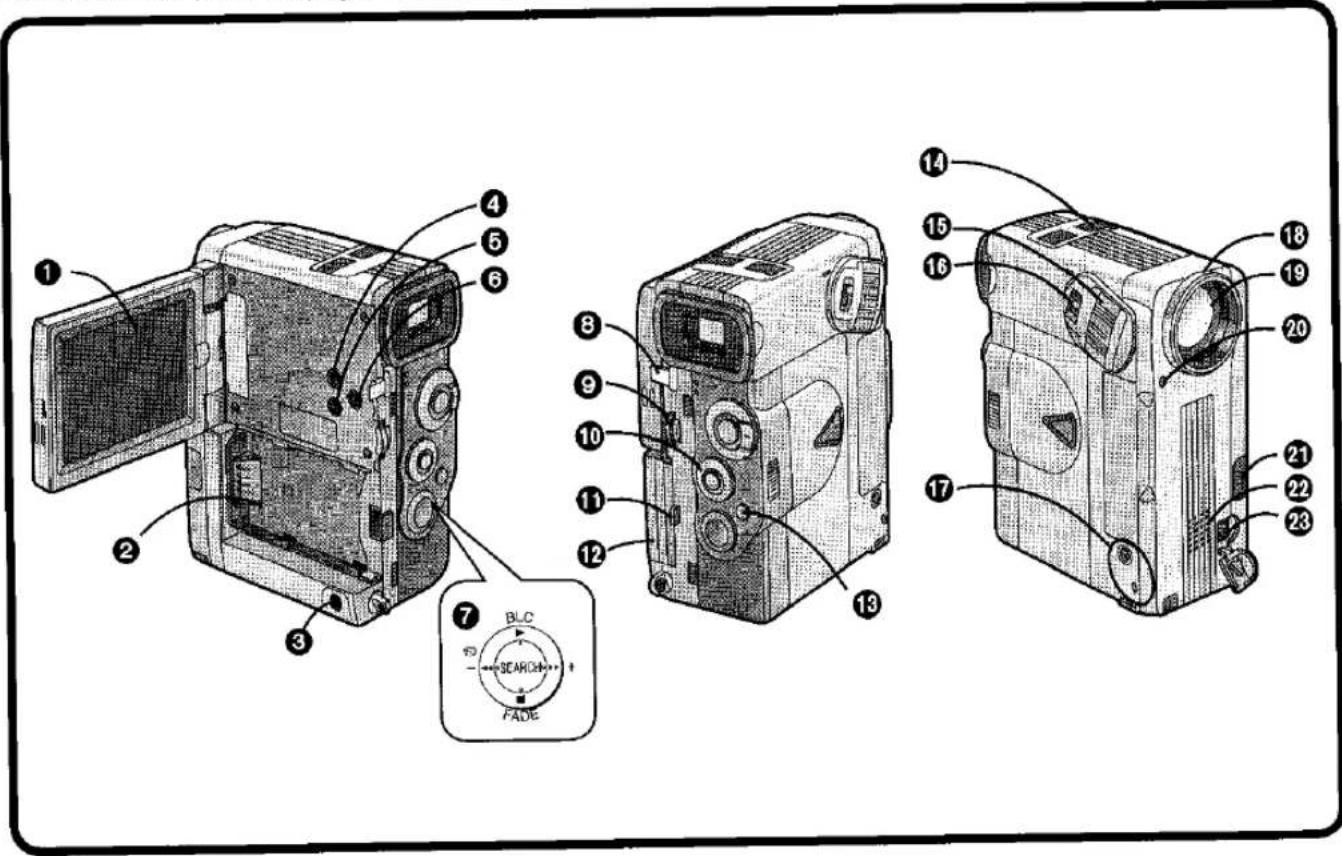
① LCD Monitor (p. 12, 95)
Due to limitations in LCD production technology, there may be some tiny bright or dark spots on the LCD Monitor screen. However, this is not a malfunction and does not affect the recorded picture.
② Battery Holder (p. 6, 8)
③ Audio-Video Output Socket [AV OUT] (p. 32, 74, 95)
When a cable is connected to this socket, the Movie Camera's built-in speaker is turned off.
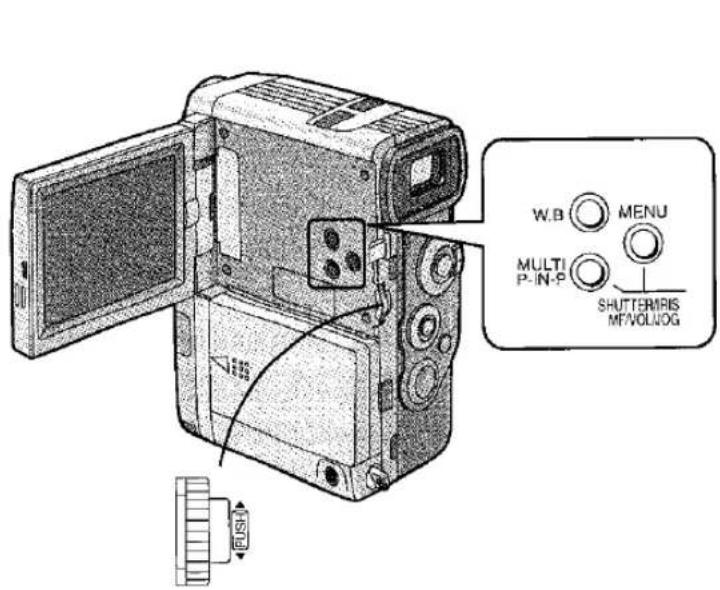
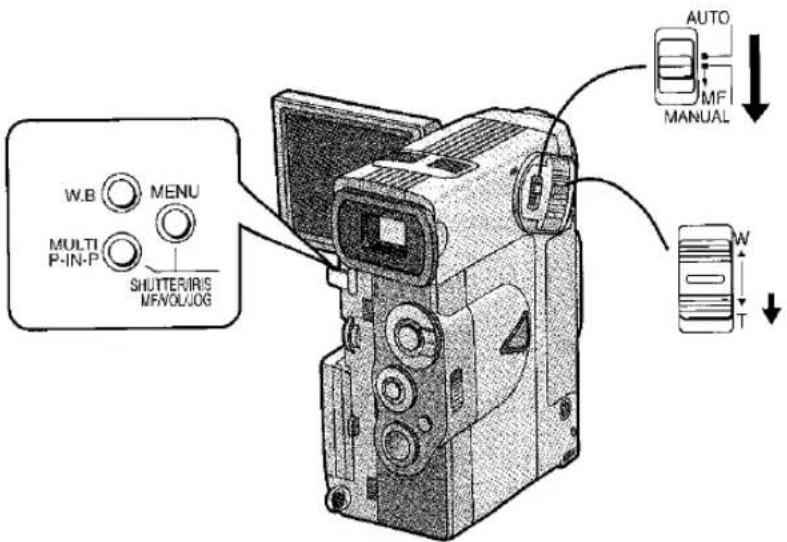
④ White Balance Button [W.B] (p. 52)
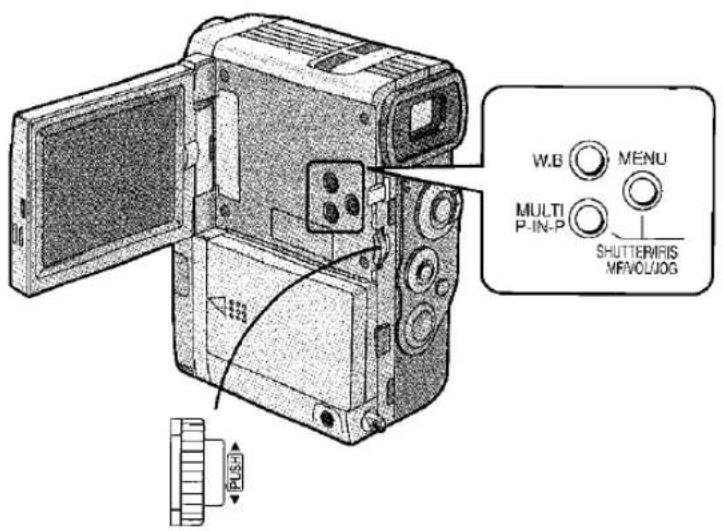
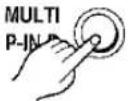
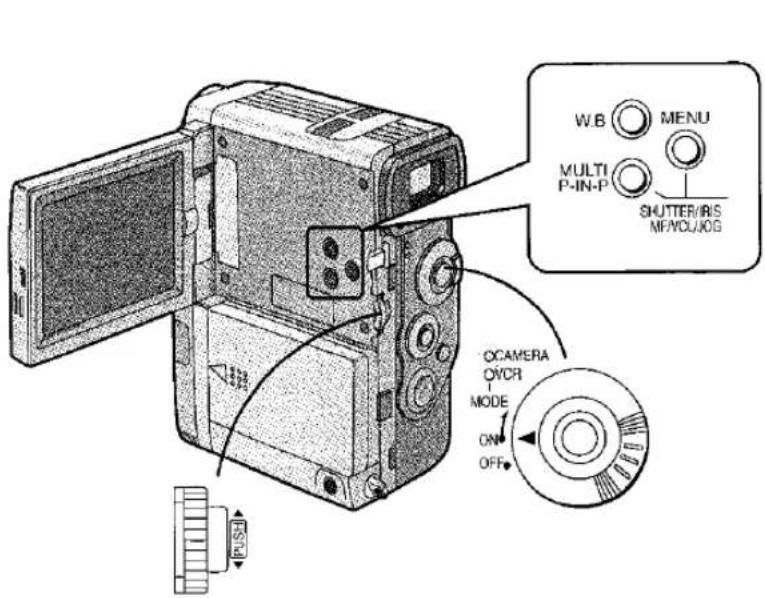
⑤ Multi-Picture Button [MULTI] (p. 44, 58)
Picture-in-Picture Button [P-IN-P] (p. 48)
⑥ Menu Button [MENU] (p. 82)
⑦ Operation Button
The functions indicated in white letters can be used in the Camera Mode, and the functions indicated in green letters can be used in the VCR Mode by pressing the corresponding part (top, bottom, left, right) of the Operation Button.
Backlight Button [BLC] (p. 18)
Play Button [▶] (p. 28)
Reverse Search Button [-SEARCH] (p. 34)
Rewind/Review Button [◀◀] (p. 28)
Recording Check Button [☐] (p. 18)
Forward Search Button [SEARCH+] (p. 34)
Fast Forward/Cue Button [▶▶] (p. 28)
Fade Button [FADE] (p. 38)
Stop Button [■] (p. 28)
⑧ LCD Monitor Lock (p. 12)
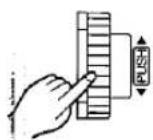
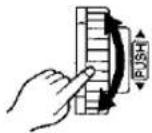
⑨ Multi-Function Dial [PUSH] (p. 20, 28, 31, 54, 82)
⑩ Photoshot Button [PHOTO SHOT] (p. 22)
⑪ Battery Eject Lever [BATT. EJECT] (p. 8)
⑫ Battery Holder Cover
When attaching the Battery or connecting the DC Input Lead, remove this cover.
⑬ Pause Button [III]
14 Microphone (built-in, stereo)
⑮ Zoom Lever [W/T] (p. 22)
16 Mode Selector Switch [AUTO/MANUAL/MF] (p. 16, 20, 40, 52, 54)
⑰ Hand Grip Screw Hole and Pin Hole (p. 14)
18 Lens Hood
19 Lens
20 Recording Indicating (Tally) Lamp (p. 17)
② White Balance Sensor (p. 97) Remote Control Sensor (p. 72)
22 Speaker
23 DV Terminal (i.LINK) [i.]
To output digital signals. Connect it to digital video equipment. "i.LINK" is the name of the connector in accordance with the International Standard IEEE1394-1995.
" i " is the logo marked on products conforming with the "i.LINK" specifications.
Inputting digital signals into this Movie Camera is not possible.
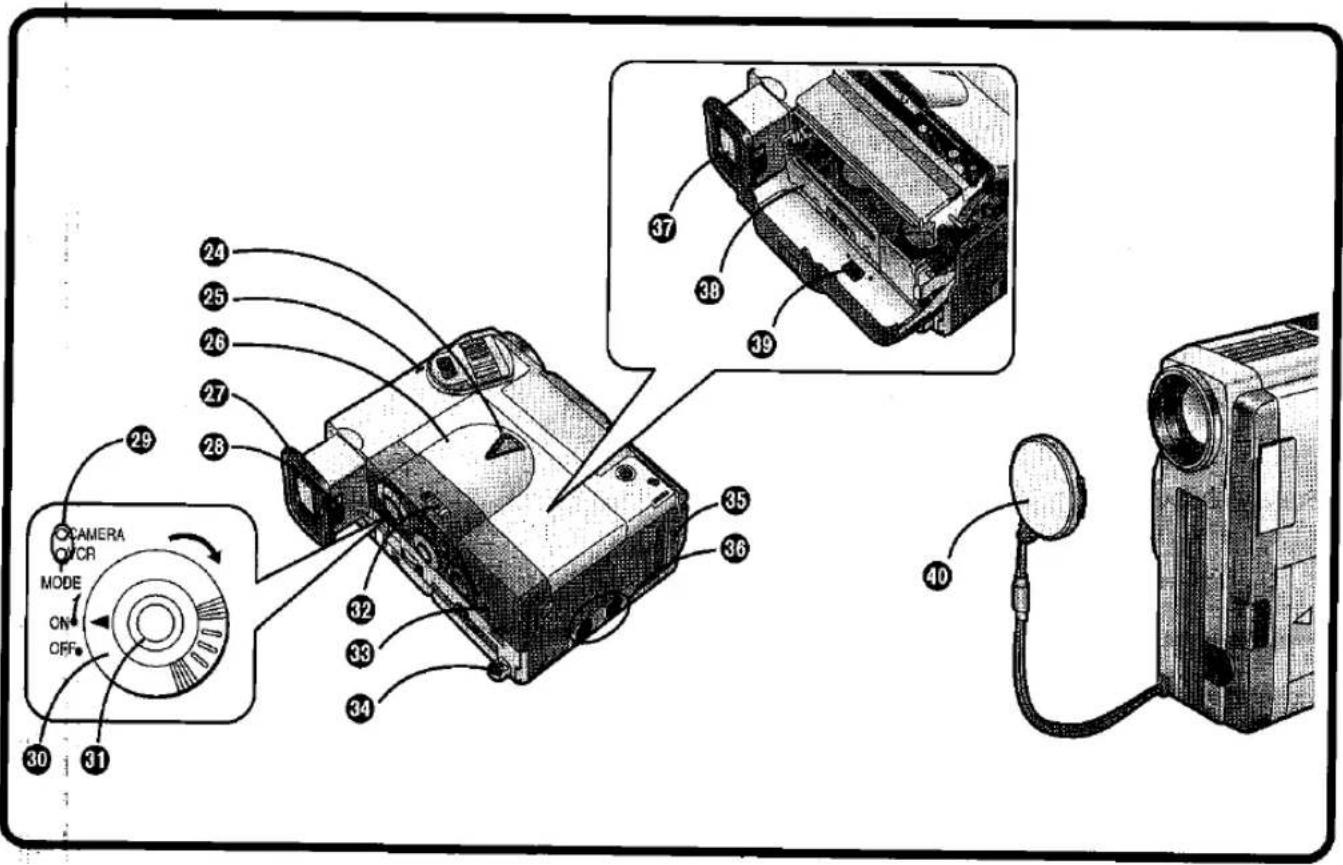
24 Cassette Compartment Window
25 Condensation Sensor Slot
Through this slot, the Movie Camera detects condensation. Do not cover this slot with your fingers, etc. and take care that it does not get clogged with dirt.
26 Upper Cassette Compartment Cover (p. 10)
27 Eyecup
28 Eyepiece Corrector Lever (p. 12)
29 Camera Mode Lamp [CAMERA] (p. 16) VCR Mode Lamp [VCR] (p. 28)
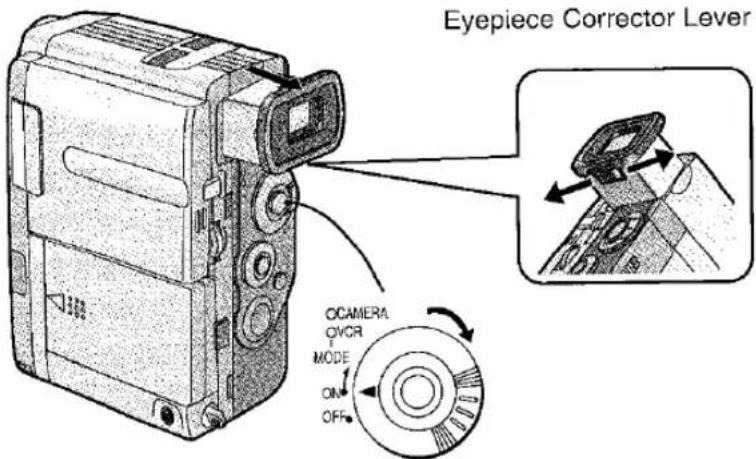
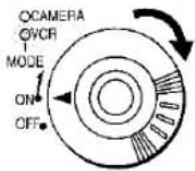
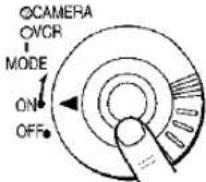
30 Off/On Mode Selector Switch [OFF/ON/MODE] (p. 12, 16, 28, 32)
By turning this switch, you can turn the Movie Camera on and off and also change between the Camera Mode and the VCR Mode.
- When you turn this switch in the direction of the arrow (clockwise) to [ON], the Movie Camera turns on. When you turn it back to [OFF], the Movie Camera turns off.
- When you turn this switch to [ON] to turn the Movie Camera on, the Movie Camera is always in the Camera Mode. To change to the VCR Mode, turn the switch further clockwise. Every additional clockwise turn of this switch changes between the Camera Mode and the VCR Mode.
- Do not turn this switch again before the Movie Camera has completed the change-over from one operation mode to the other.
31 Recording Start/Stop Button (p. 16)
32 Cassette Compartment Open Lever [CASSETTE DOOR OPEN] (p. 10, 32)
33 Lower Cassette Compartment Cover (p. 10)
34 Hand Strap Holder (p. 14)
35 Multi Terminal (p. 32, 75)
36 Tripod Receptacle
To mount the Movie Camera on an optional tripod.
③7 Viewfinder (p. 12, 95, 100)
Due to limitations in LCD production technology, there may be some tiny bright or dark spots on the Finder screen. However, this is not a malfunction and does not affect the recorded picture.
38 Cassette Holder (p. 10)
39 Cassette Eject Button [▲ CASSETTE EJECT] (p. 10)
40 Lens Cap (p. 15)
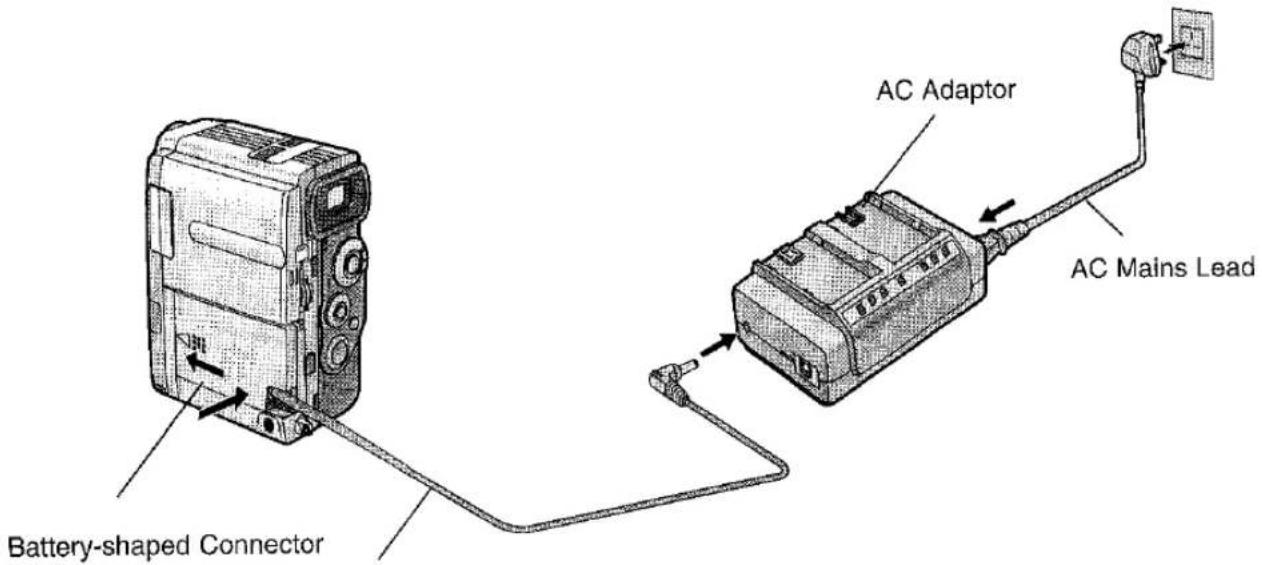
DC Input Lead
| Title | Procedure |
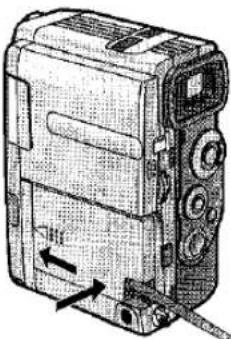
| The 3 Types of Power Supply1) AC Adaptor (supplied) to supply power from an AC mains socket2) Car Adaptor Cord (optional) to supply power from a Cigarette Lighter Socket3) Battery (supplied). (p. 8)1) Supplying Power from an AC Mains Socket | Insert the battery-shaped connector of the DC Input Lead into the Battery Holder on the Movie Camera and slide it toward the front until it locks with a click. |
 | |
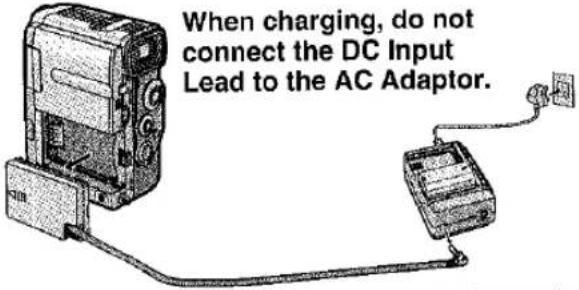
| 2) Supplying Power from the Cigarette Lighter Socket In a CarThe use of the Car Adaptor Cord (VW-KA7E; optional) together with the AC Adaptor makes it possible to supply power to the Movie Camera in a car for recording and playback. It also allows charging the Movie Camera's Battery. However, do not connect the Movie Camera to the AC Adaptor during charging. | 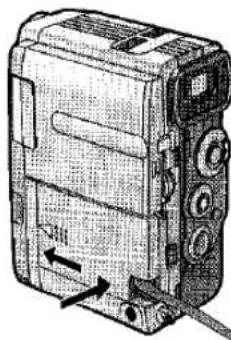 DC Input Lead DC Input Lead |
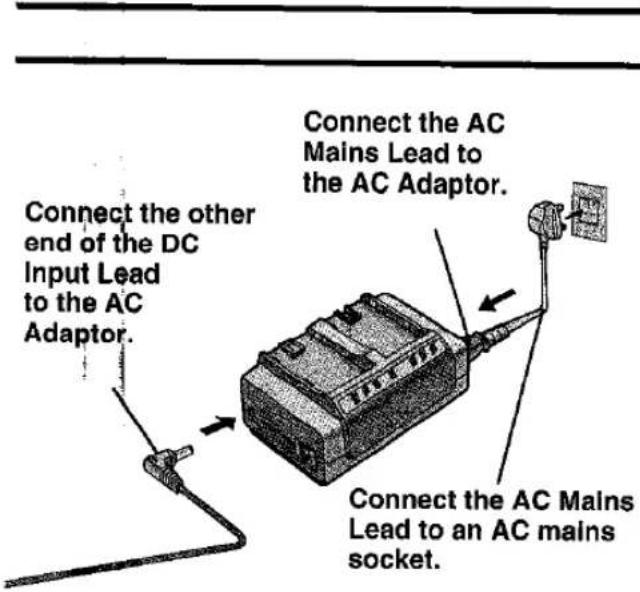 | Remarks, etc. | |
| ●Before disconnecting the AC Mains Lead, turn the [OFF/ON/MODE] Switch on the Movie Camera to [OFF].●If you use the Movie Camera for a long time, it becomes warm. However, this is normal. | ||
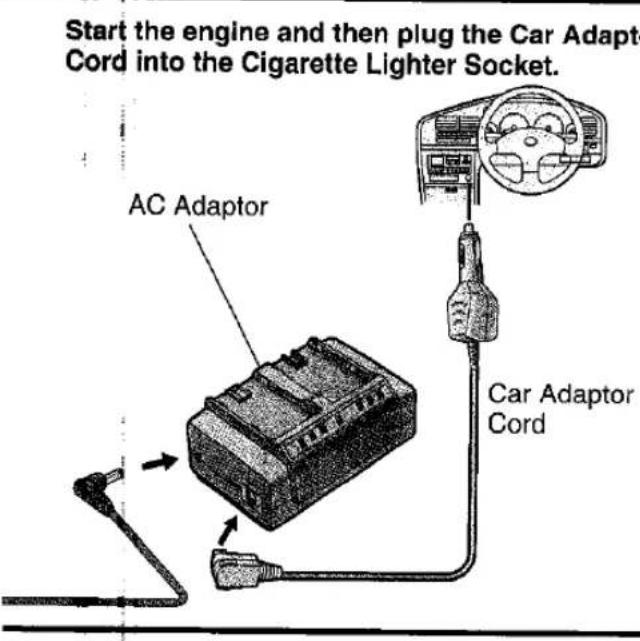 | or | ●After use, be sure to disconnect the Car Adaptor Cord from the Cigarette Lighter Socket.●Be sure to start the car engine before you connect the Car Adaptor Cord, otherwise the fuse may blow.●Also read the operating instructions of the Car Adaptor Cord.●Quick-charging is not possible when the Car Adaptor Cord is connected to the AC Adaptor.●Use the DC Input Lead supplied with the AC Adaptor. |
AC Adaptor
| Title | Procedure | |
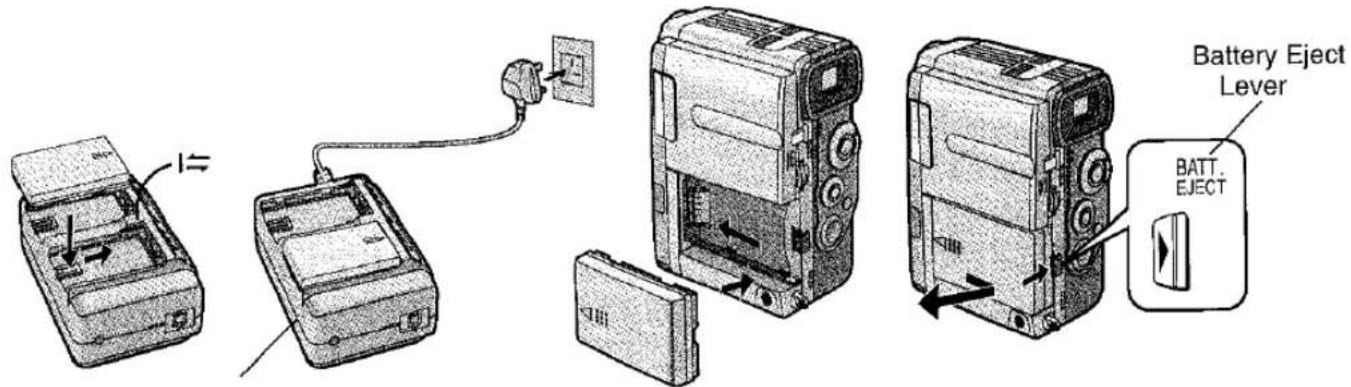
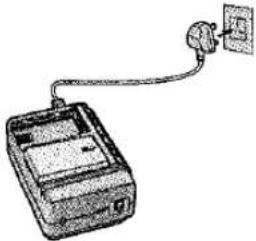
| 3) Supplying Power with the Battery Before use, charge the Battery. | 1 Place the Battery on the AC Adaptor and slide it horizontally until it stops. | 2 Connect the AC Mains Lead to the AC Adaptor and to an AC mains socket. |
 | 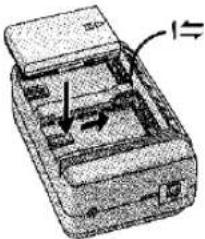 |  |
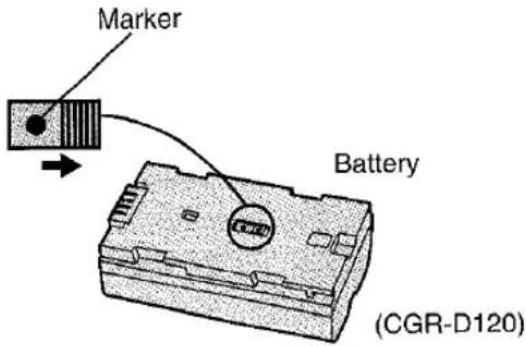
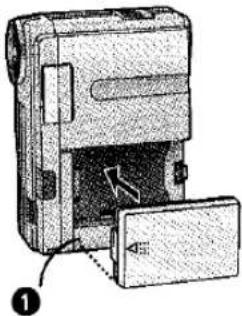
| Using the Charge Confirmation Marker on the Battery Some Battery models are equipped with a Charge Confirmation Marked with can be used to easily distinguish between charged and discharged Batteries. For example, slide the knob so that the red dot (●) is visible after the charging is completed. | 5 After aligning the front edge of the Battery with the mark 1 at the bottom edge of the Movie Camera, push it in and then slide it toward the front until it locks with a click. | |
 |  | |
Charging Time and Maximum Time for Continuous Recording
| Battery No. | Charging Time | Max. Continuous Recording Time | Intermittent Recording Time |
| CGP-D105 (supplied) | 1 h 10 min. | 1 h. (45 min.) | 30 min. (25 min.) |
| CGR-D120 (optional) | 1 h. | 1 h 25 min. (1 h 10 min.) | 45 min. (35 min.) |
| CGP-D210 (optional) | 1 h 30 min. | 2 h 30 min. (2 h 5 min.) | 1 h 15 min. (1 h 5 min.) |
| CGR-D220 (optional) | 1 h 10 min. | 3 h. (2 h 30 min.) | 1 h 30 min. (1 h 15 min.) |
| CGR-D815 (optional) | 4 h 30 min. | 10 h. (8 h 20 min.) | 5 h. (4 h 10 min.) |
(The times shown in the above chart are approximations. The figures in parentheses show the recording time when using the LCD Monitor.)
The times listed above for your information indicate the duration of recording performed at an ambient temperature of 20^ C and 60% relative humidity. The charging time may be longer when you charge the Battery at higher or lower temperature.
●During use and charging, the Battery becomes warm. The Movie Camera, too, becomes warm during use.
●During use and charging, the Battery becomes warm. The Movie Camera, too, becomes warm during use.
- The Intermittent Recording Time indicates the total recording time possible when you start and stop recording repeatedly. When you repeatedly stop and restart recording, the recording time per Battery is shorter than listed above.
- If you do not use the Battery for a long time, please read "Precautions for Storage" (p. 94).
3
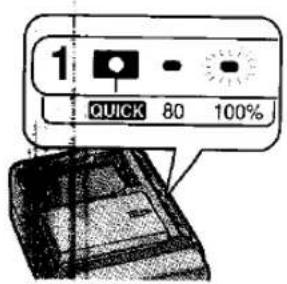
When the [100%] Lamp on the AC Adaptor is lit, charging is finished.
4
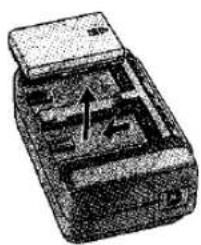
Remove the Battery by sliding it in the opposite direction of Step 1.
natural_image
Mechanical component with internal structure and mounting bracket (no visible text or symbols)- Also disconnect the AC Mains Lead.
Charging Two Batteries
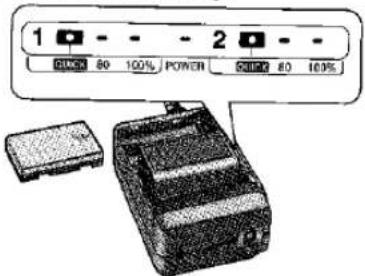
If you attach two Batteries to the AC Adaptor, they will be charged one after the other.
To charge, follow Steps 1 - 3 above.
- Charging starts from Battery 1. At this time, the Charge Lamps for Battery 2 show the remaining charge in the Battery 2. If the remaining charge is less than 80% , no Charge Lamp is lit. However, if the [QUICK] Lamp is lit at that time, continuous recording for approximately 1 hour is possible with that battery.
Remarks, etc.
- The [QUICK] Lamp flashes and then remains lit only when charging a quick-charge type battery. The Battery supplied with this Movie Camera is not of the quick-charge type.
- Charging is not possible when the DC Input Lead is connected to the AC Adaptor.
●The figures (80%, 100%) printed on the AC Adaptor indicate approximate charge reached.
Quick Charge
When you attach a quick-charge type Battery to the AC Adaptor, the [QUICK] Lamp starts to flash. When the [QUICK] Lamp has stopped flashing and remains lit, approximately 1 hour of continuous recording is possible.
- The Battery models CGP-D105 (supplied); CGR-D120 (optional) and CGR-D815 (optional) are not quick-charge type Batteries.
- If you use the Car Adaptor Cord (optional) (p. 6) to charge the Battery, quick-charging is not possible,
Charging Time and Maximum Time for Continuous Recording
| Battery No. | Time Before[QUICK] LampStops Flashing | Max. Continuous Recording Time |
| CGP-D210 | 20 min. | 1 h. |
| CGR-D220 | 15 min. | 1 h. |
When the Charge Lamps Flash as Warning
If the ambient temperature is extremely low or high, the Charge Lamps on the AC Adaptor flash. They also flash when some malfunction has occurred in the Battery or the AC Adaptor.
For details, read "When the Charge Lamps on the AC Adaptor Flash as Warning" (p. 94).
Removing the Battery from the Movie Camera
While pressing the [BATT. EJECT] Lever, slide the Battery toward the rear and then remove it.
- Be careful not to drop the Battery by accident
●Before removing the Battery, turn the [OFF/ON/MODE] Switch to [OFF].
| Title | Procedure | |
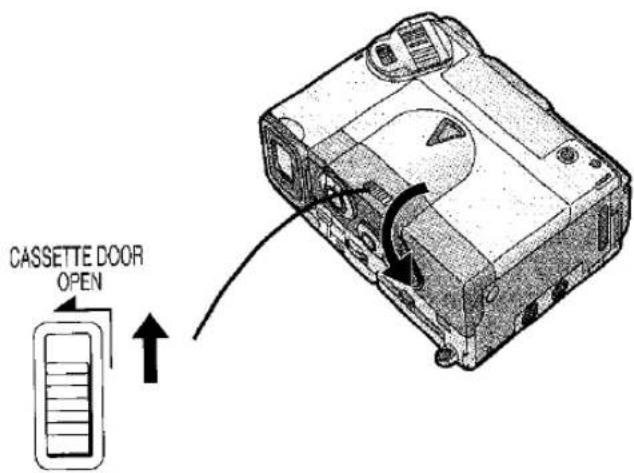
| Inserting the Cassette | 1 Slide the [CASSETTE DOOR OPEN] Lever 1 in the direction of the arrow and simultaneously open the Lower Cassette Compartment Cover completely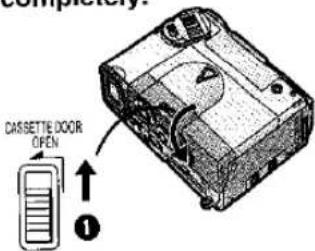 | 2 Press the [▲CASSETTE EJECT] Button. The Cassette Holder slides out.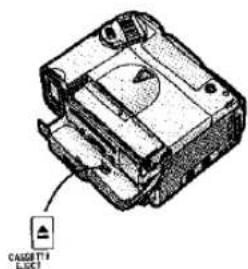 |
5 Close the Lower Cassette Compartment Cover.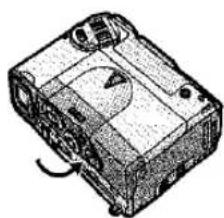 | ||

LP Mode
The desired recording speed can be selected with [REC SPEED] on the [OTHER FUNCTIONS] Sub-Menu.
If you select the LP Mode, the possible recording time is 1.5 times as long as in the SP Mode.
- As the recording track width in the LP Mode is smaller than the head width, recording new sound onto an already recorded cassette (audio dubbing) (p. 68) is not possible.
-
Recording in the LP mode does not deteriorate the picture quality. In the following cases, mosaic-like patterns may appear in the playback picture, or the picture may not be played back correctly:
-
When a cassette recorded in the LP Mode on this Movie Camera is played back on other digital video equipment.
- When a cassette recorded in the LP Mode on other digital video equipment is played back on this Movie Camera.
- When a cassette recorded in the LP Mode on this Movie Camera is played back on digital video equipment not featuring the LP Mode.
• In the Slow Motion or Still Advance Playback Mode. (p. 30) - When using the Camera Search Function. (p. 34)
| Remarks, etc. | ||
| 3Insert the cassette with its window in position 2. | 4Press on the [PUSH CLOSE] mark to close the Upper Cassette Compartment Cover.The Cassette Holder with the cassette slides back inside.Confirm that the Cassette Holder has retracted completely. | ·Do not operate the Movie Camera with the Lower Cassette Compartment Cover open, as dust and strong light could enter and cause a malfunction.·When you open the Lower Cassette Compartment Cover, be careful not to press the Recording Start/Stop Button or the [PHOTO SHOT] Button by accident. Otherwise recording starts unintentionally.·When inserting the cassette, make sure it faces in the right direction and then push it in until it stops.·When you insert a cassette onto which you have recorded before, use the Camera Search Function (p. 34) to search for the position from which you want to continue recording.·When inserting a new cassette, always rewind the tape to the beginning before you start recording. |
| If the AC Adaptor or Battery is used to supply power; it is possible to insert or eject the cassette without turning on the Movie Camera. | If the Cassette Holder Does Not Slide Back In·Press on the [PUSH CLOSE] mark and close the Upper Cassette Compartment Cover securely.·Turn the Movie Camera off and then on again.·Check if the Battery is discharged. | |
| Preventing Accidental Erasure of RecordingsOpening the cassette's erasure prevention slider 3(sliding it in the direction of the [SAVE] arrow) prevents recording. To record again, close the erasure prevention slider (slide it in the direction of the [REC] arrow). | ||
| Title | Procedure | |
| Using the ViewfinderBefore using the Viewfinder, adjust it to your eyesight so that the indications in the Viewfinder are clear and easy to read. When using the Viewfinder, close the LCD Monitor.Due to limitations in production technology, there may be some tiny bright or dark spots on the Viewfinder, however, these are not recorded on the tape.Do not leave the Viewfinder or the Lens aimed at the sun. This could seriously damage internal parts. | 1Turn the [OFF/ON/MODE] Switch from the [ON] position to put the Movie Camera either in the Camera or VCR Mode.The [CAMERA] Lamp or the [VCR] Lamp lights.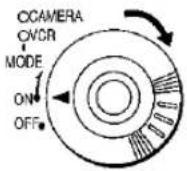 | 2Slide the Viewfinder backward.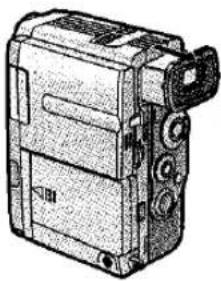 |
| Using the LCD MonitorIt is also possible to record while viewing the picture on the opened LCD Monitor.Relationship between Viewfinder and LCD MonitorOpening the LCD Monitor turns off the Viewfinder. Closing the LCD Monitor turns the Viewfinder on again. However, turning the LCD Monitor forward also turns on the Viewfinder again. (p. 20)Due to limitations in production technology, there may be some tiny bright or dark spots on the LCD, however, these are not recorded on the tape. | 1Turn the [OFF/ON/MODE] Switch from the [ON] position to put the Movie Camera either in the Camera or VCR Mode.The [CAMERA] Lamp or the [VCR] Lamp lights.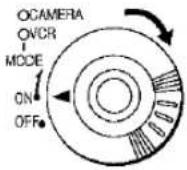 | 2Open the LCD Monitor by approximately 90° in the direction of the arrow.The Viewfinder turns off.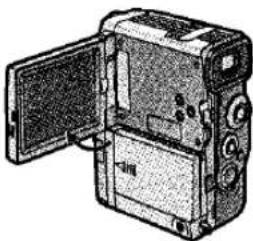 |
| Remarks, etc. | |
3 Slide the Eyepiece Corrector Lever until the indications in the Finder become sharp and clear.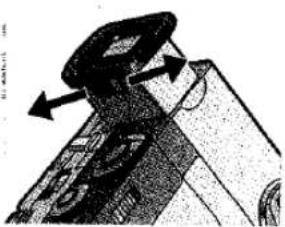 | Closing the LCD MonitorPush the LCD Monitor close until it locks with a click.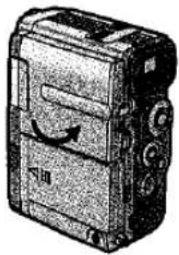 |
3 Adjust the angle of the LCD Monitor according to the recording angle.The LCD Monitor rotates upward a maximum of 180° and downward by a maximum of 90° from its normal vertical position. Trying to forcefully rotate it beyond this range could seriously damage the Movie Camera.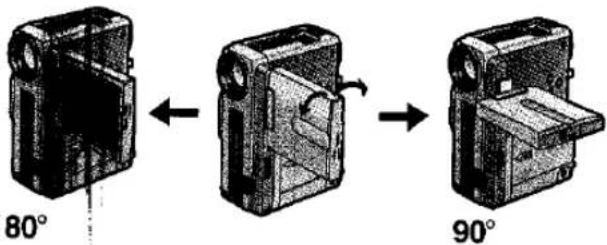 |
3
natural_image
Technical line drawing of a portable radio device with attached cable and dial (no text or symbols)| Title | Procedure | |
| Attaching the Hand Strap Attaching the Hand Strap makes it convenient to carry the Movie Camera. | 1 Pass the longer loop of the Hand Strap through the larger hole 1 of the Lens Cap Holder. | 2 Pass the shorter loop of the Hand Strap through the smaller hole 2 of the Lens Cap Holder. |
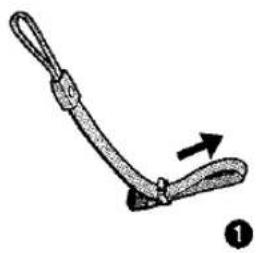 | 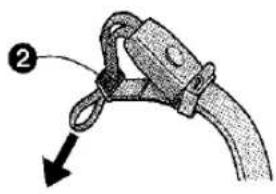 | |
| Attaching the Hand Grip The Hand Grip ensures reduced hand fatigue even during longer recording, and the integrated Hand Grip protects the Movie Camera against accidental fails. When using the Movie Camera, also loop the Hand Strap around your wrist for added safety, before passing your hand under the Grip Belt. •Put the Movie Camera on a stable surface such as a table. | 1 Correctly align the screw of the Hand Grip 1 with the Hand Grip Screw Hole 2 and the pin of the Hand Grip 3 with the Hand Grip Pin Hole 4 and insert them. | 2 Tighten the screw securely. |
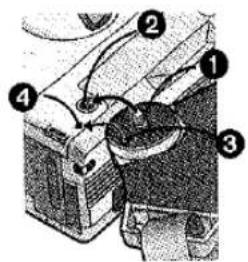 |  | |
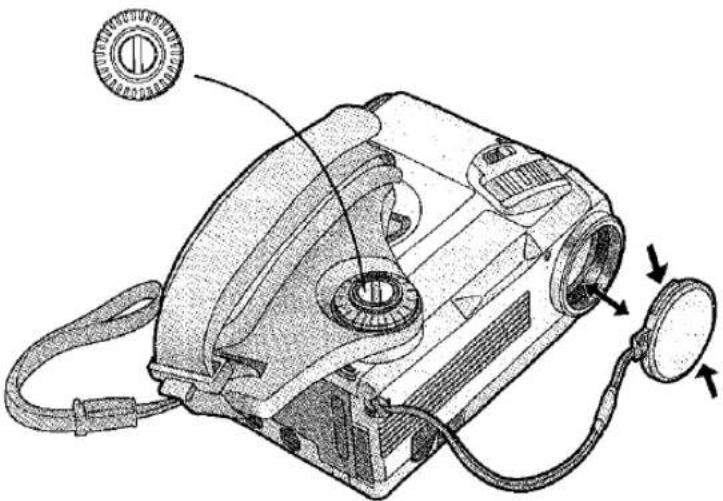
Handling the Lens Cap
Before you start recording, remove the Lens Cap.
- You can attach the removed Lens Cap either to the Lens Cap Holder on the Grip Belt ① or on the Hand Strap ②.
- When not actually recording, always attach the Lens Cap to the Lens to protect it.
- When attaching or removing the Lens Cap, be sure to press the buttons on both sides.
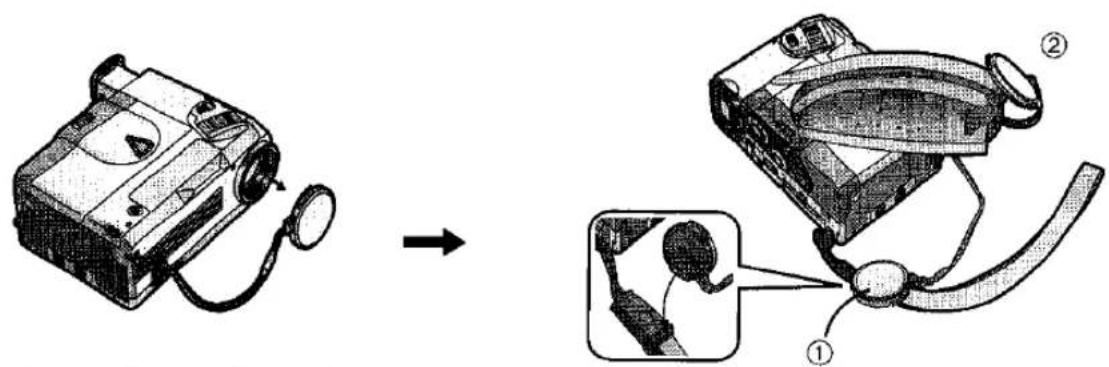
| Remarks, etc. | ||
| 3 Pull the small loop at the end of the Hand Strap through the Hand Strap Holder. | 4 Pass the big loop of the Hand Strap through the small loop. | ·When using the Hand Strap to carry the Movie Camera, loop the Hand strap around your wrist and be careful not to accidentally hit the Movie Camera against hard objects. |
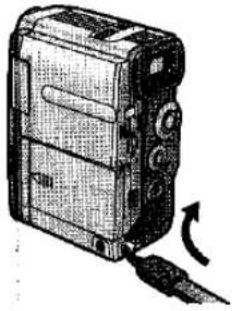 | 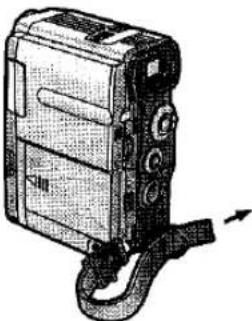 | |
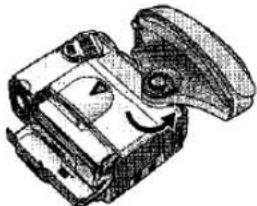
| 3 Pass your hand through the Grip Belt In the direction Indicated by the mark 5 and adjust its length. Fold up the end of the Grip Belt to securely fasten the velcro tape closure. | 4 Adjust the angle of the Hand Grip so that you can hold the Movie Camera comfortably. | ·When carrying the Movie Camera, do not hold it by the Hand Grip only. ·When you attach the Output Terminal Box [AV ONE TOUCH STATION], Shoe Adaptor (optional) or the tripod (optional), be sure to remove the Hand Grip from the Movie Camera. ·If the screw of the Hand Grip becomes loose during use of the Movie Camera, tighten it again. ·When Inserting and taking out the cassette, turn the Hand Grip as shown above so that it does not prevent the Upper Cassette Compartment Cover from opening. |
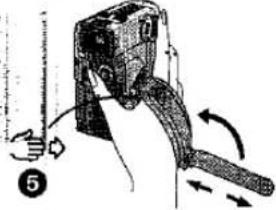 | 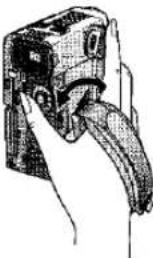 |  |
| Title | Procedure | |
| Recording (Filming)After turning the [OFF/ON/MODE] Switch to [ON] to turn the Movie Camera on and setting the Mode Selector Switch to [AUTO], you can start recording simply by pressing the Recording Start/Stop Button. In this case, the Movie Camera adjusts the focus and white balance fully automatically.Depending on the light source and recording situation, correct automatic focusing and white balance adjustment may not be possible. In such cases, adjust them manually.Focus: (p. 20)White Balance: (p. 52)Before RecordingCheck the following settings before recording especially important scenes:Recording Speed (p. 11, 82)When you intend to perform editing or audio dubbing afterward: Set to [SP].Audio Recording Mode (p. 68, 82)When you want to perform audio dubbing afterward: Set to [12bit].Cinema Mode (p. 26, 82) | Turn the [OFF/ON/MODE] Switch to [ON].The Movie Camera is now in the Camera Mode and the [CAMERA] Lamp lights.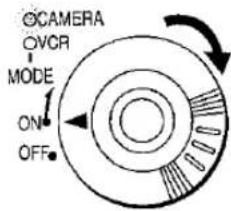  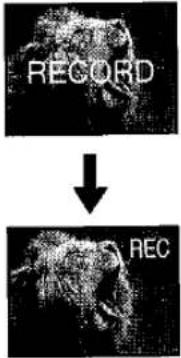 | Press the Recording Start/Stop Button.Recording starts.The [RECORD] Indication appears briefly and then changes to [REC].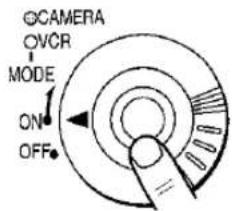 |
| Remarks, etc. | ||
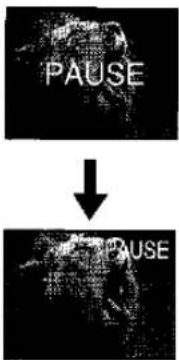
| 3To pause recording:Press the Recording Start/Stop Button again.The [PAUSE] Indication appears. | 4To finish recording:Turn the [OFF/ON/MODE] Switch to [OFF]. | ●If you leave the Movie Camera in the Recording Pause Mode for more than 6 minutes, It automatically switches off to protect the tape and to conserve battery power. To resume recording from this condition, set the [OFF/ON/MODE] Switch to [OFF] and then to [ON] again.●Be sure to remove the Lens Cap before setting the [OFF/ON/MODE] Switch to [ON]. If the Lens Cap is still attached to the Lens when the [CAMERA] Lamp lights, the automatic white balance adjustment (p. 97) may not be precise. |
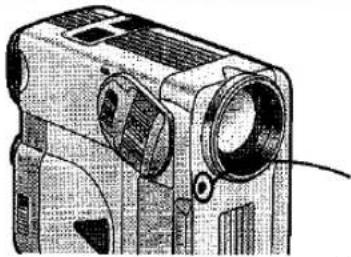
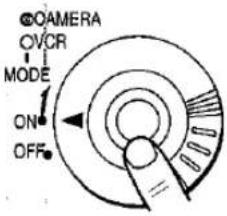 | 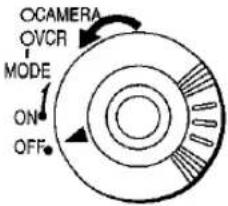 | Recording Indicating (Tally) LampThe Recording Indicating (Tally) Lamp lights during recording to let the people in front of the Movie Camera know that recording is being performed.If you set [REC LAMP] on the [OTHER FUNCTIONS] Sub-Menu to [OFF], the Recording Lamp does not light. (p. 82)●Even if [REC LAMP] on the [OTHER FUNCTIONS] Sub-Menu is set to [OFF], the Recording Lamp flashes briefly to confirm when the Movie Camera has received a command from the Remote Controller. |
 |  Recording Indicating (Tally)Lamp Recording Indicating (Tally)Lamp | |
■ Video Head Clogging and Remedy
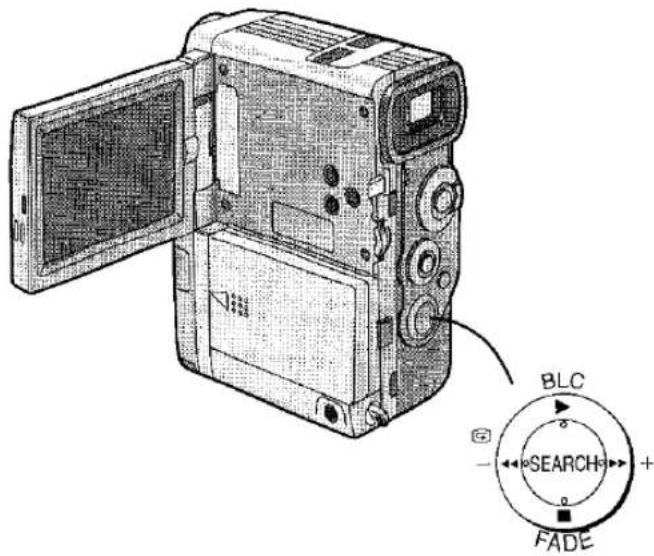
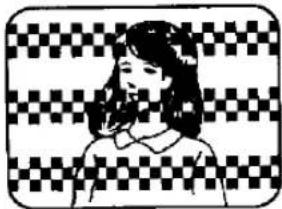
When the video heads (which contact the tape) are dirty, the playback picture contains mosaic-like patterns or the whole screen becomes black. If they become even more dirty, the recording performance deteriorates and in the worst case, recording may not be possible at all.
natural_image
Black-and-white illustration of a girl with long hair wearing a checkered top, against a checkerboard background (no text or symbols)Causes of Dirty Video Heads
●A lot of dust in the air.
●High-temperature and high-humidity environment.
• Damaged tape.
- Long-time use.
| Title | Procedure | |
| Checking If the Picture Is Recorded(Recording Check)To play back the final few seconds of the last recorded scene in the Recording Pause Mode. | 1Press the Recording Check Button [G] briefly in the Recording Pause Mode.The [CHK] Indication appears.After checking, the Movie Camera returns to the Recording Pause Mode. | |
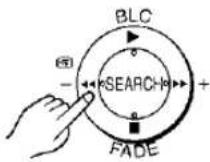 | 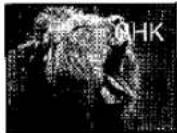 | |
| Recording Backlit Scenes(Backlight Compensation)To prevent the backlit subject from being recorded too dark(Backlight means that the light falls on the subject from behind, i.e. the subject is between the light source and the Movie Camera.) | 1Keep the Backlight Button [BLC] pressed.The backlight is being compensated as long as you keep the Button pressed, and the subject is recorded more brightly. (The picture brightens up as a whole.) | |
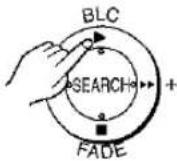 | ||
Using the Mini-DV Format Digital Video Head Cleaner (VFK1451; Not Supplied)
1 Insert the Head Cleaner into the Movie Camera in the same way as a video cassette.
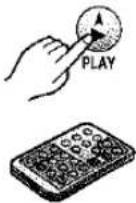
2 Press the Play Button [▶], and after approximately 20 seconds press the Stop Button [■]. (Do not rewind the tape.)
3 Take out the Head Cleaner. Insert a video cassette, perform recording and then play it back to check the picture.
4 If the picture is still not clear, repeat above operation steps 1 - 3. (Do not use the Head Cleaner more than 3 times in succession.)
●This Video Head Cleaner (VFK1451) is available from Panasonic service centres.
Notes:
- Do not rewind the tape in the Head Cleaner after every use. Rewind it only after the tape has reached its end, and then use it again in the same way from the beginning.
- If the video heads again become clogged with dirt soon after cleaning, this might be caused by a damaged tape. In this case, stop using that cassette immediately.
- Be careful not to clean the video heads too much. (Too much cleaning could cause excessive wear to the video heads. If the video heads get worn, the picture is not played back clearly even after cleaning.)
- If using the Head Cleaner does not clear the video head clogging, the Movie Camera requires cleaning or repairing by a service centre. Please consult with your dealer.
- Video head cleaning due to clogging is not a malfunction of the product and is not covered by your warranty.
| Remarks, etc. | |
| ●For Recording Check, the Movie Camera must be in the same mode (SP or LP) as used for recording otherwise the playback picture is distorted. | |
| Returning to Normal Recording Release the Backlight Button [BLC]. |
natural_image
Diagram of a vintage digital camera with an arrow pointing to a screen (no text or symbols present)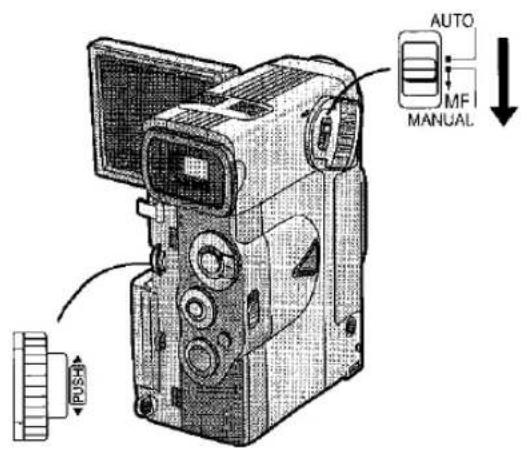
| Title | Procedure | |
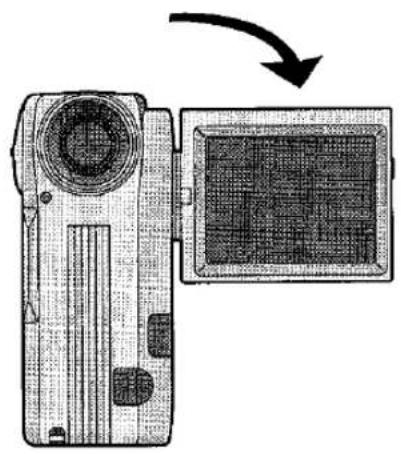
| Recording Yourself(Recording with the LCD Monitor Facing Forward)This makes it possible to record yourself while viewing the picture on the LCD Monitor or to show the persons in front of the Movie Camera the picture being recorded. | 1Open the LCD Monitor and turn it so that it faces forward (lens side).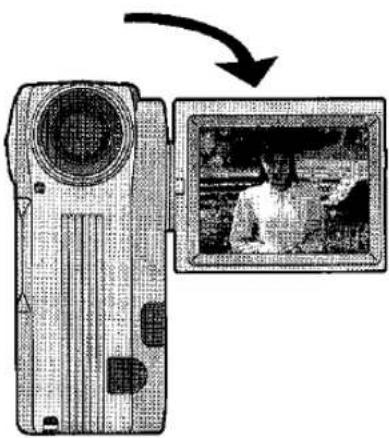 | |
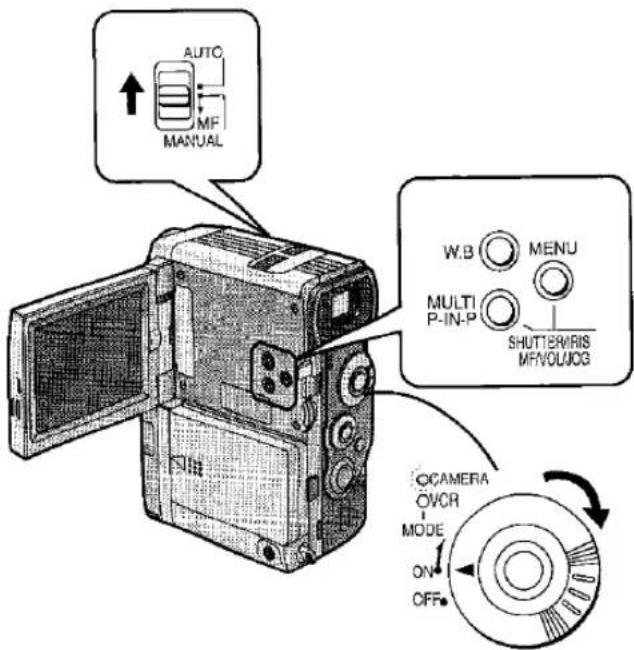
| Focusing on the Subject Manually(Manual Focus)This makes it possible to adjust the focus manually for subjects and recording situations for which automatic focusing is not preciseMF: Manual Focus ModeMNL: Manual | 1Set the Mode Selector Switch to [MANUAL].The [MNL] Indication appears.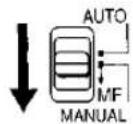 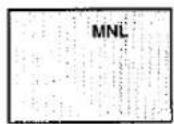 | 2Slide the Mode Selector Switch down to [MF].The [►MF] Indication appears.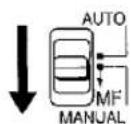 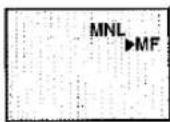 |
Mirror Mode for the Picture on the LCD Monitor
You are used to looking at yourself in the mirror. Therefore, when recording yourself with the LCD Monitor facing forward, the picture (as it is being recorded) might look unusual and distracting. If you prefer to see yourself on the LCD Monitor in the same way as you see yourself in a mirror, i.e. with the sides reversed, set [SELFSHOOT] on the [DISPLAY SETUP] Sub-Menu to [MIRROR]. However, the picture will still be recorded in the normal, non-reversed way. This mirror mode for the picture on the LCD Monitor works only during recording and in the Recording Pause Mode with the LCD Monitor facing forward. Also, it is completely different from the Mirror Mode of the Digital Effects 1 (p. 42).
| Remarks, etc. | ||
| Opening the LCD Monitor automatically turns off the Viewfinder. However, when you turn the LCD Monitor forward, the picture also appears in the Viewfinder.This lets you aim the Movie Camera and view the picture in the Viewfinder, while the persons in front of the Movie camera can check the picture on the LCD Monitor during recording. | ● In the Mirror Mode, only the following indications are displayed.●: Recording●H: Recording Pause●: Remaining Battery PowerWhen the General Warning/Alarm Indication [1] appears, turn the LCD Monitor backward so that you can confirm the actual Warning/Alarm Indication. | |
| 3Turn the [PUSH] Dial until the subject is sharp. | Returning to the Automatic Focusing ModeSet the Mode Selector Switch to [AUTO], or slide it down so that the [▶MF] Indication disappears. | Hint for Manual Focus Adjustment●If you adjust the focus in the wide-angle setting, the subject may go out of focus when you enlarge it.Therefore, enlarge the subject 1 before you adjust the focus, so that the picture remains focused when you zoom out 2. |
| AUTO MF MANUAL or AUTO MF MANUAL | ●If you want to adjust the focus manually after having adjusted the shutter speed (p. 54) or the iris (p. 54), be sure to slide the Mode Selector Switch to make the [▶MF] Indication appear, even if the [MF] Indication is displayed. | |
| Title | Procedure |
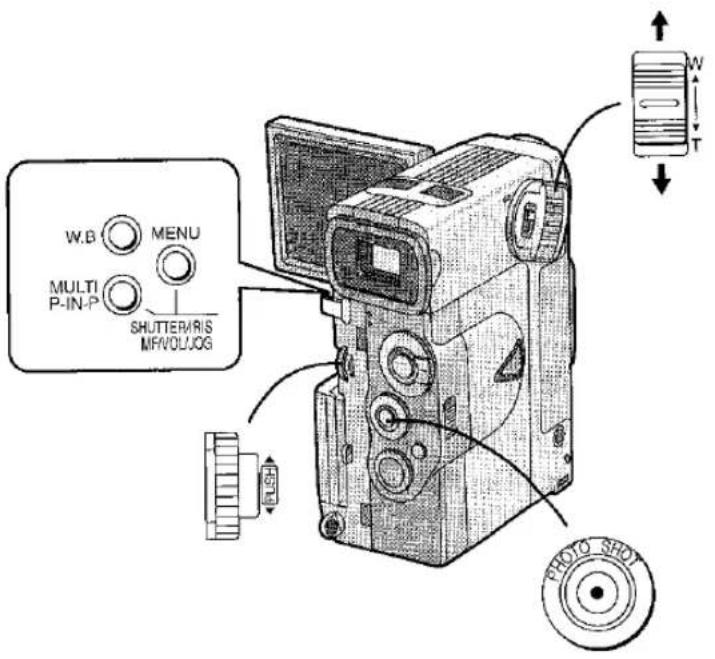
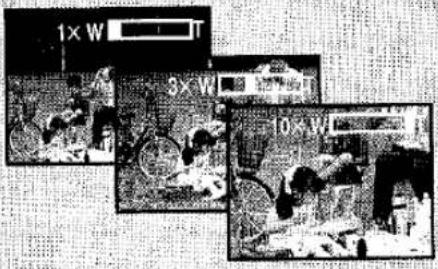
| Enlarging Your Subject or Widening the Recording Angle (Zooming In/Out)Recording close-ups of your subjects and recording wide-angle shots add special effects to your videos. | 1To record a wider view (Zooming-out):Push the [W/T] Zoom Lever toward [W].To enlarge your subject (Zooming-in):Push the [W/T] Zoom Lever toward [T].●The Zoom Magnification Indication appears for a few seconds.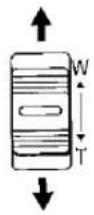 |
 | |
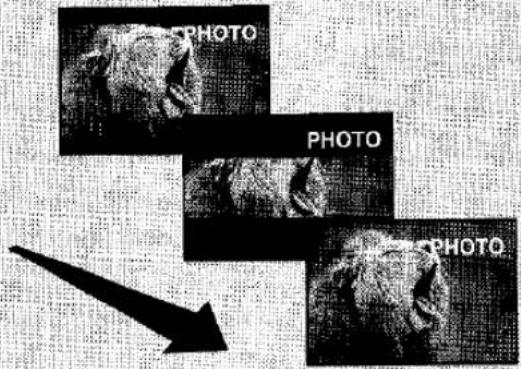
| Using the Movie Camera as a Digital Still Camera (Photoshot)With this function, you can record still pictures with sound for approximately 7 seconds each. | 1Press the [PHOTO SHOT] Button in the Recording Pause Mode.The Movie Camera records a still picture for approximately 7 seconds and then switches back to the Recording Pause Mode.●It is not possible to use the Photoshot Function during a normal recording.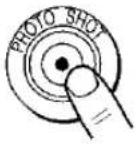 |
 |
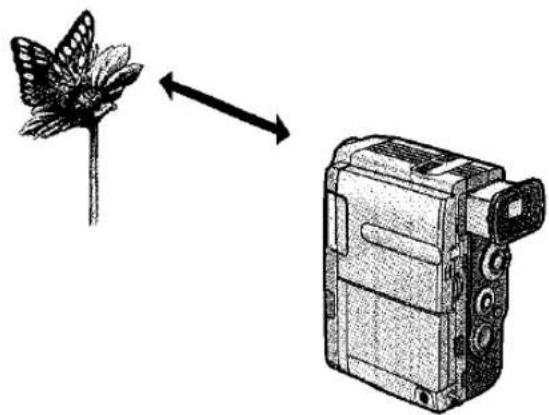
Recording Extra Close-up Shots of Small Subjects (Macro Close-up Function)
When the zoom magnification is 1×, the Movie Camera can focus on subjects down to a distance of approximately 10 mm between lens and subject. This allows recording very small subjects such as insects.
| Remarks, etc. | |
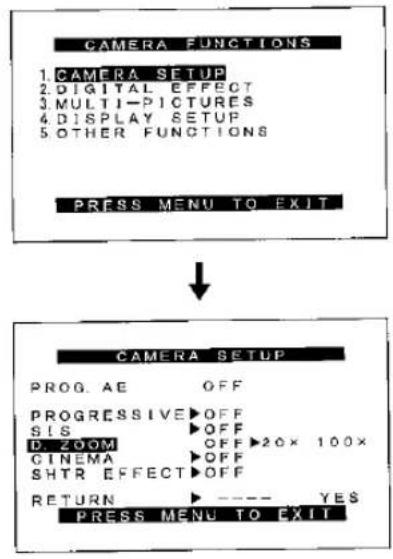
| Enlarging Your Subjects Even More(Digital Zooming)If you set [D.ZOOM] on the [CAMERA SETUP ] Sub-Menu to [20×] or [100×], it is possible to further enlarge the subject.The [D.ZOOM] Indication appears.20×: Digital zooming up to 20×.100×: Digital zooming up to 100×.Up to 10×, the zooming is done optically.The higher the Digital Zoom Magnification is, the lower is the picture quality.When you have zoomed to 10× or higher (digital zoom range), manually adjusting the white balance or selecting any of the preset white balance modes is not possible.If you set [PROGRESSIVE] on the [CAMERA SETUP] Sub-Menu to [ON], it is not possible to use the digital zoom.If you zoom to 10× or higher (digital zoom range) when [PROGRESSIVE] on the [CAMERA SETUP] Sub-Menu is set to [AUTO], the Progressive Photoshot Mode is automatically cancelled. | As a general rule, the further you push the [W/T] Zoom Lever toward [W] or [T], the faster the zooming speed.In the Recording Pause Mode, if you push the [W/T] Zoom Lever toward [W] or [T] until you feel a click, you can zoom between 1× and 10× in an extremely fast approximately 0.5 second. (Jet Zoom)During recording, zooming between 1× and 10× is possible in as short a time as approximately 1.0 second. However, even if you push the [W/T] Zoom Lever until you feel a click, it is not possible to zoom faster than in 1.0 second. Therefore, we do not recommend that you push the [W/T] Zoom Lever all the way until you feel a click, as a click sound could be recorded in this case.During very fast zooming, the picture may temporarily go out of focus.When you have zoomed to the tele setting, precise focusing is only possible on subjects no closer than 1.2 metres. |
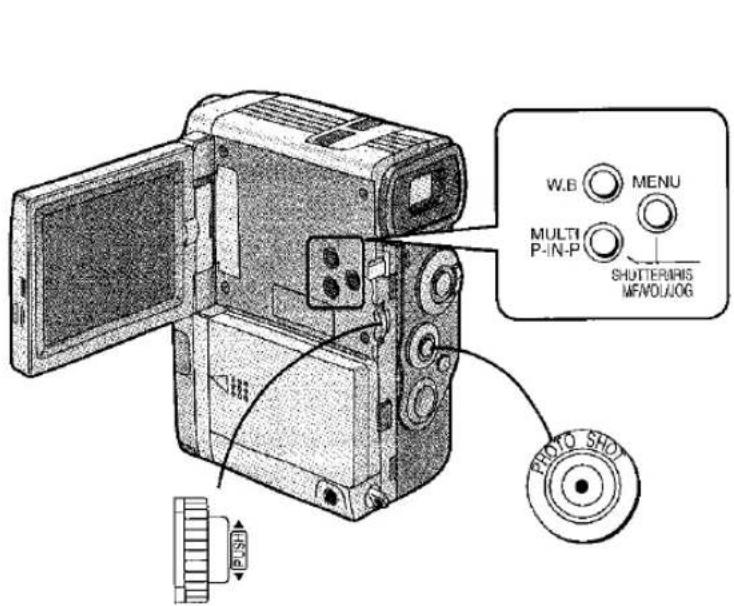
| Continuous PhotoshotIf you set [SHTR EFFECT] on the [CAMERA SETUP] Sub-Menu to [ON] and keep the [PHOTO SHOT] Button pressed in the Recording Pause Mode, the Movie Camera automatically records still pictures successively at intervals of approximately 0.7 seconds until you release the button.One more still picture may be recorded after you release the [PHOTO SHOT] Button.As the still pictures recorded in the Continuous Photoshot Mode are not marked with photoshot index signals, they cannot be located by using the Photoshot Index Search Function and printed with the Auto Print Function.When [PROGRESSIVE] on the [CAMERA SETUP] Sub-Menu is set to [ON] or [AUTO], the Continuous Photoshot Function cannot be used. | If you set [SHTR EFFECT] on the [CAMERA SETUP] Sub-Menu to [ON], the screen blinks briefly and a simulated shutter click sound can be heard when you press the [PHOTO SHOT] Button. This audiovisual effect is also recorded.With the still pictures that you have recorded in the Photoshot Mode, you can do the following:index Search (p. 36)(However, searching for the picture(s) recorded at the beginning of the tape may not be possible.)Automatic printing (p. 79)The visual shutter effect and click sound may occur with slight delay after recording of the still picture has started.The picture quality deteriorates slightly. |
| Title | Procedure | |
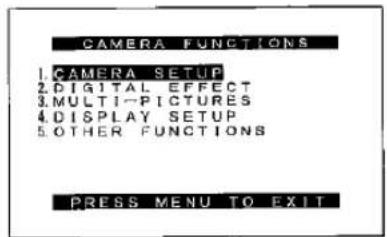
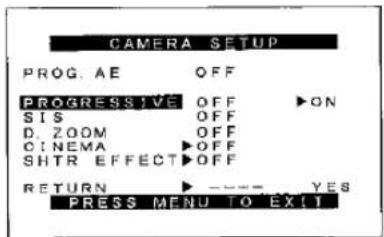
Using the Movie Camera as a Digital Still Camera (Continued) (Progressive Photoshop)The Progressive Photoshop Function lets you record still pictures with higher resolution than the normal Photoshop Function. This is ideal for example for pictures that you want to print with a Digital Video Printer or import into a computer. | 1Press the [MENU] Button.The [CAMERA FUNCTIONS] Main-Menu appears. | 2Turn the [PUSH] Dial to select [CAMERA SETUP] and then press the [PUSH] Dial.The [CAMERA SETUP] Sub-Menu appears. |
 Press the [MENU] Button to exit the menu.The [[P]] Indication appears. Press the [MENU] Button to exit the menu.The [[P]] Indication appears. |  Press the [PHOTO SHOT] Button in the Recording Pause Mode.The Movie Camera records a still picture for approximately 7 seconds and then switches back to the Recording Pause Mode. Press the [PHOTO SHOT] Button in the Recording Pause Mode.The Movie Camera records a still picture for approximately 7 seconds and then switches back to the Recording Pause Mode. | |
| Remarks, etc. | ||
3Turn the [PUSH] Dial to select [PROGRESSIVE]. | 4Press the [PUSH] Dial to select [ON] or [AUTO]. | ●When you press the [PHOTO SHOT] Button, the Movie Camera emits a click sound. However, this is normal and not a malfunction.●With this function, you can take still pictures that are recorded as frames with higher resolution. However, this Frame Mode cannot be used for normal recording of motion pictures.Notes about the Settings for [PROGRESSIVE]When the [P] Indication is displayed, you can use the Progressive Photoshot Function.●When you record a still picture in the Progressive Photoshot Mode while [PROG.AE] on the [CAMERA SETUP] Sub-Menu is set to Sports Mode [ ] or Portrait Mode [ ] (p. 40), the picture brightness may vary from picture to picture.When [PROGRESSIVE] Is Set to [ON]:You can always use the Progressive Photoshot Function.In this case, however, the following functions are deactivated.●Digital Effect Modes in [EFFECT1] (p. 42–51)●Digital Zoom [D.ZOOM] (p. 23)●Shutter Speeds of 1/750 s or faster (p. 54)When [PROGRESSIVE] Is Set to [AUTO]:In the following cases, using the Progressive Photoshot Function is not possible.●When the zoom magnification is approximately 10× or higher.●When the shutter speed is 1/750 s or faster.●When [EFFECT1] is set to [WIPE], [MIX], [STROBE], [GAINUP], [TRACER], [MOSAIC] or [MIRROR].●When a picture is displayed in the Multi-Picture Mode or in the Picture-in-Picture Mode.●When [PROGRESSIVE] on the [CAMERA SETUP] Sub-Menu is set to [ON] or [AUTO], the Continuous Photoshot Function cannot be used. |
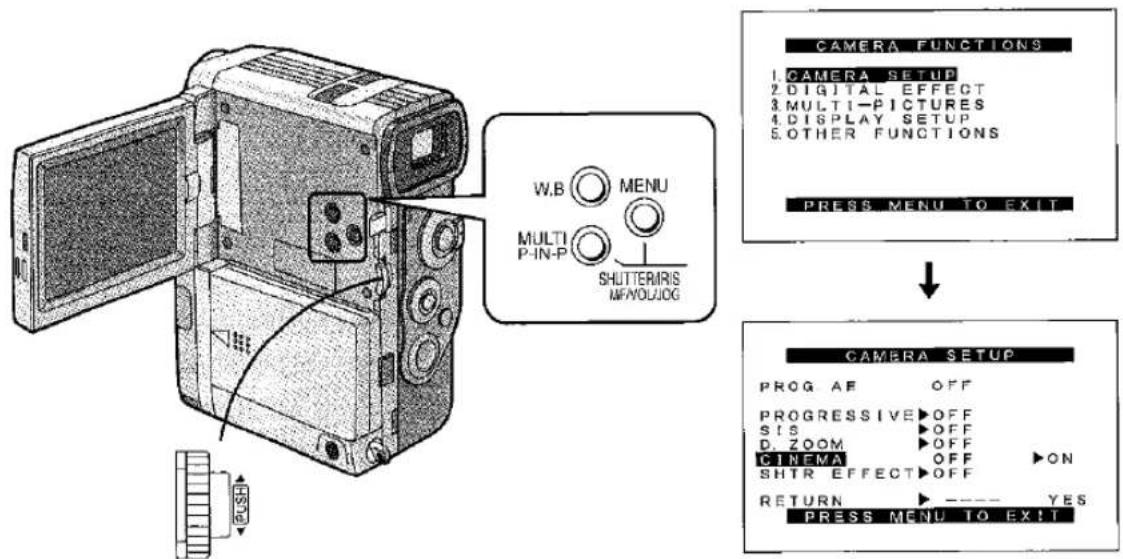
Cinema Mode
| Title | Procedure | |
Recording in the Cinema Mode(Cinema Mode)This mode lets you record in the cinema-like wide-screen format.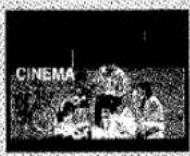 | 1Select the [CAMERA SETUP] on the[CAMERA FUNCTIONS]Main-Menu. (p. 82)The [CAMERA SETUP]Sub-Menu appears.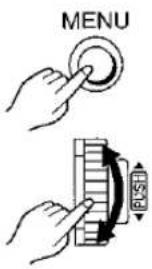 | 2Turn the [PUSH] Dial to select [CINEMA].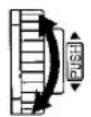 |
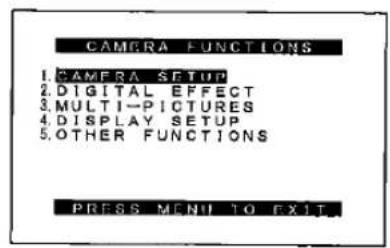
Recording with Minimised Camera Shake(Super Image Stabilizer)In recording situations where shaking of the Movie Camera is likely to happen, for example when you have zoomed in on a distant subject or when you record while walking, you can use this function to stabilize the image. | 1Select the [CAMERA SETUP] on the[CAMERA FUNCTIONS]Main-Menu. (p. 82)The [CAMERA SETUP]Sub-Menu appears.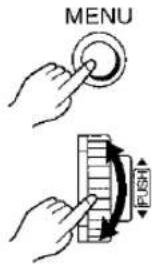 | 2Turn the [PUSH] Dial to select [SIS].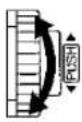 |

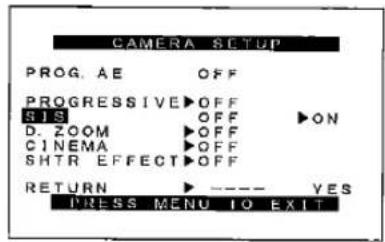
SIS Mode
| Remarks, etc. | ||
3Press the [PUSH] Dial to select [ON].Black bars appear at the top and bottom of the screen.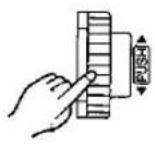 | 4Press the [MENU] Button to exit the Menu. | In the Cinema Mode, black bars appear at the top and bottom of the LCD Monitor and the Viewfinder Screen.A picture displayed in the Multi-Picture Mode cannot be displayed in the Cinema ModeIf you play back the picture recorded in the Cinema Mode on a wide-screen (16:9) format TV, the size of the playback picture is automatically adjusted to match the format of the TV screen. For details, read the TV's operating instructions.Using the Cinema Mode does not widen the recording angle.Cancelling the Cinema ModeSet [CINEMA] on the [CAMERA SETUP] Sub-Menu to [OFF]. |
3Press the [PUSH] Dial to select [ON].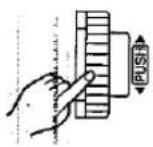 | 4Press the [MENU] Button to exit the Menu.The [ [ ] Indication appears. | In case of very strong camera shake, it may not be possible to stabilize the picture.In a dimly lit place, the Super image Stabilizer Function may not work. In this case, the [ [ ] Indication flashes.If [EFFECT 1] on the [DIGITAL EFFECT] Sub-Menu has been set to [GAINUP], the Super Image Stabilizer Function cannot be used. In this case, the [ [ ] Indication flashes.Under fluorescent lamps, the picture brightness may fluctuate and the colours may be unnatural.After-image distortion may occur.When you use a tripod, we recommend that you turn the Super Image Stabilizer Function off.Cancelling the Super Image Stabilizer Function Set [SIS] on the [CAMERA SETUP] Sub-Menu to [OFF]. |
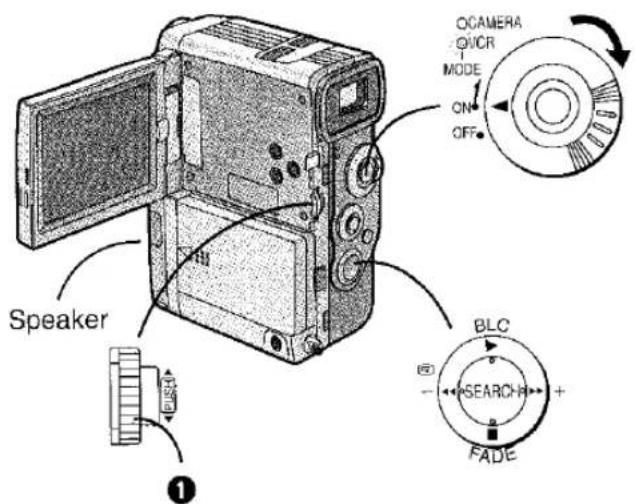
■ Adjusting the Sound Volume
Keep the [PUSH] Dial ① pressed until the [VOLUME] Indication ② appears. Then, turn the [PUSH] Dial to adjust the volume. After adjusting, press the [PUSH] Dial to make the [VOLUME] Indication disappear. To adjust the volume with the Remote Controller, press the [T] or [W] Button to make the [VOLUME] Indication appear. A few seconds after finishing the adjustment, the [VOLUME] Indication disappears.
- Only the volume of the sound from the Movie Camera's built-in speaker can be adjusted.
- When using the Playback Zoom Function, it is not possible to adjust the sound volume.
![VOLUME[-] | | | ---- (+) ②](/content/2026/05/794594/images/aaba5141b2db343b273d9bd9c51e6b2f5eff6b59097d72c9f5fb07d1c053ba65.jpg)
| Title | Procedure | |
| Viewing the Just Recorded Scenes on the Movie Camera (Playback)You can play back recorded scenes right after recording. | 1Turn the [OFF/ON/MODE] Switch clockwise from the [ON] position to put the Movie Camera in the VCR Mode.The [VCR] Lamp lights.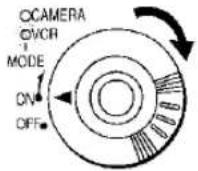 | 2Press the Rewind Button [◀◀] to rewind the tape.Rewind the tape to the point where the recording was started.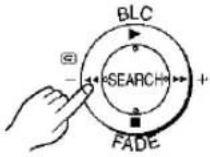 |
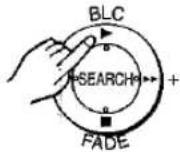
| Searching for a Scene That You Want to Play Back | Cue PlaybackKeep the Cue Button [▶▶] pressed during playback.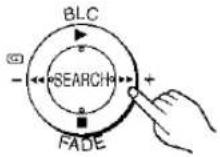  | Review PlaybackKeep the Review Button [◀◀] pressed during playback.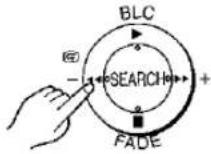  |
Search Lock Function
For longer Cue or Review Playback, press the Cue Button [▶▶] or the Review Button [◀◀] only briefly. As this locks the search function, you do not need to keep the button pressed for a long time.
- To resume normal playback, press the Play Button [▶].
- In Cue and Review Playback, pictures with fast-moving subjects may contain mosaic-like patterns.
Hyper Check Function
- If you press the Fast-forward Button [▶▶] during fast-forwarding of the tape or the Rewind Button [◀◀] during rewinding of the tape, Cue Playback or Review Playback continues for as long as you keep the Button pressed.
- At the beginning and end of Cue Playback or Review Playback, some momentary picture distortion may occur.
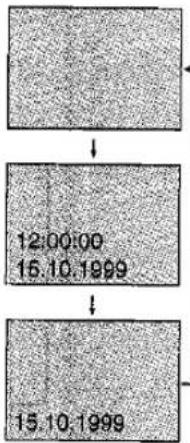
Making the Date/Time Indication Appear
This Movie Camera automatically records the date and time, however not directly in the picture but as part of the sub code (p. 98).
To make the Date/Time Indication appear, set [DATE/TIME] on the [DISPLAY SETUP] Sub-Menu of the [VCR FUNCTIONS] or the [CAMERA FUNCTIONS] Main-Menu to the desired setting. It is also possible to make the Date/Time Indication appear and change it by repeatedly pressing the [DATE/TIME] Button on the Remote Controller.
| Remarks, etc. | |||
| 3Press the Play Button [▶] to start playback. | 4To stop playback:Press the Stop Button [■]. | ●If the tape reaches the beginning during rewinding, it automatically stops.Repeat Playback●If you keep the Play Button [▶] pressed for more than 5 seconds, the Movie Camera switches over to the Repeat Playback Mode and the [R ▶] Indication appears. (To cancel the Repeat Playback Mode, turn the [OFF/ON/MODE] Switch to [OFF]). | |
 |  | ||
 | |||
Variable Speed Search FunctionIt is possible to change the speed of CuePlayback or Review Playback.1 Press the Play Button [▶] during playback.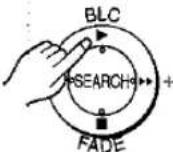  | 2Turn the [PUSH] Dial to select the desired search speed.[IMAGE] | Returning to Normal PlaybackPress the Play Button [▶]. Playback continues at normal speed.[IMAGE] | ●The Variable Speed Search function offers a choice of five playback speeds (1×, 2×, 5×, 10×, 20×) both in forward direction and reverse direction.●During Variable Speed Search (except at 1× speed in forward direction), mosaic-like patterns appear in the picture.●When using the Variable Speed Search Function, the sound is muted. |
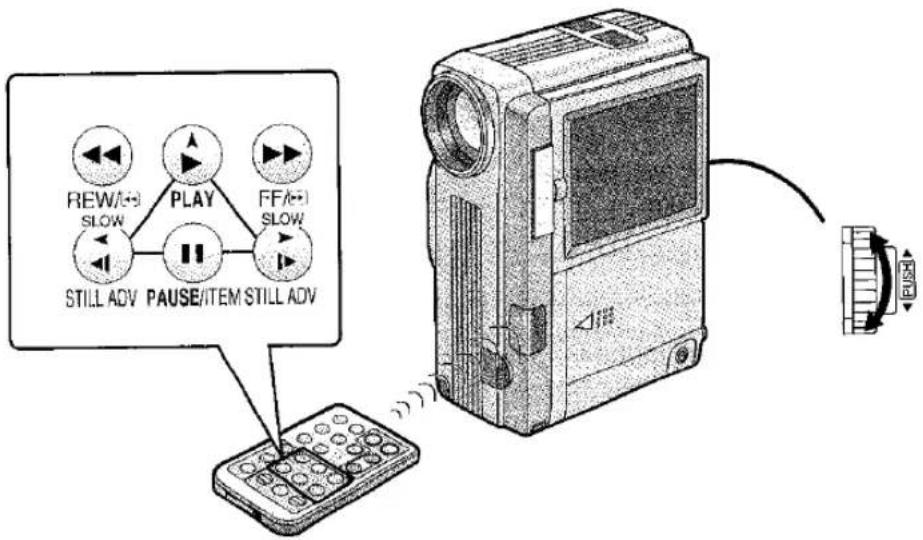
flowchart
graph TD
    A["REW/Slow"] --> B["PLAY"]
    C["FF/Slow"] --> D["PLAY"]
    E["STILL ADV"] --> F["PAUSE/ITEM STILL ADV"]
| Title | Procedure | |
| Playing Back in Slow Motion(Slow Motion Playback) | 1Press the Play Button[▶]. | 2Press the SlowMotion/Still AdvanceButton [◀] or [▶] on theRemote Controller. |
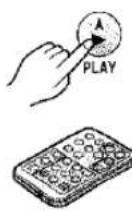 | 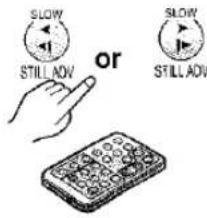 | |
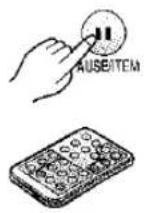
| Playing Back Still Pictures and Advancing Them One by One(Still Playback/Still Advance Playback)You can freeze the action during playback andadvance the still pictures one by one. | 1Press the Play Button[▶]. | 2Press the Pause Button[■].The playback picturestops in the StillPlayback Mode. |
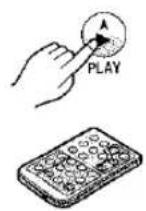 |  | |
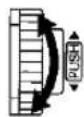
Using the Jog Dial (Jog Playback)
By turning the Jog Dial ([PUSH] Dial) on the Movie Camera in the Still Playback Mode, you can advance the still pictures one by one in forward or reverse direciton.
forward
reverse
| Remarks, etc. | ||
| Resuming Normal PlaybackPress the Play Button [▶].Playback continues with normal speed. | ●During slow motion playback in reverse direction, the Time Code Indication may not be accurate. ●Scenes recorded in the SP Mode are played back at approximately 1/5th of the normal speed. Scenes recorded in the LP Mode are played back at approximately 1/3rd of the normal speed. ●When you play back the picture recorded in the Picture-In-Picture Mode (p. 48) or Multi-Picture Mode (p. 44, 46), the picture may shake vertically. | |
| Pressing the [◀] Button starts slow motion playback in reverse direction, and pressing the [▶]. Button starts slow motion playback in forward direction. | 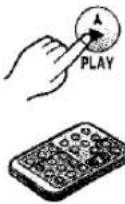 | |
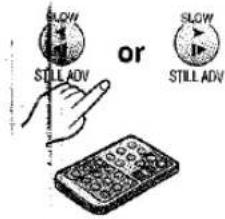
| 3Press the Slow Motion/Still Advance Button [◀] or [▶] on the Remote Controller. | Resuming Normal PlaybackPress the Play Button [▶].Playback continues with normal speed. | Pressing the [◀] Button advances the still pictures one by one in reverse direction. Pressing the [▶] Button advances the still pictures one by one in forward direction. ●Each press of the [◀] Button advances to the next still picture in reverse direction. Each press of the [▶] Button advances to the next still picture in forward direction. Keeping either button pressed continuously advances the still picture one by one until you release the button. ●If you leave the Movie Camera in the Still Playback Mode for more than 6 minutes, it switches over to the Stop Mode to protect the video heads against excessive wear. ●During Still Advance Playback, the Time Code indication may not be accurate. ●During Still Playback, adjusting the sound volume is not possible. |
 |  | |
| Title | Procedure | |
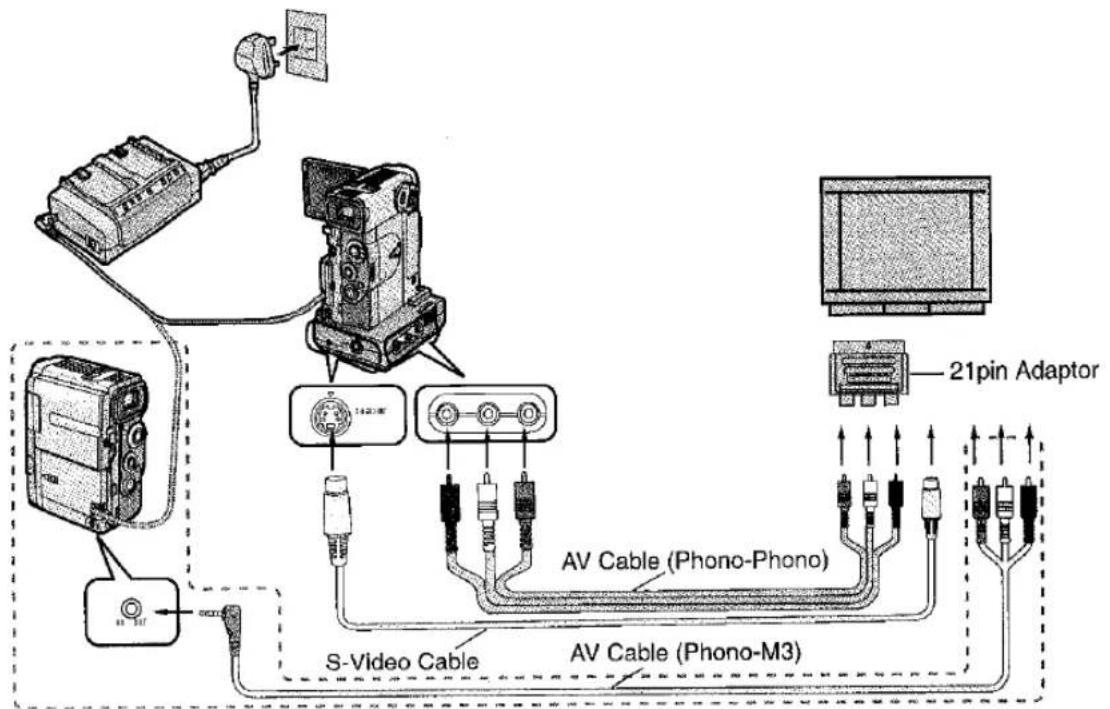
| Playing Back on a TV(With the Output Terminal Box [AV ONE TOUCH STATION] Attached)Attaching the Output Terminal Box [AV ONE TOUCH STATION] to the Movie Camera makes it possible to play back recorded scenes on a TV. | 1Attach the Output Terminal Box [AV ONE TOUCH STATION]. (p. 75)Multi Terminal | 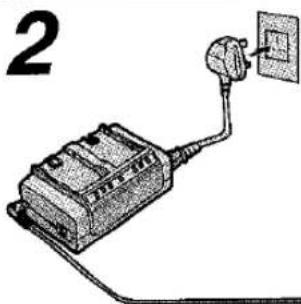 Use the AV Cable (Phono-Phono) and the 21-pin Adaptor for connection to the TV. If your TV is equipped with an S-Video Socket, also connect the S-Video Cable. Use the AV Cable (Phono-Phono) and the 21-pin Adaptor for connection to the TV. If your TV is equipped with an S-Video Socket, also connect the S-Video Cable. |
After UseRemoving the Output Terminal Box [AV ONE TOUCH STATION]If the Output Terminal Box [AV ONE TOUCH STATION] is attached to the Movie Camera, remove it in the following way: 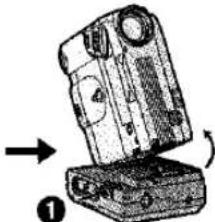 Turn the locking screw in the direction of the arrow.Remove the Output Terminal Box while pressing the [PUSH RELEASE] Button 1. Turn the locking screw in the direction of the arrow.Remove the Output Terminal Box while pressing the [PUSH RELEASE] Button 1. | 1Close the LCD Monitor.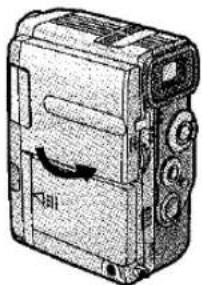 | 2Take out the cassette. (p. 10)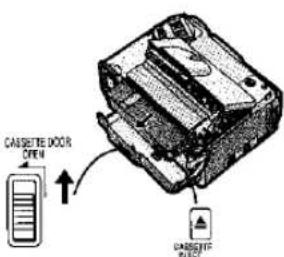 |
Easy Playback on a TV
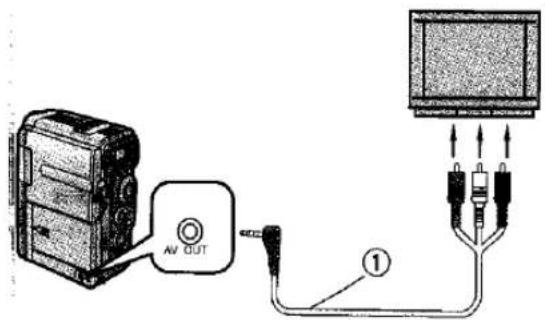
Instead of connecting the Movie Camera to the TV through the Output Terminal Box [AV ONE TOUCH STATION], you can use the AV Cable (Phono-M3) ① to connect [AV OUT] on the Movie Camera directly to the Video and Audio Input Sockets on the TV. The plug for the [AV OUT] Socket must be inserted completely.
Making the Indications Appear on the TV Screen
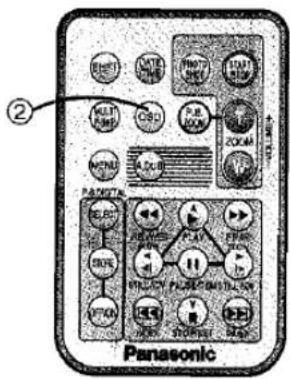
Press the [OSD] Button ② on the Remote Controller.
The On-Screen Indicaitons also appear on the TV screen.
| Remarks, etc. | ||
| Connect the Video and Audio Output Sockets to the Video and Audio Input Sockets on the TV. | ●Before connecting, turn off both the Movie Camera and the TV.●If a cassette recorded with a copyright protection signal (Copy Guard) is played back, the picture is distorted by mosaic-like patterns. However, scenes recorded with this Movie Camera do not contain a copyright protection signal.●Before attaching the Output Terminal Box [AV ONE TOUCH STATION] to the Movie Camera, clean the Multi Terminal on the underside of the Movie Camera. | |
| 3Turn the [OFF/ON/MODE] Switch to [OFF]. | 4Remove the Battery (p. 9) and retract the Viewfinder. | Attaching the Lens CapAfter use, attach the supplied Lens Cap to the Lens to protect it. |
| Title | Procedure | |
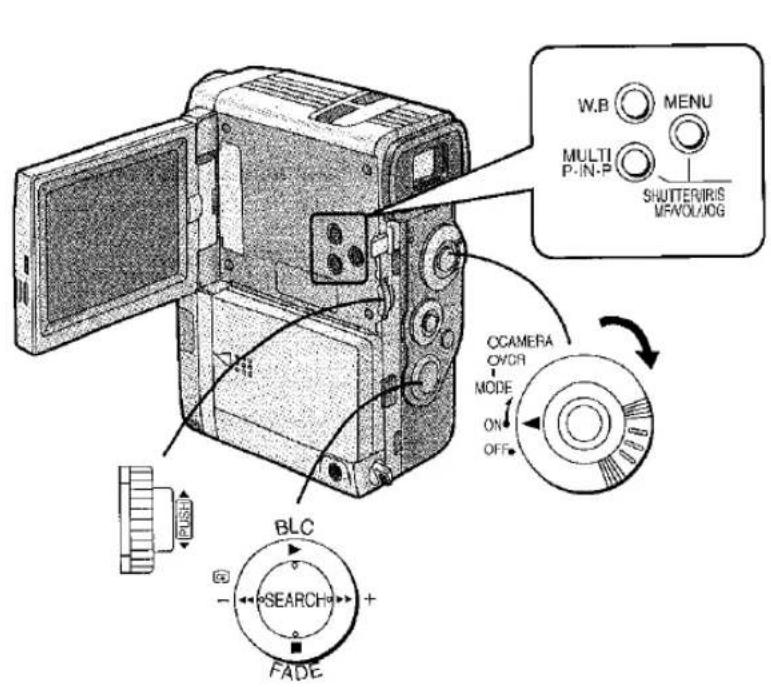
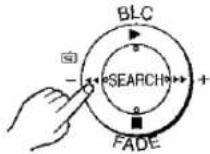
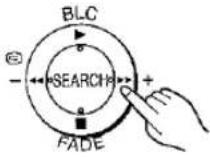
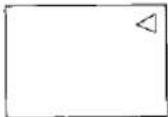
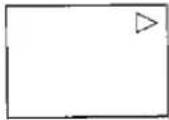
| Viewing Recorded ScenesDuring Recording Pause(Camera Search)You can view recorded scenes when the MovieCamera is in the Recording Pause Mode.The Camera Search Function is convenient to searchfor a scene from which you want to start recording anew scene with smooth scene-to-scene transition. | 1Keep the Reverse Search Button [− SEARCH]or the Forward Search Button [SEARCH+]pressed for more than 1 second.Pressing the [− SEARCH] Button plays back thepicture in reverse direction.Pressing the [SEARCH+] Button plays back thepicture in forward direction. | |
 |  | |
 |  | |
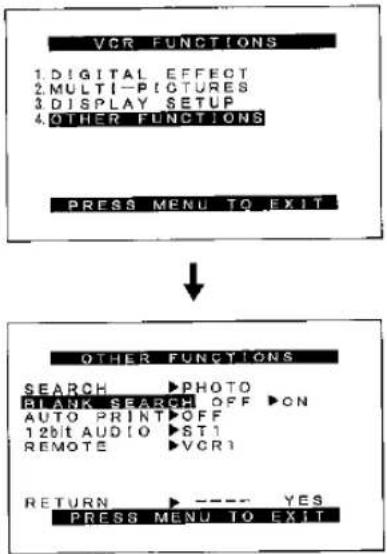
| Searching for the End of theRecorded Part on a Cassette(Blank Search)With the Blank Search Function, you can quickly locatethe end of the recorded part on a cassette (or a blankpart between recordings). | 1Turn the [OFF/ON/MODE] Switchclockwise from the[ON] position to put theMovie Camera in theVCR Mode.The [VCR] Lamp lights. | 2Select the [OTHERFUNCTIONS] on the[VCR FUNCTIONS] Main-Menu. (p. 82)The [OTHERFUNCTIONS] Sub-Menuappears.MENU 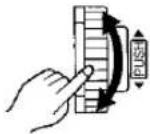 |
 | ||
| Remarks, etc. | ||
2Starting to Record from the Desired Position. Release the pressed Search Button.The Movie Camera is in the Recording Pause Mode.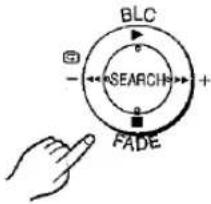 | 3Press the Recording Start/Stop Button to start recording.The Movie Camera starts recording a new scene with smooth scene-to scene transition.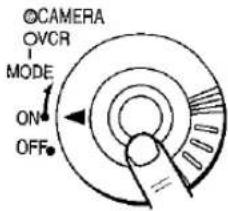 | In the Camera Search Mode, the picture may contain mosaic-like patterns. However, this phenomenon is common to digital video and completely normal.If the Recording Speed Mode (SP/LP) of the previous and the new recording are different, the playback picture may be distorted. |
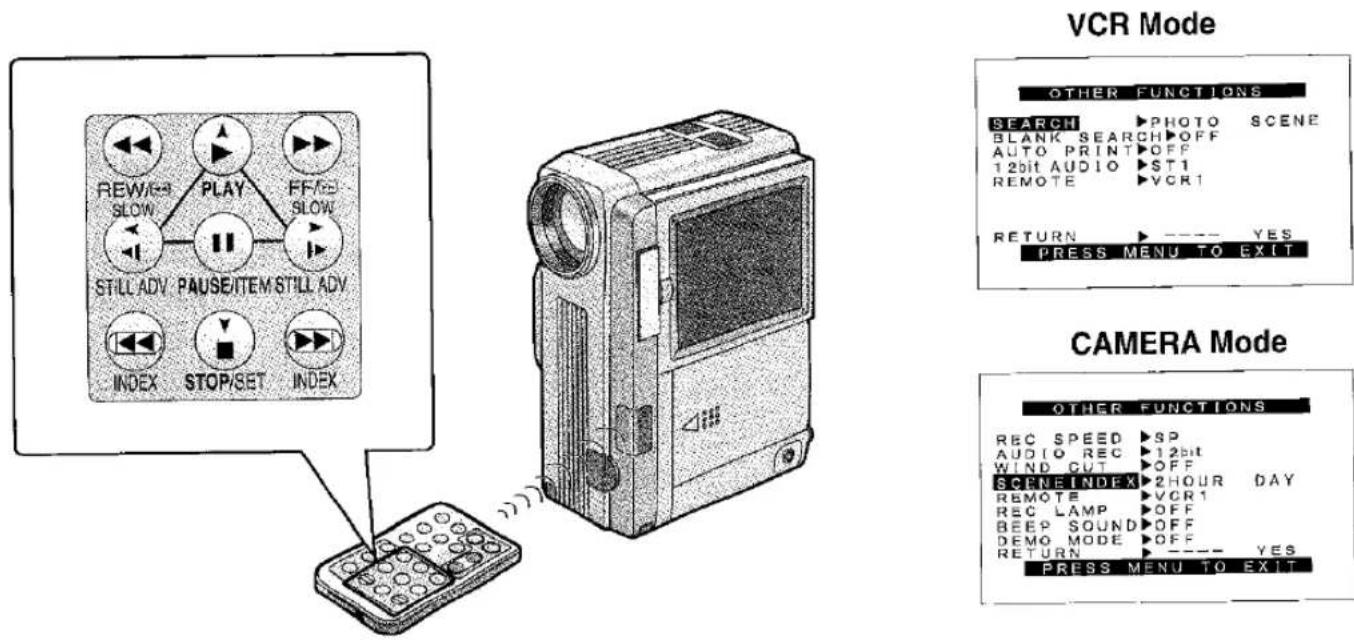
3Turn the [PUSH] Dial to select [BLANK SEARCH].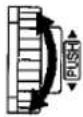 | 4Press the [PUSH] Dial to select [ON]. Approximately 1 second before the end of the last recorded scene, the Movie Camera switches over to the Still Playback Mode.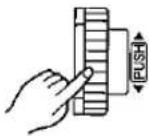 | If there is no blank part on a cassette, the Movie Camera stops at the end of the tape.When the Blank Search has finished and you turn the [OFF/ON/MODE] Switch to change over to the Camera Mode and then start recording, the new scene will be joined to the end of the last recorded scene with a smooth transition.Cancelling the Blank Search Before It Has Finished Press the [■] Button. |
| Title | Procedure | |
| Searching for the Beginning of Recorded Scenes Marked with Index Signal (Index Search)■ Searching for Photoshot Pictures (Photoshot Index Search)Turn the [OFF/ON/MODE] Switch from the [ON] position to put the Movie Camera in the VCR Mode.Set [SEARCH] on the [OTHER FUNCTIONS] Sub-Menu to [PHOTO]. | Photoshot Index Search in Forward DirectionPress the Index Button [▶▶] on the Remote Controller.  | Photoshot Index Search in Reverse DirectionPress the Index Button [◀◀] on the Remote Controller.  |
| ■ Searching for the Beginning of Recorded Scenes (Scene Index Search)Turn the [OFF/ON/MODE] Switch from the [ON] position to put the Movie Camera in the VCR Mode.Set [SEARCH] on the [OTHER FUNCTIONS] Sub-Menu to [SCENE]. | Scene Index Search in Forward DirectionPress the Index Button [▶▶] on the Remote Controller.  | Scene Index Search in Reverse DirectionPress the Index Button [◀◀] on the Remote Controller.  |
Index Search
To allow easy searching for desired scenes, this Movie Camera automatically records index signals during recording as follows:
(While an index signal is being recorded, the [INDEX] Indication flashes for a few seconds.)
INDEX
① Photoshot Index Signal
To search for still pictures recorded in the Photoshop Mode (p. 22) and to use for automatic printing (p. 79).
A photoshop index signal is automatically recorded every time you record a still picture in the Photoshop Mode.
② Scene Index Signal
To search for the beginning of recorded scenes.
A scene index signal is automatically recorded in the following cases:
- When you start recording after inserting a cassette. However, if you switch the Movie Camera from the VCR Mode over to the Camera Mode or set the date and/or time before you start recording, no index signal is recorded.
- According to the setting of [SCENEINDEX] on the [OTHER FUNCTIONS] Sub-Menu of the [CAMERA FUNCTIONS] Main-Menu:
[2HOUR]: An index signal is recorded when recording is restarted after a lapse of more than 2 hours.
[DAY]: An index signal is recorded when recording is restarted after the date has changed since the last recording.
| Remarks, etc. | |
| ●At every press of the corresponding button, the tape is fast-forwarded or rewound to the next still picture recorded in the Photoshop Mode.After reaching the next still picture, the still picture is played back continually, however the sound only for approximately 4 seconds. (If you leave the Movie Camera in the Still Playback Mode for more than 6 minutes, it switches over to the Stop Mode to protect the video heads against excessive wear). | ●The Photoshop Index Search may not work correctly for still pictures recorded near the beginning of the tape.●As no photoshop index signals are recorded for still pictures recorded in the Continuous Photoshop Mode (p. 23), the Photoshop Index Search Function cannot be used to search for these still pictures.●If you keep the [◀◀] or [▶▶] Button pressed for more than 2 seconds, the Intro Search Function is activated and it plays back all still pictures recorded in the Photoshop Mode on the cassette one after another for a few seconds each.(To cancel the Intro Search Function, press the Play Button [▶] or the Stop Button [■].) |
| ●When you briefly press the corresponding button once, the [S 1] Indication appears and the search for the next scene marked with an index signal starts. After the Scene Index Search has started, every time you press the button, the indication changes successively from [S 2] to [S 9], and the beginning of the scene corresponding to the selected number is located.After reaching the desired scene, playback starts automatically.(At a time, Scene Index Search in forward or reverse direction is possible up to the ninth scene marked with index signal from the present tape position.) | ●If the interval between two scene index signals is less than 1 minute, the Scene Index Search may not work correctly.●The Scene Index Search may not work correctly for scenes recorded near the beginning of the tape.●If you keep the [◀◀] or [▶▶] Button pressed for more than 2 seconds, the Intro Search Function is activated and it plays back the beginning of all scenes marked with an index signal on the cassette one after another for a few seconds each.(To cancel the Intro Search Function, press the Play Button [▶] or the Stop Button [■].) |
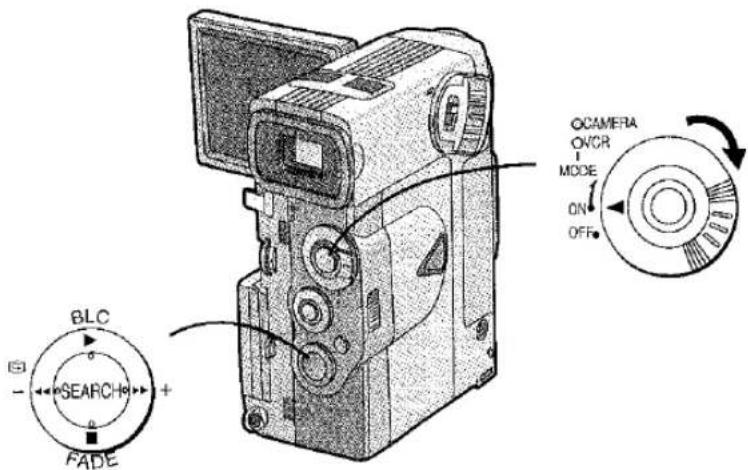
| Title | Procedure | |
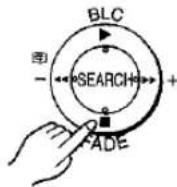
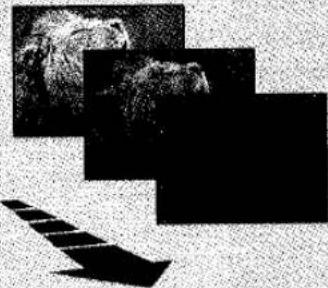
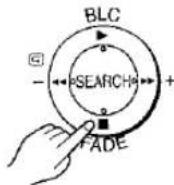
| Starting to Record with Gradually Appearing Picture and Sound (Fading In) Fading-in lets you make the picture and sound appear gradually from a black screen at the beginning of a scene. | 1 With the Movie Camera in the Recording Pause Mode, keep the Fade Button [FADE] pressed. The picture gradually disappears. | 2 When the picture has completely disappeared, press the Recording Start/Stop Button to start recording. |
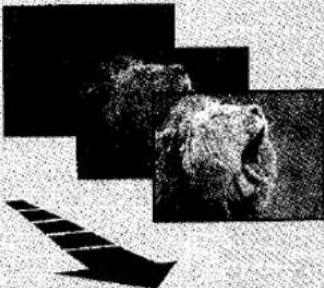 | 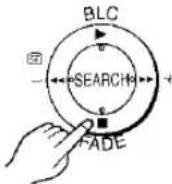 |  |
| Ending the Recording of a Scene with Gradually Disappearing Picture and Sound (Fading Out) Fading-out lets you make the picture and sound disappear gradually into a black screen at the end of a scene. | 1 During recording, keep the Fade Button [FADE] pressed. The picture gradually disappears. | 2 After the picture has completely disappeared, press the Recording Start/Stop Button to stop recording. The Movie Camera is in the Recording Pause Mode. |
 |  |  |
| Remarks, etc. | |
3Approximately3 seconds after the recording has started, release the Fade Button [FADE].The picture gradually appears again.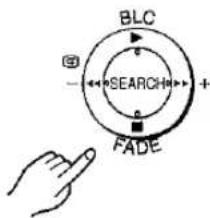 | ●Fading-in and fading-out cannot be used when recording still pictures in the Photoshop (p. 22-25) or Multi-Picture Mode (p. 44-47), and for the small still picture in the Picture-In-Picture Mode (p. 48). |
3Release the Fade Button [FADE].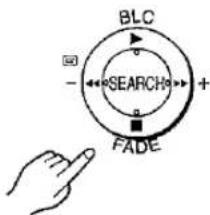 |
| Title | Procedure | ||
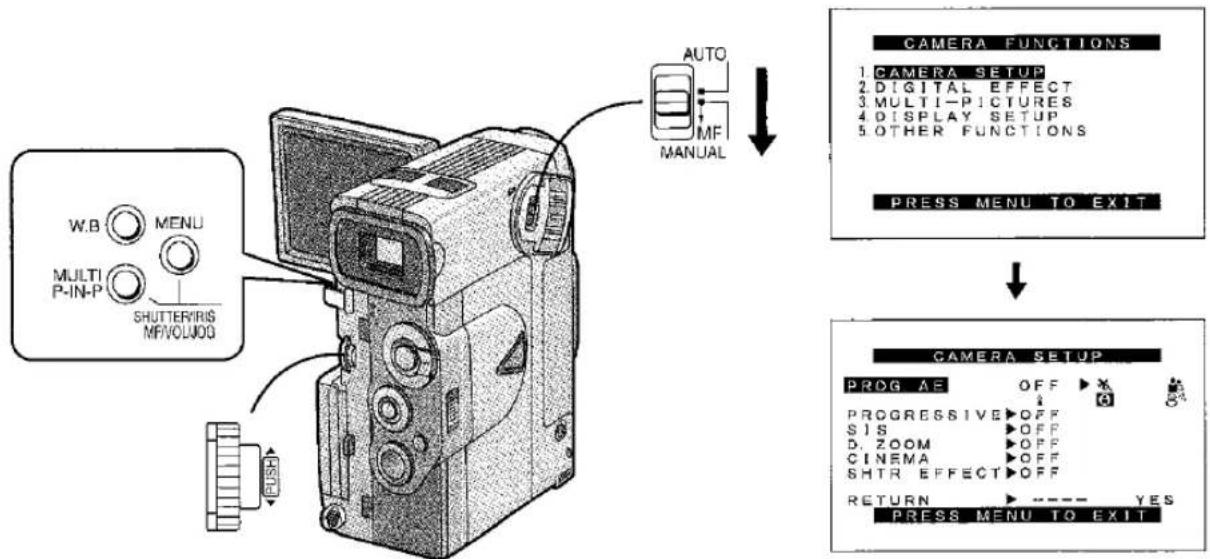
| Recording in Special Situations (Programme AE)This function lets you select Automatic Exposure settings optimized for special recording situations. | 1Set the Mode Selector Switch to [MANUAL]. The [MNL] Indication appears.↓AUTO MANUAL | 2Select the [CAMERA SETUP] on the [CAMERA FUNCTIONS] Main-Menu. (p. 82)The [CAMERA SETUP] Sub-Menu appears.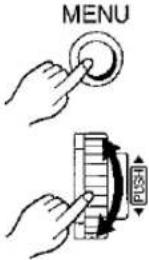 | |
 |  | ||
 |  | ||
 | 5Press the [MENU] Button to exit the Menu. The indication of the selected mode appears.MENU | Cancelling the Programme AE FunctionSet [PROG.AE] on the [CAMERA SETUP] Sub-Menu to [OFF]. Or set the Mode Selector Switch to [AUTO]. | |
| Remarks, etc. | ||
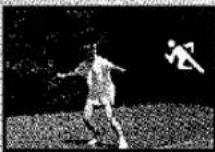
3Turn the [PUSH] Dial to select [PROG.AE].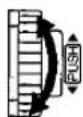 | 4Press the [PUSH] Dial to select the desired mode ([ ], [], [1], [8] or [8]).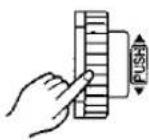 | ●It is not possible to adjust the shutter speed (p. 54) or the iris value (p. 54) when one of the Programme AE Modes is selected.Sports Mode●When playing back scenes recorded in the Sports Mode, you can enjoy slow motion and still playback of very sharp images with fine details●During normal playback, movements in the picture may not be smooth.●Avoid recording under fluorescent, mercury-vapour or natrium lamps in this mode, as the colour and the brightness of the playback picture might fluctuate.●When recording subjects lit by strong lights or with much light reflection, the playback picture may contain vertical streaks of light.●When the scene is not sufficiently lit, the [ ] Indication flashes.●When using this mode for recording indoors, the playback picture may flicker.●It is not possible to use the Sports Mode [ ] together with the Gain-up Mode [GAINUP].●When recording still pictures in the Progressive Photoshop Mode while the Sports Mode is activated, the brightness of the recorded still pictures may be unstable.Portrait Mode●When using this mode for recording indoors, the playback picture may flicker.●It is not possible to use the Portrait Mode [ ] together with the Gain-up Mode [GAINUP].●When recording still pictures in the Progressive Photoshop Mode while the Portrait Mode is activated, the brightness of the recorded still pictures may be unstable.Low Light Mode●It may not be possible to sufficiently brighten up extremely dark scenes.Spotlight Mode●When using this mode, the recorded picture may be extremely dark.●If a subject is extremely bright, the recorded picture may be whitish.Surf & Snow Mode●If a subject is extremely bright, the recorded picture may be whitish. |
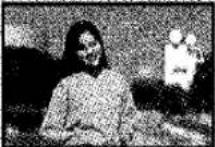
| [ ] Sports ModeTo record scenes with fast-moving subjects such as sports scenes.[ ] Portrait ModeTo make subjects stand out sharply from the background.[ ] Low Light ModeTo record dark scenes more brightly.[ ] Spotlight ModeTo record subjects under bright spotlights such as at a party, in the theatre, etc.[ ] Surf & Snow ModeTo record subjects in brightly lit surroundings such as on a ski slope, beach, etc. | ||
| Title | Procedure | |
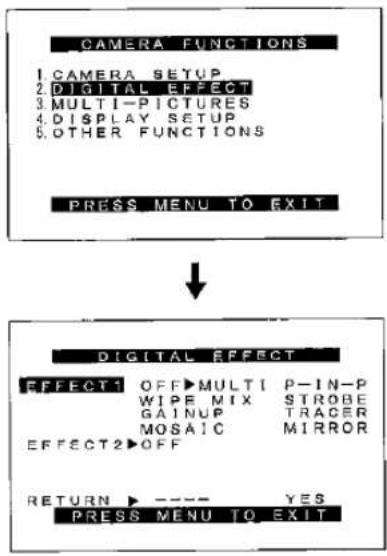
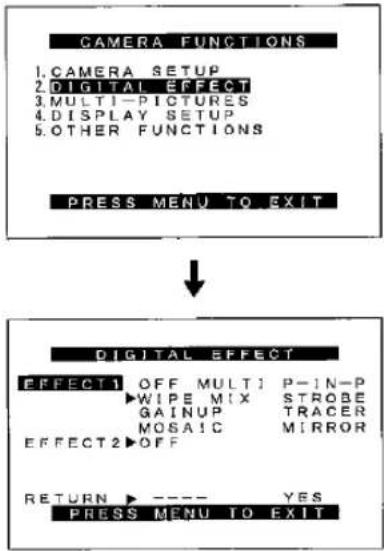
| Recording with Special Effects(Digital Effects)There are 13 different modes available for adding special digital picture effects. | 1Select the [DIGITAL EFFECT] on the [CAMERA FUNCTIONS] Main-Menu. (p. 82)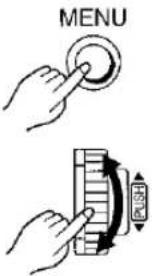 | 2Turn the [PUSH] Dial to select [EFFECT1] or [EFFECT2].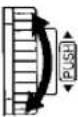 |
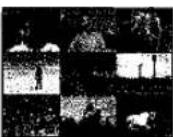
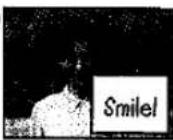
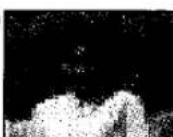
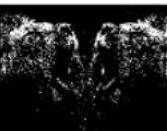
| Remarks, etc. | Digital Effects 1 [EFFECT1]1Multi-Picture Mode [MULTI]The screen is divided into 9 small still pictures. For details, (p. 44-47).2Picture-in-Picture Mode [P-IN-P]A small still picture is inserted and displayed inside the normal picture. For details, (p. 48).3Wipe Mode [WIPE]It gradually replaces a picture of the last previously recorded scene with the picture of the new scene, like drawing a curtain. For details, (p. 50).4Mix Mode [MIX]It gradually fades out the picture of the last previously recorded scene while fading in the picture of the new scene. For details, (p. 50).5Strobe Mode [STROBE]It records the pictures with a stroboscope-like effect.6Gain-up Mode [GAINUP]It electronically brightens up the picture. In this mode, adjust the focus manually. | |
| When [PROGRESSIVE] on the [CAMERA SETUP] Sub-Menu is set to [ON], it is not possible to use any of the digital modes in [EFFECT1] on the [DIGITAL EFFECT] Sub-Menu.If you have set [EFFECT1] on the [DIGITAL EFFECT] Sub-Menu to [GAINUP], you need to adjust the focus manually; however, adjusting the shutter speed and selecting a white balance mode are not possible.If you have set [EFFECT2] on the [DIGITAL EFFECT] Sub-Menu to [B/W] or [SEPIA], changing the selected white balance mode is not possible.It is not possible to select the Sports Mode [ ] or the Portrait Mode [ ] together with the Gain-up Mode [GAINUP] on the [DIGITAL EFFECT] Sub-Menu. (p. 25)Cancelling the Digital EffectSet [EFFECT1] or [EFFECT2] on the [DIGITAL EFFECT] Sub-Menu to [OFF]. | ||
3
Press the [PUSH] Dial to select the desired digital effect.
4
Press the [MENU] Button to exit the Menu.
●The picture now has the selected digital effect. However, the Multi-Picture Function, Picture-in-Picture Function, Wipe Function and Mix Function require additional operations to make their effect visible. (p. 44-51)
⑦ Trailing Effect Mode [TRACER]
The picture is recorded with a trailing effect.
⑧ Mosaic Mode [MOSAIC]
The picture becomes mosaic-like.
9 Mirror Mode [MIRROR]
The right half of the picture is a mirror image of the left half.
Digital Effects 2 [EFFECT2]
10 Negative Mode [NEGA]
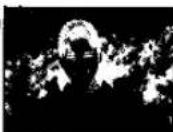
The recorded pictures have reversed colours similar to photographic negatives.
⑪ Sepia Mode [SEPIA]
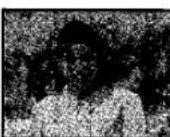
Scenes are recorded with a brown tint similar to the colour of old photographs.
⑫ Black & White Mode [B/W]
The picture is recorded in black and white.
13 Solarisation Mode [SOLARI]
The picture is recorded with an effect similar to a painting.
Effects
Digital Effects 1 [EFFECT1]
1
2
③
④
5
6
7
8
9
Digital Effects 2 [EFFECT2]
10
11
12
13
| Title | Procedure | |
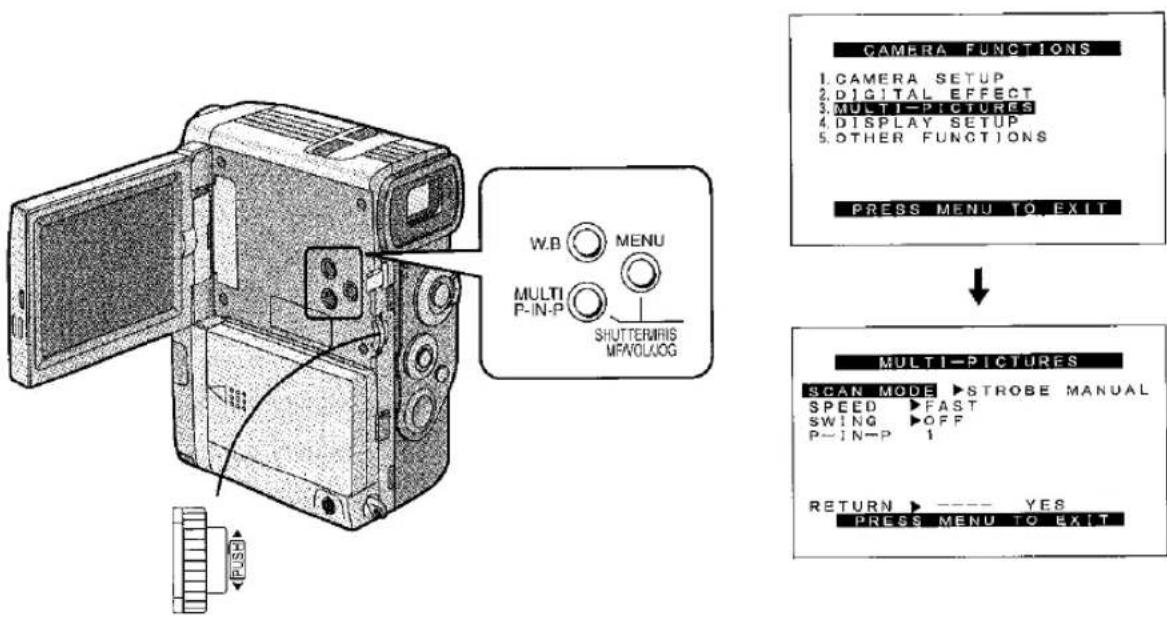
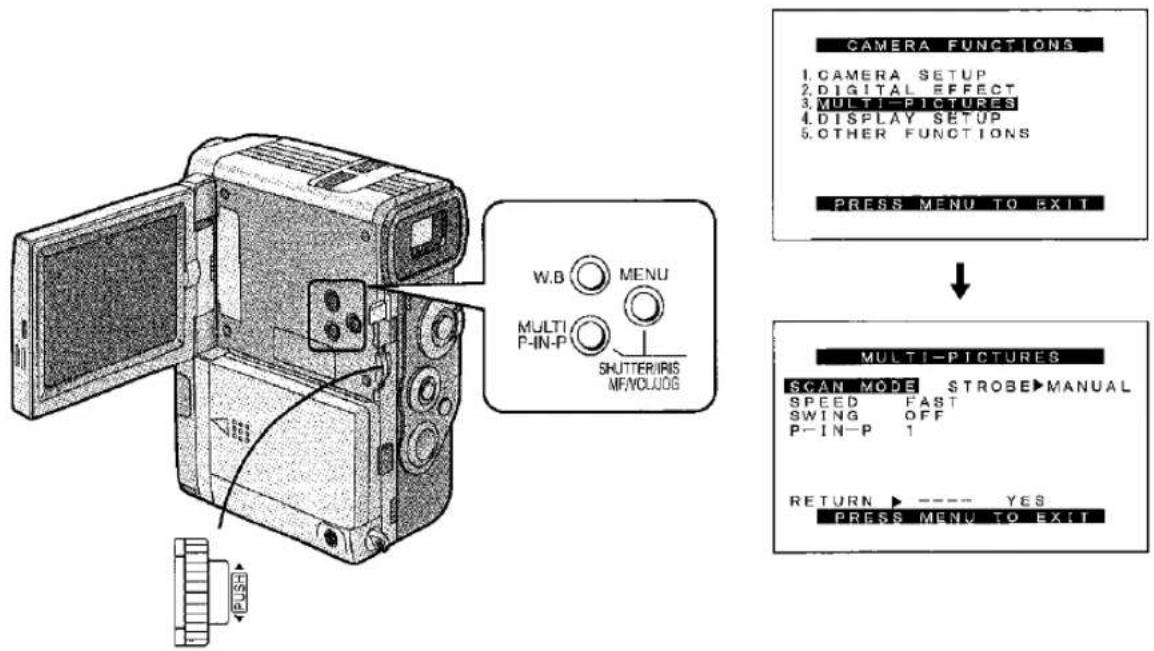
Recording with Special Effects (Digital Effects) (Continued)■ Strobe Multi-Picture ModeThis function captures and displays a sequence of 9 small still pictures.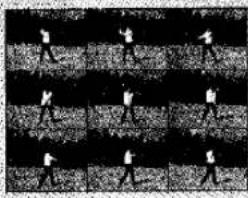 | 1After setting [EFFECT1] on the [DIGITAL EFFECT] Sub-Menu to [MULTI]... (p.42):Press the [MENU] Button. | 2Turn the [PUSH] Dial to select [MULTI- PICTURES] and then press the [PUSH] Dial.The [MULTI-PICTURES] Sub-Menu appears.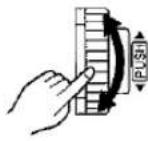 |
5Press the [MENU] Button to exit the menu.MENU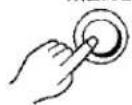 | 6Press the [MULTI] Button.A sequence of 9 still pictures appears.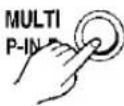 | |
| Remarks, etc. | ||
3Turn the [PUSH] Dial to select [SCAN MODE] and then press the [PUSH] Dial to select [STROBE].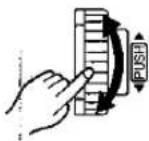 | 4Turn the [PUSH] Dial to select [SPEED] and then press the [PUSH] Dial to select the desired strobe speed.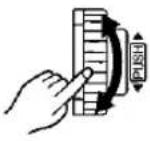 | ●At the [FAST] setting, the sequence of 9 still pictures is captured within approximately 1 second, at [NORMAL] within approximately 2 seconds, and at [SLOW] within approximately 3 seconds.Swing ModeIf you set [SWING] on the [MULTI-PICTURES] Sub-Menu of the [CAMERA FUNCTIONS] Main-Menu to [ON], the intervals at which the 9 still pictures are taken are longer at the beginning and end than in the middle of the swing strobe period.Notes for Using the Multi-Picture Mode●It is not possible to use the Multi-Picture Mode when [PROGRESSIVE] on the [CAMERA SETUP] Sub-Menu is set to [ON].●When using the Mirror Mode (p. 21) with the LCD Monitor facing forward, pressing the [MULTI] Button displays the still pictures starting at the top right corner of the screen.●The quality of the pictures recorded in the Multi-Picture Mode is slightly inferior.●To record the displayed Multi Mode still pictures onto the tape, press the Recording Start/Stop-Button or the [PHOTO SHOT] Button. |
| Making the Multi-Pictures DisappearPress the [MULTI] Button. | Displaying the Multi-Pictures AgainPress the [MULTI] Button for more than 1 second. | |
 |  | |
| Title | Procedure | |
Recording with Special Effects (Digital Effects) (Continued)■ Manual Multi-Picture ModeWith this function, you can capture up to 9 small still pictures and display them together on the same screen. These still pictures can be recorded in the Photoshot Mode.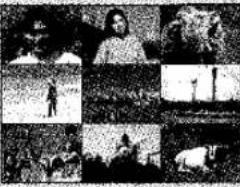 | 1After setting [EFFECT1] on the [DIGITAL EFFECT] Sub-Menu to [MULTI]...(p.42):Press the [MENU] Button. | 2Turn the [PUSH] Dial to select [MULTI-PICTURES] and then press the [PUSH] Dial. The [MULTI-PICTURES] Sub-Menu appears. |
5Press the [MULTI] Button once, and then again for each of the scenes that you want to capture in the Multi-Picture Mode. | ||
| Remarks, etc. | ||
3Turn the [PUSH] Dial to select [SCAN MODE] and then press the [PUSH] Dial to select [MANUAL]. | 4Press the [MENU] Button to exit the menu.MENI1 | Notes for Using the Multi-Picture ModeIt is not possible to use the Multi-Picture Mode when [PROGRESSIVE] on the [CAMERA SETUP] Sub-Menu is set to [ON].When using the Mirror Mode (p. 21) with the LCD Monitor facing forward, pressing the [MULTI] Button displays the still pictures starting at the top right corner of the screen.The quality of the pictures recorded in the Multi-Picture Mode is slightly inferiorTo record the displayed Multi Mode still pictures onto the tape, press the Recording Start/Stop Button or the [PHOTO SHOT] Button.Erasing the Multi-Pictures One by OneWhile the Multi-Pictures are displayed, press the [MULTI] Button for more than 1 second.This erases the last captured picture. Keeping the [MULTI] Button pressed erases the pictures continuously.After you have erased the still pictures one by one, it is not possible to display them again. |
Making All Multi-Pictures DisappearAfter displaying 9 pictures, it is possible to make them disappear in one go by pressing the [MULTI] Button. | Displaying the Multi-Pictures AgainPress the [MULTI] Button for more than 1 second. | |
| Title | Procedure | |
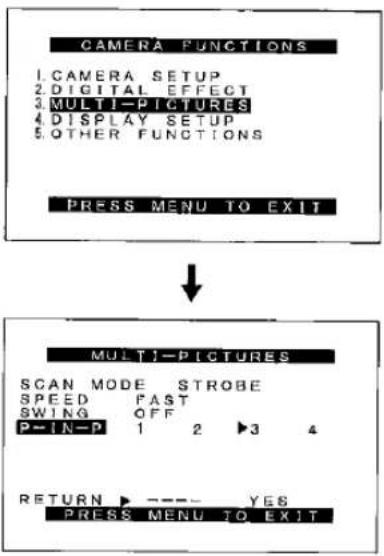
| Recording with Special Effects (Digital Effects) (Continued)■ Picture-in-Picture ModeThis function lets you display a small still picture inside the normal picture. | 1After setting [EFFECT1] on the [DIGITAL EFFECT] Sub-Menu to [P-IN-P]... (p.42):Press the [MENU] Button. | 2Turn the [PUSH] Dial to select [MULTI- PICTURES] and then press the [PUSH] Dial.The [MULTI-PICTURES] Sub-Menu appears. |
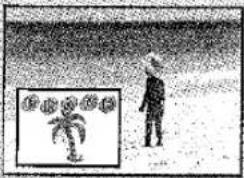 |  |  |
 | 5Aim the Movie Camera at the scene that you want to capture and insert as a small picture and press the [P-IN-P] Button.The small still picture appears inside the normal picture. | Erasing the Small PicturePress the [P-IN-P] Button. |
 |  | |
| Remarks, etc. | ||
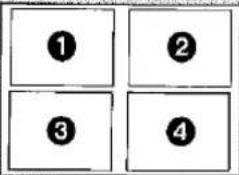
| 3Turn the [PUSH] Dial to select [P-IN-P] and then press the [PUSH] Dial to select the desired position (1, 2, 3 or 4) where you want to insert the small picture. | 4Press the [MENU] Button to exit the menu. | ●It is not possible to use the Picture-in-Picture Mode when [PROGRESSIVE] on the [CAMERA SETUP] Sub-Menu is set to [ON].●When you use the Camera Search Function or Recording Check Function, the small picture disappears. (However, it appears again after the Camera Search or Recording Check has finished.)●It is possible to record the picture with the small picture inside in the Photoshop Mode. (However, it cannot be recorded in the Progressive Photoshop Mode.)●Turning the Movie Camera off erases the small picture being displayed inside the normal picture.●To record in the Picture-in-Picture Mode, press the Recording Start/Stop Button or the [PHOTO SHOT] Button. |
| Title | Procedure | |
Recording with Special Effects (Digital Effects) (Continued)■ Wipe ModeIt gradually replaces a still picture of the last recorded scene with the moving picture of the new scene, like drawing a curtain.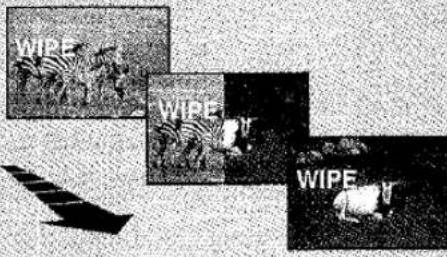 | 1Set [EFFECT 1] on the [DIGITAL EFFECT] Sub-Menu to [WIPE] and exit the Menu. (p. 42)The [WIPE] Indication appears.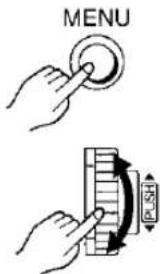 | 2Press the Recording Start/Stop Button to start recording.The normal recording starts.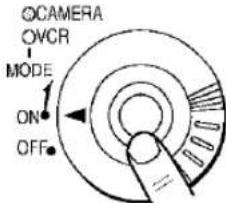 |
■ Mix ModeIt gradually fades out a still picture of the last recorded scene while fading in the moving picture of the new scene.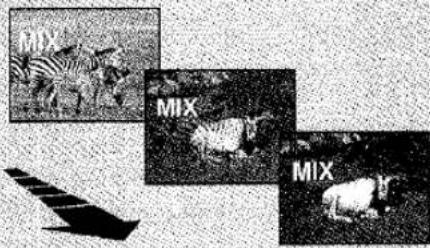 | 1Set [EFFECT 1] on the [DIGITAL EFFECT] Sub-Menu to [MIX] and exit the Menu. (p. 42)The [MIX] Indication appears.MENU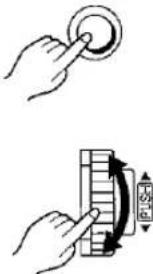 | 2Press the Recording Start/Stop Button to start recording.The normal recording starts.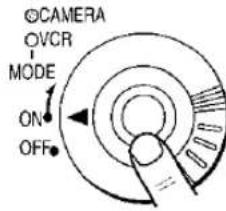 |
| Remarks, etc. | ||
3Press the Recording Start/Stop Button to pause recording.The last picture is stored in memory.The [WIPE] Indication changes to [WIPE].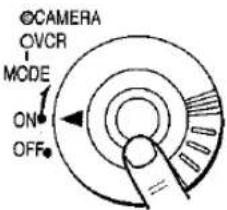 | 4Press the Recording Start/Stop Button to start recording again.The last picture of the previous scene is gradually replaced by the new scene.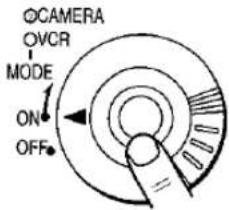 | ·If you perform any of the following operations after performing Step 3, the picture stored in memory is erased and the Wipe and Mix Functions cannot be used:·Selecting any other mode on the [DIGITAL EFFECT] Sub-Menu.·Using the Camera Search Function.·Instead of performing the Wipe or Mix from the last recorded picture, you can store a still picture in memory by pressing the [PHOTO SHOT] Button after Step 1 above and then perform Step 4. |
3Press the Recording Start/Stop Button to pause recording.The last picture is stored in memory.The [MIX] Indication changes to [MIX].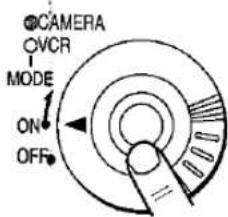 | 4Press the Recording Start/Stop Button to start recording again.The last picture gradually fades out while the new scene fades in.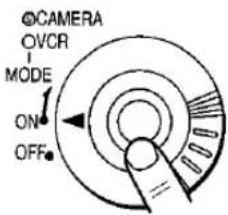 | |
1
2

3
4
| Title | Procedure | |
| Recording with Natural Colours(White Balance)This Movie Camera automatically adjusts the white balance to ensure that the pictures are recorded with natural colours. For certain types of subjects and lighting conditions, however, this Auto White Balance Adjustment Mode may not be able to ensure natural colours (p. 97). In these cases, you can select either one of the 3 preset modes explained below (indoor, outdoor, or the last manually adjusted white balance setting), or you can manually adjust the while balance.The modes change in the following order:1 Indoor Mode (recording under incandescent lamp)(*)2 Outdoor Mode (*)3 Last manually adjusted White Balance setting (■)4 Automatic White Balance Adjustment (no indication) | 1Set the Mode Selector Switch to [MANUAL].The [MNL] Indication appears.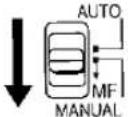 | 2Press the White Balance [W.B] Button.Repeatedly press the [W.B] Button to select the desired White Balance Mode. |
| Adjusting the White Balance ManuallyUse the Manual White Balance Adjustment Mode for all types of lighting outside the range 1 (p. 97), as the Auto White Balance Adjustment Mode can only ensure natural colours for the type of lighting within that range. For optimum results under almost any types of lighting, we recommend that you adjust the white balance manually for each new scene. | 1Attach the Lens Cap and zoom in until the entire screen becomes white.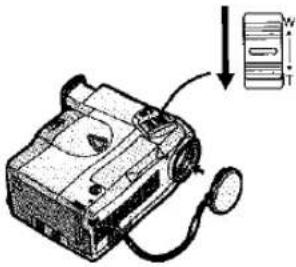 | 2Set the Mode Selector Switch to [MANUAL].The [MNL] Indication appears.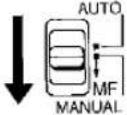 |
Remarks, etc.
Notes about the Recording with Natural Colours
- Be sure to remove the Lens Cap before setting the [OFF/ON/MODE] Switch to [ON]. If the Lens Cap is still attached to the Lens when the [CAMERA] Lamp lights, the automatic white balance setting may not be precise.
Notes about the Adjusting the White Balance Manually
In the Following Cases, the [■] Indication Flashes:
- When you recall the last manually adjusted white balance setting
The flashing indication tells you that the white balance setting you last adjusted is still maintained. This setting is kept until you adjust the white balance again.
- When you are trying to adjust the white balance in a dark place
Under weak illumination, precise manual white balance adjustment may not be possible. In this case, set the Mode Selector Switch to [AUTO] to record with automatic white balance adjustment.
- During manual adjustment of the white balance The [■] Indication flashes while the white balance is being adjusted. When the white balance adjustment is finished, the [■] Indication stops flashing and remains lit.
- It is not possible to manually adjust the white balance or select any of the preset white balance modes when you have zoomed to 10X or higher (digital zoom range), when [EFFECT1] on the [DIGITAL EFFECT]. Sub-Menu is set to [GAINUP] and when [EFFECT2] is set to [SEPIA] or [B/W].
• We recommend that you adjust the white balance anew whenever there is a change in the recording situation.
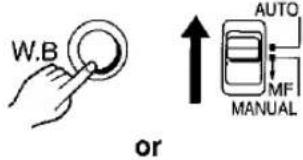
3
Keep the [W.B] Button pressed until the [■] Indication stops flashing and remains lit.

Returning to the Automatic White Balance Adjustment Mode
Press the [W.B] Button repeatedly until none of the White Balance Mode Indications ([★], [★], [■]) are displayed any more. Or, set the Mode Selector Switch to [AUTO].

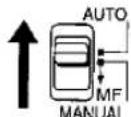
or
| Title | Procedure | |
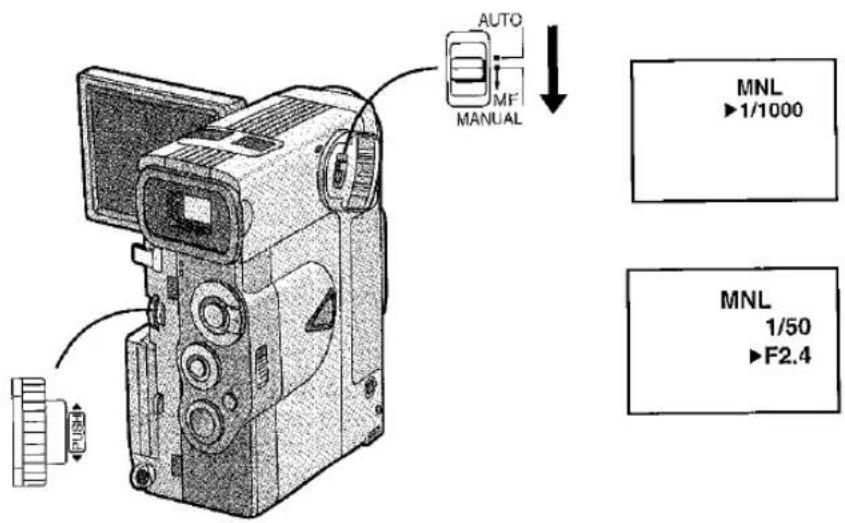
| Adjusting the Shutter Speed ManuallyTo achieve special creative effects or to cope with special lighting situations or fast-action scenes, you can adjust the shutter speed manually. | 1Set the Mode Selector Switch to [MANUAL].The [MNL] Indication appears.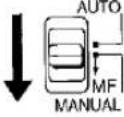 | 2Press the [PUSH] Dial.The Shutter Speed Indication appears.You can change between the Shutter Speed Indication and the Iris (F Number) Indication by repeatedly pressing the [PUSH] Dial.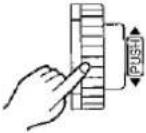 |
| Adjusting the Iris (F Number) ManuallyTo achieve special creative effects or to cope with special lighting situations, you can adjust the iris (F number) manually. | 1Set the Mode Selector Switch to [MANUAL].The [MNL] Indication appears.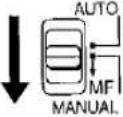 | 2Press the [PUSH] Dial twice.The [▶F] Indication appears.You can change between the Iris (F Number) Indication and the Shutter Speed Indication by repeatedly pressing the [PUSH] Dial.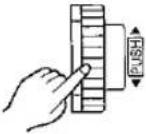 |
3Turn the [PUSH] Dial to adjust the shutter speed.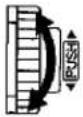 | Returning to the Normal Shutter SpeedSet the Mode Selector Switch to [AUTO].AUTO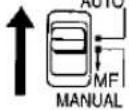 |
3Turn the [PUSH] Dial to adjust the Iris.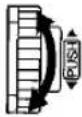 | Returning to the Normal Iris Value (F Number)Press the [PUSH] Dial one time to make the [▶F] Indication disappear. Or set the Mode Selector Switch to [AUTO].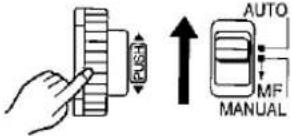 |
Remarks, etc.
Notes about the Adjusting the Shutter Speed Manually
Range of Shutter Speed Adjustment 1/50-1/8000 s
The standard shutter speed is 1/50 s.
The nearer to [1/8000] a setting you select, the faster the shutter speed becomes.
- When [PROGRESSIVE] on the [CAMERA SETUP] Sub-Menu is set to [ON], the range of selectable shutter speeds is limited from 1/50 s to 1/500 s.
- The playback picture of subjects lit by strong lights or with much light reflection may contain vertical streaks of light.
- During normal playback, the scene-to-scene transitions may not be smooth.
- Avoid recording under fluorescent lamps, mercury lamps or natrium lamps, as they can cause unstable colours and brightness of the playback picture.
- When [PROGRESSIVE] on the [CAMERA SETUP] Sub-Menu is set to [AUTO], and the shutter speed is set to 1/750 s or faster, the Progressive Photoshop Mode cannot be used. (p. 24)
- When using the Gain-up Mode (p. 42) or any of the Programme AE Modes (p. 40), it is not possible to adjust the shutter speed. If the shutter speed was manually adjusted, this setting is cancelled.
- Adjust the shutter speed according to the recording situation.
Notes about the Adjusting the Iris (F Number) Manually
Range of Iris Adjustment
CLOSE (Closed)→F 16...F 2.0→OP (Opened)+0 dB ...OP+18dB
The nearer to [CLOSE] a value you select, the darker the picture becomes.
The nearer to [OP+18dB] a value you select, the brighter the picture becomes.
The figures with+dB show the Gain-up value. If you increase the value too much, the picture quality deteriorates.
- Manually adjusting the shutter speed after performing manual iris adjustment changes the Iris back to automatic adjustment. Therefore, if you want to adjust both the shutter speed and Iris manually, be sure to adjust the shutter speed first.
- Manual Iris adjustment is not possible when [PROG.AE] on the [CAMERA SETUP] Sub-Menu is set to any setting other than [OFF]. (p. 40)
- Increasing the Gain-up value also increases the graininess of the picture.
- Depending on the zoom magnification, some Iris values may not be displayed.
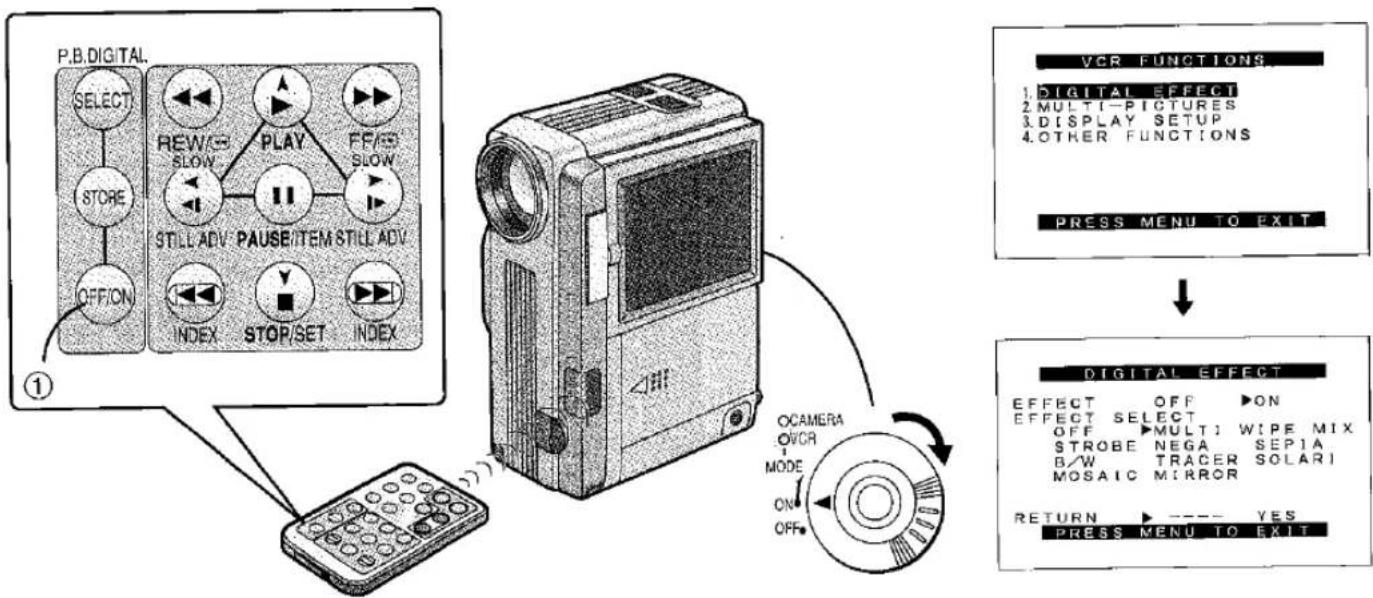
flowchart
graph TD
    A["P.B.DIGITAL"] --> B["SELECT"]
    B --> C["STORE"]
    C --> D["OFF/ON"]
    D --> E["1"]
    E --> F["REW/SLOW"]
    F --> G["PLAY"]
    G --> H["FF/SSLOW"]
    H --> I["II"]
    I --> J["STILL ADV"]
    J --> K["PAUSE/ITEM STILL ADV"]
    K --> L["INDEX"]
    L --> M["STOP/SET"]
    M --> N["INDEX"]
    O["VCR FUNCTIONS"] --> P["1. DIGITAL EFFECT"]
    P --> Q["2. MULTI-PICTURES"]
    Q --> R["3. DISPLAY SETUP"]
    R --> S["4. OTHER FUNCTIONS"]
    S --> T["PRESS MENU TO EXIT"]
    U["Digital Effect"] --> V["EFFECT OFF ON"]
    V --> W["EFFECT SELECT OFF MULTI WIPE MIX"]
    W --> X["STROBE NEGA SEP1A"]
    X --> Y["B/W TRACER SOLARI"]
    Y --> Z["MOSAIC MIRROR"]
    Z --> AA["RETURN --- YES"]
    AA --> AB["PRESS MENU TO EXIT"]
| Title | Procedure | |
| Playing Back with Special Effects(Playback Digital Effects)There are 11 different modes available for adding special digital picture effects to your recordings during playback. They are identical to the Digital Effects 1 and 2 (p. 42) that can be used during recording.1 [MULTI] 2 [WIPE]3 [MIX] 4 [STROBE]5 [NEGA] 6 [SEPIA]7 [B/W] 8 [TRACER]9 [SOLARI] 10 [MOSAIC]11 [MIRROR]■ To select the Digital Effects using the Remote Controller | 1Turn the [OFF/ON/MODE] Switch from the [ON] position to put the Movie Camera in the VCR Mode.The [VCR] Lamp lights.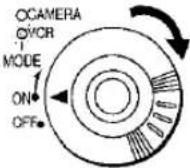 | 2Press the Play Button[▶]. |
| ■ To select the Digital Effects using the Menu Function | 1Turn the [OFF/ON/MODE] Switch to [VCR].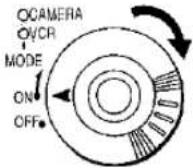 | 2Press the [MENU] Button. |
| Remarks, etc. | ||
3Press the [SELECT] Button on the Remote Controller to select the desired digital effect.●Repeatedly pressing the [SELECT] Button charges the selected digital effect in the order 1 to 1. | Cancelling the Digital EffectPress the [SELECT] Button on the Remote Controller to make the displayed digital effect indication disappear.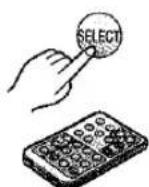 | Suspending the Playback Digital Effect TemporarilyYou can suspend and re-activate the digital effect by repeatedly pressing the [OFF/ON] Button 1.When the digital effect is temporarily suspended, the indication of the selected effect flashes.●If you press the [OFF/ON] Button while the Wipe or Mix is being performed, the effect is paused at that point. If you press the [OFF/ON] Button again, the effect resumes.●The signal of the picture with a digital effect added during playback cannot be output from the DV Terminal (p. 4) or the Digital Still Picture Terminal (p. 80).●In the VCR Mode, the Wipe and the Mix Function can only be operated with the Remote Controller.●It is not possible to use the Wipe or Mix Function during playback of an unrecorded part of the tape.●It is not possible to use the Mirror Mode of the Digital Effects and the Playback Zoom Function (p. 64) at the same time. |
3Set [EFFECT SELECT] on the [DIGITAL EFFECT] Sub-Menu of the [VCR FUNCTIONS] Main-Menu to the desired effect. (p. 82)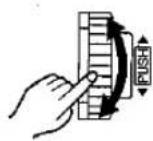 | Cancelling the Digital EffectSet [EFFECT SELECT] on the [DIGITAL EFFECT] Sub-Menu to [OFF].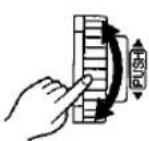 | Suspending the Playback Digital Effect TemporarilySet [EFFECT] on the [DIGITAL EFFECT] Sub-Menu to [OFF], and later to [ON] to re-activate it. When the digital effect is temporarily suspended, the indication of the selected effect flashes. |
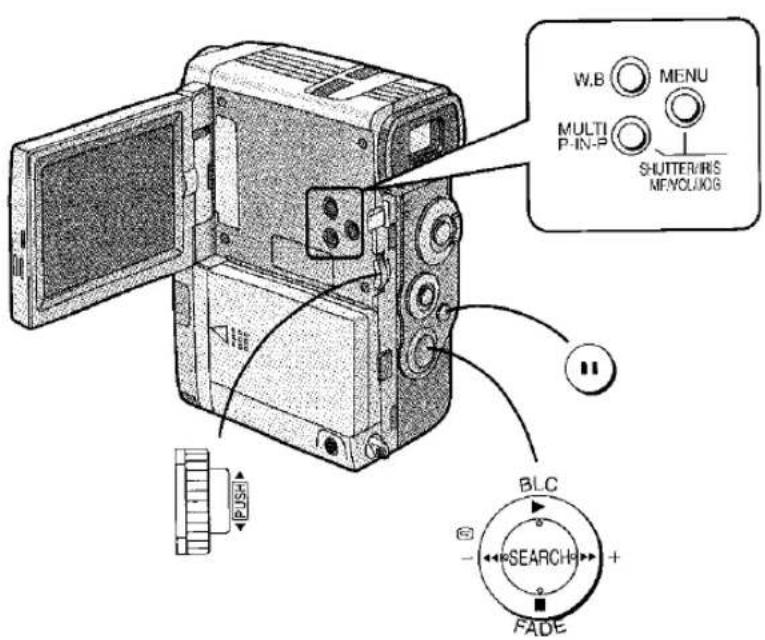
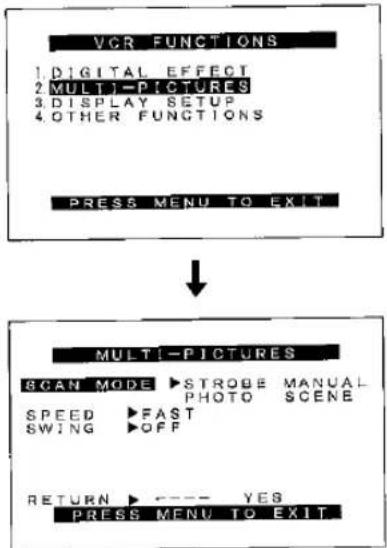
| Title | Procedure | |
| Playing Back with Special Effects(Playback Digital Effects) (Continued)■ Strobe Multi-Picture ModeThis function captures and displays a sequence of 9 small still pictures from the playback picture. This is very convenient for motion analysis of sports action, animal studies, etc. | 1In step 3 on page 57, select [MULTI].Press the [MENU] Button. | 2Turn the [PUSH] Dial to select [MULTI- PICTURES] and then press the [PUSH] Dial.The [MULTI-PICTURES] Sub-Menu appears.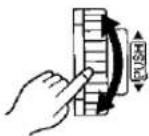 |
7Press the [MULTI] Button.A sequence of 9 still pictures appears and the tape stops.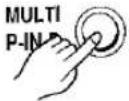 | Making the Multi- Pictures DisappearPress the [MULTI] Button.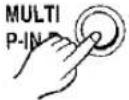 | |
3Turn the [PUSH] Dial to select [SCAN MODE] and then press the [PUSH] Dial to select [STROBE].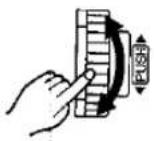 | 4Turn the [PUSH] Dial to select [SPEED] and then press the [PUSH] Dial to select the desired strobe speed.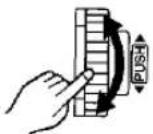 | 5Press the [MENU] Button to exit the menu. | 6Start playback, and when you reach the scene that you want to capture and display in the Strobe Multi-Picture Mode, pause the picture.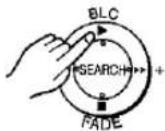  |
Displaying the Multi-Pictures AgainPress the [MULTI] Button for more than 1 second. | Remarks, etc. | ||
| ●At the [FAST] setting, the sequence of 9 still pictures is captured within approximately 1 second, at [NORMAL] within approximately 2 seconds, and at [SLOW] within approximately 3 seconds.Swing ModeIf you set [SWING] on the [MULTI-PICTURES] Sub-Menu to [ON], the intervals at which the still pictures are captured are longer at the beginning and end than in the middle of the swing strobe period.Notes for Using the Multi-Picture Mode●The playback multi-pictures cannot be output from the DV Terminal (p. 4) or the Digital Still Picture Terminal (p. 80).●The quality of the pictures displayed in the Multi-Picture Mode is slightly inferior. | |||
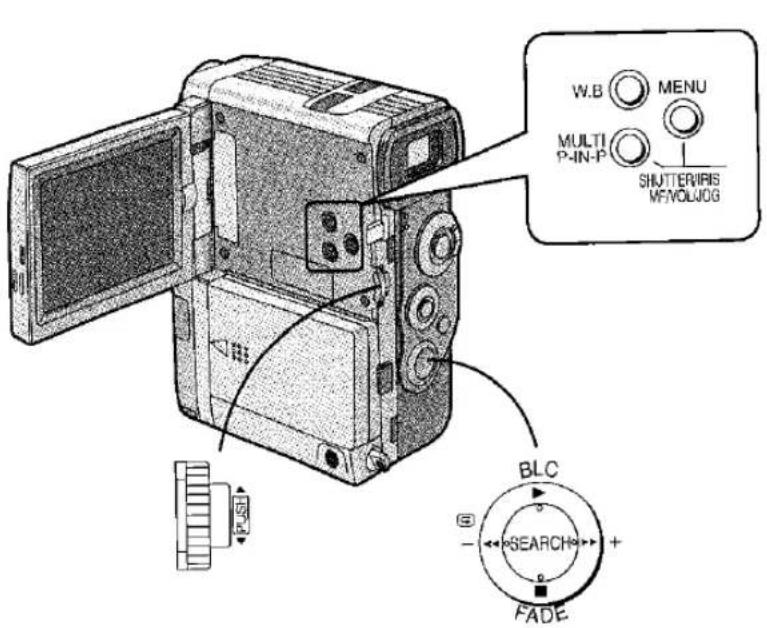
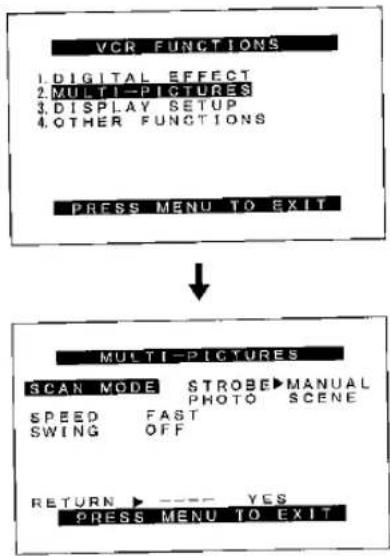
| Title | Procedure | |
| Playing Back with Special Effects(Playback Digital Effects) (Continued)■ Manual Multi-Picture ModeWith this function, you can capture up to 9 pictures from different scenes and display them together as small still pictures on the same screen. | 1In step 3 on page 57, select [MULTI]:Press the [MENU] Button. | 2Turn the [PUSH] Dial to select [MULTI- PICTURES] and then press the [PUSH] Dial.The [MULTI-PICTURES] Sub-Menu appears. |
 | 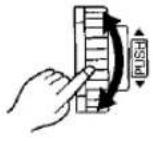 | |
| Making All Multi- Pictures DisappearPress the [MULTI] Button. | Displaying the Multi- Pictures AgainPress the [MULTI] Button for more than 1 second. | |
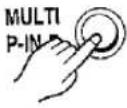 | 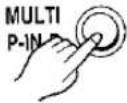 | |
3Turn the [PUSH] Dial to select [SCAN MODE] and then press the [PUSH] Dial to select [MANUAL].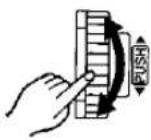 | 4Press the [MENU] Button to exit the menu. | 5Press the [►] Button. Playback starts.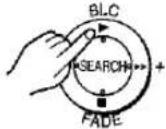 | 6Press the [MULTI] Button once, and then again for each of the scenes that you want to capture in the Multi-Picture Mode.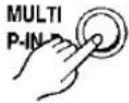 |
Erasing the Multi-Pictures One by OneWhile the Multi-Pictures are displayed, press the [MULTI] Button for more than 1 second.●This erases the last captured picture. Keeping the [MULTI] Button pressed erases the pictures continuously.●After you have erased the still pictures one by one, it is not possible to display them again. | Remarks, etc.●Every time you press the [MULTI] Button, a still picture is captured and displayed. When it still pictures are displayed, the tape stops.Notes for Using the Multi-Picture Mode●The playback multi-pictures cannot be output from the DV Terminal (p. 4) or the Digital Still Picture Terminal (p. 80).●The quality of the pictures displayed in the Multi-Picture Mode is slightly inferior. | ||
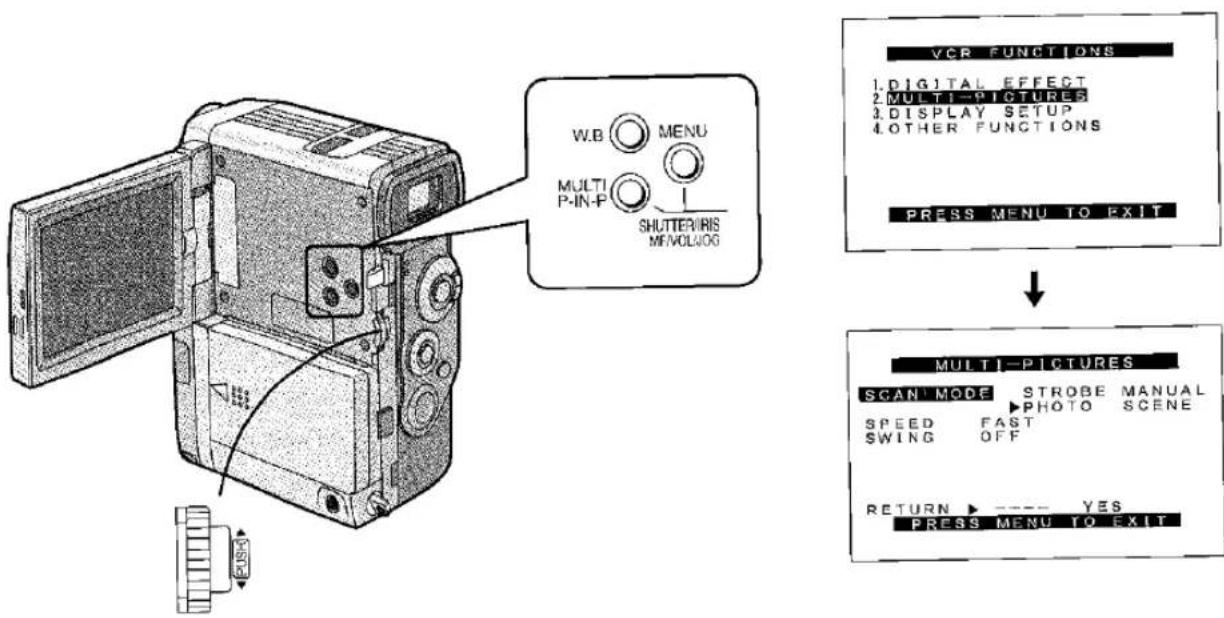
| Title | Procedure | |
| Playing Back with Special Effects(Playback Digital Effects) (Continued)■ Index Multi-Picture ModeWith this function, you can automatically capture up to 9 small still pictures of scenes or Photoshop pictures marked with index signal and display them in a single picture. | 1In Step 3 on page 57, select [MULTI]:Press the [MENU] Button. | 2Turn the [PUSH] Dial to select [MULTI- PICTURES] and then press the [PUSH] Dial.The [MULTI-PICTURES] Sub-Menu appears. |
 |  | |
| 5Press the [MULTI] Button. | Making the Multi- Pictures DisappearPress the [MULTI] Button. | |
 | 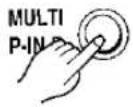 | |
| Remarks, etc. | ||
| 3Turn the [PUSH] Dial to select [SCAN MODE] and then press the [PUSH] Dial to select [PHOTO] or [SCENE]. | 4Press the [MENU] Button to exit the menu. | 9 pictures marked with index signals are captured in forward direction from the tape position at which the [MULTI] Button was pressed, and the tape then stops. (If there are less than 9 pictures marked with index signals, the tape stops at its end.)The index signals are recorded automatically during recording. (p. 37)If you switch the Movie Camera from the Index Multi-Picture Mode over to the Camera Mode, the setting of [SCAN MODE] on the [MULTI-PICTURES] Sub-Menu of the [CAMERA FUNCTIONS] Main-Menu is automatically set to [STROBE].There Are Two Different Types of Index Signals:In Step 3 above, select [PHOTO] or [SCENE] as follows:[PHOTO]: To search for still pictures marked with photoshot index signal and capture and display them.[SCENE]: To search for scenes marked with scene index signal and capture and display them as still pictures.Notes for Using the Multi-Picture ModeThe playback multi-pictures cannot be output from the DV Terminal (p. 4) or the Digital Still Picture Terminal (p. 80).The quality of the pictures displayed in the Multi-Picture Mode is slightly inferior. |
| Displaying the Multi-Pictures AgainPress the [MULTI] Button for more than 1 second. | ||
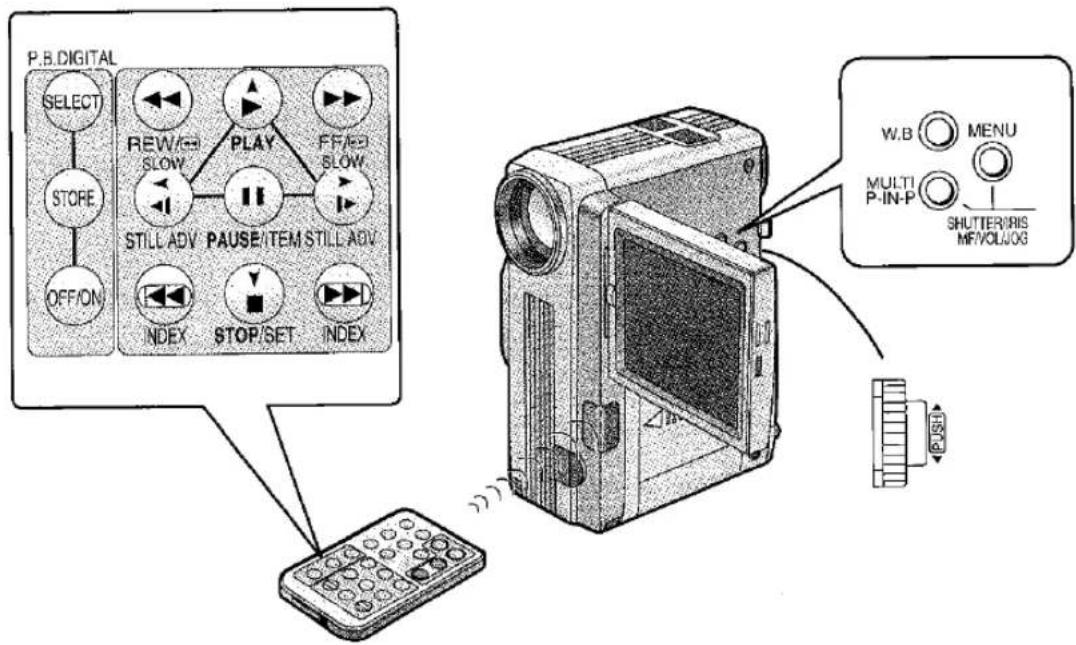
flowchart
graph TD
    A["P.B.DIGITAL"] --> B["SELECT"]
    A --> C["STORE"]
    A --> D["OFF/ON"]
    A --> E["REW/Slow"]
    A --> F["PLAY"]
    A --> G["FF/SSlow"]
    A --> H["STILL ADV"]
    A --> I["PAUSE/ITEM STILL ADV"]
    A --> J["INDEX"]
    A --> K["STOP/SET"]
    A --> L["INDEX"]
    M["W.B"] --> N["MENU"]
    O["MULTI P-IN-P"] --> P["SHUTTER/IRIS MF/VOL/OG"]
    Q["P.SU"] --> R["Radio"]
| Title | Procedure | |
Playing Back with Special Effects(Playback Digital Effects) (Continued)■ Multi-Picture SearchThis function lets you search for the tape position of a desired still picture displayed in the Multi-Picture Mode.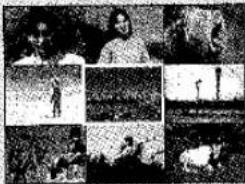 | 1After displaying the Multi-Pictures, turn the [PUSH] Dial to select a picture whose tape position you want to locate.The selected picture is marked with a flashing red frame. | 2Press the Index Button [I◄◄] or [►►I] on the Remote Controller.The tape stops at the beginning of the selected scene and the Movie Camera is in the Still Playback Mode. 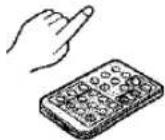 |
| ■ Wipe Function and Mix Function | 1In Step 3 on page 57, select [WIPE] or [MIX]:Press the [►] Button to start playback.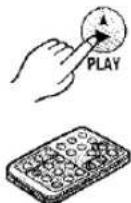 | 2Press the [STORE] Button at the moment that you want to store as still image in memory.The [WIPE] or [MIX] Indication appears and the picture is stored in memory. |
| Remarks, etc. | ||
Displaying the Still Pictures in the Multi-Picture Mode AgainPress the [MULTI] Button for more than 1 second.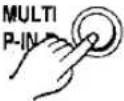 | • In case of the pictures displayed in the Manual Multi-Picture Mode (p. 60), use the Multi-Picture Search Function after displaying all 9 pictures.• In case of the pictures displayed in the Index Multi-Picture Mode (p. 62), the Multi-Picture Search Function can be used even if less than 9 pictures are displayed.• If you use a video printer equipped with a 5-pin editing socket, you can print the picture that you selected In Step 1. (p. 79)• The tape positions of the pictures located with the Multi-Picture Search Function are subject to some imprecision. | |
 Press the [OFF/ON] Button at the scene at which you want to use a Wipe or Mix effect.The scenes change with a Wipe or Mix effect. Press the [OFF/ON] Button at the scene at which you want to use a Wipe or Mix effect.The scenes change with a Wipe or Mix effect.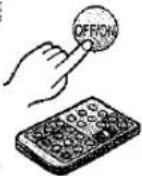 | • Operating the Wipe Function and the Mix Function during playback is only possible with Remote Controller.• It is not possible to add a Wipe or Mix effect during playback of an unrecorded part on the tape.• If you press the [OFF/ON] Button while the Wipe or Mix is being performed, the effect is paused at that point. If you press the [OFF/ON] Button again, the effect resumes. | |
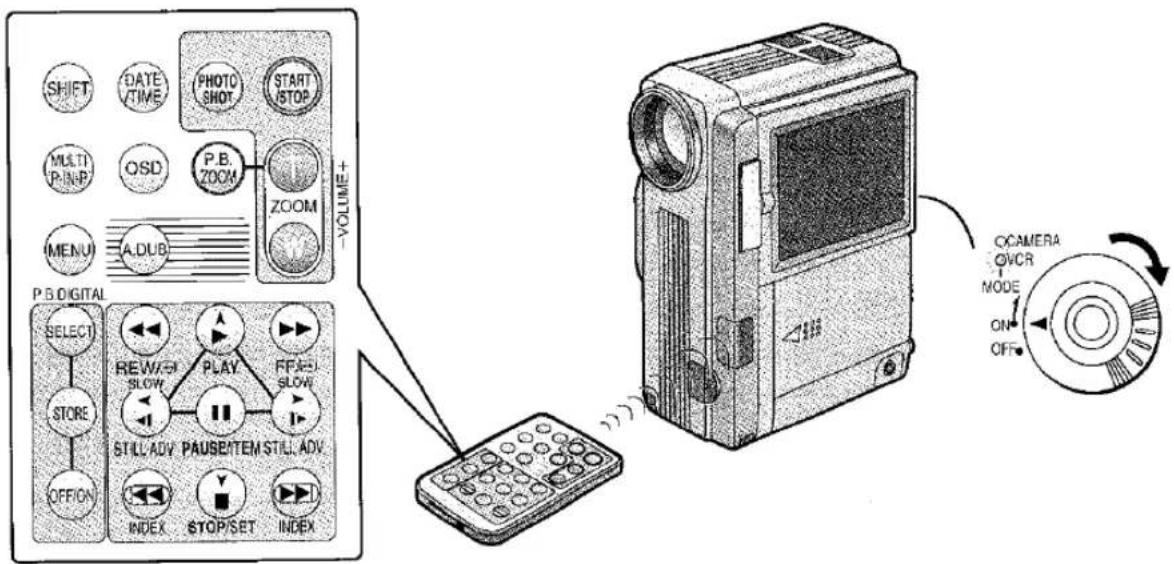
flowchart
graph TD
    A["PS DIGITAL"] --> B["SELECT"]
    A --> C["STORE"]
    A --> D["OFFION"]
    A --> E["INDEX"]
    A --> F["STOP/SET"]
    A --> G["INDEX"]
    H["VOLUME+"] --> I["controller with remote control"]
    I --> J["Camera with OCAMERA mode"]
    J --> K["ON/OFF"]
    J --> L["MODE ON/OFF"]
| Title | Procedure | |
Enlarging the Playback Picture(Playback Zoom)With this function, you can enlarge a part of the picture by up to 10 times during playback.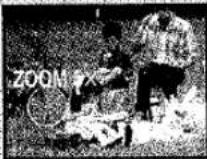 | 1Turn the [OFF/ON/MODE] Switch from the [ON] position to put the Movie Camera in the VCR Mode.The [VCR] Lamp lights.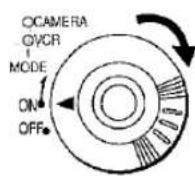 | 2Press the Play Button[▶].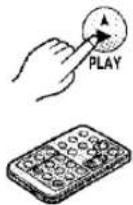 |
Changing the Zoom MagnificationPress the [W] or [T] Zoom Button on the Remote Controller to change the magnification.• You can increase the magnification up to 10×.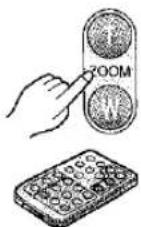 | ||
| Remarks, etc. | ||
3Press the Playback Zoom Button[P.B.ZOOM] on the Remote Controller.The centre part of the picture is enlarged about 2 times. | Cancelling the Playback Zoom FunctionPress the [P.B.ZOOM] Button on the Remote Controller. | ●In the Playback Zoom Mode, it is not possible to adjust the sound volume.●Turning the Movie Camera off or switching it from the VCR Mode over to the Camera Mode automatically cancels the Playback Zoom Mode.●Even while you are using the Playback Zoom Function, the picture output from the DV Terminal (p. 4) and the Digital Still Picture Terminal (p. 80) is not enlarged.●The more the picture is enlarged, the more its picture quality deteriorates.●If you press the [MULTI] Button in the Playback Zoom Mode, the zoom magnification becomes 1×.●It is not possible to use the Mirror Mode of the Digital Effects (p. 56) and the Playback Zoom Function at the same time. |
Changing the Part of the Picture to be Enlarged While pressing the [SHIFT] Button on the Remote Controller, press the Arrow Buttons (▲,◀,▶,▼) for the direction in which you want to shift the enlarged part of the picture.When you stop playback, the position of the part of the picture to be enlarged is automatically reset to the centre.  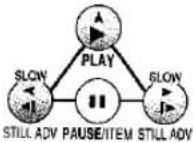   | ||
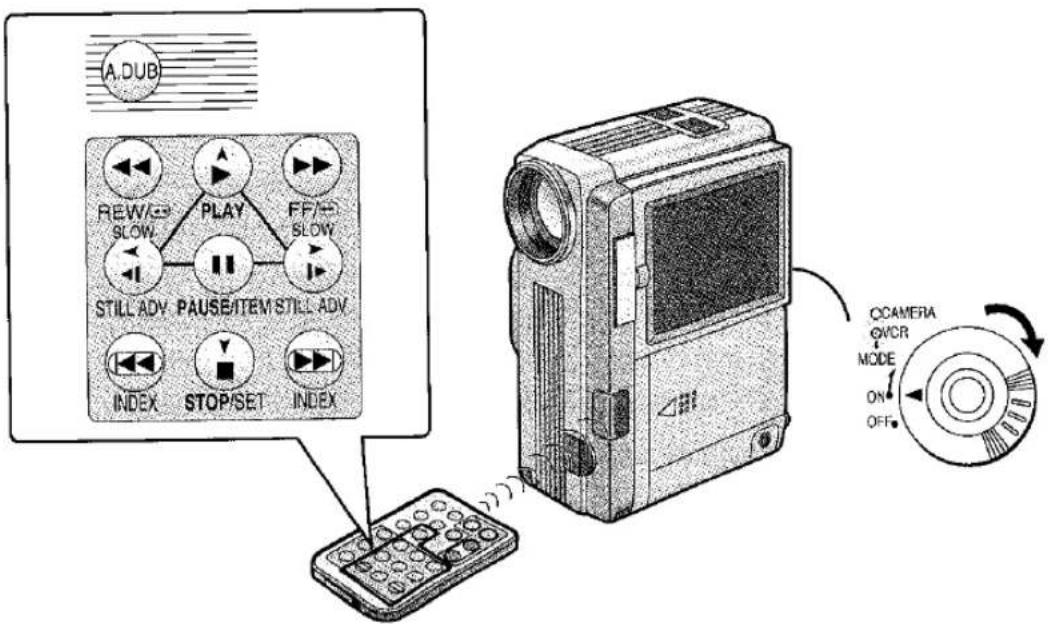
flowchart
graph TD
    A["Play"] --> B["REW/2"]
    B --> C["SLOW"]
    C --> D["STILL ADV. PAUSE/ITEM STILL ADV"]
    D --> E["INDEX"]
    D --> F["STOP/SET"]
    D --> G["INDEX"]
    H["FF/3"] --> I["SLOW"]
    J["OPEN"] --> K["ON"]
    L["OFF"] --> M["OFF"]
    N["Camera"] --> O["ON"]
    P["Clock"] --> Q["ON"]
    R["State"] --> S["State"]
| Title | Procedure | |
| Adding New Sound on a Recorded Cassette (Audio Dubbing)You can add music or narration on a recorded cassette.To perform audio dubbing, the Remote Controller is necessary.If you perform audio dubbing onto a tape that was recorded with [AUDIO REC] on the [OTHER FUNCTIONS] Sub-Menu of the [CAMERA FUNCTIONS] Main-Menu set to [16bit], the original sound is erased.(If you intend to perform audio dubbing but also want to keep the original sound, be sure to set [AUDIO REC] to [12bit] before making the original recording.)It is not possible to perform audio dubbing onto recordings made in the LP Mode. (p. 11) | 1Insert the recorded cassette and turn the [OFF/ON/MODE]Switch from the [ON] position to put the Movie Camera in the VCR Mode.Make sure that the prevention slider of the cassette is set to [REC].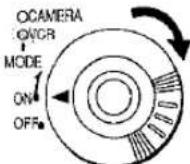 | 2Search for the position from which you want to insert the new sound.Using Cue Playback, Review Playback or Variable Speed Playback makes it easy to search for this point.[REWS]orFFED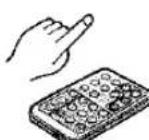 |
5Press the Pause Button [III] on the Remote Controller to start audio dubbing. A.DUB>Remarks, etc. A.DUB>Remarks, etc. | ||
3Press the Play Button [▶] and then Pause Button. [■] on the Remote Controller.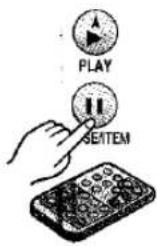 | 4Press the [A.DUB] Button on the Remote Controller.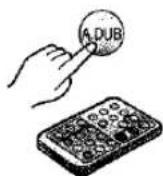 A.DUBII A.DUBII | Playing Back the Sound Recorded with Audio Dubbing●Depending on the setting selected for [12bitAUDIO] on the [OTHER FUNCTIONS] Sub-Menu of the [VCR FUNCTIONS] Main-Menu, the sound added with audio dubbing and the original sound are played back as follows:ST1: The original sound alone is played back.ST2: The dubbed sound alone is played back.MIX: The original sound and the sound added with audio dubbing are played back together.It is not possible to perform audio dubbing on an unrecorded part of the tape.If there was an unrecorded part on the tape when audio dubbing was performed, picture and sound distortion occur at that tape portion during playback.If you reset the Tape Counter to zero and turn on the Memory Stop Function (p. 99) at the point where you want the audio dubbing to end, the audio dubbing automatically stops when the tape reaches that point. |
Stopping Audio DubbingPress the Pause Button [■] on the Remote Controller.The Movie Camera is again in the Still Playback Mode. | ||
Remote Controller
Using the wireless Remote Controller supplied with the Movie Camera allows operating most of the Movie Camera's major functions from a distance.
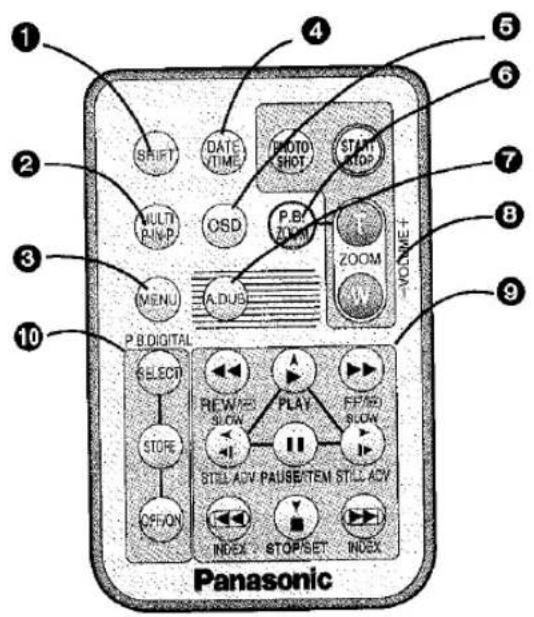
■ Buttons on the Remote Controller
① Shift Button [SHIFT] (p. 66)
To change the part of the picture to be enlarged in the Playback Zoom Mode when pressed together with one of the Direction Buttons. In this case, the functions of the following buttons are changed:
Play Button → Upward Direction Button [▲] Slow/Still Advance Button → Left/Right Direction Button [◀,▶] Stop Button → Downward Direction Button [▼]
② Multi-Picture/Picture-in-Picture Button [MULTI/P-IN-P] (p. 44, 46, 48, 58)
To operate the same functions as with the corresponding button on the Movie Camera.
③ Menu Button [MENU] (p. 82)
To display the menu. In this case, the functions of the following buttons are changed:
Pause Button → Item Button
To select items on the Menu.
Stop Button → Setting Button
To set the mode for the selected item.
④ Date and Time Button [DATE/TIME] (p. 29)
To make the Date/Time Indication appear or disappear in the picture during recording or playback.
⑤ Indication Output Button [OSD] (p. 33) To display the function and operation indications on a connected TV.
⑥ Playback Zoom Button [P.B.ZOOM] (p. 66) To enlarge a part of the playback picture.
⑦ Audio Dubbing Button [A.DUB] (p. 68) To perform audio dubbing.
⑧ Controls for Recording and Sound Volume Photoshot Button [PHOTO SHOT] (p. 22) To record still pictures.
Recording Start/Stop Button [START/STOP] (p. 16)
To start and pause recording.
Zoom/Sound Volume Buttons [ZOOM/VOLUME]
CAMERA Mode: To zoom in and out. (p. 22, 52)
VCR Mode: To adjust the volume of the playback sound. (p. 28) To change the zoom magnification of the Playback Zoom. (p. 66)
9 Controls for Playback and Menu Settings
Rewind/Review Button [◀◀]
To start review playback (p. 28) if pressed during normal playback; and to rewind the tape if pressed in the Stop Mode. Also to activate the Camera Search Function (p. 34) in reverse direction if kept pressed in the Recording Pause Mode. Pressing it briefly activates the Recording Check Function (p. 18).
Fast-forward/Cue Button [▶▶]
To start cue playback (p. 28) if pressed during normal playback; and to fast-forward the tape if pressed in the Stop Mode.
Also to activate the Camera Search Function (p. 34) in forward direction if kept pressed in the Recording Pause Mode.
Play Button [▶] (p. 28)
To start playback.
Or, when pressed together with the [SHIFT] Button, to shift upward the enlarged part of the picture in the Playback Zoom Mode.
Slow Motion/Still Advance Button [◀, ▶] (p. 30)
To perform Slow Motion Playback if pressed in the Normal Playback Mode; and to perform Still Advance Playback if pressed in the Still Playback Mode.
(◀: in reverse direction, ▶: in forward direction) Qr, when pressed together with the [SHIFT] Button, to shift to the left or right the enlarged part of the picture in the Playback Zoom Mode.
Index Search Button [◀◀, ▶▶▶]
To search for recorded scenes marked with an index signal and for still images recorded in the Photoshot Mode. (p. 36)
(I◄◄: in reverse direction, ►►I: in forward direction.)
To locate the tape position of a small still picture displayed in the Multi-Picture Mode. (p. 64) (In this case, select the desired still picture on the screen and then press either button.)
Stop Button [■]
To stop the tape (p. 28).
Or when the menu is displayed, to set a desired mode or value for the selected item (p. 82).
Or, when pressed together with the [SHIFT] Button, to shift downward the enlarged part of the picture in the Playback Zoom Mode.
Pause Button [11]
To pause playback. The playback picture stands still (p. 30).
Or when the menu is displayed, to select an item (p. 82).
⑩ Playback Digital Effects
Selection Button [SELECT] (p. 56)
To select the desired digital effect for [EFFECT SELECT] on the [DIGITAL EFFECT] Sub-Menu of the [VCR FUNCTIONS] Main-Menu.
Store Button [STORE] (p. 64)
To store a still picture in memory for the Wipe or Mix Function.
Off/On Button [OFF/ON] (p. 56)
To suspend the selected digital mode or re-activate it.
To start a Wipe or Mix transition from the still picture stored in memory.
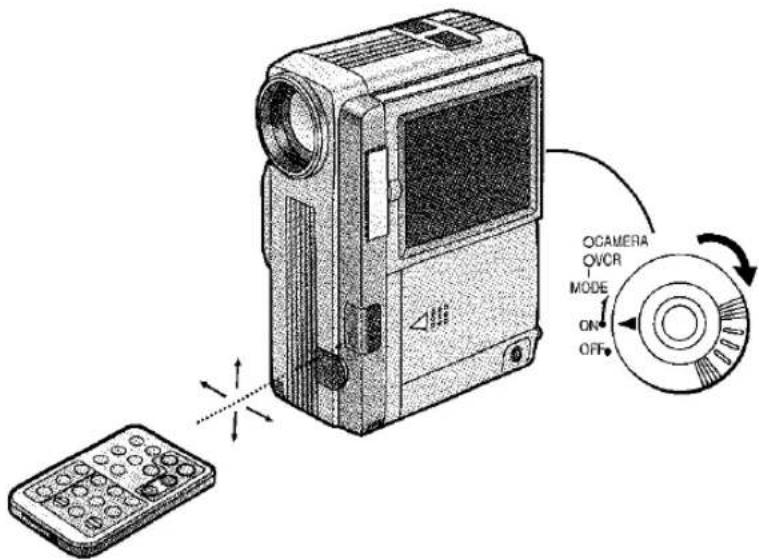
| Title | Procedure | |
| Remote Controller(Continued)■ Inserting the Button-type BatteryInsert the supplied button-type battery before using the Remote Controller.●When the button-type battery is exhausted, replace it with a new CR2025 battery.(The life of the battery is about 1 year. However, it depends on the frequency of use.)●Make sure you insert the battery with its poles correctly aligned.●Keep the button-type battery out of the reach of children. | 1Pull out the Battery Holder while pressing the Stopper 1.![PANASONIC NV-EX3B - Off/On Button [OFF/ON] (p. 56) - 2](/content/2026/05/794594/images/1972ab05275dc45b0429488f79e9244cd3da772f11d226d5c745be403fa834b4.jpg) | 2Insert the button-type battery with the stamped (+) mark facing upward.![PANASONIC NV-EX3B - Off/On Button [OFF/ON] (p. 56) - 3](/content/2026/05/794594/images/41a645fc7e63407747937e71bf1f7321c67a058348533fb8c4e6c1c9b7cc2723.jpg) |
| ■ Using the Remote Controller | 1Set the [OFF/ON/MODE] Switch on the Movie Camera to [ON].●When the [CAMERA] Lamp lights, you can use the recording functions.●If you want to use the playback functions, press the [OFF/ON/MODE] Switch so that the [VCR] Lamp lights.![PANASONIC NV-EX3B - Off/On Button [OFF/ON] (p. 56) - 4](/content/2026/05/794594/images/6cb9602fc05049472cea041f3d768968564cbb9d78ee136387af4f926c0736a2.jpg) | |
■ Selecting the Remote Controller Mode
When using two Movie Cameras at the same time, selecting different Remote Controller Modes makes it possible to operate them separately.
- If the Remote Controller Mode set on the Movie Camera and on its Remote Controller are not matched, the [REMOTE] Indication appears.
● Replacing the button-type battery in the Remote Controller automatically resets it to the [VCR1] Mode.
① Press the [▶] Button and the [■] Button simultaneously.
This selects the [VCR1] Mode.
② Press the [◀1] Button and the [■] Button simultaneously.
This selects the [VCR2] Mode.
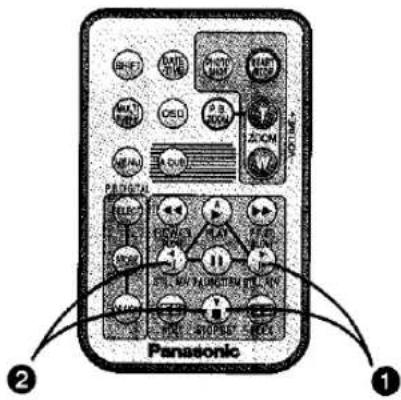
3
Insert the Battery Holder Into the Remote Controller.
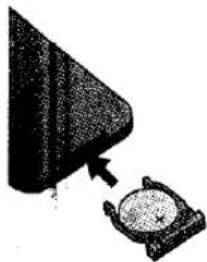
natural_image
Simple diagram showing a device emitting a fan or button into a container (no text or symbols)Information for your safety
WARNING
"THE LITHIUM BATTERY IS A CRITICAL COMPONENT (TYPE NUMBER CR2025 MANUFACTURED BY PANASONIC).
IT MUST NEVER BE SUBJECTED TO EXCESSIVE HEAT OR DISCHARGE. IT MUST THEREFORE ONLY BE FITTED IN EQUIPMENT DESIGNED SPECIFICALLY FOR ITS USE.
REPLACEMENT BATTERIES MUST BE OF THE SAME TYPE AND MANUFACTURER.
THEY MUST BE FITTED IN THE SAME MANNER AND LOCATION AS THE ORIGINAL BATTERY, WITH THE CORRECT POLARITY CONNECTIONS OBSERVED.
DO NOT ATTEMPT TO RE-CHARGE THE OLD BATTERY OR RE-USE IT FOR ANY OTHER PURPOSE. IT SHOULD BE DISPOSED OF IN WASTE PRODUCTS DESTINED FOR BURIAL RATHER THAN INCINERATION."
2
Aim the Remote Controller at the Remote Control Sensor on the Movie Camera and press the appropriate button.
Distance to the Movie Camera: Less than 5 metres.
Angle: Approximately 15^ up, down, left and right from centre axis.
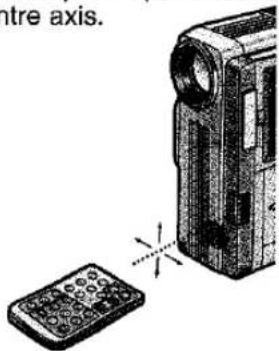
Remarks, etc.
- The operative range described on the left is valid for using the Remote Controller Indoors. When using it outdoors or under strong lights, it may not work correctly even within the left range.
- Within a distance of about 1 metre, it is also possible to use the Remote Controller from the side (LCD Monitor side).
Setting to Be Made on the Movie Camera: Set [REMOTE] on the [OTHER FUNCTIONS] Sub- Menu of the [VCR FUNCTIONS] or [CAMERA FUNCTIONS] Main-Menu to the desired Remote Controller Mode.
![Output Terminal Box [AV ONE TOUCH STATION] [AUDIO OUT] [VIDEO OUT] [S-VIDEO OUT] AV Cable (Phono-Phono) 21pin Adaptor S-Video Cable AV Cable (Phono-M3) [S-VIDEO IN] [AUDIO IN]](/content/2026/05/794594/images/48af6abf44ade1a3a8b347c3050c74db109a1eb8dd18e58bc892d2e9eb99e5a2.jpg)
| Title | Procedure | |
| Copying onto an S-VHS (or VHS) Cassette(Dubbing)You can copy the picture and sound recorded on this Movie Camera onto an S-VHS or VHS cassette in a home video recorder.After making the connections shown above, perform the necessary operations.Before copying, be sure to press the [OSD] Button on the Remote Controller (p. 70) so that no indications are visible. Otherwise, the displayed tape counter and function indications are also copied. | 1Movie Camera:Turn the [OFF/ON/MODE] Switch from the [ON] position to put the Movie Camera in the VCR Mode.The [VCR] Lamp lights.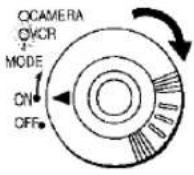 | 2Movie Camera:Insert the recorded cassette.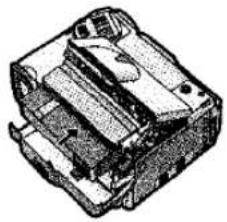 |
5VCR:Start recording. | 6VCR:Press the Pause or Stop Button to stop recording. | |
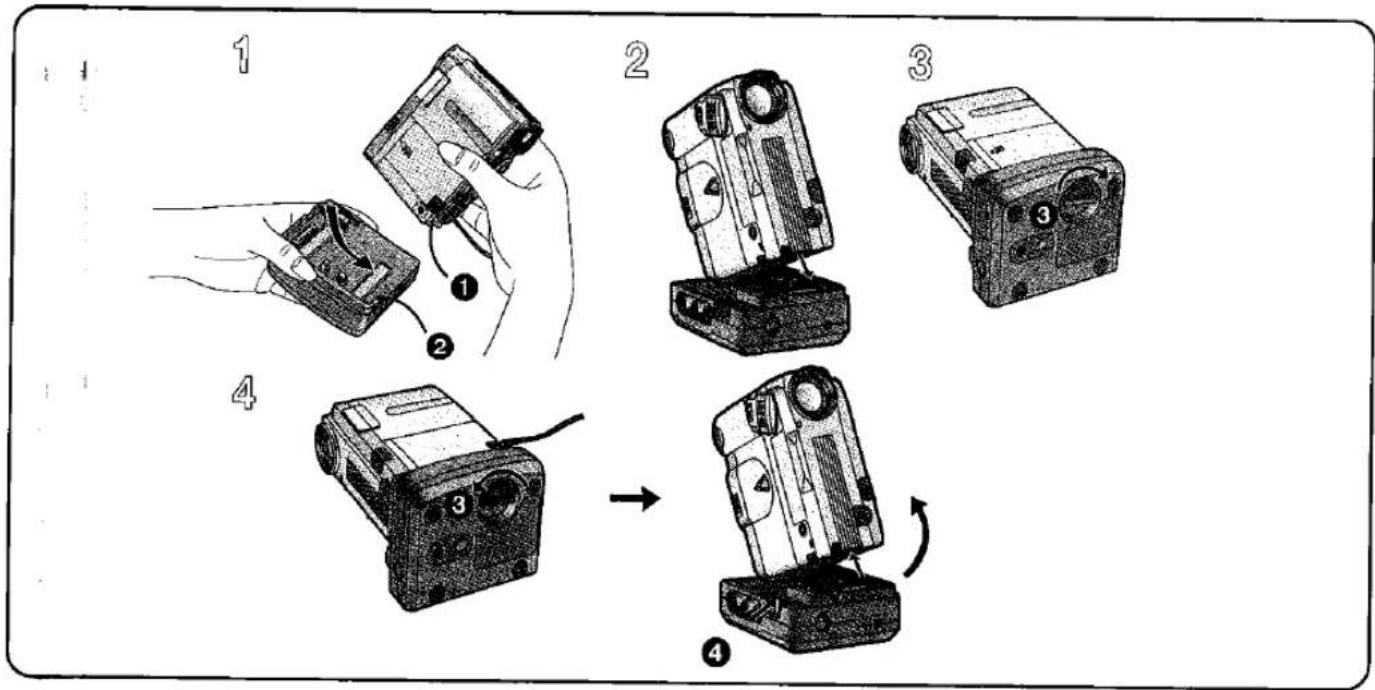
flowchart
graph TD
    A["1: Hand receipt"] --> B["2: Display"]
    B --> C["3: Panel with 3+ holes"]
    C --> D["4: Shipped device with cable"]
    D --> E["5: Final shipment with arrow indicating rotation"]
| Remarks, etc. | ||
3VCR:Insert an unrecorded cassette with intact erasure prevention tab.•As some settings (external input, tape speed, etc.) on the VCR are necessary, please refer to your VCR's operating instructions. | 4Movie Camera:Press the Play Button [▶] to start playback.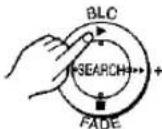 | Using the Output Terminal Box [AV ONE TOUCH STATION]When you want to connect the Movie Camera to a TV for playback or to other video equipment for editing and other purposes, attach the Output Terminal Box [AV ONE TOUCH STATION].Attaching the Output Terminal Box [AV ONE TOUCH STATION]1 Insert the protrusion 1 on bottom rear of the Movie Camera into the groove 2 on the Output Terminal Box [AV ONE TOUCH STATION].2 Push the front part of the Movie Camera straight down until it locks with a click.Be careful that the string of the Lens Cap or the DC Input Lead, etc. does not get pinched between the Movie Camera and the Output Terminal Box [AV ONE TOUCH STATION].To ensure proper connection, make sure that the Movie Camera is firmly lodged between the two guide ledges on the Output Terminal Box [AV ONE TOUCH STATION].Fasten the locking screw 3 to attach the Output Terminal Box securely.Removing the Output Terminal Box [AV ONE TOUCH STATION]Loosen the locking screw 3 and remove the Output Terminal Box while pressing the [PUSH RELEASE] Button 4.Hold both the Movie Camera and the Output Terminal Box firmly to prevent them from dropping. |
7Movie Camera:Press the Stop Button [■] to stop playback.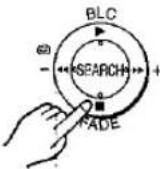 | ||
Copying with the Help of an Editing Controller
If you connect the Movie Camera to an Editing Controller equipped with 5-pin Edit Socket, this Movie Camera's palyback functions can be controlled from the Editing Controller. (The Output Terminal Box [AV ONE TOUCH STATION] is necessary.)
When Connecting the Editing Controller VW-EC500E (Optional)
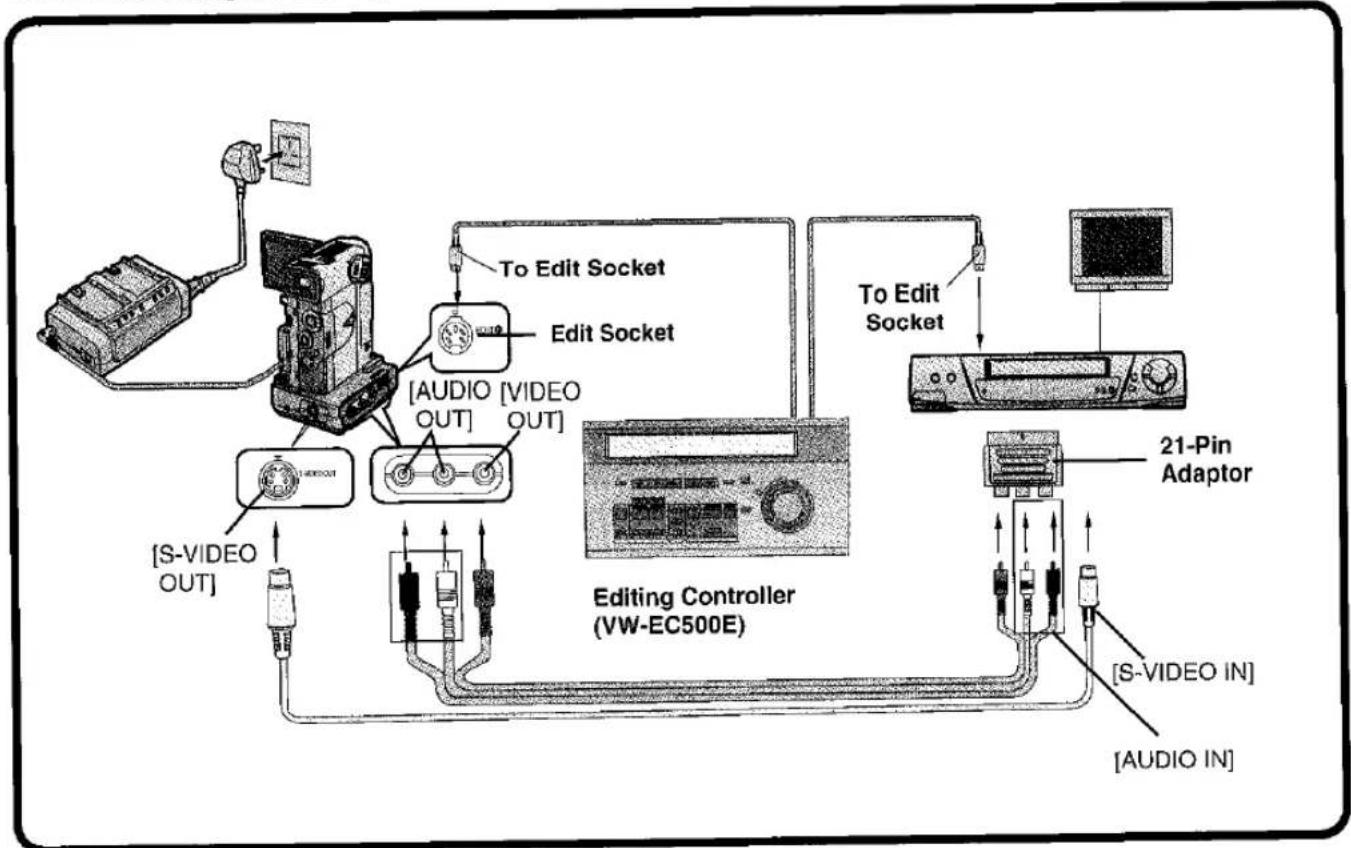
flowchart
graph TD
    A["Input Device"] --> B["Audio Out"]
    B --> C["Edit Socket"]
    C --> D["To Edit Socket"]
    D --> E["Editing Controller (VW-EC500E)"]
    E --> F["To Edit Socket"]
    F --> G["21-Pin Adaptor"]
    G --> H["21-Pin In"]
    H --> I["AUDIO IN"]
    I --> J["21-Pin In"]
    J --> K["21-Pin In"]
    K --> L["21-Pin In"]
    L --> M["21-Pin In"]
    M --> N["21-Pin In"]
    N --> O["21-Pin In"]
    O --> P["21-Pin In"]
    P --> Q["21-Pin In"]
    Q --> R["21-Pin In"]
    R --> S["21-Pin In"]
    S --> T["21-Pin In"]
    T --> U["21-Pin In"]
    U --> V["21-Pin In"]
    V --> W["21-Pin In"]
    W --> X["21-Pin In"]
    X --> Y["21-Pin In"]
    Y --> Z["21-Pin In"]
● A VCR equipped with 5-pin Edit Socket is necessary.
- When you connect the VW-EC500E to the Movie Camera, an adjustment on the VW-EC500E is necessary. For the operation of the Editing Controller, refer to its operating instructions.
When Editing with Time Code
Set [DISPLAY] on the [DISPLAY SETUP] Sub-Menu of the [VCR FUNCTIONS] Main-Menu to [TIMECODE] to make the Time Code appear.
- When the Time Code is displayed, the Time Code Signal is output from the Edit Socket.
- When the Counter Indication is displayed, the Linear Tape Counter Signal is output.
When Connecting the Editing Controller VW-EC1E (optional)
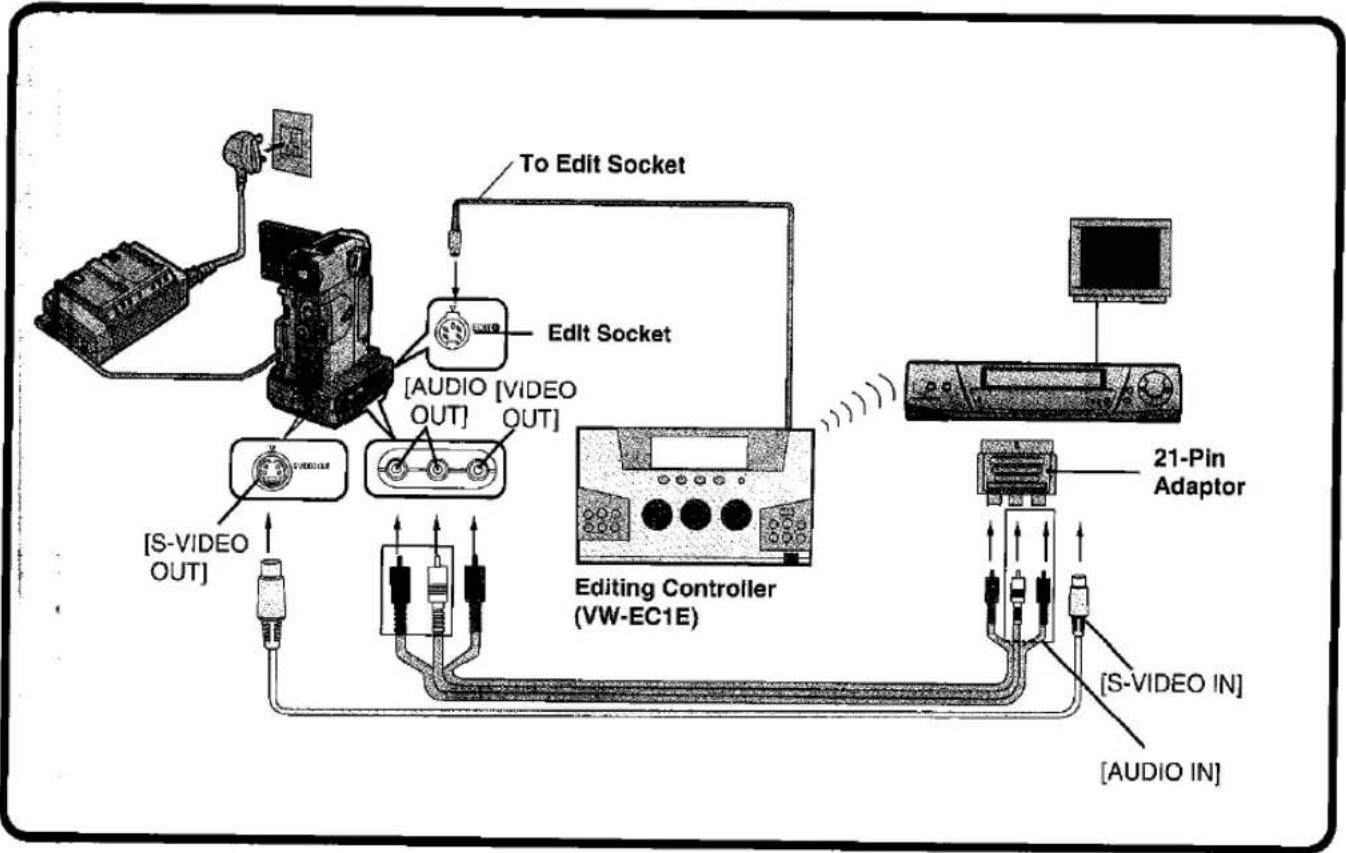
flowchart
graph TD
    A["Audio Input"] --> B["21-Pin Adaptor"]
    B --> C["Editing Controller (VW-EC1E)"]
    C --> D["To Edit Socket"]
    D --> E["Edit Socket"]
    E --> F["[AUDIO OUT"]]
    E --> G["[AUDIO OUT"]]
    E --> H["[S-VIDEO OUT"]]
    H --> I["21-Pin Adaptor"]
    style A fill:#f9f,stroke:#333
    style B fill:#ccf,stroke:#333
    style C fill:#cfc,stroke:#333
    style D fill:#fcc,stroke:#333
    style E fill:#cff,stroke:#333
    style F fill:#ffc,stroke:#333
    style G fill:#ffc,stroke:#333
    style H fill:#ffc,stroke:#333
    style I fill:#ffc,stroke:#333
- When you use the Editing Controller VW-EC1E, it is not necessary to connect it to the Edit Socket on the VCR, as the VCR's operation is performed via infrared remote control. Therefore, editing is also possible onto VCRs not equipped with an Edit Socket.
- For the operation of the Editing Controller, refer to its operating instructions.
Using the Movie Camera with a Video Printer
If you connect the Movie Camera to a Video Printer, you can print still pictures from scenes recorded with the Movie Camera. If you do not intend to use the Automatic Printing Function, connecting the Edit Cable is not necessary.
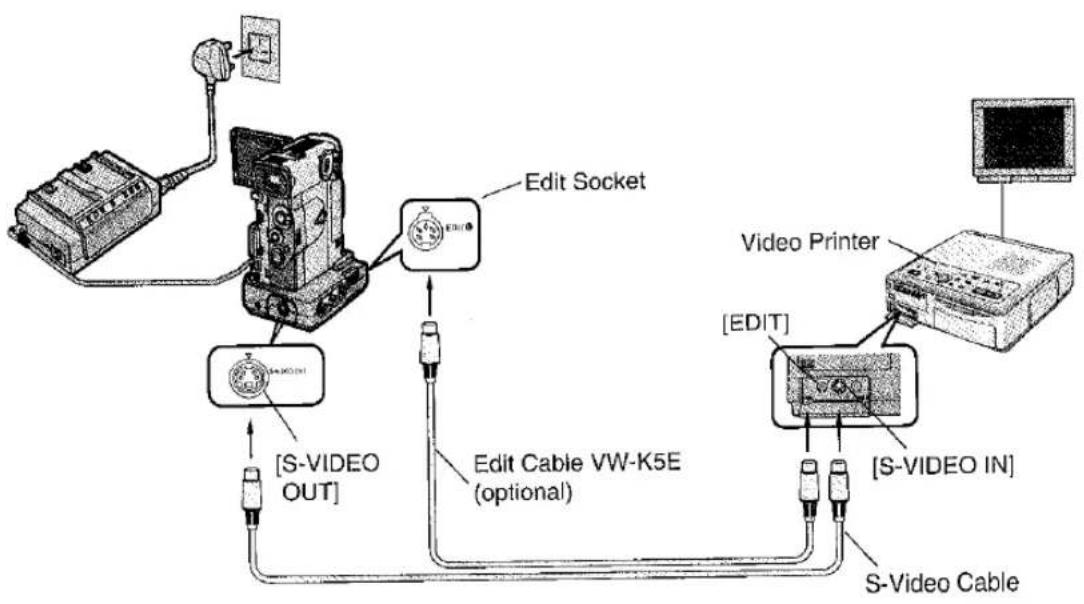
flowchart
graph TD
    A["Electronic Device"] --> B["Switch"]
    B --> C["Edit Socket"]
    C --> D["Video Printer"]
    D --> E["Monitor"]
    B --> F["Edit Cable VW-K5E (optional)"]
    F --> G["S-Video OUT"]
    F --> H["S-Video Cable"]
    style A fill:#f9f,stroke:#333
    style D fill:#ccf,stroke:#333
    style E fill:#cfc,stroke:#333
    style F fill:#fcc,stroke:#333
    style G fill:#ffc,stroke:#333
    style H fill:#fcc,stroke:#333
Movie Camera:
1 Turn the [OFF/ON/MODE] Switch from the [ON] position to put the Movie Camera in the VCR Mode. The [VCR] Lamp lights.
2 Insert a recorded cassette.
4 Press the Play Button [▶].
Video Printer:
3 Turn the Video Printer on.
5 Store the image in memory.
6 Start printing.
- For details about the operation of the Video Printer, read its operating instructions.
■ Using the Automatic Printing Function (Autoprint)
If you connect the Movie Camera to a Video Printer equipped with a 5-pin Edit Socket, you can use the Autoprint Function to automatically print all still pictures recorded with the Photoshot Function.
Video Printer:
1 Turn the Video Printer on.
2 Make the necessary settings on the Video Printer according to the input signal.
Movie Camera:
3 Turn the [OFF/ON/MODE] Switch from the [ON] position to put the Movie Camera in the VCR Mode. The [VCR] Lamp lights.
4 Search for the first still picture from which you want to start printing with the Autoprint Function. If you want to print all still pictures recorded on the cassette, rewind the tape to its beginning.
5 Press the [MENU] Button.
6 Set [AUTO PRINT] on the [OTHER FUNCTIONS] Sub-Menu to [ON]. Automatic printing starts.
- If you want to stop the automatic printing in the middle, press the Stop Button [■] on the Movie Camera.
You can select and print a single multi-picture from the displayed multi-pictures.
Video Printer:
1 Turn the Video Printer on.
2 Make the necessary settings on the Video Printer according to the input signal.
Movie Camera:
3 Turn the [OFF/ON/MODE] Switch from the [ON] position to put the Movie Camera in the VCR Mode. The [VCR] Lamp lights.
4 When still pictures are displayed in the Multi-Picture Mode, turn the [PUSH] Dial to select the picture that you want to print. (p. 56-63)
5 Press the [MENU] Button. 6 Set [AUTO PRINT] on the [OTHER FUNCTIONS] Sub-Menu to [ON]. Automatic printing starts.
- Before storing an image in memory on the Video Printer, press the [OSD] Button (p. 70) on the Remote Controller of the Movie Camera so that no indications appear in the picture. Otherwise, the Counter Indication and other function indications are also printed in the picture.
- The [PRINTER ERROR] Indication appears if the Movie Camera is not correctly connected to the Video Printer or when the ink cassette and/or the paper in the Video Printer are not loaded or used up.
- As index signals are not recorded with the still pictures recorded in the Continuous Photoshot Mode, automatic printing of these pictures is not possible.
- If you select one of 9 pictures displayed in the Multi-Picture Mode and print it with the Autoprint Function, the tape position of the selected picture may not be precise.
- In the following cases, some pictures may be skipped when printing with the Autoprint Function.
- When you print still pictures recorded in the Photoshot Mode on a video camera of another brand.
- If you turn the Movie Camera on and off several times (3 times or more) between recording two still pictures in the Photoshop Mode.
- When you record a still picture in the Photoshop Mode on the same part of a cassette where a Photoshop picture was recorded before.
- When you select a different recording speed (SP/LP) between the recording of two still pictures in the Photoshot Mode.
- At the first Photoshot picture to be printed.
● A picture that is recorded very close to the beginning of the tape may not be printed.
- When the cooling function of the Video Printer is activated and the printing speed slows down, automatic printing may stop. In this case, set [AUTO PRINT] on the [OTHER FUNCTIONS] Sub-Menu on the [VCR FUNCTIONS] Main-Menu to [ON] again.
- If you replace the ink cassette or paper during printing, the same picture may be printed twice.
- If still pictures are recorded successively in the Photoshop Mode, some pictures may be skipped during printing.
Using the Movie Camera with a Computer
![Output Terminal Box [AV ONE TOUCH STATION] Digital Still Picture Digital Still Picture Terminal Interface Adaptor](/content/2026/05/794594/images/d706926f533fee505bdb13b2a2979829da8597cd15907ab2619a22bfd37d3338.jpg)
The Personal Computer Connection Kit VW-DTA1E (optional) or VW-DTA5E (optional) for Digital Video Cameras makes it possible to connect the Movie Camera to a computer and transmit still video images to it. (The Output Terminal Box [AV ONE TOUCH STATION] is also necessary.)
Computer System Requirements
DV STUDIO can be installed in a PC/AT personal computer which can run Microsoft® Windows® 95.
| Compatible machines: | Personal computer with 80486DX4 or higherCPU (PentiumTM or higher recommended) |
| Graphic card: | True Color (approx. 16.7 million colours)recommended(operation also possible even with 256 colours) |
| Installed memory: | 16 MB or more (32 MB or more recommended) |
| Free hard disk space: | At least 10 MB |
| Disk drive: | CD-ROM drive |
| Serial port: | RS-232C (D-sub 9pin) |
| Other requirements: | Mouse |
To connect the Movie Camera to the computer, use the special Interface Adaptor contained in the Personal Computer Connection Kit.
When using the Personal Computer Kit, make sure that Movie Camera is in the VCR Mode (the [VCR] Lamp on the Movie Camera is lit).
● Pictures that you intend to import into computer applications should be recorded in the SP Mode.
- When recording, take care that the Time Code is uninterrupted from the beginning of the tape.
- If the Movie Camera is in the Repeat Playback Mode (p. 29), malfunctions may occur when importing pictures into a computer.
- If a cassette contains unrecorded parts, malfunctions may occur when importing pictures into a computer.
With a video printer equipped with a 5-pin Edit Socket, the imported pictures can be printed clearly.
●The pictures created by using the Playback Multi-Picture Mode (p. 58-65), Playback Digital Effect Mode (p. 56), or the Playback Zoom Mode (p. 66) cannot be imported into a computer.
- Windows® 95 is a trademark of Microsoft Corporation U.S.A.
- All other company and product names in the operating instructions are trademarks of their respective corporations.
Optional Accessories
AC Adaptor VW-AD9B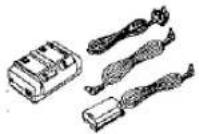 | Battery Pack CGP-D105(580 mAh)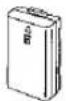 | Battery Pack CGR-D120(800 mAh) | Battery Pack CGP-D210(1400 mAh) | Battery Pack CGR-D220(1600 mAh) |
Battery Pack CGR-D815(5300 mAh)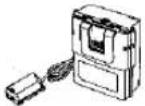 | Car Adaptor Cord VW-KA7E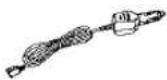 | 5-Pin Synchro Cord VW-K10E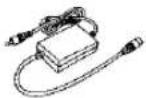 | Wide Conversion Lens VW-LW3007E | Tele Conversion Lens VW-LT3014E |
ND Filter VW-LND30E | MC Protector VW-LMC30E | Stereo Zoom Microphone VW-VMS1E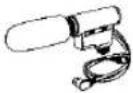 | Shoe Adaptor VW-SK10E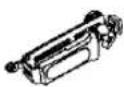 | Shoe Adaptor VW-SK11E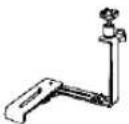 |
Tripod VZ-CT55E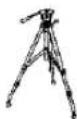 | Editing Controller VW-EC500E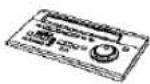 | Editing Controller VW-EC1E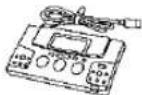 | Video Titler VW-VT1B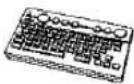 | Personal Computer Connection Kit VW-DTA1E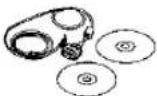 |
Personal Computer Connection Kit VW-DTA5E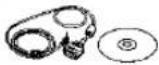 | Personal Computer Connection Kit VW-DTA10B[T5TS] | Edit Cable VW-K5E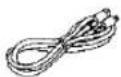 | DV Cable VW-CD1E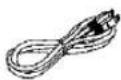 | Lens Cap VYP7015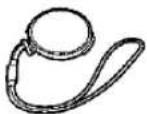 |
Digital Video Head Cleaner VFK1451 | Notes:Consult your dealer for details of other accessories not listed here.Some of the accessories listed above may not be available in some countries.Lens Cap for a filter or lens attached to the Step-up Ring.If you wish to purchase this Lens Cap, please contact your Panasonic dealer to obtain it from Panasonic spare parts department.Digital Video Head CleanerIf you wish to purchase this Digital Video Head Cleaner, please contact your Panasonic deobtain it from the Panasonic spare parts department. | |||
Charging Time and Maximum Time for Continuous Recording
| Battery No. | Charging Time | Max. Continuous Recording Time | Time Before [QUICK] Lamp Stops Flashing | Max. Continuous Recording Time When [QUICK] Lamp Is Lit |
| CGP-D105 (supplied) | 1 h 10 min. | 1 h. (45 min.) | — | — |
| QGR-D120 | 1 h. | 1 h 25 min. (1 h 10 min.) | — | — |
| QGP-D210 | 1 h 30 min. | 2 h 30 min. (2 h 5 min.) | 20 min. | 1 h. |
| CGR-D220 | 1 h 10 min. | 3 h. (2 h 30 min.) | 15 min. | 1 h. |
| CGR-D815 | 4 h 30 min. | 10 h. (8 h 20 min.) | — | — |
(The times shown in the above chart are approximations. The figures in parentheses show the recording time when using the LCD Monitor.)
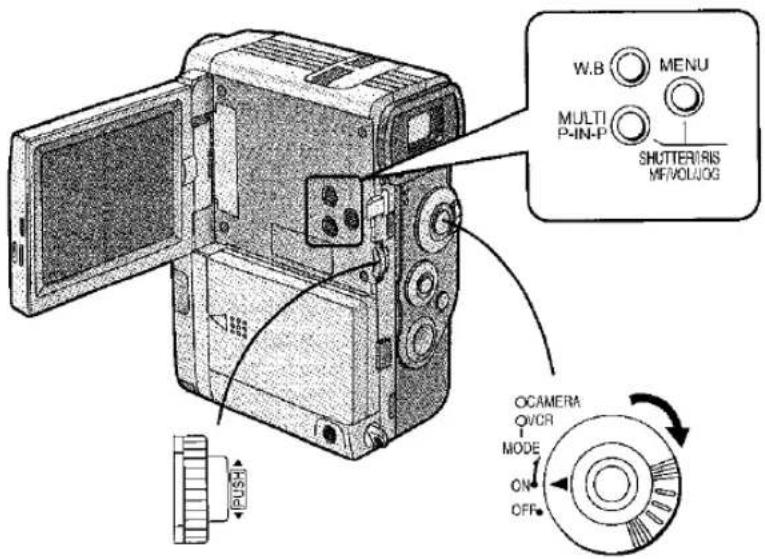
| Title | Procedure | |
| Using the Menu ScreenThis Movie Camera displays the settings of various functions in Menus to make it easy to select the desired functions and settings. | 1Press the [MENU] Button.When the Movie Camera is in the Camera Mode (the [CAMERA] Lamp is lit), pressing this button displays the Camera Mode Menu 1.When the Movie Camera is in the VCR Mode (the [VCR] Lamp is lit), pressing this button displays the VCR Mode Menu 2. MENU | 2Turn the [PUSH] Dial to select the desired sub-menu.Turning the [PUSH] Dial changes the highlighted item. |
5Press the [PUSH] Dial to set the selected item to the desired mode.Every press moves the cursor [▶] to the next mode.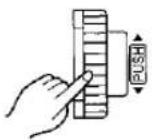 | ||
① Camera Functions Main-Menu
CAMERA FUNCTIONS
- CAMERA SETUP
- DIGITAL EFFECT
- MULTI-PICTURES
4.DISPLAY SETUP - OTHER FUNCTIONS
PRESS MENU TO EXIT
② VCR Functions Main-Menu
VCR FUNCTIONS
- DIGITAL EFFECT
- MULTI-PICTURES
- DISPLAY SETUP
- OTHER FUNCTIONS
PRESS MENU TO EXIT
| Remarks, etc. | ||
| 3Press the [PUSH] Dial to display the selected sub-menu. | 4Turn the [PUSH] Dial to select the item to be set. | Note About the Settings Made on the MenuThe settings you selected on the Menu are maintained when you turn the Movie Camera off. However, If you disconnect the power supply unit (Battery or AC Adaptor) from the Movie Camera before turning it off, the selected settings may not be maintained,While the menu is displayed, recording or playback is not possible. During playback, displaying the menu is possible, but not during recording.Settings for the menu item(s) that cannot be used due to the combination of the selected functions are displayed in dark blue.You can also perform the steps 1→5 operations by using the Remote Controller. (p. 70). |
| ■ Exiting the MenuPress the [MENU] Button again. MENU | ||
Miscellaneous/
Care of Unit
Menu Functions
Camera Functions Menu
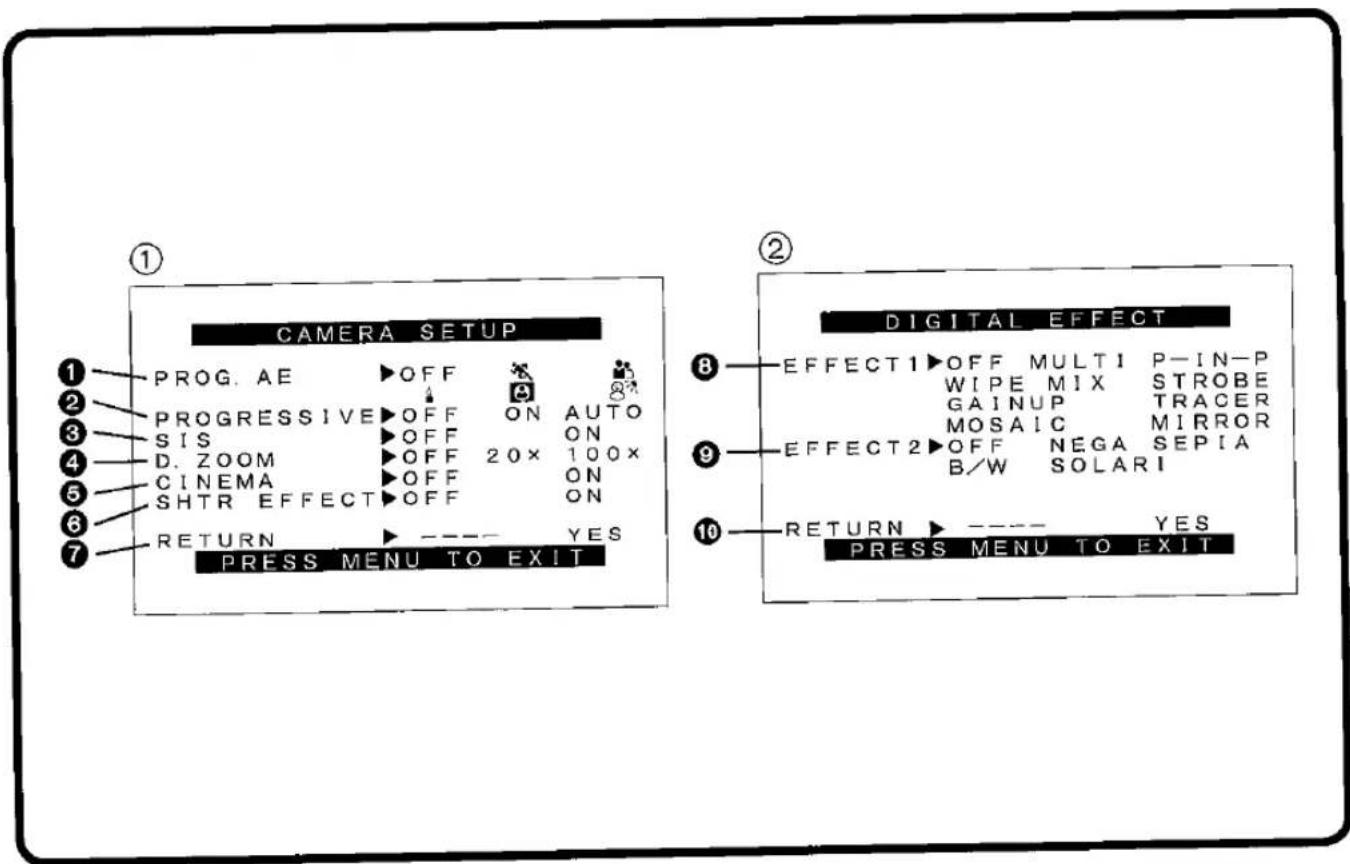
The illustrations of the menus are intended for explaining the functions; the actual menus look somewhat different.
Camera Mode Main-Menu [CAMERA FUNCTIONS]
- CAMERA SETUP
- DIGITAL EFFECT
- MULTI-PICTURES
- DISPLAY SETUP
- OTHER FUNCTIONS
[CAMERA SETUP] Sub-Menu ①
① Auto Exposure Mode [PROG.AE] (p. 40)
② Progressive Mode [PROGRESSIVE] (p. 24, 98)
③ Super Image Stabilizer [SIS] (p. 26)
4 Digital Zoom [D.ZOOM] (p. 23)
⑤ Cinema-like Format Recording [CINEMA] (p. 26)
⑥ Shutter Effect [SHTR EFFECT] (p. 23)
⑦ Returning to the Camera Mode Main-Menu [RETURN]
If you set [RETURN] to [YES], the menu changes back to the [CAMERA FUNCTIONS] Main-Menu.
[DIGITAL EFFECT] Sub-Menu ②
⑧ Digital Effects 1 [EFFECT1] (p. 42)
⑨ Digital Effects 2 [EFFECT2] (p. 42)
⑩ Returning to the Camera Mode Main-Menu [RETURN]
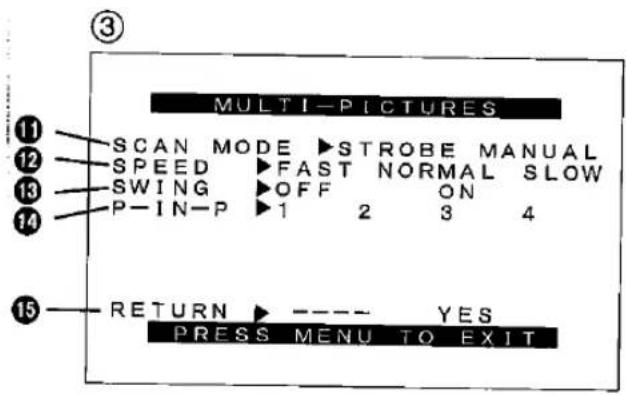
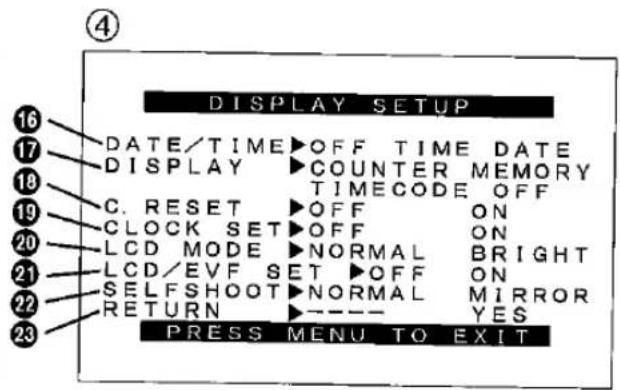
[MULTI-PICTURES] Sub-Menu ③
⑪ Multi-Picture Mode [SCAN MODE] (p. 44, 46)
⑫ Strobe Multi-Picture Speed [SPEED] (p. 44)
⑬ Swing Mode [SWING] (p. 44)
⑩ Position of Small Picture inside Normal Picture [P, IN-P] (p. 48)
15 Returning to the Camera Mode Main-Menu [RETURN]
[DISPLAY SETUP] Sub-Menu ④
16 Date and Time Indication [DATE/TIME] (p. 29)
⑰ Counter Display Mode [DISPLAY] (p. 101)
18 Counter Reset [C.RESET] (p. 99)
To reset the counter to zero.
However, the Time Code cannot be reset.
19 Date and Time Setting [CLOCK SET] (p. 90)
20 LCD Lighting Mode [LCD MODE] (p. 89)
② LCD and Viewfinder Adjustment [LCD/EVF SET] (p. 89)
22 Self-Recording [SELFSHOOT] (p. 21)
23 Returning to the Camera Mode Main-Menu [RETURN]
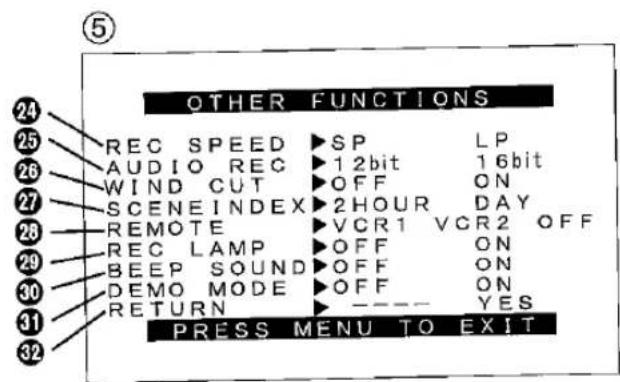
[OTHER FUNCTIONS] Sub-Menu ⑤
24 Recording Speed Mode [REC SPEED] (p. 11)
25 Audio Recording Mode [AUDIO REC] (p. 68)
26 Wind Noise Reduction [WIND CUT]
If you set [WIND CUT] to [ON], the noise of the wind hitting the microphone is reduced. However, this also causes a slight deterioration of the sound reproduction in the bass range.
27 Scene Index Mode [SCENEINDEX] (p. 37)
28 Remote Controller Mode [REMOTE] (p. 73)
29 Recording Lamp [REC LAMP] (p. 17)
30 Beep Sound [BEEP SOUND]
If you set [BEEP SOUND] to [ON], a confirmation/alarm beep sound is emitted in the following cases:
1 Beep
●When you start recording
- When you switch the [OFF/ON/MODE] Switch from [OFF] to [ON]
2 Beeps
●When you pause recording
10 Beeps
- When you operate the Movie Camera in an inappropriate way before or during recording
31 Demonstration Mode [DEMO MODE]
If you connect the AC Adaptor to the Movie Camera, turn the [OFF/ON/MODE] Switch to [ON] without any cassette inserted, and leave it on for approximately 10 minutes without performing any operation, the Movie Camera automatically switches over to the Demonstration Mode to show its functions. Pressing a button or performing some other operation suspends the Demonstration Mode. Leaving the Movie Camera again on for more than 3 minutes without operating it, causes the demonstration to start again. To cancel the Demonstration Mode, insert a cassette or set [DEMO MODE] to [OFF].
32 Returning to the Camera Mode Main-Menu [RETURN]
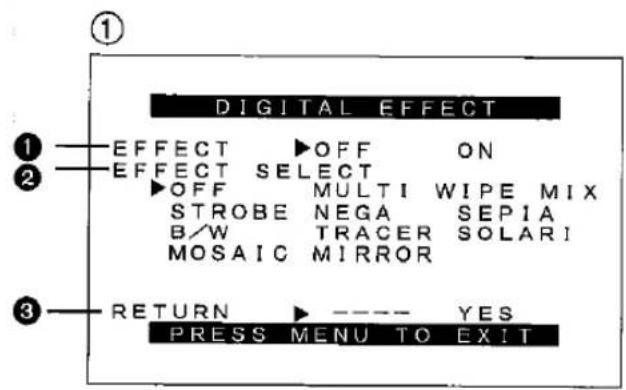
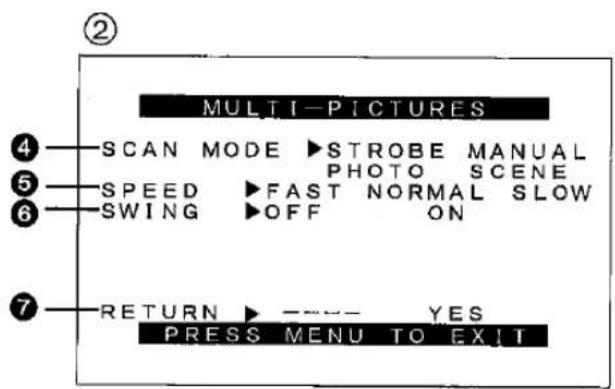
VCR Mode Main-Menu [VCR FUNCTIONS]
- DIGITAL EFFECT
- MULTI-PICTURES
- DISPLAY SETUP
- OTHER FUNCTIONS
[DIGITAL EFFECT] Sub-Menu ①
① Digital Effect On/Off [EFFECT] (p. 56)
② Digital Effect Selection [EFFECT SELECT] (p. 56)
③ Returning to the VCR Mode Main-Menu [RETURN] If you set [RETURN] to [YES], the Menu changes back to the [VCR FUNCTIONS] Main-Menu.
[MULTI-PICTURES] Sub-Menu ②
④ Multi-Pictures Mode [SCAN MODE] (p. 58-63)
⑤ Strobe Multi-Pictures Speed [SPEED] (p. 58)
⑥ Swing Mode [SWING] (p. 58)
⑦ Returning to the VCR Mode Main-Menu [RETURN]
③
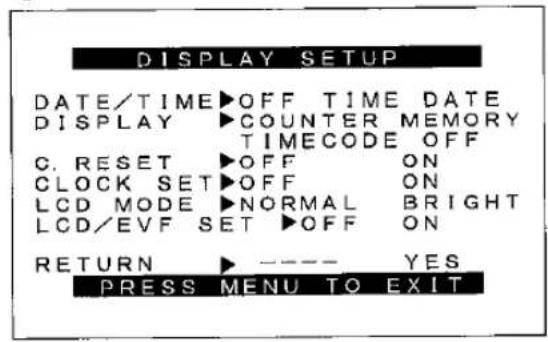
④
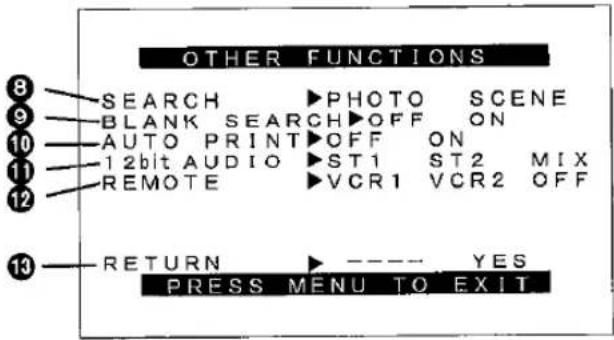
[DISPLAY SETUP] Sub-Menu ③
All items on the [DISPLAY SETUP] Sub-Menu are the same as those on the [DISPLAY SETUP] Sub-Menu of the [CAMERA FUNCTIONS] Main-Menu.
[OTHER FUNCTIONS] Sub-Menu ④
⑧ Index Search Mode [SEARCH] (p. 36)
⑨ Blank Search [BLANK SEARCH] (p. 34)
10 Automatic Printing [AUTO PRINT] (p. 79)
11 Audio Output Mode [12bitAUDIO] (p. 69)
12 Remote Controller Mode [REMOTE] (p. 73)
⑬ Returning to the VCR Mode Main-Menu [RETURN]
Adjusting the LCD Monitor/Viewfinder
If you set [LCD/EVF SET] on the [DISPLAY SETUP] Sub-Menu of the [VCR FUNCTIONS] or the [CAMERA FUNCTIONS] Main-Menu to [ON], the following items are displayed.
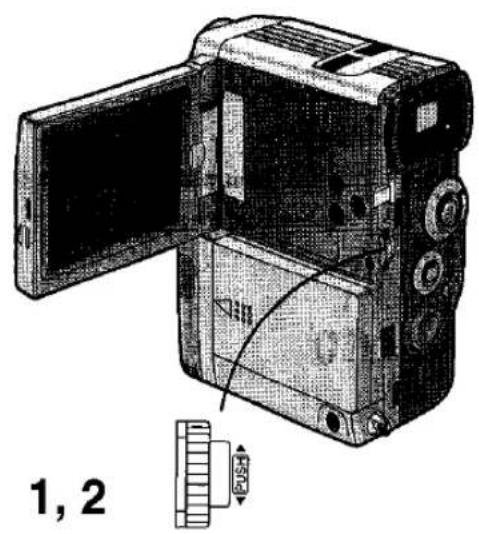
natural_image
Diagram of a digital camera module with open lid and internal components, labeled 1, 2 (no text or symbols on device body)![LCD/EVF SET LCD BRIGHTNESS (-) | | | ---- [+] LCD COLOUR LEVEL (-) | | | ---- [+] EVF BRIGHTNESS (-) | | | ---- [+] PRESS MENU TO RETURN](/content/2026/05/794594/images/72424cb98e996412240063e12c9f2d680ad7ce70d83edcd7c93a7a0fbadcd334.jpg)
LCD Brightness [LCD BRIGHTNESS]
To adjust the brightness of the LCD screen. The Bar Indication is divided into 8 steps. The more vertical bars are shown, the brighter is the screen.
LCD Colour Level [LCD COLOUR LEVEL]
To adjust the colour saturation of the LCD screen. The Bar Indication is divided into 8 steps. The more vertical bars are shown, the stronger are the colours.
Viewfinder Brightness [EVF BRIGHTNESS]
To adjust the brightness of the Viewfinder. The Bar Indication is divided into 8 steps. The more vertical bars are shown, the brighter is the screen.
1 Press the [PUSH] Dial to select the item that you want to adjust.
2 Turn the [PUSH] Dial. Turning it increases or decreases the number of vertical bars of the Bar Indication.
If you use the Remote Controller for these adjustments, press the [ITEM] Button to select the item, and then press the [SET] Button to adjust it. Keeping the [SET] Button pressed changes the number of bars.
Increasing the Brightness of the Whole LCD Monitor Screen
Set [LCD MODE] on the [DISPLAY SETUP] Sub-Menu of the [VCR FUNCTIONS] or the [CAMERA FUNCTIONS] Main-Menu to [BRIGHT].
- These adjustments have no influence on the actually recorded picture.
Setting the Date and Time
If you set [CLOCK SET] on the [DISPLAY SETUP] Sub-Menu of the [VCR FUNCTIONS] or the [CAMERA FUNCTIONS] Main-Menu to [ON], the menu shown below appears. (p. 82)
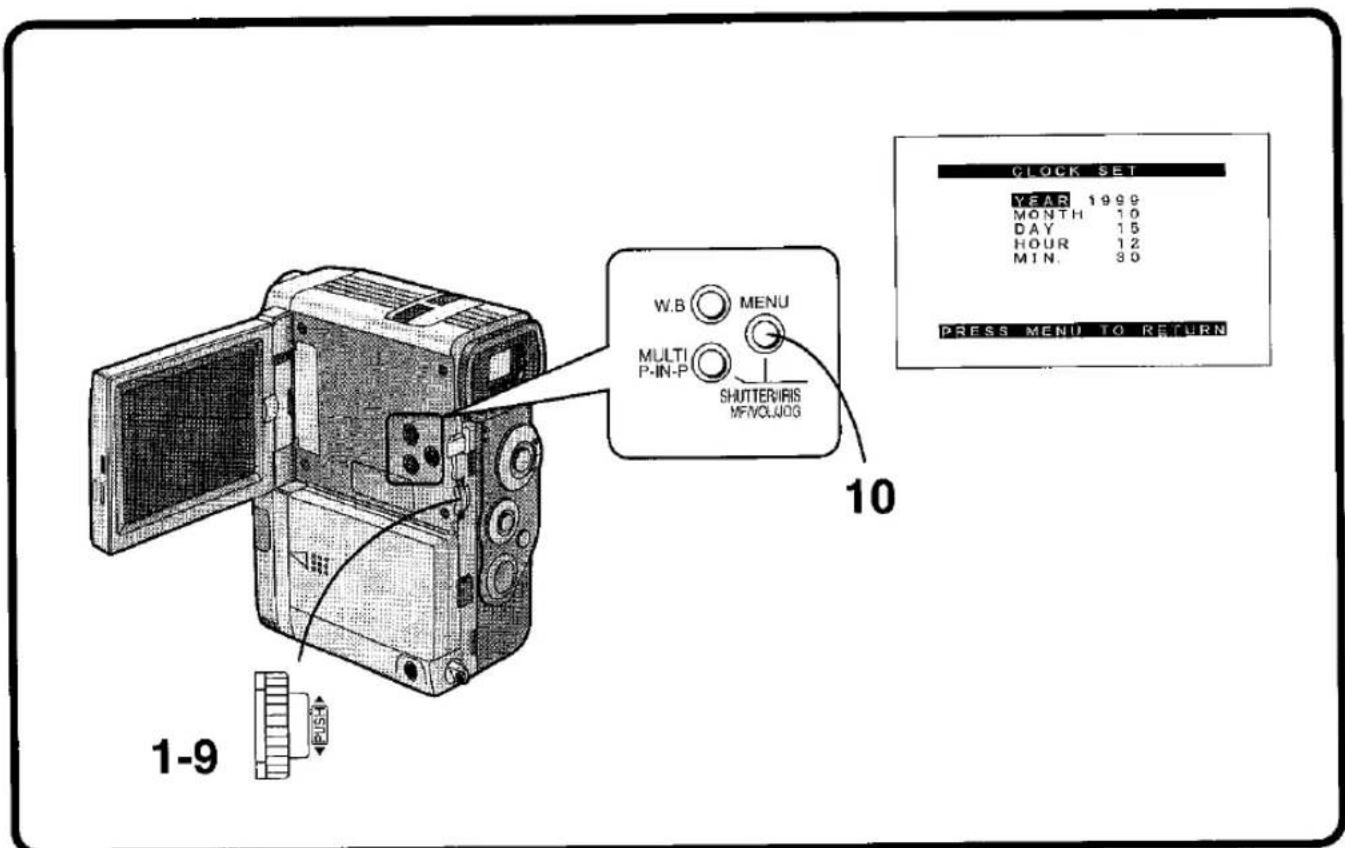
For example: To set the clock to 15th October 1999, 12:30.
1 Turn the [PUSH] Dial to set to [1999].
- The years change in the following order: 1990→1991→...→2089→1990→...
2 Press [PUSH] Dial to select [MONTH].
3 Turn the [PUSH] Dial to set to [10].
4 Press the [PUSH] Dial to select [DAY].
5 Turn the [PUSH] Dial to set to [15].
6 Press the [PUSH] Dial to select [HOUR].
7 Turn the [PUSH] Dial to set to [12].
8 Press the [PUSH] Dial to select [MIN].
9 Turn the [PUSH] Dial to set to [30].
10 Press the [MENU] Button to finish the date and time setting.
The operation of the clock starts from [00] seconds. Pressing the button one more time makes the Menu disappear.
- As the time of the Movie Camera's built-in clock is subject to a slight imprecision, be sure to check the time before recording. If the flashing [ES] Indication appears, charge the built-in battery (p. 91) and set the date and time again.
●The clock employs the 24-hour system.
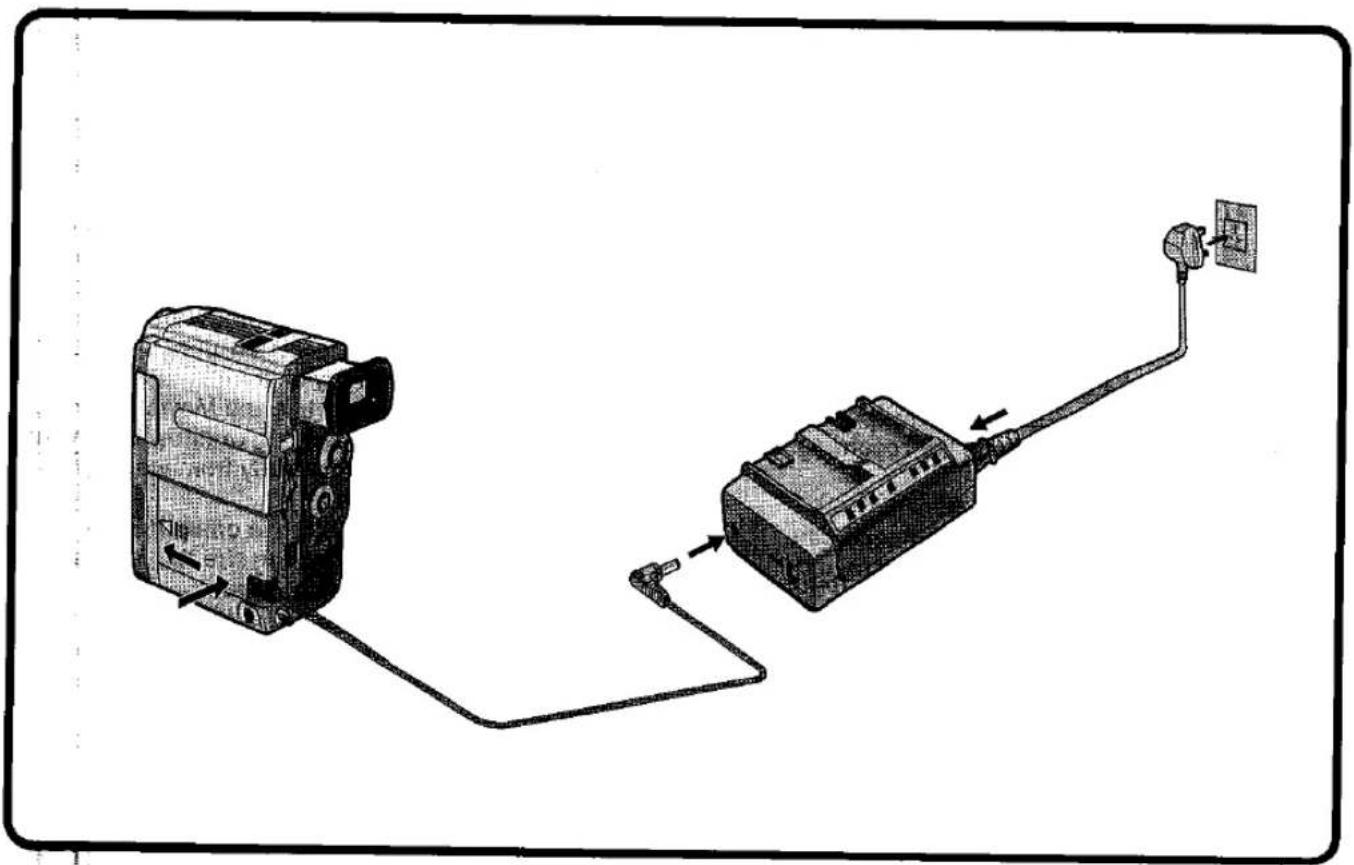
natural_image
Diagram of a device connected to a power outlet via cable, showing wiring and connection points (no text or symbols)Charging the Built-in Lithium Battery
The built-in lithium battery maintains the operation of the clock. When the [☐] Indication appears, the built-in lithium battery is discharged. Charge the discharged battery in the following way and after charging is finished, set the date and time.
1 Connect the AC Adaptor to the Movie Camera and to an AC mains socket. (p. 6)
2 Leave the Movie Camera turned off.
3 Leave the Movie Camera in this condition for approximately 4 hours.
After charging for 4 hours, the built-in lithium battery can power the clock for approximately 3 months.
Information for your safety
WARNING
THE LITHIUM BATTERY IN THIS EQUIPMENT MUST ONLY BE REPLACED BY QUALIFIED PERSONNEL. WHEN NECESSARY, CONTACT YOUR LOCAL PANASONIC SUPPLIER.
Cautions for Use
Take care that no water enters the Movie Camera when using it in the rain and snow or on the beach.
●The Movie Camera and the cassette could become damaged. (It might not be repairable.)
- If seawater has accidentally splashed on the Movie Camera, moisten a soft cloth with tap water, wring it well and wipe the camera body carefully with it. Then thoroughly wipe it with a soft, dry cloth.
Keep the Movie Camera away from magnetized equipment (TVs, video games, etc.).
- If you use the Movie Camera on or near a TV, the electromagnetic radiation may cause picture and sound distortion.
- Strong magnetic fields generated by speakers and large motors may damage the recordings on the tape and distort the picture.
●The electromagnetic radiation from micro-processors can adversely influence the Movie Camera and cause picture and sound distortion. - If the Movie Camera is adversely influenced by magnetized equipment and does not work correctly, turn the Movie Camera off, remove the Battery or disconnect the AC Adaptor and attach the Battery or connect the AC Adaptor again. Then turn the Movie Camera on.
Do not use the Movie Camera near a radio transmitter or high-voltage power line.
- If you record near a radio transmitter or high-voltage power line, the recorded picture and sound may be adversely influenced.
Do not use the Movie Camera for surveillance and other industrial application.
- If the Movie Camera is being used for a long time, the inside temperature could rise excessively and this may cause malfunction.
●This Movie Camera is not designed for industrial use.
Take care that no sand and fine dust enters the Movie Camera when using it on a beach or similar places.
- Sand and dust could damage the Movie Camera and cassette. (Be careful when inserting and removing the cassette.)
Do not spray insecticide or volatile agents on the Movie Camera.
- Such agents could harm the camera body and cause the surface coating to peel off.
- Do not leave the Movie Camera in direct contact with rubber or plastic products for a long time.
Do not use benzine or thinner for cleaning.
- They could deform the body and cause the surface coating to peel off.
●Before cleaning, remove the Battery or unplug the AC Mains Lead from the AC mains socket. - Wipe the Movie Camera with a soft, clean cloth. To remove persistent stains, wipe with a cloth moistened with mild detergent diluted with water, and then finish with a dry cloth.
- When storing or transporting the Movie Camera, place it in a softly padded bag or case to prevent the coating of the camera body from wearing off.
After use, always take out the cassette and remove the Battery or unplug the AC Mains Lead from the AC mains socket.
- If you leave the cassette in the Movie Camera, the tape can become loosened and damaged.
- If you leave the battery attached to the Movie Camera for a long time, the voltage level may drop very low so that the Battery cannot be used any more even after charging.
Notes about the AC Adaptor
- When the battery is warm, charging takes longer than usual.
- If you detach and re-attach the battery during charging, different Charge Lamp(s) may light. However, this is normal and not a malfunction.
- If you detach and re-attach the battery during charging, the Charge Lamp(s) may go out momentarily while the remaining charge is being checked. However, this is normal.
- If you detach the battery when the [QUICK] Lamp is lit and the [80%] Lamp is flashing, and then reattach it, the [QUICK] Lamp may start flashing again and it may take some time (approximately 15–20 minutes) for the [QUICK] Lamp to stop flashing and remain lit. However, this is normal.
- When you use the AC Adaptor near a radio, the radio reception may be distorted. Keep the AC Adaptor more than 1 metre away from the radio.
- When the AC Adaptor is in use, it may emit a whirring sound. However, this is normal.
- After use, be sure to disconnect the AC Mains Lead from the AC mains socket. (If you leave it connected, a small amount of electricity is consumed.)
- After connecting the AC Adaptor to an AC mains socket and attaching the battery to it, there may be a short delay before the Power Lamp lights and the [QUICK] Lamp starts flashing.
●Always keep the terminals of the AC Adaptor and the battery clean.
Condensation
Determining Whether Condensation Has Formed Inside and Remedy for Condensation If the Condensation Indication flashes after you turn on the Movie Camera, condensation has formed inside the Movie Camera. In this case, the Movie Camera automatically switches off after 1 minute.
Remedy as follows:
1 Take out the cassette.
All other functions do not work. Depending on the amount of condensation, it may not be possible to take out the cassette. In this case, wait 2–3 hours before taking out the cassette.
2 Leave the Cassette Compartment open and wait for 2–3 hours.
The required time depends on the amount of condensation and the ambient temperature.
3 After 2–3 hours, turn the Movie Camera on and check if the Condensation Indication is not displayed.
Even if the Condensation Indication is no longer displayed, wait 1 more hour for added safety before using the Movie Camera again.
Pay Attention to Condensation Even Before the Condensation Indication Appears.
- As condensation forms gradually, the Condensation Indication may not appear for the first 10–15 minutes after condensation has formed inside.
- In an extremely cold place, the condensation could freeze and turn into frost. In such a case, it takes and additional 2–3 hours for the frost to first melt condensation and then to be dissolved.
Remedy for a Fogged-up Lens
Turn the [OFF/ON/MODE] Switch to [OFF] and leave the Movie Camera in this condition for about 1 hour. When the lens has reached about the same temperature as its surroundings, it automatically clears up.
Periodic Inspection
To ensure optimum picture quality, we recommend that you have worn-out parts such as video heads replaced after approximately 1000 hours of use. (However, this depends considerably on the conditions of use such as temperature, humidity and dust.)
■ Other Useful Information
LCD Monitor
- In places where big changes in temperature occur, condensation may form on the LCD Monitor. Wipe it with a soft, dry cloth.
- When the Movie Camera is very cold when it is turned on, the picture on the LCD Monitor is initially a little darker than normally. However, as the internal temperature rises, the LCD Monitor regains its normal brightness.
- Extremely high precision technology is employed to produce the LCD Monitor screen featuring a total of approximately 200,000 pixels. The result is more than 99.99% effective pixels with a mere 0.01% of the pixels inactive or always lit.
Viewfinder
- Extremely high precision technology is employed to produce the Viewfinder screen featuring a total of approximately 130,000 pixels. The result is more than 99.99% active pixels, with a mere 0.01% of the pixels inactive or always lit. However, this is not a malfunction and does not affect the recorded picture.
- Do not leave the Viewfinder or the Lens aimed at the sun. This could seriously damage internal parts.
Listening to the Playback Sound via Headphones
- If you want to use headphones to listen to the playback sound, connect them to the supplied Headphone Conversion Adaptor and then securely plug the Headphone Conversion Adaptor all the way into the [AV OUT] Socket on the Movie Camera. In this case, no sound (including beep and shutter click sounds) is reproduced from the Movie Camera's built-in speaker, and the volume of the playback sound cannot be adjusted.
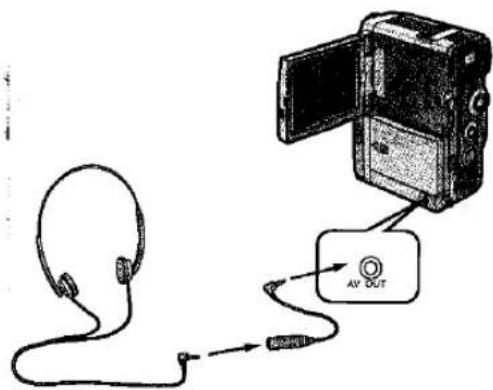
Microphone Socket
- If you want to perform audio dubbing via an external microphone or audio equipment, connect it to the [MIC] Socket on the Output Terminal Box [AV ONE TOUCH STATION]. In this case, the Movie Camera's built-in microphone is turned off.
Shoe Adaptor
- If you want to attach the External Microphone (VW-VMS1E; optional), etc. to the Movie Camera, the Shoe Adaptor (VW-SK10E; optional / VW-SK11E; optional) is necessary.
Attaching the Step-up Ring
If you want to attach a lens or filter to the Movie Camera, be sure to first remove the Lens Hood and replace it by the Step-up Ring supplied with this Movie Camera. Then attach a lens or filter with a diameter of 30.5 mm to the Step-up Ring.
1 Remove the Lens Hood by turning it counterclockwise.
2 Attach the Step-up Ring by turning it clockwise.
3 Attach a lens or filter by turning it clockwise.
To remove the lens or filter and re-attach the Lens Hood, perform the above operations in reverse.
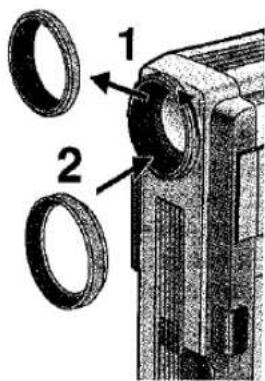
- When you want to attach the Tele Conversion Lens VW-LT3014E (optional), Wide Conversion Lens VW-LW3007E (optional), MC Protector VW-LMC30E (optional) or ND Filter VW-LND30E (optional), first remove the Lens Hood.
- When you push the [W/T] Zoom Lever toward [W] after attaching a filter or lens, the four corners of the picture may become dark (vignetting effect).
- When you attach two lenses or filters or one of each together, the four corners of the picture may become dark (vignetting effect).
● Never try to attach a lens, etc. to the Lens Hood. - It is not possible to attach the Lens Cap to the Step-up Ring.
- Be careful not to screw on the Step-up Ring too tightly.
Glossary
■ Focus
If you look at an object through a magnifying glass and move it closer or further away from your eye, you will reach a point where the object becomes clearly visible. Being focused or in focus means that the subject can be seen with optimum clarity and sharpness.
Human Eyes
Human eyes have lenses as well, and when we look at objects at different distances, the shape of these lenses changes automatically so that we can always see these objects clearly.
Movie Camera
The image of the subject enters the Movie Camera through the lens and is converted into an electric signal (video signal) for recording onto magnetic tape. The focus is adjusted either manually or automatically by moving a focusing lens.
Auto Focus Adjustment
The Auto Focus System automatically moves the internal focusing lens forward or backward and adjusts the focus so that the subject can be seen clearly.
The Auto Focus Adjustment has the following characteristics:
- It adjusts until the vertical contours of the subject are as sharp and clean as possible.
- It adjusts the focus on the subjects with strong contrast.
- It adjusts the focus on the subject in the centre of the LCD monitor or Viewfinder.
Unlike human eyes, the lens of the Movie Camera cannot instantaneously change the focus from a nearby to a distant subject and vice versa.
Lens Unit
The lens construction used in this Movie Camera generates some clicking noise if the Movie Camera is rocked up and down while it is turned off. This is not a malfunction of the lens unit. This noise does not occur when the Movie Camera is turned on.
For the following subjects and recording situations, the Auto Focus system cannot provide precise adjustment. Use the Manual Focus Mode instead. (p. 20)
1 Recording subjects with a part of it near the Movie Camera and another part far away from it
As the Auto Focus adjusts on the centre part of the image, it is often impossible to bring the nearby and distant parts of the subject into focus.
When you want to record a person with a distant mountain in the back, it is not possible to focus on both.
② Recording subjects behind glass covered with dirt or dust
As the focus is adjusted on the dirty glass, the subject behind the glass is out of focus. When recording a subject across a street on which cars are running, the focus may be adjusted on the cars.
③ Recording subjects in dark surroundings
As the amount of light information entering through the lens is greatly reduced, the Movie Camera cannot adjust the focus precisely.
4 Recording subjects surrounded by objects with shiny surfaces or much light reflection
As the Movie Camera adjusts the focus on objects with shiny surfaces or much light reflection, the subject may go out of focus. Therefore, when recording at a lake or the sea, evening scenes, fireworks, or under special types of lighting, the subject may be out of focus.
⑤ Recording fast-moving subjects
As the internal focusing lens is moved mechanically, it cannot follow fast-moving subjects without delay.
Therefore, subjects like children running back and forth may temporarily go out of focus.
⑥ Subjects with weak contrast
As the Movie Camera adjusts the focus based on vertical contours in the picture, subjects with little contrast such as a white wall may be out of focus.
■ White Balance Adjustment
While most recording with a Movie Camera is probably done outdoors under sunlight, video recording is also done very often under artificial light sources, both indoors and outdoors. However, each of these light sources gives the subject slightly different colours.
Human Eyes
Human eyes can easily adjust to different kinds of lighting and see an object with the same colours even under different lighting.
Movie Camera
Unlike human eyes, the Movie Camera does not have the innate ability to adapt to changes in lighting, and they influence the colours being recorded. Therefore, depending on the light source, the picture would be recorded with a bluish or reddish tint. To minimise the influence of the lighting on the colours of the subject, an adjustment called White Balance Adjustment is necessary.
White Balance Adjustment
The White Balance Adjustment determines the colour of the light and adjusts the colours so that white remains pure white. As white is the basic colour of the entire colour spectrum, if white is reproduced correctly, the other colours are correct and natural, too.
Auto White Balance Adjustment
This Movie Camera stores the optimum settings for several common light sources in memory. The Movie Camera judges the recording situation by determining the tint of the light received through the lens and by the White Balance Sensor (p. 4), and it selects the setting for the most similar tint. This function is called Auto White Balance Adjustment.
However, as the white balance settings for only a few light sources are stored in memory, the white balance is not correctly adjusted for other lighting conditions.
For the range of different types of lighting within which the Auto White Balance Function can provide precise adjustment, refer to the chart. For recording under lighting conditions outside this range, the Auto White Balance Function does not work correctly, and the recorded picture has a red or blue cast. However, the same also applies, if the subject is lit by more than one light source, even if these light sources are within this range.
■ Colour Temperature
Every light source has its own colour temperature measured in Kelvin (K). The higher the Kelvin value, the more bluish the light; the lower the value, the more reddish the light. The Kelvin value is related to the tint of the light, but not directly to its brightness.
The range ① indicated in the illustration below shows the light sources for which this Movie Camera can provide precise white balance adjustment and, therefore, natural colours in the recorded pictures, when using the Full Auto Mode. For light sources outside this range, adjust the white balance manually (p. 52). Also additional lighting may be necessary.
① Control range of this Movie Camera's Auto White Balance Adjustment Mode
② Blue Sky
③ Cloudy sky (Rain)
④ TV screen
⑤ Sunlight
⑥ White fluorescent lamp
⑦ 2 hours after sunrise or before sunset
⑧ 1 hour after sunrise or before sunset
9 Halogen light bulb
⑩ Incandescent light bulb
⑪ Sunrise or sunset
12 Candlelight
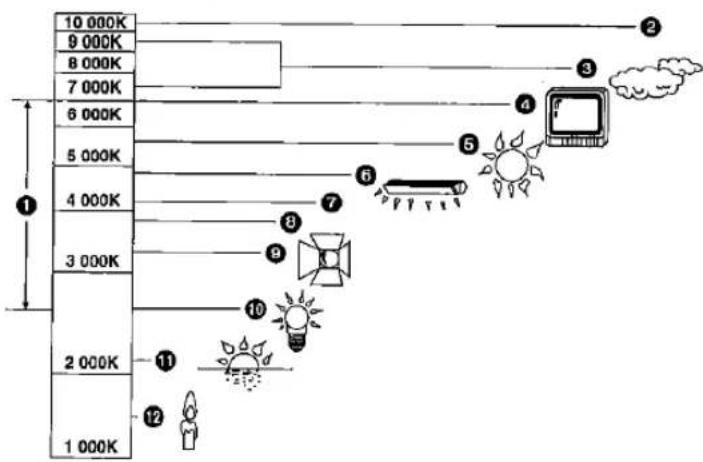
Miscellaneous/ Care of Unit
Glossary (Cont.)
■ Digital Video System
In the digital video system, picture and sound are converted into digital signals and recorded onto the tape.
This completely digital recording allows recording and playback of picture and sound with minimum quality deterioration.
In addition, such data as Time code, Date and Time are also automatically recorded as digital signals.
Features
●Superior picture resolution
●Excellent signal-to-noise ratio
- Stable pictures
●Minimised quality deterioration in dubbing
●Minimised cross colour distortion
- PCM digital sound
●No picture deterioration in LP Mode
-6.35 mm-wide tape
- Compact cassette with long recording time
●Minimised quality deterioration in editing
●Time Code editing
Compatibility with S-VHS or VHS Cassettes
As this Movie Camera uses a digital method for recording picture and sound, there is no compatibility with conventional S-VHS or VHS video equipment using analog recording methods. In addition, the size and shape of the cassette are completely different.
Compatibility with Output Signals
As the video and audio signals output from the audio and video output sockets are analog—the same as in conventional video systems—you can connect this Movie Camera to your S-VHS or VHS VCR or TV for playback.
PCM Digital Sound
For recording of the sound, this Movie Camera offers the choice between two different PCM Audio Recording Modes.
●16 bit, 48 kHz, 2 channels
●12 bit, 32 kHz, 4 channels
The "16 bit, 48 kHz, 2 channels" Mode offers superior recording sound quality.
The "12 bit, 32 kHz, 4 channels" Mode lets you record the original sound in stereo on two channels and the dubbed sound in stereo on two separate channels.
Sub Code
The digital recording system offers the added capability of recording sub code containing various data.
The following data is recorded as sub code on this Movie Camera:
•Time code
●Recording date and time
- Index signals for locating still images recorded in the Photoshop Mode
- Index signals for locating the beginning of scenes marked with index signal
■ Progressive Photoshot Function
This function lets you record still pictures with higher resolution, finer details and smoother image contours than the normal Photoshot Function.
●Usually, still pictures recorded with single-CCD Movie Cameras are field still pictures, whose vertical resolution is approximately half of that of frame still pictures, and picture details are not very precise. (1 frame consists of 2 fields.)
- When recording moving objects, there is a slight difference between two fields. If these field still pictures are recorded as a frame still picture, it will have broken up image contours.
- To record still pictures with smooth contours in excellent picture quality, this Movie Camera is equipped with the Progressive Photoshot Mode featuring:
an iris that closes like a shutter
2 field memories
Actual operation:
- Pressing the [PHOTO SHOT] Button
- Closing the iris instantaneously to prevent the next image from entering through the lens
• Storing the same picture data in 2 field memories
As a result, the recorded frame is made up of two fields taken at exactly the same time, and the resolution is approximately 50% higher to ensure a picture with smooth contours.
Notes about the Progressive Photoshot Function
Pressing the [PHOTO SHOT] Button in the Progressive Photoshot Mode records a frame still picture.
However, when [PROGRESSIVE] on the [CAMERA SETUP] Sub-Menu is set to [ON], the following functions cannot be used:
- Digital Zoom
• Digital Effect Modes in [EFFECT1]
• Shutter speeds of 1/750 s or faster - Continuous Photoshot (Also not possible when [PROGRESSIVE] is set to [AUTO].)
As still pictures recorded in the Progressive Photoshot Mode are extremely sharp and brilliant, they are highly suitable for printing on a Video Printer and for importing into a computer.
When you press the [PHOTO SHOT] Button in the Progressive Photoshot Mode, a click sound can be heard. This is caused by the closing of the iris and is not an indication of malfunction.
- During normal recording, the Progressive Photoshot Function cannot be used.
Time Code
Time Code signals are the data indicates the time in hours, minutes, seconds and frames (25 frames/sec). Having this data included in the recording gives every single picture on the tape its own address.
●The Time Code is automatically recorded as part of the sub code with every recording you make.
- When you insert a new (previously unrecorded) cassette, the Time Code automatically starts from zero. If you insert a recorded cassette, the Time Code continues where the time code of the last previous scene stopped. (In this case, the zero indication [0h00m00s00f] may appear after inserting the cassette, but when the recording starts, the Time Code records from the previous value.)
- You cannot reset the Time Code to zero.
- In playback modes other than the Normal Playback Mode, the Time Code may not be displayed (or not be correct).
- Unless the Time Code is recorded continuously from the beginning of the tape, precise editing may not be possible. To ensure that the Time Code is recorded without interruption, we recommend that you use the Camera Search Function (p. 34) or Blank Search Function (p. 34) before starting to record a new scene.
■ Memory Stop Function
The Memory Stop Function is convenient for the following operations.
Rewinding or fast-forwarding the tape to a desired position
1 Reset the Tape Counter to zero (p. 85) at the tape position from which you want to play back later.
2 Set [DISPLAY] on the [DISPLAY SETUP] Sub-Menu of the [VCR FUNCTIONS] or the [CAMERA FUNCTIONS] Main-Menu to [MEMORY].
3 Start playback or recording.
4 After playback or recording is finished: Turn the [OFF/ON/MODE] Switch from the [ON] position to put the Movie Camera in the VCR Mode.
5 Rewind the tape.
The tape automatically stops approximately at the position at which you reset the counter to zero.
Stopping the editing automatically in the audio dubbing
1 Reset the Tape Counter to zero at the tape position at which you want the editing to stop.
2 Set [DISPLAY] on the [DISPLAY SETUP] Sub-Menu of the [VCR FUNCTIONS] or the [CAMERA FUNCTIONS] Main-Menu to [MEMORY].
3 Play back a still picture at the point at which you want the audio dubbing to start.
4 Start the audio dubbing. (p. 68) The audio dubbing automatically stops approximately at the position at which you reset the counter to zero.
Indications on the LCD Monitor/in the Viewfinder
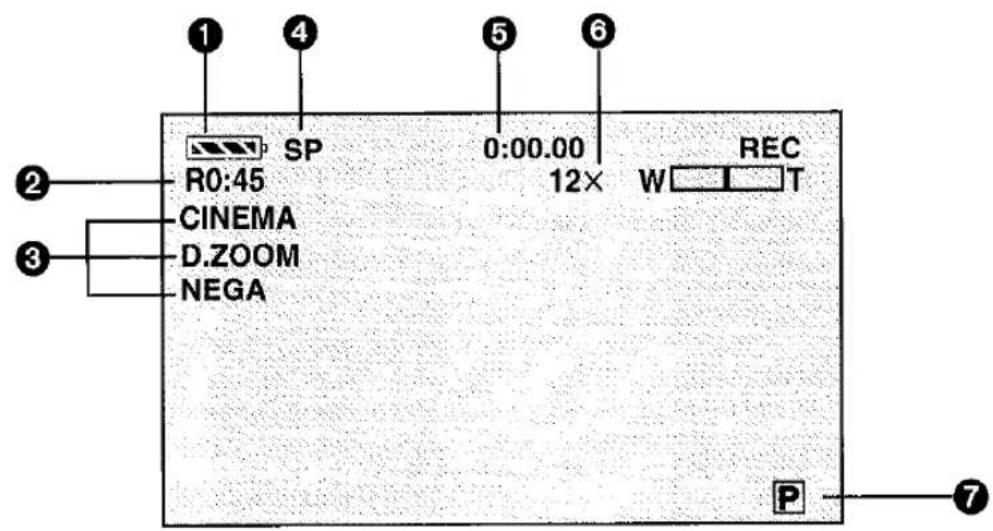
① Remaining Battery Power
As the remaining battery power decreases, the indication changes as follows:

When the battery is completely discharged, the
▶ (□) Indication flashes.
(When you are using the AC Adaptor, the
Indication may appear, however, this has no meaning in this case.)
② Remaining Tape Time
The remaining tape time is displayed in minutes. (When it becomes less than 3 minutes, the indication starts to flash.)
- If a recording lasts less than 15 seconds, the Remaining Tape Time cannot be displayed correctly.
- The displayed remaining tape time may be shorter than the actual remaining tape time.
③ Cinema Mode (p. 26)
When recording the Cinema Mode, this indication is displayed.
Digital Zoom (p. 23)
When the Digital Zoom function is activated, this indication is displayed.
Digital Effects (p. 42, 56)
When a digital effect is activated, the corresponding indication is displayed.
Playback Zoom (p. 66)
When the Playback Zoom Function is activated, this indication and the zoom magnification are displayed.
4 Recording Speed Mode (p. 11)
The selected Recording Speed Mode is displayed.
SP: Standard Mode
LP: Long-play Mode
⑤ Tape Counter, Time Code (p. 101)
The Tape Counter, Memory Stop Function or Time Code Indication is displayed.
⑥ Zoom Magnification (p. 22)
When you push the [W/T] Zoom Lever up or down, the Zoom Magnification Indication and the Zoom Gauge are displayed.
Recording Mode (p. 16, 20, 40, 52, 54)
AUTO: This appears when the Mode Selector Switch is set to [AUTO].
MNL: This appears when the Mode Selector Switch is set to [MNL].
Super Image Stabilizer (p. 26)
When the Super Image Stabilizer Function is activated, this indication is displayed.
Audio Recording Mode (p. 68)
12bit/16bit: The indication of the Audio Recording Mode that was selected for recording is displayed during playback.
Automatic Printing (p. 79)
AUTOPRINT: This indication is displayed when the Auto Print Function is being used.
⑦ Progressive Photoshot Mode (p. 24, 98)
P: This indication is displayed when the Progressive Mode is activated.
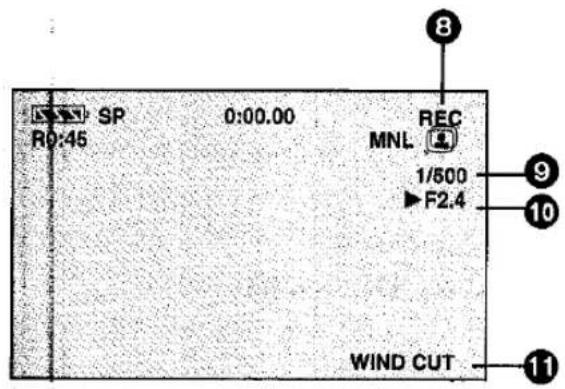
①
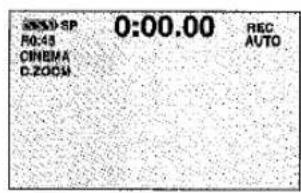
③
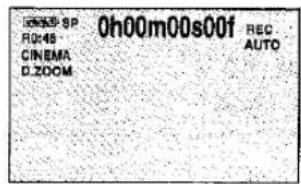
②
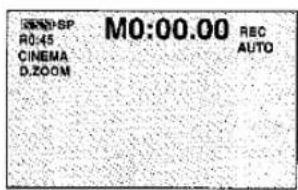
④
8 Tape Run Indications
REC: Recording (p. 16)
PAUSE: Recording Pause (p. 16)
▷: Playback (p. 28)/Camera Search in forward direction (p. 34)
◀: Camera Search in reverse direction (p. 34)
11: Still Playback (p. 30)
▷: Fast-forward/Cue Playback (p. 28)
◀◀: Rewind/Review Playback (p. 28)
▶/◀: Slow Motion Playback in forward direction/Slow Motion Playback in reverse direction (p. 30)
- Still Advance Playback in forward direction/Still Advance Playback in reverse direction (p. 30)
▷▷/|<|: Index Search in forward direction/ Index Search in reverse direction (p. 36)
CHK: Recording Check (p. 18)
A.DUB ▷: Audio Dubbing (p. 68)
A.DUB III: Audio Dubbing Pause (p. 68)
PHOTO: Recording in the Photoshot Mode (p. 22)
BLANK: Blank Search (p. 34)
2×▷: Variable Speed Search (p. 28)
R ▷: Repeat Playback (p. 29)
- When you record with the LCD Monitor facing forward using the Mirror Mode (p. 21), none of the Tape Run Indications shown above appear. Only the Remaining Battery Power Indication, the Recording Indication [●] and the Recording Pause Indication [●■] appear. If the [□] Indication appears, turn the LCD Monitor so that it faces backward and then confirm the displayed warning message(s).
⑨ Shutter Speed (p. 54)
When you manually adjust the shutter speed, this indication is displayed.
⑩ Iris Value (F Number) (p. 54)
When you manually adjust the iris, this indication is displayed.
⑪ Wind Noise Reduction [WIND CUT]
If you set [WIND CUT] on the [OTHER FUNCTIONS] Sub-Menu of the [CAMERA FUNCTIONS] Main-Menu to [ON], the [WIND CUT] Indication is displayed.
Changing the Indications
By changing the setting for [DISPLAY] on the [DISPLAY SETUP] Sub-Menu of the [VCR FUNCTIONS] or the [CAMERA FUNCTIONS] Main-Menu, the Counter Display Mode can be changed in the order shown in the above illustrations ①–④.
① Tape Counter Indication
② Tape Counter Indication with activated Memory Stop Indication
③ Time Code Indication
④ Simple Indication
(Only a few indications are displayed so that all parts of the picture can be seen clearly.)
![INDEX 12 13 14 15 MF VOLUME [-] [+] 15:30:45 15.10.1999 17](/content/2026/05/794594/images/33e9dcf80a1805cfe857933a570e20e56932887e6306e8ba9236bc56850ea6b8.jpg)
⑫ Index (p. 37)
INDEX: The [INDEX] Indication flashes for a few seconds while an index signal is being recorded.
Search Number (p. 36)
S 1: The figure indicates which number of scene ahead from the present scene is to be played back.
13 Programme AE Mode (p. 40)
The Programme AE Function offers the following settings:
: Sports Mode
: Portrait Mode
Low Light Mode
Spotlight Mode
8: Surf & Snow Mode
⑭ White Balance Mode (p. 52):
The White Balance Mode offers the following possible settings:
Indoor Mode (recording under incandescent lamp)
Outdoor Mode
☑: Last manually adjusted White Balance setting
When the Movie Camera is in the Auto Mode, none of the above 3 indications are displayed.
15 Manual Focus (p. 20)
If you select the Manual Focus Mode, the [MF] Indication is displayed.
When the Movie Camera is in the Auto Mode, this indication is not displayed.
16 Sound Volume (p. 28)
Use this indication to adjust the volume of the playback sound from the built-in speaker. Turn the [OFF/ON/MODE] Switch from the [ON] position to put the Movie Camera in the VCR Mode and keep the [PUSH] Dial pressed until the [VOLUME] Indication appears.
Then turn the [PUSH] Dial to adjust the volume.
⑰ Date and Time (p. 29)
The time is indicated in the 24-hour system.
18 Warning/Alarm
When any of the following indications lights or flashes, confirm the condition of the Movie Camera.
Condensation has occurred. (p. 93) The erasure prevention slider of the
inserted cassette is open (set to [SAVE]).
Audio dubbing was attempted on an unrecorded (blank) part of the tape.
No cassette is inserted.
The Battery is discharged. Charge it. (p. 8)
The built-in battery is discharged. (p. 91)
✗: The video heads are dirty.
☐END: During recording, the tape has reached its end.
REMOTE: Wrong Remote Controller Mode is selected. (p. 73)
INCOMPATIBLE TAPE:
The cassette is incompatible.
PRINTER ERROR:
The Video Printer is not connected correctly, or there is some trouble on the Video Printer.
UNPLAYABLE TAPE
(OTHER FORMAT):
Playback was attempted on a part of a tape recorded in a different television system.
UNABLE TO A. DUB
(LP RECORDED):
Audio dubbing is not possible because the original recording was made in the LP Mode.
Specifications
Digital Video Camera
Information for your safety
Power Source: DC 7.9/7.2V
Power Consumption: Recording: 4.0 W (When using Viewfinder) 4.8 W (When using LCD Monitor)
Recording Format: Mini DV (Consumer-use Digital Video SD Format)
Tape Used: 6.35 mm digital video tape
Recording/Playback Time: SP: 80 min. LP: 120 min. (with DVM80)
Video Recording System: Digital Component
Television System: CCIR: 625 lines, 50 fields PAL colour signal
Audio Recording System: PCM Digital Recording: 16 bit (48 kHz/2ch), 12 bit (32 kHz/4ch)
Input Sensitivity/Impedance: MIC IN (M3)-70 dBV/5.6 kohm
Image Sensor: 1/4-inch CCD Image Sensor
Lens: Auto Iris, F1.8, Focal Length; 3.6–36 mm, Macro (full range AF)
Filter Diameter: 27 mm / 30.5 mm (With Step-up Ring attached)
Zoom: 10:1 Power Zoom
Monitor: 2.5-inch LCD
ViewFinder: Colour Electronic Viewfinder
Microphone: Stereo
Speaker: 1 round speaker ∅ 20 mm
Standard Illumination: 1,400 lx
Minimum Required Illumination: 1 lx (Digital Gain-up Mode)
Video Output Level: 1.0 Vp-p, 75 ohm
S-Video Output Level: Y Output: 1.0 Vp-p, 75 ohm C Output: 0.3 Vp-p, 75 ohm
Audio Output Level: 316 mV, 600 ohm
Digital Still Picture: Digital Still Picture Output, Control Signal Input/Output (Transfer rate: max. 115kbps)
Digital Interface: DV Output Terminal (i.LINK, 4-pin)
Dimensions: Approx. 49 (W)×108 (H)×86 (D) mm
Weight: Approx. 400 g (without Battery and DV cassette)
Approx. 470 g (with CGP-D105 and DVM60)
Operating Temperature: 0°C-40°C
Operating Humidity: 10%-80%
AC Adaptor
Information for your safety
Power Source: AC 100–240 V, 50/60 Hz, DC 12 V
Power Consumption: 35 W
DC Output: DC 7.9 V, 9 W (Movie Camera Operation)
DC 8.4 V, 2.4 A (Battery Charging)
Dimensions: 121 (W)×56 (H)×81 (D) mm
Weight: Approx. 300 g (Without AC Mains Lead)
Weight and dimensions shown are approximate.
Specifications are subject to change without notice.
Before Requesting Service (Problems & Solutions)
Power Supply
P1: The Movie Camera does not turn on.
S1: Is the Battery or the AC Adaptor connected correctly? Confirm the connection. (p. 6, 8)
P2: The Movie Camera has turned off automatically.
S2: If you leave the Movie Camera in the Recording Pause Mode for more than 6 minutes, it automatically switches off to protect the tape and to conserve battery power. (p. 17)
P3: The Movie Camera quickly turns off.
S3-1: Is the Battery discharged? When the Remaining Battery Power Indication is flashing or the [☐] Indication is displayed, the Battery is discharged. Charge the Battery or attach a fully charged Battery. (p. 8)
S3-2: Has condensation formed? If the Movie Camera is brought from a cold to a warm place, condensation may form inside. In this case, the Movie Camera automatically switches off and no operation can be performed except taking out the cassette. Wait until the Condensation Indication disappears. (p. 93)
Battery
P1: The Battery discharges quickly.
S1-1: Is the Battery fully charged? Charge it with the AC Adaptor. (p. 8)
S1-2: Are you using the Battery in a place where the temperature is very low? The ambient temperature greatly influences the Battery's performance. Its operation time becomes shorter in a cold place. (p. 94)
S1-3: Has the Battery reached the end of its service life? The service life of the Battery is limited. It depends on the way the Battery is used, but when the operation time even after proper charging is too short for normal use, the servive life of the Battery has reached its end.
P2: The Battery cannot be charged.
S2: If the DC Input Lead is connected to the AC Adaptor, charging is not possible. Disconnect the DC Input Lead.
Normal Recording
P1: Recording cannot be started even though the Movie Camera is supplied with power and the cassette is inserted correctly.
S1-1: Is the erasure prevention slider of the cassette open? If it is open (set to [SAVE]), recording is not possible. (p. 11)
S1-2: Has the tape reached its end? Insert a new cassette. (p. 10)
S1-3: Is the Movie camera turned on? (p. 12)
S1-4: Is the [VCR] Lamp lit? If it is lit, recording is not possible. (p. 16)
S1-5: Is the Condensation Indicaiton [♠] displayed? When condensation has formed, no functions except taking out the cassette can be operated. Wait until the Condensation Indicaiton disappears. (p. 93)
Other Recording
P1: The picture on the LCD Monitor/in the Viewfinder suddenly stands still for a few seconds.
S1: Did you press the [PHOTO SHOT] Button? If you press the [PHOTO SHOT] Button, a still picture is recorded for approximately 7 seconds. After approximately 7 secondes, the Movie Camera switches back to the Recording Pause Mode. (p. 22)
P2: The Auto Focus Function does not work.
S2-1: Is the Manual Focus Mode selected? If you select the Auto Focus Mode, the focus is adjusted automatically. (p. 20)
S2-2: Is the subject or recording situation suitable for the Auto Focus Mode? The Auto Focus Function does not work correctly for some kinds of subjects and recording situations. In this case, use the Manual Focus Mode to adjust the focus. (p. 20, 96)
Editing
P1: Audio dubbing cannot be performed.
S1-1: Is the erasure prevention slider of the cassette open? If it is open (set to [SAVE]), editing is not possible. (p. 11)
S1-2: Are you trying to edit parts of the tape recorded in the LP Mode? As the tracks recorded in the LP Mode are narrower than the heads, audio dubbing is not possible. (p. 11, 68)
Indiçaitons
P1: The Time Code becomes incorrect.
S1: In the Slow Motion Playback Mode in reverse direction, the counter of the Time Code Indication may not be stable, however, this is not a malfunction.
P2: The Remaining Tape Time Indication disappears.
S2: If you record a still picture in the Photoshot Mode, the Remaining Tape Time Indication may disappear temporarily. However, if you switch the Movie Camera over to the Normal Recording Mode, it appears again.
P3: The Remaining Tape Time Indication does not match the actual remaining tape time.
S3-1: If scenes of less than 15 seconds are recorded successively, the remaining tape time is not indicated correctly.
S3-2: The Remaining Tape Time Indication may show a remaining tape time that is 2–3 minutes shorter than actual remaining tape time.
Playback (Picture)
P1: No playback picture is reproduced when pressing the Play Button [▶].
S1: Is the [VCR] Lamp lit? When the [VCR] Lamp is not lit, no playback functions can be operated. (p. 28)
P2: Mosaic-like patterns appear in the picture during Cue, Review or Slow Motion Playback.
S2: This phenomenon is a characteristic of the digital video system. This is not a malfunction. (p. 28)
P3: I want to play back the picture on a TV.
S3: Attach the Output Terminal Box [AV ONE TOUCH STATION] to the Movie Camera and connect it to the TV via the AV Cable (Phono-Phono). Or connect the Movie Camera directly to the TV via the AV Cable (Phono-M3). (p. 32)
P4: The Movie Camera is correctly connected to a TV, but no playback picture is reproduced.
S4: Did you select "Video Input" on the TV? Carefully read the operating instructions for your TV and select the channel that matches the input sockets used for connection.
P5: The playback picture is not reproduced cleary.
S5: Are the video heads on the Movie Camera dirty? If the video heads are dirty, the picture cannot be played back clearly.
Playback (Sound)
P1: No sound is played back from the Movie Camera's built-in speaker.
S1: Is the volume set too low? During playback, keep the [PUSH] Dial pressed until the [VOLUME] Indication appears. Then turn the [PUSH] Dial to adjust the volume. (p. 28)
P2: Different sounds are played back together.
S2: [12bitAUDIO] on the [OTHER FUNCTIONS] Sub-Menu of the [VCR FUNCTIONS] Main-Menu is set to [MIX]. Therefore, the original sound and the sound dubbed with audio dubbing are played back together. It is also possible to play them back individually. (p. 69)
P3: The original sound was erased by performing audio dubbing.
S3: If you perform audio dubbing on a recording made in the [16bit] Mode (p. 68), the original sound is erased. If you want to keep the original sound, be sure to select the [12bit] Mode for the original recording.
P4: No playback sound is reproduced.
S4-1: Is [12bit AUDIO] on the [OTHER FUNCTIONS] Sub-Menu of the [VCR FUNCTIONS] Main-Menu set to [ST2] even though no audio dubbing has been performed on the cassette that you are playing back? When you play back a cassette onto which no audio dubbing was performed, [12bit AUDIO] must be set to [ST1] (p. 69).
S4-2: Is the Variable Speed Search Function activated? Press the Play Button [▶] to cancel the Variable Speed Search Function (p. 29).
Others
P1: The cassette cannot be taken out.
S1-1: Is the Movie Camera supplied with power? Is the AC Adaptor correctly connected or the Battery correctly attached? To remove the cassette, the Movie Camera must be supplied with power, however, it is not necessary to set the [OFF/ON/MODE] Switch to [ON].
S1-2: The attached Battery may be discharged. Replace it with a charged Battery.
P2: No operation except taking out the cassette can be performed.
S2: Is the Condensation Indication [☐] displayed? If condensation has formed inside the Movie Camera, it automatically switches off and prevents all operations except taking out the cassette. Wait until the Condensation Indication disappears. (p. 93)
P3: The Remote Controller does not work.
S3-1: Is the button-type battery in the Remote Controller exhausted? If the Remote Controller does not work when you use it near the Remote Controller Sensor on the Movie Camera, the button-type battery is exhausted. Replace it with a new battery. (p. 72)
S3-2: Is the correct Remote Controller Mode selected? If the Movie Camera's setting for [REMOTE] on the [OTHER FUNCTIONS] Sub-Menu and the mode selected on the Remote Controller are not matched, operating the Movie Camera with the Remote Controller is not possible and the [REMOTE] Indication is displayed. (p. 73)
Index
A
AC Adaptor (p. 6, 8)
AC Mains Lead (p. 6, 8)
AC Mains Socket (p. 6, 8)
Audio Dubbing (p. 68)
Auto Focus (p. 96)
Automatic Printing Function (p. 79)
Automatic White Balance Adjustment (p. 97)
B
Backlight (p. 18)
Battery Eject Button (p. 9)
Before Requesting Service (p. 104)
Blank Search (p. 34)
B/W (p. 42)
C
Camera Search (p. 34)
Charge Confirmation Marker (p. 8)
Charge Lamp (p. 8)
Cinema Mode (p. 26)
Colour Temperature (p. 97)
Condensation (p. 93)
Cue Playback (p. 28)
D
Date/Time Indication (p. 29)
Date/Time Setting (p. 90)
DC Input Lead (p. 6)
Digital Effects (p. 42, 56)
Digital Zoom (p. 23)
Dubbing (p. 74)
E
Editing Controller (p. 76, 77)
[EDIT] Socket (p. 76, 77, 78)
Erasure Prevention Slider (p. 11)
Eyepiece Corrector Lever (p. 12)
F
Fade (p. 38)
FF (Fast-Forward) (p. 28)
F Number (p. 54)
G/H
Gain Up (p. 42)
Grip Belt (p. 5)
Hyper Check Function (p. 29)
I/J
Index Signals (p. 37)
Iris (p. 54)
Jet Zoom (p. 23)
Jog Playback (p. 31)
L
LCD Monitor (p. 12, 95)
Lens Cap (p. 33, 64)
Low Light Mode (p. 40)
M
Macro Close-up Function (p. 23)
Manual Focus (p. 20)
Memory Stop Funcion (p. 99)
Menu Screen (p. 82)
Microphone (p. 4)
Mix Mode (p. 50, 56, 64)
Mode Selector Switch (p. 16, 20, 40, 52, 54)
Multi-Function Dial [PUSH] (p. 20, 28, 31, 54, 84)
Multi-Pictures Function (p. 44-47, 58-65)
N/O
NEGA (p. 42)
Optional Accessories (p. 81)
T
Time Code (p. 99)
TRACER (p. 42)
P
PCM Digital Sound (p. 98)
Photoshot (p. 22)
P-IN-P Function (p. 48)
Playback Digital Effect Function(p. 56-65)
Playing Back on a TV (p. 32)
Playback Zoom (p. 66)
Portrait Mode (p. 40)
Problems & Solutions (p. 104)
Programme AE (p. 40)
Progressive Photoshot (p. 24, 98)
V
Video Head Clogging (p. 18)
Video Printer (p. 78)
Viewfinder (p. 12, 95, 100)
W
White Balance (p. 52)
Wipe Mode (p. 50, 56, 64)
R
Recording Check (p. 18)
Recording Indicating (Tally) Lamp (p. 17)
Recording Pause Mode (p. 16)
Recording Start/Stop Button (p. 16)
Rec Speed (p. 11)
Remaining Tape Time (p. 100)
Remote Controller (p. 70–73)
Review Playback (p. 28)
Z
Zoom (p. 22, 52)
S
Search Lock (p. 29)
Shutter Speed (p. 54)
Slow Motion playback (p. 30)
Sound Volume (p. 28)
Super Image Stabilizer (p. 26)
SP/LP Mode (p. 11)
Sports Mode (p. 40)
Spotlight Mode (p. 40)
Still Advance Playback (p. 30)
Strobe Mode (p. 42)
Sub Code (p. 98)
Surf & Snow Mode (p. 40)
SEPIA (p. 42)
SOLARI (p. 42)
| Door No.5 | ||
| Drop No.0 | ||
| Customer: FAO CLARE1 | ||
| Load: SPOTH1 | ||
| Model:VQT8290 | Qty:1 | |
| Assemble at: 60 | 17/08/00 | |

Printed in Japan
VQT8290
F0899C0(2500®)
D
- Panasonic
- Operating Instructions
- Information for Your Safety
- Movie Camera
- AC Adaptor
- Caution for AC Mains Lead
- IMPORTANT
- Before Use
- ■ How to replace the Fuse
- WARNING
- Contents—Basic Operations
- Contents—Advanced Operations
- Contents—Options/Editing
- Contents—Miscellaneous/Care of Unit
- Check List for the Standard Accessories
- Controls and Functions
- 3
- 4
- Charging Two Batteries
- Remarks, etc.
- Quick Charge
- When the Charge Lamps Flash as Warning
- Removing the Battery from the Movie Camera
- LP Mode
- Handling the Lens Cap
- ■ Video Head Clogging and Remedy
- Causes of Dirty Video Heads
- Using the Mini-DV Format Digital Video Head Cleaner (VFK1451; Not Supplied)
- Notes:
- Mirror Mode for the Picture on the LCD Monitor
- Recording Extra Close-up Shots of Small Subjects (Macro Close-up Function)
- ■ Adjusting the Sound Volume
- Search Lock Function
- Hyper Check Function
- Making the Date/Time Indication Appear
- Using the Jog Dial (Jog Playback)
- Easy Playback on a TV
- Making the Indications Appear on the TV Screen
- Index Search
- ① Photoshot Index Signal
- ② Scene Index Signal
- Effects
- Notes about the Recording with Natural Colours
- Notes about the Adjusting the White Balance Manually
- In the Following Cases, the [■] Indication Flashes:
- Returning to the Automatic White Balance Adjustment Mode
- Notes about the Adjusting the Shutter Speed Manually
- Notes about the Adjusting the Iris (F Number) Manually
- Remote Controller
- ■ Buttons on the Remote Controller
- Fast-forward/Cue Button [▶▶]
- Play Button [▶] (p. 28)
- Slow Motion/Still Advance Button [◀, ▶] (p. 30)
- Index Search Button [◀◀, ▶▶▶]
- Stop Button [■]
- Pause Button [11]
- ⑩ Playback Digital Effects
- Selection Button [SELECT] (p. 56)
- Store Button [STORE] (p. 64)
- Off/On Button [OFF/ON] (p. 56)
- ■ Selecting the Remote Controller Mode
- 2
- Copying with the Help of an Editing Controller
- When Editing with Time Code
- Using the Movie Camera with a Video Printer
- Movie Camera:
- Video Printer:
- ■ Using the Automatic Printing Function (Autoprint)
- Using the Movie Camera with a Computer
- Computer System Requirements
- ① Camera Functions Main-Menu
- CAMERA FUNCTIONS
- ② VCR Functions Main-Menu
- VCR FUNCTIONS
- Menu Functions
- Camera Functions Menu
- Camera Mode Main-Menu [CAMERA FUNCTIONS]
- [MULTI-PICTURES] Sub-Menu ③
- [DISPLAY SETUP] Sub-Menu ④
- VCR Mode Main-Menu [VCR FUNCTIONS]
- [DISPLAY SETUP] Sub-Menu ③
- Adjusting the LCD Monitor/Viewfinder
- LCD Brightness [LCD BRIGHTNESS]
- LCD Colour Level [LCD COLOUR LEVEL]
- Viewfinder Brightness [EVF BRIGHTNESS]
- Increasing the Brightness of the Whole LCD Monitor Screen
- Setting the Date and Time
- Charging the Built-in Lithium Battery
- Cautions for Use
- Take care that no water enters the Movie Camera when using it in the rain and snow or on the beach.
- Keep the Movie Camera away from magnetized equipment (TVs, video games, etc.).
- Do not use the Movie Camera near a radio transmitter or high-voltage power line.
- Do not use the Movie Camera for surveillance and other industrial application.
- Take care that no sand and fine dust enters the Movie Camera when using it on a beach or similar places.
- Do not spray insecticide or volatile agents on the Movie Camera.
- Do not use benzine or thinner for cleaning.
- After use, always take out the cassette and remove the Battery or unplug the AC Mains Lead from the AC mains socket.
- Notes about the AC Adaptor
- Condensation
- ■ Other Useful Information
- LCD Monitor
- Viewfinder
- Listening to the Playback Sound via Headphones
- Microphone Socket
- Shoe Adaptor
- Attaching the Step-up Ring
- Glossary
- ■ Focus
- Human Eyes
- Auto Focus Adjustment
- Lens Unit
- ■ White Balance Adjustment
- White Balance Adjustment
- Auto White Balance Adjustment
- ■ Colour Temperature
- Glossary (Cont.)
- ■ Digital Video System
- Features
- Compatibility with S-VHS or VHS Cassettes
- Compatibility with Output Signals
- PCM Digital Sound
- Sub Code
- ■ Progressive Photoshot Function
- Notes about the Progressive Photoshot Function
- Time Code
- ■ Memory Stop Function
- Rewinding or fast-forwarding the tape to a desired position
- Stopping the editing automatically in the audio dubbing
- Indications on the LCD Monitor/in the Viewfinder
- ① Remaining Battery Power
- ② Remaining Tape Time
- ③ Cinema Mode (p. 26)
- Digital Zoom (p. 23)
- Digital Effects (p. 42, 56)
- Playback Zoom (p. 66)
- Recording Speed Mode (p. 11)
- ⑤ Tape Counter, Time Code (p. 101)
- ⑥ Zoom Magnification (p. 22)
- Recording Mode (p. 16, 20, 40, 52, 54)
- Super Image Stabilizer (p. 26)
- Audio Recording Mode (p. 68)
- Automatic Printing (p. 79)
- ⑦ Progressive Photoshot Mode (p. 24, 98)
- Tape Run Indications
- ⑨ Shutter Speed (p. 54)
- ⑩ Iris Value (F Number) (p. 54)
- ⑪ Wind Noise Reduction [WIND CUT]
- Changing the Indications
- ⑫ Index (p. 37)
- Search Number (p. 36)
- Programme AE Mode (p. 40)
- ⑭ White Balance Mode (p. 52):
- Manual Focus (p. 20)
- Sound Volume (p. 28)
- ⑰ Date and Time (p. 29)
- Warning/Alarm
- Before Requesting Service (Problems & Solutions)
- Power Supply
- Battery
- Normal Recording
- Other Recording
- Editing
- Indiçaitons
- Playback (Picture)
- Playback (Sound)
- Others
- Index
- A
- B
- C
- D
- E
- F
- G/H
- I/J
- L
- M
- N/O
- T
- P
- V
- W
- R
- Z
- S
Marke : PANASONIC
Modell : NV-EX3B
Kategorie : Camcorder