
EM-704M - Mikrowelle SANYO - Kostenlose Bedienungsanleitung
Finden Sie kostenlos die Bedienungsanleitung des Geräts EM-704M SANYO als PDF.


| Produkttyp | Mikrowelle |
| Marke | Sanyo |
| Modell | EM-704M |
| Gewicht | 14,0 kg |
| Garraum | Glasdrehteller (Drehrichtung wechselnd) |
| Drehteller | Glasdrehteller und Rollenring |
| Bedienung | Mechanische Drehknöpfe für Timer und Leistung |
| Leistungsstufen | Niedrig, Auftauen, Schmoren, Köcheln, Aufwärmen, Maximale Leistung |
| Timer | Bis 60 Minuten, Klingelton bei Ende |
| Lüftung | Abluft an der linken Seite unten, mindestens 5 cm Abstand zur Wand |
| Stromversorgung | Standard-Haushaltssteckdose |
| Geeignete Materialien | Ofenfestes Glas, Porzellan ohne Metall, Keramik, Kunststoff (kurze Zeit), Papier (max. 3-4 Min.) |
| Ungeeignete Materialien | Metall, Alufolie (außer kleine Stücke in 2,5 cm Abstand), Holz, beschädigtes Geschirr |
| Reinigung | Mildes Reinigungsmittel, keine Scheuermittel; Glasdrehteller und Rollenring abnehmbar |
| Sicherheitsfunktionen | Türverriegelung, automatische Abschaltung bei Türöffnung, Schutz vor leerem Betrieb |
| Besondere Hinweise | Keine Eier in der Schale kochen; bei Flüssigkeiten Glasstab verwenden, um verzögertes Sieden zu vermeiden |
| Zubehör | Glasdrehteller, Rollenring, Bedienungsanleitung |
| Nutzung | Nur für den Hausgebrauch |
| Kundendienst | Nächstgelegene Sanyo-Servicestelle |
Häufig gestellte Fragen - EM-704M SANYO
Benutzerfragen zu EM-704M SANYO
0 Frage zu diesem Gerät. Beantworten Sie die, die Sie kennen, oder stellen Sie Ihre eigene.
Eine neue Frage zu diesem Gerät stellen
Laden Sie die Anleitung für Ihr Mikrowelle kostenlos im PDF-Format! Finden Sie Ihr Handbuch EM-704M - SANYO und nehmen Sie Ihr elektronisches Gerät wieder in die Hand. Auf dieser Seite sind alle Dokumente veröffentlicht, die für die Verwendung Ihres Geräts notwendig sind. EM-704M von der Marke SANYO.
BEDIENUNGSANLEITUNG EM-704M SANYO
EM-603M / 606M / 700M / 704M
Microwave Oven
Table of Contents
General Instructions
• Installation 2
- Please take care 2
• How a Microwave Oven Makes Cooking Faster, Easier and Much More Enjoyable 2
- Names of Oven Parts 3
User Instructions
• Operation 4
• Power Control Setting Guide 5
Taking Care of Your Microwave Oven 6
Precautions to Avoid Any Possible Exposure to Electricity or Excessive Microwave Energy 6
Suitable Cooking Utensils and Materials 7
Utensils and Materials Not Suitable for Microwave Cooking 7
What To Do If Repairs are Needed .... Back Cover
Installation
- Install the oven on a flat, level surface.
Strong enough to safely bear the weight of the oven, which is 14.0kg. To avoid the possibility of causing vibration or noise the oven must be in a stable position.
- Keep the oven away from heat and water
Exposure to heat and water can lower oven efficiency and lead to malfunctioning, so be sure to install the oven away from heat and water sources.
- The exhaust vent of the oven is at the left side of the bottom plate, so keep it at least 5cm away from the rear wall and the side wall.
Covering the exhaust vent may lead to malfunctioning. Hot air escapes from this vent, so be sure not to obstruct it or let curtains come between the oven and the rear wall.
- Place the oven as far away from radios and T.V.'s as possible. If the oven is placed too close to a radio or TV, some interference may occur, so keep them as far apart as possible.
NOTE
It is quite normal for steam to be emitted around the door, or for misting to occur on the door, or even for water droplets to appear below the door during the cooking cycle.
This is merely condensation from the heat of the food and does not affect the safety of your oven. The door is not intended to seal the oven cavity completely but its special Sanyo design contributes to the complete safety of the appliance.
Please Take Care
- When cleaning the door seal surfaces, never use abrasive powders or pads.
- Should the oven have been damaged during the transport or when using it later on - especially on the door seal - it must not be operated. Please get in touch with your nearest service organization.
How A Microwave Oven Makes Cooking Faster, Easier And Much More Enjoyable :
- A festive meal in minutes
High energy microwaves penetrate the food and cook it quickly, evenly and efficiently.
- Natural flavour
Microwave cooking preserves the natural taste and nutritive value of the food to a much higher degree than conventional cooking methods.
- Utensils
Glassware, earthenware, paper containers and practically all utensils except metal ones are perfectly suitable for microwave cooking.
- Clean, cool operation
No smoke, no grease, no heat, your kitchen stays cool and clean at all times.
- Perfect for defrosting and reheating
Your microwave oven allows you to thaw frozen foods within a very short time. It defrosts all kinds of frozen foods and reheats them fast.
- Economical
Since the required cooking time is extremely short, microwave cooking is more economical than conventional ovens.
Names of Oven Parts
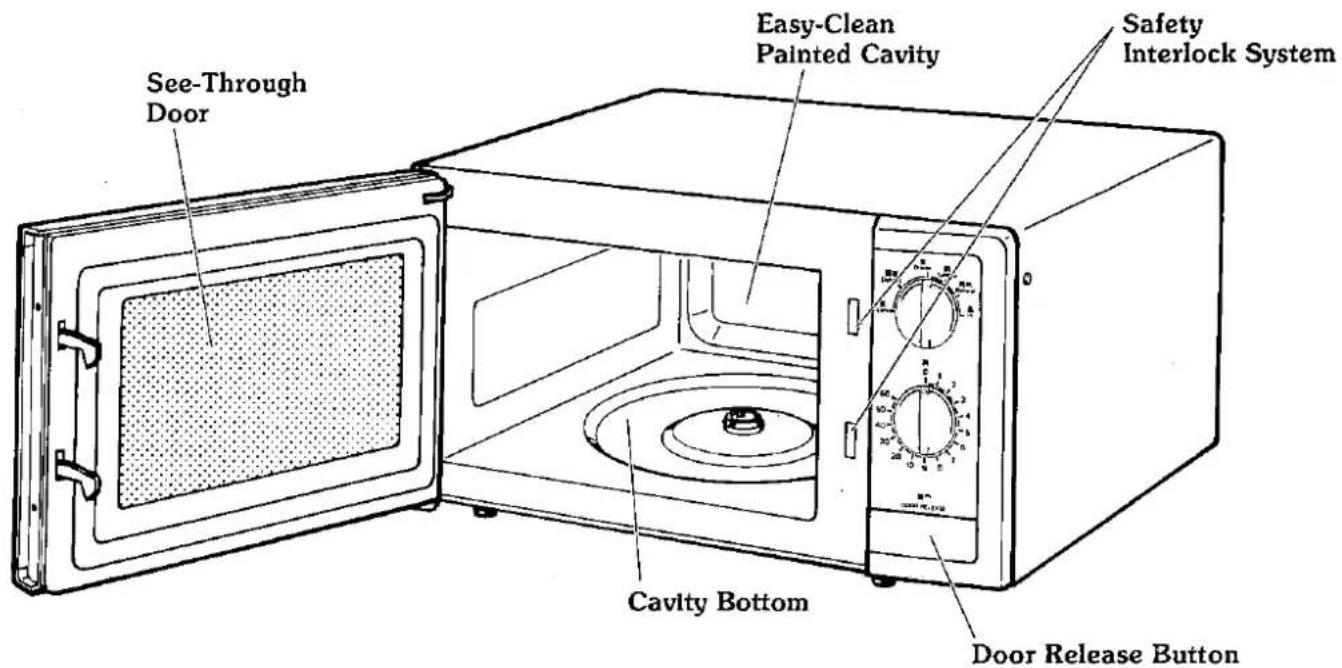
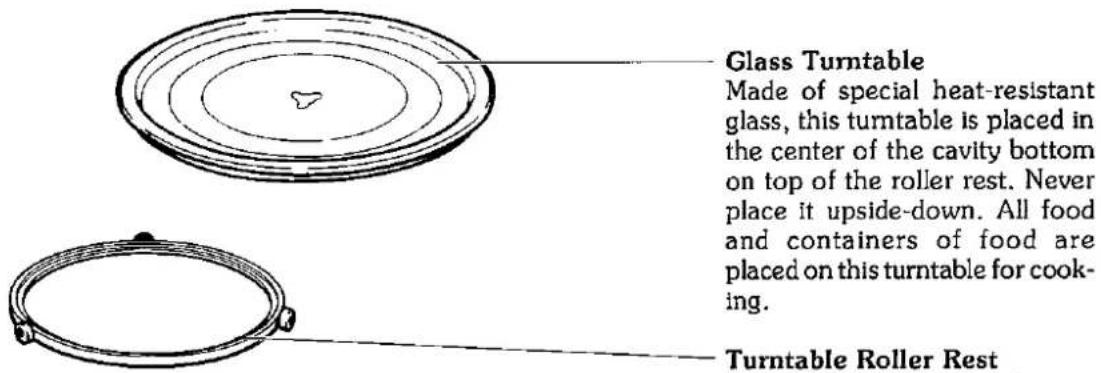
NOTE: The oven should not be used without the glass turntable and turntable roller rest in place, and should never be restricted so that the glass turntable cannot rotate. The glass turntable will rotate clockwise or counterclockwise.
Remove your Oven and all material from the shipping carton. Your oven comes with the following material:
Glass Turntable 1 each
Roller Rest 1 each
Instruction Manual 1 each
Do not use this Microwave Oven for commercial purposes. This Microwave Oven is made for domestic use only.
Operation
Your microwave oven is most useful when placed near the center of your cooking area. You will find it useful for making some steps in regular cooking easy as well as for basic recipe preparation. Because microwave use periods are short and user attendance is necessary, you will want the oven close to your work area.
It is best to have counter space beside the microwave. You may often have more than one dish ready to go in and some already cooked foods standing before serving.
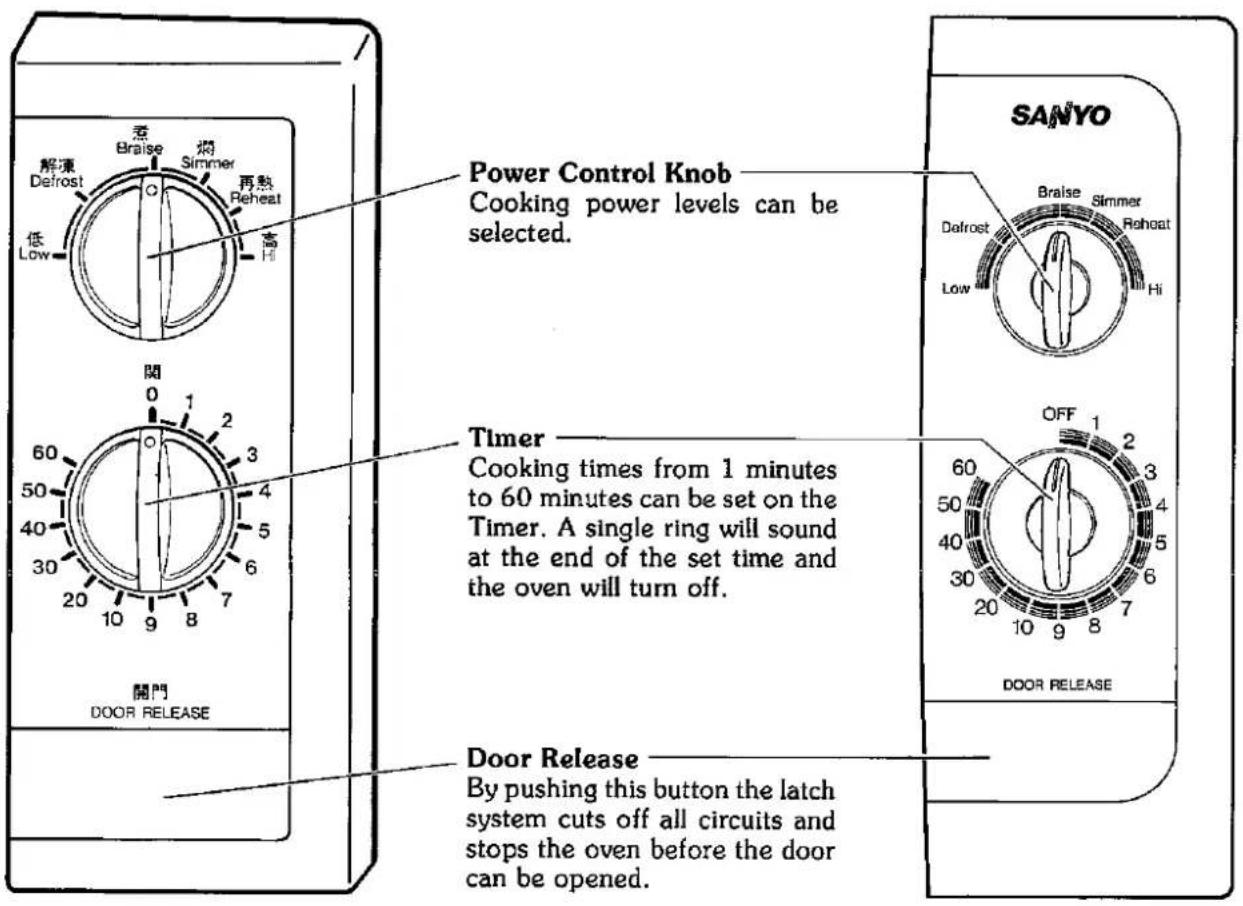
TO START
- Open the oven door and place food on glass turntable.
- Shut the oven door. Make sure that it is firmly closed.
- Set the power control knob to the desired cooking power level.
- Set the timer to desired time by turning the timer knob. The oven begins heating food.
- When the cooking time is up, the time pointer reads off, the bell rings and heating stops. Open the door and take out the food. If you wish to check the food before the end of the set time, open the door and the oven will automatically turn off. When the door is closed, heating will automatically resume. Heating time can be reset at any time during the cooking operation by turning the timer knob.
- After use, be sure to return the timer to '0'.
- Occasional turning of food is recommended for even cooking and heating.
Power Control Setting Guide
The Power Control feature lets you choose the best power level for the food being cooked.
| POWER SETTINGS | EXAMPLES |
| LOW | Softening cream cheese.Keeping casseroles and main dishes warm. |
| DEFROST | Thawing meat, poultry and seafood.Completing the cooking cycle of casseroles, stews and some sauces.Cooking small quantities of food. |
| BRAISE | Cooking less tender cuts of meat in liquid or slow cooking dishes.Completing the cooking cycle of less tender roasts. |
| SIMMER | Cooking stews and soups after bringing to a boil.Cooking baked custards and pasta. |
| REHEAT | Reheating precooked or prepared food quickly.Heating sandwiches. |
| MAX POWER | Cooking tender cuts of meat.Cooking poultry, fish, vegetables and starting most casseroles.Preheating the browning dish.Boiling water.Thickening some sauces. |
As you get to know your microwave oven, you may find that a particular setting is too low or too high for the results you desire. The variable power control knob gives you the capability to obtain greater precision in setting power levels. For instance, if you want a power level between Braise and Simmer, you would set the time as usual; set the power control knob between Braise and Simmer.
Taking Care Of Your Microwave Oven :
Wipe the oven inside and outside with a mild detergent solution, rinse and wipe dry. This should be done on a weekly basis -- more often if needed. Never use abrasive powders or pads.
Removable parts:
- The glass turntable can be removed for cleaning in the sink. Wipe up all spilt food with a paper towel or cloth before removing glass turntable.
- The roller rest can be removed for easy cleaning.
Special care:
The inner door panel and oven front frame should be free of food or grease for optimum performance and safety. Wipe both frequently with a mild detergent, rinse and wipe dry. Never use abrasive powders or pads.
Please note:
-
Eggs are rather difficult to cook. Before frying, the membrane around the yolk should be pierced, because the yolk swells more than the surrounding part. It is not possible to boil eggs in their shells in the oven. They will explode.
-
The oven should not be operated when empty. This will damage the oven. When cooking small amounts of food, or food with low water contents (e.g. bread etc.), always place a glass of water inside the oven with the food.
- Exhaust outlets are located on the upside of the oven. Blocking the outlets can damage the oven. No special electrical wiring is necessary. Simply connect the plug to a nearby electrical outlet.
Delayed boiling
With boiling or re-heating of liquids especially water — it may happen that you cannot see the usual bubbles even though the boiling point has already been reached. This so-called delayed boiling can cause a sudden overboiling when the container is taken out of the microwave oven. You may be hurt by boiling water jumping out of the glass or container. In order to avoid any trouble, we recommend a standard glass stick be put into the glass or container so that an even boiling can occur.
Precautions To Avoid Any Possible Exposure To Electricity Or Excessive Microwave Energy :
- Do not attempt to operate the oven with the door open. It could result in harmful exposure to microwave energy. Do not tamper with the safety interlocks.
- Nothing should be placed between the oven front and the door. Neither dirt nor cleaner residue should be allowed to accumulate on the sealing surfaces.
-
Do not operate the oven if it is damaged. It is particularly important that the oven door closes properly and that the following parts are intact:
-
Door (not bent)
- Hinges and Latches (not broken or loosened)
-
Door seals and Sealing surfaces
-
Then oven should not be adjusted or repaired by anyone except properly qualified service personnel.
Please take care:
Arcing in the oven during operation usually occurs from use of metallic utensils or extensive use of aluminium foil. Arcing is denoted by a 'snapping' or 'cracking' noise and may be accompanied by bright flashes. Continuous arcing can damage the unit. If continuous arcing occurs during operation, do not use the unit. Call your nearest Sanyo dealer.
Improper use can result in costly damage to the oven. No one should use the oven until completely familiar with its operation and the new cooking technique.
This microwave oven has been factory tested and complies with prevailing standards for domestic use at the time of its manufacture. Make no adjustments or repairs yourself.
Suitable Cooking Utensils And Materials :
Ovenproof Glass
Oven-ware (treated for intense heat), such as utility dishes, bread dishes, pie plates, cake plates, liquid measuring cups, casseroles and bowls without metallic decoration.
China or Porcelain
Bowls, cups, serving dishes, plates and platters without metallic decoration.
Pottery
Dishes, cups, mugs and bowls.
Plastic
Plastic wrap may be used as a cover. Lay the plastic wrap over the dish and press it to the sides. The dish should be deep enough so that the plastic wrap does not touch the food. As the food heats it may cause the wrap to melt if it touches the food. Plastic dishes, cups, semi-rigid freezer containers and plastic bags can be used for short cooking times. Use with care, the heat from the food may soften the plastic.
Paper
Paper towels, waxed paper, paper napkins and paper plates can be used if the cooking times are not longer than 3 or 4 minutes. If they are used for longer cooking times, the wax on the paper may melt from the heat of the food.
Utensil Test
A simple way to determine whether a utensil is suitable for use in a microwave oven is to place it, empty, on the cooking tray; close the door and turn the timer to 20 seconds. If the utensil is warm to touch at the end of this time, it should not be used.
Caution:
Always make sure that closed containers, such as jars of baby food, are opened. Plastic pouches containing vegetables etc. should be pierced before placing in the oven. Tightly closed containers might explode.
Utensils And Materials Not Suitable For Microwave Cooking :
Metal Utensils
Metal utensils are not recommended because the metal shields the food from microwave energy on the bottom and the sides, causing uneven cooking results. Metal utensils might cause arcing and damage the appliance.
Metal Decoration
Metal-trimmed or banded dinner-ware, casseroles, etc. should not be used. The metal trim interferes with normal cooking and may damage the dish.
Aluminium Foil
Large sheets or pieces of aluminium foil should be avoided because they will disrupt cooking and may cause harmful arcing. However, small pieces may be used to cover areas such as poultry legs and wings. Any aluminium foil used should never be closer than 1 inch from the side walls of the oven.
Wood
Wooden bowls and boards will become dried out when used in microwave oven and may split or crack.
Other Materials
Avoid using cracked, flawed or defective utensils, including ovenproof glassware.
Caution:
Do not use metal ties on any paper or plastic bags; the ties become hot and could cause a fire.
What To Do If Repairs Are Needed
Get in contact with your nearest Sanyo Service Centre. On no account remove or interfere with any parts or screws. "THIS COULD PROVE VERY DANGEROUS" Make the following simple check-up before contacting the Sanyo Service Centre :
- If the interior lamp does not light when the timer knob is set:
-
Make sure that the mains lead is securely plugged in.
-
Make sure that the door is properly closed.
- If the lamp inside lights but the food is not heated: Make sure that the food is not completely covered with a metal container or aluminium foil.
- Noisy operation : Make sure that sparks are not being produced due to the use of metal utensils.


- EM-603M / 606M / 700M / 704M
- Microwave Oven
- Table of Contents
- General Instructions
- User Instructions
- Installation
- NOTE
- Please Take Care
- How A Microwave Oven Makes Cooking Faster, Easier And Much More Enjoyable :
- Names of Oven Parts
- Operation
- TO START
- Power Control Setting Guide
- Taking Care Of Your Microwave Oven :
- Delayed boiling
- Precautions To Avoid Any Possible Exposure To Electricity Or Excessive Microwave Energy :
- Suitable Cooking Utensils And Materials :
- Ovenproof Glass
- China or Porcelain
- Pottery
- Plastic
- Paper
- Utensil Test
- Caution:
- Utensils And Materials Not Suitable For Microwave Cooking :
- Metal Utensils
- Metal Decoration
- Aluminium Foil
- Wood
- Other Materials
- What To Do If Repairs Are Needed
Marke : SANYO
Modell : EM-704M
Kategorie : Mikrowelle