
EM-1410 - Mikrowelle SANYO - Kostenlose Bedienungsanleitung
Finden Sie kostenlos die Bedienungsanleitung des Geräts EM-1410 SANYO als PDF.


| Produkttyp | Mikrowelle |
| Marke | SANYO |
| Modell | EM-1410 |
| Abmessungen (B × T × H) | 49,0 × 36,7 × 32,5 cm |
| Garraummaße (B × T × H) | 29,4 × 29,6 × 19,3 cm |
| Leistung (max.) | 500 W |
| Stromversorgung | 230 V / 50 Hz |
| Leistungsstufen | 7 Stufen: Niedrig (10 %), Warm (20 %), Auftauen (35 %), Köcheln (55 %), Braten (70 %), Aufwärmen (85 %), Hoch (100 %) |
| Timer | Mechanisch, bis zu 60 Minuten |
| Starttaste | Ja |
| Innenbeleuchtung | Ja |
| Drehteller | Ja (Glas, herausnehmbar) |
| Sichtfenster | Ja |
| Sicherheitsfunktionen | 6 Sicherheitsvorrichtungen: Verschlusssystem, Türschalter, Chokedichtung, Strahlungsabsorber, Thermosicherung, Überwachungsschalter |
| Gehäuse | Kompakt und leicht |
| Reinigung | Mit mildem Reinigungsmittel; keine Scheuermittel |
| Geeignete Utensilien | Ofenfestes Glas, Porzellan, Keramik, Kunststoff (ohne Metall) |
| Ungeeignete Utensilien | Metall, große Alufolienstücke, Holz |
| Zubehör | Glasdrehteller, Rollenständer |
| Hersteller | SANYO Electric Co., Ltd., Osaka, Japan |
Häufig gestellte Fragen - EM-1410 SANYO
Benutzerfragen zu EM-1410 SANYO
0 Frage zu diesem Gerät. Beantworten Sie die, die Sie kennen, oder stellen Sie Ihre eigene.
Eine neue Frage zu diesem Gerät stellen
Laden Sie die Anleitung für Ihr Mikrowelle kostenlos im PDF-Format! Finden Sie Ihr Handbuch EM-1410 - SANYO und nehmen Sie Ihr elektronisches Gerät wieder in die Hand. Auf dieser Seite sind alle Dokumente veröffentlicht, die für die Verwendung Ihres Geräts notwendig sind. EM-1410 von der Marke SANYO.
BEDIENUNGSANLEITUNG EM-1410 SANYO
EM-1410
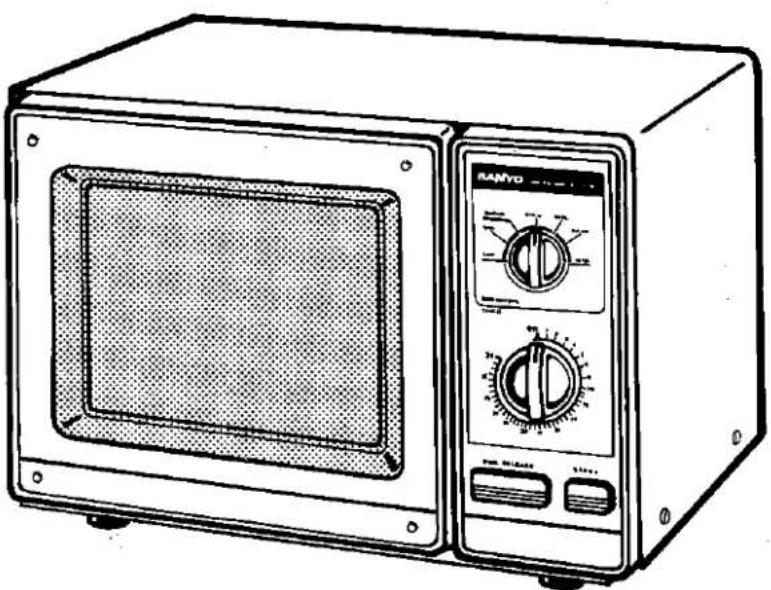
MICROWAVE OVEN
natural_image
Line drawing of a RANYO microwave oven with front and back panels (no text or symbols)How a Microwave Oven Makes Cooking Faster, Easier and Much More Enjoyable
- A feast in minutes.
High energy microwaves penetrate the food and cook it quickly, evenly and efficiently.
- Natural flavour.
Microwave cooking preserves the natural taste and nutritive value of the food to a much higher degree than conventional cooking methods.
- Utensils.
Glassware, earthenware, wooden bowls, paper containers and practically all utensils EXCEPT METAL ONES are perfectly suitable for microwave cooking.
- Simplified operation.
You are cooking by time, and not by heat. Simply set the timer and push the 'START' button.
- Clean, cool operation.
No smoke, no grease, no heat. Your kitchen stays cool and clean at all times.
- Perfect for defrosting and reheating.
When there is no time for natural thawing of frozen foods, your microwave oven can reduce the process to a matter of seconds. It defrosts all kinds of frozen foods and it reheats fast.
- Economical.
Since the required cooking time is extremely short, microwave cooking is more economical than conventional ovens.
The Extra Features of Your Sanyo Microwave Oven
- Compact, light weight, easy to move.
Fits easily on a kitchen work surface. Can be installed practically anywhere. Light enough to be moved to a summer house or seaside cottage.
- Six separate safety features.
1) Latch system: when the door release button is pushed, a built-in switch turns off the oven before the door is opened.
2) Door switch: when the door is opened this switch automatically turns off the oven.
3) Choke seal: a special seal around the door prevents all radiation leakage from the oven.
4) Radiation absorbent: this absorbent is made of durable ferrite rubber.
5) Thermal limiter: when the temperature of the magnetron rises above the limit, this switch automatically turns off all radiation.
6) Monitor switch: should the latch switch fail to function properly, this switch is activated to prevent microwave radiation.
- Variable power control
By setting the selector knob, the appropriate power between 50W to 500W may be selected.
- Simplified cooking.
Simply set the timer and push the 'START' button. Your oven does the rest, and a chime sounds when the food is ready.
- High-visible viewing window
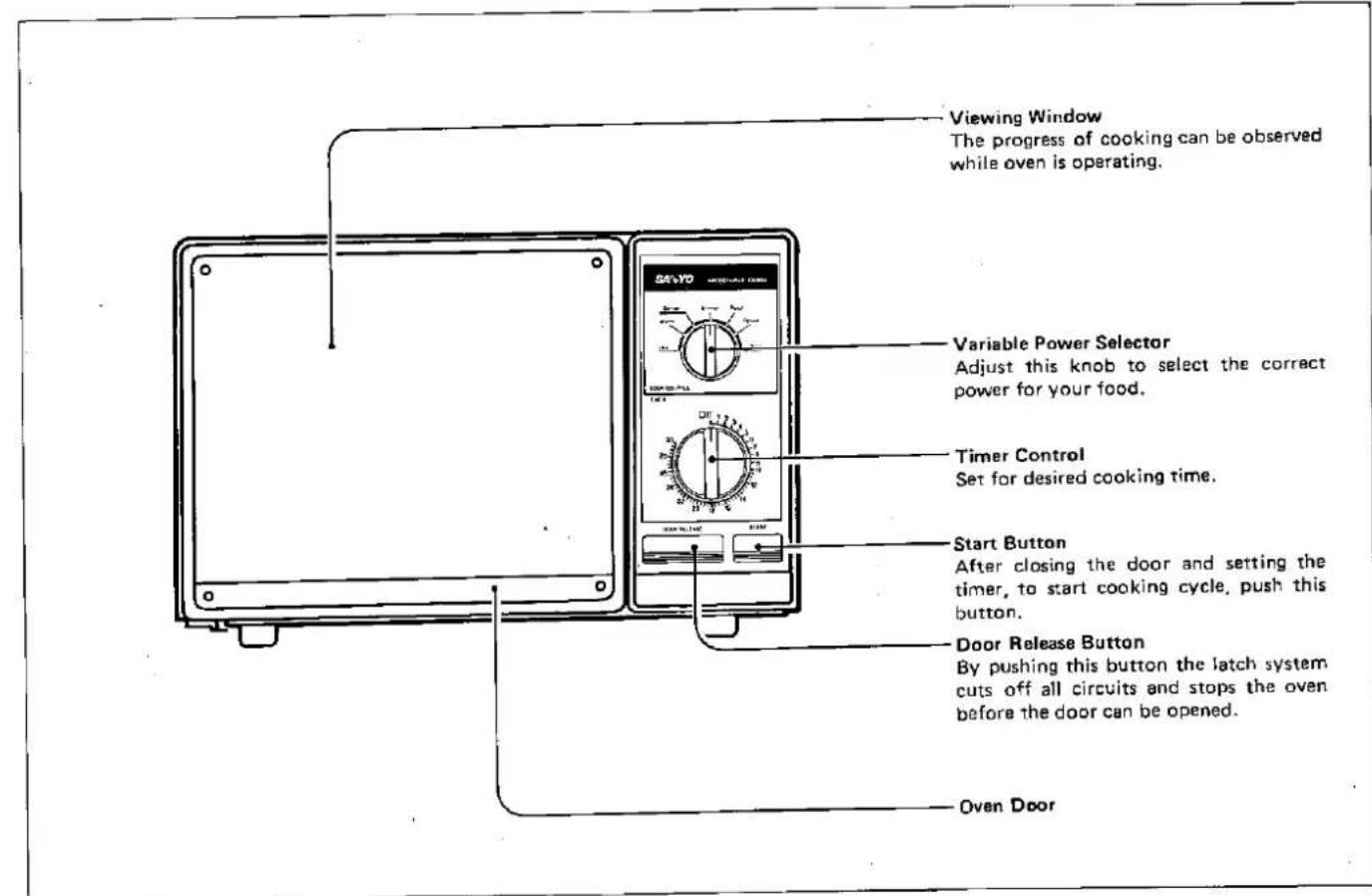
The progress of cooking can be observed while oven is operating.
- Practical dimensions.
1) Overall: 49.0(W) × 36.7(D) × 32.5(H)cm
2) Oven: 29.4(W) × 29.6(D) × 19.3(H)cm
WARNING-This appliance must be earthed.
IMPORTANT
The wires in this mains lead are coloured in accordance with the following code:
Green-and-yellow: Earth.
Blue: Neutral.
Brown: Live or Active
As the colours of the wires in the mains lead of this appliance may not correspond with the coloured markings identifying the terminals in your plug, proceed as follows:
The wire which is coloured green-and-yellow must be connected to the terminal in the plug which is marked with the letter E or by the earth symbol 12 or coloured green or green-and-yellow.
The wire which is coloured blue must be connected to the terminal which is marked with the letter N or coloured black. The wire which is coloured brown must be connected to the terminal which is marked with the letter L or A or coloured red.
If You Know All About It, You'll Enjoy It More
Things You Should Know About Variable-Power Cooking
Sanyo technology has eliminated the last major drawback to microwave cooking: its lack of flexibility. And this has been accomplished through the added variable-power feature of this model. It is a feature that you should get to know. It provides you with the freedom to choose the speed of your microwave cooking, a feature that is not only a time advantage but affects the flavour and texture of the food as well. The "HIGH" (max. power) setting is, of course, the speediest method; REHEAT to LOW settings provide the greatest possible choice of cooking conditions. Defrosting, for example, is also given added flexibility since some foods can be defrosted either by a single DEFROST setting or by starting on "HIGH" and then
reducing the speed to the DEFROST setting. This faster method is recommended for high-density foods that weigh over 450g (1 pound) such as meat joints.
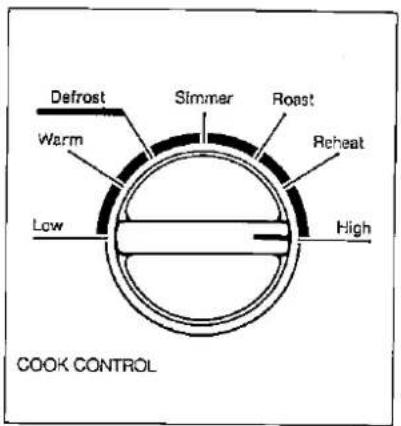
You will learn from experience in effectively using multi-power cooking. But it might be good to occasionally refer to the chart below which lists the approximate power level percentages for each setting:
| Variable-Power Setting | Approximate power level percentage |
| LOW | 10% |
| WARM | 20% |
| DEFROST | 35% |
| SIMMER | 55% |
| ROAST | 70% |
| REHEAT | 85% |
| HIGH (max. power) | 100% (500W) |
Variable Power Control provides the means to obtain greater precision in setting power levels. For instance, if you want a power level between ROAST and REHEAT, you would set the time as usual and set the variable Power Selector Dial to between ROAST and REHEAT. The oven is then set to operate at power level in between.
Cooking Guide for Variable-Power Settings
| POWER SETTING | SUGGESTED COOKING USES |
| LOW | Softening cream cheese; keeping casseroles and main dishes warm. |
| WARM | Softening chocolate; heating breads, rolls, pancakes, tacos, tortillas, and French toast; clarifying butter; taking chill out of fruit; heating small amounts of food. |
| DEFROST | Thawing meat, poultry and seafood; finish cooking casseroles, stews, and some sauces; cooking small quantities of most food. |
| SIMMER | Cooking stews and soups after bringing to the boil; cooking baked custards and pasta. |
| ROAST | Cooking rump roast, ham, veal and lamb; cooking cheese dishes; cooking eggs, and milk; cooking quick breads and cereal products. |
| REHEAT | Quickly reheating precooked or prepared food; heating sandwiches. |
| HIGH (max. power) | Cooking tender cuts of meat; cooking poultry, fish, vegetables, and most casseroles; preheating the browning dish; boiling water; thickening some sauces; cooking muffins. |
How to use your Microwave Oven safely
Although your oven is provided with safety features, it is important to observe the following:
a) It is important not to interfere or tamper with safety interlocks.
b) Do not place any object between the oven front face and the door or allow residue to accumulate on door sealing surfaces. Wipe the door sealing area frequently with a mild detergent, rinse and wipe dry. Never use abrasive powders or pads.
c) When opened, the door must not be subjected to strain, for example, a child hanging on an opened door or any load could cause the oven to fall forward to cause injury and also damaged to the door.
Do not operate the oven if it is damaged, until it has been repaired by a qualified service engineer. It is particularly important that the oven close properly and that there is no damage to the:
i) Door (bent)
ii) Hinges and Latches (broken or loosened)
iii) Door seals and Sealing surfaces
d) The oven should not be adjusted or repaired by anyone except properly qualified service engineer.

NOTE
It is quite normal for steam to be emitted around the door during the cooking cycle.
The door is not intended to seal the oven cavity completely but its special SANYO design contributes to the complete safety of the appliance.
WARNING
- Do not heat food or liquids in bottles or jars with lids on. . Air must be allowed to escape from the container. Do not warm babies bottles in the microwave oven with screw top lids or teats in place.
- Milk or food for babies should be heated on approximately 50 percent power (SIMMER). It should then be stirred thoroughly and the milk or food should be tested to ensure that it is at the correct temperature before giving it to the baby.
- When boiling water or other liquids, be sure to use a wide necked container. This will allow air bubbles to escape freely. Should a narrow necked container be used, air bubbles may combine to form a large bubble which may in turn cause the liquid to boil over. This may happen even after the cooking time has stopped.
- Do not attempt to operate the oven while empty as this will cause damage.
- As an exhaust is located in the rear of the oven, install the oven so as not to block the outlet.
How to operate your Microwave Oven.
- Connect the mains lead to an electrical outlet.
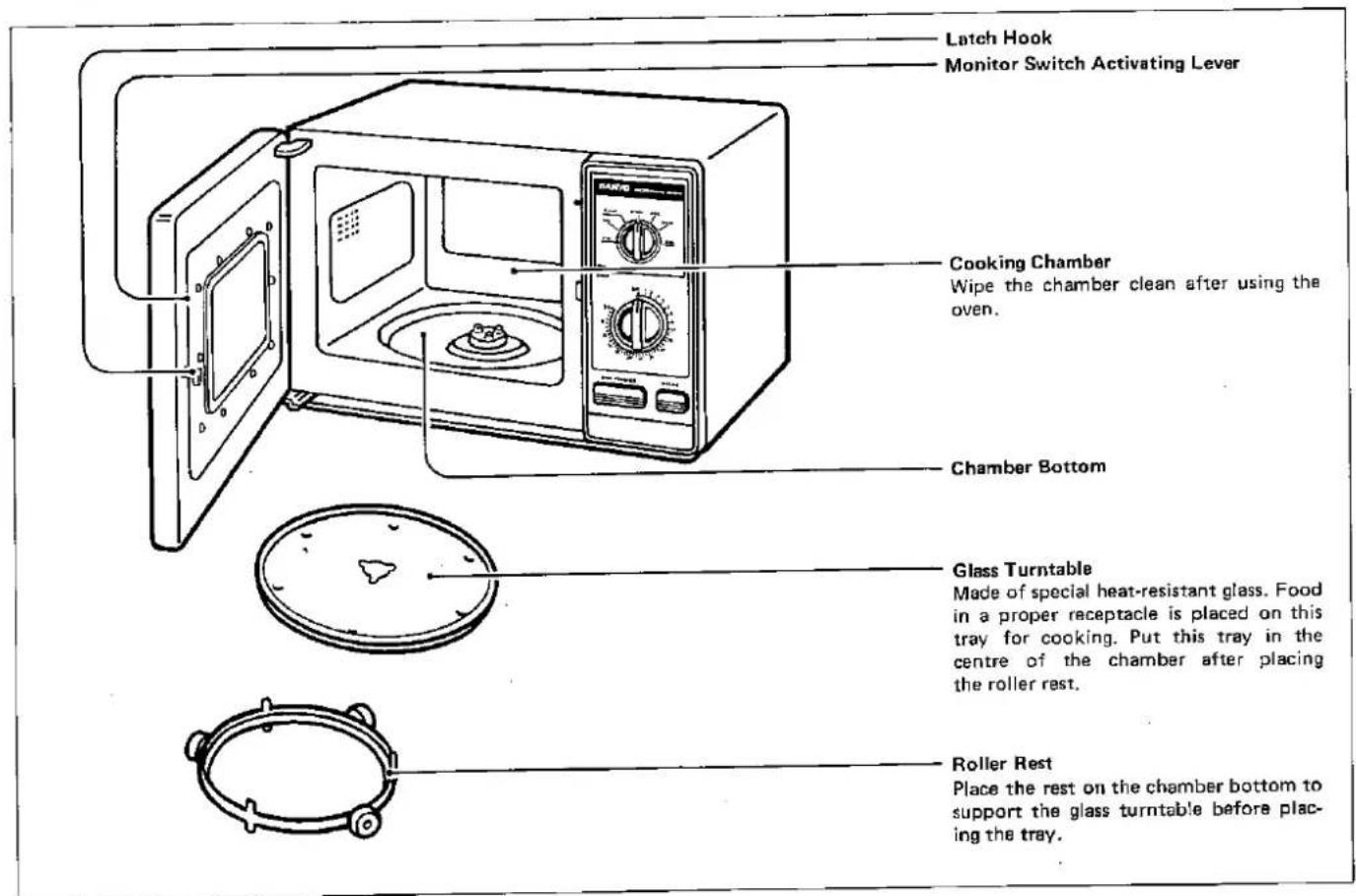
- After placing the food in a suitable receptacle, open the oven door and put it on the cooking tray.
- Shut the oven door. Make sure that it is firmly closed.
- Set the Variable Power Selector to the desired power level. (For details, refer to "Guide to Variable cooking Power")
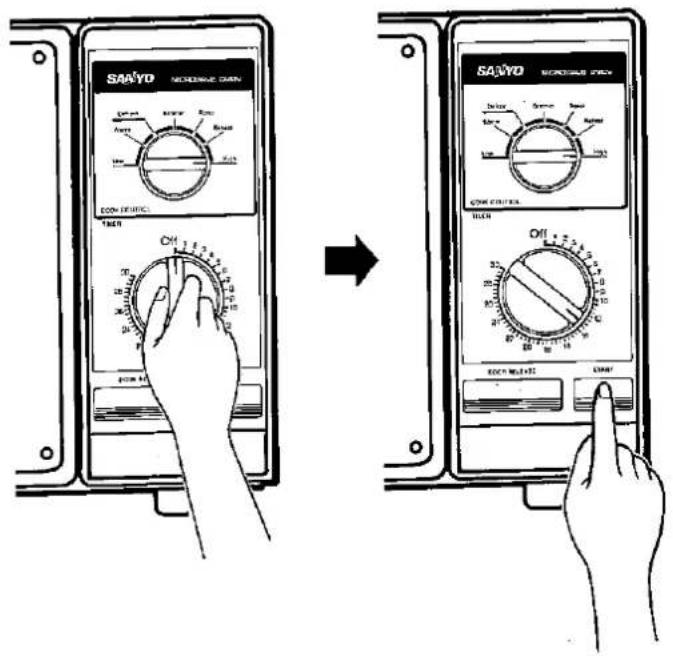
- Set the timer control by turning the timer knob. When setting the timer to less than 2 minutes, first set the dial for a longer period, then return it to the desired reading.
- Press the 'START' button. This will light up the interior lamp and start the cooking process.
- When the cooking time is up, the time pointer reads 'OFF', the chime rings and heating stops. Push the door release button, open the door and take out the food.
- To turn off the oven during cooking, simply open the oven door or turn the timer to off. Cooking time can be reset at any time during the cooking operation by turning the timer knob.
- After use, be sure to return the timer to 'OFF'.
Taking Care of Your Microwave Oven
Wipe the oven inside and out with a mild detergent solution, rinse, and wipe dry. Any food left in oven could possibly cause arcing due to carbonization. This should be done on a weekly basis — more often if needed. Never use abrasive powders or pads.
REMOVABLE PARTS
- The glass turntable can be removed for cleaning at the sink. Wipe up excess of spillovers with paper towel or cloth prior to removal of turntable.
- Roller rest can be removed for easy cleaning.
Usable Cooking Utensils and Materials
OVENPROOF GLASS
Ovenware (treated for high-intensity heat), such as utility dishes, bread dishes, pie plates, cake plates, liquid measuring cups, casseroles, and bowls without metallic decoration.
CHINA
Bowls, cups, serving pieces, plates, and platters without metallic decoration.
POTTERY
Dishes, cups, mugs, and bowls.
PLASTIC
Plastic wrap may be used as a cover. Lay the plastic wrap loosely over the dish and press it to the sides. The dish should be deep enough so that plastic wrap will not touch the food. As the food heats, it may cause the wrap to melt wherever it touches the food. Plastic dishes, cups, semi rigid freezer containers, and plastic bags are usable for short cooking operations. Use with care as some softening of the plastic can occur with heat from the food.
Utensils and Materials to Avoid
METAL UTENSILS
Metal utensils are not recommended because the metal shields the food from microwave energy on the bottom and sides, causing uneven cooking results. Metal utensils could also cause arcing and damage the appliance.
METAL DECORATION
Metal-trimmed or banded dinnerware, casseroles, etc., should not be used. The metal trim interferes with normal cooking and may damage the dish.
ALUMINIUM FOIL
Large sheets or pieces of aluminium foil should be avoided because they will disrupt cooking and may cause harmful arcing. However, smaller pieces may be used to shield areas such as poultry legs and wings. Any aluminium foil used should never be closer than 2.5cm (1 inch) from side walls of oven.
Aluminium foil containers may also be used to reheat food provided the containers do not touch the oven walls. The depth of the containers should be no more than 5cm.
A Few Other Precautions
- Arcing in the oven during operation usually occurs from use of metallic utensils or overuse of aluminium foil. Arcing is denoted by a "snapping" or "cracking" noise and may be accompanied by bright flashes.
Continuous arcing can damage the unit. If continuous arcing occurs during operation, do not use the unit and call a service engineer.
WOOD
Wooden bowls and boards will become dried out when used in the microwave oven and may split or crack.
OTHER
Avoid using cracked, flawed, or defective utensils, including ovenproof glassware.
CAUTION: DO NOT USE METAL TIES ON ANY PAPER OR PLASTIC BAGS; THE TIES BECOME HOT AND COULD CAUSE A FIRE.
- Always make sure that closed containers, such as jars of baby food, are opened and plastic pouches of vegetable are pierced before cooking.
Tightly closed containers could explode.
- Do not cook eggs in their shells because they will explode. Puncture the membrane around the yolk before frying eggs. This is because the yolk swells faster than the membrane and the egg explodes when heated quickly.
What to Do If Repairs Are Needed
Get in contact with your nearest Sanyo Service Centre. On no account remove or interfere with any parts or screws. "THIS COULD PROVE VERY DANGEROUS"
Make the following simple check-up before contacting the Sanyo Service Centre:
- If the interior lamp does not light when the 'START' button is pressed:
- Make sure that the mains lead is securely plugged in.
- Make sure that the door is properly closed.
- Make sure that the timer is not set at 'OFF'.
- Check the fuse or circuit breaker.
- If the lamp inside lights but the food is not heated:
Make sure that the food is not completely covered with a metal container.
- Noisy operation:
- Make sure that sparks are not being produced due to the use of metal utensils.
- Make absolutely sure that the contents of the oven are not touching the stirrer shield.
SANYO
SANYO Electric Co., Ltd.
OSAKA, JAPAN


- EM-1410
- MICROWAVE OVEN
- How a Microwave Oven Makes Cooking Faster, Easier and Much More Enjoyable
- The Extra Features of Your Sanyo Microwave Oven
- WARNING-This appliance must be earthed.
- IMPORTANT
- Things You Should Know About Variable-Power Cooking
- How to use your Microwave Oven safely
- NOTE
- WARNING
- How to operate your Microwave Oven.
- Taking Care of Your Microwave Oven
- REMOVABLE PARTS
- Usable Cooking Utensils and Materials
- OVENPROOF GLASS
- CHINA
- POTTERY
- PLASTIC
- Utensils and Materials to Avoid
- METAL UTENSILS
- METAL DECORATION
- ALUMINIUM FOIL
- A Few Other Precautions
- WOOD
- OTHER
- What to Do If Repairs Are Needed
Marke : SANYO
Modell : EM-1410
Kategorie : Mikrowelle