
ST121SA - ENCASTREMENT DANS LES MEUBLES - Réfrigérateur encastrable SMEG - Notice d'utilisation et mode d'emploi gratuit
Retrouvez gratuitement la notice de l'appareil ST121SA - ENCASTREMENT DANS LES MEUBLES SMEG au format PDF.


| Type de produit | Réfrigérateur encastrable |
| Marque | SMEG |
| Modèle | ST121SA |
| Classe énergétique | E (estimation) |
| Capacité totale (litres) | Environ 121 L |
| Capacité réfrigérateur (litres) | Environ 105 L |
| Capacité congélateur (litres) | Environ 16 L |
| Dimensions (H x L x P) (mm) | 820 x 600 x 575 (estimation) |
| Poids net (kg) | Environ 30 kg |
| Niveau sonore (dB) | Environ 38 dB |
| Alimentation électrique | 220-240 V, 50 Hz |
| Consommation annuelle (kWh) | Environ 180 kWh |
| Type d'installation | Encastrable sous plan de travail ou dans meuble |
| Porte réversible | Oui |
| Éclairage intérieur | LED |
| Thermostat réglable | Oui, manuel |
| Dégivrage | Automatique pour le réfrigérateur, manuel pour le congélateur |
| Entretien et nettoyage | Nettoyer l'intérieur avec un chiffon doux et du savon doux, ne pas utiliser de produits abrasifs |
| Pièces détachées et réparabilité | Disponibles via le service après-vente SMEG |
| Sécurité | Conforme aux normes électriques, mise à la terre obligatoire |
FOIRE AUX QUESTIONS - ST121SA - ENCASTREMENT DANS LES MEUBLES SMEG
Questions des utilisateurs sur ST121SA - ENCASTREMENT DANS LES MEUBLES SMEG
0 question sur cet appareil. Repondez a celles que vous connaissez ou posez la votre.
Poser une nouvelle question sur cet appareil
Téléchargez la notice de votre Réfrigérateur encastrable au format PDF gratuitement ! Retrouvez votre notice ST121SA - ENCASTREMENT DANS LES MEUBLES - SMEG et reprennez votre appareil électronique en main. Sur cette page sont publiés tous les documents nécessaires à l'utilisation de votre appareil ST121SA - ENCASTREMENT DANS LES MEUBLES de la marque SMEG.
MODE D'EMPLOI ST121SA - ENCASTREMENT DANS LES MEUBLES SMEG
ISTRUZIONI DI MONTAGGIO DELLE LAVATRICI INTEGRABILI
|
INSTRUCTIONS DE MONTAGE DU LAVE-LINGE INTEGRABLES
F
ASSEMBLY INSTRUCTIONS FOR BUILT-IN WASHING MACHINES
GB
INSTRUCCIONES DE INSTALACION DE LAS LAVADORAS INTEGRABLES
E
INSTRUKTIES VOOR DE MONTAGE VAN INBOUWWASAUTOMATEN
NL
MONTAGEANLEITUNG FÜR DIE INTEGRIERBAREN WASCHVOLLAUTOMATEN
D
INSTRUÇÕES DE MONTAGEM PARA MÁQUINAS DE LAVAR ROUPA ENCASTRÁVEIS
P
Built-in washing machines
Important - The machine complies with the current safety provisions governing electrical equipment. It must be installed by a specialized technician in compliance with the current standards in order to prevent it from becoming a potential danger for the user.
| Technical instructions for recessing | These washing machines can be built into modular furniture, under flush work tops or under sinks. They are made like true built-in appliances. In view of its final installation position, the appliance is supplied without a work top since this is unnecessary. |
| Panels can be mounted on the front of the washing machine. This means that the washing machine will fully match the surrounding. | |
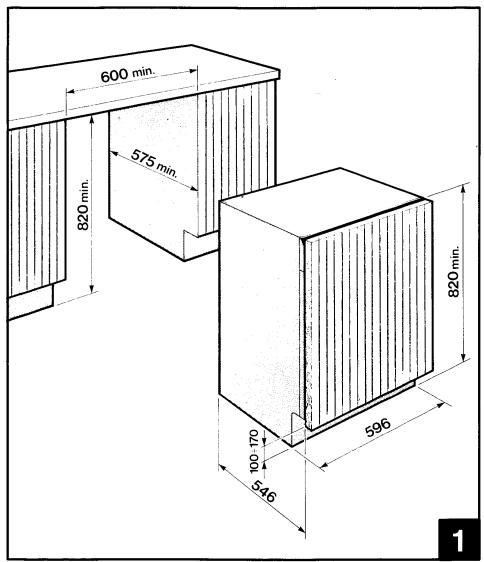
| The housing recess must measure: minimum 820 mm., minimum width 600 mm. and minimum depth 575 mm. (see figure 1). | |
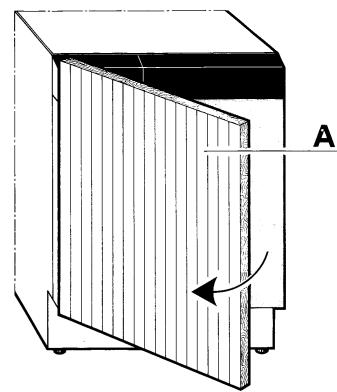
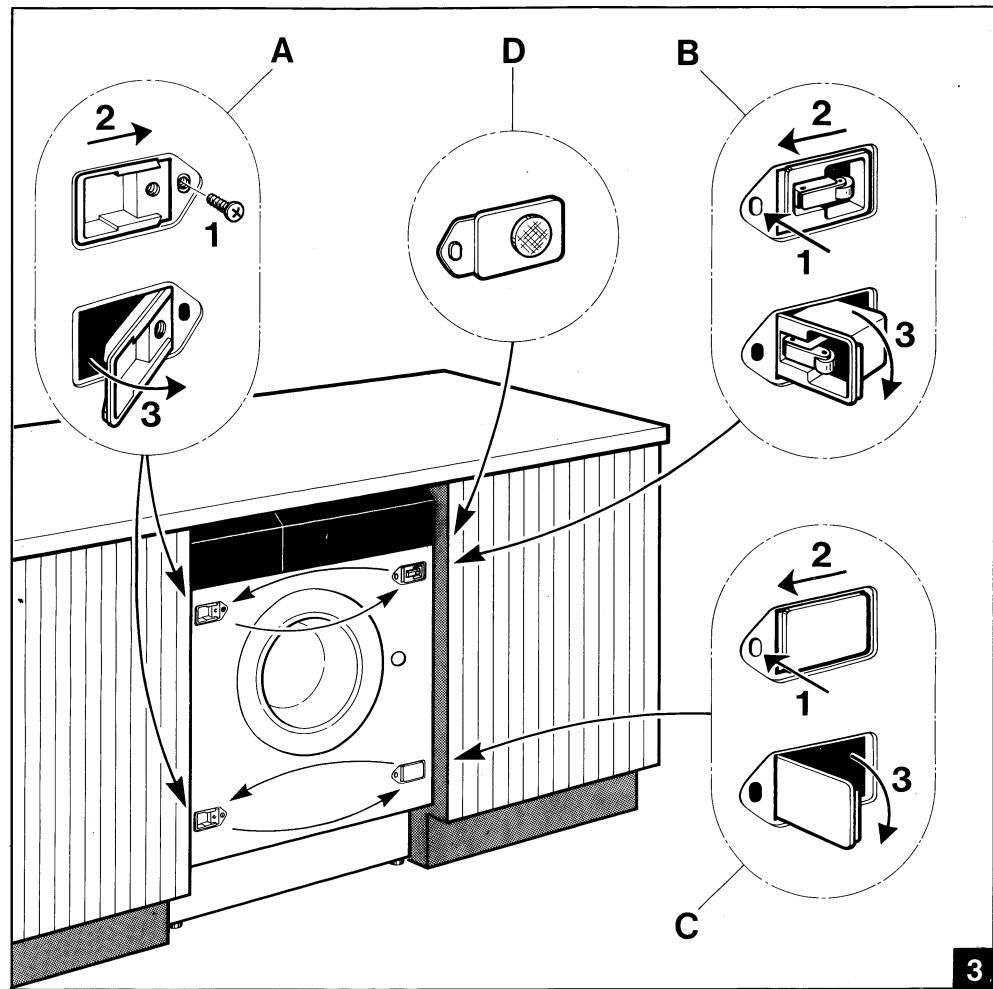
| How to fit on the panel | The panel that covers the front can be hinged on either the left side or right side (fig. 2). For practical reasons, it is advisable to maintain the same opening direction as the glass door (with hinges applied to the left-hand side). The appliance has hinge supports on the left-hand side, while the push-pull closing system is mounted on the upper right-hand part. If the magnetic closing mechanism is required, remove the existing support (fig. 3B) and install the supplied one fitted with this mechanism (fig. 3D) |
| Important! It is absolutely essential to disconnect the appliance from the electricity main when fitting the panel (during which all hinging and closing mechanisms must be removed from the front) on to the washing machine. |
Use of the template
Warning - To hinge the panel on the right-hand side (opening direction opposite to that of the glass door), completely remove the hinge supports (fig. 3A), the closing hook (fig. 3B), the lower bearing plug of the rubber plug (fig. 3C) from the front part of the machine and fit them to the opposite side.
All parts fitted to the front of the washing machine must be correctly remounted (no hole must be left open). This will prevent users from touching live parts of the appliance.
Our company declines all responsibility for damages caused by failures to comply with these safety provisions.
- Totally retracting washing machines
Calculate the height of the wooden panel by first establishing the height of the plinth.
Example: a 100 mm. plinth corresponds to a maximum panel height of 720 mm..
Reduce the height of the wooden panel if the plinth height must be increased.
Proceed in the following way when applying the wooden panel to the washing machine:
- Totally retracting washing machines (fig. 4)
1) Calculate the height of the plinth.
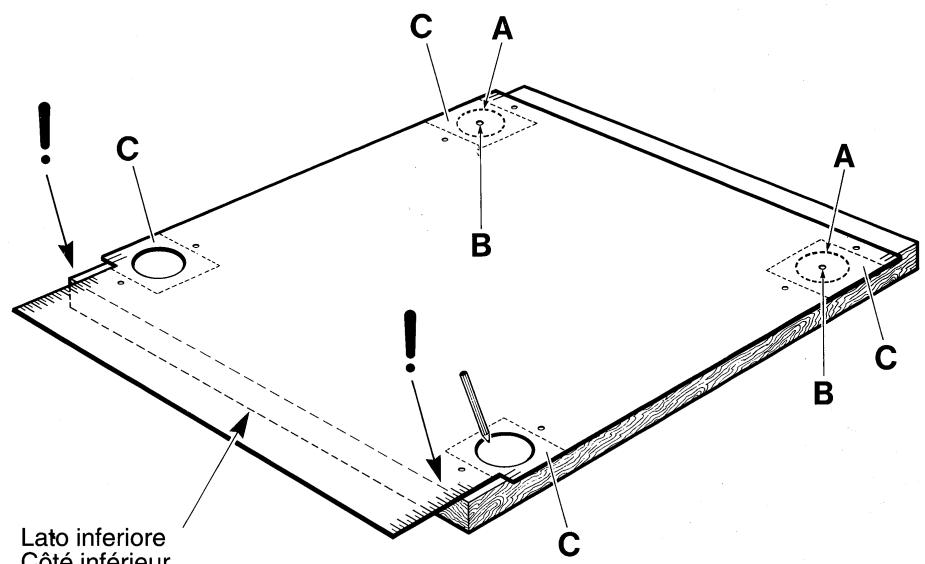
2) There are two holes «A» in the upper part of the template. These will have been partially broken through and are used to mark the holes that will subsequently house the upper hinge and the support for the push-pull closing mechanism. Remove the precut internal part in order to free hole «A».
The small central hole «B» is used to mark the position of the metal plate fixing hole when the magnetic closing device is required.
3) Remove the four pieces of protective film from self-adhesive areas «C» of the template.
| 4) Position the template on the inner part of the panel and match the established plinth height with the lower edge of the panel itsel.5) After having set the template in its correct position and after having also checked that it is centered in a horizontal direction with reference to the lines marked at the ends, mark the positions of the holes using the tip of a pencil. | |
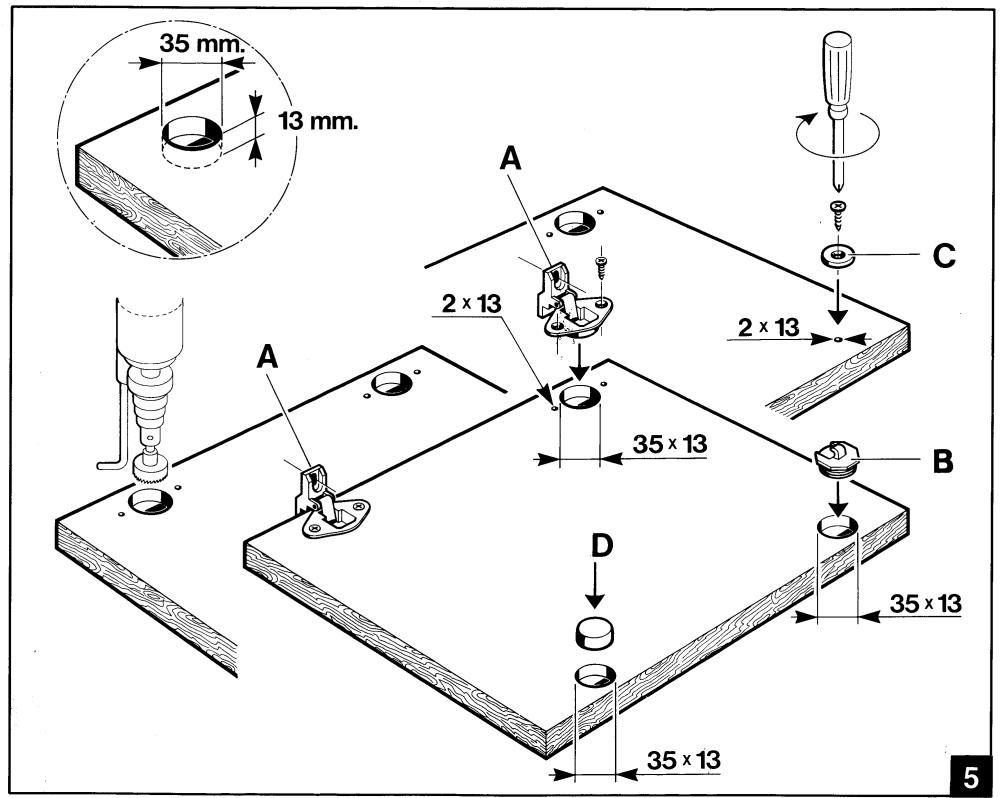
| Fitting the hinging components to the panel (fig. 5) | 1) Make holes in the wooden panel for the hinges, the rubber block and the closing hook, or the metal plate if the magnetic closing device is required.2) The depth of the 2 mm. diameter holes used to fix the hinges and metal plate should be 13 mm. in solid wood panels. Just drill the top veneer in chipboard panels.3) Screw the two hinges «A» to the wooden panel.4) Mount closing hook «B» on to the side opposite the hinges, or metal plate «C» into the upper hole, then close the underlying hole with the relative rubber plug «D».5) Following these operations, the panel will be ready to be fitted to the front of the appliance. Use the two supplied screws «A» for this operations (see fig. 6) |
| Adjusting the hinges | If, after having been fitted to the washing machine, the panel is slightly tilted or misaligned in relation to the front part of the machine, these imperfections may be corrected by means of the mobile part of the hinges. Slacken the two screws «A» (fig. 6) to correct the position of the panel, then tighten screws «A» again. |
Recessing the appliance
Push the washing machine into its recess. Turn the feet to horizontally level the machine if necessary, and lock them in place with the relative check nut.
To prevent vibrations from the machine from being transmitted to the surrounding furniture, check that the sides and top of the appliance are unable to touch the furniture itself. There must be a space of at least 2 mm. all round. The rear part of the machine must also remain some distance away from the back wall.
If the recessing cavity is higher than 820 mm., the opening between the floor and the lower side of the plinth and between the floor and sides of the machine (when this is installed at the end of a line of furniture), must be completeli closed in compliance with the relative safety provisions.
The covering must make it impossible for users to touch live parts of the electrical system and must require tools in order to be removed.
Our company declines all responsibility for damages caused by failures to comply with these safety provisions.
Fitting the plinth
The full length plinth at the base of modular furniture must be removable to allow the drain pump to be cleaned if this becomes clogged with buttons, fasteners or similar objects and the water is prevented from draining away.
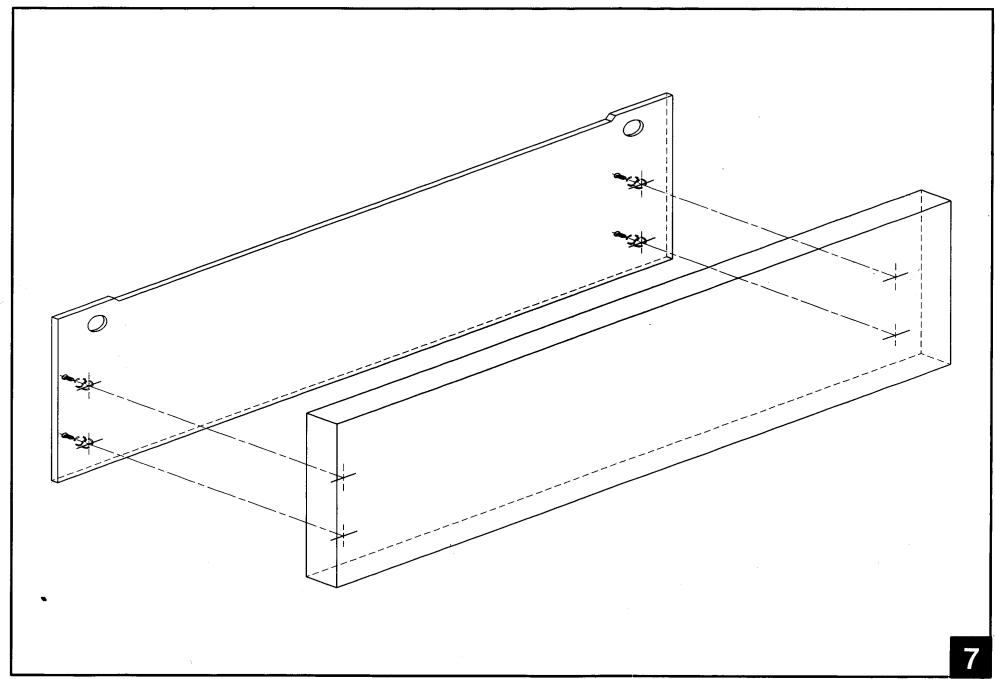
In certain cases the plinth of modular furniture is not continuous, but is limited only to the width of the washing machine. In this case, the plinth of the furniture must be screwed to the plinth of the washing machine by 4 screws using the four preset holes on the same (see fig. 7).
Application of the plinth to the furniture must not involve elimination or modification of the washing machine plinth. Owing to safety reasons, this may not be removed. It must absolutely remain intact and fixed to the washing machine.
natural_image
Diagram of a mechanical or architectural component with a folded panel and directional arrow, labeled 'A' (no text or symbols beyond label)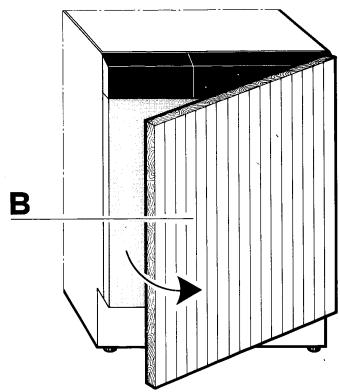
natural_image
Diagram of a cabinet with a door and side panel, labeled B, showing internal structure without any text or symbols.2
3
Lato inferiore
Côté inférieur
Lower edge
Lado inferior
Onderkant
natural_image
Technical line drawing of a metal bracket with mounting holes and internal fasteners (no text or symbols)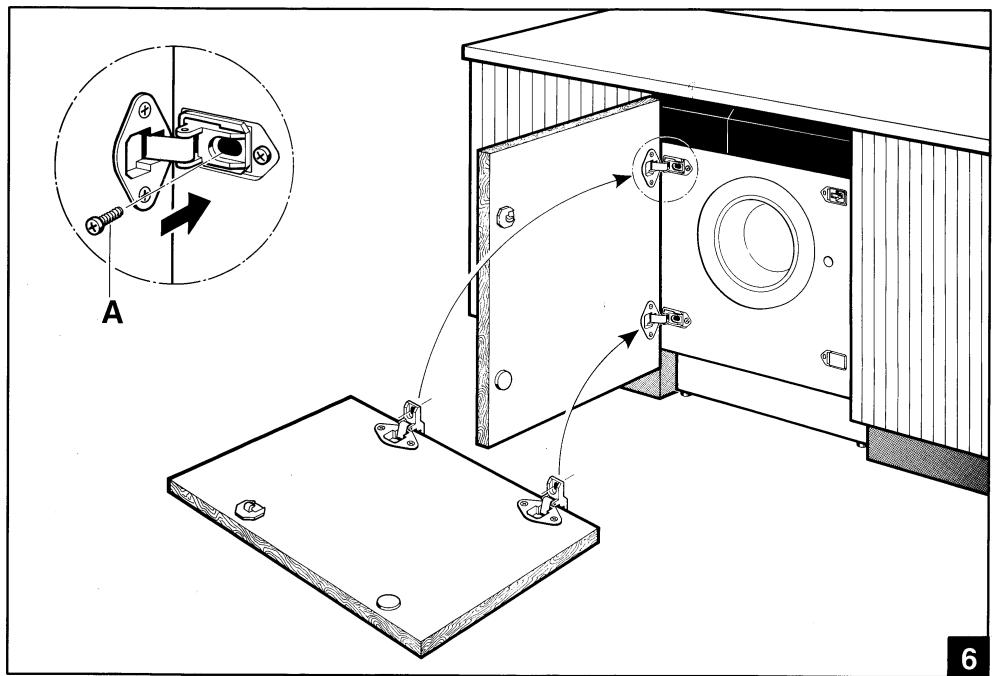
- ISTRUZIONI DI MONTAGGIO DELLE LAVATRICI INTEGRABILI
- INSTRUCTIONS DE MONTAGE DU LAVE-LINGE INTEGRABLES
- ASSEMBLY INSTRUCTIONS FOR BUILT-IN WASHING MACHINES
- INSTRUCCIONES DE INSTALACION DE LAS LAVADORAS INTEGRABLES
- INSTRUKTIES VOOR DE MONTAGE VAN INBOUWWASAUTOMATEN
- MONTAGEANLEITUNG FÜR DIE INTEGRIERBAREN WASCHVOLLAUTOMATEN
- INSTRUÇÕES DE MONTAGEM PARA MÁQUINAS DE LAVAR ROUPA ENCASTRÁVEIS
- Built-in washing machines
- Use of the template
- - Totally retracting washing machines
- - Totally retracting washing machines (fig. 4)
- Recessing the appliance
- Fitting the plinth
Marque : SMEG
Modèle : ST121SA - ENCASTREMENT DANS LES MEUBLES
Catégorie : Réfrigérateur encastrable