DATA BACK - Accessoires photo PENTAX - Notice d'utilisation et mode d'emploi gratuit
Retrouvez gratuitement la notice de l'appareil DATA BACK PENTAX au format PDF.

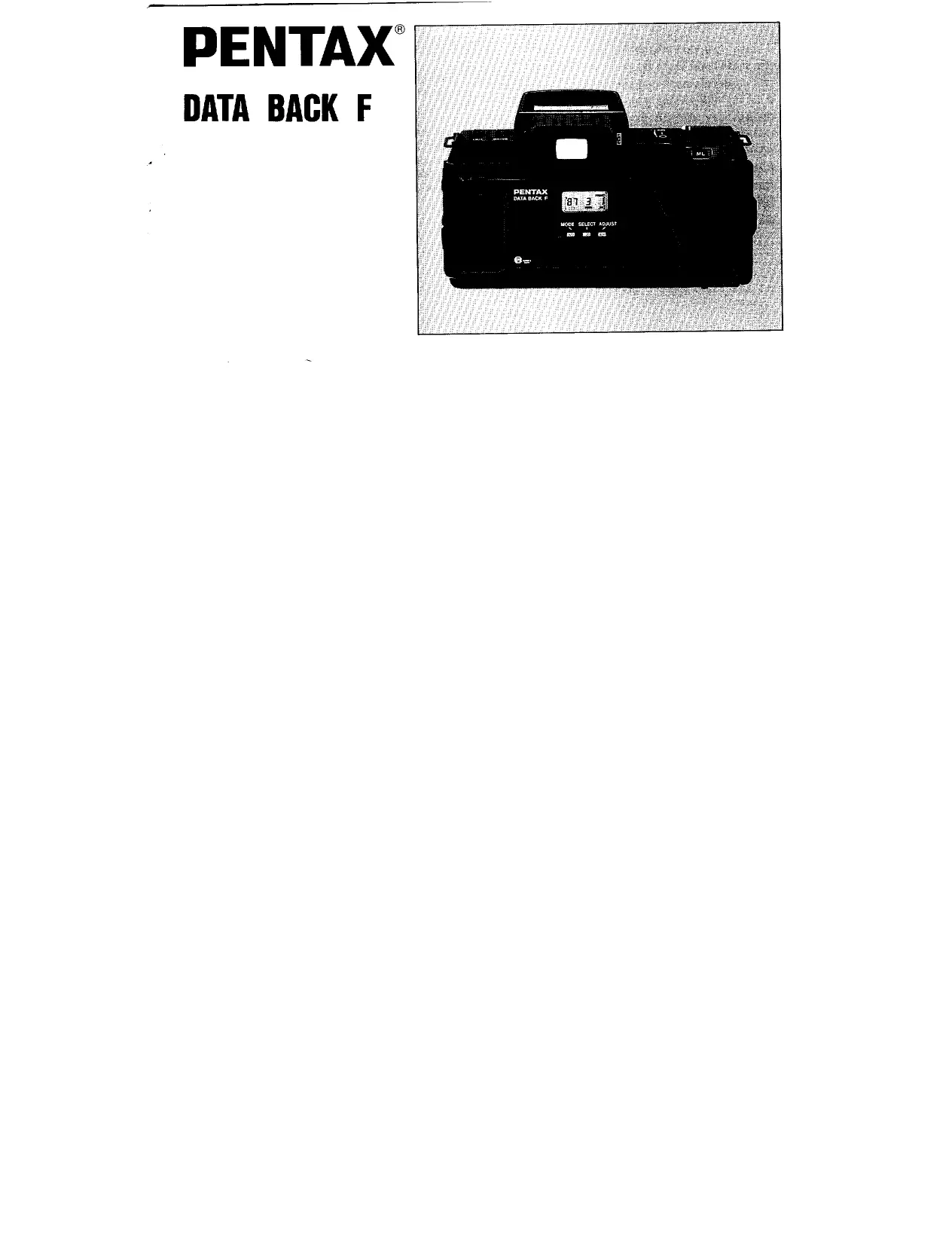
| Type de produit | Dos dateur pour reflex PENTAX |
| Marque | PENTAX |
| Modèle | DATA BACK F |
| Compatibilité | PENTAX SFX / SF1 |
| Dimensions (L x H x P) | 144 x 57 x 25,5 mm |
| Poids (sans piles) | 76 g |
| Alimentation | 2 piles miniatures 1,5 V (alcalines ou oxyde d'argent) |
| Autonomie (nombre de flashes) | Environ 5 000 impressions |
| Fonctions principales | Impression date/heure sur le film (5 modes d'affichage), correction des données, mode veille |
| Modes d'affichage de données | Année/mois/jour, mois/jour/année, jour/mois/année, jour/heure/minute, AM/PM heure/minute, et arrêt |
| Correction des données | Par incréments via les touches SELECT et ADJUST, avance rapide après 1-2 secondes |
| Plage de sensibilité film | ISO 25 à 1600 (réglage automatique) |
| Température de fonctionnement | 0 °C à 50 °C |
| Affichage | Écran LCD 7 segments, 6 chiffres |
| Entretien et nettoyage | Ne pas toucher la fenêtre d'enregistrement ; utiliser une soufflette pour la poussière, un chiffon doux pour les salissures |
| Sécurité | Ne pas démonter, recharger ni jeter les piles au feu ; insérer avec la bonne polarité |
| Accessoires fournis | Étui souple, dos spécial pour range-appareil |
| Informations générales | Garantie du fabricant, pile de test fournie (peut être faible) |
FOIRE AUX QUESTIONS - DATA BACK PENTAX
Questions des utilisateurs sur DATA BACK PENTAX
0 question sur cet appareil. Repondez a celles que vous connaissez ou posez la votre.
Poser une nouvelle question sur cet appareil
Téléchargez la notice de votre Accessoires photo au format PDF gratuitement ! Retrouvez votre notice DATA BACK - PENTAX et reprennez votre appareil électronique en main. Sur cette page sont publiés tous les documents nécessaires à l'utilisation de votre appareil DATA BACK de la marque PENTAX.
MODE D'EMPLOI DATA BACK PENTAX
PENTAX®
DATA BACK F
text_image
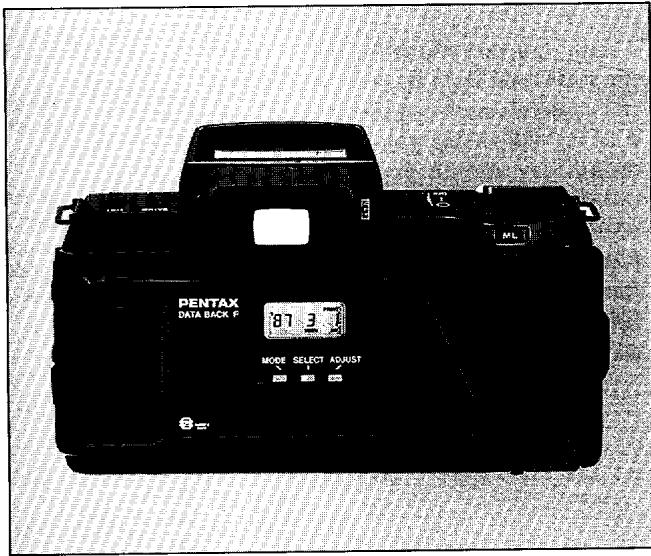
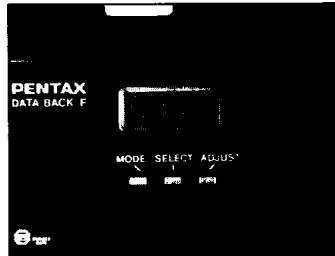
PENTAX DATA BACK F 87 3 MODE SELECT ADJUSTThank you very much for purchasing the PENTAX Data Back F. Replacing the camera's back cover with the Data Back F cover will enable you to print the year/month/day, month/day/year, day/hour/minute or A/P/hour/minute on the pictures you take.
Please read this manual carefully and familiarize yourself with all the features and functions so that you can fully benefit from all it has to offer.
CONTENTS
Names of Parts 1
General Precautions 2
How to Fit Data Back On.... 3
How to Insert Batteries 4
On Batteries 5
Data Setting 6
Precautions When Taking Pictures 12
Specifications 14
Special Back Case 16
text_image
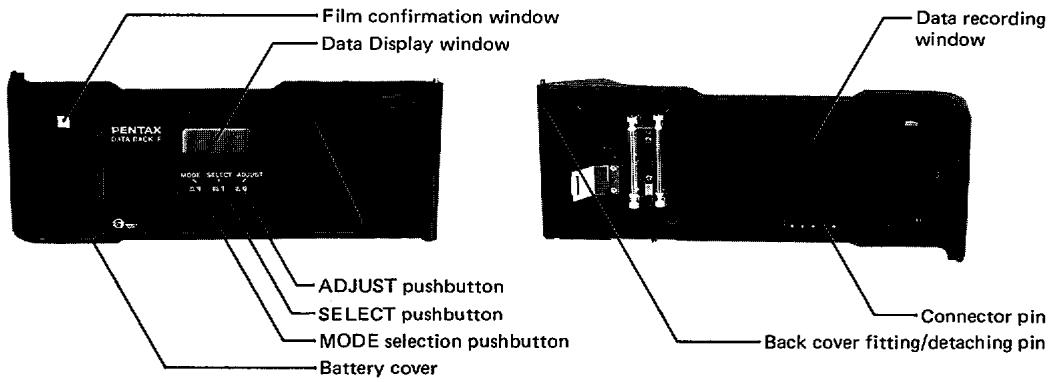
Film confirmation window Data Display window PENTAX DATA BACK 5 MODE SELECT ADJUST 23 61 69 ADJUST pushbutton SELECT pushbutton MODE selection pushbutton Battery cover Data recording window Connector pin Back cover fitting/detaching pinGENERAL PRECAUTIONS
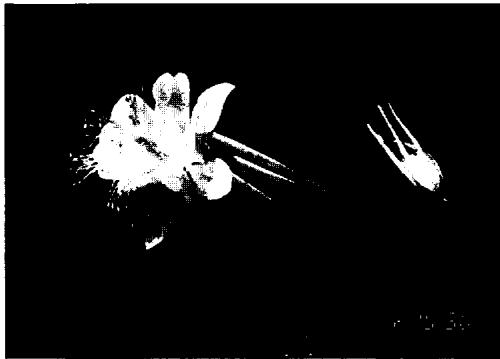
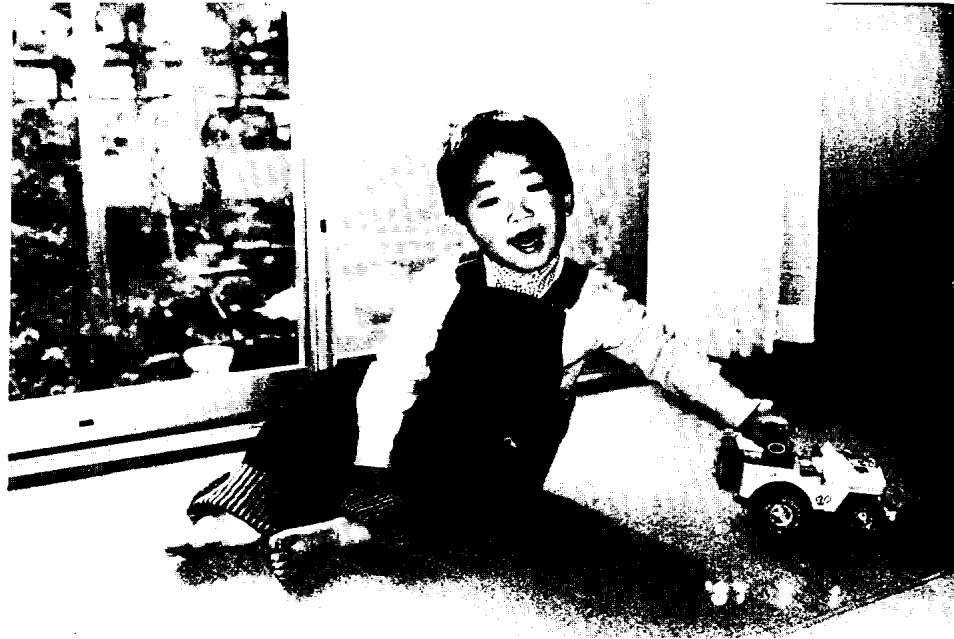
The data (year/month/day or hour: minute) is printed on the lower right-hand corner of the picture, as shown in the accompanying photograph. This data will be hard to see if this part of the photograph is whitish or yellowish in color, so try to take pictures in such a way as to make this part of the picture have a dark background whenever possible.
natural_image
Abstract black-and-white ink splatter pattern with no text or symbolsHOW TO FIT DATA BACK COVER ON
natural_image
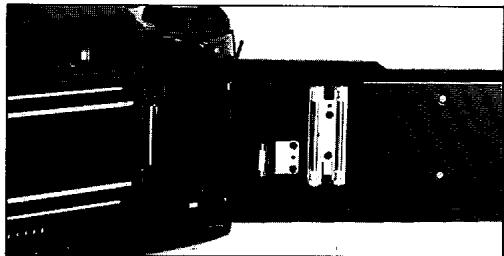
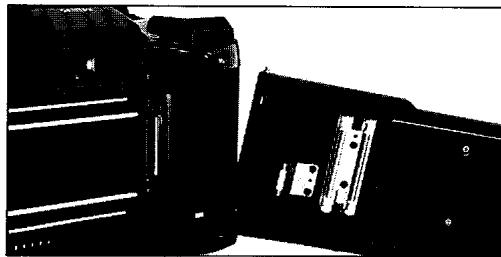
Pure mechanical component diagram without any text, numbers, or symbolsWhen replacing the back cover with the Data Back, first remove the back cover by flipping it open and inclining it outward while pushing on the fitting/ detaching pin shown by the arrow. Store the removed back cover into the accessory casing in order to keep it from deforming. When fitting Data Back F on, first fit the lower shaft stem into the camera, and then fit the upper shaft stem in
natural_image
Two black electronic components with metallic contacts and mounting holes, no visible text or symbolswhile pushing on the fitting/detaching pin, then release the fitting/detaching pin.
Caution: Do not tamper with the data recording window. Blow off any dust with a blower, and whenever soiled, clean with a soft cloth.
HOW TO INSERT BATTERIES
1
text_image
PENTAX DATA PRICE 22
text_image
PENTAX DATA (BACK-1)3
text_image
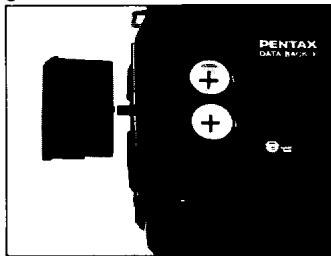
PENTAX DATA BACK F MODE SELECT ADJUST N PPT PPT- As shown in the photograph, remove the battery cover by pulling it in the direction of the arrow.
-
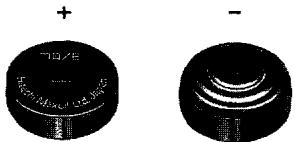
Insert two batteries into the battery compartment with the positive terminals facing upward, then replace the cover by fitting it into its grooves and pushing it in until it clicks.
-
Inserting the batteries will light the data display window. If the display lamp is not properly lit (no display, weak or flickering light), check to make sure the batteries have been properly inserted, or replace with new batteries.
- After inserting the batteries, adjust the display in conformance with the data setting instructions, which are explained later.
ON BATTERIES
- Two batteries of either of the following types can be used:
1.5V alkaline mini battery
1.5V silver-oxide mini battery
Batteries with the same shape but having different voltages cannot be used.
- Be sure to insert the batteries in correctly.
Otherwise, electrolyte leakage, excessive heating, or damage to the camera may result.
text_image
+ -- When replacing batteries with new ones, change both batteries at the same time, using the same kind of batteries made by the same manufacturer. Do not use an old and new battery or different kinds of batteries together.
- When not using the camera for long periods of time, remove the batteries. Old batteries may leak and damage the camera's casing. Store the removed batteries in a safe place, out of the reach of children.
- Tearing apart the batteries, recharging them, or casting them into a fire may cause them to explode.
text_image
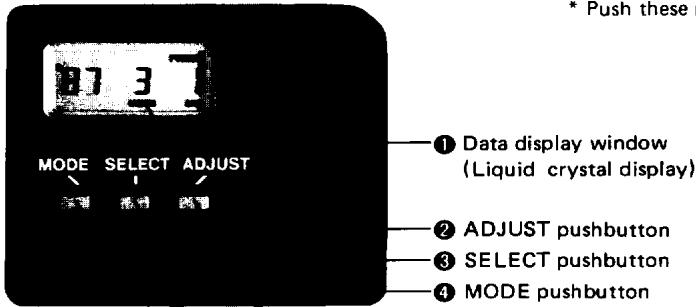
① Data display window (Liquid crystal display) ② ADJUST pushbutton ③ SELECT pushbutton ④ MODE pushbutton * Push these* Push these pushbuttons by finger or match stick

flowchart
graph LR
    A["Year/month/day\n(For Japanese use)"] --> B["Month/day/year\n(For American use)"]
    B --> C["Day/month/year\n(For European use)"]
    C --> D["Day/hour/minute or A/P/hour/minute"]
    D --> E["OFF"]
Mode Switching
As shown in the accompanying diagram, pushing the MODE pushbutton ④ will sequentially shift the mode to five different modes: year/month/day, month/day/year, day/month/year, day/hour/minute (A/P hour/minute), and OFF with each push of the button, to determine the data on the data display window ①. Stop pushing the button when the desired mode is obtained.
- OFF means termination of data printout on the pictures. Pushing the ADJUST pushbutton during modes other than the day/hour/minute (A/P hour/minute) mode will display the day/hour/minute (A/P hour/minute) data, so this can also be used to confirm the time of day.
Day/Hour/Minute A/P/Hour/Minute Switching
- Push the MODE pushbutton ④ to switch to day/hour/minute (24-hr display) or to A/P hour/minute (12-hr display)
- Continue to push the ADJUST pushbutton ② for 2\~3 seconds. This will permit alternate switching to the photography date or to A/P (morning/afternoon).
For example: 21 15:30 P 3:30
Photographed on March 1, 1987
natural_image
Black-and-white photo of a smiling child sitting at a desk with toys and a toy car, near a window (no visible text or symbols)Data Correction
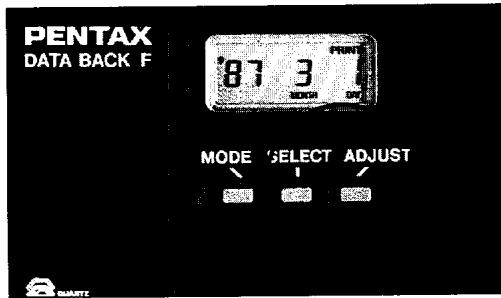
- The SELECT pushbutton ③ is pushed first. All existing modes will switch to an hour: minute display and the colon (:) will flicker. The flicker display will shift each time the SELECT push-button is pushed, from colon (:) → minute → hour → day → month → year, with the display data to be corrected flickering.
- The ADJUST pushbutton ② is pushed to change the numerical values of the display data that are designated by the SELECT pushbutton. The numerical value advances each time the ADJUST pushbutton is pushed, and continuously pushing the pushbutton will make the fast forward of the numerical values after two or three seconds.
text_image
PENTAX DATA BACK F 87 31 MODE SELECT ADJUST QUARTCorrection of "SECOND" Display
- Pushing the SELECT pushbutton will cause the colon (:) display to flicker.
- Push the ADJUST pushbutton according to a time signal. The colon (:) will stop flickering for an instant, and the second will be set to zero.
Correction of Hour/Minute and Year/Month/Day Display
- Push the SELECT pushbutton to flicker the numerical values of the hour/minute or year/month/day display, whichever is to be corrected.
- Push the ADJUST pushbutton and match the numerical values to the correct values.
$$ \text { Year } = 8 5 \sim 0 9 (1 9 8 5 \sim 2 0 0 9) $$
$$ \text { Month } = 1 \sim 1 2 (\text { January to December }) $$
$$ \text { Day } = 1 \sim 3 1 $$
$$ \text { Hour } = 0 \sim 2 3 (\mathrm{A} / \mathrm{P} 1 \sim 1 2) $$
$$ \text { Minute } = 0 0 \sim 5 9 $$
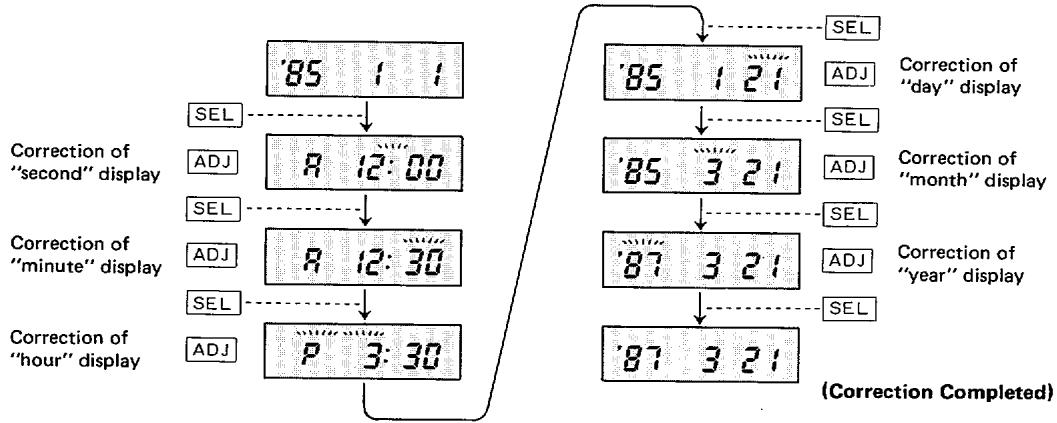
The central diagram shows an example of how the display data "1985, January 1, A.M. 12:00" is changed to "1987, March 21, P.M. 3:30."
- The symbol SEL in the diagram refers to the SELECT pushbutton, and ADJ to the ADJUST pushbutton.
When making these corrections, pushing the MODE pushbutton under "flicker display" will terminate the correction mode. However, if the flicker indication is left as is, it will return to the mode prior to the correction mode in 5\~8 minutes.
(Before Correction)
flowchart
graph TD
    A["'85 1 1'"] --> B["Correction of "second" display"]
    B --> C["ADJ: R 12:00"]
    C --> D["Correction of "minute" display"]
    D --> E["ADJ: R 12:30"]
    E --> F["Correction of "hour" display"]
    F --> G["ADJ: P 3:30"]
    G --> H["'85 1 21'"]
    H --> I["Correction of "day" display"]
    I --> J["ADJ: R 85 3 21"]
    J --> K["Correction of "month" display"]
    K --> L["ADJ: R 87 3 21"]
    L --> M["Correction of "year" display"]
    M --> N["ADJ: R 87 3 21"]
    N --> O["Correction Completed"]
PRECAUTIONS WHEN TAKING PICTURES
- "Year/month/day" and "hour:minute" cannot be printed on the picture simultaneously.
- Releasing the shutter causes the PRINT indication in the data display window to flicker for 2\~3 seconds and the data to be printed onto the photographed picture.
- The working temperature for data printing is 0\~50°C.
- The films that can be used are those with ISO 25\~1600, and the camera is automatically set with the ISO film speed. Using high-speed films (ISO 1,000\~1,600) may blur the printed characters, while using films with speeds that are less than ISO 50 may result in the characters and numerals coming out dim.
Regarding Batteries
Whenever the timing function performs abnormally, or the data display flickers, becomes dim, or isn't illuminated, replace the batteries as quickly as possible.
Regarding the Liquid Crystal Display
- Avoid storing or leaving the camera for long periods of time in a place that is too warm. Such place as the automobiles or near heaters are considered to be unsuitable.
- The liquid crystal display darkens at temperatures as high as 60^ , but its functions are restored when the temperature goes down to normal.
- At extra low temperature, the liquid crystal's display response may be delayed, but this is due to the properties of liquid crystal and not to any trouble.
text_image
ISO DRIVE ML PENTAX DATA BACK F 8712-0 MODE SELECT ADJUST E21 E22 E23SPECIFICATIONS
| Camera used ...... | PENTAX SFX/SF1 |
| Mounting method ...... | Used in place of camera's back cover. |
| Method of data printout ...... | Prints out on back of film with 7-segment, 6-figure liquid crystal display (LCD) device. |
| Data modes ...... | Five modes. "year/month/day," "day/month/year," "month/day/year," day/hour/minute" or "A/P hour/minute," by MODE pushbutton switching. Also provided with auto-calendar function (Automatic correction of year, leap year, long and short months).Year ('85~'09) = 1985~2009Month (1~12) = January to DecemberDay (1~31)Hour (0~23) or A/P 1~12Minute (00~59) |
| Size of printed out data ...... | Height 0.7mm, width 0.4mm per character. |
| Data correction ...... | Push the SELECT pushbutton for the sequential flicker-display of second, minute, hour, day, month, and year, then correct them by pushing the ADJUST pushbutton. Continuously depressing the ADJUST pushbutton enables fast forward after 1~2 seconds. |
| Data display window | Uses 7-segment, 6-figure liquid crystal display (LCD) device.PRINT indication flickers for 2~3 seconds during printout. |
| Film speeds | ISO 25~1600, automatic setting. |
| Power source | Two 1.5V alkaline or silver-oxide mini batteries. |
| Battery alarm | Data display flickers when voltage drops. |
| Number of flashes | Approximately 5,000 times |
| Continuous photography | Possible at around 1.8 frames/sec. |
| Accessories | Soft case |
| Size and Weight | 144 x 57 x 25.5mm; 76 grams (without batteries) |
* The batteries that come with Data Back F are provided at the time the camera is shipped from the factory, so they may have become weak because of natural discharge.
SPECIAL BACK CASE
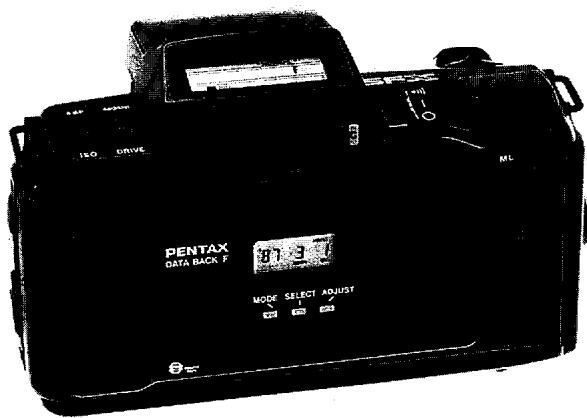
The special back case for the camera with the Data Back F enables you to check the data display and switch the mode with the camera stored in the case.
The front case S or L can be combined with this back case.