Steam Iron FV5687 - Fer à repasser CALOR - Notice d'utilisation et mode d'emploi gratuit
Retrouvez gratuitement la notice de l'appareil Steam Iron FV5687 CALOR au format PDF.

| Type de produit | Fer à repasser vapeur |
| Marque | Calor |
| Modèle | Steam Iron FV5687 |
| Puissance | 2400 W |
| Tension d'alimentation | 220-240 V ~ 50/60 Hz |
| Capacité du réservoir d'eau | 300 ml |
| Débit vapeur continu | Jusqu'à 40 g/min |
| Débit vapeur variable | Oui |
| Fonction vapeur pressing | Oui, jusqu'à 150 g/min |
| Semelle | Durilium® |
| Arrêt automatique | Oui, avec détection de mouvement |
| Système anti-calcaire | Oui, collecteur de calcaire intégré |
| Nettoyage auto-nettoyant | Oui, fonction auto-nettoyage |
| Longueur du cordon d'alimentation | 2,5 m |
| Poids | 1,2 kg |
| Dimensions (L x l x h) | 30 x 12 x 16 cm |
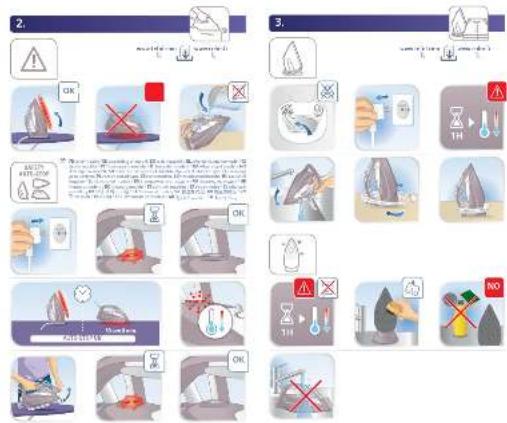
| Entretien et nettoyage | Nettoyer la semelle avec un chiffon humide. Utiliser la fonction auto-nettoyage régulièrement. |
| Sécurité | Arrêt automatique après 8 min en position verticale ou 30 sec en position horizontale. |
| Pièces détachées et réparabilité | Réservoir d'eau, semelle, boutons, cordon disponibles. Indice de réparabilité : 8,5/10. |
| Informations générales | Couleur : blanc et violet. Garantie 2 ans. |
FOIRE AUX QUESTIONS - Steam Iron FV5687 CALOR
Questions des utilisateurs sur Steam Iron FV5687 CALOR
0 question sur cet appareil. Repondez a celles que vous connaissez ou posez la votre.
Poser une nouvelle question sur cet appareil
Téléchargez la notice de votre Fer à repasser au format PDF gratuitement ! Retrouvez votre notice Steam Iron FV5687 - CALOR et reprennez votre appareil électronique en main. Sur cette page sont publiés tous les documents nécessaires à l'utilisation de votre appareil Steam Iron FV5687 de la marque CALOR.
MODE D'EMPLOI Steam Iron FV5687 CALOR
Theorem 1. The correspondence from (\mathbb{R}^n) to the group of all the elements of a finite group is given by the following formula: (\operatorname{Hom}{\mathbb{R}^n}\left(\mathbb{R}^n, \mathbb{Z}\right) = \operatorname{Hom}{\mathbb{R}^n}\left(\mathbb{Z}, \mathbb{Z}\right)). Let (X) be a finite group and let (A) be an algebraic module over (X). Then the image of (A) on (X) is a linear combination of the image of (A) on (X). If (A) is a finite group, then (A) is a prime ideal of (X) and hence (A) is a prime ideal of (X). If (A) is not a prime ideal of (X), then (A) is a prime ideal of (X). If (A) is a prime ideal of (X) and (B) is a submodule of (A), then (A) is a submodule of (B). If (A) is a submodule of (B), then (A) is a submodule of (B). If (A) is a submodule of (B), then (A) is a submodule of (B). If (A) is a submodule of (B), then (A) is a submodule of (B). If (A) is a submodule of (B), then (A) is a submodule of (B). If (A) is a submodule of (B), then (\operatorname{Hom}{\mathbb{R}^n}(A, B)) is a submodule of (B). If (A) is a submodule of (B), then (\operatorname{Hom}{\mathbb{R}^n}(A, B)) is a submodule of (B). If (A) is a submodule of (B), then (\operatorname{Hom}{\mathbb{R}^n}(A, B)) is a submodule of (B). If (A) is a submodule if not of (B), then (\operatorname{Hom}{\mathbb{R}^n}(A, B)) is a submodule if not of (B). If (A) is a submodule if not of (B), then (\operatorname{Hom}{\mathbb{R}^n}(A, B)) is a submodule if not of (B). If (A) is a submodule if not of (B), then (\operatorname{Hom}{\mathbb{R}^n}(A, B)) is a submodule if not of (B). If (B) is a submodule if not of (A), then (\operatorname{Hom}{\mathbb{R}^n}(A, B)) is a submodule if not of (A). If (B) is a submodule if not of (A), then (\operatorname{Hom}{\mathbb{R}^n}(A, B)) is a submodule if not of (B). If (B) is a submodule if not of (A), then (\operatorname{Hom}{\mathbb{R}^n}(A, B)) is a submodule if not of (A). If (B) is a submodule if not of (A), then (\operatorname{\mathrm{Hom}}{\mathbb{R}^n}(A, B)) is a submodule if not of (B). If (B) is a submodule if not of (A), then (\operatorname{\mathrm{Hom}}{\mathbb{R}^n}(A, B)) is a submodule if not of (C). If (C) is a submodule if not of (A), then (\operatorname{\mathrm{Hom}}{\mathbb{R}^n}(A, B)) is a submodule if not of (C). If (C) is a submodule if not of (A), then (\operatorname{\mathrm{Hom}}_{\mathbb{R}^n}(A, B)) is a submodule if not of (C). If (C) has no element in the set ({0, 1, 2, 3, 4, 5, 6, 7, 8, 9, 10, 11, 12, 13, 14, 15, 16, 17, 18, 19, 20, 21, 22, 23, 24, 25, 26, 27, 28, 29, 30, 31, 32, 33, 34, 35, 36, 37, 38, 39, 40, 41, 42, 43, 44, 45, 46, 47, 48, 49, 50, 51, 52, 53, 54, 55, 56, 57, 58, 59, 60, 61, 62, 63, 64, 65, 66, 67, 68, 69, 70, 71, 72, 73, 74, 75, 76, 77, 78, 79, 80, 81, 82, 83, 84, 85, 86, 87, 88, 89, 90, 91, 92, 93, 94, 95, 96, 97, 98, 99, 100, 101, 102, 103, 104, 105, 106, 107, 108, 109, 110, and so on.
www.ordet.com www.ordet.com