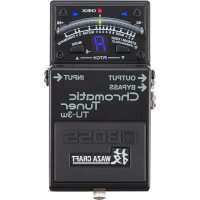
TU3W - Accordeur électronique BOSS - Notice d'utilisation et mode d'emploi gratuit
Retrouvez gratuitement la notice de l'appareil TU3W BOSS au format PDF.


| Type de produit | Accordeur chromatique pour guitare basse |
| Marque | Boss |
| Modèle | TU-3W |
| Dimensions | 73 x 129 x 59 mm |
| Poids | 460 g (avec pile) |
| Alimentation | Pile 9 V (6F22/6L861) ou adaptateur secteur PSA série (optionnel) |
| Consommation | 60 mA (normal), 110 mA (mode Haute Luminosité) |
| Plage d'accordage | Do0 (16,35 Hz) à Do8 (4,186 kHz) |
| Fréquence de référence | La4 = 436–445 Hz (réglable par pas de 1 Hz) |
| Précision d'accordage | ±1 cent |
| Impédance d'entrée | 1 MΩ |
| Impédance de sortie | 1 kΩ |
| Niveau d'entrée nominal | -20 dBu |
| Niveau de sortie nominal | -20 dBu |
| Modes d'accordage | Chromatique, Chromatique bémol, Guitare, Guitare bémol, Basse, Basse bémol |
| Fonction Accu-Pitch Sign | Indique visuellement la fin de l'accordage |
| Mode Haute Luminosité | Améliore la visibilité en extérieur |
| True Bypass / Buffered Bypass | Sélectionnable via commutateur OUTPUT BUF/THRU |
| Sortie jack | OUTPUT (muet en accordage), BYPASS (toujours actif) |
| Affichage | Afficheur à LED avec indicateurs de note/corde et aiguille lumineuse |
| Accessoires inclus | Notice, pamphlet de sécurité, pile alcaline 9 V |
| Options | Adaptateur secteur PSA série, cordon DC parallèle PCS-20A |
| Entretien et nettoyage | Essuyer avec un chiffon sec ; ne pas utiliser de solvants |
| Remplacement de la pile | Ouvrir la pédale en dévissant la vis moletée, remplacer la pile 9 V |
FOIRE AUX QUESTIONS - TU3W BOSS
Questions des utilisateurs sur TU3W BOSS
0 question sur cet appareil. Repondez a celles que vous connaissez ou posez la votre.
Poser une nouvelle question sur cet appareil
Téléchargez la notice de votre Accordeur électronique au format PDF gratuitement ! Retrouvez votre notice TU3W - BOSS et reprennez votre appareil électronique en main. Sur cette page sont publiés tous les documents nécessaires à l'utilisation de votre appareil TU3W de la marque BOSS.
MODE D'EMPLOI TU3W BOSS
Before using this unit, carefully read the sections entitled: "USING THE UNIT SAFELY" and "IMPORTANT NOTES" (supplied on a separate sheet). These sections provide important information concerning the proper operation of the unit.
Additionally, in order to feel assured that you have gained a good grasp of every feature provided by your new unit, this manual should be read in its entirety. The manual should be saved and kept on hand as a convenient reference.
A battery is supplied with the unit. The life of this battery may be limited, however, since its primary purpose was to enable testing.

Main Features
- TU-3W features a function that allows you to switch between the true bypass and buffered bypass.
● High Brightness mode enhances meter visibility outdoors. - Accu-Pitch Sign function uses the motion of the meter's lights to show when tuning is completed.
● Guitar/Bass mode lets you tune by string number, with support for 7-string guitars and 6-string basses. - Flat tuning is supported with Guitar Flat mode, which allows for "down" tunings up to six semitones below standard pitch.
- Switching on the tuner automatically mutes the output signal, allowing you to tune without outputting the sound.
How to Use the Tuner
- Connect the guitar or bass you want to tune to the INPUT jack. (This switches on the power.)
- Press the pedal switch to turn the tuner on. The CHECK indicator will light.
- Play a single note on your guitar or bass, and tune it. The note name or string number closest to the tone being played appears in the display. Tune the instrument so that both Tuning Guide Indicators are lit and the center of the meter is lit green. (Cent display)
The meter will light farther toward the left as the pitch gets flatter, or farther toward the right as the pitch gets sharper.
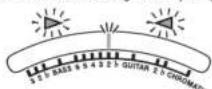
* When the Accu-Pitch Sign function is on, the meter lights stream toward the center of the display when stable tuning at the correct pitch is reached.
* The meter behavior described here is when the CENT display is selected (the factory setting). The behavior is different when you've selected the STREAM display.
* The sound from the OUTPUT jack is muted when the tuner is on.
Convenient Functions
■ Having the Meter Indicate Completion of Tuning (Accu-Pitch Sign function)
When the Accu-Pitch Sign function is on, the meter lights stream toward the center of the display when stable tuning at the correct pitch is reached.
- While holding down the STREAM/CENT button, turn on the power (insert a plug into the INPUT jack).
- Press the STREAM/CENT button again to toggle the Accu-Pitch Sign function on/off.
On: The meter lights stream to the center from the left and right.
Off: The meter lights up at the left and right.
* The TU-3W returns to its normal state when several seconds have elapsed without the STREAM/CENT button being pressed.
* This setting remains stored even after the power is turned off.
■ Changing the Reference Pitch
You can adjust the reference pitch over a range of 436-445 Hz. (440 Hz is the factory default.)
- Press the MODE button and STREAM/CENT button simultaneously. The lowest digit of the current reference pitch (e.g., "0" when set to 440 Hz) blinks in the Note Name/String indicator.
- Press the MODE button or STREAM/CENT button to change the reference pitch.
MODE button: Raises the reference pitch by 1 Hz.
STREAM/CENT button: Lowers the reference pitch by 1 Hz.
* If you allow several seconds to elapse without pressing the MODE button or STREAM/CENT button, the TU-3W will return to normal operation.
* When you turn on the power, the current reference pitch will be displayed for several seconds.
* This setting remains stored even after the power is turned off.
■ Changing the Meter's Brightness (High Brightness mode)
By switching the meter to High Brightness mode, you can increase its visibility when performing outdoors.
To switch to High Brightness mode, hold down the STREAM/CENT button for two seconds or longer. To return to normal brightness, hold down the STREAM/CENT for two seconds or longer once again.
* Normal brightness is automatically selected when you turn on the power.
Panel Descriptions
Parallel DC Cord (PCS-20A: optional)
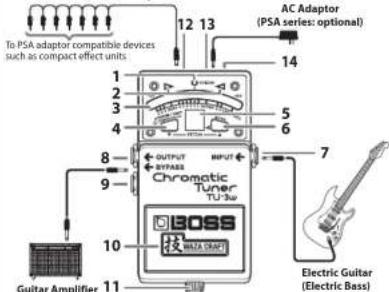
* If you connect other effect units, you must connect them after the TU-3W. If the TU-3W is connected after other effect units, you won't be able to tune correctly.
- CHECK Indicator
This indicator shows whether the effect is on or off, and also doubles as the battery check indicator.
* If you're powering the unit with a battery and the CHECK indicator goes dim—or doesn't light at all—when you try to turn the effect on, the battery is near depletion and should be replaced. For instructions on changing the battery, refer to "Changing the Battery."
- Tuning Guide Indicator
Indicates when the proper tuning is reached.

- Meter
Indicates the tuning of the input sound's pitch.
- STREAM/CENT button
Switches the meter's display pattern.
* This setting remains stored even after the power is turned off. CENT display
The meter lights farther toward the left as the pitch gets flatter, or farther toward the right as the pitch gets sharper. When the pitch is correct, the center of the meter lights green.
* The center of the meter and the tuning guide indicator remain lit for several seconds after you've selected this setting.
STREAM display
The meter lights stream toward the left if the input pitch is flat, or toward the right if the input pitch is sharp. The lights flow more slowly as the pitch discrepancy decreases, and stop flowing when the pitch is exact.
* The meter lights stream toward the left for several seconds after you've selected this setting.
- Note Name/String Number Indicator
Indicates the note name, string number, or reference pitch. Note indicator

- MODE Button
The tuning mode changes each time you press the MODE button. The meter lights at the position of the currently selected mode.
* When you turn on the power, the current tuning mode will be displayed for several seconds.
* This setting remains stored even after the power is turned off. In this example, the Tuning mode is set to GUITAR.
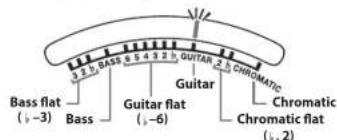
| Mode | Explanation | Indicator Status |
| Chromatic | Lets you tune all twelve chromatic steps of the octave. | The note name is displayed. |
| Chromatic flat | Lets you tune one semitone lower (b) or two semitones lower (2). | |
| Guitar | Lets you tune by guitar string numbers. | The guitar string number is displayed.(7th string is displayed as "7.") |
| Guitar flat | Lets you tune one semitone lower (b) or anywhere from two to six semitones lower (2-6). | |
| Bass | Lets you tune by bass string numbers. | The bass string number is displayed.(Hi-C string is displayed as "C," Lo-B string is displayed as "b.") |
| Bass flat | Lets you tune one semitone lower (b) two semitones lower (2), or three semitones lower (3). |
- INPUT Jack
Connect the guitar or bass guitar to be tuned here.
* The INPUT jack doubles as the power switch. Power to the unit is turned on when you plug into the INPUT jack; the power is turned off when the cable is unplugged.
- OUTPUT Jack
Connect an effects processor, guitar amp, or other such device here.
* The output is muted when the tuner is on.
- BYPASS Jack
Connect an effects processor, guitar amp, or other such device here. This jack will always output the signal from the instrument connected to the Input jack. Use this jack if you want to be heard while you tune.
- Pedal Switch
This switch turns the effect on/off.
- Thumbscrew
When this screw is loosened, the pedal will open, allowing you to change the battery. For instructions on changing the battery, refer to "Changing the Battery."
- DC OUT Jack
When an AC adapter is used, you can connect a PCS-20A parallel DC cord (optional) to supply power to effects processors and other PSA adaptor-compatible gear.
* Power cannot be supplied from the DC OUT jack when the TU-3W is running on batteries.
13.DC IN Jack
Accepts connection of an AC Adaptor (PSA series: optional). By using an AC Adaptor, you can play without being concerned about how much battery power you have left.
* Use only the specified AC adaptor (PSA series), and connect it to an AC outlet of the correct voltage. Do not use any other AC adaptor, since this may cause malfunction.
* We recommend that you keep batteries installed in the unit even if you'll be powering it with the AC adaptor. That way, you'll b continue a performance even if the cord of the AC adaptor gets accidentally disconnected from the unit.
- OUTPUT BUF/THRU Switch
Switches between true bypass and buffered bypass.
Precautions When Connecting
* To prevent malfunction and/or damage to speakers or other devices, always turn down the volume, and turn off the power on all devices before making any connections.
* Some connection cables contain resistors. When connection cables with resistors are used, the sound level may be extremely low, or impossible to hear. For information on cable specifications, contact the manufacturer of the cable.
* If you'll be using the TU-3W for an extended time, we recommend that you use an AC adaptor.
* Once the connections have been completed, turn on power to your various devices in the order specified. By turning on devices in the wrong order, you risk causing malfunction and/or damage to speakers and other devices.
When powering up: Turn on the power to your guitar amp last. When powering down: Turn off the power to your guitar amp first.
* This unit is equipped with a protection circuit. A brief interval (a few seconds) after power up is required before the unit will operate normally.
* When operating on battery power only, the unit's indicator will become dim when battery power gets too low. Replace the battery as soon as possible.
Changing the Battery
When the indicator goes dim or no longer lights while the effect is on, it means that the battery must be replaced.
* Please be sure to read the separate sheet "USING THE UNIT SAFELY" and "IMPORTANT NOTES" for details on battery handling.
* Batteries should always be installed or replaced before connecting any other devices. This way, you can prevent malfunction and damage.
1. Hold down the
pedal and loosen the thumbscrew, then open the pedal upward.
* The pedal can be opened without detaching the thumbscrew completely
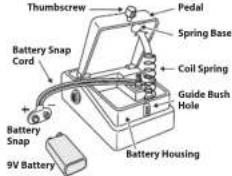
- Remove the old battery from the
battery housing, and remove the snap cord connected to it.
- Connect the snap cord to the new battery, and place the battery inside the battery housing.
* Be sure to carefully observe the battery's polarity (+ versus -).
- Slip the coil spring onto the spring base on the back of the pedal, and then close the pedal.
* Carefully avoid getting the snap cord caught in the pedal, coil spring, and battery housing.
- Finally, insert the thumbscrew into the guide bush hole and fasten it securely.
Storefront Demo Display
- While holding down the STREAM/CENT button and Pedal switch, turn the power on (insert a plug into the INPUT jack).
The storefront display appears. The storefront display remains until you turn the TU-3W's power off and then on again, or until you press the Pedal switch.
Specifications
TU-3W: Chromatic Tuner
| Tuning Range | C0 (16.35 Hz)-C8 (4.186 Hz) |
| Reference Pitch | A4 = 436-445 Hz (1 Hz step) |
| Tuning Accuracy | ±1 cent |
| Nominal Input Level | -20 dBu |
| Input Impedance | 1 MΩ |
| Nominal Output Level -20 dBu | |
| Output Impedance | 1 kΩ |
| Recommended Load Impedance | 10 kΩ or greater |
| Power Supply | Carbon-zinc battery (9 V, 6F22)/Alkaline battery (9 V, 6L861), AC Adaptor (sold separately) |
| Current Draw | 60 mA (DC 9 V)110 mA (DC 9 V, when High Brightness mode is on) |
| Dimensions | 73 (W) x 129 (D) x 59 (H) mm2-7/8 (W) x 5-1/8 (D) x 2-3/8 (H) inches |
| Weight | 460 g1 lb 1 oz (including battery) |
| Accessories | Owner's Manual, Leaflet ("USING THE UNIT SAFELY," "IMPORTANT NOTES," and "Information"), Alkaline battery (9 V, 6L861) |
| Options | AC adaptor: PSA seriesParallel DC cord: PCS-20A |
* Duration of continuous use with battery operation:
These figures will vary depending on the actual conditions of use.
| Battery | When the tuner is continuously on | When the tuner is on for one minute and off for three minutes | ||
| When High Brightness mode is off | When High Brightness mode is on | When High Brightness mode is off | When High Brightness mode is on | |
| Carbon | 0.5 hours | 0.2 hours | 1 hour | 0.5 hours |
| Alkaline | 6 hours | 3 hours | 6.5 hours | 6 hours |
* The battery that was supplied with the unit is for temporary use, intended primarily for testing the unit's operation.

Marque : BOSS
Modèle : TU3W
Catégorie : Accordeur électronique