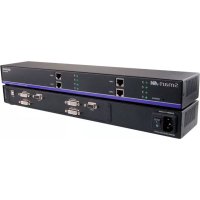
SDX4PTX - Extension audio/video Smart-AVI - Notice d'utilisation et mode d'emploi gratuit
Retrouvez gratuitement la notice de l'appareil SDX4PTX Smart-AVI au format PDF.

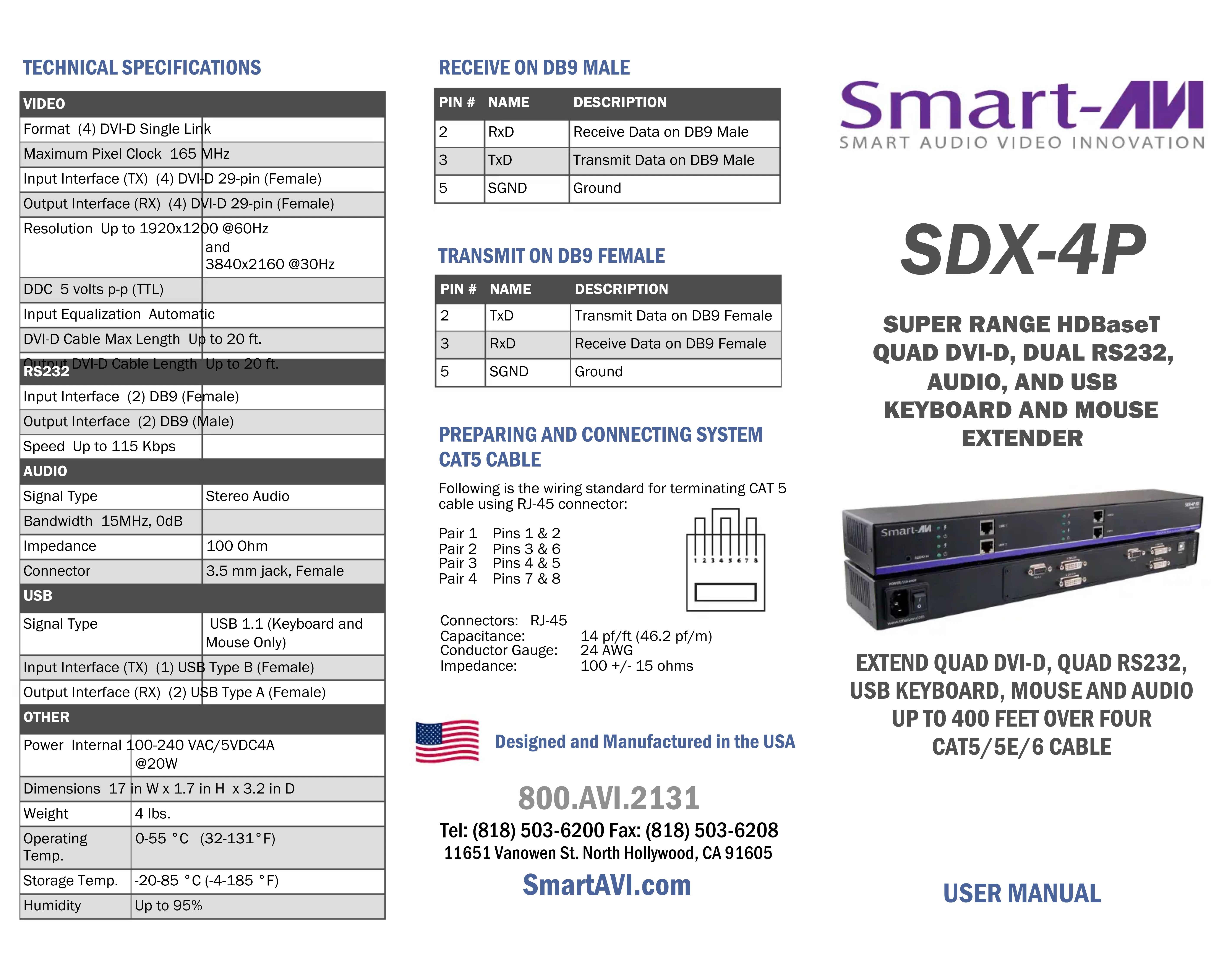
| Type de produit | Extendeur audio/vidéo HDBaseT |
| Marque | Smart-AVI |
| Modèle | SDX4PTX (SDX-4P) |
| Dimensions (L x H x P) | 43,2 cm x 4,3 cm x 8,1 cm (17 x 1,7 x 3,2 pouces) |
| Poids | 1,8 kg (4 lb) |
| Alimentation | Interne 100-240 VAC / 5 VDC 4A, 20 W |
| Distance maximale | 120 m (400 pieds) sur câble CAT5/5e/6 |
| Formats vidéo pris en charge | 4x DVI-D Single Link |
| Résolutions maximales | 1920x1200 @ 60 Hz et 3840x2160 @ 30 Hz |
| Entrées vidéo (TX) | 4x DVI-D 29 broches (femelle) |
| Sorties vidéo (RX) | 4x DVI-D 29 broches (femelle) |
| Entrée audio (TX) | Jack 3,5 mm stéréo (femelle) |
| Sortie audio (RX) | Jack 3,5 mm stéréo (femelle) |
| USB | USB 1.1 (clavier et souris) : 1x USB Type B (TX), 2x USB Type A (RX) |
| RS-232 | 2x DB9 femelle (TX), 2x DB9 mâle (RX), jusqu'à 115 Kbps |
| Prise en charge HDCP | Oui |
| Apprentissage EDID | Automatique |
| Température de fonctionnement | 0 à 55 °C (32 à 131 °F) |
| Température de stockage | -20 à 85 °C (-4 à 185 °F) |
| Humidité | Jusqu'à 95 % |
| Contenu de la boîte | 1x émetteur (TX), 1x récepteur (RX), 2x blocs d'alimentation (5 VDC 4 A) |
| Pays de fabrication | États-Unis |
FOIRE AUX QUESTIONS - SDX4PTX Smart-AVI
Questions des utilisateurs sur SDX4PTX Smart-AVI
0 question sur cet appareil. Repondez a celles que vous connaissez ou posez la votre.
Poser une nouvelle question sur cet appareil
Téléchargez la notice de votre Extension audio/video au format PDF gratuitement ! Retrouvez votre notice SDX4PTX - Smart-AVI et reprennez votre appareil électronique en main. Sur cette page sont publiés tous les documents nécessaires à l'utilisation de votre appareil SDX4PTX de la marque Smart-AVI.
MODE D'EMPLOI SDX4PTX Smart-AVI
TECHNICAL SPECIFICATIONS
| VIDEO | |
| Format (4) DVI-D Single Link | |
| Maximum Pixel Clock 165 MHz | |
| Input Interface (TX) (4) DVI-D 29-pin (Female) | |
| Output Interface (RX) (4) DVI-D 29-pin (Female) | |
| Resolution Up to 1920x1200 @60Hzand3840x2160 @30Hz | |
| DDC 5 volts p-p (TTL) | |
| Input Equalization Automatic | |
| DVI-D Cable Max Length Up to 20 ft. | |
| Output DVI-D Cable Length Up to 20 ft. | |
| RS232 | |
| Input Interface (2) DB9 (Female) | |
| Output Interface (2) DB9 (Male) | |
| Speed Up to 115 Kbps | |
| AUDIO | |
| Signal Type | Stereo Audio |
| Bandwidth 15MHz, 0dB | |
| Impedance | 100 Ohm |
| Connector | 3.5 mm jack, Female |
| USB | |
| Signal Type | USB 1.1 (Keyboard and Mouse Only) |
| Input Interface (TX) (1) USB Type B (Female) | |
| Output Interface (RX) (2) USB Type A (Female) | |
| OTHER | |
| Power Internal 100-240 VAC/5VDC4A@20W | |
| Dimensions 17 in W x 1.7 in H x 3.2 in D | |
| Weight | 4 lbs. |
| Operating Temp. | 0-55 °C (32-131°F) |
| Storage Temp. | -20-85 °C (-4-185 °F) |
| Humidity | Up to 95% |
RECEIVE ON DB9 MALE
| PIN # | NAME | DESCRIPTION |
| 2 | RxD | Receive Data on DB9 Male |
| 3 | TxD | Transmit Data on DB9 Male |
| 5 | SGND | Ground |
TRANSMIT ON DB9 FEMALE
| PIN # | NAME | DESCRIPTION |
| 2 | TxD | Transmit Data on DB9 Female |
| 3 | RxD | Receive Data on DB9 Female |
| 5 | SGND | Ground |
PREPARING AND CONNECTING SYSTEM CAT5 CABLE
Following is the wiring standard for terminating CAT 5 cable using RJ-45 connector:
Pair 1 Pins 1 & 2
Pair 2 Pins 3 & 6
Pair 3 Pins 4 & 5
Pair 4 Pins 7 & 8
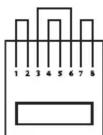
Connectors: RJ-45
Capacitance:
Conductor Gauge:
Impedance:
14 pf/ft (46.2 pf/m)
24 AWG
100 +/- 15 ohms

Designed and Manufactured in the USA
800.AVI.2131
Tel: (818) 503-6200 Fax: (818) 503-6208
11651 Vanowen St. North Hollywood, CA 91605
SmartAVI.com
Smart-AM
SMART AUDIO VIDEO INNOVATION
SDX-4P
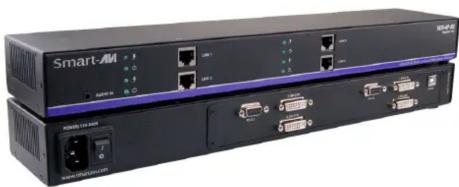
SUPER RANGE HDBaseT QUAD DVI-D, DUAL RS232, AUDIO, AND USB KEYBOARD AND MOUSE EXTENDER
natural_image
Exterior view of a black Smart-AM network device with ports and connectors (no visible text or symbols)EXTEND QUAD DVI-D, QUAD RS232, USB KEYBOARD, MOUSE AND AUDIO UP TO 400 FEET OVER FOUR CAT5/5E/6 CABLE
USER MANUAL
INTRODUCTION
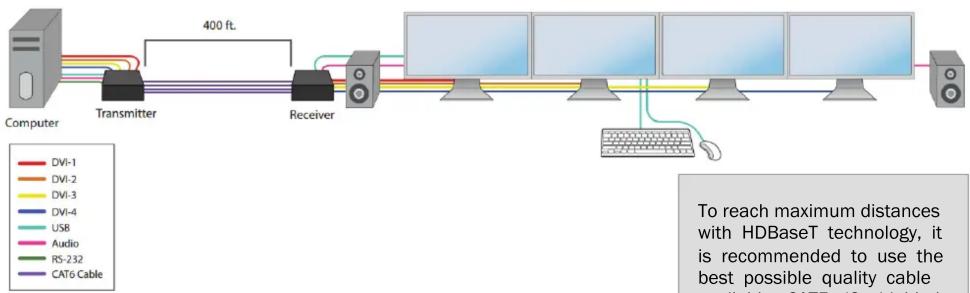
Using HDBaseT technology, the SDX-4P DVI extender is capable of sending quad DVI-D signals up to 400 feet over two conventional and inexpensive CAT5/5e/6 cable. HDBaseT technology is superior to older DVI extenders that require special CAT6 shielded cable to go a short distance.
The SDX-4P also has USB keyboard and mouse, audio and RS232 extension, giving you the ability to control your displays or devices remotely.
FEATURES
- Extends quad DVI-D up to 400 feet (120m) from the source
- HDCP Support
• Supports up to 1920x1200 resolution @ 60Hz.
• Supports 4k/2k (3840x2160) resolution @ 30Hz.
• Automatic EDID Learning - USB Keyboard and Mouse extension
- Uncompressed Video using HDBaseT
- RS-232 extension allows for remote control of displays
• Supports Stereo Sound - Compatible with Windows, Mac and Linux Operating Systems
WHAT'S IN THE BOX?
| PART NO. QTY DESCRIPTION | ||
| SDX-4P-RX | 1 SDX-4P Receiver. Quad DVI-D, Dual RS232, USB & Audio Receiver over CAT5/5e/6 | |
| SDX-4P-TX | 1 SDX-4P Transmitter. Quad DVI-D, Dual RS232, USB & Audio Transmitter over CAT5/5e/6 | |
| Power Supply | 2 PS5VDC4A | |
APPLICATION DIAGRAM
flowchart
graph LR
    A["Computer"] --> B["Transmitter"]
    B --> C["Receiver"]
    C --> D["ATMs 1-5"]
    D --> E["ATMs 5-10"]
    E --> F["ATMs 10-15"]
    F --> G["ATMs 15-20"]
    G --> H["ATMs 20-25"]
    H --> I["ATMs 25-30"]
    I --> J["ATMs 30-35"]
    J --> K["ATMs 35-40"]
    K --> L["ATMs 40-45"]
    L --> M["ATMs 45-50"]
    M --> N["ATMs 50-55"]
    N --> O["ATMs 55-60"]
    O --> P["ATMs 60-65"]
    P --> Q["ATMs 65-70"]
    Q --> R["ATMs 70-75"]
    R --> S["ATMs 75-80"]
    S --> T["ATMs 80-85"]
    T --> U["ATMs 85-90"]
    U --> V["ATMs 90-95"]
    V --> W["ATMs 95-100"]
    W --> X["ATMs 100-105"]
    X --> Y["ATMs 105-110"]
    Y --> Z["ATMs 110-115"]
    Z --> AA["ATMs 115-120"]
    AA --> AB["ATMs 120-125"]
    AB --> AC["ATMs 125-130"]
    AC --> AD["ATMs 130-135"]
    AD --> AE["ATMs 135-140"]
    AE --> AF["ATMs 140-145"]
    AF --> AG["ATMs 145-150"]
    AG --> AH["ATMs 150-155"]
    AH --> AI["ATMs 155-160"]
    AI --> AJ["ATMs 160-165"]
    AJ --> AK["ATMs 165-170"]
    AK --> AL["ATMs 170-175"]
    AL --> AM["ATMs 175-180"]
    AM --> AN["ATMs 180-185"]
    AN --> AO["ATMs 185-190"]
    AO --> AP["ATMs 190-195"]
    AP --> AQ["ATMs 195-200"]
    AQ --> AR["ATMs 200-205"]
    AR --> AS["ATMs 205-210"]
    AS --> AT["ATMs 210-215"]
    AT --> AU["ATMs 215-220"]
    AU --> AV["ATMs 220-225"]
    AV --> AW["ATMs 225-230"]
    AW --> AX["ATMs 230-235"]
    AX --> AY["ATMs 235-240"]
    AY --> AZ["ATMs 240-245"]
    AZ --> BA["ATMs 245-250"]
    BA --> BB["ATMs 250-255"]
    BB --> BC["ATMs 255-260"]
    BC --> BD["ATMs 260-265"]
    BD --> BE["ATMs 265-270"]
    BE --> BF["ATMs 270-275"]
    BF --> BG["ATMs 275-280"]
    BG --> BH["ATMs 280-285"]
    BH --> BI["ATMs 285-290"]
    BI --> BJ["ATMs 290-295"]
    BJ --> BK["ATMs 295-300"]
    BK --> BL["ATMs 300-305"]
    BL --> BM["ATMs 305-310"]
    BM --> BN["ATMs 310-315"]
    BN --> BO["ATMs 315-320"]
    BO --> BP["ATMs 320-325"]
    BP --> BQ["ATMs 325-330"]
    BQ --> BR["ATMs 330-335"]
    BR --> BS["ATMs 335-340"]
    BS --> BT["ATMs 340-345"]
    BT --> BU["ATMs 345-350"]
    BU --> BV["ATMs 350-355"]
    BV --> BW["ATMs 355-360"]
    BW --> BX["ATMs 360-365"]
    BX --> BY["ATMs 365-370"]
    BY --> BZ["ATMs 370-375"]
    BZ --> CA["ATMs 375-380"]
    CA --> CB["ATMs 380-385"]
    CB --> CC["ATMs 385-390"]
    CC --> CD["ATMs 390-395"]
    CD --> CE["ATMs 395-400"]
SDX-4P-TX FRONT

SDX-4P-TX BACK

SDX-4P-RX FRONT

SDX-4P-RX BACK

CONNECTING THE SDX-4P
- Power off all devices.
- Connect four DVI-D sources from the computer to the four DVI-D input ports on the back of the SDX-4P-TX.
- Connect the computer's USB port to the USB port on the SDX-4P-TX using a USB male (A-to-B) cable.
- Connect the computer's stereo audio output to the audio input port of the SDX-4P-TX using a 3.5 mm (1/8 in) stereo audio cable.
- Optionally connect RS-232 from a computer for control functions.
- Connect Links 1 to 4 of the SDX-4P-TX to Links 1 to 4 of the SDX-4P-RX using four CAT5/5e/6 cables.
- Connect a DVI-D compatible display to each of the four DVI-D ports on the back of the SDX-4P-RX.
- Connect a USB keyboard and mouse to the USB ports on the SDX-4P-RX.
- Optionally connect RS-232 to an RS-232 enabled device for control functions.
- Connect power cables to the SDX-4P-RX and the SDX-4P-TX and turn both units on.
- Power on all the displays and then the computer.
The EDID of your displays will be learned automatically.