
T20 - Téléphone mobile ERICSSON - Notice d'utilisation et mode d'emploi gratuit
Retrouvez gratuitement la notice de l'appareil T20 ERICSSON au format PDF.


| Type de produit | Téléphone mobile GSM |
| Marque | Ericsson |
| Modèle | T20s / T20sc |
| Dimensions | 101 x 54 x 28 mm |
| Poids | 113 g (avec batterie standard) |
| Réseau | GSM 900 / GSM 1800 |
| Type de batterie | Li-ion rechargeable |
| Capacité du répertoire | Dépend de la carte SIM + 100 positions en mémoire téléphone |
| Affichage | Écran graphique avec icônes |
| Fonctions principales | Appels, SMS, WAP, réveil, jeux, calculatrice, conférence téléphonique, renvoi d’appels, messagerie vocale, commande vocale |
| Alimentation | Chargeur secteur (5V) via connecteur dédié |
| Entretien et nettoyage | Essuyer avec un chiffon doux et humide ; ne pas utiliser de produits chimiques |
| Sécurité | Verrouillage par code PIN/PUK, verrouillage téléphone, restriction d’appels |
| Pièces détachées et réparabilité | Batterie et antenne remplaçables par un centre agréé ; ne pas démonter soi-même |
| Informations générales | Manuel d’utilisation de 83 pages, première édition avril 2000 |
FOIRE AUX QUESTIONS - T20 ERICSSON
Questions des utilisateurs sur T20 ERICSSON
0 question sur cet appareil. Repondez a celles que vous connaissez ou posez la votre.
Poser une nouvelle question sur cet appareil
Téléchargez la notice de votre Téléphone mobile au format PDF gratuitement ! Retrouvez votre notice T20 - ERICSSON et reprennez votre appareil électronique en main. Sur cette page sont publiés tous les documents nécessaires à l'utilisation de votre appareil T20 de la marque ERICSSON.
MODE D'EMPLOI T20 ERICSSON
Contents
Getting Started 3
Making and Receiving Calls 9
Key Functions 13
Using the Menu 14
Entering Letters 18
Your Personal Phone Book 19
Using the Call List 24
Your Voice Mail Service 25
Personalizing Your Phone 26
Text Messages (SMS) 32
The WAP Browser 37
Profiles 43
Voice Control 45
Diverting Incoming Calls 47
Handling More Than One Call
Simultaneously 48
Call Time and Call Cost 50
Security for Your Phone and
Subscription 52
Using Two Voice Lines 56
Calling Card Calls 56
Setting Network Preferences 58
Fax and Data Calls 59
Extras 60
Online Services 64
Ericsson Mobile Internet 65
Troubleshooting 66
DisplayIcons 68
Quick Keys 69
Technical Data 70
Guidelines for Safe and Efficient Use .... 71
Limited Warranty 76
Declaration of Conformity 78
Index 79
Ericsson T20s
First edition (April 2000)
This manual is published by Ericsson Mobile Communications AB, without any warranty. Improvements and changes to this manual necessitated by typographical errors, inaccuracies of current information, or improvements to programs and/or equipment, may be made by Ericsson Mobile Communications AB at any time and without notice. Such changes will, however, be incorporated into new editions of this manual.
All rights reserved.
Ericsson Mobile Communications AB, 2000
Publication number: EN/LZT 108 3919 R2A INNOVATRON PATENTS
Please note:
Some of the services in this manual are not supported by all networks. This also applies to the GSM International Emergency Number 112.
Please contact your network operator or service provider if you are in doubt whether you can use a particular service or not.
Note! You should read the "Guidelines for Safe and Efficient Use" and the "Limited Warranty" chapters before using your mobile phone.
W@PTM and WAP ForumTM are registered trademarks of the WAP Forum, LTD., a registered company in the United Kingdom.
Getting Started
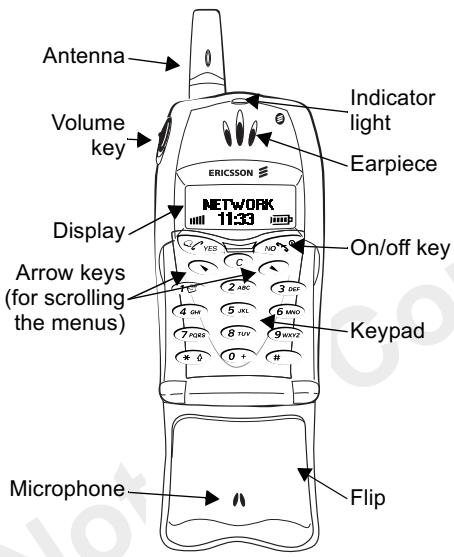
Front
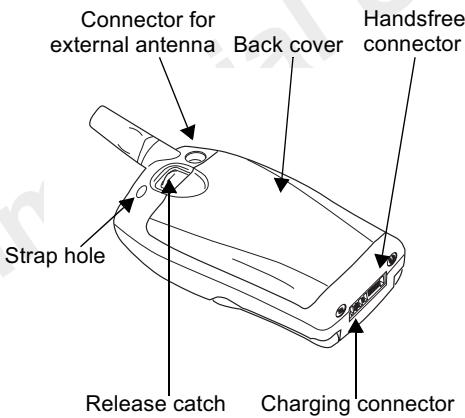
Back
About this User's Guide
Some services and functions described in this User's Guide are dependent on your network and subscription. Because of this, all menus may not be available in your phone and the shortcut numbers to menus and functions may vary between phones.
This symbol indicates that a service or function is dependent on your network and subscription.

Please refer to the information provided by your network operator for more information about your subscription.
We recommend that you read the chapter "Using the Menus" on page 14 for information about how to move through the menus.
The SIM Card
When you register as a subscriber with a network operator, you get a SIM (Subscriber Identity Module) card. The SIM card contains a computer chip that keeps track of your phone number, the services included in your subscription, and your Phone Book information, among other things.
SIM cards come in two sizes. One is the size of a credit card and the other is smaller. Your phone uses
the smaller card. Many credit-card-sized SIM cards have a perforated smaller card that you can take out easily.
Assembly
Before you can use your phone you need to:
- insert the SIM card.
- attach and charge the battery until the indicator light turns green.
Note: Always turn off the phone and detach the charger before you insert or remove a SIM card.
Inserting and Removing the SIM Card
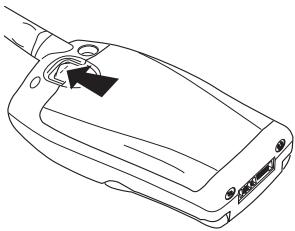
- Remove the back cover by sliding the release catch upwards. Then lift the cover.
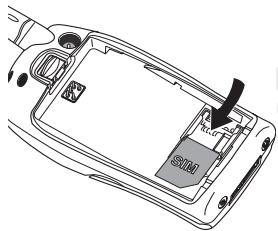
- To remove it, raise the edge of the SIM card and slide it out.
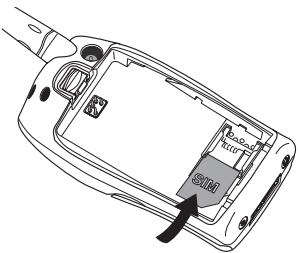
- Slide the SIM card into the slot, under the silvery holders, with the golden connectors facing down and the cut corner to the right.
Attaching the Battery to Your Phone
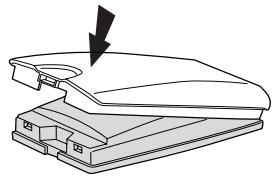
- Remove the back cover of the phone. Press it onto the battery until you hear a click. This unit is now referred to as the battery.
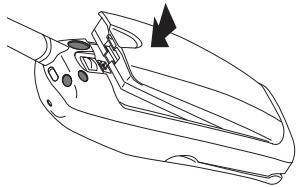
- Press the battery against the phone until it snaps into place.
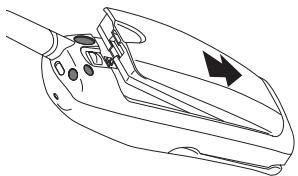
- Place the battery on the back of the phone.
The Battery
Your phone comes with a Li-ion lithium battery. The battery is not charged when you buy your phone, but there may be enough power to switch the phone on. We recommend that you charge the battery until the indicator on top of the phone shows a green light and then for another half-hour before you use the phone for the first time. Charging the battery fully, lengthens its lifetime.
When to Charge the Battery
The battery can be charged whenever you wish without affecting its performance. To remind you that you need to charge the battery:
- an alarm signal (a short beep) sounds and Attention! Battery low appears in the display.
Charging the Battery
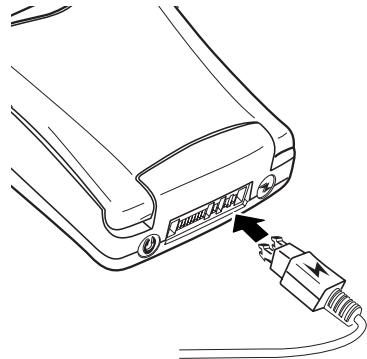
- Make sure that the battery is attached to the phone.
- Connect the charger to the phone at the flash symbol as shown in the picture. The flash symbol on the charger plug must face upwards.
- Connect the charger to the mains.
To indicate charging:
- the battery meter in the display pulses continuously
- if the phone is on, the indicator on top of the phone shows a steady green light.
Note: If you charge a new battery, or one that has not been used for a long time, it may take a while before you get an indication of charging in the display.
You can use the phone while the battery is being charged. However, this lengthens the charging time. When the battery is fully charged, the battery meter in the display is full.
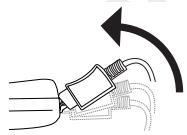
Disconnecting the Charger
- Disconnect the charger from the phone by tilting the plug upwards.
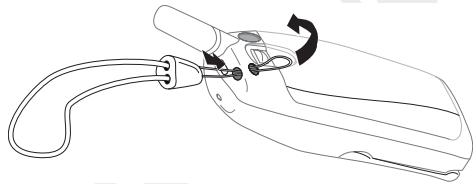
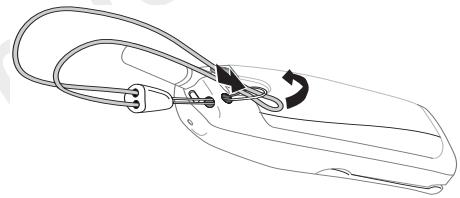
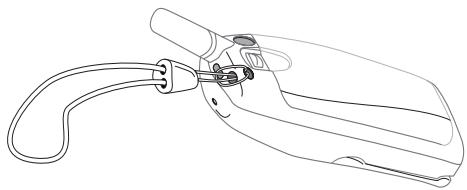
Attaching the Strap
Making and Receiving Calls
Before you can make and receive calls, you need to turn on the phone and be within range of a network.
Turning Your Phone On
- Open the flip.
- Press and hold the no key until you hear a tone.
Some SIM cards are protected with a PIN (Personal Identity Number). If PIN: appears in the display after you have turned on the phone:
- Enter your PIN.
If you make a mistake while entering your PIN, delete the wrong number by pressing the c key.
- Press YES.
Note: Your PIN is provided by your network operator.
Network Search
After you have turned on the phone (and entered your PIN), the phone searches for a network. When a network is found, the phone beeps three times. The
indicator light on top of the phone flashes green and your network operator's name appears in the display.
This is called "standby mode". You can now make and receive calls.
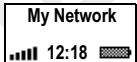
Note: If you do not reach standby, see "Error Messages" on page 66.
Making a Call
- Open the flip.
- Enter the area code and phone number.
- Press YES.
Ending a Call
- Close the flip or press NO to end the call.
Changing the Earpiece Volume
During a call you can change the listening volume by sliding the volume key on the side of the phone.
- Slide upwards to increase the volume.
- Slide downwards to decrease the volume.
Turning Off the Microphone
During a call you can turn off the microphone.
- Press the c key for a few seconds to turn off the microphone.
- Press and hold c again to resume the conversation.
Turning Your Phone Off
- In standby mode, press and hold the NO key until the shut down show starts, or until the phone switches off. To go to standby mode, press and hold NO.
Re-dialling a Previously Called Number
In the Call List you can find the numbers that you have dialled, answered or missed.
To re-dial a previously called number
- Press YES from standby mode to enter the Call List.
- Press or to scroll through the list.
- When the number you want to call is highlighted, press YES to make the call.
See "Using the Call List" on page 24.
Automatic Re-Dialling
If a connection failed, and the display shows Retry?, you can re-dial the number by pressing the YES key. Your phone automatically re-dials (up to 10 times):
- until the call is answered, or
- until you press a key or receive a call.
Note: Automatic re-dialling is not available for fax and data calls.
Making International Calls
- Press and hold the 0 key until a + sign appears. The + replaces the international prefix number of the country from which you are calling.
- Enter the country code, area code (without the leading zero) and phone number.
- Press YES.
Making Emergency Calls
- Enter 112 (the international emergency number).
- Press YES.
Your Ericsson phone supports the international emergency number 112. This means that it can normally be used to initiate an emergency call in any
country, with or without a SIM card inserted, if a GSM network is within range.
Note: Some network operators may require that a SIM card is inserted, and in some cases that the PIN has been entered as well.
Emergency Numbers
Some countries may not promote the international emergency number, 112. Your operator may therefore have stored additional local emergency numbers on the SIM card, which work in addition to the international emergency number.
To use another emergency number
- Press to go to the Phone Book menu.
- Press YES to select the menu.
- Press until SOS Numbers is highlighted, then press YES.
- Press or to go to the number you want, then press YES to make the call.
Receiving Calls
When you receive a call, the phone rings and the display shows Answer?.
If your subscription includes the Calling Line Identification (CLI) service and the caller's network sends the number, the caller's number is shown in the display. If you have saved the caller's name and number in the phone book, the caller's name is displayed. If the network does not send the number, the display shows Withheld.
Answering a Call
- Open the flip, or press YES if the flip is open.
Rejecting a Call
- Slide the volume key on the side of the phone twice.
Note: To open the flip without answering a call, you need to slide the volume key while opening the flip. Then you may reject a call by pressing NO or by closing the flip.
The caller hears a busy tone if this is supported by the caller's network. If Divert Calls When Busy is on, the call is diverted to the number you have specified. See "Diverting Incoming Calls" on page 47.
The Notepad
If you want to make a note of a phone number during a call, you can use your phone display as a notepad.
Use the number keys to enter the number. When you end the call, the number remains in the display.
When you enter the number, the person at the other end can hear the tones. You can turn the tones off (can only be done during a call).
To turn the tone signals off during a call
- Press until the Ongoing Call menu appears.
- Press YES to select the menu.
- Press YES again to turn off the tone signals.
Showing and Hiding Your Phone Number
You can choose to show or hide your number for a particular call, if this service is supported by your subscription.

To hide or show your phone number
- Enter the phone number you wish to call.
- Press until the Call Info menu appears.
- Press YES to select the menu.
-
Press l again until Next Call is highlighted.
-
Press YES to select Next Call.
- Select Hide My Number or Show MyNumber and press YES to make the call.
Ciphering
Ciphering is a built-in feature that scrambles your calls and messages to provide additional privacy.
An exclamation mark inside a triangle is shown in the display during a call to indicate that ciphering is currently not being provided by the network.
Key Functions
The table below shows some examples of the key functions. See also "Quick Keys" on page 69.
| Key | Use |
| Flip | Open the flip to answer incoming calls. (To end a call, close the flip.) |
| YES | To make calls and answer calls. To select a menu or setting. |
| NO | To turn the phone on or off, press and hold the key. To end a call. To reject a call. To go back one level in the menus, to leave a setting unchanged. To go back to standby mode, press and hold NO. |

To move (scroll) through menus, lists and text.
c (Clear) To delete numbers and letters from the display. To delete an item from a list. To turn off the microphone during a call, press and hold the key. To turn the ring signal off (from standby).
| Key | Use |
| 1-9, 0 | To enter the digits 0-9. Press and hold 0 to enter the international prefix +. To enter letters. To move through menus using shortcuts. |
| * | To enter *. To shift between capital and lower-case letters when entering text. |
| # (Hash) | To enter #. |
| Volume key upwards or downwards | To increase or decrease the volume of the earpiece or handsfree loudspeaker during a call. To reject an incoming call, slide the key twice. To open the flip without answering a call, slide and hold the key while opening the flip. To scroll through menus, lists and text. To enter the Status menu. To initiate voice dialling, slide and hold the volume key. |
Using the Menu
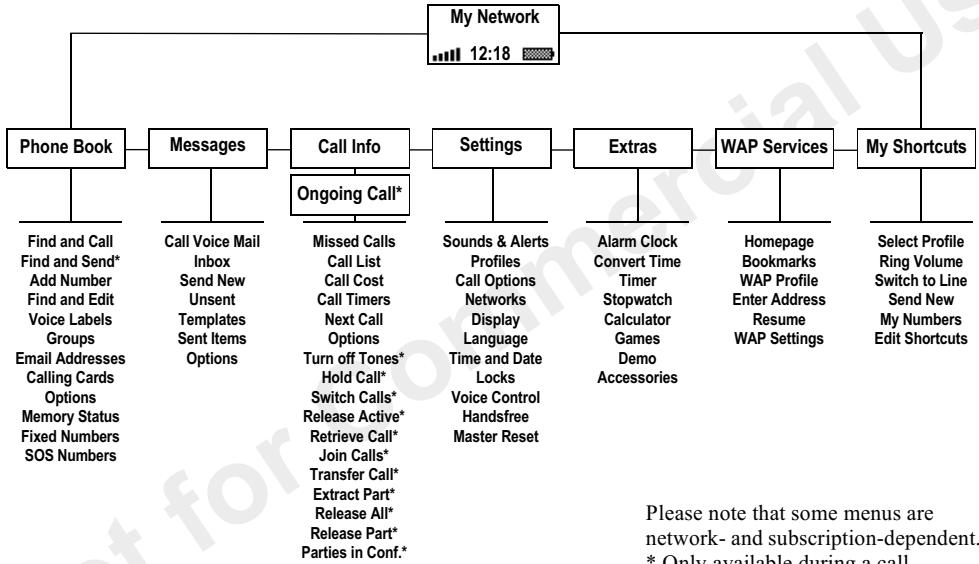
There are seven main menus. Each menu has several sub-menus, where you find the different functions.
You move through the menus by pressing the and keys, or by using shortcuts. You move from left to right in the main menus and up and down in the sub-menus.
Moving Through the Menus
There are two ways of moving through the menus:
- Scrolling with the and keys
Using shortcuts
Scrolling by Using or
Press... to...

scroll left or up through the menus.

scroll right or down through the menus.
YES
select a menu, sub-menu or an option.
NO
go back one level in the menus, leave an option unchanged.
press and hold NO to go back to standby.
Using Shortcuts
A quicker way to move through the menus is to use shortcuts. Enter the menus by pressing and then simply enter the number of the menu to which you want to go. To get back to standby, press and hold NO.
How to Interpret the Instructions
In this example of how to interpret the instructions, we are going to set the key sound to the tone option.
To set the key sound
- Scroll to Settings, YES, Sounds & Alerts, YES, Key Sound, YES.
- Select Tone and press YES.
Interpret the instructions as follows:
1.From standby,press or to scroll to the Settings menu.
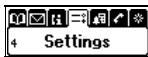
- Press YES to select the Settings menu. The name of the menu that you have chosen is shown at the top of the display (Settings). A flashing arrow in the right part of the display indicates that more menus are available.
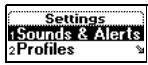
- Press YES to select the Sounds & Alerts sub-menu. (You do not need to scroll with the arrow keys as this is the first sub-menu.)
- Press or to scroll to the Key Sound sub-menu and press YES to select it.
- Press or to scroll to the Tone option and press YES to select it. You have now set the key sound to tones.
- Press and hold NO to go back to standby.
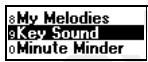
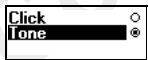
Shortcuts
This is how to interpret the instructions above by using shortcuts:
To set the key sound
- Press or to enter the main menu.
- Press 4 to select the Settings menu.
- Press 1 to select the Sounds & Alerts sub-menu.
- Press 9 to select the Key Sound sub-menu.
- Press l or l to scroll to Tone.
- Press YES to select the tone option.
- To go back to standby, press and hold NO.
Tip: To check a setting without changing it: scroll to the setting and leave it unchanged by pressing NO.
Display Text
- Text at the top indicates the menu you have chosen.
- A text that is highlighted shows your position in the menu. If you press YES, you enter this menu or select this option.
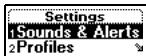
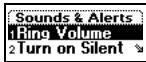
- Grey text indicates a function that is temporarily unavailable, for example due to your subscription or due to a certain setting which has not been turned on.
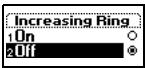
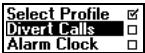
- A filled button indicates that this option is selected.
- A tick indicates that this item is selected.

Help Texts
To help you use the menus and functions, your phone has pop-up help texts that explain the menus.
These help texts are set to On when you buy your phone, but you can turn them off at any time.
To turn the help texts on or off
- Scroll to Settings, YES, Display, YES, Menu Help, YES.
- Select On or Off and press YES.
Display Language
Most SIM cards automatically set the display language to the language of the country where you bought your
SIM card, Automatic. If this is not the case, the preset language is English.
To change the display language
1.Scroll to Settings, YES, Language, YES, Menus, YES.
2. Select a language and press YES.
Note: You can always choose Automatic by pressing 8888 in standby.
You can always choose English by pressing 0000 in standby.
The Call Info/Ongoing Call Menu
Depending on whether a call is ongoing or not, either the Call Info or the Ongoing Call menu is shown.
- The Call Info menu is active when the phone is standby mode.
- The Ongoing Call Menu is active during a call.
Menu Overview
Entering Letters
You can enter letters when you add names to the phone book, write text messages (SMS) or enter WAP addresses. Press the appropriate key, 1-9, 0 or #, repeatedly until the character you want appears in the display.
Press... to get...
1 Space -?!, .; ;" < => () _1
2 A B C A A /E àç 2 Γ
3 D E F è É 3 Δ Φ
4 G H I i 4
5 J K L 5 Λ
6 M N O N Ñ ò ò 6
7 P Q R S β 7 Π Σ
8 T U V Ü ñ 8
9 W X Y Z 9
0 + & @ / % £ ¥ £ i 0 Θ Σ Ω
# * _
- capital or lower-case letters
Example:
To enter an 'A', press 2 once.
- To enter a 'B', quickly press 2 twice.
- To enter lower-case letters, enter the letter, for example an 'A' and then press . Lower-case letters appear until you press again.
- To enter numbers, press and hold any numeric key.
- To delete letters and numbers, press c.
Choosing Alphabet(s)
You can choose which alphabet(s) (input methods) you want to use. When you are writing messages, entering names or WAP addresses, you can switch to another alphabet by pressing #. First you need to set the alphabets you want to choose from.
To choose an alphabet
- Scroll to Settings, YES, Language, YES, Input, YES.
- Use to select the alphabets (input methods) you want to choose from or to cancel the selection.
- Press YES to leave the menu.
Your Personal Phone Book
Your phone has a phone book in which you can save numbers and accompanying names (an entry).
This means that you can recall a number from the phone book instead of entering the number again.
Your phone also supports voice dialling which means that you can add a voice label to a phone book entry and then call that entry by simply saying the name. See "Voice Control" on page 45.
Saving a Number Together with a Name
When you want to save a phone number, you use the Add Number function in the Phone Book menu. If you have already made and received calls, you can find these numbers in the Add Number list.
Every phone number you save also gets a position number. If you want to, you can choose to sort your phone book entries according to their position number instead of the name.
If you intend to use your phone both at home and abroad, it is a good idea to save all phone numbers as international phone numbers, i.e. with the + sign, followed by the country code, the area code and the phone number. Press and hold 0 to enter the + sign.
To save a number together with a name
- Scroll to Phone Book, YES, Add Number, YES.
- Select Add new? or any of the numbers from the list by pressing YES.
- Enter the phone number that you want to save and press YES.
- Enter a name that you want to associate with the phone number and press YES. See "Entering Letters" on page 18.
- Press Yes again to save the entry in the suggested position.
- When voice dialling is on, you are asked if you want to record a voice label for your entry. Press YES if you want to record a voice label, press NO if you do not. You can always add a voice label later. See "Voice Control" on page 45 for more information.
Calling a Number Saved in the Phone Book
You use the Find and Call function to call a number that you have saved in the phone book.
To call a number saved in the phone book
-
Press and hold until the Find and Call menu appears.
-
Enter the name (or the first few letters of the name) associated with the number that you want to call and press YES.
If the name displayed is not the one you want, press or until you find the correct name and number. - Press YES to make the call.
Shortcuts to Phone Book Entries
You can call the phone numbers that you have saved in positions 1-9 by entering the position number in standby, and then pressing YES.
Example:
- Press 3 and then YES.
When in standby, you can find an entry by pressing and holding one of the keys 2-9 to find an entry beginning with the first letter on that key, or the closest following.
Example:
- Press and hold 4 to get to the first entry beginning with the letter 'G' (or the closest following). Press 4 twice to get to the first entry beginning with 'H' and
so on. When you find the entry you want, press YES to make the call.
Ask to Save
If Ask to Save is on, you are asked if you want to save any called or answered number that is not already saved in your phone book.
To turn the Ask to Save function on or off
- Scroll to Phone Book, YES, Options, YES, Ask to Save, YES.
- Select On or Off and press YES.
Note: Your subscription must support the Calling Line Identification Service, if you want to save answered numbers.
Keeping the Phone Book Up to Date
You can change and delete names and numbers from the phone book.
To edit an entry
- Scroll to Phone book, YES, Find and Edit, YES.
-
Enter the name (or the first few letters) for the entry that you wish to edit and press YES.
-
Press YES to select the entry.
- Select Edit and press YES.
- When you have finished editing, press YES to save your changes.
To delete an entry from the phone book
- Scroll to Phone book, YES, Find and Edit, YES.
- Enter the name (or the first few letters) for the entry that you wish to edit and press YES.
- When the entry you want to delete is highlighted, press c.
- Press YES to confirm.
Sort Order
You may change the sort order of your phone book entries, so that they are sorted according to their position number instead of the name. This means that you search for the position number when you use the Find and Call or the Find and Edit functions.
To choose a sort order
- Scroll to Phone Book, YES, Options, YES, Sort Order, YES.
- Select a sort order and press YES.
Phone Book Memories
Your phone book entries are saved in the memory on your SIM card. The number of entries you can save depends on your SIM card. By saving your entries on the SIM card, you still have access to them if you use the card with another phone.
You can also save your entries in the phone memory. The phone memory holds 100 positions in which your entries are saved when all SIM positions are occupied. If you save your entries in the phone memory, you still have access to them if you use another SIM card with your phone.
Choosing Where to Save an Entry
When you save an entry and are asked to enter the position number, you can do the following:
To save the number in the first empty position suggested, press YES.
- To save the number in another position, press c to delete the position number, enter a new position number and press YES.
- To save the number in the phone memory, you first need to know how many positions you have got on your SIM card. You can check this in the Memory Status menu. If, for example, you have 200 positions
on your SIM card, you can enter position number 201 to save a number in the first position of the phone memory.
Overwrite Protection
If you try to save a phone number in a position which already contains a phone number, the message Overwrite? appears together with the name saved in that position. You now have two options:
- Press YES to replace the number with the new one.
- Press NO if you do not want to replace the old number. Enter a new position and press YES.
Checking the Status of the Memory
You can check how many memory positions you have in your memories and how many of them you have used.
To check the status of the memories
- Scroll to Phone Book, YES, Memory Status, YES.
If you have saved entries in the phone memory, you can delete them.
To delete all entries from the phone memory
- Scroll to Phone Book, YES, Options, YES, Delete All, YES.
- Press YES again.
- Enter the phone lock code (0000 or another one that you have chosen yourself, see "The Phone Lock" on page 52), and press YES.
Note: The entries on your SIM card are not deleted.
Groups
You can create a group of phone book entries. You can then send a text message to all members of that group at the same time. See "Text Messages (SMS)" on page 32.
To create a new group
- Scroll to Phone Book, YES, Groups, YES, Add new?, YES.
- Enter a name for the group and press YES.
- Scroll to Add new? and press YES.
- Select an entry in your phone book and press YES.
- To add the next member, repeat steps 3 and 4.
- Press No to leave the menu.
To add a member to an existing group
- Select the group you want and then select Edit/Add new?. Select a new member and then press YES.
Copying From One SIM Card to Another
You can copy your phone book entries on one SIM card to another, via the phone's memory.
If your phone memory contains phone book entries that you wish to keep, you first need to copy these entries from the phone memory to a SIM card, otherwise they will be deleted.
Note: You can only copy 100 items at a time. Check your phone memory and your SIM card memory before you start copying, to make sure that you do not delete entries you want to keep.
Note: Always turn off the phone and detach the charger before you insert or remove a SIM card.
To copy from a SIM card to the phone memory
-
Insert a SIM card.
-
Scroll to Phone Book, YES, Options, YES, Copy, YES, Copy from Card, YES.
-
Enter from which position number on the SIM card you want to start copying and press YES.
- Press YES again to start copying. Wait until the display shows Phone book entries copied:.
To copy from the phone memory to a SIM card
- Insert a SIM card.
- Scroll to Phone Book, YES, Options, YES, Copy, YES, Copy to card, YES.
- Enter the position number of your SIM card where you want to start saving your entries and press YES. For example, if you have 10 entries on the SIM card that you want to keep, select position 11.
- Press YES again to start copying. Wait until the display shows Phone book entries copied:.
Using the Call List
The Call List is a phone number log that saves information (time, date, phone number and name) about the last 20 dialled, answered and missed calls. Once your list exceeds 20 calls, the oldest one is deleted.
The calls are saved in chronological order, except for the last dialled number, which is always displayed in the first position. If you check a call within 24 hours, the time of the call is displayed. Otherwise, the time is replaced by the date.
If the incoming call is a restricted number, the display shows Withheld.
To call a number from the call list
- Press Yes when the phone is in standby mode.
- Select the number you want to call and press YES.
Tip: You can also select the Call List from the Call Info menu.
You can clear the call list.
- Select Clear Call List from the Call Info/Options menu.
To turn the call list on or off
- Scroll to Call Info, YES, Options, YES, Set Call List, YES.
- Select On or Off and press YES.
If you turn off the list, it is cleared.
Missed Calls
If you have missed a call, the message Missed Calls:1 appears in standby mode. (The number indicates the number of missed calls.)
To check your missed calls
- Press YES.
- If you wish to call a number from the list, select the number and press YES.
Press NO if you do not want to check your missed calls now. You can always check them later.
- Select Missed Calls from the Call Info menu.
Your Voice Mail Service
The answering service of your network operator allows callers to leave a voice message when you cannot answer your calls.

Depending on your operator, you are informed that someone has left a message in different ways.
Most operators send a text message (SMS), asking you to call your voice mail service, for example. See "Text Messages (SMS)" on page 32 for more information.
Other operators send a specific voice mail indication. If this is the case, the voice mail icon appears in the display.
Using Your Voice Mail Service
You can save the number to your voice mail service, making it easier for you to call your voice mail.
To save your Voice Mail number
- Scroll to Messages, YES, Options, YES, Voice Mail No., YES.
- Enter your Voice Mail number and press YES.
To call your Voice Mail Service
- Press and hold 1 from standby.
You can also select Call Voice Mail from the Messages menu.
Receiving a Voice Mail
When you receive a voice mail, your phone beeps and the message New Voice Mail appears in the display.
- Press YES to listen to the voice mail.
If you want to listen to it later, press NO.
Personalizing Your Phone
You can adjust the phone settings to suit your own requirements.
Ring Signals
You can specify the ring signal volume, choose among different ring signals or compose your own.
Ring Signal Volume
The ring signal volume can be set to six levels. You can also turn the ring signal off (0).
To set the ring signal volume
- Scroll to Settings, YES, Sounds & Alerts, YES, Ring Volume, YES.
- Press or to increase or decrease the volume. If you increase the volume, the phone rings once for each level.
- Press YES to save the setting.
Tip: Use the volume key on the side of the phone to change the volume silently.
To turn the ring signal on or off
1.From standby, press and hold c.
2. Press YES.
All signals except the alarm and timer signals are turned off.
To cancel, repeat step 1 and press YES.
Increasing Ring
You can choose a ring signal that rises in steps from the lowest volume to the highest.
To turn the increasing ring on or off
- Scroll to Settings, YES, Sounds & Alerts, YES, Increasing Ring, YES.
- Select On or Off and press YES.
Ring Signal Type
You can choose a ring signal from a list of different sounds and melodies.
To choose a ring signal
- Scroll to Settings, YES, Sounds & Alerts, YES, Ring Signals, YES, Voice Calls, YES.
- Select a ring signal and press YES.
Tip: Use the volume key on the side of the phone to scroll silently.
Tip: If you subscribe to the "Two Line Service", you can set different ring signals for the two lines. If your SIM subscription supports fax and data calls, you can set different ring signals for these too.
Specific Ring Signals for Personal Calls If your subscription includes the Calling Line Identification (CLI) service, you can assign a personal ring signal to up to ten callers.
If the last seven digits of a caller's number correspond to a number you have specified, then that caller's ring signal is used.
You can include question marks in a phone number. For example, 012345??? means that calls from phone numbers between 012345000 and 012345999 will have the same personal ring signal. Press and hold # to insert a question mark.
To set a specific ring signal for a caller
-
Scroll to Settings, YES, Sounds & Alerts, YES, Ring Signals, YES, Personal Rings, YES, Add new?, YES.
-
Enter the caller's number and press YES.
Press to recall a number from the phone book.
- Select a ring signal and press YES.
Composing Your Own Ring Signal
You can compose four different ring signals.
To compose or edit a ring signal
- Scroll to Settings, YES, Sounds & Alerts, YES, My Melodies, YES.
- Select one of the melodies and press YES.
- Press c to remove notes.
-
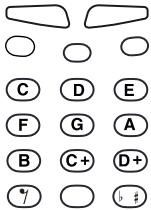
Use the keypad to enter notes:
-
Press and hold a key to enter a long note.
- Press 0 to raise the note one octave.
- Press # once to raise the note one semitone.
- Press # twice to lower the note one semitone.
- To listen to your melody, press YES.
- Press YES again to save it or press NO to continue composing.
Vibrating Alert
You can choose to be notified of an incoming call by the buzzing of the Vibrating Alert. You can set the phone's Vibrating Alert to one of the following:
- On (all the time)
- On If Silent (on when the ring volume is turned off or when you have set the phone to silent)
- Off (all the time)
Note: When your phone is placed in a desktop charger or a handsfree car kit, the Vibrating Alert is turned off automatically.
To set the Vibrating Alert
- Scroll to Settings, YES, Sounds & Alerts, YES, Vibrating Alert, YES.
- Select the setting you want, and then press YES.
Message Signal
You can set the message signal to clicks, tones or silent.
- Select Message Alert from the Settings/Sounds & Alerts menu and then select the signal you want.
Key Sound
You can set the key sound to clicks, tones or silent.
- Select Key Sound from the Settings/Sounds & Alerts menu and then select the key sound you want.
Minute Minder
If you turn on the minute minder, you hear a beep once every minute during a call.
- Select Minute Minder from the Call Info/Call Timers menu and then select On or Off.
Display Light
The display light can be set to automatic, off or on. In automatic mode, the display light is turned off a few seconds after you press the last key.
- Select Light from the Settings/Display menu, and then select the alternative you want.
My Shortcuts
You can place your favourite functions in the menu My Shortcuts. In this way, you can quickly and easily reach the functions you use most. When you buy your phone, My Shortcuts contains a few functions which you can remove if you wish.
To add a function to My Shortcuts
- Scroll to My Shortcuts, YES, Edit Shortcuts, YES.
- Select a function from the list by pressing
- Enter the position number you want for your function in this menu and press YES.
To add another function, repeat steps 2 and 3.
To remove a function, repeat steps 1 and 2.
- Press YES to exit the list.
Tip: Press and hold to reach the first sub-menu in the menu My Shortcuts.
Time and Date
The time is always displayed in standby mode.
To set the clock
- Scroll to Settings, YES, Time and Date, YES, Set Time, YES.
If Internet time is on, you have to choose whether the clock should be set to Local time or Internet time. See "Internet Time" on page 30.
- Enter the time and press YES.
If you select the 12-hour clock, you can alternate between am and pm by pressing #.
You can choose a 12-hour or a 24-hour clock.
- Select Time Format from the Settings/Time and Date menu, then select the time format you want.
Automatic Time Zone
If you turn on the Automatic Time Zone function, you will be asked if you want to set the clock when you enter a new time zone.

- Select Automatic Time Zone from the Settings/Time and Date menu.
Date
When the phone is in standby mode, you can slide the volume key to see today's date.
To set the date
- Scroll to Settings, YES, Time and Date, YES, Set Date, YES.
- Enter the year (two digits), month and day and then press YES.
You can select another date format.
- Select Date Format from the Settings/Time and Date menu, then select the date format you want.
Internet Time
Swatch® Internet time represents a new global time concept, without time zones. The time is the same all over the world.
The 24 hours of the day are divided into 1,000 "beats". 1 beat is 1 minute 26.4 seconds. Internet time is identified by @ plus three digits, ranging from @000 to @999. The Internet Day starts at midnight (wintertime) in Bienne, Switzerland, the home of Swatch. Internet Time was invented by Swatch Ltd.
The first time you turn Internet time on, you are asked to enter the current Internet time. If you do not know this, you can enter GMT (Greenwich Mean Time). The phone then calculates the current Internet time automatically.
To turn Internet time on
- Scroll to Settings, YES, Time and Date, YES, Time Settings, YES, Internet time, YES.
- Select On and press YES.
- Select either Set I-net time or Set GMT time and then press YES.
- Enter the current Internet time or GMT and then press YES.
When Internet time is on, it is displayed in standby mode instead of local time. You can still view local time when Internet time is on by pressing the NO key once. If you turn Internet time off again, you can still view it in standby by pressing the NO key once.
When Internet time is on, you can convert Internet time to local time and vice versa.
To convert from Internet time
- Scroll to Extras, YES, Convert Time, YES, From I-net time, YES.
- Enter the Internet time and then press YES.
To convert to Internet time
- Scroll to Extras, YES, Convert Time, YES, To I-net time, YES.
- Enter the local time and then press YES.
Tip: You can use Internet time in the alarm clock. See "Internet Time Alarm" on page 61.
Answering Mode
When using handsfree equipment, you can choose to answer a call by pressing any key (except the NO key) or set the phone to answer the call automatically.
To select answering mode
- Scroll to Settings, YES, Handsfree, YES, Answering Mode, YES.
- Select an answering mode and press YES.
Tip: You can also answer a call by using the voice answering function. See "Voice Answering" on page 46.
Start Up/Shutdown Show
When you turn your phone on or off, the Ericsson start up/shut down show appears in the display. Your operator's own greeting may be shown instead.
If you want to interrupt the start up show, you can press the NO key.
To select a start up/shut down show
- Scroll to Settings, YES, Display, YES, User Greeting, YES.
- Select a show and press YES.
You can also turn off the start up/shut down show by selecting Off.
To turn the start up melody on or off
-
Scroll to Settings, YES, Display, YES, User Greeting, YES.
-
Select a show and press YES.
- Select Animationsound, YES, On or Off, YES.
My Animation
By purchasing the Ericsson infrared modem, DI 28, you can create and download your own start up show (provided you have a PC). You can also compose or download a melody and set this as your start up melody. From your phone, you can set the transition of your animation, for example if you want it to "box out" etc.
- Select My Animation from the Settings/Display/User Greeting menu and then select the transition you want.
Demo
You can run a demo which shows the phone's main menus.
- Select Demo from the Extras menu.
- Press NO when you want to end the demo.
Phone Number Display
You can check your own phone number(s).
- Select My Numbers from the Settings/Display menu If your number is not stored on your SIM card, you can enter it yourself.
Master Reset
You can reset the phone settings to the way they were when you bought your phone.
To reset the phone
- Scroll to Settings, YES, Master Reset, YES.
- Enter the phone lock code (0000 or the new code if you have changed it) and press YES.
Text Messages (SMS)
You can use the Short Message Service (SMS) to send and receive text messages consisting of up to 160 characters.
If the number to your service centre is not stored on your SIM card, you must specify the number yourself. Otherwise you cannot reply to received messages or send your own.
To check the number to your service centre
- Scroll to Messages, YES, Options, YES, Service Centres, YES.
If no number is found, select Add new? and press YES.
- Enter the number, including the international + sign and country code, and press YES.
Note: The number to your service centre is provided by your operator.
To send a text message
- Scroll to Messages, YES, Send New, YES.
- Enter your message and press YES. See "Entering Letters" on page 18.

- Enter the recipient's phone number or recall it from the phone book by pressing .
- Press Yes to send the message.
If you want to send the message later, press NO when you are asked to enter the phone number. The message is saved in the Unsent list in the Message menu.
Sending a Text Message to a Group
You can send text messages to group that you have specified and saved in your phone book, see "Groups" on page 22.
To send a text message to a group
- Scroll to Messages, YES, Send New, YES.
- Enter your message and press YES.
- Press , select Groups and press YES.
- Select a group and press YES.
Note: You will be charged for each group member.
Customizing Your Text Messages
Before you send a message, you can set the "type of message", the "validity period" and whether you want the recipient of your message to reply.
You can set a standard option or turn on "set on send", which means that you make your choices each time you send a message.
Message Type
You can send different types of messages. Your network operator's service centre may offer the facility of converting a text message into a format (e-mail, fax, etc.) that suits the equipment that is going to receive the message.
To select a message type
- Scroll to Messages, YES, Options, YES, Message Type, YES, Set Default, YES.
- Select a message type and press YES.
To turn on the Set on Send option, select Set on Send, then On and press YES.
Validity Period
If your message cannot be delivered, for example if the recipient has turned off the phone, your service centre can save the message to send it later. If the service centre has not reached the recipient within a certain time, the message is deleted.
To set a validity period
- Scroll to Messages, YES, Options, YES, Validity Period, YES, Set Default, YES.
- Select a validity period and press YES. To turn on the Set on Send option, select Set on Send, then On and press YES.
Reply to Messages
If you want the recipient of your message to reply, you can turn on the Request Reply option.
To turn the Request Reply function on or off
- Scroll to Messages, YES, Options, YES, Reply Request, YES.
- Select On or Off and press YES.
Templates
If you have one or more messages that you send often, you can save these as templates. You can save 10 templates consisting of up to 25 characters each.
Your phone may come with a set of templates that your operator or service provider has prepared for you. These templates appear in the list of templates, indicated by a letter icon with a dotted sheet. You cannot edit or delete these types of templates.
To create a template
- Scroll to Messages, YES, Templates, YES, Add new?, YES.
- Enter the message and press YES.
- To send the template now, press YES when Send message now? appears and proceed as described in "To send a text message" on page 32.
Press NO if you do not want to send the template now.
To send a template later, select it from the Template list in the Message menu, and proceed as described in "To send a text message" on page 32.
Receiving a Message
When you receive a message, the phone beeps, the indicator light
rapidly flashes green and the message New message Read now? appears in the display.
New message Read now?
To read the message now
- Press YES.
-
Press and to scroll through the message. An arrow in the bottom right corner of the display indicates that there is more text in the message.
-
When you have read the message, press YES. A new menu with different options appears. These options are described on the following pages.
Note: If the sender of the message wants you to reply, the message "Reply requested Reply?" appears in the display. Press YES again to reply. If you do not want to reply, press NO.
To read the message later
- Press NO to save the message in your Inbox in the Message menu.
To reply to a message
- When you have read the message, press YES.
- Select Reply in the option list and press YES.
-
Select the message you want to send as a reply and press YES. You can choose between:
-
Send new.
- Include this Message. The message you received is included in your answer.
-
Any templates you have created.
-
Write your message and press YES.
To forward a message
-
When you have read the message, press YES.
-
Select Forward and press YES.
Continue in the same way as when sending a new text message.
To call a phone number found in a message
- When the number is highlighted, press YES twice.
To call the sender of the message
- When you have read the message, press YES.
- Select Call and press YES.
To read the next message
- When you have read the message, press YES.
- Select Read Next and press YES.
To delete a message
- When you have read the message, press YES.
- Select Delete and press YES.
Tip: To delete a message from your Inbox, select the message and press c.
Saving Incoming Messages
Incoming messages are saved in the phone memory. The phone memory can hold up to 10 messages. When
the phone memory is full, the oldest read message is deleted when a new message is received.
If the phone memory becomes full of unread messages, new messages are automatically saved on the SIM card. Messages that are saved on the SIM card remain there until you delete them.
To save a message on the SIM card
- When you have read the message, press YES.
- Select Save and press YES.
E-mail Addresses
You can save e-mail addresses to be used when you want to send a text message as an e-mail. You can save 10 e-mail addresses.
To save an e-mail address
- Scroll to Phone Book, YES, Email Addresses, YES, Add new?, YES.
- Enter an e-mail address and press YES.
- Enter a name and press YES.
Area Information
The ordinary Short Message Service is a personal service that carries your private

messages. Area Information is another type of text message that is sent to all subscribers in a certain network area.
This information could, for example, be a local traffic report or the phone number of a local taxi company.
To turn Area Information on or off
- Scroll to Messages, YES, Options, YES, Area Info, YES, Reception, YES.
- Select On or Off and press YES.
Area Information Codes
Please refer to the information provided by your operator for more information about the area information codes.
To insert an Area Information code
- Scroll to Messages, YES, Options, YES, Area Info, YES, Edit List, YES, Add new?, YES.
- Enter the new code and press YES.
Receiving an Area Message
When you receive an Area Information message, the message automatically appears in the display. You
read the message in the same way as you read an ordinary text message. You cannot save area messages. When you have read the message and press YES or NO, it is deleted.
Cell Information
The "Cell information channel" is used by some network operators for sending messages
to their subscribers within a certain network area.
You read messages on the Cell information channel in the same way as when reading area messages.
- To turn on the channel, select Cell Information from the Messages/Options menu and then select On.

The WAP Browser

Your phone has a WAP browser which lets you connect to the Internet and access with specially designed interactive services and view WAP pages. WAP (Wireless Application Protocol) is a standard specially created for mobile communications devices and gives fast access to information and services on the Internet.
Examples of WAP services you may find are:
- Ericsson Mobile Internet, a portal offering you online access to customer services, user guides and useful information when you are travelling. The address to Ericsson Mobile Internet is:
mobileinternet.ericsson.com
- Reservation services.
- News, sports and weather.
- Restaurants,cinemas,gamesetc.
Banking and stock exchange quotations.
Voice mail, e-mail and fax mail.
Preparing Your Phone for WAP
Before you can start using the WAP browser, you need to make sure that your access settings are
correctly set. You need to set your User ID and Gateway address, among other things.
Depending on your network operator, you can receive the access settings you need in different ways.
- When you buy your phone together with a WAP subscription. Your operator has already entered all the WAP settings you need.
Over the air via SMS. Your operator sends you a text message with the access settings you need. When this happens you will be asked if you want to install the settings and specify which WAP profile you want them to apply to.
Note: Always make sure who the sender of the message is, before you install any settings. If you are unsure, choose not to install any settings by pressing No. Call your operator and ask them to send the settings again, if it was in fact your operator who sent the message.
- Manually by yourself. Your operator or another service provider, for example your company, provides you with the settings you need. You then have to enter them yourself.
Entering the WAP Settings Manually
The WAP settings you enter will be associated with one of the WAP profiles. If you want to use more than one WAP profile, you need to specify the settings for each profile. See "Using WAP Profiles" on page 42.
Note: Please refer to the information provided by your operator before you enter your settings.
Choosing Which Access Type to Use When Browsing
Your mobile phone supports two types of connection to the internet: via GSM Data and via SMS. The speed and cost of the WAP service depends on the access type you use. For more information, please contact your service provider or network operator.
If your subscription supports both access types, you can set the phone to always ask which type you want to use, each time you start the browser. If you can use only one access type, we recommend that you set this as your preferred access type.
To set a preferred access type
- Scroll to WAP Services, YES, WAP Settings, YES.
-
Select a WAP profile and press YES.
-
Scroll to Access, YES, Access Type, YES.
- Select the Access Type you want and press YES.
To set up a GSM Data Connection
- Scroll to WAP Services, YES, WAP Settings, YES.
- Select a WAP profile and press YES.
3.Scroll to Access, YES, Gateway, YES, User ID, YES. - Enter the User ID to your gateway and press YES.
- Select Password and press YES.
- Enter the password to your gateway and press YES.
- Select Data Address and press YES.
- Enter the IP address to your gateway and press YES. An IP address looks something like this: 123.4.67.901.
Note: An IP address consists of four groups of digits, with a maximum of three digits in each group. If one of your digit groups consists of only one or two digits, you have to enter a zero (0) in front of the original digit for each digit that is missing. For example, if you were to enter the IP number above, 123.4.67.901, you should write 123.004.067.901.
After you have entered the IP address, press NO to go back one level in the menus. You are now in the access menu. Follow the instruction below:
- Scroll to GSM Data, YES, Phone Number, YES.
- Enter the phone number you use with your GSM Data connection and press YES.
- Scroll to User ID and press YES.
- Enter the User ID for your GSM Data Connection and press YES.
- Scroll to Password and press YES.
- Enter the Password for your GSM Data Connection and press YES.
- Scroll to Dial Type and press YES.
- Select Analogue or ISDN connection and press YES. You have now entered the settings you need to start browsing the internet.
To set up an SMS Connection
- Scroll to WAP Services, YES, WAP Settings, YES.
- Select a WAP profile and press YES.
3.Scroll to Access, YES, Gateway, YES, User ID, YES. - Enter the User ID to your gateway and press YES.
- Select Password and press YES.
-
Enter the password to your gateway and press YES.
-
Select SMS Address and press YES.
- Enter the phone number to your gateway and press YES.
After you have entered the SMS address phone number, press NO to go back one level in the menus. Now you need to enter the phone number to your service centre.
- Select Service Centre and press YES.
- Enter the phone number to your service centre and press YES.
You have now entered the settings you need to start the WAP browser.
Open a WAP Page
There are three ways to open a WAP page:
- by opening a homepage.
- by entering the address of the WAP page.
- by opening a bookmark that you have saved. See "Bookmarks" on page 41.
Open a Homepage
When you buy your phone Ericsson Mobile Internet is set as your homepage for all WAP profiles. If you want to, you can choose another WAP page as your homepage, see "To change homepage" on page 40.
To open a homepage
- Scroll to WAP Services, YES.
- Select the top menu and press YES.
The name of this menu depends on what you have chosen to call it. See "To edit the homepage of a WAP profile" on page 43.
To go to a WAP page by entering the address
- Scroll to WAP Services, YES, Enter Address, YES.
- Enter the address, for example mobileinternet.ericsson.com and press YES.
Tip: If the WAP address starts with http://, you do not need to enter this prefix. You only need to enter the prefix if it starts with something else, for example, ftp://.
To change homepage
- Scroll to WAP Services, YES, WAP Settings, YES.
- Select the WAP profile you want and press YES.
- Select Edit Homepage and press YES.
- Enter a name for this homepage and press YES.
- Enter the address to the WAP page you want to set as your homepage and press YES.
Options While You are Browsing
While you are browsing you can press and hold YES to reach an options menu. The menu may look different depending on what page you are browsing. It can, for example contain special features of the WAP page you are currently browsing. It always, however, contains the options below:
- Go to Menu. Go back to the WAP services menu where you can access your bookmarks among other things.
- Reload page. Get the latest version of the WAP page you are browsing.
- Add bookmark. Add the page you are currently browsing to your list of bookmarks.
- Send link. Send the current page as a bookmark to another person via SMS.
- New homepage. Set the current WAP page as your homepage.
- Exit WAP. End your browsing.
To reach the options menu
- Press and hold YES while you are browsing.
If you select Go to Menu from the options menu, you can easily return to the WAP page you are currently browsing.
To return to the browser
- Scroll to WAP Services, YES, Resume, YES.
Bookmarks
If there are some WAP pages that you visit often, you can save these as bookmarks, making it easier to go to these pages.
Note: You can only add bookmarks while you are browsing.
To add a bookmark
- Start the browser in one of the ways described in this chapter.
- Go to the WAP page you want to bookmark.
- Press and hold YES until the Options menu appears.
- Select Add bookmark and press YES.
Wait until the messageBookmark saved appears in the display.
To open a bookmark while browsing
- When you are browsing, press and hold YES until the Options menu appears.
2.Scroll to Go to Menu, YES, Bookmarks, YES. - Select the bookmark you want and press YES.
- Select Go to and press YES.
Images
If you do not want to display the images on the WAP page that you are browsing, you can turn them off. Images take longer to download, but the WAP page may look better with them.
If an image contains a link, you can access the link by highlighting the image, then press YES.
If you turn off the Show images function, the images appear as icons in the display.
To turn the show images function on or off
- Scroll to WAP Services, YES, WAP Settings, YES.
- Select a WAP profile and press YES.
- Scroll to Show Images and press YES.
- Select On or Off and press YES.
Download Timeout
Some WAP pages can take a long time to download. You can specify the time that should pass before the download attempt is stopped.
To set the download timeout
- Scroll to WAP Services, YES, WAP Settings, YES
- Select a WAP profile and press YES.
-
Select Access, YES, Response Timer and press YES.
-
Enter how many seconds you want the download to continue before it stops, and press YES.
Using WAP Profiles
Your phone comes with three WAP profiles, in order to simplify your browsing. You can, for example associate one profile to your operator's WAP page and one to your company's intranet. Instead of having to enter the access settings, when you want to switch between your operator's WAP page and your company's intranet, you can simply switch profiles.
It is important to remember two things about the WAP profiles:
- You can set different homepages, one for each WAP profile. When you switch profile, the homepage changes to the homepage set for that profile.
- A saved bookmark may not work with all WAP profiles. When you save a bookmark, it is associated with the WAP profile that you are currently using. If you cannot access a bookmark, you may solve the problem by switching profiles and then accessing the bookmark again.
To switch WAP profiles
- Scroll to WAP Services, YES, WAP Profile, YES.
- Select a WAP profile and press YES.
This WAP profile is active until you switch again.
Renaming a WAP Profile
You can change the name of your WAP profiles to a name of your own choice.
To change the name of a WAP profile
- Scroll to WAP Services, YES, WAP Settings, YES.
- Select a WAP profile and press YES.
- Select Rename and press YES.
- Enter a new name and press YES.
To edit the homepage of a WAP profile
- Scroll to WAP Services, YES, WAP Settings, YES.
- Select the WAP profile you want and press YES.
- Select Edit Homepage and press YES.
- Enter a guiding name for this profile and press YES.
- Enter the address to the WAP page you want to set as your homepage for this profile and press YES.
Profiles
A profile is a group of settings which are set to suit a certain environment. For example, when you go to a meeting, you can simply choose the Meeting profile and a number of settings that suit a meeting are set - the ring signal is turned off etc.
Some phone accessories can activate a profile automatically. For example, when you place your phone in a car handsfree unit, the In Car profile is activated.
The Profiles
There are six profiles in the phone:
Normal
Meeting
In Car
- Outdoors
- Port H-free (portable handsfree)
Home
When you buy your phone, it is set to the Normal profile. You cannot create more profiles, but you can change the name of a profile, change the settings included in a profile or add an accessory to a profile.
You cannot change the name of or add any accessories to the Normal profile.
To choose a profile manually
- Scroll to Settings, YES, Profiles, YES, Select Profile, YES.
- Select a profile and press YES.
To change the name of a profile
- Scroll to Settings, YES, Profiles, YES, Edit Profile, YES, Profile Name, YES.
- Enter a new name and press YES.
To change a profile setting
- Scroll to Settings, YES, Profiles, YES, Edit Profile, YES.
- Select a setting and press YES.
- Change the profile settings and press YES to confirm.
You can reset all profile settings to the way they were set when you bought your phone.
- Select Reset Profiles from the Settings/Profiles menu.
Automatic Activation
Some profiles, for example the In Car and the Port H-free profiles, are automatically activated when used with a specific accessory. When you disconnect your
phone from the accessory, the profile is changed back to the one which was active before, if the current profile was activated automatically.
When you buy your phone, the automatic activation is set to on for the Car and Portable handsfree profiles.
To turn automatic activation on or off
- Scroll to Settings, YES, Profiles, YES, Edit Profile, YES, Auto Activation, YES.
- Select On or Off and press YES.
Note: A profile with no associated accessories, such as Meeting or Normal, must be chosen manually.
Voice Control
With your phone you can:
- voice dial - call someone by saying the name.
- answer and reject calls by using your voice when connected to handsfree equipment.
Preparing Your Phone for Voice Dialling
Before you can use voice dialling, you need to record voice labels for your phone book entries. When recording voice labels, make sure you are in a quiet environment.
To record voice labels for a phone book entry
- Scroll to Phone Book, YES, Find and Edit, YES.
- Select a phone book entry and press YES.
- Select Add voice, and press YES.
- Wait for the tone and say the name (voice label) you want to save.
The voice label is played back to you.
- Press YES to save the voice label.
If the recording is not OK, press no and repeat step 4.
Recording Problems
If your phone cannot detect any speech, one of the following might have happened:
- you spoke too softly - try speaking more loudly
- the voice label was too short - it should be around one second long
- you spoke too late or too soon - speak after the tone
To make a call using your voice
- Press and hold YES until you hear a tone.
- Release Yes and say a name you have recorded earlier. Your phone automatically dials the number.
Instead of pressing and holding YES, as in step 1 above, you can slide and hold the volume key when the flip is open. A third alternative is to initiate voice dialling by just opening the flip, but then "Start on Flip" must be on.
To turn on Start on Flip
- Scroll to Settings, YES, Voice Control, YES, Start on Flip, YES.
- Select On.
When "Start on Flip" is on, an icon appears in standby.

To edit a voice label
- Scroll to Phone Book, YES, Voice Labels, YES.
- Select an entry and press YES.
- Select Replace Voice or Erase Voice and press YES.
To turn Voice Dialling on or off
- Scroll to Settings, YES, Voice Control, YES, Voice Dialling, YES.
- Select On or Off and press YES.
Voice Answering
When connected to handsfree equipment, you can answer or reject incoming calls by using your voice. First you need to turn on the voice answering function and record your voice commands. Use the handsfree microphone.
To turn on Voice Answering
- Scroll to Settings, YES, Handsfree, YES, Voice Answering, YES.
- Select On and press YES.
- Press YES again to continue.
- Follow the instructions in the phone display, i.e. say the word "answer" (or another word) and press YES to
save your recording. If the recording was not OK, repeat step 3.
- Say the word "busy" (or another word) and press YES to save your recordings.
These are the commands you use to answer or reject calls.
To answer or reject an incoming call using your voice
- When the phone rings, say the word Answer or Busy.
Diverting Incoming Calls
If you cannot answer an incoming voice, fax or data call, you can divert it to another number.
For voice calls, (not fax and data) you can choose between the following divert alternatives:
- All Voice Calls - divert all voice calls.
- When Busy - divert calls if you are already on the phone.
- Not Reachable - divert calls if your phone is turned off or if you are unreachable.
- No Reply - divert calls that you do not answer within a specified time limit (operator service).
To turn on a call divert
- Scroll to Settings, YES, Call Options, YES, Divert Calls, YES.
- Select a divert option and press YES.
- Select Activate and press YES.
- Enter the phone number to which you want your calls to be diverted and press YES, or retrieve it from the phone book by pressing l
Note: When the "Restricted Calls" function is on, some Divert Calls options cannot be activated.
To turn off a call divert
- Scroll to Settings, YES, Call Options, YES, Divert Calls, YES.
- Scroll to a divert option and press YES.
-
Select Cancel and press YES.
-
Select Get Status to check if a divert option is on or off.
You can check the status of all divert options.
- Select Check All from the Settings/Call Options/Divert Calls menu.
Handling More Than One Call Simultaneously
Your phone can handle more than one call simultaneously. You can, for example, put an ongoing call on hold while you make or answer a second call, and then switch between the two calls.
You can also set up a conference call to have a joint conversation with up to five people.
The Call Waiting Service
If the call waiting service is on, you hear a beep if you receive a second call during an ongoing call.
To turn the Call Waiting service on or off
- Scroll to Settings, YES, Call Options, YES, Call Waiting, YES.
- Select Activate or Cancel and press YES.
Select Get Status to check if call waiting is on or off.
Note: If you are engaged in a fax or data call, incoming calls are rejected.
Making a Second Call
-
Put the ongoing call on hold by pressing YES.
-
Enter the number you wish to call and press YES. Press and hold to retrieve a number from the phone book.
Note: You can only put one call on hold.
Receiving a Second Call
If the Call Waiting service is on, you hear a beep in the earpiece if you receive a second call. A list of alternatives, Answer, Busy and Release&Answer, is shown in the display. You can do one of the following:
To put the ongoing call on hold and answer the waiting call
- Press YES to answer the waiting call.
The held call is marked in grey and the active call is marked in black.
To continue the ongoing call and reject the waiting call - Select Busy.
To end the ongoing call and answer the waiting call
- Select Release&Answer.
One Active Call and One Call On Hold
When you have one active call and one call on hold, you can do one of the following:
To switch between the two calls
Press YES.
To end the active call and return to the call on hold
- Press NO.
- Press YES.
To end both calls
- Scroll to Ongoing Call, YES, Release All, YES.
To connect the two calls
- Scroll to Ongoing Call, YES, Transfer Call, YES. The two calls are now connected to each other, and you are disconnected from both.
To join the two calls into a conference call
- Scroll to Ongoing Call, YES, Join Calls, YES.
Receiving a Third Call
You cannot answer a third call without ending one of the first two calls.
To end the current call and accept the waiting call
- Select Release&Answer.
The waiting call becomes active and the call on hold remains on hold.
To reject the waiting call
- Select Busy.
Conference Calls
You can include up to five participants in a conference call. To create a conference call, you must have one active call and one call on hold.
To join the two calls into a conference call
- Scroll to Ongoing Call, YES, Join Calls, YES.
To add a new participant
- Press YES to put the conference group on hold.
- Call the next person you wish to include in the conference group.
- Scroll to Ongoing Call, YES, Join Calls, YES. You can include up to five participants in the conference call by repeating steps 1 to 3 above.
To check the participants
- Select Ongoing Call, YES, Parties in Conf, YES.

You can extract one participant from the conference call for a private conversation and put the other participants on hold.
To extract a participant
- Scroll to Ongoing Call, YES, Extract Part, YES.
- Select a participant and press YES.
To rejoin the participant
- Scroll to Ongoing Call, YES, Join Calls, YES.
To release a participant
- Scroll to Ongoing Call, YES, Release Part, YES.
- Select a participant and press YES.
To release all participants
- Scroll to Ongoing Call, YES, Release All, YES.
You can put a conference on hold and make a new call. You can switch between the calls in the same way as when switching between two normal calls.
To end the conference call
Press NO.
Call Time and Call Cost
During a call, the duration of the call is shown in the display. If you subscribe to cost information, the call cost (or the number of call units) is displayed instead.
Call Time
You can check the duration of your Last Call, Outgoing Calls, Incoming Calls and the Total Time.
To check the call time
- Scroll to Call Info, YES, Call Timers, YES
-
Select a call time and press YES.
-
Select Clear Timers if you want to reset a call time counter.
Call Cost
You can check the cost of your Last Call and the Total Cost of your calls.

To check the call cost
- Scroll to Call Info, YES, Call Cost, YES.
-
Select a call cost and press YES.
-
Select Clear Total Cost to reset the counter.
Note: If you subscribe to cost information, you must enter your PIN2 to clear the cost or time counter.
SMS Counter
You can check the number of text messages that you have sent.
To check the number of sent messages
- Scroll to Call Info, YES, Call Costs, YES, Sent SMS, YES. Select Clear Msg Count to reset the counter.
Determining the Call Cost
You can use the 'tariff' function to specify the price per call unit. If you do not specify a price per call unit, the number of call units is displayed instead.
To enter the price per call unit
- Scroll to Call Info, YES Call Costs, YES, Set Tariff, YES.
- Enter your PIN2 and press YES.
- Select Change Tariff and press YES.
- Enter the code for the currency you want, (for example GBP for Pounds Sterling), and press YES.
- Enter the price per call unit and press YES. To enter a decimal point, press

Credit Limit for Calls
If supported by your network and your subscription, you can enter a total amount of money that can be used for making calls. When the amount reaches zero, no more calls can be made. Please note that the credit limit is only an estimated value.
To set a specific credit limit
- Scroll to Call Info, YES, Call Costs, YES, Set Credit, YES.
- Enter your PIN2 and press YES.
- Select Change Credit and press YES.
- Enter an amount and press YES. To set an unlimited credit, select Unlimited.
Security for Your Phone and Subscription
The SIM Card Lock
The SIM card lock protects your subscription, but not your phone itself, from unauthorized use. If you change SIM cards, the phone still works with the new SIM card.
Most SIM cards are locked at the time of purchase. If the SIM card lock is on, you have to enter a "PIN" (Personal Identity Number) every time you turn on your phone.
If you enter your PIN incorrectly three times in a row, the SIM card is blocked. This is indicated by the message PIN blocked. To unblock it you need to enter your "PUK" (Personal Unblocking Key). Your PIN and PUK are supplied by your operator.
To unblock your SIM card
- PIN blocked appears in the display.
- Enter your PUK and press YES.
- Enter a new four- to eight-digit PIN and press YES.
- Re-enter the new PIN to confirm and press YES.
To change your PIN
- Scroll to Settings, YES, Locks, YES, Card Lock, YES, Change PIN, YES.
- Enter your old (current) PIN and press YES.
- Enter your new PIN and press YES.
- Re-enter the new PIN to confirm and press YES.
Note: If the message "Codes do not match" appears, you entered the new PIN incorrectly. If the message "Wrong PIN" appears, followed by "Old PIN:" you entered your old PIN incorrectly.
To change your PIN2
- Scroll to Settings, YES, Locks, YES, Card Lock, YES, Change PIN2, YES.
- Proceed as described in "To change your PIN".
To turn the SIM card lock on or off
- Scroll to Settings, YES, Locks, YES, Card Lock, YES, Protection, YES.
- Select On or Off, and press YES.
- Enter your PIN and press YES.
The Phone Lock
The phone lock protects the phone against unauthorized use if it is stolen and the SIM card is exchanged. It is
not on when you buy the phone. You can change the phone lock code (0000) to any four- to eight-digit personal code. The phone lock can be set to on, automatic or off.
Phone Lock On
If the phone lock is on, the message Phone locked Phone lock code: appears each time you turn on the phone. You have to enter your code followed by YES to use your phone.
Automatic
If the phone lock is set to automatic, you do not need to enter your phone lock code until a different SIM card is inserted in the phone.
To change the phone lock code
- Scroll to Settings, YES, Locks, YES, Phone Lock, YES, Change Code, YES.
- Follow the steps described in "To change your PIN" on page 52.
Note: It is important that you remember your new code. If you should forget it, you have to hand in your phone to your local Ericsson retailer.
To set the phone lock
- Scroll to Settings, YES, Locks, YES, Phone Lock, YES, Protection, YES.
- Select an alternative and press YES.
- Enter the phone lock code and press YES.
Restrict Calls
The Restrict Calls service allows you to restrict certain types of calls being made and received.

You need a password, which comes with your subscription, to activate or cancel a call restriction.
The following calls can be restricted:
- all outgoing calls, All Outgoing
- all outgoing international calls, Outgoing Intl
- all outgoing international calls except to your home country, Outg Intl Roam
- all incoming calls, All Incoming
- all incoming calls when you are abroad (when roaming), Inc when Roam
To turn a call restriction on or off
- Scroll to Settings, YES, Call Options, YES, Restrict Calls, YES.
-
Select an option and press YES.
-
Select Activate or Cancel and press YES.
-
Enter your password and press YES.
-
To check the status of a call restriction, select the call restriction and then Get Status.
- To turn off all call restrictions, select Cancel All.
- To change the password, select Change Passwd.
Note: If you divert incoming calls, you cannot activate some Restrict Calls options. Likewise, if you restrict calls, you cannot activate some Divert Calls options.
Fixed Dialling
The Fixed Dialling function allows calls to be made only to certain numbers saved on the SIM card. If an attempt is made to call other numbers, the message Number not permitted appears in the display. Fixed dialling requires a SIM card that allows fixed numbers to be saved. The fixed numbers are protected by your PIN2.
- Partial numbers can be saved. For example, storing 0123456 allows calls to be made to all numbers starting with 0123456.
- Numbers that include question marks can be saved. For example, storing 01234567?0, allows calls to be
made to numbers from 0123456700 to 0123456790. To enter a question mark, press and hold #.
Note: Calls to the international emergency number 112 can still be made, even when Fixed Dialling is on.
To turn Fixed Dialling on or off
- Scroll to Phone Book, YES, Options, YES, Fixed Dialling, YES.
- Enter your PIN2 and press YES.
- Select On or Off and press YES.
To save a fixed number
- Select Add new? from the Phone Book/Fixed Numbers menu, then enter the number.
Closed User Groups
The Closed User Group function is a way of lowering call costs. On some networks it is cheaper to make calls within a call group. Your network operator can place certain numbers in groups. You can have a maximum of 10 groups.
To add a group
-
Scroll to Settings, YES, Call Options, YES, Closed Groups, YES, Edit List, YES.
-
Scroll to Add new? and press YES.
- Enter the name of the user group and press YES.
- Enter the index number and press YES.
You get the index number from your operator.
To activate a group
- Scroll to Settings, YES, Call Options, YES, Closed Groups, YES, Edit List, YES.
- Select a group and press YES.
- Select Activate and press YES. Calls can only be made within the selected group.
To call outside Closed User Groups
- Scroll to Settings, YES, Call Options, YES, Closed Groups, YES, Open Calls, YES.
- Select On and press YES.
Accept Calls
With the Accept Calls service, you can choose to receive calls only from certain numbers. Other calls are rejected by a busy tone. You have to save the numbers that you want to receive in an Accepted Callers List. The numbers must first be saved in your phone book. The rejected calls are saved in the Call List.
To add numbers to the Accepted Callers List
- Scroll to Settings, YES, Call Options, YES, Accept Calls, YES, Accepted List, YES.
2.Scroll to Add new?, YES. This takes you to the phone book. - Select an entry and press YES.
To set the accept calls option
- Scroll to Settings, YES, Call Options, YES, Accept Calls, YES, Accept Options, YES.
- Select an option and press YES.
Using Two Voice Lines
If you subscribe to the "Two Line Service", you can choose which line you want to use for outgoing calls. Incoming calls can be received on both lines, irrespective of the line currently chosen.
When you buy your phone, the names of the lines are normally Line 1 and Line 2. You can have different settings for your two lines, for example, ring signal, call divert.
Before you make a call, you need to choose which line to use.
To choose a phone line
- Scroll to Call Info, YES, Next Call, YES.
- Select the line you want and press YES.
All outgoing calls are made on this line until you change it.
You can change the name of your lines, for example "private" and "work".
- Select Edit Line Tags from the Settings/Display menu and then select the line you want.
Calling Card Calls
The Calling Card Service lets you redirect the charges to either a credit card account or to a calling card account, instead of your normal account.

You can save two separate calling card numbers in your phone. The numbers are protected by the phone lock code. See "The Phone Lock" on page 52.
Note: You cannot use the Calling Card Service for fax and data calls.
Activating the Calling Card Service
To be able to make calling card calls, you need to turn on the service.
To turn on the calling card service
- Scroll to Phone Book, YES, Options, YES, Set Calling Cards, YES.
- Enter your phone lock code and press YES.
- Select On and press YES.
To save a card number
- Scroll to Phone Book, YES, Calling Cards, YES.
- Enter your phone lock code and press YES.
- Select Add new? and press YES.
- Enter the access number of the calling card server and press YES.
- Enter a name and press YES.
- Enter the verification code of the calling card server and press YES.
- Select which you want to send first – the number you want to call or the verification – and press YES.
Choosing a Card
Before you can make a calling card call, you need to activate the card that you want to use. If you have saved two card numbers, you must choose which card you want to use.
To select a card
- Scroll to Phone Book, YES, Calling Cards, YES.
- Enter your phone lock code and press YES.
- Select the card you want and press YES.
- Select Activate card and press YES.
Making a Calling Card Call
- Enter the phone number of the person you want to call.
- Press and hold YES.
The access number of the calling card server is called. During the connecting phase, you are asked to send the phone number you want to call and the verification code, in the order chosen earlier.
- Press YES when the display shows Send or wait a few seconds and the number and code are sent automatically.
Setting Network Preferences
When you turn on the phone, it automatically searches for your home network. If this is not
within range, you may use another network, provided your network operator has an agreement that allows you to do so. This is called roaming.

To select a network
- Scroll to Settings, YES, Networks, YES, Select Network, YES.
- Select a network and press YES.
To start an automatic network search
- Scroll to Settings, YES, Networks, YES, New Search, YES.
List of Preferred Networks
You can edit the list that defines in which order your phone will select a network during automatic network selection. The list is set by your operator and stored on the SIM card.
To review the list of networks
-
Scroll to Settings, YES, Networks, YES, Preferred Nets, YES.
-
To see a network's full name, select the network and then select Full Name.
To add a network to the list
- Scroll to Settings, YES, Networks, YES, Preferred Nets, YES, Add new?, YES.
- Select the network you want and press YES.
- If the network you want does not appear in the list, scroll to Other and press Yes.
- Enter the three-digit country number and the two-digit network number and press YES.
- Enter a position number and press YES.
To rearrange the list
- Scroll to Settings, YES, Networks, YES, Preferred Nets, YES.
- Select the network you want to move and press YES.
- Select Change Priority and press YES.
- Enter the new position number and press YES.
Search Modes
-
Automatic search mode means that your phone first searches for the last accessed network. If this is not available, it automatically searches for another available network within range.
-
Manual search mode means that your phone first searches for the last accessed network, but if this is not available, the question Select net? appears. You then need to choose a network as described in "To select a network" on page 58.
To select automatic or manual search mode
- Select Automatic or Manual from the Settings/ Networks/Search Mode menu and press YES.
Fax and Data Calls
Sending Fax and Data Calls
To send fax and data calls you need to connect your phone to a computer, and then start the appropriate software program.
Receiving Fax and Data Calls
The procedure of receiving fax and data calls depends on your network and subscription. If you have separate numbers for voice, fax and data calls, your phone will recognize the type of call.
To receive a fax or data call (separate numbers)
- Connect your phone to a computer.
- Answer the call from within the software program (if it does not answer automatically).
You cannot answer a fax or data call by pressing the YES key on the phone.
One Number
If you have a SIM card that does not support separate fax and data numbers, the phone does not recognize the type of incoming call.
If you want to receive a fax or data call you have to set the phone to one of these options. Once you have set your phone for a specific incoming call, it stays like this until you change it.
To set the next incoming call type
- Scroll to Call Info, YES, Next Call, YES, Next Incoming, YES.
- Select the call type you want and press YES.
Extras
Alarm Clock
The phone has an alarm clock which rings at the time set, even if the phone is turned off. The alarm rings for 60 seconds and is repeated every nine minutes for 60 minutes if you do not turn it off.
To set the alarm
- Scroll to Extras, YES, Alarm Clock, YES.
- Enter the time and press YES.
Note: If Internet time is on, you have to choose whether the alarm should be set in local or Internet time.
To turn the alarm signal off
- Press any key to turn the alarm off when it rings. If you do not want the alarm to be repeated, press YES.
To turn the alarm function off
- Scroll to Extras, YES, Alarm Clock, YES.
- Select Cancel and press YES.
To change the alarm signal
- Scroll to Settings, YES, Sounds & Alerts, YES, Alarm Signal, YES.
- Select a signal and press YES.
Internet Time Alarm
If you have turned Internet time on, you can set the alarm clock to ring at a certain Internet time.
To set the alarm in Internet time
- Scroll to Extras, YES, Alarm Clock, YES, Internet time, YES.
- Enter the Internet time and press YES.
To change the alarm time
- Scroll to Extras, YES, Alarm Clock, YES, New Time, YES, Internet time, YES.
- Enter a new alarm time and press YES.
Calculator
The phone has a built-in calculator which can add, subtract, divide and multiply.
- Press # or or to get + , -, x, /.
- Press c to erase.
- Press to enter a decimal point or %.
To use the calculator
In this example, we are going to divide 134 by 32.
- Scroll to Extras, YES, Calculator, YES.
- Enter 134.
- Press # repeatedly until the division sign (I) appears.
- Enter 32.
- Press YES to get the answer.
- To clear the display, press c.
Stopwatch
The phone has a built-in stopwatch.
To run the stopwatch
- Scroll to Extras, YES, Stopwatch, YES.
- Press Yes to start the stopwatch.
- Press YES again to stop it.
- Press c to reset the stopwatch.
Tip: By pressing # when the stopwatch is running, you can store up to 9 lap times. Press or to check your lap times.
Note: The stopwatch is turned off if you receive a call or text message, or if you exit the stopwatch menu.
Timer
The phone has a built-in 24-hour timer. You set the time you want and when that time is up, the phone beeps.
To set the timer
1.Scroll to Extras, YES, Timer, YES.
2. Enter the time and press YES to start the timer.
3. When the alert sounds, press any key to turn it off.
Games
Your phone has four games. Help texts are available in each game.
Tetris
The object of Tetris is to prevent the blocks from reaching the top. Each time you fill a line, the line disappears.
To start Tetris
- Scroll to Extras, YES, Games, YES, Tetris, YES.
- To start a game, select Start and press YES.
- Select level (1-10).
- Press any key to start. Instead of choosing Start you can select High-score or Help by pressing at step 2.
To control Tetris
- 8 or slide the volume key downwards = move left
- 2 or slide the volume key upwards = move right
- 5 or 9 = rotate
- 3 or 6 = drop faster
- c = pause
- NO = quit
Tetris ^® ; © Elorg 1987. Classic Tetris ^TM ; © Elorg 1998. Tetris Logo by Roger Dean; © The Tetris Company 1997. All Rights Reserved.
Erix
The object of Erix is to fill the display. You draw a line and when the line is connected at both ends, the contained area is filled. When you have filled approximately 75% of the display you move up to the next level. If a ball hits you or the line you are drawing, you lose a life.
To control Erix
- 2 = up, 8 = down, 4 = left, 6 = right
To start Erix
-
Scroll to Extras, YES, Games, YES, Erix, YES.
-
Select New Game and press YES.
Instead of selecting a New Game, you can select Difficulty, Help, High-score or Resume Game by pressing at step 2. Slide the volume key to switch difficulty level.
E-Maze
The object of E-Maze is to eat all the "dots" and avoid being eaten by the monsters. When you eat any of the "bullets" in the corner, you can fire at the enemies. Collect the diamond, when it appears, for bonus points.
To control E-Maze
- 2 = up, 8 = down, 4 = left, 6 = right, 1 or 3 = fire
- 0 = save game
To start E-Maze
- Scroll to Extras, YES, Games, YES, E-Maze, YES.
- Select Start and press YES.
- Select Easy, Normal, or Hard, and press YES. Instead of choosing Start, you can select Help or High-score by pressing at step 2.
Ballpop
The object of Ballpop is to prevent blocks from reaching the left side of the display. You do this by using a bat to bounce a ball against the blocks. Some blocks need to be hit more than once before they go away. At regular intervals, a new row of blocks is added. A row is also added when the ball hits the left-hand wall. If a block touches the bat or the left-hand wall, you lose a life. Some blocks appear as icons. When the ball hits these, a new characteristic is added to the bat, for example it is turned into a multiball, a hardball, a cannon or the bat becomes enlarged, or you get an extra life. When all blocks on the display are eliminated, you advance to the next difficulty level. You also advance when you reach a certain score.
To start Ballpop
- Scroll to Extras, YES, Games, YES, Ballpop, YES.
- Select Start and press YES.
- Select difficulty level using or and then press YES.
- To start the game, press any key. Instead of choosing Start, you can select High-score or Quit by pressing at step 2.
To control Ballpop
- 8 or slide the volume key downwards = move the bat downwards
- 2 or slide the volume key upwards = move the bat upwards
- 5 = to fire shots when the bat is a cannon
Online Services
The Online Services is the network operators' way of offering customized services, independently of mobile phones and mobile phone manufacturers.

New Menu
A SIM card which supports the Online Services works in the same way as a normal SIM card.
When you have inserted your SIM card and turned on your phone, your network operator can download data to your SIM card. After the first data download and after restarting your phone, a new menu appears. In your phone, this menu appears as the first submenu under the Extras menu.
To enter your new menu system
- Scroll to Extras, YES, Online Services, YES.
Note: This menu only appears if your SIM card supports this service. Some operators may not use the name "Online Services".
Data Download to the SIM
Your network operator can at any time download new data, for example a new feature, to your SIM card over the air.
Resetting Your SIM Card
When the operator updates your SIM card over the air, the phone notifies you by showing a message in your display. You also hear a beep. The message can, for example, prompt you to make a call or send a text message (SMS).
In order for your new SIM settings to take effect, you have to turn off your phone and then turn it on again.
Note: Your phone does not support all services offered by the Online Services. The Online Services on the SIM card are provided by network operators and not by mobile phone manufacturers.
Ericsson Mobile Internet
The Mobile Internet is a service supplied by Ericsson to make it easier for you to communicate and receive information quickly, wherever you are. It gives you access to various messaging services, online customer services, user manuals and other useful information. With the Mobile Internet you can also download communications software to ensure you get the best out of your Ericsson products.
The Ericsson Mobile Internet address is: http://mobileinternet.ericsson.com
Troubleshooting
This chapter lists some problems that you might encounter while using your phone. Some problems require that you call your service provider, but most of the problems you can easily correct yourself.
The Phone Cannot Be Switched On
Hand-held Phone
- Recharge or replace the battery. See "The Battery" on page 7.
Handsfree Phone in Car
Make sure that the phone is properly inserted into its holder.
No Indication of Charging
When you start charging a battery that is empty or a battery that has not been used for a long time, it makes take a while before the battery meter appears in the display.
Display Language
If the display shows a language that you do not understand, you can always choose Automatic
(determined by your SIM card) by pressing 8888 in standby. You can always choose English by pressing 0000 in standby.
Error Messages
Insert Card
There is no SIM card in the phone or you may have inserted it incorrectly. Insert a SIM card. See "The SIM Card" on page 4.
Insert Correct SIM Card
The phone is set to work only with certain SIM cards. Insert the correct SIM card.
SOS Calls Only
You are within range of a network, but you are not allowed to use it. However, in an emergency, some operators allow you to call the international emergency number 112. See "Making Emergency Calls" on page 10.
No Network
There is no network within range or the received signal is too weak. You have to move to get a signal that is strong enough.
Wrong PIN, Wrong PIN2
You have entered your PIN or PIN2 incorrectly.
- Enter the correct PIN or PIN2, and press YES. See "The SIM Card Lock" on page 52.
Codes Do Not Match
When you want to change a security code (for example your PIN) you have to confirm the new code by entering it again. The two codes that you have entered do not match. See "The SIM Card Lock" on page 52.
PIN/PIN2Blocked
You have entered your PIN or PIN2 incorrectly three times in a row. To unblock, see "The SIM Card Lock" on page 52.
PUK Restricted - Contact Operator
You entered your personal unblocking key code (PUK) incorrectly 10 times in a row. Contact your network operator provider or service provider.
Phone Locked
The phone is locked. To unlock the phone, see "The Phone Lock" on page 52.
Phone Lock Code:
Your phone comes with the phone lock code, 0000. You can change it to any four- to eight-digit code. See "The Phone Lock" on page 52.
Number Not Permitted
The Fixed Dialling function is on and the number you have dialled is not on your fixed numbers list. See "Fixed Dialling" on page 54.
Charging, Alien Battery
The battery you are using is not an Ericsson-approved battery and is charging slowly for safety reasons.
Display Icons
Symbol Description

Network signal indicator.

Battery status indicator.

The ring signal is turned off.

All audible signals are turned off, except the alarm and timer.

You have received a text message.

You have received a voice message.

The alarm clock has been set and is on.

All incoming calls will be diverted to a defined number, or Restrict Calls is in operation.

You have an ongoing call.

Indicates a missed call in the call list.
Symbol Description

Indicates an answered call in the call list.

Indicates a dialled number in the call list.

Line 1 is in use for outgoing calls.

Line 2 is in use for outgoing calls.

The phone book entry is saved in the phonememory.

The phone book entry is a group.

Unread text message (in inbox list).

Unchecked voice message (in inbox list).

Text message template.

You can enter the phone book by pressing

The text message is saved in the SIM card memory.
Symbol Description

Voice label recorded for that entry. Voice dialling is set to Start on Flip.

Preferred network.

Forbidden network.

Your home network is within range.

Indicates a help text.

The card lock or phone lock is on.

Ciphering is currently not being provided by the network.
Quick Keys
| To... | Do this: |
| enter the Call List | press YES from standby |
| to enter the first function in the menu My Shortcuts | press and hold ↓ from standby |
| to enter the Find and Call menu | press and hold ↓ from standby |
| voice dial | press and hold YES from standby |
| call your voice mail service | press and hold 1 from standby |
| enter the + sign to make an international phone call | press and hold 0 from standby |
| set the phone to silent | press and hold c from standby |
| turn off the microphone | press and hold c during a call |
| speed dial (phone book positions 1-9) | press any of the number keys 1-9 and YES from standby |
To...
Do this:
find a phone book entry beginning with the first letter (or the closest following) on a key
press and hold any of the keys 2-9 from standby
find a phone book entry
enter the position number and press # from standby
put a call on hold
press YES
switch between two calls
press YES
Technical Data
General
Product name
T20s/T20sc
System
GSM 900/GSM 1800
SIM Card
Small plug in card 3V or 5V
Dimensions
Size
101 × 54 × 28 ~mm
Weight with standard battery
113g
Ambient temperatures
Max
+55°C
Min
-10°C
Guidelines for Safe and Efficient Use
Note: Read this information before using your mobile phone.
Product Care and Maintenance
Your mobile phone is a highly sophisticated electronic device. To get the most out of your mobile phone read this text about product care, safe and efficient use.
Product Care
- Do not expose your product to liquid or moisture.
- Do not expose your product to extreme hot or cold temperatures.
- Do not expose your product to lit candles, cigarettes, cigars, open flames etc.
- Do not drop, throw or try to bend the product since rough treatment could damage your product.
- Do not paint your product as the paint could obstruct the microphone, microphone or any moveable parts and prevent normal use.
-
Do not attempt to disassemble your product, a broken warranty seal will void the warranty. The product does not contain consumer serviceable components. Service should only be performed by Certified Service Centres.
-
Do not use any other accessories than Ericsson originals. Failure to do so may result in loss of performance, damage to the product, fire, electric shock or injury, and will void the warranty.
- Treat your product with care, keep it in a clean and dust free place. Only use a soft damp cloth to clean your product.
Antenna Care and Replacement
- To avoid impaired performance please ensure your mobile phone's antenna is not bent or damaged.
- Do not remove the antenna yourself. If your phone's antenna is damaged please take it to a Certified Service Centre.
- Only use an antenna that has been specifically designed for your phone. Unauthorized antennas, modifications, or attachments could damage the phone and may violate the appropriate regulations causing loss of performance and radio frequency (RF) energy above the recommended limits.
Efficient Phone Operation
To enjoy optimum performance with minimum power consumption please:
-
Hold the phone as you would any other telephone. While speaking directly into the mouthpiece, angle the antenna in a direction up and over your shoulder. If the antenna is extendable/retractable, it should be extended during a call.
-
Do not hold the antenna when the phone is in use. Holding the antenna affects call quality, may cause the phone to operate at a higher power level than needed and shorten talk and standby times. If your mobile phone is equipped with an infrared eye, never direct the infrared ray at anyone's eye and make sure that it does not disturb any other infrared units.
Radio Frequency Energy
Your mobile phone is a radio transmitter and receiver. When the phone is turned on, it receives and transmits radio frequency (RF) energy. Depending on the type of mobile phone you possess, it operates on different frequency ranges and employs commonly used modulation techniques. The system that handles your call when you are using your phone controls the power level at which your phone transmits.
Exposure to Radio Frequency Energy
The International Commission on Non-Ionising Radiation Protection (ICNIRP), supported by the World Health Organisation (WHO), published during 1996 a statement and in 1998 guidelines which set recommended limits for exposure to RF fields from handheld mobile telephones. According to ICNIRP statement, which is based on the available body of research, there is no evidence that mobile terminals meeting the recommended limits can cause any adverse health effects. All Ericsson
telephones conform to the ICNIRP guidelines and other international exposure standards, such as:
CENELEC European Pre-standard ENV50166-2:1995 (Europe)
ANSI/IEEE C95.1-1992 (USA, Asia-Pacific)
AS/NZS 2772.1 (Int):1998 (Australia, New Zealand)
Driving
Check the laws and regulations on the use of mobile phones in the areas where you drive. If you are going to use your phone while driving, please:
- Give full attention to driving.
- Use an Ericsson Vehicle Handsfree Solution, if available. Law in many countries requires vehicle Handsfree Solution. Read the installation instructions carefully before installing a vehicle Handsfree Solution.
- Pull off the road and park before making or answering a call if driving conditions so require.
RF energy may affect some electronic systems in motor vehicles such as car stereo, safety equipment etc. In addition, some vehicle manufacturers do not allow use of mobile phones, unless the installation is supported by a handsfree kit with an external antenna, in their vehicles. Check with your vehicle manufacturer's representative to be sure that your mobile phone will not affect the electronic systems in your vehicle.
Vehicles Equipped with an Air Bag
An air bag inflates with great force. Do not place objects, including either installed or portable wireless equipment, in the area over the air bag or in the air bag deployment area. If in-vehicle wireless equipment is improperly installed and the air bag inflates, serious injury could result.
Electronic Devices
Most modern electronic equipment, for example equipment in hospitals and cars, is shielded from RF energy. However, certain electronic equipment is not, therefore:
- Do not use your mobile phone near medical equipment without requesting permission.
Mobile phones may affect the operation of some implanted cardiac pacemakers and other medically implanted equipment. Pacemaker patients should be aware that the use of a mobile phone very close to a pacemaker might cause the device to malfunction. Avoid placing the phone over the pacemaker, i.e. in your breast pocket. When using the phone, place it at your ear opposite the pacemaker. If a minimum distance of 15cm is kept between the phone and the pacemaker, the risk of interference is limited. If you have any reason to suspect that interference is taking place, immediately turn off your phone.
Contact your cardiologist for more information.
Some hearing aids might be disturbed by mobile phones. In the event of such disturbance contact your local Ericsson Call-Centre to discuss alternatives.
Aircraft
- Turn off your mobile phone before boarding any aircraft.
- Do not use it on the ground without crew permission.
To prevent interference with communication systems, you must not use your mobile phone while the plane is in the air.
Blasting Areas
Turn off your mobile phone when in a blasting area or in areas posted "turn off two-way radio" to avoid interfering with blasting operations. Construction crews often use remote control RF devices to set off explosives.
Potentially Explosive Atmosphere
Turn off your mobile phone when in any area with a potentially explosive atmosphere. It is rare, but your phone or its accessories could generate sparks. Sparks in such areas could cause an explosion or fire resulting in bodily injury or even death.
Areas with a potentially explosive atmosphere are often, but not always, clearly marked. They include fuelling areas, such as petrol stations, below deck on
boats, fuel or chemical transfer or storage facilities, and areas where the air contains chemicals or particles, such as grain, dust, or metal powders.
Do not transport or store flammable gas, liquid, or explosives in the compartment of your vehicle, which contains your mobile phone and accessories.
Power Supply
- Connect AC (Power supply) only to designated power sources as marked on the product.
- To reduce risk of damage to the electric cord, remove it from the outlet by holding onto the AC adapter rather than the cord.
- Make sure the cord is positioned so that it will not be stepped on, tripped over or otherwise subjected to damage or stress.
- To reduce risk of electric shock, unplug the unit from any power source before attempting to clean it.
- The charger must not be used outdoors or in damp areas.
Children
Do not allow children to play with your mobile phone since it contains small parts that could become detached and create a choking hazard.
Emergency Calls IMPORTANT!
This phone, like any mobile phone, operates using radio signals, cellular and landline networks as well as user-programmed functions, which cannot guarantee connection under all conditions. Therefore you should never rely solely upon any mobile phone for essential communications (e.g. medical emergencies).
Remember, in order to make or receive calls the phone must be switched on and in a service area with adequate cellular signal strength. Emergency calls may not be possible on all cellular phone networks or when certain network services and/or phone features are in use. Check with your local service provider.
Battery Information
New Batteries
The battery delivered with your phone is not fully charged. We recommend that you fully charge it before you use it for the first time.
Battery Use and Care
A rechargeable battery has a long service life if treated properly. A new battery, or one that has not been used for a long period of time could have reduced capacity the first few times it is being used.
- The talk and standby times depend on the actual transmission conditions when using the phone. If the
phone is used nearby a base station less power is required and talk and standby times are prolonged.
- Use only Ericsson original batteries and chargers. Using non-original Ericsson accessories could be dangerous and the warranty does not cover product failures which have been caused by use of non-Ericsson original accessories.
- Do not expose your battery to extreme temperatures, never above +60^ (+140^) . For maximum battery capacity use your battery in room temperature. If the battery is used in cold temperatures the battery capacity will be reduced.
- The battery can only be charged when the temperature is between +5^ (+41^) and +45^ (+113^) .
- Turn off your phone before removing the battery.
- Use only the battery for the intended purpose.
- Do not attempt to take a battery apart.
- Do not let the metal contacts on the battery touch another metal object. This could short-circuit and damage the battery.
- Do not expose a battery to open flames. This could cause the battery to explode.
- Do not expose a battery to liquid.
- Do not allow the battery to be placed into the mouth. Battery electrolytes may be toxic if swallowed.
Recycling Your Battery
The battery must be disposed of properly and should never be placed in municipal waste. Check local regulations for proper disposal instructions.
Limited Warranty
Thank you for purchasing this Ericsson Product. To get maximum use of the features of your new product we recommend that you follow a few simple steps:
- Read the Guidelines for Safe and Efficient use.
- Read all the terms and conditions of your Ericsson Warranty.
- Save your original receipt. You will need it for warranty repair claims. Should your Ericsson Product need warranty service, you should return it to the dealer from whom it was purchased or contact your local Ericsson Call-Centre to get further information.
Our Warranty
Ericsson warrants this Product to be free from defects in material and workmanship at the time of its original purchase by a consumer, and for a subsequent period of one (1) year.
All accessories for the Product are covered by a warranty for a period of one (1) year from the date of its original purchase by a consumer.
What We Will Do
If, during the warranty period, this Product fails to operate under normal use and service, due to improper materials or workmanship, Ericsson subsidiaries, authorised distributors or Certified Service Centres will, at its
option, either repair or replace the Product in accordance with the terms and conditions stipulated herein.
Conditions
- The warranty is valid only if the original receipt issued to the original purchaser by the dealer, specifying the date of purchase and serial number, is presented with the Product to be repaired or replaced. Ericsson reserves the right to refuse warranty service if this information has been removed or changed after the original purchase of the Product from the dealer.
- If Ericsson repairs or replaces the Product, the repaired or replaced Product shall be warranted for the remaining time of the original warranty period or for ninety (90) days from the date of repair, whichever is longer. Repair or replacement may be via functionally equivalent reconditioned units. Replaced faulty parts or components will become the property of Ericsson.
- This warranty does not cover any failure of the Product due to normal wear and tear, misuse, including but not limited to use in other than the normal and customary manner, in accordance with Ericsson's instructions for use and maintenance of the Product, accident, modification or adjustment, acts of God, improper ventilation and damages resulting from liquid.
- This warranty does not cover Product failures due to repair installations, modifications or improper service performed by a non-Ericsson Certified Service Centre
or opening of the Product by non-Ericsson certified persons.
- The warranty does not cover Product failures which have been caused by use of non-Ericsson original accessories.
- Tampering with any of the seals on the Product will void the warranty.
- THERE ARE NO OTHER EXPRESS WARRANTYES, WHETHER WRITTEN OR ORAL, OTHER THAN THIS PRINTED LIMITED WARRANTY. ALL IMPLIED WARRANTYES, INCLUDING WITHOUT LIMITATION THE IMPLIED WARRANTYES OR MERCHANTABILITY OR FITNESS FOR A PARTICULAR PURPOSE, ARE LIMITED TO THE DURATION OF THIS LIMITED WARRANTY. IN NO EVENT SHALL ERICSSON BE LIABLE FOR INCIDENTAL OR CONSEQUENTIAL DAMAGES OF ANY NATURE WHATSOEVER, INCLUDING BUT NOT LIMITED TO LOST PROFITS OR COMMERCIAL LOSS. TO THE FULL EXTENT THOSE DAMAGES CAN BE DISCLAIMED BY LAW.
International Service
If your Ericsson Product needs service in another country than the one you bought it in you can have your Ericsson Product serviced within the warranty period in any country where this identical Product is sold by an authorised Ericsson distributor. To find out if your Product is sold in the country you are in please call the local Call-Centre. In order to be granted service you have to present your original receipt. Please observe
that certain services may not be possible to have made elsewhere than in the country of original purchase for example due to the fact that your Ericsson Product may have an interior or exterior which is different from equivalent models sold in other countries. There may also be limited possibilities to repair SIM-locked Products.
Some countries do not allow the exclusion or limitation of incidental or consequential damage, or limitation of the duration of implied warranties, so the preceding limitations or exclusions may not apply to you. This warranty gives you specific legal rights, and you may also have other rights which may vary from country to country.
Declaration of Conformity
We, Ericsson Mobile Communications AB of Nya Vattentornet
221 83 Lund, Sweden
declare under our sole responsibility that our product
Ericsson type 110 1401-BV
to which this declaration relates is in conformity with the appropriate standards TBR 19, 20, 31 and 32, ETS 300 342-1 and EN 60950, following the provisions of, Radio & Teleterminals directive 99/5/EC with requirements covering EMC directive 89/336/EEC, and Low voltage directive 73/23/EEC.
u_2R( 90^ )
Place & date of issue

C∈0682
Index
A
Accept calls 55
Alarm clock 60
Internet time 61
setting time 60
turning off 60
Alarm indicator 68
Alarm signal 61
Alphabets
choosing 18
Answering a call 11
Answering mode 30
Answering service. See Voice mail service
Area information 36
receiving area messages 36
Ask to save 20
Assembling the phone 4
B
Ballpop 63
Barring calls. See Restrict calls
Battery 7
attaching 6
charging 7
disconnecting the charger 8
Battery indicator 68
Bookmarks 41
adding a bookmark 41
C
Calculator 61
Call barring. See Restrict calls
Call cost 50
setting a credit limit 51
setting a price per call unit 51
Call divert
divert indicator 68
turning off 47
turning on 47
Call forwarding. See Call divert
Call list 24
call number 24
missed calls 24
Call restrictions. See Restrict calls
Call time 50
Call waiting service 48
turning off 48
turning on 48
Calling card services 56
activating 56
Calling Line Identification (CLI)
service 11
Calls
answering 11, 13
conference 49
emergency 10
ending 9
hiding your number 12
international 10
making 9
putting on hold 48, 49
receiving 11
re-dialling 10
rejecting 11
showing your number 12
switching between calls 49
Cell information 37
Changing phone lines 56
Charger
disconnecting 8
Charging the battery 7
Choosing a calling card 57
Clock. See Time
Closed user groups 54
Conference calls 49
adding a participant 49
extracting a participant 50
releasing a participant 50
releasing all participants 50
setting up 49
Converting Internet time 30
Credit card calls 56
making a call 57
saving a number 57
D
Date 29
setting 29
Display
help texts 16
light 28
start up/shut down show 31
Display language 16
Divert calls
turning off 47
turning on 47
Divert indicator 68
E
Earpiece volume 9
E-Maze 63
Emergency calls 10
Emergency numbers 11
Ending a call 9
Entering letters 18
Erix 62
F
Fax
sending and receiving 59
Fixed dialling 54
turning on 54
Fixed numbers 54
storing 54
Forwarding calls. See Call divert
G
Games 62
Ballpop 63
E-Maze 63
Erix 62
Tetris 62
Groups. See Phone book
H
Handsfree 30
Help texts 16
Hiding your number 12
1
International calls 10
International emergency number 10
Internet time 30
converting 30
setting alarm clock 61
K
Key functions 13, 14
quick keys 69
Key sound 28
Keypad 3
L
Language in display 16
Letters
entering 18
Line
choosing a line 56
M
Making a call 9
Master reset 32
Menu 14
display text 15
leaving a menu 14
moving (scrolling) through 14
phone book 19
selecting a menu 14
shortcuts 15
Message signal 28
Messages. See Text messages
Microphone
muting 10
turning off 10
Minute minder 28
Missed calls 24
Moving through menus 13, 14
Muting the microphone 10
My shortcuts 28
adding function 28
removing function 28
N
Network 58
preferred 58
search modes 58
selecting 58
Notepad 12
0
Online services 64
Opening a homepage 40
Opening a WAP page 40
P
Personal ring signal 27
Phone
turning off 10
turning on 9
Phone book 19
ask to save 20
calling from 19
card memory 21
checking the memory 22
delete a phone number 21
editing a name 20
editing a phone number 20
groups 22
memory 21
overwrite protection 22
phone memory 21
saving a number 19
shortcuts 20
sort order 21
Phone lock
activating/cancelling 53
auto lock 53
changing the security code 53
on 53
PIN
changing 52
PIN2
changing 52
Plus sign (+) 10
Profiles
selecting 44
PUK 52
Q
Quick keys 69
R
Reading a message 34
Receiving a call 11
Re-dialling 10
automatic 10
Rejecting a call 11
Request reply (SMS) 34
Restrict calls 53
changing password 54
changing status 53
Ring signal
choosing 26
composing own melody 27
increasing ring 26
message signal 28
personal 27
turning off 26
volume 28
S
Saving a number 19
Scrolling 13, 14
Sending a message 32
Service centre 32
Shortcuts 15
Showing your number 12
Silent ring signal 26
SIM card
inserting 5
resetting 65
unblocking 52
SIM card lock
activating/cancelling 52
SMS. See Text messages
SOS calls 10
SOS numbers 11
Standby mode 9
Strap
attaching 8
Switching between two calls 49
T
Tetris 62
Text messages
calling phone number in 35
deleting 35
forwarding 35
message types 33
reading 34
replyrequested34
replying 35
saving 35
sending 32
Time 29
automatic time zone 29
format 29
internet time 30
setting the time 29
Tone signals
turning off 12
Turning microphone off 10
Turning phone off 10
Turning phone on 9
V
Vibrating alert 28
Voice control
answering 45
dialling 45
rejecting 45
Voice mail service 25
calling 25
saving number 25
Volume
earpiece 9
Volume key 11, 13
W
WAP
bookmarks 41
entering WAP settings 38
opening a homepage 40 opening a WAP page 40 preparing the phone 37 WAP profiles 42