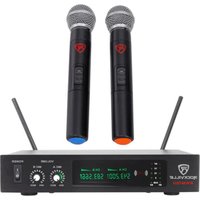
RWM70U - Microphone Rockville - Notice d'utilisation et mode d'emploi gratuit
Retrouvez gratuitement la notice de l'appareil RWM70U Rockville au format PDF.


| Type de produit | Microphone sans fil UHF |
| Marque | Rockville |
| Modèle | RWM70U |
| Gamme de fréquences | UHF 500-900 MHz (selon région) |
| Portée maximale | 100 mètres (ligne de vue) |
| Réponse en fréquence | 80 Hz - 15 kHz |
| Rapport signal/bruit | > 100 dB |
| Distorsion harmonique totale | < 0.5% |
| Type de capsule | Dynamique |
| Directivité | Cardioïde |
| Alimentation de l'émetteur | 2 piles AA (non fournies) |
| Autonomie des piles | Environ 10 heures |
| Alimentation du récepteur | Adaptateur secteur (inclus) ou USB |
| Dimensions de l'émetteur (L x Ø) | 255 x 50 mm |
| Poids de l'émetteur (sans piles) | 300 g |
| Dimensions du récepteur (L x l x h) | 200 x 150 x 45 mm |
| Poids du récepteur | 600 g |
| Matériau | Corps métallique (émetteur) |
| Connecteurs | Sortie XLR et Jack 6,35 mm |
| Fonctions principales | Mise en sourdine, sélection de canal, indicateur LED |
| Accessoires inclus | Récepteur, adaptateur secteur, câble audio, support de table |
| Entretien et nettoyage | Nettoyer avec un chiffon sec et doux. Éviter l'humidité. |
| Sécurité | Ne pas exposer à des températures extrêmes. Éteindre après usage. |
| Pièces détachées et réparabilité | Contacter le service après-vente Rockville. |
| Informations générales | Utilisation professionnelle pour chant, conférences. |
FOIRE AUX QUESTIONS - RWM70U Rockville
Questions des utilisateurs sur RWM70U Rockville
0 question sur cet appareil. Repondez a celles que vous connaissez ou posez la votre.
Poser une nouvelle question sur cet appareil
Téléchargez la notice de votre Microphone au format PDF gratuitement ! Retrouvez votre notice RWM70U - Rockville et reprennez votre appareil électronique en main. Sur cette page sont publiés tous les documents nécessaires à l'utilisation de votre appareil RWM70U de la marque Rockville.
MODE D'EMPLOI RWM70U Rockville
ROCKVILLE

RWM70U
OWNER'S MANUAL
RWM50U/RWM60U/RWM70/RWM81U
HIGH PREFERENCE WIRELESS MICROPHONE SYSTEMS
Who reads manuals?
Instead, go to vimeo.com/496095639
or scan the QR code and watch a
short video, which shows you how to
set this item up and how to use it.

ROCKVILLE
Thank you for purchasing this Rockville Wireless Microphone System. Please read this owner's manual carefully for proper use of your Wireless Microphone System. Should you need assistance, please call our technical help line at 1-646-758-0144, Monday through Thursday, 9am to 10pm EST., and Fridays, 9am to 3pm EST.
Table of Contents
Specs....1
RWM50U/60U Receiver (Front) 2
RWM50U/60U Receiver (Back) 2
RWM70U/81U Receiver (Front) 3
RWM70U/81U Receiver (Back) 3
Microphone 4
Headset 5
Setup and Operation 6
Troubleshooting 7
FCC Statement. 8
FEATURES
• High performance wireless microphone system
- Includes transmitter with: 1 wireless UHF handheld cardioid microphone (RWM50U)
1 wireless UHF headset cardiod microphone (RWM60U)
2 wireless UHF handheld cardiod microphones (RWM70U)
2 wireless UHF headset cardiod microphones (RWM81U)
• High sensitivity, unidirectional, wireless cardioid microphones
- Featuring a dual filter design to limit feedback and interference
- Ultra signal stability eliminates unwanted distortion
• Professional receiver with a multifunction display shows frequency, signal synch, and audio input
• Transmitter automatically links to receiver for ease of use
- Use any two mics (handheld or headset) at once (RWM70U/RWM81U ONLY)
- Individual microphone volume controls
• Durable composite mic construction with our signature comfortable rubbery coating
• Comfortable ergonomic composite microphone construction
- Low power consumption for longer battery life
SPECIFICATIONS
Operating Range: 300' - 400' (indoor), 250' - 350' (outdoor)
Channels: RWM50U/RWM60U: 1 channel; RWM70U/RWM81U: 2 channel
Frequency Range: 500MHz - 590MHz
Frequency Response: 50Hz - 15KHz (±3dB)
Frequency Stability: ±0.005%
Dynamic Range: 105dB
Signal-to-Noise Ratio: 100dB
T.H.D.: <0.5% (1KHz)
RF Output Power: 10mW
Output Level: 0 - 300mV
Modulation Mode: UHF
Oscillation Mode: Quartz crystal
Audio Outputs: Two XLR balanced & one 1/4" mixed
Mic Battery Operating Time: Up to 10 hours
Operating Temperature: 3°F – 130°F
Power Voltage: AC 110/220V - 50/60Hz
*Operating range is subject to environmental conditions. Results may vary.
Receiver RWM50U/60U (front)
a. Antenna
b. AF signal LED indicator
c. RF signal LED indicators
d. LCD Display: shows frequency and signal strength.
e. Volume adjustment knob
f. Power switch

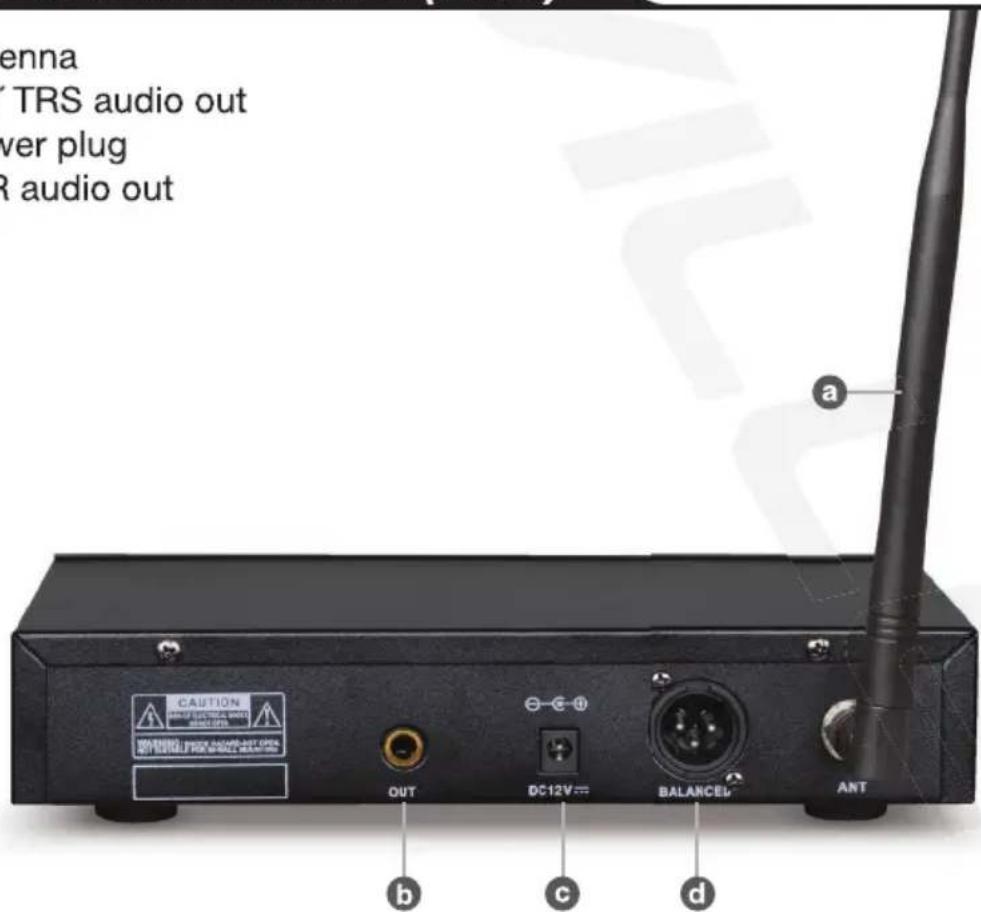
Receiver RWM50U/60U (back)
a. Antenna
b. 1/4" TRS audio out
c. Power plug
d. XLR audio out
Receiver RWM70U/81U (front)
a. Antenna A
b. Antenna B
c. Ch A/Ch B AF signal LED indicators
d. Ch A/Ch B RF signal LED indicators
e. LCD Display: shows frequency and signal strength.
f. MIC A volume adjustment knob
g. MIC B volume adjustment knob
h. Power switch

Receiver RWM70U/81U (back)
a. Antenna B
b. Antenna A
c. MIC B XLR out
d. 1/4" TRS Mix out
e. Power plug
f. MIC A XLR out

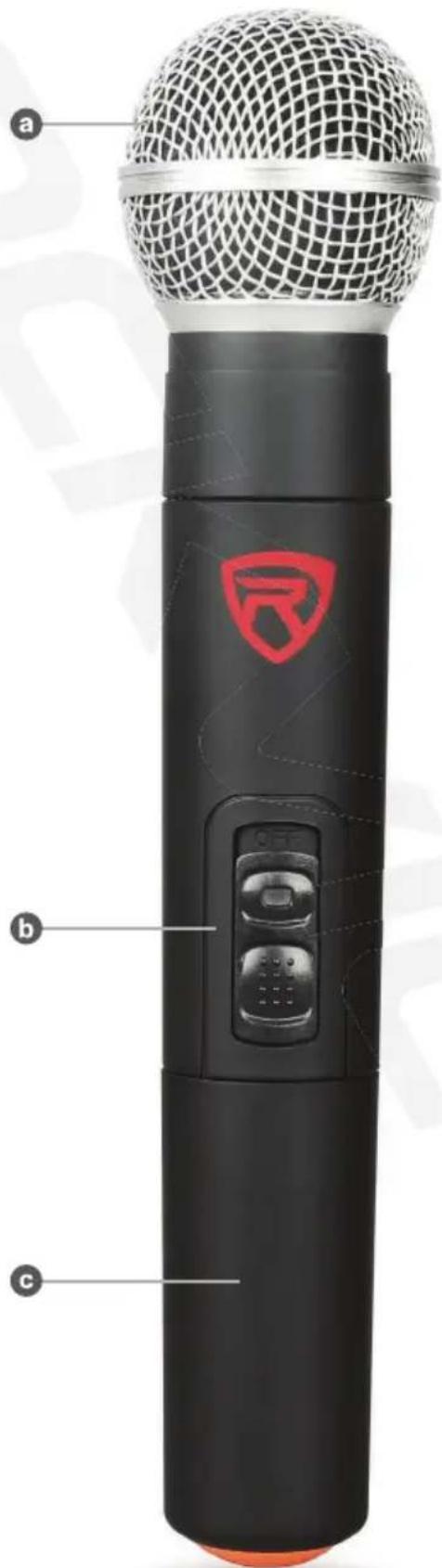
a. Microphone windscreen
b. Power on/off switch
c. Battery compartment
a. Microphone windscreen
b. 3.5mm input
c. 3.5mm connector
d. Antenna
e. Power on/off switch
f. LCD screen

Setup and Operation
For best performance of the wireless microphone system you should make sure that you run the cable from the receiver output (XLR or 1/4 " output) into a microphone input on a powered speaker or mixing board. If you run it right into a line level input then the audio volume level output of the microphone(s) will drop significantly. Most mixers and powered speakers have both a Microphone input and a line level input.
- The reciever should be placed in an area that is stable and least likely to shake the unit.
- The receiver should be at least 3 ft off the ground for optimal transmission.
- Connect the antenna, balanced cable AF line, and power supply provided.
• The antenna should extend vertically. - Switch on the receiver.
- While the receiver is in stand-by, switch on the microphones.
- Adjust volume as necessary.
Tip:
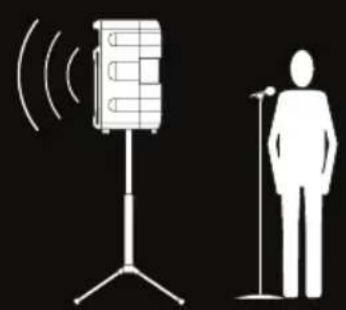
To minimize feedback avoid operating the microphones in close proximity of or in front of speakers.

| Problem | Soluton |
| No sound or faint sound | Verify all sound system connections or adjust channel volume as needed.Verify that the receiver is connected to the mixer/amplifier. |
| Turn on transmitter.Make sure the batteries are installed correctly.Charge or change battery. | |
| Make sure AC adapter is securely plugged into electrical outlet.Make sure reciever is powered on. | |
| Audio artifacts or dropouts | Change receiver and transmitter to a different group and/or channel.Identify nearby sources of interference (cell phones, Wi-Fi access points, signal processor, etc...) and shutdown or remove source.Charge or change transmitter battery.System must be set up within recommended range and receiver kept away from metallic surfaces.Transmitter must be used in line of sight from receiver for optimal sound. |
| Distortion | Reduce transmitter channel volume. |
| Sound level variations when switching to different sources | Adjust transmitter volume as necessary. |
| Transmitter information does not appear on the Receiver LCD | Transmitter is off. |
FEDERAL COMMUNICATIONS COMMISSION COMPLIANCE INFORMATION
Responsible party name: Rockville
Address: 600 Bayview Ave, Entrance A, Inwood, NY 11096
Hereby declares that the product Rockville RWM series UHF microphone kit complies with FCC rules as mentioned in the following paragraph:
This device complies with Part 15 of the FCC rules. Operation is subject to the following two conditions: (1) this device may not cause harmful interference, and (2) this device must accept any interference received, including interference that may cause undesired operation.
Note: This equipment has been tested and found to comply with the limits for a Class B digital device, pursuant to Part 15 of the FCC rules. These limits are designed to provide reasonable protection against harmful interference in a residential installation. This equipment generates, uses and can radiate radio frequency energy and, if not installed and used in accordance with the instructions, may cause harmful interference to radio communications. However, there is no guarantee that interference will not occur in a particular installation. If this equipment does cause harmful interference to radio or television reception, which can be determined by turning the equipment off and on, the user is encouraged to try to correct the interference by one or more of the following measures:
- Reorient or relocate the receiving antenna.
- Increase the separation between the equipment and receiver.
- Connect the equipment to an outlet on a circuit different from that to which the receiver is connected.
- Consult the dealer or an experienced radio/TV technician for help.
POCKVILLE
ROCKVILLE

Marque : Rockville
Modèle : RWM70U
Catégorie : Microphone