Combifire 1A - Poêle à bois JOTUL - Notice d'utilisation et mode d'emploi gratuit
Retrouvez gratuitement la notice de l'appareil Combifire 1A JOTUL au format PDF.


| Type de produit | Appareil de chauffage au bois (poêle à bois) |
| Marque | Jøtul |
| Modèle | Combifire 1A |
| Dimensions (L x P x H) | Environ 50 x 40 x 40 cm |
| Poids | Environ 80 kg |
| Alimentation | Bûches de bois (longueur recommandée : 25 cm) |
| Puissance nominale | 8 kW |
| Rendement énergétique | Jusqu'à 80 % |
| Fonctions principales | Chauffage d'appoint, conception robuste en fonte |
| Matériau | Fonte, acier |
| Vitre | Vitre céramique résistante à la chaleur |
| Porte | Porte étanche avec joint d'étanchéité |
| Raccordement fumée | Diamètre 150 mm, sortie arrière ou supérieure |
| Combustible | Bois sec (humidité < 20 %) |
| Entretien et nettoyage | Nettoyer régulièrement le foyer, le vitrage et le conduit de fumée. Vérifier les joints. |
| Sécurité | Poignée isolée, système de verrouillage de porte, conforme aux normes CE |
| Pièces détachées et réparabilité | Disponibles auprès du service après-vente Jøtul (grilles, vitres, joints) |
| Informations générales | Appareil non catégorisé, fabriqué en Norvège |
FOIRE AUX QUESTIONS - Combifire 1A JOTUL
Questions des utilisateurs sur Combifire 1A JOTUL
0 question sur cet appareil. Repondez a celles que vous connaissez ou posez la votre.
Poser une nouvelle question sur cet appareil
Téléchargez la notice de votre Poêle à bois au format PDF gratuitement ! Retrouvez votre notice Combifire 1A - JOTUL et reprennez votre appareil électronique en main. Sur cette page sont publiés tous les documents nécessaires à l'utilisation de votre appareil Combifire 1A de la marque JOTUL.
MODE D'EMPLOI Combifire 1A JOTUL
INSTALLATION AND OPERATING INSTRUCTION FOR JOTUL COMBIFIRE NO. 14 This installation and operating instruction is divided in 5 parts:
-
GENERAL INFORMATION
-
HAZARDS CONNECTED TO THE USE OF THE COMSIFIRE
-
INSTALLATION
-
OPERATION OF THE COMBIFI RE
-
SWEEPING AND MAINTENANCE.
-
GENERAL INFORMATION
1.1 J∅TUL COMBIFIRE NO. 1A is made of cast iron, designed for use of wood as fuel. Logs up to a length of appr. 50 cm. (20") can be utilized, and it can be filled with appr. 7.5 kgs. (18 lb) of wood. The combifire can be used with both open and closed door. When closed, the heating rate of the unit is manually controlled by a draft regulator
1.2 When installing, operating and maintaining this combifire please follow the guide-lines given in these instructions. Save these instructions and keep them som that they are always available for everybody using the combifire.
- HAZARDS CONNECTED TO THE USE OF THE COMBIFI RE
2.1 Any use of fire, even with the door of the combifire closed, represent a certain danger.
2.2 With intense firing, the temperature of the cast iron can exceed 500^ C ( 900^ F). The following factors must always be considered.
a. The combifire should not be mounted in parts of the room where there is a lot of traffic.
b. Loose inflammable material must be kept in a safe distance from the combifire, i.e. minimum 90 cm (36").
c. Children must be taught that the combifire is hot and must not be touched.
d. Clothes must not be dried over the combifire. They can fall down and be ignited.
e. The combifire must be mounted in accordance with the local regulations, and according to the instructions given by Jotul Inc.
f. The combifire must be used and maintained in accordance with these instructions.
2.3 Never use the combifire if there are combustible cases in the room.
2.4 Poisonous gases can come out into the room if for example the ventilation system creates a low pressure in the room where the combifire is places.
2.5 Make sure that sparks and embers don't get out of the combifire when the door is opened. Always use the spari arrester when the combifire is used with an open door.
2.6 Be aware that even if the ashes look cold, there might still be some burning embers left. Avoid placing the ashes close to combustible materials before you are positive that all burning embers are out.
2.7 The combifire, chimney connector and chimney must be inspected and cleaned frequently, i.e. at least once a year.
2.8 Creosote - formation and need for removal.
When wood is burned slowly, it produces acetic and pyroligneous acids, which combine with expelled moisture to form creosote. The creosote vapors condense in the relatively cool chimney flue of a slow-burning fire. As a result, creosote residue accumulates on the flue lining. When ignited this creosote makes an extremely hot fire.
The chimney connector and chimney should be inspected frequently during the heating season to determine if a creosote buildup has occurred.
If creosote has accumulated it should be removed to reduce the risk of a chimney fire. Experienced chimney servicing personnel should be consulted.
2.9 Utilize wood as only fuel, and never liquid fuels. Liquid fuel utilized in a combifire for solid fuel can result in an explosion and fire.
Never use gasoline, gasoline-type lantern fuel, kerosene, charcoal lighter fluid, or similar liquids to start or "freshen up" a fire in this heater. Keep all such liquids well away from the heater while it is in use.
Never use or store flammable liquids, especially gasoline, in the vicinity of the combifire.
2.10 Andirons may be used with this unit to support the logs when building a fire. If charcoal is burned, a basket grate may be placed on the hearth to hold it.
3. INSTALLATION
Please follow these installation instructions carefully. Check and execute each step before you proceed.
3.1 Check the local rules
All installation of JCTUL COMBIFI RE NO. 1A must be according to the local regulations. If nothing else is stated, the combifire should be installed according to the guide-lires given by the National Fire Protection Association in HFI No. 89M. Heat producing appliance clearances 1976, and NFPA No. 211 Chimneys, Fireplaces and Vents 1972.
For further information on using your heater safely, obtain a copy of the National Fire Protection Association publication "USING COAL AND WOOD STOVES SAFELY", NFPA No. HS-8-1974.
The address of the NFPA is 470 Atlantic Avenue, Boston, MA 02210.
3.2 Inspect your chimney
The combifire can be connected to masonry chimneys for residential type appliances, or an approved metal chimney for residential type appliances. Single wall metal chimneys shall not be used inside 1- and 2-family dwellings.
The inside dimension of a square masonry chimney should be minimum 6 by 6 inch. For a circular approved insulated chimney a diameter of 7 inch. is recommended. The minimum height of the chimney should be 10 feet.
3.3 Determine where you want to install the combifire.
The combifire can be installed in different ways, but the installation must be in accordance with the UL-listing.
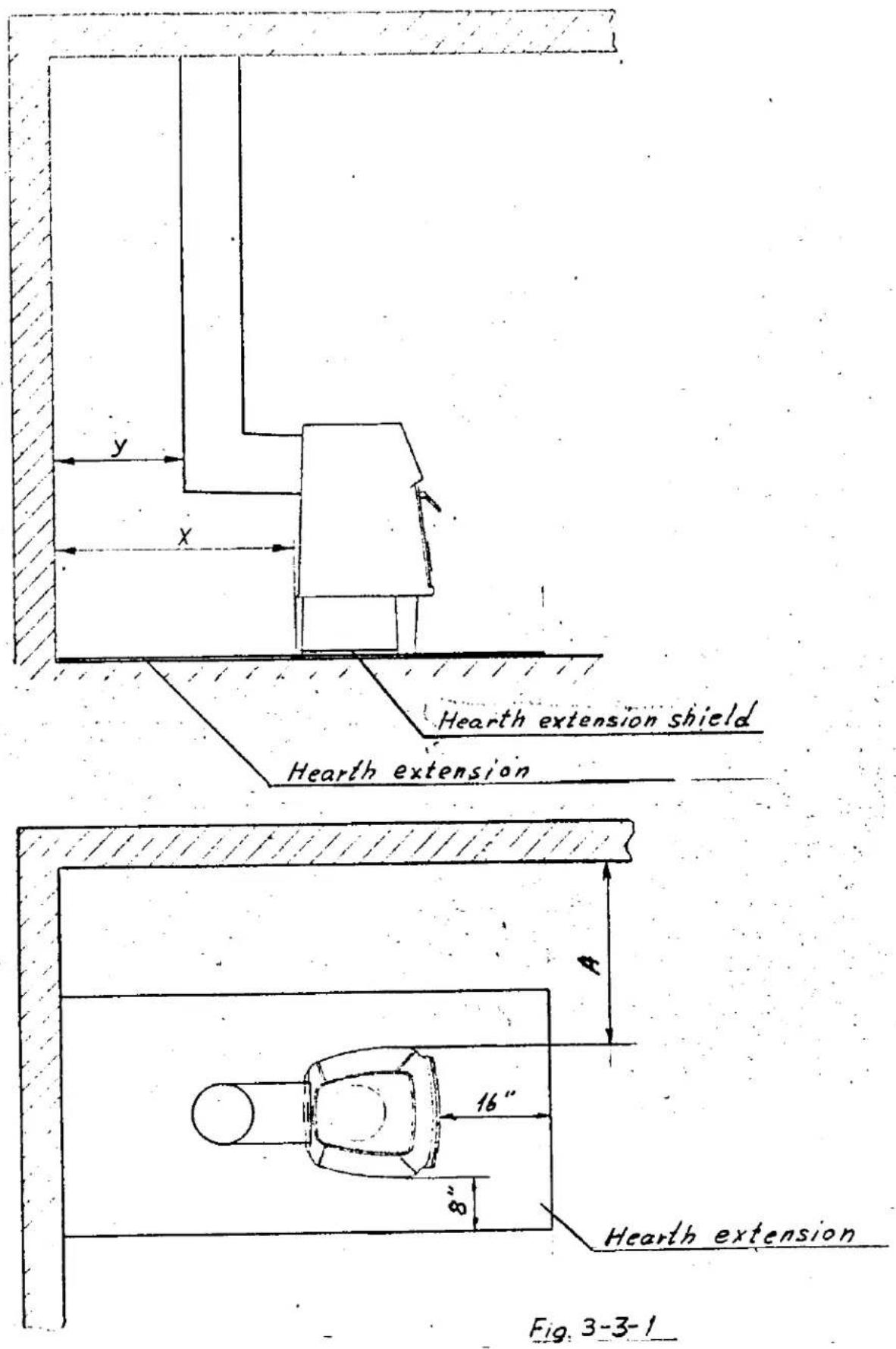
3.3.1 Installation with the smoke outlet at the back.
If the installation is made as in figure 3.3.1, the distance from the stove and the chimney connection to combustible materials must be:
$$ \begin{array}{l} x = \text { minimum } \dots 8 6 5 \dots \text { mm } (3 4 \text { in. }) \ y = \text { minimum } \dots 5 7 5 \dots \text { mm } (2 2. 5 \text { in. }) \ A = \text { minimum } \dots 9 1 5 \dots \text { mm } (3 6 \text { in. }) \end{array} $$
If the installation is made as in figure 3.3.2, the distance from the stove and the chimney connection to combustible materials must be:
$$ \begin{array}{l l l l l} x & = \text { minimum } & \dots 1 0 2 0 \dots & \text { mm } (4 0 \text { in. }) \ y & = \text { minimum } & \dots 5 7 5 \dots & \text { mm } (2 2. 5 \text { in. }) \ z & = \text { minimum } & \dots 4 6 0 \dots & \text { mm } (1 8 \text { in. }) \ A & = \text { minimum } & \dots 9 1 5 \dots & \text { mm } (3 6 \text { in. }) \end{array} $$
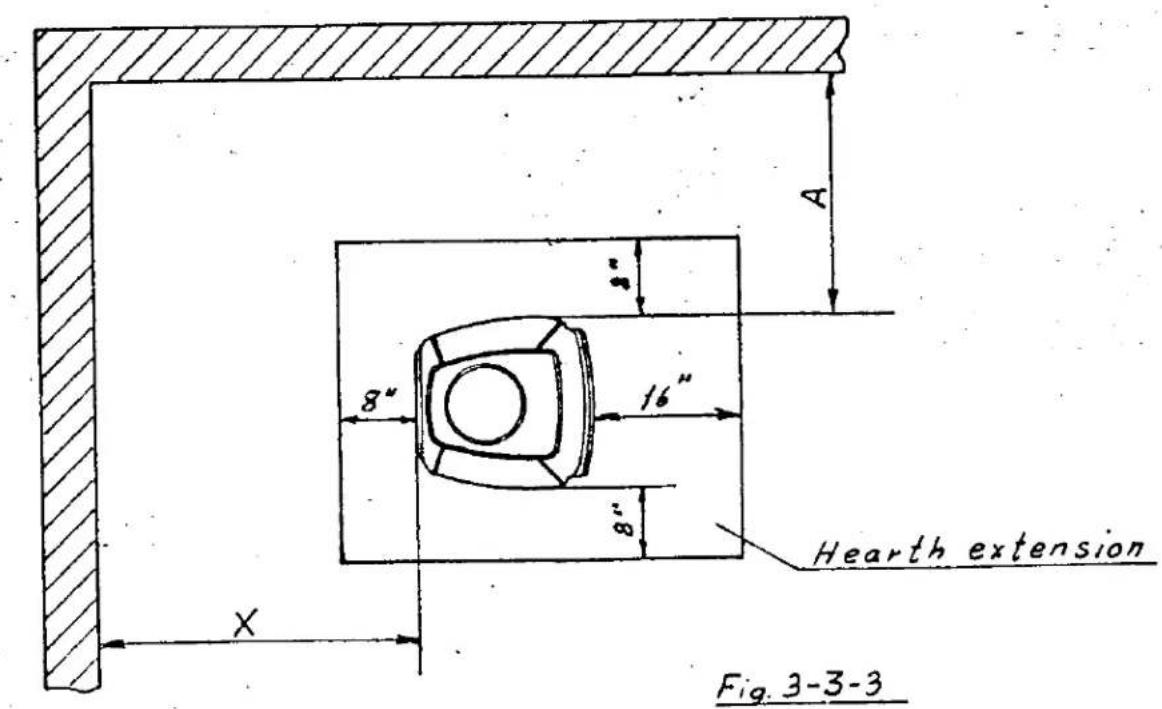
3.3.2 Installation with the smoke outlet at the top.
If the installation is made as in figure 3.3.3, the distance from the stove and the chimney connection to combustible materials must be:
- 4 -
$$ \begin{array}{r l} {x} & {= \text { minimum } \dots \dots . 7 6 5. \mathrm{mm(30in.)}} \ {A} & {= \text { minimum } \dots \dots . 9 1 5. \mathrm{mm(36in.)}} \end{array} $$
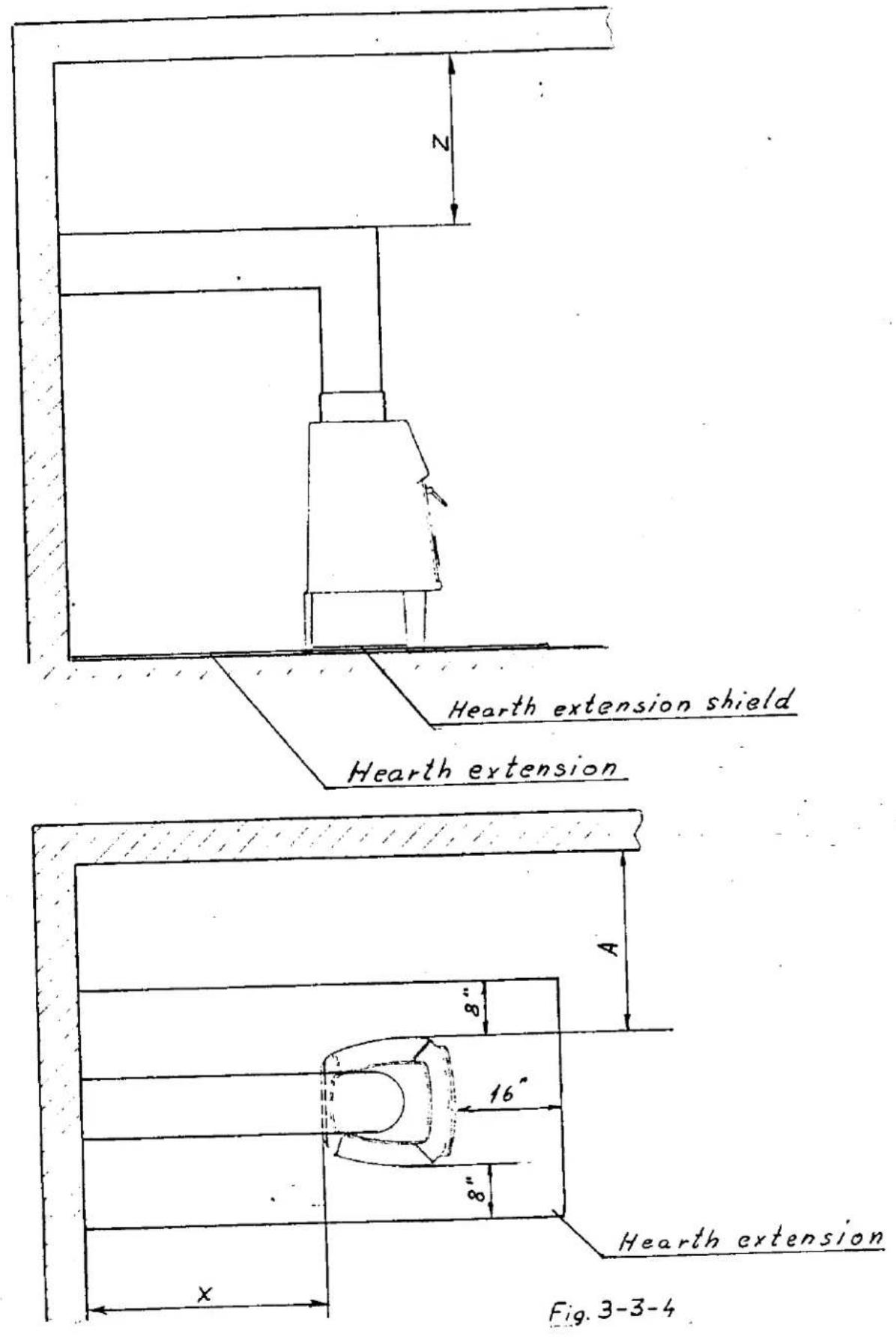
If the installation is made as in figure 3.3.3, the distance from the stove and the chimney connection to combustible materials must be:
$$ \begin{array}{r l} {x} & {= \text { minimum } \dots \dots . 7 6 5. \text { mm (30 in.) }} \ {z} & {= \text { minimum } \dots \dots . 4 6 0. \text { mm (18 in.) }} \ {A} & {= \text { minimum } \dots \dots . 9 1 5. \text { mm (36 in.) }} \end{array} $$
3.4 Make a hearth extension
The combifire shall be placed on a hearth extension not less than 3/8 inches thick of asbestos millboard of equivalent.
The hearth extension shall extend a least 16 inches in front, and at least 8 inches to each side of, and beyond the back of the combifire.
If the floor projection of the chimney connector is extending beyond the sides of the combifire, the hearth extension should be expanded in that direction in its full width to cover the floor at least 2 in. beyond the projected area.
If possible, the hearth extension should cover the floor in this direction just up to the wall.
The hearth extension may be placed on the sub or finish flooring, whether the flooring is combustible or not.
The hearth extension shall be readily distinguishable from the surrounding floor.
3.5 Assemble the combifire
Put the three legs on with screws and washers which are delivered with the combifire. There is one leg in each front corner, and one in the middle at the rear of the bottom-plate.
Place your combifire on the hearth extension according to the distances given in the previous sections.
Place the hearth extension shield between the legs of the combifire with the painted side visible.
3.6 Install the chimney connector
With the combifire in place you can now determine the path of the chimney connector. The connector shall be used to connect the combifire to the chimney. The connector shall be made of noncombustible corrosion resistant material such as steel or refractory masonry. If a steel connector is to be used, it should be 24 gauge or thicker. A connector shall be as short and straight as possible.
The connector, for it's entire length, shall have the same size as the smoke outlet of the combifire (7"
The chimney connector is secured to the smoke outlet by a 6 mm screw which is delivered with the combifire.
A connector to a masonry chimney shall extend through the wall to the inner face or liner, but no beyond, and shall be firmly cemented to masonry. A thimble may be used to facilitate removal of the chimney connector for cleaning, in which case the thimble shall be permanently cemented in place with high-temperature cement.
A chimney connector shall not pass through any floor or ceiling, nor through a fire wall or fire partition.
3.7 Before building a fire.
With the chimney connector properly secured to the smoke outlet, your JOTUL COMBIFI RE NO. 1A is ready for use. Please read the following section carefully upon using the combifire.
OPERATION OF THE COMBIFI RE
4.1 Use always wood as fuel. The wood should be air dried for at least 4 - 6 months.
4.2 Fire with closed door.
Open the damper at the smoke outlet. When the door is closed, the combifire works as a radiant room heater.
Fully open the door by pushing it underneath the bottom-plate. Kindle some sticks of dry wood, eventually use some paper. Then put in some full-length logs. Close the door by swinging it up and push the door-lock down.
The wood will now burn from air coming through the air-regulator in the door. When the combifire is loaded, have the regulator fully open for some minutes. Then close the regulator down to the desired combustion level.
In place of constant rekindling, the combifire should be kept continuously burning day and night on even rough logs. When the wood has burnt almost completely and only the necessary glows remain for continued burning, open the door and refill the combifire. The draught is increased for some minutes, and then regulated down to the desired combustion level.
4.3 Fire with open door.
When the door is open, the combifire works as a fireplace. Fully open the damper at the smoke outlet. Kindly some sticks of dry wood, eventually use some paper. At the beginning, the draught in the chimney may be poor. To prevent smoke to be released to the room, close the door to some extent. When the chimney gets warm, and the draught

being better, the door can be fully opened. When the sticks have been burning some minutes, put on greater logs.
To prevent sparks from coming out into the room when the door is open, always use the spark arrester which is delivered with the combifire.
4.4 Enamelled room heaters must not be fired to the extent that they assume a red glow. The enamel may then be damaged.
4.5 During the first few times you use a new combifire, the combifire may become somewhat damp. In order to prevent this condensate from running down the face of the combifire, open the door slightly during the first firing. As soon as the combifire is warm, this condensate will evaporate and the door may be closed.
On enamelled room heaters this condensate should be wiped off IMMEDIATELY as it may permanently stain or pit the surface.
5. SWEEPING AND MAINTENANCE
5.1 When wood burns, soot and creosote may develop and could, together with other incombustible particles settle in the chimney and the chimney connectors. If this deposit increases, it will be necessary to have it removed. This ought to be done by sweeping the chimney and chimney connector regularly. How often depends on the use of the combifire. As a rule, the chimney and the chimney connector should be swept at least once a year.
If the chimney and the chimney connector is not swept regularly, a chimney fire may develop. A chimney which is built according to the regulations, or one which has prior approval will withstand a chimney fire. However, if a fire should erupt, the chimney should be inspected by professionals before it is taken into use again.
5.2 The combifire may burn "continuously" (day and night), even on small loads. Should pitch develop during such continuous burning, the combifire should be fired intensely with regular intervals.
This repeated a few days in succession will burn away possible pitch.
5.3 To give the maximum amount the heat, the combifire and the chimney connector should be swept regularly.
When sweeping the chimney connector it may be convenient to disconnect the combifire. The chimney connector must be cleaned in its full length to assure a safe removal of all creosote which have condensed on the inner surfaces.
A bottle of black Senotherm is enclosed for unenamelled room heaters. It may be used for patching up possible scratches in the varnish.
Be sure to install the chimney connector properly after sweeping and secure it with the screw.
5.4 Disposal of ashes
Ashes should be placed in a metal container with a tight fitting lid. The closed container of ashes should be placed on a noncombustible floor or on the ground, well away from all combustible materials, pending final disposal. If the ashes are disposed of by burial in soil or otherwise locally dispersed, they should be retained in the closed container until all cinders have thoroughly cooled.
5.5 Maintenance
We recommend that you inspect your heater whenever sweeping is performed. Check all visible surfaces for cracks. Inspect the joints for visible leaks and check the gasket in the door and on the top lid. Loose gaskets may be fixed by applying some water glass in the slot.
If a mechanical failure is disclosed, please contact your local dealer.
A/S J∅TUL, OSLO, NORWAY
Imported by
KRISTIA ASSOCIATES
343 FOREST AVE.
P.O. BOX 1118
PORTLAND MAINE
CAT. NO. 12 48 14


- INSTALLATION
- Check the local rules
- Inspect your chimney
- Determine where you want to install the combifire.
- Installation with the smoke outlet at the back.
- Installation with the smoke outlet at the top.
- Make a hearth extension
- Assemble the combifire
- Install the chimney connector
- OPERATION OF THE COMBIFI RE
- SWEEPING AND MAINTENANCE
- Disposal of ashes
- Maintenance
Marque : JOTUL
Modèle : Combifire 1A
Catégorie : Poêle à bois