
PSS6 - Extension audio/video Pyle - Notice d'utilisation et mode d'emploi gratuit
Retrouvez gratuitement la notice de l'appareil PSS6 Pyle au format PDF.


| Marque | Pyle |
| Modèle | PSS6 |
| Type de produit | Extension audio/video |
| Dimensions (L x l x H) | 12 cm x 6 cm x 3 cm |
| Poids | 0.15 kg |
| Alimentation | Passive (aucune alimentation externe requise) |
| Connecteurs d'entrée | 1 x prise RCA femelle (rouge/blanc) |
| Connecteurs de sortie | 1 x prise RCA mâle (rouge/blanc) |
| Matériau | Plastique ABS et métal |
| Fonctions principales | Prolonge la portée des câbles audio/vidéo, compatible avec signaux composites et stéréo |
| Entretien et nettoyage | Essuyer avec un chiffon sec, éviter les liquides |
| Sécurité | Ne pas exposer à l'humidité, débrancher avant nettoyage |
| Pièces détachées et réparabilité | Non réparable par l'utilisateur, remplacer si défectueux |
| Informations générales | Conçu pour transmission audio/vidéo sans perte, utilisation intérieure |
FOIRE AUX QUESTIONS - PSS6 Pyle
Questions des utilisateurs sur PSS6 Pyle
0 question sur cet appareil. Repondez a celles que vous connaissez ou posez la votre.
Poser une nouvelle question sur cet appareil
Téléchargez la notice de votre Extension audio/video au format PDF gratuitement ! Retrouvez votre notice PSS6 - Pyle et reprennez votre appareil électronique en main. Sur cette page sont publiés tous les documents nécessaires à l'utilisation de votre appareil PSS6 de la marque Pyle.
MODE D'EMPLOI PSS6 Pyle

HIGH POWER STEREO SPEAKER SELECTOR
MODEL : PSS4 / PSS6

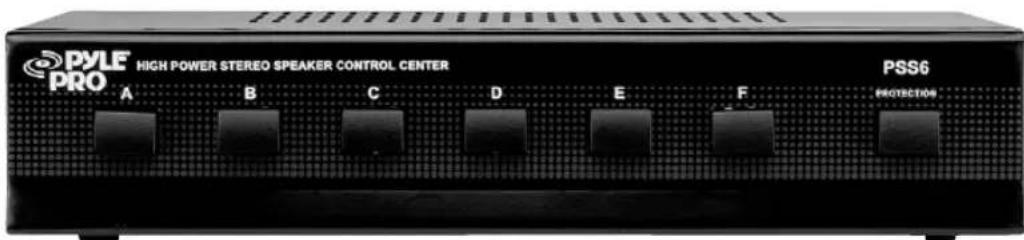
Thank you for purchasing PYLE PRO Multi-Speaker Selectors. It lets you connect up to four (PSS4) or six (PSS6) separate pairs of speakers to your stereo receiver/amplifier. The control center is especially convenient if you have speaker sets in different rooms and want to turn them on and off independently. You can enjoy the convenience and flexibility of listening to multiple speaker pairs simultaneously.


flowchart
graph TD
    A["High Power Stereo Speaker Control Center"] --> B["A"]
    A --> C["B"]
    A --> D["C"]
    A --> E["D"]
    A --> F["E"]
    A --> G["F"]
    H["PSS6 PROTECTION"] --> I["Protection Buttons"]
    J["Terminal Buttons"] --> K["Protection Buttons"]
    style A fill:#f9f,stroke:#333
    style H fill:#ccf,stroke:#333
The control center lets you use one to four (PSS4) or six (PSS6) sets of speakers at a time, and is designed to operate with a stereo receiver/amplifier that has a maximum of 100 watts per channel, and with speaker systems that have a minimum impedance of 8 ohms (see “Impedance Chart” on page 5)
PREPARATIONS
- Use the PYLE PRO Speaker Selectors only with amplifiers rated at 100 watts per channel or less.
- Your PYLE PRO Speaker Selector is designed to accept any size cable up to 14 gauge non-terminated speaker wire. If you're using non-terminated speaker wire, do not use any speaker wire that is larger than 14 gauge. The lower the gauge number, the larger the cable (e.g., 12 gauge is larger in actual physical size than 14 gauge).
- Do not hook the outputs of one selector into the inputs of another speaker selector together.
MAKING THE CONNECTIONS
The control center divides the power from your receiver/amplifier differently to its speaker terminals. (This is especially noticeable when you connect only one pair of speakers. If you connect more than one pair of speakers, see “Impedance Chart” on page 5 to selector the best terminals to connect.) For the best performance, make the connections based on how frequently you use each set of speakers.
Cautions: To avoid damaging your speakers or receiver/amplifier:
- Be sure your receiver/amplifier's power is turned off before you make the connections.
- Never let the speaker wire's bare ends touch each other or the adjacent terminals on the control center.
- Do not connect more than one pair of sepakers to each set of terminals.
Press open the desired SPK terminals on the control center. Insert the speakers' positive (+) wires in the positive (red) terminals, and negative (−) wires into the negative (black) terminals, according to the respective L (left) and R (right) terminals. Then press the tabs to close them.

Press open the AMP terminals on the control center, then insert your receiver/amplifier's positive (+) wires into the positive (red) terminals, and negative (−) wires in the negative terminals. Then press the tabs to close them.
Notes:
- If your receiver/amplifier has more than one set of speaker terminal (A and B), connect only one or the other to the control center.
- For the best results, we recommend 14-gauge, two conductor speaker wire (not supplied) for most connections. If you plan to located the speakers further than 80 feet from the control center, use a heavier gauge of wire.
OPERATION
Caution: To avoid damaging your receiver/amplifier, set its volume to the lowest setting before changing the control center's settings.
To turn on a pair of speakers connected to the control center, simply press in the desired button. For example, to turn on the set of speakers connected to SPK A, press A.
To turn off a pair of speakers, press the button again so it is in the "out" position.
Note: if no speakers are connected to a set of terminals, do not press in the corresponding control button.
IMPEDANCE CHART
Impedance is a measurement of the load placed on your receiver/amplifier by the speakers. The load placed on your receiver/amplifier from the control center will vary depending on how many pairs of speakers you turn on at one time, and on which speakers you turn on. The chart below shows the impedance for all possible combinations of 8-ohm speakers.
PSS4
| Speaker Sets On Impedance (Ω) | |
| A, B, C or D 8 | |
| A+B, A+C, A+DB+C, B+D, C+D | 4 |
| A+B+C, A+B+DA+C+D, B+C+D | 3.1 |
| A+B+C+D 2.4 | |
PSS6
| Speaker Sets On Impedance (Ω) | |
| A, B, C, D, E or F 8 | |
| A+B, A+C, A+DA+E, A+F, B+CB+D, B+E, B+FC+D, C+E, C+F, E+F | 4 |
| A+B+C, A+B+D, A+B+EA+B+F, A+C+D, A+C+EA+C+F, A+D+E, A+D+FA+E+F, B+C+D, B+C+EB+C+F, B+D+E, B+D+FC+D+E, C+D+F, D+E+F | 3.1 |
| A+B+C+D, A+B+C+EA+B+C+F, A+C+D+EA+C+D+F, A+D+E+FB+C+D+E, B+C+D+FC+D+E+F | 2.4 |
| A+B+C+D+E+F 1.7 | |
SPECIFICATIONS
Audio Power Handling 50W (R.M.S.)/ch,
1
Frequency Response 20 Hz to 20KHz
Channel Separation 80 dB
Crosstalk between channels 50 dB
Speaker terminal wire size requirements 14-22 awg
Dimensions (WxHxD) 190x50x120 mm (PSS4)
250x50x150 mm (PSS6)
Weight 0.81kgs (1.79lbs) (PSS4)
1.15kgs (2.54lbs) (PSS6)
00W (N
Marque : Pyle
Modèle : PSS6
Catégorie : Extension audio/video