
SEA BATTLE - Jeu de société SAITEK - Notice d'utilisation et mode d'emploi gratuit
Retrouvez gratuitement la notice de l'appareil SEA BATTLE SAITEK au format PDF.


| Type de produit | Jeu de société électronique |
| Marque | SAITEK |
| Modèle | SEA BATTLE |
| Dimensions (L x l x h) | 460 x 220 x 62 mm |
| Poids (sans piles) | 1,3 kg |
| Alimentation | 4 piles AA (1,5 V) de type alcalin recommandé |
| Autonomie des piles | Environ 15 heures avec piles alcalines |
| Tension de fonctionnement | 4,5 - 6,5 V |
| Consommation électrique | 1,0 W max |
| Fréquence d'horloge | 3,6 MHz ± 10% |
| Nombre de joueurs | 1 ou 2 joueurs |
| Modes de jeu | Traditionnel, Avancé, Salve, Action en direct (7 variantes) |
| Caractéristiques principales | Écran d'affichage, sonar, effets sonores, mémoire des navires, compteur de score |
| Entretien et nettoyage | Nettoyer avec un chiffon doux et sec. Ne pas exposer à l'humidité ou à des températures extrêmes. Retirer les piles en cas de non-utilisation prolongée. |
| Sécurité | Utiliser uniquement des piles recommandées. Ne pas exposer au soleil. Tenir hors de portée des jeunes enfants. |
FOIRE AUX QUESTIONS - SEA BATTLE SAITEK
Questions des utilisateurs sur SEA BATTLE SAITEK
0 question sur cet appareil. Repondez a celles que vous connaissez ou posez la votre.
Poser une nouvelle question sur cet appareil
Téléchargez la notice de votre Jeu de société au format PDF gratuitement ! Retrouvez votre notice SEA BATTLE - SAITEK et reprennez votre appareil électronique en main. Sur cette page sont publiés tous les documents nécessaires à l'utilisation de votre appareil SEA BATTLE de la marque SAITEK.
MODE D'EMPLOI SEA BATTLE SAITEK
SciSys
SEA BATTLE
ADVANCED ELECTRONIC BATTLESHIPS GAME
1. Introduction
The Advanced Electronic Sea Battle Computer is the modern electronic successor to the well-known Sea Battle game. Two people can play against each other or one person can play against the Computer. It plays exciting new variations as well as the traditional game.
2. Rules of the Game
Each player has a fleet of ships and takes turns to try and sink the other side's ships by firing missiles at them. The player that successfully sinks an entire fleet wins the game.
The main rules:
a. The game ends when all ships are sunk on one side, OR, all 102 missiles have been used up.
b. There are normally 5 ships in a fleet. A ship is sunk if all the ship's squares are hit.
c. Ships must lie across or down (Fig. 1). They may not be placed diagonally, nor overlap the edge of the ocean, nor may they be stacked. Ships may touch each other.
3. Starting Up
Fit 4 penlite (AA/AM3 size) batteries in the battery compartment in the base of the unit (Fig. 2). Be sure to fit them the right way round (as engraved in the compartment).
Open the 2 lids to the game and set them vertically (Fig. 3). Note that Side A, which has the electronic game score display, is your side when you play against the Computer.
Slide the power switch on the control panel to "ON". The Computer plays a tune, then the sonar starts. Ships can now be entered into the Computer.
4. Selecting Your Game
There are 4 types of game to choose from but with all 2 player games you can use either the traditional fleet or choose your own fleet size. This can be particularly entertaining when you wish to change tactics or compensate for unequal experience or age.
This means that in total there are 7 different ways to play Advanced Electronic Sea Battle!
Game Type
| Traditional/Advanced | Computer | Salvo | Live Action | ||||
| Game 1 | Game 2 | Game 3 | Game 4 | Game 5 | Game 6 | Game 7 | |
| Player v Player | ■ | ■ | ■ | ■ | ■ | ■ | ■ |
| Player v Computer | ■ | ■ | ■ | ■ | ■ | ■ | ■ |
| Normal firing | ■ | ■ | ■ | ■ | ■ | ■ | ■ |
| Salvo firing | ■ | ■ | ■ | ■ | ■ | ■ | ■ |
| Live action | ■ | ■ | ■ | ■ | ■ | ■ | ■ |
| Traditional game (equal fleet size) | ■ | ■ | ■ | ■ | ■ | ■ | ■ |
| Advanced game (choice of fleet size) | ■ | ■ | ■ | ■ | ■ | ■ | ■ |
Games 1, 2, and 3 are recognised automatically by the Computer and need no special keys.
The Salvo games (4 & 5) can be selected by pressing SPECIAL GAME, 1, ENTER keys and the display will show
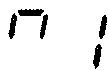
The Live Action games (6, 7) can be selected by pressing SPECIAL GAME, 2, ENTER keys and the display will show

Note: For Salvo and Live Action games, these should be selected before you enter the ships.
5. The Traditional Game with 2 Players (Game 1)
5.1 Setting up Your Fleet
There are 100 squares in each ocean. Each square can be identified by the letter of the row it is on (eg. A is the top row) and the number of the column it is on (eg. O is the leftmost column). Thus square A0 is the top left square.
Each side enters a fleet of 5 ships which traditionally is: 1 Aircraft Carrier (5 Squares), 1 Cruiser (4 Squares), 2 Destroyers (3 Squares each), 1 Frigate (2 Squares). There is no restriction on the sequence of ships you enter -- but if you try to enter a 6th ship the Computer will beep and reject it.
It is not essential to enter the standard fleet. Four sets of the traditional fleet are provided and the Computer will allow you to agree on any combination of up to 5 ships.
First select the ships you will be using in your fleet. Place the first ship onto your ocean. Tell the Computer where that ship is by pressing the keys corresponding to the squares of the bow and the stern, then press ENTER.
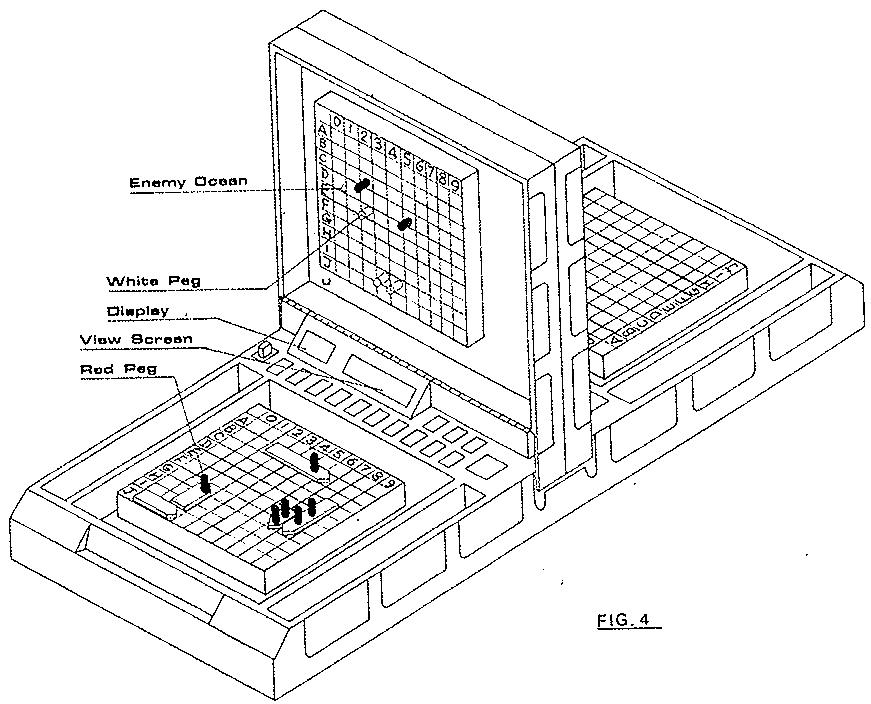

FIG. 5
For example you have an aircraft carrier on squares B2 to B6 (Fig. 1).
| PRESS KEY | DISPLAY Shows | Meaning |
| B1 | b | Row B has been identified |
| C2 | b3 | Square B2 (bow) has been identified |
| B1 | b | Row B has been identified |
| G6 | b6 | Square B6 (stern) has been identified |
| ENTER | b6 | Ship on B2 to B6 has been entered. |
This is your ship No. 1. Now repeat this for the ship No. 2 through No. 5, noting each one in the sequence (this can be useful later in checking where they are and if they have been hit).
Both players may enter their ships at the same time; the Computer will respond to each correctly entered ship. Illegal entries (ships on diagonals, ships larger than 5 squares etc.) will not be accepted and the Computer will give a high-low tone and you must enter the two squares of that ship again. [Side A's key presses will be displayed until Side B begins pressing his own keys.]
Correcting Mistakes
If you make an error before you have pressed ENTER, simply press the coordinates of the ship again, then press ENTER as usual. Only the last 4 key presses before you press ENTER are read into the Computer.
If you change your mind about where to put a ship just after entering it (eg. you misread the squares), press CANCEL SHIP and ENTER then re-enter the ship.
When all ships have been set up, press WAR on Side A, then ENTER. Now you are ready for action!
5.2 The Battle
You and your opponent take turns to fire at each other. Side A starts. Choose a square to aim at and plug a white peg into the Enemy Ocean on your vertical Battle Chart (Fig. 4). Note the square, enter the coordinates then press ENTER. A missile sound will be heard.
If a ship is hit there will be an explosion and a flash on the View Screen. Remove the white peg from the square and insert a red peg in its place. This will remind you not to fire twice at the same spot (saving ammunition also earns a higher score). A second shot at the same spot is a miss - there is nothing more there to hit.
If your ship gets hit you must place a red peg in the ship's corresponding peg-hole. Once all the peg-holes of a ship are filled with red pegs it sinks. The Computer sounds a "Whoop-whoop-whoop" siren to abandon ship.
The winner is the first to sink the whole fleet. When this happens the Computer plays a victory tune.
To check the winner's score press Side A's ENTER key once (see Chapter 10). To play a new game press ENTER again. (The victory tune will continue until the ENTER key is pressed or the Computer is turned off).
5.3 Advanced Game with 2 Players (Game 2)
This variation brings a new dimension into the game. By experimenting with different sized fleets made up of different ships you may decide that a particular configuration gives you the best chance of winning. But be careful! There are delicate trade-offs to be weighed up. A small fleet is hard to hit but when it is you are sunk - literally! Also bear in mind that your final score is made up of 3 different factors, (see Chapter 10).
Different fleet sizes can also be used as a handicap when playing against a less experienced player. However you must enter at least one ship to each side (same for other games).
6. The Traditional Game with 1 Player (Game 3)
It is you against the Computer! All the rules work in the same way as in the 2-Player Traditional Game, and now the display shows which keys you are pressing when you set up your ships. You can also verify the position and direction of your ships (Chapter 9) at any time during the game.
You must play on Side A. The Computer will automatically become your opponent if no ships are entered for Side B. The Computer does not know where your ships are and cannot cheat. It sets up a fleet matching your ship strength exactly, then awaits your first missile before firing back.
7. The Salvo Game: For 2 Players (Games 4 & 5)
This is a realistic fleet-action variation of the Game. It needs careful planning to play well.
Side A fires 5 milliles one after each other, then Side B fires 5 missiles back, and so forth. It can be played traditionally with equal sized fleets (Game 4), or as the advanced version with unequal sized fleets (Game 5).
If you want to play another Salvo Game after the Game is over, you need to reselect it (Chapter 4 - Selecting Your Game).
8. Live-Action Game: For 2 Players (Games 6 & 7)
In this Game the side that is quickest on the draw wins the right to fire. Thus you may fire several missiles in a row if you are quick.
The first person to press any key after the "Go" signal may fire the next missile. The Computer signals "Go" when the last blip of the sonar has sounded. Pressing a key or holding a key down before the "Go" signal does not count. Players must then wait for the next sonar "Go" signal.
Each side is limited to 102 shots (same for other games); so marking the ocean with pegs as you fire (to avoid firing twice at the same square) is a good idea. This game may be played traditionally with equal sized fleets (Game 6) or with unequal sized fleets (Game 7).
If you want to play another Live-Action Game once the war is over you need to reselect it (Chapter 4 -- Selecting Your Game).
9. Checking your Ships (1 Player Game Only)
You can check where any ship is, how big it is and which way it is pointing at any time during a 1 player game -- before the start of war or during it. You cannot check enemy ships.
To check where your ships are you must perform two steps to see each ship in turn. The example shown in Steps 1 and 2 assumes you are in the middle of a game, some of your ships have been hit (See Fig. 5), and you wish to check your first ship.
Step 1. Find the location of the top left square of the ship. This is done by pressing the CHECK key, the relevant Number key, and then the ENTER key. eg. To check where the first ship you entered is:
Press CHECK, 4 ENTER and the display shows square
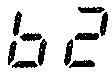
Step 2. Find the direction of the ship across or down as well as the number of squares that are unhit.
This is done by pressing the CHECK key, the relevant Number key, and then the ENTER key.
eg. To check the direction and the undamaged squares of the first ship:
Press CHECK, 9, ENTER and the display will show:
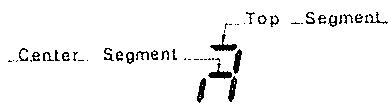
The ship's direction is shown by the centre segment of the display. If the ship is across (as it is in the example) the centre segment of the display will be lit - otherwise the ship is down.
The number of remaining unhit squares of the ship can be found as follows: Starting at the top segment and going clockwise the other lit segments represent the ship's unhit squares. In this example the bottom segment is unlit indicating the fourth square of the Aircraft Carrier's 5 squares has been hit.
To check other ships in your fleet continue the sequence as shown in the following table.
| Ship No.(See Fig. 5) | Step 1 | Step 2 | |||
| 3 Keys to Press | Display Shows | 3 Keys to Press | Display Shows | To go on Press | |
| ONE | CHECK 4 ENTER | 62 | CHECK 9 ENTER | 7 | ENTER |
| TWO | CHECK 3 ENTER | 88 | CHECK 8 ENTER | - | ENTER |
| THREE | CHECK 2 ENTER | 100 | CHECK 7 ENTER | 7 | ENTER |
| FOUR | CHECK 1 ENTER | 122 | CHECK 6 ENTER | 1 | ENTER |
| FIVE | CHECK 0 ENTER | 133 | CHECK 5 ENTER | ENTER | |
10. Score
At the end of the game the winner's score (from 1 to 99) can be seen when you press the SIDE A's ENTER key while the victory tune is playing.
The score is based on:
a. The number of ships left undamaged
b. Intact squares remaining in the fleet
c. Ammunition left,
Thus you may enter a strong 5 ship fleet so that you have more undamaged squares at the end of game. Or you may choose to play a risky single ship game so that your opponent may not find your ship easily.
Careful use of ammunition by planned shots and keeping track of shots fired (by using your pegs carefully) helps to score higher.
Pressing ENTER again blanks the display and prepares the Sea Battle Computer to start a new Traditional, Advanced or Handicap game.
11. Care and Maintenance
Advanced Electronic Sea Battle is a precision electronic Computer. Do not subject it to rough handling or expose it to extreme temperature or moisture. Do not leave it in the sun. Do not use chemical agents to clean it as these may damage its finish.
Remove the batteries if the Computer is not to be used for an extended period.
12. Specifications
| Battery requirement: | 1.5 volts (size AA, AM3 or UM3) x 4 pcs Alkaline type recommended |
| Battery life: | 15 hours typical using alkaline batteries |
| Operating voltage: | 4.5 - 6.5 volts |
| Current consumption: | At power up: 95 mA typical (V. Batt. = 6.0V) |
| Power Consumption: | 1.0W max. |
| System Clock Frequency: | 3.6 MHz ± 10% (V. Batt = 6.0V) |
| Dimensions (mm): | 460 x 220 x 62 |
| Weight (kg): | 1.3 (excluding batteries) |
- Trouble-Shooting Chart
| SYMPTOMS | POSSIBLE CAUSES | CORRECTIVE ACTIONS |
| 1. Does not work | 1.1 Batteries weak or bad.1.2 Batteries not inserted properly. | 1.1 Replace batteries.1.2 Check batteries are inserted the correct way round. |
| 2. 'Freezes' in the middle of game | 2.1 Weak batteries.2.2 Static discharge. | 2.1 Replace batteries.2.2 Switch OFF and then ON again. |
| 3. Does not accept your move correctly | 3.1 Key jammedYou can verify this by the following sequence:- press and hold player 2's "ENTER" key while switching on the computer.- segments on the display will light up sequentially, lamp flashes twice, and then a short melody sounds followed by the sonar.- If keys are jammed, an error tone will be heard and no sonar sound comes up. | 3.1 Check all keys. |
| 4. No display but computer works | 4.1 You are in "two players" mode. | 4.1 Read manual chapter 5.1. |
| 5. No explosion when a ship is hit | 5.1 Ship is elsewhere, as far as the computer is concerned. You did not press the keys for where you plugged in that ship when setting up your fleet. | 5.1 Play carefully. |
| 5.2 The square has been hit before; it only explodes the first time it is hit. | 5.2 Keep your finger on the square you want as you key in its row and column. | |
| 6. Does not accept the ship you have entered | 6.1 Illegal ship entries such as:- ships larger than 5 or less than 2 squares- ship entered diagonally e.g. AO-C2- ships overlap- more than 5 ships | 6.1 Read manual chapter 5. |
| 7. All squares on a ship appear to have been hit, but it does not sink | 7.1 It is not a single ship; the squares are from adjacent ships, e.g. X X X X ship 1X X X ship 2X X X ship 3 | 7.1 Keep playing! |
| 8. Game ends even though both sides have portions of ships still unhit | 8.1 Either side has fired more than 102 shots. This is possible when the same squares are fired on more than once. | 8.1 Read manual chapter 2. |

- SEA BATTLE
- ADVANCED ELECTRONIC BATTLESHIPS GAME
- Introduction
- Rules of the Game
- Starting Up
- Selecting Your Game
- The Traditional Game with 2 Players (Game 1)
- Setting up Your Fleet
- Correcting Mistakes
- The Battle
- Advanced Game with 2 Players (Game 2)
- The Traditional Game with 1 Player (Game 3)
- The Salvo Game: For 2 Players (Games 4 & 5)
- Live-Action Game: For 2 Players (Games 6 & 7)
- Checking your Ships (1 Player Game Only)
- Score
- Care and Maintenance
- Specifications
Marque : SAITEK
Modèle : SEA BATTLE
Catégorie : Jeu de société