
Sephia (2001) - Voiture KIA - Notice d'utilisation et mode d'emploi gratuit
Retrouvez gratuitement la notice de l'appareil Sephia (2001) KIA au format PDF.


| Type de produit | Voiture particulière |
| Marque | Kia |
| Modèle | Sephia (2001) |
| Année | 2001 |
| Carburant | Essence |
| Moteur | 1.6 L 4 cylindres |
| Transmission | Manuelle 5 rapports |
| Nombre de portes | 4 |
| Nombre de places | 5 |
| Longueur | 4,4 m (environ) |
| Largeur | 1,7 m (environ) |
| Hauteur | 1,4 m (environ) |
| Poids à vide | 1 100 kg (environ) |
| Sécurité | Airbags conducteur et passager, prétensionneurs de ceinture, verrouillage enfant des portes arrière |
| Fonctions principales | Conduite, sécurité, confort (sièges réglables, vitres électriques optionnelles) |
| Entretien et nettoyage | Vidange huile moteur, remplacement filtres, nettoyage intérieur |
| Pièces détachées et réparabilité | Disponibles chez les concessionnaires Kia agréés |
| Alimentation | Batterie 12V, réservoir essence |
FOIRE AUX QUESTIONS - Sephia (2001) KIA
Questions des utilisateurs sur Sephia (2001) KIA
0 question sur cet appareil. Repondez a celles que vous connaissez ou posez la votre.
Poser une nouvelle question sur cet appareil
Téléchargez la notice de votre Voiture au format PDF gratuitement ! Retrouvez votre notice Sephia (2001) - KIA et reprennez votre appareil électronique en main. Sur cette page sont publiés tous les documents nécessaires à l'utilisation de votre appareil Sephia (2001) de la marque KIA.
MODE D'EMPLOI Sephia (2001) KIA
KIA MOTORS
SEPHIA
2001 OWNER'S MANUAL
Foreword
Thank you for choosing a Kia vehicle.
When you require service, remember that your authorized Kia dealer knows your vehicle best. Your dealer has factory-trained technicians, recommended special tools, genuine Kia replacement parts, and is dedicated to your complete satisfaction.
Because subsequent owners require this important information as well, this publication should remain with the vehicle if it is sold.
This manual covers all 2001 Sephia models and will familiarize you with operational, maintenance and safety information about your new vehicle. It is supplemented by a Consumer Information Guide and by a Warranty Information Booklet that provides important information on all warranties regarding your vehicle: New Vehicle Limited Warranty, Powertrain Limited Warranty, Limited Warranty Covering Perforation from Corrosion, and Emission Control System Warranty. If your vehicle is equipped with an audio system, you will also have a Kia Integrated Audio Systems manual explaining its operation. We urge you to read these publications carefully and follow the recommendations to help assure enjoyable and safe operation of your new vehicle.
Kia offers a great variety of options, components and features for its various models.
Therefore, the equipment described in this manual, along with the various illustrations, may not all be applicable to your partic-vehicle. The information and specifications included in this manual were accurate at the time of printing. Kia Motors reserves the right to discontinue or change specifications or design at any time without notice and without incurring any obligation. If you have questions, always check with your Kia Dealer.
We assure you of our continuing interest in your motoring pleasure and satisfaction in your Kia vehicle.
©2000 Kia Canada, Inc.
All rights reserved. May not be reproduced or translated in whole or in part without the written consent of Kia Canada, Inc.
Printed in Korea
Table of Contents
Introduction Section 1
Your Vehicle At A Glance.... Section 2
Knowing Your Vehicle .... Section 3
Including "Air Bags" on page 3-34
"Child Restraints Anchorage" on page 3-23
"Safety Belts" on page 3-15
Driving Your Vehicle .... Section 4
Driving Tips.... Section 5
In Case Of An Emergency .... Section 6
Maintenance....Section 7
Specifications.... Section 8
Index Section 9
Introduction
How To Use This Manual 1-2
Vehicle Break-In Process....1-3
Introduction
How To Use This Manual
We want to help you get the greatest possible driving pleasure from your vehicle. Your Owner's Manual can assist you in many ways. We strongly urge you to review the entire manual. However, in order to prevent death or injuries, at the very least, you must review the WARNING and CAUTION sections spread throughout the manual, which are easily recognized by their special markings indicated below.
Illustrations complement the words in this manual to help explain the best way to enjoy your vehicle. By reading your manual, you can find out about features, important safety information, and driving under various road conditions.
Layout of the manual is provided in the Table of Contents.
Index: A good place to start is the index; it has an alphabetical listing of all information in your manual.
Sections: This manual has eight sections plus an index. Each begins with a brief list of contents so you can tell at a glance if that section has the information you want.
You'll find various WARNINGS, CAUTIONs, and NOTICEs in this manual. These WARNINGS, CAUTIONs and NOTICEs were prepared to enhance your personal safety and continued satisfaction with your Kia vehicle. You should carefully read and follow ALL procedures and recommendations provided in these WARNINGS, CAUTIONs and NOTICEs.
WARNING
A WARNING indicates a situation in which serious bodily injury or death could result if the warning is ignored.
CAUTION
A CAUTION indicates a situation in which personal injury, perhaps severe, could result if the caution is ignored.
* NOTICE
A NOTICE indicates a situation in which damage to your vehicle could result if the notice is ignored.
Vehicle Break-In Process
No special break-in period is needed. By following a few simple precautions for the first 1 000 km (600 miles) you may add to the performance, economy and life of your vehicle.
- Do not race the engine.
- Do not maintain a single speed for long periods of time, either fast or slow. Varying engine speeds are beneficial for proper engine break-in.
- Avoid hard stops, except in emergencies, to allow the brakes to seat properly.
- Avoid full-throttle starts.
Your Vehicle At A Glance
Instrument Panel Overview 2-3
Interior and Exterior Overview 2-2
Your Vehicle At A Glance
Interior and Exterior Overview

AS2B02001
Instrument Panel Overview
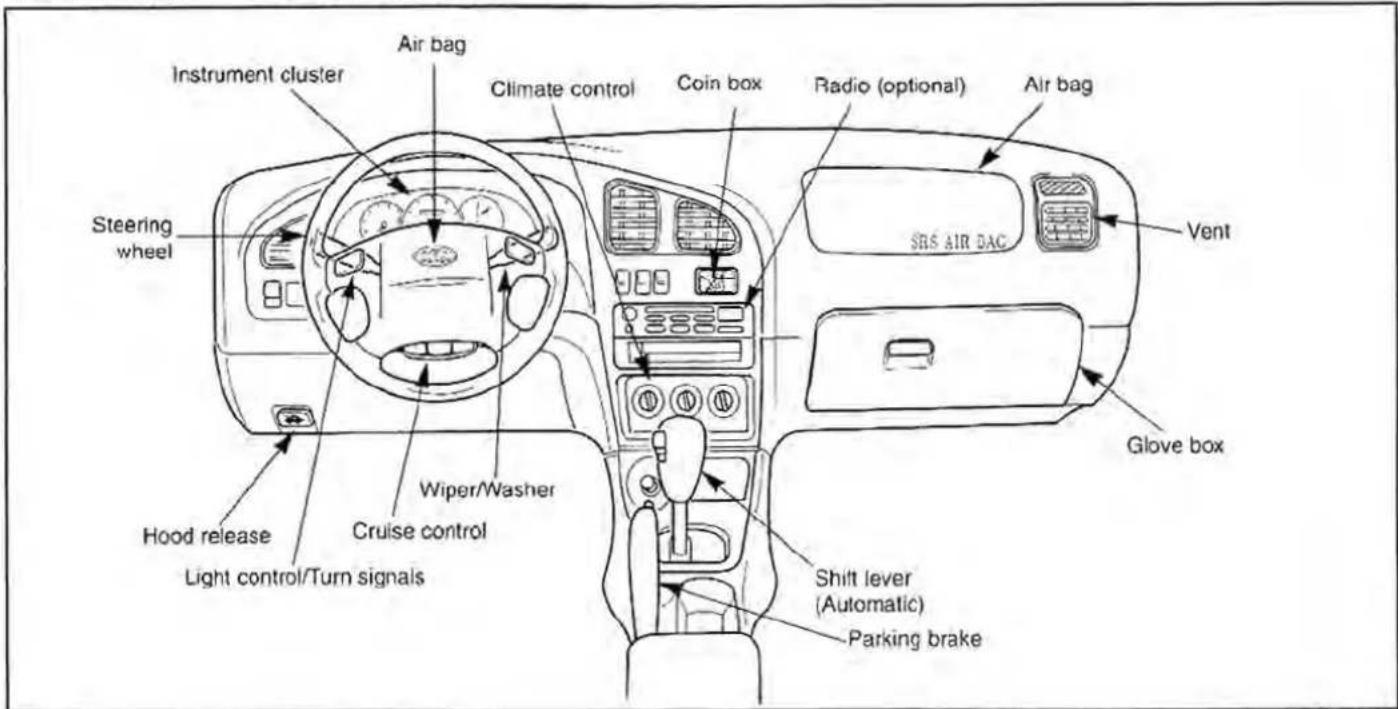
AS2B02002
Knowing Your Vehicle
Air Bags 3-34
Child Restraints Anchorage 3-23
Cup Holders and Console Storage Compartment 3-53
Door Locks 3-3
Fuel Filler Door....3-46
Hood 3-44
Interior Lights 3-52
Keys 3-2
Mirrors 3-49
Safety Belts 3-15
Seats 3-9
Steering Wheel 3-48
Trunk Lid 3-42
Windows 3-6
Knowing Your Vehicle
Keys

AS2B03001
The key code number is stamped into the plate attached to the key set. If you should lose your keys, this number will enable an Authorized Kia Dealer to duplicate the keys easily. Remove the plate and store it in a safe place. Also, record the code number and keep it in a safe and handy place, but not in the vehicle.
⚠ WARNING – Ignition Key
Leaving children unattended in a vehicle with the ignition key is dangerous even if the key is not in the ignition. Children copy adults and they could place the key in the ignition. The ignition key would enable children to operate power windows or other controls, or even make the vehicle move which could result in serious bodily injury or even death. Never leave the keys in your vehicle with unsupervised children.
Door Locks
Manual Door Locks
Operating Door Locks - With Key
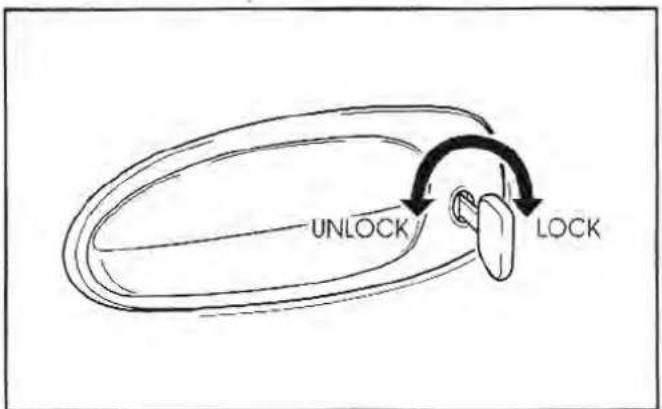
AS2B03002
- Both front doors can be locked and unlocked with the key.
- Turn the key to the left to unlock and to the right to lock the door.
- Once a door is unlocked, it may be opened by lifting the door handle.
Operating Door Locks – Without Key

AS2B03003
To lock a door without the key, push the inside door lock button to the "LOCK" position (toward rear of vehicle) and close the door.
* NOTICE
Always remove the ignition key, engage the parking brake, close all windows and lock all doors when leaving your vehicle unattended.
Knowing Your Vehicle
Operating Door Locks from Inside the Vehicle
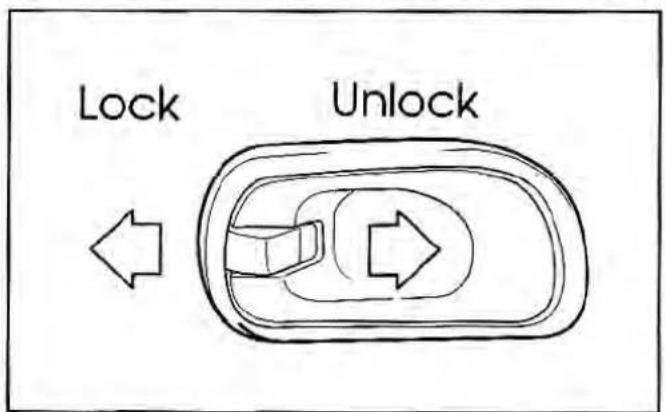
AS2B03004
- To lock a door, push the door lock button to the "LOCK" position (toward rear of vehicle).
- To unlock a door, push the door lock button to the "UNLOCK" position (toward front of vehicle).
- To open a door, pull the door handle towards the middle of your vehicle.
The door ajar warning light will illuminate if a door is not fully closed. Close the door completely and the light will go out.
WARNING
Never leave children or animals unattended in the vehicle. An enclosed vehicle can become extremely hot, causing death or severe injury to children or to animals who cannot escape the vehicle.
CAUTION
The doors should always be fully closed and locked while the vehicle is in motion to prevent accidental opening of the doors. Locked doors will also discourage potential intruders when the vehicle stops or slows.
Automatic Door Locks (optional)
When the driver's door is locked or unlocked with a key or with the door lock button, all the other doors will lock or unlock automatically.
Rear Door Child Safety Lock

AS2B03006
The child safety lock is provided to help prevent children from accidentally opening the rear doors from inside the vehicle.
- To lock a rear door so that it cannot be opened from the inside, push the child safety lock located on the rear edge of the door to the "LOCKED" position (toward front of vehicle) before closing the door.
- To open a rear door while the child safety lock is engaged, push the door lock knob to the "FREE" position (toward rear of vehicle) then lift the outside door handle.
WARNING - Rear Door Locks
If children accidentally open the rear doors while the vehicle is in motion, they could fall out and be seriously or fatally injured. To prevent children from opening the rear doors from the inside, the rear door safety locks should be used whenever children are in the vehicle.
Knowing Your Vehicle
Windows
Manual Windows

AS2B03007
Use the window crank to open and close each window.
Power Windows (if equipped)
The ignition switch must be in the ON position for power windows to operate. Each door has a power window switch that controls that door's window. However, the driver has a power window lock switch which can cancel the operation of the three passenger window switches.
* NOTICE
To prevent the power window fuse from malfunctioning and the power window system from being damaged, do not open or close more than two windows at the same time.
Driver's Door Power Window Controls

AS2B03008A
All windows can be opened or closed using the power window master control on the driver's door. To open a window, press down on the corresponding power window switch. To close a window, pull up on the corresponding power window switch.
Driver's Window Automatic-Down Window Switch
The driver's window has an "Automatic-Down" feature. To activate the express-down feature, momentarily depress the front of the switch to the second detent position. To cancel this feature, pull up on the front of the switch and then release it.
Driver's Power Window Switch
The driver's power window switch provides two (2) separate window-down functions.
- Depressing the driver's power window switch completely, automatically lowers (Automatic-Down) the driver's window. To cancel this function, pull up on the front of the switch and release it.
- Depressing the driver's power window switch partially (to the first detent) provides precise control of the window-down position.
To raise/close the driver's window, pull up on the power window switch.
Knowing Your Vehicle
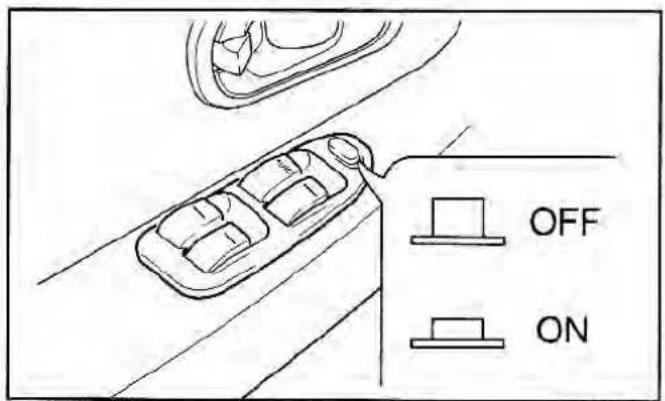
Power Window Lock Switch Feature
AS2B03009A
The driver can disable the power window switches on all passenger doors by depressing the power window lock switch located on the driver's door to ON. When the power window lock switch is ON, only the driver's master control can operate the windows.
WARNING - Passengers
- Keep the power window lock switch on the driver's door in the ON (depressed) position except when someone is operating a passenger door window. Serious injury can result from unintentional window operation, especially to children.
- Always double check to make sure all arms, hands, and other obstructions are safely out of the way before closing a window.
* NOTICE
If you experience buffeting and pulsation (wind shock) with either side window open, you should open the opposite window slightly to reduce the condition.
Passenger Door Power Window Controls

To open a window, press the front portion of the switch down. To close a window, pull the front portion of the switch up.

WARNING - Passengers
Do not allow children to play with the power windows. They may seriously injure themselves or others.
Seats

WARNING - Drivers
- Never adjust the driver's seat or seatback when the vehicle is moving. Doing so could cause loss of control, and serious personal injury or death.
- Do not allow packages or other objects to interfere with the normal position of a seat back. These objects may prevent the seat back from locking, which could result in serious injury or death in the event of a sudden stop or collision.
• Always drive and ride with your seatback upright and the lap portion of the safety belt snug and low across the hips.
- If a child is riding in the front passenger seat, they should always ride with the seatback in the fully upright position.
Knowing Your Vehicle
Front Seat Adjustment
Moving the Front Seat Forward and Backward (Both seats)

AS2B03011
To move the seat forward or backward;
- Pull the seat slide adjustment lever under the front edge of the seat cushion up and hold it.
- Slide the seat to the position you desire.
- Release the lever and make sure the seat is locked in place.
ZCAUTION
Do not place anything under the front seats. Loose objects might interfere with the seat slide mechanism or possibly roll out from under the seat and interfere with the operation of the brake, clutch or accelerator foot pedals.
Adjusting the Front Seatback Recliner (Both seats)

AS2B03012
To recline the seatback;
- Lean forward slightly and lift up on the seatback recline lever located on the outside of the seat, toward the rear.
- Lean back on the seat and adjust the back of the seat to the position you desire.
- Release the lever and make sure the seatback is located in place. (The lever MUST return to its original position for the seatback to lock.)
WARNING - Passengers
To reduce the risk of sliding under the lap portion of the lap/shoulder belt, and potentially suffering serious personal injury or death in the event of a collision, do not use the front seatback in a reclined position while the vehicle is in motion. If a seat is reclined, the occupant's hip could slide under or out of the lap portion of the lap/shoulder belt during a collision. If that occurs, the occupant may no longer be properly restrained, and the safety belt could apply restraint forces to the unprotected abdomen resulting in serious personal injury or death. Therefore, keep the seatbacks in a comfortably upright position whenever the vehicle is in motion.
Knowing Your Vehicle
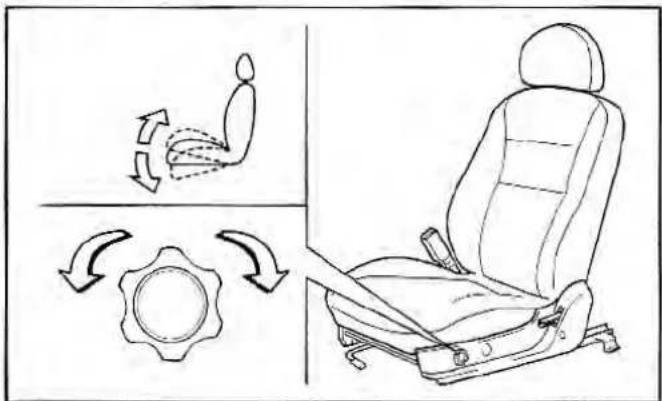
Adjusting the Height of Driver's Seat Cushion (Driver's side-If equipped)
AS2B03013
To change the height (front portion) of the seat cushion, rotate the knob located on the outside of the seat cushion.
- To lower the seat cushion, rotate the knob toward the front of the vehicle.
• To raise the seat cushion, rotate the knob toward the rear of the vehicle.
WARNING
To drive properly, adjust the driver's seat and its headrest before starting. After doing so, you should adjust the day/night rearview mirror and the outside rearview mirror.
Adjustable Headrest
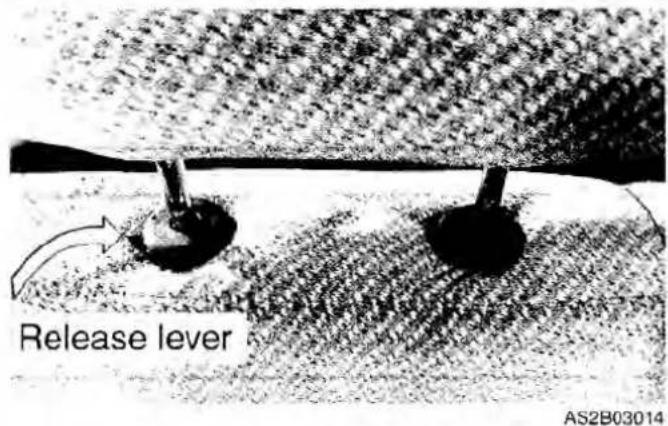
To raise the headrest, simply pull it up to the desired position. To lower the headrest, press the release lever on the left side grommet, while pushing the headrest down to the desired position. To remove the headrest, raise it as far as it can go then press the release lever while pulling upward.
WARNING - Headrests
- To reduce the risk of head and neck injuries, do not operate the vehicle with the headrest removed or improperly positioned.
- Do not attempt to adjust the driver's headrest while driving.
- Adjust the top of the headrest so that it is even with the top of your ears in order to reduce the chance of injury in the event of a collision.
Knowing Your Vehicle
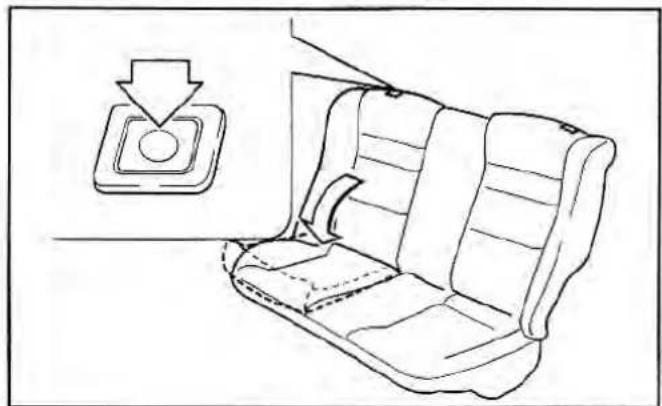
Split Folding Rear Seat (If equipped)
AS2B03015
The rear seatbacks fold forward to provide additional cargo space and to provide a access to the trunk area.
- To fold the rear seatback(s) down, press the unlock button located in the top of the seatbacks, then fold the seatback forward and down.
- To raise the seatback, lift and push it firmly until it clicks into place.
- When you return the seatback to its upright position, reposition the rear safety belts so that they can be used by rear seat passengers.
WARNING -Cargo
Cargo should always be secured to prevent it from shifting and causing injury to the vehicle occupants.
CAUTION
Do not remove the floor carpet in your vehicle, emission controls cause high exhaust temperatures under the floor.
* NOTICE
When returning the rear seatbacks to the upright position, remember to return the rear shoulder belts to their proper position. Routing the safety belt webbing through the rear safety belt guides will help keep the belts from being trapped behind or under the seats.
Safety Belts
Pre-tensioner Seat Belt (If equipped)
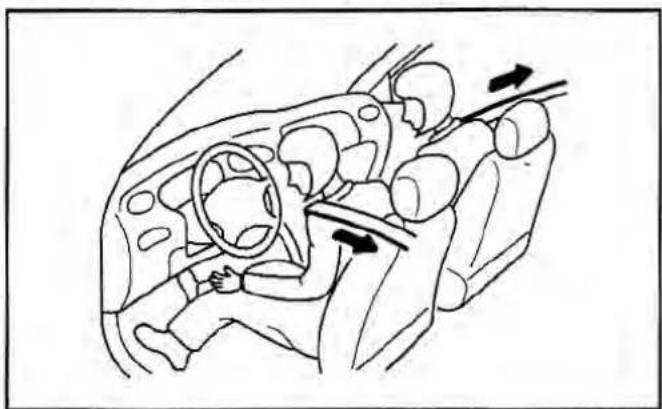
AS2B03105
Your vehicle is equipped with driver's and front passenger's pre-tensioner seat belts. The purpose of the pre-tensioner is to make sure that the seat belts fit tightly against the occupant's body in certain frontal collisions.
The pre-tensioner seat belts can be activated alone or, where the frontal collision is severe enough, together with the airbags.
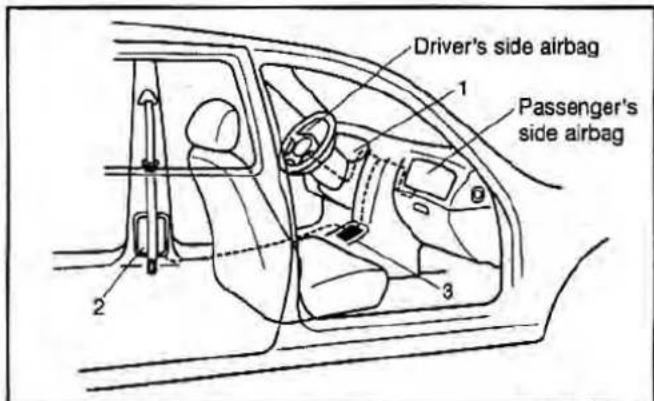
AS2B030015B
The pre-tensioner seat belt operates in the same way as an Emergency Locking Retractor (ELR) type of seat belt. When the vehicle stops suddenly, or if the occupant tries to lean forward too quickly, the seat belt retractor will lock into position. However, in certain frontal collisions, the pre-tensioner will activate and pull the seat belt into tighter contact against the occupant's body.
The seat belt pre-tensioner system consists mainly of the following components.
Their locations are shown in the illustration.
- SRS airbag warning light
- Seat belt pre-tensioner assembly
- SRS control module
Knowing Your Vehicle
WARNING
To obtain maximum benefit from a pre-tensioner seat belt:
- The seat belt must be worn correctly.
- The seat belt must be adjusted to the correct position.
* NOTICE
- Both the driver's and front passenger's pretensioner seat belt will be activated in certain frontal collisions. When the frontal collision is severe enough, the pre-tensioners will be activated together with the airbags. The pretensioners will be activated under these conditions even if the seat belts are not being worn at the time of the collision.
- When the pre-tensioner seat belts are activated, a loud noise may be heard and fine dust that may appear to be smoke, may be visible in the passenger compartment. These are normal operating conditions and are not hazardous.
- Although it is harmless, the fine dust may cause skin irritation and should not be breathed for prolonged periods. Wash your hands and face thoroughly after an accident in which the pretensioner seat belts were activated.
CAUTION
- Because the sensor that activates the SRS airbag is connected with pre-tensioner seat belt, the SRS airbag warning light AIR BAG on the instrument panel will blink for approximately 6 seconds after the ignition key has been turned to the "ON" positions, and then it should turn off.
- If the pre-tensioner seat belt is not working properly, this warning light will illuminate even if there is no malfunction of SRS airbag system. If the SRS airbag warning light does not illuminate when the ignition key is turned to "ON" or if it remains illuminated after blinking for approximately 6 seconds, or if it illuminates while the vehicle is being driven, please have an authorized Kia dealer inspect the pre-tensioner seat belt or SRS airbag system as soon as possible.

WARNING
- Pre-tensioners are designed to operate only one time. After activation, pre-tensioner seat belts must be replaced. All seat belts, of any type, should always be replaced after they have been worn during a collision.
- The pre-tensioner seat belt assembly mechanisms become hot during activation. Do not touch the pre-tensioner seat belt assemblies for several minutes after they have been activated.
- Do not attempt to inspect or replace the pretensioner seat belts yourself. This must be done by an authorized Kia dealer.
- Do not strike the pre-tensioner seat belt assemblies.
- Do not attempt to service or repair the pretensioner seat belt system in any manner.
- Improper handling of the pre-tensioner seat belt assemblies, and failure to heed the warnings to not strike, modify, inspect, replace, service or repair the pre-tensioner seat belt assemblies may lead to improper operation or inadvertent activation and serious injury.
• Always wear the seat belts when driving or riding in a motor vehicle.
Safety Belt Restraint System

WARNING
The driver and all passengers should always use the safety belts provided in order to minimize the risk of severe bodily injury.
We strongly recommend that the driver and all passengers be properly restrained at all times by using the safety belts provided with the vehicle. Proper use of the safety belts decreases the risk of severe injury or death in accidents or sudden stops. In most states and in Canada, the law requires their use.
Safety belts provide the best restraint when:
• the seatback is upright
• the occupant is sitting upright (not slouched)
- the lap belt portion of the safety belt is snug and low on the hips
- the shoulder belt portion of the safety belt is snug against the chest
• the knees are straight forward
Knowing Your Vehicle
To help you remember to fasten your safety belt, a warning light may come on and a chime may sound. See Safety Belt Warning on page 4-30.
All seats, except the center rear seat, have lap/shoulder belts. The center rear seat has a lap belt.
Inertial locks in the safety belt retractors allow all of the lap/shoulder safety belts to remain unlocked during normal vehicle operation. This allows the occupants some freedom of movement and increased comfort while using the safety belts. If a force is applied to the vehicle, such as a strong stop, a sharp turn, or a collision, the safety belt retractors will automatically lock the safety belts.
Since the inertial locks do not require a collision in order to lock up, you may become aware of the safety belts locking while braking or going around sharp corners.
The center rear seat safety belt does not have an inertial lock so it is always in a locked condition. Whenever possible, use the center rear seat position to install your child restraint. The center rear seat is the best position to install your child restraint. However, if the center seat is unavailable, a child restraint may be installed in the front passenger seat or in the rear outboard seats using the special auto lock mode feature provided with those safety belt.
The front passenger safety belt and rear outboard safety belts have been designed to allow a child restraint to be used in these positions without an added locking clip. These safety belts normally lock only under extreme or emergency conditions (this is the emergency lock mode which uses the locking retractor). However, they can be adjusted so that they remain fixed and locked when a child restraint is placed in those positions (this auto lock mode should only be used to secure a child restraint).
The driver's safety belt can only operate in the emergency lock mode.
⚠ WARNING -Twisted Safety Belts
Never drive or ride with a twisted or jammed safety belt. If you cannot untwist or unjam the safety belt, see your Kia dealer or the nearest qualified technician immediately.
⚠ WARNING -Safety Belt Usage
Each seating position in your vehicle has a specific safety belt assembly which includes a buckle and tongue that are designed to be used together. 1) Use the shoulder belt on the outside shoulder only. Never wear the shoulder belt under the arm. 2) Never swing the safety belt around your neck to fit over the inside shoulder. 3) Never use a single belt for more than one person.
⚠ WARNING - After a Collision
- Lap/shoulder belt assemblies may be stretched or damaged when subjected to the stress and forces of a collision.
A safety belt must be replaced if any part of the "Replace Belt" label is visible. You won't see this label unless your restraint system has been heavily loaded in a collision. This "Replace Belt" label shown in the picture in the next column, is located on the front belts near the door opening.
The entire restraint system should be inspected following any collision. All belts, retractors, anchors and hardware damaged by a collision should be replaced before the vehicle is operated again.
Knowing Your Vehicle

AS2B03054
⚠ WARNING - Safety Belt Care
- Safety belts should be inspected periodically for excessive wear or damage. Pull out each belt fully and look for excessive fraying, cuts, burns or other damage. Make sure that the lap/shoulder belts return smoothly and easily into the retractor. Check the latches to make sure they latch and release without interference or delay. Any belt not in good condition or in good working order should be promptly replaced.
CAUTION - Damage to Safety Belts
Never close the doors on any part of the lap or shoulder belt. It can damage the safety belt or buckle which could increase the risk of injury in case of an accident.
Restraint of Pregnant Women
Pregnant women should wear lap/shoulder belt assemblies whenever possible according to specific recommendations by their doctors. The lap portion of the belt should be worn AS SNUGLY AND AS LOW AS POSSIBLE.
⚠ WARNING - Pregnant Women
Pregnant women must never place the lap portion of the safety belt over the area of the abdomen where the fetus is located or above the abdomen.
Restraint of Infants and Small Children
Small children and infants should be restrained by an approved child restraint system to help protect them while riding in a vehicle.
Never allow a child to stand or kneel on the seat of a moving vehicle. Never allow a safety belt to be placed around both a child and an adult or around two children at the same time.
⚠ WARNING - Children on Laps
Never hold a child on your lap or in your arms in a moving vehicle. Even a very strong person cannot hold onto a child in the event of even a minor collision.
Knowing Your Vehicle
Many companies manufacture child restraint systems (often called child seats) for infants and small children. An acceptable child restraint system must always satisfy Canadian Motor Vehicle Safety Standards.
Make sure that any child restraint system you use in your vehicle is labeled as complying with those safety standards.
The child restraint system should be chosen to fit both the size of the child and the size of the vehicle seat. Be sure to follow any instructions provided by the child restraint system manufacturer when installing the child restraint system.
CAUTION - Hot Metal Parts
Safety belts and seats can become hot in a vehicle that has been closed during warm/hot weather; they could burn a child. Check seat covers and buckles before you place a child anywhere near them.
Restraint of Large Children
As children grow, they may need to use new child restraint systems, including larger child seats or booster seats, which are appropriate for their increased size.
A child who has outgrown available child restraint systems should use the belts provided in the vehicle. When seated in the rear outboard seats, the child should be restrained by the lap/shoulder belt.
If the shoulder belt portion touches the child's neck or face, you can use some after-market devices made by independent manufacturers which help pull the shoulder belt down and away from the child's face or neck.
⚠ WARNING - Shoulder Belts on Small Children
- Never allow a shoulder belt to be in contact with a child's neck or face while the vehicle is in motion.
- If safety belts are not properly worn and adjusted, the risk of death or serious injury to such a child is high.
WARNING - Child Restraints
- Children will be endangered in a crash if their child restraint systems are not properly secured by the safety belts in the vehicle.
- According to accident statistics, children are safer when properly restrained in the rear seating positions rather than the front seating positions.
- When a child restraint system is not secured by a safety belt, store it in the trunk so that it will not be thrown forward in the event of a sudden stop or accident.
Knowing Your Vehicle
Child Restraint Anchorage Fitting (If Equipped)
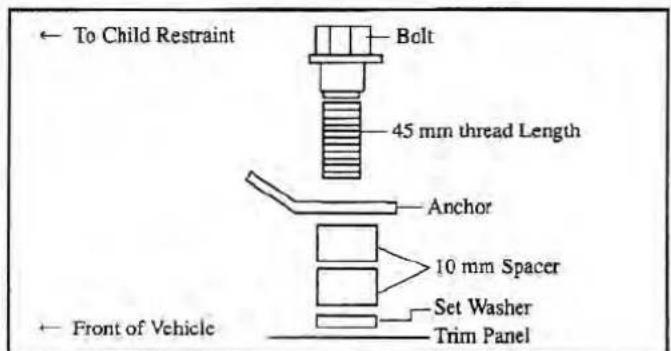
AS2B03067A
Your vehicle is equipped with an anchor for securing the tether strap of a child restraint system(child seat).
The anchor fitting package consists of:
• Bolt: 5/16 inch-18 unc, 45mm thread length
- Spacer: 10mm thickness X 2EA
- Set washer: 0.7mm thickness
- Anchor fitting: three is installed on the vehicle.
Child Restraint Anchorage Position
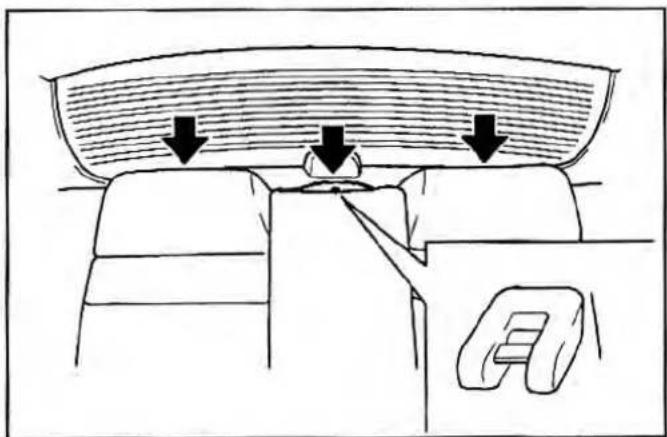
A\$2B03062A
The child restraint anchor fittings are equipped in the vehicle, the shelf behind the rear seat.
- KIA MOTORS
- SEPHIA
- FOREWORD
- TABLE OF CONTENTS
- INTRODUCTION
- HOW TO USE THIS MANUAL
- WARNING
- CAUTION
- NOTICE
- VEHICLE BREAK-IN PROCESS
- YOUR VEHICLE AT A GLANCE
- KNOWING YOUR VEHICLE
- ⚠ WARNING – IGNITION KEY
- DOOR LOCKS
- AUTOMATIC DOOR LOCKS (OPTIONAL)
- WARNING - REAR DOOR LOCKS
- WINDOWS
- POWER WINDOWS (IF EQUIPPED)
- DRIVER'S WINDOW AUTOMATIC-DOWN WINDOW SWITCH
- DRIVER'S POWER WINDOW SWITCH
- WARNING - PASSENGERS
- PASSENGER DOOR POWER WINDOW CONTROLS
- SEATS
- WARNING - DRIVERS
- FRONT SEAT ADJUSTMENT
- ZCAUTION
- ADJUSTING THE FRONT SEATBACK RECLINER (BOTH SEATS)
- ADJUSTABLE HEADREST
- WARNING - HEADRESTS
- WARNING -CARGO
- SAFETY BELTS
- SAFETY BELT RESTRAINT SYSTEM
- ⚠ WARNING -TWISTED SAFETY BELTS
- ⚠ WARNING -SAFETY BELT USAGE
- ⚠ WARNING - AFTER A COLLISION
- ⚠ WARNING - SAFETY BELT CARE
- CAUTION - DAMAGE TO SAFETY BELTS
- RESTRAINT OF PREGNANT WOMEN
- ⚠ WARNING - PREGNANT WOMEN
- RESTRAINT OF INFANTS AND SMALL CHILDREN
- ⚠ WARNING - CHILDREN ON LAPS
- CAUTION - HOT METAL PARTS
- RESTRAINT OF LARGE CHILDREN
- ⚠ WARNING - SHOULDER BELTS ON SMALL CHILDREN
- WARNING - CHILD RESTRAINTS
Marque : KIA
Modèle : Sephia (2001)
Catégorie : Voiture