
DRC525WJU - Réfrigérateur congélateur combiné DE DIETRICH - Notice d'utilisation et mode d'emploi gratuit
Retrouvez gratuitement la notice de l'appareil DRC525WJU DE DIETRICH au format PDF.


| Marque | DE DIETRICH |
| Modèle | DRC525WJU |
| Type de produit | Réfrigérateur congélateur combiné |
| Dimensions (H x L x P) | Environ 180 x 60 x 65 cm |
| Poids | Environ 70 kg |
| Alimentation électrique | 220-240 V, 50 Hz |
| Classe énergétique | Non spécifié (estimation A+ ou supérieure) |
| Capacité de congélation | Indiquée sur la plaque signalétique (kg/24h) |
| Type de réfrigérant | R600a ou R134a selon modèle |
| Système No Frost | Oui, dégivrage automatique |
| Fonction Super Congélation | Oui, bouton dédié |
| Fonction Hiver/Super | Oui, bouton dédié |
| Réversibilité des portes | Oui, possible côté gauche |
| Pieds réglables | Oui, à l'avant |
| Éclairage intérieur | Ampoule 15 W max |
| Entretien et nettoyage | Utiliser une solution de bicarbonate de soude (1 cuillère pour 4 L d'eau) |
| Sécurité | Normes CE, mise à la terre obligatoire |
| Pièces détachées et réparabilité | Contacter les centres de service agréés |
| Informations générales | Notice d'utilisation gratuite disponible en PDF |
FOIRE AUX QUESTIONS - DRC525WJU DE DIETRICH
Questions des utilisateurs sur DRC525WJU DE DIETRICH
0 question sur cet appareil. Repondez a celles que vous connaissez ou posez la votre.
Poser une nouvelle question sur cet appareil
Téléchargez la notice de votre Réfrigérateur congélateur combiné au format PDF gratuitement ! Retrouvez votre notice DRC525WJU - DE DIETRICH et reprennez votre appareil électronique en main. Sur cette page sont publiés tous les documents nécessaires à l'utilisation de votre appareil DRC525WJU de la marque DE DIETRICH.
MODE D'EMPLOI DRC525WJU DE DIETRICH
FROST FREE COMBINED FRIDGE AND FREEZER
GB
CONGRATULATIONS!
You have made an excellent choice!
By purchasing our domestic appliance, you have chosen a reliable, highly performing, non-cumbersome, efficient and useful product. Indeed, the perfect way to preserve your foodstuffs for the preparation of varied, healthy meals.
Your new appliance is easy to use. Nevertheless, please read the instructions and the tips described therein, to enable you to use your refrigerator to its highest capacity, whilst saving on electricity.
We are certain that this appliance will meet with your requirements and we look forward to having you as one of our permanent clients.
INDEX
SAFETY REGULATIONS
YOUR APPLIANCE
WHAT IS REFRIGERATION VENTILATION AND HOW DOES IT WORK?
REVERSIBILITY OF THE DOORS
APPLIANCE INSTALLATION
SAVING ENERGY
ELECTRICAL CONNECTION
STARTING PROCEDURE
USE OF THE APPLIANCE
FREE ZING
DEFREEZING
CLEANING
MINOR BREAKDOWNS AND ANOMALIES
SAFETY REGULATIONS
This appliance preserves and freezes foodstuffs for household use. Avoid any other use.
Installation of the appliance must be carried out according to the Instructions Manual.
An incorrect installation may damage the appliance.
Should you have any problems regarding the good performance of the appliance, kindly contact the authorized Service Centres, or, specialized technicians only.
Prior to any maintenance operation, unplug the appliance from the power supply. Avoid pulling off the feed cable or the appliance itself. Simply pull out the plug.
Keep the Instructions Manual in good condition and pass it on to any future owner of the appliance.
In adherence to the most recent laws on the protection of the environment, we use small quantities of a coolant called R600a or R134a, according to the model. The type of refrigerant is clearly specified on the data plate. In the case of damage to the components of the refrigerating curcuit (tubing, etc) of apparatuses supplied with R600a, the room in which the apparatus is situated must be aired and flames, sparks or other sources of fire must be avoided for a few minutes.
The parts destined to be in contact with foods are in accordance with the EEC 89/109 directives.
CE
CE marking certifies that this appliance complies with EEC Directives 89/336 (electromagnetic compatibility), 73/23 (low voltage), 96/57 (energy efficiency) and their subsequent amendments.
DISPOSAL OF USED APPLIANCES
Should this appliance replace another equipped with snap, spring or lock closing devices, etc. please remember to remove these before disposing of your old appliance, or better still, do disassemble the door so as to prevent anyone, like for instance, children at play, animals, etc. from becoming entrapped within.
Remove the plug from the socket and cut the power supply to the cables.
The refrigerators and freezers contain refrigerant gases and substances which require to be properly disposed of. Furthermore, they contain others materials which can be recycled.
Please dispose of such materials by delivering them to specific collection centres. Your own Municipality will be able to advise you on correct ecological disposal methods.
YOUR APPLIANCE
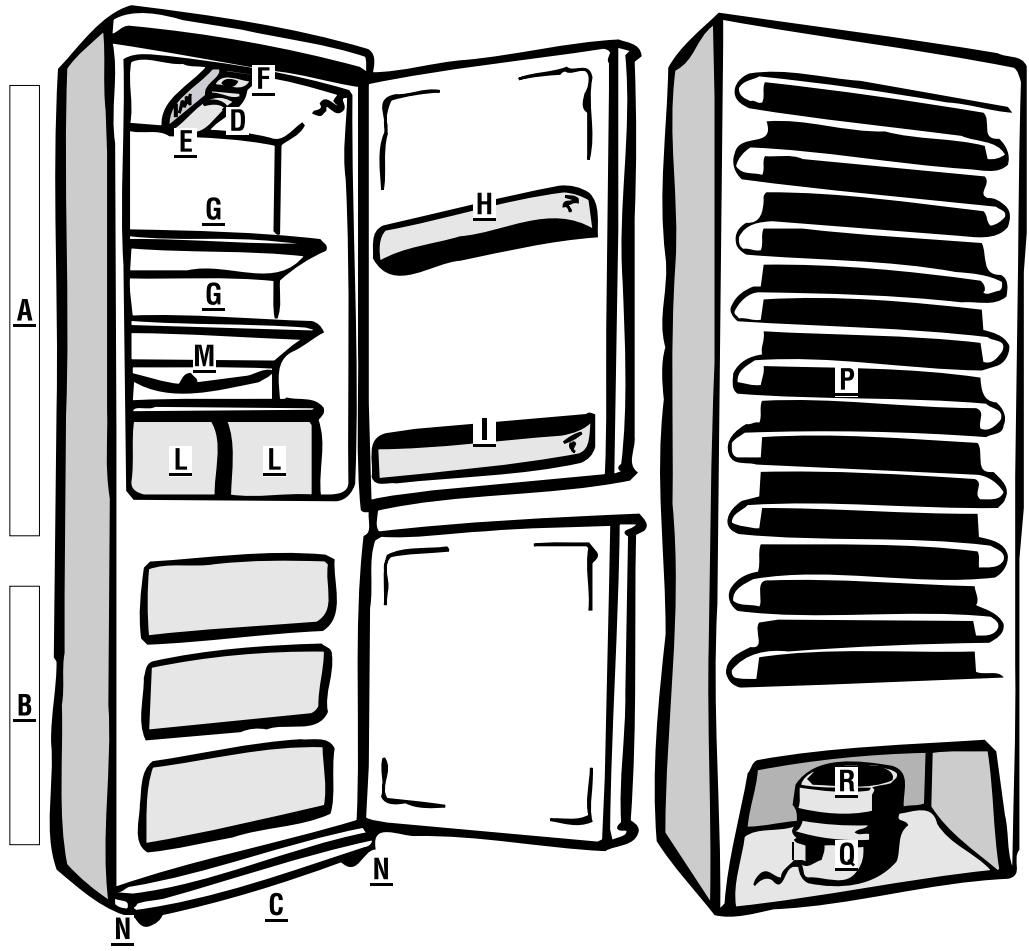
CAPTION
A Refrigerator zone
B Freezer zone
C Base trim
D Thermostat knob
E Light box
F Super / Winter button
G Shelves
H Door trays
Bottle holders
L Salad/vegetable drawers
M Water drainage outlet
N Adjustable feet
P Condenser
Q Compressor
R Water collecting tray
Drawing is purely illustrative
WHAT IS REFRIGERATION VENTILATION AND HOW DOES IT WORK?
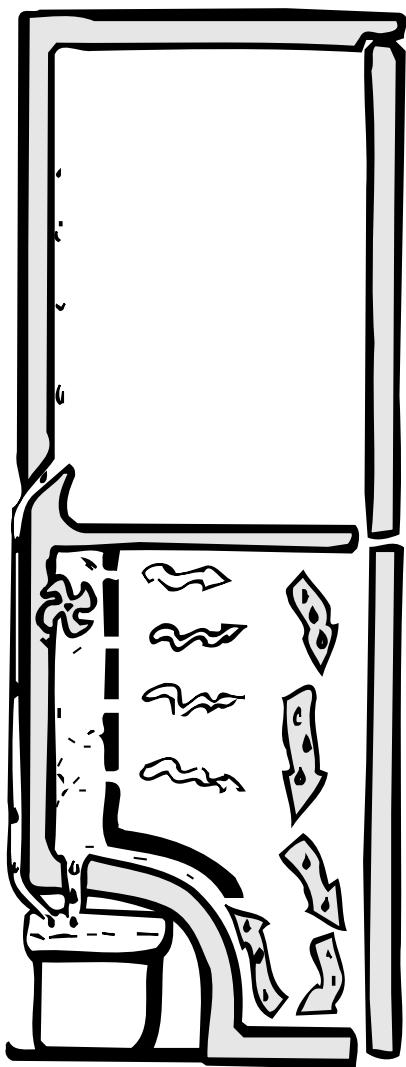
This appliance has been designed and built so as to avoid condensation forming within the refrigerator. Condensation dispersal is carried out automatically by a specific device. The ensuing water will flow through a small pipe into a collection tank from where it will evaporate.
"NO FROST": You are not required to carry out any defrosting operation.
natural_image
Diagram of a water channel with flow indicators and pipe sections (no text or symbols)REVERSIBILITY OF THE DOORS
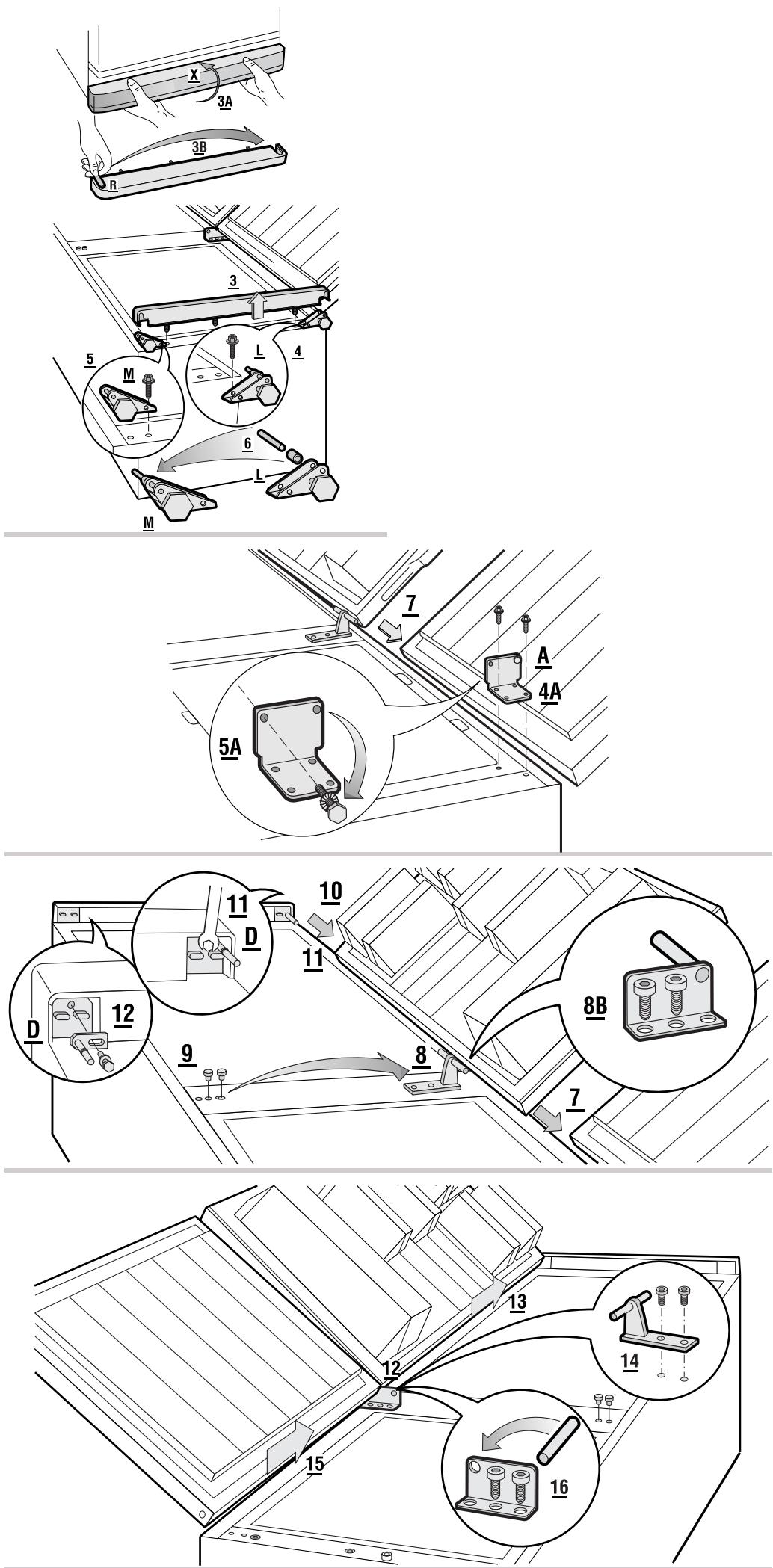
The doors normally open on the left (with the hinge on the right). If instead you wish to revert the process, you may proceed as shown on the illustration on the following pages. Your appliance may have different types of hinges. Please refer to the drawings which correspond to your model.
- Lay the device gently down at the back (with the doors facing upwards).
- Extract the base trim (by pulling it towards the top) (fig. 3) or if you have type X (fig. 3A), remove the base trim by inserting your hands below it. Pull the tongues which are found in the middle of the base trim towards the bottom, in order to release them from the pivots. Rotate the base trim towards the top to release it.
- Remove tongue R (fig. 3B) from the left seat of the base trim and re-insert it into the right seat.
- Unscrew the two lower hinges L and M (fig. 4/5) or unscrew hinge A (fig. 4A).
- Remove the pivot from hinge L and place in into hinge M (fig. 6), or unscrew the pivot on the right and re-screw it on the left (fig. 5A).
-
Remove the freezer door from the intermediary hinge P (fig. 7).
-
Unscrew hinge (fig. 8/8B) and close the holes with the caps which have been removed from the left (fig. 9).
-
Remove the refrigerator door from the upper hinge D (fig. 10).
-
Unscrew hinge D (fig. 11) and assemble it on the left (fig. 12).
-
Insert the refrigerator door into the pivot of hinge D (fig. 13).
-
Rotate hinge 8 by 180^ and assemble it (fig. 14). Re-insert the freezer door (fig. 15).
-
Remove the P pin from the 8B hinge, which is now on the right-hand side, and insert it on the left-hand seat (fig 16).
-
Screw the 8B hinge on the left-hand side and insert the freezer door again (fig. 15).
-
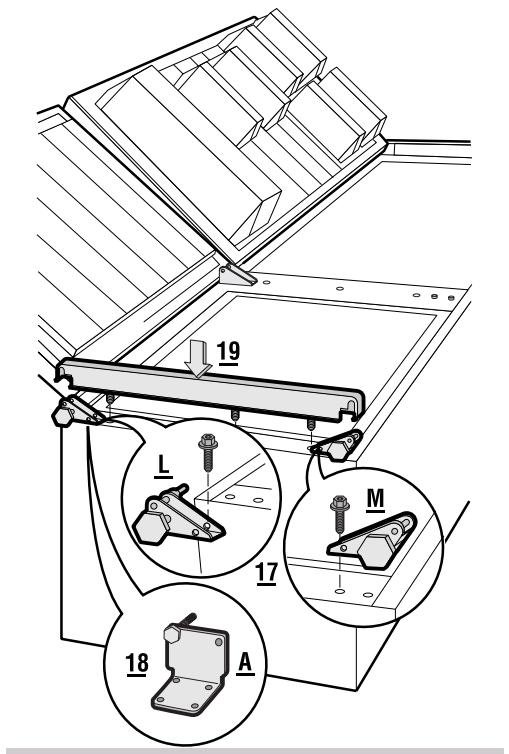
Re-screw hinges L and M, already modified at point 4, (fig. 17) or hinge A (fig. 18).
-
Re-insert the base trim and bring the device back into a vertical position (fig. 19).
Reversibility of the handles
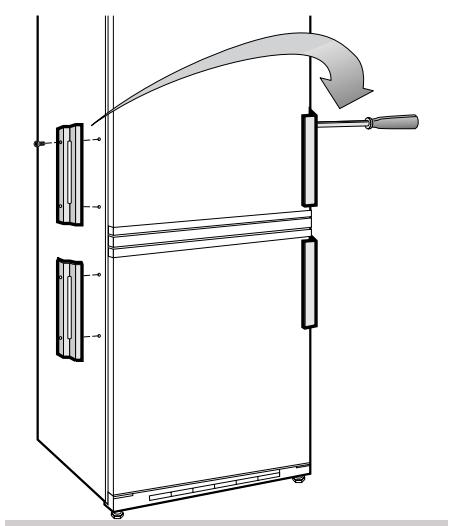
If the appliance has vertical handles, you must unscrew them from the left-hand side and screw them on the right moving the protection caps from right to left.
natural_image
Diagram of a refrigerator with a handle and arrow indicating rotation or movement (no text or symbols)APPLIANCE INSTALLATION
natural_image
Isometric diagram of a room interior with a cylindrical chamber, directional arrow, and control panel (no text or symbols)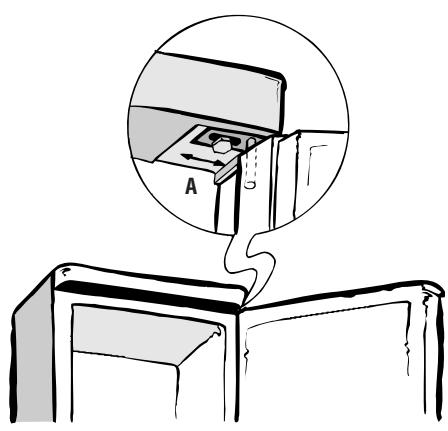
SAVING ENERGY
After installing your appliance, check that nothing has been damaged. Should you detect any possible damage to the appliance, please contact your appliance salesman immediately.
Do not disperse packaging material such as plastic bags, polystyrene strips, etc., around the environment. Keep such material away from children.
If the appliance has been transported in a horizontal position, do not plug in the appliance but wait for a few hours in order to allow the oil to flow back into the compressor. Place the appliance in a dry and aerated environment, duly protected from weather elements. Avoid placing your appliance on balconies, verandas, terraces. Excessive heat during summer and cold during winter could alter the good functioning operation of the appliance or even damage it altogether.
Do not position your appliance near a source of heat like an oven or a central heating plant.
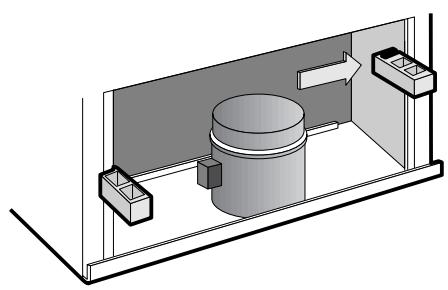
Do not place your appliance next to other pieces of furniture, but leave at least a 3 to 5cm space on the sides and 10~cm on the top.
Keep your appliance away from the wall by inserting spacers at the back of the said appliance.
Adjust the front legs so that the appliance will lean slightly backwards, to allow the door to close properly.
Clean your refrigerator compartment with a solution of sodium bicarbonate dissolved in water (1 spoon for every 4 litres of water). Do not use alcohol, abrasive powders or detergents, as these could ruin the surface.
This appliance works best when the ambient temperature is between 10 °C and 32 °C .
Hinges Adjustment
In case of any accidental bumps during transport, the upper door may not be perfectly aligned with the frame panel. Should this occur, lightly loosen the screw which fastens the pivot-holding plate (A) to the upper hinge. Close the door and align it with the frame panel. Tighten the screw and check that the gasket closes properly.
The first way to save electricity is to select the correct place for appliance installation as specified above under installation instructions.
The second way to save electricity is to prevent heat from entering the refrigerator compartments. Keep the refrigerator doors open for as little time as possible and never store hot food inside, like soups or similar dishes in particular, as these will produce a great deal of steam. Periodically check the door gaskets. Ensure the perfect closure of the doors. Should this not be the case, please contact the Service Centre.
The third way to save electricity is to maintain the heat exchange parts in good condition. Prevent condensation from accumulating in the refrigerator. Defrost the appliance whenever the frost thickness exceeds 1-2 cm. This is not necessary with NO-FROST appliances. Clean the condenser periodically as specified below in this Booklet.
ELECTRICAL CONNECTION
natural_image
Line drawing of an open refrigerator with shelves and doors, no text or symbols presentUSE OF THE APPLIANCE
natural_image
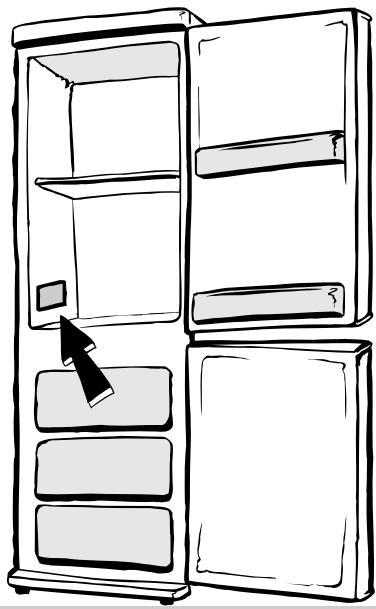
Hand inserting a component into a device housing (no text or symbols visible)Please ensure that the voltage (Volt, V) of the mains socket matches the indications on the data plate which you will find inside your appliance.
Should the socket and the appliance plug not be compatible, do not use adapters, multiple plugs or extensions, but have the socket replaced with another suitable kind by qualified personnel.
The socket which feeds the appliance must be kept operational for future operations (cleaning, defrosting, etc.).
Should the cable become damaged, replace it timeously by contacting specialized Service Centres for the purchase and assembly of the said cable.
Electric safety of this appliance is assured only when it has been connected to a perfectly effective earthing installation as specified in the electric safety norms in force.
STARTING PROCEDURE
Important: if the appliance has been transported to your house in a horizontal position, please wait for a few hours before plugging in the appliance to allow oil to flew back into the compressor.
Proceed with the Internal cleaning, then connect the appliance to the electric socket without using an adaptor (see Electrical connection).
Adjust the thermostats to the food preservation position of your choice (see Instructions for fridge-freezer use).
Thermostat Adjustment
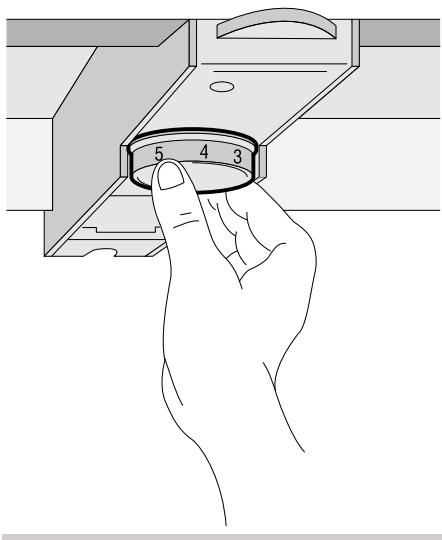
To adjust the internal temperature, turn the thermostat KNOB positioned on the controls section. Position 1 corresponds to milder temperatures. For colder temperatures turn knob to higher numbers. Normally, an intermediate position will be appropriate.
To switch the appliance off, turn the thermostat knob to the 0/STOP position.
WARNING: the appliance remains "live"!
The internal temperatures are influenced by ambient temperatures, according to how many times the refrigerator door has been opened and the quantity of food placed in the refrigerator. You can choose the perfect temperature accordingly.
In extreme ambient conditions, it is best to use the thermostat differently.
When the room temperature is very hot (e.g. in summer) we recommend adjusting the knob to the lower numbers. On the other hand, with cold room temperatures, we recommend adjusting the knob to higher numbers.
With very cold room temperatures, we recommend switching on the winter/super button.
Packaged foodstuffs and other food that has been packed on the shelves must not touch the back wall of the appliance.
FAST FREEZE
Switch Fast Freeze on by pushing the button on the control panel, and switch it off by pushing it again.
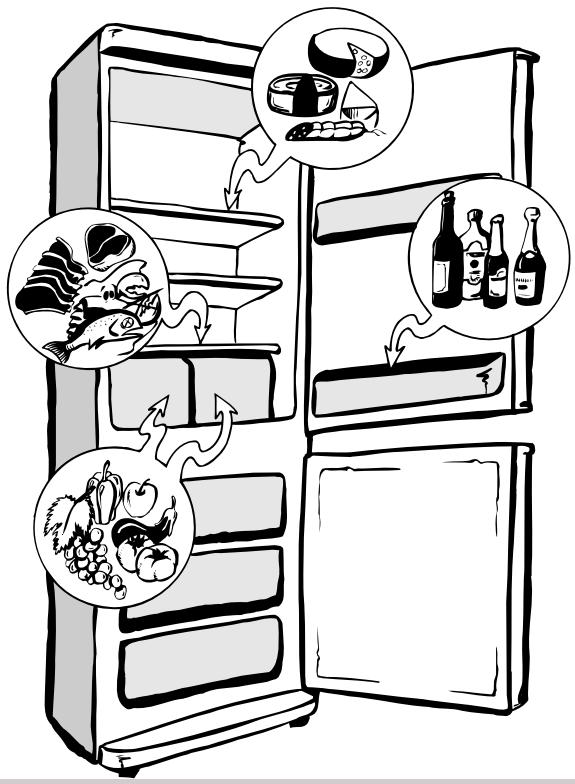
In order to preserve foodstuffs properly, store them in the correct refrigeration compartment, as there are areas in the refrigerator where the temperature is colder than in others.
BEWARE! before closing the freezer door, ensure that every container flap and/or drawer be perfectly closed within the appliance.
FREEZING
Important notice
If you purchase frozen foodstuffs verify that:
• the packing has boon well sealed and not mishandled or damaged;
- there are no iced lenses (this means that the product has already been oven partially thawed);
- the processing date and dates relevant to the type of freezer have boon clearly marked (yours is * * * *);
- in the meantime the products have not thawed, not oven partially;
Never put into your mouth frozen products that have just been taken out of the freezer (ice-cream, ice-blues, ice cubes, etc.), where the low temperature to which they have been subjected may cause ice burns and possible tongue damage.
In case of prolonged current absence transfer the frozen foodstuffs into another working freezer.
If the food stuffs have been thawed, even partially, you may re-freeze them only after having cooked them!
Freezing
Ensure that your freezing operations are carried out under the most hygienic conditions as freezing alone does not sterilise the food. It is advisable to freeze the food by packing it into separate meal portions and not in bulk form. Never put hot or even warm foodstuffs into the freezer! Prior to storing the frozen food, pack it in plastic bags, polyethylene sheets, aluminium foil or freezing containers (this material is found on the market and is labelled “suitable for freezing”). Each pack or container, etc. which you will store into the freezer must follow the instructions below:
- freezing date and expiry date;
• number of portions; - the glass containers must be of the Pyrex type and MUST NEVER be filled to the brim: (freezing expands liquids);
- the packs must be pressed down for air elimination within and must be as flat as possible;
- all frozen food packs, whatever the type, must be closed in order to protect the food.
The maximum quantity of food which can be stored within a period of 24 hours is shown on the data table. Never store a higher quantity of food than indicated.
Do not place fresh foodstuffs next to frozen food. This would cause an increase in the temperature of the frozen foodstuffs.
In order to obtain maximum freezing capacity, turn on the fast-freeze switch (see Caption) 24 hours before putting in food to be frozen.
The fast freezing compartment is the first compartment at the top.
The maximum amount of food that can be frozen is stated on the information plate under the heading " "Capacità di congelazione/Freezing capacity (kg/24h)". Never place larger amounts inside all at the same time. It is better that you turn the switch off as soon as the freezing is completed (max 24 hours).
DEFREEZING
Defrost foodstuffs for immediate use only. Defrosting can be carried out in the following four manners:
• inside the refrigerator;
• in ambient temperatures;
- inside an oven at 40 / 50^ or in a micro-wave oven;
- directly by cooking.
Defrosting in the refrigerator is a slower but safer operation and allows you to save electricity. The freezing temperature of the foodstuff is released into the refrigerator during defrosting.
CLEANING
Internal cleaning
Before carrying out any other operation, unplug the freezer. Clean both the refrigerator and the freezer by using sodium bicarbonate dissolved in water (1 spoonful every 4 litres of water). DO NOT USE ABRASIVE DETERGENTS.
Rinse off with water and dry with a cloth. Plug into the socket. Turn the knob to the conservation temperature position. Wait 3-4 hours before placing food inside. To use the freezer activate fast freeze and wait 3-4 hours before placing deep frozen and/or fresh products into the respective compartments of the freezer. Remove the fast freeze operation after 24 hours.
External cleaning
Before carrying out any other operation, unplug the freezer. Use the same delicate method for external cleaning as you did for the internal cleaning. Remember to dust off the condenser placed at the back of the appliance. Use a dry brush or better still, a vacuum cleaner.
MINOR BREAKDOWNS AND ANOMALIES
Before calling the Service department, check whether you can solve the problem through the following check-points:
Unusual noises - You haven't regulated the base properly and so the freezer vibrates.
Reduced cooling power - You have placed a larger quantity of food than advisable. You have opened the door too many times. The door has not been properly closed.
The appliance does not cool - Check that the plug and socket are making contact. You may have blown a mains fuse. The main light switch has tripped. The thermostat is off, the knob is on "0" position.
The exterior of the appliance is hot - This is NOT a defect, but helps to prevent formation of condensate on the external parts of the appliance.
White streaking on frozen meats - The temperature is too low or you have not heeded the expiry dates indicated on the freezing chart.
Part-freezing - Normally, products containing lots of sugar, fats and alcohol such as ice-creams or juices, do not freeze completely and remain partially soft.
Water droplets on the external walls of the appliance - During the Spring and Autumn seasons, when the house heating is turned off, it may happen that the external walls of the appliance show some water droplets (condensate). This phenomenon does not interfere with the good functioning of the appliance and is not dangerous to people.
Frost build up inside - The doors are not properly shut. You have opened the doors too often.
Water or ice droplets on the back vertical wall of the refrigerator compartment - This is not a defect.
The door opens with difficulty - It is normal for the door to offer some resistance to opening after being closed. This is to ensure a perfect seal of the doors. Wait a few minutes before opening once again.
The light inside the refrigerator is off
- Check the points detailed under "No cooling power"
• The refrigerator light is burnt out.
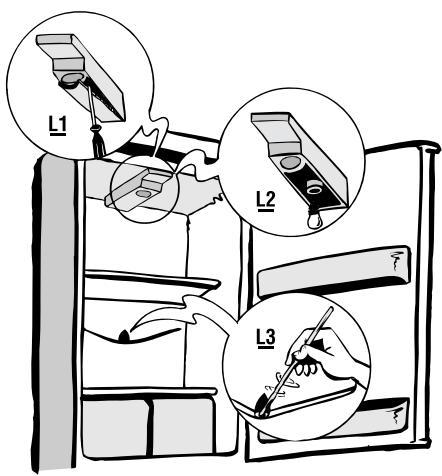
Replace bulb in this manner: unplug the electric current, prise open the light box with a screwdriver (it has been pressure fitted), (fig. L1); replace bulb with a similar one (max 15 WATT), (fig. L2); insert it into the light box. Remove the burnt-out bulb only if you have another to replace it.
Water droplets at the bottom of the refrigerator
The water drainage outlet is obstructed. Clean it with the help of a small wire (fig. L3).
FREEZING TABLES
Fresh meat
| PRODUCT | TIME LIMIT |
| Small cuts of lamb | 6 months |
| Roasted pig | 5 months |
| Pork chops | 4 months |
| Boiled beef, roast beef | 10 months |
| Beef steaks, ribs, stew | 8 months |
| Roast veal | |
| Veal steaks, choice veal cuts | 10 months |
| Minced meat | 4 months |
| Giblets | 3 months |
| Sausages | 2 months |
We advise you to thaw the meat completely before cooking it to avoid meat from cooking quicker on the outside than on the inside, with the exception of schnitzels that can be put directly to cook with a low/medium flame and for boiled meats.
Poultry
They must be plucked, skinned and the innards removed, cut into pieces, washed and dried.
| PRODUCT | TIME LIMIT |
| Duck | 4 months |
| Rabbit | 6 months |
| Chicken for broth | 7 months |
| Goose | 4 months |
| Chicken | 10 months |
| Turkey | 6 months |
| Giblets | 3 months |
Feathered game
They must be plucked, skinned and the innards removed, cut into pieces, washed and dried.
| PRODUCT | TIME LIMIT |
| Wild duck | 8 months |
| Woodcock | |
| Pheasant | |
| Hare | 6 months |
| Partridge | 8 months |
| Quail |
Fish
| PRODUCT | TIME LIMIT | PREPARATION |
| Carp | 2 months | Remove scales, gut and clean fish, remove head, wash, dry and freeze |
| Pike | ||
| Rhomb | ||
| Salmon | ||
| Mackerel | ||
| Tench | ||
| Trout | ||
| Gilthead | 3 months | Remove scales, gut and clean fish, remove head, wash, immerse in cold salt water for 30 seconds, dry and freeze |
| Sole |
Cooked food
N.B. The time limit of preservation of cooked food is reduced if you use fat bacon or lard as sauces.
| PRODUCT | TIME LIMIT | COOKING PREPARATIONS |
| Meat stew sauce | 3 months | Not fully cooked |
| Tomato sauce | Fully cooked | |
| Vegetable soup | 2 months | Without pasta |
| Lasagne | 4 months | Not fully cooked |
| Roast | 2 months | Fully cooked |
| Osso buco (Marrow-bone) | 1 month | Not fully cooked |
| Meat stews | 3 months | |
| Game in salmi | 2 months | Fully cooked |
| Boiled fish | ||
| Baked fish | ||
| Pepperoni, eggplant (aubergines), Meat-stuffed | ||
| baby marrows | Not fully cooked | |
| Boiled spinach | ||
| Pizza | 6 months | Fully cooked |
Put directly onto the flame or into the oven without thawing.
Vegetables
It is advisable to steam cook the vegetables so as not to loose the vitamins and minerals into the water. Therefore there is no need to wait for them to dry before freezing them, but allow them to cool first.
| PRODUCT | TIME LIMIT | PREPARATION | QUICK-BOILING TIME |
| Asparagus | 12 months | Wash, remove hard parts | 2 minutes |
| Cabbage, cauliflower | 6 months | Wash, cut into pieces | 2 minutes (1) |
| Artichokes | 12 months | Remove external leaves | 6 minutes (1) |
| Beans | Shell | 3 minutes | |
| French beans | Wash, remove stalk | 4 minutes | |
| Mushrooms | Wash | 2 minutes (1) | |
| Eggplants | Wash, slice | 4 minutes (2) | |
| Pepperonies (3) | Wash, slice, remove pips | Do not boil | |
| Peas, tomatoes (3) | Shell, freeze, immediately placing them on one layer only, pack them | ||
| Parsley, basil | 8 months | Wash | |
| Spinach | 12 months | 2 minutes | |
| Mixed vegetables ready for soup (Celery, carrots, beetroot, leaks, etc.) | Wash, cut into pieces, divide into portions, do not put potatoes as they turn black | Do not boil | |
| (1) Put a bit of vinegar or lemon in the cooking water.(2) Salt well before cooking.(3) The vegetables become mushy during the thawing, owing to the high content of water in them. We advise freezing only if you intend consuming the cooked products. | |||
Generally, the vegetables are better if they are cooked directly without thawing. Reduce the cooking times bearing in mind the boiling effected before freezing.
Fruit
Fruit must be covered with sugar or syrup according to the cases. The quantity of sugar to use in order to preserve it is about 250 gr. per kg of fruit. Syrups are to be used in different percentages and they are prepared by boiling water with some sugar already melted in it. The various concentration are:
• 30% solution, 450 gr. of sugar for every litre of water
• 40% solution, 650 gr. of sugar for every litre of water
• 50% solution, 800 gr. of sugar for every litre of water
To maintain the colour of the fruit unaltered, dip it into some lemon juice before covering it with sugar, or otherwise add some lemon juice to the syrup. Fruit to be freezed needs an hour in the fridge for setting before being placed into the freezer. The syrup must cover the fruit completely.
| PRODUCT | TIME LIMIT | PREPARATION |
| Apricots | 8 months | Wash, stone, 40% syrup |
| Pineapple | 10 months | Peel, slice, 50% syrup |
| Oranges | Peel, slice, 30% syrup | |
| Cherries | Wash, stone, cover with sugar or with 30% syrup | |
| Strawberries | 12 months | Wash, remove stalks and cover with sugar |
| Melons | Peel, slice, remove pips and cover with 30% syrup | |
| Peaches | 8 months | Peel, stone, slice and cover with 50% syrup |
| Grapefruit | 12 months | Peel, slice, 30% syrup |
| Citrus juice | 10 months | Squeeze, remove pips, sugar according to taste |
| Plums | 12 months | Peel, stone, cover with sugar or with 50% syrup |
| Grapes | Separate the grapes from the stalk, wash, cover with sugar or with 30% syrup | |
| Whortleberries, blackberries red, black current goose berries, raspberries | 10 months | Wash, remove stalks, cover with sugar |
Bread
To be preserved for 2 months. Defreeze the bread in the oven at 50 C having put it in before switching the oven on.
Butter and cheese
Before freezing butter and cheese, cut them into pieces for weekly consumption. Butter is preserved for 8 months and so is hard cheese (parmesan). Other types of cheese need 4 months. defreezing must be done in the fridge being careful about the condensation which logically forms on these products.
- FROST FREE COMBINED FRIDGE AND FREEZER
- GB
- CONGRATULATIONS!
- INDEX
- SAFETY REGULATIONS
- CE
- DISPOSAL OF USED APPLIANCES
- YOUR APPLIANCE
- CAPTION
- WHAT IS REFRIGERATION VENTILATION AND HOW DOES IT WORK?
- REVERSIBILITY OF THE DOORS
- Reversibility of the handles
- Hinges Adjustment
- ELECTRICAL CONNECTION
- USE OF THE APPLIANCE
- STARTING PROCEDURE
- Thermostat Adjustment
- WARNING: the appliance remains "live"!
- FAST FREEZE
- FREEZING
- Important notice
- In order to obtain maximum freezing capacity, turn on the fast-freeze switch (see Caption) 24 hours before putting in food to be frozen.
- DEFREEZING
- CLEANING
- Internal cleaning
- External cleaning
- MINOR BREAKDOWNS AND ANOMALIES
- The light inside the refrigerator is off
- Water droplets at the bottom of the refrigerator
- FREEZING TABLES
- Poultry
- Feathered game
- Cooked food
- Vegetables
- Fruit
- Bread
- Butter and cheese
Marque : DE DIETRICH
Modèle : DRC525WJU
Catégorie : Réfrigérateur congélateur combiné