SAROS ICE8LPT - Høyttaler Crestron - Gratis bruksanvisning og manual
Finn enhetens veiledning gratis SAROS ICE8LPT Crestron i PDF-format.


Brukerspørsmål om SAROS ICE8LPT Crestron
0 spørsmål om dette apparatet. Svar på dem du kjenner, eller still ditt eget.
Still et nytt spørsmål om dette apparatet
Last ned instruksjonene for din Høyttaler i PDF-format gratis! Finn veiledningen din SAROS ICE8LPT - Crestron og ta den elektroniske enheten tilbake i hendene. På denne siden er alle dokumenter som er nødvendige for bruken av enheten din publisert. SAROS ICE8LPT av merket Crestron.
BRUKSANVISNING SAROS ICE8LPT Crestron
SAROS IC6LPT/IC8LPT/ICE6LPT/ICE8LPT
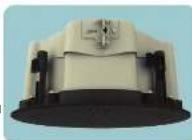
Saros® Low Profile & Saros Express Low Profile 2-Way In-Ceiling Speakers
Sarce ^1 speakers by Crestron ^2 deliver professional grade performance and flexible installation in a range of popular sizes for demanding commercial applications.
Ideal for use in music, paging, and sound reinforcement systems. Seros speakers are engineered to achieve smooth, even coverage, high output, and clear, natural sound quality through the employment of horn loaded dome tweeters, high-efficiency damped cone woofers, ported enclosures, and precisely tuned crossovers.
Sarcs 2-way in-ceiling speakers are available in white or black and may be painted to blend with the ceiling surface

Installation
Prepare the Mounting Hole
Before finalizing the speaker location, check to make sure there are no fixtures, pipes, air ducts, joints, or other possible obstructions. If applicable, use a good quality stud finder to locate joints. If there are no obstructions, use the supplied template to trace an outline of the mounting hole. For drop tile ceilings, remove the ceiling tile and place on a flat surface to trace the mounting hole. For drywall or standard construction ceilings, use the template to trace the mounting hole directly on the ceiling.
Install the Speaker Cable
Run the speaker cable (not included) from the audio source to the speaker location, observing all appropriate local codes. Strip the ends of the speaker cables approximately 1/8 in. to 3/16 in. (\~3 mm to \~5 mm) and twist the strands.
Install the Tile Bridge
The included tile bridge components provide proper support when the speaker is installed in a typical drop tile ceiling. Refer to the illustration below.
-
Based on the location of the mounting hole determined in the "Prepare the Mounting Hole" section above, use the two supplied screws to attach the support ring to the rails so that when installed, the ring is aligned with the mounting hole and the rails rest on the ceiling grid frame.
-
The support ring position on the rails is adjustable to enable off-center speaker positioning. The tie bridge assembly can be folded to fill through the speaker cutout in blind-mount situations.
Tile Bridge Assembly

Install or Remove the Grille
The zero-bezel frameless grille is held in place by powerful magnets. A safety tether is included to prevent the grille falling from the ceiling. With the tether attached, place the grille in position on the speaker. To remove the grille, grip the edges and pull away from the speaker.
Paint the Speaker Grille
Painting the Speaker grille should be done prior to mounting.
-
Carefully remove the mesh on the underside of the grille and set it aside for reinstallation. It may be necessary to use a knife or other sharp instrument to free an edge of the mesh so it can be peeled away. Use care to avoid cutting or tearing the mesh.
-
Dry brush or lightly spray paint grille. Use care to avoid clogging the holes in the grille.
-
Once the paint is dry, reinstall the mesh to the underside.
Mount or Remove the Speaker
The in-ceiling speaker includes four loggle clamps that simplify the mounting process. If the grille is mounted on the speaker, remove it before proceeding. (Refer to "Install or Remove the Grille" above.)
-
Referring to the illustrators to the right, remove the screw securing the rear cover panel, and lift the cover panel off to expose the supplied terminal block.
-
Route the speaker cable through the cover cable clamp and connect the wires to the terminal block, using the outer IN terminals: red to + and black to -. Use the inner + and - THRU terminals to connect a pass-through (parallel) speaker.
-
Allow some slack in the speaker cable and position the cover panel on the back, making certain it engages the mounting clips. Secure the cover panel using the screw removed in step 1, and tighten the cable clamp to secure the cable. Do not overlighten. Use a safety tether (SPKA-ST-15 (not included)) attached to the rear enclosure to prevent the speaker from accidentally falling.
-
The toggle clamps offer two positions to accommodate both standard and extra thick surfaces up to 2.4 in. (61 mm). For extra thick tiles, reset the toggle clamps to the upper position. a. With the toggle clamps turned inward, insert the speaker into the opening.
b. Hold the speaker against the ceiling and begin tightening the four screws on the front of the speaker. The toggle clamps first rotate into clamping position (as indicated in the front view illustration to the right) and then begin holding the speaker to the ceiling.
c. Tighten the screws until the speaker is secure. Do not overtighten
Set the Transformer Tap Selector Switch
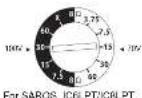
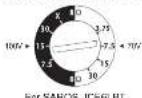
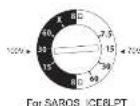
The speakers are equipped with a 70V/100V matching transformer for distributed audio systems. The transformer tap selector switch on the front panel is used to set the speaker power level. Use a flat blade screwdriver to adjust the switch.
-
For SAROS_ICBLPT and SAROS_ICBLPT 70V systems, use the left side settings and select from 3.75, 7.5, 15, 30, or 60 walls.
-
For SAROS_ICELPT and SAROS_ICELPT 100V systems, use the right side settings and select from 7.5, 15, 30, or 60 watts. The X position should not be used.
-
For SAROS_ICE6LPT 70V systems, use the left side settings and select from 3.75, 7.5, 15, or 30 walls.
-
For SAROS_ICE6LPT 100V systems, use the right side settings and select from 7.5, 15, or 30 walls. The X position should not be used.
-
For SAROS_ICE&LPT 70V systems, use the right side settings and select from 7.5, 15, 30, or 60 watts.
-
For SAROS_ICE&LPT 100V systems, use the right side settings and select from 15, 30, or 60 watts. The X position should not be used.
The switch may also be set to 8Ω operation, bypassing the transformer completely. This setting should be used only for 8Ω audio systems.
Speaker Cable Connections
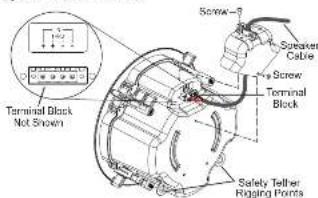
Front View - Grille Removed
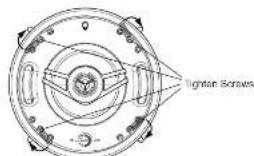
SAROS IC6LPT/IC8LPT/ICE6LPT/ICE8LPT
Saros® Low Profile & Saros Express Low Profile 2-Way In-Ceiling Speakers

Physical Views
Front View - Grille Removed (Typical)
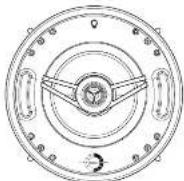
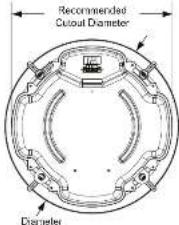
Rear and Side View (Typical)
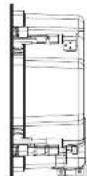

Specifications
SAROS_IC6LPT/IC8LPT/ICE6LPT/ICE8LPT
| SPECIFICATION | SAROS_IC6LPT SAROS_IC8LPT SAROS_SOROPTICE6LPT | |||
| Wooler | 6.5 in. (165 mm) polypropylene with ring mode decoupled cloth surround and steel basket | 8.0 in. (203 mm) polypropylene with ring mode decoupled cloth surround and steel basket | 8.5 in. (165 mm) treated paper with ring mode decoupled cloth surround and steel basket | 8.0 in. (200 mm) treated paper with ring mode decoupled cloth surround and steel basket |
| Tweeler | 0.98 in. (25 mm) titanium dome, non-coated | 0.98 in. (25 mm) titanium dome, non-coated | 0.98 in. (25 mm) treated cone dome, non-coated | 0.98 in. (25 mm) treated cone dome, non-coated |
| Crossover Frequency | 2.5 kHz | 2.5 kHz | 2.5 kHz | 2.5 kHz |
| Impedance | 8.0 nominal with transformer set to 8Ω | 8.0 nominal with transformer set to 8Ω | 8.0 nominal with transformer set to 8Ω | 8.0 nominal with transformer set to 8Ω |
| Transformer Tops | 3.75, 7.5, 15, 30, 60 watts at 70V, 7.5, 15, 30, 60 watts at 100V | 3.75, 7.5, 15, 30, 60 watts at 70V, 7.5, 15, 30, 60 watts at 100V | 3.75, 7.5, 15, 30 watts at 70V, 7.5, 15, 30 watts at 100V | 7.5, 15, 30, 60 watts at 70V, 15, 30, 90 watts at 100V |
| Frequency Response | 65 Hz to 20 kHz (±3 dB) | 95 Hz to 20 kHz (±3 dB) | 85 Hz to 20 kHz (±3 dB) | 80 Hz to 20 kHz (±3 dB) |
| Frequency Range | 55 Hz to 20 kHz (-10 dB) | 55 Hz to 20 kHz (-10 dB) | 70 Hz to 20 kHz (-10 dB) | 65 Hz to 20 kHz (-10 dB) |
| Power Handling | 50 walls program, (8 Ω) | 50 walls program (8 Ω) | 60 walls program (8 Ω) | 60 walls program, (8 Ω) |
| Sensitivity | 88 dB @ (W/m) | 90 dB @ (W/m) | 88 dB @ (W/m) | 89 dB @ (W/m) |
| Coverage | 95° conical (nominal) | 95° conical (nominal) | 95° conical (nominal) | 95° conical (nominal) |
| ConnectionsInput | (1) 4-pin 5 mm detachable terminal block with screw-down flanges;Speaker Input with parallel pass-through;Maximum Wire Size: 12 AWG | |||
| ControlsTransformer Top | (1) Recessed 5-position screwdriver adjustable rotary switch on buffer;Used to select 70V/100 V gap settings or 8Ω (bypass) | |||
| EnvironmentalTemperatureHumidity | -2" to 120°F (-10" to 49°C)6% to 95% R/I (non-condensing) | |||
| ConstructionEnclosureBottleGrillsMounting | Zinc-plated steel, plenum-rated, side-entry cable clampABS UL84V0 plasticSteel with textured trash, paintbrush, magnetically-old zero-bazeal frameless, safety tetherFlush ceiling mount using 4 integral 2-slew loggle clamps, 2.4 in. (61 mm) maximum surface thickness, file bridge included; (2) Rigging joints for safety rather (SPKA-ST-15 sold separately) | |||
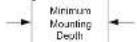
| DimensionsDiameterDepthRecommended output diameterMinimum mounting depth | 10.64 in. (270 mm) not including loggles5.30 in. (135 mm)9.70 in. (246 mm)5.20 in. (132 mm)8.2 lb (3.7 kg) | 12.13 in. (328 mm) not including loggles5.30 in. (135 mm)11.20 in. (285 mm)5.20 in. (132 mm)11.1 lb (5.3 kg) | 10.64 in. (270 mm) not including loggles5.30 in. (135 mm)9.70 in. (246 mm)5.20 in. (132 mm)9.2 lb (4.2 kg) | 12.13 in. (308 mm) not including loggles5.30 in. (135 mm)11.20 in. (285 mm)5.20 in. (132 mm)10.8 lb (4.9 kg) |

Problem Solving
Troubleshooting
The following table provides corrective action for possible trouble situations. If further assistance is required, please contact a Crestron True Blue Support at 1-888-CRESTRON [1-888-273-7676].
| TROUBLE | POSSIBLE CAUSE(S) | CORRECTIVE ACTION |
| No sound or intermittent sound is coming from the speakers. | There is a cable connection error. | Verify the cable connections between the amplifier and speakers. |
| The amplifier is not receiving an input signal or there is a malfunction. | Verify that the amplifier is functioning correctly, that it is receiving an input signal, and that the correct input source is selected. | |
| Constant noise such as buzz, hunt, or hiss is coming from the speakers. | There is a faulty device in the system. | Verify that all system devices are functioning properly. |
| There is a system grounding fault. | Verify that system grounding is correct. | |
| Low frequency output is poor. | There is an incorrect polarity connection at the speaker or amplifier. | Verify the speaker connection polarity (+ on amplifier to + on speaker). |
Further Inquiries
To locate specific information or resolve questions after reviewing this guide, contact Crestron True Blue Support at 1-888-CRESTRON [1-888-273-7876] or, for assistance within a particular geographic region, refer to the listing of Crestron worldwide offices at www.crestron.com/offices.
To post a question about Creslron products, log onto Creslron's Online Help at www.creslron.com/onlinehelp. First-time users must establish a user account to fully benefit from all available features.
The specific patents that cover creslron products are listed at patents.cresciron.com.
Crestron, the Crestron logo, and Bars are either trademarks or registered trademarks of Crestron Electronics, Inc., in the United States and/or other countries. Other trademarks, registered trademarks, and trade names may be used in this document to transfer to other entities qualifying the marks and names of their products. Crestron disclaims any proprietary interest in the marks and names of others. Crestron is not responsible for errors in typography or photography.
This document was written by the Technical Publications department at Crestron, 02021 Crestron Electronics, Inc.