
MYTHO 6 - Monitor RCF - Free user manual and instructions
Find the device manual for free MYTHO 6 RCF in PDF.


| Product Type | Active Studio Monitor |
| Brand | RCF |
| Model | MYTHO 6 |
| Woofer Size | 6.5 inches (165 mm) |
| Tweeter Size | 1 inch (25 mm) dome |
| Amplifier Power | 100 W (RMS) total |
| Frequency Response | 50 Hz - 20 kHz |
| Crossover Frequency | 2.0 kHz |
| Maximum SPL | 110 dB (peak) |
| Input Connectors | XLR balanced, TRS balanced, RCA unbalanced |
| Input Impedance | 20 kOhm (balanced), 10 kOhm (unbalanced) |
| Dimensions (H x W x D) | 350 x 220 x 280 mm |
| Weight | 8.2 kg |
| Power Supply | AC 100-240 V, 50/60 Hz |
| Power Consumption | 60 W (max) |
| Enclosure Type | Bass reflex with front port |
| Cabinet Material | MDF with vinyl finish |
| Protection Features | Overload, thermal, limiter |
| Indicators | Power LED, limiter LED |
| Operating Temperature | 0°C to 40°C |
| Storage Temperature | -20°C to 60°C |
| Cleaning Instructions | Wipe with dry cloth; do not use solvents |
| Spare Parts Availability | Contact RCF authorized service centers |
| Reparability | Replaceable amplifier module and drivers |
Frequently Asked Questions - MYTHO 6 RCF
User questions about MYTHO 6 RCF
0 question about this device. Answer the ones you know or ask your own.
Ask a new question about this device
Download the instructions for your Monitor in PDF format for free! Find your manual MYTHO 6 - RCF and take your electronic device back in hand. On this page are published all the documents necessary for the use of your device. MYTHO 6 by RCF.
USER MANUAL MYTHO 6 RCF
- All the precautions, in particular the safety ones, must be read with special attention, as they provide important information.
2. POWER SUPPLY FROM MAINS
a. The mains voltage is sufficiently high to involve a risk of electrocution; install and connect this product before plugging it in.
b. Before powering up, make sure that all the connections have been made correctly and the voltage of your mains corresponds to the voltage shown on the rating plate on the unit, if not, please contact your RCF dealer.
c. The metallic parts of the unit are earthed through the power cable. An apparatus with CLASS I construction shall be connected to a mains socket outlet with a protective earthing connection.
d. Protect the power cable from damage; make sure it is positioned in a way that it cannot be stepped on or crushed by objects.
e. To prevent the risk of electric shock, never open this product: there are no parts inside that the user needs to access.
- Make sure that no objects or liquids can get into this product, as this may cause a short circuit.
This apparatus shall not be exposed to dripping or splashing. No objects filled with liquid, such as vases, shall be placed on this apparatus. No naked sources (such as lighted candles) should be placed on this apparatus.
- Never attempt to carry out any operations, modifications or repairs that are not expressly described in this manual.
Contact your authorized service centre or qualified personnel should any of the following occur:
- The product does not function (or functions in an anomalous way).
- The power cable has been damaged.
- Objects or liquids have got in the unit.
-
The product has been subject to a heavy impact.
-
If this product is not used for a long period, disconnect the power cable.
-
If this product begins emitting any strange odours or smoke, switch it off immediately and disconnect the power cable.
-
Do not connect this product to any equipment or accessories not foreseen.
For suspended installation, only use the dedicated anchoring points and do not try to hang this product by using elements that are unsuitable or not specific for this purpose. Also check the suitability of the support surface to which the product is anchored (wall, ceiling, structure, etc.), and the components used for attachment (screw anchors, screws, brackets not supplied by RCF etc.), which must guarantee the security of the system / installation over time, also considering, for example, the mechanical vibrations normally generated by transducers.
To prevent the risk of falling equipment, do not stack multiple units of this product unless this possibility is specified in the user manual.
- RCF S.p.A. strongly recommends this product is only installed by professional qualified installers (or specialised firms) who can ensure correct installation and certify it according to the regulations in force.
The entire audio system must comply with the current standards and regulations regarding electrical systems.
- Supports and trolleys
The equipment should be only used on trolleys or supports, where necessary, that are recommended by the manufacturer. The equipment / support / trolley assembly must be
IMPORTANT

moved with extreme caution. Sudden stops, excessive pushing force and uneven floors may cause the assembly to overturn.
-
There are numerous mechanical and electrical factors to be considered when installing a professional audio system (in addition to those which are strictly acoustic, such as sound pressure, angles of coverage, frequency response, etc.).
-
Hearing loss
Exposure to high sound levels can cause permanent hearing loss. The acoustic pressure level that leads to hearing loss is different from person to person and depends on the duration of exposure. To prevent potentially dangerous exposure to high levels of acoustic pressure, anyone who is exposed to these levels should use adequate protection devices. When a transducer capable of producing high sound levels is being used, it is therefore necessary to wear ear plugs or protective earphones. See the manual technical specifications to know the maximum sound pressure level.
IMPORTANT NOTES
To prevent the occurrence of noise on line signal cables, use screened cables only and avoid putting them close to:
- Equipment that produces high-intensity electromagnetic fields
- Power cables
- Loudspeaker lines.
IMPORTANT NOTES

OPERATING PRECAUTIONS

OPERATING PRECAUTIONS
- Place this product far from any heat sources and always ensure an adequate air circulation around it.
- Do not overload this product for a long time.
- Never force the control elements (keys, knobs,etc.).
- Do not use solvents, alcohol, benzene or other volatile substances for cleaning the external parts of this product.
IMPORTANT NOTES
Before connecting and using this product, please read this instruction manual carefully and keep it on hand for future reference. The manual is to be considered an integral part of this product and must accompany it when it changes ownership as a reference for correct installation and use as well as for the safety precautions. RCF S.p.A. will not assume any responsibility for the incorrect installation and / or use of this product.
WARNING: To prevent the risk of fire or electric shock, never expose this product to rain or humidity.
IMPORTANT NOTES

WARNING

PRODUCT INFORMATIONS

'Mytho 6' and 'Mytho 8' are 'studio monitors' (or 'reference monitors'): loudspeakers specifically designed for audio production applications where an accurate reproduction (having an extended and flat frequency response) is required, such as recording, television and radio studios.
These studio monitors are defined 'near-field', as they are designed to be small enough to be placed on a stand or a desk in proximity to the listener (1 – 2 m), so that most of the sound that the listener hears directly comes from loudspeakers, rather than reflecting off of walls and ceilings (minimising the 'sound coloration' and the reverberation of the room).
ICC TECHNOLOGY
'Mytho' woofers feature a unique 'Impedance Control Coil' technology: a secondary coil wound on the loudspeaker yoke and driven in opposite phase to the primary coil has the function of cancelling the primary coil inductance, increasing the speaker sensitivity and reducing the loudspeaker distortion.
A primary effect of this technology is the improvement of the temporal behaviour of the loudspeaker, improving the crossover transition from the woofer to the tweeter and resulting in incredible midrange accuracy and perfect phase linearity.
NEODYMIUM VENTED WOOFERS
Neodymium 'Mytho' woofers feature a large sized 51 mm voice coil. This guarantees very high energy for tight and controlled bass reproduction and perfect thermal stability with minimum power compression. The magnetic circuit features a special air ventilation to reduce air compression, air noises and minimize distortion in large excursion situations.
HIGH DEFINITION TWEETER
'Mytho' monitors features high quality metal dome tweeter. The dome is large for the best vocal reproduction and its design is the state of the art for high frequency definition.
ALUMINIUM CABINET
The die cast aluminium cabinet is the result of many years of experience. The cabinet is internally braced and reinforced to improve the low frequency response and reduce resonances. The internal volume is maximised in comparison with more traditional wooden cabinets. The external shape of the cabinet is precisely designed to minimize edge reflections. The front baffle integrates a 'precision
directivity' wave-guide designed to improve the treble dynamics and create uniform high frequency dispersion. Special attention has been dedicated to the bass reflex air port design. The cabinet vertical angle can be adjusted to optimise the orientation for the listening position.
DEDICATED POWER
'Mytho' monitors are 2-way (bi-amplified) active loudspeakers, having a 200 watt amplifier for the low frequencies and a 100 watt amplifier for the high frequencies; both amplifiers are AB class.
DSP PROCESSING
The digital signal processing is carried out by a dedicated high quality DSP, in order to guarantee a fine crossover tuning and an optimal frequency response, independently from temperature and component tolerances.
Soft amplifier clipping and transducers protections are integrated in the DSP processing.
INPUT BOARD
The 'Mytho' input board features all the controls to set up the system in every situation:
- Balanced combo XLR – jack signal input
- Input sensitivity control (+6 dBu ÷ -6 dBu).
- Woofer and tweeter mute switches, useful to listen each single transducer (for testing)
- 'Treble tilt' control
- 'Bass tilt' control
ICC TECHNOLOGY
NEODYMIUM VENTED WOOFERS
HIGH DEFINITION TWEETER
ALUMINUM CABINET
DEDICATED POWER
DSP PROCESSING
INPUT BOARD
- 'Bass roll-off' control with a choice among 4 settings
- 'Equalisation' and 'Desktop control' corrections
MAIN FEATURES
- Bi-amplified: 200 W + 100 W, AB class
- Dedicated DSP
- Fully featured input board
- 6.5" ('Mytho 6') / 8" ('Mytho 8') neodymium ICC vented woofer
- 1" aluminium dome tweeter
- Constant directivity wave-guide
- Die cast aluminium cabinet
- Reflection free cabinet design
- Low distortion reflex port
MAIN FEATURES
FRONT PANEL

FRONT PANEL
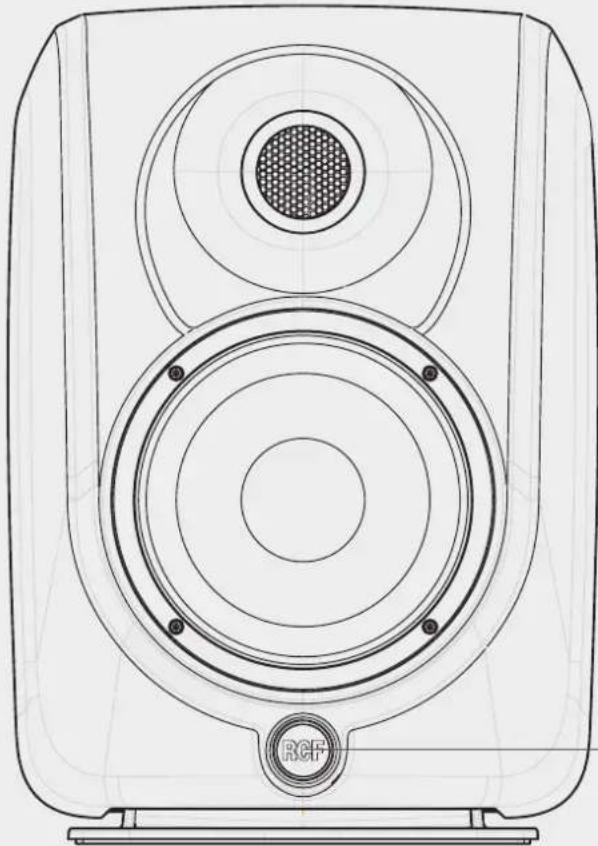
1 ON - STAND-BY SWITCH WITH LEDs
Touch to switch on / off (stand-by) the studio monitor.
STAND-BY: red LEDs are lit
ON: white LEDs are lit
natural_image
Line drawing of a speaker with two concentric circles and a textured grille, labeled 'RCF' at the base (no text or symbols on the speaker itself)1
REAR PANEL


2 Input (with protecting fuse) for the power cable.
3 Main power switch.
4 Voltage selector (115 – 230 V).
IMPORTANT NOTES
Before powering up, ensure that the voltage selector corresponds to the mains voltage. FUSE: use either T4A for 115 V or T2A for 230 V.
5 Audio signal balanced input with combo XLR - 1/4" jack socket.
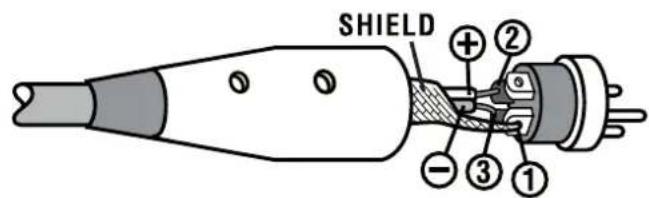

①-ground
②-hot +
③-cold
IMPORTANT NOTES

XLR PLUG


IMPORTANT NOTES
UNBALANCED CONNECTION: the audio signal can be affected by external interferences and its level is attenuated of 6 dB (due to its half voltage). Do not use a cable longer than 5m!
6 INPUT SENSITIVITY CONTROL
The input sensitivity can be adjusted through this control (+6 dBu ÷ -6 dBu). Turn it clockwise to increase the input sensitivity. The central (0 dBu) and the 2 extreme (+6 dBu, -6 dBu) positions are dented
IMPORTANT NOTES
Ensure that all studio monitors placed in the same recording studio (/ room) are all set to the same level.
7 Dip-switches
See the following section 'Dip-switch settings'
8 USB port reserved for RCF service only.
IMPORTANT NOTES

IMPORTANT NOTES

DIP-SWITCH SETTINGS

BASS TILT (A, B dip-switches)
This setting is a low-shelf shaping filter that reduces frequencies below 500 Hz by the selected amount (OFF, -1dB, -2dB, -4dB). This filter helps to correct the progressive increase of mid-low and low frequencies due to resonances in small rooms. The amount of correction will depend on the size and shape of the room (a bigger correction for smaller and regular shaped rooms). A large room shall require no correction.

BASS ROLL-OFF (C, D dip-switches)
This filter that reduces the very low frequencies. If the switch is set in OFF position the filtering is bypassed.
In the -3 dB or -6 dB position the low-shelf filter reduces frequencies below 80 Hz by the selected amount. The low frequency attenuation is necessary when loudspeakers are placed near the room walls or corners. The amount will depend on the specific situation (in general -3 dB for wall placement and -6dB in case of corner placement). The 80 Hz High Pass filter apply to the input a Butterworth high-pass filter with cut-off frequency at 80 Hz. This filter will be used for vocal monitoring purposes or when the Mytho monitors are used in combination with a subwoofer.
WOOFER (E dip-switch)
It turns on/off the low frequency amplifier. This switch must be kept on and set to MUTE for testing purpose only.
POWER LED (F dip-switch)
This switch in low position turns off the LEDs around the RCF logo in front of the speaker. This option can be required when the positioning of the Mytho Monitor is close to video sources or in residential applications.
TWEETER (H dip switch)
This switch in low position mute the high frequency amplifier. This option will help evaluating the proper working condition of the bass channel.
This switch must be kept on and set to MUTE for testing purposes only.
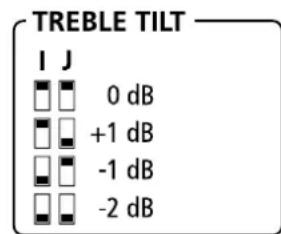
TREBLE TILT (I, J dip-switches)
This setting is a high-shelf shaping filter that increase or reduce frequencies above 6 kHz by a selected amount. A room can be very dull or very bright depending on wall materials. This filter help to correct the behaviour in the high frequencies for a specific room.
For a normal room no correction shall be applied (0 dB position). For a dull room the treble tilt filter shall be set at +1 dB. The filter shall be set at -1 dB or -2 dB for a bright or very bright room.
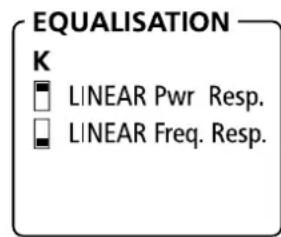
EQUALISATION (K dip-switch)
The woofer emission is omni directional for very low and mid-low frequencies but tend to be more directive for mid frequencies. When the room is small the amount of reflections from the walls is bigger for the very low and mid-low frequencies that will tend to be to be predominant compared to mid frequencies in case of same axial emission.
When this switch is set to LINEAR POWER response a dedicated filter compensates this lack of mid frequencies from the woofer channel.
In medium to large rooms, where the wall reflections tend to be negligible, this switch must be set in the LINEAR FREQUENCY response.
DESKTOP CONTROL (L dip-switch)
This control reduces the emission in the frequency range (centred in the 150 Hz octave) that is usually boosted when studio monitors are directly placed on a reflective surface (e.g. the mixing desk, a table, etc.).
If Mytho Monitors are placed in this positions set this switch ON to obtain a linear listening.
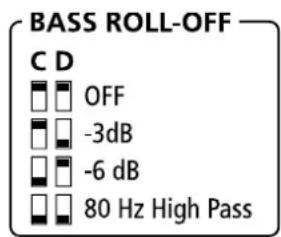




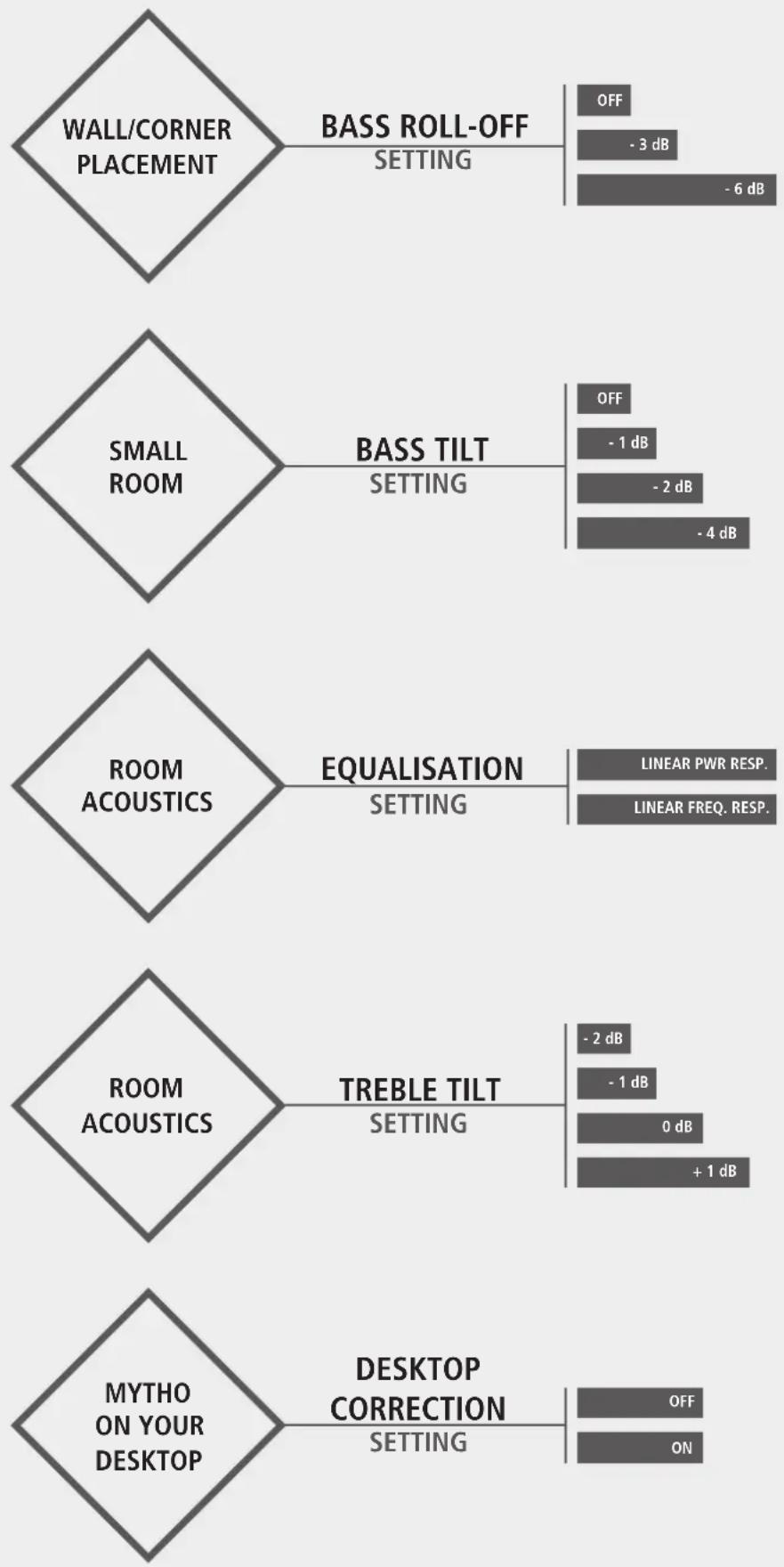
The low frequency attenuation is necessary when loudspeakers are placed near the room walls or corners. The amount will depend on the specific situation (in general -3 dB for wall placement and -6dB in case of corner placement).
It corrects the progressive increase of mid-low and low frequencies due to resonances in small rooms. The amount of correction will depend on the size and shape of the room (a bigger correction for smaller and regular shaped rooms). A large room shall require no correction.
It corrects the woofer mid-frequencies emission in small rooms. When the room is small the amount of reflections from the walls is bigger for the very low and mid-low frequencies that will tend to be to be predominant compared to mid frequencies in case of same axial emission. Set to LINEAR POWER response to compensates this lack of mid frequencies from the woofer channel. In medium to large rooms, where the wall reflections tend to be negligible, this switch must be set in the LINEAR FREQUENCY response.
A room can be very dull or very bright depending on wall materials. This filter help to correct the behaviour in the high frequencies for a specific room. For a normal room no correction shall be applied (0 dB position). For a dull room the treble tilt filter shall be set at +1 dB. The filter shall be set at -1 dB or -2 dB for a bright or very bright room.
If Mytho Monitors are placed in this positions set this switch ON to obtain a linear listening. This filter reduces the emission in the frequency range (centred in the 150 Hz octave) that is usually boosted when studio monitors are directly placed on a reflective surface (e.g. the mixing desk, a table, etc.).
SPEAKER PLACEMENTS

IMPORTANT NOTES
- The acoustic axis of every studio monitor shall be aimed to the listener ears.
- It is strongly advisable to keep them in the vertical position in order to get the best results.
- The stereo reproduction is got through a symmetrical configuration of loudspeakers: the left and the right studio monitors shall be placed at an equal distance from the listener (in order to get an ideal triangle, where the 2 loudspeakers and the listener are the its vertexes).
- Do NOT put objects close to studio monitors that may cause undesired reflections and / or slightly change the frequency response.
STUDIO MONITORS ON FLOOR STANDS
This is the optimal solution: the 2 studio monitors are on 2 identical floor stands placed just behind the mixer. The floor stand height needs to be suitable for this purpose: each loudspeaker axis is to be at the same level of the listener ears. Set (or leave) both BASS TILT and BASS ROLL-OFF controls to OFF (but particular studio monitor placements, explained in the next manual section).
IMPORTANT NOTES

STUDIO MONITORS ON FLOOR STANDS

natural_image
Top-down schematic of a computer monitor with two speakers and a central control panel (no text or labels)

If the floor stands are not available, a solution is to place the studio monitors directly on the mixer (if there is enough room). As the mixer is in fact a desk just under the loudspeakers, the early sound reflections can affect the frequency response. A smart correction against this little problem is given by the DESKTOP CONTROL, so on both 'Mytho' studio monitors, set the 'L' dip-switch (on the rear panel) to ON.
natural_image
Front view of a computer terminal layout with two speakers and a central control panel (no text or labels visible)

NEAR WALLS
When studio monitors are placed just a few centimetres from the wall behind them, the low frequencies are emphasized. In this case, it is advisable to attenuate the low frequencies by setting the BASS ROLL OFF control (on both the 'Mytho' studio monitors; C and D dip-switches) to -3 dB.
NEAR WALLS


CLOSE TO ROOM CORNERS
When studio monitors are placed just a few centimetres from the room corners, the low frequencies are extremely emphasized. In this case, it is advisable to set (on both 'Mytho' studio monitors):
- the BASS ROLL-OFF control (C, D dip-switches) to -6 dB.
CLOSE TO ROOM CORNERS


The 5 'Mytho' studio monitors shall be placed according to the picture above, respecting the room symmetry. In a reverberant room, it may be necessary to reduce the low frequencies by setting the BASS TILT control (on all the 5 studio monitors; A and B dip-switches) to a suitable value.
'Mytho' studio monitors can be wall-mounted through mounting accessories (not included). On the rear, there are four M5 threaded mounting points conforming to an industry-standard pattern (i.e. Omnimount™):
Mytho 6: (centre to centre) 107.9 x 50.8 mm (4¼" x 2")
Mytho 8: (centre to centre) 127 x 69.9 mm (5" x 2 ^3/4 ).
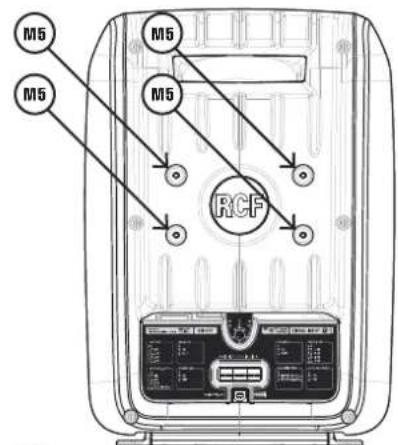

At the bottom, there is a single M 10 thread, useful to fix the studio monitor on a stand.
FINAL TIPS

STUDIO MONITORS
Real studio monitors should not always sound good to our ears, as their main purpose is to be 'sound microscopes' capable of highlighting all sound nuances in the audible frequency range.
Studio monitors are tools to find out any possible problem in the mix.
Although studio monitors and HI-FI loudspeakers may seem similar, they have different characteristics and purposes: studio monitors are neutral and have a flat frequency response (without distortion); most HI-FI loudspeakers are often deliberately designed to have particular frequency responses that 'colour' the sound (to match listeners' tastes).
STUDIO MONTORS
The studio monitor position shall be symmetrical with respect to the side walls and asymmetrical with respect to the ideal line between the rear and the front walls, otherwise reflections may alter the sound image.
Studio monitors shall be at the same level (height from the floor) of the listener ears.
STABLE BASES and FLOOR STANDS
Studio monitors shall be placed on stable and firm bases, in order to avoid annoying vibrations and sound interferences. Usually, it is preferable to place studio monitors on floor stands (and not on mixing desks).
LISTENING VOLUME LEVEL
It is not recommended to listen at high volume too long: apart from the obvious health risks, ears fatigue can set in and dull your perception of top end frequencies.
Monitoring at different volume levels is a good practice anyway; even to listen to a song mix outside the recording studio may help.
EQUALISATION
'Mytho' controls can help to equalise the sound, yet these should be used if necessary only as they cannot replace a good room acoustic treatment and correct a wrong loudspeaker placement.
VERY LOW FREQUENCIES
'Mytho' studio monitors can provide an extended response on low frequencies, even without a subwoofer, but the limit is fixed by the room dimensions. The room longest diagonal is indicative of the maximum wavelength reproducible: for instance, a recording studio with dimensions 3.6 x 3.75 x 4.5 m has the longest diagonal equal to 6.88 m, which corresponds to a c.50 Hz wave.
STABLE BASES AND FLOOR STANDING
LISTENING VOLUME LEVEL
EQUALIZATION
VERY LOW FREQUENCIES
SPECIFICATIONS

TRANSDUCERS
Woofer (low frequencies)
MYTHO 6
MYTHO 8
Driver (high frequencies)
AMPLIFIERS / DSP
Power (low frequencies)
Power (high frequencies)
Cooling
Crossover frequency
MYTHO 6
MYTHO 8
Protections
Limiter
CONTROLS
Input sensitivity
Bass tilt
Bass roll-off
Treble tilt
Desktop control
Equalisation
Woofer mute
Tweeter mute
USB port
ACOUSTIC DATA
Frequency response
MYTHO 6
MYTHO 8
Max. sound pressure level
Coverage angles
GENERIC
Input connector
Operating voltage
Max. consumption (power)
Dimensions (w, h, d)
MYTHO 6
MYTHO 8
Net weight
MYTHO 6
MYTHO 8
Cabinet
6.5" neo
8" neo
1" neo, metal dome
200 W
100 W
convection
1900 Hz
1800 Hz
thermal, over excursion, rms
soft limiter
+ 6 ÷ - 6 dBu
Low-shelf filter: -1 dB, -2 dB, -4 dB @ 500 Hz
Low-shelf filter: -3 dB, -6 dB @ 80 Hz
Low-pass filter (Butterworth): 80 Hz, 12 dB / oct.
Hi-shelf filter: +1 dB, -1 dB, -2 dB @ 6 kHz
- 3 dB @ 150 Hz
2.0 (1.1 compatible); for RCF service only
40 Hz ÷ 20 kHz
35 Hz ÷ 20 kHz
114 dB 116 dB
110° horizontal, 70° vertical
combo XLR-jack
115-230V ac / 50-60 Hz
200 W
265 mm, 370 mm, 250 mm
310 mm, 430 mm, 300 mm
10.5 kg
13 kg
die-cast aluminium
AVVERTENZE PER LA SICUREZZA
- Cassa con design anti-diffrazioni
- Porta reflex a bassa distorsion
CARATTESTICHE PRINCIPALI
PANNELLO FRONTALE

PANNELLO FRONTALE
natural_image
Line drawing of a speaker with two concentric circles and a central grille, labeled 'RCF' at the base (no text or symbols on the diagram itself)1
PANNELLO POSTERIORE


TWEETER (H dip switch)
TREBLE TILT (I, J dip-switches)




natural_image
Pure electrical circuit lines without any symbols

natural_image
Top-down schematic of a computer board with two ports and a central connector (no text or symbols visible)

VICINO A PARETI
Filtro Hi-shelf: +1 dB, -1 dB, -2 dB @ 6 kHz
- 3 dB @ 150 Hz



- POWER SUPPLY FROM MAINS
- IMPORTANT NOTES
- OPERATING PRECAUTIONS
- PRODUCT INFORMATIONS
- ICC TECHNOLOGY
- NEODYMIUM VENTED WOOFERS
- HIGH DEFINITION TWEETER
- ALUMINIUM CABINET
- DEDICATED POWER
- DSP PROCESSING
- INPUT BOARD
- ALUMINUM CABINET
- MAIN FEATURES
- FRONT PANEL
- REAR PANEL
- INPUT SENSITIVITY CONTROL
- Dip-switches
- USB port reserved for RCF service only.
- DIP-SWITCH SETTINGS
- BASS TILT (A, B dip-switches)
- BASS ROLL-OFF (C, D dip-switches)
- WOOFER (E dip-switch)
- POWER LED (F dip-switch)
- TWEETER (H dip switch)
- TREBLE TILT (I, J dip-switches)
- EQUALISATION (K dip-switch)
- DESKTOP CONTROL (L dip-switch)
- SPEAKER PLACEMENTS
- STUDIO MONITORS ON FLOOR STANDS
- NEAR WALLS
- CLOSE TO ROOM CORNERS
- FINAL TIPS
- STUDIO MONITORS
- STUDIO MONTORS
- STABLE BASES and FLOOR STANDS
- LISTENING VOLUME LEVEL
- EQUALISATION
- VERY LOW FREQUENCIES
- SPECIFICATIONS
- TRANSDUCERS
- Woofer (low frequencies)
- Driver (high frequencies)
- AMPLIFIERS / DSP
- Power (low frequencies)
- Power (high frequencies)
- Cooling
- Crossover frequency
- Protections
- CONTROLS
- Input sensitivity
- Treble tilt
- Desktop control
- ACOUSTIC DATA
- Frequency response
- Max. sound pressure level
- GENERIC
- Input connector
- Max. consumption (power)
- Dimensions (w, h, d)
- Net weight
- AVVERTENZE PER LA SICUREZZA
- CARATTESTICHE PRINCIPALI
- PANNELLO FRONTALE
- PANNELLO POSTERIORE
- VICINO A PARETI
Brand : RCF
Model : MYTHO 6
Category : Monitor