AB 95 - Washing machine Hotpoint Ariston - Free user manual and instructions
Find the device manual for free AB 95 Hotpoint Ariston in PDF.


| Product Type | Washing machine |
| Brand | Hotpoint Ariston |
| Model | AB 95 |
| Dimensions (H x W x D) | 85 x 60 x 60 cm |
| Weight | 70 kg |
| Power Supply | 220-240 V, 50 Hz |
| Power Consumption | 2000 W |
| Water Consumption | 52 L per cycle (average) |
| Energy Efficiency Class | A+ (estimate) |
| Max Spin Speed | 1200 rpm |
| Load Capacity | 7 kg |
| Control Type | Electronic with display |
| Number of Programs | 16 |
| Key Programs | Cotton, Synthetics, Delicates, Wool, Quick Wash, Eco |
| Special Features | Delay start, Child lock, Anti-stain |
| Noise Level (Wash/Spin) | 58 / 74 dB(A) |
| Installation Type | Freestanding |
| Door Opening | Left hinge |
| Drum Material | Stainless steel |
| Usage | Household |
Frequently Asked Questions - AB 95 Hotpoint Ariston
User questions about AB 95 Hotpoint Ariston
0 question about this device. Answer the ones you know or ask your own.
Ask a new question about this device
Download the instructions for your Washing machine in PDF format for free! Find your manual AB 95 - Hotpoint Ariston and take your electronic device back in hand. On this page are published all the documents necessary for the use of your device. AB 95 by Hotpoint Ariston.
USER MANUAL AB 95 Hotpoint Ariston
Instructions for installation and use
natural_image
Close-up of a glossy black oval object with a white handle, placed on a white surface (no text or symbols visible)TR
Çamaşır Makinesı
Instructions for installation and use
1
15
MARGHERITA AB9
AB95
Kumaşların sırları
natural_image
Illustration of a woman washing clothes next to a washing machine, with scattered clothes nearby (no text or symbols)natural_image
Illustration of a person wearing glasses and holding documents, with no visible text or symbolsBölme 1'e:
natural_image
Cartoon illustration of a smiling washing machine character holding a camera lens (no text or symbols)
natural_image
Black-and-white cartoon illustration of a muscular figure and a kneeling figure with exaggerated facial features, both examining an open book (no text or symbols present)DOĞRU
natural_image
Cartoon illustration of a washing machine with a bag and clothes nearby (no text or symbols)natural_image
Illustration of a woman pushing a large washing machine with a smiling face, next to a newspaper (no text or symbols visible)natural_image
Illustration of a woman stretching her back while holding papers and falling fragments (no text or symbols)natural_image
Technical diagram showing a circular component mounted on a wall, labeled 'Şekil 2' (no other text or symbols)How to get better results
Instructions for installation and use

■ Class A at 40°C
The first washing machine to give a perfect wash at only 40°C
Margherita Washing machine safe
and easy to use
Quick guide to Margherita
Here are the 11 topics explained in this manual. Read, learn and have fun: you will discover many secret ways to get a better wash, more easily and making your washing machine last longer.....and especially keeping an eye on safety.
1. Installation and removal (p. 24)
Installation, after delivery or transport, is the most important operation for the correct functioning of your Margherita washing machine. Always check:
- That the electric system complies with the law;
-
That the inlet and draining pipes are connected correctly. Never use hoses that have already been used, always use the new ones provided with your machine.
-
That the washing machine is levelled properly; something worth checking for the life of your washing machine and the quality of your wash;
-
That the drum's fixing screws have been removed from the back of the washing machine.
2. What goes in your washing machine and how to start your Margherita (p. 16)
A correct distribution of your laundry is vital to both the successful outcome of the wash and the life of the washing machine. Learn all the tips and secrets to dividing your linen: colour, type of fabric and tendency of creating fuzz are the most important criteria.
3. Guide to understanding labels (p. 19)
The symbols on the labels of your garments are easy to understand and equally important for the success of your wash. The guide includes simple instructions to help you choose the right temperature, wash cycles and ironing methods.
4. Useful tips to avoid mistakes (p. 20)
Yeras back, our grandmothers were the ones who gave us good advice -and in those days synthetic fibres did not exist: washing was easy. Today, Margherita offers you helpful advice allowing you to wash wool even better than an expert laundress would by hand.
5. The detergent dispenser (p. 21)
How to use the detergent dispenser and the bleach compartment.
6. Understanding the control panel (p. 17)
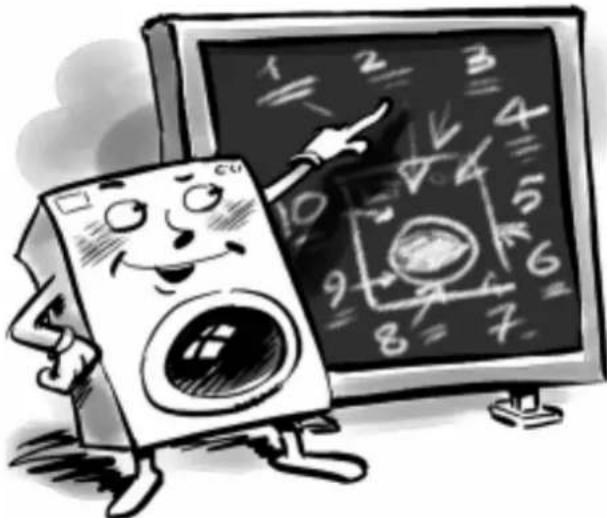
Margherita's control panel is very simple. It has only a few essential buttons to help you choose any type of wash cycle, ranging from the most energetic, capable of cleaning a mechanic's overalls, to the most delicate for cashmere. Familiarising with it will help you get the best out of your wash while helping your washing machine last longer. It's easy.
7. Guide to Margherita's programmes (p. 18)
Herein is an easy table to help you choose the right programme, temperature, detergents and possible additives. Choose the right programme and you will get better results with your wash while saving time, water and energy, day after day.
8. Care and maintenance (p. 25)
Margherita is a true friend. With just a bit of care, it will repay you with loyalty and devotion. With the necessary upkeep, it will wash for years and years to come.
9. Problems and solutions (p. 22 and 23)
Before calling a technician, read these pages: immediate solutions may be found for a number of problems. If the problem persists, call Ariston customer services and any failure will be repaired, as soon as possible.
10. Technical characteristics (p. 23)
Herein are the technical features of your washing machine: model type number, electric and water specifications, size, capacity, speed of the spin cycle and compliance with Italian and European rules and regulations.
11. Safety for you and your children (p.26)
Here you will find the necessary guidelines for the safety of your entire household, because safety is very important indeed.
What goes in your washer?
Dividing your garments according to fabric and colour, is very important for good results
Before washing, you can do a great deal for better results. Divide your garments according to fabric and colour. Read the labels, follow their indications and alternate small items with large ones.
Before washing.
Divide your washing according to the type of fabric and colour resistance: sturdy fabrics should be separated from delicate ones. Light colours should be separated from dark ones.
Empty all pockets (coins, paper, money and small obejects) and check the buttons. Mend immediately or remove loose buttons as they could fall off during the wash cycle.
The labels say it all.
Always look at the labels: they tell you everything about your garment and how to wash it in the best way possible.
The table on page 19 shows you all the secrets of the symbols found on labels. Their indications are a valuable guide to a better wash and to longer lasting clothes.
Big and small happily together.
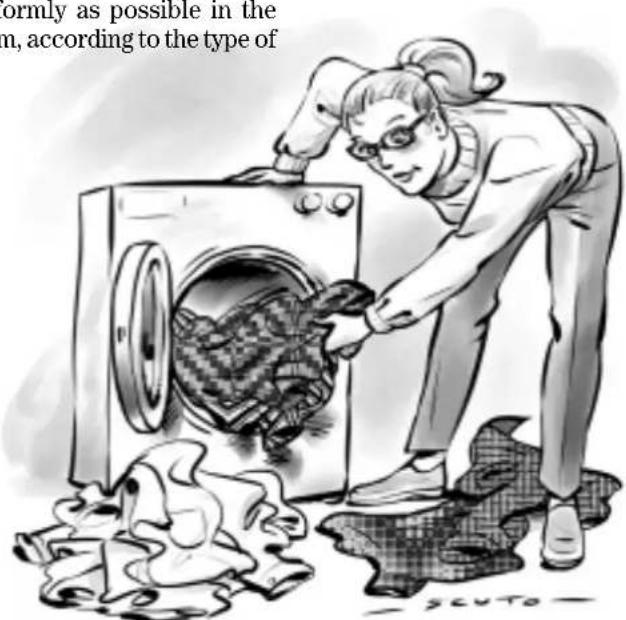
This washing machine has a special electronic control device for distributing the wash load evenly: before the spin cycle starts, this device allows the washing to position itself as uniformly as possible in the drum, according to the type of
washing and initial positioning. For this reason, even at top spin, the washing machine does not vibrate or make any noise.
Starting Margherita
After installing your new washing machine, start a wash cycle by setting programme "1" at 90 degrees.
Starting Margherita in the right way is important for the quality of your wash, for preventing problems and for lengthening the life of your appliance. After loading your washing and pouring in the detergent together with any additives, always check that:
For more delicate garments:
protect underwear, tights and stockings and delicate items by placing them in a canvas pouch
-
The door is correctly shut.
-
The plug is inserted in the socket.
-
The water tap is open.
-
Selector knob A is positioned on one of the symbols ● (Stop/Reset).
Choose the desired programme The programme is selected according to the type of garments that need to be washed. To choose a programme, refer to the table on page 18. Turn knob A until the selected programme coincides with the pointer situated on the control panel, set the temperature using knob B and, if necessary, use buttons D, E, F and G and then press on/off button H (position ON).
Remember that, if you want to use it, the "programmed start" should be set before the wash cycle.
At the end of the wash cycle... Wait for the L lamp to turn off: it will take about three minutes. Then turn Margherita off by pressing on-off button H (OFF position). You can now open the washing machine door safely.
After having removed the freshly cleaned washing, leave the door open or ajar so that the humidity left inside can evaporate. Always close the water tap.
Remember that, in the event of a power failure, or should the washing machine switch itself off, the programme chosen will be memorised.
How to eliminate the most common stains
Ink and biro Dab with a wad of cotton soaked in methyl alcohol or alcohol at 90°.
Tar Dab with fresh butter, rub in turpentine then wash immediately.
Wax Scrape away, then run a hot iron between two sheets of absorbent paper. Then rub in cotton with turpentine or methyl alcohol.
Chewing gum Rub in nail polish remover and wipe with a clean rag.
Mold Cotton and white linen should be placed in a solution of 5 parts water, one bleach and a spoon of vinegar, then washed immediately. For other white fabrics, use hydrogen peroxide at 10 volumes and wash immediately. Lipstick Dab with ether on wool or cotton. Use tricloroetilene for silk.
Nail polish Place a sheet of absorbent paper on the side of the stain, wet it with nail polish remover, shifting the garment as the sheet gradually changes colour.
Grass Dab with a wad of cotton soaked in methyl alcohol.
Here I'm in command
Making the right choice is important. And it's easy.

Programme selector knob and programmed start
Use this knob to select the wash programme.
Turn this knob clockwise only. To select a programme, you should turn the knob so that the symbol/number of the desired programme is in line with the pointer on the control panel. Now press on/off button H (position ON), pilot lamp I will start flashing.
After 5", the setting will be accepted, pilot lamp I will stop flashing (staying lit) and the wash cycle will begin.
Should you wish to interrupt the programme in progress or set a new one, select one of the symbols ● (Stop/Reset) and wait 5": when the cancellation has been accepted, pilot lamp I flashes, and you can then turn the appliance off.
You can use this knob to delay the appliance's operation.
Select one of the four delay time positions, press the on/off button H (position ON) and wait 5". The setting has now been accepted (pilot lamp I stays lit) and you can select the programme you desire.
Pilot lamp I has a particular flashing motion (2" on and 4" off) to indicate that a delayed start has been set.
During this phase, you can open the appliance door and change the washing load, should you wish to do so.
After the wash cycle has been set and accepted by the washing machine, turning the knob will have no effect (except for when it is on position ● Stop/Reset).
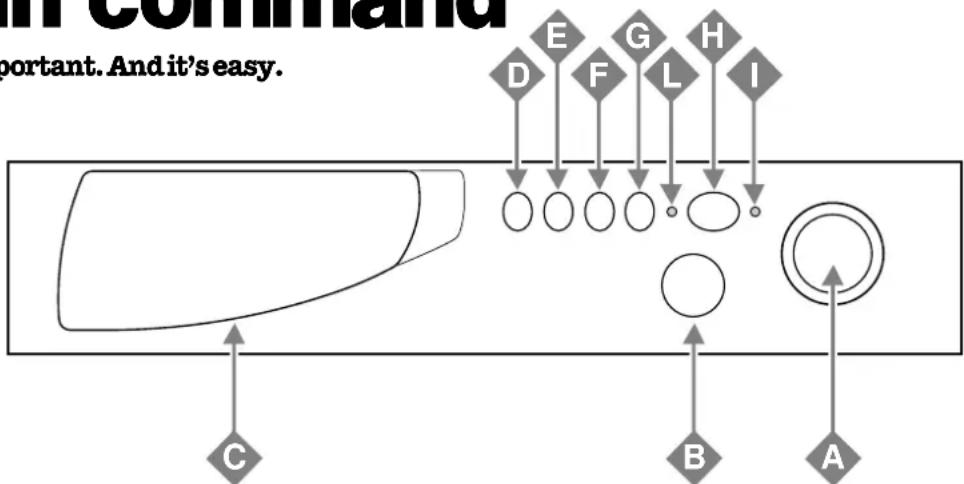

Temperature control knob
It is used to set the wash temperature indicated in the programme table. It also allows you to reduce the temperature recommended for the selected programme, and even to set a cold wash cycle (*).

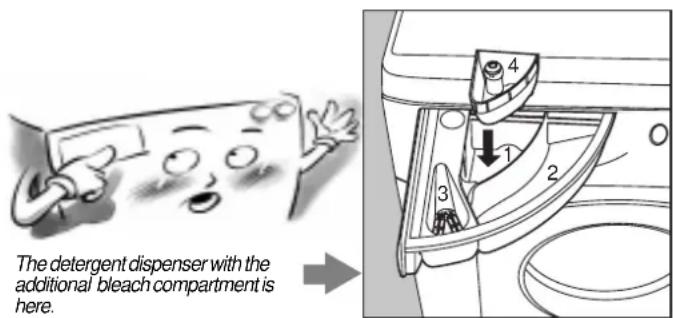
Detergent dispenser
It is divided into three compartments:
- Detergent for pre-washing;
- Detergent for the wash cycle;
- Fabric softeners.
The washing machine is equipped with extra compartment 4 (provided) for the bleach, to be inserted in compartment 1.

Slow spin
Use this button to reduce the spinning speed from 900 to 400 rpm for the cotton programmes and from 750 to 400 rpm for the synthetic fabrics programmes.

Rapid wash
This button reduces the length of the wash programme by about 30%. It cannot be used with special programmes (see page 18) or those for wool and silk.

Stain removal (see page 21)
Thanks to this command, Margherita will carry out a more intensive wash that optimises the effectiveness of the liquid additives, thus allowing more resistant stains to be removed. When you press the stain removal button, you cannot activate the pre-wash cycle (G).

Pre-wash
With this button, you can pre-wash on all programmes except the wool programme and the special programmes (see page 18).

On-off
When button H is pressed, the washing machine is switched on, when it is not the machine is switched off.
Turning the appliance off does not cancel the selected programme.

The door block lamp
The safety lamp indicates that the washing machine door is blocked to prevent it from being opened accidentally. To avoid any damages, you must wait for the lamp to switch itself off before you open the door. You must wait around three minutes.
Anti-crease
This function (represented by the symbol ▲) interrupts the wash programme, keeping the washing soaking in water before draining. It is only enabled in programmes for synthetic fabrics, silk and curtains. It is very useful, because it prevents delicate and synthetic fabrics from creasing (for example, when you cannot take the washing out at the end of the wash cycle but only a few hours later). The programme can be completed by turning knob A one notch. In the case of synthetic fabrics, should you prefer draining rather than a spin cycle, turn knob A until you have selected the symbol ∥(Drain).

The on-off lamp
Lamp I flashes when the appliance is switched on and awaiting a programme to be set. A steady light means the appliance has accepted the selected programme.
What are you washing today?
A programme for all seasons
| Type of fabric and degree of soil Progr. knob | Temperat. knob | Detergent for wash | Fabric softener | Stain rem. button/ Bleach | Length of the cycle (minutes) | Description of wash cycle |
STURDY FABRICS
| Exceptionally soiled whites (sheets, tablecloths, etc.) | 190°C | ◆ | ◆ | Del./Trad. | 145 | Wash cycle at 90°C, rinse cycles, intermediate and final spin cycles | ||
| Heavily soiled whites and fast colours | 260°C | ◆ | ◆ | Del./Trad. | 130 | Wash cycle at 60°C, rinse cycles, intermediate and final spin cycles | ||
| Heavily soiled whites and fast colours | 3 | 4 | 0 | ◆° | C | 150 | Wash cycle at 40°C, rinse cycles, intermediate and final spin cycles | |
| Slightly soiled whites and delicate colours (shirts, jumpers, etc.) | 4 | 4 | 0 | ◆° | C | Del./Trad. | 95 | Wash cycle at 40°C, rinse cycles, intermediate and final spin cycles |
| Rinse cycles/Bleach | ◆ | Del./Trad. | Rinse cycles, intermediate and final spin cycles | |||||
| Spin cycle Draining and final spin cycle | ||||||||
| Stop/Reset | Interrupts/Cancels the selected programme | |||||||
SYNTHETIC FABRICS
| Heavily soiled fast colour synthetics (baby linen, etc.) | 5 60°C | ◆ | ◆ | Delicate | 100 | Wash cycle at 60°C, rinse cycles, anti-crease or delicate spin cycle | ||
| Delicate colour synthetics (all types of slightly soiled garments) | 6 | 4 | 0 | ◆° | C | Delicate | 70 | Wash cycle at 40°C, rinse cycles, anti-crease or delicate spin cycle |
| Delicate colour synthetics (all types of slightly soiled garments) | 7 | 3 | 0 | ◆° | C | 30 | Wash cycle at 30°C, rinse cycles and delicate spin cycle | |
| Rinse cycles/Bleach | ◆ | Delicate | Rinse cycles, anti-crease or delicate spin cycel | |||||
| Fabric softener | ◆ | Rinse cycles with automatic introduction of softener, anti-crease or delicate spin cycle | ||||||
| Spin cycle Draining and delicate spin cycle | ||||||||
| Stop/Reset | Interrupts/Cancels the selected programme | |||||||
WOOL
| Wool | 8 | 4 | 0 | ◆° | C | 60 | Wash cycle at 40°C, rinse cycles and delicate spin cycle |
| Particularly delicate garments and fabrics (curtains, silk, viscose, etc.) | 9 | 3 | 0 | ◆° | C | 50 | Wash cycle at 30°C, rinse cycles, anti-crease or draining |
| Rinse cycles | ◆ | Rinse cyclesi, anti-crease or draining | |||||
| Spin cycle Draining and delicate spin cycle | |||||||
| Draining Draining | |||||||
| Stop/Reset | ● | Interrupts/Cancels the selected programme | |||||
PROGRAMMED START
| 12 - 9 - 3 - 1 hour delay Start is delayed by 12 - 9 - 3 - 1 hours | ||
| Stop/Reset | ● | Interrupts/Cancels the selected programme |
Important: to cancel the wash programme you have just set, select one of the symbols ● (Stop/Reset) and wait for at least 5".
The data found in the table is purely indicative, and can vary according to the quantity and type of washing, the water system temperature and the room temperature.
Special programmes
Class A at 40°C Margherita has a special programme to allow you to obtain optimum results even at low temperatures.
By setting programme 3 at a temperature of 40^ , the results you will obtain will be the same as you would normally obtain at 60^ thanks to the washing machine's action and the length of the wash cycle.
Daily wash Margherita has a programme studied for the washing of lightly soiled garments in a short amount of time.
By setting programme 7 at a temperature of 30^ C, you can wash different types of fabrics together (except for wool and silk), with a maximum load of 3 kg. This programmes allows you to save on both time and energy as it only lasts around 30 minutes.
WE RECOMMEND THE USE LIQUID DETERGENT.
Understanding labels
Learn the meaning of these symbols and you will get better results, your garments will last longer and your machine will repay you by washing better.
All over Europe, garment labels contain messages expressed in small yet important symbols. Understanding them is very important if you want to get better results and treat your garments the way they deserve to be treated.
These symbols are divided in five different categories and shapes: washing □, bleaching △ ironing △, dry cleaning Ⓗ and drying □.
Useful tips
Turn shirts inside out to get better results and make them last longer.
Always empty pockets of their contents.
Look at the label: it will always give you useful advice.
When loading your washing, alternate large and small garments.
natural_image
Black-and-white illustration of a person wearing glasses and holding documents, with no visible text or symbolsMake sure you select the right temperature!
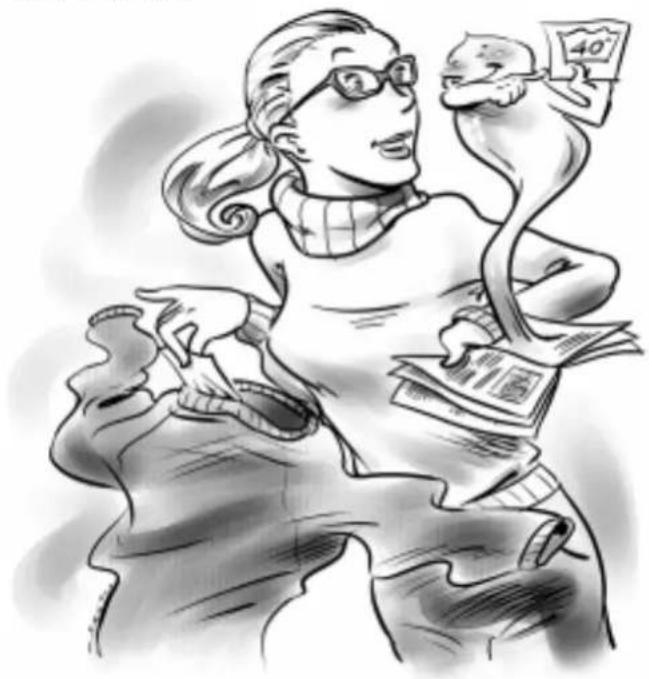
Consult and learn the symbols in this table: they will help you obtain a better wash, treat your clothes properly, and get a better performance out of your Ariston Margherita.
| Wash Bleaching Ironing Dry cleaning Drying | △ | △ | ○ | □ | |
| Strongaction | Delicate action | HighTemp. LowTemperat. | |||
| 95Wash at 95°C | 95Bleaching only in cold water | △Hot iron at max 200°C | △Dry clean with any solvent | A | Machine dryable |
| 60Wash at 60°C Do not bleach | 60 | △Medium hot ironing at max 150°C | △Dry clean only with perchloride, benzine av., pure alcohol, R111 and R113 | P | Do not machine dry |
| 40Wash at 40°C | 40Do not dry clean | △Iron at max 110°C | △Dry clean with av. benzine, pure alcohol and R113 Spread to dry | F | - |
| 30Wash at 30°C Not ironable Do not dry clean | △ | △ | ⊗ | Hang to dry without spin drying | |
| Hand wash | Dry on clothes hanger | ||||
| Not washable in water | |||||
| Wash Bleaching | Ironing Dry cleaning Drying | ○ | □ | |
| StrongactionDelicate action | HighTemp.LowTemperat. | |||
| 95Wash at95°C | C Bleaching only in cold water | Hot iron at max 200°C | ADry clean with any solvent | Machine dryable |
| 60Wash at60°C Do not bleach | A | Medium hot ironing at max 150°C | PDry clean only with perchloride, benzine av., pure alcohol, R111 and R113 | Do not machine dry |
| 40Wash at40°C | Do not dry clean | Iron at max 110°C | FDry clean with av. benzine, pure alcohol and R113 Spread to dry | - |
| 30Wash at30°C Not ironable | Do not dry clean | Hang to dry without spin drying | ||
| Hand wash | Dry on clothes hanger | |||
| Notwashable in water | ||||
Useful tips to avoid mistakes
■ Never use your washing machine to wash... torn, fraying or non-hemmed linen. If it is absolutely neccessary, place it in a bag for protection. Brightly coloured linen with whites.
■ Watch the weight!
For best results, do not exceed the weight limits stated below (figures show weight when dry):
- Resistant fabrics: 4,5 kg maximum
-Synthetic fabrics: 2.5 kg maximum
-Delicate fabrics: 2kg maximum
-Pure new wool: 1 kg maximum
■ How much does it weigh? 1 sheet 400-500 gr. 1 pillow case 150-200 gr. 1 tablecloth 400-500 gr. 1 bathrobe 900-1,200 gr. 1 towel 150-250 gr.
Coloured T-shirts, printed ones and shirts last longer if turned inside out before washing. Printed T-shirts and sweatshirts should always be ironed inside out.
Salopette alert.
Very popular “salopette” type overalls have straps with hooks that can damage the drum of your washing machine or other garments during the wash. By placing the hooks in the bib pocket and fastening them with safety pins, all risks are avoided.
■ Holidays: unplug the appliance.
When you go on holiday, we recommend that you unplug your washing machine, shutting off the water inlet tap and leaving the door opened or ajar. In this way, both the drum and the gasket will remain nice and dry and unpleasant odours will not develop inside the washing machine.
WOOL CYCLE
For best results, we recommend you use a specific detergent, taking care not to wash more than 1 kg of laundry.
How to wash almost anything
Curtains.
Curtains tend to crease a great deal. Here is a tip to reduce creasing: fold the curtains and place them in a pillow case or mesh bag. Do not load anything else, so that the overall weight does not exceed the half load. Remember to use the specific programme 9 which automatically excludes the spin cycle.
■ Quilted coats and wind-cheaters.
You can wash quilted coats and wind-cheaters, too, if they are padded with goose or duck down. Do not load more than 2-3 kg and never load 4,5 kg. Repeat rinse once or twice using the gentle spin.
Trainers.
Once you have removed mud and dirt from trainers, you can wash them with jeans and other tough garments. Do not wash trainers with whites.
It's important for a good wash
The secrets of the detergent dispenser
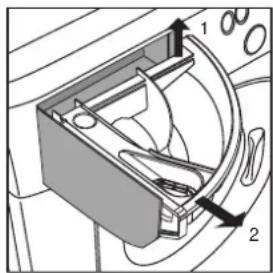
The first secret is the easiest: the detergent dispenser is opened by rotating it outwards.
You must add detergent and any additives following the dosage recommended by the manufacturers: generally, all the indications you need are on the box. Doses vary according to wash load, the water hardness and how soiled the washing is. Experience will help you select the right dosage almost automatically: it will become your secret.
Before pouring in the detergent for pre-washing in compartment 1, make sure that the extra compartment for bleach 4 has not been inserted.
When pouring in the softener in compartment 3, avoid making it overflow from the grate.
The washing machine automatically adds the softener to the wash in each programme.
Liquid detergent is to be poured into compartment 2 only a few seconds before starting the wash cycle.
Remember that liquid detergent is particularly indicated for wash cycles of up to 60 degrees and those not requiring pre-washing, therefore you do not need to use button G.
Liquid or powder detergents are sold together with special containers that are to be placed directly inside the washing machine drum, according to the instructions found on the detergent box.
Never use hand wash detergent, because it may form too much foam, which could damage the washing machine.
Detergents that are specifically indicated for both hand and machine wash are an exception. One last secret: when washing with cold water, always reduce the amount of detergent you use: it dissolves less easily in cold water than in hot water, so part of it would be wasted.
The detergent dispenser can be removed and cleaned: just lift it up and pull it outwards, as indicated in the figure. Then leave it under running water for a few minutes.
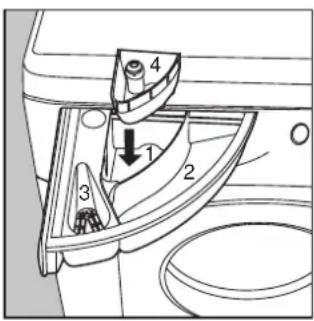
In compartment 1: Detergent for pre-washing (powder)
In compartment 2: Detergent for washing (powder or liquid) In compartment 3: Additives (softeners, perfumes, etc.)
In compartment 4: Bleach and delicate bleach.
Bleach cycle and stain removal button
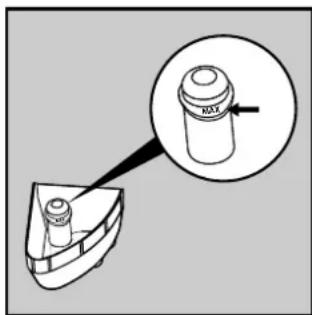
If bleaching is necessary, the extra case 4 (provided) must be inserted into compartment 1 of the detergent dispenser.
When pouring in the bleach, be careful not to exceed the "max" level indicated on the central pivot (see illustration).
The use of the additional bleach container excludes the possibility of using the pre-wash cycle. Traditional bleach can only be used on sturdy white fabrics, whereas delicate bleach can be used for coloured fabrics, synthetics and for wool.
natural_image
Diagram showing a mechanical component with an inset magnified view of its cylindrical part (no text or symbols)You cannot bleach with the “Silk” programme and with the “special programmes” (see page 18).
Use the stain removal button every time you want to bleach. Should you want to do it separately you must pour the bleach into the additional container 4, press button F (stain removal), start the washing machine, then select one of the symbols according to the type of fabric.
When you bleach during a normal wash cycle, pour the detergent and any additives in the special compartments, press button F (stain removal), set the programme you desire and turn the washing machine on.
Cutting costs efficiently
MAXIMISE THE LOAD SIZE
Achieve the best use of energy, water, detergent and time by using the recommended maximum load size. SAVE up to 50% energy by washing a full load instead of 2 half loads.
DO YOU NEED TO PRE-WASH?
For heavily soiled laundry only! SAVE detergent, time, water and between 5 to 15% energy consumption by NOT selecting Prewash for slight to normally soiled laundry.
IS A HOT WASH REQUIRED?
Pretreat stains with stain remover or soak dried in stains in water before washing to reduce the necessity of a hot wash programme. SAVE up to 50% energy by using a 60°C wash programme.
BEFORE USING A DRYING PROGRAMME ...
SAVE energy and time by selecting a high spin speed to reduce the water content in laundry before using a drying programme.
A guide to environmentally friendly and economic use of your appliance.
Troubleshooting
Before calling, read the following
Your washing machine could fail to work. In most cases, the problems arising can be easily solved without having to call for a technician. Before calling for assistance, always check these points.
The washing machine fails to start.
Is the plug correctly inserted into the socket? It could have been moved whilst cleaning.
Is there electricity in the house?
A circuit breaker could have gone off, perhaps because too many appliances are on at the same time. Or perhaps because of a general power failure in your entire area.
Is the washing machine door closed properly?
For safety reasons, the
washing machine cannot work if the door is open or not shut properly.
■Is the On/Off button pressed?
If it is, then a programmed start has been set.
Is the programmed start knob, on those models concerned, in the correct position?
Is the water tap open? For safety reasons, if the washing machine does not load water, it cannot start a wash cycle.

natural_image
Illustration of a cartoon character kneeling beside a giant creature with an open book (no text or symbols present)RIGHT
Close the tap after every wash cycle. Limit the use of the washing machine's hydraulic system and eliminate leakage risks when no-one is at home.
Always leave the appliance door ajar to avoid bad odours.
Clean the appliance's exteriors delicately. To clean the exteriors and the rubber parts of the appliance, always use a rag dipped in lukewarm water and soap.
WRONG
Leave the washing machine plugged in while cleaning. Even during maintenance, the appliance should always be unplugged.
Use solvents and aggressive abrasives. Never use solvents or abrasives to clean the external and rubber parts of the washing machine.
Neglect the detergent dispenser. It is removable and can easily be cleaned by leaving it under running water.
Go on holiday without thinking about her. Before leaving, always make sure that the washing machine is unplugged and that the water tap is closed.
But where did all the water go?
Simple: with the new Ariston technology, you need less than half of it, to get good results on twice as much! This is why you cannot see the water through the door: because there is little, very little of it, to respect the environment yet without renouncing maximum cleanliness. And, on top of that, you are also saving electricity.

natural_image
Cartoon illustration of a smiling washing machine holding a megaphone (no text or symbols)
The washing machine fails to load water.
Is the tap correctly attached to the pipe?
Is there a water shortage? There could be work in progress in your building or street.
Is there enough pressure? The autoclave may be malfunctioning.
Is the tap filter clean? If the water is very calcareous, or if work has recently been carried out on the water piping, the tap filter could be clogged with particles and debris.
Is the rubber hose bent? The tract of the rubber hose bringing water to the washing machine must be as straight as possible. Make sure it is not squashed or bent.
The programme selector knob keeps turning?
■ Wait a few minutes for the drain pump to empty the tub, switch Margherita off, select one of the symbols stop/reset ●, then switch it back on. If the knob continues to turn, call for assistance because it is reporting an anomaly.

natural_image
Cartoon illustration of a washing machine with a person cleaning it (no text or symbols)The washing machine continuously loads and unloads water.
Is the drain hose positioned too low? It must be installed at a height ranging from 60 to 100 cm.
Is the hose's mouth immersed in water?
Does the wall drainage system have a breather pipe? If the problem persists even after these checks, close the water tap, switch the appliance off and call for assistance.
If you live on an upper floor of your building, there may be a problem with your drain trap. To solve this problem, a special valve must be installed.

The washing machine does not drain or spin.
■ Does the selected programme foresee water draining? Some wash cycles require enabling the draining manually.
Is the "Anti-crease" function -where provided -enabled? This function require enabling the draining manually.
Is the drain pump clogged? To check it, close the tap, unplug the washing machine and follow the instructions on page 25, or call for technical assistance.
Always get assistance from authorised technicians and always insist on original spare parts.
Is the drain hose bent? The tract of the drain hose must be as straight as possible. Make sure it is not squashed or bent.
Is the washing machine's drain duct clogged? Is there an extension of the drain hose? If so, is it positioned incorrectly, blocking the water flow?

The washing machine vibrates too much during the spin cycle.
■Has the internal floating unit been correctly unblocked during installation? See following page on installation procedures.
■Has the washing machine been levelled correctly? The levelling of the appliance should be checked periodically. In time, the machine could move imperceptibly. Adjust the feet and check them with a level.
Is the appliance closed in between furniture and a wall? If it is not a built-in model, the washing machine needs to oscillate a bit during the spin cycle. A few cm of space should therefore be left around it.

The washing machine leaks.
Is the metal ring of the inlet hose properly attached? Close the tap, unplug the appliance and try tightening its attachment without forcing it.
Is the detergent dispenser obstructed? Try extracting it and washing it under tap water.
Is the drain hose well attached? Close the tap, unplug the appliance and try tightening its attachment.
Too much foam.
Is the detergent appropriate for machine washing? Check whether its label reads the definition "for machine wash" or "hand and machine wash", or other similar indications.
Is the correct amount being used? An excessive amount of detergent, besides producing too much foam, does not guarantee a more effective wash, and causes scaling in the internal parts of the appliance.
If, despite all checks, the washing machine fails to function and the problem persists, call your nearest authorised Customer Service Centre, providing the following information:
- the type of malfunctioning - the model type no. (Mod. ....) - the serial number (S/N ....)
These indications can be found on the data plate situated on the back of the washing machine.
Technical characteristics
| Model | AB 95 |
| Dimensions | width 59,5 cmheight 85 cmdepth 52,5 cm |
| Capacity | from 1 to 4,5 kg |
| Electrical connections | voltage 220/230 Volt 50 Hzmaximum absorbed power 1850 W |
| Water connections | maximum pressure 1 MPa (10 bar)minimum pressure 0,05 MPa (0,5 bar)drum capacity 40 litre |
| Spinning speed | up to 900 rpm |
| Control programs in compliance with IEC regulation 456 | programme 2; temperature 60°C; carried out with 4,5 kg load; |
 | This appliance conforms with the following E.E.C. directives:- 73/23/EEC of 19/02/73 (Low Voltage) and subsequent modifications- 89/336/EEC of 03/05/89 (Electromagnetic Compatibility) and subsequent modifications |
 | TS 2004 EN 60335-2-7 |
Installation and removal When Margherita arrives
Whether new or just transported to a new house, installation is extremely important for the correct functioning of your washing machine.
After removing the appliance from its packaging, check that it is intact. If in doubt, contact a qualified technician immediately. The inside of the machine is blocked, for transportation, by 3 screws on the back panel.
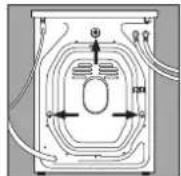
Before using the washing machine, remove the screws, remove the rubber with the aid of the special spacer (keeping all the parts) and use the plastic tabs provided to fill in the holes.
Important: Use the cap (provided) to close the 3 holes which housed the stop pin, situated in the right-hand part of the lower back of the washing machine.
Levelling
The washing machine must be levelled appropriate in order to guarantee its correct functioning. To level the appliance, the front feet must be adjusted; the angle of inclination, measured according to the worktop, must not exceed 2°. When placed on carpet, make sure the ventilation is not hampered within its surroundings.
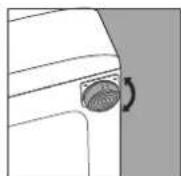
The front feet are adjustable.
Do not throw the blocking screws and the spacers away. In the event of a removal, they can be used to block the components inside the appliance again and so to protect it during transport.
Connection to the water mains
Connect the supply pipe to the water mains using a gas 3/4 attachment, fitting the rubber gasket supplied with the appliance and ensuring that they are firmly tightened to the taps. The water supply marked C must be connected to the cold water tap; the pipe marked H must be connected to the hot water tap. Both pipes may be connected to the cold water tap using the special Y connection with multiple attachments, supplied with the appliance.
Warning: clean the filters regularly by rinsing it under running water.
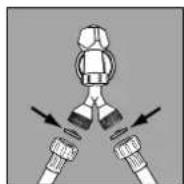
The rubber hose filter.
If the water piping is new or has been unused for some time, run the water before making the connection until it is quite clear. Remember that impure water may damage the washer. Connect the other end of the pipe to the appliance, at the top on the right, by the water connection.
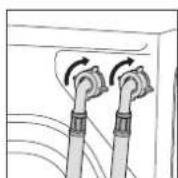
Water pipe inlet at the top right.
Connecting the drain hose
There are two hooks (right or left) on the rear of your washing machine to which the drain hose is to be fixed. Insert the other end in a duct or place it on the edge of a sink or tub avoiding excessive kinks and bending. It
natural_image
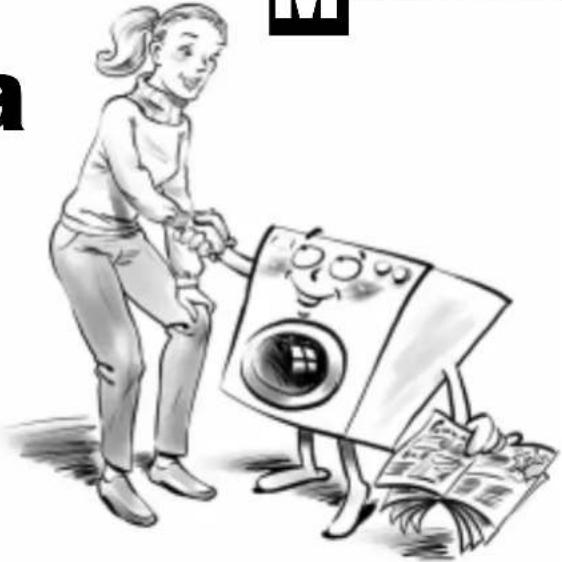
Illustration of a woman pushing a large washing machine with a smiling face, next to a newspaper (no text or symbols visible)should be placed at a height ranging from 60 to 100 cm. In case it is necessary to fix the end of the hose at a height below 60 cm from the ground, it must be fixed in the appropriate hook placed on the upper part of the back panel.
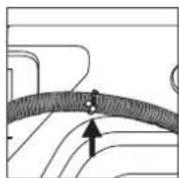
The hook to be used in case the drain hose ends at a height below 60 cm.
If the tube drains into a tub or sink, apply the plastic guide and tie it to the tap.
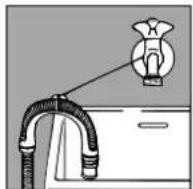
The guide for draining into tubs and sinks.
It must never remain immersed in water.
Extensions are unadvisable. In case of absolute need, the extension must have the same diameter as the original hose and must not exceed 150 cm. In case of wall draining pipes, their efficiency must be checked by a qualified technician. If the dwelling is on one of the upper floors of a building, there may be drain trap problems causing the washing machine to load and unload water continuously.
In order to avoid such an inconvenience, special anti-drain trap valves are available in shops.
MARGHERITA
Electric connection
Before connecting the appliance to the electric socket, be sure that:
1) the electric socket is able to sustain the appliance's maximum power load indicated on the data plate and in compliance with the law;
2) the supply voltage is included within the values indicated on the data plate;
3) the socket is compatible with the appliance's plug. If not, do not use adapters, but replace either the socket or the plug;
4) electric household appliances must be equipped with an "earthing" system.
Warning!
The company denies all liability if and when these norms are not respected.
Plastic bags.
expanded styrofoam, nails and other
packaging parts are not children's toys, and are potentially dangerous.
Treat her well and she'll be your
friend forever
Your washing machine is a reliable companion in life and on the job. It is just as important for you to keep it in shape.
Margherita is a washing machine designed to last a lifetime without any problems. A few simple steps help keep it in shape and last longer. Firstly, you must close the water tap after each wash: the constant pressure of water could warp a few of the component parts.
In addition, by doing so, you will avoid the risk of leaks when no-one is at home.
If the water in your area is too hard, use a delimming product (water is hard if it often leaves whitish stains around taps or drains, especially of bath tubs.
For more accurate information as to the type of water in your system, call the local water works or a local plumber).
Pockets must always be emptied removing even pins, badges and any other hard object.
The washing machine exterior should be cleaned with a rag dipped in lukewarm water and soap.
It is important to wash the detergent dispenser regularly. To prevent dried washing powder from accumulating, place the dispenser under running water for a few minutes.
Never exaggerate with doses.
Normal detergents already contain deliming agents. Only if the water is particularly hard, that is, rich in lime content, do we recommend the use of a specific product at every wash.
A periodical wash cycle with a dose of a deliming product, without detergents or washing, may prove useful.
Never use too much detergent or additives because this could cause an excess amount of foam, scaling and possible damage to the component parts of your washing machine.
natural_image
Illustration of a woman sorting items from a giant paper airplane, with no visible text or symbolsDo not forget to empty all pockets: small objects can cause damage to your friend Margherita.
When in need, check the pump and the rubber hose.
Margherita comes equipped with a self-cleaning pump that does not require any cleaning or maintenance. Small objects may accidentally fall into the pump: coins, hair clips, loose buttons and other small items. To avoid possible damage, they are withheld in an accessible pre-chamber, situated at the lower end of the pump.
natural_image
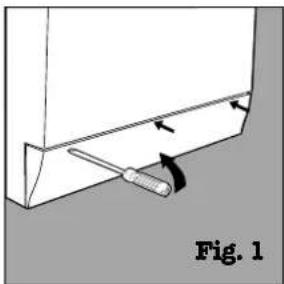
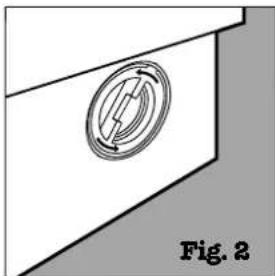
Diagram of a mechanical component with a lever and directional arrows, labeled Fig. 1 (no text or symbols on the diagram itself)To access this pre-chamber, just remove the panel covering the bottom of the washing machine using a screwdriver (figure 1); then lift the cover rotating it anti-clockwise (figure 2) and check its contents accurately.
The rubber hose
Check the rubber hose at least once a year. If you see any cracks, replace it immediately. When you use your washing machine, water pressure is very strong and a cracked tube could easily split open.
natural_image
Technical diagram showing a circular component mounted on a rectangular base, labeled Fig. 2 (no text or symbols within the diagram itself)Attention: make sure that the wash cycle has come to a full stop and unplug the appliance before removing the lid as well as before any type of maintenance procedure. It is normal to find that a little water comes out after removing the lid. When replacing the panel, make sure you insert the hooks situated at the bottom of the washing machine in the right slots before pushing it back against the appliance.
More and more important
Your safety and that of
your children
Margherita has been built in compliance with the strictest international safety regulations. To protect you and all your family.
Read these indications and all the information in this manual carefully: they are an important source, not only of numerous useful tips, but also of vital information on safety, use and maintenance.
- Margherita should not be installed in an outdoor environment, not even when a roof shelters the area, because it may be very dangerous to leave it exposed to rain and thunderstorms.
- It must only be used by adults and exclusively for washing clothes following the instructions provided in this manual.
- Should it have to be moved, proceed with the help of two or three people and handle it with the utmost care. Never try to do this alone, because the appliance is very heavy.
-
Before loading the washing machine, make sure the drum is empty.
-
Never touch the washing machine when barefoot or with wet or damp hands or feet.
-
Never use extensions or multiple plugs, which are particularly dangerous in humid environments. The power supply cable must never be bent or dangerously compressed.
-
Never open the detergent dispenser while the appliance is functioning; do not use hand wash detergent because the abundance of foam could damage its internal parts.
- Never pull on the plug or the washing machine to disconnect it from the wall socket: it is extremely dangerous.
- While the appliance is functioning, do not touch the drain water as it could reach very high temperatures. The appliance door, during wash cycles, tends to become heated; keep it out of children's reach. Never force the washing machine door because this could damage the safety block on the opening, which serves to protect from accidental openings.
- In case of malfunctioning, first close the water tap and unplug the appliance from the wall socket; do not under any circumstances touch internal parts in order to attempt repairs.
How to change the power supply cable
The power supply cable must only be replaced by one of our authorised Service Engineers.
- MARGHERITA AB9
- Kumaşların sırları
- DOĞRU
- ■ Class A at 40°C
- Margherita Washing machine safe
- Quick guide to Margherita
- Installation and removal (p. 24)
- What goes in your washing machine and how to start your Margherita (p. 16)
- Guide to understanding labels (p. 19)
- Useful tips to avoid mistakes (p. 20)
- The detergent dispenser (p. 21)
- Understanding the control panel (p. 17)
- Guide to Margherita's programmes (p. 18)
- Care and maintenance (p. 25)
- Problems and solutions (p. 22 and 23)
- Technical characteristics (p. 23)
- Safety for you and your children (p.26)
- What goes in your washer?
- Before washing.
- The labels say it all.
- Big and small happily together.
- Starting Margherita
- How to eliminate the most common stains
- Here I'm in command
- Programme selector knob and programmed start
- Temperature control knob
- Detergent dispenser
- Slow spin
- Rapid wash
- Stain removal (see page 21)
- Pre-wash
- On-off
- The door block lamp
- Anti-crease
- The on-off lamp
- What are you washing today?
- A programme for all seasons
- Special programmes
- Understanding labels
- Useful tips
- Useful tips to avoid mistakes
- ■ Watch the weight!
- Salopette alert.
- ■ Holidays: unplug the appliance.
- WOOL CYCLE
- How to wash almost anything
- Curtains.
- ■ Quilted coats and wind-cheaters.
- Trainers.
- It's important for a good wash
- The secrets of the detergent dispenser
- The first secret is the easiest: the detergent dispenser is opened by rotating it outwards.
- Bleach cycle and stain removal button
- Cutting costs efficiently
- MAXIMISE THE LOAD SIZE
- DO YOU NEED TO PRE-WASH?
- IS A HOT WASH REQUIRED?
- BEFORE USING A DRYING PROGRAMME ...
- Troubleshooting
- Before calling, read the following
- The washing machine fails to start.
- RIGHT
- WRONG
- But where did all the water go?
- The washing machine fails to load water.
- The programme selector knob keeps turning?
- The washing machine continuously loads and unloads water.
- The washing machine does not drain or spin.
- The washing machine vibrates too much during the spin cycle.
- The washing machine leaks.
- Too much foam.
- Installation and removal When Margherita arrives
- Levelling
- Connection to the water mains
- Connecting the drain hose
- Electric connection
- Treat her well and she'll be your
- friend forever
- Never exaggerate with doses.
- When in need, check the pump and the rubber hose.
- The rubber hose
- More and more important
- Your safety and that of
- your children
- How to change the power supply cable
Brand : Hotpoint Ariston
Model : AB 95
Category : Washing machine