ASM-3 - Speaker Senal - Free user manual and instructions
Find the device manual for free ASM-3 Senal in PDF.


| Product Type | Shotgun Microphone |
| Brand | Senal |
| Model | ASM-3 |
| Polar Pattern | Supercardioid / Lobar |
| Frequency Response | 40 Hz - 20 kHz |
| Impedance | 200 Ω |
| Sensitivity | -32 dB ± 2 dB (1 kHz, 1 Pa) |
| Signal-to-Noise Ratio | 78 dB (A-weighted) |
| Equivalent Noise | 16 dB (A-weighted) |
| Maximum SPL | 130 dB (1 kHz, 1% THD) |
| Dynamic Range | 114 dB |
| Connector | XLR 3-pin male |
| Power Supply | Phantom power 48V |
| Low-Cut Filter | Switchable (80 Hz / 160 Hz) |
| Dimensions (L x Diameter) | 280 mm x 22 mm |
| Weight | 150 g (without mount) |
| Material | Aluminum alloy housing |
| Included Accessories | Windshield, shock mount, carrying case |
| Usage | Video, film, broadcasting |
Frequently Asked Questions - ASM-3 Senal
User questions about ASM-3 Senal
0 question about this device. Answer the ones you know or ask your own.
Ask a new question about this device
Download the instructions for your Speaker in PDF format for free! Find your manual ASM-3 - Senal and take your electronic device back in hand. On this page are published all the documents necessary for the use of your device. ASM-3 by Senal.
USER MANUAL ASM-3 Senal
natural_image
Black and white photo of a portable electric heater with two speakers and a mesh grille (no visible text or symbols)Introduction ...... 2
Overview ...... 3
Precautions .....4
Setting Up .....5-9
Specifications ..... 10-11
Troubleshooting ....12-13
Warranty 14

ASM-3
PROFESSIONAL TWO-WAY ACTIVE SPEAKERS
Thank you for choosing Senal.
The ASM-3 Two-Way Active Speakers are a pair of powered stereo speakers designed for near-field monitoring in professional audio applications. Their convenient size makes them equally ideal for desktop audio systems. The ASM-3 features active filter technology and a dual-channel power amplifier, driven by a 3" woofer and 0.8" metal dome tweeter that deliver a wide and flat frequency response with pristine audio reproduction and accurate sound imaging. The cabinet's curved port tube provides natural low-frequency output and minimizes distortion, while the ellipsoidal design and rigid, high-intensity aluminum alloy construction prevent diffraction and cabinet resonance. This meticulous engineering allows the ASM-3 to handle high sound pressure levels in an ultracompact cabinet size.
Fine-tune settings allow the user to adjust the high, mid, and low frequencies to compensate for the listening environment, speaker placement, and audio source. Each ASM-3 comes with a rubber base that isolates the speaker from its resting surface to prevent resonant coupling, and makes it easy to adjust the vertical angle of the speaker to down fire or up fire. The speakers can also be mounted on a wall or a stand via the mounting threads on the cabinet.
Overview

Precautions ⚠️ ⚣️
- Please read and follow these instructions, and keep this manual in a safe place.
- Exposure to high sound levels can cause permanent hearing loss. Avoid listening at high volumes for extended periods of time.
- Keep this product away from water, moisture, and any flammable gases or liquids.
- Make sure this product is powered off when plugging it into a power source.
- Use only the correct, recommended voltage.
- Do not attempt to disassemble or repair this product. There are components inside that can produce a hazardous electric shock.
■ Handle this product with care. - Clean this product with only a soft, dry cloth.
- Keep this product away from children.
- All photos are for illustrative purposes only.
Setting Up
Mounting the Speaker
For desktop placement, place the speaker on the included rubber base. This base serves to isolate the speaker from its resting surface and prevent resonant coupling. The base is designed to make it easy for you to adjust the vertical angle of the speaker to down fire or up fire, so you can aim the acoustic axis at the listener's ear.


natural_image
Diagram showing a person sitting at a desk receiving attention from three cameras on a stand, with no text or symbols present.
natural_image
Diagram showing a person sitting at a desk receiving signals from three devices, with no text or symbols present.The speaker may also be mounted on a wall via the mounting threads on the rear of the cabinet, or on a speaker stand via the threaded mount on the bottom of the cabinet. To mount the speaker on a wall, you can use the Senal speaker bracket kit, sold separately.
Speaker Placement and Positioning
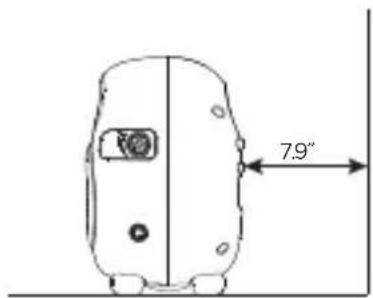
Position the speakers 2.3' to 6' (0.7 to 1.8 m) from where the listener will be situated, and aim the tweeter at the approximate height of the listener's ears. There should be no obstructions between the speakers and the listener. Each speaker should be 7.9" (20 cm) or more from the wall to prevent early reflections, which can interfere with stereo imaging.
For stereo placement, space the two speakers equally to form an equilateral triangle with the listener at the third point of the triangle.

flowchart
graph TD
    A["L"] --> C["Center"]
    B["R"] --> C["Center"]
    C["Center"] --> D["✓"]
    E["L"] --> F["Center"]
    G["R"] --> F["Center"]
    F["Center"] --> H["X"]
For optimal audio performance, the listener should be on the centerline of the room.
The Listening Environment
A room with dimensions that are multiples of each other, such as a room that is twice as wide as it is tall, may result in standing waves that can blur the bass frequencies. Large areas of a smooth material like glass will cause acoustic reflections and may interfere with sound-field reproduction and imaging. You can avoid reflections by strategically placing sound-absorbing materials like acoustic foam, carpeting, and heavy curtains around the room.
Connecting the Speaker
-
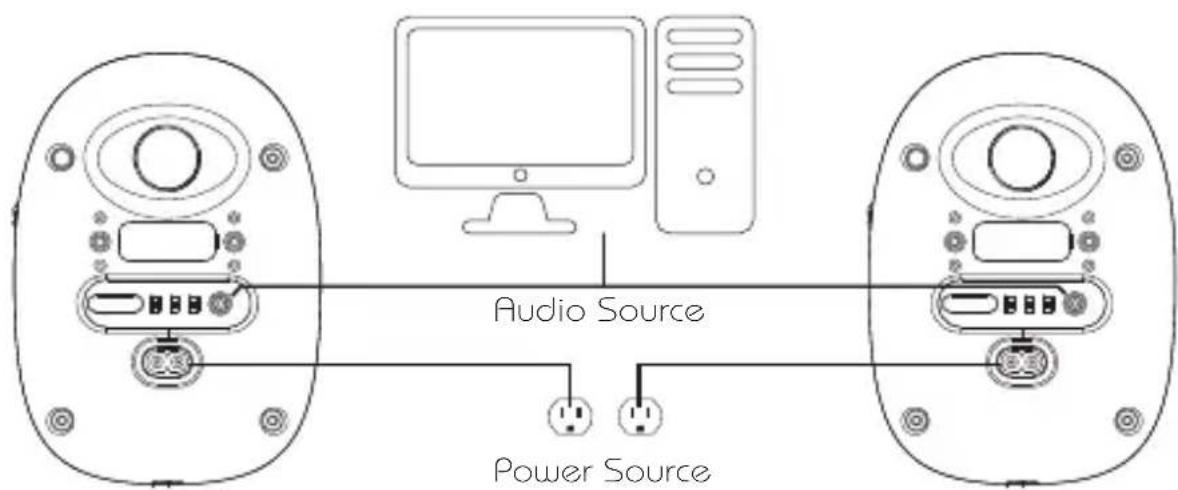
Plug the stereo 3.5 mm connector of the included audio cable into the audio output of your audio source.
-
Plug the left and right RCA connectors into the audio inputs of the left and right speakers.
-
Use the included AC power cables to plug the speakers into an AC power source.
-
Turn on your audio source and the speakers.
-
Use the volume controls on the speakers and your audio source to adjust the audio level. When using an audio source that has its own master level, such as a recording console, turn the volume on the speakers all the way up, and control the volume through the master level on the console.
Fine-Tune Settings
You can fine-tune the frequency response of the speaker via four fine-tune settings on the rear of the cabinet.
You can adjust the high frequency (HF) by ±1 dB and the low frequency (LF) by ±2 dB. We recommend adjusting these to suit the listening environment.


You can adjust the mid frequency (MF) by -2 and -4 dB. We recommend adjusting these to suit your speaker placement. When the speaker is placed on a stand or mounted on a wall, we recommend setting the MF switch to 0. When the speaker is placed on a desk or table and its face is 3.1" to 9.8" (8 to 25 cm) from the edge of the desk, we recommend setting the MF switch to -2. When the speaker is more than 9.8" (25 cm) from the edge of the desk, we recommend setting the MF switch to -4. These measurements are approximate and will depend on your specific listening environment.

The frequency adjust terminal is for testing and adjusting the curve. It had been adjusted in an anechoic chamber to its optimal position, and we strongly recommend that you do not adjust this setting.
Specifications
| System series: | Professional monitor active filter speaker system |
| System type: | Two-way vented |
| Drivers configuration: | 3" (76.2 mm) midwoofer, 0.8" (20 mm) metal dome tweeter |
| Frequency range: | 75 Hz to 20 kHz(±2.5 dB, free space) |
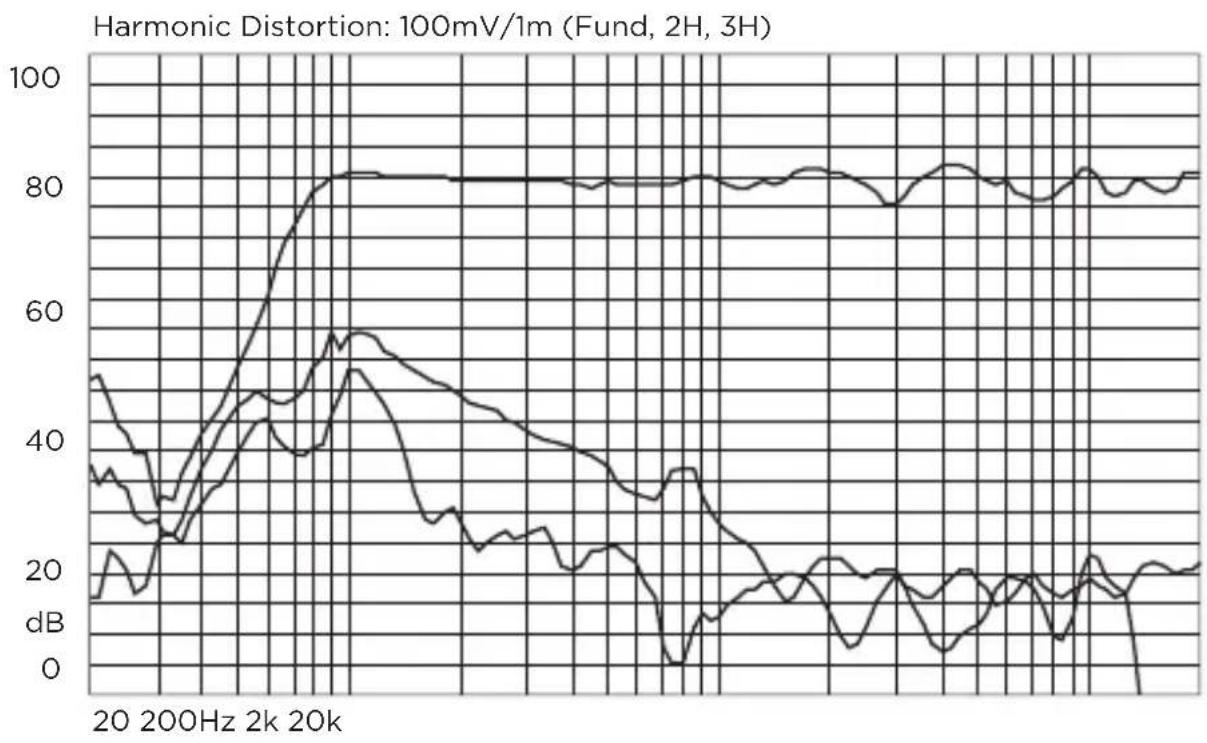
| Harmonic distortion: | 330 Hz to 20 kHz ≤1% (85 dB/1 m) |
| Filter type: | Professional active filter |
| Rated power: | 28 W RMS/channel |
| Active crossover frequency: | 3.0 kHz |
| Bass adjustment range: | + 2, 0, -2 dB (100 Hz) |
| Mid-low adjustment range: | 0, - 2, -4 dB (200 Hz) |
| Treble adjustment range: | +1, 0, -1 dB (10 kHz) |
| Signal-to-noise: | >96 dB |
| Input sensitivity: | 350 mV |
| Input impedance: | 12,000 Ω |
| Maximum input: | 3,000 mV |
| Finish: | High-intensity aluminum alloy cabinet |
| Dimensions per speaker: | 5" × 7" × 4.8"(127 × 177.8 × 121.9 mm) |
| Weight per speaker: | 3.5 lb. (1.6 kg) |
Distortion Curve
line
| Frequency | Harmonic Distortion (dB) | | --------- | ------------------------ | | 20 | ~15 | | 200Hz | ~35 | | 2k | ~45 | | 20k | ~55 | | 200k | ~80 |
line
| Frequency (Hz) | Total Harmonic Distortion (dB) | THD (%) | | -------------- | ------------------------------ | ------- | | 20 | -15 | 10 | | 100 | -30 | 5 | | 200 | -40 | 1 | | 1000 | -50 | 0.5 | | 2000 | -60 | 0.1 | | 10000 | -70 | 0.1 | | 20000 | -65 | 0.1 | | 100000 | -68 | 0.1 | | 200000 | -70 | 0.1 |Troubleshooting
| Problem Reason Solution Comment | |||
| There is no sound coming from the speaker. | The power cable is not connected. | Connect the power cable. | |
| The speaker is turned off. | Turn the speaker on. | ||
| There is a short circuit or the audio source is not connected to the speaker. | Check whether the audio cable has a short circuit or is disconnected from the speaker. If necessary, plug the cable into the speaker. | If the audio cable connector is oxidized, worn out, or corroded, we recommend replacing the connector or the cable. | |
| The volume control is turned down. | Turn up the volume control on the speaker or the audio source. | ||
| There is no sound coming from one of the channels in a multichannel setup. | The balance of the audio source is not set properly. | Adjust the balance of the audio source. | This usually occurs when configuring two or more channels. |
Problem Reason Solution Comment
| The sound is distorted or noisy. | The speaker is not placed correctly or the listening environment is poor. | Place the speaker correctly or improve the listening environment according to the instructions in this manual. | |
| The fine-tune settings on the speaker are not adjusted correctly. | Adjust the fine-tune settings according to the instructions in this manual. | The fine-tune settings can be adjusted to compensate for the listening environment, speaker placement, and audio source. | |
| The audio source has a malfunction or the quality of the audio source is poor. | Check your audio source to determine the cause of the malfunction. | ||
| The connection between the audio cable and the speaker is poor. | Make sure the audio cable is fully plugged into the speaker and the audio source. If necessary, plug the cable into the speaker. | We suggest using one of the included high-quality audio cables or a cable of comparable quality. |
Warranty
Senal provides a limited warranty that this product is free from defects in materials and workmanship to the original purchaser under normal use for a period of one (1) year from the original purchase date or thirty (30) days after replacement whichever occurs later. Our responsibility with respect to this limited warranty shall be limited solely to repair or replacement, at its option, of any product which fails during normal consumer use.
To obtain warranty coverage during the Warranty Period, contact your place of purchase (“Seller”) to obtain a return merchandise authorization (“RMA”) number, and return to Seller the defective product along with proof of purchase and the RMA number.
This warranty does not extend to damage or failure which results from misuse, neglect, accident, alteration, abuse, improper installation or maintenance. EXCEPT AS PROVIDED HEREIN, SENAL MAKES NEITHER ANY EXPRESS WARRANTIES NOR ANY IMPLIED WARRANTIES, INCLUDING BUT NOT LIMITED TO ANY IMPLIED WARRANTY OF MERCHANTABILITY OR FITNESS FOR A PARTICULAR PURPOSE. This warranty provides you with specific legal rights, and you may also have additional rights which vary from state to state.
© Copyright 2013 Gradus Group
All other trademarks are the property of their respective owners. All photos are for illustrative purposes only.
Brand : Senal
Model : ASM-3
Category : Speaker