CO-220 - Gas detector FLUKE - Free user manual and instructions
Find the device manual for free CO-220 FLUKE in PDF.


| Product Type | Carbon Monoxide (CO) Gas Detector |
| Brand | Fluke |
| Model | CO-220 |
| Measurement Range | 0 to 1000 ppm CO |
| Resolution | 1 ppm |
| Accuracy | ±5% of reading or ±5 ppm (whichever is greater) at 25°C (77°F) |
| Alarm Setpoint | Adjustable, default 35 ppm |
| Display | Backlit LCD with numeric readout and bar graph |
| Battery Type | 2 x AA alkaline batteries |
| Battery Life | Typically 300 hours continuous use |
| Dimensions (H x W x D) | 160 x 80 x 40 mm |
| Weight | 240 g (including batteries) |
| Operating Temperature | 0°C to 50°C (32°F to 122°F) |
| Storage Temperature | -20°C to 60°C (-4°F to 140°F) |
| Humidity Range | 15% to 90% RH (non-condensing) |
| Audible Alarm | Piezo buzzer, >85 dB at 30 cm |
| Visual Alarm | Red LED flashes |
| Included Accessories | Batteries, user manual, quick reference guide |
| Calibration | Recommended annually; zero and span calibration |
| Warranty | 2 years |
| Compliance | CE, CSA, UL |
| Product Certifications | IEC 61010-1, IEC 61326-1 |
Frequently Asked Questions - CO-220 FLUKE
User questions about CO-220 FLUKE
0 question about this device. Answer the ones you know or ask your own.
Ask a new question about this device
Download the instructions for your Gas detector in PDF format for free! Find your manual CO-220 - FLUKE and take your electronic device back in hand. On this page are published all the documents necessary for the use of your device. CO-220 by FLUKE.
USER MANUAL CO-220 FLUKE
CO-220 English Instruction Sheet
FLUKE®
CO-220
The CO-220 Carbon Monoxide Meter (hereafter referred to as "the Meter") detects the presence of carbon monoxide (CO) and measures concentrations between 1-1000 parts per million (PPM).
The Meter indicates the presence of carbon monoxide in two ways:
- By a reading on the LCD in PPM.
- By a beeper tone.
Contacting Fluke
To contact Fluke, call one of the following telephone numbers:
USA: 1-888-99-FLUKE (1-888-993-5853)
Canada: 1-800-36-FLUKE (1-800-363-5853)
Europe: +31 402-675-200
Japan: +81-3-3434-0181
Singapore: +65-738-5655
Anywhere in the world: +1-425-446-5500
Or, visit Fluke's Web site at: www.fluke.com.
PN 690559 (English)
May 1998 Rev.2, 4/04
© 1998-2004 Fluke Corporation. All rights reserved.
All product names are trademarks of their respective companies.
CO-220 English Instruction Sheet
⚠ Safety Information - Read First
⇒ Do not use the Meter as a personal safety monitor.
Learn and recognize the effects of CO poisoning.
| 0-1 PPM Normal background levels. |
| 9 PPM ASHRAE Standard 62-1989 for living areas. |
| 50 PPM OSHA enclosed space 8-hour average level.* |
| 100 PPM OSHA exposure limit.* |
| 200 PPM Mild headache, fatigue, nausea and dizziness. |
| 800 PPM Dizziness, nausea and convulsions.Death within 2 to 3 hours. |
| * U.S. Department of Labor, Occupational Safety & Health Administration (OSHA) Regulation 1917.24: The CO content in any enclosed space shall be maintained at not more than 50 PPM (0.005%). Remove employees from enclosed space if the CO concentration exceeds 100 PPM (0.01 %). |
What the Meter Does
The Meter indicates the presence of CO by a reading on the LCD and a beeper tone.
Above 1000 PPM, the LCD reads "OL" to indicate an out of range condition.
The beeper functions much like clicking of a Geiger counter:
- The higher the concentration of CO, the faster the beeper sounds.
- Above 200 PPM, the beeper sounds continuously, while the frequency of the tone increases with the concentration of CO.
Install the battery. (See "Installing and Replacing the Battery.")
To turn the Meter on, press the green button.
The Meter beeps twice, then performs a self-test. During the self-test, the display counts down from "10" to "0", while the Meter emits a series of 2 beeps followed by a pause.
If the Meter passes the self-test, the Meter begins monitoring, which is indicated by a beep every two seconds, and shows a reading on the display.
CO-220 English Instruction Sheet
Self-Test
The Meter tests the sensor and the battery each time it is turned on and continuously monitors the battery. If the battery is low,
+ is shown on the LCD.
If battery power is below the level required to power the Meter, or if the sensor fails, the Meter emits a series of five beeps, followed by a long pause, and another series of five beeps. The Meter then turns itself off.
If after replacing the battery, the alarm condition persists, the sensor may have failed. Contact an authorized Fluke service center for information on how to replace the sensor.
Establishing a Baseline
Before testing for CO, establish a baseline against which the Meter compares other environments.
Do this by turning on the Meter. If the Meter detects between 0-3 PPM of CO, the beeper sounds and the Meter establishes a new baseline.
If the Meter detects more than 3 PPM, it does not establish a new baseline, but starts taking CO measurements.
Storing Maximum Readings (Max/Hold)
In the Max/Hold mode, the Meter stores the maximum CO level it has detected.
In this mode, the Meter continuously monitors the level of CO, which is indicated by the beeper, while displaying only the highest level detected on the LCD.
To enable or disable the Max/Hold mode, press the MAX button; the beeper emits two quick tones when the Max/Hold mode is enabled and disabled. When the Max/Hold mode is enabled, "MAX" is shown on the LCD.
Auto-Back-light
If the ambient light is too low (making the LCD difficult to read), the LCD back-light automatically turns on. The back-light automatically turns off when sufficient light is present.
Automatic Power-Off
The Meter automatically turns itself off after 20 minutes.
CO-220 English Instruction Sheet
Muting the Beeper
To mute the beeper, press the ON/OFF switch for more than 2 seconds when turning the instrument on.
The mute beeper icon is shown on the display.
To re-enable the beeper, turn the Meter off and then turn it back on.
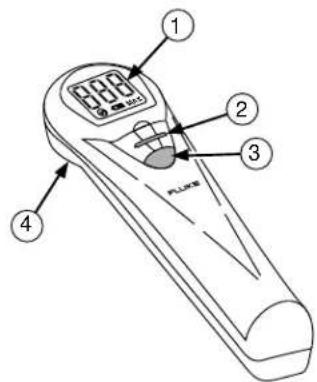
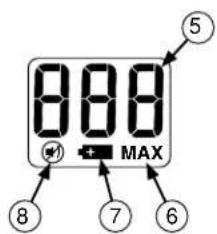
NV001F.EPS
①LCD (Liquid Crystal Display)
②Max/Hold button
③ON/OFF button
④Sensor (Fluke PN 689497)
⑤Digital reading in parts/million (PPM)
⑥Max/Hold mode (display shows maximum reading)
⑦Low battery indicator
⑧Beeper turned off
Fluke CO-220 Carbon Monoxide Meter
CO-220 English Instruction Sheet
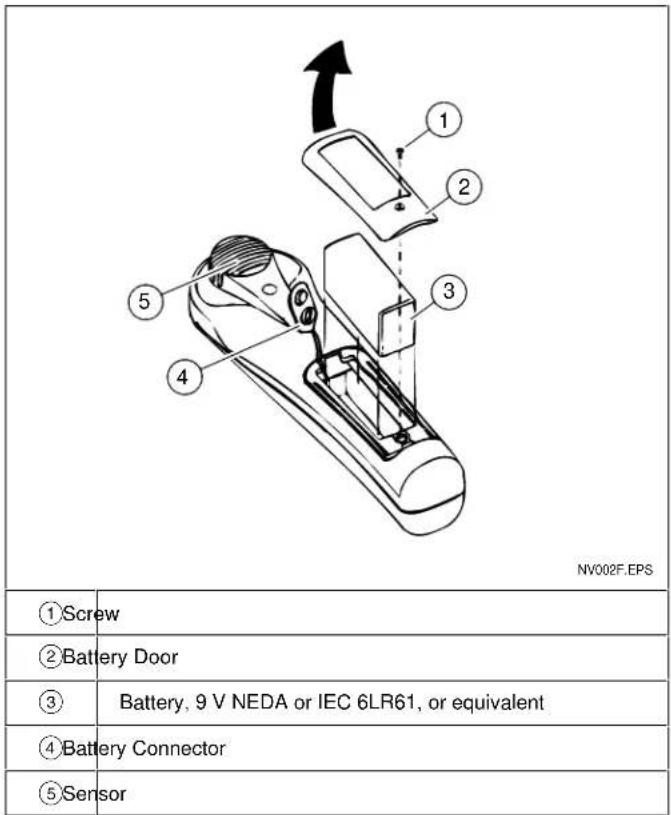
Installing and Replacing the Battery
Common Sources of CO
Common sources of potentially dangerous levels of CO are:
- Poorly maintained furnaces, gas heaters, or fireplaces.
- Dirty or plugged chimneys, or flue exhausts.
- Poorly maintained gas, oil, or kerosene appliances.
- Internal combustion engines (e.g., automobiles, lawnmowers, blowers).
CO-220 English Instruction Sheet
CO and Appliance Malfunctions
The following table identifies typical problems that can produce high levels of CO.
| Appliance Fuel Typical Problems | ||
| Gas furnacesRoom heaters | Oil, natural gas, or LPG (liquefied petroleum gas) | 1. Cracked heat exchanger.2. Not enough air to burn fuel properly.3. Defective/blocked flue.4. Maladjusted burner.5. Building not properly pressurized. |
| Central heating furnaces | Coal or kerosene | 1. Cracked heat exchanger.2. Not enough air to burn fuel properly.3. Defective grate. |
| Room heatersCentral heaters | Kerosene | 1. Improper adjustment.2. Wrong fuel (not K-1).3. Wrong wick or wick height.4. Not enough air to burn fuel.5. System not properly vented. |
| Water heaters Natural gas or LPG | 1. Not enough air to burn fuel properly.2. Defective/blocked flue.3. Maladjusted burner.4. Building not properly pressurized. | |
| RangesOvens | Natural gas or LPG | 1. Not enough air to burn fuel.2. Maladjusted burner.3. Misuse as a room heater.4. System not properly vented. |
| StovesFireplaces | Gas, wood, coal | 1. Not enough air to burn fuel properly.2. Defective/blocked flue.3. Green or treated wood.4. Cracked heat exchanger.5. Cracked firebox. |
CO-220 English Instruction Sheet
Specifications
| TemperatureOperating:Storage: | 0 °C to +50°C-30 °C to +50°C |
| Humidity (non-condensing)< 3 weeks> 3 weeks | 0-99 % RH0-90 % RH |
| Measurement range 0 to 1000 PPM | |
| Measurementresolution | 1 PPM for 0 - 200 PPM;5 PPM for 200 - 1000 PPM |
| Accuracy | 5 % or ± 2 PPM (whichever is greater) |
| Sensor type | Stabilized electrochemicalGas-specific (CO) |
| Typical sensor life 3 years | |
| Temperature Coefficient | Add 0.4 % per °C > 25 °CAdd 0.6 % per °C < 20 °C |
| Self Test < 20 seconds | |
| Battery 9 V, NEDA 1604A or IEC | 6LR61,or equivalent. |
| Typical battery life 500 hours | |
| Certification | CE |
CO-220 English Instruction Sheet
Calibration or Service
The Meter should be calibrated once a year by an authorized Fluke service center.
During normal use, the Meter does not require adjustment.
Any required adjustments are made at calibration. To replace the sensor, contact an authorized Fluke service center.
Warranty
LIMITED WARRANTY & LIMITATION OF LIABILITY
This Fluke product will be free from defects in material and workmanship for one year from the date of purchase. This warranty does not cover fuses, disposable batteries or damage from accident, neglect, misuse or abnormal conditions of operation or handling. Resellers are not authorized to extend any other warranty on Fluke's behalf. To obtain service during the warranty period, send your defective tester to the nearest Fluke Authorized Service Center with a description of the problem.
THIS WARRANTY IS YOUR ONLY REMEDY. NO OTHER WARRANTIES, SUCH AS FITNESS FOR A PARTICULAR PURPOSE, ARE EXPRESSED OR IMPLIED. FLUKE IS NOT LIABLE FOR ANY SPECIAL, INDIRECT, INCIDENTAL OR CONSEQUENTIAL DAMAGES OR LOSSES, ARISING FROM ANY CAUSE OR THEORY. Since some states or countries do not allow the exclusion or limitation of an implied warranty or of incidental or consequential damages, this limitation of liability may not apply to you.
Fluke Corporation Fluke Europe B.V.
P.O. Box 9090 P.O. Box 1186
Everett, WA. 5602 B.D. Eindhoven
98206-9090 The Netherlands
10/96
- CO-220 English Instruction Sheet
- FLUKE®
- CO-220
- Contacting Fluke
- ⚠ Safety Information - Read First
- What the Meter Does
- Self-Test
- Establishing a Baseline
- Storing Maximum Readings (Max/Hold)
- Auto-Back-light
- Automatic Power-Off
- Muting the Beeper
- Common Sources of CO
- CO and Appliance Malfunctions
- Calibration or Service
- Warranty
- LIMITED WARRANTY & LIMITATION OF LIABILITY
Brand : FLUKE
Model : CO-220
Category : Gas detector