C70 Ad Astra - Wristwatch Christopher Ward - Free user manual and instructions
Find the device manual for free C70 Ad Astra Christopher Ward in PDF.


| Product Type | Wristwatch |
| Brand | Christopher Ward |
| Model | C70 Ad Astra |
| Movement Type | Automatic (self-winding) |
| Case Material | Stainless steel |
| Case Diameter | 42 mm |
| Case Thickness | 13 mm |
| Lug Width | 22 mm |
| Weight | Approx. 85 g |
| Water Resistance | 10 ATM (100 meters) |
| Crystal Material | Domed sapphire crystal with anti-reflective coating |
| Dial Color | Black with luminous hands and markers |
| Functions | Hours, minutes, small seconds, date, chronograph (60-second, 30-minute, 12-hour counters), tachymeter |
| Power Reserve | Approximately 38 hours |
| Strap Type | Leather strap or stainless steel bracelet (variant) |
| Clasp Type | Deployment clasp with push-button release |
| Servicing Interval | Every 3-5 years |
| Care Instructions | Clean with soft cloth; avoid magnets and extreme temperatures; rinse with fresh water after saltwater exposure |
| Spare Parts | Available through authorized dealers or Christopher Ward directly |
| Repairability | Repairable by certified watchmakers |
| Warranty | 5 years (extendable by registering) |
| Country of Origin | Switzerland |
| Manufacturer | Christopher Ward |
Frequently Asked Questions - C70 Ad Astra Christopher Ward
User questions about C70 Ad Astra Christopher Ward
0 question about this device. Answer the ones you know or ask your own.
Ask a new question about this device
Download the instructions for your Wristwatch in PDF format for free! Find your manual C70 Ad Astra - Christopher Ward and take your electronic device back in hand. On this page are published all the documents necessary for the use of your device. C70 Ad Astra by Christopher Ward.
USER MANUAL C70 Ad Astra Christopher Ward
natural_image
Concentric circles in red, white, and blue on a solid blue background (no text or symbols)The C70 Royal Air Force Ad Astra
OWNER'S HANDBOOK
Time on your side...
Your Christopher Ward watch has been designed and engineered by highly talented craftspeople to ensure not only accurate and precise timekeeping but also to bring a real pride of ownership that only luxury items of the highest quality can ever hope to deliver.
You have made an investment, a good one, and the aim of this handbook is to help you make the most of that investment during what I hope will be a lifetime of ownership.
Christopher Ward
Caring for your Christopher Ward quartz watch
Your C70 Royal Air Force Ad Astra chronograph is constructed from the finest components and materials available including one of Switzerland's finest quartz movements.
As with all watches of this quality, with just a little care, it has the potential to become an heirloom piece giving further joy to future generations.
Here are a few hints to help keep your watch working perfectly over the years:
- Although the battery in your watch may last longer, we recommend you have it changed every 2/3 years by a reputable watch repairer.
- At the same time as having the battery changed it makes sense to have the watch repairer clean and lubricate your watch as necessary.
- Make sure the crown is screwed down fully before putting the watch into water. Adhere to the water resistance ratings towards the end of the handbook to prevent water getting to the movement which could result in a very costly repair or the need for a replacement movement.
- Your watch is shock resistant to minor impacts but dropping from height onto a hard surface may damage the movement.
Should you need a replacement part - don't worry, we keep stocks of spare parts for years, even for discontinued models. It's all part of the Christopher Ward service.
Finally, don't forget our famous 60:60 Guarantee allows you to return your watch absolutely free, for any reason, and with no quibbles, for up to 60 days after purchase and we also guarantee your movement for up to 60 months.
After all, why shouldn't you enjoy peace of mind as much as you enjoy your watch?
The RAFBF and Christopher Ward
The Royal Air Force Benevolent Fund is the RAF's leading welfare charity, providing financial, practical and emotional support to all members of the RAF family, helping both serving and former members of the RAF, as well as their partners and dependants. If you require further information please visit the official RAFBF website www.rafbf.org. As a British company we are both proud and delighted to be working with the RAF in helping to commemorate the British battle that most symbolises the destiny of our nation. Christopher Ward will donate 5% of the retail value of every C5 Battle of Britain (70) 6B/159 and C70 RAF Ad Astra watches sold to the RAFBF.

RAFBF
THE HEART OF THE RAF FAMILY
natural_image
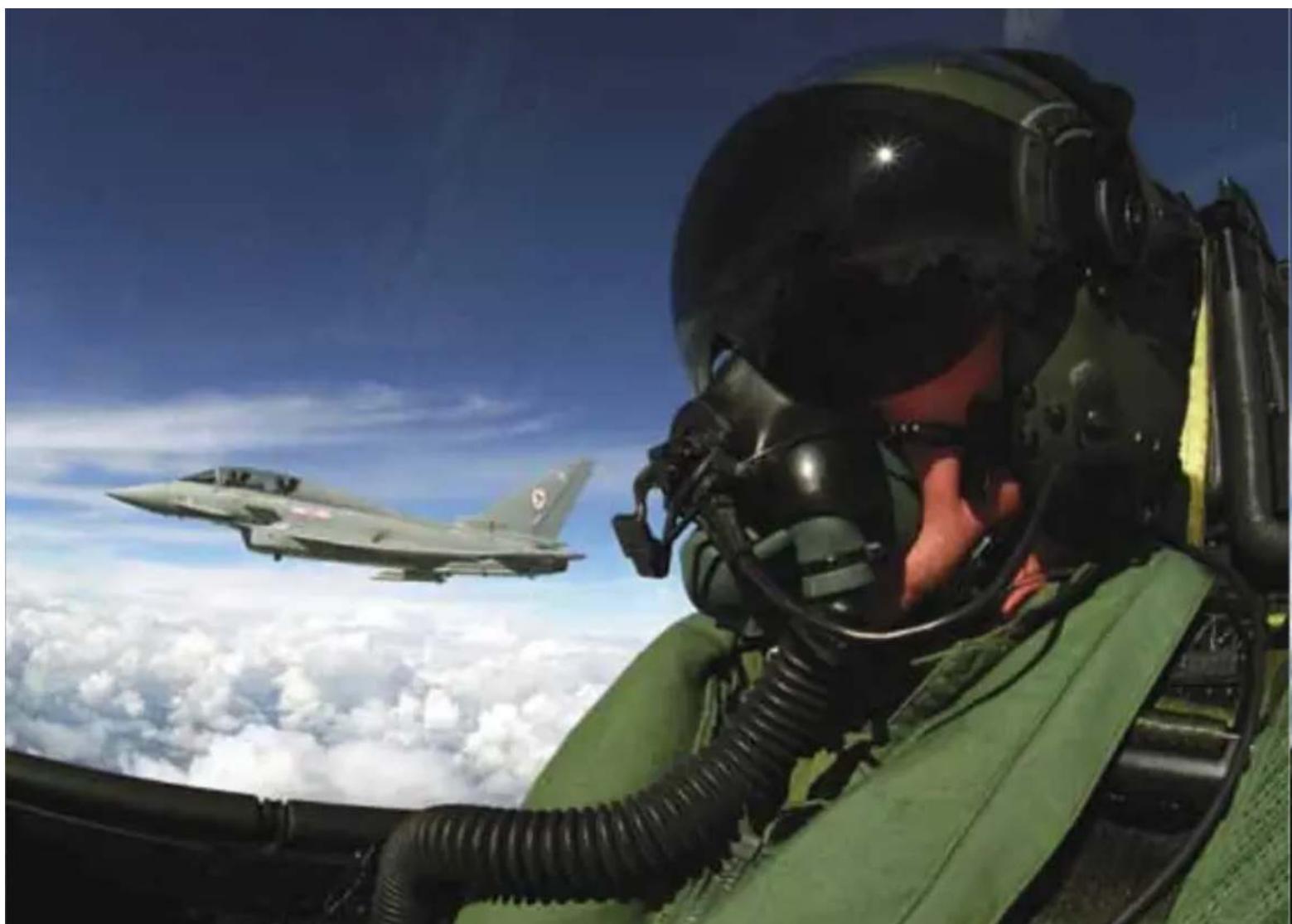
Pilot in cockpit looking out of a fighter jet flying above clouds (no visible text or symbols)Agile. Adaptable. Capable.
The Royal Air Force (RAF) is the United Kingdom's air force and the oldest independent air force in the world. Formed on 1st April 1918, the RAF has taken a significant role in British military history ever since, playing a large part in WWII and more recent conflicts.

The RAF operates 1,109 aircraft and, as of October 2009, had a total man power strength of 44,300 regular, and 2,500 part time personnel. These 46,800 active personnel make it the largest air force in the European Union, the second largest in NATO and fifth largest in the world.
The majority of the RAF's aircraft and personnel are based in the UK with many others serving on operations (principally Afghanistan, the Middle East and the Balkans) or at long-established overseas bases (Ascension Island, Canada, Cyprus, Diego Garcia, Gibraltar, the Falkland Islands and Germany). The RAF's mission is to support the objectives of the British Ministry of Defence (MoD), which are to "provide the capabilities needed: to ensure the security and defence of the United Kingdom and overseas territories, including against terrorism; to support the Government's foreign policy objectives particularly in promoting international peace and security."
The RAF's own mission statement reads as thus, to provide 'An agile, adaptable and capable Air Force that, person for person, is second to none, and that makes a decisive air power contribution in support of the UK Defence Mission.'


The Origins of Per Adua Ad Astra
Per ardua ad astra ('Through Adversity to the Stars') is the motto of the Royal Air Force and other Commonwealth air forces such as the RAAF, RNZAF, and the former RCAF. It dates from 1912 and was used by the newly-formed Royal Flying Corps.

The first Commanding Officer of the Royal Flying Corps (Military Wing) was Colonel Frederick Sykes. He asked his officers to come up with a motto for the new service, one which would produce a strong esprit de corps. Not long after this, two junior officers were walking from the Officers' Mess at Farnborough to Cody's Shed on Laffan Plain.
As they walked they discussed the problem of the motto and one of them, Lieutenant J. S. Yule, mentioned the phrase 'Sic itur ad Astra', from the Virgilian texts. He then expanded on this with the phrase 'Per Ardua ad Astra' which translated as 'Through Adversity to the Stars'. Colonel Sykes approved of this as the motto and forwarded it to the War Office. It was then submitted to the King, who approved its adoption.
The question of where this motto had come from can be answered by the fact that Yule had read it in a book called The People of the Mist by Sir Henry Rider Haggard.
In the first chapter was the passage: "To his right were two stately gates of iron fantastically wrought, supported by stone pillars on whose summit stood griffins of black marble embracing coats of arms and banners inscribed with the device 'Per Ardua ad Astra."
Where Rider Haggard obtained this phrase is still unclear, although it is possible that it originated from the Irish family of Mulvany who had used it as their family motto for hundreds of years and translated it as 'Through Adversity to the Stars'.
The authoritative translation of the motto is just as uncertain as the source. Since there can be a number of different meanings to 'Ardua' and 'Astra', scholars have declared it untranslatable. To the Royal Air Force and the other Commonwealth air forces, however, it will remain translated as 'Through Adversity to the Stars'.
natural_image
Rescue personnel in full gear navigating choppy water, no visible text or symbolsThe Royal Air Force Roundel
The Royal Air Force roundel is a circular identification mark painted on aircraft to identify them to other aircraft and ground forces. In one form or another it has remained standard for British military and naval aircraft from 1915 to the present.

natural_image
Two identical blue concentric circles with a small red dot in the center, no text or symbols present.When the First World War started in 1914 it was the habit of ground troops to fire on all aircraft, friend or foe, which encouraged the need for some form of identification mark so the Union Flag was painted under wings and the sides of the fuselage. Left. Inter-war roundels.
It soon became obvious that at a distance the Union Flag could be confused with the Iron Cross being used to identify German aircraft. Right. WWII fighter aircraft.

natural_image
Four circular target designs with concentric circles and colored centers (no text or symbols)After a Union Flag inside a shield was tried it was decided to follow the lead of the French who used a tricolour Cockade (a roundel of red and white with a blue centre) by reversing the colours it became the standard markings on RFC aircraft from 11th December 1914 the Royal Naval Air Service meanwhile used a red ring with a white centre until they too standardized on the RFC roundel. Left. Bomber and transport roundel development.

natural_image
Two identical circular target designs with blue, white, and red centers, no text or symbols present.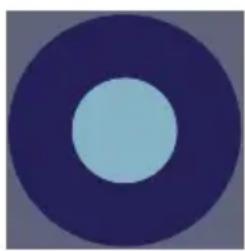
natural_image
Simple concentric circle design with two shades of blue, no text or symbols present.The official order stated: All aeroplanes of the RFC to be marked on the underside and on the rudder with concentric circles similar to those on the French machines but with the colours reversed, that is with a red circle inside a blue ring. The circles to be as large as possible. In addition a Union Jack 2ft x 1½ft will be painted on the wing tips outside the circles. Left. To prevent confusion with Japanese markings South East Asia lost the red circle.
In 1915 with the roundel carried by all RFC (and RNAS) aircraft the use of the Union Jack was discontinued. The RAF has employed several versions of the roundel during its existence. Right. The standard Gulf War roundel (left) and a local variant applied in the field (right).

natural_image
Two abstract circular shapes with contrasting colors: one light blue and orange, the other pink and beige (no text or symbols)
natural_image
Simple concentric circle graphic with red center and blue outer ring (no text or symbols)Between the wars it was dispensed with, as not being required on the majority of aircraft, which were silver-doped. During WW2 with the reintroduction of camouflage, the outline was also reintroduced, but in yellow. Post World War Two the outline was again dispensed with, however individual aircraft may have a white outline but this is not a part of the official roundel specifications as it was previously.
natural_image
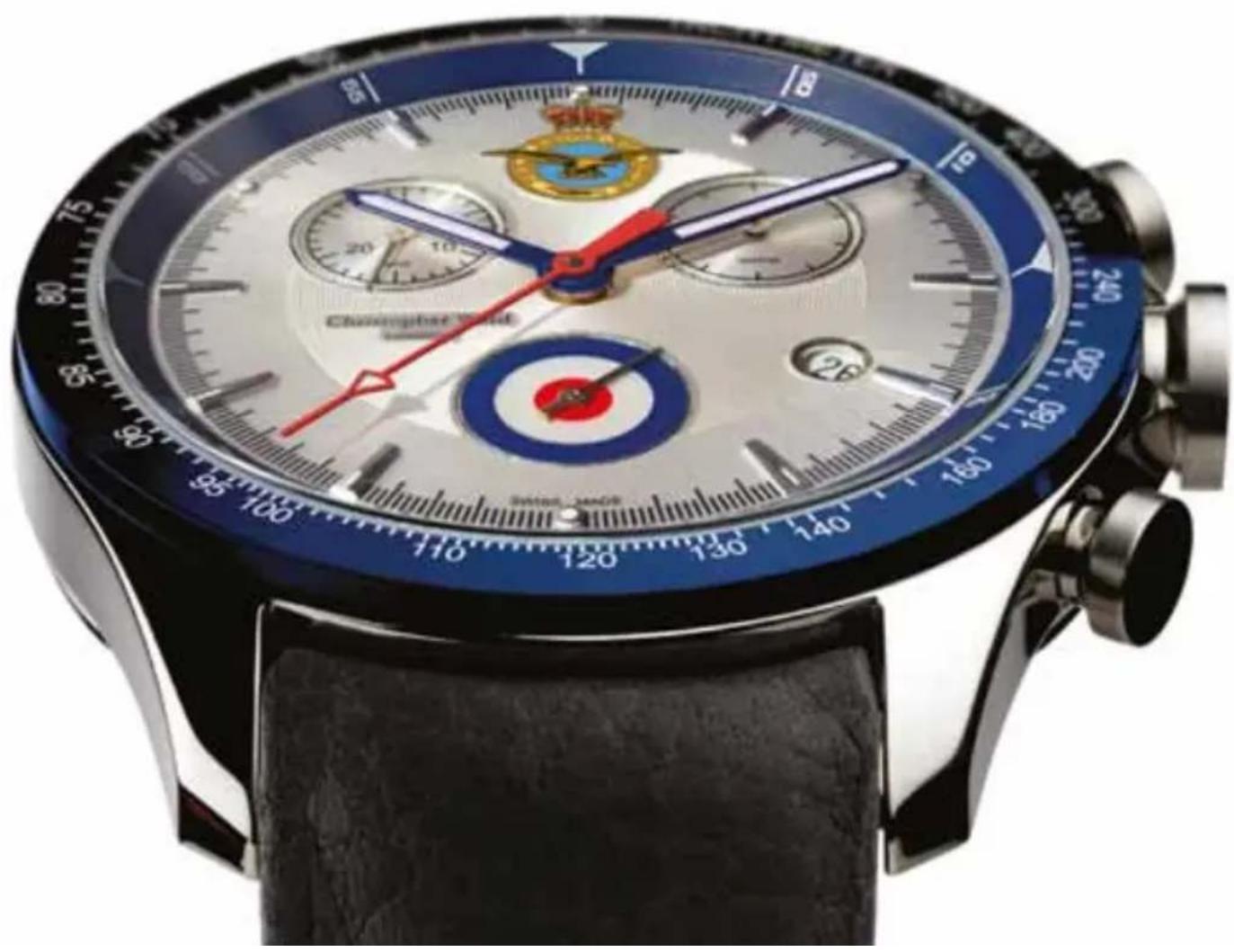
Close-up of a luxury wristwatch with blue and silver casing, featuring a detailed clock face and brand emblem (no readable text or symbols beyond branding)The C70 Royal Air Force Ad Astra
Features
22 jewel Swiss quartz movement
Royal Air Force roundel and insignia
Multi-function chronograph
Date window
Convex sapphire crystal with ant-reflective coating
Water resistant to 10 atm
Adjustable quick-release butterfly clasp
Screw-in crown
Engraved caseback with unique serial number
Chronographic dials with split
minutes / seconds / 1/10 seconds
Tachymeter bezel and engraved backplate
Technical Data
Diameter: 42mm
Height: 10.7mm
Weight: 80g - 160g
Case: 316L Stainless steel
Calibre: ETA 251.272
Accuracy: +20 / -10 seconds per month
Description of the display and control buttons
Display elements
Control buttons
Minute Hand
Tenths
Minutes
Hour hand
Centre stop-second
Seconds
Date Window
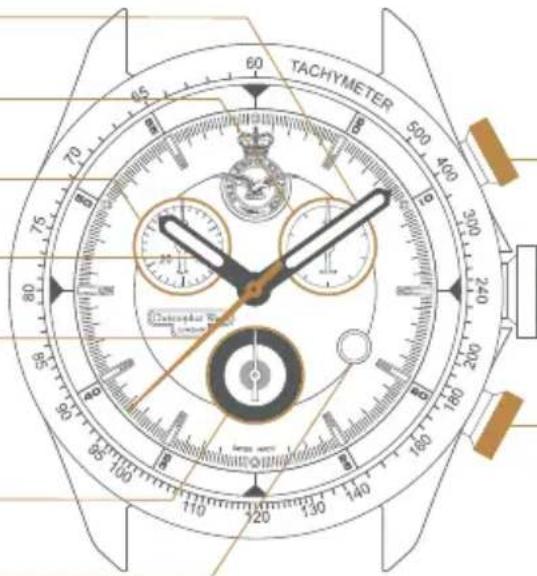
Push-button A
Crown
Push-button B
natural_image
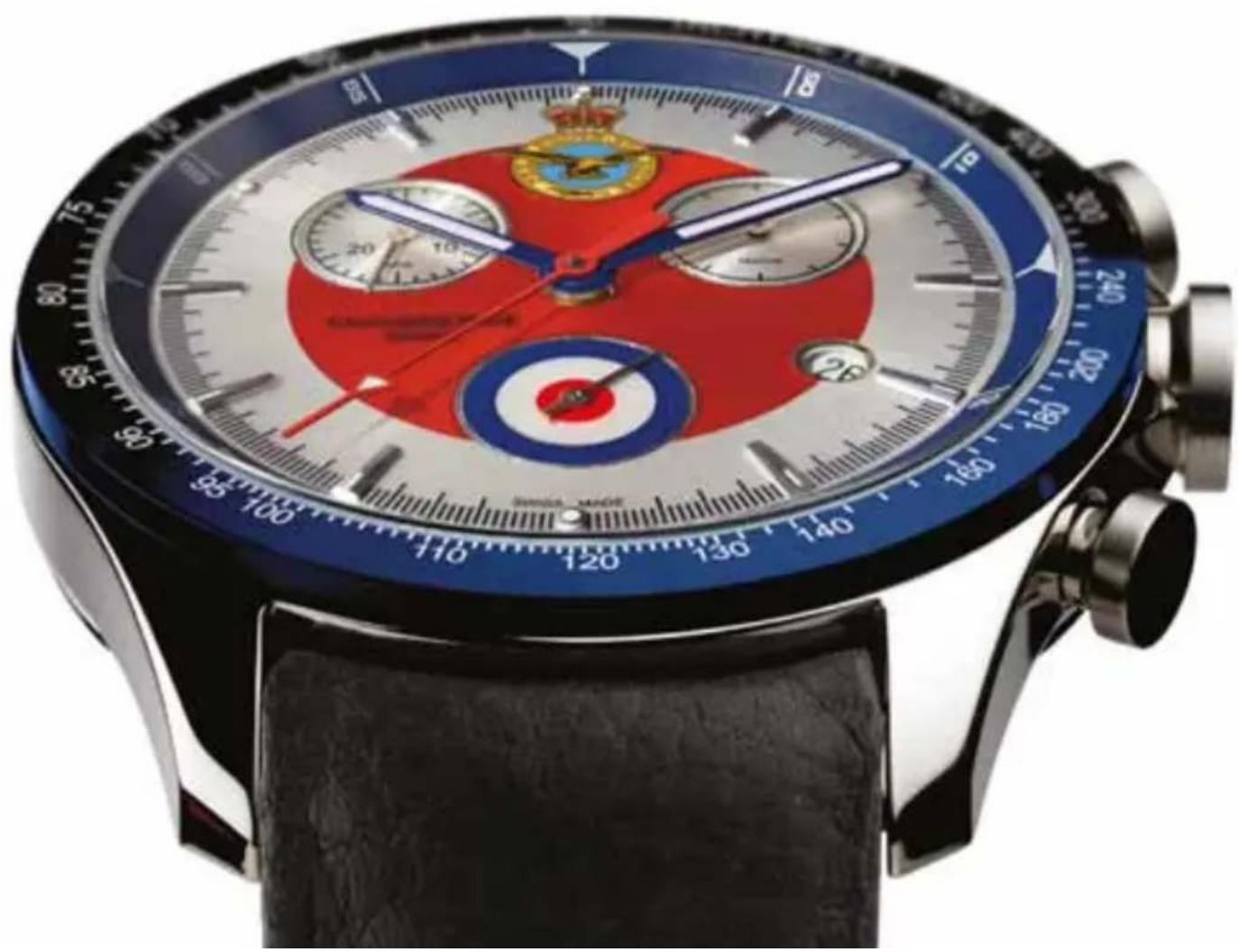
Close-up of a luxury wristwatch with blue and red dials, featuring a central emblem and abstract design (no readable text or symbols)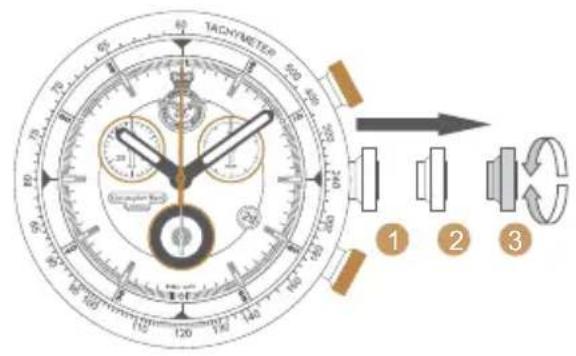
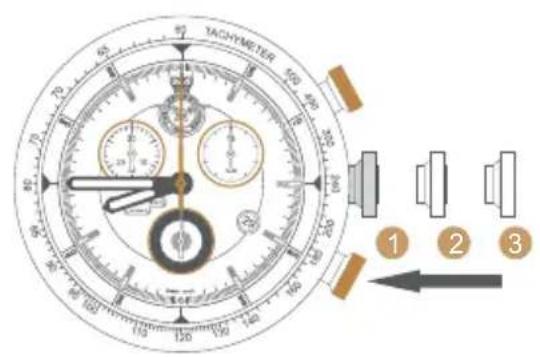
Setting the time
For a superior water resistance your crown is of the screw-in type. To get to position 1 turn the crown anti-clockwise until it releases itself.
- Pull out the crown to position ③(the watch stops).
- Turn the crown until you reach the correct time e.g. 08.45 hr.
- Push the crown back into position 1 and screw the crown in a clockwise direction in order to maintain water resistance. The crown should sit flush to the case.
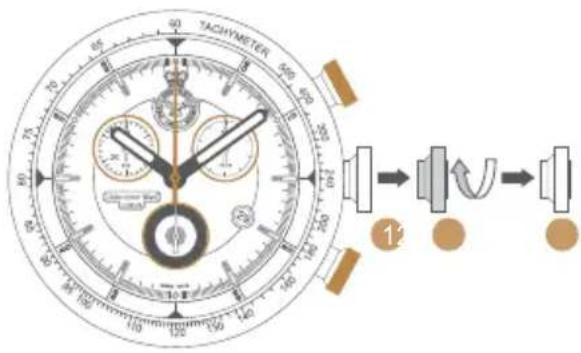
Setting the date (quick mode)
- Pull out the crown to position 2(the watch continues to run).
- Turn the crown clockwise until the correct date appears. The hour hand moves in one hour increments.
• Pull the crown to position 3
Push the crown back into position 1 until flush with the case and screw in.
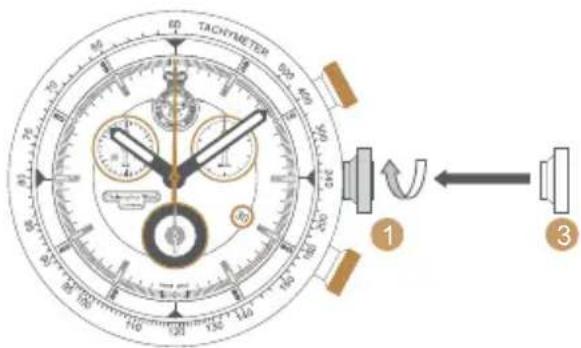
Please note:
The date can not be changed during the date changing phase between 21.00 hr and 02.00 hr as the watch gearing will already be aligning itself to change the date.
The crown should always be screwed in after adjustment, and it is best to do so from position 3 to avoid advancing beyond the desired date.
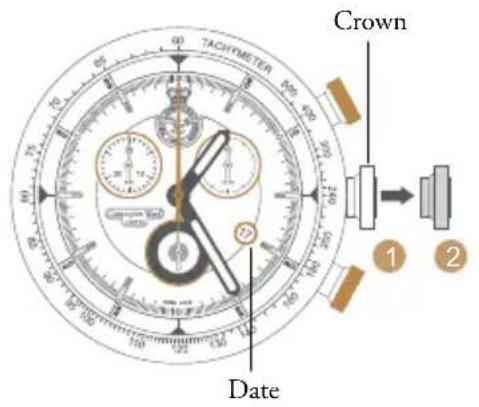
Setting the date/time
Example:
Date / time on the watch: 17th / 01.25 hr Present date / time: 4th / 20.30 hr
- Pull out the crown to position ② (the watch continues to run).
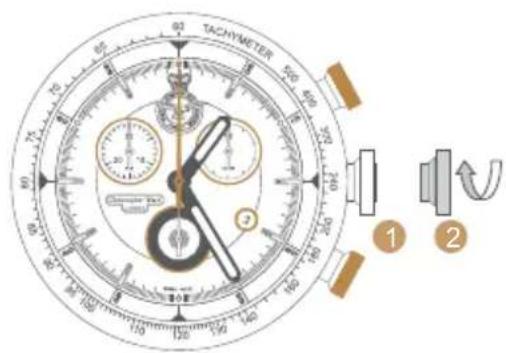
- Turn the crown clockwise until yesterday's date appears ie. 3rd.
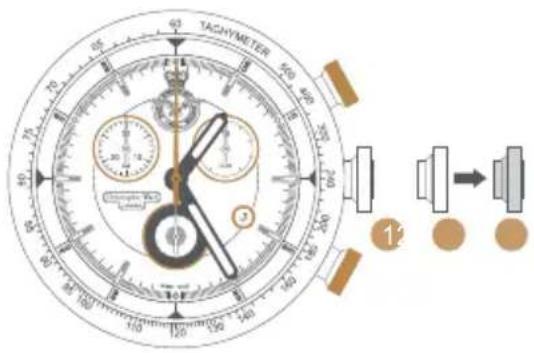
- Pull out the crown to position 3(the watch stops).
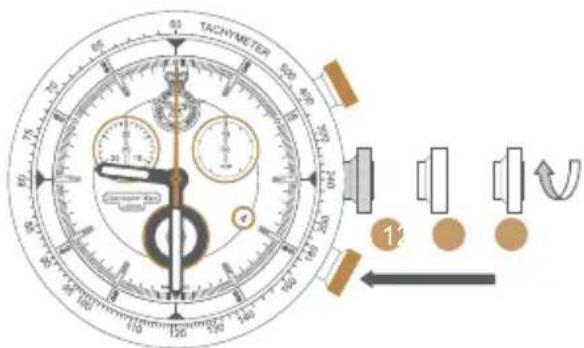
- Turn the crown clockwise until the correct date ie. 4th appears (after passing through midnight).
- Continue to turn the crown until the correct time 21.30 hr appears.
- Push the crown back into position 1 until flush with the case and screw in.
Chronograph:
• The minute counter measures 30 minutes per rotation.
• The centre stop-second measures 60 seconds per rotation.
• The 1/10 second counter measures 1 second per rotation.
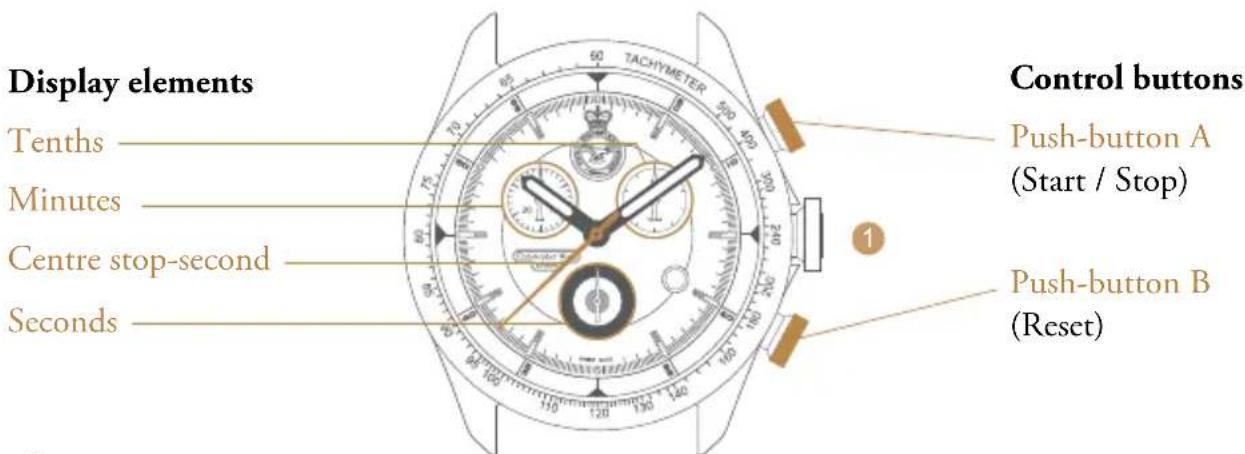
Please note:
Before using the chronograph functions, please ensure that:
• The crown is in position 1(screwed in).
• The 3 chronograph hands are at zero position.
Should this not be the case, the positions of the hands must be adjusted (see the chapter entitled ‘Adjusting the chronograph hands to zero position’).
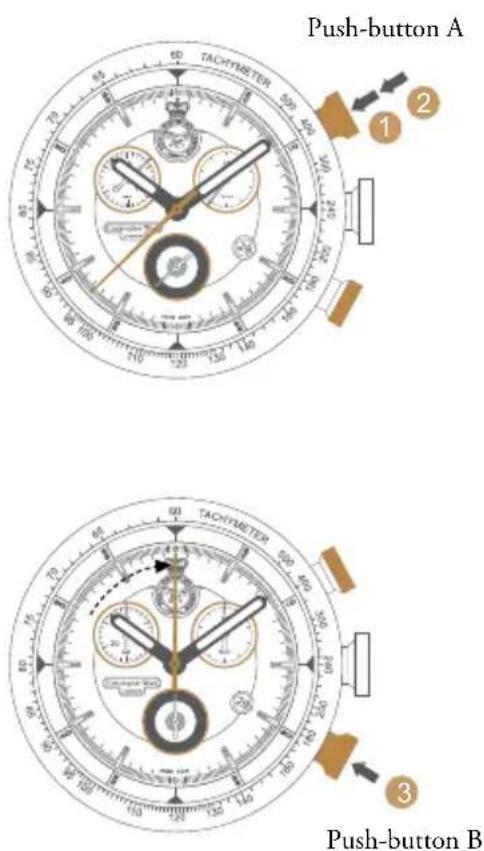
Chronograph: Basic function
(Start / Stop / Reset)
Example:
Start: Press push-button A.
② Stop: to stop the timing, press push-button A once more and read the 3 chronograph counters: 4 min / 38 sec / 7/10 sec.
3Zero positioning:
Press push-button B.
(The 3 chronograph hands will be reset to their zero positions).
Example of use:
Timing a runner over 100m.
Push-button B
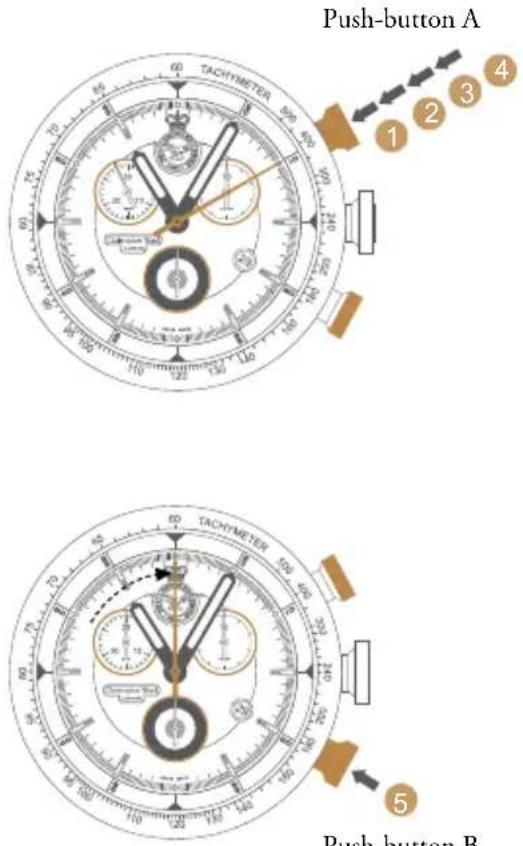
Chronograph: Accumulated timing
Example:
Start: (start timing).
2Stop: (e.g. 15 min 5 sec following ). 1
Restart: (timing is resumed).
4Stop: (e.g. 13 min 5 sec following ) ③ = 28 min 10 sec (the accumulated measured time is shown)
5Reset:
The 3 chronograph hands are returned to their zero positions.
6Repeat: as necessary.
Example of use:
Overall time to complete a journey less the coffee breaks.
Push-button B
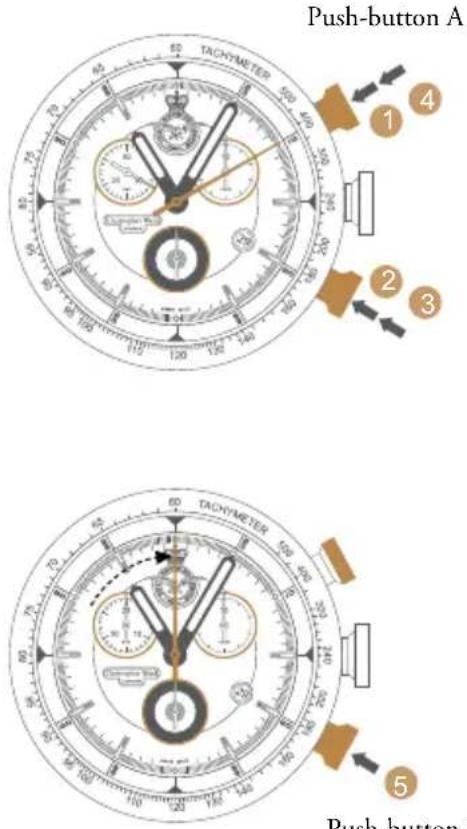
Chronograph:
Intermediate or interval timing
Example:
Start: (start timing).
^2 Display interval:
e.g. 10 minutes 10 seconds (timing continues in the background).
③Making up the measured time:
(the 3 chronograph hands are quickly advanced to the ongoing measured time).
4 * Stop: (final time is displayed).
5Reset:
The 3 chronograph hands are returned to their zero positions.
Please note:
* Following ③, further intervals or intermediates can be displayed by pressing push-button B.
Example of use: 4 x 100m relay.
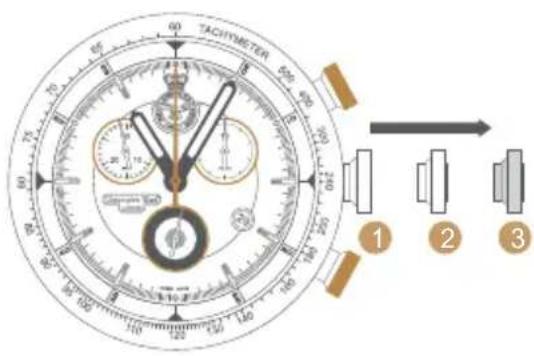
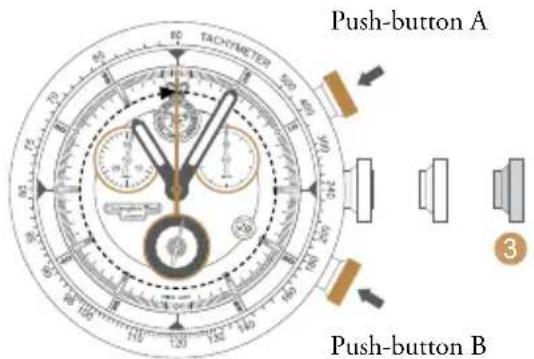
Adjusting the chronograph hands to zero position
Example:
One or several chronograph hands are not in their correct zero positions and have to be adjusted (e.g. following a battery change).
- Pull out the crown to position 2 press Button B to reset the 30 minute counter to zero
- Pull out the crown to position ③. Push Button A to adjust the stop second hand and Button B to adjust the tenths seconds hand.
Fitting the bracelet
If you find the bracelet needs adjusting to your wrist we recommend you have it re-sized by a reputable watch repairer or jeweller. Most local jewellers will either do this for free or perhaps make a nominal charge for what is a job that should only take a few minutes. It is always best to be present so a comfortable fit is achieved.
Establishing the length of the bracelet
Place the watch with its separated bracelet on your wrist and estimate the number of links you need to remove. If you need to remove several links, try to keep the numbers removed from both halves of the bracelet as equal as possible to ensure that the clasp remains roughly in the middle of your wrist.
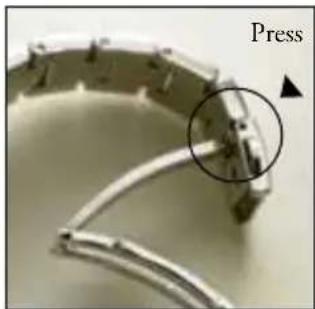
To open your bracelet simply press either side of the clasp to release as shown.
The quick-release butterfly clasp
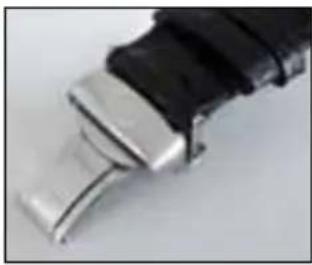
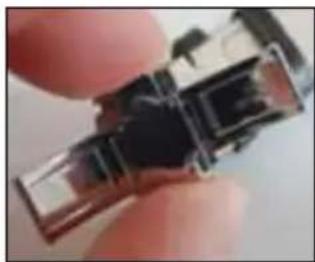
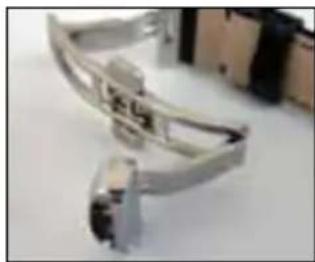
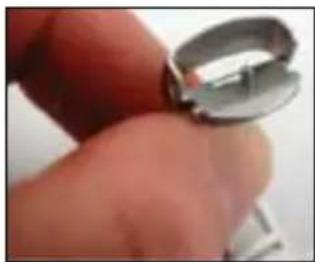
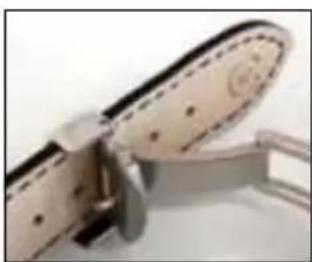
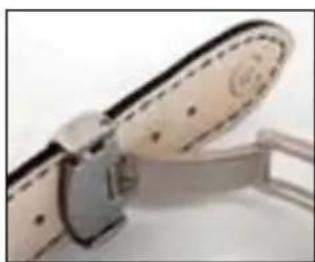
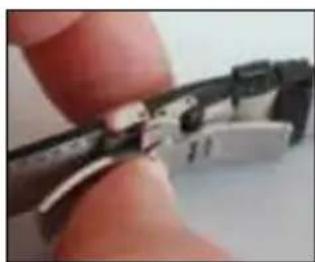
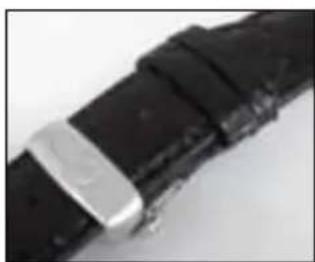
The strap versions of the C70 Royal Air Force Ad Astra use quick-release butterfly clasps. If you are unfamiliar with the butterfly clasp system just follow our 8 step guide below.
natural_image
Close-up of a black and silver buckle buckle (no text or symbols visible)Step 1 Locate the clasp
natural_image
Close-up of a hand holding a small electronic component (no visible text or symbols)Step 2 Click quick-release
natural_image
Close-up of a white plastic mechanical component with a small inset showing internal structure (no visible text or symbols)Step 3 Pull open clasp
natural_image
Close-up of a hand holding a small metallic clip (no visible text or symbols)Step 4 Prise cover open
natural_image
Close-up of a mechanical clamp or bracket with metallic components and a small circular feature (no visible text or symbols)Step 5 Thread strap through
natural_image
Close-up of a white mechanical device with a metallic bracket and circular components (no visible text or symbols)Step 6 Snap back
natural_image
Close-up of a hand holding a small electronic device with visible components (no text or symbols)Step 7 Close clasp
natural_image
Close-up of a black wrist strap with silver metal clip (no text or symbols visible)Step 8 Complete

natural_image
Abstract black-and-white icon depicting a hand holding a device, enclosed in a circular frame (no text or symbols)1 ATM (10 Metres)

natural_image
Icon showing a car with a streetlamp above it, symbolizing surveillance or navigation (no text)3 ATM (30 Metres)

natural_image
Black and white icon of a showerhead showerhead with no text or symbols5 ATM (50 Metres)
Safe to wear your watch while washing your hands with tap water.
Washing your car and or general hosepipe usage.
Water resistant to most household shower units.

natural_image
Circular icon with a white diving gear and wave pattern, no text or symbols present.10 ATM (100 Metres)

natural_image
Black and white circular icon depicting a diver swimming with waves (no text or symbols)30 ATM (300 Metres)

natural_image
Black and white circular icon depicting a submarine with water waves (no text or symbols)50 ATM (500 Metres)
Safe to use while snorkelling in open water, it is not advisable to dive with your watch.
Ideal for experienced divers and, in general, anybody practising scuba-diving.
Professional divers, experienced prolonged exposure underwater.
Water resistance
Please note. these are only guidelines but we strongly urge you to adhere to them to retain the integrity of your watch. If you have any queries regarding this please contact us direct.
NB. To safeguard watch movement please ensure the crown is, at all times, screwed in correctly.
Keeping in touch with Christopher Ward...
From small beginnings just a few short years ago (our first workshop was actually a refurbished chicken shed!), Christopher Ward has won a worldwide following for his eponymous watch brand and can justifiably claim to manufacture the most affordable luxury watches in the world.
For many, the philosophy behind the brand, trying to put luxury watches within the reach of everyone, is as attractive as the watches themselves as is the very open approach of the business which means that Chris and the team spend a lot of time communicating personally with our customers - many of whom have become friends.
As the owner of a Christopher Ward watch, if ever you need to get hold of us we are at your service. We have listed some useful contact details on the back cover.
There is also always something new going on at our website at www.christopherward.co.uk and, if you haven't already discovered the independent forum dedicated to our brand at www.christopherwardforum.com we would recommend a visit. Informative and fun, it's a great place to hear the unexpurgated view of Christopher Ward of London!

Christopher Ward
LONDON
Head Office. Christopher Ward (London) Limited, 1 Park Street, Maidenhead Berkshire SL6 1SL, United Kingdom
Telephone (Head Office). +44 (0)1628 763040
Customer Services. 0844 875 1515 (UK) 1.877.226.8224 (USA)
Website. www.christopherward.co.uk
General. customerservices@christopherward.co.uk
Technical. technical@christopherward.co.uk
- The C70 Royal Air Force Ad Astra
- Time on your side...
- Caring for your Christopher Ward quartz watch
- The RAFBF and Christopher Ward
- Agile. Adaptable. Capable.
- The Origins of Per Adua Ad Astra
- The Royal Air Force Roundel
- Features
- Technical Data
- Description of the display and control buttons
- Display elements
- Control buttons
- Setting the time
- Setting the date (quick mode)
- Please note:
- Setting the date/time
- Example:
- Chronograph:
- Chronograph: Basic function
- 3Zero positioning:
- Example of use:
- Chronograph: Accumulated timing
- 5Reset:
- Intermediate or interval timing
- Display interval:
- ③Making up the measured time:
- Adjusting the chronograph hands to zero position
- Fitting the bracelet
- Establishing the length of the bracelet
- The quick-release butterfly clasp
- Water resistance
- Keeping in touch with Christopher Ward...
- Christopher Ward
- LONDON
Brand : Christopher Ward
Model : C70 Ad Astra
Category : Wristwatch