KF3390 - Refrigerator ELEKTRO HELIOS - Free user manual and instructions
Find the device manual for free KF3390 ELEKTRO HELIOS in PDF.


| Product Type | Freestanding Refrigerator (with small freezer compartment) |
| Brand | Elektro Helios |
| Model | KF3390 |
| Energy Class | E |
| Annual Energy Consumption | 180 kWh |
| Dimensions (H x W x D) | 85 cm x 55 cm x 55 cm |
| Weight | 25 kg |
| Voltage / Frequency | 220-240 V / 50 Hz |
| Climate Class | N-ST |
| Refrigerant | R600a (Isobutane) |
| Temperature Control | Mechanical rotary thermostat (1-7) |
| Interior Lighting | Incandescent bulb (max 15 W) |
| Shelves | 3 adjustable glass shelves |
| Vegetable Drawer | 1 crisper drawer with glass cover |
| Door Balconies | 4 adjustable door racks |
| Freezer Section | Small ice tray compartment |
| Defrosting | Manual (refrigerator section); manual (freezer section) |
| Noise Level | 42 dB(A) |
| Cleaning | Unplug before cleaning; use mild soap and water; avoid abrasive cleaners |
| Spare Parts | Available from authorized service centers |
| Repair Index (if applicable) | Not rated |
Frequently Asked Questions - KF3390 ELEKTRO HELIOS
User questions about KF3390 ELEKTRO HELIOS
0 question about this device. Answer the ones you know or ask your own.
Ask a new question about this device
Download the instructions for your Refrigerator in PDF format for free! Find your manual KF3390 - ELEKTRO HELIOS and take your electronic device back in hand. On this page are published all the documents necessary for the use of your device. KF3390 by ELEKTRO HELIOS.
USER MANUAL KF3390 ELEKTRO HELIOS
INSTRUCTION BOOKLET BRUK SANVISNING KÄYTTÖOHJE
⚠️ Warnings for your safety
Warnings for your safety. Carefully read these instructions before installing and using the machine.
This freezer is designed to be operated by adults only. Children should not be allowed to tamper with the controls or play with the product.
⚠️ Any electrical work required to install the appliance should be carried out by a qualified electrician or competent person.
This appliance is heavy. Care should be taken when moving it.
⚠ Make sure that the cable is not trapped underneath the appliance, nor touches the motor.
⚠️ Repairs carried out by inexperienced persons may cause injuries or serious malfunctioning. Refer to the nearest Authorized Dealer.
⚠ Make sure the rear part of the appliance stands against a wall as there are working parts which heat up and should not be of easy access.
⚠ Make sure that there is a continuous and adequate ventilation as a failure to do so may result in damage to the appliance or deterioration of the food.
The appliance should be left for at least 4 hours after installation before it is turned on ill order to allow the refrigerant to settle.
This product must be serviced only by an AUTHORIZED DEALER, and only GENUINE SPARE PARTS must be employed.
⚠ Before cleaning or repairing the appliance, make sure it is unplugged.
⚠ It is dangerous to alter the specifications or modify this product in any way.
These domestic refrigerators are designed to be used specifically for the storage and conservation of food.
⚠ DO NOT USE SHARP INSTRUMENTS to scrap off frost or ice. Frost may be removed by using a plastic scraper. (See defrosting instructions).
⚠ Frozen food must not be re-frozen once it has been thawed out.
⚠ Manufacturer's storage recommendations should be strictly complied with.
⚠ Lollies can cause frost burns if consumed right away from the freezer.
⚠ Do not place carbonate or fizzy drinks in the freezer as these may explode.
⚠ When an old freezer is to be discarded make sure to:
⚠ Dismount the doors in order to prevent children from getting trapped inside.
Have the gas from the cooling system withdrawn before making it to scrap iron.
Índex
Warnings for your safety pag. 2
Installation pag. 4
Changing the opening directions of the doors and Panelling pag. 5
Regulation and Control pag. 6
How to use your Refrigerator-Freezer pag. 7 - 8
Maintenance of your Refrigerator-Freezer pag. 9 - 10
Something not working pag. 11 - 12
Normal noises when functioning pag. 13
Guarantee, Service and Spare Parts pag. 14
- Place the refrigerator away from direct sunlight and heat sources.
- Maintain recommended ventilation - see Fig. 1.
- Make sure the refrigerator is accurately levelled turning the adjustable feet in order to avoid vibrations and noises.
- This is a built in design to be aligned with other furniture
Cleaning the interior
- Do not use alcohol or any cleanig product containing alcohol because it can damage the cabinet.
- Before using the appliance for the first time wash the interior with luke warm water and some neutral soap so as to remove the typical smell of a brand-new product arid then dry thoroughly.
- Do not use detergents or abrasive powders as these will damage the finish.
- Remove security used for transportation.
Electrical connection
▲Before plugging the appliance make sure that the voltage and frequency shown on the «Technical Features» correspond to your home supply.
△It is essential that the appliance be efficiently earthed.
For this purpose the supply cable plug incorporates a special earth contact. If the sockets of your domestic wiring system are not grounded, have the appliance connected to a separate ground wire in accordance with existing safety regulations.
«THE MANUFACTURER DECLINES TO ACCEPT ANY LIABILITY IF THIS SAFETY RULE IS NOT OBSERVED».
Should a change of the supply cord be necessary, remove the lid of the terminal board acting on «E» and «F» as shown figure 3 in order to gain access to the terminals. Fig. 3.
Starting - up
• Plug the appliance into the mains.
- Make sure the inner light «H» turns on when opening the door.
- Turn to intermediate position the knobs of the «temperature regulators» «f» for refrigerating compartment and «e» for freezing compartment.
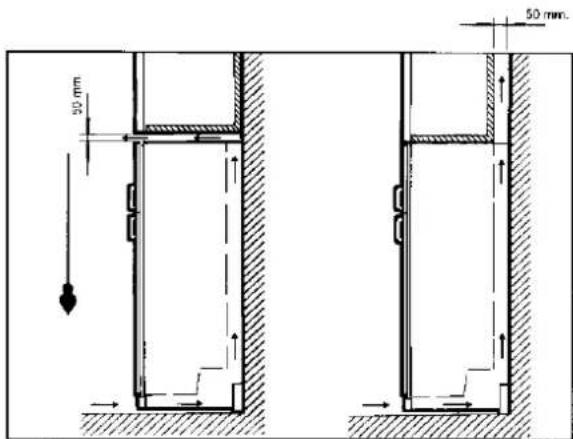
Fig. 1
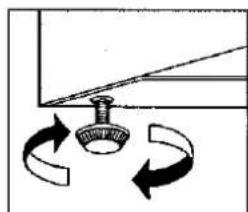
Fig. 2

Fig. 3
Changing the opening direction of doors and Panelling
If you wish to change the opening side of the doors proceed as follows:
1... Remove the handles of the doors, (some models only).
2... Take off the plinth pressed onto cabinet.
3... Remove the lower hinge taking care for the lower door not to fall off.
4... Lift the lower door off the central hinge.
5... Remove the central hinge taking care for the upper door not to fall off and not to lose the plastic washer.
6... Take the upper door off the upper hinge. Be careful not to lose the plastic washer.
7... Unscrew the plastic plugs located on the opposite side of the central hinge and introduce them in the holes occupied before by the hinge.
8... Unscrew the axle of the upper hing and screw it into the hinge on the opposite side. Make sure to fit in the metal washer for blocking.
9... Place upper door.
For the remaining parts proceed the other way round.
Once finished make sure that all joints close perfectly well all around the door and cheek that the internal light turns of when the fridge door closes.
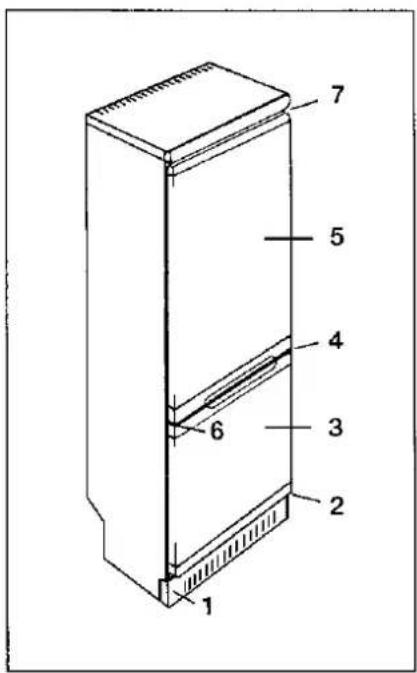
Regulation and Control
Freezer: Fig.5
Red light: (a)
When lighted indicates abnormal temperature conditions in the freezer, but for the exceptions appering on «Freezing of food» and «Something not working».
Orange light (b)
Indicates that the freezer is on freezing mode (S).
Fast-freezing knob: (c)
Turn the knob to switch on or off the fast-freezing.
Green light: (d)
Indicates connection to mains when lighted
Temperature Regulator for Freezer: (e)
Allows to adjust the temperature inside the freezer according to use and external conditions.
- Lowest setting, minimum cold: 1
• Highest setting, maximum cold: 6 - Off
Fridge: Fig. 5
Temperature Regulator for Refrigerator: (f)
Allows to adjust the temperature inside the refrigerator according to use and external conditions.
- Lowest setting, minimum cold: 1
• Highest setting, maximum cold: 6 - Off
Inside light: (H) Fig. 4
This comes on when you open the refrigerator door and goes off when you close it.
If you need get the bulb (see «IF SOMETHING FAILS TO OPERATE» remove the protective cover «X», pulling its clip horizontally.
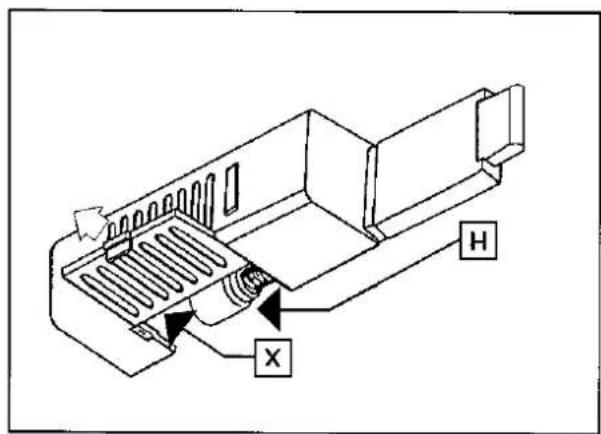
Fig. 4

Fig. 5
How to use your Refrigerator-Freezer
Freezer Compartment
This freezer, is marked ✦*** , and is suitable for freezing fresh foodstuffs and keeping food for long periods.
Freezing of food
Freezing should take place as quickly as possible, in a maximum of 24 hours. The procedure for this is as follows:
1... Set the «Temperature Control» «f» to position maximum.
- If the freezer was switched off and empty, 3 hours prior to placing the food to be frozen.
- If the freezer is already operating and contains frozen food, 24 hours before placing the food to be frozen.
2... The maximum amount which can be frozen in 24 hours is indicated in the section «Technical Features».
3... Place the food to be frozen inside the lower compartment of the freezer. You can also use the top shelf. If necessary, the highest capacity of freezing is reached removing the lower basket.
4... Red light «b», may be on for a few hours during freezing process. Switch-on time for this light will vary according to amount of food being put in for congelation and time while door remains open.
5... 24 hours after the food in the freezer, the freezing process can be regarded as complete.
6... Set the «Temperature Control» «f» in a middle position.
Keeping frozen food
For optimum conservation, the temperature inside the freezer compartment must be at least -18°C.
This temperature is adjusted automatically.
Check that the «Temperature Control» is in a middle position. Sometimes it may be necessary (insufficient ventilation, high room temperature, frequent opening and closing of the door...) to change the position of the
«Temperature Control».
If the appliance should be accidentally switched off by a fault or power cut, take the following precautions:
- Keep the doors closed at all times.
• Find out how long the stoppage is expected to last.
Once normal power is restored:
A) If the freezer is full and the stoppage has been less than «Time for temperature Rise» indicated for each model in the «Technical Features» section, then no damage will have been caused to the food.
B) If the freezer is not full, the cold will be lost more quickly. If the food has not started to thaw, then follow the instructions in «A».
C) If the food has begun to thaw, use them up as quickly as possible, or cook them and refreeze them.
Refrigerator Compartment:
This compartment is for storing drinks and fresh food products.
The temperature inside is very evenly distributed. Make sure food does not touch the back wall, since behind this surface is where the cold is generated and food could bee partially frozen. Also, this can impede the circulation of cold air.
This appliance is provided with an automatic defrosting system. Consequently you will sometimes notice a thin layer of ice or drops of water on the rear wall.
How to use your Refrigerator-Freezer
Useful Hints
Do not introduce any new food during a freezing period.
Do not put any newly introduced food for freezing near to already frozen food.
i Wrap the food up properly or place it in hermetic recipies before introducing it into the freezer.
i Do not introduce any hot food into the freezer.
i Food and drinks of a strong flavour may pass this on to others and affect their flavour. Wrap them up adequately or put them into tight closing bags.
i Follow the instructions given in the cook books, freezing books and wrapping utensiles for better conservation of food.
Maintenance of your Refrigerator-Freezer
Prior to undertaking any maintenance operation, be sure to unplug the appliance.
Defrosting of the freezer
The inner walls of the freezer become gradually covered with a layer of frost keeping in mind not to open the door frequently and keeping the food wrapped up in closed bags.
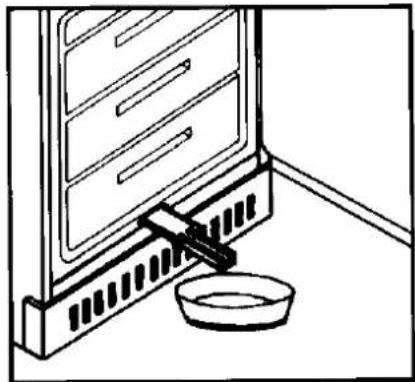
Whenever the thickness of ice reaches 5 mm. the frost should be removed. Here to proceed as follows:
1... Remove all food staff and place it in the coolest possible place..
2...Place the Plastic Scraper (supplied with the appliance) into the existing slot above the plinth.
3...Place a bowl under the outlet to collect the water.
4...Pull out the drawers and the upper tray.
5... Under no circumstances should you try and tear off the ice formed, wait for it to melt away.
6...Once the ice eliminated and the appliance is clean and dry, remove the plastic scraper and replace the drawers and the upper tray.
7...Plug in the appliance.
Maintenance of your Refrigerator-Freezer
Defrosting of the refrigerator
Frost is automatically eliminated in the refrigerator. Clean regularly the water drain opening «G».
Cleaning
- Do not use alcohol or any cleanig product containing alcohol because it can damage the cabinet.
- Use lukewarm water and neutral soap or bicarbonate of soda for cleaning the interior and the exterior of the appliance. Never use detergents nor abrasive powders.
- Clean the black grill on the read of the appliance (condeser), motor and the upper and downer ventilation slots with a brush or vacuum cleaner. This way the performance of the appliance will improve and energy consumption reduced.
- Clean the water container above the motor.
- Extract the base pulling it outwards in order to permit cleaning underneath the appliance.
Idle periods
During periods when the appliance is not in use take the following precautions:
- Unplug the appliance.
- Remove all the food.
- Defrost and clean the interior and all accessories.
- Leave the door ajar to permit the air to circulate in the interior and thus avoid unpleasant smells.

Something not working
Some functioning problems may be due to causes which can easily be solved before calling the Network Service. Follow theses instructions:
| Problem | Cause | Solution |
| A) LAMP AND INDICATORS | ||
| 1. Green lamp does not come on (If available) | Appliance not connected.No power at mains socket.Freezer is not properly closed.Freezer door has been open for too long.The «Temperature Regulator of the Freezer» has been recently moved to a colder position.Food has been put into the freezer.The layer of ice in the freezer is too thick. | Plug it in.Check the domestic automatic cut out.Close the door. The light will come off after a few hours.This is normal. The light will come off after a few hours.This is normal. The light will come off after a few hours.This is normal. The light will come off after a few hours.Remove it according to instructions. |
| 2. The red light does not come off (if availabel) | ||
| 3. Inner light (Refrigerator compartment) does not come on («H» Fig. 4). | Appliance unplugged.No power at mains socket.instalación doméstica.Bulb loose or burnt out.The appropriate «Temperature Regulator» is in position «●». | Plug the appliance into mains.Chek the domestic automatic cutout.Tighteen or substitute it fo another of same rating.Change to another position. |
| B) PERFORMANCE | ||
| 1. The freezer or the refrigerator do not cool. | The appropriate «Temperature Regulator» is in position «●». | Change to another position. |
| 2. The freezer or the refrigerator do not cool enough. | Door not properly closed.The door has been opened frequently.Inadequate position of «Temperature Regulator».Food has been introduced recently in large quantities. | Close well.Avoid frecuent opening.Change position to a cooler one.The appliance will get back to normal, wait. |
Something not working
| Problem | Cause | Solution |
| 3. Food gets frozen in the refrigerator.4. The motor does not stop running:C) WATER/ICE1. Makes too much ice.2. Water in the lower part of the Refrigerator.3. Water in the vegetable box.4. The outside of the cabinet stearns up.D) DOORS1. Door does not close.E) NOISES | «Temperature Regulator» on inadequate position.Food touches the back walls.Temperature regulator on inadequate position.Door not properly closed.Door opened frequently.Food has been put in recently in large quantity.«Temperature Regulator» in inadequate position.Door not properly closed.Ecessive door opening.Drain blockedWet vegetables have been introduced.High humidity level . in the roomThe appliance is not properly levelled.Door has been banged too hard and bounces back.Food protudes.Drawers protude.Appliance not properly levelled.Friction from back pipes.Some fixing screw is loose.Something inside is vibratingOthers. | Change position to less cold.Bring food forwards.Change position to less cold.Close the door correctly.Avoid frequent opening.Wait for the appliance to come back to normal.Change position to less cold.Close correctly.Avoid frequent opening.Clean duct «G».This is normal.This is normal. It does not affect the performance. of the applianceLevel smooth.Never bang the door.Place food properly.Push them into place.Level properly.Space well.Tihten the screw.Place correctly.See next page. |
Normal noises when functioning
I. Temperature Regulator.
May cause cracking sounds when the system connects or disconnects.
2. Refrigerating system.
The injected cooling gas may produce a burbling sound while running through the tubes.
3. Compressor.
May cause zumbing noises and/or slight bumping.
4. Insulation.
The material used has a tendency to increase noises, but it does insulate perfectly and is of low energy consumption.
Guarantee, Service and Spare Parts
Together with the appliance you should receive an instruction booklet like this together with: :
- A guarantee card, with the conditions of the guarantee printed on the back.
This documentation should always be at hand for consulting. Should this appliance be sold or transferred to another user, make sure that this documentation stays with the appliance so the new owner can be acquainted with the functioning of the appliance and relevant warnigns.
Before calling the repairman
Read the user instruction and follow the advice and directives given. In many cases, you will be able to clarify any doubts yourself and thus avoid unnecessary service calls.
The preceding section entitled «If the appliance does not perform correctly» includes suggestions for what should be checked before a serviceman is called.
If, after the above check, there is still a fault call your nearest Service Centre.
Please make sure you give the model and serial number of the appliance. This information can be found on the data plate inside the cabinet.
Guarantee
According to the enclosed Guarantee registration card.
Service and spare parts
Can be obtained from our service organization «Asistencia tecnica».
Model:
Product Number:
Serial Number:
⚠️ Safety
Read the safety and warning texts at the beginning of the user instructions. The manufacturer is not responsible for faults caused by the product being used incorrectly or for purposes other than those specified in the user instructions.
⚠ Warning
Don't use the fridge/freezer unit for storing explosive gases or liquids, e.g. cigarette lighter gas, petrol (gasoline), ether, acetone.
Technical Features
DIMENSIONS WITH
DOORS CLOSED

DIMENSIONS WITH
DOORS OPEN

CE This appliance complies with the following CEE Directives:
- 73/23 CEE of 19/02/73 (low voltage directive) and subsequent modifications.
- 89/336 CEE of 03/05/89 (electromagnetic compatibility directive) and subsequent modifications.
DATA IN AGREEMENT WITH «UNE» REQUIREMENTS
| MODEL | 1840 | 1980 |
| TOTAL GROSS VOLUME (L) | 326 | 370 |
| HEIGHT «A» (mm) | 1.840 | 1.980 |
| VOLTAGE (V) ± 6% | 220...230 | 220...230 |
| FREQUENCY (Hz) | 50 | 50 |
| FREEZING CAPACITY (Kg/24h) | 12 | 12 |
| POWER CONSUMPTION (W) | 230 | 230 |
| TEMPERATURE RISING TIME (H) | (ST)18/(T)15 | (ST)18/(T)15 |
- INSTRUCTION BOOKLET BRUK SANVISNING KÄYTTÖOHJE
- ⚠️ WARNINGS FOR YOUR SAFETY
- WARNINGS FOR YOUR SAFETY. CAREFULLY READ THESE INSTRUCTIONS BEFORE INSTALLING AND USING THE MACHINE
- ÍNDEX
- CLEANING THE INTERIOR
- ELECTRICAL CONNECTION
- STARTING - UP
- CHANGING THE OPENING DIRECTION OF DOORS AND PANELLING
- REGULATION AND CONTROL
- FREEZER: FIG.5
- RED LIGHT: (A)
- ORANGE LIGHT (B)
- FAST-FREEZING KNOB: (C)
- GREEN LIGHT: (D)
- TEMPERATURE REGULATOR FOR FREEZER: (E)
- FRIDGE: FIG. 5
- TEMPERATURE REGULATOR FOR REFRIGERATOR: (F)
- INSIDE LIGHT: (H) FIG. 4
- HOW TO USE YOUR REFRIGERATOR-FREEZER
- FREEZER COMPARTMENT
- FREEZING OF FOOD
- KEEPING FROZEN FOOD
- REFRIGERATOR COMPARTMENT
- USEFUL HINTS
- MAINTENANCE OF YOUR REFRIGERATOR-FREEZER
- DEFROSTING OF THE FREEZER
- DEFROSTING OF THE REFRIGERATOR
- CLEANING
- IDLE PERIODS
- SOMETHING NOT WORKING
- NORMAL NOISES WHEN FUNCTIONING
- TEMPERATURE REGULATOR
- REFRIGERATING SYSTEM
- COMPRESSOR
- INSULATION
- GUARANTEE, SERVICE AND SPARE PARTS
- BEFORE CALLING THE REPAIRMAN
- GUARANTEE
- SERVICE AND SPARE PARTS
- ⚠️ SAFETY
- ⚠ WARNING
- TECHNICAL FEATURES
Brand : ELEKTRO HELIOS
Model : KF3390
Category : Refrigerator