
SB-80 - Loudspeaker Paradigm - Free user manual and instructions
Find the device manual for free SB-80 Paradigm in PDF.


User questions about SB-80 Paradigm
0 question about this device. Answer the ones you know or ask your own.
Ask a new question about this device
Download the instructions for your Loudspeaker in PDF format for free! Find your manual SB-80 - Paradigm and take your electronic device back in hand. On this page are published all the documents necessary for the use of your device. SB-80 by Paradigm.
USER MANUAL SB-80 Paradigm
SB-SERIES SUBWOOFERS
OWNERS MANUAL
CONGRATULATIONS!
YOU ARE ABOUT TO HEAR the difference a musically accurate subwoofer makes in your audio system. Please take a few moments to read this manual. Follow all instructions to ensure proper installation and operation for maximum listening enjoyment.
Comprehensive R & D has been undertaken to achieve optimum performance of every individual component part at every design stage. This has enabled PARADIGM to produce subwoofer systems that have outstanding musical ability and unprecedented value!
Use of the finest components and materials along with sophisticated manufacturing and quality control techniques ensure that this exceptional level of performance will be maintained for many years.
PARADIGM SB-SERIES SUBWOOFERS are finished in high quality vinyl woodgrain veneer which is both attractive and durable. To clean use a damp, soft cloth. Do not use a strong or abrasive cleaner. Avoid getting any part of the speaker system wet.
NOTE!
IF YOUR PARADIGM SUBWOOFER has been transported or stored at temperatures below 10^ C ( 50^ F) it must be allowed to warm up to normal room temperature before using, otherwise performance will be significantly affected. This is because the surround material used in the bass driver unit is made of a compound that stiffens in colder temperatures.
Although PARADIGM speakers sound great "right out of the carton", they will sound even better after they are "broken-in". We therefore recommend that you play music for several hours before doing any serious listening.
YOUR LISTENING ROOM
PARADIGM SB-SERIES SUBWOOFERS will provide excellent musical results in a wide variety of domestic settings. Since bass frequencies are essentially non-directional your PARADIGM subwoofer may be placed anywhere in the room without effecting the stereo image of the primary speakers.
It is important to note however, that the type of construction, dimensions and furnishings of your room will effect the performance capabilities of any subwoofer. Please consider these guidelines:
a) Concrete floors and walls (i.e. basement rooms) tend to aggravate standing wave problems and are less preferred.
b) Rooms where the height, width and length are similar are less desirable as they can exhibit significant standing wave problems. This may result in reduced clarity. If no other room is possible, experimenting with subwoofer placement will minimize the problem.
The listening room itself effects bass performance. Both quantity and quality of bass is effected. Bass can be adjusted by moving the subwoofer to different locations in the room.
QUANTITY: Placing the subwoofer inside the "shaded" areas of your room will typically result in the following: (top view of your listening room)

Placing the
subwoofer toward the center of the room provides the least bass.

Placing the
subwoofer near the walls of the room provides more bass.

natural_image
Blank white page with four corner gray squares (no text or symbols)Placing the
subwoofer in the corners of the room provides the most bass.
QUALITY: Bass is never distributed evenly throughout a room. To achieve the best quality of bass performance at the seated listening area of your room may require an alternative room placement and/or perhaps reversing the polarity of the subwoofer. The later section - Set-up Procedure - will outline how to achieve optimum results with your PARADIGM SB-SERIES SUBWOOFER.
IN CANADA: PARADIGM ELECTRONICS INC., 101 HANLAN RD., WOODBRIDGE, ON L4L 3P5 IN THE U.S.: AUDIOSTREAM, MPO BOX 2410, NIAGARA FALLS, NY 14302
CONNECTION
BE SURE YOUR AMPLIFIER IS OFF before connecting. This will avoid damage which may result from accidental shorting of speaker cables. For optimum sound reproduction the use of high-quality audiophile speaker cable is essential. We recommend AUDIOSTREAM® speaker cable. The following chart identifies minimum gauge requirements for various lengths:
Length
| Under 4.5m (15ft) |
| Under 9m (30ft) |
| Over 9m (30ft) |
Diameter
| 1.3 mm |
| 1.6 mm |
| 2.0 mm |
Gauge
| 16 awg |
| 14 awg |
| 12 awg |
Polarity, or phase, affects stereo imaging and bass performance. If you hear a dislocated stereo image, then your main speakers are most likely connected out of phase to each other. Because the subwoofer produces bass from a different location than the main speakers experimentation with the polarity of the subwoofer vs. main speakers may be required. The later section on set-up procedure will outline how to do this.
Carefully connect one subwoofer channel and main speaker at a time to ensure proper connection of left and right channels. Connect the red (+) amplifier terminal to the red (+) PARADIGM subwoofer terminals and main speaker terminals. The same applies to the black (-) terminals. Make sure all wires are firmly fastened.
PARADIGM SB-SERIES SUBWOOFERS can be connected in a variety of ways. This provides for greater flexibility in level matching to your main speakers. It also allows you to add another SB-SUBWOOFER for operation with larger main speakers. In all cases the main speakers continue to operate full-range. Low frequencies are not filtered out of the main speakers in order to better preserve stereo imaging.
Please refer to the following chart to determine the best way to connect the SB-SUBWOOFER with your main speakers:
| Description of Main Speakers | Sensitivity of Main Speakers | Nominal Impedance of Main Speakers | Separate Amplifier Required for Subwoofer? | Hook-up Diagram |
| Small to Mid Size (average sensitivity) | 86dB to 90dB | 8 ohms or more | No. One receiver/amplifier can be used. | #1 or #2 |
| Less than 8 ohms | Yes | #3 | ||
| Mid to Larger Size (average to above average sensitivity) | 87dB to 93dB | 8 ohms or more | No. One receiver/amplifier can be used. | #2 |
| Less than 8 ohms | Yes | #4 | ||
| Mid to Larger Size (high sensitivity) | 92dB to 96dB | not applicable* | Yes - must be rated to operate at 4 ohms | #5 |
* Since this hook-up only allows for operation of the subwoofers with a separate amplifier, the impedance of the main speakers are not a required criteria for connection.
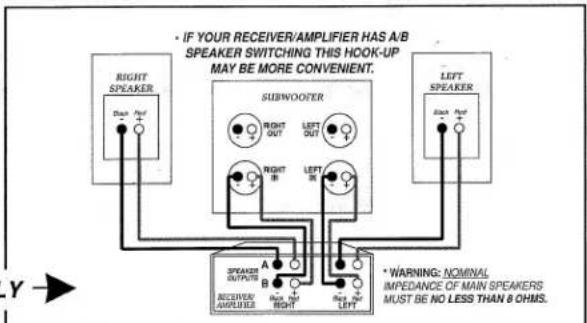
To HOOK-UP A SINGLE SB-SUBWOOFER follow diagram #1 below. This set-up provides excellent performance with most small to mid sized speakers of average sensitivity. It also allows the use of your existing receiver/amplifier - but please note:
1
ONE SB-SUBWOOFER + MAIN SPEAKERS WITH ONE AMPLIFIER
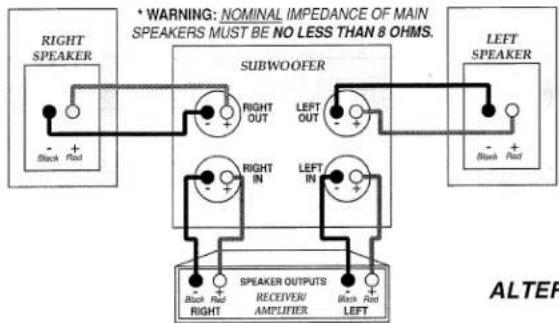
• The main speakers must have a nominal impedance of 8 ohms or more.
- Once connected the complete subwoofer/main speaker system will draw more power from your amplifier - ensure adequate amplifier ventilation.
flowchart
graph TD
    A["RIGHT SPEAKER"] --> B["SUBWOOFER"]
    B --> C["LEFT SPEAKER"]
    D["RECEIVER AMPLIERS"] --> E["A"]
    F["RECEIVER AMPLIERS"] --> G["B"]
    H["RECEIVER AMPLIERS"] --> I["C"]
    J["RECEIVER AMPLIERS"] --> K["D"]
    L["RECEIVER AMPLIERS"] --> M["E"]
    N["RECEIVER AMPLIERS"] --> O["F"]
    P["RECEIVER AMPLIERS"] --> Q["G"]
    R["RECEIVER AMPLIERS"] --> S["H"]
    T["RECEIVER AMPLIERS"] --> U["L"]
    V["RECEIVER AMPLIERS"] --> W["N"]
    X["RECEIVER AMPLIERS"] --> Y["P"]
    Z["RECEIVER AMPLIERS"] --> AA["R"]
    AB["RECEIVER AMPLIERS"] --> AC["S"]
    AD["RECEIVER AMPLIERS"] --> AE["L"]
    AF["RECEIVER AMPLIERS"] --> AG["R"]
    AH["RECEIVER AMPLIERS"] --> AI["S"]
    AJ["RECEIVER AMPLIERS"] --> AK["L"]
    AL["RECEIVER AMPLIERS"] --> AM["R"]
    AN["RECEIVER AMPLIERS"] --> AO["S"]
    AP["RECEIVER AMPLIERS"] --> AQ["R"]
    AR["RECEIVER AMPLIERS"] --> AS["S"]
    AT["RECEIVER AMPLIERS"] --> AU["R"]
    AV["RECEIVER AMPLIERS"] --> AW["S"]
    AX["RECEIVER AMPLIERS"] --> AY["R"]
    AZ["RECEIVER AMPLIERS"] --> BA["S"]
    BB["RECEIVER AMPLIERS"] --> BC["R"]
    BD["RECEIVER AMPLIERS"] --> BE["S"]
    BF["RECEIVER AMPLIERS"] --> BG["R"]
    BH["RECEIVER AMPLIERS"] --> BI["S"]
    BJ["RECEIVER AMPLIERS"] --> BK["R"]
    BL["RECEIVER AMPLIERS"] --> BM["S"]
    BN["RECEIVER AMPLIERS"] --> BO["R"]
    BP["RECEIVER AMPLIERS"] --> BQ["S"]
    BR["RECEIVER AMPLIERS"] --> BS["R"]
    BT["RECEIVER AMPLIERS"] --> BU["S"]
    BV["RECEIVER AMPLIERS"] --> BW["R"]
    BX["RECEIVER AMPLIERS"] --> BY["S"]
    BZ["RECEIVER AMPLIERS"] --> BQ
    CA["RECEIVER AMPLIERS"] --> BQ
    CB["RECEIVER AMPLIERS"] --> BQ
    CC["RECEIVER AMPLIERS"] --> BQ
    CE["RECEIVER AMPLIERS"] --> BQ
    CF["RECEIVER AMPLIERS"] --> BQ
    CG["RECEIVER AMPLIERS"] --> BQ
    DH["RECEIVER AMPLIERS"] --> BQ
    DI["RECEIVER AMPLIERS"] --> BQ
    DJ["RECEIVER AMPLIERS"] --> BQ
    DK["RECEIVER AMPLIERS"] --> BQ
    DL["RECEIVER AMPLIERS"] --> BQ
    DV["RECEIVER AMPLIERS"] --> BQ
    DW["RECEIVER AMPLIERS"] --> BQ
    DX["RECEIVER AMPLIERS"] --> BQ
    DXB["RECEIVER AMPLIERS"] --> BQ
    DXC["RECEIVER AMPLIERS"] --> BQ
    DXD["RECEIVER AMPLIERS"] --> BQ
    DXE["RECEIVER AMPLIERS"] --> BQ
    DXF["RECEIVER AMPLIERS"] --> BQ
    DXG["RECEIVER AMPLIERS"] --> BQ
    DXH["RECEIVER AMPLIERS"] --> BQ
    DXI["RECEIVER AMPLIERS"] --> BQ
    DXJ["RECEIVER AMPLIERS"] --> BQ
    DXK["RECEIVER AMPLIERS"] --> BQ
    DXL["RECEIVER AMPLIERS"] --> BQ
    DXM["RECEIVER AMPLIERS"] --> BQ
    DXN["RECEIVER AMPLIERS"] --> BQ
    DXO["RECEIVER AMPLIERS"] --> BQ
    DXP["RECEIVER AMPLIERS"] --> BQ
    DXQ["RECEIVER AMPLIERS"] --> BQ
    DXR["RECEIVER AMPLIERS"] --> BQ
    DXS["RECEIVER AMPLIERS"] --> BQ
    DXT["RECEIVER AMPLIERS"] --> BQ
    DXU["RECEIVER AMPLIERS"] --> BQ
    DXV["RECEIVER AMPLIERS"] --> BQ
    DXW["RECEIVER AMPLIERS"] --> BQ
    DXX["RECEIVER AMPLIERS"] --> BQ
    DXY["RECEIVER AMPLIERS"] --> BQ
    DXZ["RECEIVER AMPLIERS"] --> BQ
    DXYX["RECEIVER AMPLIERS"] --> BQ
    DXYZ["RECEIVER AMPLIERS"] --> BQ
    DXZX["RECEIVER AMPLIERS"] --> BQ
    DXYZX["RECEIVER AMPLIERS"] --> BQ
    DXZY["XEFFECTOR: NOMINAL IMPEDANCE OF MAIN SPEAKERS MUST BE NO LESS THAN 8 CHMS."]
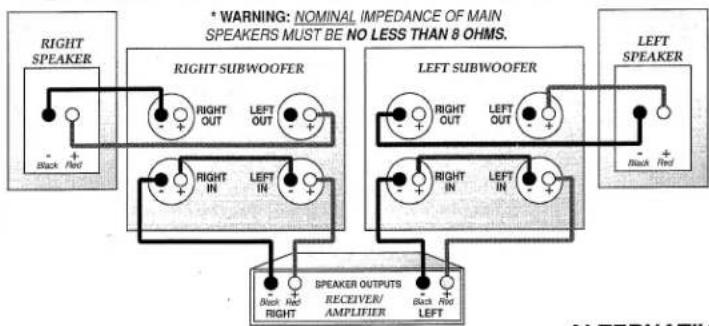
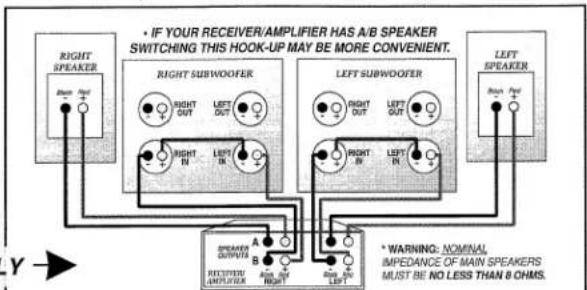
To Hook-UP Two SB-SUBWOOFERS follow diagram #2 below. This set-up provides excellent performance with mid to larger sized speakers of average to above average sensitivity. It also allows the use of your existing receiver/amplifier - but please note:
2
TWO SB-SUBWOOFERS + MAIN SPEAKERS WITH ONE AMPLIFIER
flowchart
graph TD
    A["RIGHT SPEAKER"] --> B["RIGHT OUT"]
    A --> C["LEFT OUT"]
    D["RIGHT IN"] --> E["RIGHT IN"]
    D --> F["LEFT IN"]
    G["SPEAKER OUTPUTS"] --> H["RECEIVER/AMPLIFIER"]
    I["LEFT SUBWOOFER"] --> J["RIGHT OUT"]
    I --> K["LEFT OUT"]
    L["Black Red"] --> M["Black Red"]
    N["Black Red"] --> O["Black Red"]
    P["Black Red"] --> Q["Black Red"]
    R["Black Red"] --> S["Black Red"]
    T["Black Red"] --> U["Black Red"]
    V["Black Red"] --> W["Black Red"]
    X["Black Red"] --> Y["Black Red"]
    Z["Black Red"] --> AA["Black Red"]
    AB["* WARNING: NOMINAL IMPEDANCE OF MAIN SPEAKERS MUST BE NO LESS THAN 8 OHMS."]
    AC["ALTERNATIVE"]
• The main speakers must have a nominal impedance of 8 ohms or more.
- Once connected the complete subwoofer/main speaker system will draw more power from your amplifier - ensure adequate amplifier ventilation.
- Two subwoofers allow more placement options to maximize overall performance.
- Sensitivity is the same as with a single subwoofer but, since two subwoofers are operating, the bass output capability is much higher. This ensures better maximum output matching with most mid to larger sized main speakers.
flowchart
graph TD
    A["RIGHT SPEAKER"] --> B["RIGHT SUBWOOFER"]
    B --> C["LEFT SUBWOOFER"]
    C --> D["LEFT SPEAKER"]
    E["Speaker OUTPUT"] --> F["RECEIVED AMPLIFIER"]
    F --> G["Ground"]
    H["Warning: NOMINAL IMPEDANCE OF MAIN SPEAKERS MUST BE NO LESS THAN 8 OHMS."] --> I["Ground"]
    J["• IF YOUR RECEIVER/AMPLIFIER HAS A/B SPEAKER SWITCHING THIS HOOK-UP MAY BE MORE CONVENIENT."]
    K["• WARNING: NOMINAL IMPEDANCE OF MAIN SPEAKERS MUST BE NO LESS THAN 8 OHMS."] --> L["Ground"]
ALTERNATIVELY

OTHER OPTIONS
THE PRECEDING SECTION OUTLINED the hook-up with main speakers that have a nominal impedance of 8 ohms or more using one amplifier/receiver. Even with 8 ohm main speakers, however, performance can be improved by using a separate amplifier to drive the subwoofer - bass will sound cleaner and tighter.
Please note that if your main speakers have a nominal impedance of less than 8 ohms, SB-SUBWOOFERS must be used with a separate amplifier.
When using a separate amplifier to power SB-SERIES SUBWOOFERS connection options are as follows:
PARADIGM recommends the use of identical amplifiers or amplifiers that have similar gain. If the amplifier used with the subwoofer has gain controls this will allow maximum flexibility in level matching to your main speakers. See dealer for details.
ONE SB-SUBWOOFER + MAIN SPEAKERS WITH TWO AMPLIFIERS

3
TWO SB-SUBWOOFERS + MAIN SPEAKERS WITH TWO AMPLIFIERS

flowchart
graph TD
    A["RIGHT SPEAKER"] --> B["RIGHT SUBWOOFER"]
    B --> C["LEFT SUBWOOFER"]
    C --> D["LEFT SPEAKER"]
    A --> E["Speaker Outputs Amplifier 42"]
    B --> E
    C --> E
    D --> E
    E --> F["Connect Amplifier Inputs in Parallel with Each Other"]
    style A fill:#f9f,stroke:#333
    style B fill:#ccf,stroke:#333
    style C fill:#cfc,stroke:#333
    style D fill:#fcc,stroke:#333
    style E fill:#ffc,stroke:#333
    style F fill:#cff,stroke:#333
To HOOK-UP A SINGLE SB-SUBWOOFER to a dedicated amplifier follow diagram #3 above. This set-up provides excellent performance with most small to mid sized speakers of average sensitivity.
#4
To HOOK-UP TWO SB-SUBWOOFERS to a dedicated amplifier follow diagram #4 at left. This set-up provides excellent performance with mid to larger sized speakers of average to above average sensitivity. Please note:
- Two subwoofers allow more placement options to maximize overall performance.
- The subwoofer impedance is now higher (16 ohms - voice coils are connected in series). But because two subwoofers are used, overall subwoofer sensitivity is unchanged.
- Since two subwoofers are operating the bass output capability is much higher. This ensures better maximum output matching with most mid to larger sized main speakers.
TWO SB-SUBWOOFERS + MAIN SPEAKERS WITH TWO AMPLIFIERS

flowchart
graph TD
    A["RIGHT SPEAKER"] --> B["RIGHT SUBWOOFER"]
    B --> C["LEFT SUBWOOFER"]
    C --> D["Speaker OUTPUTS AMPLIFIER #2"]
    D --> E["Speaker OUTPUTS AMPLIFIER #1"]
    E --> F["CONNECT AMPLIFIER INPUTS IN PARALLEL WITH EACH OTHER"]
    style A fill:#f9f,stroke:#333
    style B fill:#ccf,stroke:#333
    style C fill:#ccf,stroke:#333
    style D fill:#cfc,stroke:#333
    style E fill:#cfc,stroke:#333
    style F fill:#fcc,stroke:#333
#5
To Hook-UP TWO SB-SUBWOOFERS and increase the sensitivity of the subwoofer follow diagram #5 at left. This set-up provides excellent performance with mid to larger sized speakers of higher sensitivity. Please note:
- Two subwoofers allow more placement options to maximize overall performance.
- The subwoofer impedance is now lower (4 ohms - voice coils are connected in parallel). And since two subwoofers are used, overall subwoofer sensitivity is increased (by 6dB). This allows for a better balance with main speakers that have higher sensitivity.
- Since two subwoofers are operating the bass output capability is much higher. This ensures better maximum output matching with most mid to larger sized main speakers.
- This higher sensitivity set-up can also provide better balance with average sensitivity speakers in listening rooms that have poor bass characteristics.
SET-UP PROCEDURE
THE BEST LOCATION FOR A SUBWOOFER is typically between the main speakers close to the back wall. Many times however, this position will not be the primary choice. With a little effort excellent results can also be achieved in other locations in your listening room. Two things will affect the bass performance of the subwoofer in your room:
a) PLACEMENT: The closer the subwoofer is to a wall or corner the greater the bass output. Bass balance can be fine-tuned by simply moving the subwoofer closer to, or further away, from a wall or corner. A center room position provides the least bass, a near wall position has more and a corner position provides the most bass.
b) POLARITY: Some subwoofer locations in your listening room may result in phase cancellation of bass frequencies. This can sometimes be solved by reversing the polarity of the subwoofer relative to the main speakers. Since the backs of main speakers are more easily accessible than the bottom of the subwoofer, it will be more convenient to change the polarity of the main speakers. To change polarity simply reverse the speaker wires at each main speaker as follows: First switch amplifier off. Disconnect the speaker wire and then reconnect the (+) wire to the (-) speaker terminal and the (-) wire to the (+) speaker terminal.
To get the best performance possible from any subwoofer requires a little experimentation. Following these steps will ensure that you get the most listening pleasure from your SB-SERIES SUBWOOFER:
- Select music that you are familiar with that contains sections with good extended bass.
-
Place the SB-SUBWOOFER in your first choice position.
-
Hook-up the subwoofer and main speakers following the connection instructions previously outlined.
-
Play the musical selection and sit within the normal listening area of your room.
-
Assess the bass for overall output and blend with the main speakers. It should not be overbearing or draw attention to the subwoofer, nor should it be thin and difficult to hear. It should add "weight" and "solidity" to the sound and also keep pace with the main speakers.
-
If there is too little bass move the subwoofer closer to the wall or corner. If there is too much bass move the subwoofer further away from the wall or corner.
-
If the bass is very weak and sounds dislocated try reversing the polarity (do this with main speakers). If that doesn't help reconnect them back to the correct polarity and move the subwoofer to another location.
-
Repeat these steps until you find the location that is best able to provide a natural and extended bass balance that integrates well with the main speakers.
PREVENTING SPEAKER DAMAGE
PARADIGM SPEAKERS are efficient and can be driven to loud listening levels with moderate power. They are also able to handle the output of very powerful amplifiers.
AMPLIFIER DISTORTION - THE #1 CULPRIT!
Amplifier distortion is the principal cause of speaker damage. When listening at loud levels your amplifier may run out of clean power. It will then begin to produce distorted power several times greater than its rated output power. This distortion will damage any speaker very quickly.
MORE POWERFUL AMPLIFIERS ARE SAFER
A 30 watt/channel amplifier will have substantial distortion above 30 watts. When a speaker requires 40 watts, this amplifier will deliver distorted power - which may damage the speaker. A 100 watt/channel amplifier will have substantial distortion above 100 watts, but very low distortion below 100 watts. Thus, when the speaker requires 40 watts, this more powerful amplifier will deliver clean power and speaker damage is less likely to occur.
THE VOLUME CONTROL
Do not be fooled by the Volume Control of your Receiver/Preamplifier. It only adjusts listening level - it is not a "power-output" dial. The amount of amplifier power actually used at a given Volume Control setting depends solely on the nature of the music you are listening to. At a given Volume Control setting a quiet section of music will use less amplifier power than a loud section. With typical pop-rock, jazz or large scale classical music, the rated output power of many Receivers/Amplifiers is often reached when the Volume Control is between the "11 and 1 o'clock" setting (with bass/treble and loudness controls not used - otherwise rated power may be reached at even lower Volume Control settings).
Remember, all amplifiers produce distortion beyond their rated output power. Distortion will damage all speakers. Exercise caution! If you listen at loud levels, be careful to listen for the point of audible distortion... then turn the Volume Control down or your speakers and/or amplifier(s) will be damaged. If louder volumes are desired obtain a more powerful amplifier.
THERE IS A LIMIT!
Although more powerful amplifiers are safer, there is a point at which you could have more power than the speaker can handle. At that point you will overpower the speaker and damage it. Exercise caution! At loud levels do not increase bass/treble controls from zero and ensure that all loudness/contour/bass EQ buttons are off (otherwise rated output power will be reached at lower Volume Control settings). If you listen at loud levels, watch for excessive visible cone excursion (grill removed) from the woofer... then turn the Volume Control down.
THE RIGHT AMOUNT OF POWER
A power-range rating is given as a guide to indicate the minimum and maximum power input, approximately, of your PARADIGM speakers. Amplifiers that exceed your speakers' power-range rating are, in fact, recommended. Their greater power reserves provide better sound. However, exercise caution! Use the speakers within their power-range rating to prevent damage (keep listening levels below the point of excessive woofer cone excursion).
W A R R A N T Y
PARADIGM SPEAKERS are warranted to be and remain free of manufacturing and/or material defects for a period of 5 years from the date of the original retail purchase. Within this period, repair, replacement or adjustment of parts for manufacturing and/or material defects will be free of charge.
LIMITATIONS:
- Warranty begins on date of original retail purchase from an AUTHORIZED PARADIGM DEALER only. It is not transferable.
- Warranty applies to product in normal home use.
- Warranty does not apply if the product is used in professional or commercial applications.
WARRANTY IS VOID IF:
• The speaker has been abused (intentionally or accidentally).
- The speaker has been used in conjunction with unsuitable or faulty equipment.
- The speaker has been subjected to damaging signals, derangement in transport, mechanical damage or any abnormal conditions.
• The speaker (including cabinet) has been tampered with or damaged by an unauthorized service facility.
• The serial number plate has been removed or defaced.
OWNER RESPONSIBILITIES:
- Provide normal/reasonable operating care and maintenance.
- Provide proof of purchase (your sales receipt given at time of purchase from your AUTHORIZED PARADIGM DEALER must be retained for proof of purchase-date).
- Provide or pay for transportation charges for product to service facility.
Should servicing be required contact your nearest AUTHORIZED PARADIGM DEALER, PARADIGM ELECTRONICS INC. (in Canada), AUDIOSTREAM, DIVISION OF BAVAN CORPORATION (in the U.S.) or IMPORT DISTRIBUTOR (outside the U.S. and Canada) to arrange, bring in or ship, prepaid, any defective unit.
PARADIGM ELECTRONICS INC. reserves the right to improve the design of any product without assuming any obligation to modify any product previously manufactured.
This warranty is in lieu of all other warranties expressed or implied, of merchantability, fitness for any particular purpose and may not be extended or enlarged by anyone. In no event shall PARADIGM ELECTRONICS INC., their agents or representatives be responsible for any incidental or consequential damages. Some jurisdictions do not allow limitation of incidental or consequential damages, so this exclusion may not apply to you.
Paradigm®
SB-SERIES ADDENDUM
SB-Series Subwoofers now contain a "High-Pass" filter designed to reduce low frequency output from your satellites (see illustration at right). This will result in lower distortion, improved sound quality and a higher playing ceiling.
To use this "High-Pass" filter, your satellites must be connected to the output terminals of the SB-Series Subwoofer.
The "Connection" section of the SB-Series Owners Manual shows various hook-up illustrations. The following chart indicates if the "High Pass" filter is connected for each of these hook-up options:

ILLUSTRATION
SATELLITES CONNECTED TO
"HIGH-PASS" FILTER CONNECTED?
| #1 | SB-Subwoofer Output Terminals | Yes | |
| #1 | “ALTERNATIVELY” | Receiver/Amplifier | No |
| #2 | SB-Subwoofer Output Terminals | Yes | |
| #2 | “ALTERNATIVELY” | Receiver/Amplifier | No |
| #3 | Amplifier | No | |
| #4 | Amplifier | No | |
| #5 | NOTE: DO NOT USE THIS HOOK-UP METHOD. IT HAS NOW BEEN AMENDED AS SHOWN BELOW. | No | |
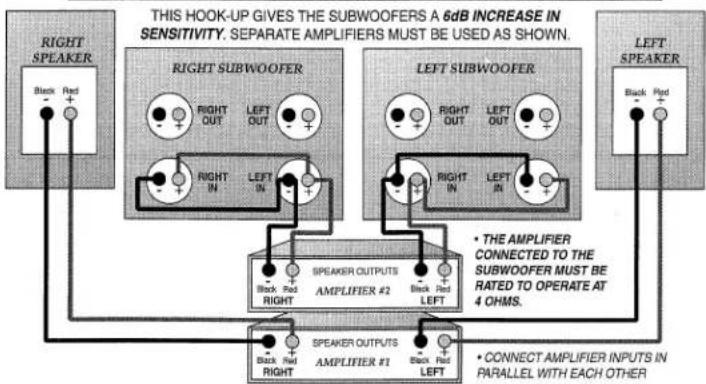
TWO SB-SUBWOOFERS + MAIN SPEAKERS WITH TWO AMPLIFIERS
flowchart
graph TD
    A["RIGHT SPEAKER"] --> B["RIGHT SUBWOOFER"]
    B --> C["LEFT SUBWOOFER"]
    C --> D["LEFT SPEAKER"]
    D --> E["Speaker Outputs AMPLIFIER #1"]
    E --> F["Speaker Outputs AMPLIFIER #2"]
    F --> G["• The Amplifier Connected to the Subwoofer Must Be Rated to Operate at 4 OHMS."]
    G --> H["• Connect Amplifier Inputs in Parallel With Each Other"]
    style A fill:#f9f,stroke:#333
    style B fill:#ccf,stroke:#333
    style C fill:#ccf,stroke:#333
    style D fill:#cfc,stroke:#333
    style E fill:#fcc,stroke:#333
    style F fill:#cff,stroke:#333
    style G fill:#ffc,stroke:#333
    style H fill:#fcc,stroke:#333
#5 - AMENDED
To HOOK-UP TWO SB-SUBWOOFERS and increase the sensitivity of the subwoofer, follow diagram #5 at left. This set-up provides excellent performance with mid to larger sized speakers of higher sensitivity. Please note:
- Two subwoofers allow more placement options to maximize overall performance.
- The subwoofer impedance is now lower (4ohms - voice coils are connected in parallel). And since two subwoofers are used, overall subwoofer sensitivity is increased (by 6dB). This allows for a better balance with main speakers that have higher sensitivity.
- Since two subwoofers are operating, the bass output capability is much higher. This ensures better maximum output matching with most mid to larger sized speakers.
- This higher sensitivity set-up can also provide better balance with average sensitivity speakers in listening rooms that have poor bass characteristics.
- SB-SERIES SUBWOOFERS
- OWNERS MANUAL
- CONGRATULATIONS!
- NOTE!
- YOUR LISTENING ROOM
- CONNECTION
- 1
- 2
- OTHER OPTIONS
- 3
- #4
- #5
- SET-UP PROCEDURE
- PREVENTING SPEAKER DAMAGE
- AMPLIFIER DISTORTION - THE #1 CULPRIT!
- MORE POWERFUL AMPLIFIERS ARE SAFER
- THE VOLUME CONTROL
- THERE IS A LIMIT!
- THE RIGHT AMOUNT OF POWER
- W A R R A N T Y
- LIMITATIONS:
- WARRANTY IS VOID IF:
- OWNER RESPONSIBILITIES:
- Paradigm®
- #5 - AMENDED
Brand : Paradigm
Model : SB-80
Category : Loudspeaker