Voyager - Uncategorized Walrus Audio - Free user manual and instructions
Find the device manual for free Voyager Walrus Audio in PDF.


| Product Type | Guitar Effect Pedal (Overdrive) |
| Brand | Walrus Audio |
| Model | Voyager |
| Dimensions | 2.6 x 4.8 x 2.2 inches |
| Weight | 0.5 lbs |
| Power Supply | 9V DC, Center Negative, 100mA |
| Battery | 9V Battery (Not Included) |
| Controls | Volume, Tone, Gain |
| Bypass | True Bypass |
| Input Impedance | 1M Ohm |
| Output Impedance | 1k Ohm |
| Current Draw | ~50mA |
| Construction | Aluminum Enclosure |
| Warranty | Limited Lifetime Warranty |
| Cleaning | Wipe with dry cloth |
| Repairability | Serviceable by qualified technician |
Frequently Asked Questions - Voyager Walrus Audio
User questions about Voyager Walrus Audio
0 question about this device. Answer the ones you know or ask your own.
Ask a new question about this device
Download the instructions for your Uncategorized in PDF format for free! Find your manual Voyager - Walrus Audio and take your electronic device back in hand. On this page are published all the documents necessary for the use of your device. Voyager by Walrus Audio.
USER MANUAL Voyager Walrus Audio
The Voyager MKII is a mid-focused overdrive/preamp that contains all the mythical magic from the original Voyager and adds a wealth of features not seen before in a Klon-style pedal. From its lowest to highest settings, the Voyager provides a uniquely superb amount of clarity to any playing style. At lower gain settings, it brightens the signal and adds clarity to each note. With the gain turned up, the Voyager transforms into a thick overdrive, providing depth to chorded playing while retaining the clarity needed to break through solos.
*Only use a 9 volt DC, Center Negative, 100mA to power the pedal.
The use of an isolated power supply is recommended for powering all Walrus Audio Pedals.
Daisy chain power supplies are not recommended.
Got questions or need a repair?
Email help@walrusaudio.com to talk with a real live human about your Walrus gear!
This product comes with a limited lifetime warranty.
Click Here for more info.
CONTROLS
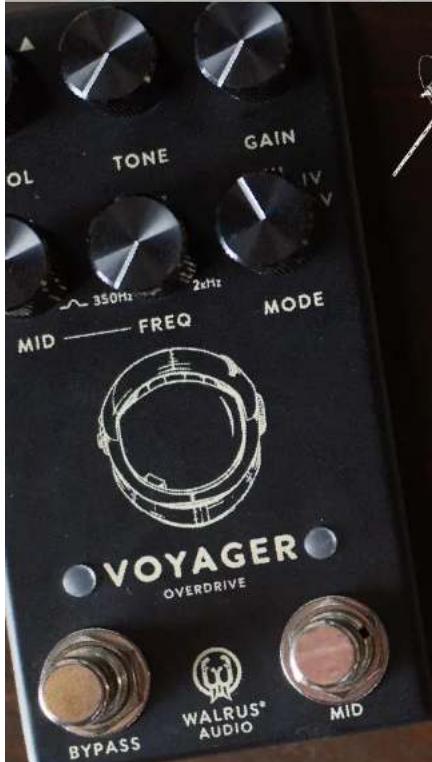
Bypass: Soft-touch, relay true bypass. Press the switch to engage/disengage the pedal. LED indicates whether the circuit is engaged or not.
Mid Switch: Turns the Mid-EQ circuit on/off. This is only active when the bypass switch has been engaged. You can use this to change your tone for specific sections of the song or when pairing with other pedals.
Volume: Control the overall volume of the Voyager. Clockwise increases volume, counter-clockwise decreases the volume. Use to set "unity" after you get the gain you are wanting.
Tip: With the gain knob set at a lower setting, you can use the pedal as a "clean" boost paired with the mid-EQ. Really nice tone-shaping feature and pairs well with other drives.
CONTROLS
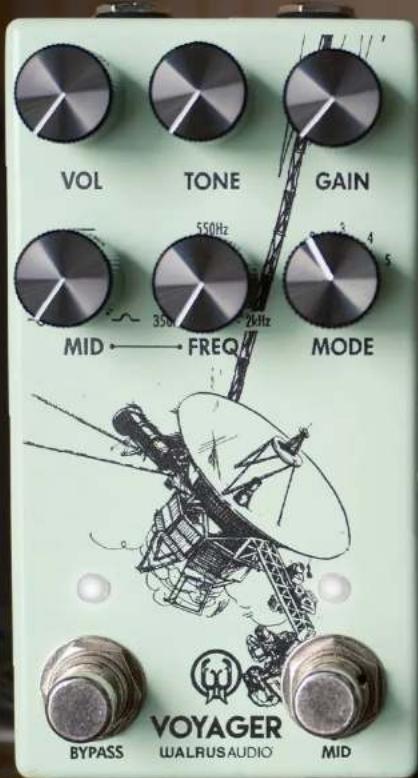
Tone: Adjust the cutoff frequency of a low-pass filter to tame the high end or let it sing. Clockwise increases high-frequency amplitude, counter-clockwise decreases high frequency amplitude.
Gain: Use to increase the overall gain of the drive circuit. Clockwise increases gain, counter-clockwise decreases gain. This circuit blends your guitar's clipped signal with your dry signal. As you increase the gain, you will start to hear less dry signal and more of that overdriven sound that we all love.
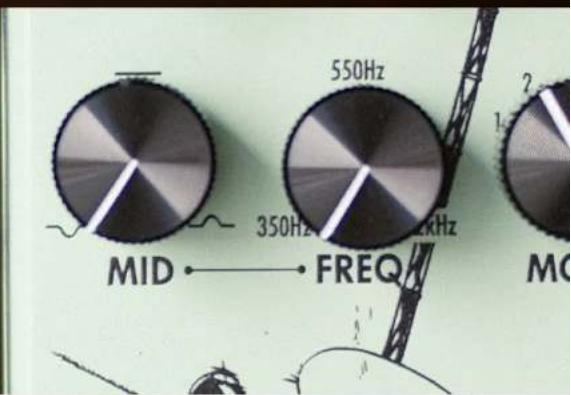
Mid: Control the gain of a parametric EQ. Has a gain range of +/-12dB, with 12 o'clock being flat, the classic Voyager tone. This can be used to focus in on a specific frequency area for solo-type sections or used to clean up the lower mid area to achieve a tight, driven guitar tone.
Freq (Frequency): Control the center frequency of the MID EQ. The range is 250Hz-2kHz. Use it to tailor your tone to your style of playing. A nice range to cover a wide range of guitar and pickup types.
MODES
MODE 1: Classic 1N34A Germanium Diodes (most compressed).
Mode 2: Classic 1N34A Germanium Diodes with bass boost (trust us).
Mode 3: Symmetric Silicon Diodes (more open and dynamic).
Mode 4: Asymmetric Silicon Diodes (a little bit of compression).
Mode 5: Asymmetric Silicon Diodes, with bass boost (a little bit of compression, with bass).
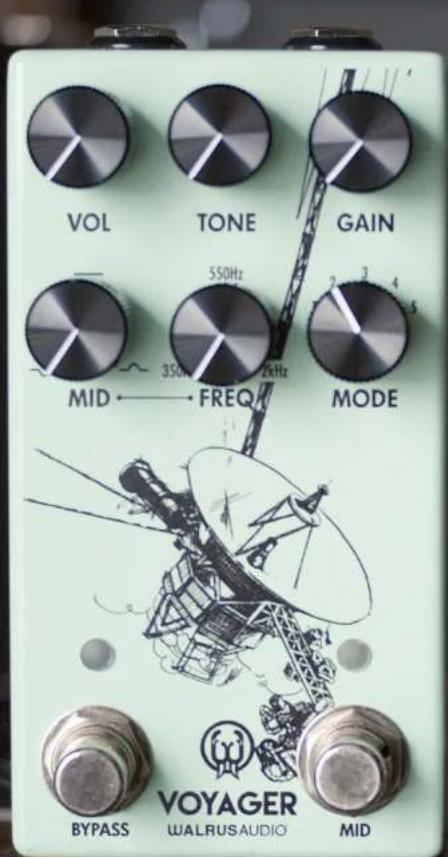
Sea foam pedal art by Nathan Price
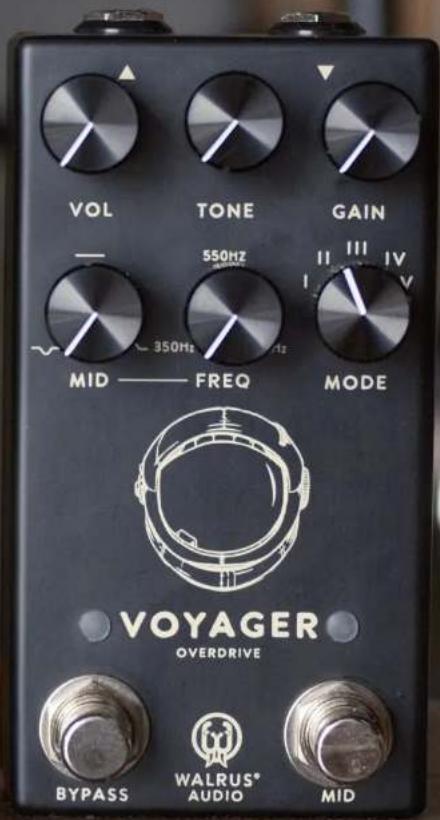
Black art by Christi Du Toit
The die cast enclosure's exact size is
2.62 x 4.77 x 2.25 inches including knobs.
Input: 1/4" TS, Unbalanced, 1M impedance
Output: 1/4" TS, Unbalanced, 100k impedance
True-Bypass