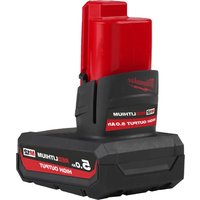
M12 HB5 - Battery MILWAUKEE - Free user manual and instructions
Find the device manual for free M12 HB5 MILWAUKEE in PDF.


| Product Type | Rechargeable Battery Pack |
| Brand | Milwaukee |
| Model | M12 HB5 |
| Voltage | 12V |
| Capacity | 5.0 Ah |
| Battery Chemistry | Lithium-ion (Li-ion) |
| Dimensions (L x W x H) | 4.5 x 2.5 x 3.5 inches |
| Weight | 0.55 lbs (0.25 kg) |
| Compatible Chargers | Milwaukee M12 Chargers (e.g., M12-18C, 48-59-1812) |
| Charge Time | Approx. 60 minutes (with standard M12 charger) |
| LED Fuel Gauge | Yes, 4-LED indicator |
| Overload Protection | Yes, electronic protection circuit |
| Over-Discharge Protection | Yes |
| Temperature Protection | Yes, thermal cutoff |
| Operating Temperature | -18°C to 50°C (0°F to 120°F) |
| Storage Temperature | -20°C to 40°C (-4°F to 104°F) |
| Compatible Tools | All Milwaukee M12 Cordless Tools |
| Battery Type | Slide-on pack |
| Housing Material | Impact-resistant plastic |
| Maintenance | Keep contacts clean; store in cool, dry place |
| Safety Certifications | UL, CE, RoHS |
| Warranty | Limited 2-year warranty |
| Spare Parts / Repair | Contact Milwaukee service center; not user-serviceable |
Frequently Asked Questions - M12 HB5 MILWAUKEE
User questions about M12 HB5 MILWAUKEE
0 question about this device. Answer the ones you know or ask your own.
Ask a new question about this device
Download the instructions for your Battery in PDF format for free! Find your manual M12 HB5 - MILWAUKEE and take your electronic device back in hand. On this page are published all the documents necessary for the use of your device. M12 HB5 by MILWAUKEE.
USER MANUAL M12 HB5 MILWAUKEE
| TTI-EMEATechtronic Industries GmbHMax-Eyth-Straße 1071364 Winnenden, GermanyRevision: 06 Oct 2023Rev. No.: 7 | Safety Data SheetMilwaukee Lithium Ion Batteries(battery pack with lithium ion cells)according to 1907/2006/EC Article 31 |  |
INTRODUCTORY STATEMENTS
EU
These batteries are neither "substances" nor "preparations" in the sense of REACH Regulation (EC) 1907/2006, but are instead to be regarded as "products". The intentional release of substances during use is not foreseen. Consequently, there is no obligation to provide a safety data sheet conforming to Article 31 of the REACH Regulation.
USA
Preparation of safety data sheets (SDS) is a subrequirement of the Hazard Communication Standard 29 CFR, Section 1910.1200, of the Occupational Safety and Health Administration (OSHA). This standard does not apply to "articles". The OSHA standard defines an "article" as a manufactured item other than a fluid or particle:
- which is formed to a specific shape or design during manufacture;
- which has end use function(s) dependent in whole or in part upon its shape or design during end use; and
- which under normal conditions of use does not release more than very small quantities, e.g., minute or trace amounts of a hazardous chemical, and does not pose a physical hazard or health risk to employees.
As all of our batteries are classified as "articles", they are exempted from the requirements of the Hazard Communication Standard.
1. IDENTIFICATION OF THE SUBSTANCE/MIXTURE AND OF THE COMPANY/UNDERTAKING
1.1 Product identifier: Lithium ion batteries, rechargeable
Trade name
| No. | Lithium-Ion rechargeable battery Model designation | Nominal Voltage (V) | Rated Capacity (Ah) | Rated Energy (Wh) |
| 1 | M28BX | 28 V | 3.0 Ah | 84 Wh |
| 2 | M28B5 | 28 V | 5.0 Ah | 140 Wh |
| 3 | C18B, M18B | 18 V | 1.5 Ah | 27 Wh |
| 4 | M18B2 | 18 V | 2.0 Ah | 36 Wh |
| 5 | C18B, M18BX, MV18BX | 18 V | 3.0 Ah | 54 Wh |
| 6 | M18HB3 | 18 V | 3.0 Ah | 54 Wh |
| 7 | M18B4 | 18 V | 4.0 Ah | 72 Wh |
| 8 | M18B5 | 18 V | 5.0 Ah | 90 Wh |
| 9 | M18HB5.5 | 18 V | 5.5 Ah | 99 Wh |
| 10 | M18B6 | 18 V | 6.0 Ah | 108 Wh |
| 11 | M18HB6 | 18 V | 6.0 Ah | 108 Wh |
| TTI-EMEATechtronic Industries GmbHMax-Eyth-Straße 1071364 Winnenden, GermanyRevision: 06 Oct 2023Rev. No.: 7 | Safety Data SheetMilwaukee Lithium Ion Batteries(battery pack with lithium ion cells)according to 1907/2006/EC Article 31 |  |
| No. | Lithium-Ion rechargeable battery Model designation | Nominal Voltage (V) | Rated Capacity (Ah) | Rated Energy (Wh) |
| 12 | M18HB8 | 18 V | 8.0 Ah | 144 Wh |
| 13 | M18B9 | 18 V | 9.0 Ah | 162 Wh |
| 14 | M18HB12 | 18 V | 12.0 Ah | 216 Wh |
| 15 | C14B, M14B | 14.4 V | 1.5 Ah | 22 Wh |
| 16 | C14BX, M14BX | 14.4 V | 3.0 Ah | 44 Wh |
| 17 | C12B, M12B | 12 V | 1.5 Ah | 18 Wh |
| 18 | M12B2 | 12 V | 2.0 Ah | 24 Wh |
| 19 | M12B3 | 12 V | 3.0 Ah | 36 Wh |
| 20 | C12BX, M12BX | 12 V | 3.0 Ah | 36 Wh |
| 21 | M12B4 | 12 V | 4.0 Ah | 48 Wh |
| 22 | M12B6 | 12 V | 6.0 Ah | 72 Wh |
| 23 | M4B2 | 4 V | 2.0 Ah | 8 Wh |
| 24 | V4B | 4 V | 3.0 Ah | 12 Wh |
| 25 | MXF CP203 | 72 V | 3.0 Ah | 216 Wh |
| 26 | MXF XC406 | 72 V | 6.0 Ah | 432 Wh |
| 27 | L4B2 | 4 V | 2.5 Ah | 10 Wh |
| 28 | L4B3 | 4 V | 3.0 Ah | 12 Wh |
| 29 | M18B5-CR | 18 V | 5.0 Ah | 90 Wh |
| 30 | M12HB2.5 | 12 V | 2.5 Ah | 30 Wh |
| 31 | M12HB5 | 12 V | 5.0 Ah | 60 Wh |
| 32 | MXFXC608 | 72 V | 8.0 Ah | 576 Wh |
| 33 | MXFHD812 | 72 V | 12.0 Ah | 864 Wh |
| 34 | IR-PL250 (*) | 3.7 V | 0.7 Ah | 2.6 Wh |
| 35 | IR-FL500 (*) | 3.6 V | 3.0 Ah | 10.8 Wh |
| 36 | IR-HL450 (*) | 3.7 V | 0.7 Ah | 2.6 Wh |
| 37 | M18FB6 | 18 V | 6.0 Ah | 108 Wh |
* Product with integrated Lithium-Ion Cell.
1.2 Relevant identified use of the substance or mixture and uses advised against
Product category AC3 – Electrical batteries and accumulators
TTI-EMEA
Techtronic Industries GmbH
Max-Eyth-Straße 10
71364 Winnenden, Germany
Revision: 06 Oct 2023
Rev. No.: 7
Safety Data Sheet Milwaukee Lithium Ion Batteries (battery pack with lithium ion cells) according to 1907/2006/EC Article 31

1.3 Details of the supplier of the safety data sheet
Techtronic Industries GmbH
Max-Eyth-Straße 10
71364 Winnenden, Germany
Phone: +49 7195 120
www.ttigroup.com
Person providing the information
Maximilian Wieler
maximilian.wieler@tti-emea.com
See Section 16
1.4 Emergency telephone number
24-hour service
Chemtrec International: +1 703-741-5970
Chemtrec United States only: 1-800-424-9300
2. HAZARDS IDENTIFICATION
2.1 Classification of the substance or mixture
Cells in lithium ion batteries are hermetically sealed and are harmless when used in compliance with the manufacturer's instructions for use and handling.
These devices are classified as products in accordance with REACH Article 3 (3) and are therefore not subject to the labelling requirements of hazardous substance legislation.
According to the CLP Regulation the product(s) is/are not classified as hazardous to health or the environment.
2.2 Label elements
According to EC Regulation No. 1272/2008, labelling of the product is not obligatory.
Hazard pictogram Not required
Signal word Not required
Hazard statements Not required
2.3 Other hazards
A pressure release vent opens in the event of improper use of the battery pack in combination with electrical load, fire or mechanical impact. If the product is damaged, the battery housing can rupture and allow the ingredients to be released.
Corrosive vapours can be released in the event of fire.
| TTI-EMEATechtronic Industries GmbHMax-Eyth-Straße 1071364 Winnenden, GermanyRevision: 06 Oct 2023Rev. No.: 7 | Safety Data SheetMilwaukee Lithium Ion Batteries(battery pack with lithium ion cells)according to 1907/2006/EC Article 31 |  |
3. COMPOSITION / INFORMATION ON INGREDIENTS
3.1 Substances
Not applicable
3.2 Mixtures
Rechargeable lithium ion battery pack
Cathode: Li, Ni, Co & Mn oxides (active substances); phosphates
Polyvinyl difluoride/SBR (binder)
Carbon (conductive material), additives, aluminium foil
Anode: Carbon (active substance)
Silicone, polyvinyl difluoride/SBR (binder), additives, copper foil
Electrolyte: Organic solvent (non-aqueous liquid), lithium salt, additives
| Chemical name | CAS no. | EC / List no. | Concentration [%] |
| Aluminium | 7429-90-5 | 231-072-3 | 0.1 – 10 |
| Biphenyl | 92-52-4 | 202-163-5 | 0.1 – 0.3 |
| Copper | 7440-50-8 | 231-159-6 | 0.1 – 10 |
| Chemical name | CAS no. | EC / List no. | Concentration |
| Linear and cyclic carbonate solutions | n/a | n/a | 0 – 17 |
| Carbon | 7440-44-0 | 231-153-3 | 10 – 30 |
| Metal oxide or other electrolyte (proprietary) | secret | secret | 10 – 50 |
| Lithium hexafluorophosphate (1-) | 21324-40-3 | 244-334-7 | 0 – 5 |
| Polyvinyl difluoride | 24937-79-9 | 607-458-6 | 0.1 – 5 |
| Styrene-butadiene rubber (SBR) | n/a | n/a | < 5 |
| Aluminium, steel, nickel, and other inert materials | n/a | n/a | Rest |
Contact with the ingredients is not possible under normal operating conditions.
4. FIRST AID MEASURES
4.1 Description of first aid measures
The lithium ion batteries contain an organic electrolyte. The following measures must be taken if the electrolyte has emerged and come in contact the skin and/or eyes:
Skin or eye contact with emerging substances (electrolyte)
In case of skin or eye contact, rinse the affected areas thoroughly with water for at least 15 minutes. In case of eye contact, always contact a doctor in addition to thorough rinsing.
| TTI-EMEATechtronic Industries GmbHMax-Eyth-Straße 1071364 Winnenden, GermanyRevision: 06 Oct 2023Rev. No.: 7 | Safety Data SheetMilwaukee Lithium Ion Batteries(battery pack with lithium ion cells)according to 1907/2006/EC Article 31 |  |
Burns
Suitable treatment is necessary in the event of burns. It is strongly recommended to contact a doctor.
Respiratory tract
In case of intense smoke formation or release of gas, leave the room immediately. In case of relatively large amounts and irritation of the respiratory tract, seek medical attention. Provide adequate ventilation as much as possible.
Swallowing
Rinse mouth and surrounding areas with water. Seek medical attention immediately.
4.2 Essential acute and delayed symptoms and effects
No further relevant information available
4.3 Advice on immediate first aid treatment or special treatment
No further relevant information available
5. FIREFIGHTING MEASURES
5.1 Extinguishing media
Always use water spray to fight fires with lithium ion batteries. No special extinguishing media are required. Conventional extinguishing media should be used to fight fires in the vicinity of the batteries. Battery fire cannot be considered separately from surrounding fire.
The cooling effect of water hampers propagation of the fire to battery cells which have not yet reached the critical temperature for ignition ("thermal runaway").
Reduce the fire burden by singling out large quantities and removing them from the hazard area.
5.2 Special hazards arising from the substance or mixture
In the event of a fire, gases can be formed which are harmful to health when inhaled.
5.3 Advice for firefighters
Ensure adequate respiratory protection. Use self-contained respiratory equipment.
Observe local regulations and ensure adequate ventilation.
6. ACCIDENTAL RELEASE MEASURES
6.1 Personal precautions, protective equipment and emergency procedures
Use personal protective equipment appropriate to the situation (protective gloves, protective clothing, face protection, respiratory protection).
Wear protective gloves to prevent direct skin contact. Rinse with copious amounts of water.
| TTI-EMEATechtronic Industries GmbHMax-Eyth-Straße 1071364 Winnenden, GermanyRevision: 06 Oct 2023Rev. No.: 7 | Safety Data SheetMilwaukee Lithium Ion Batteries(battery pack with lithium ion cells)according to 1907/2006/EC Article 31 |  |
6.2 Environmental precautions
Avoid seepage into the sewer system and/or soil.
6.3 Methods and materials for containment and cleaning up
Electrolyte can emerge if the battery housing is damaged. Place batteries in an air-tight plastic bag and add dry sand, lime powder (CaCO 3 ) or vermiculite. Electrolyte traces can be soaked up with dry paper towels.
6.4 Reference to other sections
See Section 7 for more information on safe handling.
See Section 8 for more information on personal protective equipment.
See Section 13 for more information on disposal.
7. HANDLING AND STORAGE
7.1 Reference to other sections
Handle discharged batteries carefully
Discharged batteries are also a hazard source because they can still deliver very high short-circuit currents. Even when lithium ion batteries appear to be discharged, they must be handled just as carefully as when they are not discharged.
Avoid exposure to physical effects and/or blows
Blows and penetration of objects can damage the battery. That can lead to leaks, overheating, smoke formation, ignition or explosion of the battery.
Keep batteries away from other metallic objects
Including paper clips, coins, keys, screws, and other metallic objects which could cause shorting of the battery terminals. A short-circuit between the battery terminals can cause burns or fire.
Liquid can emerge from the battery if it is used improperly
Avoid contact with leaky batteries. In case of accidental contact, rinse with water. If the liquid comes in contact with the eyes, also seek medical attention. Emerging liquid can lead to skin irritation or burns.
Do not expose batteries to fire or high temperatures
If the batteries are thrown into a fire or exposed to temperatures above 85° C, the heat can lead to an explosion and/or fire and cause personal injuries. Do not incinerate batteries except in a waste incinerator approved for that purpose.
Do not dismantle batteries
Dismantling or altering the battery can degrade the protective measures. That can lead to overheating, smoke formation, ignition or explosion of the battery.
Do not immerse batteries in liquids, such as water or beverages
Contact with liquids can damage the battery. That can lead to overheating, smoke formation, ignition or explosion of the battery.
Recharge batteries only in battery chargers recommended by the manufacturer
There is a risk of fire if a charger is used with batteries other than those for which it is intended.
TTI-EMEA
Techtronic Industries GmbH
Max-Eyth-Straße 10
71364 Winnenden, Germany
Revision: 06 Oct 2023
Rev. No.: 7
Safety Data Sheet Milwaukee Lithium Ion Batteries (battery pack with lithium ion cells) according to 1907/2006/EC Article 31

Use batteries only in the electrical tools and garden implements for which they are intended
Using other electrical tools or garden implements can lead to injuries or fire.
Do not use batteries which are damaged or in abnormal condition
Damaged batteries and batteries in abnormal condition can have unforeseeable properties which can lead to fire, explosion or personal injuries.
Do not use defective batteries
Stop using the battery immediately if it shows signs of abnormal properties, such as odour, heat, discolouration or deformation. Continued use of a defective battery can lead to overheating, smoke formation, ignition or explosion.
7.2 Conditions for safe charging with respect to incompatibilities
Always carefully observe the warning notices on the batteries and in the use instructions. Using only recommended battery types.
Lithium batteries should preferably be stored in a dry place at room temperature (max. 50° C). Large temperature variations should be avoided (do not store close to heaters, avoid long-term exposure to direct sunlight, etc.).
Consult local authorities and/or insurance companies with regard to the storage of relatively large quantities of lithium batteries.
7.3 Specific end uses
No further relevant information available
8. EXPOSURE CONTROLS / PERSONAL PROTECTION
8.1 Control parameters
Lithium ion batteries are products which do not release any substances under normal and reasonably foreseeable conditions of use. Exposure control and personal protective equipment are therefore not normally required.
8.2 Exposure controls
If substances are released from the battery cells, the following instructions for accident prevention when handling chemicals must be observed.
Personal protective equipment

Protective gloves with CE mark conforming to category III of EN 374.

Closed safety glasses or goggles

Protective clothing
| TTI-EMEATechtronic Industries GmbHMax-Eyth-Straße 1071364 Winnenden, GermanyRevision: 06 Oct 2023Rev. No.: 7 | Safety Data SheetMilwaukee Lithium Ion Batteries(battery pack with lithium ion cells)according to 1907/2006/EC Article 31 |  |
9. PHYSICAL AND CHEMICAL PROPERTIES
9.1 Information on basic physical and chemical properties
General information
| Form | Compact batteries with (plastic) enclosure and electrical terminals |
| Colour | Black |
| Odour | Odourless |
| Odour threshold | Not applicable |
| pH | Not applicable |
| Melting point / freezing point | Not applicable |
| Boiling point | Not applicable |
| Flash point | Not applicable |
| Flammability (solid, gas) | Not determined |
| Ignition temperature | Not determined |
| Decomposition temperature | Not determined |
| Spontaneous flammability | Not spontaneously flammable |
| Explosion hazard | No explosion hazard in normal and reasonably foreseeable use |
| Explosive limits (lower, upper) | Not determined |
| Vapour pressure | Not applicable |
| Density | Not determined |
| Solubility / miscibility in water | Insoluble |
| Partition coefficient | Not applicable |
| Viscosity | Not applicable |
| Solvent content | 0.0% |
9.2 Other information
No further relevant information available
10. STABILITY AND REACTIVITY
10.1 Reactivity
10.2 Chemical stability
No decomposition when used as intended
10.3 Possibility of hazardous reactions
No hazardous reactions known
10.4 Conditions to avoid
| TTI-EMEATechtronic Industries GmbHMax-Eyth-Straße 1071364 Winnenden, GermanyRevision: 06 Oct 2023Rev. No.: 7 | Safety Data SheetMilwaukee Lithium Ion Batteries(battery pack with lithium ion cells)according to 1907/2006/EC Article 31 |  |
If the upper temperature limit (e.g. 130° C) is exceeded, there is a risk that the batteries may burst or that the pressure relief vent may open.
Storage temperatures above 60° C can lead to accelerated ageing and premature loss of functionality.
10.5 Incompatible materials
Strong oxidants, strong acids, electrically conductive materials
10.6 Hazardous decomposition products
Vapours harmful to health are released in the event of fire.
11. TOXOLOGICAL INFORMATION
11.1 Information about toxicological effects
Lithium batteries are products which do not release any substances under normal and reasonably foreseeable conditions of use. Organic electrolyte and other ingredients may be released if the product is damaged. Primary irritative effect:
On the skin
Irritating to the skin and mucous membranes.
On the eyes
Irritating
Additional toxicological information
According to the calculation procedure of the latest EC version of the General Classification Guideline, the product is not subject to labelling requirements.
12. ECOLOGICAL INFORMATION
12.1 Toxicity
No further relevant information available
12.2 Persistence and degradability
No further relevant information available
12.3 Bioaccumulative potential
No further relevant information available
12.4 Mobility in soil
No further relevant information available
12.5 Results of PBT and vPvB assessment
PBT: Not applicable
vPvB: Not applicable
12.6 Other adverse effects
General considerations
TTI-EMEA
Techtronic Industries GmbH
Max-Eyth-Straße 10
71364 Winnenden, Germany
Revision: 06 Oct 2023
Rev. No.: 7
Safety Data Sheet Milwaukee Lithium Ion Batteries (battery pack with lithium ion cells) according to 1907/2006/EC Article 31

No adverse effects on the environment are to be expected under normal and reasonably foreseeable conditions of use. The batteries do not contain any heavy metals (lead, cadmium, mercury, etc.).
13. DISPOSAL CONSIDERATIONS
13.1 Waste treatment methods
Dispose of the battery pack in accordance with national regulations.
In the EU, used batteries may not be disposed of as household waste and may not be mixed with batteries of different types, in order to avoid difficulties with recycling and hazards to people and the environment.
Used batteries must be taken back (at no charge) by the sales point or handed in to a disposal facility (industrial or commercial).
In accordance with the European directive for batteries, lithium batteries are marked with the "symbol for sorted collection" (a waste bin with a strike-through line) as shown in the figure.

To prevent short circuits and resulting heat generation, lithium batteries may never be stored or transported unprotected in loose bulk. Suitable measures to prevent short circuits include:
- Placing the battery in the original package, in the original device or in a plastic bag
• Taping over the terminals - Embedding in dry sand
European Waste Catalogue
16 06 05 Other batteries and accumulators
20 01 34 Batteries and accumulators other than those falling under 20 01 33
14. TRANSPORT INFORMATION
Commercial transport of lithium ion batteries is subject to the provisions of hazardous goods legislation. Transport preparation and transportation may only be performed by suitably trained persons and/or the process must be supervised by suitable experts or qualified firms.
Transport regulations
Lithium batteries are subject to the following hazardous goods regulations and related exceptions, in all cases in the latest applicable version:
14.1 UN numbers
UN 3480 / UN 3481
14.2 UN proper shipping name
UN 3480: LITHIUM ION BATTERIES
UN 3481: LITHIUM ION BATTERIES IN EQUIPMENT
(i.e. installed in the battery-operated device) or
LITHIUM ION BATTERIES PACKAGED WITH EQUIPMENT
(i.e. packaged together with the battery-operated device)
| TTI-EMEATechtronic Industries GmbHMax-Eyth-Straße 1071364 Winnenden, GermanyRevision: 06 Oct 2023Rev. No.: 7 | Safety Data SheetMilwaukee Lithium Ion Batteries(battery pack with lithium ion cells)according to 1907/2006/EC Article 31 |  |
14.3 Transport hazard class(es)
Class 9
14.4 Packing group
ADR, RID
Special provision (≤ 100 Wh): 188, 230, 376, 377, 636b
Special provision (> 100 Wh): 230, 376, 377, 636b
Packing instructions: P903, P908, P909
Tunnel category E
IMDG code
Special provision (≤ 100 Wh): 188, 230b, 376, 377
Special provision (> 100 Wh): 230b, 376, 377
Packing instructions: P903, P908, P909
EmS: F-A, S-I
Stowage category A
ICAO, IATA-DGR
Special provision: A88, A99, A154, A164, A183
Packing instructions (≤ 100 Wh): 965 IB, 965 II, 966 II, 967 II
Packing instructions (> 100 Wh): 965 IA, 966 I, 967 I
Environmental hazards
None
14.5 Special precautions for user
None
14.6 Transport in bulk according to Annex II of MARPOL 73/78 and the IBC Code
Not applicable
All transport modes
Defective or damaged batteries are subject to more stringent regulations extending as far as a complete transport prohibition. A general transport prohibition applies to air transport (IATA Special Provision A154).
However, it must be pointed out that used but undamaged batteries are also subject to relevant special regulations. Air transport of waste batteries and batteries shipped to recycling or disposal facilities is prohibited (IATA Special Provision A183). Exceptions require the prior consent of the competent national authorities of the country of origin and the country of the aviation company.
15. REGULATORY INFORMATION
15.1 Safety, health and environmental regulations / legislation specific for the substance or mixture
National regulations
- Regulation (EC) No 1907/2006 of the European Parliament and of the Council of 18 December 2006 concerning the Registration, Evaluation, Authorisation and Restriction of Chemicals (REACH)
• Directive 2011/65/EU of the European Parliament and of the Council of 8 June 2011 on the restriction of the use of certain hazardous substances in electrical and electronic equipment (RoHS)
| TTI-EMEATechtronic Industries GmbHMax-Eyth-Straße 1071364 Winnenden, GermanyRevision: 06 Oct 2023Rev. No.: 7 | Safety Data SheetMilwaukee Lithium Ion Batteries(battery pack with lithium ion cells)according to 1907/2006/EC Article 31 |  |
- Directive 2012/19/EU of the European Parliament and of the Council of 4 July 2012 on waste electrical and electronic equipment (WEEE)
- Directive 2006/66/EC of the European Parliament and of the Council of 6 September 2006 on batteries and accumulators and waste batteries and accumulators and repealing Directive 91/157/EEC
Classification according to the German Plant Safety Ordinance (BetrSichV)
None
Other regulations, restrictions or prohibitory ordinance
None
Substances of very high concern (SVHC) according to REACH Article 57
None
15.2 Substance safety assessment
None
Transport regulations according to IATA, ADR, IMDG, RID. See also Section 14.
16. OTHER INFORMATION
The information in this document is intended to provide assistance for compliance with statutory regulations but does not replace them. It is based on the current state of our knowledge.
The information in this document has been compiled to the best of our knowledge and ability.
It does not constitute a warranty of properties. Distributors and users of the product are directly responsible for determining and complying with applicable legislation and regulations.
Issued by
Techtronic Industries GmbH
Max-Eyth-Straße 10
71364 Winnenden, Germany
Phone: +49 7195 120
Contact person
Maximilian Wieler
Abbreviations and acronyms
| RID | Règlement international concernant le transport des marchandises dangereuses par chemin de fer (Regulations Concerning the International Transport of Dangerous Goods by Rail) |
| ICAO | International Civil Aviation Organisation |
| ADR | Accord européen sur le transport des marchandises dangereuses par Route (European Agreement concerning the International Carriage of Dangerous Goods by Road) |
| IMDG | International Maritime Code for Dangerous Goods |
| IATA | International Air Transport Association |
| CLP | Classification, labelling and packaging of substances and mixtures |
| CAS | Chemical Abstracts Service (division of the American Chemical Society) |
- INTRODUCTORY STATEMENTS
- EU
- USA
- IDENTIFICATION OF THE SUBSTANCE/MIXTURE AND OF THE COMPANY/UNDERTAKING
- 1.1 PRODUCT IDENTIFIER: LITHIUM ION BATTERIES, RECHARGEABLE
- 1.2 RELEVANT IDENTIFIED USE OF THE SUBSTANCE OR MIXTURE AND USES ADVISED AGAINST
- TTI-EMEA
- SAFETY DATA SHEET MILWAUKEE LITHIUM ION BATTERIES (BATTERY PACK WITH LITHIUM ION CELLS) ACCORDING TO 1907/2006/EC ARTICLE 31
- 1.3 DETAILS OF THE SUPPLIER OF THE SAFETY DATA SHEET
- 1.4 EMERGENCY TELEPHONE NUMBER
- HAZARDS IDENTIFICATION
- 2.1 CLASSIFICATION OF THE SUBSTANCE OR MIXTURE
- 2.2 LABEL ELEMENTS
- 2.3 OTHER HAZARDS
- COMPOSITION / INFORMATION ON INGREDIENTS
- 3.1 SUBSTANCES
- 3.2 MIXTURES
- FIRST AID MEASURES
- 4.1 DESCRIPTION OF FIRST AID MEASURES
- SKIN OR EYE CONTACT WITH EMERGING SUBSTANCES (ELECTROLYTE)
- BURNS
- RESPIRATORY TRACT
- SWALLOWING
- 4.2 ESSENTIAL ACUTE AND DELAYED SYMPTOMS AND EFFECTS
- 4.3 ADVICE ON IMMEDIATE FIRST AID TREATMENT OR SPECIAL TREATMENT
- FIREFIGHTING MEASURES
- 5.1 EXTINGUISHING MEDIA
- 5.2 SPECIAL HAZARDS ARISING FROM THE SUBSTANCE OR MIXTURE
- 5.3 ADVICE FOR FIREFIGHTERS
- ACCIDENTAL RELEASE MEASURES
- 6.1 PERSONAL PRECAUTIONS, PROTECTIVE EQUIPMENT AND EMERGENCY PROCEDURES
- 6.2 ENVIRONMENTAL PRECAUTIONS
- 6.3 METHODS AND MATERIALS FOR CONTAINMENT AND CLEANING UP
- 6.4 REFERENCE TO OTHER SECTIONS
- HANDLING AND STORAGE
- 7.1 REFERENCE TO OTHER SECTIONS
- HANDLE DISCHARGED BATTERIES CAREFULLY
- AVOID EXPOSURE TO PHYSICAL EFFECTS AND/OR BLOWS
- KEEP BATTERIES AWAY FROM OTHER METALLIC OBJECTS
- LIQUID CAN EMERGE FROM THE BATTERY IF IT IS USED IMPROPERLY
- DO NOT EXPOSE BATTERIES TO FIRE OR HIGH TEMPERATURES
- DO NOT DISMANTLE BATTERIES
- DO NOT IMMERSE BATTERIES IN LIQUIDS, SUCH AS WATER OR BEVERAGES
- RECHARGE BATTERIES ONLY IN BATTERY CHARGERS RECOMMENDED BY THE MANUFACTURER
- USE BATTERIES ONLY IN THE ELECTRICAL TOOLS AND GARDEN IMPLEMENTS FOR WHICH THEY ARE INTENDED
- DO NOT USE BATTERIES WHICH ARE DAMAGED OR IN ABNORMAL CONDITION
- DO NOT USE DEFECTIVE BATTERIES
- 7.2 CONDITIONS FOR SAFE CHARGING WITH RESPECT TO INCOMPATIBILITIES
- 7.3 SPECIFIC END USES
- EXPOSURE CONTROLS / PERSONAL PROTECTION
- 8.1 CONTROL PARAMETERS
- 8.2 EXPOSURE CONTROLS
- PERSONAL PROTECTIVE EQUIPMENT
- PHYSICAL AND CHEMICAL PROPERTIES
- 9.1 INFORMATION ON BASIC PHYSICAL AND CHEMICAL PROPERTIES
- 9.2 OTHER INFORMATION
- STABILITY AND REACTIVITY
- 10.1 REACTIVITY
- 10.2 CHEMICAL STABILITY
- 10.3 POSSIBILITY OF HAZARDOUS REACTIONS
- 10.4 CONDITIONS TO AVOID
- 10.5 INCOMPATIBLE MATERIALS
- 10.6 HAZARDOUS DECOMPOSITION PRODUCTS
- TOXOLOGICAL INFORMATION
- 11.1 INFORMATION ABOUT TOXICOLOGICAL EFFECTS
- ON THE SKIN
- ON THE EYES
- ADDITIONAL TOXICOLOGICAL INFORMATION
- ECOLOGICAL INFORMATION
- 12.1 TOXICITY
- 12.2 PERSISTENCE AND DEGRADABILITY
- 12.3 BIOACCUMULATIVE POTENTIAL
- 12.4 MOBILITY IN SOIL
- 12.5 RESULTS OF PBT AND VPVB ASSESSMENT
- 12.6 OTHER ADVERSE EFFECTS
- DISPOSAL CONSIDERATIONS
- 13.1 WASTE TREATMENT METHODS
- EUROPEAN WASTE CATALOGUE
- TRANSPORT INFORMATION
- TRANSPORT REGULATIONS
- 14.1 UN NUMBERS
- 14.2 UN PROPER SHIPPING NAME
- 14.3 TRANSPORT HAZARD CLASS(ES)
- 14.4 PACKING GROUP
- ADR, RID
- IMDG CODE
- ICAO, IATA-DGR
- ENVIRONMENTAL HAZARDS
- 14.5 SPECIAL PRECAUTIONS FOR USER
- 14.6 TRANSPORT IN BULK ACCORDING TO ANNEX II OF MARPOL 73/78 AND THE IBC CODE
- ALL TRANSPORT MODES
- REGULATORY INFORMATION
- 15.1 SAFETY, HEALTH AND ENVIRONMENTAL REGULATIONS / LEGISLATION SPECIFIC FOR THE SUBSTANCE OR MIXTURE
- NATIONAL REGULATIONS
- CLASSIFICATION ACCORDING TO THE GERMAN PLANT SAFETY ORDINANCE (BETRSICHV)
- OTHER REGULATIONS, RESTRICTIONS OR PROHIBITORY ORDINANCE
- SUBSTANCES OF VERY HIGH CONCERN (SVHC) ACCORDING TO REACH ARTICLE 57
- 15.2 SUBSTANCE SAFETY ASSESSMENT
- OTHER INFORMATION
- ISSUED BY
- CONTACT PERSON
Brand : MILWAUKEE
Model : M12 HB5
Category : Battery