
CCG2T718EX - Refrigerator CANDY - Free user manual and instructions
Find the device manual for free CCG2T718EX CANDY in PDF.


| Product Type | Refrigerator-Freezer |
| Brand | Candy |
| Model | CCG2T718EX |
| Dimensions (W x D x H) | 703 x 703 x 1855 mm |
| Power Supply | 220-240 V ~ 50/60 Hz |
| Climate Class | SN, N, ST, T |
| Refrigerant | R600a (isobutane) |
| Defrosting | Automatic |
| Temperature Control | Electronic with LED display |
| Inverter Technology | Yes |
| Functions | Fast Cooling, Fast Freezing, Smart, Vacation, Door Open Alarm, Power Cut Memory, Power-On Delay, Over-Temperature Alarm, Fault Alarm |
| Shelves & Drawers | Adjustable glass shelves, Crisper drawer, Freezer drawers |
| Door Reversal | Reversible (instructions included) |
| Lighting | LED lamp (type G) |
| Appliance Class | Freestanding (not built-in) |
| Energy Efficiency Class (lamp) | G |
| Noise Level | Not specified |
| Weight | Not specified |
| Gross Capacity | Not specified |
| Safety Features | Child lock not available; lock on optional models; key out of reach |
| Warranty | Refer to seller |
Frequently Asked Questions - CCG2T718EX CANDY
User questions about CCG2T718EX CANDY
0 question about this device. Answer the ones you know or ask your own.
Ask a new question about this device
Download the instructions for your Refrigerator in PDF format for free! Find your manual CCG2T718EX - CANDY and take your electronic device back in hand. On this page are published all the documents necessary for the use of your device. CCG2T718EX by CANDY.
USER MANUAL CCG2T718EX CANDY
Dear users, this manual contains the product's basic knowledge, how to use it, fault diagnosis and basic troubleshooting methods. In order to better understand and use this product, please take good care of this manual and read it carefully.
I. SAFETY
↓
WARNING!
It is hazardous for anyone other than authorized service personnel to carry out servicing or repairs which involves the removal of covers. To avoid the risk of an electric shock do not attempt to repair this appliance yourself.
WARNING!
Risk of fire / flammable materials.
Safety tips
Do not use electrical appliances such as a hair dryer or heater to defrost your Fridge/Freezer.
Containers with flammable gases or liquids can leak at low temperatures.
Do not store any containers with flammable materials, such as spray cans, fire extinguisher refill cartridges etc. in the Fridge/Freezer.
Do not place carbonated or fizzy drinks in the Freezer compartment. Ice lollies can cause "Frost/Freeze burns". If consumed straight from the Fridge/Freezer.
Do not remove items from the Fridge/Freezer compartment if your hands are damp/wet, as this could cause skin abrasions or "Frost/Freezer burns". Bottles and cans must not be placed in the Freezer compartment as they can burst when the contents freeze.
Manufacturer's recommended storage times should be adhered to. Refer to relevant instructions.
Do not allow children to tamper with the controls or play with the Fridge/Freezer. The Fridge/Freezer is heavy. Care should be taken when moving it. It is dangerous to alter the specification or attempt to modify this product in any way.
Do not store inflammable gases or liquids inside your Fridge/Freezer.
If the power cable is damaged, it must be replaced by the manufacturer, its service agent or similarly qualified persons in order to avoid a hazard.
This appliance can be used by children aged from 8 years and above and persons with reduced physical, sensory or mental capabilities or lack of experience and knowledge if they have been given supervision or instruction concerning use of the appliance in a safe way and understand the hazards involved. Children shall not play with the appliance. Cleaning and user maintenance shall not be made by children without supervision.
This refrigerating appliance is not intended to be used as a built-in appliance.
This appliance is intended to be used in household and similar applications such as staff kitchen areas in shops, offices and other working environments;
farm houses and by clients in hotels, motels and other residential type environments; bed and breakfast type environments;
·catering and similar non-retail applications.
Keep ventilation openings, in the appliance enclosure or in the built-in structure, clear of obstruction.
Do not use mechanical devices or other means to accelerate the defrosting process, other than those recommended by the manufacturer.
Do not damage the refrigerant circuit.
Do not use electrical appliances inside the food storage compartments of the appliance, unless they are of type recommended by the manufacturer.
Do not store explosive substances such as aerosol cans with a flammable propellant in this appliance.
This appliance is not intended for use by persons (including children) with reduced physical, sensory or mental capabilities, or lack of experience and knowledge, unless they have been given supervision or instruction concerning use of the appliance by a person responsible for their safety. Children should be supervised to ensure that they do not play with the appliance.
- WARNING: Keep ventilation openings, in the appliance enclosure or in the built-in structure, clear of obstruction.
- WARNING: Do not use mechanical devices or other means to accelerate the defrosting process, other than those recommended by the manufacturer.
- WARNING: Do not damage the refrigerant circuit.
- WARNING: Do not use electrical appliances inside the food storage compartments of the appliance, unless they are of the type recommended by the manufacturer.
- WARNING: Refrigerating appliances – in particular a refrigerator-freezer Type I – might not operate consistently (possibility of defrosting of contents or temperature becoming too warm in the frozen food compartment) when sited for an extended period of time below the cold end of the range of temperatures for which the refrigerating appliance is designed;
- WARNING: The necessity that, for doors or lids fitted with locks and keys, the keys be kept out of the reach of children and not in the vicinity of the refrigerating appliance, in order to prevent children from being locked inside.
- WARNING: The refrigerant used in your appliance and insulation materials requires special disposal procedures.
- WARNING: When positioning the appliance, ensure the supply cord is not trapped or damaged.
- WARNING: Do not locate multiple portable socket-outlets or portable power supplies at the rear of the appliance
Children aged from 3 to 8 years are allowed to load and unload refrigerating appliances.
To avoid contamination of food, please respect the following instructions:
- Opening the door for long periods can cause a significant increase of the temperature in the compartments of the appliance.
–Clean regularly surfaces that can come in contact with food and accessible drainage systems.
–Clean water tanks if they have not been used for 48 h; flush the water system connected to a water supply if water has not been drawn for 5 days.
- Store raw meat and fish in suitable containers in the refrigerator, so that it is not in contact with or drip onto other food.
- Two-star frozen-food compartments are suitable for storing pre-frozen food, storing or making ice-cream and making ice cubes.
- One-, two- and three-star compartments are not suitable for the freezing of fresh food.
-If the refrigerating appliance is left empty for long periods, switch off, defrost, clean, dry, and leave the door open to prevent mould developing within the appliance.
Electrical Connection
□WARNING□
The power cord of this appliance is equipped with a plug which mates with the standard wall outlets to minimize the possibility of electrical shock.
Under any circumstances, ensure that the power cord is grounded.
This refrigerator appliance requires a standard 220-240VAC 50/60Hz electrical outlet with grounding.
This refrigerator appliance is not designed to be used with an inverter.
The cord should be secured behind the appliance and not left exposed or dangling to prevent accidental injury.
Never unplug the refrigerator by pulling the power cord. Always grip the plug firmly and pull straight out from the receptacle. Do not use an extension cord with this appliance. If the power cord is too short, have a qualified electrician or service technician install an outlet near the appliance. Use of an extension cord can negatively affect the performance of the unit. Improper use of the grounded plug can result in the risk of electrical shock. If the power cord is damaged, have it replaced by an authorized service center.
Climate Range
The information about the climate range of the appliance is provided on the rating plate. It indicates at which ambient temperature (that is, room temperature, in which the appliance is working) the operation of the appliance is optimal (proper).
| Climate range | Permissible ambient temperature |
| SN | from +10°C to +32°C |
| N | from +16°C to +32°C |
| ST | from +16°C to +38°C |
| T | from +16°C to +43°C |
Note : Given the limit values of the ambient temperature range for the climate classes for which the refrigerating appliance is designed and the fact that the internal temperatures could be affected by such factors as location of the refrigerating appliance, ambient temperature and the frequency of door opening, the setting of any temperature control device might have to be varied to allow for these factors, if appropriate.

Note: When operating in an environment other than the specified climate type (i.e., beyond the rated ambient temperature range), the appliance may not be able to maintain the desirable compartment temperatures.
Locks
If your Refrigerator is fitted with a lock, keep the key out of reach and not in the vicinity of the applianceto prevent children being entrapped. When disposing of an old Refrigerator, break off any old locks or latches as a safeguard.
Freon-free
The Freon -free refrigerant (R600a) and the foaming insulation material (cyclopentane) that is environmentally friendly are used for the refrigerator, causing no damage to the ozone layer and having a very small impact on the global warming. R600a is flammable, and sealed in a refrigeration system, without leakage during normal use. But, in case of refrigerant leakage due to the refrigerant circuit being damaged, be sure to keep the appliance away from open flames and open the windows for ventilation as quickly as possible.
II. Product features
★Computer control
Adopting the electronic temperature control mode, the fridge-freezer is designed with a LED display screen, by which the temperature of each compartment and the working parameters can be managed and set.
★Inverter technology
Integrated with precise frequency conversion, noise reduction, energy saving, precise temperature control and other technologies, the fridge-freezer boasts of superior performances. Furthermore, working efficiency of the inverter compressor can be automatically adjusted according to the ambient temperature and the set temperature, so as to keep the fridge-freezer operating in its optimal state.
★Green technology
The Freon -free refrigerant and foaming insulation material are used for the fridge-freezer, causing no damage to the ozone layer and having a very small impact on the global warming, so it is the environmentally friendly product.
★More user-friendly designs
Such functions as wide working voltage range, automatic temperature control, power-off memory, power-on delay, automatic alarm, fast freezing, and fridge power-off, etc. are available.
Explosive views and parts list
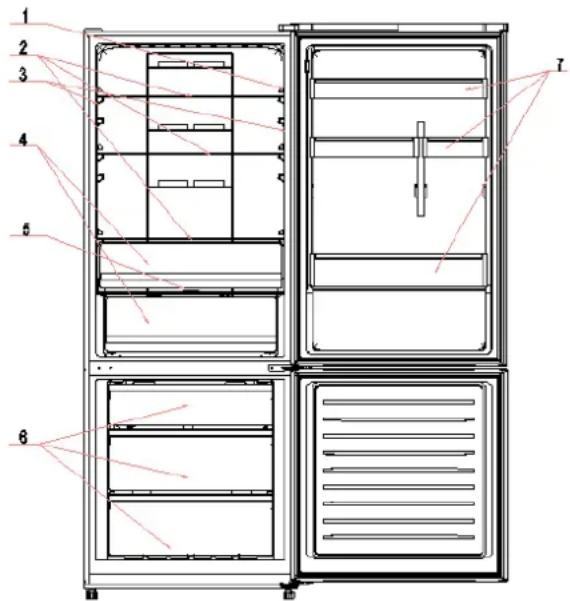
| No | Description |
| 1 | Light switch |
| 2 | Fridge shelves |
| 3 | Light |
| 4 | Crisper box |
| 5 | Crisper box cover |
| 6 | Freezer drawers |
| 7 | Door balcony |
Due to technological innovation, the descriptions of the product in this manual may not be completely consistent with your refrigerator. Details are in accordance with the material item.
III. Preparations for use
Installation location
1. Ventilation condition
The position you select for the refrigerator installation should be well-ventilated and has less hot air. Do not locate the refrigerator near a heat source such as cooker, boiler, and avoid it from direct sunlight, thus guaranteeing the refrigeration effect while saving energy consumption. Do not locate the refrigerator in the damp place, so as to prevent the refrigerator from rusting and leaking electricity. The result of the refrigerant charge amount of the refrigerator being divided by the total space of the room in which the refrigerator is installed shall be less than 8 g / m^3 .
Note: The amount of refrigerant charged for the refrigerator can be found on the nameplate.
2. Heat dissipation space
When working, the refrigerator gives off heat to surroundings. Therefore, at least 30mm of free space should be spared at the top side, more than 100mm on both sides, and above 50mm at the back side of the refrigerator.
Dimensions in mm:
| W | D | H | A | B | C(°) | E | F |
| 703 | 703 | 1855 | 1165 | 1360 | 125±5 | 50 | 100 |
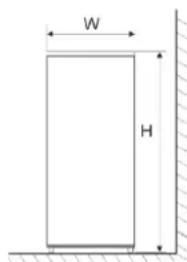
Fig. 1
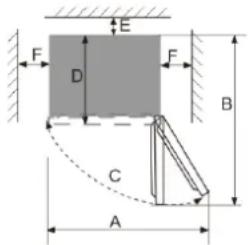
Fig. 2
Note : Figure 1, Figure 2 only illustrate the space demand of the product.
3. Level ground
Place the refrigerator on the solid and flat ground (floor) to keep it stable, or else, it will give rise to vibration and noise. When the refrigerator is placed on such flooring materials as carpet, straw mat, polyvinyl chloride, the solid backing plates should be applied underneath the refrigerator, so as to prevent color change due to heat dissipation.

Unobstructed ventilation shall be maintained around the appliance or in an embedded structure.
Preparations for use
1. Standing time
After the refrigerator is properly installed and well cleaned, do not switch it on immediately. Make sure to energize the refrigerator after more than 1 hour of standing, so as to ensure its normal operation.
2. Cleaning
Confirm the accessory parts inside the refrigerator and wipe the inside with a soft cloth.
3. Power-on
Insert the plug into the solid socket to start the compressor. After 1 hour, open the freezer door, if the temperature inside the freezer compartment drops obviously, it indicates the refrigeration system is working normally.
4. Storage of food
After the refrigerator runs for a period of time, the internal temperature of the refrigerator will be automatically controlled according to the user's temperature setting. After the refrigerator is fully cooled, put in foods, which usually need 2\~3 hours to be fully cooled. In summer, when the temperature is high, it takes more than 4 hours for the foods to be fully cooled (Try to open the refrigerator door as less as possible before the internal temperature cools down).

If the refrigerator is installed in the moisture place, make sure to check whether the ground wire and leakage circuit breaker are normal. If vibration noises are produced due to the refrigerator contacting the wall or if the wall gets blackened for convection around the compressor, move the refrigerator away from the wall. Setting up the refrigerator may cause nothing noise or image chaos to the mobile phone, fixed-line telephone, radio receiver, television set surrounding it, so I keep the refrigerator as far away as possible in such case.
IV. Functions
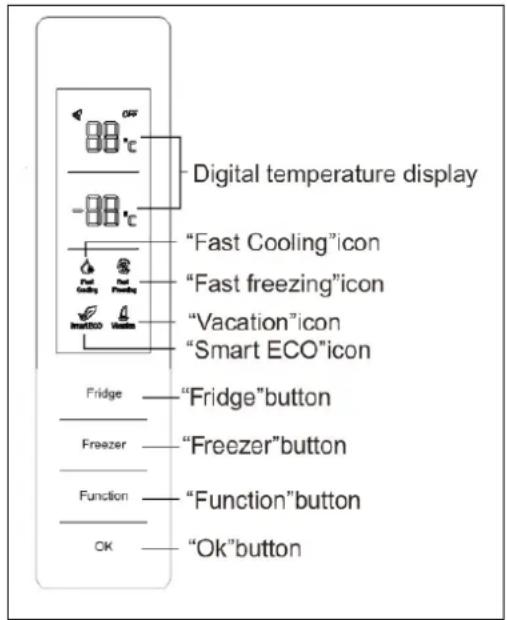
The display panel is designed on the fridge door, illustrated as the following figure.
Function Setting
When the refrigerator system is connected to power supply for the first time, all icons on the display panel gets illuminated for 2s. When all the doors are closed, the display gets extinguished automatically if no key operation within 3 minutes. When the display is off, it will light up if any door is opened or any key is pressed.
The following key operations are valid only when the keys are unlocked and gets illuminated on the display.
1.1 Temp. setting
1) Fridge temperature setting
Press the 'Fridge' button, with the fridge temperature digits flickering, and then press the 'Fridge' key to adjust the temperature, finally press the OK to validate the above temperature setting.
The fridge temperature setting cycles as following:
5^ 6^ 7^ 8^ OFF 2^ 3^ 4^ 5^;
OFF refers to Fridge Off, and when OFF takes effect, the fridge will stop cooling.
⚠️ Take foods out of the fridge compartment before setting this function.
2) Freezer temperature setting
Press the 'Freezer' button, with the freezer temperature digits flickering, and then press the 'Freezer' key to adjust the temperature, finally press the OK to validate the above temperature setting.
The freezer temperature setting cycles as following:
-18^ -17^ -16^ -24^ -23^ -22^ -21^ -20^ -19^ -18^;
1.2 Fast Cooling
1) When the fast cooling function is enabled, the fridge temperature will be set at 2^ C, with the compartment temperature reduced rapidly, so that foods can be kept in fresh condition with their nutrition not lost.
Under the 'Fast Cooling' mode, the compartment temperature is subjected to no change.
2) Enabling the Fast Cooling function
◆ Press the Function key to select Fast Cooling until the corresponding icon gets flickering, and then press the OK key within 5s for confirmation. If the OK key is not pressed within 5s, the setting will be invalidated.
3) Exiting the Fast Cooling function
Under the Fast Cooling mode, press the Function key to select Fast Cooling until the corresponding icon gets flickering, and then press the OK key for confirmation, the Fast Cooling function will get exited.
When the Smart function or Vacation function is enabled, the Fast Cooling function will be disabled automatically.
1.3 Fast Freezing
1) When the Fast Freezing function is enabled, the freezer temperature will be controlled at -32^ C automatically, and after 26 hours of running, the Fast Freezing function gets exited. Cooling down the freezer temperature in a rapid manner is beneficial to the prevention of food nutrition against lost and the preservation of freshness.
! Under the Fast-Freezing mode, the freezer temperature is subjected to no adjustment.
2) Enabling the Fast-Freezing function
◆ Press the Function key to select Fast Freezing until the corresponding icon gets flickering, and then press the OK key within 5s for confirmation. If the OK key is not pressed within 5s, the setting will be invalidated.
3) Exiting the Fast-Freezing function
◆ After a cumulative running period of 26 hours, the Fast Freezing function will exit automatically.
Under the Fast Freezing mode, press the Function key to select Fast Freezing until the corresponding icon gets flickering, and then press the OK key for confirmation, the Fast Freezing function will get exited.
When the Smart function is enabled, the Fast-Freezing function will be disabled automatically.
1.4 Vacation
1) When the Vacation function is enabled, the fridge temperature will be controlled at 14^ C. When you are out for a quite long time, you can set the Vacation function to keep the refrigerator running with low energy consumption, while ensuring the fresh food compartment is free from undesirable smell and the freezer compartment operates normally.
! Be sure to take out all foods from the fresh food compartment before setting this function.
⚠️ Under the Vacation mode, the fridge temperature is subject to no change.
2) Enabling the Vacation function
◆ Press the Function key to select Vacation until the corresponding icon gets flickering, and then press the OK key within 5s for confirmation. If the OK is not pressed within 5s, the setting will be invalidated.
3) Exiting the Vacation function
Under the Vacation mode, press the Function key to select Vacation until the corresponding gets flickering, and then press the OK key for confirmation. The Vacation function will get exited.
When the Smart or Fast Cooling function is enabled, the Vacation function will be disabled automatically.
1.5 Smart
1) When the Smart function is enabled, the temperature of the fresh food compartment is controlled at 4^ C, and that of the freezer compartment at -18^ C, so that foods can be stored in the best condition while the refrigerator is running more efficiently and with better performance.
⚠️ Under the Smart mode, the fresh food compartment temperature and the freezer compartment temperature are subject to no change.
2) Enabling the Smart function
◆ Press the Function key to select Smart until the corresponding icon gets flickering, and then press the OK key within 5s for confirmation. If the OK is not pressed within 5s, the setting will be invalidated.
3) Exiting the Smart function
Under the Smart mode, press the Function key to select Smart until the corresponding gets flickering, and then press the OK key for confirmation. The Smart function will get exited.
When the Vacation or Fast Freezing function is enabled, the Smart function will be disabled automatically.
1.6 Door open alarm
If the fridge door is open for more than 3 minutes, buzzer alarms will be continuously issued, which can be stopped when any key is pressed, but will be restored after 3 minutes if the door keeps open. The alarms will not be lifted until the door is closed.
1.7 Power cut memory
In case of power failure, the refrigerator will maintain the operating state before power failure when power supply is restored.
1.8Power-on delay
In order to protect the refrigerator compressor from being damaged in the case of short-time power failure (i.e., less than 5 minutes), the compressor will not be started immediately after it is powered on.
1.9 Over-temperature alarm (only after power outage)
When the refrigerator system is powered on, if the freezer sensor temperature is higher than -10^ , the said temperature will be displayed, and 5s later, the over-temperature alarm gets stopped.
1.10 Fault alarm
In case E0,E1,E2,EH, or EC is displayed on the operation panel, it indicates fault with the refrigerator. Please contact the aftersales person for visiting service in such case.
V. Instructions for food storage
Precautions for use
- The appliance might not operate consistently (there is possibility of defrosting or temperature becoming too warm in the frozen food compartment) when sited for an extended period of time below the cold limit of the temperature range for which the refrigerating appliance is designed
● The information of climate type of the appliance is provided on the rating plate.
- The internal temperature could be affected by such factors as the location of refrigerating appliance, ambient temperature, and frequency of door open, etc., and if appropriate, a warning that setting of any temperature control device might have to be varied to allow for these factors should be made.
- Effervescent drinks should not be stored in the freezer compartment or the low-temperature compartment, and some products such as water ices should not be consumed too cold.
Food storage location
- Due to the cold air circulation in the refrigerator, the temperature of each area in the refrigerator is different, so different kinds of food should be placed in different areas.
- The fresh food compartment is suitable for the storage of such foods as need not to be frozen, the cooked food, beer, eggs, some condiments that need cold preservation, milk, fruit juice, etc. The crisper box is suitable for the preservation of vegetables, fruits, etc.
- The freezer compartment is suitable for the storage of ice cream, frozen food and the foods to be preserved for a long time.
Use of the fresh food compartment
Fridge shelf: When removing the shelf, lift it up first, and then pull it out; and when installing the shelf, place it into position before putting it down. Keep the shelf rear flange upward, to prevent foods from contact the liner wall. When taking out or putting in the shelf, hold it firmly, and handle with care to avoid damage.
Crisper box: Pull out the crisper box for access to food. After using or cleaning the cover plate of the crisper box, be sure to put it back onto the crisper, so that the internal temperature of the crisper box will not be affected.
Use of the humidity regulating rod of the crisper box
The humidity regulating rod is used to preserve moisture inside the crisper box, so as to keep fresh the vegetables and fruits stored inside.
When the humidity regulating rod is adjusted to the right side, with more holes exposed, the internal moisture of the crisper box can be maintained at the low level.
When the humidity regulating rod is adjusted to the left side, with less holes exposed, the internal humidity of the crisper box can be maintained at the high level.
How to use the ice-making box
Place the ice-making box in the upper position of the freezer compartment, so that it ices up as soon as possible.
Cautions for food storage
You'd better clean the foods and wipe them dry before storing them inside the refrigerator. Before foods are put in the refrigerator, it is advisable to seal them up, so as to prevent water evaporation to keep fresh fruits and vegetables on one hand, and prevent taint of odor on the other hand.
Donot put too many or too weight foods inside the refrigerator. Keepenough space between foods; if too close, the cold air flow will be blocked, thus affecting the refrigeration effect. Do not store excessive or overweight foods, to avoid the shelf from being crushed. When storing the foods, keep a distance away from the inner wall; and do not place the water-rich foods too close to the fridge rear wall, lest they get frozen on the inner wall.
Categorized storage of foods : Foods should be stored by category, with the foodsyou eat every day placed in front of the shelf, so that the door open duration can be shortened and food spoilage due to expiration can be avoid.
Energy-saving tips: Allow the hot food cool down to the room temperature before putting it in the refrigerator. Put the frozen food in the fresh food compartment to thaw, using the low temperature of the frozen food to cool the fresh food, thus saving energy.
Storage of fruits and vegetables
In the case of refrigerating appliances with chill compartment, a statement to the effect that some types of fresh vegetables and fruits are sensitive to cold and therefore are not suitable for storage in this kind of compartment should be made.
Use of the frozen food storage compartment
The freezer temperature is controlled below -18 °C, and it is advisable to store the food for long-term preservation in the freezer compartment, but the storage duration indicated on the food packaging should be adhered to.
The freezer drawers are used to store food that needs to be frozen. Fish and meat of large block size should be cut into small pieces and packed into fresh-keeping bags before they are evenly distributed inside the freezer drawers.
Fast freezing
(1) Refer to the description about fast freezing function in the "Function" section.
(2) Compared with the normal freezing, fast freezing enables food to pass through the maximum ice crystal formation zone at the fastest speed. Fast freezing can freeze the food water content into fine ice crystals, without damaging the cell membrane, so cell juice will not be lost when thawing, and the original freshness and nutrition of food can be maintained.
(3) The fast-freezing function is designed to preserve nutrition of the frozen food, with the food thoroughly frozen in the shortest time. Fast freezing consumes more energy than the normal freezing does.
★ Allow the hot foods to cool down to the room temperature before putting them in the freezer compartment.
★Do not put a glass container with liquid or the canned liquid that is sealed in the freezer compartment, so as to avoid burst due to volume expansion after the liquid gets frozen up.
★Divide the food into appropriately small portions
★You’d better pack the food up before freezing it, and the packing bag used should be dry, in case the packing bags are frozen together. Foods should be packed or covered by such suitable materials as are firm, tasteless, impervious to air and water, non-toxic and pollution-free, to avoid cross-contamination and transfer of odor.
Tips for shopping the frozen foods
-
When you are buying frozen food, look at the Storage Guidelines on the packaging. You will be able to store each item of frozen food for the period shown against the star rating. This is usually the period stated as “Best to use them before×”, found on the front of the packaging.
-
Check the temperature of the frozen food cabinet in the shop where you buy the frozen foods.
-
Make sure the frozen food package is in perfect condition.
-
Always buy frozen products last on your shopping trip or visit to the supermarket.
-
Try to keep frozen food together whilst shopping and on the journey home, as this will help to keep the food cooler.
-
Don't buy frozen food unless you can freeze it straight away. Special insulated bags can be bought from most supermarkets and hardware shops. These keep the frozen foods cold longer.
-
For some foods, thawing before cooking is unnecessary. Vegetables and pasta can be added directly to boiling water or steam cooked. Frozen sauces and soups can be put into a saucepan and heated gently until thawed.
-
Use quality food and handle it as little as possible. When foods are frozen in small quantities, it will take less than for them to freeze up and thaw.
-
Estimate the amount of foods to be frozen up. When freezing large amounts of fresh food, adjust the temperature control knob to the low mode, with the freezer temperature lowered. So, foods can be frozen up in fast manner, with the food freshness well kept.
VI. Tips for special needs
Moving the refrigerator/freezer
- Location
Do not place your refrigerator/freezer near a heat source, e.g. cooker, boiler or radiator. Avoid it from direct sunlight in outbuildings or sun lounges.
•Leveling
Make sure to level your refrigerator/freezer using the front leveling feet. If not level, the refrigerator/freezer door gasket sealing performance will be affected, or even it may lead to the operating failure of your refrigerator/freezer.
After locating the refrigerator/freezer in position, wait for 4 hours before using it, so as to allow the refrigerant to settle.
•Installation
Do not cover or block the vents or grilles of your appliance.
When you are out for a long timen
•Take out all foods.
- Clean and dry the interior thoroughly. To prevent odor and mold growth, leave the door ajar: block it open or have the door removed if necessary.
- Keep the cleaned appliance in a dry, ventilated place and away from the heat source, place the appliance smoothly, and do not place heavy objects on top of it.
- The unit should not be accessible to child's play.
VII. Maintenance and cleaning
Before cleaning, unplug the power plug first; Do not plug in or plug out the plug with wet hand, because there is a risk of electric shock and injury. Do not spill water directly on the refrigerator, to avoid rust, electricity leakage and accidents. Do not stretch your hands into the bottom of the refrigerator, since you might be scratched by sharp metal corners.
Internal cleaning and external cleaning
The food residuals in the refrigerator are liable to produce bad odor, so the refrigerator must be cleaned regularly. The fresh food compartment is usually cleaned once a month.
Remove all shelves, crisper box, bottle racks, cover board, and drawers etc., and clean them with a soft towel or sponge dipped in warm water or neutral detergent.
Clear off the dusts accumulated on the rear panel and side plates of the refrigerator often.
After using detergent, be sure to rinse it with clean water, and then wipe it dry.
Do not use bristle brush, steel wire brush, detergent, soap powder, alkaline detergent, benzene, gasoline, acid, hot water and other corrosive or soluble items to cleanse the cabinet surface, door gasket, plastic decorative parts, etc., so as to avoid damage.
Carefully wipe dry the door gasket, clean the groove using a wooden chopstick wrapped with cotton string. After the cleaning, fix the four corners of the door gasket first, and then embed it segment by segment into the door groove. Interruption of power supply or failure of the refrigerating system
•Take care of the frozen foods in the event of an extended non-running of the refrigerating appliance (such as interruption of power supply or failure of the refrigerating system).
- Try to open the refrigerator door as less as possible, in this way can food safely and freshly kept for hours even in hot summer.
- If you get the power outage notice in advance :
1) Adjust the thermostat knob to the high mode an hour in advance, so that foods get fully frozen (Do not store new food during this time!). Restore the temperature mode to the original setting when power supply becomes normal in a timely manner.
2) You can also make ice with a watertight container, and put it in the upper part of the freezer, so as to extend the time for fresh food to be stored.
Note: Once the refrigerator is used, you'd better use it continuously; and under normal circumstance, do not stop its use, so as not to affect the service life.
Defrosting
This appliance is designed with automatic defrosting function, thus no need to defrost it manually.
Changing the lamp
The LED lamp is used by the refrigerator for lighting, which features low energy consumption and long service life. In case of any abnormality, please contact the after-sales personnel for visiting service. The lamps can only be replaced by the manufacturer together with a part of the appliance.
Lamp type : LED light.
Energy efficiency level : G
Safety-check after maintenance
Is the power cord broken or damaged?
Is the power plug firmly inserted into the socket?
Is the power plug abnormally overheated?
Note: Electric shock and fire accident may be caused in case the power cord and plugs damaged or stained by dust. If any abnormality, please unplug the power plug and get in contact with the vendor.
Howto disassemble the parts.
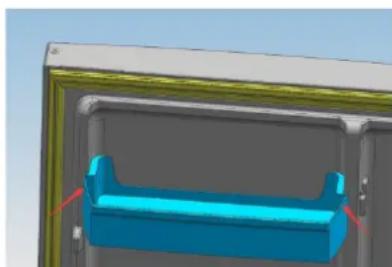
Fridge door bottle rack:
Hold two sides of bottle rack with both hands, squeeze inward to make it deform slightly, and then push it up.
natural_image
3D CAD model of a mechanical part with a blue component and green wall, shown without any text or symbols.Fridge shelf:
Hold one end of the shelf, and lift it up while pulling it outwards.
VIII. Simple fault analysis and elimination
With regard to the following small faults, not every failure needs to be fixed by the technical service personnel; you can try to solve the problem.
| Case | Inspection | Solutions |
| Completely non-refrigeration | •Is power plug off?•Are breakers and fuses broken?•No electricity or line trip? | •Re-plug•Opening the door and checking whether the lamp is lit. |
| Abnormal noise | •Is refrigerator stable?•Does refrigerator contact the wall? | •Adjusting refrigerator's leveling feet.•Off the wall. |
| Poor refrigerating efficiency | •Do you put hot food or too much food?•Do you open the door frequently?•Do you clip food bag to the door gasket?•Direct sunlight or near a furnace or stove?•Is it well-ventilated?•Temperature setting in too high? | •Putting food into refrigerator when hot food becomes cool.•Checking and closing the door.•Removing the refrigerator from the heat source.•Emptying the distance to maintain good ventilation..•Setting to the appropriate temperature. |
| Peculiar smell in refrigerator | •Any spoiled food?•Do you need to clean refrigerator?•Have you packed food of strong flavors? | •Throwing away spoiled food.•Cleaning refrigerator.•Packing food of strong flavors. |
| •Temperature setting impossible | •Check whether the Smart, Fast Freeze or Vacation function is enabled on the display panel. | •Exit the special function mode, and then set up the temperature (for details refer to the Functions section) |
| •Freezer temperature displayed on the panel, with the temperature digits flashing | •Is power cut before? | •Press any key to lift the alarm (refer to the Overtemperature alarm function), and then check the foods inside the fridge and freezer compartments get spoiled. |
(⚠️Note: If the above descriptions are inapplicable to troubleshooting, do not disassemble and repair it yourself. Repairs carried out by inexperienced persons may cause injury or serious malfunctioning. Contact the local store where your purchase was made. This product should be serviced by an authorized engineer and only genuine spare parts should be used.
When the appliance is not in use for long periods, disconnect from the electricity supply, empty all foods and clean the appliance, leaving the door ajar to prevent unpleasant smells.
IX. Certifications
Electrical information
This electrical appliance must be grounded
This product is equipped with a plug, which is suitable for all houses equipped with sockets meeting the current specifications
If the fitted plug is not suitable for your socket outlets, it should be cut off and carefully disposed of. To avoid a possible shock hazard, do not insert the discarded plug into a socket.
This product complies with the following EEC directives.
X. Safe recovery instructions
Disposal
Old appliances still have some surplus value. An environmentally friendly approach will ensure that valuable raw materials are recycled.
The refrigerants used in your equipment and insulation materials require special handling procedures. Make sure there is no pipe damage on the back of the equipment before handling.
Up-to-date information on the options for disposing of old equipment and packaging from old equipment can be obtained from the local municipal office.
Correct disposal of this product
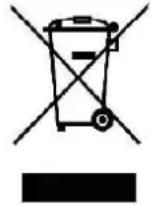
This marking indicates that this product should not be disposed with other household wastes throughout the EU. To prevent possible harm to the environment or human health from uncontrolled waste disposal, recycle it responsibly to promote the sustainable reuse of material resources. To return your used device, please use the return and collection systems or contact the retailer where the product was purchased. They can take this product for environmentally safe recycling.
Warnings for disposal
※ Refrigerant and cyclopentane foaming material used for the refrigerator are flammable. Therefore, when the refrigerator is scrapped, it shall be kept away from any fire source and be recovered by a special recovering company with corresponding qualification other than be disposed by combustion, so as to prevent damage to the environment or any other harm.
※ When the refrigerator is scrapped, disassemble the doors, and remove gasket of door and shelves; put the doors and shelves in a proper place, so as to prevent trapping of any child.
Reversing the Door Swing
● How to disassemble the fridge/freezer door.
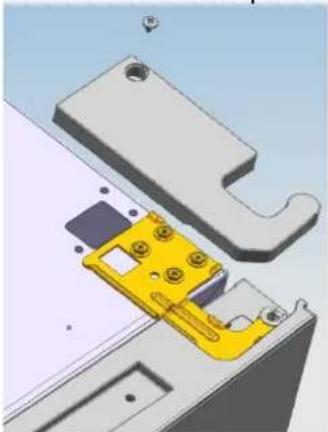
- a. Screw off the hinge cover screw, remove the hinge cover, and insert the communication wire into the hole on the cabinet top.
natural_image
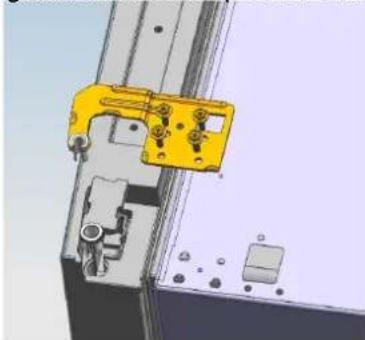
3D mechanical assembly diagram showing a yellow plastic housing with bolt holes and mounting brackets (no text or symbols visible)b. Remove the 4 screws of the upper hinge cover, remove the hinge cover, and pry up the door bushing and small end cap cover on the door.
natural_image
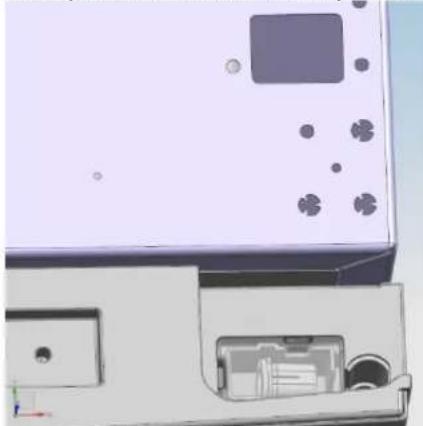
3D mechanical assembly diagram showing a yellow bracket with mounting holes and a small component (no text or symbols visible)c. Insert the door bushing and door communication wire into the hole on the door, and then put on the small end cap cover.
natural_image
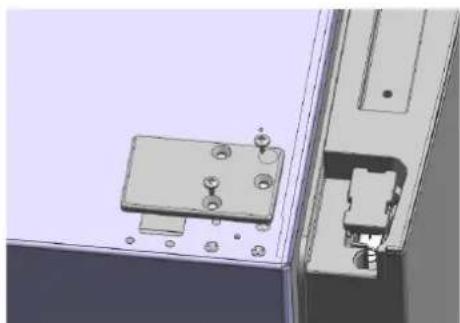
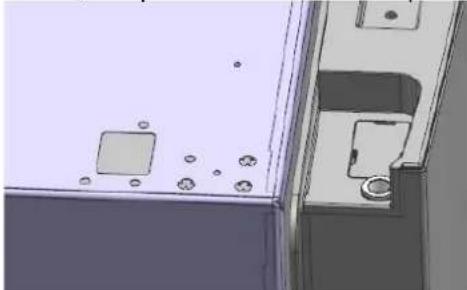
3D model of a device with labeled components and internal compartments (no visible text or symbols)d. Screw off the 2 screws as shown below to remove the hole cover on the cabinet top, get the cabinet communication wire out of the hole; Pry up the small end cap cover on the door, and get out the door bush and door communication wire.
natural_image
Technical diagram of a mechanical assembly with mounting holes and a bracket (no text or symbols visible)e. Insert the door bush into the round hole on the door, and put on the small end cap cover.
natural_image
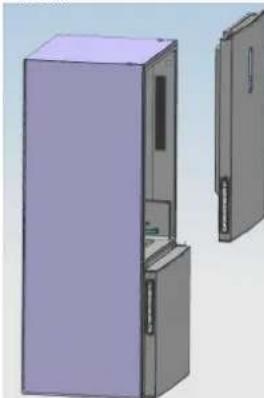
Technical diagram showing a mechanical assembly with mounting holes and internal components (no text or labels)f. Move the fridge door upward by over 50mm to remove the door.
natural_image
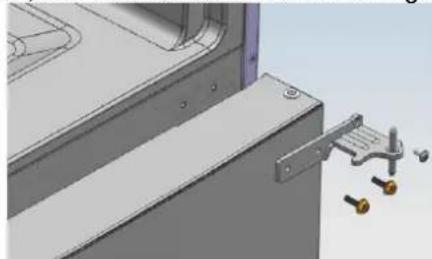
3D rendering of a two-story refrigerator with front and side views (no text or symbols)- a. Screw off the 3 screws of the middle hinge cover, and then remove the middle hinge.
natural_image
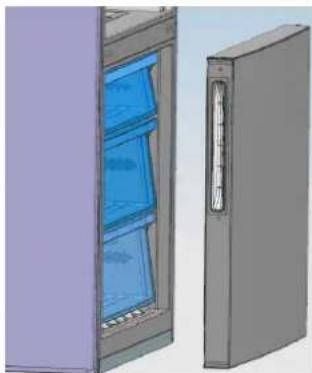
3D mechanical assembly diagram showing a bracket with mounting holes and a lever mechanism (no text or symbols)b. Move the freezer door upward by over 50mm to remove the door.
natural_image
Illustration of a refrigerator with blue doors and a side panel, shown from two different angles (no text or symbols)c. Remove the adjustable front feet under the lower hinge, and screw off the 4 screws of the lower hinge to disassemble the lower hinge.
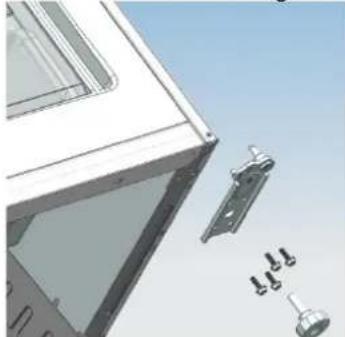
natural_image
Technical illustration of a door frame with attached metal components and disassembled parts (no text or symbols)In this way, the door disassembly is finished.
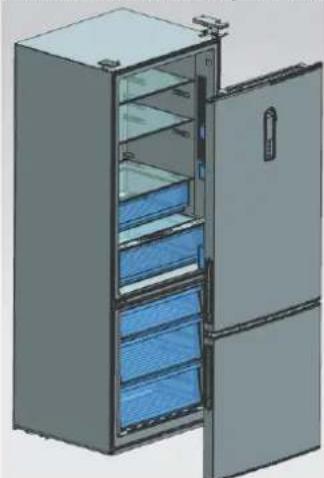
natural_image
Illustration of a two-door refrigerator with blue shelves and open door (no text or symbols)- How to assemble the door and lower hinge accessories correspondingly on the opposite side.
a. Take the door bushing out as shown below, and assemble it to the corresponding position on the opposite side.
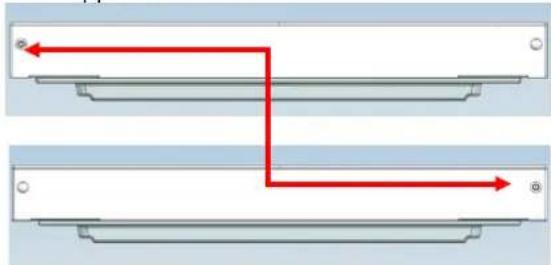
natural_image
Pure electrical circuit lines without any symbolsb. Screw off the screws of the stopper as shown below, and assemble them to the other side of the door.
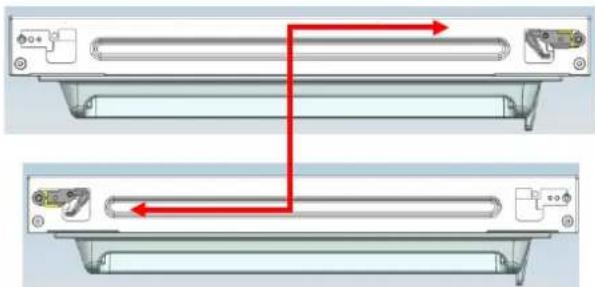
natural_image
Diagram showing two identical mechanical components with red directional arrows indicating movement or force (no text or symbols)c. Remove theaxle and two stoppers on the lower hinge, and assemble them to the position as shown below.
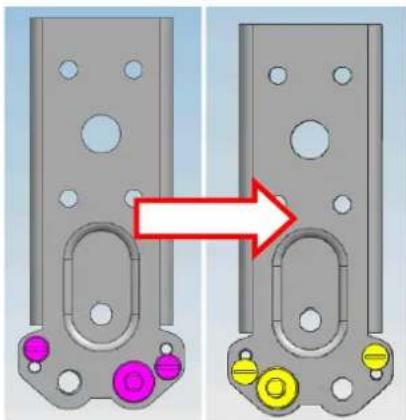
natural_image
Diagram showing a mechanical component with colored circular features, one being rotated by a red arrow (no text or symbols)● How to assemble the fridge door and freezer doors to the opposite side.
- a. Remove the adjustable front foot as shown below by hand, assemble the lower hinge to the other side of the cabinet, and fix the screws.
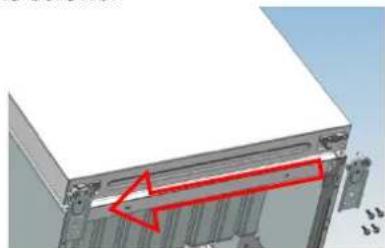
natural_image
3D mechanical assembly diagram showing a component with a red arrow pointing to a specific part (no text or symbols present)b. Assemble the shorter adjustable front foot to the lower hinge side, and adjust the height of the foot to make the refrigerator level.
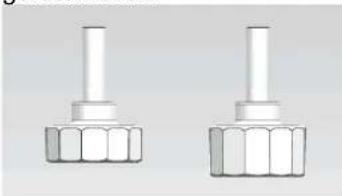
natural_image
Two identical mechanical components with flanged ends and cylindrical tops, shown side by side (no text or symbols)- Install the freezer door, turn the middle hinge by 180 °C, assemble it to the other side of the cabinet, and screw up the 3 screws to fix the middle hinge.
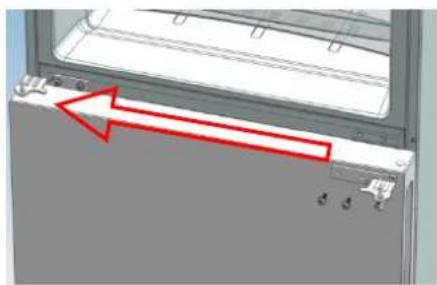
natural_image
3D diagram of a device with a red arrow pointing to a component, no visible text or symbols- Install the fridge door, assemble the left upper hinge to the other side of the cabinet, and use a tool to screw up the 4 screws to fix the upper hinge.
Then, connect the door communication wire and the cabinet communication wire, install the left upper hinge cover, and fix it using a screw.
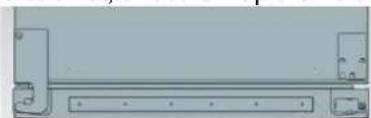
- Assemble the hole cover to the other side of the cabinet, and screw up the hole cover.
natural_image
Pure technical diagram of a mechanical component without any text, numbers, or symbolsThe door installation is finished.
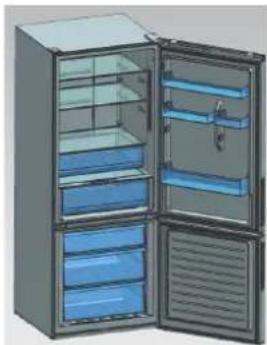
natural_image
3D rendering of a double-door refrigerator with open doors and blue-labeled compartments (no text or symbols visible)The doors are opened form the left side.
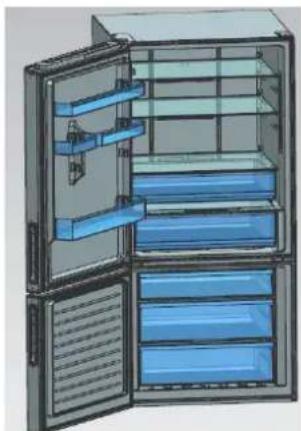
natural_image
3D illustration of an open refrigerator with blue shelves and ventilation grilles (no text or symbols)The doors are opened from the right side.

Double check that the door is aligned correctly and all the seals are closed on all sides. If necessary, re-adjust the levelling feet.
NOTE: If you want to have the door swing reversed, we recommend you to contact a qualified technician. You should only try to reverse the door yourself if you believe that you are qualified to do so.
All parts removed must be saved to do the reinstallation of the door. You should rest the fridge freezer on something solid so that it will not slip during the door change process. Do not lay the fridge freezer flat as this may damage the coolant system. Ensure the fridge-freezer is unplugged and empty. We recommend that 2 people handle the fridge-freezer during assembly.
I. GÜVENLİK
↓
UYARI!
natural_image
3D rendering of a blue mechanical component with red arrows indicating direction (no text or symbols)Buzdolabı rafi:
natural_image
3D mechanical assembly diagram showing a yellow plastic component inserted into a gray housing (no text or symbols visible)natural_image
Technical diagram of a mechanical assembly with yellow components and mounting holes (no visible text or symbols)natural_image
Illustration of a computer monitor with buttons and an open drive (no text or symbols visible)natural_image
Close-up of a mechanical assembly with mounting holes and a bracket (no visible text or symbols)natural_image
Technical diagram of a mechanical assembly with mounting holes and internal components (no text or symbols)natural_image
3D rendering of a two-story refrigerator with front and side views (no text or symbols visible)natural_image
3D mechanical assembly diagram showing a bracket with mounting holes and a lever mechanism (no text or symbols)natural_image
Illustration of a refrigerator with blue storage compartments and a gray cabinet (no text or symbols)natural_image
3D CAD model of a window frame with attached metal components and exploded view (no text or symbols)natural_image
3D rendering of a double-door refrigerator with blue shelves and glass doors (no text or symbols visible)natural_image
Diagram showing two identical mechanical components with red arrows indicating directional movement (no text or symbols)natural_image
Diagram showing a mechanical component with colored circular features and an arrow indicating transformation (no text or symbols)natural_image
3D mechanical assembly diagram showing a white base with a red arrow pointing to a component (no text or symbols visible)natural_image
Two identical mechanical components with flanged ends and cylindrical tops, shown in 3D rendering (no text or symbols)natural_image
3D mechanical component with red arrows pointing to features, no visible text or symbolsnatural_image
Pure electrical circuit lines without any symbolsnatural_image
3D rendering of an open stainless steel refrigerator with blue internal compartments (no text or symbols visible)natural_image
3D rendering of an open refrigerator with blue shelves and doorways (no text or symbols visible)¡ADVERTENCIA!
natural_image
3D CAD model of a mechanical part with a blue component and red directional arrows (no text or symbols)natural_image
3D mechanical assembly diagram showing a yellow plastic component inserted into a gray housing (no text or symbols visible)natural_image
3D mechanical assembly diagram showing a yellow bracket with mounting holes and mounting brackets (no text or symbols visible)natural_image
3D model of a device with a display and internal components (no visible text or symbols)natural_image
Technical illustration of a mechanical assembly with mounting holes and a bracket (no text or symbols)natural_image
Technical illustration of a mechanical assembly with mounting holes and a bracket (no text or symbols)natural_image
3D rendering of a two-story refrigerator with front and side views (no text or symbols)natural_image
3D CAD model of a mechanical assembly with mounting bracket and bolts (no text or symbols visible)natural_image
Illustration of a refrigerator with blue storage compartments and a side panel (no text or symbols)natural_image
3D CAD model of a cabinet or enclosure with exploded view and mounting bracket (no text or symbols visible)natural_image
3D rendering of a stainless steel refrigerator with open doors and blue-labeled shelves (no text or symbols visible)natural_image
Two identical mechanical components with red directional arrows indicating alignment or force (no text or symbols)natural_image
Diagram showing a mechanical component with colored circular features, one being cut and the other extended (no text or symbols)natural_image
3D diagram of a mechanical assembly with a red arrow pointing to a component (no text or symbols visible)natural_image
Two identical mechanical components with flanged ends and cylindrical tops, shown side by side (no text or symbols)natural_image
Diagram of a device panel with a red arrow pointing to a component, no visible text or symbolsnatural_image
Pure technical diagram of a mechanical component without any text, numbers, or symbolsnatural_image
3D rendering of an open stainless steel refrigerator with blue shelves and ventilation grilles (no text or symbols visible)natural_image
Illustration of an open refrigerator with blue shelves and ventilation grilles (no text or symbols)- SAFETY
- WARNING!
- Safety tips
- Electrical Connection
- □WARNING□
- Climate Range
- Locks
- Freon-free
- Product features
- Explosive views and parts list
- Preparations for use
- Installation location
- Ventilation condition
- Heat dissipation space
- Level ground
- Preparations for use
- Standing time
- Cleaning
- Power-on
- Storage of food
- Functions
- Function Setting
- Fast Cooling
- Smart
- Instructions for food storage
- Precautions for use
- Food storage location
- Use of the fresh food compartment
- How to use the ice-making box
- Cautions for food storage
- Storage of fruits and vegetables
- Use of the frozen food storage compartment
- Fast freezing
- Tips for shopping the frozen foods
- Tips for special needs
- Moving the refrigerator/freezer
- - Location
- •Leveling
- •Installation
- Maintenance and cleaning
- Internal cleaning and external cleaning
- Defrosting
- Changing the lamp
- Safety-check after maintenance
- Howto disassemble the parts.
- Simple fault analysis and elimination
- Certifications
- Safe recovery instructions
- Disposal
- Warnings for disposal
- Reversing the Door Swing
- GÜVENLİK
- UYARI!
- Buzdolabı rafi:
- ¡ADVERTENCIA!
Brand : CANDY
Model : CCG2T718EX
Category : Refrigerator