PD950 - Drill Powerblade - Free user manual and instructions
Find the device manual for free PD950 Powerblade in PDF.


| Product Type | 2-Stroke Post Hole Digger |
| Engine Displacement | 52 cc |
| Fuel Tank Capacity | 1.1 L |
| Fuel/Oil Mix Ratio | 25:1 (gasoline:2-stroke oil) |
| Fuel Type | Petrol Regular Unleaded 95+ RON |
| Max Power | 2.5 HP |
| Torque | 80 Nm |
| Reduction Ratio | 40:1 |
| Auger Shaft Size | 3/4 inch (19 mm) |
| Auger Diameter Options | 100 mm, 150 mm, 250 mm |
| Auger Length | 800 mm |
| Extension Shaft Length | 600 mm |
| Weight | Approximately 15 kg (33 lb) |
| Warranty | Void if no engine oil added before first use |
| Safety Features | ON/OFF switch, choke, anti-vibration system, spark arrestor |
| Maintenance Intervals | Check fasteners & air filter daily; clean air filter every 25 hrs; replace spark plug every 100 hrs |
| Intended Use | Domestic post hole digging for fencing, etc. |
| Included Components | Machine, auger(s), spark plug wrench, user manual |
Frequently Asked Questions - PD950 Powerblade
User questions about PD950 Powerblade
0 question about this device. Answer the ones you know or ask your own.
Ask a new question about this device
Download the instructions for your Drill in PDF format for free! Find your manual PD950 - Powerblade and take your electronic device back in hand. On this page are published all the documents necessary for the use of your device. PD950 by Powerblade.
USER MANUAL PD950 Powerblade
natural_image
Blue and white industrial machine with black base, no visible text or symbolsPD950 2-Stroke Post Hole Digger
User Manual
[Revision 1.0 September 2023]
READ THIS MANUAL CAREFULLY BEFORE USE – FAILURE TO DO SO MAY RESULT IN INJURY, PROPERTY DAMAGE AND MAY VOID WARRANTY. • KEEP THIS MANUAL FOR FUTURE REFERENCE. • Products covered by this manual may vary in appearance, assembly, inclusions, specifications, description, and packaging.


The product is NOT supplied with engine oil, although traces of oil from the manufacturing process may be present. It is essential to add adequate engine oil of the correct type to the engine before use. Failure to add engine oil will void the product warranty.
Safety
Safety messages are designed to alert you to possible dangers or hazards that could cause death, injury or equipment or property damage if not understood or followed. Safety messages have the following symbols:

You WILL be KILLED or SERIOUSLY INJURED if you do not follow instructions.
It is vital that you read and understand this user manual before using the product, including safety warnings, and any assembly and operating instructions. Keep the manual for future reference.
Safety precautions and recommendations detailed here must be fully understood and followed to reduce the risk of injury, fire, explosion, electrical hazard, and/or property damage.
Safety information presented here is generic in nature – some advice may not be applicable to every product. The term "equipment" refers to the product, be it electrical mains powered, battery powered or combustion engine powered.
- Before Use - If you are not familiar with the safe operation/handling of the equipment or are in any way unsure of any aspect of suitability or correct use for your application, you should complete training conducted by a person or organization qualified in safe use and operation of this equipment, including fuel/electrical handling and safety.
- Do NOT operate the equipment in flammable or explosive environments, such as in the presence of flammable liquids, gases, or dust. The equipment may create sparks or heat that may ignite flammable substances.
- Keep clear of moving parts.
- Equipment may be a potential source of electric shock or injury if misused.
- Do NOT operate the equipment if it is damaged, malfunctioning or is in an excessively worn state.
- Do NOT allow others to use the equipment unless they have read this manual and are adequately trained.
- Keep packaging away from children - risk of suffocation! Operators must use the equipment correctly. When using the equipment, consider conditions and pay due care to persons and property.
General Work Area Safety
• Work areas should be clean and well it.
- Do not operate the equipment if bystanders, animals etc are within operating range of the equipment or the general work area.
- If devices are provided for connecting dust extraction / collection facilities, ensure these are connected and used properly. Dust collection can reduce dust-related hazards.

You CAN be KILLED or SERIOUSLY INJURED if you do not follow instructions.
General Personal Safety
- Wear appropriate protective equipment when operating, servicing, or when in the operating area of the equipment to help protect from eye and ear injury, poisoning, burns, cutting and crush injuries. Protective equipment such as safety goggles, respirators, non-slip safety footwear, hard hat, hearing protection etc should be used for appropriate equipment / conditions. Other people nearby should also wear appropriate personal protective equipment. Do not wear loose clothing or jewellery, which can be caught in moving parts. Keep hair and clothing away from the equipment.
- Stay alert and use common sense when operating the equipment. Do not overreach. Always maintain secure footing and balance.
- Do not use the equipment if tired or under the influence of drugs, alcohol, or medication.
- This equipment is not intended for use by persons with reduced physical, sensory, or mental capabilities.
General Fuel Safety
- Petrol/fuel/gasoline is extremely flammable – keep clear of naked flames or other ignition sources.
- Do not spill fuel. If you spill fuel, wipe it off the equipment immediately – if fuel gets on your clothing, change clothing.
- Do NOT smoke near fuel or when refuelling.
• Always shut off the engine before refuelling. - Do NOT refuel a hot engine.
- Open the fuel cap carefully to allow any pressure build-up in the tank to release slowly.
• Always refuel in well ventilated areas. - Always check for fuel leakage. If fuel leakage is found, do not start, or run the engine until all leaks are fixed.
General Carbon-Monoxide Safety
- Using a combustion engine indoors CAN KILL IN MINUTES. Engine exhaust contains carbon-monoxide – a poison you cannot smell or see.
- Use combustion engines OUTSIDE only, and far away from windows, doors, and vents.

You CAN be INJURED if you do not follow instructions or equipment damage may occur.
General Equipment Use and Care
- The equipment is designed for domestic use only.
- Handle the equipment safely and carefully.
- Before use, inspect the equipment for misalignment or binding of moving parts, loose components, damage, or any other condition that may affect its operation. If damaged, have the equipment repaired by an authorised service centre or technician before use.
- Prevent unintentional starting of the equipment - ensure equipment and power switches are in the OFF position before connecting or moving equipment. Do not carry equipment with hands or fingers touching any controls. Remove any tools or other items that are not a part of the equipment from it before starting or switching on.
- Do not force the equipment. Use the correct equipment for your application. Equipment will perform better and be safer when used within its design and usage parameters.
- Use the equipment and accessories etc. in accordance with these instructions, considering working conditions and the work to be performed. Using the equipment for operations different from those intended could result in hazardous situations.
- Always keep equipment components (engines, hoses, handles, controls, frames, housings, guards etc) and accessories (cutting tools, nozzles, bits etc) properly maintained. Keep the equipment clean and, where applicable, properly lubricated.
- Store the equipment out of reach of children or untrained persons. To avoid burns or fire hazards, let the equipment cool completely before transporting or storing. Never place or store the equipment near flammable materials, combustible gases, or liquids etc.
- The equipment is not weather-proof, and should not be stored in direct sunlight, at high ambient temperatures or locations that are damp or humid.
- Do not clean equipment with solvents, flammable liquids, or harsh abrasives.
- For specific equipment safety use and care, see Equipment Safety.
General Electrical Safety
- Inspect electrical equipment, extension cords, power bars, and electrical fittings for damage or wear before each use. Repair or replace damaged equipment immediately.
- Ensure all power sources conform to equipment voltage requirements and are disconnected before connecting or disconnecting equipment.
- When wiring electrically powered equipment, follow all electrical and safety codes.
- Wherever possible, use a residual current device (RCD).
- High voltage / high current power lines may be present. Use extreme caution to avoid contact or interference with power lines. Electrical shock can be fatal.
General Electrical Safety
- Electrically grounded equipment must have an approved cord and plug and be connected to a grounded electrical outlet.
- Do NOT bypass the ON/OFF switch and operate equipment by connecting and disconnecting the electrical cord.
- Do NOT use equipment that has exposed wiring, damaged switches, covers or guards.
- Do NOT use electrical equipment in wet conditions or in damp locations.
- Do NOT use electrical cords to lift, move or carry equipment.
- Do NOT coil or knot electrical cords, and ensure electrical cords are not trip hazards.
General Service Information
- The equipment must be serviced or repaired at authorised service centres by qualified personnel only.
- Replacement parts must be original equipment manufacturer (OEM) to ensure equipment safety is maintained.
- Do NOT attempt any maintenance or repair work not described in this manual.
- After use, the equipment and components may still be hot – allow the equipment to cool and disconnect spark plugs and/or electrical power sources and/or batteries from it before adjusting, changing accessories, or performing repair or maintenance.
- Do NOT adjust while the equipment is running.
- Perform service-related activities in suitable conditions, such as a workshop.
- Replace worn, damaged or missing warning/safety labels immediately.
Child Choking Hazard!

- WARNING: CHOKING HAZARD - CHILDREN UNDER 8 YRS. CAN CHOKE OR SUFFOCATE ON SMALL PARTS. ADULT SUPERVISION REQUIRED.
- Carefully inspect anything a baby or child could gain access to, including this product & packaging.
- Dangers include anything of a size that could become stuck or lodged in a baby or child's airway.
• Dangers include things like raw, hard fruit and vegetable pieces, large pieces of meat, bones or sausage skins, popcorn, nuts,
hard lollies and corn chips, small magnets and batteries, coins, beads, marbles and small uninflated balloons, broken toys and smaller toys, buttons, keys, and coins. But there are also many more.
- Pay particular attention to accessories, nuts, bolts, screws, washers, caps, covers, loose parts, parts that could be removed or break off, pieces of packaging, staples, tape etc.
- In the case of any doubt, secure the item of concern in an appropriate manner, or completely remove the possibility of access by a baby or child.
Product Safety
FOR YOUR SAFETY, PLEASE FOLLOW THE INSTRUCTIONS ON THE SAFE OPERATION OF THE RULES OF OPERATION AND TECHNICAL MAINTENANCE, OR WILL CAUSE HARM TO YOUR PERSONAL SAFETY OR DAMAGE THE MACHINE. WARNING! FAILURE TO FOLLOW INSTRUCTIONS CAN INSTANTLY RESULT IN INJURY OR DEATH.
Personal Safety
- Wear a mask, goggles, helmet, and earplugs when using machine.
- Do not wear loose clothing, jewellery, shorts, slippers, or bare feet. Make sure your hair is above the shoulders.
- Do not use this tool when you are tired, sick, under the influence of alcohol or medication.
- Do not allow children or inexperienced personnel to operate the machine.
- Wear hearing protection.
- Keep the handle dry and focus on holding the handle tightly.
- Keep your hands away from the drill while the machine is running.
- Hold the handle with both hands and make sure to stand on firm ground.
- When the operation time is too long, it is necessary to take a short break from time to time.
- Be careful about your feet, do not let them come close to the rotating auger.
- Be careful: debris can be thrown away with high speed.
- Keep by standers 15m away from auger.
- Do not touch the sparking plug or high-pressure cable during the operation, otherwise it will cause electric shock.
- In order to avoid burns, please do not touching the engine, muffler, and exhaust due to these parts are very hot during use, even before the engine is stopped and after cooling.
- When the operation time is too long, intermittent moments should be taken from time to time to avoid white finger disease which may be caused by vibration.
- WARNING! FAILURE TO FOLLOW THE OPERATING INSTRUCTIONS CAN RESULT IN PERSONAL INJURY OR EQUIPMENT DAMAGE.
Tool Safety
- Please thoroughly check the tool before each use. Check whether it has fuel leaks and ensure that all fasteners are in place and fastened.
- Please always replace parts that has cracked, broken or damaged before use.
-
Keep other people away from during carburettor adjustment.
-
Please use parts according to recommendation of the manufacturer.
- WARNING! DO NOT MODIFY THE TOOL IN ANY WAY, DO NOT MODIFY THE TOOL FOR OTHER PURPOSES.
Fuel Safety
- Please avoid sparks or flames during mix and pour the fuel outdoors.
- Please use containers that are allowed for fuel.
- Please do not smoke near the tool and fuel, and do not allow others to smoke during using the tool.
- Stop the engine and ensure that it is sufficiently cool when injecting fuel and choose a place with good ventilation and no ventilation.
- Please remove all fuel spills before starting up the engine. Keep it at least 3 meters away from the burning zone before starting up.
- Please stop the engine before removing the fuel cover.
- Please empty the fuel before collecting the tools. It is recommended to empty after each use. If the fuel is left in the tank, the fuel must be not leak.
- In the storage area of tools and fuels, gasoline engines cannot be placed near heaters, motors or electric switches, stoves, etc. to produce sparks or open flames.
- WARNING! THE ANTI-VIBRATION SYSTEM DOES NOT GUARANTEE THAT YOU WILL NOT GET A WHITE FINGER DISEASE OR CARPAL TUNNEL SYNDROME. THEREFORE, REGULAR OPERATORS SHOULD MONITOR THEIR FINGERS. PLEASE SEE A DOCTOR IF THEY HAVE ANY ABOVE SYMPTOMS.
Maintenance Safety
- Please maintain the tool according to the recommended instructions.
- Please stop the engine before performing maintenance.
- Others should keep away from carburettor if making carburettor adjustment.
- Please replace only with genuine parts recommended by the manufacturer.
- When the machine is not used temporarily, clean and dry the machine, and place it in a dry and clean place. The drill bit shall be removed, and the main shaft and threaded connection part of the machine shall be coated with anti-rust oil for maintenance.
Transportation and storage
- Stop the run of engine and hold the tool, to keep the silencer away from your body.
- Please allow the engine to cool down, empty the fuel tank, and secure the tool before storing or using the gasoline carrier.
- Please empty the fuel tank before storing the tool. It is recommended to empty the fuel after each use. If the fuel remains in the tank, store it so that the fuel does not leak.
- Keep tools out of children.
- Please carefully clean the device and store it in a dry place.
- Please make sure the engine switch is off before transporting or storing.
- If the situation is not covered in the Manual, please judge it carefully and handle it carefully. If you need help, please contact your dealer.

DANGER

Running combustion engines in confined areas CAN KILL IN MINUTES. Engine exhaust fumes contain carbon-monoxide – a deadly gas that you cannot smell or see.

NEVER run a combustion engine in confined areas EVEN IF windows and doors are open. ONLY run petrol engines OUTDOORS and away from doors, windows, and vents.
Do not operate the equipment in hazardous locations, such as where there may be a risk of fire or explosions from flammable liquids, gases or dust.
Do not operate the equipment in confined areas where exhaust gases, smoke or fumes could reach dangerous concentrations.
Do not refuel a combustion engine while it is running on or hot.
Never smoke while refueling combustion engines or handling flammable substances.
For generators, the electrical output is potentially lethal and must only be connected to a fixed electrical installation by an appropriately licensed person.
Be aware that the equipment may include hazardous components, such as blades, hot surfaces and moving parts.
Handle any flammable substance with extreme caution.
- Be aware that the equipment may include hazardous components, such as blades, hot surfaces and moving parts.
- Moving blades can cause serious injury and even death if used improperly or without sufficient PPE.
- Do not use this equipment on uneven surfaces and always maintain good balance when using this equipment. Failure to do so may cause serious injury.
- Maintain a secure grip of the trigger assembly at all times.
Safety Symbols
The product may have safety warning labels attached to it, explained below. Understand the symbols on your product and their meanings. If any stickers become unreadable, unattached etc., replace them.
 Flammable Material HazardFlammable liquids, gases, or substances etc may present.Avoid ignition sources and open flames. Danger of fire. Flammable Material HazardFlammable liquids, gases, or substances etc may present.Avoid ignition sources and open flames. Danger of fire. |  Read User ManualRead and fully understand product safety warnings, operation, procedures etc before using the product. Read User ManualRead and fully understand product safety warnings, operation, procedures etc before using the product. |  Use Hand ProtectionWear appropriate hand protection and take due care as the product or use of the product may present hand hazards. Use Hand ProtectionWear appropriate hand protection and take due care as the product or use of the product may present hand hazards. |  EXhaust FumesCarbon-Monoxide HazardDo not use the product in confined areas or without adequate ventilation. Carbon-monoxide poisoning can be fatal. EXhaust FumesCarbon-Monoxide HazardDo not use the product in confined areas or without adequate ventilation. Carbon-monoxide poisoning can be fatal. |
 Electrocution / Electrical Shock HazardHigh voltage or high current electricity may be present or required by the product. Take due care when handling electrical products, cables, plugs and leads. Electrical shock can be fatal. Electrocution / Electrical Shock HazardHigh voltage or high current electricity may be present or required by the product. Take due care when handling electrical products, cables, plugs and leads. Electrical shock can be fatal. |  Toxic Fumes / Dust HazardUsing the product or by-products from use may produce fumes, smoke or particles that could be harmful if inhaled. Wear appropriate breathing protection and have adequate ventilation. Toxic Fumes / Dust HazardUsing the product or by-products from use may produce fumes, smoke or particles that could be harmful if inhaled. Wear appropriate breathing protection and have adequate ventilation. |  Explosive Material HazardCombustible liquids, gases, or substances etc may be present.Avoid ignition sources and open flames. Danger of explosion. Explosive Material HazardCombustible liquids, gases, or substances etc may be present.Avoid ignition sources and open flames. Danger of explosion. |  Cutting / Amputation HazardThe product may have blades, edges or mechanical devices that can cause severe cut injury to fingers, limbs etc. Take due care when handling and using the product. Cutting / Amputation HazardThe product may have blades, edges or mechanical devices that can cause severe cut injury to fingers, limbs etc. Take due care when handling and using the product. |
 Crush HazardThe product may have blades, edges or mechanical devices that can cause severe crush injury to fingers, limbs etc. Take due care when handling and using the product. Crush HazardThe product may have blades, edges or mechanical devices that can cause severe crush injury to fingers, limbs etc. Take due care when handling and using the product. |  Single Operator OnlyThe product must be operated by a single person only. More than one person operating the product may introduce additional hazards. Single Operator OnlyThe product must be operated by a single person only. More than one person operating the product may introduce additional hazards. |  Use Face ProtectionWear appropriate full-face protection and take due care as the product or use of the product may present face and eye hazards. Use Face ProtectionWear appropriate full-face protection and take due care as the product or use of the product may present face and eye hazards. |  Use Foot ProtectionWear appropriate foot protection and take due care as the product or use of the product may present foot hazards. Use Foot ProtectionWear appropriate foot protection and take due care as the product or use of the product may present foot hazards. |
 Use Eye / Ear / Head ProtectionWear appropriate eye and / or ear and / or head protection and take due care as the product or use of the product may present eye, hearing, and head hazards. Use Eye / Ear / Head ProtectionWear appropriate eye and / or ear and / or head protection and take due care as the product or use of the product may present eye, hearing, and head hazards. |  Running HazardDo not run on or near the product as doing so may present a fall hazard. Running HazardDo not run on or near the product as doing so may present a fall hazard. |  Diving HazardDo not dive into the product as doing so may present a neck / head injury hazard. Diving HazardDo not dive into the product as doing so may present a neck / head injury hazard. |  Adult Supervision RequiredAlways supervise children and other users of a product to prevent drowning or injury. Adult Supervision RequiredAlways supervise children and other users of a product to prevent drowning or injury. |
 Skin Penetration / Puncture HazardThe product may produce pressure, emit liquids or objects that can cause severe injury to fingers, limbs, blood etc. Take due care when handling and using the product. Skin Penetration / Puncture HazardThe product may produce pressure, emit liquids or objects that can cause severe injury to fingers, limbs, blood etc. Take due care when handling and using the product. |  Hot Surface HazardBe aware that the product may produce high temperatures and hot surfaces that can cause burn injuries. Hot Surface HazardBe aware that the product may produce high temperatures and hot surfaces that can cause burn injuries. |  Flying Debris HazardBe aware that the product or use of the product may present hazards produced by flying debris. Wear appropriate clothing and protective devices. Flying Debris HazardBe aware that the product or use of the product may present hazards produced by flying debris. Wear appropriate clothing and protective devices. |  Moving Parts HazardBe aware that the product contains or uses mechanical devices that move or rotate. Always wait for moving parts to stop fully before handling the product, adjusting, maintenance etc. Moving Parts HazardBe aware that the product contains or uses mechanical devices that move or rotate. Always wait for moving parts to stop fully before handling the product, adjusting, maintenance etc. |
 Carbon-Monoxide HazardDo not use the product in confined areas or without adequate ventilation. Carbon-monoxide poisoning can be fatal. Carbon-Monoxide HazardDo not use the product in confined areas or without adequate ventilation. Carbon-monoxide poisoning can be fatal. |  Pull HazardBe aware that the product contains or uses mechanical devices that can pull in objects and can cause severe injury to fingers, limbs etc. Take due care when handling and using the product. Pull HazardBe aware that the product contains or uses mechanical devices that can pull in objects and can cause severe injury to fingers, limbs etc. Take due care when handling and using the product. |  Slope / Fall Injury HazardBe aware that using the product on sloping surfaces or in slippery conditions may present additional dangers from falls and contact with blades, moving parts, hot surfaces etc. Slope / Fall Injury HazardBe aware that using the product on sloping surfaces or in slippery conditions may present additional dangers from falls and contact with blades, moving parts, hot surfaces etc. |  "Slam Dunk" WarningDo NOT attempt "slam dunk" manoeuvres as this may result in severe injury due to falling, product breakage or collapse etc. "Slam Dunk" WarningDo NOT attempt "slam dunk" manoeuvres as this may result in severe injury due to falling, product breakage or collapse etc. |
 Electrocution / Electrical Shock Hazard - OutdoorHigh voltage or high current electricity may be present or required by the product. Do NOT use in rain, damp, or wet conditions. Electrical shock can be fatal. Electrocution / Electrical Shock Hazard - OutdoorHigh voltage or high current electricity may be present or required by the product. Do NOT use in rain, damp, or wet conditions. Electrical shock can be fatal. |  Electrocution / Electrical Shock Hazard - DisconnectHigh voltage or high current electricity may be present or required by the product. Always disconnect the product from the electrical supply before handling the product, adjusting, maintenance etc. Electrocution / Electrical Shock Hazard - DisconnectHigh voltage or high current electricity may be present or required by the product. Always disconnect the product from the electrical supply before handling the product, adjusting, maintenance etc. |  Power Line Electrocution HazardHigh voltage / high current power lines may be present. Use extreme caution to avoid contact or interference with power lines.Electrical shock can be fatal. Power Line Electrocution HazardHigh voltage / high current power lines may be present. Use extreme caution to avoid contact or interference with power lines.Electrical shock can be fatal. |  "Kick-Back" HazardHigh level of "kick-back" hazard that can cause the machine to suddenly rotate towards operator.Kick-back injury can be fatal. "Kick-Back" HazardHigh level of "kick-back" hazard that can cause the machine to suddenly rotate towards operator.Kick-back injury can be fatal. |
 Winch Operator Position HazardDo NOT stand between winch and load. Do NOT use winch to move people. Winch Operator Position HazardDo NOT stand between winch and load. Do NOT use winch to move people. |  Winch Lift HazardDo NOT LIFT load vertically. Use machine to PULL only. Winch Lift HazardDo NOT LIFT load vertically. Use machine to PULL only. |  Cable HazardEnsure that load bearing cable is not kinked or knotted. Cable HazardEnsure that load bearing cable is not kinked or knotted. |  Winch Cable HazardEnsure that there is a minimum number of cable coils on winching mechanism. Winch Cable HazardEnsure that there is a minimum number of cable coils on winching mechanism. |
 Winch Hook HazardCarry hook to load – do NOT throw or run. Winch Hook HazardCarry hook to load – do NOT throw or run. |  Flash / Blinding HazardWear appropriate eye protection for welding. Direct exposure to weld arcs may cause permanent eye injury. Flash / Blinding HazardWear appropriate eye protection for welding. Direct exposure to weld arcs may cause permanent eye injury. |  Laser HazardLaser may be in use – do NOT look directly at laser or allow others to. Laser HazardLaser may be in use – do NOT look directly at laser or allow others to. |  Choking HazardChildren under 8 yrs. Can choke or suffocate on small parts. Adult supervision required. Choking HazardChildren under 8 yrs. Can choke or suffocate on small parts. Adult supervision required. |
Table of Contents
Safety 2
Safety Symbols....6
Parts Identification 9
Equipment Safety 10
Before Use....12
Assembly....12
Engine Oil 12
Auger....13
Air Filter 13
Fuel 13
Operation....15
Starting the Engine....15
Stopping the Engine 15
Environmental Considerations....16
Post Hole Digger Operation....16
Maintenance....17
Maintenance Schedule – 2-Stroke Engine / Machine ....18
Maintenance /Check / Overhaul 19
Daily check....19
Weekly Maintenance ....19
Monthly Maintenance....19
Carburettor Adjustments....19
Spark Plug Maintenance ....20
Air Filter Maintenance....20
Fuel Filter....21
Silencer....21
Storage 21
Troubleshooting 22
Specifications 24
Parts Identification

Equipment Safety
Post hole diggers are high-speed, fast-cutting equipment with exposed blades that can cause serious injury if not used correctly or without taking proper safety precautions. It is extremely important that you read and fully understand the information in this section and all other safety warnings / recommendations and usage instructions before using the equipment.
Operator
- If you are untrained in the use of a hole digger, it is highly recommended that you be trained/instructed by a suitably qualified or experienced post hole digger user before using the machine.
- Fully understand how to safely operate the machine and the digging process. See Post Hole Digger Operation.
- You must be in good physical condition to use a digger. NEVER operate the machine when tired, or under the influence of any substance (medication, alcohol, drugs etc) that may impair your judgement, alertness, physical strength, vision, or dexterity.
- Maintain sure-footing and balance always when using or handling the digger and have full awareness of your surroundings and any possible hazards.
- Prolonged digger use may lead to health complications, such as carpal tunnel syndrome, due to vibration. To help reduce the possibility of such conditions, wear gloves, take breaks frequently, keep fingers and hands warm, and maintain the equipment for optimal operation and minimal vibration. It is recommended to seek medical advice if you feel numbness or burning sensations in fingers/hands.
Clothing and Protective Equipment – All Operators and Assistants
- Wear approved safety goggles, or safety glasses with adequate top and side protection.
• Wear suitable hearing protection. - Wear heavy-duty, non-slip leather or protective gloves.
- Wear approved heavy-duty safety boots, with steel toecaps and non-slip soles.
- Wear suitable overalls or work clothing that fits snugly but does not restrict movement. Avoid loose fitting clothing, scarves, jewellery etc and keep long hair contained to avoid getting caught or pulled by the chainsaw or by tree branches etc.
Work Area Safety
- Use EXTREME CAUTION to avoid power cables – contact can be fatal. Also be aware of plumbing, water and gas pipes etc. If in any doubt, do NOT dig – contact the appropriate organisation or authority for information before digging.
- Be aware of fire risks resulting from machine use. Ensure that the machine exhaust and spark arrestor (if equipped) is well maintained, and that engine is tuned correctly.
• Refuel outdoors only. Avoid fuel spillage. Start the machine at least 3m (10') away from the fuelling location.
Operational Safety
- Do NOT use the machine if the throttle or any safety guard or mechanism is not installed or is not operating correctly – have the machine inspected and repaired at an authorised service centre before using it again.
• Always hold the machine firmly with both hands during operation. Always use the machine handles. -
Do NOT use any auger attachment that is cracked or damaged in any way – replace it.
-
Ensure the auger is not obstructed before digging.
- Ensure that all auger attachments are fully secured before digging.
• If the auger jams, release the throttle trigger and stop the engine immediately. - Do NOT use the equipment for purposes it is not designed for, such as cutting concrete.
- Do not attach the machine to fixed supports.
Transportation Safety
- Always STOP the engine before putting the machine down, transporting or working on it (refuelling, adjusting etc).
- When transporting the machine in a vehicle, ensure the engine is OFF, the auger is disconnected, and the machine is secured in an upright position to prevent tip-over, machine damage or fuel spills.
Before Use

Ensure that you carry out all procedures below before starting the engine or operating the equipment. All procedures described are generic in nature and slight variations between different models may exist. Failure to follow the checklist and carry out the procedures correctly may result in making the product warranty void.

IMPORTANT! BEFORE EVERY USE:
-
Before attaching the auger drill bit, start & test the engine to ensure the throttle is embled correctly, working properly and that no parts are loose/missing. Also ensure the engine t-off is working correctly.
-
Shut off the engine.
- DO NOT USE the item if there is any physical or functional problem. Arrange service or replacement.
- Once you have confirmed there are no physical or functional problems you may attach the auger drill bit and start the job.
If you lose control of the engine while in use, simply remove all humans and animals from the area and wait for it to stop.
Assembly
Engine Oil
Use only high quality two-stroke engine oil containing gasoline in a mixing ratio of 25:1 (gasoline: two-stroke oil)

WARNING! Do not smoke during oil filling and keep all sources of ignition away from the fuel tank to avoid fire or burns. Secure the gasoline and oil mixture in a separate, clean container. Wipe off any fuel spills before starting the engine.
Auger
- Set the auger (A) into the output shaft of the machine (B).

- Secure with bolt and split.

natural_image
Close-up of a mechanical component with internal structure and shaft (no visible text or symbols)Air Filter
The air filter is used to prevent dirt and other particles from possibly entering the engine and causing internal damage to it. The air filter requires regular maintenance. Always check the air filter before starting the engine.
Fuel


Petrol/fuel/gasoline is extremely flammable – keep clear of naked flames or other ignition sources. • The engine must be cool before refuelling. • Always pre-mix the fuel before
placing it in the fuel tank. • The fuel to 2-stroke engine oil mixture ratio is 25:1.
Adequately fill the fuel tank with the correct fuel type.
- Use non-ethanol unleaded petrol mixed at a 25:1 ratio with 2-stroke engine oil (higher RON values and good quality 2-stroke oil will provide best engine performance). Do not use old or contaminated fuel/oil. Fuel/oil mix ratio examples are shown below.
| Petrol (Litre) | 1 | 2 | 5 | 10 |
| Oil (Millilitre) | 40 | 80 | 200 | 400 |
| Gas (US Gal) | 0.5 | 1 | 2 | 3 |
| Oil (Fl. Oz) | 2.56 | 5.12 | 10.24 | 15.36 |
- Place the machine in a vertical position on a flat and level surface with the fuel filler cap facing up.
- Clean the machine around the fuel filler so that no dirt or other material enters the engine when the cap is removed.
- Remove (rotate left) the fuel filler cap.
- Using a funnel, carefully fill the tank with fuel. Do not fill above the top of the strainer (if equipped) or otherwise overfill the tank.
- When finished, reinstall (rotate right) the fuel filler cap until firm. Wipe away any residual fuel from the machine. If fuel has been spilt, move the machine away from the spillage before starting the engine.
Priming the Fuel System
When an engine is new or has been completely run out of fuel it may be necessary to "prime" the fuel system before attempting to start the engine. This means removing any air from the fuel line. To prime:
- Ensure the fuel tank is filled with fuel.
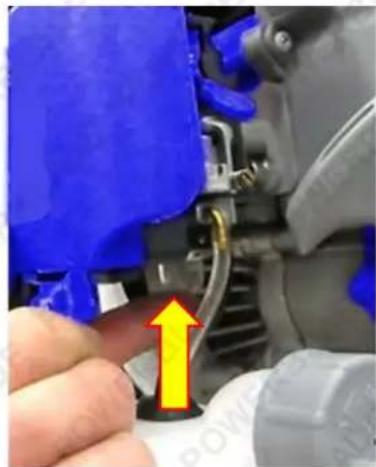
- Press the fuel primer bulb repeatedly until you feel resistance or pressure in the bulb – this indicates that it is full of fuel. Fuel may also be visible in the fuel intake tube.
natural_image
Close-up of a blue mechanical component with a yellow arrow pointing to a black circular component (no visible text or symbols)Operation
Before use, ensure that there are no electrical cables, gas, or water pipes etc or other buried or unseen hazards in the work area. Contact the applicable utility providers for assistance. • The machine should be operated on ground that is suitable for digging. Do not attempt to dig into set concrete, rock, tree roots, or other extremely hard surfaces. • Do not use the machine without an auger and bit attached. • Augers and auger tips are consumable parts and are not covered under warranty.
Before starting the engine, ensure that you have followed all procedures described in the Before Use Checklist. Failure to follow the checklist and carry out the procedures correctly may result in making the product warranty void. • Once the engine is running at sufficient speed, the clutch will engage and begin rotating the cutting attachment. • Do NOT start the engine with the machine cutting attachment touching any object. • If the engine is new or is being re-started after completely running out of fuel, it may be necessary to pull the starter cord several times for fuel to reach the carburettor.
Starting the Engine
-
Place the machine on a flat and level surface.
-
Press priming bulb until fuel is seen in tube.
-
Place engine ON/OFF switch in ON position.

natural_image
Close-up of a small electronic component with a yellow arrow pointing to its side (no visible text or symbols)
natural_image
Close-up of a mechanical component with a yellow arrow pointing to a specific area (no visible text or symbols)- Place choke in the ON ⊕ position.

- Gently pull starter until engaged, then pull rapidly. Repeat until engine starts.

natural_image
Close-up of a mechanical component with a yellow arrow pointing to a specific part (no visible text or symbols)- When the engine is warm, place the choke in the OFF position.

Stopping the Engine
To stop the engine, release the throttle and place the engine ON/OFF switch in the "OFF" or "STOP" position.
Environmental Considerations
Altitude – If the engine is being used in altitudes at or above 1500m (approximately 5000'), adjustments to the carburettor may be required. This is because there is less oxygen in the air as altitude increases, which effectively "enriches" the ratio of fuel to air going into the engine and the higher the altitude, the richer the fuel mixture becomes. If the engine is being permanently operated at high altitude, it is recommended to have an authorized service centre make the necessary carburettor adjustments. If the engine is used occasionally at altitude (not extreme altitudes), no adjustments should be required, however, a slight decrease in engine performance can be expected.
Post Hole Digger Operation
Before use, ensure that there are no electrical cables, gas, or water pipes etc. or other buried or unseen hazards in the work area. Contact the applicable utility providers for assistance. • The machine should be operated on ground that is suitable for digging. Do not attempt to dig into set concrete, rock, tree roots, or other extremely hard surfaces. • Do not use the machine without an auger and bit attached. • Augers and auger tips are consumable parts and are not covered under warranty.
The machine is used for "drilling" holes in the ground. For example, to erect fencing etc. The machine is designed for manual operation, where the operator both holds and controls it. Note the following:
- Adjust the throttle, which controls the drilling action, only when ready to begin digging the hole.
- Hold the machine as straight as possible when in use to ensure that holes are dug vertically.
- Always check the auger flutes, cutters, and bit before digging each hole. Sharpen or replace any worn or damaged components. Do not use if damaged in any way. Below is an example of the type of condition in which an auger is not to be used:

natural_image
Close-up of a hand using a tool to cut or sample a curved metallic object, no visible text or symbolsTo dig a hole:
- Start the machine and allow it to warm up.
- Position the machine in the required location, with the auger bit against the ground.
- Holding the machine firmly with both hands (or having an assistant help), use the throttle to activate the drilling action and dig the hole – once the auger starts to cut there is no need to push down on the machine. Adjust the throttle for the desired drilling rate.
- Release the throttle – this disengages the drilling action.
- Lift the machine and auger carefully from the hole.
Maintenance


Running combustion engines in confined areas CAN KILL IN MINUTES. Engine exhaust fumes contain carbon-monoxide – a deadly gas that you cannot smell or see. NEVER run a combustion engine in confined areas EVEN IF windows and doors are open. ONLY run combustion engines OUTDOORS and away from doors, windows, and vents. • Petrol / fuel / gasoline is extremely flammable – keep clear of naked flames or other ignition sources. •
Do not have the engine running during inspection and maintenance unless specifically required. • The engine should be cool enough to touch before performing maintenance activities. • Some maintenance activities may be beyond the scope of some users. Do NOT attempt procedures that you are not comfortable with, or do not have the necessary tools, experience, or knowledge for – take the unit to an authorised service centre or qualified technician for servicing. • Harsh operating environments such as extreme temperatures, dust etc may necessitate more frequent maintenance. • Failure to follow the maintenance schedule, using incorrect or non-compatible accessories or replacements parts, or general negligence may result in making the product warranty void.
ATTENTION: Surface corrosion will occur on metal surfaces over time and the rate of oxidation depends on factors such as proximity to the ocean and humidity or condensation of water vapour on metal surfaces. To mitigate this, WD40 can be used to remove surface corrosion then, when applied periodically, it will prevent rust from forming.
To keep the machine performing at optimal efficiency, regular checks and maintenance is required. The maintenance schedule below specifies preventative maintenance checks and necessary maintenance tasks and how often they should be performed. The schedule applies to multiple engines; some engines may not include some components, so maintenance on those components is not applicable.
Maintenance Schedule
Use the following maintenance schedule for a list of regular maintenance tasks and how often they need to be performed. Maintenance frequency is based on average usage. Be aware of how much the machine is used and be sure to follow the schedule according to time or usage, whichever comes first.
Towards the end of this document is a form you can use for maintenance record keeping. It is recommended that you keep a reference of all maintenance.
Major Servicing and "Heavy-Duty" Usage - For engines that are subject to "heavy-duty" use, which can be defined as being used under loads of 85% or more and / or in use more than approximately 300 hours per year (for example, generators and water pumps), more frequent "Major Service" maintenance is required. In addition to normal service requirements, and as with many smaller machine and off-road bike engines, the following parts (as applicable for petrol, diesel, or 2-stroke engines) may require replacement during a major service:
- Piston rings.
• Big-end bearings. - Small-end bearings.
• Gudgeon pin. - Oil rings.
- Gaskets and seals.
- Valve seats.
Inspection of the following items is required:
- Piston for cracks and stress fractures.
• Bore for wear requiring reconditioning.
• Full machine for broken, worn, or loose parts.
Failure to follow the maintenance schedule, using incorrect or non-compatible accessories or replacements parts, or general negligence may result in making the product warranty void.
Maintenance Schedule – 2-Stroke Engine / Machine
| Component / Task | Every Use | After First 5 Hours Use | 3 Months / 25 Hours Use | 6 Months / 50 Hours Use | 12 Months / 100 Hours Use | Major Service – Normal Use24 Months / 200 Hours Use | Major Service – Heavy-Duty Use Every 200 Hours Use |
| Loose Engine / Machine Fasteners | Check. Tighten as necessary | ||||||
| Air Filter | Check | Clean. Replace as necessary | Replace | ||||
| Spark Plug | Check | Replace | |||||
| Spark Arrestor * | |||||||
| Fuel Filter * | Clean. Replace as necessary | Replace | |||||
| Fuel Strainer * | Check | ||||||
| Float Bowl * | Clean | ||||||
| Fuel Lines / Hoses | Check | Replace as necessary | |||||
| Fuel Tank | Flush and clean | ||||||
| Idle Speed | Check. Adjust as necessary | ||||||
| Engine Tune | Check. Adjust as necessary | ||||||
| Cylinder Head Fasteners | Check. Tighten as necessary | ||||||
| Combustion Chamber | Check. Clean / de-coke as necessary | ||||||
| Major Service | Perform | ||||||
| Cutting Blade / Chain * | Check | Sharpen. Replace as necessary | |||||
| Chain Lubricant * | Check. Add as necessary. | ||||||
| Chain Lubricant Strainer * | Clean. Replace as necessary | ||||||
* Where applicable.
Maintenance /Check / Overhaul
It is recommended to regular check and maintenance based on frequency of use, keeping the tool in a better condition, and extending its useful life, ultimately reducing overall operating costs.
This specification will also protect you from serious harm.
Daily check
- Check whether all nuts and screws are tight or not.
- Check the fuel level. When filling new fuel, please wipe off the spill and clean the fuel tank.
- Check whether the belt of the transmission wheel is loose or aged and cracked or not.
Weekly Maintenance
- Check the starter, especially the wires and the springs.
- Check the outside of the sparking plug.
- Remove the sparking plug and check the electrode spacing. Adjust to 0.6MM or replace the sparking plug.
- Check the heat sink on the cylinder and check whether the air inlet of the starter is blocked or not.
- Check the air filter.
Monthly Maintenance
- Flush the fuel tank with gasoline.
- Clean the outside of the carburettor and its surroundings.
- Clean the fan and its surroundings.
Carburettor Adjustments
- The carburettor on the equipment has been adjusted at the factory but may need to be fine-tuned according to working conditions. To adjustments after the end sleeve has been removed. Before adjusting the carburettor, make sure that the air/fuel filter supplied is clean, fresh, and that the fuel has been properly mixed. To adjust after the engine has been warmed up for a few minutes. - When the idle speed is higher or lower, adjust it to the appropriate speed with the idle speed adjustment screw.
- Rotate clockwise to get a higher idle speed.
- Rotate counterclockwise to get a lower idle speed.
- If adjustable, L adjustment screw (low speed fuel adjustment) and (high speed fuel adjustment.)
- In the case of idling, turn the L adjustment screw to the right or left to find the peak value of the idling speed. From the position, return the adjustment screw to the remaining 1/4 circle.
- Turn the H adjusting screw to the right or left and follow the same procedure as the above L adjusting screw.
- The carburettor has pre-selected at the factory. Fine tuning based on climate, altitude, etc. can optimize performance. The increment of the adjustment screw must not be greater than 90 degrees, otherwise it will result in damage to the engine due to incorrect adjustment.
• If you are not familiar with the adjustment assistance, please consult your local dealer.
Spark Plug Maintenance
- To remove the spark plug, connect the high-pressure pack, and pull the starter to touch the cylinder parts has ignition spark or not.
WARNING! Do not touch the area that mounting thread of the sparking plug, because it may cause a hazard to residual gases. When pulling the recoil starter handle, do not touch the metal part of the spark plug, otherwise it will cause an electric shock. After wiping the fuel in the spark zone, make sure there is no fire and check the spark plug.

natural_image
Illustration of hands holding a screwdriver with a coiled cable (no text or symbols visible)• Under normal conditions, sparks can be seen.
• Use the recommended type of spark plug.
- Under optimal operating conditions, the electrodes on the spark plug show a dark brown colour and remain dry. If the spark plug is dirty, clean it and check the electrode spacing. If you need to adjust again, please note that the correct spacing is 0.6mm.
• The state of the spark plug is affected by the following factors:
– The settings of carburettor are incorrect.
- The mix ratio of fuel is incorrect (two-stroke oil in gasoline is too much)
- The air filter is dirty.
- Operating conditions are difficult (in cold weather conditions).
- After working for 100 hours, or in the case of a etched electrode, the spark plug should be replaced.
Air Filter Maintenance
When the air filter absorbs dust and becomes dirty, it will produce all kinds of malfunctions.
• The carburettor has failed.
- Starter has fault.
• Engine power is declining.
• Engine component has unnecessary wear.
• Fuel consumption is abnormal.
To clean the air filter:
Dust and dirt must be cleaned regularly, and the damaged filter should be replaced.
- Remove the air filter cover and filter.
- Rinse with warm soapy water and wring out before reinstalling.
- The broken filter must be replaced with a new one.
Fuel Filter
If the impurities in the fuel block the fuel filter, the fuel cannot flow into the oil.
Silencer
The power decline of engine may be due to a large amount of carbon accumulating in the cylinder exhaust port, muffler inlet or outlet after long-term use.
- After working for 100 hours, remove the silencer and clean the excess carbon from the exhaust or muffler inlet.
- When cleaning, carefully remove carbon, do not damage the pistons, cylinders, and do not allow carbon to enter the crankcase.
Storage
- Clean the parts and apply two-stroke oil to the metal parts to prevent corrosion.
- If the tool is stored for a long time (more than 3 weeks), the fuel shall be discharged from the fuel tank, and make engine to idling without load until the engine stops operating, and to empty all residual fuel in the carburettor.
- remove the spark plug, pour the two-stroke oil into the cylinder, and pull the handle of the recoil starter multiple times to inject the oil.
- Stop pulling the recoil starter handle when the component is sensed to engage.
- If the parts are damaged before storage, should be repaired at first.
- The tool storage area should be free of dust and moisture, and the temperature should be lower than 50 °C.
- Tools should be kept in a place where children cannot enter.
- The fuel should be stored in a safe container and placed in a cool room or in a place where there is no fire. Do not use old fuels that can cause engine failure.
Troubleshooting

Running combustion engines in confined areas CAN KILL IN MINUTES. Engine exhaust fumes contain carbon-monoxide – a deadly gas that you cannot smell or see. NEVER run a combustion engine in confined areas EVEN IF windows and doors are open. ONLY run combustion engines OUTDOORS and away from doors, windows, and vents. Petrol/fuel/gasoline is extremely flammable – keep clear of naked flames or other ignition
sources. • Do not have the engine running during inspection and maintenance unless specifically required. • The engine should be cool enough to touch before performing maintenance activities. • Some maintenance activities may be beyond the scope of some users. Do NOT attempt procedures that you are not comfortable with, or do not have the necessary tools, experience, or knowledge for – take the unit to an authorised service centre or qualified technician for servicing.
The following information may assist in identifying a problem and rectifying it.
| PROBLEM | POSSIBLE REASONS | CORRETIVE MEASURES |
| Engine does not start | Fuel system:■ Fuel shortage■ The sparking plug to be wet due to over fuel■ The fuel pipe is bent or disconnected.■ The carburettor function is defective. | Fill with fuel that have 25 gasoline / 1 two-stroke oil.1. Remove the spark plug.2. Exhaust excess fuel by pulling the recoil starter handle 5-6 times.3. Re-install the spark plug.4. Pull the throttle switch to the open position and pull the recoil starter handle.■ Repair the carburettor air leak.■ The adjustment of carburettor is incorrect.■ The diaphragm in the carburettor is broken.■ The weight adjustment of the carburettor valve hinge is incorrect. |
| Electrical System:■ The ignition stop switch is in the stop position.■ No sparks.■ Stop shape lead is short circuit.■ The plug is dirty.■ The sparking plug has a large gap.■ Poor connection between the high voltage cable and the ignition sparking plug.■ The ignition coil is broken. | ■ Turn to the open position.■ The connection / ignition coil is defective.■ The air gap/ignition line is defective.■ The ignition coil is defective.■ Repair or replace.■ Clean or replace.■ Adjust to the correct gap.■ Correct the connection.■ Replace. | |
| Engine stops running shortly after installation | Fuel system:■ Fuel shortage.■ The throttle lever is in the closed position.■ Air enters the fuel system.■ The carburettor function is defective. | Fill with fuel that have 25 gasoline / 1 two-stroke oil.■ turn to open position.■ Check whether the tube or connector has cracks or not and whether the tube is secured or not.■ The carburettor has air leaks.■ The adjustment of carburettor is incorrect.■ The diaphragm in the carburettor is broken.■ The weight adjustment of the carburettor valve hinge is incorrect. |
| Electrical System:■ Sparking plugs is defective.■ Ignition coil is defective. | ■ Replace.■ Replace. | |
| Engine overheats | ■ Mixing ratio is incorrect.■ Wrong choice of sparking plugs.■ Cylinders have debris/dirt in them.■ Cooling ducts have debris/dirt in them. | ■ Fill with fuel that have 25 gasoline / 1 two-stroke oil.Replace. Use only the pure and specified parts.■ Clean.■ Clean. |
Specifications
| Engine Type 2-Stroke | |
| Engine Displacement 52cc | |
| Fuel Tank Capacity 1.1L | |
| Mixed fuel ratio 25:1 | |
| Fuel Type | Petrol Regular Unleaded 95+ RON |
| Max Power 2.5HP | |
| Reduction Ratio 40:1 | |
| Auger mount shaft | 3/4" |
| Torque 80 Nm | |
| Auger Dimensions | 100mm, 150mm, 250mm (diameter), 800mm (length) |
| Extension Shaft Length 600mm | |

Some experts believe that the incorrect or prolonged use of almost any product may cause serious injury or death. To help reduce your risk of serious injury or death, refer to the information below. For more information, see www.datastreamserver.com/safety
- Consult all documentation, packaging, and product labelling before use. Note that some products feature documentation available online. It is recommended to print and retain the documentation.
■ Before each use, check the product for loose/broken/damaged/missing parts, wear, or leaks (if applicable). Never use a product with loose/broken/damaged/missing parts, wear, or leaks.
■ Products must be inspected and serviced (if applicable) by a qualified technician every 6 months. This is based on average residential use by persons of average size and strength, and on a property of average metropolitan size. Use beyond these recommendations may require more frequent inspections/servicing.
■ Ensure that all users of the product have completed a suitable industry recognised training course before being allowed access to the product.
The product has been supplied by a general merchandise retailer that may not be familiar with your specific application or description of application. Be sure to attain third-party approval from a qualified specialist for your application before use, regardless of any assurances from the retailer or its representatives.
This product is not intended for use where fail-safe operation is required. As with any product (for example, automobile, computer, toaster), there is the possibility of technical issues that may require the repair or replacement of parts, or the product itself. If the possibility of such failure and the associated time it may take to rectify could in any way inconvenience the user, business, or employee, or financially affect the user, business, or employee, then the product is not suitable for your requirements. This product is not intended for use where incorrect operation or a failure of any kind, including but not limited to, a condition requiring product return, replacement, parts replacement, or service by a technician may cause financial loss, loss of employee time or an inconvenience requiring compensation.
If this product has been purchased in error when considering the information presented here, contact the retailer directly for details of their returns policy, if required.

edisons
.com.au
©2023 PowerBlade. All rights reserved. No part of this document, including descriptive content, concepts, ideas, diagrams, or images may be reproduced or transmitted in any form or by any means, electronic or mechanical, including photocopying, scanning, or recording, or any information storage and retrieval system, without express permission or consent from the publisher.


- PD950 2-Stroke Post Hole Digger
- User Manual
- Safety
- General Work Area Safety
- General Personal Safety
- General Fuel Safety
- General Carbon-Monoxide Safety
- General Equipment Use and Care
- General Electrical Safety
- General Service Information
- Child Choking Hazard!
- Product Safety
- Personal Safety
- Tool Safety
- Fuel Safety
- Maintenance Safety
- Transportation and storage
- DANGER
- Safety Symbols
- Table of Contents
- Safety 2
- Parts Identification 9
- Equipment Safety 10
- Before Use....12
- Assembly....12
- Operation....15
- Maintenance....17
- Troubleshooting 22
- Specifications 24
- Parts Identification
- Equipment Safety
- Operator
- Clothing and Protective Equipment – All Operators and Assistants
- Work Area Safety
- Operational Safety
- Transportation Safety
- Before Use
- IMPORTANT! BEFORE EVERY USE:
- Assembly
- Engine Oil
- Auger
- Air Filter
- Fuel
- Adequately fill the fuel tank with the correct fuel type.
- Priming the Fuel System
- Operation
- Starting the Engine
- Stopping the Engine
- Environmental Considerations
- Post Hole Digger Operation
- To dig a hole:
- Maintenance
- Maintenance Schedule
- Maintenance /Check / Overhaul
- Daily check
- Weekly Maintenance
- Monthly Maintenance
- Carburettor Adjustments
- Spark Plug Maintenance
- Air Filter Maintenance
- To clean the air filter:
- Fuel Filter
- Silencer
- Storage
- Troubleshooting
- Some experts believe that the incorrect or prolonged use of almost any product may cause serious injury or death. To help reduce your risk of serious injury or death, refer to the information below. For more information, see www.datastreamserver.com/safety
- edisons
Brand : Powerblade
Model : PD950
Category : Drill