
HYSC-4000M - Battery charger HYUNDAI - Free user manual and instructions
Find the device manual for free HYSC-4000M HYUNDAI in PDF.


| Product Type | Battery Charger |
| Brand | Hyundai |
| Model | HYSC-4000M |
| Input Voltage | 220-240 V AC, 50/60 Hz |
| Output Voltage | 12V / 24V (selectable) |
| Output Current | 4 A (max) |
| Battery Types | Lead-acid (Wet, Gel, AGM) |
| Charging Stages | Bulk, Absorption, Float |
| Protection Features | Reverse polarity, short circuit, overheat, overcharge |
| Dimensions (approx.) | 200 x 100 x 60 mm |
| Weight (approx.) | 1.2 kg |
| Display | LED indicators for power, charging status, fault |
| Operating Temperature | -10°C to 40°C |
| Cable Length | 1.5 m (input), 1.0 m (output) |
| Certifications | CE, RoHS |
| Maintenance | Wipe with dry cloth; keep vents clean |
| Spare Parts Availability | Fuses and cables available from service centers |
| Repairability | Repairable by qualified technicians |
Frequently Asked Questions - HYSC-4000M HYUNDAI
User questions about HYSC-4000M HYUNDAI
0 question about this device. Answer the ones you know or ask your own.
Ask a new question about this device
Download the instructions for your Battery charger in PDF format for free! Find your manual HYSC-4000M - HYUNDAI and take your electronic device back in hand. On this page are published all the documents necessary for the use of your device. HYSC-4000M by HYUNDAI.
USER MANUAL HYSC-4000M HYUNDAI
Please read and understand all important safety and operating instructions before using this charger. In addition, please read and follow all battery and vehicle manufacturer's instructions and cautionary markings.
HYSC-4000M
natural_image
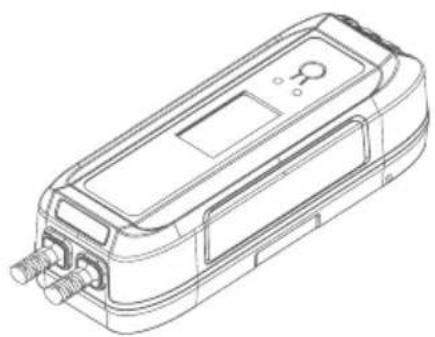
Line drawing of a rectangular electronic device with ports and a display panel (no text or symbols)We are still constantly improving this smart battery charger, therefore, some parts of this smart battery charger may be changed in order to achieve the better quality, but the main functions and operations will not be alternated and changed. Your understanding would be greatly appreciated.
Table of Contents
SAFETY 2
CONNECTING TO THE BATTERY 3
ABOUT HYSC-4000M 4
CHARGING MODES 6
CHARGING STEPS 7
BATTERY LEVEL INDICATOR 8
CHARGING TIME 8
1. SAFETY
SAFETY PRECAUTIONS FOR WORKING IN THE VICINITY OF A BATTERY
1) Batteries generate explosive gases during normal operation. Use in well-ventilated area.
2) Consider having someone close enough or within the range of your voice to come to your aid when you work near a battery.
3) Do NOT smoke, strike a match, or cause a spark in vicinity of battery or engine. Avoid explosive gas, flames and sparks.
4) Remove all personal jewelry, such as rings, bracelets, necklaces, and watches while working with a vehicle battery. These items may produce a short-circuit that could cause severe burns.
5) Be extra cautious to reduce risk of dropping a metal tool onto the battery. It might spark or short-circuit a battery or other electrical hardware which may cause an explosion or fire.
6) Wear complete eye protection, hand and clothing protection. Avoid touching eyes while working near a battery.
7) Study all battery manufacturer's specific precautions such as removing or not removing cell caps while charging and recommended rates of charge.
8) Clean battery terminals before connected with the charger. Be careful to keep corrosion from coming in contact with eyes.
9) When it is necessary to remove a battery from vehicle to charge, always remove grounded terminal from battery first. Make sure all accessories in the vehicle are off in order to prevent an arc.
10) It is NOT intended to supply power to an extra-low-voltage electrical system or to charge dry-cell batteries. Charging dry-cell batteries may burst and cause injury to persons and property.
11) NEVER charge a frozen, damaged, leaking or non-rechargeable battery.
12) If battery electrolyte contacts skin or clothing, wash immediately with soap and water. If electrolyte enters eye, immediately flood eye with running clean cold water for at least 15 minutes and get medical attention immediately.
SAFETY PRECAUTIONS FOR USING THE CHARGER
1) Do NOT place the charger in the engine compartment or near moving parts or near the battery; place as far away from them as DC cable permits. NEVER place a charger directly above a battery being charged; gases or fluids from battery will corrode and damage charger.
2) Do NOT cover the charger while charging.
3) Do NOT expose to rain or wet conditions.
4) Connect and disconnect DC output only after setting AC cord from electric outlet.
5) Use of an attachment not recommended or sold by the manufacturer may result in a risk of fire, electric shock or injury to persons.
6) Do not overcharge batteries by selecting the wrong charge mode.
7) To reduce the risk of damage to electric plug and cord, pull by the plug rather than the cord when disconnecting charger.
8) To reduce risk of electric shock, unplug charger from outlet before attempting any maintenance or cleaning.
9) Operate with caution if the charger has received direct hit of force or been dropped. Have it checked and repaired if damaged.
10) Any repair must be carried out by the manufacturer or an authorized repair agent in order to avoid danger.
2. CONNECTING TO THE BATTERY
1) Identify polarity of battery posts. The positive battery terminal is typically marked by these letters or symbol (POS,P,+). The negative battery terminal is typically marked by these letters or symbol (NEG,N,-).
2) Do not make any connections to the carburetor, fuel lines, or thin metal parts.
3) Identify if you have a negative or positive grounded vehicle. This can be done by identifying which battery post (NEG or POS) is connected to the chassis.
4) For a negative grounded vehicle (most common): connect the RED POSITIVE battery clamp first to the positive battery terminal, then connect the BLACK NEGATIVE battery clamp to the negative battery terminal or vehicle chassis.
5) For a positive grounded vehicle (very uncommon): connect the BLACK NEGATIVE battery clamp first to the negative battery terminal, then connect the RED POSITIVE battery clamp to the positive battery terminal or vehicle chassis.
6) When disconnecting, disconnect in the reverse sequence, removing the negative first (or positive first for positive ground systems).
A NOTICE: If battery clamps are reversely connected to battery terminals, the ERROR LED will be on. Exchange the battery clamps to solve this problem.
3. ABOUT HYSC-4000M
1) The HYSC-4000M is designed for charging all types of 6V lead-acid and 12V lead-acid batteries, including WET (Flooded), MF (Maintenance-Free), EFB (Enhanced Flooded Battery), GEL, AGM (Absorbed Glass Mat) batteries. It is suitable for charging battery capacities from 1.2 to 130 Amp-Hours and maintaining all battery sizes.
2) Built-in intelligent microprocessor makes charging faster, easier and safer.
3) This charger has safety features, including spark proof, protection for reverse polarity, short circuit, overheat and overcharge.
4) It has auto-memory, which returns to last selected mode when restarted (except Repair Modes).
5) When the battery level indicator bars are flashing, it is on charging; when 5 bars are solid, the charging is completed. But do NOT break the connection immediately. It will automatically switches from full charge to maintenance status without overcharging or damaging the battery.
6) Following is the charger's technical specification:
AC Input AC 220\~240V, 50/60Hz, 70W Max
DC Output DC 6V 4A, DC 12V 4A
Power (IN) Variable Power, 70W Max
Efficiency 85% Approx
Back Current Drain <5mA
Ambient Temperature 0°C \~ +40°C
Charger Type 8 steps, Full-automatic Charging Cycle
Battery Type All Types of 6V and 12V Lead-acid Batteries
Battery Capacity 1.2-130Ah (12V), 1.2-130Ah (6V), Maintains All Battery Sizes
Housing Protection IP54
Accessories Included Cable Clamps
Other Features
Norm / Cold Mode, and 8-hour Repair Process if battery voltage is too low (only for 12V Mode)
8) LCD Icons:
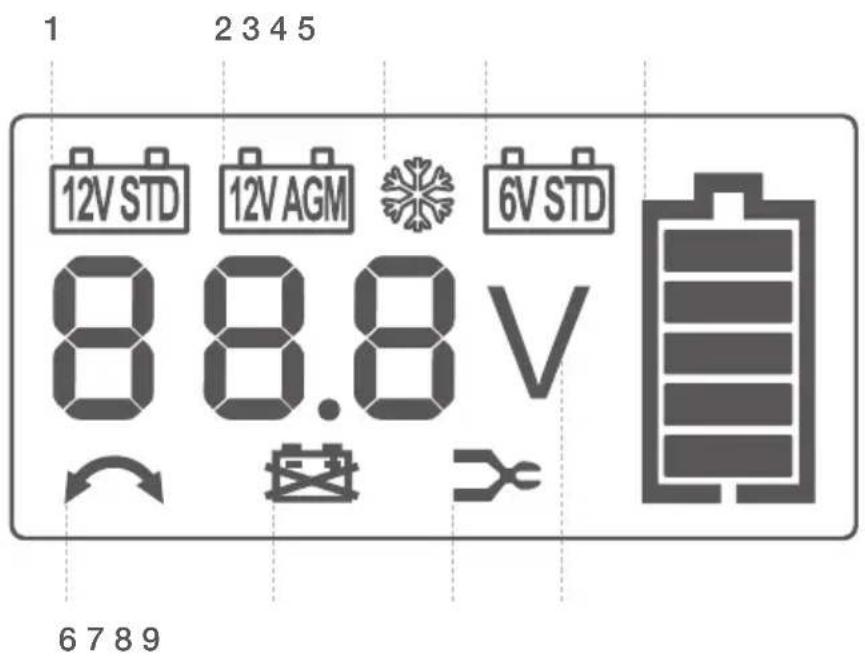
1) 12V STD Mode
2) 12V AGM Mode
3) COLD Mode
4) 6V STD Mode
5) Battery Level Indicator
6) Reverse Polarity Connection Indicator
7) Faulty Battery Indicator
8) Clamp Indicator (Open-circuit / Dirty battery posts / Dead battery / Output Short Circuit)
9) Battery Voltage Indicator (press & hold Mode button for 3 seconds to display the battery's voltage)
4. CHARGING MODES
HYSC-4000M has ten modes: Standby, 12V STD, 12V COLD, 12V AGM, 12V AGM+COLD, 6V STD, 12V STD Repair, 12V COLD Repair, 12V AGM Repair and 12V AGM+COLD Repair. Do not operate the charger until you confirm the appropriate charge mode for your battery.
CAUTION: If you choose 12V Mode(s) for 6V battery, the 6V battery will be damaged!
| Mode Icon Display Battery Size(Ah) Explanation | |||
| Standby - - | Not charging or providing any power (LCD screen turns black and Green LED is on) | ||
 | Keep on 1.2-130 Charging 12V WET/GEL/MF/EFB batteries | ||
 | Keep on 1.2-130 | Charging 12V WET/GEL/MF/EFB batteries below 10°C (50°F) | |
 | Keep on 1.2-130 Charging 12V AGM batteries | ||
 | Keep on 1.2-130 Charging 12V AGM batteries below 10°C (50°F) | ||
 | Keep on 1.2-130 Charging 6V WET/GEL/MF/EFB/AGM batteries | ||
 | Flash 1.2-130 Repairing 12V STD batteries | ||
 | Flash 1.2-130 Repairing 12V STD battery below 10°C (50°F) | ||
 | Flash 1.2-130 | Repairing 12V AGM batteries | |
 | Flash 1.2-130 Repairing 12V AGM batteries below 10°C (50°F) | ||
Using 12V REPAIR
This mode is for LEAD-ACID batteries only. It is an advanced battery recovery mode for repairing old, idle, stratified or sulfated batteries. NOT all batteries can be recovered. For optimal results, take the battery through a full charge cycle, bringing the battery to full charge, before using this mode. When this mode is chosen, do remember press Mode button for choosing appropriate 12V Mode(s). One REPAIR cycle can take up to eight (8) hours to complete the recovery process and will enter to charge (8 steps charging cycle) when completed. This mode uses a high charging voltage and may cause some water loss in WET
(flooded) cell batteries. Plus, some batteries and electronics may be sensitive to high charging voltages. To minimize risks, disconnect the battery from the vehicle before using this mode.
5. CHARGING STEPS
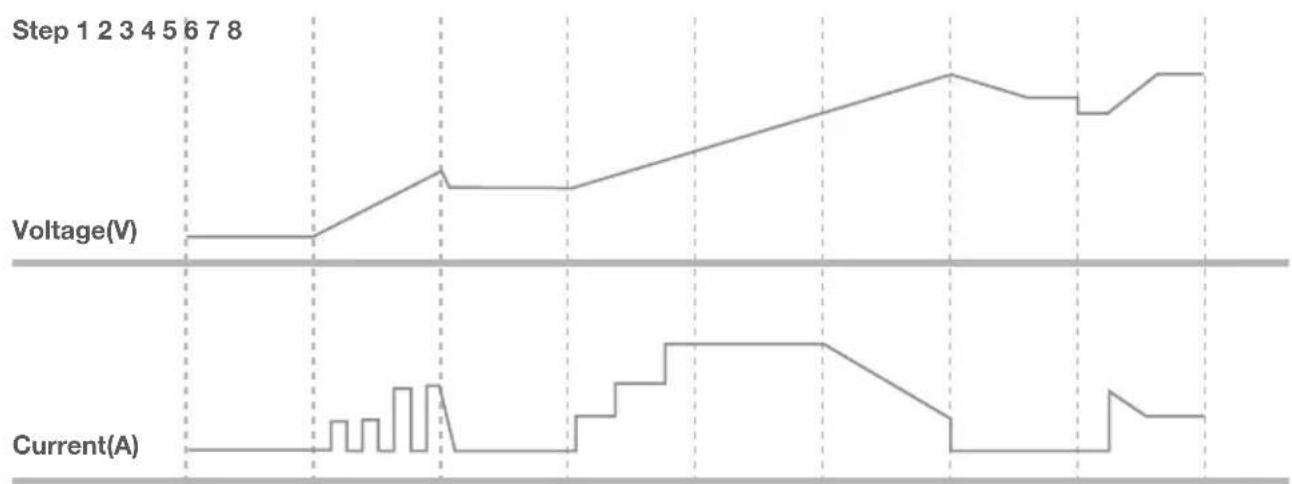
line
| Step | Voltage(V) | Current(A) | |------|------------|------------| | 1 | 0 | 0 | | 2 | 0 | 0 | | 3 | 0 | 0 | | 4 | 0 | 0 | | 5 | 0 | 0 | | 6 | 0 | 0 | | 7 | 0 | 0 | | 8 | 0 | 0 |STEP 1: DIAGNOSIS (Check if battery has connected with the charger and also check battery voltage)
STEP 2: DESULPHATION (If battery voltage is too low, programs automatically generate pulsing current to remove sulphate, up to 5 hours)
STEP 3: ANALYSE (Check if the battery voltage reaches to the threshold after desulphation, and charging begins if the battery voltage is OK)
STEP 4: SOFT START (Charge with echelon constant current)
STEP 5: BULK (Charge with constant maximum current until battery voltage is reached to the threshold)
STEP 6: ABSORPTION (Provide gradually declining current charge for maximum battery voltage)
STEP 7: ANALYSE (Test if the battery can hold charge) STEP 8: MAINTENANCE (Continuously monitor the battery, and charging current will intelligently adapt to the variable battery voltage).
STEP 8: MAINTENANCE (Continuously monitor the battery, and charging current will intelligently adapt to the variable battery voltage).
6. BATTERY LEVEL INDICATOR
Display Explanation
 | 20% | The 20% bar will slowly flash when the battery level is less than 20%.When 20% is reached, the bar will be solid. |
 | 40% | The 40% bar will slowly flash when the battery level is less than 40%.When 40% is reached, the bar will be solid. |
 | 60% | The 60% bar will slowly flash when the battery level is less than 60%.When 60% is reached, the bar will be solid. |
 | 80% | The 80% bar will slowly flash when the battery level is less than 80%.When 80% is reached, the bar will be solid |
 | 100% | The 100% bar will slowly flash when the battery level is less than 100%. When 100% is reached, the bar will be solid. Meanwhile the maintenance charging is activated. |
7. CHARGING TIME
Different battery capacity and residual voltage would affect the charging time. Following data is only for reference. (when discharge 12V lead-acid battery to 9V, with 5A discharge current.)
| Battery Size/Ah Approx. Time to Charge in Hours (12V) | |
| 20 5H @ 14.4V 7H @ 14.7V | |
| 40 8H @ 14.6V 11H @ 14.9V | |
| 60 9H @ 14.4V 12H @ 14.7V | |
| 75 14H @ 14.5V 17H @ 14.7V | |
| 100 16H @ 14.4V 20H @ 14.7V | |
EC Declaration of Conformity

2018
We :
HYUNDAI Corporation
25, Yulgok-ro 2-gil, Jongno-gu, Seoul 03143 Korea
Declare that the product detailed below :
BATTERY CHARGER FOR LEAD ACCUMULATOR
MODEL : HYSC-4000M
Satisfies the requirements of the Council Directives :
EMC directive 2014/30/EU
Low Voltage Directive 2014/35/EU
RoHS Directive 2011/65/EU
and conform with the norms :
EN 55014-1:2006/+A1:2009/+A2:2011
EN 55014-2:2015
EN 61000-3-2:2014
EN 61000-3-3:2013
EN 60335-2-29:2004 + A2:2010
EN 60335-1:2012 + A11:2014
EN 62233:2008
General Manager

Project Manager

natural_image
Abstract line drawing with curved strokes and a small circular mark (no text or symbols)Date: 2018.08.01
Yoonsung Lee
Donghoon Park
HYUNDAI Corporation
25, Yulgok-ro 2-gil, Jongno-gu,
Seoul 03143, Korea,
Post Code: 03143
+ 82 2 390 1114
www.hyundaicorp.com
Copyright HYUNDAI Corporation All rights reserved.
Made in P.R.C
Brand : HYUNDAI
Model : HYSC-4000M
Category : Battery charger