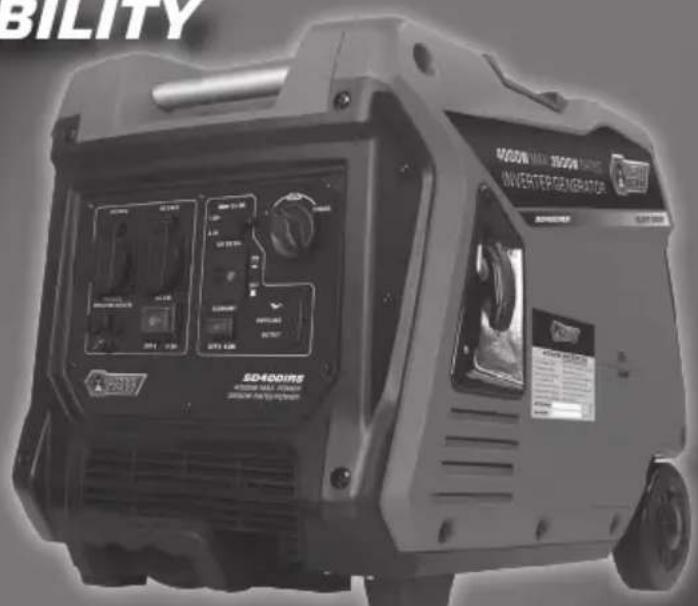
USER MANUAL SD4000IRS Full Boar
INVERTER GENERATOR
• 4000W MAX. POWER
• 3500W RUNNING WATTS
• 2 X 240V 15A POWER OUTLETS
• PARALLEL CAPABILITY
- USB PORT
INSTRUCTION MANUAL
WARNING: Read all safety warnings and all instructions. Failure to follow the warnings and instructions may result in electric shock, fire and/or serious injury. Save all warnings and instructions for future reference.
SPECIFICATIONS - MODEL NO. SD4000IRS
ENGINE
Motor type: 4-stroke, OHV, 1-cylinder
Displacement: 224 cm ^3
Engine speed: 3100/min ^4 ( ECON switch is off)
Ignition system: C.D.1
Oil capacity: 600 ml
Fuel tank capacity: 12 litres
Fuel type: 91 RON Unleaded Petrol
Spark plug: Torch F7RTC or Champion N9YC
Noise level rating (7m): 65dB@50% load
GENERATOR
AC Output: 240V
50Hz
14.6 Amp
3500W Rated
4000W Max.
DC Output: 12V, 8.0 Amp
USB Output: 5V, 1.0 Amp/2.1 Amp
L x W x H: 745 x 540 x 610 mm
Net weight: 48 kg
Gross weight: 50 kg
KNOW YOUR PRODUCT
- Fuel cap
- Spark plug socket
- Control panel
- Recoil starter
- Engine control switch (OFF/RUN/CHOKE)
- Routine maintenance cover
- Oil access cover
- AC sockets
- Funnel
- Overload indicator LED
- Output indicator LED
- Oil alert indicator LED
-
Economy throttle switch
-
DC socket
- DC circuit breaker reset
- USB port
- Convertible screwdriver
- Charging cable and clamp set
- Engine oil bottle
- Spark plug (spare)
- Ground terminal (earth)
- AC switch
- Parallel outlet
- Telescopic handle
- Carry handle x 2
- Exhaust panel
KNOW YOUR PRODUCT (cont.)
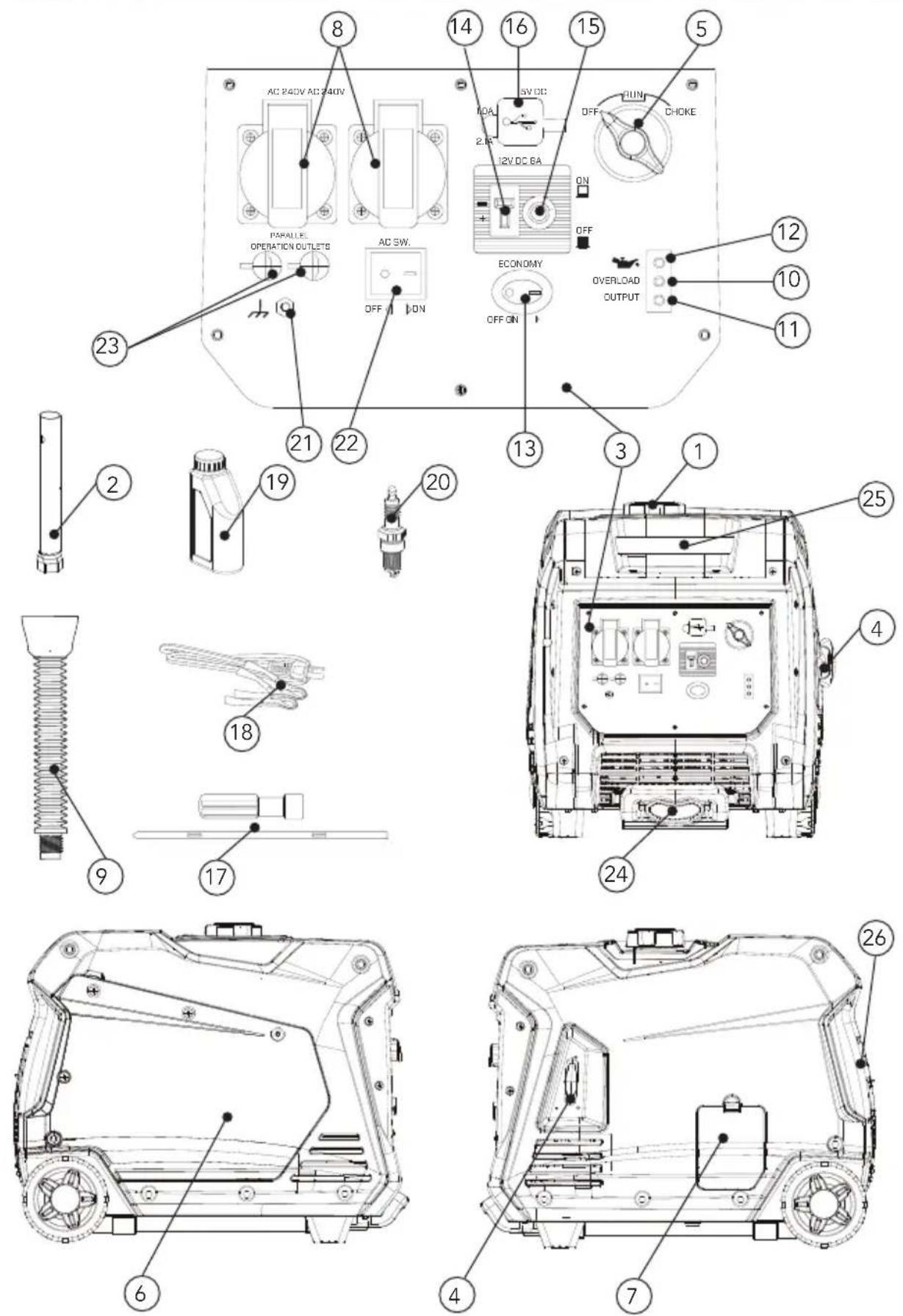
TABLE OF CONTENTS
SPECIFICATIONS...... Page 02
KNOW YOUR PRODUCT...... Page 02
INTRODUCTION...... Page 05
SAFETY INSTRUCTIONS...... Page 05
EXPLANATION OF RISKS Page 08
PRE-OPERATION CHECK...... Page 12
OPERATION...... Page 14
MAINTENANCE...... Page 20
TRANSPORTING & STORAGE Page 23
TROUBLE SHOOTING Page 24
DESCRIPTION OF SYMBOLS...... Page 25
CONTENTS...... Page 27
WARRANTY...... Page 28
INTRODUCTION
Congratulations on purchasing a Full Boar Digital Inverter Generator.
Your Full Boar Digital Inverter Generator SD4000irs has been designed to give regulated electricity for a continuous, uninterrupted power supply. Inverter technology provides a suitable power source for camping applications, outdoor lights, sound systems, televisions, microwaves and power tools.
Read and understand the Instruction Manual before operating the generator. Failure to do so could result in personal injury or equipment damage.
SAFETY INSTRUCTIONS

WARNING! When using this equipment, basic safety precautions, including the following, should always be followed to reduce risk of fire, electric shock, personal injury and material damage.
Read and understand the manual prior to operating this tool.
Save these instructions and other documents supplied with this tool for future reference.
ELECTRICAL SAFETY
The petrol generator has been designed to output 240V only. Always check that the power supply corresponds to the voltage on the rating plate.
Note: The supply of 230V and 240V on Full Boar tools are interchangeable for Australia and New Zealand.
Using an Extension Lead
Always use an approved extension lead suitable for the power output from this generator. Before use, inspect the extension lead for signs of damage, wear and ageing. Replace the extension lead if damaged or defective. When using an extension lead on a reel, always unwind the lead completely. Use of an extension lead not suitable for the power input of the tool or which is damaged or defective may result in a risk of fire and electric shock.

IMPORTANT! When using the equipment, a few safety precautions must be observed to avoid injuries and damage. Please read the complete operating manual with due care. Keep this manual in a safe place so that the information is available at all times. If you give the equipment to any other person, give them these operating instructions as well.
We cannot accept any liability for damage or accidents which arise due to a failure to follow these instructions and the safety information.
- The generator is designed to give safe and dependable service if operated according to instructions.
- Read and understand the Owner's Manual before operating the generator. Failure to do so could result in personal injury or equipment damage.
- Gasoline is extremely flammable and explosive under certain conditions. Refuel in a well ventilated area with the engine stopped.
- Keep away from cigarette, smoke and sparks when re-fuelling the generator. Always refuel in a well ventilated location.
- Prevent the spilling of fuel as this may also ignite with the hot motor. Wipe up spilled gasoline at once. Never refuel whilst the engine running.
- Connections for standby power to a building's electrical system must be made by a qualified electrician and must comply with all applicable laws and electrical codes. Improper connections can allow electrical current from the generator to back feed into the utility lines. Such back feed may electrocute utility company workers or others who contact the lines during a power outage, and when utility power is restored, the generator may explode, burn, or cause fires in the building's electrical system.
- Store the generator in a dry area away from inflammable liquids.
- Always make a pre-operation inspection before you start the engine. You may prevent an accident or equipment damage.
- Place the generator at least 1m (3ft) away from buildings or other equipment during operation. ALWAYS operate generator a minimum of 2 meters from any conductive surface eg. metals.
- Persons who are fitted with a heart pacemaker, or similar medical conditions should take care when using this device. Even the extra low voltage of the Battery charging output should not be handled by a person with medical conditions as or similar to the above.
- Operate the generator on a level surface. If the generator is tilted, fuel spillage may result.
- Do not operate in a hazardous location. Such areas include where there is a risk of explosion of petrol fumes, leaking gas or explosive dust.
- Know how to stop the generator quickly and understand operation of all the controls. Never permit anyone to operate the generator without proper instructions.
- Keep children and pets away from the generator when it is in operation.
- Keep away from rotating parts while the generator is running.
- The generator is a potential source of electrical shocks when misused; do not operate with wet hands.
SAFETY WARNINGS FOR GENERATORS (cont.)
- Your power tool should only be passed on with these instructions.
- Children should be supervised to ensure they do not play with the appliance.

WARNING! Do not parallel connect other cables to receptacles, use special jack, or it may cause an electrical shock.

WARNING! The muffler becomes very hot during operating and remains hot for a while after stopping the engine. Be careful not to touch the muffler while it is hot. Let the engine cool before storing the generator indoors.

WARNING! Exhaust contains poisonous carbon monoxide. Do not operate generator in confined area. Be sure to operate the generator in a well-ventilated environment or with an aerator. Using a generator indoors will kill you in minutes. Never use in the home or in a partly enclosed area such as garages. Only use outdoors and far from open windows doors and vents.

WARNING! The output of this generating set is potentially lethal. The set should not be connected to a fixed electrical installation except by an appropriately licensed person.

WARNING! The inverter generator is supplied with a grounding terminal (21) that may reduce the risk of electrocution in certain applications. Always consult a qualified electrician before connecting the grounding terminal or when using the generator for applications other than direct connection of appliances (such as connection to a caravan).

WARNING! When using extension leads, avoid long extensions and possible dangers to leads by pedestrian or vehicular traffic.

WARNING! Maintain normal safety precautions with appliances and accessories as for use on normal household 240V supply.
RISK OF ELECTROCUTION AND FIRE
| Hazard What could | happen How to prevent it | |
| Improper storage of extension cord. | Extension cord can come into contact with hot engine parts resulting in damage. Using a damaged extension cord can result in electrocution or death. | Remove extension cord from the generator and store separately away from generator. |
| Operation of generator in heavy rain, wet, icy, or flooded conditions. | Water is an excellent conductor of electricity! Water which comes in contact with electrically charged components can transmit electricity to the frame and other surfaces, resulting in electrical shock to anyone contacting them. | Operate generator in a clean, dry, well ventilated area. Make sure hands are dry before touching unit. |
| Placing generator on or against highly conductive surface, such as a steel walkway or metal roof. | Accidental leakage of electrical current could charge conductive surfaces in contact with the generator. | Place generator on low conductivity surface such as a concrete slab.ALWAYS operate generator a minimum of 2 meters from any conductive surface. |
| Operation of unit when damaged, or with guards or panels removed. | Attempting to use the unit when it has been damaged, or when it is not functioning normally could result in fire or electrocution.Removal of guarding could expose electrically charged components and result in electrocution. | Do not operate generator with mechanical or electrical problem. Have unit repaired by an Authorized Service Centre.Do not operate generator with protective guarding removed. |
| Attempting to fill the fuel tank while the engine is running | Fuel and fuel vapours can become ignited by coming in contact with hot components such as the muffler, engine exhaust gases, or from an electrical spark. | Turn engine off and allow it to cool before adding fuel to the tank. Equip area of operation with a fire extinguisher certified to handle fuel fires. |
| Sparks, fire, hot objects | Cigarettes, sparks, fires, or other hot objects can cause fuel or fuel vapours to ignite. | Add fuel to tank in well ventilated area. Make sure there are no sources of ignition near the generator. |
| Improper storage of fuel | Improperly stored fuel could lead to accidental ignition. Fuel improperly secured could get into the hands of children or other unqualified persons. | Store fuel in an approved container designed to hold fuel. Store container in secure location to prevent use by others. |
| Tampering with factory set engine speed settings | Engine speed has been factory set to provide safe operation. Tampering with the engine speed adjustment could result in overheating of attachments and could cause a fire. | Never attempt to “speed-up” the engine to obtain more performance. Both the output voltage and frequency will be thrown out of standard by this practice, endangering attachments and the user. |
| Inadequate ventilation for generator | Materials placed against or near the generator or operating the generator in areas where the temperature exceeds 40°C. ambient (such as storage rooms or garages) can interfere with its proper ventilation features causing overheating and possible ignition of the materials or buildings. | Operate generator in a clean, dry, well ventilated area.DO NOT OPERATE UNIT INDOORS OR IN ANY CONFINED AREA. |
| Overfilling the fuel tank - fuel spillage | Spilled fuel and its vapours can become ignited from hot surfaces or sparks. | Use care in filling the tank to avoid spilling fuel. Make sure fuel cap is secured tightly and check engine for fuel leaks before starting engine. Move generator away from refuelling area or any spillage before starting engine. Allow for fuel expansion. Never refuel with the engine running. |
RISK OF INJURY AND PROPERTY DAMAGE WHEN TRANSPORTING GENERATOR
| Hazard What could happen How to prevent it | |
| Fire, Inhalation, Damage to Vehicle Surfaces | Fuel or oil can leak or spill and could result in fire or breathing hazard, serious injury or death can result. Fuel or oil leaks can damage carpet, paint or other surfaces in vehicles or trailers. | Transport fuel only in an approved fuel container. Always place generator on a protective mat when transporting to protect against damage to vehicle from leaks. Remove generator from vehicle immediately upon arrival at your destination. |
RISK OF HOT SURFACES
| Hazard What could happen How to prevent it | |
| Contact with hot engine and generator components | Contact with hot surfaces, such as engines exhaust components, could result in serious burns. | During operation, touch only the control surfaces of the generator. Keep children away from the generator at all times. They may not be able to recognize the hazards of this product. |
RISK FROM LIFTING
| Hazard What could happen How to prevent it | |
| Lifting a very heavy object | Serious injury can result from attempting to lift too heavy an object. | When lifting, always keep the object you are lifting near the vertical axis of your body. DO NOT use you back to lift heavy loads. Both people should crouch down, grab the underside of unit and use your legs to carry the weight. Keep the object as near the centre of your body's gravity as possible. Avoid twisting your bodies when carrying the unit; instead, turn your whole body using your feet. |
| Hazard What could happen How to prevent it | |
| Operation of generator in careless manner | All sources of energy include the potential for injury. Unsafe operation or maintenance of your generator could lead to serious injury or death to you or others. | Review and understand all of the operating instructions and warnings in this manual.Become familiar with the operation and controls of the generator. Know how to shut it off quickly.Equip area of operation with a fire extinguisher certified to handle gasoline or fuel fires.Keep children or others away from the generator at all times. |
| Operating generator while suspended | Generator will not operate properly and will cause damage to the generator and could cause serious injury or death to you or others. | Never operate generator while suspended or in an unlevel position. Always operate generate on a flat, level surface. |
RISK OF BREATHING - INHALATION HAZARD
| Hazard What could happen How to prevent it | |
| Gasoline engines produce toxic carbon monoxide exhaust fumes | Breathing exhaust fumes will cause serious injury or death. | Operate generator in clean, dry, well ventilated area. Never operate unit in enclosed areas such as garages, basements, storage, sheds, or in any location occupied by humans or animals. Keep children, pets and others away from area of operating unit. |
RISK OF MOVING PARTS
| Hazard What could happen How to prevent it | |
| Contact with moving parts can result in serious injury | The generator contains parts which rotate at high speed during operation. These parts are covered by guarding to prevent injury. | Never operate generator with guarding or cover plates removed. Avoid wearing loose fitting clothing or jewellery which could be caught by moving parts. |
PRE-OPERATION CHECK
Checking the oil
Note: The generator is shipped without oil and must be filled before starting. Oil tank capacity 600 ml.
-
Be sure to check that the generator is on a level surface with the engine stopped.
-
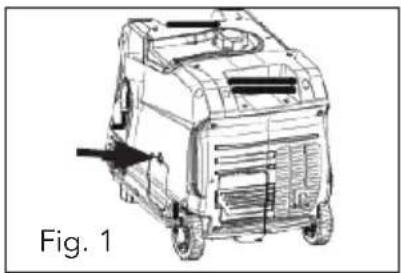
To check the oil level, remove the oil access cover (7) (fig. 1).
natural_image
Technical line drawing of a vehicle chassis with no visible text or symbols
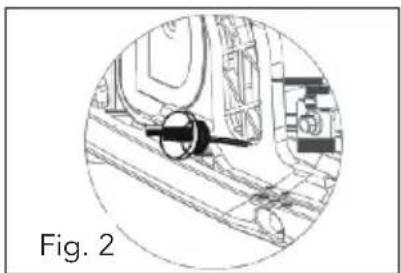
- Remove the oil filler cap, and wipe the dipstick with a clean rag. Check the oil level by inserting the dipstick in the filler hole without screwing it in and then removing it again (fig. 2).
natural_image
Technical line drawing of a mechanical component with no visible text or symbols
- If the oil level is below the end of the dipstick, refill using funnel (9) until it registers on the halfway mark of the dipstick (fig. 3). Use premium quality 4-stroke engine oil. Recommended 10W30 for most climate conditions in Australia.
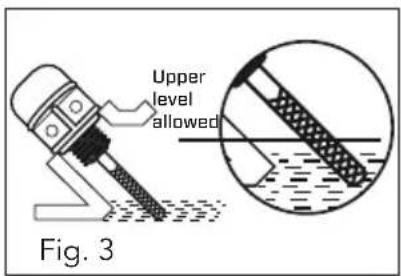
Note. The Oil Alert System will automatically stop the engine before the oil level falls below the safe limit. However, to avoid the inconvenience of an unexpected shutdown, it is still advisable to visually inspect the oil level regularly.

WARNING! Never use non-detergent oil or 2-stroke engine oil as this could seriously damage the Inverter Generator beyond repair.
Refuelling the generator

WARNING! Never refuel the inverter generator while the engine is running and always allow the engine to cool before refuelling.

WARNING! Keep away from cigarettes, smoke and sparks when refuelling the inverter generator. Always refuel in a well-ventilated location.
WARNING! Do not over fill the fuel tank.
WARNING! Be careful not to spill fuel when refuelling. Spilled fuel or fuel vapour may ignite. If any fuel is spilled, make sure the area is dry before starting the engine.
-
Switch off engine by moving the engine control switch (5) to the OFF position (fig. 4). Make sure that the inverter generator is on a level surface.
-
Remove the fuel cap (1) by rotating in a anticlockwise direction.
-
Visually check the fuel level and, if necessary, add fuel to the tank (91 RON Unleaded Petrol) (fig. 5). Do not overfill the fuel tank. Do not use ethanol blended fuels (Fuel tank capacity 12 litres).
-
After refuelling, make sure the fuel cap (1) is fitted properly and securely.
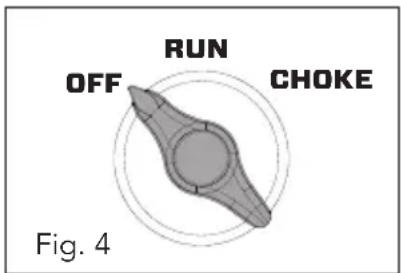
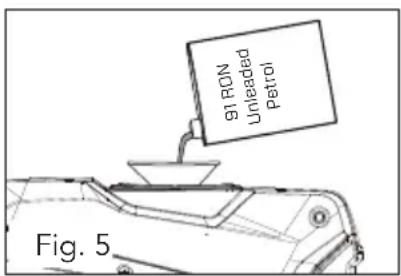

WARNING! Never operate the inverter generator in an enclosed area. Engine exhaust contains carbon monoxide. Only operate the inverter outside and away from windows, doors and vents.
Grounding
Consult with your local municipalities for your grounding codes.
The generator's ground terminal (21) must always be used to connect the generator to a driven ground rod. Connect the ground terminal (21) to the driven ground rod with copper wire. The wire connects to the terminal between the lock washer and nut. Tighten the nut securely to ensure good connection. Grounding the generator protects you from electric shock that results from a build up of static electricity or undetected ground faults.

WARNING! Be sure the inverter is properly connected to earth ground terminal (21) before operating.
OPERATION
Starting the inverter generator
Note: Before starting the engine, disconnect all appliances from the generator.
Note: Always operate the inverter generator on a dry surface free of any moisture.

WARNING! Do not rest inverter on exhaust panel (26). Do not move Inverter Generator while it is on. The inverter will be damaged if operated in this manner.
WARNING! Never operate your inverter generator outdoors during rain, snow or any combination of weather conditions that could lead to moisture collecting on, in or around the generator.
- Turn the engine control switch (5) to the CHOKE position (fig. 6).
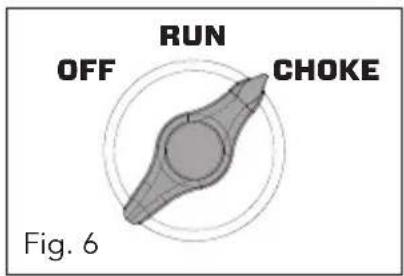
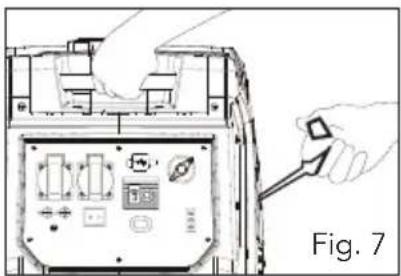
- Hold the generator steady with one hand. With the other hand, pull slightly on the recoil starter (4) until you feel resistance (fig. 7) and then pull hard and swiftly. Do not let the recoil starter retract by itself, guide it back by hand.
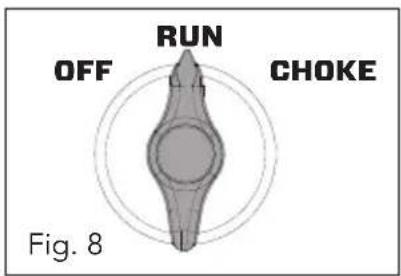
- Once engine is running / started, turn the engine control switch (5) to the RUN position (fig. 8).
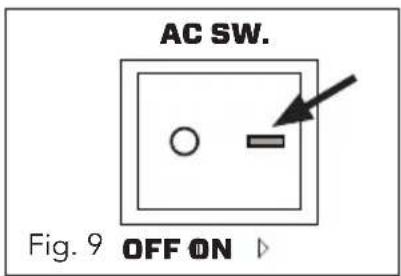
- Press the AC switch (22) ON (I) (fig. 9) ready for connecting appliances.
OPERATION (cont.)
Stopping the engine
In normal operation
- Switch off the connected equipment and pull out the plug.
-
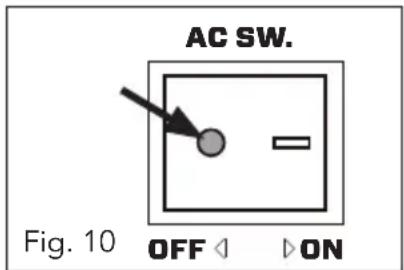
Turn the AC switch (22) to OFF (O) (fig. 10).
-
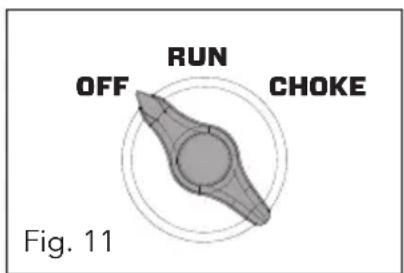
Turn the engine control switch (5) to the OFF position (fig. 11).
In emergency situation
If there is an emergency and the inverter must be stopped quickly, move the engine control switch (5) to the OFF position immediately.
Efficiency mode
The inverter is equipped with an Economy throttle switch (13) to minimize fuel consumption. In efficiency mode, the inverter will sense the load and adjust the engine RPM to the current load requirements. Efficiency mode should be used only after the inverter has been warmed up to operating temperature.
- To turn on the efficiency mode, press the switch to the ON (I) position (fig. 12). If no load is present, the inverter RPM will drop down to an idle speed. As a load is applied, the inverter will sense the load and engine RPM will increase according to the load applied.
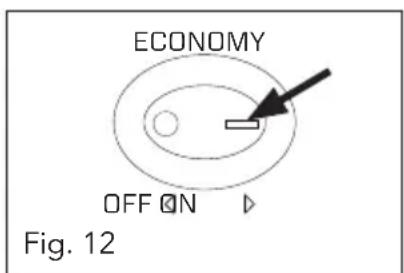
- To run the inverter at maximum power and RPM, press the efficiency mode switch to the OFF (O) position.
OPERATION (cont.)
Oil alert system
The oil alert system is designed to prevent engine damage caused by an insufficient amount of oil in the crankcase. Before the oil level in the crankcase falls below a safe limit, the oil alert system will automatically shut down the engine (the engine control switch (5) will remain in the RUN position).
If the oil alert system shuts down the engine, the Oil alert indicator LED (red) (12) will come on when you operate the starter, and the engine will not run. If this occurs, add engine oil.
Overload indicator
In the event of an overload or fault in a connected appliance, the Overload indicator LED (red) (10) will illuminate. The overload system will need to be reset if this occurs. The overload system prevents the generator from delivering power, however the engine will continue to run.
Substantial overloading that continuously lights the overload indicator LED (red) (10) may damage the generator. Marginal overloading that temporarily lights the overload indicator LED (red) (10) may shorten the service life of the generator. Stop the engine if the overload indicator LED (10) illuminates and investigate the overload source.
To reset turn the generator off and restart.
Output indicator
The output indicator LED (green) (11) illuminates when power is available to outputs.
Overload reset
An overloaded DC circuit will trip the DC circuit breaker (15) (OFF position) when the controls sense a predetermined overload condition. The inverter engine will continue to run, but there will not be any electrical output.
If this happens,
- Turn off all devices and unplug them from the inverter.
- Determine the wattage required from the devices being powered by the inverter. Make sure the wattage required does not exceed the maximum output of the inverter.
- Press in (ON position) the DC circuit breaker reset (15).
- Plug the devices in to the inverter.
- Turn on the devices as needed.
OPERATION (cont.)
AC Applications
Check the total rating of the appliance to be connected and ensure the rating of the appliance/s does not exceed the rating of the inverter generator.
-
Make sure the output indicator LED (green) (11) illuminates and the AC switch (22) is in the ON (I) position.
-
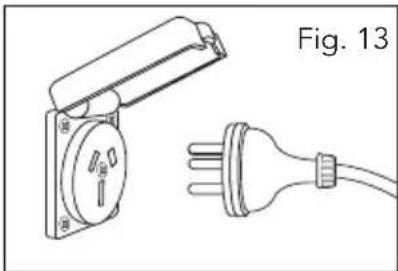
Confirm that the equipment to be used is switched off, and insert the plug of the equipment to be used into an AC socket (8) (fig. 13).
-
Switch on the equipment, and operate as normal.
natural_image
Line drawing of a fuse and plug assembly (no text or symbols)
Note: If the connected appliance does not operate, refer to the overload indicator section on the previous page.
| AC | Electric lamps | Power tools | Electric motor | DC battery |
| Power factor 1 | 0.8 - 0.9 | | 0.4 - 0.7(Efficiency 0.85) | |
| 0 - 3000W | 0 - 2400W | 0 - 1800W | | Rated voltage12VRated current 8A |

WARNING! Limit operation requiring maximum power to 30 minutes. For continuous operation, do not exceed the rated power. In either case, the total wattage of all appliances connected must be considered.

WARNING! Do not exceed the current limit specified for any one receptacle.

WARNING! Keep the generator away from other electric cables or wires such as distribution network.

WARNING! Keep the generator on a level surface when running. If generator is tilted while in operation, it may cause fuel spillage or low oil level warning.
OPERATION (cont.)
USB Outlet
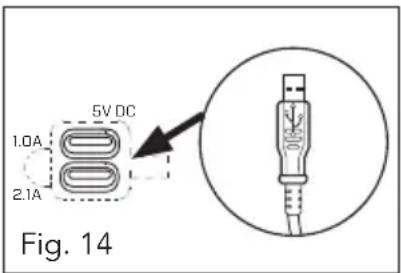
The USB port (16) 5V DC outlets that come with 1 Amp & 2.1 Amp rating (fig. 14). It is suitable for charging mobile phones, MP3 players etc.
12V Battery charging outlet
The DC socket (14) is suitable most lead acid type car batteries. Before charging, remove the battery from the vehicle. The battery MUST be totally isolated from any other circuitry.
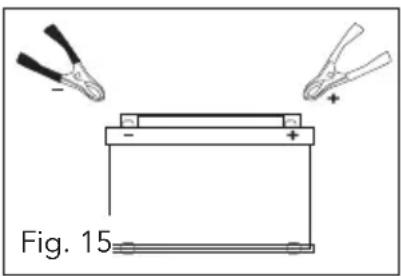
- Connect the positive (+, RED) of the charging cable and clamp set (18) to the positive battery terminal. Connect the negative (-, BLACK) to the negative battery terminal (fig. 15). Do not reverse the charging cables, or serious damage to the generator and/or the battery may occur.
natural_image
Simple line drawing of a battery with two pliers above it, labeled Fig. 15 (no text or symbols on the diagram itself)
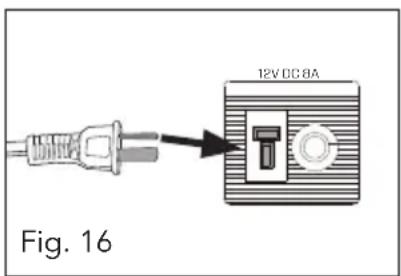
- Connect the charging cable and clamp set (18) plug to DC socket (14) (fig. 16). The battery will begin charging.
- When disconnecting, remove the plug from the inverter generator before un-clipping the clamps on the battery.
Note: Do not attempt to charge lithium ion, NiCad or NiMH batteries. The charging DC socket (14) is only intended for Lead Acid batteries.

WARNING! The battery gives off explosive gases; keep sparks, flames and cigarettes away. Provide adequate ventilation when charging.

WARNING! The battery contains sulphuric acid (electrolyte). Contact with skin or eyes may cause severe burns. Wear protective equipment.

WARNING! Batteries left unattended can potentially explode, resulting in serious injury.
OPERATION (cont.)
Inverter parallel operation
It is possible to connect two Full Boar SD4000irs generators to each other, using a parallel cable kit (sold separately), to increase available power output.

DANGER! Never connect the paralleling cord to the inverters with the inverters running. The inverters must not be running and both the paralleling cord switches must be off when connecting the cords.

WARNING! Do not attempt to parallel the inverter with any other manufacturers' inverters. Do not use the paralleling cord for any application other than inverter paralleling. Do not use this cord on other manufacturers' inverters.
WARNING! Always ensure that both ends of the paralleling cord are switched off before connecting the inverters.
- Connect PARALLEL OPERATION CABLES to two SD4000irs generators according to the instructions provided with the cable kit.
- Make sure the Economy throttle switch (13) is in the OFF position on both generators.
- All electronic devices should be turned "OFF" and disconnected from inverter generators prior to starting generator engines.
- Start generator engines. Make sure the green output indicator LED (11) comes on for each generator.
- When engines have stabilized, plug in electronic device to AC socket (8) and turn on first load.
- Allow generator output to stabilize (engine and attached devices run evenly) before plugging in the next load.
Maximum Power in Parallel Operation: 7.2kVA
Rated Power in Parallel Operation: 6.3kVA
Limit operation time to 3 seconds for load requiring maximum output. For continuous operation, do not exceed the rated output.
Note: It is strongly recommended to plug in devices with the largest output first and the smallest output last to help prevent overloading the generator.
MAINTENANCE
The purpose of the maintenance and adjustment schedule is to keep the generator in the best operating condition.
Inspect or service as scheduled in the table below.

WARNING! Shut off the engine before performing any maintenance. If the engine must be run, make sure the area is well ventilated. The exhaust contains poisonous carbon monoxide gas.

CAUTION! Use authorized parts or their equivalent. The use of replacement parts which are not of equivalent quality may damage the generator.
| REGULAR SERVICE PERIOD (1) | EACH USE | FIRST MONTH OR 20HRS | EVERY 3 MONTHS OR 50 HRS | EVERY 6 MONTHS OR 100 HRS | EVERY YEAR OR 200 HRS |
| ITEM. Perform at every indicated month or operating hour interval, whichever comes first. |
| Engine oil | Check level | ● | | | | |
| Change | | ● | | ● | |
| Air cleaner | Check | | | ● | | |
| Clean | | | ● (2) | | |
| Spark plug Check - adjust | | | | ● | |
| Spark arrester Clean | | | | ● | |
| Fuel tank & filter Clean | | | | | ● (3) |
Note:
(1) Log hours of operation to determine proper maintenance.
(2) Service more frequently when used in dusty areas.
(3) Servicing of this product can be arranged by contacting customer service.
Telephone: 1800 069 486.
MAINTENANCE (cont.)
Checking the engine oil
See "Checking the oil" section on page 12 of this manual for full details.
Changing the engine oil
It is recommended that SAE 10W-30 (multi-viscosity) 4-stroke engine oils are used at temperatures from 5 to 35°C and synthetic oils 5W-30 (multi viscosity) is used for temperatures -5 to 5°C.
- Stop the engine.
- Let engine sit and cool for several minutes (allow crankcase pressure to equalize).
- Remove the oil access cover (7) to gain access to the oil filler cap.
- Place oil pan (or suitable container) under the oil filler cap.
- Remove oil filler cap. With a damp rag, thoroughly clean around the oil filler cap.
-
Insert provided funnel (9) around oil fill/drain and carefully tilt the inverter so the oil drains down the through the funnel (9) into the container.
-
Allow oil to completely drain.
-
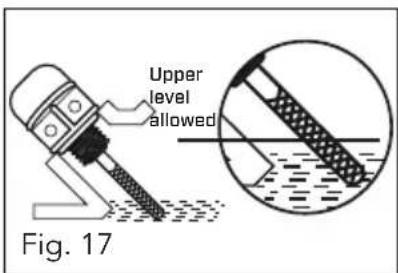
Fill crankcase with new oil using the provided funnel (9) and check the oil level with the dipstick (fig. 17).
-
Reinstall the oil access cover (7).
-
Please dispose of used motor oil according to local regulations. Do not throw it in the trash or pour it on the ground.
Air cleaner service
A dirty air cleaner will restrict air flow to the carburettor. To prevent carburettor malfunction, service the air cleaner regularly. Service more frequently when operating the generator in dust environment.
-
Turn off the inverter and let it cool for several minutes if running.
-
RemovetheRoutine maintenance cover (6) to gain access to the air filter.
-
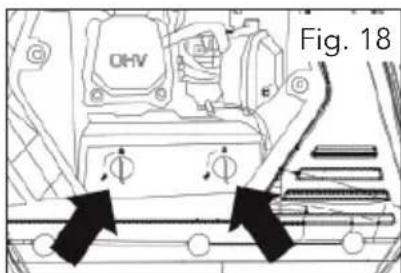
Turn the 2 knobs on the air cleaner to unlock the cover (fig. 18). Tip the cover down to access the foam air filter.
-
Remove the foam air filter from the air cleaner housing.
-
Wash the foam air filter by submerging the filter in a solution of household detergent soap and warm water. Slowly squeeze the foam to thoroughly clean.
-
Rinse in clean water by submerging the foam air filter in fresh water and applying a slow squeezing action.
-
Dry the air filter element by again applying a slow firm squeezing action.
-
Allow the air filter to completely dry.
-
Return the air filter element to its position in the air cleaner housing. Install the air cleaner cover, making sure the knobs lock into place. Install the routine maintenance cover (6).
MAINTENANCE (cont.)
Spark plug servicing
Use only compatible spark plugs. To ensure proper engine operation, the spark plug must be properly gapped and free of deposits.
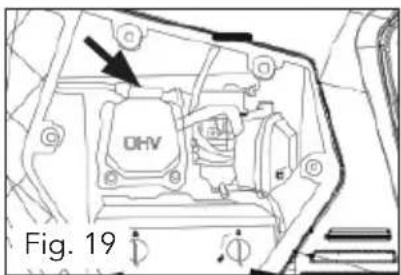
- Remove the routine maintenance cover (6) to gain access to the spark plug.
- Take out the spark plug lead and rubber cover (fig. 19).
- Remove the spark plug with spark plug socket (2).
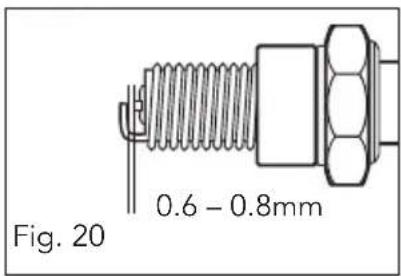
- Visually inspect the spark plug. Discard it if the insulator is cracked or chipped. The gap should be between 0.6 – 0.8mm (fig 20). Clean spark plug with a wire brush (not included) if it is to be reused.
- Install the spark plug carefully by hand, to avoid cross-threading. Tighten it securely with provided spark plug socket (2).
- Reinstall the ignition coil rubber boot on the spark plug securely.

WARNING! The spark plug must be securely tightened. An improperly tightened plug can become very hot and possibly damage the generator.
- Reinstall the routine maintenance cover (6).
Spark arrester
Dirty spark arrester will make a lot of noise and affect the engine's running. Check and clean the spark arrestor after every 100 hours of use or 6 months.

WARNING! Before cleaning the fire net of the muffler, make sure the generator is switched off. Make sure that the machine has cooled in order to avoid scalding by the hot muffler.
Note: Be sure to wear gloves before commencing any of the following operations.
-
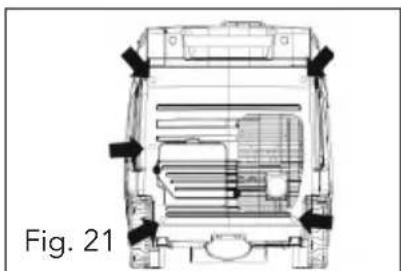
Remove the 5 screws holding the exhaust panel (26) in place (fig. 21).
-
To remove the spark arrester from the muffler, first loosen the screw on the band that fastens the spark arrester to the muffler. Once loosened, the spark arrester can be pulled free.
-
Clean using a wire brush, remove any dirt and debris that may have collected on the spark arrestor screen. If the spark arrestor screen shows signs of wear (rips, tears or large openings in the screen), replace the spark arrestor screen.
-
Secure spark arrester over muffler and refit routine maintenance cover (6)
natural_image
Technical line drawing of a vehicle chassis with labeled components (no text or symbols beyond label)
TRANSPORTING & STORAGE
When transporting generator:
- When transporting a short distance, it is advised that you use the telescopic handle (24). The handle can be extended out from its position at the front base of the generator. Along with the wheels at the rear base of the unit, the telescopic handle (24) makes transporting easy over short distances.
- Do not overfill the fuel tank (there should be no fuel in the filler neck).
- Do not operate the generator while it is on a vehicle. Take the generator off the vehicle and use it in a well ventilated place.
- Avoid a place exposed to direct sunlight when putting the generator on a vehicle. If the generator is left in an enclosed vehicle for many hours, high temperatures inside the vehicle could cause fuel to vaporize, resulting in a possible explosion.
- Do not drive on a rough road for an extended period with the generator on board. If you must transport the generator on a rough road, drain the fuel from the generator beforehand.
Before storing for an extended period

WARNING! Never store an inverter with fuel in the tank indoors or in a poorly ventilated area where the fumes can come in contact with an ignition source such as a: 1) pilot light of a stove, water heater, clothes dryer or any other gas appliance; or 2) spark from an electric appliance.
Proper care should be taken to prepare the inverter for any storage
- Be sure the storage area is free of excessive humidity and dust.
- Completely drain the fuel from the tank. Start the engine and operate it in the idle position until all remaining fuel is gone and the engine stops automatically.

WARNING! Petrol is extremely flammable and explosive under certain conditions. Do not smoke or allow flames or sparks in the area.
- Check the engine control switch (5) is turned to the OFF position.
- Change engine oil (see "Changing the engine oil" section on page 21).
- Remove the spark plug (see "Spark plug servicing" section on page 22) and place about 1 tablespoon of oil in the spark plug opening. While placing a clean rag over the spark plug opening, slowly pull the recoil starter (4) to allow the engine to turn over several times. This will distribute the oil and protect the cylinder wall from corroding during storage.
- Move the inverter to a clean, dry place for storage.
TROUBLESHOOTING
Engine will not start
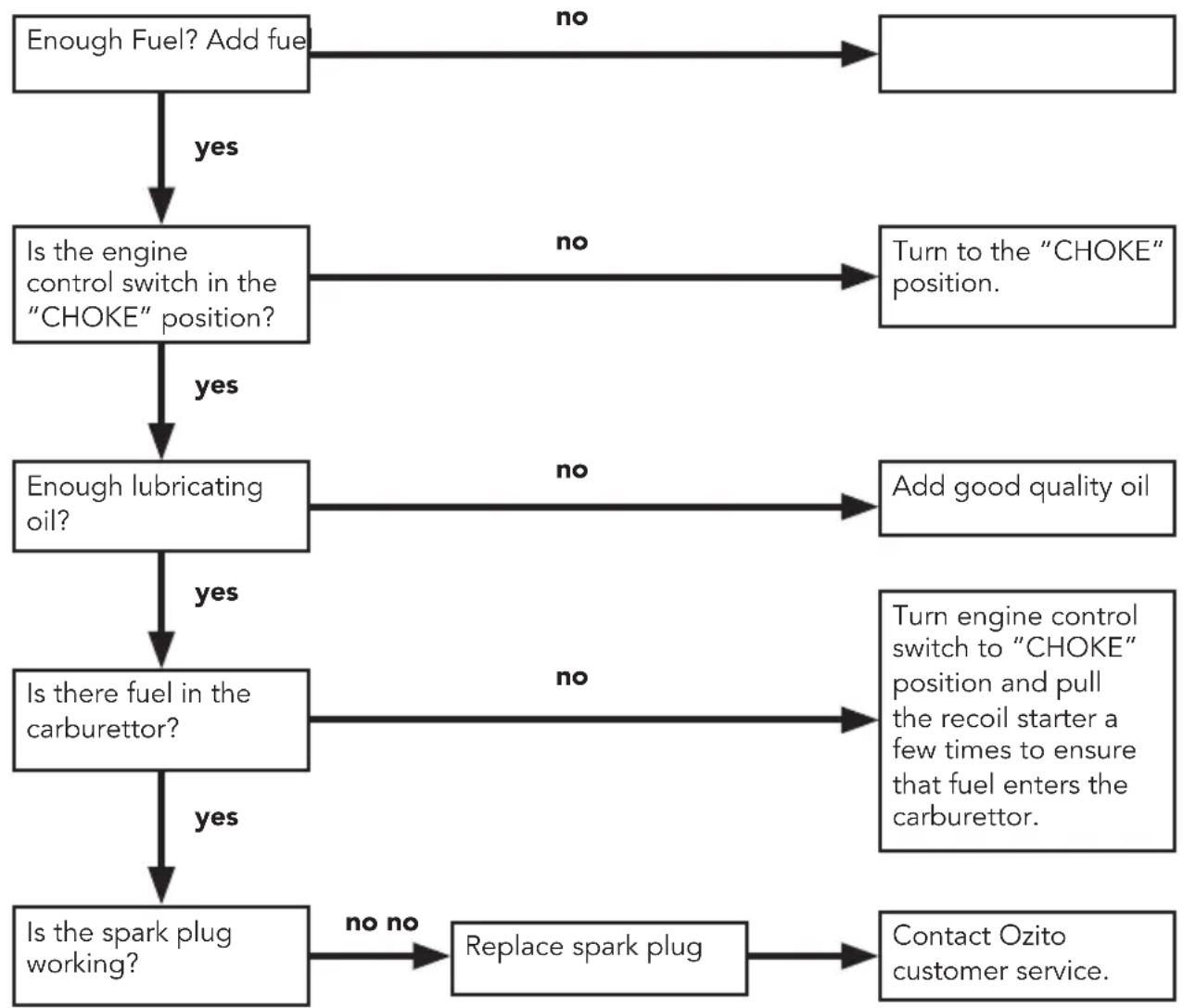
flowchart
graph TD
    A["Enough Fuel? Add fuel"] -->|yes| B["Is the engine control switch in the "CHOKE" position?"]
    B -->|yes| C["Enough lubricating oil?"]
    B -->|no| D["Turn to the "CHOKE" position."]
    C -->|yes| E["Is there fuel in the carburettor?"]
    C -->|no| F["Add good quality oil"]
    E -->|yes| G["Is the spark plug working?"]
    E -->|no| H["Turn engine control switch to "CHOKE" position and pull the recoil starter a few times to ensure that fuel enters the carburettor."]
    E -->|yes| I["Replace spark plug"]
    F -->|no| J["Contact Ozito customer service."]
    G -->|no| K["Replace spark plug"]
    H -->|no| L["Replace spark plug"]
    I -->|no| M["Replace spark plug"]
    J --> N["Replace spark plug"]
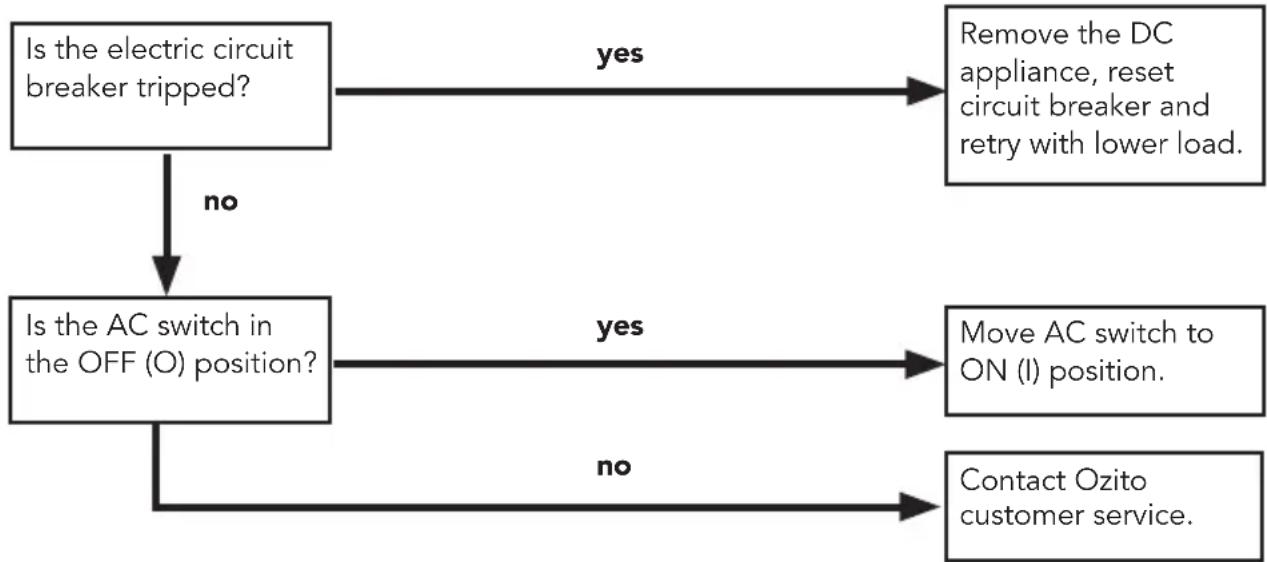
There is no power in the DC electric outlet
flowchart
graph TD
    A["Is the electric circuit breaker tripped?"] -->|yes| B["Remove the DC appliance, reset circuit breaker and retry with lower load."]
    A -->|no| C["Is the AC switch in the OFF (O) position?"]
    C -->|yes| D["Move AC switch to ON (I) position."]
    C -->|no| E["Contact Ozito customer service."]
DESCRIPTION OF SYMBOLS
| V | Volts | Hz | Hertz |
| ~ | Alternating current | W | Watts |
| min^-1 | Revolutions orreciprocation per minute | No | No load speed |
 | Read instruction manual |  | Regulator compliance mark |
 | Warning |  | Hot surface |
 | Do not parallel connect other cables to receptacles, use special jack,or it may cause an electrical shock. |
 HOT ! HOT ! | Extremely hot surface. Do not touch a hot muffler or exhaust system.You may get burned. These parts get extremely hot from operationand remain hot a short time after the unit is turned off. |
 | Exhaust contains poisonous carbon monoxide. Do not operate generatorin confined area. |
 | Unleaded Petrol |  | Four stroke engine oil |
 | Chassis or Frame Ground |  | Do not smoke |
 | Keep bystanders away |  | Toxic Fumes |
 | Engine may continue to rotate after machine is switched off |
CARING FOR THE ENVIRONMENT
natural_image
Simple line drawing of a trash bin with crossed lines indicating no waste or discharge (no text or symbols)
Power tools that are no longer usable should not be disposed of with household waste but in an environmentally friendly way. Please recycle where facilities exist. Check with your local council authority for recycling advice.

Recycling packaging reduces the need for landfill and raw materials. Reuse of recycled material decreases pollution in the environment. Please recycle packaging where facilities exist. Check with your local council authority for recycling advice.
CONTENTS
1 x Inverter generator
1 x Convertible screwdriver
1 x Charging cable and clamp set
1 x Spark plug socket
1 x Spark plug (spare)
1 x Engine oil bottle
1 x Funnel
Note. The inverter generator warranty does not cover components that have been subjected to operator abuse or negligence. To receive full value from the warranty, the operator must maintain the inverter generator as instructed in this manual.
Note. The manufacturer's liability shall be deemed void if the machine is modified in any way and the manufacturer shall therefore accept no liability for any damages arising as a result of modifications.
Ozito Industries will not be responsible for any damage or injuries caused by the repair of the inverter generator by an unauthorised person or by mishandling of the inverter generator
Distributed by:
Ozito Industries Pty Ltd
AUSTRALIA / NEW ZEALAND (Head Office)
1-23 Letcon Drive, Bangholme Victoria, Australia, 3175
Australia: 1800 069 486
New Zealand: 0508 069 486
WARRANTY
YOUR WARRANTY FORM SHOULD BE RETAINED BY YOU AT ALL TIMES. IN ORDER TO MAKE A CLAIM UNDER THIS WARRANTY YOU MUST RETURN THE PRODUCT TO YOUR NEAREST BUNNINGS WAREHOUSE (see www.bunnings.com.au or www.bunnings.co.nz for store locations) WITH YOUR BUNNINGS REGISTER RECEIPT. PRIOR TO RETURNING YOUR PRODUCT FOR WARRANTY PLEASE TELEPHONE OUR CUSTOMER SERVICE HELPLINE:
Australia 1800 069 486
New Zealand 0508 069 486
TO ENSURE A SPEEDY RESPONSE PLEASE HAVE THE MODEL NUMBER AND DATE OF PURCHASE AVAILABLE. A CUSTOMER SERVICE REPRESENTATIVE WILL TAKE YOUR CALL AND ANSWER ANY QUESTIONS YOU MAY HAVE RELATING TO THE WARRANTY POLICY OR PROCEDURE.
1 YEAR WARRANTY
Your product is guaranteed for a period of 12 months from the original date of purchase. If a product is defective it will be repaired in accordance with the terms of this warranty. Warranty excludes consumable parts, for example: wheels, bearings.
The benefits provided under this warranty are in addition to other rights and remedies which are available to you under law. The warranty covers manufacturer defects in materials, workmanship and finish under normal use.
Our goods come with guarantees that cannot be excluded under Australian Consumer law & Consumer Guarantees Act 1993 (NZ). You are entitled to a replacement or refund for a major failure and to compensation for other reasonably foreseeable loss or damage. You are also entitled to have the goods repaired and replaced if the goods fail to be of acceptable quality and the failure does not amount to a major failure.
WARRANTY EXCLUSIONS
The following actions will result in the warranty being void.
If the tool has been operated on a supply voltage other than that specified on the tool.
If the tool shows signs of damage or defects caused by or resulting from abuse, accidents • or alterations.
Failure to perform maintenance as set out within the instruction manual.
• If the tool is disassembled or tampered with in any way.
• The warranty excludes damage resulting from product misuse or product neglect.
This warranty is given by Ozito Industries Pty Ltd.
ABN: 17 050 731 756
Ph.1800 069 486
Australia/New Zealand (Head Office)
1-23 Letcon Drive, Bangholme, Victoria, Australia 3175

