JC-350L - Refrigerator Jocel - Free user manual and instructions
Find the device manual for free JC-350L Jocel in PDF.


| Product Type | Freestanding Refrigerator-Freezer |
| Brand | Jocel |
| Model | JC-350L |
| Total Capacity | 350 liters |
| Dimensions (H x W x D) | 185 x 60 x 65 cm |
| Weight | 65 kg |
| Energy Class | A+ |
| Power Supply | 220-240 V, 50 Hz |
| Power Consumption | 120 kWh/year |
| Noise Level | 40 dB |
| Refrigerant | R600a |
| Temperature Control | Adjustable thermostat |
| Defrost Type | Auto defrost in refrigerator, manual in freezer |
| Interior Light | LED |
| Door Reversible | Yes |
| Number of Shelves | 4 glass shelves |
| Crisper Drawer | 1 |
| Freezer Compartment | 3-star rating, 12 kg/24h freezing capacity |
| Climatic Class | N-ST (16°C to 38°C) |
| Maintenance | Clean with mild detergent and water; defrost freezer when ice exceeds 5 mm |
| Safety Features | Automatic fuse, door alarm, anti-tip bracket |
| Spare Parts Availability | Contact Jocel support or authorized service centers |
| Repairability Index | 7.5/10 |
Frequently Asked Questions - JC-350L Jocel
User questions about JC-350L Jocel
0 question about this device. Answer the ones you know or ask your own.
Ask a new question about this device
Download the instructions for your Refrigerator in PDF format for free! Find your manual JC-350L - Jocel and take your electronic device back in hand. On this page are published all the documents necessary for the use of your device. JC-350L by Jocel.
USER MANUAL JC-350L Jocel
natural_image
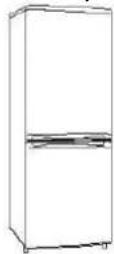
White refrigerator with closed lid and visible door, no text or symbols on body
MANUAL DE INSTRUÇÕES MANUAL DE FUNCIONAMENTO INSTRUCTION MANUAL
AVISO!
natural_image
Two vertical panels with checkmarks and a cross symbol, no text or labels presentnatural_image
Illustration of a hand pouring liquid from a container into a container with a spoon (no text or symbols)Etiquetar tudo
natural_image
Line drawing of a two-tiered storage tray or rack with a central vent (no text or symbols)natural_image
Technical line drawings of a mechanical assembly with a tool and two views (no text or symbols)natural_image
Diagram showing a mechanical assembly or tool interacting with a bracket (no text or symbols visible)natural_image
Simple line drawing of a wooden bench with an inset showing hand positioning (no text or symbols)natural_image
Illustration of two workers carrying a large cardboard box, no text or symbols presentnatural_image
Simple line drawing of a screwdriver inserted into a mechanical component (no text or symbols)natural_image
Line drawing of a mechanical clamp or bracket assembly (no text or symbols)Telef. 00 351 252 910351
Fax: 00 351 252 910367
E-mail: assistencia@jocel.pt
http://www.jocel.pt
ADVERTENCIA
Cajón para verduras
natural_image
Illustration of a hand pouring liquid into a container with a spoon (no text or symbols)Etiquete todo
natural_image
Line drawing of a closed storage tray with a lid and base (no text or symbols)natural_image
Technical line drawings of a mechanical assembly with a tool and two views (top: flat plate, bottom: tilted rectangular frame), no text or symbols present.natural_image
Diagram showing a mechanical assembly with a tool and a component, no visible text or symbolsnatural_image
Line drawing of a mechanical component with an inset showing a hand holding a part labeled 'a' (no text or symbols present)natural_image
Two workers carrying a large cardboard box, no text or symbols presentnatural_image
Simple line drawing of a screwdriver inserted into a mechanical component (no text or symbols)natural_image
Line drawing of a mechanical clamp or bracket assembly (no text or symbols)natural_image
Symbol of a trash bin crossed with a diagonal line, no text or labels presentTelef. 00 351 252 910351
Fax: 00 351 252 910367
E-mail: assistencia@jocel.pt
http://www.jocel.pt
WARNING!
It is hazardous for anyone other than authorized service personnel to carry out servicing or repairs which involves the removal of covers. To avoid the risk of an electric shock do not attempt to repair this appliance yourself.
SAFETY TIPS
- Do not use electrical appliances such as a hair dryer or heater to defrost your Fridge/Freezer.
- Containers with flammable gases or liquids can leak at low temperatures.
- Do not store any containers with flammable materials, such as spray cans, fire extinguisher refill cartridges etc. in the Fridge/Freezer.
- Do not place carbonated or fizzy drinks in the Freezer compartment. Ice lollies can cause "Frost/Freeze burns". If consumed straight from the Fridge/Freezer.
- Do not remove items from the Fridge/Freezer compartment if your hands are damp/wet, as this could cause skin abrasions or “Frost/Freezer burns”. Bottles and cans must not be placed in the Freezer compartment as they can burst when the contents freeze. Manufacturer’s recommended storage times should be adhered to. Refer to relevant instructions.
- Do not allow children to tamper with the controls or play with the Fridge/Freezer. The Fridge/Freezer is heavy. Care should be taken when moving it. It is dangerous to alter the specification or attempt to modify this product in any way.
- Do not store inflammable gases or liquids inside you Fridge/Freezer.
- If the power cable is damaged, it must be replaced by the manufacturer, its service agent or similarly qualified persons in order to avoid a hazard.
- Children should be supervised to ensure that they do not play with the appliance.
- This appliance is not intended for use by persons (including children) with the reduced physical, sensory or mental capabilities, or lack of experience and knowledge, unless they have been given supervision or instruction concerning use of the appliance by a person responsible for their safety. This appliance is intended to be used in household and similar applications such as staff kitchen areas in shops, offices and other working environments; farm houses and by clients in hotels, motels and other residential type environments; bed and breakfast type environments; catering and similar non-retail applications.
- Keep ventilation openings in the appliance, clear of obstruction.
- Do not use mechanical devices or other means to accelerate the defrosting process, other than those recommended by the manufacturer.
- Do not damage the refrigerant circuit.
- Do not use electrical appliances inside the food storage compartments of the appliance, unless they are of type recommended by the manufacturer.
Disposal
Old appliances still have some residual value. An environmentally friendly method of disposal will ensure that valuable raw materials can be recovered and used again.
The refrigerant used in your appliance and insulation materials requires special disposal procedures. Ensure that none of the pipes on the back of the appliance are damaged prior to disposal. Up to date information concerning options for disposing of your old appliance and packaging from the new one can be obtained from your local council office.
INTRODUCTION
Before use
Please read these instructions and the Safety guidelines on page 29 carefully before using your new Fridge/Freezer. The Fridge/Freezer is for indoor, domestic use only.
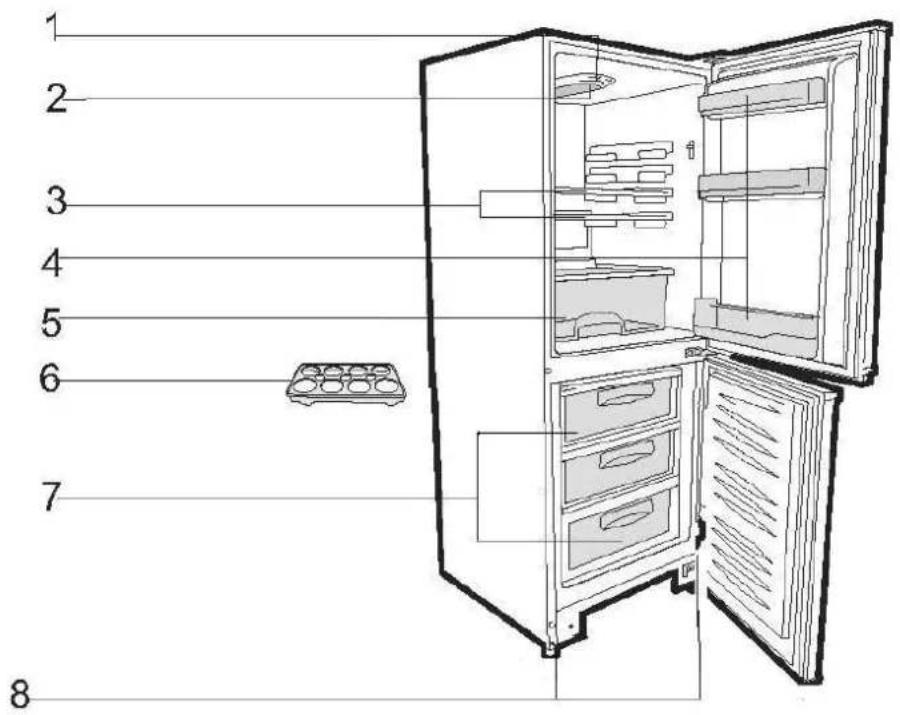
| No | Description |
| 1 | Thermostat |
| 2 | Internal light |
| 3 | Adjustable shelves |
| 4 | Bottle storage |
| 5 | Salad bin |
| 6 | Egg tray |
| 7 | Freezer draws |
| 8 | Leveling feet |
INSTALLATION
Location
When selecting a position for your Fridge/Freezer you should make sure the floor is flat and firm, and the room is well ventilated with an average room temperature of between 16°C and 32°C. Avoid locating your Fridge/Freezer near a heat source, eg, cooker, boiler or radiator. Also avoid direct sunlight in out-buildings or sun lounges. If you are placing your Fridge/Freezer in an out-building such as a garage or annex ensure that the Fridge/Freezer is placed above the damp course, otherwise condensation will occur on the Fridge/Freezer cabinet. Never place the Fridge/Freezer in a wall recessed or into fitted cabinets or furniture when your Fridge/Freezer is working, the grille at the back may become hot and the sides warm. It must therefore be installed so that the back of the Fridge/Freezer has at least 9cm of free space and the sides have 2cm. Do not drape the Fridge/Freezer with any covering.
Leveling the Fridge/Freezer
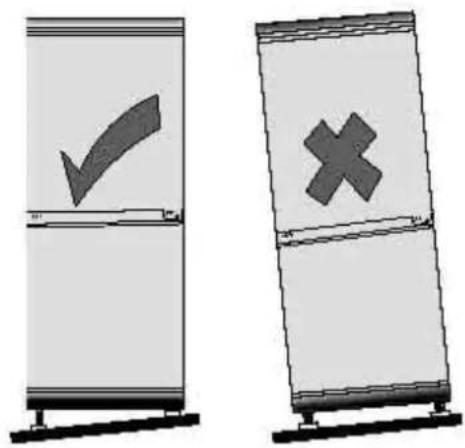
If the Fridge/Freezer is not level, the door and magnetic seal alignment will be affected and may cause you Fridge/Freezer to work incorrectly. Once the Fridge/Freezer is placed in its final location, adjust the leveling feet at the front by turning them.
Cleaning before use
Wipe the inside of the Fridge/Freezer with a weak solution of bicarbonate of soda. Then rinse with warm water using a damp sponge or cloth. Wash the baskets and shelves in warm soapy water and dry completely before replacing in the Fridge/Freezer. The external parts of the Fridge/Freezer can be cleaned with wax polish. See page 6 for more details on cleaning.
Before plugging in YOUMUST
Check that you have a socket which is compatible with the plug supplied with the Fridge/Freezer. If not see the section called ELECTRICAL INFORMATION on page 43.
Before switching on!
DO NOT SWITCH ON UNTIL FOUR HOURS AFTER MOVING THE FRIDGE/FREEZER. The coolant fluid needs time to settle. If the appliance is switched off at any time, wait 30 minutes before switching back on to allow the coolant fluid to settle.
Before filling your Fridge/Freezer
Before storing foods in your Fridge/Freezer, turn the Fridge/Freezer on and wait for 24 hours, to make sure it is working properly and to allow the Fridge/Freezer to fail to the correct temperature.
START
Switching on your Fridge/Freezer
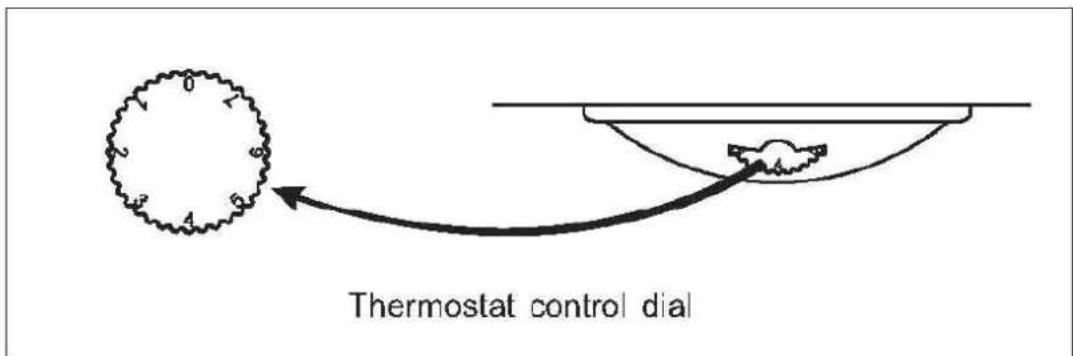
- Before connecting the Fridge/Freezer to the mains supply position. The thermostat control dial is located inside the Fridge compartment.
- Turn the thermostat knob to the "4" position and turn on the electricity. The compressor and the light inside the refrigerator will begin to work.
- Wait 24 hours before placing food into the Fridge/Freezer, the temperature inside your Fridge/Freezer will then be cool enough to chill and freeze foods sufficiently.
Adjusting the temperature
- The temperature in the refrigerator and freezer compartment is controlled by the temperature controller installed on the inside wall of the refrigerator compartment.
- The marks on the knob are the temperature grades, NOT the exact degrees of temperature. "0" is "OFF" and "7" represents the lowest temperature.
- Please start with the knob set to position "4". Use a suitable thermometer to check the temperature after two hours. The refrigerator temperature should be set between +2°C and +5°C and the freezer will vary between -18 and -25 degrees centigrade over a typical cycle. To reduce the refrigerator temperature turns the knob towards "6" and check after one hour
NOTE: The Fridge/Freezer may not operate at the correct temperature if it is in a particularly hot or cold room or is you open the Fridge/Freezer door too often.
Super Freezing
-
Quick freezing allows moisture inside foodstuffs to form fine ice-crystals which prevent the cell membrane from being damaged and the cytoplasm being lost when unfreezing, thus the original freshness and nutrition constituent of foodstuffs can be retained.
-
Fresh meat and fish to be stored for long time must be done by quick freezing. To quick freeze turn the temperature knob to setting "6" before adding food.
NOTE: the maximum allowable capacity is 3KG at a time.
- After quick freezing, turn the knob back to the original position (Normally time for quick freezing shall not exceed 4 hours).
IN USE
Tips for keeping food perfect in the Fridge
Take extra care with meat and fish
Cooked meats should always be stored on a shelf above raw meats to avoid bacterial transfer. Keep raw meats on a plate which is large enough to collect juices and cover it with cling film or foil.
Leave space around food
This allows cold air to circulate around the Fridge, ensuring all parts of the Fridge are kept cool.
Wrap up food!
To prevent transfer of flavors and drying out, food should be separately packed or covered. Fruit and vegetables need not be wrapped.
Pre-cooked food should be cooled properly
Allow pre-cooked food to cool down before placing in the Fridge. This will help to stop the internal temperature of the Fridge from rising.
Shut the door!
To prevent cold air escaping, try to limit the number of times you open the door. When retuning from shopping, sort foods to be kept in your Fridge before opening the door. Only open the door to put food in or take it out.
Where to store your foods in the fridge
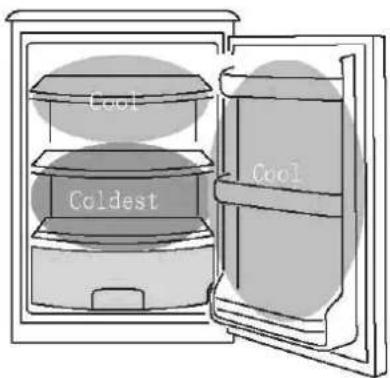
Cool area
This is where to store foods which will keep longer if they are kept cool. Milk, eggs, yogurt, fruit juices, hard cheeses eg. Cheddar. Opened jars and bottles of salad dressings, sauces and jams. Fats, eg. Butter, margarine, low-fat spreads, cooking fats and lard.
Coldest area: 0°C to 5°C
This is where foods which must be cold to keep them safe should be kept:
- Raw and uncooked foods should always be wrapped.
- ·Pre-cooked chilled foods, eg. Ready meals, meat pies, soft cheeses.
- ·Pre-cooked meats eg. Ham,
- Prepared salads(including pre-packed mixed green salads, rice, potato salad etc).
- ·Desserts, eg. Fromage frais, home-prepared food and leftovers or cream cakes.
Salad bin
This is the most humid part of the Fridge. Vegetables, fruit, fresh salad items eg. Unwashed whole lettuce, whole tomatoes, radishes etc can be stored here.
WE RECOMMEND THAT ALL PRODUCE KEPT IN THE SALAD BIN IS WRAPPED.
NOTE: Always wrap and store raw meat, poultry and fish on the lowest shelf at the bottom of the fridge. This will stop them dripping onto, or touching other foods. Do not store inflammable gasses or liquids in the fridge.
Tips for shopping for frozen foods
Your Freezer is 4 star
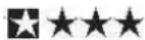
When you are buying frozen food, look at the Storage Guidelines on the packaging. You will be able to store each item of frozen food for the period shown against the 4 star rating. This is usually the period stated as “Best, Before”, found on the front of the packaging.
Check the Fridge/Freezer temperature
Check the temperature of the frozen food cabinet in the shop where you buy your frozen foods. It should show a temperature lower than -18°C.
Choose packs carefully
Make sure the frozen food package is in perfect condition.
Purchase frozen food last
Always buy frozen products last on your shopping trip or visit to the supermarket.
Keep frozen foods together
Try to keep frozen food together whilst shopping, and on the journey home as this will help to keep the food cooler.
Store food straight away
Don't buy frozen food unless you can freeze it straight away. Special insulated bags can be bought from most supermarkets and hardware shops. These keep frozen food cold for longer.
Thawing frozen food
For some foods, thawing before cooking is unnecessary. Vegetables and pasta can be added directly to boiling water or steam cooked. Frozen sauces and soups can be put into a saucepan and heated gently until thawed.
Freezing fresh foods, useful tips
Use quality food and handle it as little as possible. Freeze food in small quantities, it freezes faster, takes less time to thaw and enables you to eat it in the quantity you need.
Freezing fresh foods
First, estimate the amount of food you will be freezing. If you are freezing large amounts of fresh food, remember to turn the control dial to Max. This will lower the temperature in the Freezer (approx -30°C), freezing your food quicker and helping to keep the goodness in. However you should do this sparingly to conserve energy.
Preparations for freezing
– Leave cooked food to cool completely.
- Chill food in a Fridge before freezing if possible.
— Consider how you want to cook the food before freezing it.
- Don't freeze food in metal containers as you may want to microwave it straight from the Freezer.
- Use special Freezer bags available from supermarkets, Freezer film, polythene bags, plastic containers, aluminum foil for acidic foods(such as citrus fruits).
- Do not use thin cling film or glass. Do not use used food containers (unless cleaned thoroughly first).
- Exclude as much air from the container as possible. You could buy a special vacuum pump which sucks excessive air out of the packaging.
– Leave a small amount of “air space” when freezing liquids, to allow for expansion.
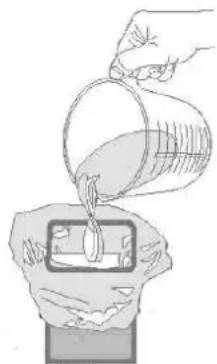
- You can use the space in the Freezer most efficiently if you freeze liquids(or solids with liquids, such as stew) in square blocks.
- This is known as “performing” Pour the liquid into a polythene bag which is inside a square sided container. Freeze it like this, then remove it from the container and seal the bag.
natural_image
Illustration of a hand pouring liquid from a container into a small container (no text or symbols)Label everything
- Many foods look the same when frozen, so careful labeling will help avoid forgetting what an item is. Storage times being exceeded could cause food poisoning. On home cooked food add the date as you will then be able to make sure you don not eat food past the recommended storage period.
- You can buy special Fridge/Freezer labels and pens. Labels come in different colors which can help you use your Fridge/Freezer effectively. For instance you could color code meat red and vegetables green. Using a different color label for each quarter of the year will help you rotate your frozen food more efficiently.
- Write the contents and date. Add the weight and notes on cooking such as "thaw first", or "cook from frozen" and keep a separate "log-book" of what is in each drawer. This will save opening the door and searching around unnecessarily.
Recommended storage periods
For recommended food storage time, refer to the information given on your food packaging.
DEFROSTING
Defrosting
After a period of time frost will build up in certain areas in the Fridge/Freezer compartment. After a period of time frost will build up in certain areas in the Fridge/Freezer compartment. As a temporary measure, this frost should be scraped away using a plastic scraper. NEVER use a metal or sharp instrument. Complete defrosting will however become necessary approximately once per year, or if the frost layer exceeds 5mm to maintain the efficiency of the Fridge/Freezer. This should be carried out if the frost build-up cannot be scraped away, or if it begins to interfere with the food storage. Chose a time when the stock of frozen food is low and proceed as follow:
- Take out the frozen food, turn the Fridge/Freezer off at the mains supply and leave the doors open. Ideally the frozen food should be put into another Fridge/Freezer or refrigerator. If this is not possible wrap the food, firstly in several sheets of newspaper or large towels and then in a thick rug or blanket and keep it in a cool place.
- Scrape away as much frost build-up as possible using the plastic scraper. To accelerate the thawing process place bowls of hot water inside the Fridge/Freezer cabinet. As the solid frost loosens, prize it away with the plastic scraper and remove.
- When defrosting is completed, clean your Fridge/Freezer as described.
Cleaning inside the Fridge/Freezer
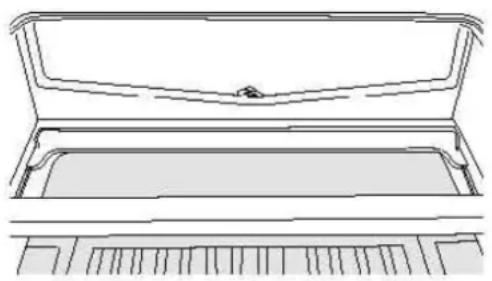
After defrosting you should clean the Fridge/Freezer internally with a weak solution of bicarbonate of soda. Then rinse with warm water using a damp sponge or cloth and wipe dry. Wash the baskets in warm soapy water and ensure they are completely dry before replacing in the Fridge/Freezer. Condensation will form on the back wall of the Fridge; however it will normally run down the back wall and into the drain hole behind the salad bin.
natural_image
Line drawing of a two-tiered storage tray or vent (no text or symbols)The drain hole will have a “cleaning spike” inserted into it. This ensures that small pieces off food cannot enter the drain. After you have cleaned the inside of your Fridge and removed any food residues from around the whole, use the “cleaning spike” to make sure that there are no blockages.
Cleaning outside the Fridge/Freezer
Use standard furniture polish to clean the Fridge/Freezer exterior. Make sure that the doors are closed to prevent polish getting on the magnetic door seal or inside.
The grille of the condenser at the back of the Fridge/Freezer and the adjacent components can be vacuumed using a soft brush attachment.
Do not use harsh cleaners, scouring pads or solvents to clean any part of the Fridge/Freezer
Cleaning tip
Defrost when food stocks are low.
TROUBLESHOOTING AND MAINTENANCE
Trouble Shooting
Power cut
If the internal temperature of the Fridge/Freezer compartment is -18^ or less when the power returns, your food is safe. The food in your Fridge/Freezer will remain frozen for approx 16 hours with the door closed. Do not open the Fridge/Freezer door more than necessary.
The Fridge/Freezer is exceptionally cold
You may have accidentally adjusted the thermostat control dial to a higher position.
The Fridge/Freezer is exceptionally warm
The compressor may not be working. Turn the thermostat control dial to the maximum setting and wait a few minutes. If there is no humming noise, it is not working. Contact the local store where your purchase was made.
The Fridge/Freezer is not working
Check it is plugged in and switched on. Check that the fuse in the plug has not blown. Plug in another appliance, such as a lamp, to see if the socket is working. The Fridge/Freezer should be placed in a well ventilated room with an ambient temperature of between 16°C and 32°C.
Leave the Fridge/Freezer for 30 minutes.
Condensation appears on the outside of the Fridge/Freezer
This may be due to a change in the room temperature. Wipe off any residue of moisture. If the problem continues contact the local store where your purchase was made.
Noises inside the Fridge/Freezer
If you have not owned a Fridge/Freezer before, you may notice that it makes some rather unusual noises. Most noises are perfectly normal; however you should be aware of them!
GURGLING, WHOOSHING
These noises are caused by the circulation of the refrigerant liquid in the cooling system. It has become more pronounced since the introduction of CFC free gases. This is not a fault and will not affect the performance of your Fridge/Freezer.
HUMMING, PURRING OR PULSATING
This is the compressor motor working, as it pumps the refrigerant around the system.
MOVING THE FRIDGE/FREEZER
Location
Do not place your Fridge/Freezer near a heat source, eg. Cooker, boiler or radiator. Also avoid direct sunlight in out-buildings or sun lounges.
Leveling the Fridge/Freezer
Make sure the Fridge/Freezer is level. Use the rotating leveling feet at the front. If the Fridge/Freezer is not level, the doors and magnetic seal alignments will be affected and may cause your Fridge/Freezer to work incorrectly.
Do not turn on the Fridge/Freezer for 4 hours
After the Fridge/Freezer is in place it needs to be left for 4 hours. This allows time for the coolant to settle.
Installation
Don't cover or block the vents or grilles of your appliance.
Servicing
This product should be serviced by an authorized engineer and only genuine spare parts should be used.
Under no circumstances should you attempt to repair the appliance yourself.
Repairs carried out by inexperienced persons may cause injury or serious malfunctioning.
Contact the local store where your purchase was made.
When the appliance is not in use for long periods, disconnect from the electricity supply, empty all foods and clean the appliance, leaving the door ajar to prevent unpleasant smells.
Changing the internal light
-
Before carrying out the bulb replacement always press and turn the thermostat control to dial to position 0, then disconnecting the mains supply.
-
Hold and lift up the light bulb cover.
-
Remove the old bulb by unscrewing it in an anti-clockwise direction.
-
Replace with a new bulb (10W) by screwing it in a clockwise direction marking sure that it is secure in the bulb holder.
-
Refit the light cover and re-connect your Fridge/Freezer to the mains supply and switch on.
Reversing the Door Swing
To change the opening direction yourself, please follow these instructions:
Tools required: Philips style screwdriver / flat bladed screwdriver / Hexagonal spanner
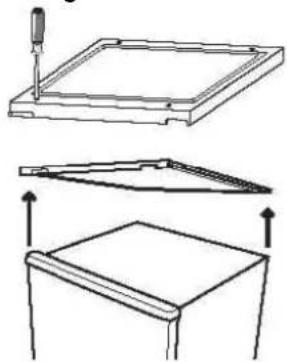
- a. Remove all the cover's screws first.
b. Lift the top cover away from the Fridge.
natural_image
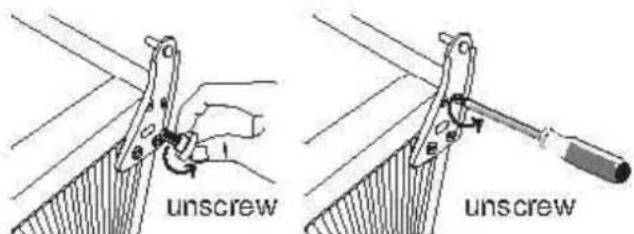
Technical line drawings of a mechanical assembly with a tool and two views (no text or symbols)c. Remove the left hinge cover. Insert the right hinge cover.
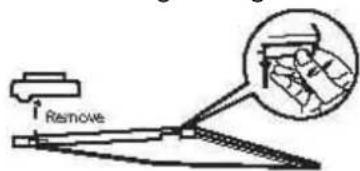
- a. Undo the screws, lift the hinge bracket up and take it off.
natural_image
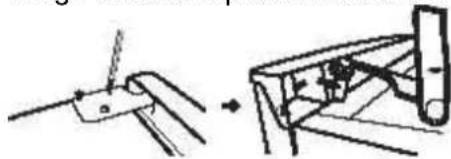
Diagram showing a mechanical assembly with a tool and a bracket, no text or symbols presentb. Remove the bolt with a screwdriver and flip the hinge bracket then reattach the bolt to the hinge bracket. Remove the fridge door.
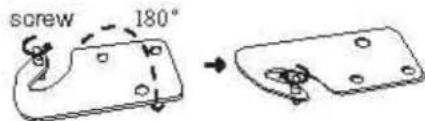
- a. Lift the top hinge cover on the fridge door and move it to the side you want to install.
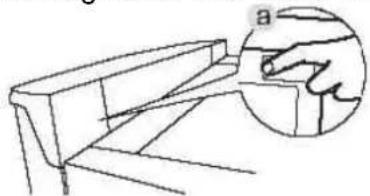
natural_image
Technical line drawing of a mechanical component with an inset showing a hand holding a block (no text or symbols)b. Take of the middle hinge by removing the screws. Lift the freezer door up and move it away.
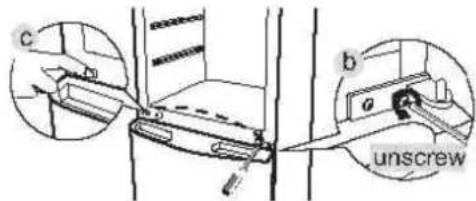
c. Remove the screws' covers and place them to the opposite side.
- Remove the bottom hinge adaptor from the freezer door. Move the adaptor to the opposite side. Ensure it is securely located.
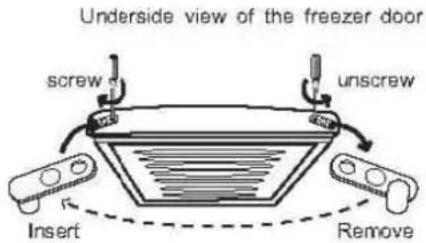
- a. Tilt the fridge carefully. 2 people are required to tilt the fridge during the door reversing process.
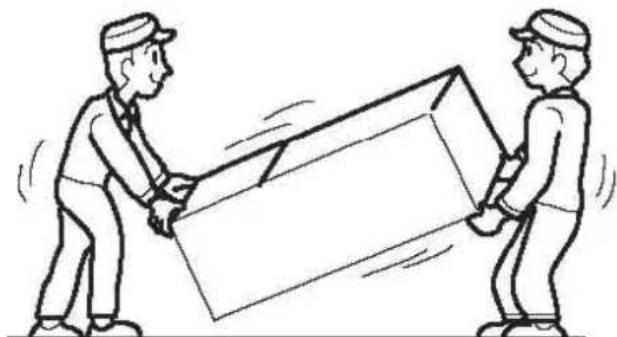
natural_image
Two workers carrying a large cardboard box, no text or symbols presentb. Remove the screws and bottom hinge. Then remove the adjustable feet from both side and reattach them to the opposite side.
- Remove the screw from the bottom hinge and refit it to the opposite side.
Place the freezer door back on.

- After placing the freezer door, screw the middle hinge back onto (the opposite side) the fridge.

Ensure the freezer door is aligned horizontally and vertically, so that the seals are closed on all sides before finally tightening the hinge.
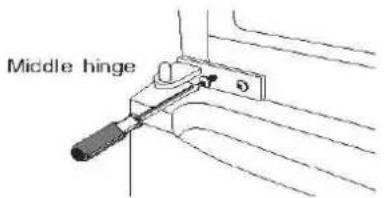
- Place the fridge door back on. Ensure the fridge door is aligned horizontally and vertically so that the seals are closed on all sides before finally tightening the top hinge.
a. Insert the hinge bracket and screw it to the top of the fridge.
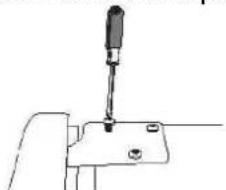
natural_image
Simple line drawing of a screwdriver inserted into a mechanical component (no text or symbols)b. Use a spanner to tighten it if necessary.
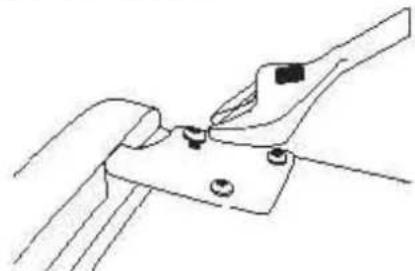
natural_image
Line drawing of a mechanical clamp or bracket assembly (no text or symbols)- Put the top cover back and tighten it with the screws. Reverse step 1a to 1c for details

Double check that the door is aligned correctly and all the seals are closed on all sides. If necessary, re-adjust the levelling feet.
NOTE: If you want to have the door swing reversed, we recommend that your contact a qualified technician. You should only try to reverse the door yourself if you believe that you are qualified to do so.
All parts removed must be saved to do the reinstallation of the door. You should rest the fridge freezer on something solid so that it will not slip during the door change process. Do not lay the fridge freezer flat as this may damage the coolant system. Ensure the fridge freezer is unplugged and empty. We recommend that 2 people handle the fridge freezer during assembly.
ELECTRICAL INFORMATION
THIS APPLIANCE MUST BE EARTHED.
This appliance is fitted with a fused three pin plug to BS 1363 which will be suitable for use in all houses fitted with sockets to current specifications.
If the fitted plug is not suitable for your socket outlets, it should be cut off and carefully disposed of. To avoid a possible shock hazard, do not insert the discarded plug into a socket.
This appliance complies with the following EEC Directives:
73 / 23 EEC (Low Voltage Directive)
89 / 336 EEC (EMC Directive).
Alternating current

Watt
Communate Europene
Correct Disposal of this product
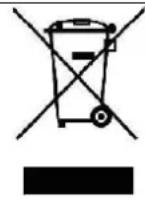
This marking indicates that this product should not be disposed with other household wastes throughout the EU. To prevent possible harm to the environment or human health from uncontrolled waste disposal, recycle it responsibly to promote the sustainable reuse of material resources. To return your used device, please use the return and collection systems or contact the retailer where the product was purchased. They can take this product for environmental safe recycling.
GENERAL WARRANTY TERMS
- The warranty is valid only on presentation of invoice of purchase.
- This WARRANTY is limited exclusively to parts substitution ineffective due to faulty manufacture, made in our workshops.
- The elimination of several faults of the scope of the guarantee is made for repair or replacement of defective parts, according to the discretion of our technical services. Defective parts are our property.
- Are not covered under warranty damage caused by transportation, neglect or poor use, improper assembly or installation, as well as external influences such as: lightning strikes or power, flooding, humidity, etc..
- Lose warranty, all appliances that are not being used according to the instructions, or connected to FEEDING NETWORKS not guarantee a constant voltage of 220/240V.
- The warranty does not cover damages for personal injury or damage caused directly or indirectly in any capacity whatsoever.
- This warranty terminates when it is found to have been undergoing repairs, alterations or interventions by any person not authorized by Jocel.
THE WARRANTY EXPIRES
- With the modification or disappearance of the nameplate of the appliance.
- Exceeded the period of 2 years for home appliances and 06 months for industrial appliances, warranty expires and assistance will be made by charging the costs of manpower, according to current fees.
TECHNICAL ASSISTANCE
For technical assistance request, our services are available through the following contacts:
Telef. 00 351 252 910351
Fax: 00 351 252 910367
E-mail: assistencia@jocel.pt
http://www.jocel.pt
- AVISO!
- Etiquetar tudo
- ADVERTENCIA
- Cajón para verduras
- Etiquete todo
- WARNING!
- SAFETY TIPS
- Disposal
- INTRODUCTION
- Before use
- INSTALLATION
- Location
- Leveling the Fridge/Freezer
- Cleaning before use
- Before plugging in YOUMUST
- Before switching on!
- Before filling your Fridge/Freezer
- START
- Switching on your Fridge/Freezer
- Adjusting the temperature
- Super Freezing
- IN USE
- Tips for keeping food perfect in the Fridge
- Take extra care with meat and fish
- Leave space around food
- Wrap up food!
- Pre-cooked food should be cooled properly
- Shut the door!
- Where to store your foods in the fridge
- Cool area
- Coldest area: 0°C to 5°C
- Salad bin
- Tips for shopping for frozen foods
- Your Freezer is 4 star
- Check the Fridge/Freezer temperature
- Choose packs carefully
- Purchase frozen food last
- Keep frozen foods together
- Store food straight away
- Thawing frozen food
- Freezing fresh foods, useful tips
- Freezing fresh foods
- Preparations for freezing
- Label everything
- Recommended storage periods
- DEFROSTING
- Cleaning inside the Fridge/Freezer
- Cleaning outside the Fridge/Freezer
- Cleaning tip
- TROUBLESHOOTING AND MAINTENANCE
- Trouble Shooting
- Power cut
- The Fridge/Freezer is exceptionally cold
- The Fridge/Freezer is exceptionally warm
- The Fridge/Freezer is not working
- Condensation appears on the outside of the Fridge/Freezer
- Noises inside the Fridge/Freezer
- GURGLING, WHOOSHING
- HUMMING, PURRING OR PULSATING
- MOVING THE FRIDGE/FREEZER
- Do not turn on the Fridge/Freezer for 4 hours
- Servicing
- Changing the internal light
- Reversing the Door Swing
- ELECTRICAL INFORMATION
- THIS APPLIANCE MUST BE EARTHED.
- Correct Disposal of this product
- GENERAL WARRANTY TERMS
- THE WARRANTY EXPIRES
- TECHNICAL ASSISTANCE
Brand : Jocel
Model : JC-350L
Category : Refrigerator