KG176IX-37 - Fridge Respekta - Free user manual and instructions
Find the device manual for free KG176IX-37 Respekta in PDF.


| Product Type | Built-in Refrigerator |
| Brand | Respekta |
| Model | KG176IX-37 |
| Installation Type | Built-in |
| Height | 176 cm |
| Width | 54 cm |
| Depth | 55 cm |
| Weight | Approx. 50 kg |
| Energy Efficiency Class | F (EU energy label scale A to G) |
| Annual Energy Consumption | Approx. 200 kWh/year |
| Noise Level | 39 dB(A) |
| Climate Class | SN-ST (subnormal to subtropical) |
| Total Net Capacity | Approx. 230 L |
| Refrigerator Net Capacity | Approx. 190 L |
| Freezer Net Capacity | Approx. 40 L |
| Freezing Capacity | 4 kg/24h |
| Storage Time During Power Failure | 12 hours |
| Defrost Type | Automatic (fridge), manual (freezer) |
| Refrigerant | R600a (isobutane) |
| Power Supply | 220-240 V, 50 Hz |
| Power Consumption | 100 W |
| Door Hinge Position | Right (reversible) |
| Interior Lighting | LED |
| Shelves Material | Glass |
| User Manual Language | English, German (available online) |
Frequently Asked Questions - KG176IX-37 Respekta
User questions about KG176IX-37 Respekta
0 question about this device. Answer the ones you know or ask your own.
Ask a new question about this device
Download the instructions for your Fridge in PDF format for free! Find your manual KG176IX-37 - Respekta and take your electronic device back in hand. On this page are published all the documents necessary for the use of your device. KG176IX-37 by Respekta.
USER MANUAL KG176IX-37 Respekta
Installation & Operating Instructions Fridge-Freezer
natural_image
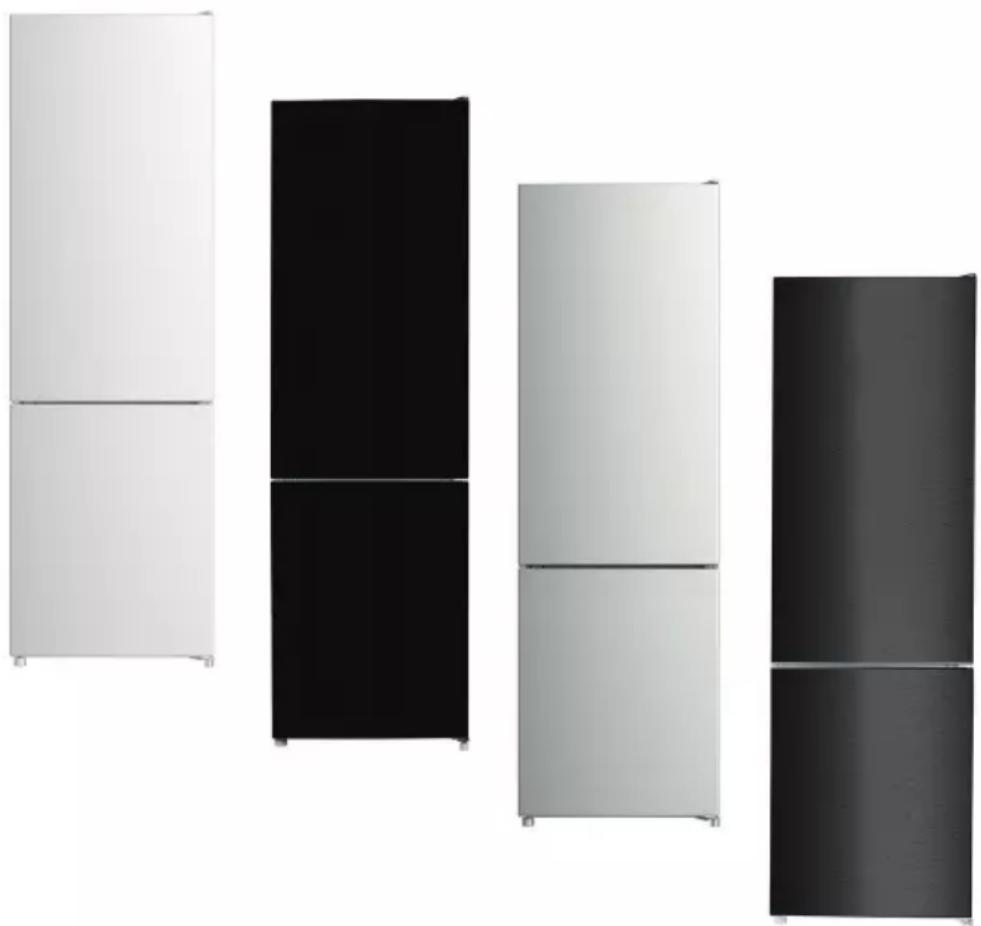
Four different refrigerator units in white and black shades arranged in a row (no text or symbols visible)Respekta
Mod. No.:
KG176W-37
KG176S-37
KG176IX-37
KG176BS-37
Inhalt
1 : ALLGEMEINE INFORMATIONEN......de-3
Abb. 4.1
natural_image
Hand inserting a plug into an electrical outlet (no text or symbols visible)Abb. 4.2
Abb. 5.4
Abb. 5.9
1.1 Reading the manual......en-3
2 : GENERAL SAFETY PRESCRIPTIONS......en-7
2.1 Important warnings...... en-7
2.2 Environmental protection ...... en-12
3: TECHNICAL DATA AND CHARACTERISTICS......en-13
3.1 Technical data ...... en-13
3.2 Wiring diagram...... en-16
4 : PRESCRIPTIONS FOR USE ...... en-17
4.1 Preliminary recommendations...... en-17
4.2 Using the refrigerator ...... en-18
5: INSTALLATION ...... en-25
5.1 Accessories list ...... en-25
5.2 Preliminary operations ...... en-25
5.3 Installation instructions...... en-25
5.4 Connection to the electrical supply ...... en-30
6 : MAINTENANCE ...... en-31
6.1 Cleaning and care...... en-31
7 : TROUBLESHOOTING ...... en-33
7.1 Fault finding...... en-33
1 : GENERAL INFORMATION
1.1 Reading the manual
1.1.1 Foreword
Dear customer, thank you for purchasing an appliance from our range.
The appliance is designed to refrigerate food or other perishables. Please read these instructions and follow them carefully: they describe the use and operation of your new appliance.
The appliance you have purchased is designed for both commercial and domestic use.
The manufacturer declines all liability for injury to persons or damage to property caused by incorrect or improper installation of the appliance.
The manufacturer reserves the right to make any changes it deems fit to the various models in order to comply with the technical regulations in force.
In case of complaints, please get in touch with your dealer's customer service department.
1.1.2 Manufacturer's data
1.1.3 Assistance service
For technical queries concerning your appliance, contact your dealer's customer service department.
Before calling the customer service department, make a note of:
- the model identification code
1.1.4 Introduction and safety
Before installing and/or using the appliance, read the instructions in this manual carefully.
This will help you gain familiarity with your new appliance.
Keep this document on hand so you can consult it whenever necessary and transfer it to the new owner if the appliance is sold.
Read the safety messages in the introduction to this manual and pay attention to safety information marked: "Caution", "Warning" and "Danger" in the text.
 | This symbol means:NOTEThis symbol denotes useful recommendations and highlights correct procedures and actions. Paying attention to the instructions accompanied by this symbol will help to prevent possible problems.This symbol highlights methods and procedures to adopt for correct use of the appliance. |
 | This symbol means:WARNINGThis symbol highlights an operation to be performed with special care because it could jeopardise the structure of the appliance or of its components. |
 | This symbol means:CAUTIONThis symbol highlights safety information. Read the information carefully. Also make sure you have fully understood the causes of potentially dangerous accidents. |
 | This symbol means:DANGERThis symbol highlights a situation that is potentially dangerous for you and for others. Read the information carefully. Also make sure you have fully understood the causes of potentially dangerous or fatal accidents. |
 | This symbol means:DISPOSALThis symbol on the product or on the pack shows that the product must not be treated as normal municipal waste but must be consigned to an electrical and electronic equipment collection and recycling centre. By disposing of the product correctly you are helping to protect the environment and the health and well-being of others. Incorrect disposal of the product endangers the environment and health. More information on how to recycle this product can be obtained from local authorities, waste disposal regulations, or the point of sale where you purchased the product. |
1.1.5 Appliance identification
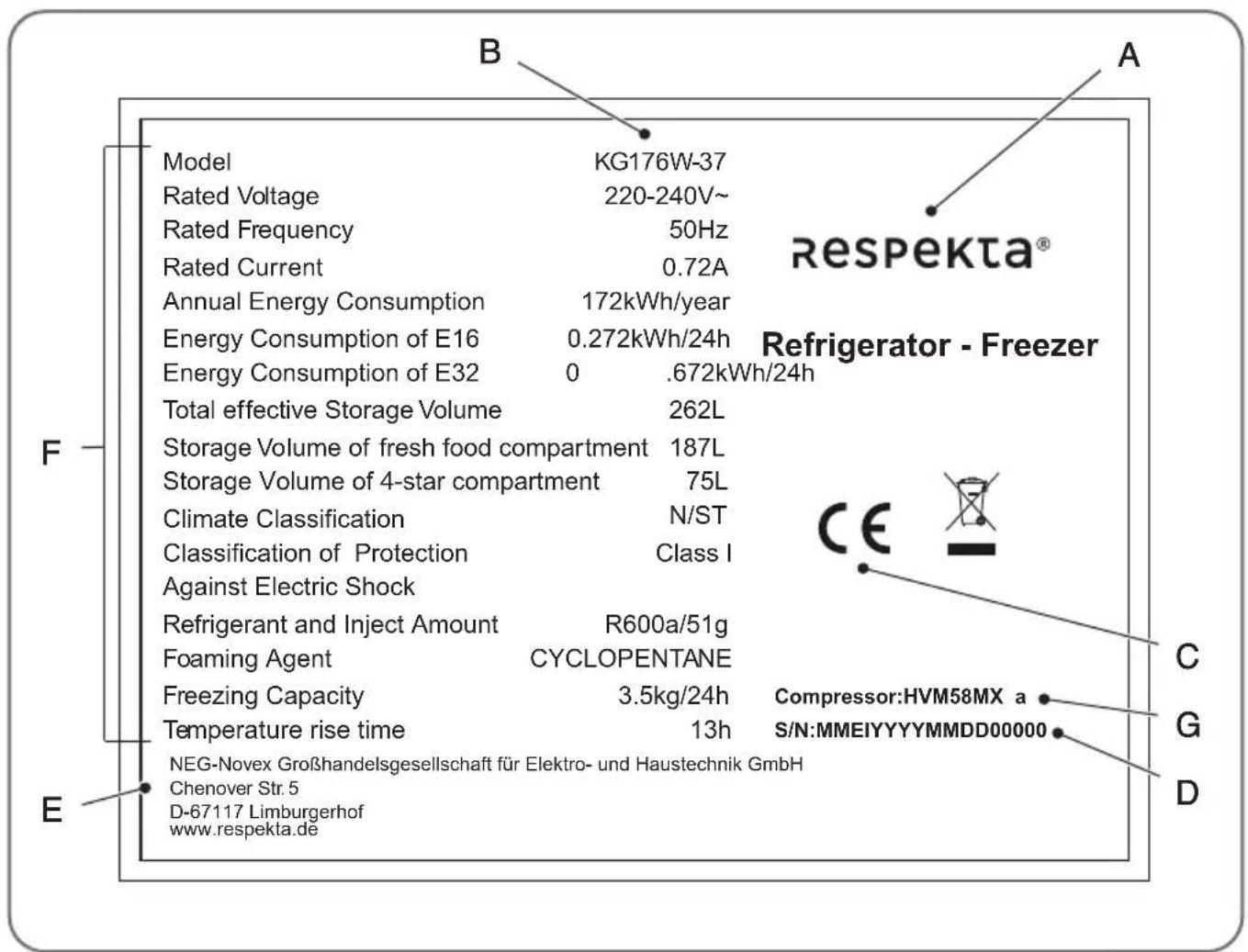
Fig. 1.1
The following information is shown on the nameplate:
A - Manufacturer
B - Model
C - CE mark
D - Serial number
E - Manufacturer's data
F - Description
G - Compressor model
 | NOTE: We recommend making a separate note of the appliance data and serial numbers to have a readily available record on hand when needed. |
 | NOTE: To maximise efficiency of the assistance and spare parts service, always quote the data on this nameplate. |
Nameplate location
The nameplate is located inside the appliance.
CE declaration of conformity
The manufacturer of the appliances described in this document, to which this declaration refers, states under its sole responsibility that the appliances are in compliance with the basic health, safety, and protection requirements of the relevant EC directives and that the related test reports, notably the CE declaration of conformity duly issued by the manufacturer or by its authorised representative, are available for inspection by the competent authorities and can be requested from the appliance dealer. The manufacturer also declares that any parts of the appliance or appliances described in this manual that may come into contact with fresh foods do not contain toxic substances.
1.1.6 Warranty conditions
The manufacturer declines all liability for damage caused by the purchaser.
This appliance is manufactured and tested using the latest available methods. Apart from the legally required 6-month warranty provided by the seller/dealer, the manufacturer provides a warranty for parts and workmanship for a period of 24 months from the date of purchase. Any repairs or alterations carried out by the purchaser or by third parties will automatically invalidate the warranty. The warranty does not cover damage caused by improper use or operation, by incorrect installation or storage, by an unsuitable power connection, or by causes of force majeure or other external influences. We reserve the right to repair or replace defective parts or to replace the appliance in case of warranty claims. Only if the appliance cannot provide the function specified by the manufacturer following repairs or replacement can the purchaser request a reduction of the purchase price or cancellation of the purchase contract under warranty within six months, calculated from the date of purchase.
Requests for compensation for damages, also in relation to consequential losses, will not be considered unless based on claims of malice or gross negligence.
Warranty claims must be validated by the purchaser by means of the purchase receipt.
2 : GENERAL SAFETY PRESCRIPTIONS
2.1 Important warnings
 | DANGER: Do not place flammable products or objects soaked in flammable liquids in, on top of, or near the appliance. |
 | DANGER: If the surface of the appliance is damaged, disconnect it from the power supply immediately to avoid electric shock. |
 | DANGER: Do not make any modifications to the appliance. Maintenance or repair work that calls for removal of protective panels is potentially dangerous for anyone except specialised technical personnel. To avoid electric shock hazards NEVER attempt to repair the appliance on your own initiative. |
 | DANGER: Do not burn flammable substances near the appliance to avoid the risk of fire. Do not use the appliance to store flammable or explosive substances (such as spray cans), acidic liquids and alkaline liquids. |
 | DANGER: Take care not to damage the refrigerant circuit because the fas is highly flammable. |
 | DANGER: There is a risk of fire if cleaning is not carried out in compliance with the instructions given in this manual. |
 | CAUTION: The appliance must be disconnected from the electrical supply before carrying out maintenance or cleaning tasks. |
 | CAUTION: Do not place carbonated or fizzy drinks in the freezer compartment because the containers can burst when the contents freeze.Do not place glasses in the freezer unless they are designed to resist low temperatures: the glass could crack or break, with risk of injury. |
 | CAUTION: Do not eat ice cubes or ice lollies immediately after removing them from the freezer because they can cause frost/freezer burns.Do not touch frozen foods with wet hands because the food may stick to your skin and cause frost/freezer burns. |
 | CAUTION: Before connecting the appliance make sure the data on the nameplate are compatible with the electrical supply in the place in which the appliance is to be installed. In the case of discrepancies, consult a qualified electrician. |
 | CAUTION: Do not touch the compressor: when in operation it can reach a surface temperature of 80°C. |
 | CAUTION: Do not insert the plug into the power socket until the appliance has been moved to its final position. Make sure the plug is still accessible after the appliance has been positioned. |
 | CAUTION: Insert the appliance plug correctly (fully) into the socket to avoid the risk of fire. |
 | CAUTION: Make sure the power cable connections are tight and the cable is not tangled.The power cable of this appliance is fitted with a plug compatible with a standard wall socket to minimise the risk of electric shock.This refrigerator requires a standard earthed 220-240VAC 50Hz power socket.Make sure the appliance is not placed on top of the power cable and take care not to tread on the power cable.The power cable must be secured behind the appliance and not left exposed or hanging, to eliminate the risk of injury.Do not use multiple socket adapters or extension leads. If the power cable is too short, have a power socket installed in a convenient position by a qualified electrician. Using an extension cable may impair performance of the appliance.If the power socket is loose, do not plug in your appliance.Do not pull the power cable to unplug the appliance. Always unplug the appliance by gripping the plug.Do not damage the power plug or cable. Contact the authorised customer service network or a specialised electrician to replace a damaged power cable. |
 | CAUTION: The mains power circuit must have an earth connection capable of carrying at least 10A. Do not connect the appliance to a transformer or multiple socket adapter. |
 | CAUTION: In case of fire, the plug must be readily accessible so the appliance can be unplugged easily, also after it has been positioned. |
 | CAUTION: Keep children less than 8 years of age away from the appliance. Children must be supervised to ensure they do not use the appliance improperly.The appliance can be used by children from 8 years of age on the condition that they are supervised or that they have been taught how to use the appliance safely and that they understand the associated hazards.Cleaning and maintenance must not be entrusted to children without supervision.Do not allow children to play with the appliance or tamper with the controls. Do not allow children to pull on the door, to avoid the risk of the appliance falling over.Keep children away from the appliance doors, to eliminate the risk of them becoming trapped inside.Do not allow children to access the compressor compartment or touch any metal parts on the rear of the appliance, to avoid the risk of injury.Keep all the packaging material out of reach of children. |
 | CAUTION: Use of the appliance by persons with physical, sensory, or psychological disabilities is permitted only when they are supervised by a carer responsible for their safety. |
 | CAUTION: The ventilation openings must never be covered or obstructed. |
 | CAUTION: Remove all packaging material, stickers and protective film (if present) before using the appliance for the first time. |
 | CAUTION: To clean the appliance first make sure it is switched off. |
 | CAUTION: Do not use a damaged appliance. |
 | CAUTION: If the appliance develops a fault, inform customer service. Never attempt to repair the appliance on your own initiative. |
 | CAUTION: Do not spray water on the appliance or wash it by pouring water on it or by flushing it with water or the electrical insulation may be damaged with the risk of electric shock. |
 | CAUTION: Do not use the appliance with wet hands or when in contact with water. |
 | CAUTION: Exposing the appliance to rain, snow, direct sunlight or wind, is hazardous in terms of electrical safety. |
 | CAUTION: Do not overload the refrigerator. Objects in the refrigerator may fall when the door is opened, causing injury or damage to property. Similar problems may arise also when placing objects on top of the appliance. |
 | CAUTION: Do not use mechanical devices or other means (hair-dryers/fan heaters) to speed up the defrosting process, other than the methods prescribed by the manufacturer. Do not use steam or steam cleaners to clean or defrost the refrigerator. Steam that comes into contact with electrical parts of the refrigerator may cause short circuits or electric shock. |
 | CAUTION: Containers in the appliance that contain flammable gases or liquids can leak at low temperatures. |
 | CAUTION: Do not damage the refrigerant circuit. |
 | CAUTION: Do not use electrical appliances inside the refrigerator food storage compartments, other than of the type allowed by the manufacturer. |
 | CAUTION: Beware of frost/freezer burns. Do not touch the surface of the compartment lining when the appliance is operating, especially if your hands are wet, to avoid the risk of frost/freezer burns. |
 | CAUTION: Take care not to trap your hands or any other part of the body in moving parts of the refrigerator. |
 | CAUTION: Due to the weight of the appliance, use special caution when installing or moving it. Always wear safety gloves and shoes. |
 | WARNING: The appliance should be installed by a specialised technician in compliance with the manufacturer's instructions and in conformity with statutory legislation. Incorrect installation may invalidate any possible warranty claims. |
 | WARNING: After removing the appliance from the package, check that it is in perfect condition. If it shows signs of damage, do not use it and instead contact the RESPEKTA service network. |
 | WARNING: Do not leave the appliance door open for long periods when it is operating. Prolonged opening of the appliance door can cause a significant rise of the temperature in the compartments, with a negative effect on the food quality and an increase in energy consumption. |
 | WARNING: Make sure bottles containing high proof spirits are tightly sealed and kept upright. |
 | WARNING: This refrigerator is designed for built-in installation. |
 | WARNING: This refrigerator may not work correctly (risk of foods thawing) if it remains in a place subject to temperatures that are outside the stated temperature range for optimal operation for prolonged periods.The compatible temperature range is shown on the nameplate. |
 | WARNING: Disconnect the appliance from the electrical supply before carrying out maintenance. |
 | WARNING: Clean the appliance regularly with a soft damp cloth (as illustrated in Sect.6 Maintenance).Do not clean the appliance with water jets or steam.Use exclusively pH neutral detergents to clean the appliance surfaces.Do not use scouring pads, solvents, or metal objects.WARNING: The appliance must not be modified in any way. Do not de-install and re-install the appliance unassisted, to avoid the risk of damaging it. Such actions will invalidate the warranty. |


WARNING: If the appliance is not used for long periods, unplug it from the electrical power socket and remove the food stored inside it.
WARNING: If the refrigerator has a door with a handle, do not attempt to move it by gripping the door handle (handle could become loose).
WARNING: To avoid spoilage of food products or undesirable alterations of flavour, comply with the following prescriptions:
- do not leave the appliance door open for long periods as this can cause a significant rise in the temperature of the compartments;
- regularly clean surfaces that may come into contact with food and the accessible drainage systems;
- store raw meat and fish in suitable refrigerator containers so it is not in contact with or at risk of dripping onto other food;
- if the refrigerator is to be left empty for long periods, switch it off, defrost it, clean it, dry it, and leave the door open to prevent the development of mould inside.
NOTE: Before installing and/or using the appliance, read the instructions in this manual carefully and keep them for future consultation.
NOTE: Respect manufacturers' recommended storage times. Refer to the instructions in this manual.
NOTE: The appliance is designed for commercial and domestic use.
The appliance is suitable for:
- kitchens, shops, offices and other workplaces;
- hotels, guest houses and other residential type premises.
NOTE: This appliance complies with electromagnetic radiation safety regulations.
NOTE: To benefit from the terms of the warranty, make sure you can produce the warranty card and the purchase receipt, otherwise the warranty will not be offered.
2.2 Environmental protection
2.2.1 Packaging
The packaging materials are 100% recyclable. Dispose of them in compliance with local legislation.

WARNING: The packaging material (plastic bags, polystyrene components, etc.) is potentially dangerous for children. Keep the packaging material out of reach of children.
2.2.2 Disposal

WARNING: Dispose of the appliance in compliance with legal prescriptions in a designated recycling centre. Before disposing of the appliance, cut off the power cable to make it unusable.

WARNING: The refrigerant and the cyclopentane foaming agent used in the refrigerator are flammable. Therefore, when the refrigerator is scrapped, it must be kept well away from any sources of ignition and must be disposed of by an authorised recycling company, to avoid environmental harm or any other type of damage.

WARNING: Before scrapping the appliance, remove the doors and remove the seals to prevent children from becoming trapped inside it.
3 : TECHNICAL DATA AND CHARACTERISTICS
3.1 Technical data
3.1.1 Models KG176W-37, KG176S-37, KG176IX-37, KG176BS-37
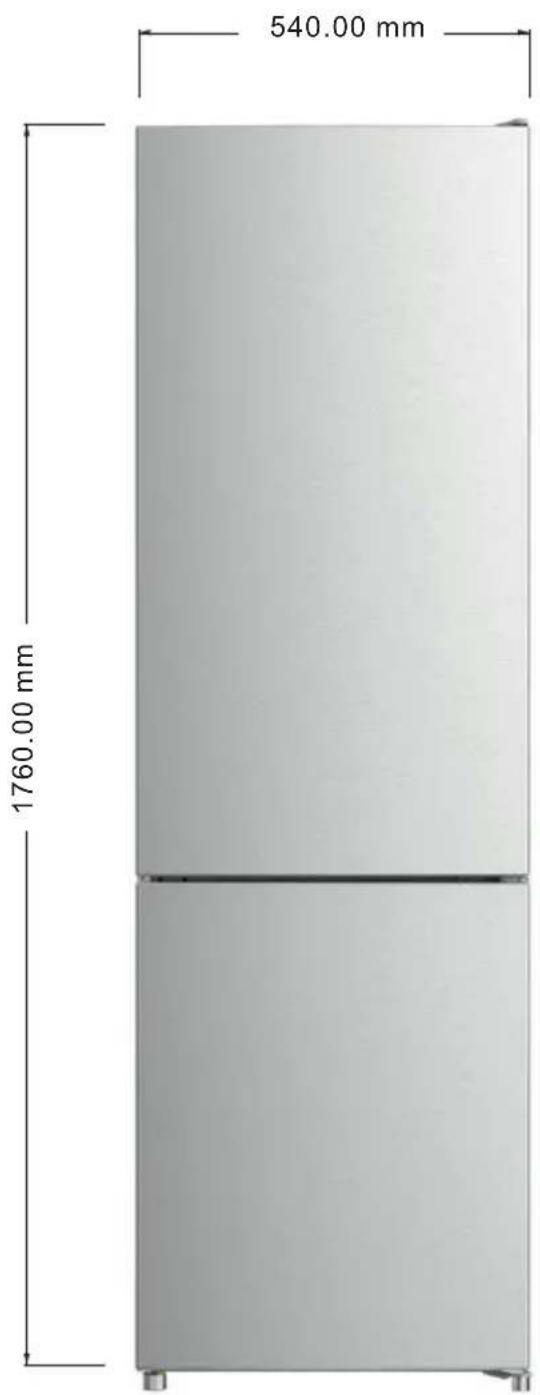
other
| Dimension | Value (mm) | | :--- | :--- | | Height | 1760.00 | | Width | 540.00 |Fig. 3.1

NOTE: The colour of the model you have purchased may differ from the one illustrated.
| Model no. | KG176W-37, KG176S-37, KG176IX-37, KG176BS-37 | |
| Product identification / Brand NEG Respekta | ||
| Product family (refrigerator, larder, freezer, wine cooler, beverage cooler) | Refrigerator | |
| Product type (combi, double door, single door, table-top, side-by-side)- free standing- built-in- built-under | Free-standing double-door refrigerator | |
| Energy efficiency class (EEC) (A-G) D | ||
| Energy efficiency index (EEI) % 80 |
General characteristics
| Exterior colour / finish (product body / door) KG176W-37 (White) | KG176S-37 (Black)KG176IX-37 (Inox Look)KG176BS-37 (Black Steel) | |
| Handles (external/integrated) Integrated | ||
| Voltage / Frequency V/Hz 220-240V~/50Hz | ||
| Input power / mains fuse (amperage) W / A 56/0.72 | ||
| Energy consumption / year kWh/year 172 | ||
| Energy consumption at 16°C for 24h kWh/24h 0.272 | ||
| Energy consumption at 32°C for 24h kWh/24h 0.672 | ||
| Climate class (SN=10~32°C, N=16~32°C,ST=16~38°C, T=16~43°C) | N/ST | |
| Noise emissions | dB(A) re1pW | 38 |
| Length of power cable with plug | mm | 1800 |
| Total volume (capacity) | Litres 262 | |
| Refrigerator net capacity | Litres 187 | |
| Freezer compartment net capacity | Litres 75 | |
| Refrigerant type (R134a/R600a/R290/etc.) | R600a/51g | |
| Foaming components (R141b / R134a / C-P) | C-P | |
| Cooling system: (Compressor / Absorption) | Compressor | |
| Compressor type: (Convection / Inverter) | Inverter | |
| Number of compressors | 1 | |
| Fridge / freezer defrosting (manual / automatic) | Manual | |
| Control system (electronic / mechanical) | Electronic | |
| Freezing capacity / 24 hours kg/24 h 3.5 | ||
| Freezer max storage time in case of power loss hours 13 | ||
| Appliance dimensions (Width-Height-Depth) mm 540 x | 1760 x 550 | |
| Net weight kg 49 | ||
| Gross weight (including packaging) kg 54 | ||
| Package dimensions (Width-Height-Depth) mm 580 x | 1820 x 590 | |
Refrigerator compartment
| Transparent glass shelves no. 3 | ||
| Salad crisper shelf no. 1 | ||
| Salad drawer no. 1 (transparent) | ||
| Door (storage racks) no. 3 | ||
| Reversible door Yes/No Yes |
Freezer compartment
| Drawers | no. 3 | |
| Drawer colours (white, transparent, green, grey) | Transparent | |
| Reversible door Yes/No Yes |
Lighting
| Interior light type | LED | |
| Interior light power W 1 |
Equipment or accessories
| Ice cube tray(s) | no. 1 | |
| Ice scraper(s) | no. 1 | |
| Egg tray(s) / Total number of eggs | no. 1 / for 7 eggs | |
| Height adjustable feet (front/rear) | no. 2 (front) | |
| Wheels (front / rear) | no. 2 (rear) |
3.2 Wiring diagram
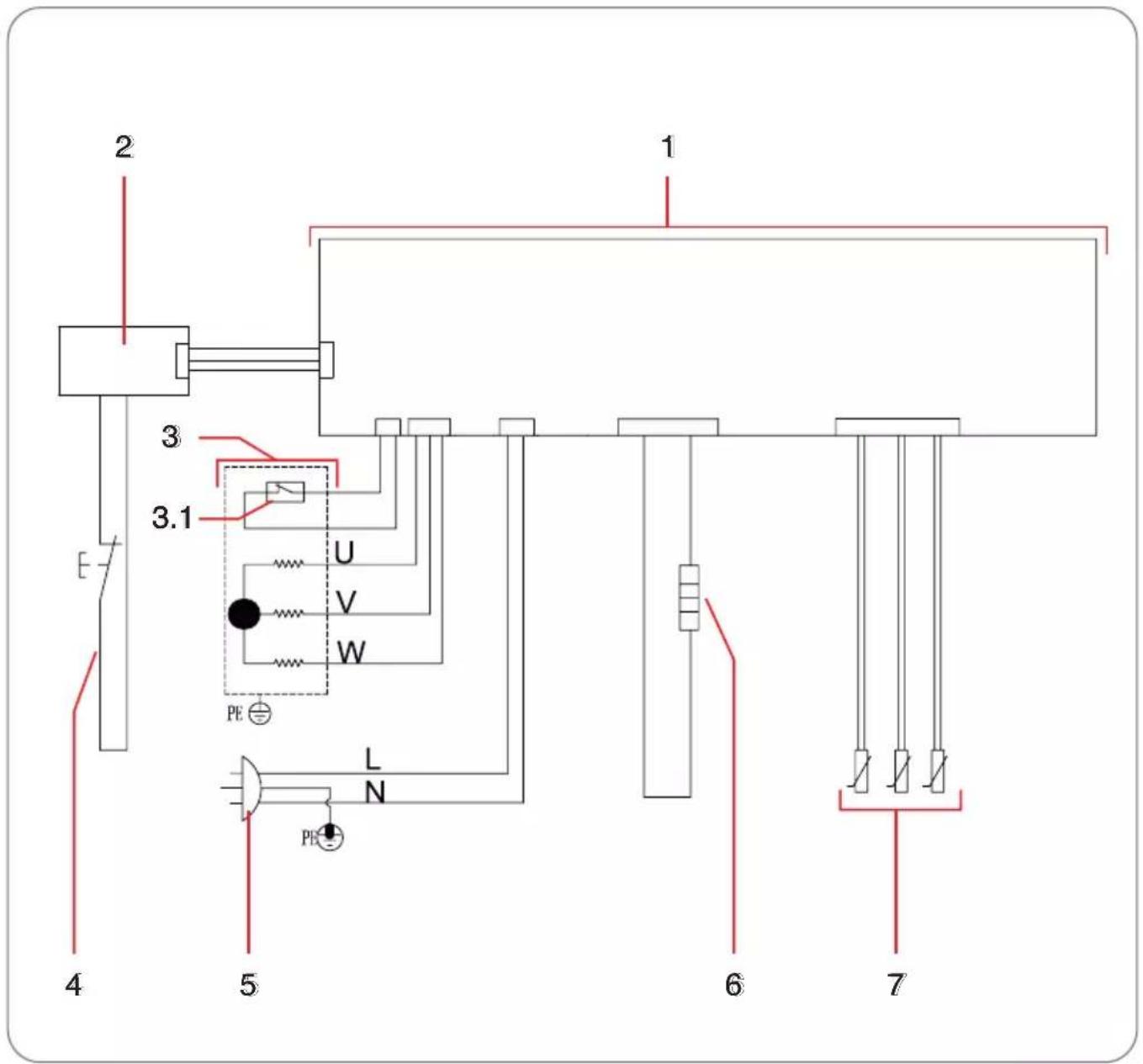
Fig. 3.2
1 - Control panel
2 - Display
3 - Compressor
3.1 - Fuse
4 - Switch
5 - Plug
6 - Heating element
7 - Temperature sensor
4 : PRESCRIPTIONS FOR USE
4.1 Preliminary recommendations
 | CAUTION: The appliance must be disconnected from the electrical supply before carrying out maintenance or cleaning tasks. |
 | CAUTION: The ventilation openings must never be covered or obstructed. |
 | WARNING: Check the appliance for transport damage. |
 | WARNING: Remove all protective film (if present). |
 | WARNING: Regular maintenance keeps the appliance in good working order with optimal performance. |
 | WARNING: Do not obstruct the area in front of the fan or cooling will be impaired. |
 | WARNING: Do not use steam cleaners. |
4.1.1 Main refrigerator functions
Electronic temperature control
Reversible refrigerator and freezer doors
4.2 Using the refrigerator
4.2.1 Main components of the refrigerator
KG176W-37, KG176S-37, KG176IX-37, KG176BS-37
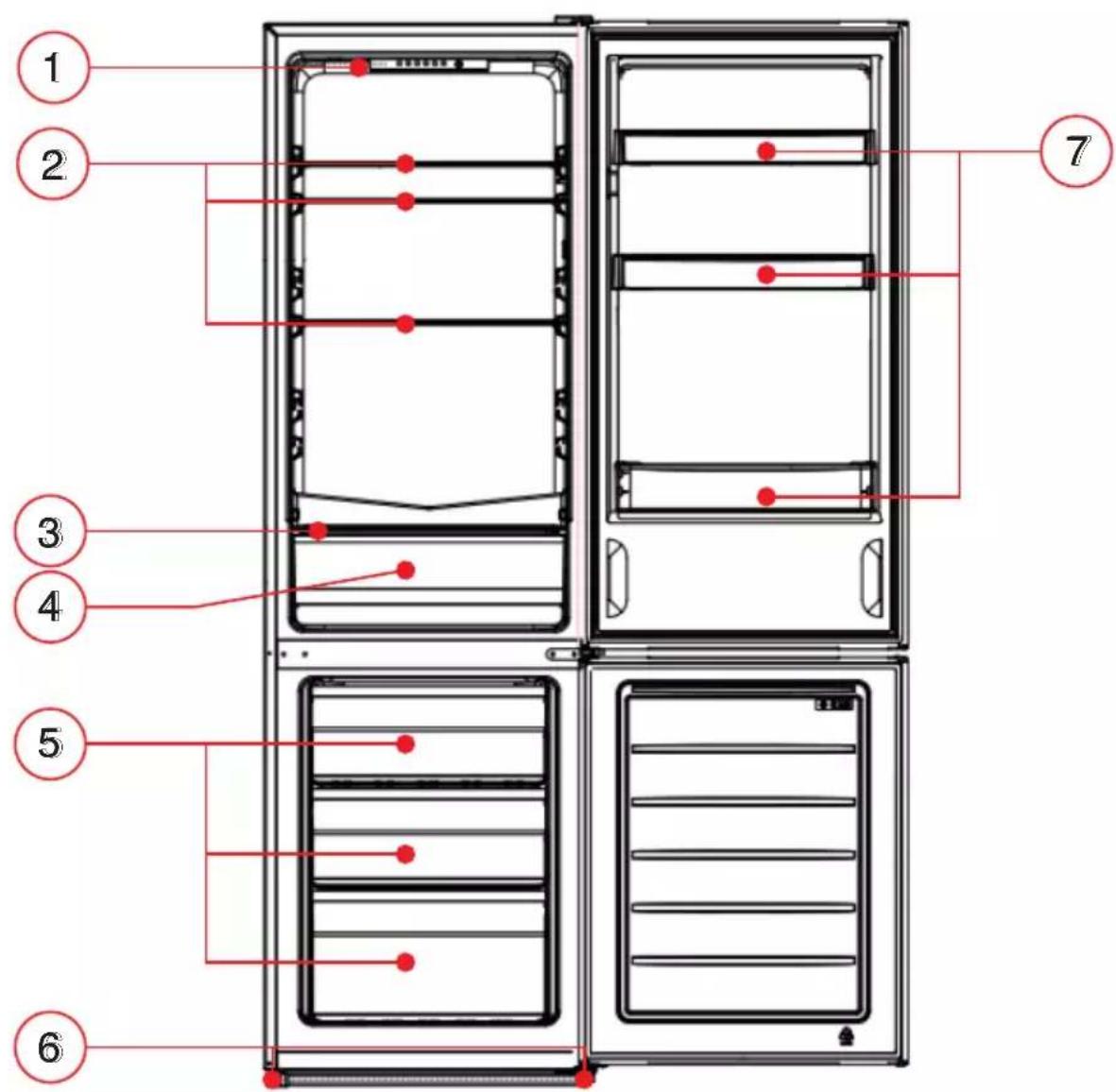
Fig. 4.1
1 - Thermostat
2 - Fridge glass shelves
3 - Salad drawer cover
4 - Salad drawer
5 - Freezer drawers
6 - Adjustable feet
7 - Bottle holder

NOTE: The descriptions in this manual may not correspond to your appliance. Refer to the physical product and to the technical specifications in Sect.3 "Technical data and characteristics".
4.2.2 First use
Use a soft cloth to clean the interior of the appliance carefully (including accessories). Before switching on the refrigerator, make sure the interior is dry.

CAUTION: Do not use the appliance with wet hands or when in contact with water.
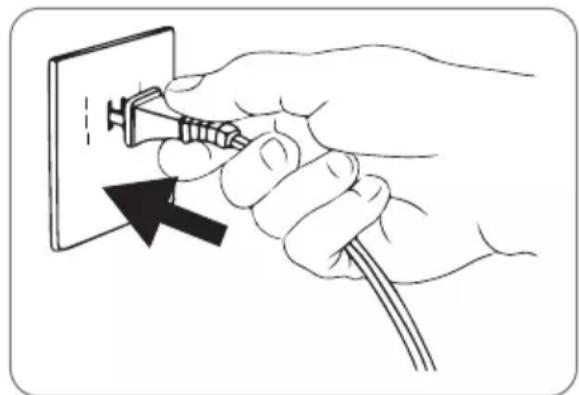
Plug the refrigerator into the electrical socket. The interior light will switch on when the refrigerator door is opened. Operate the refrigerator for approximately 5/6 hours without loading any foods. After just one hour you should be able to feel a significant temperature drop when you open the freezer door.
natural_image
Hand inserting a plug into an electrical outlet (no text or symbols visible)Fig. 4.2
Once the set temperature has been reached (default level 3) you can insert the food products, which will take 2 or 3 hours (longer in summer months) to reach the chilled storage temperature.

WARNING: Do NOT install the appliance in a very damp room. If the appliance must be installed in a damp room, apart from normal checking of the electrical system (RCD protection and protective earth) make sure the power cable is raised from the floor and that the socket is at least 30 cm above floor level.

WARNING: Do not install the appliance too close to the wall, to avoid noisy operation or blackening of the surfaces; follow the guidelines in (Fig.5.1).

WARNING: The refrigerator may cause interference with phones, radios and TVs; position the refrigerator as far as possible from all such devices.

NOTE: You will hear a noise when the compressor starts up. Also the liquids and gases inside the refrigeration system can produce noises, even with the compressor stopped. Such occasional noises are completely normal.

NOTE: Open the refrigerator door only when necessary.
4.2.3 Temperature control panel
flowchart
graph TD
    A["FAST COOL"] --> B["COLDESTRECOMMEND"]
    C["1"] --> D["OLD"]
    E["2"] --> F["SET"]
    G["3"] --> H["FAST COOL"]
Fig. 4.3
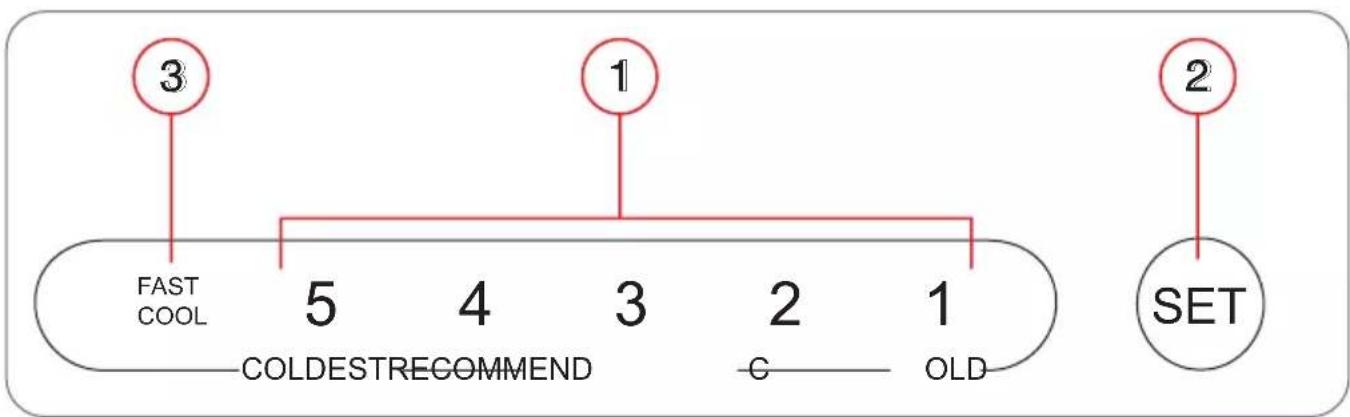
The refrigerator temperature is managed from the control panel in the refrigerator compartment (1, Fig.4.1).
1 - Temperature levels (from 1 to 5)
2 - Temperature selection key (SET)
3 - "FAST COOL" level
Temperature setting
The refrigerator temperature is set by pressing "SET" key (2) until reaching the required temperature level.
Increasing the value produces a lower temperature; 5 is the maximum available setting. Every time the "SET" key is pressed, the current temperature level switches off and the next level starts flashing. If no change is made within 5 seconds, the flashing level will be fixed and the refrigerator will retain the new setting. When it is first switched on, the refrigerator will automatically set to the recommended level "3".
The control panel settings proceed as follows: 3→2→1→FAST COOL→5→4→3.
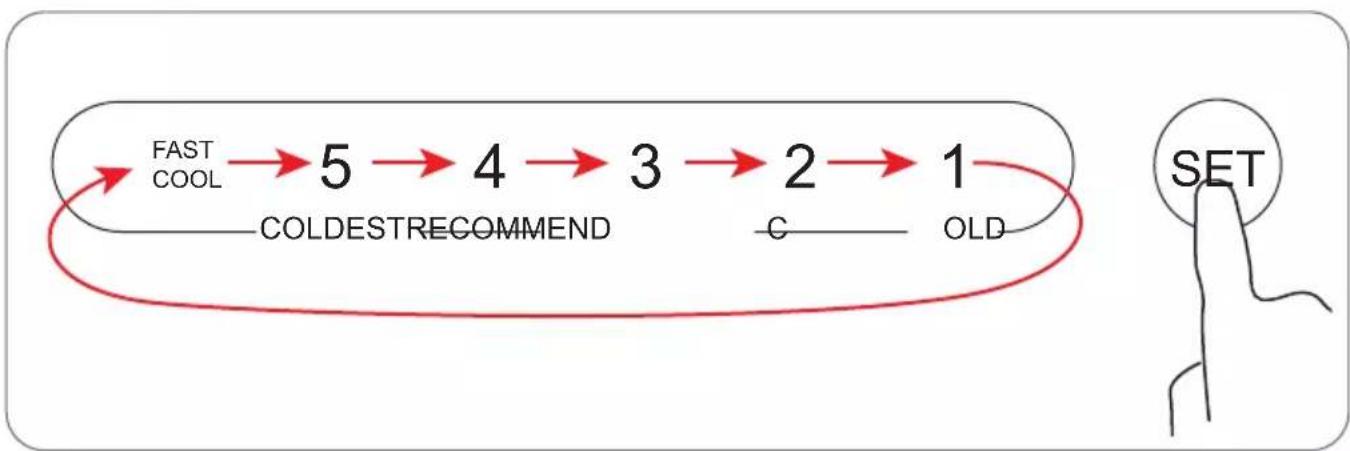
flowchart
graph LR
    A["FAST COOL"] --> B["5"]
    B --> C["4"]
    C --> D["3"]
    D --> E["2"]
    E --> F["1"]
    F --> G["COLDESTRECOMMEND"]
    G --> H["OLD"]
    H --> I["SET"]
Fig. 4.4
E.g.: if the current temperature level is "3", pressing "SET" once, level "2" will start flashing and level "3" will switch off; you can now press the "SET" key again to set the next value or, if "SET" is not pressed level "2" will become the new setting after about 5 seconds. Press the "SET" key as many times as necessary to set the required temperature.
"FAST COOL" setting
To chill or freeze food rapidly select the "FAST COOL" level (3, Fig.4.3).
Press the “SET” key once or several times (depending on the current temperature level) until enabling the "FAST COOL" level. The fast cool function will switch off automatically after a maximum of 26 hours and the temperature level will return to the previous setting, or it can be deactivated manually by pressing the "SET" key to set a different temperature.

WARNING: If indicator light "5", "3" or "1" flashes continuously, it means the refrigerator is faulty. Contact the assistance service as soon as possible.
Table of settable temperatures
| Settable temperature levels | Fridge temperature Freezer temperature | |
| 1 (6) ~ (8)°C (-10) ~ (-12)°C | ||
| 2 (4) ~ (7)°C (-12) ~ (-16)°C | ||
| 3 (*) (2) ~ (6)°C (-16) ~ (-20)°C | ||
| 4 (1) ~ (5)°C (-18) ~ (-22)°C | ||
| 5 (**) (0) ~ (4)°C (-20) ~ (-24)°C | ||
| FAST COOL (-2) ~ (2)°C (-22) ~ (-26)°C |

NOTE: (*) The recommended temperature setting is "3". (**) Avoid using mode "5" to avoid the risk of freezing the food items.
4.2.4 Food storage instructions
Precautions for use
 | WARNING: This refrigerator may not work correctly (risk of foods thawing) if it remains in a place subject to temperatures that are outside the stated temperature range for optimal operation for prolonged periods.The compatible temperature range is shown on the nameplate. |


Precautions for storing foods
Some foods should be washed and carefully dried before placing them in the fridge. Wrap foods before placing them in the refrigerator to prevent water evaporation and minimise odours.
Do not overload the refrigerator. Leave sufficient space between food items; if they are too close together the cold air stream is obstructed and chilling is less efficient. Do place excessive amounts of food (or very heavy items) on the shelf to avoid overloading it. Keep food a certain distance from the inner wall; do not place very wet foods close to the fridge walls to prevent them from freezing.
Foods that are eaten daily should be placed in the most accessible compartment in order to reduce the duration of door opening and avoid food degradation.
Food storage
Cold air circulation in the refrigerator leads to different temperatures in different areas, so various food types should be placed in different areas.
The fresh food compartment is suitable for foods that must not be frozen, cooked food, beer, eggs, some condiments requiring low temperature storage, milk, fruit juice, etc. The crisper draw is suitable for vegetables, fruit, etc.
The freezer drawers are for ice cream, frozen foods, and foods suitable for long storage times.
Use of the fresh food compartment
Set the fresh food compartment temperature at 2^ 8^ for short term food storage and for regular consumption.
When you remove the shelf, lift it first and then slide it out; when refitting the shelf, position it before lowering it. For the double shelf, push the first section towards the back and then pull out the second section.

NOTE: For all shelves. Keep the rear flange of the shelf upwards to prevent the foods from coming into contact with the inner walls of the refrigerator. When removing or fitting the shelf, hold it firmly and handle it with care to avoid damage.
Storing fruit and vegetables
Pull out the crisper drawer to reach its contents. After using or cleaning the crisper compartment cover, make sure you refit it correctly to avoid changing the internal temperature.
If your fridge has chiller compartment, pay attention because certain types of vegetables and fresh fruit are sensitive to the cold and are therefore unsuitable for storage in this type of space. Follow the instructions on the package.
Using the freezer
The freezer temperature is kept below -15^ (preferably -18^ ), i.e. the recommended temperature for long term food storage.

NOTE: Check the storage life of foods as shown on the package.
Place the ice cube tray at the top of the freezer so the water freezes rapidly.
The freezer drawers are used to store foods that must be frozen. Fish and meat should be placed in dry freezer bags for storage and distributed uniformly in the freezer drawers. If necessary, divide large size food items into smaller pieces. Food must be packaged or wrapped in suitable materials: strong, impermeable to air and water, non-toxic and non-polluting, to avoid contamination and odour formation.
- Foods suitable for freezing: bakery products, fish and seafood, meat, game, poultry, vegetables, fruit, herbs, liquid egg, dairy products (choose, butter and ricotta), ready meals, soups, casseroles and sweets.
- Foods not suitable for freezing: vegetables normally consumed raw, such as salad and radishes, fresh eggs, grapes, apples, pears, peaches, hard-boiled eggs, yoghurt, milk curds, sour cream, crème fraîche and mayonnaise.

WARNING: Do not place liquid containers (e.g. glass bottles) in the freezer. Such containers may burst due to expansion of liquids when they freeze.

WARNING: Do not place glass containers or cans in the freezer: they might burst.

WARNING: Thawed foods should not be refrozen.

NOTE: Allow hot foods to cool to ambient temperature before placing them in the freezer compartment.
Tips when buying frozen foods
1) When you buy frozen foods, comply with the storage guidelines shown on the package.
2) Make sure the frozen food package is in perfect condition.
3) Always purchase frozen foods last when shopping and pick them up last in the supermarket. Keep frozen foods together while shopping and during the return journey in order to keep them cold.
4) Do not buy frozen foods unless you can put them in the freezer shortly. Insulated shopping bags can be purchased to keep foods frozen for longer.
5) For certain foods, such as frozen vegetables, pasta, meat, fish, or sauces always follow the instructions on the pack for thawing and cooking times.
6) Handle frozen foods as little as possible.
7) If freezing large quantities of food, lower the freezer temperature to the minimum: the foods will be frozen rapidly, thus maintaining their initial properties unchanged.
4.2.5 When you are away from home
- Short vacations: leave the refrigerator running when going away for less than three weeks, remembering however that long power cuts may occur during your absence.
- Long vacations: if the appliance will be unused for several months, switch it off and unplug it, remove all foods, and clean and dry the interior carefully. To avoid the formation of odours and mould, leave the appliance door open / ajar.
4.2.6 Energy saving
Do not leave the fridge-freezer doors open for long periods. Arrange the food in the refrigerator in order to reduce the need to open the door. Remove the number of products required all at the same time and close the door as soon as possible. Make sure the refrigerator door is perfectly closed and in contact with the seals. Do not place hot or warm foods or beverages in the refrigerator. Do not overload the refrigerator. Dry containers before placing them in the refrigerator, to avoid the formation of condensation.
The cooling capacity is reduced when air circulation in the refrigerator is obstructed: arrange the foods to avoid obstructing the air flow. Do not cover the shelves with foil or kitchen roll. Such coverings will interfere with cold air circulation, making the refrigerator less efficient and causing food to deteriorate.
Do not position the refrigerator in places exposed to direct sunlight. Install the appliance at least 30 cm from heat sources such as hobs, ovens, radiators and stoves.
Thawing frozen foods in the refrigerator compartment helps save energy and protects the quality of the food products.
4.2.7 Climate range for use of the refrigerator
Information on the climate range for use of the appliance is given on the nameplate, which is marked with a code referred to ambient temperature (temperature of the room where the appliance is used) for optimal operation of the appliance. Refer to the table shown below.
| Code showing climate range for use Permissible ambient temperature | |
| SN from +10°C to +32°C | |
| N from +16°C to +32°C | |
| ST from +16°C to +38°C | |
| T from +16°C to +43°C | |

NOTE: Considering the climate range values for which the appliance is designed and the fact that internal temperatures may be affected by various factors including positioning of the appliance, ambient temperature, and the frequency of door opening, the setting of temperature control devices may need to be adjusted accordingly.

NOTE: If the appliance is used in a place in which the temperature is outside the climate range of use, it may be unable to maintain the set temperatures.
4.2.8 Refrigerant characteristics
The refrigerator uses a freon-free refrigerant (R600a) and an environmentally compatible foaming insulation material (cyclopentane) that does not harm the ozone layer and has minimal impact on global warming.

CAUTION: In case of refrigerant leakage caused by damage to the refrigerant circuit, be sure to keep the appliance away from open flames and open the windows for ventilation as quickly as possible.
5 : INSTALLATION
5.1 Accessories list
A list of accessories available for models KG176W-37, KG176S-37, KG176IX-37, KG176BS-37 is provided at the end of Sect.3 "TECHNICAL DATA AND CHARACTERISTICS".
5.2 Preliminary operations
5.2.1 Safety instructions for installation
Before installation:
 | WARNING: The appliance must be installed on a stable, dry, and level floor. |
 | WARNING: Check that the installation area is free of structural impediments. |
 | WARNING: Do not install / use the appliance in damp or freezing premises.Do not use the appliance outdoors where it is exposed to direct sunlight or rain. |
 | WARNING: Do not tilt the appliance more than 45° when positioning it. |
 | WARNING: Make sure the appliance is installed in compliance with all the applicable regulations and safety standards. |
 | WARNING: Make sure there is sufficient clearance for heat dissipation at the sides of the refrigerator. |
5.3 Installation instructions
5.3.1 Positioning
Ventilation conditions
The position chosen for installation of the refrigerator must be well ventilated. Do not position the refrigerator close to heat sources such as gas rings or boilers and ensure it is not exposed to direct sunlight in order to guarantee optimal refrigeration and save on energy consumption. Do not install the refrigerator in a damp room, to avoid the formation of rust and oxidation of the wiring. The result of the refrigerant charge quantity divided by the total space in the room in which the appliance is installed must be less than 8g / m³.

NOTE: The quantity of refrigerant in the refrigerator is shown on the nameplate.
Heat dissipation space
During operation, the refrigerator emits heat into the surrounding environment. Therefore, it is important to leave at least 30 mm of clearance at the top, 100 mm at both sides and more than 50 mm at the rear of the appliance.
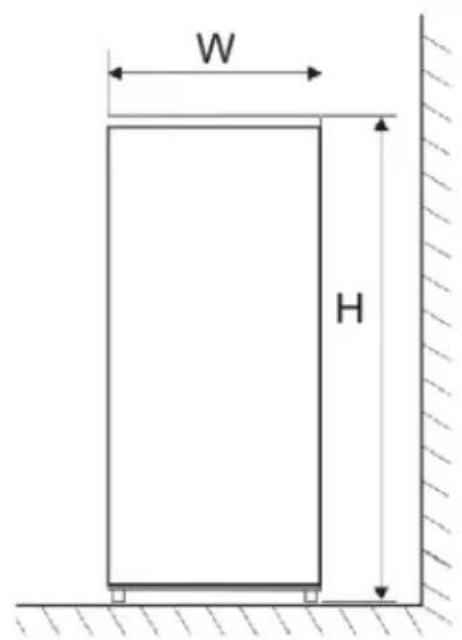
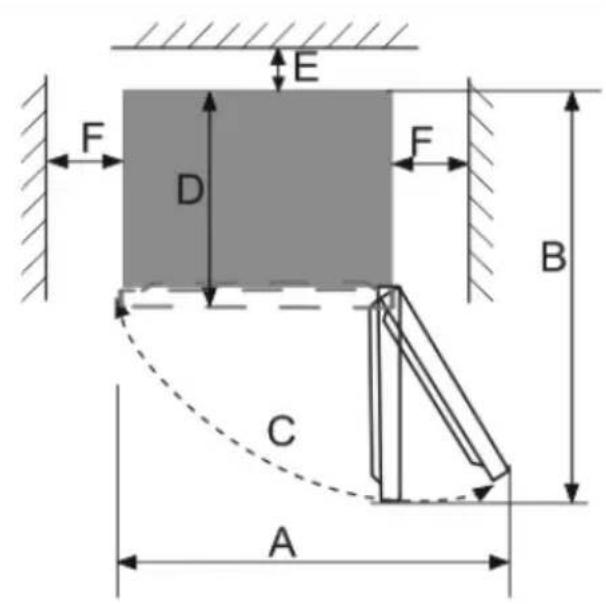
Fig. 5.1
| W (mm) D | (mm) H (mm) | A (mm) B (mm) C (°) E | (mm) F (mm) | |||
| 540 550 17 | 60 910 1055 | 130±5 50 100 |


Supporting surface
Install the refrigerator on a solid and flat floor surface to keep it stable, otherwise it may be subject to vibration and noise. If the refrigerator is standing on flooring materials such as carpet, mats, or polyurethane, interpose solid supports/boards under the appliance to prevent deterioration of the aforementioned flooring materials due to heat dissipation.
Levelling
Stabilise the refrigerator by means of the front levelling feet (height adjustable). If the refrigerator is not correctly stabilised, the door seals may become distorted, thus preventing the appliance from working correctly. In addition, the appliance may vibrate anomalously. After having positioned the refrigerator, wait at least 4 hours before using it, to allow the refrigerant to settle.
WARNING: Make sure the appliance is disconnected from the electrical supply.
If, while reversing the door, the appliance is supported on a wall or laid on its side for a period of time, it must be left in an upright position for 6 hours before plugging it back in, to avoid damaging the internal components.

NOTE: Before tightening the hinge screws, make sure the rubber seals are perfectly airtight around the entire perimeter of the doors.
Open the refrigerator door by 90 degrees.
Prise hinge cover (A) and remove it, then remove the three screws fixing the top hinge to the door and remove hinge (B).
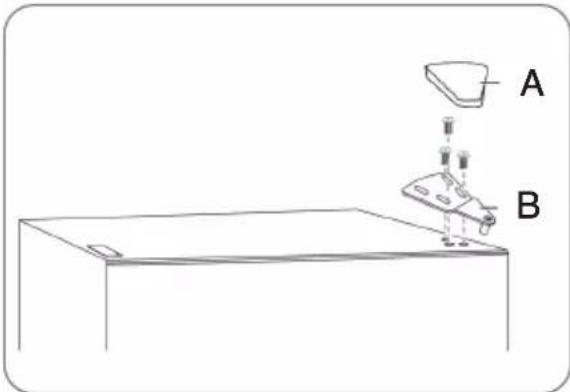
Fig. 5.2
Remove the refrigerator door (C).
Remove the two screws fixing central hinge (D).
Remove central hinge (D) and then remove the freezer door.
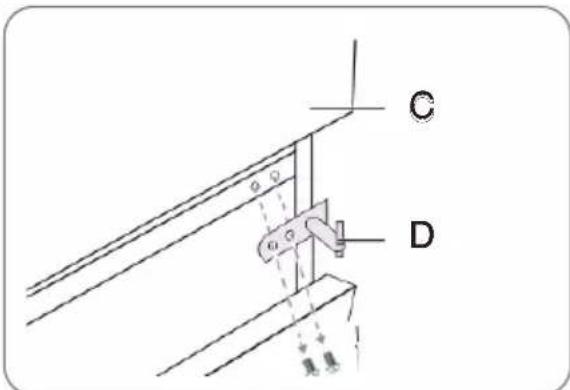
Fig. 5.3
Remove the bottom hinge fixing screws (right-hand side of the fridge), then remove hinge (E).
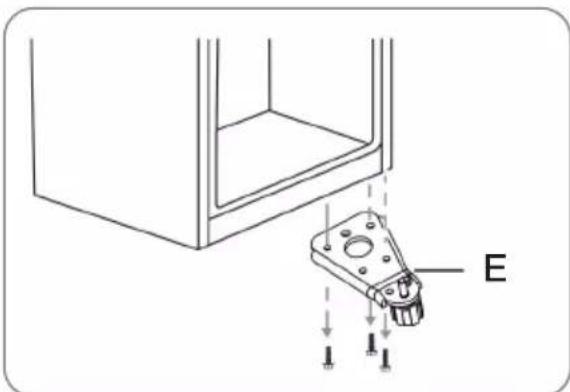
Fig. 5.4
Remove the washer and nut securing pin (F) to bottom hinge (E).
Remove pin (F).
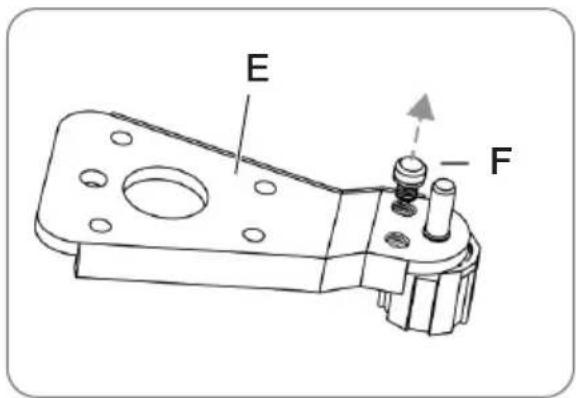
Fig. 5.5
Insert pin (F) into the LH hole of bottom hinge (E).
Fix pin (F) with the washer and nut.
Install bottom hinge (E) on the LH of the refrigerator.
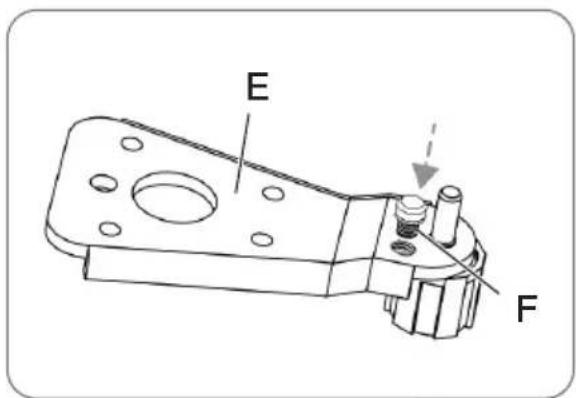
Fig. 5.6
Remove the screw that secures door stop (G) located at the bottom right of freezer door (H), then remove stop (G) and install it on the left lower side of freezer door (H).
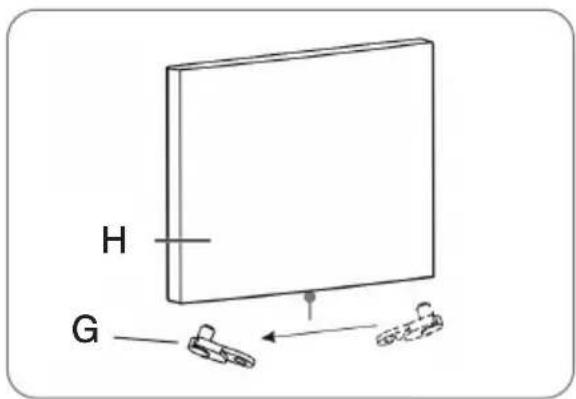
Fig. 5.7
Install freezer door (H).

NOTE: Make sure the door is perfectly aligned with the base of he refrigerator and that the rubber seal is perfectly airtight.
Move bushing (I) from the top RH side to the top LH side of freezer door (H).
Move blanking plug (L) from the LH hole to the RH one.
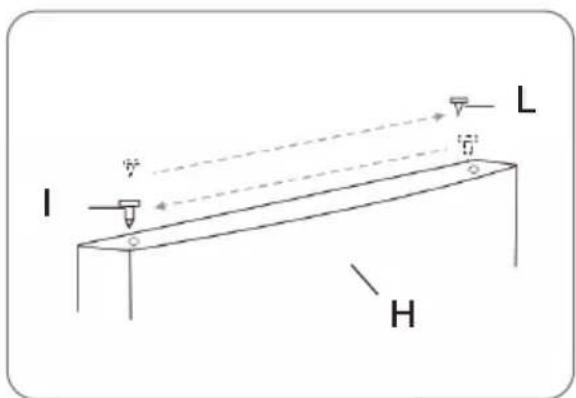
Fig. 5.8
Remove blanking plug (M) on the LH side of the refrigerator (at the height of the central hinge) then fit it in the screw holes on the RH side of the refrigerator.
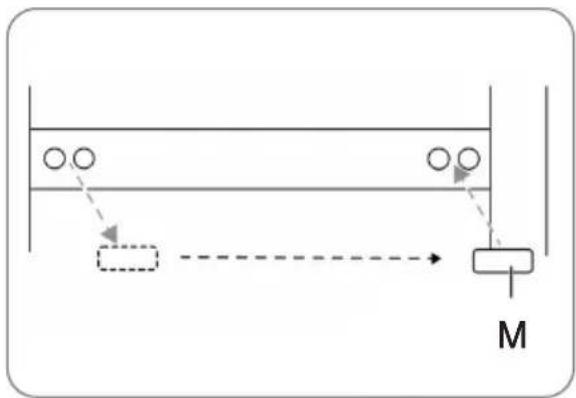
Fig. 5.9
Install central hinge (D) on the LH side, insert and tighten the two previously removed screws (Fig.5.3).
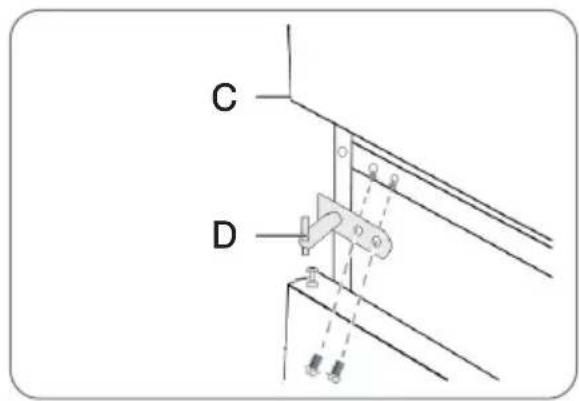
Fig. 5.10
Remove the screw securing door stop (G) located at the bottom RH side of refrigerator door (C), then remove stop (G) and install it on the LH bottom side of refrigerator door (C).
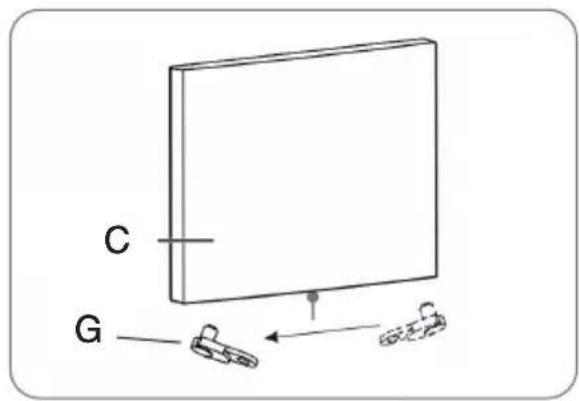
Fig. 5.11
Install refrigerator door (C).
Move bushing (I) from the top RH side to the top LH side of the refrigerator door.
Move blanking plug (L) from the LH hole to the RH one.
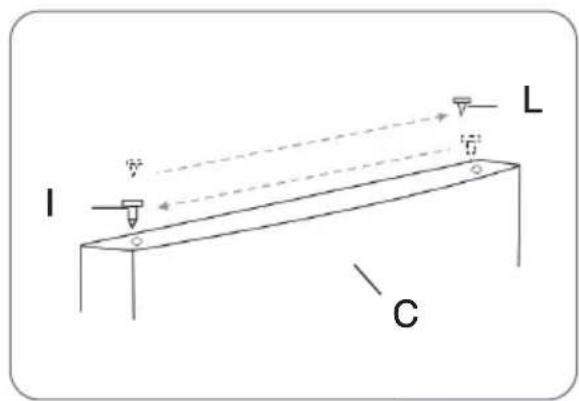
Fig. 5.12
Remove screw hole cover (N) from the top LH side of the refrigerator and fix it on the top RH side.
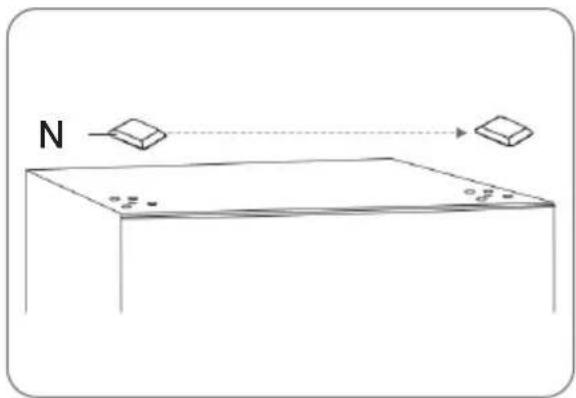
Fig. 5.13
Fix top hinge (B) to the top LH side of the refrigerator with the three previously removed screws (Fig.5.2).

NOTE: Before tightening the top hinge screws make sure the door is perfectly aligned with the upper part of the refrigerator and that the rubber seal is perfectly air tight.
Fit cover (A) on the top LH hinge of the refrigerator.
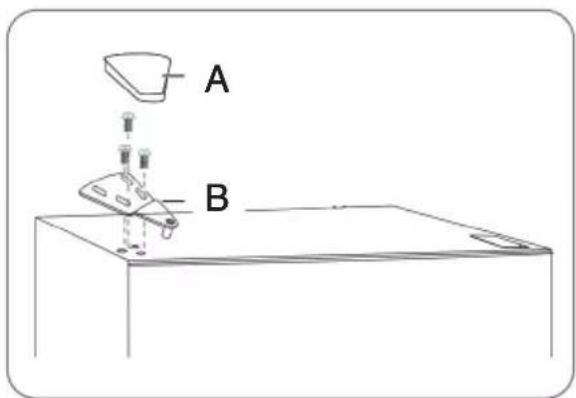
Fig. 5.14
5.4 Connection to the electrical supply
Before connecting the appliance to the electrical supply, read the following information:
 | DANGER: Do not use adapters, multiple sockets or extension leads to connect the appliance to the electrical supply, to avoid the risk of overheating and fire. The power cable must be positioned so that it is not in contact with any hot surfaces at any point. |
 | WARNING: A specialised technician must check that the home electrical system is compatible with the power input of the refrigerator. Check the values shown on the appliance nameplate. |
 | WARNING: The home electrical system must be fitted with a single-pole circuit breaker/contactor or an equivalent device, in compliance with local regulations. |
 | WARNING: Check the power cable regularly.If the power cable is damaged or must be replaced, this operation must be carried out only by a specialised technician with suitable tools, to avoid the risk of injury. |
 | WARNING: The cable must not be kinked or pinched. |
6 : MAINTENANCE
6.1 Cleaning and care

CAUTION: Before proceeding with cleaning, unplug the appliance from the power socket.
NEVER plug in/unplug the appliance while your hands are wet: risk of electric shock and injuries.

WARNING: Never use petrol, benzene or similar substances to clean the appliance.
Do not use vinegar, denatured alcohol, or other alcohol based detergents on any of the internal surfaces of the appliance.
Do not use water or chlorine based detergents to clean the external surfaces. Chlorine may produce abrasions on some metal surfaces.
Do not use abrasive or sharp tools, soap, household detergents, laundry detergent, or wax polish.
Keep water well away from the interior light socket and all other electrical parts.

WARNING: When you start using the refrigerator, it is advisable to use it continuously; in normal circumstances, do not stop using it to avoid negatively impacting the reliability and lifetime.
Cleaning the fridge
Dissolve a teaspoonful of bicarbonate of soda in half a litre of water. Immerse a cloth in the solution and wring it out thoroughly. Clean the interior of the refrigerator with the cloth and dry it carefully. Regularly check that the door seals are clean. Clean the doors seals if necessary.
If the refrigerator is not required for use for a long period, unplug it from the power socket, remove all the food from inside, clean it and leave the door open or ajar.
Remove all the shelves, compartments, bottle racks, etc. and clean them with a soft cloth or a sponge soaked in warm water or a neutral detergent. Dry all the detachable parts before refitting them in the refrigerator.
Power loss or refrigeration system fault
Check the condition of the frozen foods in case of prolonged non-operation of the appliance (e.g. due to a power failure or refrigeration system fault).
Try to open the refrigerator door as infrequently as possible so that the products will be safely preserved and remain fresh for longer.
If you are informed of an impending power outage in good time, proceed as follows:
1 - Set the thermostat to the coldest mode one hour in advance (use FAST COOL mode if necessary), in order to completely freeze the food items (do not insert food during this period). Restore the normal thermostat setting when a continuous power supply is restored.
2 - You can prepare ice in a sealed container and place it in the upper part of the freezer in order to extend the food storage time.
Odour prevention
Sometimes unpleasant odours may be emitted if foods are stored incorrectly and the interior surfaces of the refrigerator are not cleaned regularly.
It is important to keep the refrigerator clean. Food residues, liquid spills, etc. can produce undesirable odours. The refrigerator should therefore be cleaned every 15 days with a water and sodium bicarbonate solution. Never use detergents or soap.
Keep food in sealed containers. Microorganisms found in uncovered containers can produce undesirable odours. Never store food beyond its expiry date or spoiled foods.
Defrosting
After a certain period of use, a thin layer of ice will form on the interior surfaces of the freezer compartment. When the ice is more than 5 mm thick the cooling efficiency of the appliance will be reduced, so the ice should be removed as soon as possible.
The layer of ice must be removed approximately every 3 months.
Perform the following operations to remove excess ice:
1 - Remove the frozen food contents, unplug the appliance from the power socket, open the freezer door and carefully remove the ice from the inner walls using a specific plastic scraper. For faster defrosting place a bowl of hot water in the freezer. When the ice starts to melt, use the plastic scraper to remove it.
2 - After defrosting, clean and dry the interior of the freezer with a soft cloth, and then plug the appliance back into the power socket.
Changing the refrigerator interior light bulb
 | CAUTION: Always disconnect power from the appliance before carrying out any maintenance operations. |
 | WARNING: The light bulbs must be replaced by the manufacturer, by its technical assistance service, or by a specialised technician. |
 | WARNING: When handling the light bulbs, hold them with a cloth or wear gloves to avoid transferring perspiration to the glass, which can led to premature failure of the bulb. |
 | WARNING: When changing a light bulb, make sure the new bulb's power rating (or consumption) is no higher than that of the original bulb. |
The bulbs are LEDs, for low energy consumption and long life refrigerator interior lighting. In case of anomalous operation or faults, get in touch with the technical assistance service.
7 : TROUBLESHOOTING
7.1 Fault finding

CAUTION: Do not damage the plug or power cable: risk of electric shock and fire. Contact the authorised customer service network or a specialised electrician to replace a damaged power cable.
| Problem Possible causes Solution | |||
| The appliance is not working or is insufficiently cold. | The appliance is unplugged. Plug in the | the appliance to the power socket. | |
| Circuit breakers have tripped or fuses have blown. | Open the refrigerator door and check to ensure the interior light comes on. | ||
| Electrical power failure or power line fault. | Make sure the appliance is correctly connected to the mains supply and that the power socket is working. | ||
| The refrigerator has been stored in a place in which the ambient temperature is below 10°C. | Install the refrigerator in a protected place with ambient temperature higher than 10°C. If the refrigerator is installed in a room where the temperature is too low, the internal cooling system may malfunction. | ||
| The compressor runs constantly. Possible fault. If the appliance is not cooling, call customer service. | |||
| The seals appear to be deformed. After prolonged use, the door seal may harden and become partially deformed. Warm the seal with a hot cloth to soften it and then close the refrigerator door. | |||
| Abnormal noise. The appliance has been placed in an unstable position. | Use the feet adjustment facility to stabilise the appliance. | ||
| Appliance is touching a wall. Move the appliance away from the wall and follow the indications given in (Fig.5.1). | |||
| There are objects on top of the fridge. | Remove the objects. | ||
| Poor refrigeration efficiency | Hot foods or large quantities of room temperature foods have been placed in the refrigerator. | Place food in the refrigerator only when it has cooled and in limited quantities at a time. | |
| Doors are opened too often or for too long. | Make sure the refrigerator doors are perfectly closed and in contact with the door seals. Do not open the doors too frequently: open only when strictly necessary. | ||
| Your appliance is exposed to direct sunlight or is too close to an oven or stove. | Install the refrigerator away from heat sources. | ||
| Insufficient ventilation clearance. Check that there is sufficient ventilation clearance around the appliance. Follow the instructions in (Fig.5.1). | |||
| The room temperature is very high. Check the refrigerator temperature setting and lower it if necessary. | |||
| The fridge has been switched on again following a long period of disuse. | Wait for the refrigerator to cool down. | ||
| Unpleasant odour in the refrigerator | Food is past its expiry date. Remove expired food products from the refrigerator promptly. | ||
| Refrigerator has not been cleaned regularly. | Clean the refrigerator regularly in accordance with the instructions in Sect. 6 Maintenance. | ||
| Storage of highly spiced food and food with strong flavours. | Foods of this type should be preserved in storage bags or containers. | ||
| Refrigerator interior light is not working | No power supply. First of all check the power supply. | ||
| Possible fault. If the interior light is broken, call the dealer's customer service. | |||

CAUTION: If the various corrective actions shown in the table fail to solve the problem DO NOT attempt to repair the appliance on your own initiative under any circumstances. Contact customer service or a specialised technician.

WARNING: Use only genuine original replacement parts.
- Installation & Operating Instructions Fridge-Freezer
- Respekta
- Inhalt
- : ALLGEMEINE INFORMATIONEN......de-3
- : GENERAL SAFETY PRESCRIPTIONS......en-7
- 3: TECHNICAL DATA AND CHARACTERISTICS......en-13
- : PRESCRIPTIONS FOR USE ...... en-17
- 5: INSTALLATION ...... en-25
- : MAINTENANCE ...... en-31
- : TROUBLESHOOTING ...... en-33
- : GENERAL INFORMATION
- Reading the manual
- Foreword
- Manufacturer's data
- Assistance service
- Introduction and safety
- Appliance identification
- Nameplate location
- CE declaration of conformity
- Warranty conditions
- : GENERAL SAFETY PRESCRIPTIONS
- Important warnings
- Environmental protection
- Packaging
- Disposal
- : TECHNICAL DATA AND CHARACTERISTICS
- Technical data
- Models KG176W-37, KG176S-37, KG176IX-37, KG176BS-37
- Wiring diagram
- : PRESCRIPTIONS FOR USE
- Preliminary recommendations
- Main refrigerator functions
- Using the refrigerator
- Main components of the refrigerator
- First use
- Temperature control panel
- Temperature setting
- "FAST COOL" setting
- Food storage instructions
- Precautions for storing foods
- Food storage
- Use of the fresh food compartment
- Storing fruit and vegetables
- Using the freezer
- Tips when buying frozen foods
- When you are away from home
- Energy saving
- Climate range for use of the refrigerator
- Refrigerant characteristics
- : INSTALLATION
- Accessories list
- Preliminary operations
- Safety instructions for installation
- Installation instructions
- Positioning
- Ventilation conditions
- Heat dissipation space
- Supporting surface
- Levelling
- Connection to the electrical supply
- : MAINTENANCE
- Cleaning and care
- Cleaning the fridge
- Power loss or refrigeration system fault
- Odour prevention
- Defrosting
- Changing the refrigerator interior light bulb
- : TROUBLESHOOTING
- Fault finding
Brand : Respekta
Model : KG176IX-37
Category : Fridge