
MX-5 Miata (2022) - Automobile MAZDA - Free user manual and instructions
Find the device manual for free MX-5 Miata (2022) MAZDA in PDF.


| Product Type | Convertible/Roadster |
| Brand | Mazda |
| Model | MX-5 Miata (2022) |
| Engine | 2.0L 4-cylinder, 181 hp |
| Transmission | 6-speed manual or 6-speed automatic |
| Drivetrain | Rear-wheel drive |
| Seating Capacity | 2 passengers |
| Overall Length | 3,915 mm (154.1 in) |
| Overall Width | 1,735 mm (68.3 in) |
| Overall Height | 1,235 mm (48.6 in) soft top; 1,245 mm (49.0 in) RF |
| Wheelbase | 2,310 mm (90.9 in) |
| Curb Weight | Approx. 1,060 kg (2,336 lb) soft top; 1,080 kg (2,381 lb) RF |
| Fuel Type | Gasoline (premium unleaded recommended) |
| Fuel Tank Capacity | 45 L (11.9 US gal) |
| Convertible Top | Soft top (manual) or retractable hardtop (RF) available |
| Safety Systems | SRS air bags (driver, passenger, side), seat belt pretensioners, DSC, LDWS |
| Seat Warmers | 3-level seat warmers (High/Mid/Low) |
| Infotainment | Mazda Connect with 7-inch display, Bluetooth, USB |
| Steering Wheel Adjustment | Manual tilt and telescopic |
| Maintenance | Refer to owner's manual for detailed intervals; oil, filters, tires, brakes |
| Warranty | 3-year/36,000-mile basic; 5-year/60,000-mile powertrain (US) |
Frequently Asked Questions - MX-5 Miata (2022) MAZDA
User questions about MX-5 Miata (2022) MAZDA
0 question about this device. Answer the ones you know or ask your own.
Ask a new question about this device
Download the instructions for your Automobile in PDF format for free! Find your manual MX-5 Miata (2022) - MAZDA and take your electronic device back in hand. On this page are published all the documents necessary for the use of your device. MX-5 Miata (2022) by MAZDA.
USER MANUAL MX-5 Miata (2022) MAZDA
California Proposition 65 Warning
Operating, servicing and maintaining a passenger vehicle or off-road vehicle can expose you to chemicals including engine exhaust, carbon monoxide, phthalates, and lead, which are known to the State of California to cause cancer and birth defects or other reproductive harm. To minimize exposure, avoid breathing exhaust, do not idle the engine except as necessary, service your vehicle in a well-ventilated area and wear gloves or wash your hands frequently when servicing your vehicle. For more information go to www.P65Warnings.ca.gov/passenger-vehicle.
NOTE
The following manuals are available on the website. Please read them as well (see the link on the last page).
• Mazda Connect Owner's manual
- Navigation manual
Web Owner's Manual
You can view the Web Owner's manual using a Computer, Smartphone, or Tablet.
Feel free to use the Web Owner's manual as well.
To Customers in U.S.A. and Puerto Rico
- Please go to the website below.
2022 MAZDA MX-5 Interactive Owner's manual
https://www.mazdausa.com/static/manuals/2022/mx-5/index.html
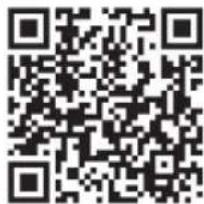
Mazda Connect Interactive Owner's manual
https://www.mazdausa.com/static/manuals/mazdaconnect-6Gb/index.html
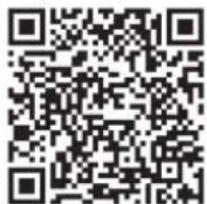
Navigation manual
https://www.mazdausa.com/siteassets/pdf/owners-optimized/
2022/mx-5/2022-mx-5-navigation-owners-manual.pdf
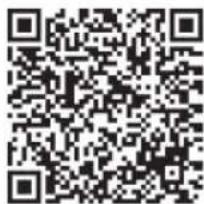
To Customers in Canada
- Please go to the web site below, and select the desired material or model (model year).
https://www.mazda.ca/en/owners/manuals/
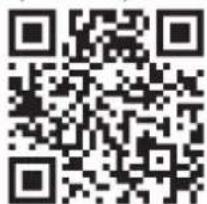
Limitations on use
- This Web Owner's manual may not display normally depending on the device being used and the contracted services available with the device.
- Communication fees may occur while connected (accessing).
- Access may not be available in poor network or communication environments.
Thank you for choosing a Mazda. We at Mazda design and build vehicles with complete customer satisfaction in mind.
To help ensure enjoyable and trouble-free operation of your Mazda, read this manual carefully and follow its recommendations.
An Authorized Mazda Dealer knows your vehicle best. So when maintenance or service is necessary, that's the place to go.
Our nationwide network of Mazda professionals is dedicated to providing you with the best possible service.
We assure you that all of us at Mazda have an ongoing interest in your motoring pleasure and in your full satisfaction with your Mazda product.
Mazda Motor Corporation HIROSHIMA, JAPAN
Important Notes About This Manual
Keep this manual in the trunk as a handy reference for the safe and enjoyable use of your Mazda. Should you resell the vehicle, leave this manual with it for the next owner.
All specifications and descriptions are accurate at the time of printing. Because improvement is a constant goal at Mazda, we reserve the right to make changes in specifications at any time without notice and without obligation.
Air Conditioner and the Environment
Your Mazda's genuine air conditioner is filled with a refrigerant that has been found not to damage the earth's ozone layer. If the air conditioner does not operate properly, consult an Authorized Mazda Dealer.
Perchlorate
Certain components of this vehicle such as [air bag modules, seat belt pretensioners, lithium batteries,...] may contain Perchlorate Material-- Special handling may apply for service or vehicle end of life disposal. See www.dtsc.ca.gov/hazardouswaste/perchlorate.
Please be aware that this manual applies to all models, equipment and options. As a result, you may find some explanations for equipment not installed on your vehicle.
We want to help you get the most driving pleasure from your vehicle. Your owner's manual, when read from cover to cover, can do that in many ways.
Illustrations complement the words of the manual to best explain how to enjoy your Mazda. By reading your manual, you can find out about the features, important safety information, and driving under various road conditions.
The symbol below in this manual means “Do not do this” or “Do not let this happen”.
natural_image
Simple circular symbol with a diagonal line through it, representing no text or numbers.Index: A good place to start is the Index, an alphabetical listing of all information in your manual.
You'll find several WARNINGS, CAUTIONs, and NOTES in the manual.

WARNING
A WARNING indicates a situation in which serious injury or death could result if the warning is ignored.

CAUTION
A CAUTION indicates a situation in which bodily injury or damage to your vehicle, or both, could result if the caution is ignored.
NOTE
A NOTE provides information and sometimes suggests how to make better use of your vehicle.
The following symbol, located on some parts of the vehicle, indicates that this manual contains information related to the part.
Please refer to the manual for a detailed explanation.

Table of Contents
| Pictorial IndexInterior, exterior views and part identification of your Mazda. | 1 |
| Essential Safety EquipmentImportant information about safety equipment, including seats, seat belt system, child-restraint systems and SRS air bags. | 2 |
| Before DrivingUse of various features, including keys, doors, mirrors and windows. | 3 |
| When DrivingInformation concerning safer driving and stopping. | 4 |
| Interior FeaturesUse of various features for ride comfort, including air-conditioning system and audio system. | 5 |
| Maintenance and CareHow to keep your Mazda in top condition. | 6 |
| If Trouble ArisesHelpful information on what to do if a problem arises with the vehicle. | 7 |
| Customer Information and Reporting Safety DefectsImportant consumer information including warranties and add-on equipment. | 8 |
| SpecificationsTechnical information about your Mazda. | 9 |
| Index | 10 |
1 Pictorial Index
Interior, exterior views and part identification of your Mazda.
Interior Overview......1-2
Interior Equipment (View A)......1-2
Interior Equipment (View B)......1-3
Interior Equipment (View C)......1-4
Interior Equipment (View D)......1-5
Exterior Overview...... 1-7
Convertible Top (Soft Top)......1-7
Convertible Top (Hardtop)...... 1-8
Interior Equipment (View A)
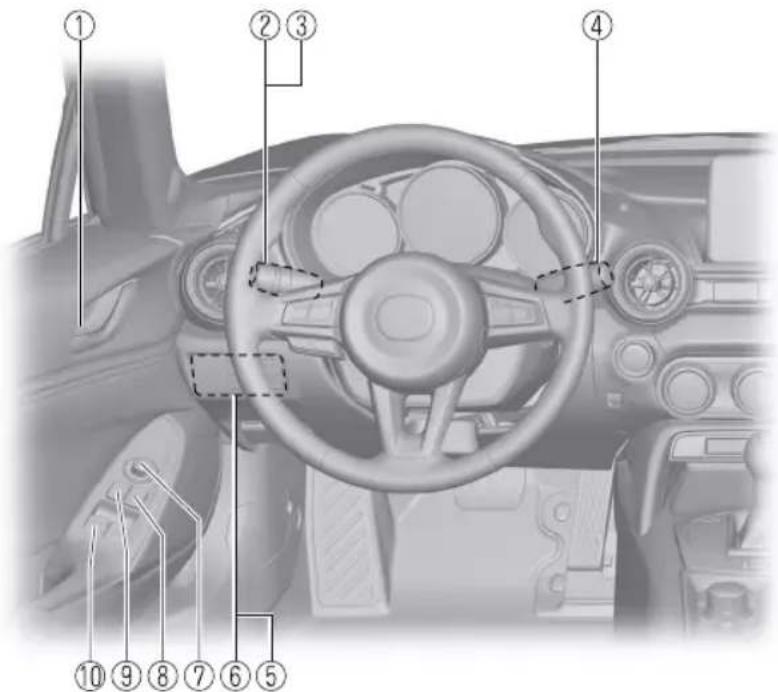
① Door-lock knob...... page 3-18
② Turn and lane-change signal......page 4-51
③ Lighting control......page 4-45
④ Wiper and washer lever......page 4-52
⑤ DSC OFF switch......page 4-69
⑥ Lane Departure Warning System (LDWS) OFF switch......page 4-82
⑦ Outside mirror switch......page 3-27
⑧ Door-lock switch......page 3-17
⑨ Power window lock switch...... page 3-30
⑩ Power window switches......page 3-30
Interior Equipment (View B)
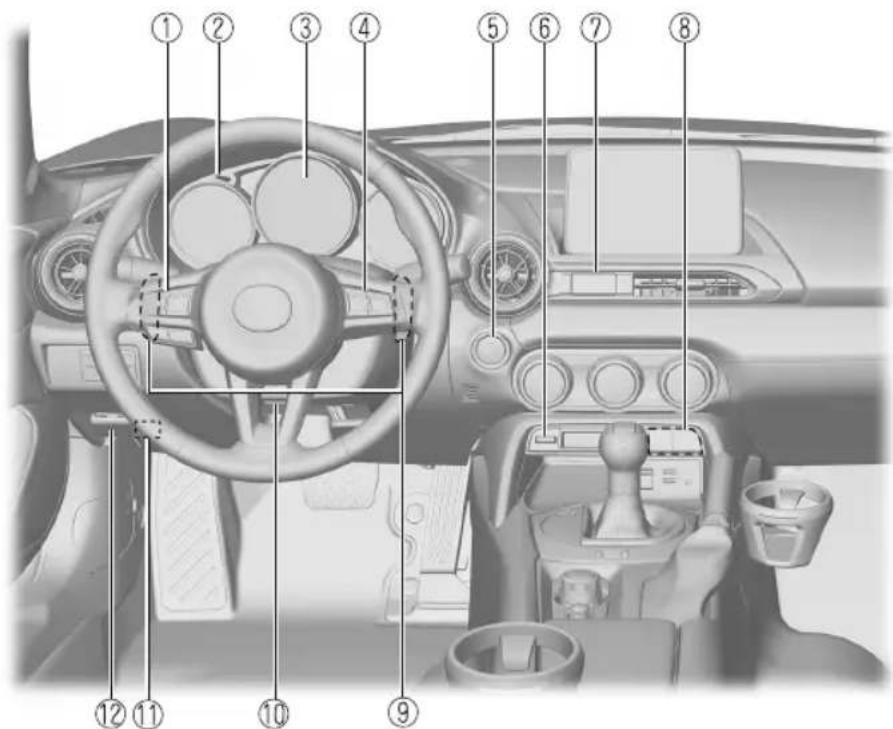
① Audio control switches......page 5-21
② Dashboard illumination knob......page 4-16
③ Instrument cluster......page 4-12
④ Cruise control switches......page 4-109
⑤ Push button start......page 4-4
⑥ Retractable hardtop switch......page 3-41
⑦ Hazard warning flasher switch......page 4-58
⑧ Seat warmer switches......page 2-12
⑨ Steering shift switches......page 4-38
⑩ Lock release lever...... page 2-5
⑪ Trunk release button......page 3-19
⑫ Hood release handle......page 6-17
Interior Equipment (View C)
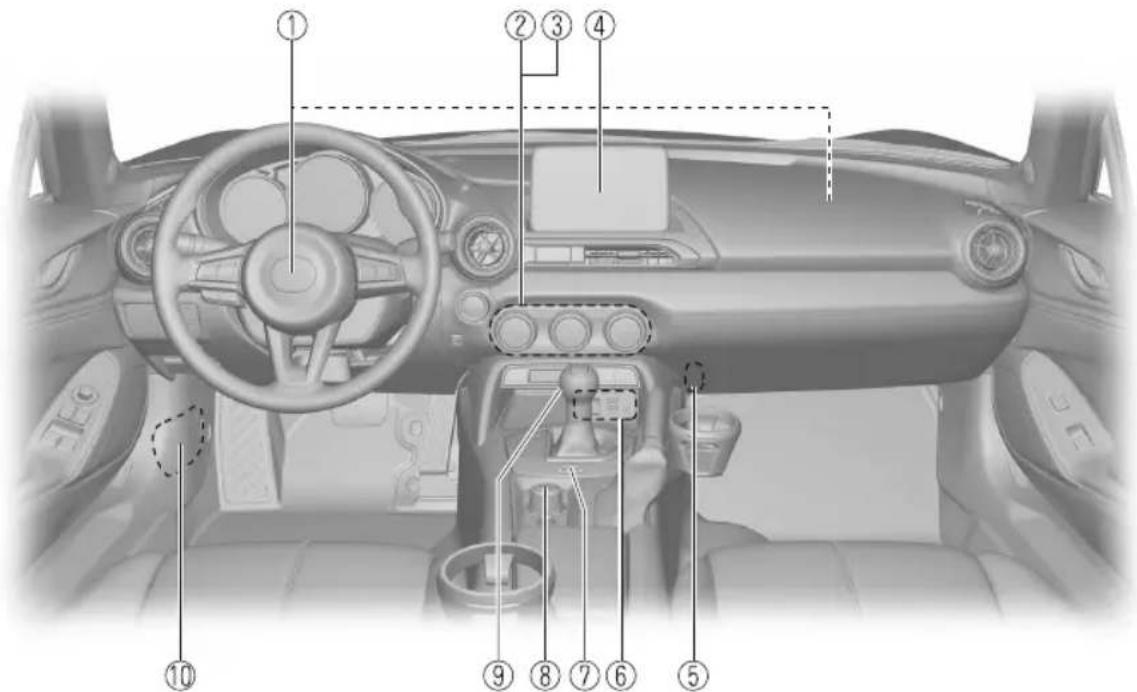
① SRS air bags......page 2-36
② Climate control system......page 5-2
③ Rear window defogger switch......page 4-56
④ Mazda Connect......page 5-14
⑤ Accessory socket......page 5-36
⑥ External input terminal......page 5-14
⑦ Drive selection switch......page 4-70
⑧ Commander switch......page 5-19
⑨ Shift lever/Selector lever...... page 4-32, 4-35
⑩ Fuse block (Left side)......page 6-47
Interior Equipment (View D)
▼ Convertible Top (Soft Top)
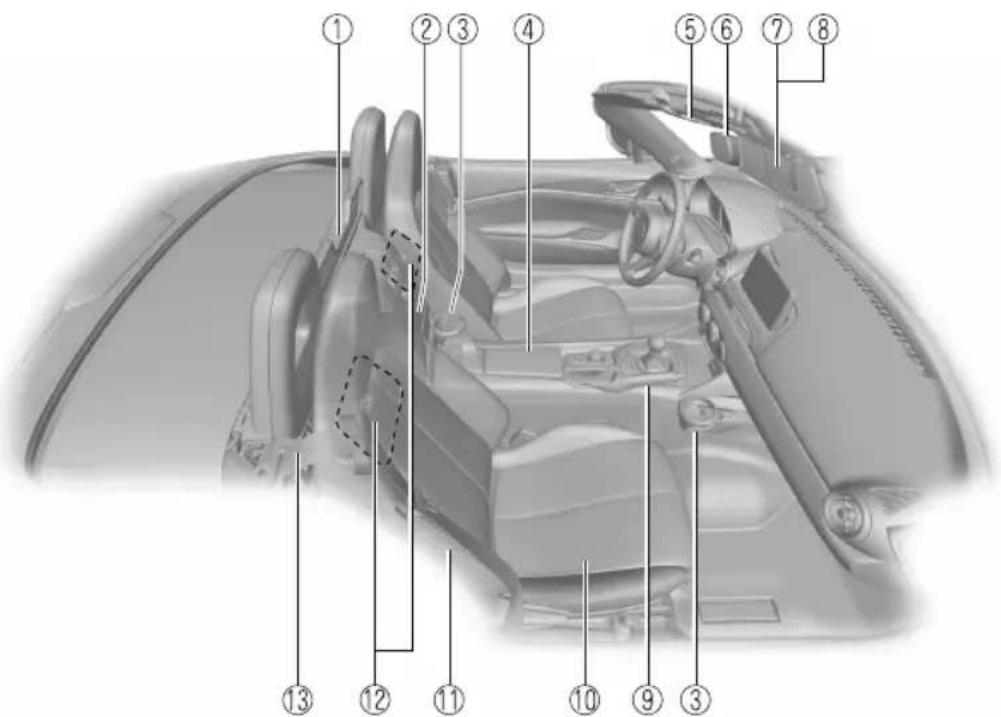
① Windblocker......page 5-44
② Seat side box...... page 5-42
③ Cup holders...... page 5-38
④ Console box......page 5-42
⑤ Interior light...... page 5-35
⑥ Rearview mirror...... page 3-28
⑦ Sunvisor......page 5-35
⑧ Vanity mirror......page 5-35
⑨ Parking brake...... page 4-63
⑩ Seat......page 2-5
⑪ SRS air bag......page 2-36
⑫ Back trim storage boxes......page 5-43
⑬ Seat belt......page 2-13
▼ Convertible Top (Hardtop)
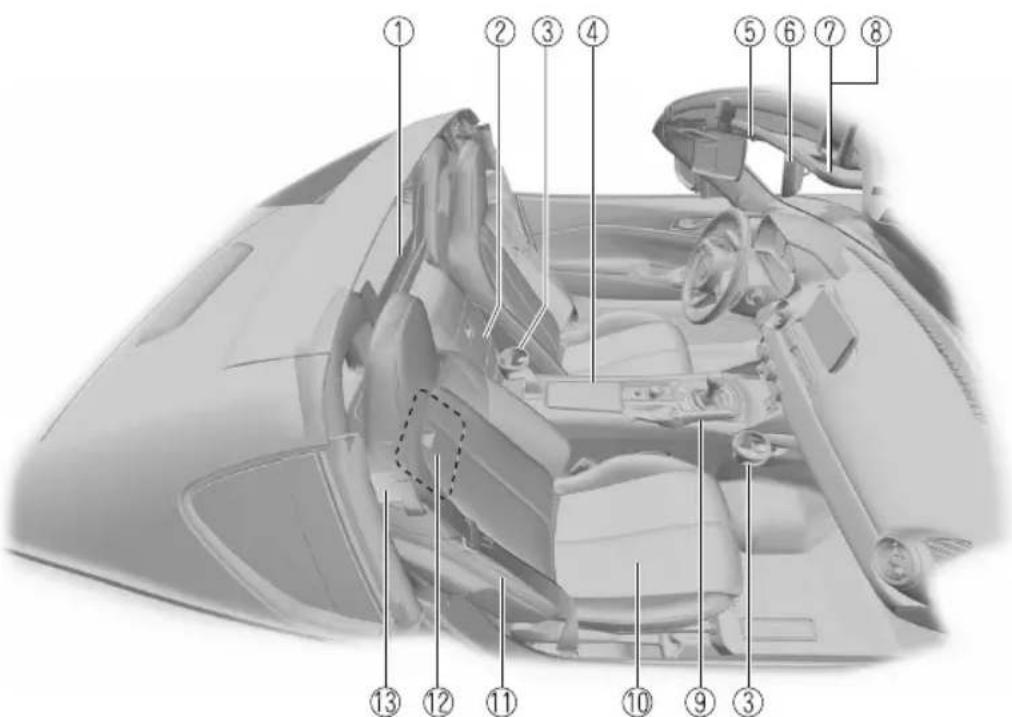
① Windblocker...... page 5-44
② Seat side box...... page 5-42
③ Cup holders...... page 5-38
④ Console box......page 5-42
⑤ Interior light...... page 5-35
⑥ Rearview mirror...... page 3-28
⑦ Sunvisor......page 5-35
⑧ Vanity mirror...... page 5-35
⑨ Parking brake...... page 4-63
⑩ Seat......page 2-5
⑪ SRS air bag......page 2-36
⑫ Back trim storage box...... page 5-43
⑬ Seat belt......page 2-13
Convertible Top (Soft Top)
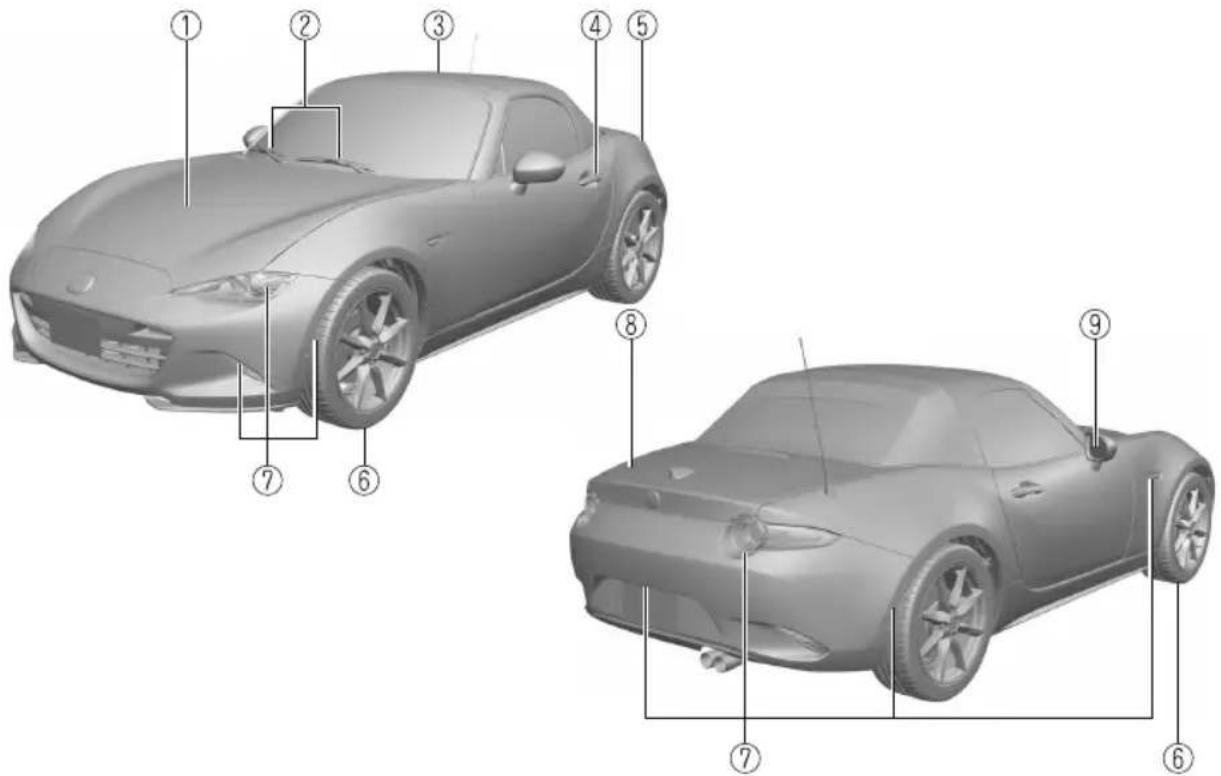
① Hood......page 6-17
② Windshield wiper blades......page 6-25
③ Convertible Top (Soft Top)...... page 3-33
④ Door and key......page 3-14
⑤ Fuel-filler lid...... page 3-25
⑥ Wheels and Tires......page 6-34
⑦ Exterior lights......page 6-38
⑧ Trunk Lid......page 3-19
⑨ Outside mirror...... page 3-27
Convertible Top (Hardtop)
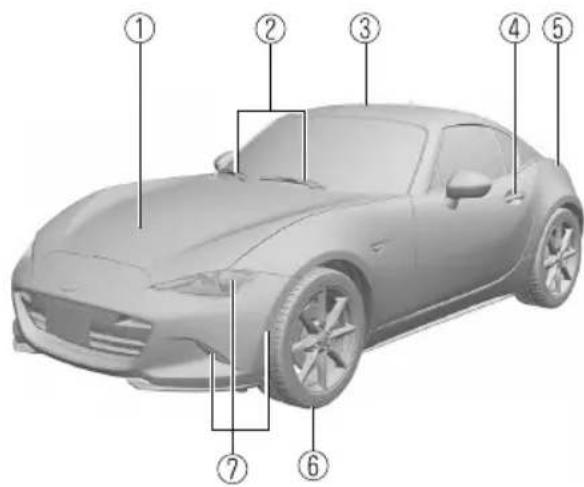
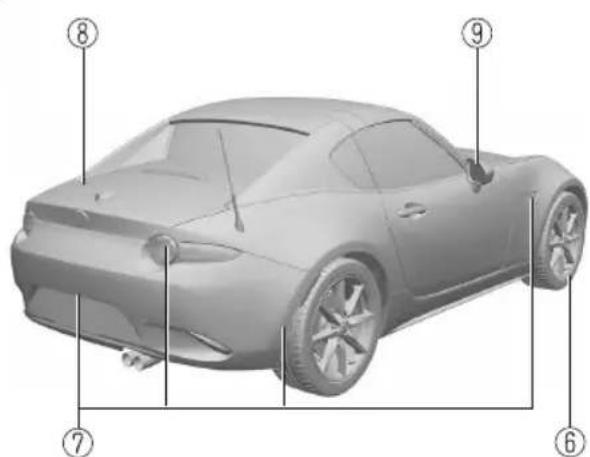
① Hood......page 6-17
② Windshield wiper blades...... page 6-25
③ Convertible Top (Hardtop)......page 3-38
④ Door and key......page 3-14
⑤ Fuel-filler lid...... page 3-25
⑥ Wheels and Tires......page 6-34
⑦ Exterior lights......page 6-38
⑧ Trunk Lid......page 3-19
⑨ Outside mirror......page 3-27
2 Essential Safety Equipment
Important information about safety equipment, including seats, seat belt system, child-restraint systems and SRS air bags.
Seats......2-2
Seat Precautions....2-2
Seat.... 2-5
Head Restraints....2-11
Seat Warmer.... 2-12
Seat Warmer ^* 2-12
Seat Belt Systems....2-13
Seat Belt Precautions....2-13
Seat Belt....2-16
Seat Belt Warning Systems......2-17
Seat Belt Pretensioner and Load Limiting Systems....2-18
Seat Belt Extender.... 2-19
Child Restraint.... 2-21
Child-Restraint Precautions......2-21
Child-Restraint System Installation.... 2-25
Child-Restraint System Suitability for Various Seat Positions Table....2-27 Installing Child-Restraint Systems....2-29
SRS Air Bags......2-36
Supplemental Restraint System (SRS) Precautions....2-36
Supplemental Restraint System Components......2-42
How the SRS Air Bags Work..... 2-43 SRS Air Bag Deployment
Criteria....2-46
Limitations to SRS Air Bag......2-47
Passenger Occupant Classification System.... 2-49
Constant Monitoring......2-55
Seat Precautions

WARNING
Make sure the adjustable components of a seat are locked in place:
Adjustable seats and seatbacks that are not securely locked are dangerous. In a sudden stop or collision, the seat or seatback could move, causing injury. Make sure the adjustable components of the seat are locked in place by attempting to slide the seat forward and backward and rocking the seatback.
Never allow children to adjust a seat:
Allowing children to adjust a seat is dangerous as it could result in serious injury if a child's hands or feet become caught in the seat.
Do not drive with the seatback unlocked:
All of the seatbacks play an important role in your protection in a vehicle. Leaving the seatback unlocked is dangerous as it can allow passengers to be ejected or thrown around and baggage to strike occupants in a sudden stop or collision, resulting in severe injury. After adjusting the seatback at any time, even when there are no other passengers, rock the seatback to make sure it is locked in place.
Adjust a seat only when the vehicle is stopped:
If the seat is adjusted while the vehicle is being driven, the seating posture may become unstable and the seat could move unexpectedly resulting in injury.
Do not modify or replace the seats:
Modifying or replacing the seats such as replacing the upholstery or loosening any bolts is dangerous. The seats contain air bag components essential to the supplemental restraint system. Such modifications could damage the supplemental restraint system and result in serious injury. Consult an Authorized Mazda Dealer if there is any need to remove or reinstall the seats.
Do not drive with damaged seats:
Driving with damaged seats, such as seat cushions torn or damaged down to the urethane, is dangerous. A collision, even one not strong enough to inflate the air bags, could damage the seats which contain essential air bag components. If there was a subsequent collision, an air bag may not deploy which could lead to injuries. Always have an Authorized Mazda Dealer inspect the seats, seat belt pretensioners and air bags after a collision.
Do not drive with either seats reclined:
Sitting in a reclined position while the vehicle is moving is dangerous because you do not get the full protection from seat belts. During sudden braking or a collision, you can slide under the lap belt and suffer serious internal injuries. For maximum protection, sit well back and upright.
Do not place an object such as a cushion between the seatback and your back:
Putting an object such as a cushion between the seatback and your back is dangerous because you will be unable to maintain a safe driving posture and the seat belt cannot function at its full capacity in a collision, which could result in a serious accident, injury or death.
Do not place objects under the seat:
The object could get stuck and cause the seat to not be fixed securely, and result in an accident.
Do not stack cargo higher than the seatbacks:
Stacking luggage or other cargo higher than the seatbacks is dangerous. During sudden braking or a collision, objects can fly around and become projectiles that may hit and injure passengers.
Make sure luggage and cargo is secured before driving:
Not securing cargo while driving is dangerous as it could move or be crushed during sudden braking or a collision and cause injury.
Additionally, if the air bags deploy, the cargo may scatter which could result in serious injury or death.
Always leave your car locked and keep the car keys safely away from children:
Leaving your car unlocked or the keys in reach of children is dangerous. Children who find their way into the trunk through an open trunk can become accidentally locked in the trunk. This could result in death or brain damage from heat prostration, particularly in the summer. Always lock the doors and the trunk.

CAUTION
When operating a seat, be careful not to put your hands or fingers near the moving parts of the seat or on the side trim to prevent injury.
When moving the seats, make sure there is no cargo in the surrounding area. If the cargo gets caught it could damage the cargo.
When moving the seats forward and rearward or returning a rear-reclined seatback to its upright position, make sure you hold onto the seatback with your hand while operating. If the seatback is not held, the seat will move suddenly and could cause injury.
When inserting your hand under the seat to clean the cabin or pick up something you dropped under the seat, be careful not to hurt yourself. If you contact the moving parts of the seat rail or seat frame, it could result in injury.
Seat
▼ Adjusting the Driver's Seat
Using the driving position set up procedure recommended by Mazda allows you to maintain a relaxed posture, drive the vehicle for longer periods without feeling tired, and make quick operations naturally.
Also, you can be assured of a clear view in the forward direction to help you drive more safely and comfortably.
The adjustments for the driving position recommended by Mazda are done using the following procedures.
- Moving the steering wheel and seat to their default positions.
- Adjusting the seatback angle.
- Adjusting the seat position forward and back.
- Adjusting the steering wheel position.
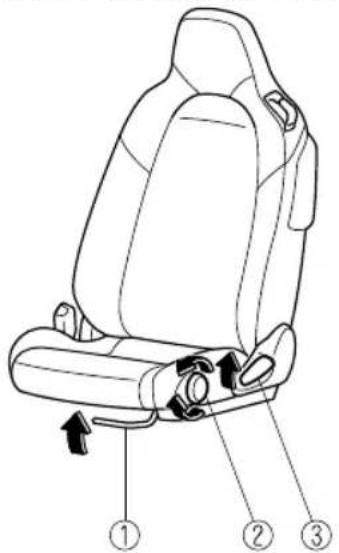
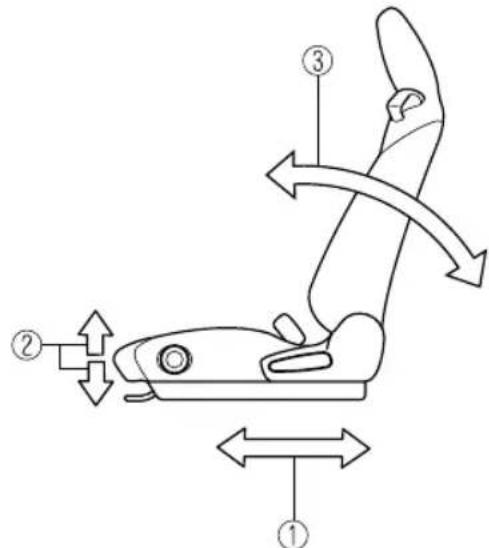
① Seat Slide
To move a seat forward or backward, raise the lever and slide the seat to the desired position and release the lever.
Make sure the lever returns to its original position and the seat is locked in place by attempting to push it forward and backward.
② Height Adjustment for Front Edge of Seat Bottom
To adjust the height for front edge of the seat bottom, rotate the dial to the desired position.
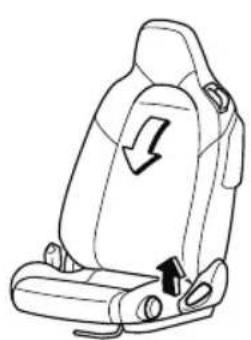
③ Seat Recline
To change the seatback angle, lean forward slightly while raising the lever. Then lean back to the desired position and release the lever.
Make sure the lever returns to its original position and the seatback is locked in place by attempting to push it forward and backward.
Before making adjustments to the driving position recommended by Mazda
Before making adjustments, move the steering wheel and seat to their default positions.
How to move the steering wheel to its default position

WARNING
Never adjust the steering wheel while the vehicle is moving:
Adjusting the steering wheel while the vehicle is moving is dangerous. Moving it can very easily cause the driver to abruptly turn to the left or right. This can lead to loss of control or an accident.
After adjusting the steering wheel position, make sure it is securely locked by trying to move it up and down:
Driving with the steering wheel not securely locked in position is dangerous. If the steering wheel moves unexpectedly while driving, you could lose control of the steering resulting in an accident.
Lower the lever, move the steering wheel to the lowest position, and then push it down and all the way back.
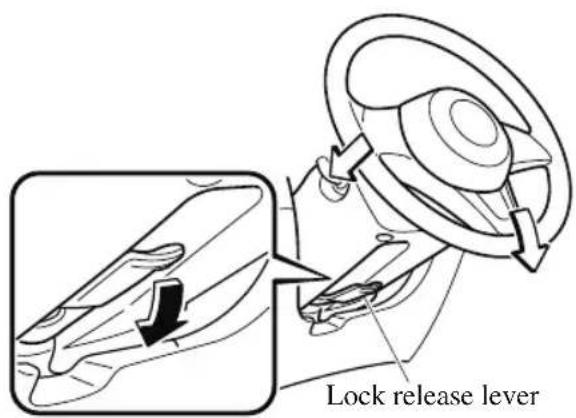
How to move a driver's seat to its default position
- Slide the seat all the way back.
- Sit squarely in the seat and rest your back against the seatback.
Seat adjustment procedure for the driving position recommended by Mazda
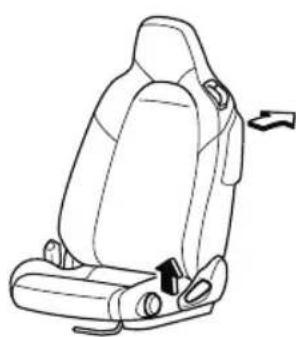
Adjusting the seatback angle (reclining)
Adjust the seatback to the angle providing a comfortable seated posture.
- With your posture slightly slouched, move the seatback forward to the angle where your waist feels slightly cramped.
natural_image
Line drawing of a car seat with a lightning bolt symbol indicating downward force (no text or labels)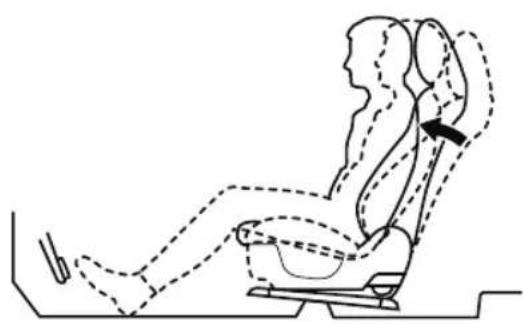
natural_image
Line drawing of a car seat with dashed lines indicating motion or movement, no text or symbols present- Move the seatback backward to a comfortable seated posture without any feeling of cramping in your waist.
natural_image
Line drawing of a car seat with a belt buckle and side panel (no text or symbols)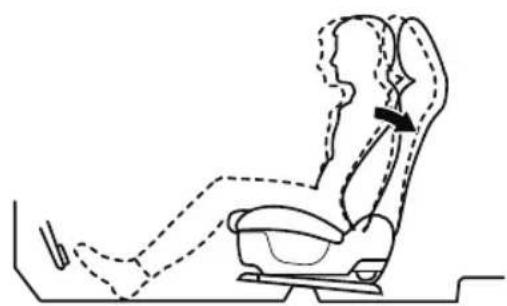
natural_image
Line drawing of a person seated in a car seat, showing seat alignment and movement (no text or symbols)Adjusting the seat position forward and back (sliding)
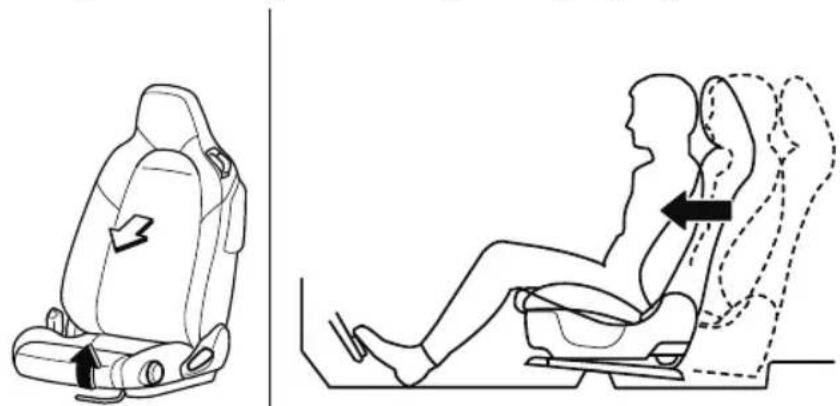
Adjust the seat to the position best for operating the accelerator and brake pedals.
-
Place your left foot on the footrest, your right foot between the accelerator and brake pedals, and position your heel to the position allowing easy switching between the pedals.
-
With your heel set on the floor, set your right foot on the brake pedal and move the seat forward as far as possible until you feel a slight cramping in your ankle.
natural_image
Side-by-side line drawings of a car seat and passenger seat, showing seat movement and head positioning (no text or symbols)-
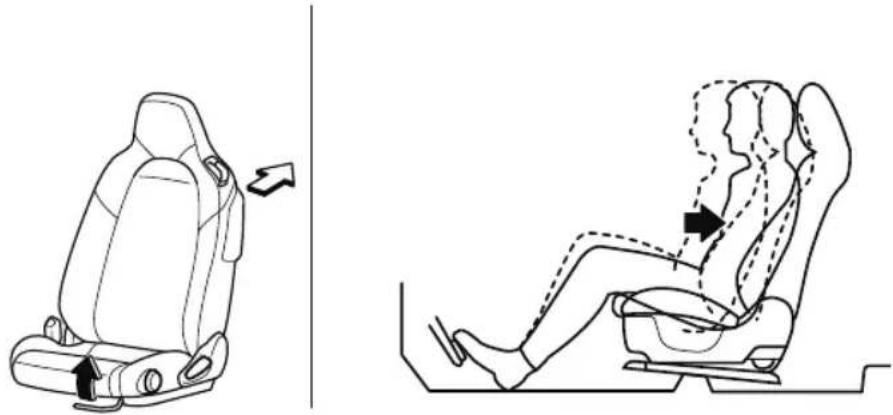
With your right foot set on the brake pedal, move the seat back until you no longer feel cramping in your ankle.
-
With your heel set on the floor, make sure you can move your foot between the brake pedal and accelerator pedal smoothly.
-
Depress the accelerator pedal completely with your heel set on the floor and make sure that your ankle does not feel over-stretched.
natural_image
Side-by-side line drawings of a car seat assembly, showing left and right views with arrows indicating movement (no text or symbols)Adjusting the steering wheel position
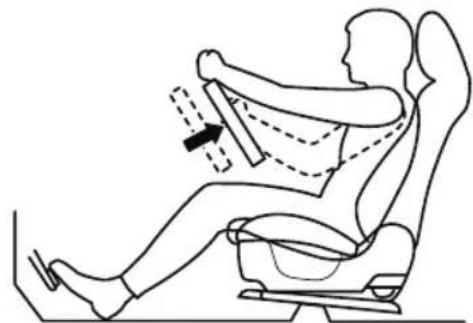
Adjust the steering wheel to the position where it can be operated easily and the gauges can be viewed easily.
- With your back resting against the seatback, extend both arms, place them on the top of the steering wheel, and pull the steering wheel towards you to the position of your wrists.
natural_image
Line drawing of a person seated in a car seat, showing motion lines and movement direction (no text or symbols)-
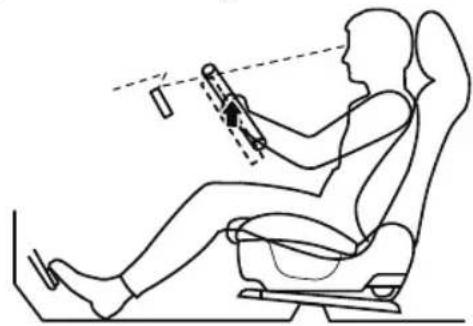
Adjust the steering wheel height so that the gauges can be viewed easily.
-
Raise the lever to securely lock the steering wheel.
natural_image
Line drawing of a person sitting in a car with a device, no text or symbols present▼ Adjusting the Passenger's Seat
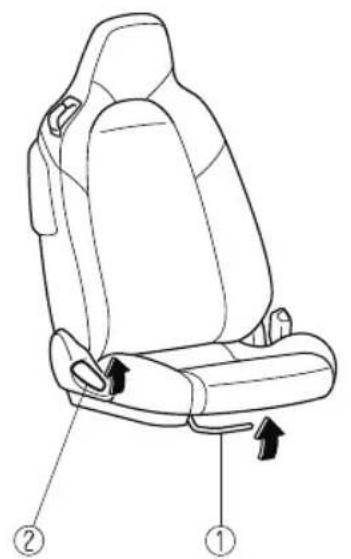
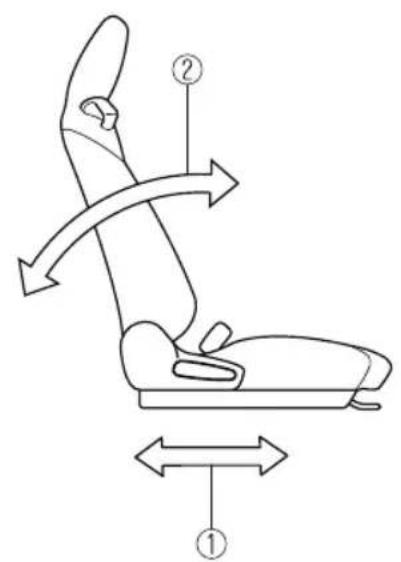
① Seat Slide
To move a seat forward or backward, raise the lever and slide the seat to the desired position and release the lever.
Make sure the lever returns to its original position and the seat is locked in place by attempting to push it forward and backward.
② Seat Recline
To change the seatback angle, lean forward slightly while raising the lever. Then lean back to the desired position and release the lever.
Make sure the lever returns to its original position and the seatback is locked in place by attempting to push it forward and backward.
Head Restraints
▼ Non-Adjustable Head Restraints
Your vehicle is equipped with non-adjustable head restraints on the driver's and passenger's seatbacks. The non-adjustable head restraints consist of a trimmed foam covering over the upper structure of the seatbacks and are intended to help protect you and the passenger from neck injury. Adjust the seatbacks to their upright, on-road positions so that the head restraint is positioned as close as possible to the back of your head.

WARNING
Make sure the seatbacks are properly adjusted to their upright, on-road positions before the vehicle is driven:
Driving with the seatbacks not adjusted properly is dangerous. With no support behind your head, your neck could be seriously injured in a collision.
Seat Warmer\*
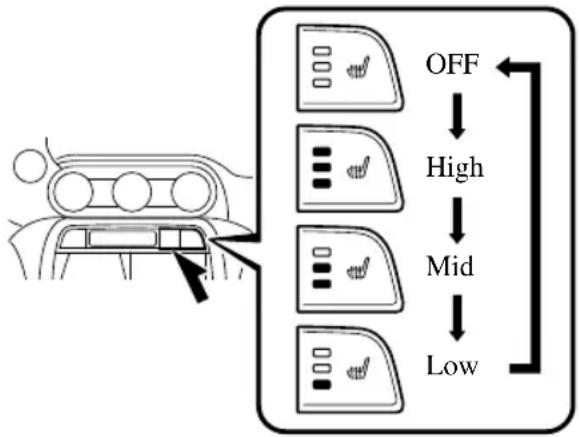
The seats are electrically heated. The ignition must be switched ON.
Press the seat warmer switch while the ignition is switched ON to operate the seat warmer. The indicator lights turn on to indicate that the seat warmer is operating. The mode changes as follows each time the seat warmer switch is pressed.
flowchart
graph TD
    A["Car Top Left"] --> B["Control Panel Off"]
    A --> C["Control Panel High"]
    A --> D["Control Panel Mid"]
    A --> E["Control Panel Low"]
    B --> F["Off"]
    C --> G["High"]
    D --> H["Mid"]
    E --> I["Low"]

WARNING
Be careful when using the seat warmer:
The heat from the seat warmer may be too hot for some people, as indicated as follows, and could cause a low-temperature burn.
➢ Infants, small children, elderly people, and physically challenged people
▶ People with delicate skin
▶ People who are excessively fatigued
▶ People who are intoxicated
➢People who have taken sleep-inducing medicine such as sleeping pills or cold medicine
Do not use the seat warmer with anything having high moisture-retention ability such as a blanket or cushion on the seat:
The seat may be heated excessively and cause a low-temperature burn.
Do not use the seat warmer even when taking a short nap in the vehicle:
The seat may be heated excessively and cause a low-temperature burn.
Do not place heavy objects with sharp projections on the seat, or insert needles or pins into it:
This could cause the seat to become excessively heated and result in injury from a minor burn.

CAUTION
➢Do not use organic solvents to clean the seat. It may damage the seat surface and the heater.
NOTE
- Use the seat warmer when the engine is running. Leaving the seat warmer on for long periods with the engine not running could cause the battery power to be depleted.
- If the ignition is switched off while the seat warmer is operating (High, Mid or Low) and then switched ON again, the seat warmer will automatically operate at the temperature set before switching off the ignition.
- The temperature of the seat warmer cannot be adjusted beyond High, Mid and Low because the seat warmer is controlled by a thermostat.
Seat Belt Precautions
Seat belts help to decrease the possibility of severe injury during accidents and sudden stops. Mazda recommends that the driver and passenger always wear seat belts.
(Except Mexico)
All of the seat belt retractors are designed to keep the lap/shoulder belts out of the way when not in use.
The driver's seat belt has no provisions for child-restraint systems and has only an emergency locking mode. The driver may wear it comfortably, and it will lock during a collision.
However, the passenger's seat lap/shoulder belt retractor operates in two modes: emergency locking mode, and for child-restraint systems, automatic locking mode. If you must use the passenger seat for a child, slide the passenger seat as far back as possible and make sure any child-restraint system is secured properly.
(Mexico)
All the seats have lap/shoulder belts. These belts have retractors with inertia locks that keep them out of the way when not in use. The locks allow the belts to remain comfortable on users, but they will lock in position during a collision.

WARNING
Always wear your seat belt and make sure all occupants are properly restrained:
Not wearing a seat belt is extremely dangerous. During a collision, occupants not wearing seat belts could hit someone or things inside the vehicle or even be thrown out of the vehicle. They could be seriously injured or even killed. In the same collision, occupants wearing seat belts would be much safer.
Do not wear twisted seat belts:
Twisted seat belts are dangerous. In a collision, the full width of the belt is not available to absorb the impact. This puts more force on the bones beneath the belt, which could cause serious injury or death. So, if your seat belt is twisted, you must straighten the seat belt to remove any twists and to allow the full width of the belt to be used.
Never use one seat belt on more than one person at a time:
Using one seat belt for more than one person at a time is dangerous. A seat belt used in this way cannot spread the impact forces properly and the two passengers could be crushed together and seriously injured or even killed. Never use one belt for more than one person at a time and always operate the vehicle with each occupant properly restrained.
Do not operate a vehicle with a damaged seat belt:
Using a damaged seat belt is dangerous. An accident could damage the belt webbing of the seat belt in use. A damaged seat belt cannot provide adequate protection in a collision. Have an Authorized Mazda Dealer inspect all seat belt systems in use during an accident before they are used again.
Have your seat belts changed immediately if the pretensioner or load limiter has been expended:
Always have an Authorized Mazda Dealer immediately inspect the seat belt pretensioners and air bags after any collision. Like the air bags, the seat belt pretensioners and load limiters will only function once and must be replaced after any collision that caused them to deploy. A seat belt with an expended pretensioner or load limiter is still better than wearing no seat belt at all; however, if the seat belt pretensioners and load limiters are not replaced, the risk of injury in a collision will increase.
Positioning the Shoulder Portion of the Seat Belt:
Improper positioning of the shoulder portion of the seat belt is dangerous. Always make sure the shoulder portion of the seat belt is positioned across your shoulder and near your neck, but never under your arm, on your neck, or on your upper arm.
Positioning the Lap Portion of the Seat Belt:
The lap portion of the seat belt worn too high is dangerous. In a collision, this would concentrate the impact force directly on the abdominal area, causing serious injury. Wear the lap portion of the belt snugly and as low as possible.

CAUTION
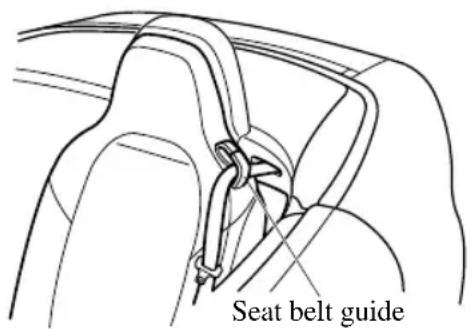
Belt retraction may become difficult if the belts and seat belt guides are soiled, so try to keep them clean. For more details about cleaning the seat belts, refer to "Seat Belt Maintenance" (page 6-63).
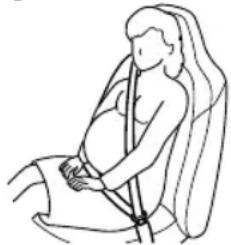
▼ Pregnant Women and Persons with Serious Medical Conditions
Pregnant women should always wear seat belts. Ask your doctor for specific recommendations.
The lap belt should be worn SNUGLY AND AS LOW AS POSSIBLE OVER THE HIPS.
The shoulder belt should be worn across your shoulder properly, but never across the stomach area.
Persons with serious medical conditions also should wear seat belts. Check with your doctor for any special instructions regarding specific medical conditions.
natural_image
Line drawing of a person sitting in a chair, holding a seatbelt (no text or symbols)▼ Emergency Locking Mode
When the seat belt is fastened, it will always be in the emergency locking mode.
In the emergency locking mode, the belt remains comfortable on the occupant and the retractor will lock in position during a collision.
If the belt is locked and cannot be pulled out, retract the belt once, and then try pulling it out slowly. If this fails, pull the belt strongly 1 time and loosen, then pull it out again slowly.
(Seat Belt with Automatic Locking Mode)
When the seat belt is fastened, it will always be in the emergency locking mode until it is switched to automatic locking mode by pulling it all the way out to its full length. If the belt feels tight and hinders comfortable movement while the vehicle is stopped or in motion, it may be in the automatic locking mode because the belt has been pulled too far out. To return the belt to the more comfortable emergency locking mode, wait until the vehicle has stopped in a safe, level area, retract the belt fully to convert it back to emergency locking mode and then extend it around you again.
▼ Automatic Locking Mode\*
Always use the automatic locking mode to keep the child-restraint system from shifting to an unsafe position in the event of an accident. To enable seat belt automatic locking mode, pull it all the way out and connect it as instructed on the child-restraint system. It will retract down to the child-restraint system and stay locked on it. See the section on child restraint (page 2-21).
Seat Belt

WARNING
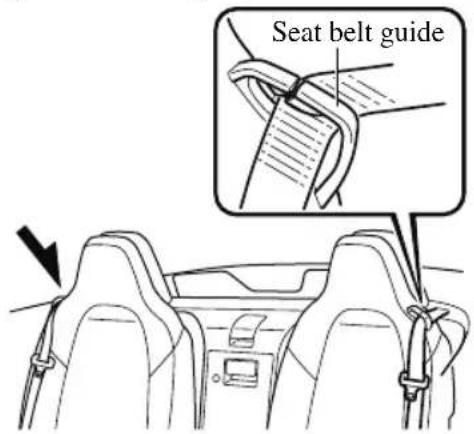
Always wear the seat belt with it correctly routed in its guide:
Wearing a seat belt without the seat belt routed in its guide is dangerous because the seat belt would not be able to provide adequate protection in an accident, which could result in serious injury.
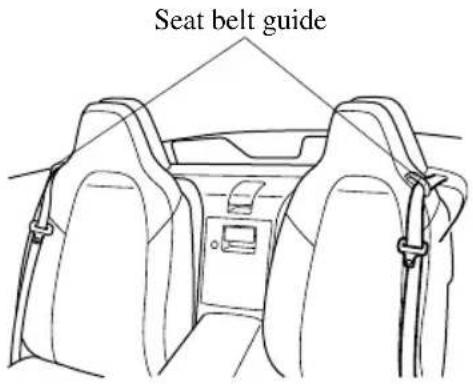
▼ Fastening the Seat Belt
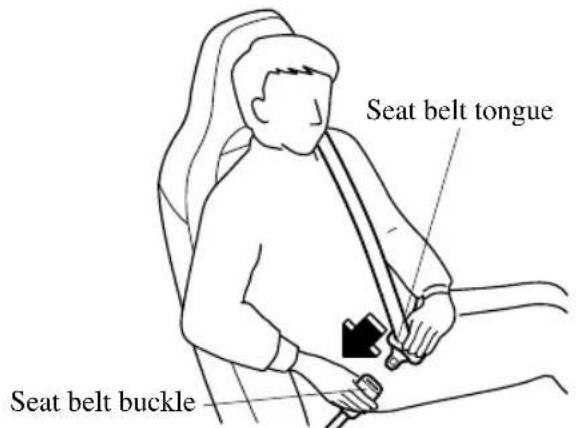
Position the lap belt as low as possible, not on the abdominal area, then adjust the shoulder belt so that it fits snugly against your body.
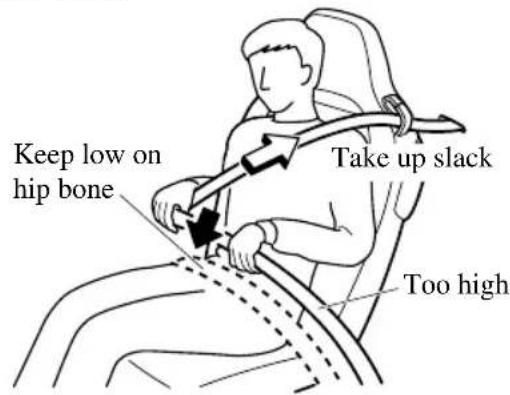
Before fastening the seat belt, make sure that the seat belt passes through the seat belt guide correctly and it is not twisted.
▼ Unfastening the Seat Belt
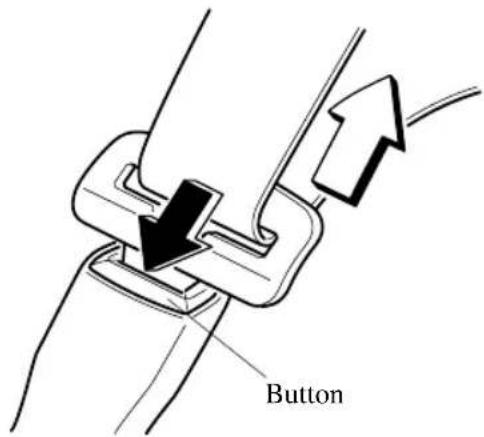
Depress the button on the seat belt buckle. If the belt does not fully retract, pull it out and check for kinks or twists. Then make sure it remains untwisted as it retracts.
NOTE
If a belt does not fully retract, inspect it for kinks and twists. If it is still not retracting properly, have it inspected at an Authorized Mazda Dealer.
Seat Belt Warning Systems
If it detects that the occupant seat belt is unfastened, the warning light or beep alerts the occupant.
Refer to Taking Action on page 7-40. Refer to Seat Belt Warning Beep on page 7-48.
Seat Belt Pretensioner and Load Limiting Systems
For optimum protection, the driver and passenger seat belts are equipped with pretensioner and load limiting systems. For both these systems to work properly you must wear the seat belt properly.
Pretensioners:
When a collision is detected, the pretensioners deploy simultaneously with the air bags.
For deployment details, refer to the SRS Air Bag Deployment Criteria (page 2-46).
The seat belt retractors remove slack quickly as the air bags are expanding. Any time the air bags and seat belt pretensioners have fired they must be replaced.
A system malfunction or operation conditions are indicated by a warning.
Refer to Taking Action on page 7-40.
Refer to Air Bag/Seat Belt Pretensioner System Warning Beep on page 7-48.
In addition, the pretensioner system for the passenger, like the front and side passenger air bag, is designed to only deploy when the passenger occupant classification sensor detects a passenger sitting on the passenger's seat.
For details, refer to the passenger occupant classification sensor (page 2-49).
Load limiter:
The load limiting system releases belt webbing in a controlled manner to reduce belt force on the occupant's chest. While the most severe load on a seat belt occurs in frontal collisions, the load limiter has an automatic mechanical function and can activate in any accident mode with sufficient occupant movement.
Even if the pretensioners have not fired, the load limiting function must be checked by an Authorized Mazda Dealer.

WARNING
Wear seat belts only as recommended in this owner's manual:
Incorrect positioning of the driver and passenger seat belts is dangerous. Without proper positioning, the pretensioner and load limiting systems cannot provide adequate protection in an accident and this could result in serious injury. For more details about wearing seat belts, refer to "Fastening the seat belts" (page 2-16).
Have your seat belts changed immediately if the pretensioner or load limiter has been expended:
Always have an Authorized Mazda Dealer immediately inspect the seat belt pretensioners and air bags after any collision. Like the air bags, the seat belt pretensioners and load limiters will only function once and must be replaced after any collision that caused them to deploy. A seat belt with an expended pretensioner or load limiter is still better than wearing no seat belt at all; however, if the seat belt pretensioners and load limiters are not replaced, the risk of injury in a collision will increase.
Do not modify the components or wiring, or use electronic testing devices on the pretensioner system:
Modifying the components or wiring of the pretensioner system, including the use of electronic testing devices is dangerous. You could accidentally activate it or make it inoperable which would prevent it from activating in an accident. The occupants or repairers could be seriously injured.
Properly dispose of the pretensioner system:
Improper disposal of the pretensioner system or a vehicle with non-deactivated pretensioners is dangerous. Unless all safety procedures are followed, injury could result. Have an Authorized Mazda Dealer safely dispose of the pretensioner system or scrap a pretensioner system equipped vehicle.
NOTE
- The pretensioner system may not operate depending on the type of the collision. For details, refer to the SRS Air Bag Deployment Criteria (page 2-46).
- Some smoke (non-toxic gas) will be released when the air bags and pretensioners deploy. This does not indicate a fire. This gas normally has no effect on occupants, however, those with sensitive skin may experience light skin irritation. If residue from the deployment of the air bags or the pretensioner system gets on the skin or in the eyes, wash it off as soon as possible.
Seat Belt Extender
If your seat belt is not long enough, even when fully extended, a seat belt extender may be available to you at no charge from your Authorized Mazda Dealer.
This extender will be only for you and for the particular vehicle and seat. Even if it plugs into other seat belts, it may not hold in the critical moment of a crash.
When ordering an extender, only order one that provides the necessary additional length to fasten the seat belt properly. Please contact your Authorized Mazda Dealer for more information.

WARNING
Do not use a seat belt extender unless it is necessary:
Using a seat belt extender when not necessary is dangerous. The seat belt will be too long and not fit properly. In an accident, the seat belt will not provide adequate protection and you could be seriously injured. Only use the extender when it is required to fasten the seat belt properly.
Do not use an improper extender:
Using a seat belt extender that is for another person or a different vehicle or seat is dangerous. The seat belt will not provide adequate protection and the user could be seriously injured in an accident. Only use the extender provided for you and for the particular vehicle and seat. NEVER use the extender in a different vehicle or seat. If you sell your Mazda, do not leave your seat belt extender in the vehicle. It could be used accidentally by the new owner of the vehicle. After removing the seat belt extender, discard it. Never use the seat belt extender in any other vehicle you may own in the future.
Do not use an extender that is too long:
Using an extender that is too long is dangerous. The seat belt will not fit properly. In an accident, the seat belt will not provide adequate protection and you could be seriously injured. Do not use the extender or choose one shorter in length if the distance between the extender's buckle and the center of the user's body is less than 15 cm (6 in).
Do not leave a seat belt extender connected to the buckle:
Leaving a seat belt extender connected to the buckle without using the seat belt is dangerous. When the seat belt extender is connected to the driver's seat belt buckle (or passenger's seat belt buckle), the SRS driver's (or passenger's) air bag system will determine that the driver (or passenger) is wearing the seat belt even if the driver (or passenger) is not wearing it. This condition could cause the driver's (or passenger's) air bag to not activate correctly and result in death or serious injury in the event of collision. Always wear the seat belt with the seat belt extender.
Do not use the seat belt extender when installing a child-restraint system on the passenger seat:
Using a seat belt extender to fasten a child-restraint system on any seat is dangerous. Always follow the child-restraint system manufacturer's installation instructions and never use a seat belt extender.
NOTE
When not in use, remove the seat belt extender and store it in the vehicle. If the seat belt extender is left connected, the seat belt extender might get damaged as it will not retract with the rest of the seat belt and can easily fall out of the door when not in use and be damaged. In addition, the seat belt warning light will not illuminate and function properly.
Child-Restraint Precautions
Mazda strongly urges the use of child-restraint systems for children small enough to use them.
You are required by law to use a child-restraint system for children in the U.S. and Canada. Check your local and state or provincial laws for specific requirements regarding the safety of children riding in your vehicle.
Whatever child-restraint system you consider, please pick the appropriate one for the age and size of the child, obey the law and follow the instructions that come with the individual child-restraint system.
A child who has outgrown child-restraint systems should use seat belts, both lap and shoulder. If the shoulder belt crosses the neck or face, move the child closer to the center of the vehicle.
A rear-facing child-restraint system should NEVER be used on the passenger seat with the air bag system activated.
To reduce the chance of injuries caused by deployment of the passenger air bag, the passenger occupant classification sensor work as a part of the supplemental restraint system. This system deactivates the passenger front and side air bags and also the passenger seat belt pretensioner system when the passenger air bag deactivation indicator light illuminates.
When an infant or small child sits on the passenger seat, the system shuts off the passenger front and side air bags and seat belt pretensioner system, so make sure the passenger air bag deactivation indicator light illuminates.
For more details, refer to "Passenger occupant classification sensor" (page 2-49).

WARNING
Use the correct size child-restraint system:
For effective protection in vehicle accidents and sudden stops, a child must be properly restrained using a seat belt or child-restraint system depending on age and size. If not, the child could be seriously injured or even killed in an accident.
Follow the manufacturer's instructions and always keep the child-restraint system buckled down:
An unsecured child-restraint system is dangerous. In a sudden stop or a collision it could move causing serious injury or death to the child or other occupants. Make sure any child-restraint system is properly secured in place according to the child-restraint system manufacturer's instructions. When not in use, remove it from the vehicle or fasten it with a seat belt.
Always secure a child in a proper child-restraint system:
Holding a child in your arms while the vehicle is moving is extremely dangerous. No matter how strong the person may be, he or she cannot hold onto a child in a sudden stop or collision and it could result in serious injury or death to the child or other occupants. Even in a moderate accident, the child may be exposed to air bag forces that could result in serious injury or death to the child, or the child may be slammed into an adult, causing injury to both child and adult.
Always make sure the passenger air bag deactivation indicator light is illuminated when using a child-restraint system:
Seating a child in a child-restraint system that is installed on the passenger seat with the passenger air bag deactivation indicator light not illuminated is extremely dangerous. In an accident, an air bag could inflate and cause serious injuries or even death to the child seated in the child-restraint system. Always make sure the passenger air bag deactivation indicator light is illuminated.
Refer to Passenger Occupant Classification System on page 2-49.
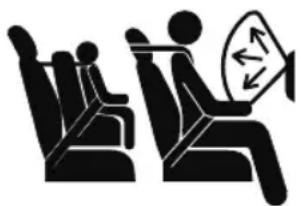
(Except Mexico)
Vehicles with a passenger air bag have the following warning label. The warning label is displayed in compliance with regulations.
natural_image
Silhouette of two people sitting in a chair, one holding a magnifying glass (no text or symbols)(Mexico)
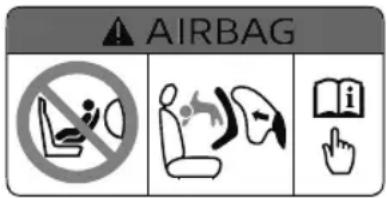
NEVER use a rearward facing child restraint on a seat protected by an ACTIVE AIRBAG in front of it, DEATH or SERIOUS INJURY to the CHILD can occur.
Vehicles with a passenger air bag have the following warning label. The warning label reminds you not to put a rear-facing child-restraint system on the passenger seat at any time.
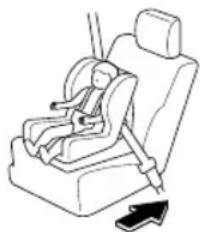
Before installing child-restraint system on the passenger seat, move the passenger seat as far back as possible:
In a collision, the force of a deploying air bag could cause serious injury or death to the child.
natural_image
Line drawing of a car seatbelt with a black arrow indicating downward motion (no text or symbols)Seating a child in a child-restraint system on the passenger seat is dangerous under certain conditions:
Your vehicle is equipped with passenger occupant classification sensor. Even with the passenger occupant classification sensor, if you must use the passenger seat to seat a child, using a child-restraint system on the passenger seat under the following conditions increases the danger of the passenger air bag deploying and could result in serious injury or death to the child.
The passenger air bag deactivation indicator light does not illuminate when seating a child in the child-restraint system.
➢ Luggage or other items are placed on the seat with the child in the child-restraint system.
The seat is washed.
▶ Liquids are spilled on the seat.
The passenger seat is moved backward, pushing into luggage or other items placed behind it.
➢Luggage or other items are placed between the passenger seat and driver seat.
▶An electric device is put on the passenger's seat.
➢ An additional electrical device, such as a seat warmer is installed to the surface of the passenger seat.
Do not allow a child or anyone to lean over to or against the side window of a vehicle with side and curtain air bags:
It is dangerous to allow anyone to lean over to or against the side window, the area of the front passenger seat, the front and rear window pillars and the roof edge along both sides from which the side and curtain air bags deploy, even if a child-restraint system is used. The impact of inflation from a side or curtain air bag could cause serious injury or death to an out of position child. Furthermore, leaning over to or against the door could block the side and curtain air bags and eliminate the advantages of supplemental protection. Because the front seats are equipped with front air bags, the rear seat is always a better location for children. Take special care not to allow a child to lean over to or against the side window, even if the child is seated in a child-restraint system.
Never use one seat belt on more than one person at a time:
Using one seat belt for more than one person at a time is dangerous. A seat belt used in this way cannot spread the impact forces properly and the two passengers could be crushed together and seriously injured or even killed. Never use one belt for more than one person at a time and always operate the vehicle with each occupant properly restrained.
Always use a child-restraint system designed for use without a tether or the ISOFIX/LATCH ^1 lower anchor:
Using a child-restraint system that requires a tether or the ISOFIX/LATCH ^1 lower anchor is dangerous. Your Mazda does not have a child-restraint tether or the ISOFIX/LATCH ^1 lower anchor. The child-restraint system cannot be properly secured. In a collision, it could move and injure other occupants as well as result in serious injuries or death to the child.
*1 ISOFIX (Mexico)/LATCH (Except Mexico)

CAUTION
A seat belt or child-restraint system can become very hot in a closed vehicle during warm weather. To avoid burning yourself or a child, check them before you or your child touches them.
Child-Restraint System Installation
▼ Categories of Child-Restraint Systems
NOTE
When purchasing, ask the manufacturer of the child-restraint system which type of child-restraint system is appropriate for your child and vehicle.
(Mexico)
Child-restraint systems are classified into the following 5 groups according to the UN-R 44 and UN-R 129 regulation.
| Group Age | Weight | Size Classification/ Fixture (CRF) | |
| 0 Up to about 9 months old Up to 10 kg (up to 22 lb) | ISO/L1 | ||
| ISO/L2 | |||
| ISO/R1 | |||
| 0+ Up to about 2 years old Up to 13 kg (up to 29 lb) | ISO/R1 | ||
| ISO/R2 | |||
| ISO/R3 | |||
| 1 | About 8 months to 4 years old | 9 kg — 18 kg (20 lb — 40 lb) | ISO/R2 |
| ISO/R3 | |||
| ISO/F2 | |||
| ISO/F2X | |||
| ISO/F3 | |||
| 2 | About 3 to 7 years old | 15 kg — 25 kg (33 lb — 55 lb) | — |
| 3 | About 6 to 12 years old | 22 kg — 36 kg (48 lb — 79 lb) | — |
(Except Mexico)
Please comply with the legal regulations concerning the use of child-restraint systems in your country.
▼ Child-Restraint System Types
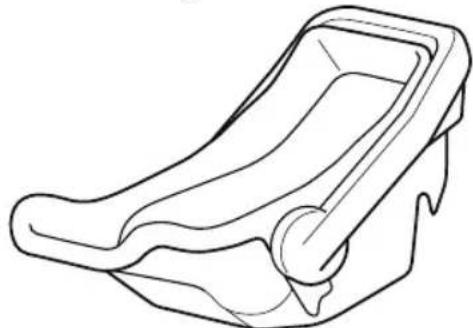
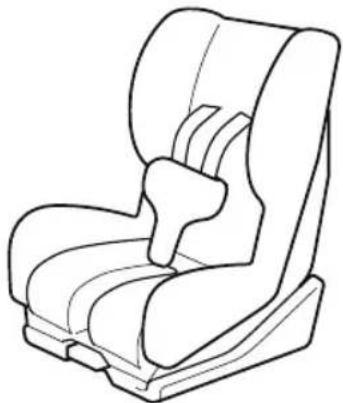
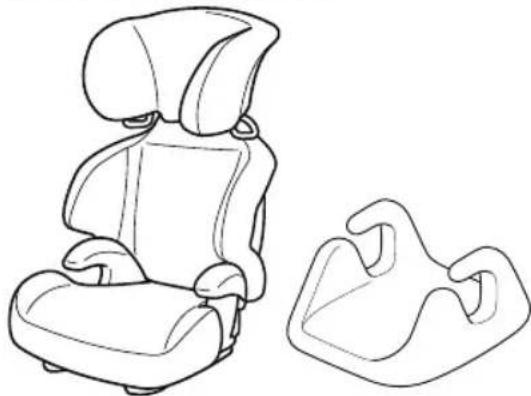
In this owner's manual, explanation of child-restraint systems is provided for the following three types of popular child-restraint systems: infant seat, child seat, booster seat.
NOTE
- Installation position is determined by the type of child-restraint system. Always read the manufacturer's instructions and this owner's manual carefully.
- Due to variations in the design of child-restraint systems, vehicle seats and seat belts, all child-restraint systems may not fit all seating positions. Before purchasing a child-restraint system, it should be tested in the specific vehicle seating position (or positions) where it is intended to be used. If a previously purchased child-restraint system does not fit, you may need to purchase a different one that will.
Infant seat
An infant seat provides restraint by bracing the infant's head, neck and back against the seating surface.
Equal to Group 0 and 0+ of the UN-R 44 and UN-R 129 regulation.
natural_image
Line drawing of a baby car seat with no text or symbolsChild seat
A child seat restrains a child's body using the harness.
Equal to Group 1 of the UN-R 44 and UN-R 129 regulation.
natural_image
Line drawing of a car seat with adjustable seat and seatbelt (no text or symbols)Booster seat
A booster seat is a child restraint accessory designed to improve the fit of the seat belt system around the child's body.
Equal to Group 2 and 3 of the UN-R 44 and UN-R 129 regulation.
natural_image
Line drawing of a car comfort seat and its side view (no text or symbols)Child-Restraint System Suitability for Various Seat Positions Table
(Mexico)
Provided information in the table shows your child-restraint system suitability for various seating position. For installation suitability of other manufacturer child-restraint system, carefully consult the manufacturer's instructions which accompany the child-restraint system.
When installing a child-restraint system, the following points must be observed:
- When installing a child-restraint system to the passenger seat, adjust the seat slide position as far back as possible.
Refer to Adjusting the Passenger's Seat on page 2-10.
- When it is difficult to install a child-restraint system to the passenger seat, or the seat belt cannot be secured to the child-restraint system, perform the following operations to adjust the seat holding the child-restraint system so that the seat belt can be secured completely to it.
- Move the seat forward or back.
- Move the seatback forward or back.
- An i-Size child-restraint system refers to a child-restraint system which has acquired i-Size category certification for the UN-R 129 regulation.
When installing a child-restraint system to the passenger seat, refer to the child-restraint system manufacturer's instructions.
| Seating position | Passenger | |
| Airbag activated Airbag de-activated | ||
| Seating position suitable for universal belted (Yes/No) | Yes (UF) Yes (U) | |
| i-Size seating position (Yes/No) No No | ||
| Largest suitable rearward facing fixture (R1) | No No | |
| Largest suitable rearward facing fixture (R2) | No No | |
| Largest suitable rearward facing fixture (R2X) | No No | |
| Largest suitable rearward facing fixture (R3) | No No | |
| Largest suitable forward facing fixture (F2) | No Yes (IUF) | |
| Largest suitable forward facing fix-ture (F2X) | No Yes (IUF) | |
| Largest suitable forward facing fix-ture (F3) | No No | |
| Largest suitable lateral facing fix-ture (L1) | No No | |
| Largest suitable lateral facing fix-ture (L2) | No No | |
| Largest suitable booster fixture (B2) | No No | |
| Largest suitable booster fixture (B3) | No No | |
| Non i-size compatible with a sup-port leg (Yes/No) | No Yes | |
| Lower ISOFIX anchorages but without Top Tether (Yes/No) | No No | |
U = Suitable for “universal” category restraints approved for use in this mass group.
UF = Suitable for forward-facing “universal” category restraints approved for use in this mass group.
IUF = Suitable for ISOFIX forward child restraints systems of universal category approved for use in the mass group.
L = Suitable for particular child restraints given on attached list. These restraints may be of the “specific vehicle”, “restricted” or “semi-universal” categories.
IL = Suitable for particular ISOFIX child restraint systems (CRS) given in the attached list. These ISOFIX CRS are those of the “specific vehicle”, “restricted” or “semi-universal” categories.
i-U = Suitable for i-Size "universal" Child Restraint Systems forward and rearward facing.
i-UF = Suitable for forward-facing i-Size "universal" Child Restraint Systems only.
Yes = Child-restraint system can be secured on the seat.
No = Child-restraint system cannot be secured on the seat, or there is no fixture.
X = Child-restraint system cannot be installed.
Regarding child-restraint systems which can be installed to your Mazda, consult an Authorized Mazda Dealer.
(Except Mexico)
- Regarding child-restraint systems which can be installed to your Mazda, consult an Authorized Mazda Dealer.
- Please comply with the legal regulations concerning the use of child-restraint systems in your country.
- For the CRS which do not carry the ISO/XX size class identification (A to G), for the applicable mass group, the child seat manufacturer shall indicate the vehicle specific LATCH child-restraint systems recommended for each position.
Installing Child-Restraint Systems
The passenger lap/shoulder belt can easily be converted into the automatic locking mode, which must be done to hold the child-restraint system.
NOTE
- To check if your seats have side air bags:
Mazda vehicles equipped with side air bag will have an embossed "SRS AIRBAG" marking on the outboard shoulder of the seats.
· Follow the child-restraint system manufacturer's instructions carefully.
Depending on the type of child-restraint system, it may not employ seat belts which are in automatic locking mode, however if it uses an upper tether, it may not be mounted properly in this vehicle as there is no safe way to anchor the tether. Confirm whether the child-restraint system can be used with seat belts by reading the child-restraint system manufacturer's instructions.

WARNING
Do not allow a child or anyone to lean over to or against the side window of a vehicle with side and curtain air bags:
It is dangerous to allow anyone to lean over to or against the side window, the area of the front passenger seat, the front and rear window pillars and the roof edge along both sides from which the side and curtain air bags deploy, even if a child-restraint system is used. The impact of inflation from a side or curtain air bag could cause serious injury or death to an out of position child. Furthermore, leaning over to or against the door could block the side and curtain air bags and eliminate the advantages of supplemental protection. Because the front seats are equipped with front air bags, the rear seat is always a better location for children. Take special care not to allow a child to lean over to or against the side window, even if the child is seated in a child-restraint system.

CAUTION
When moving the seats forward and rearward, make sure you hold onto the seatback with your hand while operating. If the seatback is not held, the seat will move suddenly and could cause injury.
Passenger's Seat Child-Restraint System Installation (Except Mexico)
-
Make sure the ignition is switched off.
-
Slide the seat as far back as possible.
natural_image
Line drawing of a child wearing a seatbelt and holding a device (no text or symbols)-
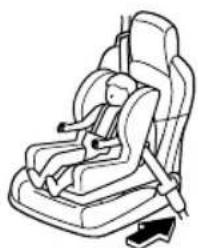
Place the child-restraint system on the seat without putting your weight on the seat and secure the child-restraint system with the lap portion of the lap/shoulder belt. See the manufacturer's instructions on the child-restraint system for belt routing instructions.
-
To get the retractor into the automatic locking mode, pull the shoulder belt portion of the seat belt until the entire length of the belt is out of the retractor.
-
Push the child-restraint system firmly into the vehicle seat. Be sure the belt retracts as snugly as possible. A clicking noise from the retractor will be heard during retraction if the system is in automatic locking mode. If the belt does not lock the seat down tight, repeat the previous step and also this one.
NOTE
- Inspect this function before each use of the child-restraint system. You should not be able to pull the shoulder belt out of the retractor while the system is in the automatic locking mode. When you remove the child-restraint system, be sure the belt fully retracts to return the system to emergency locking mode before occupants use the seat belts.
-
Seat your child safely in the child-restraint system and secure the child according to the instructions from the child-restraint system manufacturer.
-
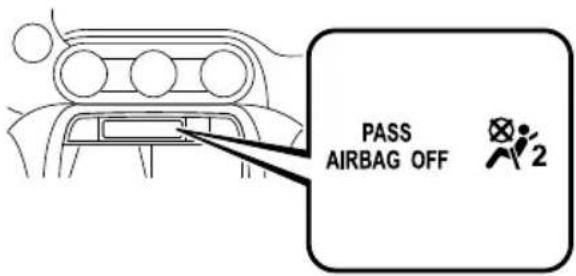
Switch the ignition ON and make sure the passenger air bag deactivation indicator light illuminates after installing a child-restraint system on the passenger seat. If the passenger air bag deactivation indicator light does not illuminate, remove the child-restraint system, switch the ignition to OFF, and then re-install the child-restraint system (page 2-49).

- California Proposition 65 Warning
- NOTE
- Web Owner's Manual
- To Customers in U.S.A. and Puerto Rico
- To Customers in Canada
- Limitations on use
- Important Notes About This Manual
- Air Conditioner and the Environment
- Perchlorate
- WARNING
- CAUTION
- Pictorial Index
- Interior Overview......1-2
- Exterior Overview...... 1-7
- Interior Equipment (View B)
- Interior Equipment (View D)
- ▼ Convertible Top (Soft Top)
- ▼ Convertible Top (Hardtop)
- Convertible Top (Soft Top)
- Convertible Top (Hardtop)
- Essential Safety Equipment
- Seats......2-2
- Seat Warmer.... 2-12
- Seat Belt Systems....2-13
- Child Restraint.... 2-21
- SRS Air Bags......2-36
- Seat Precautions
- Make sure the adjustable components of a seat are locked in place:
- Never allow children to adjust a seat:
- Do not drive with the seatback unlocked:
- Adjust a seat only when the vehicle is stopped:
- Do not modify or replace the seats:
- Do not drive with damaged seats:
- Do not drive with either seats reclined:
- Do not place an object such as a cushion between the seatback and your back:
- Do not place objects under the seat:
- Do not stack cargo higher than the seatbacks:
- Make sure luggage and cargo is secured before driving:
- Always leave your car locked and keep the car keys safely away from children:
- Seat
- ▼ Adjusting the Driver's Seat
- Before making adjustments to the driving position recommended by Mazda
- Never adjust the steering wheel while the vehicle is moving:
- After adjusting the steering wheel position, make sure it is securely locked by trying to move it up and down:
- How to move a driver's seat to its default position
- Seat adjustment procedure for the driving position recommended by Mazda
- Adjusting the seatback angle (reclining)
- Adjusting the seat position forward and back (sliding)
- Adjusting the steering wheel position
- ▼ Adjusting the Passenger's Seat
- ① Seat Slide
- ② Seat Recline
- Head Restraints
- ▼ Non-Adjustable Head Restraints
- Make sure the seatbacks are properly adjusted to their upright, on-road positions before the vehicle is driven:
- Seat Warmer\*
- Be careful when using the seat warmer:
- Do not use the seat warmer with anything having high moisture-retention ability such as a blanket or cushion on the seat:
- Do not use the seat warmer even when taking a short nap in the vehicle:
- Do not place heavy objects with sharp projections on the seat, or insert needles or pins into it:
- Seat Belt Precautions
- (Except Mexico)
- (Mexico)
- Always wear your seat belt and make sure all occupants are properly restrained:
- Do not wear twisted seat belts:
- Never use one seat belt on more than one person at a time:
- ▼ Pregnant Women and Persons with Serious Medical Conditions
- ▼ Emergency Locking Mode
- (Seat Belt with Automatic Locking Mode)
- ▼ Automatic Locking Mode\*
- Seat Belt
- ▼ Unfastening the Seat Belt
- Seat Belt Warning Systems
- Seat Belt Pretensioner and Load Limiting Systems
- Pretensioners:
- Load limiter:
- Wear seat belts only as recommended in this owner's manual:
- Have your seat belts changed immediately if the pretensioner or load limiter has been expended:
- Do not modify the components or wiring, or use electronic testing devices on the pretensioner system:
- Properly dispose of the pretensioner system:
- Seat Belt Extender
- Do not use a seat belt extender unless it is necessary:
- Do not use an improper extender:
- Do not use an extender that is too long:
- Do not leave a seat belt extender connected to the buckle:
- Do not use the seat belt extender when installing a child-restraint system on the passenger seat:
- Child-Restraint Precautions
- Use the correct size child-restraint system:
- Follow the manufacturer's instructions and always keep the child-restraint system buckled down:
- Always secure a child in a proper child-restraint system:
- Always make sure the passenger air bag deactivation indicator light is illuminated when using a child-restraint system:
- Before installing child-restraint system on the passenger seat, move the passenger seat as far back as possible:
- Seating a child in a child-restraint system on the passenger seat is dangerous under certain conditions:
- Do not allow a child or anyone to lean over to or against the side window of a vehicle with side and curtain air bags:
- Always use a child-restraint system designed for use without a tether or the ISOFIX/LATCH 1 lower anchor:
- Child-Restraint System Installation
- ▼ Categories of Child-Restraint Systems
- ▼ Child-Restraint System Types
- Infant seat
- Child seat
- Booster seat
- Child-Restraint System Suitability for Various Seat Positions Table
- Installing Child-Restraint Systems
- Passenger's Seat Child-Restraint System Installation (Except Mexico)
Brand : MAZDA
Model : MX-5 Miata (2022)
Category : Automobile