
CellPac BLOX - Battery VARTA - Free user manual and instructions
Find the device manual for free CellPac BLOX VARTA in PDF.


| Product Type | Lithium-Ion Rechargeable Battery Pack |
| Brand | VARTA |
| Model | CellPac BLOX |
| Cell Types Available | Cylindrical (e.g., LIC18650) and Polymer (e.g., LPP series) |
| Nominal Voltage | 3.6 V to 3.70 V (depending on cell) |
| Capacity Range | 660 mAh to 5700 mAh (depending on configuration) |
| Energy Range | 2.44 Wh to 20.81 Wh |
| Dimensions (Cylindrical Cell LIC18650) | Diameter: 19.5 mm, Height: 71.0 mm |
| Dimensions (Polymer Cell LPP443441S) | Length: 39.0 mm, Width: 34.0 mm, Height: 4.5 mm |
| Weight (Cylindrical Cell LIC18650) | Approx. 50 g |
| Weight (Polymer Cell LPP443441S) | Approx. 12.8 g |
| Charging Method | Constant Current + Constant Voltage (CC/CV) |
| Charge Voltage | 4.20 V per cell |
| Operating Temperature (Charge) | 0°C to +45°C |
| Operating Temperature (Discharge) | -20°C to +60°C (some cells -10°C to +60°C) |
| Protection Features | Overcharge, overdischarge, overcurrent protection; NTC thermistor |
| Safety Certification | UL 1642 recognized; IEC62133 edition 2 available (optional) |
| Life Expectancy | 300 to 500 cycles with 70-80% remaining capacity |
| Maintenance & Storage | Store at half charge; avoid trickle charge and deep discharge |
| Spare Parts / Reparability | Not user-serviceable; contact distributor for replacement |
| General Information | Semi-custom design; pre-tested cell+PCM combinations; MOQ 5000; samples up to 25 pcs; lead time 3 weeks (samples), 12-16 weeks (mass production) |
Frequently Asked Questions - CellPac BLOX VARTA
User questions about CellPac BLOX VARTA
0 question about this device. Answer the ones you know or ask your own.
Ask a new question about this device
Download the instructions for your Battery in PDF format for free! Find your manual CellPac BLOX - VARTA and take your electronic device back in hand. On this page are published all the documents necessary for the use of your device. CellPac BLOX by VARTA.
USER MANUAL CellPac BLOX VARTA
natural_image
Exploded view of a battery pack assembly showing internal components and wiring (no text or symbols visible)
To buy or discuss any of the products in the CellPac BLOX range:
| USA | EUROPE | ASIA |
| VARTA Microbattery, Inc.555 Theodore Fremd Avenue,Suite C304Rye, NY 10580, USATel +1 914 592 25 00Fax +1 914 3450 488 | Weisbauer ElektronikMr. Thomas Arnoldtarnold@weisbauer.deTel: +49 23155 730 225Fax: +49 23155 760 233www.weisbauer.de | VARTA Microbattery Pte. Ltd.300, Tampines Avenue 5, #05-01Tampines Junction,529653 SingaporeTel +65 6 260 58 01Fax +65 6 260 58 12 |
| Arrow EuropeMr. Christian Schmidtcschmidt@arroweurope.comTel: +49 6102 5030 8262www.arrow.com | VARTA Microbattery Pte. Ltd.Room 1702-3, 17/F.,Fullerton Centre19 Hung to Road, Kwun TongTel +852 28 98 83 73Fax +852 28 97 76 09 | |
| Avnet AbacusMr. Tim Parkertim.parker@avnet-abacus.euTel: +44 1628 512 904Mo: +44 7768 396 697www.avnet-abacus.eu | VARTA Microbattery Pte. Ltd.Kyobashi Y'SUS Bldg, 3F. 1-6-12, Kyobashi,Chuo-KuTokyo 104-0031, JapanTel +81 3 35 67 81 71Fax +81 3 35 67 81 75 | |
| Haug Components Holding GmbHMr. Dominik Peukerd.peuker@haug-components.comTel: +49 6081 405-180www.haug-components.com/de/ | VARTA Microbattery Pte. Ltd.11F-4, No. 130, Section 2Chung Hsaio East RoadTaipei 10053, TaiwanTel +886 233 931 557Fax: +886 233 931 556 |
For more information visit our website https://www.varta-ag.com/en/industry/service
Overview
CELL PAC BLOX
CellPac BLOX - Semi-Custom Battery Design
CellPac BLOX suits those customers in need of semi-customization and where design-cycles, engineering costs and time to market must be minimized for success. Battery designs are limited in their complexity, but available for nearly no NRE cost and development effort.
CELL PAC LTE
CellPac LITE - Our Range of Standard Lithium-Ion Packs
We offer a range of pre-configured battery packs that are immediately available for standard applications: CellPac LITE. They are made exclusively of cylindrical or prismatic lithium batteries. CellPac LITE power packs are fitted with an electronic protective switch and additional overcurrent protection. They comply with the requirements of safety standard UL 1642.
CELL PAC PLUS
CellPac PLUS - Custom Lithium Rechargeable Design Service
VARTA Storage's CellPac PLUS service focuses on designing and manufacturing customer-specific battery packs for mobile equipment. VARTA Storage combines its expert knowledge in cell chemistry and electronics with extensive market experience – for example in the fields of communications, medical technology, robotics and special-industrial. Because they are designed for specific applications, CellPac PLUS power packs offer maximum safety, reliability and efficiency.
Find more information on the website
Contents
- Introduction to CellPac BLOX....1
- FAQ - Frequently Asked Questions....2
- The CellPac BLOX Range of Cells.... 3
- Connectors....4
- CellPac BLOX possible configurations....5
- Individual BLOX Datasheets....6
- Design Tips for VARTA CellPac BLOX Battery Packs....23
- Reliability and Life Expectancy 27
- Safety 28
- Storage 29
- Transportation of VARTA CellPac BLOX Batteries 29
- Proper Use and Handling 29
© by VARTA Storage GmbH
Note:
This handbook is subject to change without prior notice and should be used in an advisory capacity and does not form part of any offer. Data and product availability is updated and the latest version of this handbook can be downloaded from our website at the following link: https://www.varta-ag.com/en/industry/product-solutions/lithium-ion-battery-packs/cellpac-blox
1. Introduction to CellPac BLOX
How does CellPac BLOX work?
This handbook is a portfolio of all combinations of cells and PCM which can be ordered under the CellPac BLOX program. We have already reviewed and tested these combinations in detail to ensure a good fit between the cell and safety electronics.
On the following pages, there is detailed information about each cell and the cell performance as well as the configurations which can be ordered of that type. On each datasheet page, there is a CellPac BLOX Order Reference Number (CPB XXXX) and MOQ for that individual battery.

flowchart
graph LR
    A["Choose Configuration"] --> B["Contact BLOX Distributor with CellPac BLOX Order Reference Number"]
    B --> C["Agree Volumes & Pricing"]
    C --> D["Place Sample Order"]
    E["Test & Approve Samples"] --> F["Place Volume Orders"]
    F --> G["Place Volume Orders"]
The VARTA CellPac BLOX distributor will quote the customer for samples, mass production and any NREs if necessary. All that needs to be provided to quote you is:
CPB Reference Number
▶ Wire & connector requirements (wire length & connector type)
Mass production quantities for pricing determination
Once orders are received for samples, VARTA will work on a battery drawing and build samples of the battery, which will be shipped normally within 3 weeks from order. After internal customer testing of the samples you can send the approved drawing back to your distributor and order the agreed mass production quantity with any necessary NREs, which were already determined. The provided drawing of the battery is the master document and defines the battery (check it carefully!). Lead time for mass production is typically 12-16 weeks. Please note that this will be longer if certification such as IEC62133 edition 2 is required for the battery pack.
2. FAQ - Frequently Asked Questions
How many samples can be ordered?
Up to 25 samples can be ordered to test and validate the design.
How long does it take?
Once POs are placed and your project is started, a technical drawing of the final battery and the samples will be provided for you for drawing approval and samples testing. We aim to ship the drawing and sample bundle within 3 weeks.
For the mass production order after your approval the typical lead time can vary between 12 and 16 weeks for the mass production quantity. Actual lead-times can be checked via your distributor when you discuss your individual requirements.
I need a high volume, is special pricing available?
CellPac BLOX can be ordered at any volume above the MOQ but fits best to OEMs requiring volumes of 5000-50k pcs. Pricing can be negotiated with your distributor to reflect commitment levels.
Why is there an NRE (Non-Recurring Engineering) charge?
Your battery will be a new design, with its own part number. As well as the new drawing, there will be manufacturing and quality documentation established. Fixtures will be produced to ensure repeatable quality and UN38.3 testing and certification is mandatory. NRE is kept as low as possible and avoided completely in many cases.
Can the CellPac BLOX battery be certified for special requirements, such as IEC62133 edition 2?
Yes, additional certification is possible for medium-to-high volume projects but more time and effort is involved. Please discuss your individual requirements with your VARTA representative.
3. The CellPac BLOX Range of Cells
| Cylindrical | Cell | Nominal Capacity |
 | LIC 18650-26 SKE | 2600mAh |
| LIC 18650-29 EC | 2850mAh |
| Polymer | Cell | Nominal Capacity |
 | LPP 443441 S | 660mAh |
| LPP 463149 S | 700mAh | |
| LPP 523450 S | 1000mAh | |
| LPP 423566 BE | 1160mAh | |
| LPP 503562 S | 1200mAh | |
| LPP 683566 BE | 1880mAh |
4. Connectors
If the choice of the connector is not critical, VARTA will supply you with a standard 2-Pin or 3-Pin Connector for your battery. If you want to have special connector from our existing range, please inform your BLOX distributor. This will be specified in your battery drawing. We handle a large number of connector types from the majority of market-leading manufacturers. In the rare case that your connector requirement cannot be met, you will be informed.
5. CellPac BLOX possible configurations
| Description | BLOX No. | Estimated SOC | MDQ/ MDQ | Capacity mAh | Voltage Volts | Energy Wh |
| 1S1P / LIC 18650 - 26 SKE | CPB 1007 | 25% | 5000 | 2600 mAh | 3,60 V | 9,50 Wh |
| 1S2P / LIC 18650 - 26 SKE sbs | CPB 1008 | 25% | 5000 | 5200 mAh | 3,60 V | 19,00 Wh |
| 2S1P / LIC 18650 - 26 SKE sbs | CPB 1009 | 25% | 5000 | 2600 mAh | 7,30 V | 19,00 Wh |
| 1S1P / LIC 18650 - 29EC | CPB 1011 | 18% | 5000 | 2850 mAh | 3,65 V | 10,40 Wh |
| 1S2P / LIC 18650 - 29EC sbs | CPB 1012 | 18% | 5000 | 5700 mAh | 3,65 V | 20,81 Wh |
| 1S1P / LPP 423566 BE | CPB 3005 | ~ 50% | 5000 | 1160 mAh | 3,70 V | 4,29 Wh |
| 1S1P / LPP 443441 S | CPB 3007 | ~ 50% | 5000 | 660 mAh | 3,70 V | 2,44 Wh |
| 1S2P / LPP 443441 S sbs | CPB 3008 | ~ 50% | 10000 | 1320 mAh | 3,70 V | 4,88 Wh |
| 1S1P / LPP 463149 S | CPB 3015 | ~ 50% | 5000 | 700 mAh | 3,70 V | 2,59 Wh |
| 1S2P / LPP 463149 S sbs | CPB 3016 | ~ 50% | 10000 | 1400 mAh | 3,70 V | 5,18 Wh |
| 1S1P / LPP 503562 S | CPB 3019 | ~ 50% | 5000 | 1200 mAh | 3,70 V | 4,44 Wh |
| 1S2P / LPP 503562 S sbs | CPB 3020 | ~ 50% | 10000 | 2400 mAh | 3,70 V | 8,88 Wh |
| 1S1P / LPP 523450 S | CPB 3027 | ~ 50% | 5000 | 1000 mAh | 3,70 V | 3,70 Wh |
| 1S2P / LPP 523450 S sbs | CPB 3028 | ~ 50% | 10000 | 2000 mAh | 3,70 V | 7,40 Wh |
| 1S1P / LPP 683566 BE | CPB 3031 | ~ 50% | 5000 | 1880 mAh | 3,70 V | 6,96 Wh |
The standard terms and conditions of VARTA apply.
In addition the relevant version of our Handling Precautions and Prohibitons apply for Li-Ion batteries.
Subject to change without prior notice
For Volumes >10k pieces shipment can be scheduled
Final box quantity will only be defined during the project
6. Individual BLOX Datasheets
CELL PAC BLOX

| LIC 18650-26SKE | |
| System | Li-Ion |
| Recognition | UL 1642 |
| IEC62133 ed. 2 | |
| Nominal Voltage | 3.6V |
| Nominal Capacity | 2600 mAh |
| Minimum Capacity, C | 2500 mAh (at 0.2C and 25±2°C) |
| Impedance Initial | ≤120 mΩ @ 1kHz at 4.2 V |
| Life Expectancy | 300 cycles for ≥80 % |
| Battery | |
| Diameter (d) | 19.5 mm (max.) |
| Height (h) | 71.0 mm (max.) |
| Weight, approx. | 50 g |
| Function | |
| Charging Method | Constant Current + Constant Voltage |
| Charge Voltage | 4.20V |
| Initial Charge Current | Standard Charge: 1300mA (15~45°C) |
| Charging Cut-Off (a) or (b) | |
| a) by time | Standard Charge: 3h |
| Rapid Charge: 2.5h | |
| b) by min. current | 52mA |
| Discharge Cut-Off voltage | 2.75V |
| Max. Continuous Discharge Current | 3900mA (+45°C to +60°C) |
| Data connection | |
| Operating Temperature | Charge: 0°C to+ 45°C |
| Discharge: -20°C to +60°C | |
| Storage Temperature | 1 Month at -20°C to +60°C >90% |
| Capacity Rate | 3 Month at -20°C to +40°C >90% |
| 1 Year at -20°C to +20°C >90% | |
| CONFIGURATIONS | 1S1P | 1S2P sbs * | 2S1P sbs * |
| Rated Capacity | 2600mAh | 5200mAh | 2600mAh |
| Nominal Voltage | 3.65 V | 3.65 V | 7.30 V |
| Watt-Hour Rating | 9.5Wh | 19Wh | 19Wh |
| Charge Temperature | 0 to +45°C | 0 to +45°C | 0 to +45°C |
| Discharge Temperature | -20 to +60°C | -20 to +60°C | -20 to +60°C |
| Overcharge Detection | 4.3V ± 25mV | 4.275V ± 25mV | 4.35 V ± 25mV |
| Overdischarge Detection | 2.4V ± 35mV | 2.3V ± 80mV | 2.3V ± 50mV |
| Overcurrent Detection | 6A - 8A | 4A - 6.3A | 4A - 6.3A |
| NTC | 10k B=3435k | 10k B=3435k | 10k B=3435k |
| MOQ/ MDQ | 5.000 | 5.000 | 5.000 |
| Order Reference Number | CPB 1001 | CPB 1002 | CPB 1003 |
* sbs - denotes cells will be side by side
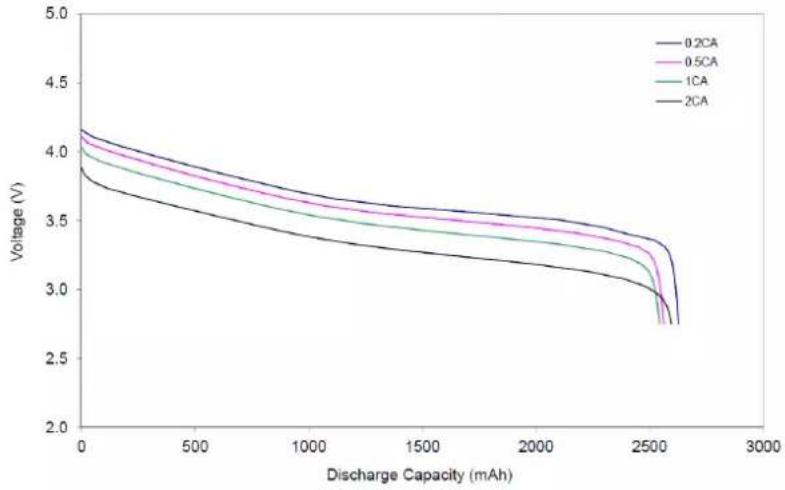
LIC 18650-26SKE Discharge Profile
Test Conditions:
| 1-3 cycles | Charge 1.0C; tmax = 3h; |
| Imin = 0.02C; 4.2V | |
| Discharge 1.0C | |
| UEOD = 3.0V |
| 2 - 1 cycle | Charge 1.0C; tmax = 3h; |
| Imin = 0.02C; 4.2V | |
| Discharge 0.2C | |
| UEOD = 3.0V |
Maximum Discharge Current taken from the product specification
line
| Discharge Capacity (mAh) | 0.2CA | 0.5CA | 1CA | 2CA | | ------------------------ | ----- | ----- | --- | --- | | 0 | 4.1 | 4.05 | 3.95 | 3.85 | | 500 | 3.9 | 3.8 | 3.7 | 3.6 | | 1000 | 3.7 | 3.6 | 3.5 | 3.4 | | 1500 | 3.6 | 3.5 | 3.4 | 3.3 | | 2000 | 3.5 | 3.4 | 3.3 | 3.2 | | 2500 | 3.4 | 3.3 | 3.2 | 3.1 | | 2600 | 2.8 | 2.7 | 2.6 | 2.5 | | 2700 | 2.7 | 2.6 | 2.5 | 2.4 | | 2800 | 2.6 | 2.5 | 2.4 | 2.3 | | 2900 | 2.5 | 2.4 | 2.3 | 2.2 | | 3000 | 2.4 | 2.3 | 2.2 | 2.1 |LIC 18650-26SKE Temperature Profile @ 0.5C/ 0.2C
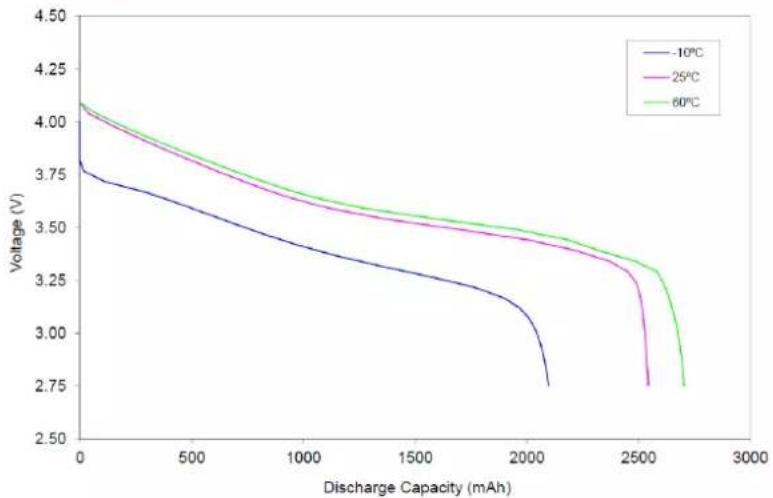
Test Conditions:
Charge (0.5C; t = 3h; lmin 0.02C; Umax = 4.2V at room temperature) 4h rest at the below mentioned temperatures
Discharge (0.2C; UEOD = 3.0V) at the following temperatures: 60°C, 25°C, -10°C. Starting with 0.2C at -20°C; always charging at RT after 4h rest time
line
| Discharge Capacity (mAh) | -10°C Voltage (V) | 25°C Voltage (V) | 60°C Voltage (V) | | ------------------------ | ----------------- | ---------------- | ---------------- | | 0 | 4.1 | 4.1 | 4.1 | | 500 | 3.7 | 3.8 | 3.9 | | 1000 | 3.5 | 3.6 | 3.7 | | 1500 | 3.3 | 3.5 | 3.6 | | 2000 | 3.1 | 3.4 | 3.5 | | 2500 | 2.8 | 3.3 | 3.4 | | 2750 | 2.7 | 2.8 | 2.9 | | 3000 | 2.7 | 2.7 | 2.7 |LIC 18650-26SKE Cycling at 20°C
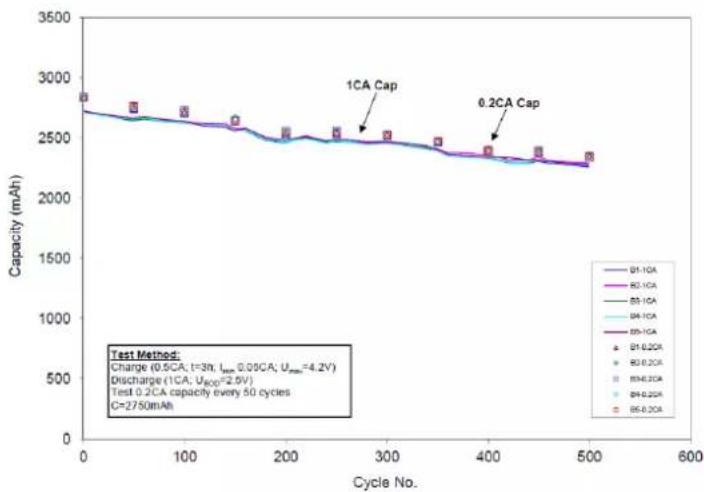
Test Conditions:
a) Capacity
charge (0.5C; t = 3h; lmin 0.02C; Umax = 4.2V)
discharge (1.0C; UEOD = 2.75)
Determination of the 0.2C capacity
(discharge 0.2C; UEOD = 3.0V) after
charging each 50 cycles
b) Impedance measurements before and after cycling reference impedance according to specification of cell.
c) Thickness measurement before and after cycling reference thickness according to specification of cell

line
| Cycle No. | B1 | B2 | B3 | B4 | B5 | | --------- | ---- | ---- | ---- | ---- | ---- | | 0 | 2500 | 2500 | 2500 | 2500 | 2500 | | 100 | 2500 | 2500 | 2500 | 2500 | 2500 | | 200 | 2450 | 2450 | 2450 | 2450 | 2450 | | 300 | 2400 | 2400 | 2400 | 2400 | 2400 | | 400 | 2350 | 2350 | 2350 | 2350 | 2350 | | 500 | 2300 | 2300 | 2300 | 2300 | 2300 | | 600 | 2250 | 2250 | 2250 | 2250 | 2250 |LIC 18650-29EC
| System | Li-Ion |
| Recognition | UL 1642 |
| IEC62133 ed. 2 | |
| Nominal Voltage | 3.65V |
| Nominal Capacity | 2850 mAh (at 0.2C and 20°C) |
| Minimum Capacity, C | 2750 mAh |
| Impedance Initial | ≤45 mΩ @ 1kHz at 4.2 V |
| Life Expectancy | 500 cycles for ≥1868 mAh |
| Battery | |
| Diameter (d) | 18.4 mm (max.) |
| Height (h) | 65.0 mm (max.) |
| Weight, approx. | 48.0 g |
| Function | |
| Charging Method | Constant Current + Constant Voltage |
| Charge Voltage | 4.20V (± 50mV) |
| Initial Charge Current | Standard Charge: 1375 mA |
| Rapid Charge: 2700 mA | |
| Charging Cut-Off (a) or (b) | |
| a) by time | Standard Charge: 3h |
| Rapid Charge: 2.5h | |
| b) by min. current | 0.02C |
| Discharge Cut-Off voltage | 2.5V |
| Max. Continuous Discharge Current | 5500 mA |
| Data connection | |
| Operating Temperature | Charge: 0°C to+ 45°C |
| Discharge: -20°C to +60°C | |
| Storage Temperature | 1 Month at -20°C to +60°C >80% |
| Capacity Rate | 3 Month at -20°C to +45°C >80% |
| 1 Year at -20°C to +25°C >80% | |
| CONFIGURATIONS | 1S1P | 1S2P sbs * |
| Rated Capacity | 2850 mAh | 5700 mAh |
| Nominal Voltage | 3.65 V | 3.65 V |
| Watt-Hour Rating | 10.40 Wh | 20.81 Wh |
| Charge Temperature | 0 to +45°C | 0 to +45°C |
| Discharge Temperature | -20 to +60°C | -20 to +60°C |
| Overcharge Detection | 4.3 V ± 25 mV | 4.275 V ± 25 mV |
| Overdischarge Detection | 2.4 V ± 35 mV | 2.3 V ± 80 mV |
| Overcurrent Detection | 6A - 8A | 4A - 6.3A |
| NTC | 10k B=3435k | 10k B=3435k |
| MOQ/ MDQ | 5.000 | 5.000 |
| Order Reference Number | CPB 1001 | CPB 1002 |
* sbs - denotes cells will be side by side
LIC 18650-29 EC Discharge Profile
Test Conditions:
| 1 - 3 cycles | Charge 1.0C; tmax = 3h; |
| Imin = 0.02C; 4.2V | |
| Discharge 1.0C | |
| UEOD = 3.0V |
| 2 - 1 cycle | Charge 1.0C; tmax = 3h; |
| Imin = 0.02C; 4.2V | |
| Discharge 0.2C | |
| UEOD = 3.0V |
Maximum Discharge Current taken from the product specification

line
| Discharge Capacity (mAh) | 0.2CA | 0.5CA | 1CA | 1.5CA | 2CA | 3CA | | ------------------------ | ----- | ----- | --- | ----- | --- | --- | | 0 | 4.1 | 4.1 | 4.0 | 4.0 | 4.0 | 3.9 | | 500 | 3.9 | 3.85 | 3.75| 3.7 | 3.65| 3.5 | | 1000 | 3.7 | 3.6 | 3.5 | 3.45 | 3.4 | 3.2 | | 1500 | 3.5 | 3.4 | 3.3 | 3.25 | 3.2 | 3.0 | | 2000 | 3.3 | 3.2 | 3.1 | 3.05 | 3.0 | 2.8 | | 2500 | 3.1 | 3.0 | 2.9 | 2.85 | 2.8 | 2.6 | | 2800 | 2.8 | 2.7 | 2.6 | 2.55 | 2.5 | 2.4 | | 2900 | 2.7 | 2.6 | 2.5 | 2.45 | 2.4 | 2.3 | The chart displays a line graph with six distinct curves labeled by current density (CA) and labeled by cell number (Cell 3). The x-axis represents discharge capacity in mAh and the y-axis represents voltage in volts (V). The legend indicates that each curve corresponds to a specific current density or concentration (CA). The data points are plotted for each curve at various discharge capacities, with labels indicating the current density (CA) and corresponding cell number (Cell 3). The chart is saved as an image file named 'results of Cell 3'.LIC 18650-29 EC Temperature Profile @ 1C
Test Conditions:
Charge (1.0C; t = 3h; Imin 0.02C; Umax = 4.2V at room temperature) 4h rest at the below mentioned temperatures
Discharge (0.2C; UEOD = 3.0V) at the following temperatures: 60°C, 40°C, RT, 0°C, -10°C, -20°C Starting with 0.2C at -20°C; always charging at RT after 4h rest time

LIC 18650-29 EC Cycling at 20°C
Test Conditions:
a) Capacity charge (1.0C; t = 3h; Imin 0.02C; Umax = 4.2V) discharge (1.0C; UEOD = 3.0V) Determination of the 0.2C capacity (discharge 0.2C; UEOD = 3.0V) after charging each 50 cycles
b) Impedance measurements before and after cycling reference impedance according to specification of cell.
c) Thickness measurement before and after cycling reference thickness according to specification of cell
LPP 423566 BE
| System | Li-Ion |
| Recognition | UL 1642 |
| Nominal Voltage | 3.70 V |
| Nominal Capacity, C | 1160 mAh (at 0.2C and 20°C) |
| Minimum Capacity | 1130 mAh |
| Impedance Initial | ≤80 mΩ @ 1kHz at 4.2V |
| Life Expectancy | 400 cycles for ≥848 mAh |
| Battery | |
| Length (l) | 65.4 mm (max.) |
| Width (w) | 35.0 mm (max.) |
| Height (h) | 4.5 mm (max.) |
| Weight, approx. | 25.0 g |
| Function | |
| Charging Method | Constant Current + Constant Voltage |
| Charge Voltage | 4.20V (± 50mV) |
| Initial Charge Current | Standard Charge: 565 mA |
| Rapid Charge: 1130 mA | |
| Charging Cut-Off (a) or (b) | |
| a) by time | Standard Charge: 5 h |
| Rapid Charge: 2.5 h | |
| b) by min. current | 0.02 C |
| Discharge Cut-Off voltage | 3.0 V |
| Max. Continuous Discharge Current | 2260 mA |
| data connection | |
| Operating Temperature | Charge: 0°C to+ 45°C |
| Discharge: -20°C to +60°C | |
| Storage Temperature | 1 Month at -20°C to +45°C >85% |
| Capacity Recovery Rate | 3 Month at -20°C to +45°C >80% |
| 1 Year at -20°C to +35°C >80% | |
| CONFIGURATIONS | 1S1P |
| Rated Capacity | 1160 mAh |
| Nominal Voltage | 3.70 V |
| Watt-Hour Rating | 4.29 Wh |
| Charge Temperature | 0 to +45°C |
| Discharge Temperature | -20 to +60°C |
| Overcharge Detection | 4.275 V ± 25 mV |
| Overdischarge Detection | 2.3 V ± 58 mV |
| Overcurrent Detection | 2A - 4A |
| NTC | 10k B=3380k |
| MOQ/ MDQ | 5.000 |
| Order Reference Number | CPB 3005 |
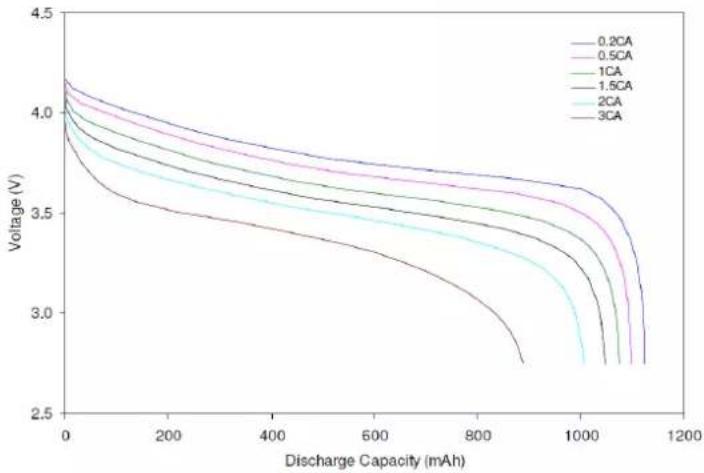
LPP 423566 BE Discharge Profile
Test Conditions:
| 1 – 3 cycles | Charge 1.0C; tmax = 3h;Imin = 0.02C; 4.2VDischarge 1.0CUEOD = 3.0V |
| 2 – 1 cycle | Charge 1.0C; tmax = 3h;Imin = 0.02C; 4.2VDischarge 0.2CUEOD = 3.0V |
Maximum Discharge Current taken from the product specification
line
| Discharge Capacity (mAh) | 0.2CA | 0.5CA | 1CA | 1.5CA | 2CA | 3CA | | ------------------------ | ----- | ----- | --- | ----- | --- | --- | | 0 | 4.1 | 4.05 | 4.0 | 3.95 | 3.85| 3.75| | 200 | 4.0 | 3.9 | 3.8 | 3.7 | 3.6 | 3.5 | | 400 | 3.9 | 3.8 | 3.7 | 3.6 | 3.5 | 3.4 | | 600 | 3.8 | 3.7 | 3.6 | 3.5 | 3.4 | 3.3 | | 800 | 3.7 | 3.6 | 3.5 | 3.4 | 3.3 | 3.2 | | 1000 | 3.6 | 3.5 | 3.4 | 3.3 | 3.2 | 3.1 | | 1200 | 3.5 | 3.4 | 3.3 | 3.2 | 3.1 | 3.0 |LPP 423566 BE Temperature Profile @ 1C/0.2C
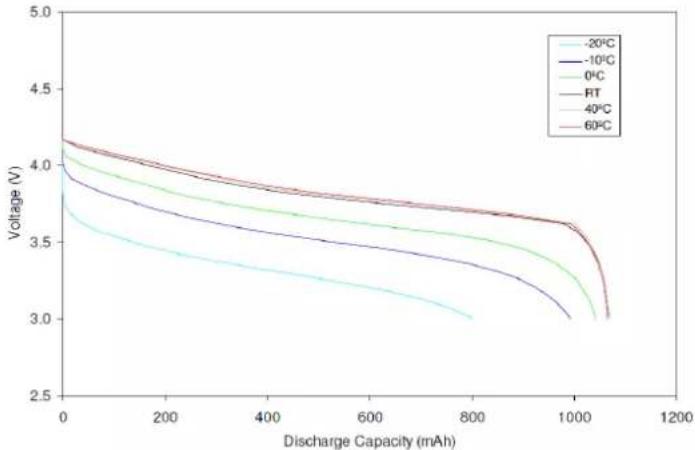
Test Conditions:
Charge (1.0C; t = 3h; lmin 0.02C; Umax = 4.2V at room temperature) 4h rest at the below mentioned temperatures
Discharge (0.2C; UEOD = 3.0V) at the following temperatures: 60°C, 40°C, RT, 0°C, -10°C, -20°C Starting with 0.2C at -20°C; always charging at RT after 4h rest time
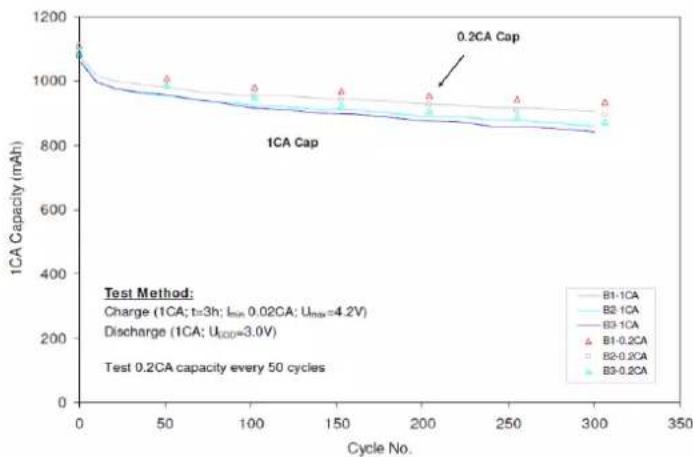
LPP 423566 BE Cycling at 20°C
Test Conditions:
a) Capacity
charge (1.0C; t = 3h; Imin 0.02C; Umax = 4.2V)
discharge (1.0C; UEOD = 3.0V)
Determination of the 0.2C capacity
(discharge 0.2C; UEOD = 3.0V) after charging each 50 cycles
b) Impedance measurements before and after cycling reference impedance according to specification of cell.
c) Thickness measurement before and after cycling reference thickness according to specification of cell
line
| Cycle No. | B1-1CA | B2-1CA | B3-1CA | B1-0.2CA | B2-0.2CA | B3-0.2CA | | --------- | ------ | ------ | ------ | -------- | -------- | -------- | | 0 | 1100 | 1100 | 1100 | 1100 | 1100 | 1100 | | 50 | 980 | 970 | 960 | 975 | 965 | 955 | | 100 | 950 | 940 | 930 | 955 | 945 | 935 | | 150 | 920 | 910 | 900 | 940 | 930 | 920 | | 200 | 900 | 890 | 880 | 930 | 920 | 910 | | 250 | 880 | 870 | 860 | 920 | 910 | 900 | | 300 | 860 | 850 | 840 | 910 | 900 | 890 | | 350 | 840 | 830 | 820 | 900 | 890 | 880 |LPP 443441 S
| System | Li-Ion |
| Recognition | UL 1642 |
| Nominal Voltage | 3.7 V |
| Nominal Capacity, C | 660 mAh (at 0.2C and 20°C) |
| Minimum Capacity | 630 mAh |
| Impedance Initial | ≤70 mΩ @ 1kHz at 4.2V |
| Life Expectancy | 500 cycles for ≥ 70 % |
| Battery | |
| Length (l) | 39.0 mm (max.) |
| Width (w) | 34.0 mm (max.) |
| Height (h) | 4.5 mm (max) |
| Weight, approx. | 12.8 g |
| Function | |
| Charging Method | Constant Current + Constant Voltage |
| Charge Voltage | 4.20V (± 50mV) |
| Initial Charge Current | Standard Charge: 315 mA |
| Rapid Charge: 630 mA | |
| Charging Cut-Off (a) or (b) | |
| a) by time | Standard Charge: 3.5 h |
| Rapid Charge: 2.5 h | |
| b) by min. current | 6.3 mA |
| Discharge Cut-Off voltage | 3.0 V |
| Max. Continuous Discharge Current | 1260 mA |
| Data connection | |
| Operating Temperature | Charge: 0°C to+ 45°C |
| Discharge: -10°C to +60°C | |
| Storage Temperature | 1 Month at -20°C to +45°C >90% |
| Capacity Recovery Rate | 3 Month at -20°C to +45°C >80% |
| 1 Year at -20°C to +30°C >80% | |
| CONFIGURATIONS | 1S1P | 1S2P sbs * |
| Rated Capacity | 660 mAh | 1320 mAh |
| Nominal Voltage | 3.70 V | 3.70 V |
| Watt-Hour Rating | 2.44 Wh | 4.88 Wh |
| Charge Temperature | 0 to +45°C | 0 to +45°C |
| Discharge Temperature | -10 to +60°C | -10 to +60°C |
| Overcharge Detection | 4.275 V ± 25 mV | 4.275 V ± 25 mV |
| Overdischarge Detection | 2.3 V ± 58 mV | 2.3 V ± 58 mV |
| Overcurrent Detection | 2A - 4A | 2A - 4A |
| NTC | 10k B=3380k | 10k B=3380k |
| MOQ/ MDQ | 5.000 | 10.000 |
| Order Reference Number | CPB 3007 | CPB 3008 |
* sbs - denotes cells will be side by side
LPP 443441 S Discharge Profile
Test Conditions:
| 1 - 3 cycles | Charge 1.0C; tmax = 3h; |
| Imin = 0.02C; 4.2V | |
| Discharge 1.0C | |
| UEOD = 3.0V |
| 2 - 1 cycle | Charge 1.0C; tmax = 3h; |
| Imin = 0.02C; 4.2V | |
| Discharge 0.2C | |
| UEOD = 3.0V |
Maximum Discharge Current taken from the product specification

line
| Discharge Capacity (mAh) | 0.2CA | 0.5CA | 1CA | 2CA | | ------------------------ | ----- | ----- | --- | --- | | 0 | 4.1 | 4.1 | 4.1 | 4.1 | | 100 | 3.9 | 3.95 | 3.85| 3.75| | 200 | 3.7 | 3.8 | 3.65| 3.55| | 300 | 3.5 | 3.7 | 3.55| 3.45| | 400 | 3.3 | 3.6 | 3.45| 3.35| | 500 | 3.1 | 3.5 | 3.35| 3.25| | 600 | 3.0 | 3.4 | 3.25| 3.15| | 700 | 2.9 | 3.3 | 3.15| 3.05| | 800 | 2.8 | 3.2 | 3.05| 2.95|LPP 443441 S Temperature Profile @ 1C/0.2C
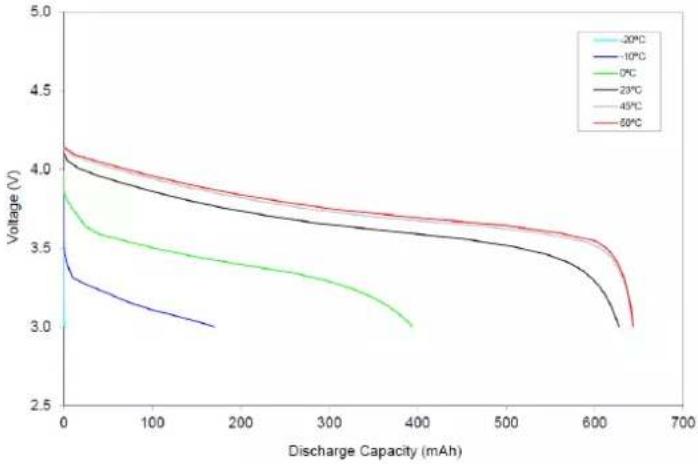
Test Conditions:
Charge (1.0C; t = 3h; Imin 0.02C; Umax = 4.2V at room temperature) 4h rest at the below mentioned temperatures
Discharge (0.2C; UEOD = 3.0V) at the following temperatures: 60°C, 40°C, RT, 0°C, -10°C, -20°C Starting with 0.2C at -20°C; always charging at RT after 4h rest time
line
| Discharge Capacity (mAh) | -20°C | 10°C | 0°C | 23°C | 45°C | 60°C | | ------------------------ | ----- | ---- | --- | ---- | ---- | ---- | | 0 | 3.0 | 3.5 | 3.8 | 4.0 | 4.1 | 4.2 | | 100 | 3.1 | 3.3 | 3.6 | 3.9 | 4.0 | 4.1 | | 200 | 3.2 | 3.2 | 3.5 | 3.8 | 3.9 | 4.0 | | 300 | 3.3 | 3.1 | 3.4 | 3.7 | 3.8 | 3.9 | | 400 | 3.4 | 3.0 | 3.3 | 3.6 | 3.7 | 3.8 | | 500 | 3.5 | 2.9 | 3.2 | 3.5 | 3.6 | 3.7 | | 600 | 3.6 | 2.8 | 3.1 | 3.4 | 3.5 | 3.6 | | 700 | 3.7 | 2.7 | 3.0 | 3.3 | 3.4 | 3.5 |LPP 443441 S Cycling at 20°C
Test Conditions:
a) Capacity
charge (1.0C; t = 3h; lmin 0.02C;
Umax = 4.2V)
discharge (1.0C; UEOD = 3.0V)
Determination of the 0.2C capacity
(discharge 0.2C; UEOD = 3.0V) after
charging each 50 cycles
b) Impedance measurements before and after cycling reference impedance according to specification of cell.
c) Thickness measurement before and after cycling reference thickness according to specification of cell

line
| Cycle No. | Test Method | Capacity (mAh) | | --------- | ----------- | -------------- | | 0 | 0.2CA | 650 | | 50 | 0.2CA | 630 | | 100 | 0.2CA | 620 | | 150 | 0.2CA | 610 | | 200 | 0.2CA | 600 | | 250 | 0.2CA | 590 | | 300 | 0.2CA | 580 |LPP 463149 S
| System | Li-Ion |
| Recognition | UL 1642 |
| Nominal Voltage | 3.7 V |
| Nominal Capacity, C | 700 mAh (at 0.2C and 20°C) |
| Minimum Capacity | 670 mAh |
| Impedance Initial | ≤70 mΩ @ 1kHz at 4.2V |
| Life Expectancy | 500 cycles for ≥ 80 % |
| Battery | |
| Length (l) | 49.0 mm (max.) |
| Width (w) | 31.5 mm (max.) |
| Height (h) | 4.5 mm (max.) |
| Weight, approx. | 14.0 g |
| Function | |
| Charging Method | Constant Current + Constant Voltage |
| Charge Voltage | 4.20V (± 50mV) |
| Initial Charge Current | Standard Charge: 335 mA |
| Rapid Charge: 670 mA | |
| Charging Cut-Off (a) or (b) | |
| a) by time | Standard Charge: 3.5 h |
| Rapid Charge: 2.5 h | |
| b) by min. current | 6.7 mA |
| Discharge Cut-Off voltage | 3.0 V |
| Max. Continuous Discharge Current | 670 mA |
| Data connection | |
| Operating Temperature | Charge: 0°C to+ 45°C |
| Discharge: -20°C to +60°C | |
| Storage Temperature | 1 Month at -20°C to +45°C >80% |
| Capacity Recovery Rate | 3 Month at -20°C to +45°C >80% |
| 1 Year at -20°C to +30°C >80% | |
| CONFIGURATIONS | 1S1P | 1S2P sbs * |
| Rated Capacity | 1590 mAh | 3180 mAh |
| Nominal Voltage | 3.70 V | 3.70 V |
| Watt-Hour Rating | 5.88 Wh | 11.77 Wh |
| Charge Temperature | 0 to +45°C | 0 to +45°C |
| Discharge Temperature | -20 to +60°C | -20 to +60°C |
| Overcharge Detection | 4.275 V ± 25 mV | 4.275 V ± 25 mV |
| Overdischarge Detection | 2.3 V ± 58 mV | 2.3 V ± 58 mV |
| Overcurrent Detection | 2A - 4A | 2A - 4A |
| NTC | 10k B=3380k | 10k B=3380k |
| MOQ/ MDQ | 5.000 | 10.000 |
| Order Reference Number | CPB 3011 | CPB 3012 |
* sbs - denotes cells will be side by side
LPP 463149 S Discharge Profile
Test Conditions:
| 1 - 3 cycles | Charge 1.0C; tmax = 3h;Imin = 0.02C; 4.2VDischarge 1.0CUEOD = 3.0V |
| 2 - 1 cycle | Charge 1.0C; tmax = 3h;Imin = 0.02C; 4.2VDischarge 0.2CUEOD = 3.0V |
Maximum Discharge Current taken from the product specification

line
| Discharge Capacity (mAh) | 0.2CA | 0.5CA | 1CA | 2CA | | ------------------------ | ----- | ----- | --- | --- | | 0 | 4.2 | 4.2 | 4.2 | 4.2 | | 100 | 4.1 | 4.1 | 4.1 | 4.1 | | 200 | 4.0 | 4.0 | 4.0 | 4.0 | | 300 | 3.9 | 3.9 | 3.9 | 3.9 | | 400 | 3.8 | 3.8 | 3.8 | 3.8 | | 500 | 3.7 | 3.7 | 3.7 | 3.7 | | 600 | 3.6 | 3.6 | 3.6 | 3.6 | | 700 | 3.5 | 3.5 | 3.5 | 3.5 | | 750 | 3.0 | 3.0 | 3.0 | 3.0 | | 800 | 2.5 | 2.5 | 2.5 | 2.5 |LPP 463149 S Temperature Profile @ 1C/ 0.2C
Test Conditions:
Charge (1.0C; t = 3h; Imin 0.02C; Umax = 4.2V at room temperature) 4h rest at the below mentioned temperatures
Discharge (0.2C; UEOD = 3.0V) at the following temperatures: 60°C, 40°C, RT, 0°C, -10°C, -20°C Starting with 0.2C at -20°C; always charging at RT after 4h rest time

line
| Discharge Capacity (mAh) | -20°C | -10°C | 0°C | 23°C | 40°C | 60°C | | ------------------------ | ----- | ----- | --- | ---- | ---- | ---- | | 0 | 3.2 | 3.7 | 3.9 | 4.1 | 4.2 | 4.3 | | 100 | 3.15 | 3.5 | 3.8 | 4.0 | 4.1 | 4.2 | | 200 | 3.1 | 3.4 | 3.7 | 3.95 | 4.05 | 4.15 | | 300 | 3.05 | 3.3 | 3.6 | 3.85 | 3.95 | 4.05 | | 400 | 3.0 | 3.25 | 3.5 | 3.75 | 3.85 | 3.95 | | 500 | 2.95 | 3.2 | 3.4 | 3.65 | 3.75 | 3.85 | | 600 | 2.9 | 3.1 | 3.3 | 3.55 | 3.65 | 3.75 | | 700 | 2.85 | 3.0 | 3.2 | 3.45 | 3.55 | 3.65 | | 800 | 2.8 | 2.95 | 3.1 | 3.35 | 3.45 | 3.55 |LPP 463149 S Cycling at 20°C
Test Conditions:
a) Capacity
charge (1.0C; t = 3h; lmin 0.02C;
Umax = 4.2V)
discharge (1.0C; UEOD = 3.0V)
Determination of the 0.2C capacity
(discharge 0.2C; UEOD = 3.0V) after
charging each 50 cycles
b) Impedance measurements before and after cycling reference impedance according to specification of cell.
c) Thickness measurement before and after cycling reference thickness according to specification of cell

line
| Cycle No. | S1-ICA | S2-ICA | S3-ICA | S4-ICA | S5-ICA | | --------- | ------ | ------ | ------ | ------ | ------ | | 50 | 700 | 700 | 700 | 700 | 700 | | 100 | 690 | 690 | 690 | 690 | 690 | | 150 | 680 | 680 | 680 | 680 | 680 | | 200 | 670 | 670 | 670 | 670 | 670 |LPP 523450 S
| System | Li-Ion |
| Recognition | UL 1642 |
| Nominal Voltage | 3.7 V |
| Nominal Capacity, C | 1000 mAh (at 0.2C and 20°C) |
| Minimum Capacity | 950 mAh |
| Impedance Initial | ≤60 mΩ @ 1kHz at 4.2V |
| Life Expectancy | 500 cycles for ≥80 % |
| Battery | |
| Length (l) | 50.5 mm (max.) |
| Width (w) | 35.5 mm (max.) |
| Height (h) | 5.2 mm (max.) |
| Weight, approx. | 19.0 g |
| Function | |
| Charging Method | Constant Current + Constant Voltage |
| Charge Voltage | 4.20V (± 50mV) |
| Initial Charge Current | Standard Charge: 500 mA |
| Rapid Charge: 1000 mA | |
| Charging Cut-Off (a) or (b) | |
| a) by time | Standard Charge: 3.5 h |
| Rapid Charge: 2.0 h | |
| b) by min. current | 10 mA |
| Discharge Cut-Off voltage | 3.0 V |
| Max. Continuous Discharge Current | 2000 mA |
| Data connection | |
| Operating Temperature | Charge: 0°C to+ 45°C |
| Discharge: -10°C to +60°C | |
| Storage Temperature | 1 Month at -20°C to +60°C >80% |
| Capacity Recovery Rate | 3 Month at -20°C to +45°C >80% |
| 1 Year at -20°C to +30°C >80% | |
| CONFIGURATIONS | 1S1P | 1S2P sbs * |
| Rated Capacity | 1000 mAh | 2000 mAh |
| Nominal Voltage | 3.70 V | 3.70 V |
| Watt-Hour Rating | 3.70 Wh | 7.40 Wh |
| Charge Temperature | 0 to +45°C | 0 to +45°C |
| Discharge Temperature | -10 to +60°C | -10 to +60°C |
| Overcharge Detection | 4.275 V ± 25 mV | 4.275 V ± 25 mV |
| Overdischarge Detection | 2.3 V ± 58 mV | 2.3 V ± 58 mV |
| Overcurrent Detection | 2A - 4A | 2A - 4A |
| NTC | 10k B=3380k | 10k B=3380k |
| MOQ/ MDQ | 5.000 | 10.000 |
| Order Reference Number | CPB 3027 | CPB 3028 |
* sbs - denotes cells will be side by side
LPP 523450 S Discharge Profile
Test Conditions
| 1-3 cycles | Charge 1.0C; tmax = 3h; |
| Imin = 0.02C; 4.2V | |
| Discharge 1.0C | |
| UEOD = 3.0V |
| 2-1 cycle | Charge 1.0C; tmax = 3h; |
| Imin = 0.02C; 4.2V | |
| Discharge 0.2C | |
| UEOD = 3.0V |
Maximum Discharge Current taken from the product specification

line
| Discharge Capacity (mAh) | 0.2CA | 0.5CA | 1CA | 2CA | | ------------------------ | ----- | ----- | --- | --- | | 0 | 4.1 | 4.1 | 4.0 | 4.0 | | 200 | 3.9 | 3.85 | 3.75| 3.65| | 400 | 3.75 | 3.7 | 3.6 | 3.5 | | 600 | 3.65 | 3.6 | 3.55| 3.4 | | 800 | 3.55 | 3.5 | 3.45| 3.3 | | 1000 | 3.0 | 3.0 | 3.0 | 3.0 | | 1200 | - | - | - | - |LPP 523450 S Temperature Profile @ 1C/ 0.2C
Test Conditions:
Charge (1.0C; t = 3h; lmin 0.02C; Umax = 4.2V at room temperature) 4h rest at the below mentioned temperatures
Discharge (0.2C; UEOD = 3.0V) at the following temperatures: 60°C, 40°C, RT, 0°C, -10°C, -20°C Starting with 0.2C at -20°C; always charging at RT after 4h rest time

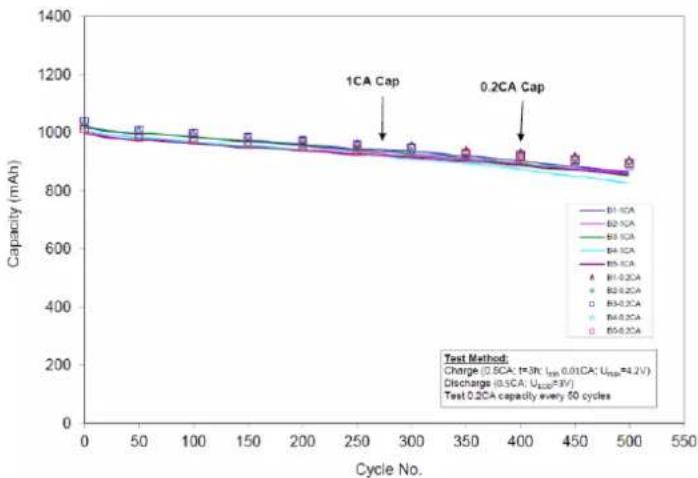
LPP 523450 S Cycling at 20°C
Test Conditions:
a) Capacity
charge (1.0C; t = 3h; Imin 0.02C; Umax = 4.2V)
discharge (1.0C; UEOD = 3.0V)
Determination of the 0.2C capacity
(discharge 0.2C; UEOD = 3.0V) after charging each 50 cycles
b) Impedance measurements before and after cycling reference impedance according to specification of cell.
c) Thickness measurement before and after cycling reference thickness according to specification of cell
line
| Cycle No. | B1-ICA | B2-ICA | B3-ICA | B4-ICA | B5-ICA | | --------- | ------ | ------ | ------ | ------ | ------ | | 0 | 1020 | 1020 | 1020 | 1020 | 1020 | | 50 | 1000 | 1000 | 1000 | 1000 | 1000 | | 100 | 980 | 980 | 980 | 980 | 980 | | 150 | 960 | 960 | 960 | 960 | 960 | | 200 | 940 | 940 | 940 | 940 | 940 | | 250 | 920 | 920 | 920 | 920 | 920 | | 300 | 900 | 900 | 900 | 900 | 900 | | 350 | 880 | 880 | 880 | 880 | 880 | | 400 | 860 | 860 | 860 | 860 | 860 | | 450 | 840 | 840 | 840 | 840 | 840 | | 500 | 820 | 820 | 820 | 820 | 820 |LPP 503562 S
| System | Li-Ion |
| Recognition | UL 1642 |
| Nominal Voltage | 3.7 V |
| Nominal Capacity, C | 1200 mAh (at 0.2C and 20°C) |
| Minimum Capacity | 1150 mAh |
| Impedance Initial | ≤55 mΩ @ 1kHz at 4.2V |
| Life Expectancy | 500 cycles for ≥70 % |
| Battery | |
| Length (l) | 60.0 mm (max.) |
| Width (w) | 35.0 mm (max.) |
| Height (h) | 4.65 mm (max.) |
| Weight, approx. | 22.0 g |
| Function | |
| Charging Method | Constant Current + Constant Voltage |
| Charge Voltage | 4.20 V (± 50mV) |
| Initial Charge Current | Standard Charge: 575 mA |
| Rapid Charge: 1150 mA | |
| Charging Cut-Off (a) or (b) | |
| a) by time | Standard Charge: 3.5 h |
| Rapid Charge: 2.5 h | |
| b) by min. current | 11.5 mA |
| Discharge Cut-Off voltage | 3.0 V |
| Max. Continuous Discharge Current | 2300 mA |
| Data connection | |
| Operating Temperature | Charge: 0°C to+ 45°C |
| Discharge: -10°C to +60°C | |
| Storage Temperature | 1 Month at -20°C to +45°C >90% |
| Capacity Recovery Rate | 3 Month at -20°C to +45°C >80% |
| 1 Year at -20°C to +30°C >80% | |
| CONFIGURATIONS | 1S1P | 1S2P sbs * |
| Rated Capacity | 1200 mAh | 2400 mAh |
| Nominal Voltage | 3.70 V | 3.70 V |
| Watt-Hour Rating | 4.44 Wh | 8.88 Wh |
| Charge Temperature | 0 to +45°C | 0 to +45°C |
| Discharge Temperature | -10 to +60°C | -10 to +60°C |
| Overcharge Detection | 4.275 V ± 25 mV | 4.275 V ± 25 mV |
| Overdischarge Detection | 2.3 V ± 58 mV | 2.3 V ± 58 mV |
| Overcurrent Detection | 2A - 4A | 2A - 4A |
| NTC | 10k B=3380k | 10k B=3380k |
| MOQ/ MDQ | 5.000 | 10.000 |
| Order Reference Number | CPB 3019 | CPB 3020 |
* sbs - denotes cells will be side by side
LPP 503562 S Discharge Profile
Test Conditions
| 1-3 cycles | Charge 1.0C; tmax = 3h; |
| Imin = 0.02C; 4.2V | |
| Discharge 1.0C | |
| UEOD = 3.0V |
| 2-1 cycle | Charge 1.0C; tmax = 3h; |
| Imin = 0.02C; 4.2V | |
| Discharge 0.2C | |
| UEOD = 3.0V |
Maximum Discharge Current taken from the product specification

line
| Discharge Capacity (mAh) | 0.2CA | 0.5CA | 1CA | 2CA | | ------------------------ | ----- | ----- | --- | --- | | 0 | 4.2 | 4.15 | 4.1 | 4.0 | | 200 | 4.0 | 3.95 | 3.9 | 3.8 | | 400 | 3.85 | 3.8 | 3.75| 3.65| | 600 | 3.75 | 3.7 | 3.65| 3.55| | 800 | 3.65 | 3.6 | 3.55| 3.45| | 1000 | 3.55 | 3.5 | 3.45| 3.35| | 1200 | 3.0 | 2.95 | 2.9 | 2.8 | | 1400 | - | - | - | - |LPP 503562 S Temperature Profile @ 1C/ 0.2C
Test Conditions:
Charge (1.0C; t = 3h; Imin 0.02C; Umax = 4.2V at room temperature) 4h rest at the below mentioned temperatures
Discharge (0.2C; UEOD = 3.0V) at the following temperatures: 60°C, 40°C, RT, 0°C, -10°C, -20°C Starting with 0.2C at -20°C; always charging at RT after 4h rest time

line
| Discharge Capacity (mAh) | -20°C | -10°C | 0°C | 23°C | 40°C | 60°C | | ------------------------ | ----- | ----- | --- | ---- | ---- | ---- | | 0 | 4.1 | 3.5 | 3.8 | 4.0 | 4.1 | 4.1 | | 200 | 3.9 | 3.3 | 3.6 | 3.9 | 4.0 | 4.0 | | 400 | 3.7 | 3.1 | 3.4 | 3.8 | 3.9 | 3.9 | | 600 | 3.5 | 2.9 | 3.2 | 3.7 | 3.8 | 3.8 | | 800 | 3.3 | 2.7 | 3.0 | 3.6 | 3.7 | 3.7 | | 1000 | 3.1 | 2.5 | 2.8 | 3.5 | 3.6 | 3.6 | | 1200 | 2.9 | 2.3 | 2.6 | 3.4 | 3.5 | 3.5 | | 1400 | 2.7 | 2.1 | 2.4 | 3.3 | 3.4 | 3.4 |LPP 503562 S Cycling at 20°C
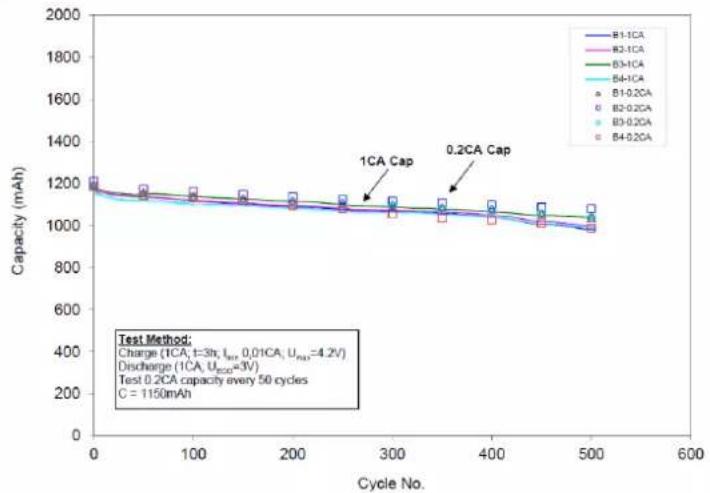
Test Conditions:
a) Capacity charge (1.0C; t = 3h; Imin 0.02C; Umax = 4.2V) discharge (1.0C; UEOD = 3.0V) Determination of the 0.2C capacity (discharge 0.2C; UEOD = 3.0V) after charging each 50 cycles
b) Impedance measurements before and after cycling reference impedance according to specification of cell
c) Thickness measurement before and after cycling reference thickness according to specification of cell
line
| Cycle No. | B1-1CA | B3-1CA | B3-1CA | B4-1CA | B1-0.2CA | B2-0.2CA | B3-0.2CA | B4-0.2CA | | --------- | ------ | ------ | ------ | ------ | -------- | -------- | -------- | -------- | | 0 | 1200 | 1200 | 1200 | 1200 | 1200 | 1200 | 1200 | 1200 | | 100 | 1150 | 1150 | 1150 | 1150 | 1150 | 1150 | 1150 | 1150 | | 200 | 1100 | 1100 | 1100 | 1100 | 1100 | 1100 | 1100 | 1100 | | 300 | 1050 | 1050 | 1050 | 1050 | 1050 | 1050 | 1050 | 1050 | | 400 | 1000 | 1000 | 1000 | 1000 | 1000 | 1000 | 1000 | 1000 | | 500 | 950 | 950 | 950 | 950 | 950 | 950 | 950 | 950 |LPP 683566 BE
| System | Li-Ion |
| Recognition | UL 1642 |
| Nominal Voltage | 3.7 V |
| Nominal Capacity, C | 1880 mAh (at 0.2C and 20°C) |
| Minimum Capacity | 1820 mAh |
| Impedance Initial | ≤80 mΩ @ 1kHz at 4.2V |
| Life Expectancy | 400 cycles for ≥75 % |
| Battery | |
| Length (l) | 65.85 mm (max.) |
| Width (w) | 35.0 mm (max.) |
| Height (h) | 6.8 mm (max.) |
| Weight, approx. | 40.0 g |
| Function | |
| Charging Method | Constant Current + Constant Voltage |
| Charge Voltage | 4.20V (± 50mV) |
| Initial Charge Current | Standard Charge: 910 mA |
| Rapid Charge: 1820 mA | |
| Charging Cut-Off (a) or (b) | |
| a) by time | Standard Charge: 5 h |
| Rapid Charge: 2.5 h | |
| b) by min. current | 20 mA |
| Discharge Cut-Off voltage | 3.0 V |
| Max. Continuous Discharge Current | 3640 mA |
| Data connection | |
| Operating Temperature | Charge: 0°C to+ 45°C |
| Discharge: -20°C to +60°C | |
| Storage Temperature | 1 Month at -20°C to +60°C >85% |
| Capacity Recovery Rate | |
| CONFIGURATIONS | 1S1P |
| Rated Capacity | 1880 mAh |
| Nominal Voltage | 3.70 V |
| Watt-Hour Rating | 6.96 Wh |
| Charge Temperature | 0 to +45°C |
| Discharge Temperature | -20 to +60°C |
| Overcharge Detection | 4.275 V ± 25 mV |
| Overdischarge Detection | 2.3 V ± 58 mV |
| Overcurrent Detection | 2A - 4A |
| NTC | 10k B=3380k |
| MOQ/ MDQ | 5.000 |
| Order Reference Number | CPB 3031 |
LPP 683566 BE Discharge Profile
Test Conditions
| 1-3 cycles | Charge 1.0C; tmax = 3h; |
| Imin = 0.02C; 4.2V | |
| Discharge 1.0C | |
| UEOD = 3.0V |
| 2-1 cycle | Charge 1.0C; tmax = 3h; |
| Imin = 0.02C; 4.2V | |
| Discharge 0.2C | |
| UEOD = 3.0V |
Maximum Discharge Current taken from the product specification

line
| Temperature | Voltage (V) | | ----------- | ----------- | | 0.2C | 4.1 | | 0.5C | 3.9 | | 1C | 3.7 | | 1.6C | 3.5 | | 2C | 3.3 |LPP 683566 BE Temperature Profile @ 1C/0.2C
Test Conditions:
Charge (1.0C; t = 3h; Imin 0.02C; Umax = 4.2V at room temperature) 4h rest at the below mentioned temperatures
Discharge (0.2C; UEOD = 3.0V) at the following temperatures: 60°C, 40°C, RT, 0°C, -10°C, -20°C Starting with 0.2C at -20°C; always charging at RT after 4h rest time
line
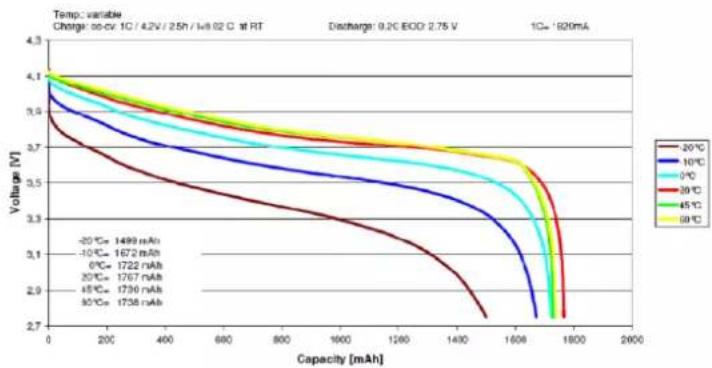
| Temperature | Charge (o-cv) | BOD (V) | Capacity (mAh) | |-------------|---------------|---------|----------------| | 20°C | 1499 | 1672 | 1499 | | 10°C | 1722 | 1722 | 1722 | | 0°C | 1767 | 1767 | 1767 | | 30°C | 1730 | 1730 | 1730 | | 45°C | - | - | - | | 50°C | - | - | - | | 60°C | - | - | - |LPP 683566 BE Cycling at 20°C
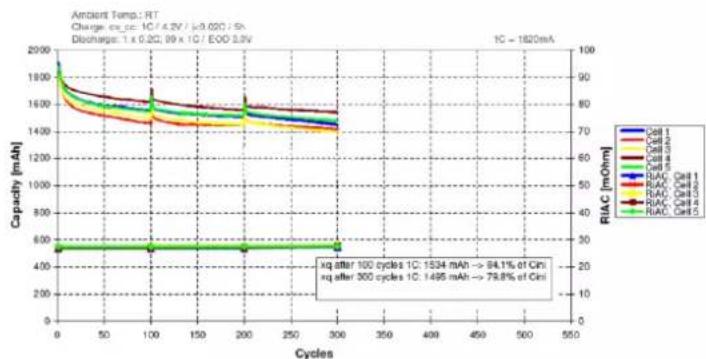
Test Conditions:
a) Capacity
charge (1.0C; t = 3h; lmin 0.02C;
Umax = 4.2V)
discharge (1.0C; UEOD = 3.0V)
Determination of the 0.2C capacity
(discharge 0.2C; UEOD = 3.0V) after
charging each 50 cycles
b) Impedance measurements before and after cycling reference impedance according to specification of cell.
c) Thickness measurement before and after cycling reference thickness according to specification of cell
6. Design Tips for VARTA CellPac BLOX Battery Packs
In general, we strongly recommend for any design-in to consult the sales engineer of the distributing company. For applications with special requirements or environments which go beyond the specified conditions, CellPac BLOX batteries will not be suitable.
To support your own design-in process, we offer the following tips, to help avoid the most common issues which can occur:
-
A lithium rechargeable battery is a "living" product combining mechanical, electrical and chemical engineering disciplines. Its performance is highly dependent on how it is treated, as shown in the technical data within this handbook. The limitation of our own data is that it is generic and therefore in most cases only indicative of reality. For CellPac BLOX batteries you will get samples to test its performance specifically for your application before finalizing your design and moving to mass production.
-
For pouch-cell battery designs, it is important to take good care of the case during handling or installation. The cavity should not contain any protrusions which may dent or pressure the pouch surface and should be big enough to contain the cell with room for a little swelling over lifetime (0.1-0.2mm per cell, unless stated on the Product Information Sheet).
-
To secure pouch cells comfortably, especially in cases of too much space, a suitably-sized adhesive pad secured inside the battery cavity is recommended to a good fit.
-
It's important to be aware of any standby-mode or continuous-drain which your application may put on the battery (e.g. clock, memory or data functions), especially with respect to avoiding over-discharge. Some batteries may have relatively low charge on arrival or at the time of installation to your devices. Long-term storage without re-charging, especially after full discharge of your application, may risk bringing the battery into "deep-discharge" at a very low voltage below 3.0V. This can cause long-term performance problems, swelling and in very extreme cases, lithium plating within the cell. A half-charge is an ideal condition for storage in general, but if your application does drain the battery in standby or "off" modes, the storage lifetime should be calculated and managed.
-
Avoid extreme or tight bending of wires, especially at the connector point or where the wires are soldered to the battery electronics.
-
The safety electronics of the PCM included in the battery are intended as a final safety function. They should not be relied upon within the application design to control the application behaviour. The electronics within the application design and charger design should normally control all functions of the application without any trigger to the battery safety functions. The battery safety functions are intended to intervene in the event of a failure of the normal electronics function of the application and/or charger.
-
For installation of pouch cells, especially designs with no connector, take special care to consider the installation process. Dropping cells directly onto hard surfaces may damage them and cause swelling over time. If cells are dropped before installation, it is generally recommended that they are removed from your production and not installed. Soldering processes should not be done too close to the PCM or pouch to avoid any risk of heat damage. For example, to trim wires down to a very short length would bring the solder point very close to critical components. The safety function of the PCM could be compromised or the cell itself could become damaged.
-
Sharp ribs or corners within the cavity should be avoided where possible. In a scenario where your application may be dropped (a high risk for handheld devices especially), these can cut into the cell during impact.
Charging
Fast charging (CC/CV charging) can be achieved in a temperature range of 0 ... +45°C. The current of charging needs to be limited to individual specification of the battery selected.
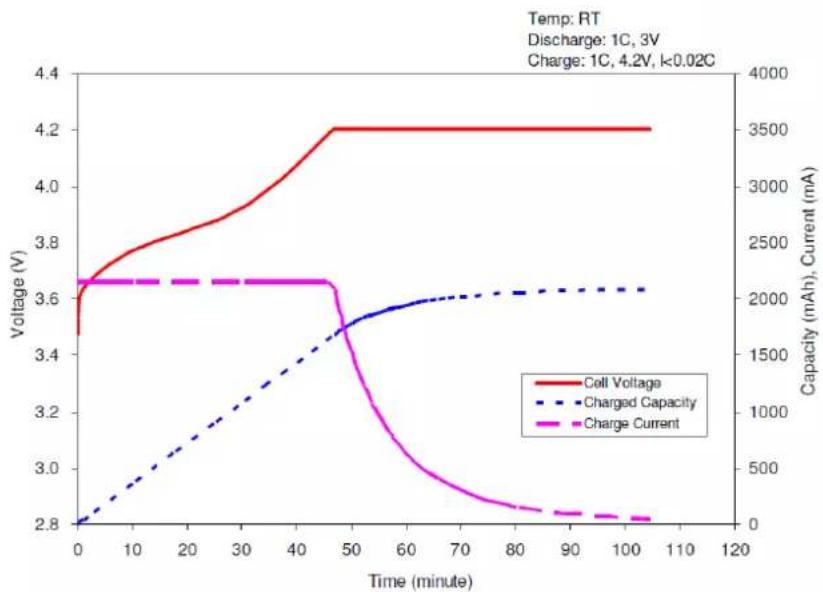
Limiting factors may be the PCM, wire connector assembly or the cell itself. In order to avoid overcharging along with damaging the battery or even hazardous situations, the charging voltage has to be limited strictly to 4.2 V per cell, see the individual specification for your battery choice for the most in detail information. It is recommended to terminate the charging either after 3hrs and/or after the charging current falls below 0.02 C.
The charging process is illustrated below showing current and voltage of a LPP 443441 S battery using 1 C I/V - charging.
line
| Time (minute) | Cell Voltage (V) | Charged Capacity (mAh) | Charge Current (mA) | | ------------- | ---------------- | --------------------- | ------------------- | | 0 | 3.5 | 280 | 2100 | | 50 | 4.2 | 3500 | 2100 | | 100 | 4.2 | 3600 | 100 | | 150 | 4.2 | 3600 | 100 | | 200 | 4.2 | 3600 | 100 | | 250 | 4.2 | 3600 | 100 | | 300 | 4.2 | 3600 | 100 | | 350 | 4.2 | 3600 | 100 | | 400 | 4.2 | 3600 | 100 | | 450 | 4.2 | 3600 | 100 | | 500 | 4.2 | 3600 | 100 | | 550 | 4.2 | 3600 | 100 | | 600 | 4.2 | 3600 | 100 | | 650 | 4.2 | 3600 | 100 | | 700 | 4.2 | 3600 | 100 | | 750 | 4.2 | 3600 | 100 | | 800 | 4.2 | 3600 | 100 | | 850 | 4.2 | 3600 | 100 | | 900 | 4.2 | 3600 | 100 | | 950 | 4.2 | 3600 | 100 | | 1000 | 4.2 | 3600 | 100 | | 1050 | 4.2 | 3600 | 100 | | 1100 | 4.2 | 3600 | 100 | | 1150 | 4.2 | 3600 | 100 | | 1200 | 4.2 | 3600 | 100 |Cell charging characteristics
Discharging
Since all CellPac BLOX batteries are delivered with a safety-circuit, the max. current rating established in the specification must be observed. There are two levels of overcurrent protection of which the first one will lead to a reversible interruption of current supply, while exceeding the second level will make the battery unusable permanently.
Please see the individual Product Information sheets for details of the safety parameters built into our modules which are set differently depending on the type designation.

Typical discharge curves with different temperatures as parameter
7. Reliability and Life Expectancy
VARTA CellPac BLOX batteries combine maximum safety with top-performance and reliability.
Cycle life is expected to be 300-500 cycles with a remaining capacity of 70% - 80%, depending on exact model.

line
| Cycle No. | B1-1CA | B2-1CA | B3-1CA | B4-1CA | B5-1CA | B6-1CA | B7-1CA | B8-1CA | B9-1CA | B10-2CA | B12-2CA | B13-2CA | B14-2CA | B15-2CA | | --------- | ------ | ------ | ------ | ------ | ------ | ------ | ------ | ------ | ------ | ------- | ------- | ------- | ------- | ------- | | 0 | 1000 | 1000 | 1000 | 1000 | 1000 | 1000 | 1000 | 1000 | 1000 | 1000 | 1000 | 1000 | 1000 | 1000 | | 50 | 980 | 985 | 985 | 985 | 985 | 985 | 985 | 985 | 985 | 985 | 985 | 985 | 985 | 985 | | 100 | 960 | 970 | 970 | 970 | 970 | 970 | 970 | 970 | 970 | 970 | 970 | 970 | 970 | 970 | | 150 | 940 | 960 | 960 | 960 | 960 | 960 | 960 | 960 | 960 | 960 | 960 | 960 | 960 | 960 | | 200 | 920 | 950 | 950 | 950 | 950 | 950 | 950 | 950 | 950 | 950 | 950 | 950 | 950 | 950 | | 250 | 900 | 940 | 940 | 940 | 940 | 940 | 940 | 940 | 940 | 940 | 940 | 940 | 940 | 940 | | 300 | 880 | 930 | 930 | 930 | 930 | 930 | 930 | 930 | 930 | 930 | 930 | 930 | 930 | 930 | | 350 | 860 | 920 | 920 | 920 | 920 | 920 | 920 | 920 | 920 | 920 | 920 | 920 | 920 | 920 | | 400 | 840 | 910 | 910 | 910 | 910 | 910 | 910 | 910 | 910 | 910 | 910 | 910 | 910 | 910 | | 450 | 820 | 895 | 895 | 895 | 895 | 895 | 895 | 895 | 895 | 895 | 895 | 895 | 895 | 895 | | 500 | 805 | 885 | 885 | 885 | 885 | 885 | 885 | 885 | 885 | 885 | 885 | 885 | 885 | 885 | Test Method: Charge (Ω.CA): t=3Ω, Imin=4.2V; Discharge (Ω.CA): Umax=3V; Test result: every cycle; Test capacity of every cycle.Typical cycle-life at room temperature (20°C) LPP 523450 S
8. Safety
All CellPac BLOX batteries are equipped with an electronic module for protection against malfunction of charging and discharging, misuse and abuse. Moreover, cells are selected which provide the best of performance data combined with excellent inherent safety features for usage within reasonable boundaries of specifications. To cope with any foreseeable abuse of our batteries, we have implemented a number of safety criteria which are usually multi-redundant when implemented together with a carefully designed application device and related charging circuitry in particular.
It is VARTA Storage policy to have all new cells tested and listed/recognized by UL (a worldwide acting, non-profit organisation in the field of consumer safety protection), according to the standard UL 1642. Relevant testing requirements, which represent to us the minimum level of safety testing, are given in the following table:
| Test | Description | Required results |
| Abnormal Charging Test | Charging Current I: 3 times max. allowed charging currentCharging Voltage U: CellPac BLOX cells: 4.8 VCharging Time t: t = 2.5 C / I, (Current in CA) - at open voltaget = 12 h - at limited charging voltage (manufacturer specification)If necessary additional safety elements according to UL fileTesting Conditions:Test at RTCell in discharged state (3.0 V after 1.0 C discharge)An integrated overcurrent or over temperature safety element is not allowed to be activated (the maximum load has to be chosen)The cell will be connected in series with a direct current source and a charging current is applied | no bursting, no fire |
| Short Circuit Test | Testing Conditions:Test at RTCell used in charged state (3 h with 1.0 CA to 4.2 V, lmin 0.02 C)Cell is shortened in the test with a maximum resistance of 100 mOhm (to be documented) | no bursting, no fireMax. temperature 150°C |
| Voltage Reversal Charge Test(according to UN Manual 38. | Testing Conditions:Test at RTCell in discharged state (3.0 V after 1.0 C discharge)- 1 C; 12 V until cell temperature is back at RT (tmax = 1h) | no bursting, no fireMax. temperature 75°C |
| Heating Test | Testing Conditions:Charge conditions: cell fully charged (according to UL 1643h / 4.25 V (1 C)Heating of the cell in the temperature box to 130°C (D 5°C/min +/- 2°C)- 10 minutes holding time at 130°C | no fire, no rupture |
9. Storage
Where possible, storage under fully charged state (CC/CV 4.2V, 3h) should be avoided to maximize longevity. Trickle charge, common in aqueous battery systems (Ni-Cd, Ni-MH), is strictly forbidden to avoid performance issues and safety concerns.
10. Transportation of VARTA CellPac BLOX Batteries
Rechargeable lithium ion batteries manufactured by VARTA Storage are considered to be UN 3480 Lithium Ion Batteries, and are tested according to 38.3 of the "UN Manual of Tests and Criteria" for compliance with the requirements of special provisions ADR 188, IMDG 188, DOT / 49 CFR § 173.102, and the requirements of IATA DGR packing instruction 965. Positive test results as well as other relevant information required for transportation are stated in dedicated "Declarations of Conformity".
Onward transportation of CellPac BLOX batteries in original VARTA packaging is permitted provided the shipment is made in accordance with the transport rules in force at the time of shipping. Repackaging and onward shipment should only be done by trained personnel in accordance with the latest transportation regulations in force and is the sole responsibility of the shipping party.
11. Proper Use and Handling
For proper use and handling please refer to the latest VARTA Handling Precautions supplied with your batteries or under following link:
https://www.varta-ag.com/en/industry/service/downloads


- Overview
- CELL PAC BLOX
- CellPac BLOX - Semi-Custom Battery Design
- CELL PAC LTE
- CellPac LITE - Our Range of Standard Lithium-Ion Packs
- CELL PAC PLUS
- CellPac PLUS - Custom Lithium Rechargeable Design Service
- Contents
- Note:
- Introduction to CellPac BLOX
- How does CellPac BLOX work?
- FAQ - Frequently Asked Questions
- The CellPac BLOX Range of Cells
- Connectors
- CellPac BLOX possible configurations
- Individual BLOX Datasheets
- LIC 18650-26SKE Discharge Profile
- LIC 18650-26SKE Temperature Profile @ 0.5C/ 0.2C
- Test Conditions:
- LIC 18650-26SKE Cycling at 20°C
- LIC 18650-29 EC Discharge Profile
- LIC 18650-29 EC Temperature Profile @ 1C
- LIC 18650-29 EC Cycling at 20°C
- LPP 423566 BE Discharge Profile
- LPP 423566 BE Temperature Profile @ 1C/0.2C
- LPP 423566 BE Cycling at 20°C
- LPP 443441 S Discharge Profile
- LPP 443441 S Temperature Profile @ 1C/0.2C
- LPP 443441 S Cycling at 20°C
- LPP 463149 S Discharge Profile
- LPP 463149 S Temperature Profile @ 1C/ 0.2C
- LPP 463149 S Cycling at 20°C
- LPP 523450 S Discharge Profile
- LPP 523450 S Temperature Profile @ 1C/ 0.2C
- LPP 523450 S Cycling at 20°C
- LPP 503562 S Discharge Profile
- LPP 503562 S Temperature Profile @ 1C/ 0.2C
- LPP 503562 S Cycling at 20°C
- LPP 683566 BE Discharge Profile
- LPP 683566 BE Temperature Profile @ 1C/0.2C
- LPP 683566 BE Cycling at 20°C
- Design Tips for VARTA CellPac BLOX Battery Packs
- Charging
- Discharging
- Reliability and Life Expectancy
- Safety
- Storage
- Transportation of VARTA CellPac BLOX Batteries
- Proper Use and Handling
Brand : VARTA
Model : CellPac BLOX
Category : Battery