FK 180 - Wine cellar Cylinda - Free user manual and instructions
Find the device manual for free FK 180 Cylinda in PDF.


| Product Type | Wine Cellar / Bottle Cooler |
| Brand | Cylinda |
| Model | FK 180 |
| Power Supply | 220-240 V, 50 Hz AC |
| Fuse Rating | 10-13 A |
| Climate Class | Optimum ambient 10-32°C |
| Refrigerant Type | Flammable hydrocarbon (see rating plate for quantity) |
| Control Type | Electronic with digital display |
| Temperature Setting | Adjustable via ▲ and ▼ buttons |
| ECO Mode | Yes, enabled manually or automatically after 3h door closed |
| Defrost | Automatic (self-evaporating) and manual (ECO button >2 sec) |
| Cooling System | Fan-assisted |
| Interior Light | Class 1 LED product |
| Door | Glass door with handle |
| Lock | Yes (key included) |
| Adjustable Feet | Yes |
| Transport Protection | Included (can be used to readjust door) |
| Ventilation | Rear ventilation guards, min. 30 mm from wall |
| Weight | Max. 36 kg |
| Maintenance | Clean defrost drain and condenser regularly |
Frequently Asked Questions - FK 180 Cylinda
User questions about FK 180 Cylinda
0 question about this device. Answer the ones you know or ask your own.
Ask a new question about this device
Download the instructions for your Wine cellar in PDF format for free! Find your manual FK 180 - Cylinda and take your electronic device back in hand. On this page are published all the documents necessary for the use of your device. FK 180 by Cylinda.
USER MANUAL FK 180 Cylinda
natural_image
Simple line drawing of a kitchen appliance with oven, refrigerator, and washing machine (no text or symbols)FK 180
Varning
WARNING:
natural_image
Line drawing of a hand inserting a plug into a socket (no text or symbols)fig. 2
Ventilation
fig. 6
Bortskaffning
As the appliance contains a flammable refrigerant, it is essential to ensure that the refrigerant pipes are not damaged.
The quantity and type of the refrigerant used in your appliance is indicated on the rating plate.
Standard EN378 specifies that the room in which you install your appliance must have a volume of 1 m^3 per 8 g of hydrocarbon refrigerant used in the appliances. This is to avoid the formation of flammable gas/air mixtures in the room where the appliance is located in the event of a leak in the refrigerant circuit.
WARNING:
Keep ventilation openings in the appliance's cabinet or in the built-in structure clear of obstruction
WARNING:
Do not use other mechanical devices or other means to accelerate the defrosting process than those recommended by the manufacturer
WARNING:
Do not damage the refrigerant system
WARNING:
Do not use electrical appliances inside the refrigerated storage compartment, unless they are of a type recommended by the manufacturer
WARNING:
Do not expose the appliance to rain
WARNING:
This appliance may be used by children over the age of 8 years old and by persons with reduced physical, sensory or mental capabilities or by persons with a lack of experience or knowledge if they are supervised or are instructed by a person responsible for their safety how to use the appliance safely and have understood the associated hazards.
WARNING:
Children must not play with, on, or around the appliance.
WARNING:
Children must not clean the appliance or carry out general maintenance unless they are at least 8 years old and are being supervised.
WARNING:
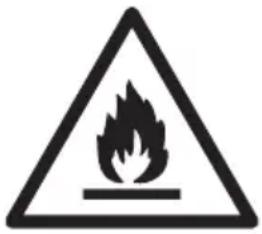
Danger risk of fire or explosion if flammable refrigerant are used. To be repaired only by trained personnel.
natural_image
Warning symbol of a flame inside a triangle (no text or numbers)WARNING:
Do not store explosives, such as aerosol cans with flammable propellants in the unit.
WARNING:
When positioning the appliance, ensure the power cord is not trapped or damaged.
• Always keep the keys in a separate place and out of reach of children
- Before servicing or cleaning the appliance, unplug the appliance from the mains or disconnect the electrical power supply
- If the supply cord is damaged, it must be replaced by the manufacturer, its service agent, or similarly qualified persons in order to avoid a hazard
- Relevant for Australia: Supply cord fitted with a plug complies with AS/NZS 3112.
- Frost formation on the interior evaporator wall and upper parts is a natural phenomenon. Therefore, the appliance should be defrosted during normal cleaning or maintenance.
- Please note that changes to the appliance construction will cancel all warranty and product liability
CLASS 1 LED PRODUCT
Contents
Warning 2
Before starting the appliance....4
Get to know your wine or bottle cooler: .....5
Electrical connection....6
Installation and start-up 6
Ventilation....7
Controller - Operation and function .....8
Fault finding....9
Defrosting, cleaning and maintenance .....10
Warranty, spare parts and service......11
Disposal....12
Before starting the appliance
Before operating your new appliance, please read the following instructions carefully as they contain important information on safety, installation, operation and maintenance. Keep the instructions for future reference.
On receipt, check to ensure that the appliance has not been damaged during transport. Transport damage should be reported to the local distributor before the appliance is put to use.
Remove the transport protector before the appliance is put to use. Hang it on one of the shelves as it can be used to readjust the door.
Get to know your wine or bottle cooler:
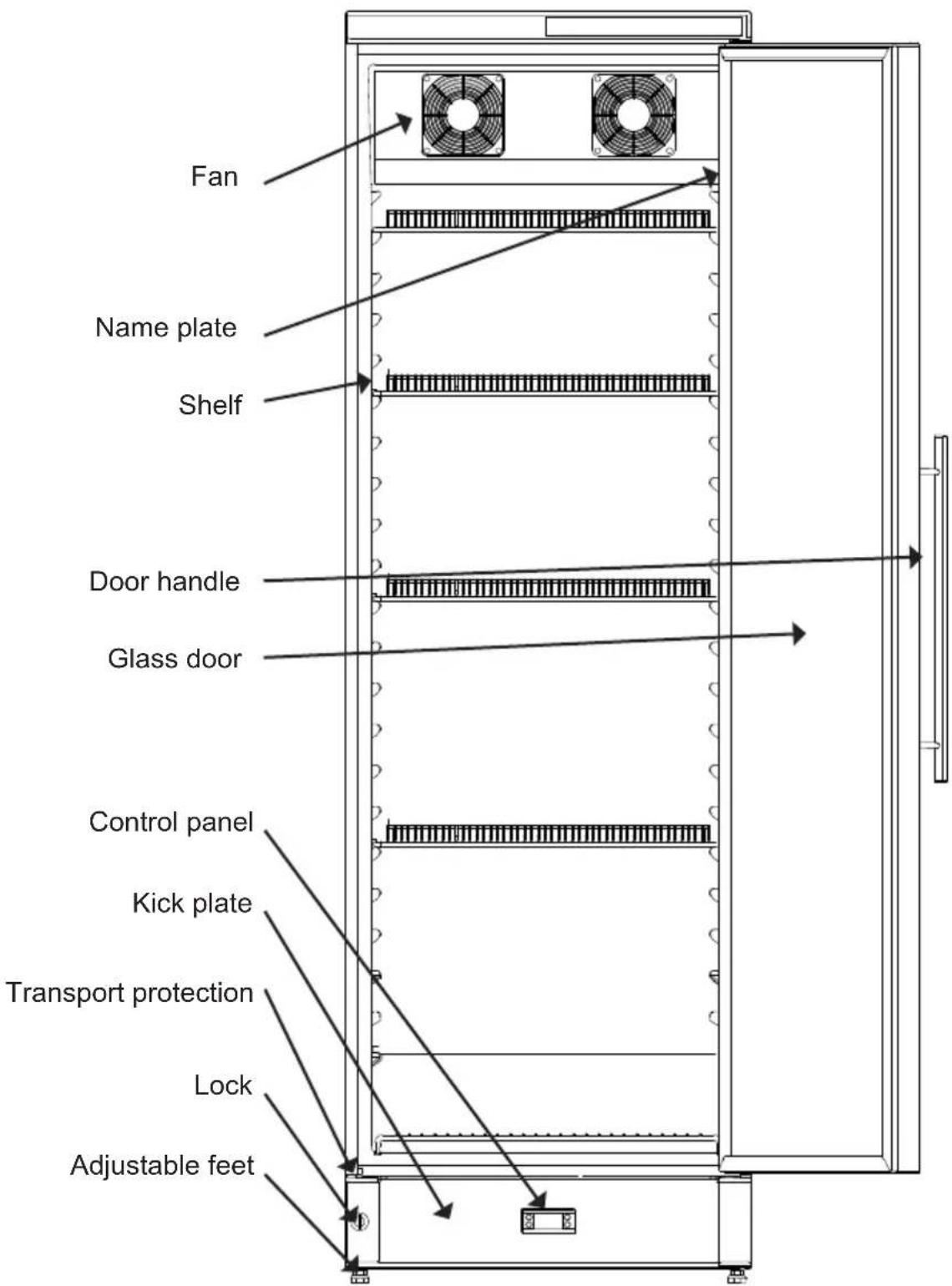
fig. 1
Electrical connection
Wiring and connections in power supply systems must be all applicable (local and national) electrical codes. Consult these codes lengths and sizes prior to cabinet installation.
This device complies with relevant EU directives including Low Voltage Directive 2014/35/EU and Electromagnetic Compatibility Directive 2014/30/EU
The socket should be freely accessible.
Connect the appliance only to 220/240 V / 50Hz alternating current via a correctly installed earthed socket.
The socket must be fused with a 10-13 A fuse.
If the appliance is to be operated in a non-European country, check on the rating plate whether the indicated voltage and current type correspond to the values of your mains supply.
Information regarding voltage, current or power are given on the rating plate
The power cord may be replaced by a technician only.
The rating plate provides various technical information as well as type and serial number.
Installation and start-up
Placement
For safety and operational reasons, the appliance shall not be exposed to rain.
The appliance should be placed on a level surface in a dry, well ventilated room (max. 70% relative air humidity). Never place the appliance close to sources of heat and avoid placing it in direct sunlight.
The surface on which the appliance is to be placed must be level. Do not use a frame or similar.
The appliance can be installed as a free-standing unit against a wall or side-by-side with other appliances (see fig. 4)
Room temperature
The climate class is stated on the name plate (see fig. 1). This specifies the optimum room temperature.
Note that the appliance operates best at room temperatures from 10^ C to 32^ C.
Installation of ventilation guard
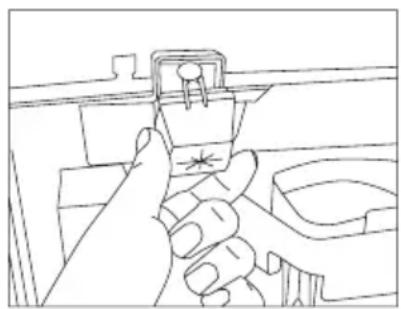
Close the two ventilationguards placed on the rear of the appliance, to ensure sufficient air circulation
natural_image
Line drawing of a hand inserting a component into a housing (no text or symbols)fig. 2
Ventilation
It is important that the appliance be well ventilated and that air can circulate unhindered above, below and around it. Keep ventilation openings, in the appliance enclosure or in the built-in structure, clear of obstruction. The figures below illustrate the clearance necessary to achieve the required air circulation.
OBS: There must be at least 30 mm between the cabinet and the wall behind it.
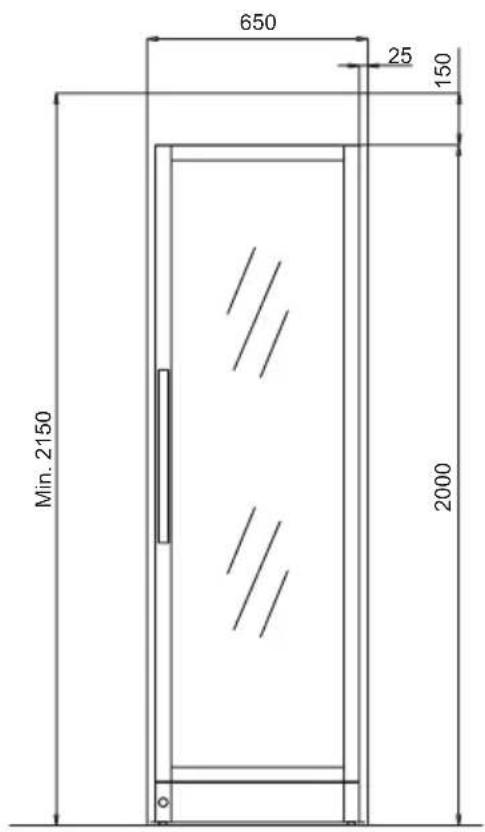
fig. 3
Side by side
In side-by-side arrangement, there must be at least 25 mm between and at the sides of the cabinets, so the doors can be opened freely
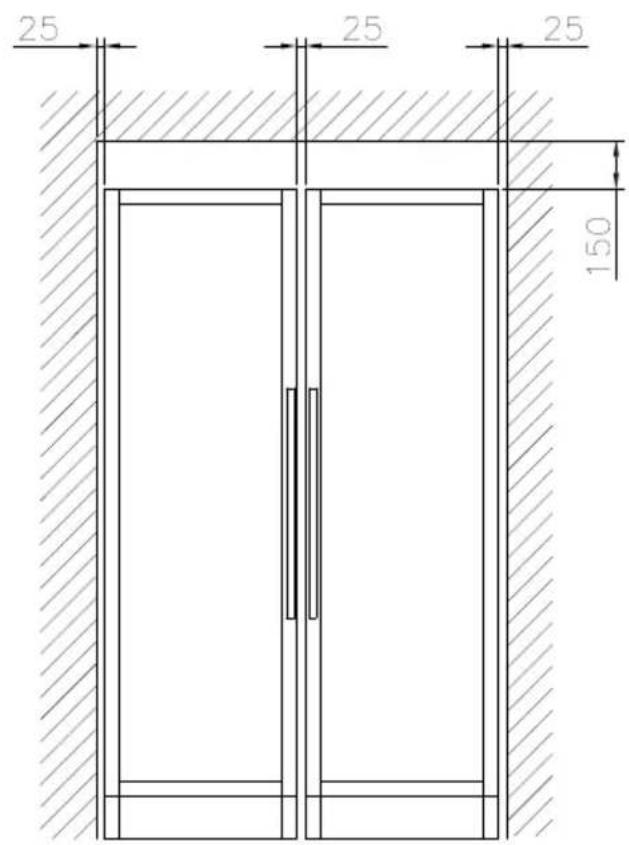
fig.4
Controller - Operation and function
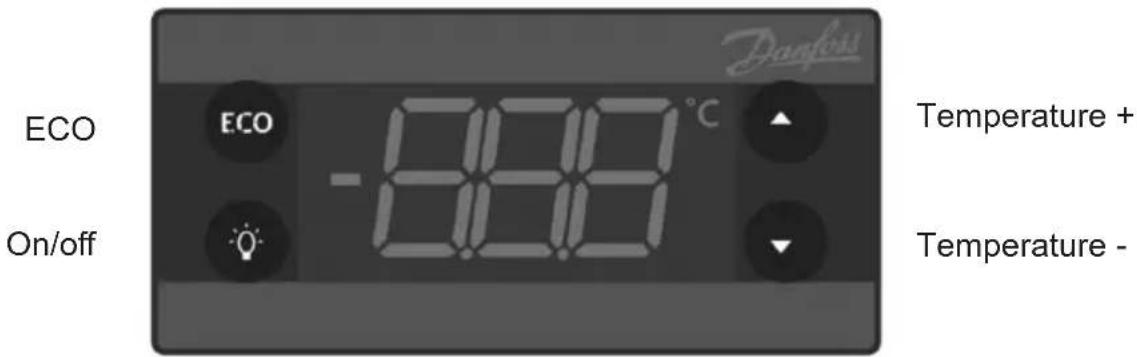
fig. 5
Electronic controls
The electronic controls ensure that the set temperature is maintained.
Following any power failure, the temperature settings are automatically recalled.
Manual defrosting
If there is a need for manual defrosting, push the ECO button for more than 2 sec-ond and a manual defrost will start.
After 30 min. the electronic control will return to normal mode.
Temperature display
The display shows the actual temperature in the cabinet, and indicates that power is connected.
Temperature setting
Push the bottom ▲ to increase set point and ▼ to decrease the set point.
ON/OFF
Push and hold the buttom 🙏 for more than 2 sec. to switch the appliance on and off.
ECO mode:
In ECO mode the set point is higher than in serving mode.
ECO mode is switched ON/OFF by pushing the ECO button
ECO mode is also switched ON when the door has not been opened for 3 hours, and switched OFF again at the first door opening.
ECO mode is OFF by default.
How to switch ON ECO mode:
ECO mode is switched ON/OFF in the parameter ECO in the parameter group ECS Access the parameter by:
-
Press and hold "up and down" for 5 sec
-
First parameter group shown is tHE
-
Press "up or down" to find parameter group ECS
-
Press "OK"
-
Press "down" to select ECO
-
Press "OK"
-
Press "down" to select yes
-
Press "OK"
After 30 sec the display automatically reverts to showing the current temperature.
Fault finding
| Fault Possible cause | Remedy | |
| The unit does not work | The appliance is switched off.Power failure; the fuse is blown; the appliance is not plugged in correctly. | Press the on/off switch.Check that power is connected. Reset the fuse. |
| Water collects in the bottom of the cabinet. | The defrost water pipe is blocked. | Clean the defrost water channel and the drain hole on the rear wall of the cabinet. |
| Vibration or bothersome noise. | The appliance is not level.The appliance is resting against other kitchen elements.Containers or bottles inside the cabinet are rattling against one another. | Level the appliance using a spirit level.Move the appliance away from the kitchen elements or appliances it is in contact with.Move containers and/or bottles apart. |
| Compressor runs continuously. | High room temperature. Ensure adequate ventilation. | |
Defrosting, cleaning and maintenance
Automatic defrosting.
The unit is defrosted automatically. Defrost water runs through a pipe and is collected in a tray above the compressor where the heat generated by the compressor causes it to evaporate. The defrost water tray should be cleaned at intervals.
Cleaning.
Before cleaning the appliance, unplug it from the main supply. The cabinet is best cleaned using warm water (max. 65°C) with a little mild detergent. Never use cleaning agents that scour. Use a soft cloth. Rinse with clean water and dry thoroughly.
The defrost water channel, in which condensation from the evaporator runs, is located at the bottom of the rear inside wall of the cabinet and must be kept clean. Add a few drops of disinfectant, e.g. Rodalon, to the defrost water drain a couple of times a year, and clean the drain using a pipe cleaner or similar. Never use sharp or pointed implements.
The sealing strip around the door must be cleaned regularly to prevent discolouration and prolong service life. Use clean water. After cleaning the sealing strip, check that it continues to provide a tight seal.
Dust collecting on the condenser on the rear of the cabinet, the compressor and in the compressor compartment is best removed using a vacuum cleaner.
Warranty, spare parts and service
Warranty disclaimer
Faults and damage caused directly or indirectly by incorrect operation, misuse, insufficient maintenance, incorrect building, installation or mains connection. Fire, accident, lightening, voltage variation or other electrical interference, including defective fuses or faults in mains installations.
Repairs performed by others than approved service centres and any other faults and damage that the manufacturer can substantiate are caused by reasons other than manufacturing or material faults are not covered by the warranty.
Please note that changes to the construction of the appliance or changes to the component equipment of the appliance will invalidate warranty and product liability, and the appliance cannot be used lawfully. The approval stated on rating plate will also be invalidated.
Transport damage discovered by the buyer is primarily a matter to be settled between the buyer and the distributor, i.e. the distributor must ensure that such complaints are resolved to the buyer's satisfaction.
Before calling for technical assistance, please check whether you are able to rectify the fault yourself. If your request for assistance is unwarranted, e.g. if the appliance has failed as a result of a blown fuse or incorrect operation, you will be charged the costs incurred by your call for technical assistance.
Spare parts
When ordering spare parts, please state the type, serial and product numbers of your appliance. This information is given on the rating plate. The rating plate contains various technical information, including type and serial numbers.
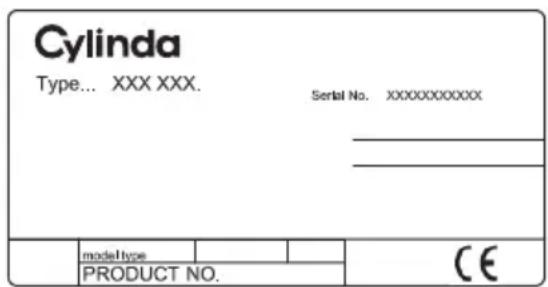
fig. 6
Disposal
Information for Users on Collection and Disposal of Old Equipment and used Batteries
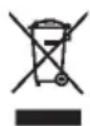
These symbols on the products, packaging, and/or accompanying documents mean that used electrical and electronic products and batteries should not be mixed with general household waste. For proper treatment, recovery and recycling of old products and used batteries, please take them to applicable collection points, in accordance with your national legislation and the Directives 2012/19/EU and 2006/66/EC.
By disposing of these products and batteries correctly, you will help to save valuable resources and prevent any potential negative effects on human health and the environment which could otherwise arise from inappropriate waste handling.
For more information about collection and recycling of old products and batteries, please contact your local municipality, your waste disposal service or the point of sale where you purchased the items.
Penalties may be applicable for incorrect disposal of this waste, in accordance with national legislation.
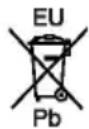
For business users in the European Union.
If you wish to discard electrical and electronic equipment, please contact your dealer or supplier for further information.
Information on Disposal in other Countries outside the European Union
These symbols are only valid in the European Union. If you wish to discard this product, please contact your local authorities or dealer and ask for the correct method of disposal.
Note for the battery symbol :
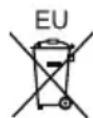
This symbol might be used in combination with a chemical symbol. In this case it complies with the requirement set by the Directive for the chemical involved.
Service
Vi har service i hela Sverige/ Nationwide service in Sweden
Besök www.cylinda.se / Visit www.cylinda.se
Ring 0771-25 25 00 (endast lokaltaxa) / Call 0771-25 25 00
Uppge / Declare
Maskintyp / Model code
Serienummer / Serial number
Inköpsdatum / Purchase date
Problembeskrivning / Problem description

- Varning
- WARNING:
- Ventilation
- Bortskaffning
- Contents
- Before starting the appliance
- Get to know your wine or bottle cooler:
- Electrical connection
- Information regarding voltage, current or power are given on the rating plate
- Installation and start-up
- Placement
- Room temperature
- Installation of ventilation guard
- Side by side
- Controller - Operation and function
- Electronic controls
- Manual defrosting
- Temperature display
- Temperature setting
- ON/OFF
- ECO mode:
- ECO mode is OFF by default.
- How to switch ON ECO mode:
- Defrosting, cleaning and maintenance
- Automatic defrosting.
- Cleaning.
- Warranty, spare parts and service
- Warranty disclaimer
- Spare parts
- Disposal
- Information on Disposal in other Countries outside the European Union
- Note for the battery symbol :
- Service
- Uppge / Declare
Brand : Cylinda
Model : FK 180
Category : Wine cellar