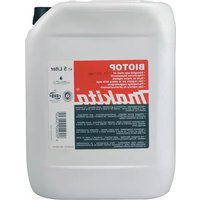
980008611 - Lubricant MAKITA - Free user manual and instructions
Find the device manual for free 980008611 MAKITA in PDF.


| Product Type | Lubricant (MAKITA BIO-TOP) |
| Brand | Makita |
| Model / Article No. | 980008611 / 0744M |
| Intended Use | Lubricant for various applications |
| Appearance | Golden yellow liquid |
| Odor | Typical |
| Flash Point | >250 °C (DIN 51376) |
| Density at 15 °C | 0.92 g/cm³ (DIN 51757) |
| Kinematic Viscosity at 40 °C | 113 mm²/s (DIN 51562) |
| Pour Point | <-20 °C |
| Water Solubility | Insoluble |
| VOC Content | 0.0% by weight |
| Hazard Classification | Not classified as dangerous according to 1999/45/EC |
| Recommended Personal Protection | Nitrile gloves, safety glasses, protective clothing |
| Storage Conditions | Keep container tightly closed in cool, well-ventilated place; protect from frost, heat, and sunlight |
| Spill Cleanup | Use non-flammable absorbent (sand, earth, vermiculite); do not use solvents |
| Disposal | Do not allow into drains or surface water; dispose according to local regulations (waste code 130207) |
| Transport Classification | Not dangerous goods (ADR, RID, IMDG) |
| Composition | Fatty oil-containing formulation |
| Safety Data Sheet Version | 1.0, dated 29.07.2011 |
Frequently Asked Questions - 980008611 MAKITA
User questions about 980008611 MAKITA
0 question about this device. Answer the ones you know or ask your own.
Ask a new question about this device
Download the instructions for your Lubricant in PDF format for free! Find your manual 980008611 - MAKITA and take your electronic device back in hand. On this page are published all the documents necessary for the use of your device. 980008611 by MAKITA.
USER MANUAL 980008611 MAKITA
Article no.: 0744M MAKITA BIO-TOP
Date of print: 10.09.2012 Revision date: 29.07.2011
version: 1.0 Date of issue: 29.07.2011
999 EN
page:1 / 6
1. Identification of the substance/ preparation and of the company/ undertaking
1.1. Product identifiers:
Article no. (manufacturer / supplier): 0744M
Identification of the substance or preparation: MAKITA BIO-TOP
Analysenzertifikat **E**
1.2. Relevant identified uses of the substance or mixture and uses advised against
Relevant identified uses
Lubricant
1.3. Details of the supplier of the safety data sheet
Manufacturer / Supplier:
Dept. responsible for information (Product Safety):
Phone: +49 (0) 7161 / 802-297
Fax: +49 (0) 7161 / 802-599
Emergency telephone:
Phone: +44 (0) 870 600 6266 (UK Poisons Emergency number)
Phone: +49 (0) 7161 / 802-400 (German)
2. Hazards identification
2.1. Classification of the substance or mixture
Classification according to Directive 67/548/EEC or 1999/45/EC
This preparation is not classified as dangerous according to 1999/45/EC.
2.2. Label elements
Labelling (67/548/EEC or 1999/45/EC)
Hazard Statements:
n.a.
Safety precautions:
n.a.
contains:
n.a.
Special provisions concerning the labelling of certain mixtures
n.a.
2.3. Other hazards
No information available.
3. Composition/ Information on ingredients
3.2. Mixtures
chemical characterization (preparation)
Description: Fatty oil-containing formulation.
Hazardous ingredients:
Classification according to Directive 67/548/EEC or 1999/45/EC
| Article no.: | 0744M | MAKITA BIO-TOP |
| Date of print: | 10.09.2012 | Revision date: 29.07.2011 |
| version: | 1.0 | Date of issue: 29.07.2011 |
| EC No: | REACH No: | |
| CAS No.: | Identification of the hazard: | % by weight |
| INDEX no.: | classification: | Remark: |
Additional information
Full text of R-phrases: see section 16.
4. First-aid measures
4.1. Description of first aid measures:
General information:
In all cases of doubt, or when symptoms persist, seek medical advice. In case of unconsciousness give nothing by mouth, place in unconscious position and seek medical advice. Remove contaminated clothing immediatley and dispose off safely.
After inhalation
Move victim to fresh air. Put victim at rest and keep warm.
In case of skin contact:
After contact with skin, wash immediately with plenty of water and soap.
In case of eye contact:
Rinse immediately carefully and thoroughly with eye-bath or water. In case of eye irritation consult an ophthalmologist.
After ingestion:
If swallowed, rinse mouth with water (only if the person is conscious). Consult physician immediately. Keep victim calm. Do not induce vomiting.
4.2. Most important symptoms and effects, both acute and delayed:
In all cases of doubt, or when symptoms persist, seek medical advice.
4.3. Indication of any immediate medical attention and special treatment needed
Treatment:
No information available.
5. Firefighting measures
5.1. Extinguishing media
Suitable extinguishing media:
alcohol resistant foam, Extinguishing powder, Carbon dioxide.
Extinguishing media which must not be used for safety reasons:
High power water jet.
5.2. Special exposure hazards arising from the substance or preparation itself, its combustion products or from resulting gases:
Dense black smoke occurs during fire. Hazardous decomposition products: carbon monoxide, Carbon dioxide. Inhaling hazardous decomposing products can cause serious health damage.
5.3. Special protective equipment for firefighters:
In case of fire: Wear self-contained breathing apparatus.
Additional information:
Cool closed containers that are near the source of the fire. Do not allow water used to extinguish fire to enter drains, ground or waterways. Treat runoff as hazardous.
6. Accidental release measures
6.1. Personal precautions, protective equipment and emergency procedures
See protective measures under point 7 and 8.
6.2. Environmental measures
Do not allow to enter into surface water or drains. If the product contaminates lakes, rivers or sewages, inform competent authorities in accordance with local regulations.
6.3. Methods and material for containment and cleaning up
Isolate leaked material using non-flammable absorption agent (e.g. sand, earth, vermiculit, diatomaceous earth) and collect it for disposal in appropriate containers in accordance with the local regulations (see chapter 13). Clean using cleansing agents. Do not use solvents.
| Article no.: | 0744M | MAKITA BIO-TOP |
| Date of print: | 10.09.2012 | Revision date: 29.07.2011 |
| version: | 1.0 | Date of issue: 29.07.2011 |
6.4. Reference to other sections
Observe protective provisions (see chapter 7 and 8).
7. Handling and storage
7.1. Precautions for safe handling
Advices on safe handling
Follow the legal protection and safety regulations. Personal protective equipment: refer to chapter 8. Do no eat, drink or smoke when using this product. Open and handle container with care. Provide for good room ventilation. Avoid the formation of aerosol.
Precautions against fire and explosion:
No special measures are required.
7.2. Conditions for safe storage, including any incompatibilities
Requirements for storerooms and containers:
Protect against: frost. Protect from heat and direct sunlight. Keep container tightly closed in a cool, well-ventilated place.
7.3. Specific end use(s)
Observe technical data sheet.
8. Exposure controls / Personal protection
8.1. Control parameters
| EC No: CAS No.: | Description: | type: | Limit value STEL (EC) TWA (EC) | unit |
Additional information
TWA (EC): Occupational exposure limit value
STEL (EC): Short term occupational exposure limit value
8.2. Exposure controls
refer to chapter 7. No further action is necessary.
Occupational exposure controls:
Respiratory protection:
When splashes or fine mist form, a permitted breathing apparatus suitable for these purposes must be used.
Hand protection:
For prolonged or repeated handling the following glove material must be used: NBR (Nitrile rubber). Breakthrough times and swelling properties of the material must be taken into consideration. Recommended glove articles: DIN EN 374. Barrier creams can help protecting exposed skin areas. In no case should they be used after contact.
Eye protection:
Wear closely fitting protective glasses in case of splashes.
Body protection:
Protective clothing.
Protective measures:
After contact clean skin thoroughly with water and soap oder use appropriate cleanser. When using do not eat, drink, smoke, sniff.
Environmental exposure controls
Do not allow to enter into surface water or drains. refer to chapter 7. No further action is necessary.
9. Physical and chemical properties
9.1. information on basic physical and chemical properties
Appearance:
| Physical state: | liquid |
| Colour | golden yellow |
| Odour: | typical |
| Safety relevant basis data | unit | Method | Remark: |
| Flash point: | >250 °C | DIN 51376 | |
| lower explosion limit: | n.a. | ||
| Upper explosion limit: | n.a. | ||
| Article no.: | 0744M | MAKITA BIO-TOP | |
| Date of print: | 10.09.2012 | Revision date: 29.07.2011 | 999 EN |
| version: | 1.0 | Date of issue: 29.07.2011 | page:4 / 6 |
| Vapour pressure (at temperature in °C) | n.b. | |
| density at 15 °C: | 0,92 g/cm 3 | DIN 51757 |
| Water solubility (g/l): | insoluble | |
| pH (at temperature in °C): 20 | n.a. | |
| Viscosity (at temperature in °C): 40 | 113 mm 2 /s | DIN 51562 |
| boiling temperature / boiling range: | n.b. | |
| Pourpoint: | <-20 | |
| VOC % by weight: | 0,0 |
9.2. Other information:
No information available.
10. Stability and reactivity
10.1. Reactivity
No information available.
10.2. Chemical stability
Stable when applying the recommended regulations for storage and handling. Further information on correct storage: refer to chapter 7.
10.3. Materials to avoid
Keep away from: Oxidising agent.
10.4. Conditions to avoid
Stable when applying the recommended regulations for storage and handling. Further information on correct storage: refer to chapter 7. Hazardous decomposition byproducts may form with exposure to high temperatures.
10.5. Incompatible materials
No information available.
10.6. Hazardous decomposition products
Hazardous decomposition byproducts may form with exposure to high temperatures.
11. Toxicological information
11.1. Information on toxicological effects
Acute toxicity
Toxicological data are not available.
Irritant and corrosive effects
Toxicological data are not available.
Sensitisation
Toxicological data are not available.
Specific target organ toxicity
Toxicological data are not available.
Aspiration hazard:
Toxicological data are not available.
CMR effects (carcinogenicity, mutagenicity and toxicity for reproduction)
Toxicological data are not available.
Practical experience
Other observations:
Keeping to the general worker's protection rules and the industrial hygienics, there is no risk in handling this product through the personnel. Prolonged/repetitive skin contact may cause skin defattening or dermatitis.
Overall Assessment on CMR properties:
The components in this formulation do not meet the criteria for classification as CMR category 1 or 2.
There is no information available on the preparation itself. The preparation has been assessed following the conventional method of the Dangerous Preparations Directive 1999/45/EC and classified according to the toxicological dangers. See chapters 2 and 15 for details.
12. Ecological information
Overall evaluation:
| Article no.: | 0744M | MAKITA BIO-TOP |
| Date of print: | 10.09.2012 | Revision date: 29.07.2011 |
| version: | 1.0 | Date of issue: 29.07.2011 |
There is no information available on the preparation itself. Do not allow to enter into surface water or drains.
12.1. Toxicity
No information available.
Long Term Ecotoxicity
Toxicological data are not available.
12.2. Persistence and degradability
Toxicological data are not available.
12.3. Bioaccumulative potential
Toxicological data are not available.
Bioconcentration factor (BCF):
Toxicological data are not available.
12.4. Mobility in soil
Toxicological data are not available.
12.5. Results of PBT and vPvB assessment
The components in this formulation do not meet the criteria for classification as PBT or vPvB.
12.6. Other adverse effects
The preparation has been assessed following the conventional method of the Dangerous Preparations Directive 1999/45/EC and is not classified as dangerous for the environment.
13. Disposal considerations
13.1. Waste treatment methods
Appropriate disposal / Product
Recommendation:
Do not allow to enter into surface water or drains. This material and its container must be disposed of in a safe way. Waste disposal according to EC directives 75/442/EEC and 91/689/EEC in the corresponding versions, covering waste and dangerous waste.
Control report for waste code/ waste marking according to EAKV:
According to EAKV, allocation of waste identity numbers/waste descriptions must be carried out in a specific way for every industry and process.
130207 readily biodegradable engine, gear and lubricating oils
Contaminated packaging:
Recommendation:
Cleaned containers may be recycled. Vessels not properly emptied are special waste.
14. Transport information
No dangerous good in sense of the transport regulations.
14.1 UN-No.:
No dangerous good in sense of this transport regulation.
14.2 UN proper shipping name
14.3 Transport hazard class(es)
n.a.
14.4. Packing Group:
n.a.
14.5. Environmental hazards:
Land transport (ADR/RID) n.a.
Marine pollutant: n.a.
14.6. Special precautions for user
Transport always in closed, upright and safe containers. Make sure that persons transporting the product know what to do in case of an accident or leakage.
Advices on safe handling: see parts 6 - 8
| Article no.: | 0744M | MAKITA BIO-TOP |
| Date of print: | 10.09.2012 | Revision date: 29.07.2011 |
| version: | 1.0 | Date of issue: 29.07.2011 |
Further remarks:
Land transport (ADR/RID)
Tunnel restriction code: -
Sea transport (IMDG)
EmS-No.: n.a.
14.7. Transport in bulk according to Annex II of MARPOL 73/78 and the IBC Code not applicable
15. Regulatory information
15.1. Safety, health and environmental regulations/legislation specific for the substance or mixture EU legislation National regulations
15.2. Chemical Safety Assessment Chemical safety assessments for substances in this preparation were not carried out.
16. Other information
Wording of the r-phrases under paragraph 3:
Further remarks:
The information supplied on this safety data sheet complies with our current level of knowledge as well as with national and EU regulations. Without written approval, the product must not be used for purposes different from those mentioned in chapter 1. It is always the user's duty to take any necessary measures for meeting the requirements laid down by local rules and regulations. The details in this safety data sheet describe the safety requirements of our product and are not to be regarded as guaranteed attributes of the product.
Annex:
| n.a.: | not applicable |
| n.b.: | not determined |
| ADR: | Accord européen relatif au transport international des marchandises Dangereuses par Route (European Agreement concerning the International Transport of Dangerous Goods by Road) |
| RID: | Règlement international concernant le transport des marchandises dangereuses par chemin de fer (Regulations Concerning the International Transport of Dangerous Goods by Rail) |
| IMDG: | International Maritime Code for Dangerous Goods |
| IATA: | International Air Transport Association |
| ICAO: | International Civil Aviation Organization |
| GHS: | Globally Harmonized System of Classification and Labelling of Chemicals |
| LD50: | lethal dose, 50% |
| LC50: | lethal concentration, 50% |

- IDENTIFICATION OF THE SUBSTANCE/ PREPARATION AND OF THE COMPANY/ UNDERTAKING
- PRODUCT IDENTIFIERS
- RELEVANT IDENTIFIED USES OF THE SUBSTANCE OR MIXTURE AND USES ADVISED AGAINST
- RELEVANT IDENTIFIED USES
- DETAILS OF THE SUPPLIER OF THE SAFETY DATA SHEET
- HAZARDS IDENTIFICATION
- CLASSIFICATION OF THE SUBSTANCE OR MIXTURE
- LABEL ELEMENTS
- OTHER HAZARDS
- COMPOSITION/ INFORMATION ON INGREDIENTS
- MIXTURES
- FIRST-AID MEASURES
- DESCRIPTION OF FIRST AID MEASURES
- GENERAL INFORMATION
- AFTER INHALATION
- IN CASE OF SKIN CONTACT
- IN CASE OF EYE CONTACT
- AFTER INGESTION
- MOST IMPORTANT SYMPTOMS AND EFFECTS, BOTH ACUTE AND DELAYED
- INDICATION OF ANY IMMEDIATE MEDICAL ATTENTION AND SPECIAL TREATMENT NEEDED
- TREATMENT
- FIREFIGHTING MEASURES
- EXTINGUISHING MEDIA
- SUITABLE EXTINGUISHING MEDIA
- EXTINGUISHING MEDIA WHICH MUST NOT BE USED FOR SAFETY REASONS
- SPECIAL EXPOSURE HAZARDS ARISING FROM THE SUBSTANCE OR PREPARATION ITSELF, ITS COMBUSTION PRODUCTS OR FROM RESULTING GASES
- SPECIAL PROTECTIVE EQUIPMENT FOR FIREFIGHTERS
- ADDITIONAL INFORMATION
- ACCIDENTAL RELEASE MEASURES
- PERSONAL PRECAUTIONS, PROTECTIVE EQUIPMENT AND EMERGENCY PROCEDURES
- ENVIRONMENTAL MEASURES
- METHODS AND MATERIAL FOR CONTAINMENT AND CLEANING UP
- REFERENCE TO OTHER SECTIONS
- HANDLING AND STORAGE
- PRECAUTIONS FOR SAFE HANDLING
- ADVICES ON SAFE HANDLING
- PRECAUTIONS AGAINST FIRE AND EXPLOSION
- CONDITIONS FOR SAFE STORAGE, INCLUDING ANY INCOMPATIBILITIES
- REQUIREMENTS FOR STOREROOMS AND CONTAINERS
- SPECIFIC END USE(S)
- EXPOSURE CONTROLS / PERSONAL PROTECTION
- CONTROL PARAMETERS
- EXPOSURE CONTROLS
- OCCUPATIONAL EXPOSURE CONTROLS
- RESPIRATORY PROTECTION
- HAND PROTECTION
- EYE PROTECTION
- BODY PROTECTION
- PROTECTIVE MEASURES
- ENVIRONMENTAL EXPOSURE CONTROLS
- PHYSICAL AND CHEMICAL PROPERTIES
- INFORMATION ON BASIC PHYSICAL AND CHEMICAL PROPERTIES
- APPEARANCE
- OTHER INFORMATION
- STABILITY AND REACTIVITY
- REACTIVITY
- CHEMICAL STABILITY
- MATERIALS TO AVOID
- CONDITIONS TO AVOID
- INCOMPATIBLE MATERIALS
- HAZARDOUS DECOMPOSITION PRODUCTS
- TOXICOLOGICAL INFORMATION
- INFORMATION ON TOXICOLOGICAL EFFECTS
- ACUTE TOXICITY
- IRRITANT AND CORROSIVE EFFECTS
- SENSITISATION
- SPECIFIC TARGET ORGAN TOXICITY
- ASPIRATION HAZARD
- CMR EFFECTS (CARCINOGENICITY, MUTAGENICITY AND TOXICITY FOR REPRODUCTION)
- PRACTICAL EXPERIENCE
- OVERALL ASSESSMENT ON CMR PROPERTIES
- ECOLOGICAL INFORMATION
- TOXICITY
- LONG TERM ECOTOXICITY
- PERSISTENCE AND DEGRADABILITY
- BIOACCUMULATIVE POTENTIAL
- BIOCONCENTRATION FACTOR (BCF)
- MOBILITY IN SOIL
- RESULTS OF PBT AND VPVB ASSESSMENT
- OTHER ADVERSE EFFECTS
- DISPOSAL CONSIDERATIONS
- WASTE TREATMENT METHODS
- APPROPRIATE DISPOSAL / PRODUCT
- RECOMMENDATION
- CONTROL REPORT FOR WASTE CODE/ WASTE MARKING ACCORDING TO EAKV
- CONTAMINATED PACKAGING
- TRANSPORT INFORMATION
- 14.1 UN-NO
- 14.2 UN PROPER SHIPPING NAME
- 14.3 TRANSPORT HAZARD CLASS(ES)
- PACKING GROUP
- ENVIRONMENTAL HAZARDS
- SPECIAL PRECAUTIONS FOR USER
- FURTHER REMARKS
- LAND TRANSPORT (ADR/RID)
- SEA TRANSPORT (IMDG)
- REGULATORY INFORMATION
Brand : MAKITA
Model : 980008611
Category : Lubricant