
VT-FX611A - VCR HITACHI - Free user manual and instructions
Find the device manual for free VT-FX611A HITACHI in PDF.


| Product Type | VCR (Video Cassette Recorder) |
| Brand | Hitachi |
| Model | VT-FX611A |
| Video Format | VHS |
| Recording Mode | SP (Standard Play), LP (Long Play) |
| Tuner | 99-channel capable tuner |
| Timer Recording | 8-program 1-month timer |
| Auto Tracking | Yes |
| Hi-Fi Stereo | Yes |
| Input Connectors | Composite video, stereo audio (RCA) |
| Output Connectors | Composite video, stereo audio (RCA), RF out |
| Front Panel Controls | Play, Stop, Rewind, Fast Forward, Record, Eject, Power |
| Remote Control | Infrared remote included |
| Power Supply | 120V AC, 60Hz (or 230V depending on region) |
| Power Consumption | Approx. 25 W |
| Dimensions (W x D x H) | 430 x 250 x 90 mm |
| Weight | Approx. 4.2 kg |
| Cleaning and Maintenance | Use a soft dry cloth; avoid alcohol or solvents; clean video heads with dedicated cleaning tape |
| Safety Features | Auto power off after 3 minutes in stop mode |
| Spare Parts and Repairability | Spare parts available through Hitachi service centers; user replaceable fuse |
| General Information | Designed for home use; supports NTSC (or PAL depending on region) |
Frequently Asked Questions - VT-FX611A HITACHI
User questions about VT-FX611A HITACHI
0 question about this device. Answer the ones you know or ask your own.
Ask a new question about this device
Download the instructions for your VCR in PDF format for free! Find your manual VT-FX611A - HITACHI and take your electronic device back in hand. On this page are published all the documents necessary for the use of your device. VT-FX611A by HITACHI.
USER MANUAL VT-FX611A HITACHI
to Videocassette Viewing
and Recording
Using these quality features:
□ VHS hi-fidelity sound in playback
☐ Automatic tape head cleaning
☐ Up to 8 delayed recording programs
□ Auto tracking for improved picture in playback
☐ Frequency synthesizer quartz tuner
□ On-screen programming guide
□ Multi-channel TV sound (MTS)
□ Auto clock set feature
HITACHI HOME ELECTRONICS
HITACHI SALES
HITACHI (HSC)
CORPORATION
CANADA
INC.
(AMERICA), INC.
OF HAWAII, INC.
3300 Trans Canada
Hwy.
3890 Steve Reynolds Blvd., 3219 Koapaka Street Pointe
Claire, Quebec
Norcross, GA 30093 Honolulu, HI 96819 H9R1B1,
CANADA
Tel. 404-279-5600
Tel.
808-836-3621
Tel.
514-
FOR YOUR SAFETY 4
IMPORTANT SAFEGUARDS ....5
Read This First 9
Getting Started....10
Simple Hookups....10
1 Decide Where to Put Your VCR 10
2 Decide Which Hookup Method to Use....10
3 Hook Up the Audio/Video Signal 11
4 Hook Up the RF Signal....11
5 Attach the TV and VCR to the Power Supply 14
6 Install Batteries in the Remote Control 14
7 Switch the RF or Video Channel....15
Getting Started (Controls)....16
Quick Tour of the Controls 16
Remote Control Buttons 16
When the Remote Doesn't Work Right....17
VCR Controls 18
Display Indicators 18
Meet Your On-Screen Guide....19
Getting Started (Initial Setup) 20
Setup for First-Time Operation....20
Setting the Clock....20
More About Channel Selections....22
Setting Up Your VCR for Each Function Using the Menu Screen......23
Choosing a Mode for Audio Playback....24
Stereo vs. Mono Sound 24
Hi-Fi Sound....24
Channel Caption (Station Identifier) 25
Getting Started (Video Tapes)....26
About Videocassette Tapes....26
Types 26
Safety Tabs Prevent Erasure 26
Loading and Ejecting 26
Tape Storage....27
Basic Operations (Playback) 28
Viewing a Videocassette 28
To Play Back a Recorded Tape 28
To Fine Tune the Picture....28
Rewinding the Tape 28
Special Playback Effects....29
Viewing the On-Screen Display 30
To Find Specific Sections on a Tape....31
Basic Operations (Recording) 33
Recording a Program....33
Before You Record....33
Basic Recording Steps 33
Recording Tips 33
Using the Instant Recording Timer (IRT) 34
Setting the VCR to Record Later 35
Reviewing What You Have Programmed 37
Programming Priorities 37
Advanced Operations 38
Controlling Your TV with the VCR's Remote 38
Programming the Remote Control 38
Controlling the TV 39
Advanced Operations (Cable Box Hookups)....40
Hooking Up to a Cable Box 40
A Step-by-Step Approach 40
Remote Control of the Cable Converter 42
Advanced Operations (Stereo System) 43
Integrating Your Stereo System....43
Hookup 43
Recording from Your Stereo System......43
Advanced Operations (Second VCR) 44
Integrating a Second VCR 44
Hookup 44
Copying from One VCR to Another (Dubbing)......44
Advanced Operations (Camcorder)......45
Copying Tapes From A Camcorder 45
VCR Care and Servicing 46
Routine Cleaning 46
Head Cleaning 46
Periodic Maintenance 46
VCR Care and Servicing (Problems) 47
If the VCR Doesn't Work Right....47
Don't Attempt Repairs Yourself 47
Technical Specifications....47
Often Encountered Problems 48
Hitachi Service Hotline....49
F O R Y O U R S A
POWER SUPPLY: AC 120V, 60 Hz ONLY.
The POWER switch turns the VCR on and off, leaving the clock/timer unaffected. If the unit is to be
left unattended for a long period, it is recommended that the unit be completely switched off and
unplugged.
Illustrated below is the label on the back of your unit.
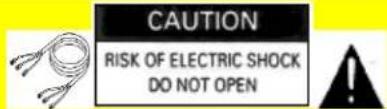

This symbol warns the user that uninsulated voltage within the unit may have sufficient magnitude to cause electric shock. Therefore, it is dangerous to make any kind of contact with any inside part of this unit.

This symbol alerts the user that important literature concerning the operation and maintenance of this unit has been included. Therefore, it should be read carefully in order to avoid any problems.
CAUTION: TO REDUCE THE RISK OF ELECTRIC
SHOCK, DO NOT REMOVE COVER (OR BACK).
NO USER-SERVICEABLE PARTS INSIDE.
REFER SERVICING TO QUALIFIED SERVICE PERSONNEL.
WARNING: Many television programs and films are copyrighted. In certain circumstances, copyright law may apply to private in-home videotaping of copyrighted materials.
WARNING: TO PREVENT FIRE OR ELECTRIC SHOCK, DO NOT EXPOSE THIS APPLIANCE TO RAIN OR MOISTURE.
CAUTION: TO PREVENT ELECTRIC SHOCK, MATCH WIDE BLADE OF PLUG TO WIDE SLOT, FULLY INSERT.
Caution to the user: Changes or modifications not expressly approved by the party responsible
for compliance could void the user's authority to operate the equipment.
"Note to CATV system installer: This reminder is provided to call the CATV system installer's
attention to Article 820-40 of the NEC that provides guidelines for proper grounding and, in
particular, specifies that the cable ground shall be connected to the grounding system of the building,
as close to the point of cable entry as practical".
I M P O R T A N T S
In addition to the careful attention devoted to quality standards in the manufacture of your video product, safety is a major factor in the design of every instrument. But, safety is your responsibility too.
This page lists important information that will help to assure your enjoyment and proper use of a Video Cassette Recorder and accessory equipment. Please read it carefully before operating your video product and keep it in a handy place for future reference.
INSTALLATION
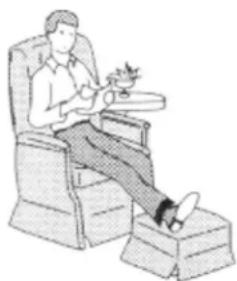
1 Read and Follow Instructions -- All the safety and operating instructions should be read before the video product is operated. Follow all operating and use instructions.
natural_image
Illustration of a person sitting in a chair using a tablet and standing on a staircase (no text or symbols)2 Retain Instruction -- The safety and operating instructions should be retained for future reference.
3 Heed Warnings -- Comply with all warnings on the video product and in the operating instructions.
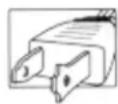
4 Polarized Plug -- This video product is equipped with a polarized alternating current line plug (a plug having one blade wider than the other). This plug will fit into the power outlet only one way. This is a safety feature. If you are unable to insert the plug fully into the outlet, try reversing the plug. If the plug should still fail to fit, contact your electrician to replace your obsolete outlet. To prevent electric shock do not use this polarized plug with an extension cord, receptacle or other outlet unless the blades can be fully inserted without blade exposure. If you need an extension, use a polarized cord.
5 Power Sources -- This video product should be operated only from the type of power source indicated on the marking label. If you are not sure of the type of power supply to your home, consult your video dealer or local power company. For video products intended to operate from battery power, or other sources, refer to the operating instructions.
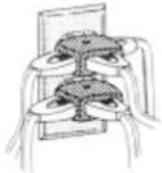
6 Overloading -- Do not overload wall outlets and extension cords as this can result in a risk of fire or electric shock. Overloaded AC outlets and extension cords are dangerous, and so are frayed power cords, damaged or cracked wire insulation and broken plugs. They may result in a shock or fire hazard.
Periodically examine the cord and have it replaced by your service technician if appearance indicates damage or deteriorated insulation.
7 Power Cord Protection -- Power supply cords should be routed so that they are not likely to be walked on or pinched by items placed upon or against them, paying particular attention to cords at plugs, convenience receptacles, and the point where they exit from the appliance.
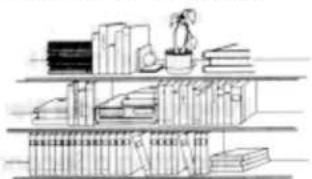
8 Ventilation -- Slots and openings in the cabinet are provided for ventilation to ensure reliable operation of the video product and to protect it from overheating. These openings must not be blocked or covered. The openings should never be blocked by placing the video product on a bed, sofa, rug or other similar surface. This video product should never be placed near or over a radiator or heat register. This video product should not be placed in a built-in installation such as a bookcase or rack unless proper ventilation is provided or the video product manufacturer's instructions have been followed.
natural_image
Line drawing of a bookshelf with books, a desk, and a plant (no text or symbols)9 Attachments -- Do not use attachments unless recommended by the video product manufacturer as they may cause hazards.
Caution: Maintain electrical safety. Powerline operated equipment or accessories connected to this unit should bear the UL listing mark or CSA certification mark on the accessory itself and should not have been modified so as to defeat the safety features. This will help avoid any potential hazard from electric shock or fire. If in doubt, contact qualified service personnel.
10 Water and Moisture -- Do not use this video product near water - for example, near a bath tub, wash bowl, kitchen sink, or laundry tub, in a wet basement, or near a swimming pool, and the like.
11 Accessories -- Do not place this video product on an unstable card, stand, tripod, bracket or table. The video product may fall, causing serious injury to a child or adult, and serious damage to the appliance. Use only with a cart, stand, tripod, bracket or table recommended by the manufacturer, or sold with the video product. Any mounting of the product should follow the manufacturer's instructions, and should use a mounting accessory recommended by the manufacturer.
11A An appliance and cart combination should be moved with care. Quick stops, excessive force, and uneven surfaces may cause the appliance and cart combination to overturn.

12 Outdoor Antenna Grounding -- If an outside antenna or cable system is connected to the video product, be sure the antenna or cable system is grounded so as to provide some protection against voltage surges and built-up static charges. Section 810 of the National Electrical Code, ANSI/NFPA No. 70, provides information with respect to proper grounding of the mast and supporting structure, grounding of the lead-in wire to an antenna discharge unit, size of grounding conductors, location of antenna-discharge unit, connection to grounding electrodes, and requirements for the grounding electrode. See example below.
EXAMPLE OF ANTENNA GROUNDING
13 Power Lines -- An outside antenna system should not be located in the vicinity of overhead power lines or other electric light or power circuits, or where it can fall into such power lines or circuits. When installing an outside antenna system, extreme care should be taken to keep from touching or approaching such power lines or circuits as contact with them might be fatal. Installing an outdoor antenna can be hazardous and should be left to a professional antenna installer.
USE
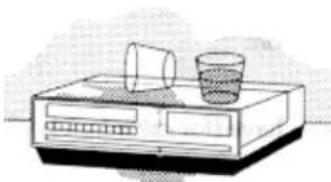
14 Cleaning -- Unplug this video product from the wall outlet before cleaning. Do not use liquid cleaners or aerosol cleaners. Use a damp cloth for cleaning. 15 Object and Liquid Entry -- Never push objects of any kind into this video product through openings as they may touch dangerous voltage points or short-out parts that could result in a fire or electric shock. Never spill liquid of any kind on the video product.
natural_image
Illustration of a desktop computer with two glasses on top (no text or symbols)16 Lightning -- For added protection for this video product during a lightning storm, or when it is left unattended and unused for long periods of time, unplug it from the wall outlet and disconnect the antenna or cable-system. This will prevent damage to the video product due to lightning and power-line surges.
SERVICE
17 Servicing -- Do not attempt to service this video product yourself as opening or removing covers may expose you to dangerous voltage or other hazards. Refer all servicing to qualified service personnel.
18 Conditions Requiring Service -- Unplug this video product from the wall outlet and refer servicing to qualified service personnel under the following conditions.
a. When the power-supply cord or plug is damaged.
b. If liquid has been spilled, or objects have fallen into the video product.
c. If the video product has been exposed to rain or water.
d. If the video product does not operate normally by following the operating instructions. Adjust only those controls that are covered by the operating instructions. Improper adjustment of other controls may result in damage and will often require extensive work by a qualified technician to restore the video product to its normal operation.
e. If the video product has been dropped or the cabinet has been damaged.
f. When the video product exhibits a distinct change in performance - this indicates a need for service.
19 Replacement Parts -- When replacement parts are required, have the service technician verify that the replacements he uses have the same safety characteristics as the original parts. Use of replacements specified by the video product manufacturer can prevent fire, electric shock or other hazards.
20 Safety Check -- Upon completion of any service or repairs to this video product, ask the service technician to perform safety checks recommended by the manufacturer to determine that the video product is in safe operating condition.
Read This First
Thank you for buying a Hitachi product. You've chosen the best VCR for you, and we want to help you make the most of your purchase. Please take time to become familiar with this manual and how it is set up. Keep it handy for future reference, too.
To guide you, we've concluded:
"Must read" sections containing important cautions for your family's safety as well as the basic facts you need to use the VCR. These sections are highlighted like this in the table of contents:
Information on the advanced features of your Hitachi VCR. We hope you'll take time to learn about these functions since we've designed them for you. But you can use the VCR without reading these sections.
We want this manual to be a tool for you, so we provide two ways to find the information you need:
☐ A quick index to the basic functions of the VCR which you will use often (this page).
A detailed table of contents directing you to specific information quickly (page 6).
Get to know your VCR by using this manual, and get to know Hitachi. We appreciate your business.
Getting Started
Relax. Using a VCR is very straightforward.
This sections explains how to hookup the VCR, quick tour of the controls, set up for first-time operation using on-screen menus, and videocassette tapes.
Enjoy getting to know all about your Hitachi VCR. Let's get started.
Simple Hookups
1 Decide Where to Put Your VCR
☐ Be sure your chosen location allows for proper ventilation, stability, and protection from heat and moisture (see Important Safeguards).
Place the VCR near your TV but not on top of it. For convenience in using the remote control, locate them no more than three feet apart.
☐ If you have an external cable or antenna, place the TV and VCR where you have ample cable to hook them up. If necessary, you can purchase a cable extension and connector.
If you plan to route your VCR audio through your stereo speakers for better sound reproduction, place the VCR near the stereo receiver, or have enough long audio cables to make the connections. (But keep in mind that the electronic signal weakens the further it has to travel.)
2 Decide Which Hookup Method to Use
To make your VCR function, you'll deal with two basic hookups:
- The audio and video signal: If all you want to do is view a prerecorded videotape on the VCR, this three-line hookup is the only one you need.
- The radio frequency (RF) signal from a cable or antenna: Make this hookup if you also want to record programs, or if you have no audio/video connectors on your TV.
We will show you the simplest hookups first and then present several variations to suit specific needs. Be aware that you may need to purchase additional connectors to make the desired hookup. These are available at video stores and electronic hardware stores.
Choose which hookup method to use based on:
□ Your TV's capabilities
☐ The type of antenna or cable system you have (for cable box hookup, see Advanced Operations)
□ Any other devices you want to include in the system (stereo, second VCR, etc.)
We will guide you through the process. But first, turn the TV and the VCR around so you are looking at their backs. Note the various input and output receptacles, their shapes, and how they are labeled. Then read through the rest of this hookup section before proceeding to an actual hookup.
DO NOT TURN ON THE POWER YET. FOR YOUR SAFETY, LEAVE YOUR
TV AND VCR UNPLUGGED WHILE HOOKING THEM UP.
3 Hook Up the Audio/Video Signal
If your TV is a fairly recent model, you probably have both audio and video jacks. Look on the back of your TV for three jacks - possibly color-coded yellow, white, and red. They will be labeled something like IN (L and R), AUDIO IN, or VIDEO IN. (If you are not sure, look at the back of your VCR - you will see two sets of these jacks.)
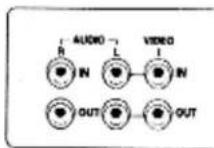
If you have no jacks like these on your TV, skip this step and proceed to Step 4.
TV with Audio and Video Jacks
If you do find all three jacks on your TV, you need to purchase a three-line audio/video cable with bell (RCA) connectors, like this:
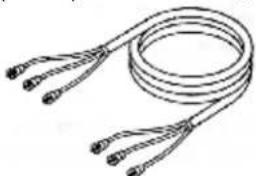
natural_image
Coiled cable with multiple connectors (no text or symbols visible)If you find a video jack and only one audio jack, your TV is probably monaural. You can purchase a two-line audio/video cable, but the three-line is handy in case you get a stereo TV later.
Connect the yellow VIDEO OUT jack on the VCR to the VIDEO IN jack on the TV.
This direct video input will give you the best picture. It will also let you play videos in a "picture in picture" feature, if your TV has it.
☐ Then connect the AUDIO OUT jacks (red and white) on the VCR to the AUDIO IN jacks on the TV (left to left, right to right).
This audio hookup will give you better sound than the RF signal hookup, because the electronic signal won't have to go through a conversion process.
Plus your VCR has a stereo decoder, which your TV might not. For big speaker sound, you can also use these jacks to connect the VCR to your stereo system (page 50).
Capabilities: The audio and video signal connections are all you need to play back a prerecorded tape. If you do not intend to record on your VCR from your antenna/cable, then you're all hooked up now. Otherwise, continue with Step 4, which will let you record off TV channels.
4 Hook Up the RF Signal
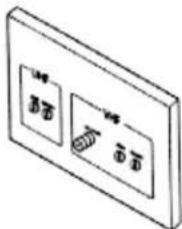
natural_image
Isometric line drawing of a wall-mounted electrical switch with two buttons and a bulb (no text or symbols)Look at the back of your TV for a connector that looks like one of these, and follow the corresponding hookup option. If you have any sort of cable box, see the hookup options in Advanced Operations (page 46).
Simple Antenna/Cable 75 Ohm Hookup
This is an easy hookup that you can use if your cable or antenna has a 75 ohm round wire connector. You will need the 75 ohm cable supplied with your VCR. It looks like this:
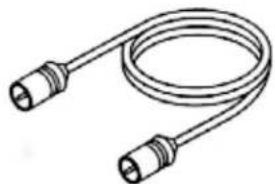
natural_image
Line drawing of a coiled cable or hose with two connectors (no text or symbols)If you have been watching the TV in your home before getting the VCR, you will already have a round wire attached to your TV. Otherwise, look for a cable connection coming in through the wall from outside. (If you find this connection, remember to call your local cable company to start the service.)
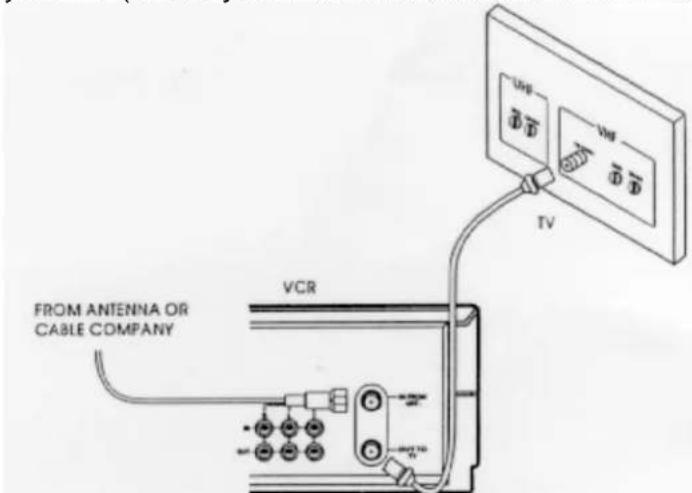
- If still hooked up to your TV, unscrew the round wire from the 75 ohm connector on your television. Otherwise, take the wire that comes in from the wall.
- Screw this round wire into the IN FROM ANT jack on the back of your VCR.
- Using the 75 ohm cable supplied with your VCR, slide on either end to the OUT TO TV jack on the back of the VCR.
- Connect the other end of the same cable onto the 75 ohm antenna input on your TV (where you first disconnected the TV in step 1.)
Getting Started
Capabilities: With this hookup, you should now be able to perform all the basic functions provided by this equipment.
External or Internal 300 Ohm Antenna
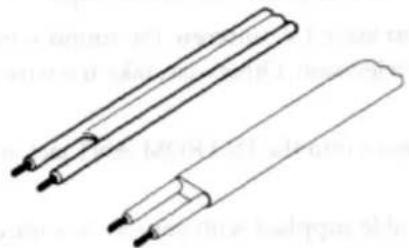
If you have either an external or internal (rabbit ears) antenna rather than cable, you may have 300 ohm connectors like these.
natural_image
Line drawing of three different types of cylindrical objects with no text or symbolsIn this case, you will need special adapters to make the 75 ohm round wire connection shown below. (You may already have one on your TV.)
- Remove the antenna line from the back of your TV if it is already connected there, or take it from where it comes in on the wall.
- Considering the three pictures below, determine which adapter you will need to hook it into your VCR.
If you have
Use this adapter
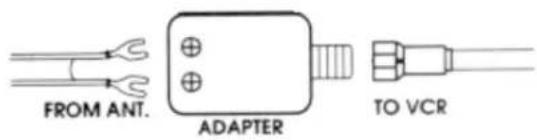
Single 300 ohm flat wire
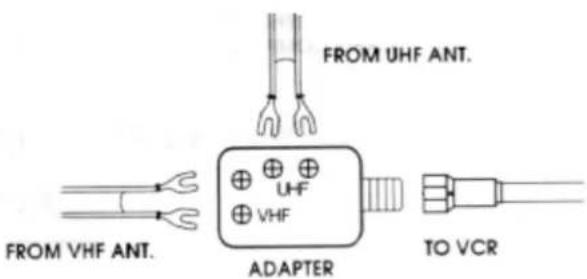
Separate UHF and VHF antenna wires, both 300 ohm flat wire
300 ohm flat UHF and 75 ohm
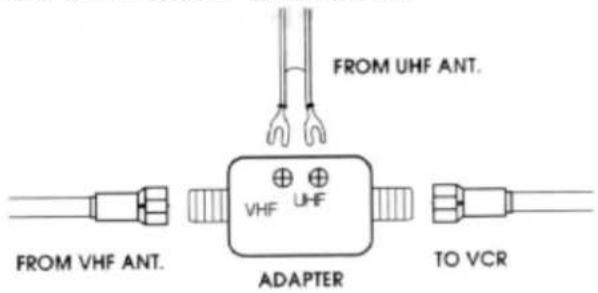
round VHF
If you have "rabbit ears" (an antenna on top of your TV), you will need an additional adapter and 75 ohm extension to make your leads reach from the antenna to the VCR. This connection will work only if you have a strong, clear picture on the TV, indicating a strong signal. Connect the antenna to the adapter, and use the cable extension to go from the adapter to the VCR. Use the supplied 75 ohm cable to connect the VCR to the TV.
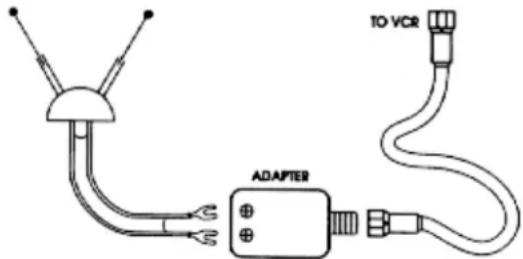
Now continue with the hookup:
- Using whichever adapter you have fit your antenna with, attach that connector to the IN FROM ANT jack on the back of the VCR.
- Using the 75 ohm cable supplied with your VCR, connect either end to the OUT TO TV jack on the back of the VCR.
- Use a second adapter to attach the other end of the 75 ohm connector back into the TV (where you first disconnected the antenna).
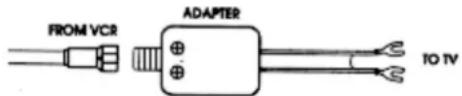
Capabilities: With this hookup, you should now be able to perform all basic functions provided by this equipment.
5 Attach the TV and VCR to the Power Supply
Plug in the TV and VCR power cords to the wall outlet or an appropriate extension cord or surge protector. See Important Safeguards for further precautions.
6 Install Batteries in the Remote Control
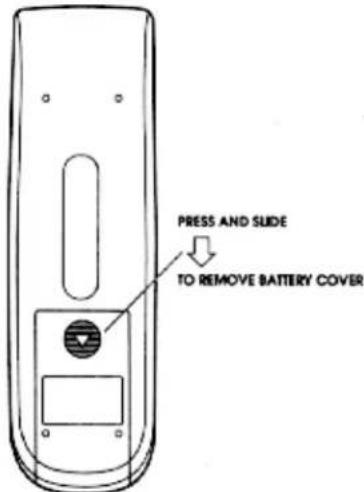
The remote control requires two fresh "AA" batteries. On the back of the remote, a plastic cover slides off in the direction shown by the arrow. Remove this cover and install the batteries, matching the plus end of each battery with the plus mark on the remote.
Getting Started
7 Switch the RF or Video Channel
When the VCR is on, its video signal can come into your TV on either channel 3 or channel 4. You need to select the appropriate channel.
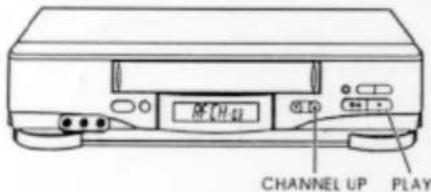
If you already have a tape in the VCR, eject it. When the power is turned on, press POWER to turn it off. Press PLAY/STILL on the VCR to turn the power on again. Pressing the CHANNEL UP button on the VCR alternates between RFCH-03 (channel 3) and RFCH-04 (channel 4) in the VCR's display. Display the channel which is not used by a commercial channel in your area.
Your basic hookup is now complete. When you're ready to try hooking up a second VCR or a video camera for a complete home entertainment system, see Advanced Operations.
Now turn the TV and VCR back around facing you and begin your quick tour of the controls (page 15).
Getting Started (Controls)
□ Quick Tour of the Controls
Study these pictures carefully to learn about the buttons and controls that you'll need for everyday operation. Various controls are explained throughout this manual as they are needed, but now is a good time to get familiar with their locations.
Most of the time, you'll be directing the VCR from the remote control, but there are some controls on the VCR that will come in handy too.
When you're familiar with these basic controls, proceed to Setup for First-Time Operation (page 21). We'll show you how to program your local channels and set the clock to make your VCR fully functional.
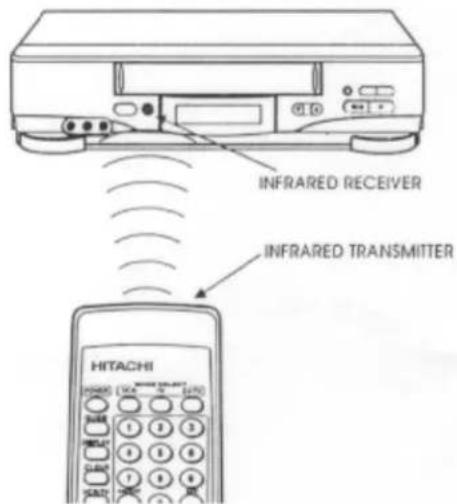
How the Remote Control Works
Pressing a button on the remote control transmits an invisible beam of light (infrared) to a receiver at the right front of the VCR.
When using the remote, aim the front end toward the VCR and make sure nothing - such as a coffee table or your dog - is blocking the path of the infrared beam.
Remote Control Buttons
Remote Control Illustration
POWER Turns the VCR on and off.
GUIDE Brings up an on-screen setup and programming guide, the Easy Guide System.
Getting Started (Controls)
DISPLAY Used in on-screen programming and indexing.
CLEAR Used in on-screen programming and indexing.
VCR/TV Switches between viewing through the VCR and not viewing through the VCR.
VOLUME Increase or decrease the audio volume.
PROGRAM Used to program the timer for unattended recording.
REW Rewinds the videotape.
PLAY Starts playing a loaded videocassette.
REC Starts recording on the station the VCR is set to.
VCR, TV, CATV (MODE SELECT) Device buttons let you set the remote to control one of the three devices.
0 to 9 Number buttons used in on-screen programming. Can also be used to change channels. (Simply press 2 or 3 digits for the channel you want--such as 0 and 6 for channel 6, or 100/ENT and 2 and 4 for channel 124.)
AVX Used for recording from an auxiliary input such as a stereo system.
CHANNEL Top button switches to the next higher channel, bottom button switches to the next lower channel. For these to operate, you must have preset your channels.
LAST CHANNEL Switches to the TV channel you watched previously during the current viewing session.
F.FWD Fast forwards the videotape.
STOP Stops a videocassette from playing, recording, pausing, rewinding--or anything it is doing.
PAUSE Temporarily stops the cassette from recording or playing. Press PAUSE again (or PLAY) to resume.
When the Remote Doesn't Work Right
Check out these possibilities:
Low Battery
If the remote is not working even at close range, try putting in two fresh AA batteries.
☐ When replacing the batteries, remove the old batteries and press the POWER button on the remote and hold it for about 10 seconds, then insert two fresh batteries.
Objects in the Way
Getting Started (Controls)
There may be objects between the remote and the VCR - for instance, a stack of books on the coffee table, your 2-year-old child, the dog. Hold the remote so that it points at the VCR with nothing in the way.
If You Just Want to Watch TV
For normal TV viewing, you do not need to disconnect the VCR. When the TV and VCR are already on, press POWER on the remote control. The VCR will shut off, but the TV will stay on.
If you are recording on the VCR but want to watch a different channel on the TV, press the VCR/TV button to switch back and forth between the TV channel and the recording channel.
VCR Controls
Front Panel Controls Illustration
POWER Turns VCR power on and off.
STOP/EJECT Cancels any videotape action, and when pressed a second time, ejects tape.
PLAY Plays the loaded videotape.
DISPLAY Shows time, channel, and status indicators.
CHANNEL/ Up and down arrows for selecting channels. TRACKING Used to adjust the tracking during playback.
REC/IRT To begin recording.
F.FWD Fast forwards the videotape
REW Rewinds the videotape
Display Indicators
Watch for these signs and symbols that let you know that the VCR is responding to your instructions.
| ☐ ☑ | HI-FI Tape Playing | -SRCH | Reverse Search |
| ☐ ☐ | Cassette Loaded | REM | Remaining Tape Display |
| ☐ ☐ | Recording | Programmed to Record Later | |
| REW | Rewind | L1 or L2 | Signal Being Received Through Audio/Video Input Jacks on Front or Back of Unit |
| FF | Fast-Forward | ||
| PLAY | Playback | ||
| STILL | Stop-Motion Play | ||
| SLOW | Slow-Motion Play | ||
| VCR | VCR Mode | ||
| SRCH | Forward Search |
Meet Your On-Screen Guide
Your Hitachi VCR has as a special feature called the Easy Guide System. This feature guides you through simple setup and programming tasks right on the TV screen.
With the TV and VCR turned on, press GUIDE on the remote control. You will see this screen:
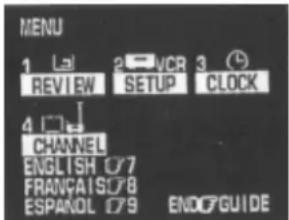
You may view all the on-screen instructions in English, French, or Spanish.
When you first set up your VCR, it will be set to English. Press number 8 or 9 for the other language options.
Now, you will do most of your programming and setup by pressing numbers on the remote control which correspond to options presented in this and other on-screen menus. Instructions are easy to follow, and a white dash "--" will show you where your input is required.
When you want to leave the Easy Guide System, simply press GUIDE several times. This will back you out to the normal TV viewing screen.
☐ If you don't press any button for a while, the VCR will switch you back to an earlier screen or to regular TV viewing.
Here is what the options mean.
1 REVIEW Press 1 of the remote control to review the programs you have preset in the timer or erase them as required. (See page 43)
2 VCR SETUP Press 2 to display the VCR SETUP screen and select the required sound from the VCR and its functions. (See page 26)
3 CLOCK Press 3 to display the CLOCK SET screen and correct the VCR's clock. (See page 21)
4 CHANNEL Press 4 to display the CHANNEL PRESET screen and preset channels. (See page 25)
7 ENGLISH Press 7 to display all option setting screens in English.
8 FRANCAIS Press 8 to display all option setting screens in French.
9 ESPANOL Press 9 to display all option setting screens in Spanish.
Setup for First-Time Operation
Before you use your VCR to watch or record from your TV, you need to "tell" the VCR whether your TV uses cable or antenna input and let it program itself to receive your TV's channels. It's also a good idea to set the clock so you can do timed recording later. With your TV and VCR hooked up, turn them both on and follow these steps using the remote control.
Setting the Clock
This is easy to do and important for your later timed recordings.
You'll need to set the clock when first hooking up your VCR, and any time the power goes out more than 1 hour.
When you first plug in the VCR or after a power outage, the clock display will read "--:--".
Auto Clock Set Function
This function sets the VCR's clock automatically when the VCR is tuned to a station which transmits a time signal together with TV programs.
It also automatically sets the time differences between various time zones and sets the time during Daylight Savings Time (D.S.T.). The auto clock set function operates each time the VCR is turned off.
☐ Some broadcast stations may not transmit a time signal. The auto clock set function does not operate when the VCR is tuned to a station which does not transmit a time signal. In this case, set the clock manually (See page 24).
When the clock is set automatically, the displayed time may drift from the current time by up to one minute.
Setting the Clock with the Auto Clock Set Function
- Press POWER to turn the VCR power off.
When the VCR is turned off, press POWER to turn the power on, then press it again to turn the power off.
The set time appears in the VCR display to show that the current time has been set.
It may take about five minutes for auto clock setting.
☐ If the clock is not set after about five minutes have elapsed, press GUIDE then set the clock manually (See page 24).
When the VCR power is recovered after a power failure of more than one hour, the clock can be set automatically from the "--:--" indication.
☐ If the displayed time drifts from the current time by more than one hour, select your correct time zone and set the DST (See page 22).
What to do if the displayed time drifts from the current time by more than one hour
- Press GUIDE, then press 3 to bring up the CLOCK SET screen. Check that item 1 is specified "CLOCK SET
"
Getting Started (Initial Setup)
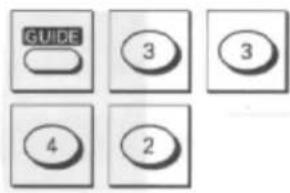
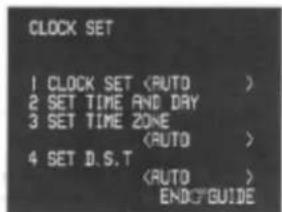
- Press 3 to select your local time zone.
Each time 3 is pressed, the option for "3 SET TIME ZONE" switches from
This screen gives an example where
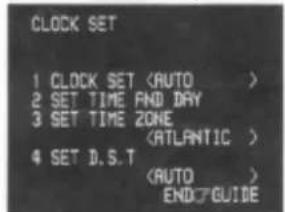
- Press 4 to select the D.S.T. option.
Each time 4 is pressed, the option for "4 SET D.S.T." switches from
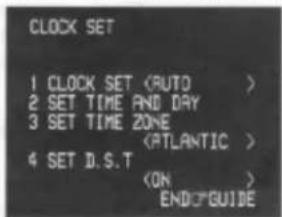
☐ This screen gives an example where
- Press 2 and set the time again.
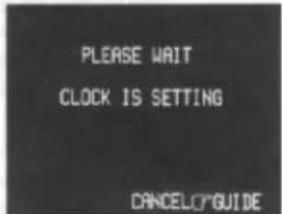
- The screen shown in Step 4 above changes to a TV picture and the current time appears in the VCR's display.
It may take about five minutes for auto clock setting.
☐ If the displayed time drifts from the current time by more than one hour even after steps 1-5 have been performed, change the D.S.T. option again in step 3, then return to step 4 and set the time again.
To set the clock manually
- Press GUIDE, then press 3 to bring up the CLOCK SET screen. Press 1 to switch "CLOCK SET
" of item 1 to "CLOCK SET "
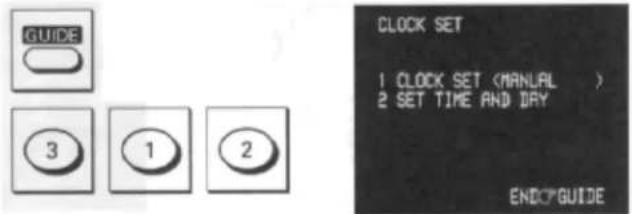
☐ If "CLOCK SET
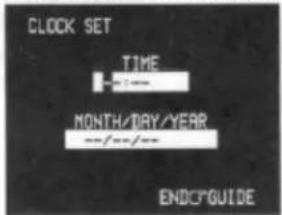
Press the number buttons on the remote control to set the current time--two digits for the hour and two for the minutes. Then press 1 or 2 for AM or PM, respectively.
For example, if it is now 2:15 PM, press 0, 2, 1, and 5 for hours and minutes, and press 2 for PM.
Continue pressing buttons to set the date. For example, if today is July 8, 1996, press 0, 7, 0, 8, 9, and 6 to get 07/08/96.
When you're done, press GUIDE twice to return to regular viewing.
Tips:
☐ The white dash "--" appears for the item to be changed on the screen as you proceed.
The clock uses the 12-hour system. You set it for AM or PM.
☐ An illogical time (like 13 for the hour or 20 for the month) will not be accepted.
☐ If you press the wrong digit, exit the screen by pressing GUIDE and recall the screen to enter the correct setup.
The day of the week is set automatically.
More About Channel Selections
Your VCR is capable of receiving 68 broadcast TV channels (VHF 2-13, UHF 14-69) and 125 cable channels (CATV 1-125).
- Press GUIDE, then press 4 to bring up the CHANNEL PRESET screen.
- Press 1 to select the type of receiving setup you have.
Each time 1 is pressed, the option for "1 CHANNEL" switches from
Getting Started (Initial Setup)
- Press 2 to select "2 AUTO CHANNEL SET". The tuner automatically cycles through all available channels in your area and place them in memory. This takes 2-3 minutes. After the channels are stored in memory, the channel with the lowest number appears in the VCR's display. Press GUIDE to return to regular viewing.
For convenience, the TV channel numbers should match those programmed into the VCR. If your TV has automatic channel programming, set it on the same mode--CATV1, ANT or CATV2--and let it reprogram to match the VCR.
Once channels are preset, you can use the up and down CHANNEL buttons to move through the active channels. Or you can press the number buttons to move quickly between channels that are far apart.
Removing Channels
You may not want to keep all the stations the auto-programmer selects, since you may prefer to have only a few favorite channels in the tuner's memory. Or, you may want to delete from memory a weak or unused channel that the tuner picked up.
☐ Erased channels cannot be selected by the up and down CHANNEL buttons but can still be selected by using the numbered buttons 0 to 9 and 100/ENT.
Adding Channels
Occasionally the auto-programming may skip an active channel because the antenna was pointed in the wrong direction or the channel had a weak signal or was "off the air" at the time of programming. Or you may change your mind about a channel you removed from memory.
To Add or Erase Channels
☐ Press GUIDE, then press 4 to bring up the CHANNEL PRESET screen. Item 3 lets you add or delete channels. Use the number buttons to enter the channel you want to change, then press STOP to delete it or press PLAY to add it.
Setting Up Your VCR for Each Function Using the Menu Screen
Press GUIDE, then press 2 to bring up the VCR SETUP screen.

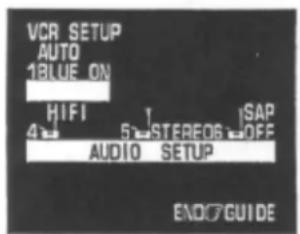
The screen shows the default settings on your VCR. The default settings are the ones that are preset at the factory.
Getting Started (Initial Setup)
Look at each item to see if it matches your own setup:
To change a setting, press the button that has the same number as that item. This will cycle you through several options.
☐ When everything is set up as you want, press GUIDE to return to regular viewing.
Here is what the options mean:
1 AUTO BLUE Press 1 to control the auto blue function which makes the screen blue and mutes sound when you select a channel without a broadcast signal on the VCR or a channel without a broadcast signal on the VCR or a channel on which broadcasting has finished. Options are
4 HIFI/LINEAR Press 4 to control how the audio signal is processed by the VCR. Options are
5 STEREO/MONO Press 5 to control how the audio signal is recorded and sent to the TV. Options are
6 SAP Press 6 when you are ready to record a second audio program. Options are
Choosing a Mode for Audio Playback
Choose between hi-fi and linear modes, depending on your needs.
HIFI is the preferred setting because it works for all tapes whether they were recorded in hi-fi or linear modes. If the audio sounds distorted or unusual or there is no audio, try the LINEAR option.
When you set the option to HIFI, hi-fi tapes will play in high fidelity, and non-hi-fi tapes will play in linear mode.
Stereo vs. Mono Sound
When you select the STEREO option, your VCR records in stereo any station that broadcasts stereo sound. When a TV channel broadcasts in stereo, you'll see a stereo indicator on the TV screen.
STEREO is the normal factory setting because it works for both stereo and mono broadcasts. It is also necessary for recording a second audio program (SAP).
When you select MONO, sound is recorded as mono even when a channel broadcasts in stereo.
Use the MONO setting when the stereo signal is not strong enough for quality reception (for example, when there is signal drift or noise).
Hi-Fi Sound
Hi-Fi sound is the same quality as that of a compact disc player. Its dynamic range of over 90dB will record either stereo or monaural broadcasts with the highest quality possible. Linear sound, on the other hand, will record monaural
Getting Started (Initial Setup)
sound using the same format as a non hi-fi VCR. Stereo programs are recorded in hi-fi on both the left and right channels and also recorded on the linear track as monaural.
Channel Caption (Station Identifier)
When your VCR is receiving a channel caption signal that is being transmitted by a local broadcasting station together with a TV program, a station identifier is displayed on the TV screen.
Getting Started (Video Tapes)
About Videocassette Tapes
Types
The best thing you can do for your VCR is use the best quality tapes available. This VCR uses VHS tapes only, which are the most common type. Look for the VHS mark on new or prerecorded tapes you buy.
Tapes are marked either T-120, T-160, T-180, T-210, etc. which signifies how many minutes of programming they can hold at standard recording speed (SP). To get the best quality picture, record at standard speed. But if you want to get more on a tape and are less concerned about the quality, set the VCR for extended play (EP).
Tape Capacities at Different Speeds
You may have noticed that there is also an LP speed. Your Hitachi VCR does not record at this speed, but it can play cassettes that were recorded in LP mode. No special setting is required for playback.
Safety Tabs Prevent Erasure
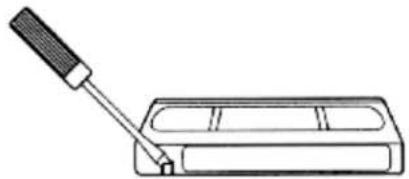
A safety tab is located on the front left edge of every videotape next to the label. Break this tab off if you want to keep a special tape from being erased accidentally. (Notice this tab is already removed on prerecorded tapes you buy or rent.) Poke a screwdriver or similar tip into the space behind the tab to break it off.
Don't worry, you can change your mind and record on this tape even after the tab is broken off - simply cover the hole with cellophane tape.
natural_image
Line drawing of a tool applying material to a rectangular object (no text or symbols)Loading and Ejecting
Getting Started (Video Tapes)
When you load a videocassette into the VCR, there is only one right way! Most tapes show you the way with a little arrow on the top side which should go in first.
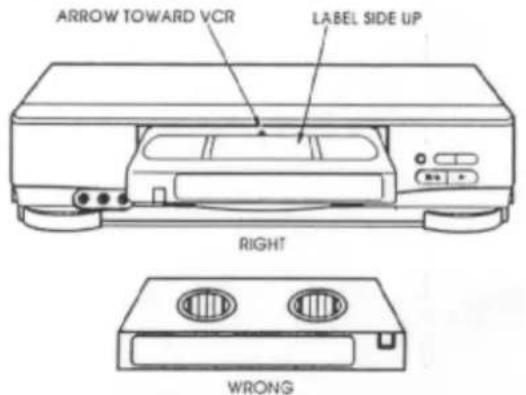
Push the videocassette gently into the slot on the front of the VCR. You will feel the VCR take it in.
When the cassette is all the way in, the VCR powers up automatically and a TAPE-IN indicator shows on the display. It may also start playing immediately if the safety tab has been removed.
To remove the cassette, simply press the STOP/EJECT button on the VCR. (If the tape is playing, press STOP/EJECT once to stop the tape and a second time to eject it.)
Now you can take the cassette out and put it away.
Tape Storage
Store your videocassettes in their jackets and in an upright position (like books in a bookshelf) away from any magnetic sources. Resist the temptation to leave them lying flat on top of the VCR. Tapes will last longer - and so will your VCR - if you store them properly. Remember, dust, dirt and liquids are enemies of your tapes and VCR.
To avoid aggravation later, apply the labels that come with new tapes. On them, write notes to yourself about what you recorded.
Basic Operations (Playback)
Practice starting and stopping a video you've rented - play it through, see how it automatically rewinds.
Get a blank tape and try recording a TV show. Then you'll know how to use the VCR when you need to--or where in the manual to find the instructions you forgot. Let's go!
□ Viewing a Videocassette
To Play Back a Recorded Tape
- Insert the cassette, arrow-side forward, into the slot at the front of the VCR. The power comes on automatically and the tape indicator lights on the display
- Turn on the TV and select the video channel (3 or 4). Or, if you are hooked up with a direct audio/video cable, set the TV to AUX or VIDEO.
- Press PLAY to start the tape.
- Press STOP to end play.
Direct Video Input to the TV
Normally you would select channel 3 or 4 on the TV to receive a signal from the VCR. You can get an even better picture if your TV has an auxiliary video input feature and if the TV and VCR have a direct video-to-video hookup. If this is the case, do not select channel 3 or 4. Instead:
Press the AUX or VIDEO button on the TV's remote control to select the proper input channel for playback.
To Fine Tune the Picture
Auto Tracking
Pressing PLAY starts the auto tracking feature, which adjusts the tuning to eliminate static lines that may appear on the screen.
Manual Tracking
Scratched tapes or poorly recorded tapes may require additional picture adjustment. Press the CHANNEL up or down button until picture becomes clear. After operating the tracking manually, eject the tape and reinsert it to reactivate auto tracking.
Rewinding the Tape
When you are done watching a video, you can rewind the tape automatically or manually. If the video cassette reaches the end of the tape, the VCR will stop and automatically rewind the video cassette. If you press POWER while the tape is rewinding, the power will shut off automatically after the tape has completely rewound.
Manual Rewind
Press STOP and REW. The VCR rewinds the tape all the way to the beginning, then stops. Press STOP/EJECT on the VCR to release the tape.
Movie Return
If your videocassette has the safety tab removed, the VCR will stop and automatically rewind the videocassette, eject it, and turn off the power when it reaches the end of the tape or a blank section of tape which lasts for more than 30 seconds.
This function works only in PLAYBACK mode, not in RECORDING mode.
Special Playback Effects
Visual Search
This function lets you search backward and forward through the videotape while viewing it.
Using the buttons on the remote control:
☐ Press PLAY and then REW to search in reverse.
☐ Press PLAY and then F.FWD to search ahead.
☐ Press PLAY again to return to to normal playback.
Press REW or F.FWD and hold it; you can search backward or forward through the tape at a higher speed while viewing it.
☐ Press PLAY and REW, then hold REW for backward search at a higher speed.
☐ Press PLAY and F.FWD, then hold F.FWD for forward search at a higher speed.
☐ Release REW or F.FWD to return to normal playback
Still Playback (Pause)
Press PAUSE on the remote control to still the tape during play. The picture will "freeze". You may see some minor noise or interference on the screen. This is normal.
After 1 minute in PAUSE mode, the VCR automatically switches to STOP mode to protect the tape.
If noise bars appear on the TV screen during PAUSE mode, first set the VCR to SLOW mode by using the SHUTTLE dial and then press the CHANNEL up or down button to minimize the noise bars.
If the screen jitters during PAUSE, press the CHANNEL up or down button to minimize it.
To resume play, press PLAY or PAUSE again.
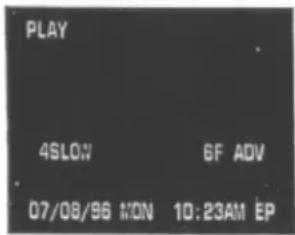
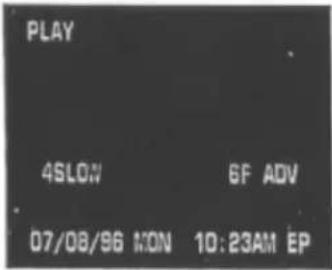
If you press the DISPLAY button when viewing a videocassette, the display, as shown, appears for several seconds so you can see the functions of the number buttons on the remote control.
4: SLOW 6: F ADV
The above functions always work when you are viewing a videocassette even if the display, as shown, is not displayed.
Frame Advance
While in PAUSE mode during playback, press 6 button to view the video one frame at a time. Press PAUSE to resume play.
Skip Playback
While playing back your tape you can skip forward by pressing the 6 button. The tape will search ahead for about a minute and then resume playing.
Slow Motion
To slow the playback speed, press PLAY then press 4 button.
Use the CHANNEL up or down button to minimize any visual noise bands on the screen.
After 1 minute in slow motion playback, the VCR will stop the tape automatically to prevent damage to the tape and the VCR.
To return to playback at a normal speed, press PLAY. To stop the tape, press STOP.
Viewing the On-Screen Display
Switching between the Clock, Time Counter and Time of Remaining Tape
Press DISPLAY while the on-screen display is displayed. The on-screen display switches in the order below together with the VCR's display.
On-Screen Display Examples
Displaying the Time Counter
The time counter keeps track of how many hours, minutes and seconds the tape has run.
Press DISPLAY. The time counter will appear on the TV screen and in the VCR's display.
The linear time counter operates only if there is something recorded on the tape.
The counter changes to 0:00:00 when the tape is ejected.
Basic Operations (Playback)
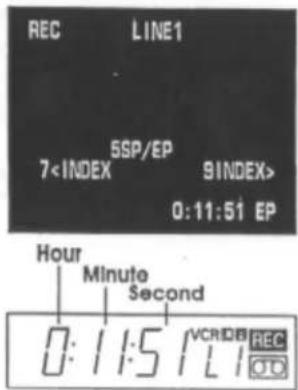
Displaying the Tape Remaining Time
This function displays the tape remaining time in hours and minutes.
- Press DISPLAY to display the tape remaining time.
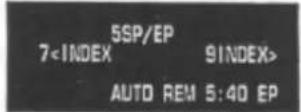
Immediately after the tape is inserted, "- : --" will appear. 2 minutes after playback or recording is started, the tape remaining time is displayed.
- Press CLEAR repeatedly to switch the type of the tape used. The correct remaining time will appear.
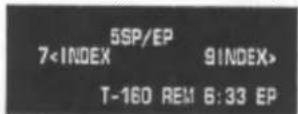
AUTO: T-120 or shorter tape
T-160: T-140 or T-160 tape
T-180: T-180 tape
T-210: T-210 tape
The tape remaining time is not displayed correctly for a tape without any recordings or tapes other than T-30 / 60 / 90 / 120 / 140 / 160 / 180 / 210.
☐ The remaining time may not be displayed correctly during fast forwarding or rewinding.
To Find Specific Sections on a Tape
Searching with the Time Counter
If there is one part of the video that you know you are going to want to return to, you can set the time counter to memorize that spot. Begin in either STOP or PLAY mode.
Press DISPLAY several times to display the counter on the VCR.
Begin recording or playing back a tape.
At the point that you want to go back to, press CLEAR. This resets the counter to 0:00:00.
Press STOP when you are done recording or playing back the tape.
Basic Operations (Playback)
Now when you rewind the tape, it will automatically stop at the spot where you cleared the counter. (Notice it moves just past the marker and then back to it.) Press PLAY to watch the tape from that preselected spot.
☐ Press DISPLAY to take the counter display off. The spot is still in memory until you set a new one or until the tape is ejected.
Jump to an Index Mark with INDEX
A quick way to access specific program segments is with the index search feature. This lets you move through a tape that has several recordings on it by searching for the INDEX "mark." This function only works with recordings that have been set up with indexing. Each time you make a recording, an INDEX "mark" (VISS signal) is recorded automatically at the start of the recording. For more on how this gets recorded, see the section on Recording a Program (page 34).
This VCR's indexing system is based on the VHS Index Search System (VISS). The new system may not recognize index marks on tapes recorded on older VCRs.
☐ If the VCR is in PLAY mode, press STOP.
Press DISPLAY. This brings up the Index Screen.
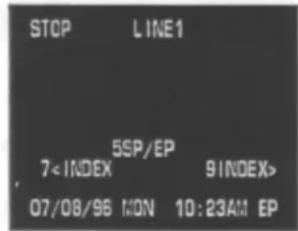
☐ Press 7 for rewind or 9 for forward to begin the index search.
The tape rewinds or fast-forwards until an index mark is detected. During this search, the word INDEX is displayed at the top left corner of your screen. When the VCR finds an index mark, it plays 15 seconds of the program that begins at that spot.
☐ If this is the program you were looking for, press PLAY to resume normal playback.
☐ If this is not the program you want, don't press anything. After 15 seconds, the VCR will move to the next mark and play a part of that program. The VCR will continue searching until you press STOP or reach the end of the tape.
When you find the program you want and press PLAY, the VCR returns to PLAY mode.
To stop the index search before an index mark is reached, press STOP.
If there are no index marks on the tape, the VCR will just rewind to the beginning or fast forward to the end.
□ Recording a Program
Before You Record
☐ The VCR must be hooked up properly for recording. See the Simple Hookups at the beginning of this manual.
Copyright Infringement Warning
Most television programs and films are copyrighted. This means that someone has legal rights governing the reproduction and distribution of this material. In certain circumstances, copyright law may apply to private in-home taping of copyrighted materials. In most cases, it is okay to record for personal use, as long as you do not sell the material. You must act responsibly in this area - check into the matter if you are unsure.
Basic Recording Steps


- Load the videocassette into the VCR. The power comes on automatically when the tape is fully inserted.
- Turn on the TV and select the video channel (3 or 4). Or, if you are hooked up with a direct audio/video cable, set the TV to AUX or VIDEO.
- Press DISPLAY, then press 5 when the SP/EP message appears on the TV screen, to select SP (standard play, for the best picture quality) or EP (extended play, for longest recording time on a single tape).
- Set the VCR to the channel you want to record from. Use the up and down CHANNEL buttons to flip through the channels, or use the number buttons to go directly to the channel you want.
- To begin recording, press REC on the remote control or REC/IRT on the VCR. Recording will start unless the cassette is protected with the safety tab. If this tab has been removed, the VCR will eject the tape to prevent recording over what is there.
Recording Tips
To Watch the Same Program While Recording
To view what you are recording, press VCR/TV so that the VCR is selected - the VCR indicator will light up on the VCR's display. You'll want to do this the first few times anyway to be sure you're recording what you think you are.
To Watch One Program While Recording Another
Once you have set the VCR for recording, press VCR/TV. Now, you will be viewing through your TV only. Switch channels using your TV controls or the VCR remote, if it's programmed to control your television (see Advanced
Operations).
The recording will continue as set on the VCR. If a preset timed recording starts up while you are watching the TV, you'll hear the cassette as it clicks on and see the recording indicator light up on the VCR display.
You can check on the recording by pressing VCR/TV again. This will switch you back to viewing through the VCR, you'll see the program you are recording.
To Skip Commercials
When a commercial comes on that you don't want to record, simply press PAUSE on the remote control. The VCR will stop recording. Press PAUSE again to continue recording when you see the commercial is over. If you stay in PAUSE mode for more than 5 minutes, the VCR automatically switches to STOP mode to protect the tape.
To Change the Channel Being Recorded
Suppose you are recording one program, and you remember that something else is on that you would rather record. You can change the channel while in the recording mode.
☐ Press PAUSE to stop the recording temporarily. This is necessary because the CHANNEL buttons won't work while you are in recording mode--to keep you from accidentally switching the station while recording.
☐ Change the channel to the one you prefer.
Press PAUSE to continue recording.
To Leave Index Marks on the Tape
This feature is useful when you are recording several programs on the same tape. It helps you quickly find the beginnings of the shows during playback (page 36).
You create the index "mark" every time you begin recording by pressing REC. To leave an index mark between shows, simply press STOP at the end of each show, then press REC to record the next show. (Pressing PAUSE during recording does not leave an index mark.)
During timed recordings, the VCR automatically inserts an index mark at the beginning of the recording.
To Record a Second Audio Program (SAP)
Some stations transmit a Second Audio Program - such as in a second language. If a station broadcasts in SAP, the SA indicator will display on your TV screen.
You can set the VCR to record a second audio program by activating the SAP option through the Easy Guide System.
☐ Press GUIDE, then press 2 to bring up the VCR SETUP screen.
☐ Press 6 to set the SAP option to ON.
☐ Make sure that STEREO/MONO selection is set to STEREO.
When this is set, the VCR records the second audio program.
Using the Instant Recording Timer (IRT)
The Instant Recording Timer (REC/IRT button on the VCR) will let you make a
Basic Operations (Recording)
simplified timer recording without having to use the programming timer. In order to set the IRT properly the clock must be set before starting.
Follow the steps 1 through 5 on "Basic Recording Steps" on page 34.
After the recording has started, press the REC/IRT button again to indicate the recording time on the display.
You can set the recording time length, which increases by intervals of 30 minutes, one hour, one and half hours, two hours, three hours, and four hours, (i.e. 0:30, 1:00, 1:30, 2:00, 3:00, 4:00) by continually pressing the REC/IRT button. While you are recording, the time remaining is shown in the display. At the end of your recording the display will read "0:00"; recording will then automatically stop and the VCR will turn itself off.
To stop recording while in the IRT mode, press the POWER button and then press the STOP button (this can be done either on the VCR or with the remote control) within 10 seconds.
Setting the VCR to Record Later
With the delayed recording feature, you can set this VCR so that it automatically comes on and records programs whenever you like--without your being around! You can record a program one time only, or you can automatically record a show every weekday or every week at the same time. You can preset as many as 8 timed recordings at once.
We suggest you try all the different ways of programming the VCR when you have some leisure time, so you can learn how it works. That way, when an important show is going to be on that you really want to record, you'll be confident that your timed recording setup will work.
Types of Delayed Recordings
ONE TIME Records one show at a particular date and time.
DAILY Records a show at the same time every day of the week, Monday through Friday.
WEEKLY Records a show at the same day and time every week.
Your VCR can record up to 8 programs at different days and times, or up to 8 programs on the same day.
Before You Begin
Assemble the information you need for timed recording:
☐ Be sure that the clock is set to the correct time.
□ Date and day of the program
□ Starting time
□ Ending time
☐ Channel to be recorded
Blank or erasable videocassette (safety tab intact)
Delayed Recording Steps
Basic Operations (Recording)
You set up the delayed recording using the on-screen Easy Guide System.
☐ Press the PROGRAM button, then press number buttons 1, 2 or 3 for ONE TIME, DAILY, or WEEKLY RECORDING. Follow the white dashes "--" on screen to complete the programming.
Remember to press 0 before single-digit channel numbers, times, and dates - for example, 0 and 6 for channel 6.
After you enter the channel and time, the VCR automatically shows the current date or the next date, whichever is most logical. Leave the date as it comes up, or enter new digits for the month and day.
☐ If you make a mistake when entering digits, press CLEAR repeatedly to return the white dash "--" to the digit to be corrected. Then, punch in the correct number. Illogical times and dates won't be accepted.
☐ If you want to record from external equipment, press AVX button to select LINE1 or LINE2 instead of the channel number.
☐ When everything is set as you want (even though white dashes "--" may still appear on some items), press PROGRAM to program your settings into memory.
☐ To preset additional recordings, repeat these steps.
☐ Don't forget to load a videocassette to record on.
Your delayed recording settings take effect when you turn off the power on the VCR.
When the power is off, the delayed recording indicator will display on the VCR. This tells you that the VCR will automatically record at the times and dates you have programmed.
To Stop a Delayed Recording in Progress
Press POWER and then immediately - within 10 seconds - press the STOP button (use buttons on the remote or VCR as you wish).
An Example
Let's say you were interviewed today by a local TV reporter. You're eager to see yourself on the evening news tonight. The news comes on channel 8 at 6 0'clock-but you've got a meeting scheduled during that time. Luckily you just purchased this Hitachi VCR.
Press the PROGRAM button, then press 1 to bring up the screen for One Time recording:
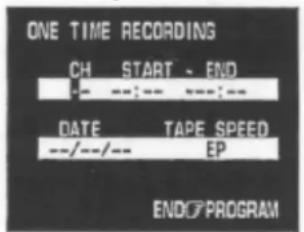
Now fill in the blanks:
Select channel 8 by pressing 0 and 8 on the remote control.
☐ Enter the start time by pressing 0, 6, 0, and 0 for 6 o'clock. Then press 2 for PM
Basic Operations (Recording)
☐ Enter the end time, half past six, as 06:30. The VCR automatically selects PM for you.
The screen shows today's date, so no changes are needed on that line.
☐ Press 5 to switch to SP because you want the best quality picture for this recording.
Everything is as you want it, so press PROGRAM to set the program in memory. Insert a videocassette, and power off the VCR. Check for the delayed recording indicator on the VCR's display. Prepare to admire yourself on the evening news.
Reviewing What You Have Programmed
You can look back over any of the recordings you have preset, and if you need to, clear out any of the programs. Normal programs will clear automatically once recording is complete, but daily and weekly settings must be cleared out manually.
☐ Press GUIDE, then press 1 for the PROGRAM REVIEW option. This brings up the screen settings for the first program. Keep pressing 1 to cycle through all the programs you have preset.
☐ To remove a program, press CLEAR. The screen will display the next program, if there are more, or it will switch back to regular TV viewing.
Programming Priorities
When you have set up several timed recordings, it may occur that some of their times overlap. For example, this can happen if you are set up to record shows on a daily or weekly basis, and a special show comes on that you try to record during the same time slot.
Shows with Same Starting Time
If the overlapping programs start at the same time, the VCR records in order that they were programmed. If the shows are all scheduled to start at 7 AM, the VCR starts with the first program at 7 AM, and switches to what remains of the second program when the first program is done recording, and so on.
Shows with Different Starting Times
If the programs start at different times, the VCR records the show scheduled to start earliest, records the entire show, then moves on to the show with the next earliest starting time.
To avoid recording only bits and pieces of different overlapping shows, review your programming and delete those shows that are not essential.
Advanced Operations
A d v a n c e d O p
This section explains how to use the VCR's remote control to operate your TV. It also shows you how to hook up a cable box and how to connect a stereo or a second VCR for a complete home entertainment system.
Controlling Your TV with the VCR's Remote
Compatibility
The remote control is designed to be compatible with many televisions, but will not work with every one made. If your TV does not respond the way it should when you program it as explained below, this remote may be incapable of operating it.
Once you have programmed the remote, you won't have to do it again until you change the batteries.
This Hitachi remote control can be used with your TV as well as the VCR, as long as your TV comes with a remote control. This feature comes in handy - you don't have to juggle two remotes.
The remote control is compatible with the fifteen makers of TV's listed below - but don't be alarmed if yours is not on our list. You may still be able to program the remote for your TV.
Every TV that comes with a remote control is set up to detect certain infrared signals. You need to program the VCR's remote control to send signals that your TV will recognize and respond to. Here's what to do:
Programming the Remote Control
Turn the television on (any channel is okay).
Aim the VCR's remote control at your TV set. Hold down the TV button (not the VCR/TV button) while you press the number corresponding to your brand of television as shown in the chart (page 45).
For example, if you have an RCA television, press TV and 0 at the same time. If this button combination sends a signal that matches with your TV, the channel will change on the TV, and you'll know the remote is set to control the television.
☐ If that button combination does not change the TV channel, go through the whole list of button combinations one by one until you find the one that does change your TV channel.
Also, if your brand of TV is not listed in the chart, try all the number buttons. One of them may work for you.
If the TV channel still doesn't change after going through all the button combinations listed, it is likely that you will not be able to program this remote control for your TV.
TV Brands Press TV and This Number
Advanced Operations
| Hitachi | 1 | |
| Zenith | 2 | |
| Sony | 3 | |
| Magnavox | 4 | |
| Sanyo | 5 | |
| Gold Star 1 | 6 | |
| Toshiba | 7 | |
| Gold Star 2 | 8 | |
| Panasonic | 2 | 9 |
| RCA | 0 | |
| Panasonic 1 | CHANNEL (up arrow) | |
| Mitsubishi | CHANNEL (down arrow) | |
| JVC | 100/ENT | |
| Sharp 1 | LAST CH | |
| Sharp 2 | DISPLAY | |
Controlling the TV
Once programmed, the VCR's remote control is ready to control the TV.
☐ First press TV to change to the TV function mode, then press the button of the TV function that you want.
For example, press TV and the CHANNEL up arrow, and the TV station will change to the next higher station.
Press VCR to operate your VCR with the remote again.
Be aware that not all of your TV's functions may work even though the remote control is correctly programmed.
Advanced Operations (Cable Box Hookups)
Hooking Up to a Cable Box
The cable box brings all the advantages of pay cable, but finding a satisfactory hookup can be challenging. To sort out what to do, we suggest a step-by-step approach to installation.
You will need RF TV splitters, coaxial cable jumpers, and possible RF switches to try various configurations. These are not furnished with your VCR because each installation will have different needs and require different cable lengths.
Before you begin, take a close look at the back of your TV to see where cables are currently connected. You may need to reconnect them that way later. As an aid to memory, use masking tape to label each cable and connection.
A Step-by-Step Approach
Try the hookups listed as Options 1 through 4. They are based on whether the cable channel signals are scrambled, unscrambled, or a combination. (Your cable company can tell you more about this.)
After each hookup, power up the VCR and the TV. Use the CHANNEL PRESET screen (page 25) to select option CATV1 or CATV2. Then check out the system using these questions as a guide.
☐ Does the TV receive the same number of channels as before the installation?
☐ Does the VCR record all channels?
☐ Do the VCR and TV remote control functions work?
☐ Can I record on one channel while watching another?
Do I receive my pay channels, and do all special cable features work?
If any function does not work, or works in an unexpected way, hook up everything the way it was when you started and begin again with the next hookup option.
If you don't have a direct video connection - the one using the audio/video cable - make sure the TV channel is set to 3 or 4 when you play back a tape.
Consult the cable company or the cable converter manual for assistance in using the VCR with a cable converter. You will probably need to set the VCR to channel 3 or 4 and then use the cable converter to switch stations. There may be additional procedures for picking up pay-for-view or scrambled channels, which the cable company will gladly help you with.
Option 1--All Channels Scrambled
- Remove the cable company's cable line from the back of your TV. Connect it to the IN FROM ANT lower jack on the back of the VCR.
- Using the 75 ohm coaxial cable supplied with your VCR, connect either end to the VCR's OUT TO TV upper jack.
- Connect the other end of the 75 ohm cable to the TV, in the same place where you removed the cable line.
Advanced Operations (Cable Box Hookups)
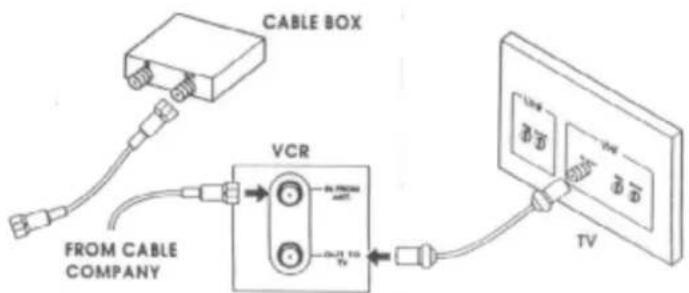
Check all the TV and VCR functions. If you don't get all the functions you want, proceed with Option 2.
Option 2--All Channels Unscrambled
- Remove the cable company's line from the back of the cable box that goes to your TV. Connect it to the IN FROM ANT lower jack on the back of the VCR.
- Using the 75 ohm coaxial cable supplied with the VCR, connect either end to the VCR's OUT TO TV upper jack.
- Connect the other end of the 75 ohm cable to the TV, in the same place where you removed the cable line.
Note: You will end up with an extra cable that originally went from the cable box to the TV.
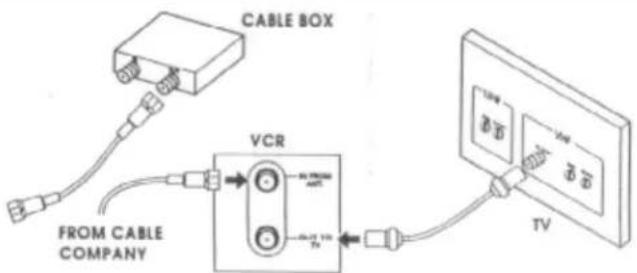
Check all the TV and VCR functions. If you don't get all the functions you want, proceed with Option 3.
Option 3--Some Channels Scrambled
This hookup requires three coaxial jumpers with connectors, a 1-into-2 splitter, and an A-or-B switch box.
- Disconnect the cable from the cable box and attach it to the input line of the 1-into-2 splitter.
- Using a coaxial jumper, reconnect one of the splitter outputs to the cable box's input that you just freed up.
- Using a second coaxial jumper, connect the other splitter output to the A of the a-or-B switch.
- Using the cable box output line, connect the cable box receptacle to the B of the A-or-B switch.
-
Using a third coaxial jumper, connect the output of the A-or-B switch to the input of the VCR.
-
Take the coaxial cable that is still connected to the television and hook it to the output of the VCR.
Some Channels Scrambled Cable Box Hookup
This setup lets you switch between the two configurations in Options 1 and 2. Check all the TV and VCR functions. If you still don't get the functions you want, proceed with Option 4.
Option 4
If none of the preceding hookups work, check with your cable company. You may need to purchase a video switching system from your local electronics or video retailer. This will easily handle most hookup problems.
Remote Control of the Cable Converter
If you have a cable converter, you will probably want to program your VCR's remote control so you can easily change channels. The process is the same as for programming the remote to operate your TV. For additional details, see page 44.
Hold down the CATV button and press the number of your brand of cable box (shown in the chart).
If that button combination does not work, or if your brand is not on the chart, just go through all the button combinations until you find the one that works best.
Cable Converters Press CATV and This Number
| Jerrold | 1 | 1 |
| Jerrold | 2 | 2 |
| Jerrold | 3 | 3 |
| Hamlin | 4 | |
| Zenith | 5 | |
| Scientific | Atlanta | 6 |
| Pioneer | 7 | |
| Philips | 8 |
To operate the cable box once the remote is programmed for it:
☐ Press CATV and then the button of the function you want.
☐ Press VCR to operate your VCR with the remote again.
Advanced Operations (Stereo System)
□ Integrating Your Stereo System
There are several reasons to consider hooking up your stereo system with your TV and VCR.
If your TV does not have stereo, you can get stereo quality from your VCR by hooking it to your stereo receiver.
Even if your TV does have stereo, you can get better sound by taking advantage of your stereo's better speakers.
☐ You can record stereo audio on your VCR for longer play times, or use the VCR as an extra tape deck for dubbing.
Hookup
Stereo System Hookup
To make this hookup, you need to be familiar with the options on your stereo system. Look at the back of your receiver. Probably you have AUDIO IN and OUT jacks for a second tape deck - labeled Tape 1 and 2, or AUX 1 and 2.
Consult your stereo owner's manual for further information.
You will need two audio cables - the kind with two color-coded plugs on each end (for left and right audio channels). With the power off:
Connect the right (red) and left (white) AUDIO OUT on the VCR to the right and left AUDIO IN on the stereo system.
Connect the left and right AUDIO OUT on the stereo to the right and left AUDIO IN on the VCR.
The AUDIO IN (left) on the front of the VCR handles the left-channel or monaural sound. If you connect an audio source only to AUDIO IN (left), both left and right hi-fi tracks will record an audio signal as monaural.
Recording from Your Stereo System
With the hookup just shown, you can use your VCR to record a custom program of selections from your stereo library. The videotape recording will give you excellent stereo quality and a long-running tape. In this case no video will be recorded, so you can do the whole thing without turning on the TV.
Assemble the selections you want to record on the stereo, and insert a blank VHS cassette into the VCR. Be sure that HIFI is selected in the VCR SETUP screen (See page 26).
☐ Press DISPLAY, then press 5 on the remote control to select SP or EP. The EP setting gives you reasonable audio quality and a longer tape program.
☐ Press AVX on the remote control to turn the LINE (L1) indicator on.
☐ Press REC/IRT on the VCR and start the stereo system audio source (Tape, CD, etc.).
To stop recording, press STOP. To play back the recording, rewind the tape and press PLAY.
Advanced Operations (Second VCR)
□ Integrating a Second VCR
With another VCR hooked up, you can copy videotapes as needed, and you can get fancy with multimedia programming. For this discussion, we refer to the model VT-FX611A Hitachi as VCR2 and the other unit as VCR1.
Hookup
To hook up a second VCR, you need:
☐ A video cord with a single jack on each end, and
□ An audio cord with two jacks on each end, or
☐ A three-way cord that has both audio and video jacks
Study the back of VCR2 (VT-FX611A) to find the three color-coded jacks that are labeled IN. The yellow jack is for video, red and white are for audio. Locate similar jacks on VCR1. Then, with the power off:
Connect VIDEO OUT on VCR2 to the yellow VIDEO IN on VCR1.
☐ Connect the AUDIO OUT jacks (left and right) on VCR2 to the AUDIO IN jacks (left and right) on VCR1. Be sure to match left to left (white) and right to right (red).
Second VCR Hookup
Copying from One VCR to Another (Dubbing)
Consider VCR1 the recording VCR, and VCR2 (VT-FX611A) the playback VCR. You will play a tape on VCR2 and record it on VCR1. To begin copying:
☐ Insert the videotape you wish to record in VCR2.
☐ Insert a blank or erasable tape (with the safety tab intact) into VCR1.
☐ Press AVX on VCR1--the LINE indicator will display.
☐ Press REC on VCR1, and press PLAY on VCR2.
To monitor the picture as you record, VCR1 must be connected to your TV (follow instructions in the other VCR's manual). Press the VCR/TV button on the remote. The VCR indicator will light on VCR1's display and you can view the picture being recorded.
Putting the Record VCR in Pause
Some models of VCR will switch to the "STOP" mode if they are left in the RECORD/PAUSE mode for more than five minutes. It is a good idea not to leave your recording deck in RECORD/PAUSE for more than five minutes so that this will not happen.
Advanced Operations (Camcorder)
Copying Tapes From A Camcorder
If you would like to copy a video tape shot in your camcorder onto your VCR, here's how to do it.
Connect the camcorder's AV output cable to your VCR. (see diagram below)
Camcorder to VCR Hookup Illustration
* It is not necessary to connect the S-VIDEO jack.
Press the AVX button on the VCR's remote control so that the L2 (Line) indicator appears in the VCR display.
☐ Press REC/IRT on the VCR to start recording.
Press PLAY on your camcorder to start copying your tape.
Information on Audio Hookup
If your camcorder is only capable of monaural output (one audio jack) connect it to the AUDIO IN L/MONO input on the front of the VCR.
V C R C a r e a n o
The VCR is fairly self-servicing, but you'll want to keep an eye on a few things as you go. In addition, you may sometimes have troubles with your VCR. We offer some suggestions for care to prevent problems, ways to troubleshoot, and places to contact when you cannot solve the problems yourself.
Routine Cleaning
Head Cleaning
The heads are tiny mechanisms in the VCR that pick up the video signal as a videotape passes over them. In time, a residue of electromagnetic dust builds up on the heads because of contact with the tape. This dust interferes with the signal being picked up.
Your Hitachi VCR automatically cleans the video heads whenever a cassette is loaded or ejected and when a cassette is already inside the VCR when you turn the power off. It also self-cleans during fast-forward and reverse play. You will hear a mechanical sound during auto head cleaning.
Even with the auto head cleaning system, dirt can build up on the heads. If the picture is blurry during playback, or is occasionally interrupted or blanks out, try playing different cassettes to see whether you get the same picture problems. If the picture problems persist, the heads may need to be cleaned professionally. Consult your VCR dealer for the name of trained service technician near you.
Periodic Maintenance
Your Hitachi VCR is a precision electro mechanical device which requires professional maintenance after a period of normal use.
Usually no maintenance other than head cleaning is required during the warranty period, unless the VCR is used either heavily or infrequently. Defective parts are covered during the warranty period, but normal maintenance is your responsibility.
Consult your VCR service center to find out what they recommend as normal maintenance based on your location, how you use the VCR, and the age of the machine.
□ If the VCR Doesn't Work Right
Many operational problems are easily remedied by reviewing the instructions in this manual and trying out some different controls and settings. The chart on page 57 covers the more common problems that new VCR owners encounter.
Don't Attempt Repairs Yourself
Do not remove the cover or the back of the VCR - this will void the warranty and endanger your safety. The exposed uninsulated voltage in this unit may be high enough to cause electrical shock. It is dangerous to make contact with any inside part, and none of these parts are intended to be serviced by an untrained user. To be safe, refer service problems to qualified service personnel.
Technical Specifications
Format: VHS
Video Signal System: NTSC color EIA standard
Record/Playback System: Video: 4 Heads
Audio: VHS Hi-Fi stereo record/playback system
Tape Speed: 33.35 mm/sec (SP), 16.67 mm/sec (LP)( playback only),
11.12
mm/sec
(EP)
RF Input: UHF/VHF 75 ohm
Tuner: USA: 181 channel tuning ability* (125 cable channels)
Canada: 178 channel tuning ability* (122 cable
channels)
Type: Auto
programming
frequency
synthesis
Power Input:
AC120V
60Hz
Power Consumption: 20W nominal
Cabinet Size: 14-15/16" (W) x 3-11/16" (H) x 10-11/16" (D)
38.0 cm (W) × 9.3 cm (H) × 27.1 cm (D)
Weight: 7.7
lbs. (3.5
kg)
Storage Temperature: -4°F to 131°F
Operating Temperature: 41°F to 104°F
Accessories: 1 coaxial cable (Part No. EW10251),
1 remote control unit (Part No. HL10622), 2 AA
batteries
* Check your cable company's compatibility requirements.
For more information about how to obtain these accessories, please call TOLL FREE 1-800-448-2244 for your nearest Hitachi Authorized Parts Distributor in the continental United States. For ALASKA and HAWAII, please contact the nearest Hitachi Regional office.
Design and specifications subject to change without notice.
Often Encountered Problems
| Problem Things to Check | Solution | |
| No power. Power cord plugged in? Connect the power cord to AC outlet. | ||
| Delayed recording does not work. | Program set to the correct channel? | Reset the delayed recording. |
| Program time and date | set correctly? | Reset the delayed recording. |
| VCR power turned off? Turn power off to activate the timer. | ||
| Safety tab removed from the videocassette? | the videocassette? | Put cellophane tape over the tab area, or use a videocassette with the safety tab intact. |
| Clock set to "--:--"? Set the time, then program the delayed recording. | ||
VCR Care and Servicing (Problems)
| Does not record when you press REC. | Safety tab removed from the videocassette? | Put cellophane tape over the tab area, or use a videocassette with the safety tab intact. |
| TV program cannot be viewed or recorded. | Loose or inappropriate connections between VCR and TV? | Review and make correct, firm connections. |
| Poor picture quality (“noise”) during playback. | TV channel selector on the proper channel? | Set TV to channel 3 or 4 as correct for your area. |
Hitachi Service Hotline
Authorized Hitachi service facilities are available throughout the US and Canada. For the location nearest you, call the Hitachi Service Hotline at one of these numbers:
In the continental U.S.A.
DIAL TOLL FREE
7 days a week, 24 hours a day
1-800-HITACHI
(1-800-448-2244)
You must state your zip code when calling
In Canada
| QUEBEC | 418-681-7719 |
| MONTREAL | 514-679-9150 |
| TORONTO | 416-821-4545 |
| VANCOUVER | 604-526-7881 |
iMention as current model!! Introduced in the 96-97 product line!!
Warranty: 90 days labor, 1 year parts!!!
Memory backup: 1 hour
- Using these quality features:
- HITACHI HOME ELECTRONICS
- HITACHI SALES
- HITACHI (HSC)
- CORPORATION
- CANADA
- INC.
- (AMERICA), INC.
- OF HAWAII, INC.
- Trans Canada
- F O R Y O U R S A
- I M P O R T A N T S
- INSTALLATION
- EXAMPLE OF ANTENNA GROUNDING
- USE
- SERVICE
- Read This First
- Getting Started
- Simple Hookups
- Decide Where to Put Your VCR
- Decide Which Hookup Method to Use
- TV AND VCR UNPLUGGED WHILE HOOKING THEM UP.
- Hook Up the Audio/Video Signal
- TV with Audio and Video Jacks
- Hook Up the RF Signal
- Simple Antenna/Cable 75 Ohm Hookup
- External or Internal 300 Ohm Antenna
- If you have
- Use this adapter
- round VHF
- Attach the TV and VCR to the Power Supply
- Install Batteries in the Remote Control
- Switch the RF or Video Channel
- Getting Started (Controls)
- □ Quick Tour of the Controls
- How the Remote Control Works
- Remote Control Buttons
- When the Remote Doesn't Work Right
- Low Battery
- Objects in the Way
- If You Just Want to Watch TV
- VCR Controls
- Display Indicators
- Meet Your On-Screen Guide
- Setup for First-Time Operation
- Setting the Clock
- Auto Clock Set Function
- Setting the Clock with the Auto Clock Set Function
- What to do if the displayed time drifts from the current time by more than one hour
- Getting Started (Initial Setup)
- To set the clock manually
- Tips:
- More About Channel Selections
- Removing Channels
- Adding Channels
- To Add or Erase Channels
- Setting Up Your VCR for Each Function Using the Menu Screen
- Choosing a Mode for Audio Playback
- Stereo vs. Mono Sound
- Hi-Fi Sound
- Channel Caption (Station Identifier)
- Getting Started (Video Tapes)
- About Videocassette Tapes
- Types
- Safety Tabs Prevent Erasure
- Tape Storage
- Basic Operations (Playback)
- □ Viewing a Videocassette
- To Play Back a Recorded Tape
- Direct Video Input to the TV
- To Fine Tune the Picture
- Auto Tracking
- Manual Tracking
- Rewinding the Tape
- Manual Rewind
- Movie Return
- Special Playback Effects
- Visual Search
- Still Playback (Pause)
- Frame Advance
- Skip Playback
- Slow Motion
- Viewing the On-Screen Display
- Switching between the Clock, Time Counter and Time of Remaining Tape
- Displaying the Time Counter
- Displaying the Tape Remaining Time
- To Find Specific Sections on a Tape
- Searching with the Time Counter
- Jump to an Index Mark with INDEX
- □ Recording a Program
- Before You Record
- Copyright Infringement Warning
- Basic Recording Steps
- Recording Tips
- To Watch the Same Program While Recording
- To Watch One Program While Recording Another
- Operations).
- To Skip Commercials
- To Change the Channel Being Recorded
- To Leave Index Marks on the Tape
- To Record a Second Audio Program (SAP)
- Using the Instant Recording Timer (IRT)
- Basic Operations (Recording)
- Setting the VCR to Record Later
- Types of Delayed Recordings
- Before You Begin
- Delayed Recording Steps
- To Stop a Delayed Recording in Progress
- An Example
- Reviewing What You Have Programmed
- Programming Priorities
- Shows with Same Starting Time
- Shows with Different Starting Times
- Advanced Operations
- A d v a n c e d O p
- Controlling Your TV with the VCR's Remote
- Compatibility
- Programming the Remote Control
- TV Brands Press TV and This Number
- Controlling the TV
- Advanced Operations (Cable Box Hookups)
- Hooking Up to a Cable Box
- A Step-by-Step Approach
- Option 1--All Channels Scrambled
- Option 2--All Channels Unscrambled
- Option 3--Some Channels Scrambled
- Option 4
- Remote Control of the Cable Converter
- Advanced Operations (Stereo System)
- □ Integrating Your Stereo System
- Hookup
- Stereo System Hookup
- Recording from Your Stereo System
- Advanced Operations (Second VCR)
- □ Integrating a Second VCR
- Copying from One VCR to Another (Dubbing)
- Putting the Record VCR in Pause
- Advanced Operations (Camcorder)
- Copying Tapes From A Camcorder
- Information on Audio Hookup
- V C R C a r e a n o
- Routine Cleaning
- Head Cleaning
- Periodic Maintenance
- □ If the VCR Doesn't Work Right
- Don't Attempt Repairs Yourself
- Technical Specifications
- Design and specifications subject to change without notice.
- Hitachi Service Hotline
- DIAL TOLL FREE
- 1-800-HITACHI
Brand : HITACHI
Model : VT-FX611A
Category : VCR