
LiteWave LS109P - Uncategorized TP-LINK - Free user manual and instructions
Find the device manual for free LiteWave LS109P TP-LINK in PDF.


| Product Type | Unmanaged Network Switch |
| Model | LiteWave LS109P |
| Brand | TP-Link |
| Ports | 8 x 10/100 Mbps Ethernet ports |
| Dimensions (W x D x H) | 158 x 105 x 27 mm |
| Weight | 0.45 kg |
| Power Supply | External power adapter, 5V DC / 0.6A |
| Standards | IEEE 802.3, 802.3u, 802.3x |
| Switching Capacity | 1.6 Gbps |
| MAC Address Table | 1K entries |
| Jumbo Frame Support | 2 KB |
| LED Indicators | Power, Link/Activity per port |
| Housing Material | Plastic |
| Cooling | Fanless, silent operation |
| Operating Temperature | 0°C to 40°C |
| Storage Temperature | -40°C to 70°C |
| Operating Humidity | 10% to 90% non-condensing |
| Certifications | CE, FCC, RoHS |
| Mounting | Desktop or wall-mountable |
| Package Contents | Switch, power adapter, user manual |
Frequently Asked Questions - LiteWave LS109P TP-LINK
User questions about LiteWave LS109P TP-LINK
0 question about this device. Answer the ones you know or ask your own.
Ask a new question about this device
Download the instructions for your Uncategorized in PDF format for free! Find your manual LiteWave LS109P - TP-LINK and take your electronic device back in hand. On this page are published all the documents necessary for the use of your device. LiteWave LS109P by TP-LINK.
USER MANUAL LiteWave LS109P TP-LINK
Running at 10/100 Mbps, but no activity.
Flashing:
Running at 10/100 Mbps and is transmitting or receiving data.
Off:
No device is linked to the corresponding port.
PoE Status
On: Providing PoE power
Flashing: Current-overload/Short-circuit
Off: Not providing PoE power
PoE Max
For LS105LP/LS106LP:
On: 34 W≤Total power supply < 41 W
Flashing: Total power supply ≥ 41 W
Off: Total power supply < 34 W
For LS109P:
On: 56 W≤Total power supply < 63 W
Flashing: Total power supply ≥ 63 W
Off: Total power supply < 56 W
Switches Explanation
Note: The numbers in brackets indicate the ports where the feature takes effect. For example, when Extend (Port 1-4) is toggled to On, the Extend mode will be enabled for ports 1-4.
Extend (For LS105LP/LS106LP/LS109P)
Off: The corresponding ports run at 10/100 Mbps and support PoE power supply up to 100 m away.
On: The corresponding ports run at 10 Mbps and support PoE power supply up to 250 m away.
Recovery (For LS105LP/LS106LP/LS109P)
Off: The PoE Auto Recovery function is disabled.
On: The switch will constantly detect the working status of a PoE powered device (PD). When the switch finds that the PD works abnormally, the switch will reboot it.
Isolation (For LS109P)
Off: Ports can transmit data with each other.
On: The corresponding ports cannot transmit data with other downlink ports. They can transmit data only with the uplink port.
Note: For simplicity, we will take LS106LP for example throughout this Guide.
Connection
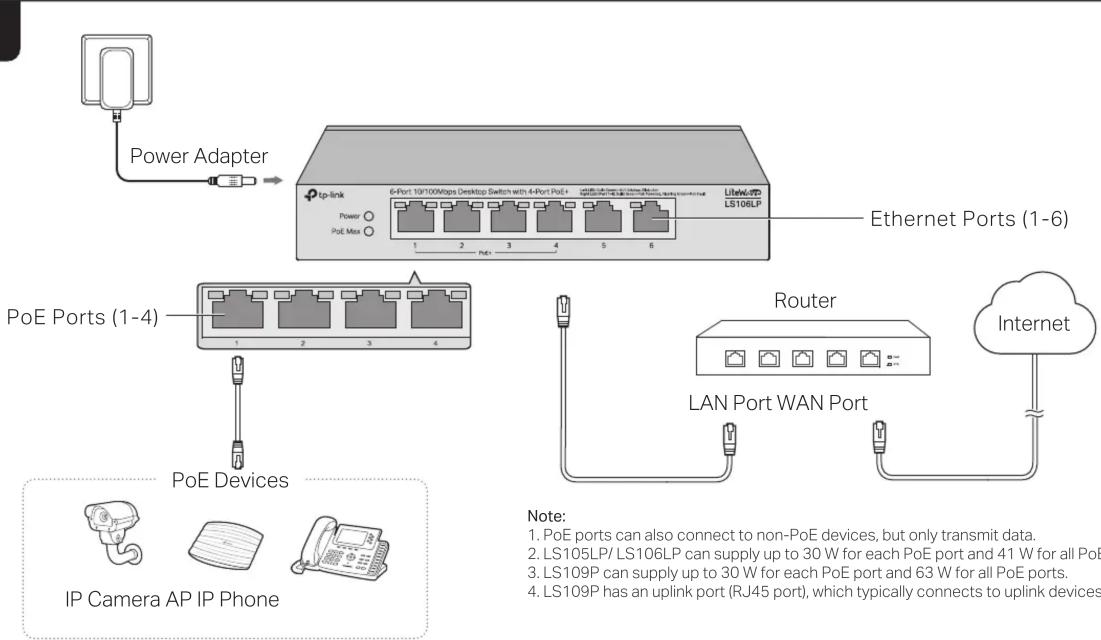
Specifications
General Specifications
| Standard | IEEE802.3i, IEEE802.3u, IEEE802.3x, IEEE802.3af, IEEE802.3at |
| Interface | LS105LP:5 10/100 Mbps RJ45 PortsAuto-Negotiation MDI/MDIXPoE Ports: Port 1-4LS106LP:6 10/100 Mbps RJ45 PortsAuto-Negotiation MDI/MDIXPoE Ports: Port 1-4LS109P:9 10/100 Mbps RJ45 PortsAuto-Negotiation MDI/MDIXPoE Ports: Port 1-8 |
| Network Media (Cable) | 10BASE-T: UTP category 3, 4, 5 cable (maximum 100 m);EIA/TIA-568 100Ω STP (maximum 100 m)100BASE-TX: UTP category 5, 5e cable (maximum 100 m);EIA/TIA-568 100Ω STP (maximum 100 m) |
| Switching Capacity | LS105LP: 1 GbpsLS106LP: 1.2 GbpsLS109P: 1.8 Gbps |
| Transfer Method | Store-and-Forward |
| MAC Address Learning | Automatically learning, automatically aging |
| Power Supply | External Power AdapterInput: 100-240 VAC, 50/60 HzOutput:53.5 VDC /0.81 A (LS105LP/LS106LP)53.5 VDC /1.31 A (LS109P) |
| PoE Budget | LS105LP/LS106LP: 41 W (up to 30 W for each PoE port)LS109P: 63 W (up to 30 W for each PoE port) |
| Wall Mountable | Yes |
| Distance BetweenMounting Holes | LS105LP: 76 mmLS106LP: 65mmLS109P: 105mm |
Environmental and Physical Specifications
| Operating Temperature | 0 °C to 40 °C (32 °F to 104 °F) |
| Storage Temperature | -40 °C to 70 °C (-40 °F to 158 °F) |
| Operating Humidity | 10% to 90%RH non-condensing |
| Storage Humidity | 5% to 90%RH non-condensing |
EU declaration of conformity
TP-Link hereby declares that the device is in compliance with the essential requirements and other relevant provisions of directives 2014/30/EU, 2014/35/EU, 2011/65/EU and (EU)2015/863.
The original EU declaration of conformity may be found at https://www.tp-link.com/en/support/ce/
UK declaration of conformity
TP-Link hereby declares that the device is in compliance with the essential requirements and other relevant provisions of the Electromagnetic Compatibility Regulations 2016 and Electrical Equipment (Safety) Regulations 2016.
The original UK declaration of conformity may be found at https://www.tp-link.com/support/ukca

Frequently Asked Questions (FAQ)
Q1. Why is the Power LED not lit?
The Power LED should be lit when the power system is working normally. If the Power LED is not lit, please try the following:
A1: Make sure the AC power cord is connected to the switch with power source properly.
A2: Make sure the voltage of the power supply meets the requirements of the input voltage of the switch.
A3: Make sure the power source is on.
Q2. Why is the Link/Act LED not lit while a device is connected to the corresponding port?
It is recommended that you check the following items:
A1: Make sure that the cable connectors are firmly plugged into the switch and the device.
A2: Make sure the connected device is turned on and works normally.
A3: The cable must be less than 100 meters long (328 feet). If Extend Mode is enabled, it should be less than 250 meters (820 feet).
Q3. Why are the PoE ports not supplying power for PoE devices?
When the total power consumption of connected PoE devices exceeds the maximum, the PoE port with a smaller port number has higher priority. The system will cut off power to the ports with larger port numbers to ensure supplying to other ports.
Take LS106LP as an example. If port 1, 2 and 4 are consuming 10 W respectively, and an additional PoE device with 15 W is connected to port 3, the system will cut off the power of port 4 to compensate for the overload.
Q4. What should I notice before using the PoE Auto Recovery feature?
A1: Before upgrading a connected PoE powered device (PD), disable PoE Auto Recovery to avoid the PD's damage.
A2: When a PD does not send data packets to the switch for a long period in certain scenarios (e.g. an IPC in sleep mode), disable PoE Auto Recovery to avoid the PD repeatedly rebooting.
To ask questions, find answers, and communicate with TP-Link users or engineers, please visit https://community.tp-link.com to join TP-Link Community.
For technical support and other information, please visit https://www.tp-link.com/support, or simply scan the QR code.

Safety Information
- Keep the device away from water, fire, humidity or hot environments.
- Do not attempt to disassemble, repair, or modify the device. If you need service, please contact us.
- Place the device with its bottom surface downward.
- Do not use damaged charger or USB cable to charge the device.
- Do not use any other chargers than those recommended.
- Adapter shall be installed near the equipment and shall be easily accessible.
- The plug on the power supply cord is used as the disconnect device, the socket-outlet shall be easily accessible. (For LS109P)
- The socket-outlet shall be installed near the equipment and shall be easily accessible. (For LS109P)

- PoE Status
- PoE Max
- Switches Explanation
- Extend (For LS105LP/LS106LP/LS109P)
- Recovery (For LS105LP/LS106LP/LS109P)
- Isolation (For LS109P)
- Specifications
- EU declaration of conformity
- UK declaration of conformity
- Frequently Asked Questions (FAQ)
- Q1. Why is the Power LED not lit?
- Q2. Why is the Link/Act LED not lit while a device is connected to the corresponding port?
- Q3. Why are the PoE ports not supplying power for PoE devices?
- Q4. What should I notice before using the PoE Auto Recovery feature?
- Safety Information
Brand : TP-LINK
Model : LiteWave LS109P
Category : Uncategorized