SE300 - Meter Sanwa - Free user manual and instructions
Find the device manual for free SE300 Sanwa in PDF.


| Product Type | Digital Tachometer (Non-contact and Contact) |
| Brand | Sanwa |
| Model | SE300 |
| Measurement Method | Reflective light (non-contact) and contact with optional ENC-3 |
| Non-contact Detection Distance | Approx. 50 to 600 mm |
| Measurement Modes | rpm, rps, ms (interval), count, m/min, m/s (with rim speed ring) |
| Display | LCD, 8-digit, with backlight |
| Data Hold | Yes |
| MAX/MIN Display | Yes |
| Auto Power OFF | After approx. 2 minutes (cancellable) |
| Low Battery Alarm | Indicator when voltage below approx. 2.3 V |
| Power Supply | 2 × AA batteries (R6/LR6) |
| Battery Life | Approx. 38 hours (alkaline, backlight off) |
| Dimensions (Main Instrument) | 210 × 300 × 50 mm |
| Weight (Main Instrument) | Approx. 218 g (including batteries) |
| Tripod Mount | 1/4-20 UNC thread |
| Operating Temperature | 5 °C to 40 °C |
| Storage Temperature | -10 °C to 40 °C |
| Accessories | Manual, 2 × AA batteries, carrying case, reflective stickers (500) |
| Optional Accessories | ENC-3 Contact Measurement Attachment, spare contact maker, rim speed ring, reflective stickers, carrying case |
| Warranty | 1 year from date of purchase |
| Maintenance | Clean lens with soft dry cloth; avoid solvents; annual calibration recommended |
| Safety Precautions | Do not touch rotating objects; wear protective eyewear; use reflective sticker properly |
Frequently Asked Questions - SE300 Sanwa
User questions about SE300 Sanwa
0 question about this device. Answer the ones you know or ask your own.
Ask a new question about this device
Download the instructions for your Meter in PDF format for free! Find your manual SE300 - Sanwa and take your electronic device back in hand. On this page are published all the documents necessary for the use of your device. SE300 by Sanwa.
USER MANUAL SE300 Sanwa
Chiyoda-ku, Tokyo, Japan

01-1408 2040 6006
[1] SAFETY PRECAUTIONS
Before use, read the following safety precautions.
Thank you for purchasing Digital Tachometer Model SE300. Before use, please read this manual thoroughly. After reading it, keep it together with the product for reference to it when necessary. The instructions given under symbols “WARNING” and “CAUTION” must be followed to prevent incidents such as an injury.
1-1 Explanation of Warning Symbols
The meaning of the symbols used in this manual is as follows.
⚠️: Very important instructions for safe use.
- The warning messages are intended to prevent accidents to operating personnel such as an injury. - The caution messages are intended to prevent damage or malfunction to the instrument.
1-2 Warning Instructions for Safe Use
WARNING
To prevent human incidents such as an injury, be sure to
observe the following instructions when using the instrument. 1. Before proceeding to measurement, wear optimum working
1. Before proceeding to measurement, wear optimum working cap and wear so that your hair and clothes are not entangled
cup and wear so that your hair and clothes are not entangled by the rotating object. Be also sure to wear protective eyeglasses.
2. Never touch the rotating object during measurement.
3. Do not use the instrument if the rotating object to be measured presents any irregularity.
measured presents any irregularity.
4. If there is any risk of endangerment of the measurement personnel by a part of the rotating object, secure the safety of that part by installing an enclosure, etc.
5. Do not service or modify the instrument unless when replacing the batteries.
6. The instrument should be inspected in the start-up inspection of every day as well as more than once a year.
CAUTION
- Take care not to drop the instrument from a high altitude
when handling it. - Take care not to apply a strong impact to the lens section of the instrument.
- Do not open the case of the instrument, touch the internal circuit boards or parts or modify it in any manner.
- 1 -
[2] APPLICATIONS AND FEATURES
2-1 Applications
This instrument is a noncontact, handheld type digital tachometer designed for measuring the rotation speeds of rotating objects such as motors. The instrument can also be used as a contact type tachometer by connecting the optional ENC-3 Contact Measurement Attachment.
2-2 Features
- Designed in pursuit of the ease of holding to enable stable
measurement.
• Abundant measurement modes. - Long detection distance in noncontact measurement (max. approx. 50 cm) enabling measurement from a distance from the rotating object
• Contact measurement capability using the optional ENC-3
Contact Measurement Attachment.
• MAX/MIN display function. - Auto power OFF function (approx. 2 min., cancellation possible).
- Bright backlight
- Fixed installation possible using a commercially available camera tripod.
[3] NAME OF COMPONENT UNITS
3-1 Main Instrument and Accessories
Irradiation/detection lens
![Sanwa SE300 - [3] NAME OF COMPONENT UNITS - 1](/content/2026/05/851933/images/718d40f1448ca8d66409c5e85016bd91e5aaf9aeaa91b2f07d5db018ba548080.jpg)
![Power button Rotation detection indicator LED Function buttons See section [4] Contact adapter fixing hole Tripod hole Battery cover](/content/2026/05/851933/images/f045109da3807928ba71b3135b9952146e202df140b3f8b5954a1581324043c8.jpg)
3-2 Display
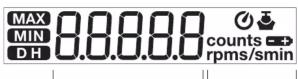
Numeric value display Units
MAX : Maximum value Ⓧ : Auto power OFF
MIN : Minimum value : Conta measurement mode
For the units and their combinations, see "5-3 Noncontact
Measurement" and "5-4 Contact Measurement".
[4] DESCRIPTION OF FUNCTIONS
4-1 Power button: ⏻
Press and hold the button for more than one second to turn the instrument ON.
All of the display and indicators light up and then the instrument
gets ready for measurement. * If there is a reflective object in front of the lane when the instrument
If there is a reflective object in front of the lens when the instrument is turned ON, a numeric value may be displayed. In such a case
is turned ON, a numeric value may be displayed in each wait for about 2 seconds until the numeric value becomes [0].

(Ready for measurement)
Press the same button for more than one second to turn the instrument OFF.
The measurement mode setting is saved in memory even after the instrument has been turned OFF.
4-2 Auto power OFF
When the instrument has not detected reflected light for about 2 minutes after the last operation performed, the instrument turns OFF automatically. To recover from the auto power OFF status, turn the instrument ON with the usual procedure.
To cancel the auto power OFF function, press and hold the HOLD
-2-
button and then hold the Power button for more than one second to turn the instrument ON. The ⬆ indicator will not be displayed in the measurement display.
4-3 Measurement mode selection: M button
Each press of the MODE switches the measurement mode. Press and hold the MODE button for more than one second. The indicator appears indicating that the instrument is in the noncontact measurement mode. To return to the contact measurement mode, press and hold the MODE button for more than one second again. *For details on the measurement mode switching of the noncontact and contact measurement modes, see *5-3 Noncontact Measurement" and "5-4 Contact Measurement".
4-4 Backlight switching: L button
Press the LIGHT on to switch ON the backlight of the display panel. Press the button again to switch the backlight OFF.
4-5 Data hold: Hbutton
When the Houlton is pressed, the indi DH appears on the display and the numeric value being displayed is held. The displayed value will not change even when the measurement input varies. When the button is pressed again, the DH indicator disappears and the data hold function is canceled. * The data hold function is also canceled when the MODE button is pressed.
4-6 Maximum and minimum value display:
MAX/MIN button
Press the MAX/MIN to enter the mode in MAX/MIN instrument saves and stores the maximum and minimum measurement values from the moment the button is pressed. Each press of the MAX/MIN button switches the displayed values in the following cycle:

• Maximum value display: The instrument displays the maximum
value since the press of the MAX/MIN button.
- Minimum value display: The instrument displays the minimum
value since the press of the MAX/MIN button.
- Current value display: The instrument displays the current
measurement value while saving the maximum and minimum values since the press of the MAX/MIN button. To view the maximum or minimum value, it is required to press the MAX/MIN button to the maximum or minimum value display.
To cancel the maximum and minimum value display, press and
hold the MAX/MIN button for more than one second. * The maximum/minimum value display function is also canceled when the MODE button is pressed.
* The MAX/MIN button is disabled during data hold (DH)
maximum and minimum values are not updated during it
* Maximum and minimum value display function is disabled in the count measurement mode.
4-7 Count clear: CLEAR button
Press the CLEAR button during count measurement (unit: count) clears the counted value.
4-8 Low battery alarm
When the battery power is consumed and the voltage drops below about 2.3 V, the + indicator appears on the display panel to solicit early replacement of the batteries.
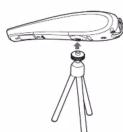
4-9 Tripod hole
The instrument can be installed on a commercially available tripod for fixed use. Screw in the tripod into the threaded tripod hole on the rear of the instrument.
• Thread size: 1/4-20 UNC (ISO 1222)
* Use a commercially available tripod.
[5] MEASURING PROCEDURE
5-1 Start-up inspection
Inspect the following points before starting the work of every day. • Appearance: Check that the appearance of the instrument is not damaged by falling, etc.
If any irregularity is found, do not use the instrument.
- Scratches and dirt on the lens: Check that the lens is not
clouded.
Accurate measurement is impossible if the lens is dirty or clouded.
Dirt or cloud should be removed by gently wiping with a soft, dry cloth.
- Check that the low battery alarm indicator is not displayed
when the instrument is turned ON. If it is displayed, replace the
batteries with new ones.
If nothing is displayed on the display panel, the batteries could be exhausted completely.
5-2 Warning for measurement
WARNING
- Do not measure a rotating object from a close distance at
which the instrument could contact the rotating object. - Do not attempt to measure an object rotating at a speed
exceeding the measuring range of the instrument.
5-3 Noncontact measurement
WARNING
Be sure to stop the rotating object to be measured before attaching the reflective sticker on it.
CAUTION
-
Before attaching the reflective sticker on the rotating object, remove the moisture, oil and dust on the sticker attaching surface completely.
-
If the sticker is to be attached on a shiny plated surface, accurate measurement would be impossible due to diffuse reflections. In this case, paint the sticker attaching surface black or attach a piece of black tape on the surface.
-
Protect the reflective sticker on the rotating object against penetration of intermittent light such as the light from a fluorescent lamp. If an effect of extraneous light is expected, adjust the positioning of the instrument so that it displays [0] when the rotating object is not rotating before measurement.
-
Accurate measurement may sometimes be impossible under direct sunlight.
-
Measurement of high-speed rotation may be impossible of the time the irradiated light passes on the reflective sticker is short (less than about 0.2 second). In this case, increase the area of the reflective sticker.
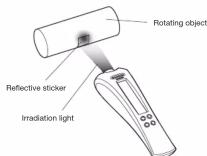
To perform noncontact measurement, attach the reflective sticker (provided with the instrument) on the rotating object to be measured as shown below.
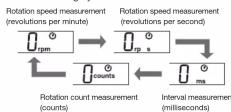
1) Turn the instrument ON and set the desired measurement mode. Each press of theMODE button switches the measurement mode in the following cycle:
2) Apply the irradiation light perpendicularly on the reflection marking on the rotating object so that the rotation detection indicator LED lights steadily. The distance between the tip of the detection section of the instrument and the reflective surface on the rotating object should be between 50 and 500mm .
3) The instrument displays the measurement result.

-4-
5-4 Contact measurement (Using the optional ENC-3)
WARNING
- Do not perform measurement if the contact adapter, contact maker or rim speed ring of the contact measurement attachment is damaged, worn or deformed.
- Be sure to tighten the contact adapter fixing screw tightly.
- Fit the contact maker or rim speed ring all the way into the root of the rotary shaft of the contact adapter.
- When measuring a high-speed rotating object (8000 rpm or higher), do not measure it continuously for more than one minute.
- Do not use a tripod in the contact measurement.
- Do not use the contact maker or rim speed ring with a high-temperature rotating object.
The contact measurement required the optional ENC-3 Contact Measurement Attachment.
1) Attach the contact adapter as shown below and secure the fixing screw tightly.
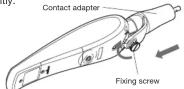
2) Select the contact maker or rim speed ring according to the purpose of measurement and fit it on the tip of the contact adapter.
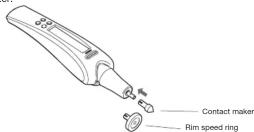
* Select the rim speed ring when measuring the velocity of a belt conveyor or similar object (Travel distance per minute in m/min or travel distance per second in m/s).
3) Turn the instrument ON and select the contact measurement mode (see "4-3 Measurement mode selection"). Ensure that the indicator appears on the display panel and set the desired measurement mode. Each press of the MODE button switches the measurement mode in the following cycle:
Rotation speed measurement Rotation speed measurement Interval measurement (revolutions per minute), (revolutions per second, in milliseconds)
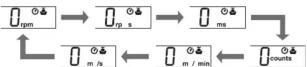
Rim speed measurement (meters per second) Rim speed measurement (meters per minute) Rotation count measurement (counts)
When the rim speed ring is attached, select either the [m / min] or [m / s] mode.
4) Apply the contact maker or rim speed ring on the rotating object. Special care is required for the method of application. The contact maker should be applied perpendicularly to the contact surface toward the axis of the rotating object. The rim speed ring should be applied in parallel with the measurement target.
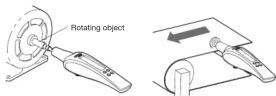
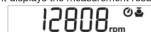
5) The instrument displays the measurement result.
- 5 -
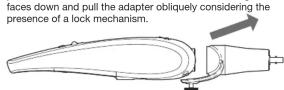
6) Detach the contact adapter by loosening the fixing screw, position the instrument so that the side with the fixing screw faces down and pull the adapter obliquely considering the presence of a lock mechanism.
5-5 Measurement modes
• [rpm] : Revolutions per minute
• [rps] : Revolutions per second
• [ms] : Reflected light detection interval (milliseconds)
• [count] : Rotation count measurement
• [m/min] : Travel distance per minute (meters)
Rotation speed(rpm)xCircumference of rim speed ring 100(mm)
• [m/s] Travel distance per second (meters)
Rotation speed(rps)xCircumference of rim speed ring 100(mm) 1000
[6] MAINTENANCE
WARNING
- The information in this section is critical for safety. Manage the instrument based on full understanding of the information given in this manual.
- For safety and accuracy of the instrument, calibrate and inspect it at least once a year.
6-1 Maintenance and Inspection
Be sure to perform the maintenance inspection of the instrument to use it safely for an extended period and keep the high quality. The inspection items are as described in "5-1 Start-up inspection".
6-2 Calibration and Inspection
For more information, please contact Sanwa's authorized agent / distribute service provider, listed in our website. See section 7-3
6-3 Battery replacement
- Batteries shipped with the instrument The batteries provided with the instrument are monitoring batteries. Their service life may be shorter than brand-new batteries. * Monitoring batteries refer to the batteries for use in checking the functionality and performance of the product.
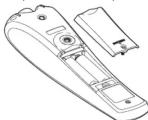
① Using a Phillips screwdriver, loosen the retaining screw of the battery cover.
② When the battery cover comes up, remove it
③ Replace both of the two batteries in the battery holder with new ones by taking care of the polarity.
④ Attach the battery cover and secure the retaining screw.
6-4 Cleaning and Storage
CAUTION
1. The instrument is not resistant to volatile solvents and should not
be wiped with lacquer thinner or alcohol. When it gets dirty, WI pe dirt away with a soft cloth moistened with a small amount of water.
2. The instrument is not resistant to heat and should not be placed near a source of high heat.
3. Do not store the instrument in a position subjected to excessive vibrations or a position presenting the risk of dropping.
4. Avoid storing the instrument under direct sunlight, high or low temperature, high humidity or a position with a risk of condensation.
5. Be sure to remove the batteries when the instrument is expected to be left unused for a long period of time.
6-5 Storage in the carrying case
The instrument can be stored in the carrying case as shown below.
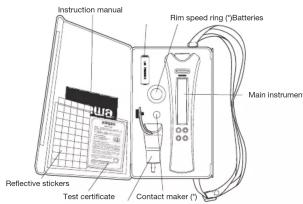
(*) Optional ENC-3 Contact Measurement Attachment
[7] AFTER-SALE SERVICE
7-1 Warranty and Provision
Sanwa offers comprehensive warranty services to its end-users and to its product resellers. Under Sanwa's general warranty policy, each instrument is warranted to be free from defects in workmanship or material under normal use for the period of one (1) year from the date of purchase.
This warranty policy is valid within the country of purchase only, and applied only to the product purchased from Sanwa authorized agent or distributor.
Sanwa reserves the right to inspect all warranty claims to determine the extent to which the warranty policy shall apply. This warranty shall not apply to disposables batteries, or any product or parts, which have been subject to one of the following causes:
1. A failure due to improper handling or use that deviates from the instruction manual.
2. A failure due to inadequate repair or modification by people other than Sanwa service personnel.
3. A failure due to causes not attributable to this product such as fire, flood and other natural disaster.
4. Non-operation due to a discharged battery.
5. A failure or damage due to transportation, relocation or dropping after the purchase.
7-2 Repair
Customers are asked to provide the following information when requesting services:
-
Customer name, address, and contact information
-
Description of problem
-
Description of product configuration
-
Model Number
-
Product Serial Number
-
Proof of Date-of-Purchase
- Where you purchased the product
Please contact Sanwa authorized agent / distributor / service provider, listed in our website, in your country with above information. An instrument sent to Sanwa / agent / distributor without above information will be returned to the customer.
Note:
1) Prior to requesting repair, please check the following:
Capacity of the built-in battery, polarity of installation and discontinuity of the test leads.
2) Repair during the warranty period:
The failed meter will be repaired in accordance with the conditions stipulated in 7-1 Warranty and Provision.
3) Repair after the warranty period has expired:
- If it is expected that servicing can restore the original functioning of the instrument, we will service it for a price upon request of the user.
- The service charge or transport freight could sometimes become higher than the product price. Please consult us before asking for servicing
- The minimum retention period of the servicing performance parts of this instrument is six (6) years after the discontinuation of production. This period is equal to the servicing available period. However, the retention period of a part may be reduced if it becomes unavailable due to discontinuation of production of the part manufacturer, etc.
4) Precautions when sending the product to be repaired: To ensure the safety of the product during transportation, place the product in a box that is larger than the product 5 times or more in volume and fill cushion materials fully and then clearly mark "Repair Product Enclosed" on the box surface. The cost of sending and returning the product shall be borne by the customer.
7-3 SANWA web site
http://www.sanwa-meter.co.jp
E-mail: exp_sales@sanwa-meter.co.jp
-7-
[8] SPECIFICATIONS
8-1 General Specifications
| Measurement methods Red | visible light photoelectric reflection method, contact method ("99999 |
| Measurement modes rpm, | rps (Revolution speed)ms (Interval)count (Rotation count)m/min, m/s (Rim speed) (°) |
| Reflection detection distance | Approx. 50 to 500 mm |
| Display panel | LCD, 5 digits, backlit |
| Display updating intervals | Approx. 1 sec. (rpm, rps, cycle, m/min, m/s modes)Approx. 0.1 sec. (count mode) |
| Operating environmental conditions | Altitude ≤ 2000 m, indoor, pollution degree II |
| Operating temperature/humidity range | 5 °C to 40 °C, ≤80 %RH (without condensation) |
| Storage temperature/humidity range | -10 °C to +40 °C, ≤80 %RH (without condensation)(The batteries should be removed before long-term storage.) |
| Auto power OFF | The instrument turns OFF in about 2 minutes after the last operation or last reflected light detection. |
| Over-scale display | "OL" is displayed on the display panel. |
| Low battery alarm | When the battery power is consumed and the voltage drops below about 2.3 V, the indicator appears on the display panel. |
| Power supply | "AA"-size dry cell battery (R6P/LR6) x 2 |
| Battery life | Approx. 28 hours (alkaline batteries, backlight not used) |
| Dimensions | 210V× 60(W) x 50(D) mm (Main instrument only)298(H× 60(W) x 50(D) mm (Contact adapter + Contact maker) |
| Weight (incl. batteries) | Approx. 218 g/(Main instrument only),Approx. 278 g/(Contact adapter + Contact maker) |
| Accessories | Instruction Manual, "AA"-size dry cell battery (R6P/LR6) x 2, carrying case, reflective stickers (× 50) |
(*) When the optional ENC-3 is used
8-2 Optional accessories
| ENC-3 | Contact Measurement Attachment (Contact adapter, contact maker and rim speed ring) |
| SE-A30 | Contact maker |
| SE-A51 | Rim speed ring, circumference 100 mm |
| SE-T3 | Reflective stickers (x 100 = 50-sticker sheet x 2) |
| C-SE300 | Carrying case |
8-3 Measuring ranges and accuracies
Accuracy guaranteed temperature/humidity ranges:23±5 °C, no more than 80 % RH (without condensation).
than 80 %RH, (without condensation. rda: Reading, dat: Lowest digits
Tag. Heading. dgt. Lowest digits. Measurement ranges
| Measurement mode | Noncontact measurement | Contact measurement |
| rpm | 30.0 – 99999 | 30.0 – 19999 |
| rps | 0.50 – 1600.0 | 0.50 – 333.00 |
| ms | 0.600 – 1999.0 | 3.000 – 1999.0 |
| count | 0 – 99999 | 0 – 99999 |
| m/min | - | 3.0 – 1999.0 |
| m/s | - | 0.05 – 33.00 |
(*) When the optional ENC-3 is used
Accuracy ±(0.03 % rdg + 1dgt)
* Accuracy in noncontact measurement. It does not include errors that may be caused by extraneous light or shake of the instrument. * In the contact measurement, the accuracies and slipping movements of the contact maker and rim speed ring are added to this figure above.
* In the rim speed measurement, ±0.5 % rdg is added to the figure above. Accuracy calculation method
Example) Noncontact revolution speed measurement (rpm)
Displayed value: 10000 rpm
Accuracy: Error: ±(10000 rpm × 0.03 % + 1 dgt) = ±4 rpm
True value: Within the range of 10000 rpm ±4 rpm (9996 – 10004 rpm)
* AT 10000 rpm, 1 dgt corresponds to 1 rpm.
For the purpose of improvement, the design and specifications of the products described above may be subject to change without notice.
-8-
- [1] SAFETY PRECAUTIONS
- 1-1 Explanation of Warning Symbols
- 1-2 Warning Instructions for Safe Use
- WARNING
- CAUTION
- [2] APPLICATIONS AND FEATURES
- 2-1 Applications
- 2-2 Features
- [3] NAME OF COMPONENT UNITS
- 3-2 Display
- [4] DESCRIPTION OF FUNCTIONS
- 4-1 Power button: ⏻
- 4-2 Auto power OFF
- 4-3 Measurement mode selection: M button
- 4-4 Backlight switching: L button
- 4-5 Data hold: Hbutton
- 4-6 Maximum and minimum value display:
- MAX/MIN button
- 4-7 Count clear: CLEAR button
- 4-8 Low battery alarm
- 4-9 Tripod hole
- [5] MEASURING PROCEDURE
- 5-1 Start-up inspection
- clouded.
- 5-2 Warning for measurement
- 5-3 Noncontact measurement
- 5-4 Contact measurement (Using the optional ENC-3)
- [6] MAINTENANCE
- 6-1 Maintenance and Inspection
- 6-2 Calibration and Inspection
- 6-3 Battery replacement
- 6-4 Cleaning and Storage
- 6-5 Storage in the carrying case
- [7] AFTER-SALE SERVICE
- 7-1 Warranty and Provision
- 7-2 Repair
- Note:
- 7-3 SANWA web site
- [8] SPECIFICATIONS
Brand : Sanwa
Model : SE300
Category : Meter