THP1300 - Saw Tryton - Free user manual and instructions
Find the device manual for free THP1300 Tryton in PDF.


| Product Type | Hand-Held Circular Saw |
| Brand | Tryton |
| Model | THP1300 |
| Rated Voltage | 230-240 V |
| Rated Frequency | 50 Hz |
| Power Consumption | 1300 W |
| Max. Rotational Speed | 4500 rpm |
| Max. Saw Blade Diameter | 160 mm |
| Saw Blade Inner Diameter | 16 mm |
| Max. Cutting Depth | 55 mm |
| Cutting Angle Range | 0° - 45° |
| Protection Class | II (Double Insulation) |
| Weight | 4.4 kg |
| Sound Pressure Level (LpA) | 95.5 dB(A) |
| Sound Power Level (LwA) | 106.5 dB(A) |
| Vibration Level (Main Grip) | 1.749 m/s² |
| Vibration Level (Auxiliary Grip) | 2.462 m/s² |
| Blade Teeth Count | 18 T |
| Safety Features | Safety pushbutton, spindle lock, self-adjusting guard, lower guard spring |
| Additional Accessories | Rip fence, hex key, carbon brushes, parallel guide |
| Maintenance | Keep clean, use compressed air for vents, store in dry place |
Frequently Asked Questions - THP1300 Tryton
User questions about THP1300 Tryton
0 question about this device. Answer the ones you know or ask your own.
Ask a new question about this device
Download the instructions for your Saw in PDF format for free! Find your manual THP1300 - Tryton and take your electronic device back in hand. On this page are published all the documents necessary for the use of your device. THP1300 by Tryton.
USER MANUAL THP1300 Tryton
E E K T R O N A R Z I
natural_image
Illustration of a cut-out saw cutting a circular cutter (no text or symbols visible)THP1300
EN
Instruction manual
HAND-HELD CIRCULAR SAW 4
PL
B



BEFORE YOU START USING THE MACHINE READ THOROUGHLY THIS MANUAL.
Keep this document for future reference.
WARNING! Read all safety warnings marked with a symbol ⚠️ and all operating safety instructions.
To limit the risk of fire, electric shock and injury while using the device, follow all operating safety instructions and tips provided below.
Keep all work safety instructions and tips for future reference.
In warnings provided herein the expression "power tool" means a power tool powered from the mains (with a power cord) or a battery powered power tool (cordless).

WARNING! General work safety warnings for use of the tool.
Workplace safety:
a) Keep your workplace tidy and well lit. Untidiness and bad lighting result in higher accident rate.
b) Do not use the power tool in explosive environments, created by flammable liquids, gases or dusts. The power tool generates sparks that can ignite dust or vapors.
c) Keep children and unauthorized persons away from the place where the power tools are used. Inattention may result in losing control over your power tool.

WARNING! General warnings regarding the use of power tools.
Electric safety:
a) Plugs used in power tools must match wall outlets. Never modify the plug of your power tool. Do not use any extension cables when operating a power tool with a grounding/earthing conductor (PE). Any modifications of plugs and outlets increase the risk of electric shock.
b) Avoid touching earthed surfaces or grounded items like pipes, heaters, central heating radiators and refrigerators. Touching earthed or grounded surfaces increases the risk of electric shock.
c) Do not expose your power tool to rain or damp environments. Water penetrating the tool increases the risk of electric shock.
d) Do not damage the power cord. Never use the power cord to carry, pull the power tool and do not pull by its power cord to disconnect plug from the outlet. Keep the power cord away from sources of heat, oils, sharp edges and moving parts. Damaged or entangled power cords increase the risk of electric shock.
e) When your power tool is operated outdoors use extension cords intended for outdoor use only. Using an extension cable intended for outdoor use decreases the risk of electric shock.
f) It is recommended to connect the device to a mains supply equipped with a residual current device (RCD) with a rated current of 30 mA or less.
g) When it is unavoidable to use your power tool in a damp environment use an RCD (Residual Current Device) for protection. The use of RCDs decreases the risk of electric shock.

WARNING! General warnings regarding the use of power tools.
Personal safety:
a) This equipment is not intended for use by persons (including children) disabled physically, mentally, sensorial or persons with no experience and knowledge in operating the equipment unless they operate the equipment under supervision or follow user's instructions provided by persons responsible for their safety.
b) It is necessary to predict steps, watch and keep common sense when using power tools. Do not operate power tools when you are tired, under influence of drugs, medicine or alcohol. A moment of inattention while operating a power tool may result in serious personal injury.
c) Use personal protective equipment (PPE). Always wear safety goggles. Wearing personal protective equipment (PPE) including a dust mask, anti-slippery footwear, a helmet and ear protection reduces personal injury.
d) Avoid unexpected start up. Before connecting your power tool to the mains and/or inserting a battery make sure its power switch is in off position. Carrying your power tool with a finger on its power switch or without disconnecting it from the mains (switched on) may result in an accident.
e) Before starting your power tool remove any keys/wrenches. Leaving a key/wrench in the rotating part of your power tool may result in personal injury.
f) Do not lean forward too far. Always remain stable and maintain balance. It will allow you to have a better control over your power tool in unpredictable situations.
g) Wear appropriate clothing. Do not wear loose clothes or jewelry. Keep your hair tied. Keep your clothes away from moving parts. Loose clothes, jewelry or long hair may be caught by moving parts.
h) If your power tool allows for using an external dust extraction or collection system, make sure it is connected and used properly. Using dust collectors may reduce dust affected risks.
i) Do not let your skills gained through the frequent use of the power tool make you overconfident and disregard safety rules. Carelessness may cause injury in a fraction of a second.

WARNING! General warnings regarding the use of power tools.
Use and taking care of your power tool:
a) Do not overload your power tool. Use a power tool with power adjusted to work being done. An appropriately chosen power tool will allow you to work better and safer under load it has been designed for.
b) Do not use a power tool when its power switch is out of order (it does not switch it on or off). Any power tool with its power switch out of order is dangerous and must be repaired.
c) Always disconnect the plug from the power source and/or disconnect its battery before changing any settings, performing replacement or storage. Such preventive measures reduce the risk of accidental power tool start up.
d) Keep your power tool out of reach of children and do not allow unauthorized persons to use the power tool. Power tools in hands of untrained persons can be dangerous.
e) Power tools require maintenance. Check power tools for concentricity or jamming of moving parts, any cracks and all
other factors affecting the power tool work safety. If any damage to the power tool is detected, it should be repaired before use. Improper power tool maintenance is a reason for many accidents.
f) Cutting tools should be sharp and clean. Keeping sharp cutting edges in good condition reduces the risk of jamming and facilitates operation.
g) Power tools, equipment, working tools etc. should be used according to this user's manual taking into account operating conditions and the work to be done. Misusing a power tool can result in dangerous situations.
h) At low temperatures and after a long brakes in operation it is recommended to turn the power tool to operate it with no load for a few minutes to provide proper grease distribution inside its driving mechanism.
i) Use soft, damp (cannot be wet) cloth and soap to clean power tools. Do not use petrol, solvents and other agents that may damage your equipment.
j) Power tools can be stored/carried after making sure that all moving components are locked and protected against release with original devices intended for this purpose.
k) Store power tools in a dry, dust and water-protected place.
1) Carry your power tool in its original packaging to provide protection against mechanical damage.
m) Keep handles and grip surfaces clean and free from oil and grease. Secure grip and control over the tool in unexpected circumstances are impossible if handles and grip surfaces are slippery.

WARNING! General warnings regarding the use of power tools.
Repair:
a) Warranty and post-warranty repairs of its power tools are carried out by PROFIX Service, which guarantees the best quality or repair and use of genuine spare parts.
b) If a fixed power cord is damaged, to avoid risks it should be replaced by power tool manufacturer or in a specialty repair shop or by a qualified person.

WARNING! Circular saw – safety warnings Personal safety:
a) Keep your hands away from the cutting area and the blade. Keep your second hand on the ancillary handle or on the motor housing. If both hands are holding the saw, they cannot be cut by the blade.
b) Do not reach underneath the workpiece. The guard cannot protect you from the blade underneath the workpiece.
c) Set the cutting depth to match the thickness of the item to be cut. The saw blade should extend below the workpiece by no more than the height of the tooth.
d) Never hold the item being cut in your hands or across your leg. Fix the item to a stable base. Stable fixing of the item being cut is necessary to minimize body exposure, blade binding, or loss of control.
e) Hold the saw by the insulated gripping surfaces when performing an operation where the saw may contact hidden live wiring or its own cord. Contact with a "live" wire will also make
exposed metal parts of the tool "live" and shock the operator.
f) When ripping always use a rip fence or straight edge guide. This improves the accuracy of cut and reduces the chance for blade binding.
g) Always use blades with correct size and shape (diamond vs. round) arbor holes. Blades that do not match the mounting hardware of the saw will run eccentrically, causing loss of control.
h) Never use damaged or incorrect blade washers or bolts. The blade washers and bolt were specially designed for the specific saw, for optimum performance and safety of operation.
Causes and prevention of kickback:
- kickback is a sudden reaction to a pinched, bound, or misaligned saw blade, causing an uncontrolled saw to lift up and out of the workpiece toward the operator;
- when the blade is pinched or bound tightly by the kerf closing down, the blade stalls and the motor reaction drives the unit rapidly back toward the operator;
- if the blade becomes twisted or misaligned in the workpiece, the teeth at the back edge of the blade can dig into the top surface of the wood, causing the blade to climb out of the kerf and jump back toward the operator.
Kickback is the result of improper use of the saw or incorrect operating procedures or conditions and can be avoided by taking proper precautions, as listed below.
a) Maintain a firm grip with both hands on the saw and position your arms to allow you to resist the kickback force. Stand on one side of the saw so as to be away from the cutting line of the saw. Kickback may cause the saw to jump backward, but the kickback force can be controlled by the operator if proper precautions have been observed.
b) When blade is binding, or when interrupting a cut for any reason, release the trigger and hold the saw motionless in the material until the blade comes to a complete stop. Never attempt to remove the saw from the workpiece or pull the saw backward while the blade is in motion or kickback may occur. Investigate and take corrective actions to eliminate the cause of blade binding.
c) When restarting a saw in the workpiece, center the saw blade in the kerf and check that saw teeth are not engaged into the material. If the blade is binding, it may walk up or kickback from the workpiece when the saw is restarted.
d) Support large panels to minimize the risk of blade pinching and kickback. Large panels tend to sag under their own weight. Supports must be placed under the panel on both sides, near the line of cut and near the edge of the panel.
e) Do not use dull or damaged blades. Unsharpened or improperly set blades produce a narrow kerf causing excessive friction, blade binding and kickback.
f) Blade depth and bevel adjusting locking levers must be tight and secure before making a cut. If blade adjustment shifts while cutting, it may cause binding and kickback.
g) Use extra caution when making a "pocket cut" into existing walls or other blind areas. The protruding blade may cut objects that can cause kickback.
h) Before each cut, check if the lower guard is positioned
properly. Do not use the saw when the lower guard does not move freely and does not close immediately. Never fix or leave the lower guard in the open position. If the saw is dropped accidentally, the lower guard may become bent. Lift the lower guard with the pulling grip and make sure that it moves freely and does not touch the saw or any other part for each angle and cutting depth setting.
i) Check the operation of the lower guard spring. If the guard or the spring does not work correctly, they should be repaired prior to use. The lower guard may move slowly due to damaged parts, sticky deposits, or accumulation of refuse.
j) Manual retraction of the lower guard is allowed only during special cuts, such as "pocket cuts" and "complex cuts." Lift the lower guard using the pulling grip; as soon as the saw blade enters the material, the lower guard should become released. For all other types of cuts, the lower guard must work on its own.
k) Always look to see if the lower guard covers the saw before you place the saw on a table or on the floor. Unprotected saw blade will cause the saw to move backwards cutting any item on its way. Keep in mind how much time it takes until the saw blade stops after the tool is switched off.

REMARK! Use dust collector equipment!
If the manufacturer has provided dust suction and collection equipment, check if it is connected and properly mounted.

WARNING!
Use protective equipment. Always use dust masks.
Contact with or inhalation of dust produced when using the circular saw may cause hazard to the health of the user and potentially to other persons located in the work area. To protect yourself from dust and vapors, always wear a dust mask and assure the safety of other persons present in the work area.

REMARK! Do not use circular saws with dimensions other than those given in this document.
Use only blades with proper diameter and thickness
and suitable for the rotational speed of the specific saw.
- Do not use blades made from high-alloy high-speed steel. Saw blades made from this material break easily.
- Do not use blades for metal or stone.
- Install only sharp blades in a perfect condition; immediately replace cracked or bent disks with new ones.
- Check if the blade is firmly fixed and turns in the proper direction.

WARNING!
Use protective equipment. Always wear protective goggles.

WARNING!
Use protective equipment. Always use hearing protection.

WARNING! Circularsaw – additional safety warnings
Personal safety:
- Do not insert the power cord (22) plug to the mains socket until you make sure that:
a) power source parameters meet the saw parameters as shown on
its data plate,
b) the tool is equipped with a cutting blade (disk) for wood and wood-like materials with an admissible rotational speed of at least 5300 rpm,
c) cutting disk (12) is properly and securely fixed, and the directions of arrows (10) on the disk and the guard are the same,
d) cutting disk (12) is in good technical condition showing no traces of damage, cracks or nicks.
e) saw switch (18) is in off position, the safety pushbutton (19) and the spindle lock lever (17) are released,
f) the hex key (23) for fixing the disk (blade) screw of disk (13) has been removed from its seat and is out of saw operation field,
g) all locks are securely tightened: - cutting depth lock (21), - cutting angle adjustment lock (6), - parallel cutting guide lock (7),
h) moving guard for cutting disk (16) is fully operational and remains in closed position.
- When using an extension cable make sure that the extension cable parameters and cable cross-sections meet the tool requirements. Extension cables used should be as short as possible. The extension cable should be fully uncoiled.
- Before switching on the saw make sure that there are no nails, screws, bolts and/or other foreign objects in the material machined.
- Never block the guard of cutting disk (16).
- When starting and operating the saw hold it always by both handles (2) and (4).
- The tool can be turned on only when its blade (12) does not contact the object machined.
- Do not start cutting until the saw disk has reached its maximum rotational speed.
- Cutting is allowed only when the saw foot (8) rests securely on the material.
- Never apply exceeding force to the saw while cutting. It may result in an accident leading to injury or death and/or damage to the overloaded motor. Damage to the motor (burned winding) resulting from machine overload is excluded from warranty cover!
- The saw cannot be used for curved-lined cutting, edge machining and milling as it may result in an accident leading to injury or death and/or damage to the machine excluded from warranty cover.
- After turning the saw off it is not allowed to brake the disk by pressing it to the material.
- Check the condition of screws fixing the saw body on a regular basis. Retighten if necessary (screwdriver Ph3).
INTENDED USE:
This hand-held circular saw is a tool used to cut wood, plywood, chipboard and other wood-like materials.
It cannot be used to cut, grind metal or stone as well it is not allowed to use blades for grinding and cutting stone or metal.
This circular saw is suitable for straight-line cutting only. It is not suitable for curved -line cutting.
Observe the safety instructions, as well as the assembly instruction and the use guidelines given in this document. The service and maintenance staff must become familiar with the guidelines and be advised of the potential hazards.
Also, the applicable occupational health and safety regulations concerning accident prevention must be strictly observed.
REMARK: Do not expose electric tools to rain or moisture.
Any use of the saw that is not in observance with the above-mentioned purpose is forbidden, leads to the loss of warranty, and relieves the manufacturer from responsibility for the resulting damage.
Any modifications of the tool by the user relieve the manufacturer from responsibility for any damage and injuries to the user and the surroundings.
Proper use of the saw also pertains to maintenance, storage, transport, and repairs.
The saw must only be repaired in service points designated by the manufacturer. Electric tools supplied from the mains must be repaired by properly authorized persons.
Proper use cannot guarantee that no residual risk will occur. Due to the design of the machine, the following risks may occur:
• the operator may touch the saw blade in the unguarded part of the saw;
- the operator may touch the saw blade while it is moving (which will result in a cut);
• the workpiece or its part may be thrown away by the saw;
• the blade may crack/break;
- the operator may suffer a hearing injury due to the failure to use the required hearing protection equipment;
- the operator may inhale the harmful wood dust while performing work in closed premises.
The tool is not intended for professional or industrial use. The guarantee will become void if the tool is used in professional workshops, industrial plants, or for similar activities.
COMPONENTS:
• Circular saw – 1 pc
- Rip fence – 1 pc
- Blade, ∅160x ∅16x 18T - 1pc
- Hex key - 1 pc
- Carbon brush – 2 pc
• Instruction manual pd
- Warranty cardpc1
MACHINE STRUCTURE:
The circular saw is a tool in protection Class II (double insulation) and it is powered with a single-phase motor.
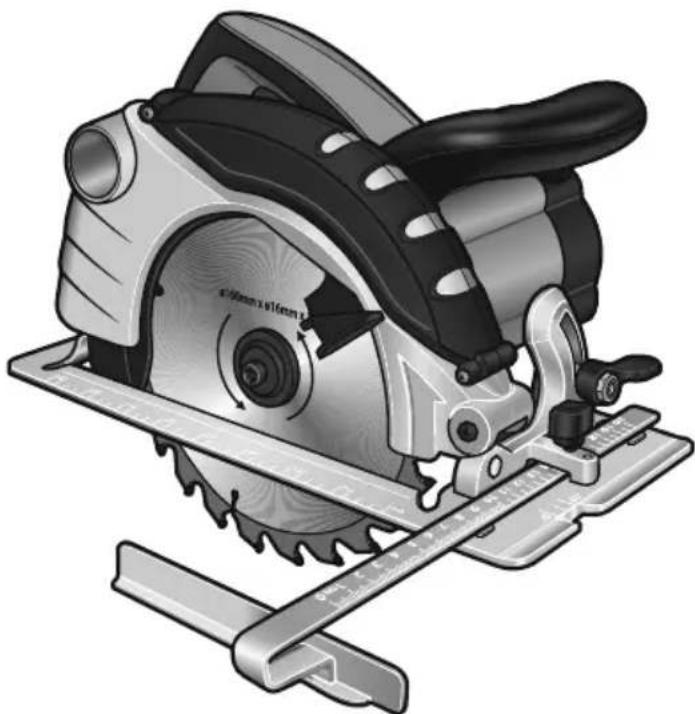
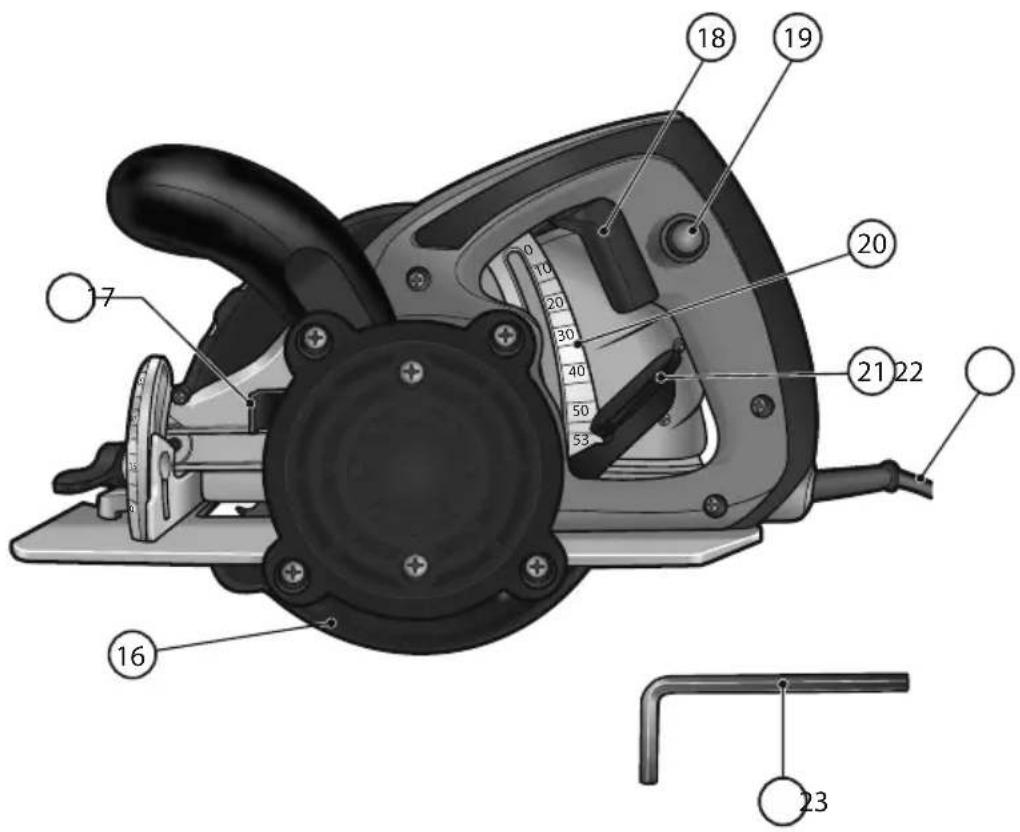
Its structure is shown in the pictures on the pages 2-3:
Fig. A: 1. Saw dust ejection
- Grip
- Saw blade guard grip
- Ancillary grip
- Bevel angle scale
-
Cut angle adjustment lever
-
Rip fence adjustment screw
-
Saw foot
-
Marks indicating the line of cut with the foot set at 0^ and 45^ angle
-
Arrows showing the blade rotation direction
-
Rip fence
-
Blade
-
Blade fixings screw
- Washer
- Outer clamping flange
- Saw blade moving guard: -open position (fig. A), -closed position (fig. B)
Fig.B:17. Spindle lock lever
-
Switch
-
Safetypushbutton
-
Cut depth scale
-
Cut depth adjustment lever
-
Cord
-
Hex key
Fig.C 24. Innerclamping flange
This is a multi-purpose manually guided tool with compact, ergonomic design. It allows users to adjust the cutting depth and adapt the tool to material thickness as well as to cut at a specified angle to the material surface (cutting plane is non-perpendicular to the material surface).
The tool provides safety thanks to the construction of self-adjusting cutting disk guard that automatically retracts during cutting process. The machine structure provides users also with easy-to-use buttons, locks and handles that are responsible for specific functions and maintenance/operation features.
TECHNICAL DATA:
| Rated voltage | 230-240 V | |
| Rated frequency | 50 Hz | |
| Power consumption | 1300 W | |
| Rotational speed max. | 4500 rpm | |
| Saw blade diameter, max. | 160 mmø | |
| Saw blade inner diameter | ø 16 mm | |
| Cutting depth, max. | 55 mm | |
| Cutting angle | 0° 45 ° | |
| Protection class | II/回 | |
| Weight | 4,4 kg | |
| Sound pressure level (LpA) | 95,5 dB(A) | |
| Sound power level (LwA) | 106,5 dB(A) | |
| Measurement tolerance K _LpA Low | 3 dB(A) | |
| Vibration level acc. to:EN 60745-1:2009 | Main grip | 1,749 m/s ^2 |
| Ancillary grip | 2,462 m/s ^2 | |
| Measurement tolerance | K=1,5 m/s ^2 | |
The vibration level value given refers to basic application of the tool. If the tool is used for other applications or with other tools, or if it is not maintained properly, the vibration level may differ from the values given. The above-mentioned causes may lead to higher exposure to vibrations during the whole work time.
One must implement additional safety measures to protect the operators from exposure to vibrations, such as maintenance of the electric tool and work tools, assurance of proper hand temperature, or determination of the sequence of work operations.
The declared total vibrations and declared noise emissions were measured in accordance with a standard test method and may be used for tool comparison.
The declared total vibrations and noise emissions can be used in preliminary exposure assessment.
Warnings:
The vibrations and noise emissions during the actual use of the power tool may differ from the declared values depending on how the tool is used and on the type of the workpiece in particular.
Determine safeguards to protect the operator. They should be based on the estimated exposure under actual operational conditions (taking into account all parts of the operating cycle such as when the tool is switched off or idle except the start time).
- Before you start working check the cutting disk condition to avoid overload and improper tool operation.
- First mark the cutting line on the material.
- The tool is provided with a safety pushbutton (19) which prevents accidental activation of the circular saw. In order to switch on the saw, one must first press the safety pushbutton and then press the saw ON/OFF button (18) and hold it in the depressed position. The operator may start working with the saw only after it reaches the maximum rotational speed.
- Put the saw foot (8) onto the material in such a way to hold it tight against the material surface, and to place the mark showing cutting line (9) under the foot.
- When operating the saw (straight-line plane forward motion) as the disk sinks into material, the guard (16) gradually exposes the disk allowing for cutting material. The guard returning spring brings back the guard to its original position as the disk withdraws from the material.
- The saw should be moved exactly along a straight line. Failure to observe this recommendation may result in raising the resistance to machining and disk blockage. It may result in burning motor windings, loosing warranty rights and even in a serious accident.
- To stop cutting with the saw:
a) withdraw the rotating disk from the material being cut,
b) release the switch button (18),
c) wait until the saw disk stops rotating,
d) put the tool aside to a safe place.
- Then after taking steps shown in section 7:
a) disconnect the power cord from the mains,
b) clean the saw to remove sawdust and dust,
c) protect the tool against unauthorized access (e.g. children).
REPLACING THE SAW BLADE:
REMARK: Before replacing the saw blade, disconnect the tool from the power supply and wait until the blade stops rotating.
When installing the disc, use protective gloves. You may suffer cuts when touching the disk.
Use only saw blades with parameters corresponding to the nominal data given in this document.
Never use grinding discs as work tools.
Figure C on page 3 shows the elements fixing the blade (12) on the tool's shaft:
- Hex socket screw
-
Screw washer
-
Outer clamping flange
- Inner clamping flange
In order to replace the blade:
- Press and hold the spindle lock lever (17). Unscrew the fixing screw (13) with the hex key (23) (fig. D, page 3).
REMARK: You may press the spindle lock lever (17) only after the spindle has stopped. Otherwise, the tool may become damaged.
- Using the guard grip (3), move the guard backwards and hold it. Take off the outer clamping flange and the blade (12) from the tool shaft (fig. E, page3).
REMARK: Do not take the outer clamping flange (24); if the flange falls out, put it back in with the flat surface to the outside of the machine body. Install a new blade taking the same steps in reverse direction. When installing a cutting disk remember to observe the rotation directions shown by the arrows.
The direction of the arrow on the disk should be the same as the direction of the arrow placed on the cutting disk.
SETTING THE CUTTING DEPTH (fig. F):
Carrying out shallow cuts at depths lower than the thickness of material being machined is possible when setting the cutting depth by lowering the foot (8) to a selected position.
Disconnect the saw from the mains. Loosen the cutting depth adjustment lever (21). Pull back the foot to a selected cutting depth position. Retighten the lever (21).
SETTING THE CUTTING INCLINATION ANGLE (fig. G):
The saw allows users to cut at an angle to the material surface within the range 0^ ÷ 45^ . To enable this it is necessary to set the saw foot (8) in a selected position.
To this disconnect the saw from the mains. Loosen the foot fixing lever (6). Move the saw foot by a selected angle. Lock the setting by tightening the lever.
USING THE PARALLEL CUTTING GUIDE (fig. H):
The guide (11) allows users to cut parallelly to the edge of the material being cut.
Disconnect the saw from the mains. Insert the guide into slots provided at the front of the foot. Set a selected cutting width. Lock the setting with screw (7). Start cutting.
MAINTENANCE, STORAGE AND TRANSPORT:
The tool does not require any special maintenance procedures.
Just keep it clean, protect against humidity and dust. After completing work it is recommended to clean the saw to remove sawdust and dust. It can be done using the guard handle of the cutting disk (3) that allows us to expose the disk (12).
NOTE: the handle can be used only during maintenance or service procedures after disconnecting the tool from the mains.
After completing work in intensely dusty environments it is recommended to use compressed air to clean venting holes – it will protect bearings against premature wear and remove dust obstructing the air-cooling intake.
The saw should be transported and stored in a package that protects it against humidity, dust and small particle penetration – special attention should be paid to provide proper protection to venting holes. Small
particles (objects) penetrating into the housing can damage the motor. with use of original spare parts.
In case of technical problems please contact an authorized service center.
ENVIRONMENTAL PROTECTION:
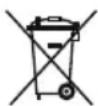
NOTE: The symbol nearby denotes that old equipment must never be disposed together with other wastes (with the penalty of a fine). Hazardous components of electronic equipment may adversely affect the natural environment and human health.
Each household may contribute to recovery and reuse (recycling) of old machinery and equipment. Both in Poland and Europe a system for recovery of used equipment either exists or is being developed. The system obliges all organizations that sell such equipment to collect back the used machinery and appliances. Moreover, general purpose collecting points for such equipment are also available.
MANUFACTURER:
PROFIX Sp. z o.o.; ul. Marywilska 34, 03-228 Warszawa, POLAND This appliance is in conformity with national and European standards as well as with general safety guidelines. Any repairs are allowed to be carried out exclusively by qualified staff
PICTOGRAMS:
Explanation of the icons located on the nominal plate and the information tags:

«Read this instruction before switching on the power supply and starting the work!»

«While carriegluding circular saw mounting circular saw blades wear protective gloves.»

«While cutting with a circular saw wear appropriate eye protection.»

«While cutting with a circular saw use appropriate hearing protection.»

PRZED PRZYSTĄPIENIEM DO UŻYTKOWANIA NALEŻY ZAPOZNAĆ SIĘ Z NINIEJSZĄ INSTRUKCJĄ.
(EN) EC/EU DECLARATION OF CONFORMITY (PL) DEKLARACJA ZGODNOŚCI WE/UE (RO) DECLARATIE DE CONFORMITATE CE/UE
(LV) EK/ES ATBILSTIBAS DEKLARACIJA (LT) EB/ES ATITIKTIES DEKLARACIJA (CS) ES/EU PROHLÁŠENÍ O SHODĚ
(HU) EK/EU-MEGFELELŐSÉGI NYILATKOZATA
(EN) MANUFACTURER
(PL) PRODUCENT
(RO) PRODUCĂTOR
(LV) RAŽOTĀJS
(LT) GAMINTOJAS
(CS) VÝROBCE
(HU) GYÁRTÓ
PROFIX Sp. z o.o. ul. Marywilska 34, 03-228 Warszawa
(EN) Person who was authorized to develop technical documentation:
(PL) Osoba upoważniona do przygotowania dokumentacji technicznej:
(RO) Persoana împuternicită pentru pregătirea documentației tehnice:
(LV) Persona atbildīga par tehniskās dokumentācijas sagatavošanu:
Representative of the Board for Certification


- E E K T R O N A R Z I
- THP1300
- EN
- PL
- Workplace safety:
- Electric safety:
- Repair:
- WARNING! Circular saw – safety warnings Personal safety:
- Causes and prevention of kickback:
- REMARK! Use dust collector equipment!
- WARNING!
- Use protective equipment. Always use dust masks.
- REMARK! Do not use circular saws with dimensions other than those given in this document.
- Personal safety:
- INTENDED USE:
- Also, the applicable occupational health and safety regulations concerning accident prevention must be strictly observed.
- REMARK: Do not expose electric tools to rain or moisture.
- The tool is not intended for professional or industrial use. The guarantee will become void if the tool is used in professional workshops, industrial plants, or for similar activities.
- COMPONENTS:
- MACHINE STRUCTURE:
- The circular saw is a tool in protection Class II (double insulation) and it is powered with a single-phase motor.
- Fig.C 24. Innerclamping flange
- Warnings:
- REPLACING THE SAW BLADE:
- SETTING THE CUTTING DEPTH (fig. F):
- SETTING THE CUTTING INCLINATION ANGLE (fig. G):
- USING THE PARALLEL CUTTING GUIDE (fig. H):
- MAINTENANCE, STORAGE AND TRANSPORT:
- ENVIRONMENTAL PROTECTION:
- MANUFACTURER:
- PICTOGRAMS:
- PROFIX Sp. z o.o. ul. Marywilska 34, 03-228 Warszawa
Brand : Tryton
Model : THP1300
Category : Saw