
IQ216 - Battery charger AccuPower - Free user manual and instructions
Find the device manual for free IQ216 AccuPower in PDF.


| Product Type | Battery Charger |
| Brand | AccuPower |
| Model | IQ216 |
| Input Voltage | 100-240V AC, 50/60Hz |
| Output Voltage | 12V DC |
| Charging Current | 6A |
| Number of Charging Channels | 1 |
| Battery Types Supported | Lead-acid (AGM, GEL, Flooded) |
| Dimensions (L x W x H) | 180 x 110 x 60 mm |
| Weight | 0.5 kg |
| Protection Features | Reverse polarity, overcharge, short circuit, overheat |
| Charging Stages | Bulk, Absorption, Float |
| Display | LED indicators for power, charging status, and fault |
| Cooling | Natural convection (no fan) |
| Operating Temperature | 0°C to 40°C |
| Storage Temperature | -20°C to 60°C |
| Humidity | 20% to 90% non-condensing |
| Maintenance | Clean with dry cloth; keep vents unobstructed |
| Safety Certifications | CE, RoHS |
| Spare Parts Available | Replacement cables and fuses |
Frequently Asked Questions - IQ216 AccuPower
User questions about IQ216 AccuPower
0 question about this device. Answer the ones you know or ask your own.
Ask a new question about this device
Download the instructions for your Battery charger in PDF format for free! Find your manual IQ216 - AccuPower and take your electronic device back in hand. On this page are published all the documents necessary for the use of your device. IQ216 by AccuPower.
USER MANUAL IQ216 AccuPower
Please read the manual carefully before using this charger.
We thank you that you have decided to purchase our intelligent charger.

natural_image
Blue AccuPower battery pack with various charging loads and a 1Q-216 model, no visible text or symbols on the main components.Please follow the safety and care instructions in this manual, to be able to use this device efficiently and safely.
Included Delivery:
- Charger IQ216
- Power supply
- User Manual



Important Notes:
- Use the IQ216 charger only with rechargeable NiCd, NiMH cells.
NiMH/NiCd: AAA / Micro, AA / Mignon, 9V E-Block - Do not use the charger with other types of batteries (for example: Alkaline or other Systems).
- Use the charger only in dry and closed rooms with normal conditions.
- If the charger is not in use, we recommend disconnecting the power cable from the socket.
- During the charging process, you should not leave the charger unattended.
- Keep the batteries out of the reach of children.
- Always use the right charging current for each battery. You can find the right current in the manufacturers specification.
- When new batteries are in use for the first time, it might be required that the batteries need to be charged and discharged several times before they reach their optimum capacity. Normally three discharge-charge cycles are optimal.
- The charger must be used on a non-flammable base.
- Heat gets produced if batteries get charged. It is very important to ensure that the charger is placed in an incombustible area (pay attention to carpets, paper, flammable liquids, furniture and so on).
Input:
Sixteen independent slots
Approx. 1.49V / AA 1000 or 500mA Max. / AAA 500mA Max., 9V 30mA Max.
Button Functions:
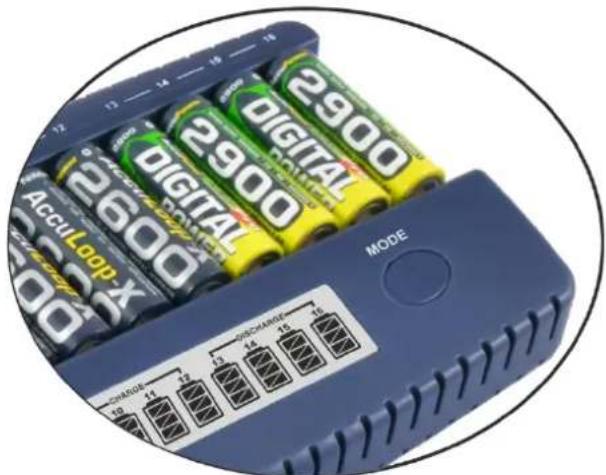
- „MODE“ Button
natural_image
Close-up of a blue electronic device with multiple cylindrical batteries and a mode switch, showing charging port labels (no readable text beyond model number)Display:
During the charging process, the following values are shown on the display:
- Battery symbol
- Slot number
• Charging current (500mA or 1000mA) - Charge level indicator
- Charging finished
- Discharge function
• End of discharge or rest phase

Figure 1: Presentation of all possible display variations
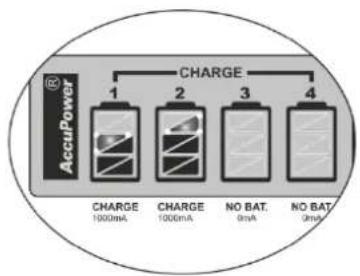
Figure 2: Charging two
batteries with batteries with 1000mA (Max.) 500mA (Max.)

Charging four

„Battery Full“
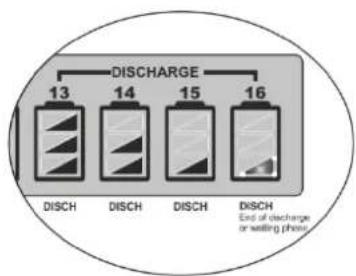
Discharging four batteries

Figure 3: LCD after turning the charger on with no inserted batteries
Charging function:
The IQ216 has 16 independently monitored charging slots, where every four slots are sharing their power. The display shows which slots belongs together. For this, every four battery symbols on the display are coupled by a bar above that also shows if the slots are charging or discharging. The discharge function is available only for the last four slots (13, 14, 15 and 16). The charging current gets automatically set by the charger, depending on the battery size. This feature should make the usage of the IQ216 much easier and much safer.
AA Size:
Because of their size, AA batteries can carry a higher charging current than the AAA batteries. Therefore, the AA batteries are the only one, that could get charged with a current up to 1000mA (max.) by the charger. The automatically chosen current is set by the IQ216 depending on how many of the by-four-paired slots are occupied. If one or two slots of a foursome are used by AA sized batteries, then the current is set to 1000mA (max.).
On the other hand, if three or all four slots get occupied by AA batteries, the charging current gets lowered to 500mA (max.)
INFORMATION: Please note, that every by-four-paired slots (e.g. slot 1, 2, 3 and 4) are working independently from the other three foursomes. A lowered current for the first four slots, doesn't mean that other slots from a different foursome can provide a high current.
After inserting a battery in a slot, the backlight of the LCD lights up for approx. 30s and confirms that the inserted battery is detected by the charger. With the help of the triangle shaped bars you can see if the charger has chosen 1000mA (max.) or 500mA (max.) for your battery / batteries. If only the left-hand bars are going up, then the battery gets charged with a lower current.
Otherwise the charger has set the higher current for the respective slot, apparent when not only the left-hand bars, but also the right-hand bars are visible.
During the charging process, the bars that stays stable are a reference for the state of charge for the respective battery.
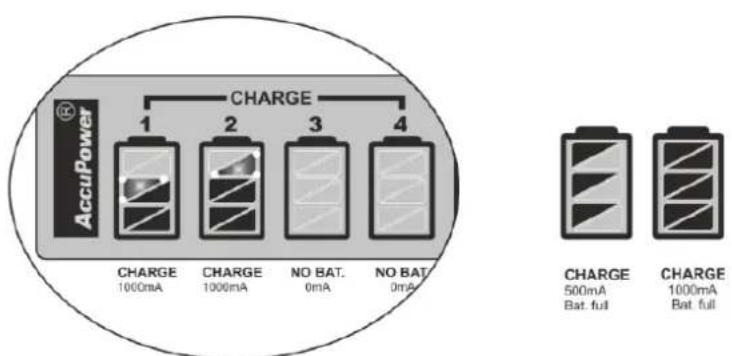
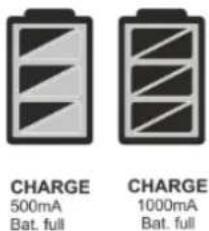
Figure 4: Double-sided triangles „Battery Full“ -higher charging current - lower charging current

Left-hand sided triangles
AAA Size:
For the benefit of lifetime of the smaller AAA batteries, the charging current, set by the charger, is reduced to 500mA (max.) and is as high as the lowered current for AA batteries.
Regardless of the used number of slots, the charging current is always 500mA (max.) for AAA batteries.
The procedure of inserting the battery to recognition of the actual state of charge works the same as for the AA batteries. So please take a look in the above subsection.

Figure 5: Charging two AAA batteries Charging four AAA betteries Finished charging with 500mA (max.) with 500mA (max.) a AAA battery
9V E-Block:
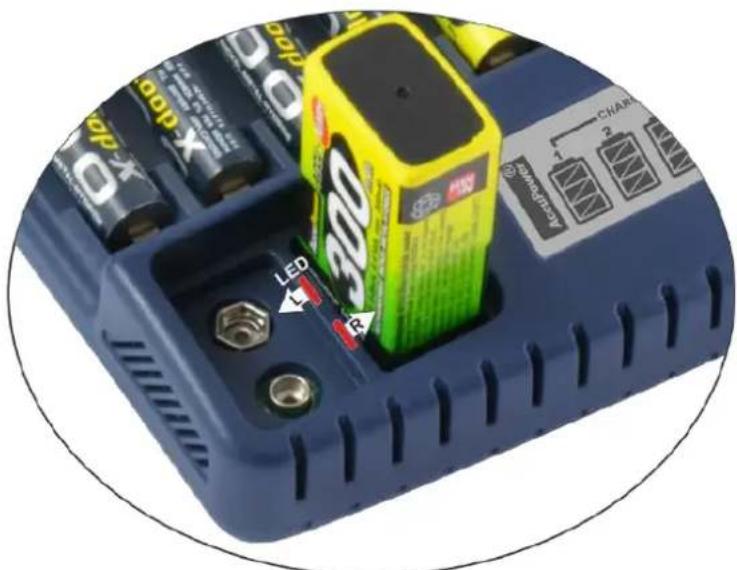
It is also possible to charge 9V blocks with the IQ216. Therefore, you need to insert one or two blocks on the left-hand side of the LCD. Information's about the charging state you can get from the beside LED for each slot. The upper LED belongs to the left slot and the bottom LED belongs to the right slot. After inserting a battery, the LED starts flashing red. That shows that the battery is charging. A stable red LED signalizes that charging has finished.
ATTENTION: Please do not use Li-Ion 9V batteries. Please pay attention to charge the right battery types only.
natural_image
Close-up of a blue battery pack with a yellow 300C batteries and red LED indicator, no visible text or symbols on the main components.Figure 6: Belonging of each LED to its charging slot
Discharge function:
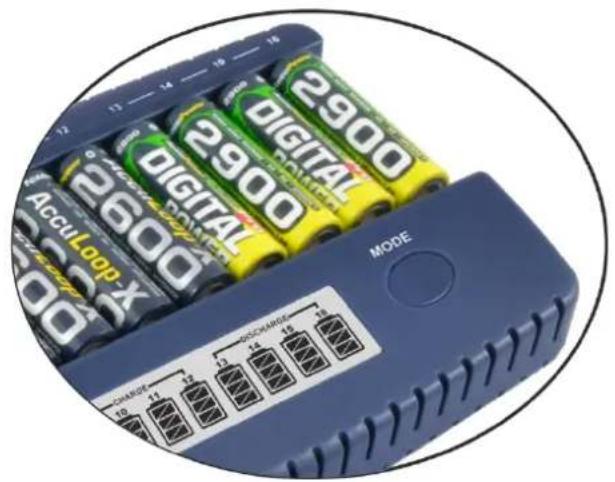
The IQ216 charger also features a discharge function that is available on the last four slots (slot 13, 14, 15 and 16). For using this function, simply insert the batteries into the slots and double press the “MODE” button.
INFORMATION: If you want to know if the four slots are charging or discharging, then take a look at the according battery symbols on the display. If the state-of-charge bars are running downwards, then the four slots are discharging. Otherwise, if the bars are running upwards, the charger is still in charging mode.
ATTENTION: If the discharge mode is selected once, it is set on all four slots (13, 14, 15 and 16). It is not possible to select single slots for discharging.
In case you have selected the discharge function accidentally, you can easily switch back to the charge mode by pressing the "MODE" button twice again. To use the discharge function, you don't need to insert all the same batteries. It is also possible to discharge different batteries (AA and AAA) at the same time.
The number of flashing bars draws no conclusion to the actual discharge state of each battery. It gives only the information that the discharge procedure is active. If one or more batteries end discharging, the bottom bars stay flashing. The charger waits for the other batteries finishing discharging, to enter a “cool-down” phase that lasts approx. 10min. to let the batteries relax. After that, the charger immediately starts to charge all batteries that were discharged before.
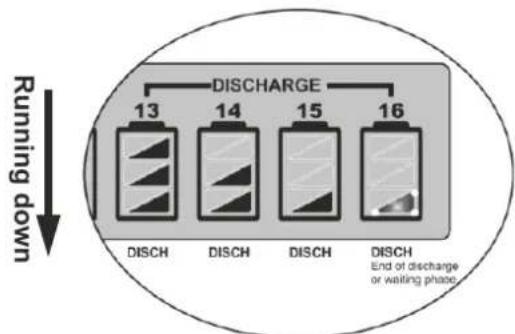
Figure 7: Battery symbol bars for discharging and blinking bar during „Cool-Down“ phase
Charging finished:
If one or more batteries finished charging, the bars of the respective slot change from running upwards to stable. The "full" signal looks different, depends on what charging current was chosen by the IQ216 charger:
MODE Button:
natural_image
Close-up of a blue electronic device with multiple cylindrical batteries and labeled charging port (no readable text or symbols)With the help of the "MODE" button you can choose different functions by a:
Short Single Press:
If you press the "MODE" button once for a short time, you active the LCD backlight. To save energy, the backlight stays on for approximately 30s and turns off automatically afterwards.
Long Single Press:
By pressing and holding the button down for about 4s you can also turn on the LCD backlight. But this time it stays on permanently. If you have activated the backlight, is signalized by the backlight itself by flashing once. To turn it off again it works the same as turning it on, by pressing and holding the "LIGHT-ON" button down for approximately 4s.
Double Press:
If the „MODE“ button gets pressed double times, the discharge function gets activated for the slots 13, 14, 15 and 16. By pressing the button again twice, you can switch back to the charging mode. Which mode is active right now is shown on the display above the battery symbols.

Figure 8: Difference between discharge and charge mode
Maintenance:
The chargers are maintenance free but should be cleaned sometimes. The charger should be disconnected from the power supply before cleaning. Use only soft and dry tissues (like cotton textiles) do not use any liquid.
Disclaimer:
- The manufacturer and supplier are not responsible for incorrect or improper use and the resulting consequences.
- Any repair or modification that is not performed by the original supplier will void the warranty.
- The device may be used only by people who have read and understood such instructions.
- The information in this document are subject to change without previously pointed out.
• This product is not a toy. Keep out of reach of children.
- The reproduction of this manual or parts of it, is permitted only with written permission of the manufacturer.
Safety instructions:
Please observe the following safety instructions:
• Use as described in the instructions, only NiCd, NiMH batteries!
- The device is not approved for outdoor use. Protect it from high humidity, water, rain or snow. Keep the device away from excessive heat and direct sunlight.
- Do not dispose batteries in a fire!
- Do not use other than the supplied accessories. In particular, attention is drawn to use the supplied original power adapter for the battery charger.
- Disconnect the power cord from the outlet when not in use.
- The device should not be used if it has received a blow or damaged in any other form.
- Don't use the charger for any other purposes than described in the instruction.
- Do not open or disassemble the unit, otherwise there is a risk for electric shock or fire.
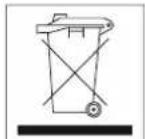
Note on disposal:
Please inform yourself about the local collection points for electronic devices.
Please check local environmental standards and do not dispose your old products with normal household waste. The charging unit may only be disposed of in waste management authorities set up collection points. The proper disposal of your old product will help the environment and health.
Rechargeable batteries may not be disposed in domestic waste. Return used batteries to your dealer or to an authorised battery collecting point.
TECHNICAL SPECIFICATIONS IQ216


| Input Voltage | AC Input: 100-240V (for AC Power supply);DC Input: 12V (11-14V) / 2A Min. |
| Monitoring / Display | LC display live view with backlight:Shows the charge status, charge current. Bat. Full, discharge modeSize: 150mm * 19mm |
| Display Backlight | Yes |
| Controls | One Button „easy to use“ function (easy handling). |
| Operating Modes | Charge, Discharge |
| Charge Method | Delta-peak Sensitivity for NiMH / NiCd |
| Safety Temp. Control | Charge Cutoff Max. Temperature (50°C) |
| Charge Voltage | NiCd / NiMH: Delta peak detection |
| Charge Current | 500mA, 1000mAAutomatically adjusted for each channel |
| Discharge Cut-off Voltage | discharge function available |
| Battery Types/Size | NiCd / NiMH: AAA / Micro, AA / Mignon, 9V E-Block |
| Battery Capacity Range | NiCd / NiMH: Min. 200 - Max. 3000mAh |
| Case Material / Size | Plastic / L: 259mm; W: 118mm; H: 32mm |
| Weight | 336g for charger unit without AC Power supply |
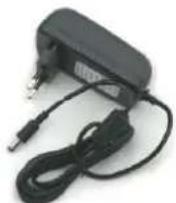
AC Power supply: AC Input: 100-240V; DC Output: 12V / 2A Min.
Information and contents in this document are for reference purpose only. They do not constitute any warranty or representation and are subject to change without notice.

Brand : AccuPower
Model : IQ216
Category : Battery charger