
CH-650 - Pressure gauge CITIZEN - Free user manual and instructions
Find the device manual for free CH-650 CITIZEN in PDF.


| Product Type | Digital Pressure Gauge |
| Brand | Citizen |
| Model | CH-650 |
| Measuring Range | 0 to 100 psi (0 to 7 bar) |
| Accuracy | ±0.5% F.S. |
| Display | Digital LCD, 4-digit |
| Units of Measurement | psi, bar, kPa, kg/cm² |
| Power Supply | 1 x 9V battery (included) |
| Battery Life | Approximately 200 hours continuous use |
| Dimensions | 180 mm x 70 mm x 35 mm |
| Weight | 250 g (with battery) |
| Connection | 1/4 inch NPT male thread |
| Operating Temperature | 0°C to 50°C (32°F to 122°F) |
| Storage Temperature | -20°C to 60°C (-4°F to 140°F) |
| Functions | Zero adjustment, data hold, auto power off, min/max recording |
| Maintenance | Clean with dry cloth; avoid solvents |
| Safety | Do not exceed maximum rated pressure; use with compatible media |
| Spare Parts & Repairability | Battery and connector available; service by qualified personnel |
| General Information | Includes user manual, battery, and carrying case |
Frequently Asked Questions - CH-650 CITIZEN
User questions about CH-650 CITIZEN
0 question about this device. Answer the ones you know or ask your own.
Ask a new question about this device
Download the instructions for your Pressure gauge in PDF format for free! Find your manual CH-650 - CITIZEN and take your electronic device back in hand. On this page are published all the documents necessary for the use of your device. CH-650 by CITIZEN.
USER MANUAL CH-650 CITIZEN
INSTRUCTION MANUAL FOR
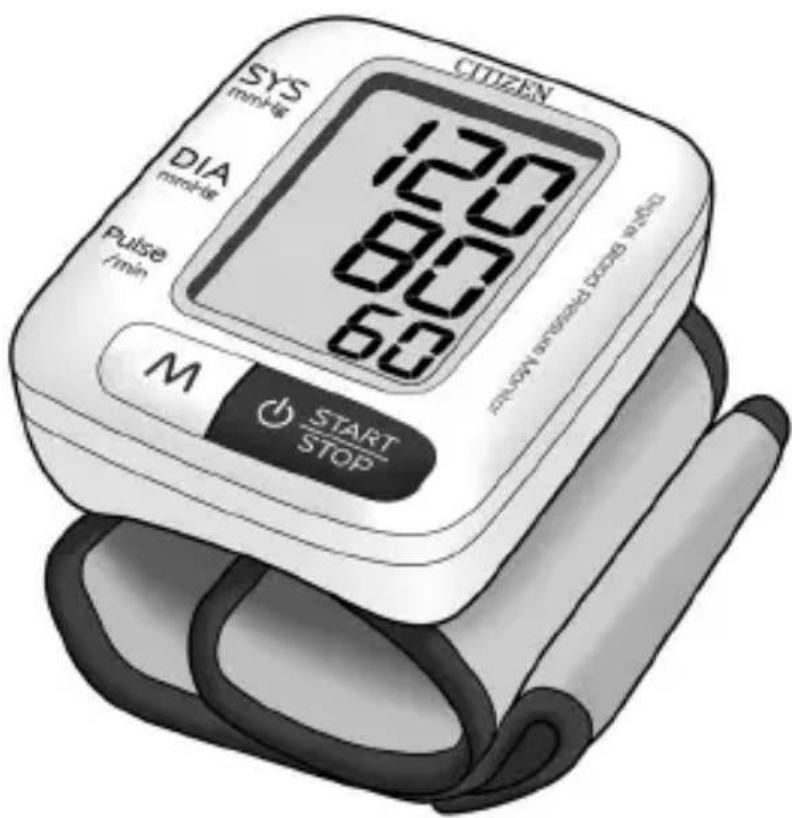
DIGITAL BLOOD PRESSURE MONITOR
REF CH-650
English
Español
Português
Deutsch
Italiano
Français
中国语
0901
Contents
3 - GENERAL REMARKS
5 - PRECAUTIONS FOR USE AND MAINTENANCE
10 - IDENTIFICATION OF PARTS
12 - LOADING THE BATTERIES
13 - REMOVING THE BATTERIES
14 - HOW TO WRAP THE WRIST CUFF
16 - TIPS FOR OBTAINING ACCURATE MEASUREMENTS
18 - MEASURING YOUR BLOOD PRESSURE
20 - CALLING UP THE DATA STORED IN MEMORY
22 - ERROR INDICATIONS
23 - ABOUT "BLOOD PRESSURE"
24 - BLOOD PRESSURE Q&A
25 - BEFORE REQUESTING REPAIRS OR TESTING
26 - SPECIFICATIONS
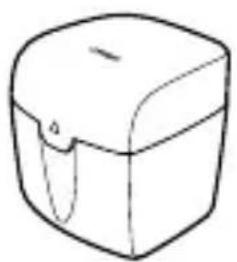
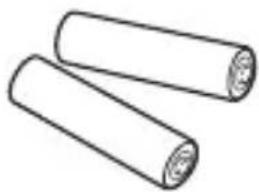
Ensure that you have all the following components
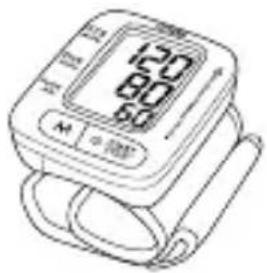
Blood pressure monitor unit
natural_image
Simple line drawing of a rectangular container with a handle and a small loop on the side (no text or symbols)Storage case (for monitor)
natural_image
Simple line drawing of two cylindrical objects with textured surfaces (no text or symbols)2 AAA batteries
Instruction Manual
General remarks on blood pressure and blood pressure measurement
- To deflate the cuff quickly, press the "START/STOP" switch.
- The attached cuff is suitable for wrist circumferences of 13.5-21.5 cm.
- When attaching the cuff, the body of a blood pressure monitor should be placed on the inside of your wrist.
- Self measurement is not therapy! In no event should you change the dosage of your medication prescribed by your physician.
- As preparation for measuring your blood pressure, you should urinate and then remain relatively still for 10 to 15 minutes prior to measurement.
- Exercising, eating, drinking, smoking, etc., prior to measurement may affect the results.
- Your blood pressure varies constantly throughout the day. Measurements should be taken regularly at the same time each day.
- DO NOT place too much emphasis on the results of one measurement. Keep a continuing record of your blood pressure variations. A complete picture can only be obtained from a large number of readings.
- Emotional stress tends to cause your blood pressure to rise.
To obtain correct blood pressure measurements
- Take five or six deep breaths and then relax before measuring your blood pressure. If you are tense when taking the measurement, you will not get a valid reading.
- Your blood pressure will be elevated if you are anxious or irritated, suffering from lack of sleep or constipation, or have just taken some exercise or eaten a meal.
- Wrap the cuff around your wrist snugly. ( See page 14)
- DO NOT measure your blood pressure after bathing or drinking.
- If you feel the need to urinate, do so before measuring your blood pressure.
- Measure your blood pressure where the room temperature is around 20^ C. DO NOT measure your blood pressure when it is too
cold (below 10^ C) or too hot (above 40^ C) in the room.
- DO NOT try to measure your blood pressure immediately after drinking coffee or tea or after smoking.
- Measure your blood pressure when you are relaxed and still. Keep the center of the cuff at the level of your heart and DO NOT move your arm or talk.
- DO NOT measure blood pressure when the cuff has been on your wrist for a few minutes or more. During this time, your wrist will have built up a higher blood pressure and you will not get valid reading.
- If the Body Movement Indicator or Irregular Heartbeat (IHB)Indicator is displayed, relax and measure your blood pressure again. If the Irregular Heartbeat (IHB) Indicator appears frequently, you are advised to consult a doctor about your health condition. (See page 19)
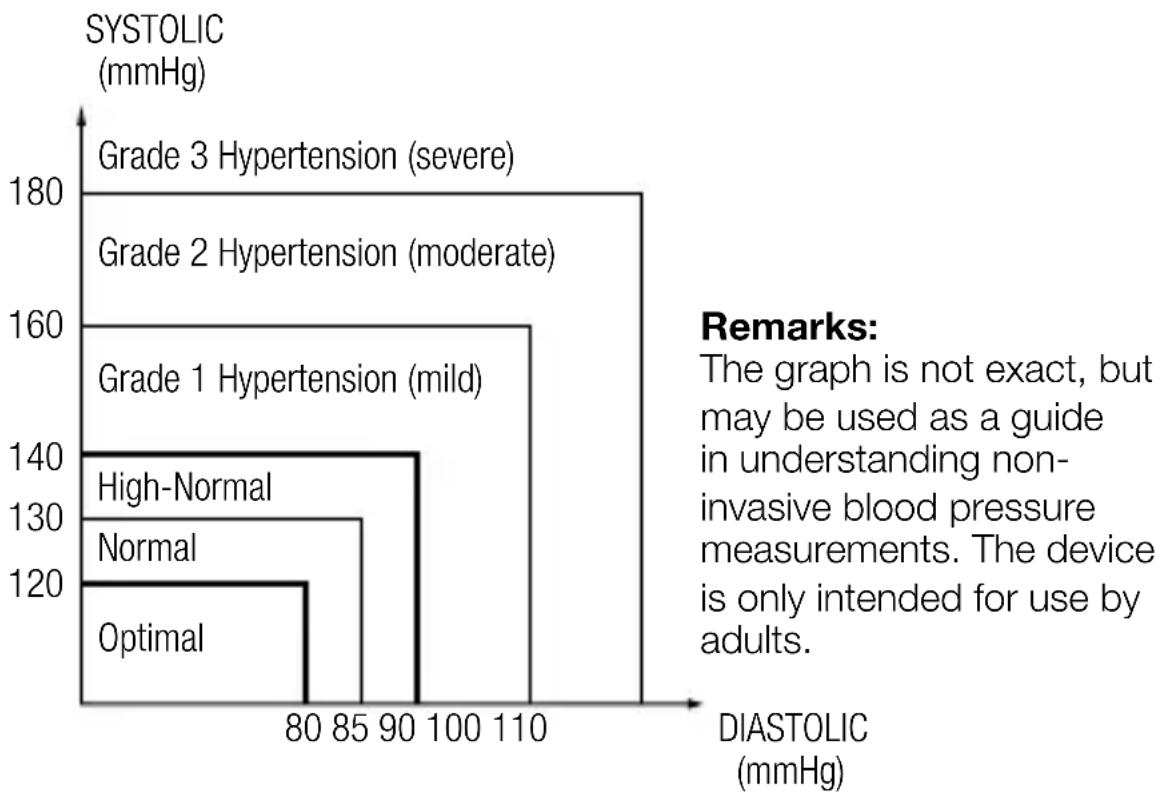
- The figure below shows the blood pressure classifications under the WHO standards.
bar
| Hypertension Level | Diastolic (mmHg) | | :--- | :--- | | Optimal | 120 | | Normal | 130 | | High-Normal | 140 | | Grade 1 Hypertension (mild) | 160 | | Grade 2 Hypertension (moderate) | 180 | | Grade 3 Hypertension (severe) | 180 | DIASTOLIC (mmHg) axis ranges from 80 to 110.Definitions and Classifications of Blood Pressure Levels
Measure your blood pressure at the same time each day.
* Your blood pressure changes all the time. This means that data gathered over a long period has far more signifi cance than data from just one measurement. For this reason, you must measure your blood pressure on a daily basis. Ideally, you should measure your blood pressure at the same time each day, wherever possible.
PRECAUTIONS FOR USE AND MAINTENANCE
Precautions for use
- If you suffer from heart disease, high blood pressure or other circulatory disease, consult your physician before using the monitor.
- If you feel abnormal pressure of the cuff during use or any other irregularity, reduce the pressure by immediately switching off the power or remove the batteries and consult the sales outlet where purchased.
- If you think the measurement is abnormal or if measurement makes you feel unwell, discontinue use and consult your physician.
- Blood pressure measurement may not be possible for anyone with a weak pulse or arrhythmia.
- Repeated blood pressure measurement may cause problems such as congestion or swelling in some people.
- Frequently repeated blood pressure measurements will not give accurate results. Allow an interval of about 1 minute between measurements.
- If you suffer from a severe problem with blood circulation in your arms, consult your physician before using the monitor. Failure to do so could be hazardous to your health.
- Measurement may not be possible for anyone with insufficient blood flow to the area where measurements will be taken or who suffers from a frequent irregular heartbeat. Consult your physician for advice on whether to use the monitor.
- DO NOT wrap the cuff around an injured wrist.
PRECAUTIONS FOR USE AND MAINTENANCE
- DO NOT wrap the cuff around a wrist in which a drip (intravenous infusion) is inserted, or which is being used for blood transfusion as part of medical treatment. Doing so could result in an injury or a serious accident.
- DO NOT use the monitor in the vicinity of fl ammable gases such as those used for anaesthesia. Doing so could ignite the gases and cause an explosion.
- DO NOT use the monitor in enriched oxygen environments such as a hospital's hyperbaric chamber or oxygen tent. Doing so could ignite the oxygen and cause a fire.
- DO NOT use mobile phones near the monitor as this could result in a malfunction.
- If you use a cardiac pacemaker, consult your physician before using the monitor.
- Be sure to use this unit only for measuring blood pressure. DO NOT use it for any other purpose.
- DO NOT use this unit on infants.
- Blood pressure measurement may not be possible for anyone with common arrhythmias such as atrial or ventricular premature beats or atrial fi brillation.
Maintenance Precautions
- DO NOT store the blood pressure monitor in locations exposed to direct sunlight, high temperatures (over 60^ C), low temperatures (below -20^ C), high relative humidity (over 95%) or excessive amounts of dust.
- DO NOT drop the blood pressure monitor or subject it to other shocks or vibration.
- Remove the batteries if the monitor will be left unused for a long period.
- DO NOT attempt to disassemble the monitor.
- DO NOT bend the cuff excessively.
- If the monitor is very dirty, wipe it clean with a cloth moistened with sterilizing alcohol or a neutral detergent. Then wipe it with a dry cloth.
PRECAUTIONS FOR USE AND MAINTENANCE
- NEVER clean the blood pressure monitor with thinners or benzene, as this could damage the monitor.
- To clean the cuff, wipe it with a moist cloth. Avoid hard rubbing, as this will cause air leakages.
Symbols Explanation
: The CE marking is meant to provide information to market inspectors in the EU member countries.
: Type B applied part
: Refer to instruction manual before use
: Appliance compliance WEEE directive
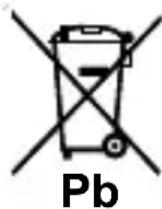
: Accumulators and battery packs for separate collection
: Manufacturer


| Warning | The device has been tested and homologated in accordance with EN60601-1-2 for EMC. This does not guarantee in any way that the device will not be affected by electromagnetic interference. Avoid using the device in high electromagnetic environment. |
PRECAUTIONS FOR USE AND MAINTENANCE
Nature and frequency of maintenance:
This product is designed for use over an extended period of time; however, it is generally recommended that it be inspected every two years to ensure proper function and performance.
Protect the nature environment:
Please help to protect natural environment by respecting national and/or local recycling regulations when disposing of the battery and the product at the end of their useful live.
WEEE MARK
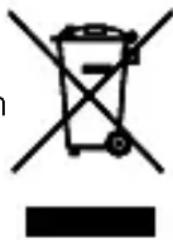
If you want to dispose this product, do not mix with general household waste. There is a separate collection systems for used electronics products in accordance with legislation under the WEEE Directive (Directive 2002/96/EC) and is effective only within European Union.
natural_image
Symbol of a trash bin with crossed lines and a horizontal bar below (no text or numbers present)Information for Users on Collection and Disposal of used Batteries.
The symbol in this information sheet means that used batteries should not be mixed with general household waste.
For proper treatment, recovery and recycling of used batteries, please take them to applicable collection points.
For more information about collection and recycling of batteries, please contact your local municipality, your waste disposal service or the point of sale where you purchased the items.
Information on Disposal in other Countries outside the European Union.
This symbol is only valid in the European Union.
If you wish to discard used batteries, please contact your local authorities or dealer and ask for the correct method of disposal.
Note for the battery symbol.
The symbol might be used in combination with a chemical symbol. In this case it complies with the requirement set by the Directive for the chemical involved.
Calibration:
The blood pressure measuring device is generally recommended to have the monitor inspected every two years to ensure correct functioning and accuracy. Please contact a distributor.
European Representative:
D-14109 Berlin, Germany
- For technical data, please contact our European Representative

0086
IDENTIFICATION OF PARTS
Component names
LOADING THE BATTERIES
(Batteries supplied with the unit should be loaded in compartment before you use the blood pressure monitor.)1 Open the cover of battery compartment.
 natural_image
Line drawing of a hand holding a mechanical component with an arrow indicating left motion (no text or symbols)2 Place batteries in the compartment.
Put the batteries paying attention to the positive and negative terminal symbols ⊕ and ⊖ \* The battery goes in negative side ⊖ first. Insert the battery near the display first. natural_image
Diagram of a device's internal battery pack with two labeled terminals and a cable inserted (no text or symbols)3 Close the battery cover.
Slide the cover in the direction of the arrow. Push the cover on until it clicks. natural_image
Line drawing of a hand inserting a device into a device component (no text or symbols)REMOVING THE BATTERIES
- When the icon is displayed or nothing appears in the display, replace the old batteries with two new ones. All two batteries should be changed at once. • Use only alkaline batteries. - Do not use rechargeable batteries. - Do not use alkaline (LR03) and manganese (R03) batteries together. - Batteries included are for demonstration purposes only. Battery life may be shorter than specified. - When disposing of used batteries, comply with governmental regulations or environmental public institution's rules that apply in your country/area.  - Eng 13 -HOW TO WRAP THE WRIST CUFF
Wrap the wrist cuff around your wrist properly. Improper wrapping of the cuff may result in measuring errors. 1 Open the wrist cuff. 2 Wrap the cuff around your left wrist so that the monitor is positioned on the inside of your wrist. - Wrap the wrist cuff on bare skin. - The wrist cuff is designed to fit wrists from 13.5 to 21.5 cm in circumference. natural_image
Line drawing of a human hand holding a blood pressure monitor (no text or symbols)To obtain accurate measurements
\- Wrapping the cuff too loosely or too tightly may prevent correct measurement. \- Sit up straight while taking the measurement.TIPS FOR OBTAINING ACCURATE MEASUREMENTS
Your blood pressure varies according to your posture, the time of day and a range of other factors. Ideally, you should measure your blood pressure in the same posture at the same time every day. ① Make sure that your posture is correct. Sit up straight, take a deep breath and relax. To obtain correct measurements
 \- Do not clench your fi st tightly. natural_image
Line drawing of a human wristwatch with a 'X' symbol above it (no text or labels on the device itself)natural_image
Line drawing of a wristwatch with a black X mark symbol (no text or labels)natural_image
Illustration of a person sitting at a desk with arms crossed, no text or symbols presentMEASURING YOUR BLOOD PRESSURE
1 Wrap the wrist cuff around your left wrist.
( See page 14 "HOW TO WRAP THE WRIST CUFF".)2 Make sure that your posture is correct.
( See page 16 "TIPS FOR OBTAINING ACCURATE MEASUREMENTS".)3 Press the "START/STOP" switch to start measurement.
 is displayed when a pulse is detected.4 The measurement results are displayed.
 Body Movement Indicator natural_image
Silhouette of a person with motion lines indicating movement (no text or symbols)natural_image
Black heart-shaped icon with exclamation mark and sound waves (no text or symbols)Caution
If the Irregular Heartbeat (IHB) Indicator appears frequently, you are advised to consult a doctor about your health condition.5 Finishing measurement.
\- Press the "START/STOP" switch to turn the monitor off.AUTOMATIC POWER OFF FEATURE
\- After taking the blood pressure measurement, pressing the “START/STOP” switch will turn the monitor off. However, if you do not press the switch, the monitor’s Auto OFF function will automatically turn the monitor off after 3 minutes.CALLING UP THE DATA STORED IN MEMORY
60 measurement results can be stored in the memory. The average value is calculated automatically to help you manage your daily health.HOW TO CALL UP THE DATA
1 Press the "MEMORY" switch.
 \- “3A” indicating the average value appears on the left section of the display. Then, the average value, based on the last three measurements, is displayed. (“3A” and the average value do not appear if there are two or fewer measurements stored in memory.)2 Each time you press the switch, the measurement data are displayed in order from the most recent to the oldest.
 \- The value stored in memory is numbered in the order of measurements. For example, when 60 sets of data are stored in memory, the data number 1 represents the latest data. Data number: 1, 2, 3, ... ... 59, 60 The latest data The earliest dataHOW TO DELETE THE DATA
1 Press the "MEMORY" switch. 2 While pressing the "MEMORY" switch, press and hold the "START/STOP" switch for more than 3 seconds. All the stored data will be deleted.  Press and hold for 3 seconds  Deleted  A message saying all the data have been deleted from the memory is displayed.ERROR INDICATIONS
| DISPLAY MARK CONDITION/CAUSE | CORRECTIVE ACTION | |
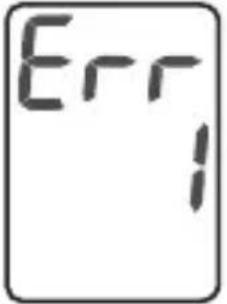 | Appears when the wrist cuff is wrapped too loose. | Re-wrap the wrist cuff snugly. Take another reading, making sure you remain still. (See page 14 “HOW TO WRAP THE WRIST CUFF”.) |
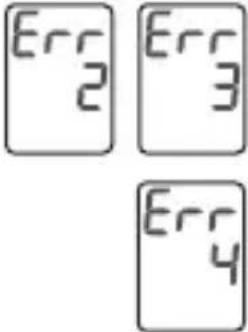 | Appears when your wrist moved during the measurement.; or Appears when the cuff is not wrapped correctly. | Re-wrap the wrist cuff correctly. Take another reading, making sure you remain perfectly still. (See page 14 “HOW TO WRAP THE WRIST CUFF”.) |
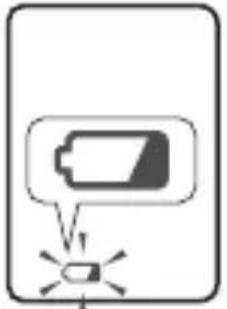 | Appears when the batteries have run out. | Replace two alkaline batteries with new ones. (See page 13 “REMOVING THE BATTERIES”.) |
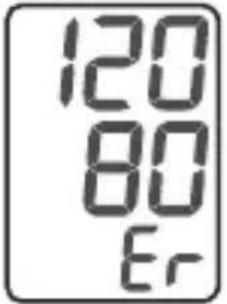 | Appears when the pulse rate falls outside the measuring range (below 39 beats/min. or above 181 beats/min.) | Re-wrap the wrist cuff properly. Take deep breaths to relax, and measure again. (See page 16 “TIPS FOR OBTAINING ACCURATE MEASUREMENT”.) |
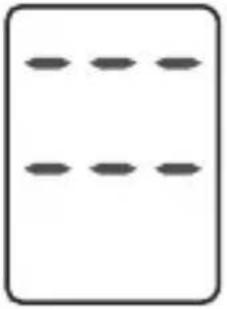 | The unit does not function properly. | Contact the store where it was purchased or your local service center. (See page 25 “BEFORE REQUESTING REPAIRS OR TESTING”.) |
ABOUT "BLOOD PRESSURE"
What is blood pressure?
The heart is a pump that circulates blood throughout your body. Blood is pumped from the heart at a constant pressure into arteries. This pressure is called the arterial blood pressure and represents, in general terms, your blood pressure. Blood pressure is indicated by several kinds of pressures, including the systolic pressure that occurs when the heart pumps blood, and the diastolic pressure that occurs when blood returns to the heart. Your blood pressure changes all the time.
Your blood pressure differs according to your age, gender and a range of other factors. It is likely to be affected by your biorhythm during the day and by your posture, physical activities, mental activities, level of stress and even by the air temperature. The blood pressure of a healthy person generally varies within a day. [Example of blood pressure variations within a day] line
| Time of day | Blood pressure value (mmHg) | | ----------- | --------------------------- | | 12 | ~60 | | 13 | ~100 | | 14 | ~80 | | 15 | ~70 | | 16 | ~150 | | 17 | ~100 | | 18 | ~90 | | 19 | ~80 | | 20 | ~70 | | 21 | ~60 | | 22 | ~140 | | 23 | ~100 | | 24 | ~150 | | 1 | ~40 | | 2 | ~60 | | 3 | ~50 | | 4 | ~30 | | 5 | ~60 | | 6 | ~70 | | 7 | ~80 | | 8 | ~140 | | 9 | ~130 | | 10 | ~140 | | 11 | ~130 |BLOOD PRESSURE Q&A
Q Why is the blood pressure measured at home different from that measured by the physician or at a hospital? A Your blood pressure may vary due to exercise, the ambient temperature or your mental state. When you have a physician or nurse measure your blood pressure, the pressure value is likely to be 10 to 20 mmHg higher than usual due to anxiety and/or stress. Knowing what affects your blood pressure helps you to better monitor your health. Q Why does the blood pressure obtained vary with measurement? A Our blood pressure is adjusted by automatic nerve function. Blood pressure differs with every heart beat. We are likely to think that our blood pressure is constant, but it varies if you take measurements in repetition. Blood pressure is susceptible to the time of day, such as morning and afternoon, season and atmospheric temperature. In addition, blood pressure is easily affected by mental stress or emotional ups and downs. It tends to increase when you feel tension or decrease when you are relaxed. Q What is the benefit of measuring my blood pressure at home? A Blood pressure measurements taken at home give reliable data as they can be taken when you are in a stable and relaxed condition. Physicians place considerable importance on blood pressure measurements taken at home. You should measure your blood pressure at the same time each day and record the variations in your blood pressure. natural_image
Illustration of a person with arms crossed and pointing, holding a question mark (no text or symbols present)BEFORE REQUESTING REPAIRS OR TESTING
Make sure to check the following before sending your blood pressure monitor away to be tested or repaired.| Problem Checks Response | ||
| Display stays blank when you press the “START/STOP” switch. | Check whether the batteries are dead. | Replace all the batteries with new ones. |
| Check whether the batteries are installed the right way round (⊕ and ⊖ oriented correctly). | Load the batteries in the correct direction. | |
| No measurements can be taken. | Check whether the measurement icon ♥ is displayed. | Attach the cuff properly. |
| Check whether the cuff is attached correctly. | ||
| Did you stay calm during measurement? | Measure your blood pressure again, making sure to remain still. | |
| Note that blood pressure measurement may not be possible for someone with an extremely weak pulse or cardiac arrhythmia (irregular pulse). | ||
| Your blood pressure readings are abnormally high or low compared with those taken in hospital. | See page 24. | |
| Other phenomena | Remove the batteries from the unit and change them with new ones. | |
SPECIFICATIONS
| Model Number CH-650 | |||
| Measurement system Oscillometric method | |||
| Display Digital display type | |||
| Wrist circumference range 13.5 to 21.5 cm | |||
| Measurement range | Pressure 0 to 280 mmHg | ||
| Pulse 40 to 180 pulse/min | |||
| Accuracy | Pressure ±3 mmHg | ||
| Pulse ±5% of reading | |||
| Inflation | Automatic inflation by internal pump | ||
| Rated voltage 3V DC | --- (---direct current) | ||
| Exhaust Electromagnetic quick exhaust valve | |||
| Power supply 2 AAA batteries (LR03) | |||
| Battery duration Approx. 400 times | (180 mmHg, once/day, 22°C) | ||
| Operating conditions | Temperature | 10°C to 40°C | |
| Humidity 30% | to 85% RH | ||
| Storage conditions | Temperature | -20°C to 60°C | |
| Humidity 10% | to 95%RH | ||
| Memory Function | Up to 60 measurements | ||
| Electric shock Protection | Internal power unit | ||
| Safety Classifi cation | Type B Equipment | ||
| Mode of operation | Continuous operation | ||
| Protection against ingress of water | IPX0 | ||
| Dimensions | 65(W) x 74(H) x 29(D) mm | ||
| Weight | Approx. 103g w/o batteries | ||
| Accessories | Set includes 2 AAA batteries (LR03) for the monitor, Instruction Manual, Storage case | ||
CITIZEN SYSTEMS JAPAN CO., LTD.
6-1-12, Tanashi-cho, Nishi-Tokyo-Shi, Tokyo 188-8511, Japan E-mail: sales-oe@systems.citizen.co.jp http://www.citizen-systems.co.jp/

- INSTRUCTION MANUAL FOR
- DIGITAL BLOOD PRESSURE MONITOR
- REF CH-650
- Contents
- Ensure that you have all the following components
- General remarks on blood pressure and blood pressure measurement
- To obtain correct blood pressure measurements
- Measure your blood pressure at the same time each day.
- PRECAUTIONS FOR USE AND MAINTENANCE
- Precautions for use
- Maintenance Precautions
- Symbols Explanation
- Nature and frequency of maintenance:
- Protect the nature environment:
- WEEE MARK
- Information for Users on Collection and Disposal of used Batteries.
- Information on Disposal in other Countries outside the European Union.
- Note for the battery symbol.
- Calibration:
- European Representative:
- IDENTIFICATION OF PARTS
- Component names
- LOADING THE BATTERIES
- Open the cover of battery compartment.
- Place batteries in the compartment.
- Close the battery cover.
- REMOVING THE BATTERIES
- HOW TO WRAP THE WRIST CUFF
- To obtain accurate measurements
- TIPS FOR OBTAINING ACCURATE MEASUREMENTS
- To obtain correct measurements
- MEASURING YOUR BLOOD PRESSURE
- Wrap the wrist cuff around your left wrist.
- Make sure that your posture is correct.
- Press the "START/STOP" switch to start measurement.
- The measurement results are displayed.
- Caution
- Finishing measurement.
- AUTOMATIC POWER OFF FEATURE
- CALLING UP THE DATA STORED IN MEMORY
- HOW TO CALL UP THE DATA
- Press the "MEMORY" switch.
- Each time you press the switch, the measurement data are displayed in order from the most recent to the oldest.
- HOW TO DELETE THE DATA
- ERROR INDICATIONS
- ABOUT "BLOOD PRESSURE"
- What is blood pressure?
- Your blood pressure changes all the time.
- BLOOD PRESSURE Q&A
- BEFORE REQUESTING REPAIRS OR TESTING
- SPECIFICATIONS
- CITIZEN SYSTEMS JAPAN CO., LTD.
Brand : CITIZEN
Model : CH-650
Category : Pressure gauge