ManualGo.com
GZ-MC500US - Camcorder JVC - Free user manual and instructions
Find the device manual for free GZ-MC500US JVC in PDF.


Download the instructions for your Camcorder in PDF format for free! Find your manual GZ-MC500US - JVC and take your electronic device back in hand. On this page are published all the documents necessary for the use of your device. GZ-MC500US by JVC.
USER MANUAL GZ-MC500US JVC
REFERENCES 52 To deactivate the demonstration, set “DEMO MODE" to “OFF”. (= pg- 48) For Customer Use: Enter below the Model No. and Serial No. which is located on the bottom of the camera. Retain this information for future reference. Model No. Serial No. INSTRUCTIONS
& GZ-MCS0OUS.book Page 2 Wednesday, April 13, 2005 7:08 PM 2 EN Major Features of this Camera Removable Hard Disk In contrast to conventional digital video cameras that record to DV tapes, the removable hard disk is a new type of card media that enables extended hours of high-resolution, MPEG2 video recording. (+7 pg. 6) Various Recording Media and Modes Video and still images can be © recorded to CompactFlash card (CF card) and SD memory card The removable hard disk (provided) or Microdrive® is a type of CF card compliant with CF+ Type IL You can select the most suitable recording medium and mode for picture quality, image size, recording time, and computer environment. (+7 pg. 62) Voice Recording Features The camera can be recorder for audio # recordings. (7 pg. 29) LUE | NOV 222005 1ra0am Various Recording Features The camera supports aperture-priority, shutter- priority, portrait, bracket shooting, and a wide range of other functions that you can select according to the scene you are shooting. C7 pg. 31 - 36) Enjoying Various Playback Features Unlike tape operation, playback is simple and easy in this camera since no time is needed for rewinding or fast fonward operations. Playlist, playback effects, and other functions are also available for enjoying many different types of playback. enov 2008 30m Editing Files on your PC USB 2.0 enables the smooth transfer of video and still images to a computer. With the bundied Cyberlink software, you can easily edit video and create your own DVDs. (Refer to the software installation and USB connection guide.) Direct Printing I your printer is compatible with PictBridge, still images can be printed easily by connecting the camera with USB cable directly to the printer. (+7 pg. 47) MasterPage: Body_Left SAR
Video Recording Zooming … Angle Adjustment Video Playback How to Use the Scroll Bar Various Playback Operations . Playback Zoom … Connecting to a TV or VCR Playback on a TV Dubbing to a VCR
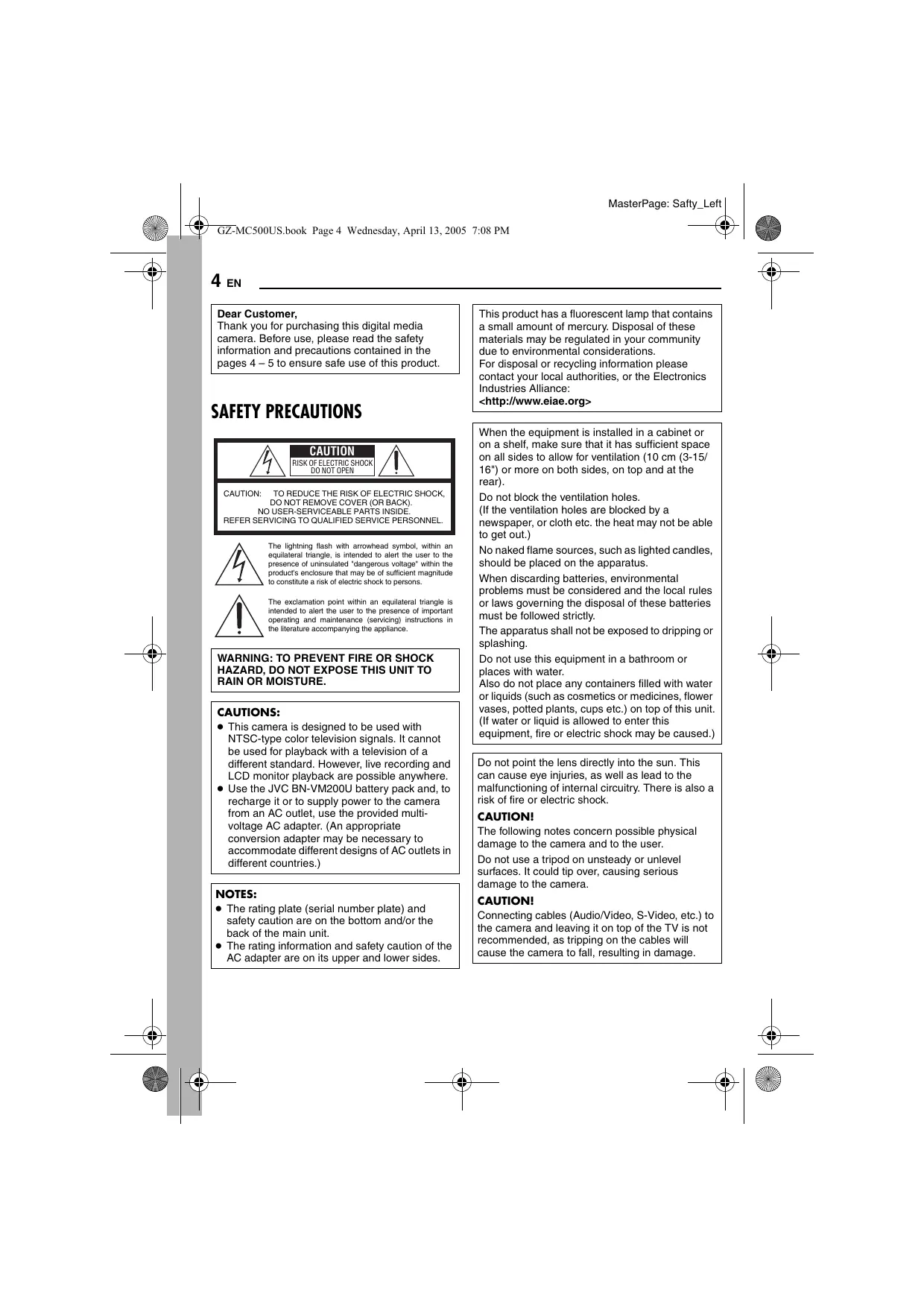
| 7 GZ-MCSOOUS.book Page 4 Wednesday, April 13, 2005 7:08 PM MasterPage: Safty_Left Dear Customer, Thank you for purchasing this digital media camera. Before use, please read the safety information and precautions contained in the pages 4 — 5 to ensure safe use of this product SAFETY PRECAUTIONS This product has a fluorescent lamp that contains a small amount of mercury. Disposal of these materials may be regulated in your community due to environmental considerations. For disposal or recycling information please contact your local authorities, or the Electronics Industries Alliance: <http:/www.eiae.org> CAUTION GAUTION: TO REDUCE THE RISK OF ELECTRIC SHOCK, DO NOT REMOVE COVER (OR BACK). 10 USER-SERVICEABLE PARTS INSIDE. REFER SERVICING TO QUALIFIED SERVICE PERSONNEL. ‘The lghiing flash win arrouhead symboï, wibin an equiateral lang, is intended 19 aler the user 1 1ha presence of uinsuiated "dangerous valage” wi tha products enciosure hat may be o! sufcient magnitude 16 constiute a ik of alectric shock lo persons. ‘The exclamation point within an equiateral triangle is intended Lo alen the user 1o 1e presence of important “operating and maintenance (sanicing) instructions in 1e iteralure accompanying he applance.
/ WARNING: TO PREVENT FIRE OR SHOCK
HAZARD, DO NOT EXPOSE THIS UNIT TO RAIN OR MOISTURE. CAUTIONS: + This camera is designed to be used with NTSC-type color television signals. It cannot be used for playback with a television of a different standard. However, live recording and LCD monitor playback are possible anywhere. + Use the JVC BN-VM200U battery pack and, to recharge it or to supply power to the camera from an AC outlet, use the provided multi- voltage AC adapter. (An appropriate conversion adapter may be necessary to accommodate different designs of AC outlets in different countries.) When the equipment is installed in a cabinet or on a shelf, make sure that it has sufficient space on all sides to allow for ventilation (10 cm (3-15/ 16") or more on both sides, on top and at the rear) Do not block the ventilation holes. {Ifthe ventilation holes are blocked by a newspaper, or cloth etc. the heat may not be able to get out.) No naked flame sources, such as lighted candles, should be placed on the apparatus. When discarding batteries, environmental problems must be considered and the local rules or laws governing the disposal of these batteries. must be followed strictiy. The apparatus shall not be exposed to dripping or splashing. Do not use this equipment in a bathroom or places with water. Also do not place any containers filled with water orliquids (such as cosmetics or medicines, flower vases, potted plants, cups etc.) on top of this unit. {IF water or liquid is allowed to enter this equipment, fire or electric shock may be caused.) NOTES: + The rating plate (serial number plate) and safety caution are on the bottom and/or the back of the main unit. + The rating information and safety caution of the AC adapter are on its upper and lower sides. Do not point the lens directly into the sun. This can cause eye injuries, as well as lead to the malfunctioning of internal cireuitry. There is also a risk of fire or electric shock. CAUTION! The following notes concern possible physical damage to the camera and to the user. Do not use a tripod on unsteady or unlevel surfaces. lt could tip over, causing serious damage to the camera. CAUTION! Connecting cables (Audio/Video, S-Video, etc.) to the camera and leaving it on top of the TV is not recommended, as tripping on the cables will cause the camera to fall, resulting in damage.
F7 GZ-MCSOOUS.book Page S Wednesday, April 13, 2005 7:08 PM MasterPage: Safty_Right
EN 5 Le IMPORTANT SAFETY INSTRUCTIONS Before Using this Camera
1. Read these instructions. This camera is designed exclusively for
2. Keep these instructions. CompactFlash Card (CF card) and SD Memory
3. Heed all warnings Card.
4. Follow al instructions, The removable hard disk (provided) or
S. Do not use this apparatus near water. Microdrive® is a type of CF card compliant with
6. Clean only with dry cloth. CF+ Type IL.
7. Do not block any ventilation openings. Install in } s
accordance with the manufacturers instructions. This camera records video in MPEG2 format
8. Do not install near any heat sources such as Pl : "mat. :
radiators, heat registers, stoves, or other Remember that this camera is not compatible apparatus (including amplifiers) that produce with other digital video formats. heat. Remember that this camera is intended for
9. Only use attachments/accessories specified by private consumer use only.
the manufacturer. Any commercial use without proper permission is
10. Use only with the prohibited. (Even if you record an event such as a
cart, stand, tripod, Show, performance or exhibition for personal bracket, or table enjoyment, it is strongly recommended that you specified by the ° obtain permission beforehand.) manufacturer, 07 Before recording important video, be sure to sold wih the make a trial recording. apparatus. iNhen a Play back your trial recording to make sure the cart is used, use LA video and audio have been recorded properly. caution when — i po moving the cart/ Make a backup of important recorded data apparatus combination to avoid injury from tip P'OteCt Your important recorded data by copying the over. pesie En is orne to nr L rom your
11. Unplug this apparatus during lightning storms or oa ‘0r other recording media for storage. 7
when uused or long period of time” Fifa toi gottare kstallaon ar USE <
12. Refer all servicing to qualified service connection guide.
personnel. Servicing is required when the Bring your camera together with the removable apparatus has been damaged in any way, such hard disk as power-supply cord or plug is damaged, liquid When requesting repairs for breakdowns by your has been spilled or objects have fallen into the dealer or JVC service center, be sure to bring your apparatus, the apparatus has been exposed to Camera together with the removable hard disk. 1f rain or moisture, does not operate normally, or one of them is not included, the cause cannot be has been dropped. diagnosed, and the repair cannot be made properiy. Also read “Cautions” on pages 57 to 59. + Manufactured under license from Dolby Laboratories. “Dolby” and double-D symbol are trademarks of Dolby Laboratories. Microdrive® is a registered trademark of Hitachi Global Storage Technologies, Inc. in the United States and/or other countries. ° CAMASCOT COGAPSULE MascotCapsule is registered trademark of HI CORPORATION in Japan. Copyright © 2001 HI CORPORATION. All rights reserved. + Other product and company names included in this instruction manual are trademarks and/or registered trademarks of their respective holders.
F7 GZ-MCSOOUS.book Page 6 Wednesday, April 13, 2005 7:08 PM 4 6 En MasterPage: Safty_Left Removable Hard Disk The removable hard disk is a precision electronic device. Be careful when handling it. Cautions for external jolt or stress + After removing the disk from the camera, store it by inserting into the supplied protective case. + Do not press on the cover. ‘ Do not subject the disk 5 to vibrations or sudden 1 jolts. Be especially careful to avoid sudden joits when shooting or during playback. ‘+ Do not affix stickers or write on the label. + Do not apply strong pressure to the outside of the disk. Also, do not put it in your pants pocket or other location where it can be pressed on. Cautions for temperature + The camera’ protection circuit may work for the proper recording or playback when the cameras internal temperature rises or during usage in a cold location. (> pg. 55) ‘+ The camera and removable hard disk can heat up when used for an extended period. However, this is not a malfunction. + The disk can heat up when used for an extended period. Therefore, do not remove it immediately from the camera. Other cautions + Condensation can cause the drive to break down. If water is splashed on the drive, make sure that it is completely dried before usage. Do not use, replace, or store the disk in locations that are exposed to strong static electricity or electrical noise. ‘+ Do not turn off ihe camera power or remove the battery or AC adapter during shooting, playback, or when otherwise accessing the recording medium Do not bring the recording medium near objects that have a strong magnetic field or that emit strong electromagnetic waves. + Since data must be read and written by the drive correct, the camera may be unable to shoot when the camera heats up, such as during continuous shooting, or when the camera is cooled down during usage in a cold location. To fix this problem, follow the messages displayed on the screen. (1 pg. 55) + To maintain high performance, perform check disks (error checks) using your computer on a regular basis. Use a USB cable to connect the camera and PC, and then perform the check disk on the removable hard disk using the same procedure as a regular local disk (C drive). Refer to the instruction manual of your PC for check disks. + Clean up the disk regularly to maintain high performance. (: pg. 41, 49) Also read ‘Recording Medium" on page 58. Be careful to completely delete data when discarding or giving away the removable hard disk. When recording data is formatted or deleted on the camera, this only modifies the file management information, and the data is not completely erased When discarding or giving away the removable hard disk, to prevent problems caused by the release of sensitive information, it is extremely important that the customer take responsibility to erase all recorded data. Some recommended methods of erasing data include using a commercial data removal program or using a hammer or strong magnet to physically or magnetically destroy the data on the hard disk so that it cannot be read. JVC shall not be responsible for any personal data that is released.
MasterPage: HeadingO_Right PS S a F7 GZ-MCS00US.book Page 7 Wednesday, April 13, 2005 7:08 PM 4 & 4 GETTING STARTED en 7 P @ AC Adapter AP-V14U @ Battery Pack BN-VM200U © S-Video/Audio/Video Cable @ USB Cable (Refer to the software installation and USB connection guide.) © Removable Hard Disk (4 GB) © Protective Case for Removable Hard Disk ® Strap (See page 8 for attachment) © Lens Cap (See page 8 for attachment) © CD-ROM & Audio Extension Cable (for optional headphones, see page 9 for attachment) ® Core Filter for Cables (See page 9 for attachment) Large (x 1): S-Video/Audio/Video Cable Medium (x 1): USB Cable Small (x 2): Audio Extension Cable and AC Adapters Cord @ Lens Hood (Already attached to the camera, pg- 8) NOTES: + In order to maintain optimum performance of the camera, provided cables may be equipped with one or more core filter. If a cable has only one core filter, the end that is closest to the filter 7 should be connected to the camera. L Las) e Make sure to use the provided cables for 4 7 0] @ connections. Do not use any other cables. GETTING STARTED ® e The removable hard disk and its protective case are packaged in a silver bag.
MasterPage: Body_Left PS S É ] F7 GZ-MCS00US.book Page 8 Wednesday, April 13, 2005 7:08 PM 4] & È Sen GETTING STARTED P Attaching the Strap Attaching/Detaching the Lens Hood 1 Press and hoïd both The provided lens hood helps block out glare aides as shown then when shooting under bright sunlight, the same detach the fastener (large). way professional photographers do. 2 Pass the strap ring To attach through the eyelet on the Align the lens hood with the camera’ lens, and lens side. then turn the hood clockwise (D. 3 Pass through the strap To detach ring. Turn the hood counterclockwise ®. , « Detach the hood only when using the optional 4 Pass ie lasers nng conversion lens or lens fier LCD side. 5 Pass through the fasteners ring. 6 Connect the tastener. When shooting Hold the camera as shown Attaching the Lens Cap the illustration, grip it gent so that it foele_ L To protect the lens, attach the provided lens cap Secure, then adjust the to the camera as shown in the illustration. strap. PS Ps Pull the strap. To secure the camera so it cannot be dropped during shooting Detach the fastener from the strap as shown in step Put your hand through the strap, then secure the strap to your wrist so that the 7) camera cannot be Slide the fastener. dropped. NOTE: To confirm the lens cap is on correctiy, make sure the cap is flush to the camera. 4 PS SN — + é —+|®
a F7 GZ-MCSOOUS.book Page 9 Wednesday, April 13, 2005 7:08 PM MasterPage: Start_Right e Lo È GETTING STARTED En 9 SP Attaching the Core Filter 3 Close the core filter until it clicks shut. Attach the core filters to the cables. The core filter reduces interference. = T Release the stoppers on both ends of the Ë core filter. £ NOTES: nm + Take care not to damage the cable. g + When connecting a cable, attach the end with the Æ core filter to the camera. È 2 Stopper How to Use the Audio Extension Cable pur te cie agi ne core lex VO | Wien using optional headphones, connect to app 2 cm ot Gable between the cable PlUG {he provided audio extension cable (with a core and'ine core filter. filter attached), then connect the audio extension Wind the cable once around the outside ofthe … Epeto the cumere The core filer réducec. core filter as shown in the illustration. ne, . Gore Filter 3 cm (1-8/167) | Open the cover. y Headphones À © Wind the cable so that it is not slack. À
Core Filter ts) <= Audio Extension Cable (provided)
MasterPage: HeadingO_Left A5 5 É ] 7 GZ-MCSOOUS.book Page 10 Wednesday, April 13, 2005 7:08 PM 4 È ) 10 en GETTING STARTED SP ATTENTION: « Be careful not to cover El, E] and during shooting. + Be careful not to cover F3 during playback. 7 An S PE —
MasterPage: Start_Right PS S a F7 GZ-MCS00US.book Page 11 Wednesday, April 13, 2005 7:08 PM 4 & È GETTING STARTED En 11 SP Controls Indicators ® Mode Button [MODE] (++ pg. 16) &i Power/Charge Lamp (7 pg. 14, 16) @ Recording Mode Dial (7 pg. 16, 31 — 32) 2 Access Lamp (Lights up or blinks when you ® Lock Button (7 pg. 16) access to any files. Do not turn off the power Hi @ Power Switch OFF, Le], (#)] (:7 pg. 16) or remove the battery pack/AC adapter while Æ ® Battery/CF Card Cover Open Switch [OPEN] accessing to files during recording or 5 C7 pg. 14, 17) playback.) rs © Delete Button [fÿ] (++ pg. 40) 2 Mode Lamp [à (video), à (still image), & € ® Zoom Lever [TW] (+ pg. 21, 25) voice)] (+ pg. 16) [rm Speaker Volume Control (17 pg. 22, 30) S ® Recording Start/Stop Button Other Parts € pg. 20, 25, 29) El Stereo Microphone © Play/Pause Button [Hi] (7 pg. 22, 27, 30) @ Multi-Controller <: Reverse Search [<1 (4)] (7 pg. 23)/Lett [#1(7 pg. 26) A: Reverse Skip [A ()] (:7 pg. 23)/Up [AJ Backlight Compensation [EM] (> pg. 31) ElLens Spot Exposure Control (> pg. 31) msn Gard Cover AA) Forward Search [> (»)] (:7 pg. 23)/ St Fadener € elet (ex pg. 8) Right [>]/Continuous Shooting/Bracket St p Eyelet Ye a Pg- Shooting [C/@] (7 pg. 26, 33) Eneot Eole { 2 V: Forward Skip [V (w>1)] (7 pg. 23)/Down Ps [VYManual Set [M SET] (7 pg. 34) À ® Focus Button [FOCUS] (++ pg. 33) À } @ Information Button [INFO] (7 pg. 38) << @ Menu Button [MENU] (17 pg. 48) Flash Open Switch [FLASH OPEN] € pg. 26) ® Manual Focus Ring (+7 pg. 33) & Lens Hood (+ pg. 8) Connectors The connectors are located beneath the covers. ® USB (Universal Serial Bus) Connector (Refer to the software installation and USB connection guide.) ® Headphone Connector [()] (+7 pg. 9) ® S-Video/Audio/Video Output Connector [AV] € pg. 24) @ DC Input Connector [DC] (++ pg. 14) 7 AN S 7 — + é —+|®
MasterPage: Body_Left A5 5 a 7 GZ-MCSOOUS.book Page 12 Wednesday, April 13, 2005 7:08 PM 4 & $ 12 en GETTING STARTED La Indications on LCD Monitor @ Picture Quality: [U] (uitra fine), [F] (fine), [N] {normal), [E] (economy) (-- pg. 50) : , y © Remaining Time (7 pg. 20, 62) During both Video and Still Image Recording 4, Counter (> pg, 49) 20 0 2 @ @REC: (Appears during recording.) D@ @ @ à [ L pg- 20) ei “. (Appears during record-standby mode.) +0 0x MIT _ € p9. 2 BR OT > ® Digital Image Stabilizer (DIS) Indicator RS ——— © (7 pg. 50) @—12 During Still mese Recording only a = + en—® Ÿ _ÿf ® © ) @ 11:30AM || [I D] | | © FM nov 10.205 | © (tr) &® FINE |T 101] ® Recording Mode Indicator (17 pg. 16) (&: Auto Mode (M: Manual Mode ) Tele Macro Mode Indicator L ) Approximate Zoom Ratio (7 @ Mode Indicator (+7 pa. 16) ) Zoom Indicator (+7 pg. 21, 50) @1S0 sensitivity (GAIN) (7 pg. 51) ) Iris Lock Indicator (7 pg. 31, 85) {When set to [AUTO], there is no indication.) ) Shutter Speed (17 pg. 32) © Focus Icon (+7 pg. 25) L. ) Brightness Control Indicator (17 pg. 49) ® Image Size: 2560 (2560 x 1920), 2048 (2048 L > ) Battery Indicator (+7 pg. 54) x1536), 1600 (1600 x 1200), 1280 (1280 x 4 ) Date/Time (r7 pg. 49) 960), 640 (640 x 480) (17 pg. 51) à Selected Medium Indicator (r7 pg. 19, 49) ® Picture Quality: FINE (fine) or STANDARD Manual Focus Adjustment Indicator (standard) (> pg. 51) pg. 33) © Flash Mode Indicator (+7 pg. 26) @ Effect Mode Indicator (+ ® Remaining Number of Shots (:7 pg. 63) & White Balance Indicator ( © © Continuous Shooting Mode Indicator Program AE Mode Indicatoi pg. 31) (7 pg-. 26) 4: Éxposure Adjustment Indicator (+7 pg. 35) Zi: Bracket Shooting Mode Indicator Es Backlight Compensation Indicator (7 pg. 38) © Shooting Icon (7 pg. 25) Seif-Timer Recording Indicator (+7 pg. 51) NOTE: For the indications on LCD monitor during voice recording, see page 29. Ÿ @ © is [U] [0h56m] 0:04:01—6) . RE © © Mode Indicator (7 pg. 16) ) Wide Mode Indicator (7 pg. 50) ) Wind Cut Indicator (+7 pg. 50) 7 AN S 7 —
a F7 GZ-MCSOOUS.book Page 13 Wednesday, April 13, 2005 7:08 PM
GETTING STARTED En 13 During Video Playback During Still Image Playback D ® @— Tr C7 | Eu ° -) mt æ ; o—e NOV 10.200515) ® Mode Indicator (: pg. 16) @ Play List Playback Indicator (Appears when play list is played back. r7 pg. 44) ® Picture Quality: [U] (ultra fine), [F] (fine), [N] {normal), [E] (economy) (++ pg. 50) @ Playback Mode (:7 pg. 22) orward High-Speed Search keverse High-Speed Search Reverse Slow-Motion {The number on the left shows speed.) © Counter (+7 pg. 49) © Volume Level Indicator @ Battery Indicator (++ pg. 54) © Date (7 pg. 49) © Selected Medium Indicator (7 pg. 19, 49) @ Effect Mode Indicator (:7 pg. 36) ® Wipe/Fader Effect Indicator
| TESoan | ©o—= nov 1602008 | ® Mode Indicator pg- 16) @ Folder/File Number © Slide Show Playback Indicator @ Battery Indicator (17 pg. 54) © Date/Time (7 pg. 49) © Selected Medium Indicator (++ NOTE: For the indications on LCD monitor during voice playback, see page 30. pg. 27) pg. 19, 49) GETTING STARTED MasterPage: Start_Right Ue |
É ] F7 GZ-MCSOOUS.book Page 14 Wednesday, April 13, 2005 7:08 PM 14 en GETTING STARTED I Power This cameras 2-way power supply system lets you choose the most appropriate source of power. Do not use provided power supply units with other equipment. Charging the Battery Pack Power Switch Lock Button (WE ) 21 power/Charge Lamp
Battery/CF Card Cover —L Battery Pack To DC connector
T Set the power switch to OFF while pressing down the lock button located on the switch. 2 Side and hold OPEN in the direction of the arrow (®, then open the battery/CF card cover. 8 insert the battery pack firmly into the battery pack mount until it locks into space as shown in the illustration. 4 Close the battery/CF card cover firmly until it locks. 5 Connect the AC adapter to the camera. 6 Piug the AC adapter into an AC outlet. The powericharge lamp on the camera blinks to indicate charging has started. Z When the power/charge lamp goes out, charging is finished. Unplug the AC adapter from the AC outlet. Disconnect the AC adapter from the camera. To detach the battery pack Open the battery/CF card cover, and remove the battery pack while sliding BATTERY in the direction of the arrow ®. Required charging time Battery pack BN-VM200U (provided) Charging time Approx. 1 hr. 35 min. MasterPage: Body_Left
F7 GZ-MCSOOUS.book Page 15 Wednesday, April 13, 2005 7:08 PM GETTING STARTED en 15 NOTES: « Charging times are for a fully discharged battery ck. + When the battery/CF card cover is opened or the SD card is removed while the power is on, the power is automatically turned off to protect the data in the recording medium. To turn on the power again after opening the battery/CF card cover, close the cover. To turn on the power again after removing the SD card, close the cover and set the power switch to OFF, then to [e] or [>]. «Itis recommended that only genuine JVC batteries are used in this camera. Using generic non-JVC batteries can cause damage to the internal charging circuitry. « Ifthe protective cap is aitached to the battery pack, remove it first + When charging the battery pack for the first time or after a long storage period, the power/charge lamp may not light. In this case, remove the battery pack from the camera, then try charging again. « Ifthe battery operation time remains extremely short even after having been fully charged, the battery is worn out and needs to be replaced. Please purchase a new one. + Using the optional AA-V200 battery charger, you can charge the BN-VM20OU battery pack without the camera. + Since the AC adapter processes electricity internally, it becomes warm during use. Be sure to use it only in well-ventilated areas. Using the Battery Pack Perform steps 2 — 4 in “Charging the Battery Pack” Maximum continuous recording time Battery pack Recording time BN-VM200U (provided) |1 hr. NOTES: + Recording time is reduced significantly under the following conditions: + Zoom or record-standby mode is engaged repeatediy. + Playback mode is engaged repeatediy. + Before extended use, it is recommended that you prepare enough battery packs to cover 3 times the planned recording time. Using AC Power Connect the AC adapter to the camera. Open the cover. To DC connector Na mark To AC outlet Da manger NOTE: The provided AC adapter features automatic voltage selection in the AC range from 110 V to 240 V. ATTENTION: « Before detaching the power source, make sure that the camera's power is turned off. Failure to do So can result in a camera malfunction. ifthe camera is a subject to electrostatic discharge, turn the power off before using it again. About Batteries DANGER! Do not attempt to take the batteries apart, or expose them to flame or excessive heat, as it may cause a fire or explosion. WARNING! Do not allow the battery or its terminals to come in contact with metals, as this can result in a short circuit and possibly start a fire. The Benefits of Lithium-lon Batteries Lithium-ion battery packs are small but have a large power capacity. However, when one is exposed to cold temperatures (below 10°C/ 50°F), its usage time becomes shorter and it may cease to function. If this happens, place the battery pack in your pocket or other warm, protected place for a short time, then re-attach it to the camera. GETTING STARTED
a F7 GZ-MCSOOUS.book Page 16 Wednesday, April 13, 2005 7:08 PM È 16 en GETTING STARTED SP 7 3 Auto/Manual Mode I Operation Mode / Set the recording mode dial to the desired To turn on the camera, set the power switch to position to switch the auto/manual recording Le] or (æ) while pressing down the lock button mode. The indicator (4) or (M appears on the located on the switch. LCD monitor. (7 pg. 12) The power/charge lamp turns on. To turn off the camera, set the power switch to Auto mode (E): OFF. You can record using no special effects or manual adjustments. 1 Power Switch Manual mode (other than m3): Manual recording is possible by == setting various functions. = > (7 pg. 31 - 36) = 3 Mode Lamp & 2 Er uage Set RL 2 moDE guag g The language on the display can be changed. 3wa {7 pg. 48, 49) (el Sr Power/Charge Lamp T Set the power switch to [8] or 1. 2 Press MENU. The menu screen appears. Lock Button 3 Select [DISPLAY] th the multi-controller à Setthe appropriate operation mode accordingto | .
a F7 GZ-MCSOOUS.book Page 17 Wednesday, April 13, 2005 7:08 PM
GETTING STARTED En 17 I Date/Time Settings I Inserting/Removing a CF Card The recording start date/ime is recorded on the video/still image/oice file and it can be checked by pressing INFO during playback. C7 pg. 22, 27, 80) T Set the power switch to [8] or (1. 2 Press MENU. The menu screen appears. 3 Select [DISPLAY] with the muli-controller (A/V), then press BI. rase een @osrur
nosnoo 4 Select [CLOCK ADJUST] with the multi- controller (A/V), then press IL. The month is highlighted. 5 input the month with the multi-controller (A/ V), then press BI. Repeat to input the day, year, hour and minute. 6 Press MENU to return to the normal screen. Built-in Clock's Rechargeable Lithium Battery Ifthe camera is not used for approx. 8 months, the clock lithium battery will become discharged and the date/time stored in memory will be lost. When this occurs, first connect the camera to an AC outlet using the AC adapter or over 24 hours to charge the clock's rechargeable lithium battery. Then perform the date/time setting before using the camera. Note that the camera can be used without setting the date/time. You can use a CF card (CompactFlash card) as a recording medium in the CF slot. The removable hard disk (provided) or Microdrive® is a type of CF cards. See page 62 for the guaranteed media to work with this camera. Rear Front Battery/CF Card Cover T Make sure the camera's power is off. 2 Side and hold OPEN in the direction of the arrow (D, then open the battery/CF card cover. 3 When the eject button is pulled out as shown in the illustration, push it once. + The button is pushed in 4 To insert a CF card, firmly insert it as shown in the illustration. To remove a CF card, push the eject button twice. The eject button comes out by pushing it once. By pushing the eject button once again ejects the CF. card. 5 Close the battery/CF card cover firmly until it lock.
a F7 GZ-MCSOOUS.book Page 18 Wednesday, April 13, 2005 7:08 PM
18 en GETTING STARTED NOTES: + Read the cautions on CF card. (17 pg. 58, “Recording Medium") + Before using the provided removable hard disk or a new CF card, it is necessary to format it. (7 pg. 19) ‘+ When the battery/CF card cover is opened or the SD card is removed while the power is on, the power is automatically turned off to protect the data in the recording medium. To turn on the power again after opening the battery/CF card cover, close the cover. To turn on the power again after removing the SD card, close the cover and set the power switch to OFF, then to [®] or [>]. ATTENTION: + Do not insert or remove the CF card while the camera is turned on, as this may cause the CF card to be corrupted or cause the camera to become unable to recognize whether or not the CF card is installed. ‘ Do not squeeze the external covers of the CF card.
You can use an SD card as a recording medium in the SD slot. See page 62 for the guaranteed media to work with this camera. Clipped edge Sp card (optional) LG Label ”
2 Write/Erase Protection Tab SD Card Cover
SD Slot T Make sure the camera's power is off. 2 open the SD card cover. 3 To insert an SD card, firmiy insert it with its clipped edge first. To remove an SD card, push it once. After the SD card comes out of the camera, pull it out. + Do not touch the terminal on the reverse side of the label. 4 Ciose the SD card cover. To protect valuable files Slide the write/erase protection tab on the side ofthe SD card in the direction of “LOCK”. This prevents the SD card from being recorded over. To record on this SD card, slide the tab back to the position opposite to “LOCK” betore inserting it. NOTE: Before using a new SD card, it is necessary to format the card. (7 pg. 19) ATTENTION: Do not insert or remove the SD card while the camera is turned on, as this may cause the SD card to be corrupted or cause the camera to become unable to recognize whether or not the SD card is installed.
MasterPage: Start_Right PS S É ] F7 GZ-MCS00US.book Page 19 Wednesday, April 13, 2005 7:08 PM 4 & ke GETTING STARTED En 19 La I Formatting a Recording Medium Escectirs Recording Medium You can format (initialize) a recording medium in Select the recording medium before starting
the CF or SD slot. You have to format the recording or playback. (:7 pg. 48, 49) er provided removable hard disk or newly- Example: When recording still images to an SD Æ purchased CF cards and SD cards with this card 5 camera before using them. This enables stable] Set the power switch to 81. 8 speeds and operation when accessing the 2 EH recording medium. Be aware that all files and Press MENU. Ths menu screen appears. E data including protected files will be erased. 3 Select [MEMORY ! S (7 pg. 39) CARD SETTING] with À cueteerme T Set the power suitch to [8] or (1. the multi-controller (2/ & ——.…
2 Press MENU. The menu screen appears. 3 Select (MEMORY = CARD SETTING] with — 4 Select [IMAGE the multi-controller (2/ Sawrrcuosemc|, | MODE] with the multi- tee V), then press II. controller (2/V), then press BI! 5 Select[SD SLOT] with non the multi-controller (2/ V), then press B 6 Press MENU to return to the normal screen. Œsur 4 Select [FORMAT] with the multi-controller (A/ V), then press DHL. 5 Select [CF SLOT] or [SD SLOT] with the multi- Le EN controller (A/V), then < sd press IL. 6 Select [EXECUTE] with the multi-controller (A/V), then press » + To cancel the formatting, select [CANCEL], then press IL. CAUTION: Do not remove the recording medium or perform any other operation (such as turning off the power) during format. Also, be sure to use the provided AC adapter, as the recording medium may be corrupted ifthe battery becomes exhausted during format. If the recording medium becomes corrupted, format it again. NOTE: Do not format the recording medium on the PC. Make sure to format the recording medium on the camera. A PS $ GE + é —+|®
É ] F7 GZ-MCSOOUS.book Page 20 Wednesday, April 13, 2005 7:08 PM
I Video Recording MODE Zoom Lever Stop Button Er Button Power Switch 1 Set the power switch to [e]. 2 Press MODE to select is. ‘+ The camera is programmed lo record videos on the medium in the CF slot by the factory-preset. To switch the recording medium, see pages 19, 48 and 49. To change the picture quality, see pages 48 and
3 Press the recording start/stop button to start recording. Approximate remaining time for recording appears on the display. 4 To stop recording, press the recording start/Stop button again. IU] [Oh56m] eREc NOTES: « lfthe camera is left without any operation during recording or playback (Video, still image or voice) for 5 minutes when using the battery pack, the camera is tumed off automatically to conserve power. To turn the camera on again, set the power Switch to OFF, then to [&] or [=]. When using the AC adapter, the camera enters the sleep mode {the access lamp lights and the LCD monitor turns off). To cancel the sleep mode, perform any operation such as zooming. < When the camera heats up, the @REC indicator flashes. If the camera continues to heat up, shooting may be stopped to protect the recording medium. In this case, turn off the camera power, and then wait until the camera cools down. (= pg. 55) + When shooting continuousiy, shooting is automatically stopped when a file size of 4 GB is reached. ‘ lf data cannot be recorded or saved properly, the video files are not saved to the [SD_ VIDEO) folder for regular video. Instead, the files are saved to the [EXTMOV] folder. To play back these files, see “To play back files in the [EXTMOV] folder’ € pg. 22). + There may be differences in the brighiness between the recorded video and still image, even if the same subject is shot. + Video file names are assigned as sequential hexadecimal numbers. «To turn the operation sounds off, see page 48. For approximate recording time, see page 62.
a F7 GZ-MCSOOUS.book Page 21 Wednesday, April 13, 2005 7:08 PM VIDEO RECORDING & PLAYBACK En 21 Zooming Angle Adjustment Use the zoom function for close-up or wide- angle shooting. You can zoom in up to 10x by using the optical zoom To zoom in Slide the zoom lever towards T (telephoto). To zoom out Slide the zoom lever towards W (wide-angle). W: Wide angle T: Telephoto Tiltthe lens part at the most convenient angle The lens part can rotate 45° upward and downward. Deleting Files Digital zoom zone 10x (Optical) zoom zone Approximate zoom ratio + The further you slide the zoom lever, the quicker the zoom action. Zoom magnification over 10x is done through digital image processing, and is therefore called digital zoom. Digital zooming is possible up to 200x. Set [ZOOMI to [40] or [200X]. (7 pg. 50) NOTES: < Focusing may become unstable during zooming. In this case, set the zoom before recording and lock the focus by using the manual focus {= pg. 33), then zoom in or out during recording. + During digital zoom, the quality of image may suffer. + Macro shooting is possible as close as approx. 5 cm (2) to the subject when the zoom lever is set allthe way to W. + When you zoom into a subject close to the lens, the camera may automatically zoom out depending on the distance to the subject. In this case, set [TELE MACRO] to [ON]. (17 pg. 50) If you press @ during recording mode, the file recorded most recently will be deleted. " pg. 40) + However, ifthe recording mode (video, still image or voice) is switched or the power is turned off and on again after recording, you cannot delete the fie. MasterPage: Basic_Right
a F7 GZ-MCSOOUS.book Page 22 Wednesday, April 13, 2005 7:08 PM
Power Switch 4 v à 1 Set the power switch to (#1. 2 Press MODE to select $. + The index screen for videos appears. The image on the index screen shows the first part of the shooting. ‘ To switch the medium to be played back, see pages 19,48 and 49. 3 Select the video file you want to play back with the mult-controller (A/V/<U>). 4 Press æII to start playback. 5 To pause playback, press II again. To return to the index screen Slide the zoom lever to W when playback is paused. To adjust the speaker volume During playback slide the zoom lever towards T. to turn up the volume, or towards W to turn down the volume. To turn onfoff the date display Set [DATE/TIME] to [ON], [AUTO] or [OFF]. C7 pg. 48, 49) To turn onfoff the on-screen display Press INFO repeatediy. To check the file information Press INFO when playback is paused. To play back files in the [EXTMOV] folder I the data cannot be recorded properly, the video files are saved to the [EXTMOV/] folder. {7 pg. 20) To play back the files in the [EXTMOV] folder, press the recording start/stop button while the index screen is displayed in step 2, and then proceed to step 3 after [MPG] is displayed. + The fast forward, rewind, slow, frame-by-frame playback, and playlist creation functions are not available for files in the (EXTMOV] folder. + When you delete the files in the (EXTMOV] folder, perform on the PC. NOTES: + The playback picture can be viewed in the LCD monitor or on a connected TV. (:- pg. 24) + Atthe junctions between scenes, the image may Stop momentarily or the sound may be interrupted. However, this is not a malfunction. « To join scenes without distortion, load the video files into the PC and use the provided software to combine the files. When the combined file is used to record a DVD, it will have the same joints without distortion between scenes as à commercial DVD. Refer to “How To Create DVDs simply" of software installation and USB connection guide for more about DVD creation. + The date and counter can be displayed during L playback. (-- pg. 49) £ + When the camera heats up, the indicator È flashes. If the camera continues to heat up, playback may be stopped to protect the recording medium. In this case, turn off the camera power, and then wait until the camera cools down. (= pg. 55) + When a cable is connected to the AV connector, the sound is not heard from the speaker or headphones. How to Use the Scroll Bar You can use the vertical scroll bar on the index screen to find the desired files quickly. The scroll bar is useful when deleting files (+7 pg. 40), creating play list (-7 pg. 43), etc. T Side the zoom lever towards W to select the scroll bar on the index screen. 2 Display the next or previous page with the mult-controller (2). If you move and hold the multi-controller to \/Y, the high speed search starts. «If you find the desired file, slide the zoom lever towards T, then select the file.
a F7 GZ-MCSOOUS.book Page 23 Wednesday, April 13, 2005 7:08 PM
VIDEO RECORDING & PLAYBACK En 23 Various Playback Operations Playback Zoom Still playback (Pause) Press II during normal playback. e To resume normal playback, press Il again. Search playback During normal playback, move the multi- controller to L> for forward search, or <1 for reverse search. e Moving the mult-controller to <l or &> repeatedly increases the search speed for each direction. (-60x to +60x) e To resume normal playback, press BI] Locating the start point of the file or skip the file Move the multi-controller to Y to locate the start point of the next file. Moving the mult-controller to V repeatedly skips files in forward direction! Move the multi-controller to À to locate the start point of the current file. Moving the multi- controller to A repeatediy skips files in reverse direction. elfthe multi-controller is moved to V or À during normal playback or search, playback resumes after locating the start point of a file. Frame-by-frame playback While playback is paused, move the multi- controller to L> or <! + Moving the multi-controller to <l or &> repeatediy advances or reverses the still picture frame by frame. «To resume normal playback, press DH. Slow motion playback While playback is paused, move and hold the multi-controller to L> or <1 for over 2 seconds. + To stop slow motion playback, press HI. You can magnify the playback image up to 5x. À During normal playback, atthe point you want to zoom in, press 1 to pause playback. 2 Side the zoom lever towards T to zoom in: + The full view of the image is displayed in the small screen on the lower right side. The * mark indicates the center point of the magnified area. 3 Move to the magnitied area you want to view with the mult-controller (A/V/</2>). 4 To zoom out, slide the zoom lever towards W. + When the z00m is set all the way to W (wide- angle) side, sliding the zoom lever to W switches the display to the index screen. (r> pg. 22) Deleting Video Files Press f, then select [EXECUTE] with the multi- controller (A/Y) and press B-HI. + You can select the desired file to be deleted with the multi-controller (</2>). + To delete multiple filles at once, see page 40. si VIDEO RECORDING & PLAYBACK MasterPage: Basic_Right
© Black to S-VIDEO IN (Connect when your TV/ À VCR has S-VIDEO IN and AW input , connectors. In this case, it is not necessary to connect the yellow video cable.) @ Yellow to VIDEO IN (Connect when your TV/ VCR has only AW input connectors.) © Red to AUDIO R IN* © White to AUDIO L IN* *_ Not required for watching still images only. NOTES: + itis recommended to use the AC adapter as the power supply instead of the battery pack. {+ pg. 15) + Make sure you adjust the TV sound volume to its minimum level to avoid a sudden burst of sound when the camera is turned on. To connect the camera to a PC, refer to the software installation and USB connection guide.
Playback on a TV T Make sure all units are turned off. 2 Connect the camera to a TV or VCR as shown in the illustration. If using a VCR, go to step 3. If not, go to step 4. 3 Connect the VCR output to the TV input, referring to your VCRS instruction manual. Æ Turn on the camera, the VCR and the TV. 5 Set the VCR to its AUX input mode, and set the TV to its VIDEO mode. 6 Start playback on the camera. (++ pg. 22) To choose whether or not the following displays appear on the connected TV + Date/Time Set [DATE/TIME] to [AUTO], [ON] or [OFF]. {= pg. 48, 49) e Counter Set [SCENE COUNTER] to [ONI or [OFF]. {= pg. 48, 49) {Pressing INFO button also turns onfotf the displays.) Dubbing to a VCR T Pertorm steps 1 to 6 above. 2 At the point you want to start dubbing, start recording on the VCR. (Refer to the VCR'S instruction manual.) 3 To stop dubbing, stop recording on the VCR, then top playback on the camera.
a F7 GZ-MCSOOUS.book Page 25 Wednesday, April 13, 2005 7:08 PM STILL IMAGE RECORDING & PLAYBACK En 25 I Still Image Recording Zoom Lever Recording Start/Stop Button Lock Button Power Switch T Set the power switch to Le] 2 Press MODE to select ©. 2 The camera is programmed lo record stil images on the medium in the CF slot by the factory- preset. To switch the recording medium, see pages 19, 48 and 49. e To change the image size and picture quality, see pages 48 and 51 e To use the flash, see page 26. 3 Press the recording start/stop button. PHOTO indicator appers during shooting. The still image is recorded. To check how the image looks before recording, press the recording start/stop button halfway and hold. The 2, indicator appears and stops blinking when the Captured image is focused. To cancel the recording, release the recording start/stop button. To record it on the recording medium, press the recording start/stop button fully. NOTES: + There may be differences in the brighiness between the recorded video and still image, even ifthe same subject is shot. «To turn the shutter sound off, see page 48. + For approximate number of storable images, see page 63. Zooming Use the zoom function for close-up or wide- angle shooting. You can zoom in up to 8x by using the optical zoom. To zoom in Slide the zoom lever towards T (telephoto). To zoom out Slide the zoom lever towards W (wide-angle). W: Wide angle Telephoto TTL 20m zone L_ Approximate zoom ratio e The further you slide the zoom lever, the quicker the zoom action. NOTES: + Zooming is possible up to 8X regardless of the ZOOM setting in the still image recording mode. < Focusing may become unstable during Zooming In this case, set the zoom before recording and lock the focus by using the manual focus {= pg. 33), then zoom in or out during recording. < Macro shooting is possible as close as approx. 5 cm (2°) to the subject when the zoom lever is set all the way to W. When you zoom into a subject close to the lens, the camera may automatically zoom out depending on the distance to the subject. In this case, set [TELE MACRO] to [ON]. à STILL IMAGE RECORDING & PLAYBACK MasterPage: HeadingO_Right Ue Lo
a F7 GZ-MCSOOUS.book Page 26 Wednesday, April 13, 2005 7:08 PM
26 En STILL IMAGE RECORDING & PLAYBACK Continuous Shooting Ifthe continuous shooting mode is set to on, keeping the recording start/stop button pressed in step 3 in “Still Image Recording” (:7 pg. 25) provides an effect similar to serial photography. {Interval between still images: approx. 0.5 seconds) To use this function, set the recording mode dial to other than fa, then move the multi-controller to L> so that the [h indicator appears on the display. ‘+ To turn off this function, move the mult-controller to L> so that Eh (or ZA) indicator disappears. + Continuous shooting may not work well depending on the recording medium. The continuous shooting speed will drop when repeatedly making continuous shots. Flash You can use the flash for still image recording, The flash mode can be changed as required. T Set the power switch to []. 2 Press MODE to select 3. 3 side FLASH OPEN in the direction of the arrow © so that the built-in flash pops up. ‘+ The flash icon appears. 4 Select the desired flash mode with the multi- controller < (#4). 4 A [AUTO]: The flash fires automatically when the surroundings are dark. #A@ AUTO RED-EYE: The flash fires automatically but reduces the red-eye phenomenon of the subject's eyes. % ON: The flash fires regardless of the shooting condition. %S SLOW SYNCHRO: The flash fires regardless of the shooting condition. The shutter speed becomes slower in this mode, so the background can be also brightened. L 1= Factory-preset When not using the flash Push the flash down slightiy NOTES: e The flash, continuous shooting or bracket shooting etc. cannot be used at the same time. An unusable mode indicator blinks or goes out. + The flash icon also blinks while charging the flash. « lfthe flash is not bright enough, set [GAIN] to [200] or [400]. (+ pg. 51) Deleting Files If you press @ during recording mode, the file recorded most recently wi be deleted. (= pg. 40) + However, i the recording mode (video, st image or voice) is switched or the power is turned off and on again after recording, you cannot delete the file.
si Lock Button Power Switch T Set the power switch to [5]. 2 Press MODE to select 3. + A st image is displayed. «To switch the medium to be played back, see pages 19, 48 and 49. 3 Move the mutti-controller to < to display the previous file. Move the multi-controller to > to display the next file. To turn on/off the date/time display Set [DATE/TIME] to [ON], [AUTO] or [OFF]. (7 pg. 48, 49) To turn onfoff the on-screen display / To check the file information (:7 pg. 38) / To display the histogram (:7 pg. 38) Press INFO repeatedly. NOTES: + Images shot and stored on the recording media with another device may not be played back correctly. « You can zoom infout or rotate still images. (x pg. 28)
Slide Show You can playback all the images stored in recording media automatically. À Set the power switch to (æ]. 2 Press MODE to select @. + À still image is displayed. To switch the medium to be played back, see pages 19, 48 and 49. 3 Press » Il to start the slide show. e li you move the mult-controller to V during the slide show, files are displayed in descending order. e li you move the mutti-controller to A during the slide show, files are displayed in ascending order. e To end the slide show, press II again. To display the next image To display the previous image Normal Playback H n > Slide Show Index Screen of Still Image Files You can view multiple files stored in a recording medium at a time. This browsing capability makes it easy to locate a particular file you want. T Side the zoom lever toWwhen a recorded |) image is displayed. ss e The display switches to ||, 4x : the index screen. 2 Move the frame to the desired file with the multi- controller (A/V/<V>). 3 Press æ11. The selected file is displayed. MasterPage: Basic_Right Te Lo
a F7 GZ-MCSOOUS.book Page 28 Wednesday, April 13, 2005 7:08 PM
28 En STILL IMAGE RECORDING & PLAYBACK How to Use the Scroll Bar Playback Zoom You can use the vertical scroll bar on the index screen to find the desired files quickly. The scroll bar is useful when deleting files (+ pg. 40), setting DPOF (7 pg. 46), etc. À Side the zoom lever towards W to select the scroll bar on the index screen. 2 bisplay the next or previous page with the muli-controller (/V). li you move and hold the multi-controller to /\/Y, the high speed search starts. If you find the desired file, slide the zoom lever towards T, then select the file. Image Rotation You can rotate a still image clockwise or counterclockwise. T Set the power switch to [»]. 2 Press MODE to select 3. + À still image is displayed. + To switch the medium to be played back, see pages 19, 48 and 49. 3 Move the mutt-controller to V to rotate 90° clockwise. ‘ Each time you move the multi-controller to Y, the image rotates clockwise. (90° — 180° — 270° — 0°) Æ Move the muti-controller to À to rotate 90° counterclockwise. ‘+ Each time you move the multi-controller to 2\, the image rotates counterclockwise. (270° + 180° + 90° — 0°) Scroll bar You can magnify the playback image up to 5x. À Set the power switch to [#]. 2 Press MODE to select ©. + A stil image is displayed. «To switch the medium to be played back, see pages 19, 48 and 49. 3 Slide the zoom lever towards T to zoom in. + The full view of the image is displayed in the small screen on the lower right side. The * mark indicates the center point of the magnified area. Æ Move to the magnified area you want to view with the multi-controller (A/V/<>). 5 To zoom out, slide the zoom lever towards W. + When the zoom is set all the way to W (wide- angle) side, sliding the zoom lever to W switches the display to the index screen. (r+ pg. 27) Deleting Still Image Files Press ff, then select [EXECUTE] with the multi- controller (A/Y) and press HI. + You can select the desired file to be deleted with the multi-controller (</2>). + To delete multiple filles at once, see page 40.
MasterPage: HeadingO_Right PS S É ] F7 GZ-MCS00US.book Page 29 Wednesday, April 13, 2005 7:08 PM 4 &
VOICE RECORDING & PLAYBACK En 29 Zoom Lever (Recording (N" Start/Stop Button — Lock Button L_ Power Switch Set the power switch to [e]. 2 Press and hold MODE to select @. e The camera is programmed to record voice on the medium in the CF slot by the factory preset. To switch the recording medium, see pages 19, 48 and 49. «To change the sound quality and recording level, see pages 48 and 51. 3 Press the recording start/stop button to start recording. Æ To stop recording, press the recording start/ stop button again. The camera re-enters the record-standby mode. NOTE: For approximate recording time, see page 63. Indication on LCD Monitor DD 10h56m] 12:55:01-——6) @— PE HU sus @ RH Es ® Remaining Time (7 pg. 63) @ Selected Medium Indicator (++ pg. 19, 49) © Sound Quality: 48 (fine), 16 (standard), 8 (economy) (+7 pg. 51) @ Recording Level: 2 (high), 2 (middle), W (low) (7 pg. 51) © Wind Cut Indicator (7 pg. 50) © Counter @ Battery Indicator (17 pg. 54) © Date/Time © Microphone Input Level Indicator Recording Mode Record Record-standby Deleting Files If you press f during recording mode, the file recorded most recently will be deleted. {7 pg- 40) + However, ifthe recording mode (video, still image or voice) is switched or the power is turned off and on again after recording, you cannot delete the fie.
É ] F7 GZ-MCSOOUS.book Page 30 Wednesday, April 13, 2005 7:08 PM È 30 En VOICE RECORDING & PLAYBACK SP 5 Indication on LCD Monitor I Voice Playback T Set the power switch to w]. 2 Press and hold MODE to select Ÿ . To switch the medium to be played back, see pages 19, 48 and 49. 3 Press »II to start playback. 4 To pause playback, press Il again. To adjust the speaker volume During playback slide the zoom lever towards T. to turn up the volume, or towards W to turn down the volume. Playback Speed: 9 (normal), «9 (fast), » To check the file information slow) (7 pa. 51) Press INFO when playback is paused. @ Selected Medium Indicator (:7 pg. 19, 49) . © Sound Quality: 48 (fine), 16 (standard), 8 To select the file on the playback list (economy) (7 pg. 51) Slide the zoom lever to @ Counter W when playback is na © Battery Indicator (+= pg. 54) paused so that the @ Date/Time (7 pg. 49) playback list appears. ® Volume Level Indicator Then select the file with @ Playback Mode the multi-controller (A/ top
V) then press DH. > ! Playback
+ Scroll bar is available Serollbar Lao | Le) to be used as on the index screen of video and 44: Reverse High-Speed Search < sitil image. »> : Forward High-Speed Search : : © Recording Level Indicator Various Playback Operations @ Folder Fils Number Search playback Deleting Voice Files During normal playback, move the multi- = controller to L> for forward search, or < for Press f, then select [EXECUTE] with the multi- reverse search. To resume normal playback, controller (//V) and press HI. press IL. + You can select the desired file to be deleted with | : : : the mult-controller (<12>) Locating the start point of the file or skip the + To delete multiple filles at once, see page 40. file Move the multi-controller to Y to locate the start point of the next file. Moving the multi-controller to V repeatedly skips files in forward direction. Move the multi-controller to A to locate the start point of the current file. Moving the multi- controller to À repeatedly skips files in reverse direction. + lfthe mult-controller is moved to V or À during normal playback or search, playback resumes after locating the start point of a file. A PS S 7 —
MasterPage: Menu_HeadingO_Right A5 5 a 7 GZ-MCSOOUS.book Page 31 Wednesday, April 13, 2005 7:08 PM 4 &
RECORDING FEATURES En 31 I Backlight Compensation “/0 I Program AE si /Q Backlight compensation brightens the subject quickly. With simple operation, dark portions of the subject are brightened by increasing the exposure. Set the power switch to [s]. 2 Set the recording mode dial to other than px so that m is displayed. 3 Move the mutti-controller to A (EM) once so that the 4 indicator appears: To cancel backlight compensation Move the mult-contrller to À (E9) ice so that the EM indicator disappears. I Spot Exposure Control “/o Selection of a spot metering area enables more precise exposure compensation. You can select one of the three metering areas. Set the power switch to [e]. 2 Set the recording mode dial to other than rx so that M is displayed. 3 Move the mutt-controller to À (EM) twice so that the [a] indicator appears. + The spot metering area frame { } appears at the center. 4 Select the desired spot metering area frame with the multi-controller (<>) 5 Press mL. The setting is completed. To lock the exposure After step 4, press and hold B-II for over 2 seconds. The [I indicator appears. To cancel spot exposure control Move the multi-controller to À (E4) once so that the [s] indicator disappears. NOTES: + Spot exposure control may not be possible when some other functions are activated. + Depending on the shooting location and condition, optimum result may not be attained. You can use the program AE settings for specific shooting situations. Î Set the power switch to[e]. 2 Set the recording mode dial to the desired position. & Twilight: Makes evening scenes look more natural Portrait: The subject in the front is accentuated by blurring the background. #& Sports: Fast shutter speed allows fast- moving subject to be captured one frame at a time vividly. The shutter speed is set at 1/250 to 1/4000 second automatically. Snow: Compensates for subjects that may appear too dark when shooting in extremely bright surroundings such as in the snow. To turn off the program AE function Set the recording mode dial to Ey or @. NOTE: While recording is in progress, the program AE cannot be set even if the recording mode dial is set. ADVANCED OPERATIONS
a F7 GZ-MCSOOUS.book Page 32 Wednesday, April 13, 2005 7:08 PM MasterPage: Body_Left + Lo È 32 En RECORDING FEATURES SP Aperture-Priority Shutter-Priority Setting the aperture value manually (A) Setting the shutter speed manually (S) You can set the aperture value (F-number) You can set the shutter speed manually. À fast manually. The larger the aperture value (lower F- shutter speed can freeze the motion of a fast- number), the more blurred the background will moving subject and a slow shutter speed can become. The smaller the aperture value (higher blur the subject to give the impression of motion. F-number), the clearer the focus will be both 1 Set the power switch to [8]. near and far object. 2 Set the recording mode dial to S. The 1 Setthe power switch to []. shutter speed is displayed! 2 Set the recording mode dial to A. The F- 3 Select the desired shutter speed with the number is displayed. multi-controller (</L>). 3 Select the desired F-number with the multi- You can select the shutter speed from the controller (<>). followings. You can select F-number from the followings. … ®’lf You cannot change the value, press 1 F1.8*/F19"/F20/F28/F40/F5.6/F80° [32 “Not available for still image recording. 14 Slow shutter speed can biur the ++ Not available for video recording. 178 subject to give the impression of If you cannot change the value, press m1 115 flowing motion. 4 Press æ II. The setting is completed 1/80 To change the F-number The shutter speed is fixed at 1/60 Press II, then select the F-number with the 1/60 second. Black bands that usually mutti-controller (<>) and press m1. appear when shooting a TV screen become narrower. À To turn off the aperture-priority À Set the recording mode dial to other than A. The shuiter speed is fixed at 14100 < second. The flickering that occurs NOTE: 1/100* when shooting under a fluorescent Ifitis too bright, set to the larger F-number. If it is light or mercury-vapor lamp is t00 dark, set to the smaller. reduced. 4250 Fast shutter speed allows fast-moving 1/500 subject to be captured one frame at a 4/1000_ |‘ime vividiy. Use these settings when 412000 | 27 Automatic adjustment does not 474000 | work well by SR (Sports) mode in Program AE. (> pg. 31)
- The shutter speed is set to 1/125 during the still image recording. ** Not available for still image recording. If the flash is used, 1/500 is also not available. 4 Press »Il. The setting is completed. To change the shutter speed Press æ Il, then select the shutter speed with the multi-controller (<>) and press To turn off the shutter-priority Set the recording mode dial to other than S . NOTES: e itis recommended to use a tripod when recording with a slow shutter speed. «The shutter speed can be set separately in video and still image. 7 AN S 7 —
a F7 GZ-MCSOOUS.book Page 33 Wednesday, April 13, 2005 7:08 PM MasterPage: Menu_Right | Te Lo È RECORDING FEATURES En 33 SP I Bracket Shooting a Amor Focus “/0 In addition to an image with the exposure set by The cameras Full Range AF system offers the camera, two other images are recorded with continuous focusing ability from close-up to exposure values shifted to the +0.3 EV and -0.3 _infinity. However, the correct focus may not be EV sides. You can select the image that has a obtained depending on the shooting condition. suitable exposure after shooting. In this case, use the manual focus mode. Decreased exposure FOCUS Standard exposure Manual Focus Ring Î Set the power switch to[e]. increased exposure 2 Set the recording mode dial to other than ps so that I is displayed. 3 Press FOCUS. The manual focus adjustment indicator appears. T Set the power switch to [8]. 4 %o focus on a further subject, rotate the 2 Press MODE to select da manual focus ring counterclockwise. À 3 Set the recording mode dial to other than 1 Focusingonaturiher DU : so that fm is displayed. subject <- 2 < Æ Move the multi-controller to L> (&) twice so a thatthe Z indicator appears on the display. £ 5 Press the recording start/stop button for = Ë bracket shooting. Three stil images are To focus on a nearer subject, rotate the manual & recorded. 8 focus ring clockwise. S To cancel the bracket shooting : £ Move the multi-controller to L> (&i) so that the Fosusing on a nearer 8 F2 indicator disappears. subjeci <
a F7 GZ-MCSOOUS.book Page 34 Wednesday, April 13, 2005 7:08 PM
To return to automatic focus Press FOCUS again or set the recording mode dial to 3. Manual focus is recommended in situations listed below; + When two subjects overlap in the same scene. + When illumination is low.* + When the subject has no contrast (difference in brightness and darkness), such as a flat, one-color wall, or a clear, blue sky.* + When a dark object is barely visible in the display." + When the scene contains minute patterns or identical patterns that are regularly repeated. + When the scene is affected by sunbeams or light reflecting off the surface of a body of water. + When shooting a scene with a high-contrast background. *_The following low-contrast warnings appear blinking: 1, 4,»,and 2. Manual Settings in MSET Menu You can use manual recording functions easily by selecting items in the MSET menus. How to Select a Menu Item T Set the power switch to [8]. 2 Set the recording mode dial to other than y so that im is displayed. 3 Move the multi-controller to Y (msET). The menu screen appears. 4 Select a desired item — from the MSET menu with the multi-controller (2), then press 11. PE QE There are 8 items in the MSET menu. AE: Manual Exposure (+ WB: White Balance (: EF: Effect (-- pg. 36) Step 5 and 6 below are example of the Le manual exposure setting. 5 Select a setting with D the mui-controller (</ D), then press IL. The setting is completed. 6 Ciose the MSET Can | menu by movingthe lle le] multi-controller to V (SET). NOTE: While recording is in progress, [EF] cannot be set even if the multi-controller is moved to V (SET )
a F7 GZ-MCSOOUS.book Page 35 Wednesday, April 13, 2005 7:08 PM
RECORDING FEATURES en 35 Manual Exposure White Balance Manual exposure is recommended in the following situations: + When shooting using reverse lighting or when the background is too bright. e When shooting on a reflective natural background such as at the beach or when skiing. e When the background is overly dark or the subject is bright. T Select [AE] in the MSET menu. (+ pg. 34) 2 H{AUTO) is selected, move the mui- controller to A\. (video mode only) 3 To brighten the image, move the mutti- controller to L-. To darken the image, move the muli-controller to <l. e Adjustment range For video recording: -6 to +6 or AUTO (automatic: exposure) For still image recording: —2.0 to +2.0 (EV) 4 Press Il. The setting is completed. 5 Ciose the MSET menu by moving the multi- controller to V (SET). To lock the exposure After step 5, press and hold BI for over 2 seconds. The [A indicator appears. NOTES: + You cannot use the manual exposure at the same time when the program AE function is set to &* (Snow) (-- pg. 31), or with backlight compensation (:- pg. 31) « Ifthe adjustment does not cause any visible change in brighiness, set [GAIN UP] to [ON]. (= pg. 50) The white balance is usually adjusted automatically for correctness of the color reproduction under various lighting. However, you can also select the following modes according to the shooting situations. T Select [WB] in the MSET menu. (++ pg. 34) 2 Select the desired mode with the mutt- controller (A/V) 1% MWE: For adjusting the white balance manually depending on the light source. & “Manual White Balance Adjustment” pg. 36) FINE: When shooting outdoors on a sunny day. & CLOUD: When shooting outdoors on a cloudy day. # HALOGEN: When a video light or similar pe of lighting is used. 3 Press æ1I1. The setting is completed. 4 Ciose the MSET menu by moving the muti- controller to V (MSET). To return to automatic white balance Select [AUTO] in step 2.
a F7 GZ-MCSOOUS.book Page 36 Wednesday, April 13, 2005 7:08 PM
Manual White Balance Adjustment T Select [MWB] in WB menu. 2 Hold a sheet of Plain white paper in front of the subject. Adjust zoom or position yourself so that the white paper fils the screen. 3 Press and hold DL until ® begins blinking then stops blinking. NOTES: In step 2, it may be difficult to focus on the white paper. In such a case, adjust with manual focusing. (:+ pg. 33) À subject can be shot under various types of lighting conditions indoors (natural, fluorescent, candlelight, etc.). Because the color temperature is different depending on the light source, the subject tint will differ depending on the white balance settings. Use this function for a more natural result. Once you adjust white balance manually, the setting is retained even if the power is turned off or the battery is removed. White paper Effect You can add special effects to your recording images. À Select [EF] in the MSET menu. (-- pg. 34) 2 Select the desired mode with the mult- controller (A/V). La SEPIA: The image has a brownish tint Ike old photos. 8/W MONOTONE: The image becomes black and white like old movies. #8 CLASSIC FILM": The image has an old movie atmosphere by the effect of skipping frames. (M STROBE": The image looks like a series of consecutive snapshots. + Not available for stil image recording. 3 Press 11. The setting is completed. 4 Ciose the MSET menu by moving the mutti- controller to V (SET). To turn off the effect Select [OFF] in step 2.
MasterPage: Menu_HeadingO_Right A5 5 a 7 GZ-MCSOOUS.book Page 37 Wednesday, April 13, 2005 7:08 PM 4 & @ PLAYBACK FEATURES en 37 La #“/0 I Wipe or Fader Effects à I Playback Effects You can view videos with various effects of scene transition. Set the power switch to [w]. 2 Press MODE to select ag 3 Press MENU. The menu screen appears. 4 Select [WIPE/FADER] with the multi- controller (A/V), then press HI 5 Select a desired effect with the multi- controller (A/V). bi] FADER-WHITE: Fade in or out with a white screen: Ex] FADER-BLACK: Fade in or out with a black screen: FADER-B.W: Fade in to a color screen from à black and white screen, or fade out from color to black and white. E2 WIPE-CORNER: Wipe in on a black screen from the upper right to the lower left corner, or wipe out from lower left to upper right, leaving a black screen 1 WIPE-WINDOW: The scene starts in the center of a black screen and wipes in toward the corners, or comes in from the corners, gradually wiping out to the center. F1 WIPE-SLIDE: Wipe in from right to left, or wipe out from left to right. [1 WIPE-DOOR: Wipe in as the two halves of a black screen open to the left and right, revealing the scene, or wipe out and the black screen reappears from left and right to cover the scene. [2 WIPE-SCROLL: The scene wipes in from the bottom to the top of a black screen, or wipes out from top to bottom, leaving a black screen. FE WIPE-SHUTTER: Wipe in from the center of à black screen toward the top and bottom, or wipe out from the top and bottom toward the center leaving a black screen. 6 Press II. The setting is completed. 7 Press MENU to close the menu screen. e The selected wipe or fader effect works when playback starts and ends. To turn off the effect Select [OFF] in step 5
You can view videos or still images with special image effects. À Set the power switch to (®1. 2 Press MODE to select à or €. 3 Press MENU. The menu screen appears. 4 Select [EFFECT] with the mult-controller (4/ V), then press BI 5 Select a desired effect with the multi- controller (A/V) La SEPIA: The image has a brownish tint like old photos. 8/W MONOTONE: The image becomes black and white like old movies. *% CLASSIC FILM”: The image has an old movie atmosphere by the effect of skipping frames. Ii STROBE": The image looks like a series of consecutive snapshots. *_ Not available for still image recording. 6 Press 11. The setting is completed. 7 Press MENU to close the menu screen. To turn off the effect Select [OFF] in step 5. ADVANCED OPERATIONS
a F7 GZ-MCSOOUS.book Page 38 Wednesday, April 13, 2005 7:08 PM 38 en MANAGING FILES Liv le Information as en © You can view the file information in playback mode. Information on Video Files Press INFO while video playback is paused. File information appears. FILE: File name FOLDER: Folder name DATETIME: Date and time of the recording PB TIME: Playback time (length of the file) QUALITY: Image quality (:+ pg. 50) PROTECT: File protection status (:+ pg. 39) + If you press INFO on the index screen € pg. 22), information on the selected file is displayed. To turn off the file information display Press INFO repeatedly. Information on Still Image Files Press INFO while a still image is displayed. File information appears. FILE: File name FOLDER: Folder name DATETIME: Date and time of the recording SIZE: Image size (:+ pg. 51) QUALITY: Image quality (:+ pg. 51) PROTECT: File protection status (++ pg. 39) + If you press INFO on the index screen € pg. 27), information on the selected file is displayed. To turn off the file information display Press INFO repeatedly. Information on Voice Files Press INFO while voice playback is paused. File information appears. FILE: File name FOLDER: Folder name DATE/TIME: Date and time of the recording PB TIME: Playback time (length of the file) QUALITY: Sound quality (-+ pg. 51) PROTECT: File protection status (:+ pg. 39) e lf you press INFO in the playback list € pg. 30), information on the selected file is displayed. To turn off the file information display Press INFO repeatedly. Histogram (for Still Image Files) A histogram is a graph indicating the image's brightness. The horizontal axis indicates the brightness level (darker on the left and brighter on the right), while the vertical axis indicates how many pixels exist for each brighiness level. + The more pixels there are in center position, the exposure is proper and the brightness is well-balanced. + The more pixels there are toward the left, the darker the image. + The more pixels there are toward the right, the brighter the image. By checking the image and its histogram, you can see the exposure level pattern and the overall tone reproduction condition To display the histogram of still image files Press INFO repeatedly while a still image is displayed. To turn off the histogram display Press INFO repeatedly. NOTE: The shutter speed, F-number and ISO sensitivity (GAIN) are also displayed as recording information with histogram. The shutter speed displayed during Shooting in auto mode is an approximation. lt may not match the one displayed with histogram Héros MasterPage: HeadingO_Left
a F7 GZ-MCSOOUS.book Page 39 Wednesday, April 13, 2005 7:08 PM MANAGING FILES Een 39 I Protecting Files CL You can protect files from the accidental erasure. Set the power switch to [#]. 2 Press (and hold) MODE to select the file type (video, still image or voice). 3 Press MENU. The menu screen appears. 4 Select [PROTECT] with the multi-controller {A/V), then press I. To protect the currently displayed file 5 Select [CURRENT] with the multi-controller (A/V), then press D 6 Select [EXECUTE] (A/V), then press »-1I « You can select the previous or next file with the mult-controller (<VL>). e To release protection, select the protected file, then perform step 5 and 6. To protect by selecting multiple files 5 Select [FILE SELECT] with the multi- controller (A/Y), then press HI. + The index screen appears. 6 Select the file you want to protect with the multi-controller (A/V/<V2>), then press BA e The On mark appears on the file. + To protect other files, repeat step 6. + The scroll bar can also be used with the zoom lever and the multi-controller (A/V). {= pg. 22, 27, 30) li you slide the zoom lever towards T, the previewr screen is displayed. Sliding the zoom lever towards W returns to the index screen. 7 Press MENU 8 Select [QUIT] with the mult-controller (A/V), then press HI. e The selected files are protected. « To release protection, select the protected file in step 6. ith the multi-controller
To protect all files 5 Select [PROTECT ALL] with the multi- controller (A/V), then press B-Il 6 Select [EXECUTE] with the mult-controller {A/V), then press » e All files are protected. To release protection of all files 5 Select [CANCEL ALL], then press HI. 6 Select [EXECUTE] with the mult-controller (A/V), then press »IL. CAUTION: Do not remove the recording medium or perform any other operation (such as turning off the power) during protection. Also, be sure to use the provided AC adapter, as the recording medium may be corrupted if the battery becomes exhausted during protection. If the recording medium becomes corrupted, format it. ( ADVANCED OPERATIONS MasterPage: Menu_Right Te Lo
a F7 GZ-MCSOOUS.book Page 40 Wednesday, April 13, 2005 7:08 PM
/o/% | LÉ g Files You can delete unnecessary files. Deleting by the & Button T Set the power switch to (). 2 Press (and hold) MODE to select the file type (video, still image or voice). 3 Display the desired file with the mut- controller (A/V/<U>), then press f. + You can also select the file on the index screen {video or still image) or playback list (voice). {= pg. 22, 27, 30) 4 Select [EXECUTE] with the mult-controller {A/V), then press mL. NOTE: If you press ff during recording mode, the file recorded most recently will be deleted. However, if the recording mode (video, still image or voice) is switched or the power is turned off and on again after recording, you cannot delete the file. Deleting on the Menu Screen 1 Set the power switch to [#]. 2 Press (and hold) MODE to select the file type {video, still image or voice). 3 Press MENU. The menu screen appears. 4 Select [DELETE] with the multi-controller (A/ V), then press BI. To delete the currently displayed file 5 Select [CURRENT] with the mult-controller (A/V), then press 1 6 Select [EXECUTE] with the multi-controller {A/V), then press »-I You can select the previous or next file with the mult-controller (<>). To delete by selecting multiple files 5 Select [FILE SELECT] with the muti- controller (A/Y), then press HI + The index screen (video or still image) or playback list (voice) appears. 6 Select the file you want to delete with the mult-controller (A/7/</>), then press 11 e To select other files, repeat step 6. e The scroll bar can also be used with the zoom lever and the multi-controller (A/V). {= pg. 22, 27, 80) «if you slide the zoom lever towards T, the preview screen is displayed. Sliding the zoom lever towards W returns to the index screen. 7 Press MENU 8 Select [EXECUTE AND QUIT] with the muiti- controller (A/Y), then press Il + The selected files are deleted. To delete all files 5 Select [DELETE ALL] with the mult-controller (A/V), then press m1 6 Select [EXECUTE] with the mult-controller (A/V), then press »1 + To cancel deletion, select [CANCEL], then press
NOTES: + Protected files cannot be deleted. To delete them, release protection first. (-7 pg. 39) + Once files are deleted, they cannot be restored. Check files before deleting. CAUTION: Do not remove the recording medium or perform any other operation (such as turning off the power) during deletion. Also, be sure to use the provided AC adapter, as the recording medium may be corrupted if the battery becomes exhausted during deletion. If the recording medium becomes corrupted, format it. (= pg. 19)
a F7 GZ-MCSOOUS.book Page 41 Wednesday, April 13, 2005 7:08 PM MANAGING FILES En 41 Cleaning Up a Recording Medium “ Copying/Moving Still Image Files Writing speed of recording media tends to become slow after long period of repeated use. To regain the speed, execute cleanup periodically. The cleanup function is equivalent to “Defragmentation” of PC'S function NOTE: Make sure to use the provided AC adapter for the power supply when cleaning up a recording Set the power switch to [s] or (#1 2 Press MENU. The menu screen appears. 3 Select MEMORY CARD SETTING] with the multi-controller (A/V), then press B-1l 4 Select [CLEAN UP] with the multi-controller (A/V), then press »H 5 Select [CF SLOT] or [SD SLOT] with the multi-controller (A/), then press BA e Ifthe AC adapter is not connected to the camera, a warning message appears. In this case, connect the AC adapter. 6 Select [EXECUTE] with the multi-controller (A/V), then press e To cancel cleanup, select [CANCEL], then press
Z When cleanup is finished, [CLEANING UP COMPLETED] appears. Press II to complete the operation: © it may take for a while until cleanup is completed. CAUTION: Do not remove the recording medium or perform any other operation (such as turning off the power) during cleanup. You can copy or move still image files between recording media in CF and SD slots using the on-screen display. Before proceeding to following steps, + Make sure that recording media are inserted in both CF and SD slots. + Make sure that enough free space is left in the copy/move destination medium. À Set the power switch to [e] or (]. 2 Press MENU. The menu screen appears. 3 Select [MEMORY CARD SETTING] with the muli-controller (A/V), then press Il. 4 Select ICOPY/MOVE] with the multi- controller (A/V), then press 1 5 Select [COPY] or [MOVE] with the multi- controller (A/V), then press Il COPY: Files are copied to the destination medium while leaving original files in the source medium MOVE: Files are moved to the destination medium while deleting original files (except read-only files) in the Source medium. 6 Select the direction of copy/move with the muli-controller (<>), then move the multi- controller to V. (SD — CF or CF — SD)
a F7 GZ-MCSOOUS.book Page 42 Wednesday, April 13, 2005 7:08 PM
To copy or move by selecting files 7 Select [FILE] with the mult-controller (</C then press »IL. The index screen appears. 8 Select a desired file with the mutt-controller (AVI<ID>), then press DHL. ‘+ The check mark (1) appears on the selected file. To select other files, repeat this step. e The scroll bar can also be used with the zoom lever and AV. (rpg. 28) 9 Press MENU to return to the previous screen. 10 Select [EXECUTE] with the multi-controller (A/V), then press mL. TT Fiie transter starts. To stop the file transfer, press &-I, then select [EXECUTE] and press IL. 12 when [COPYING (MOVING) COMPLETED] appears, press II to finish the operation. To copy or move all recording medium Z Select [ALL] with the multi-controller (</C>). 8 Select [EXECUTE] with the multi-controller (A/V), then press IL. If you want to cancel, select [CANCEL], then press DHL. 9 File transfer starts. To stop the file transfer, press @-II, then select [EXECUTE] and press Il TO when [COPYING (MOVING) COMPLETED)] appears, press Il to finish the operation. image files in the Resetting the File Number #“/a/t By reseting the file number (name), a new folder will be made. The new files you are going to make will be stored in the new folder. it is convenient to separate the new files from previously recorded files. À Set the power switch to [s] or (#] 2 Press MENU. The menu screen appears. 3 Select MEMORY CARD SETTING] with the mufti-controller (A/V), then press ml 4 Select NO. RESET] with the multi-controller (A/V), then press »1 5 Select the file type (video, still image or voice) with the multi-controller (A/V), then press ml. 6 Select [EXECUTE] with the mult-controller (A/V), then press »HI. 7 Press »11. + The new folder (such as [101/VCSO]) will be made and the file number will start again from the new number (such as “PIC_0001.JPG").
MasterPage: Menu_Right PS S a F7 GZ-MCS00US.book Page 43 Wednesday, April 13, 2005 7:08 PM 4 & $ MANAGING FILES en 43 SA To check the play list by playing back the I Creating Play List mä video You can check the play list before saving it. You can create a play list by collecting the desired scenes from the previously recorded T After step 10, select a thumbnail image of video files. the play list with the multi-controller (>). 1 set the power switch to 51. 2 Select a scene you want to check with the mult-controller (AV). 2 Press MODE to select 88. 3 mess IL The playback ofthe play ist start 3 Press MENU. The menu screen appears. Dom the galected cg" PS0 SIeNtS 4 Select [PLAY LIST] with the mult-controller «The playback stops at the end of the play list {A/V), then press pl automatically. 5 Select [EDIT] with the multi-controller (A/Y), … * T0 Stop playback midway, press II, then slide then press IL. the zoom lever towards W. 6 Select [NEW LIST] with the multi-controller T° Check only the scene transition (A/V), then press »-II T After step 10, select a scene transition with Z Scroll upward or the multi-controller (>). downward the thumbnail If a scene is selected, move the multi-controller to D once more to select the scene transition bar. images of recorded files with the multi-controller 2 Select a scene transition you want to check (A/V), and select a file with the multi-controller (A/V). to be added to a play list. 3 Press »-11 to start playback of the selected + The scroll bar can also Scene transition. be used with the zoom Thumbnail images of lever and the multi- recorded files To delete the added file from the play list FN controller (A/V). T After step 10, select a thumbnail image of à / (7 pg. 22) the play list with the multi-controller (>). ë È 8 Press »I1. The frame for selecting an 2 Select the file you want to delete withthe E inserting point appears. mult-controller (A/V), then press @. FA 9 Scroll upward or NOTES: 5 downward the thumbnail e The play list can be created up to 99. 8 of images in a play list « lf you delete the original files, the files also have © with the multi-controller been deleted from the play list. £ (2/V), and select a 8 position where you want < to insert the selected file. + The scroll bar can also be used with the zoom lever and the multi- controller (A/V). (+ pg. 22) 10 Press »11. The selected file is added to a play list. e To add other files, repeat steps 7 to 10. TT Press MENU. The confirmation screen appears. 12 Select [SAVE AND QUIT] with the muiti- controller (A/V), then press 11. « To return to the edit screen, select [CANCEL]. «If you do not want to save the play list, select IDELETE AND QUIT]. A PS $ GE + é —+|®
a F7 GZ-MCSOOUS.book Page 44 Wednesday, April 13, 2005 7:08 PM
I Playing Back Play List wi By playing back the play list, you can view your original video clips. (To create play list, £ pg. 43) T Set the power switch to (). 2 Press MODE to select 2à 3 Press MENU. The menu screen appears. Æ Select [PLAY LIST] with the mult-controller {A/V), then press Il 5 Select [PLAY LIST CONTENTS] with the mutt-controller (A/V), then press m1. The table of play lists appears: 6 Select a list you want to play back with the muhi-controller (A/V). (The display format of date and time differs ' depending on the country where this camera is sold.) e The scroll bar can also be used with the zoom lever and the multi-controller (A/V). (7 pg. 22) Z Press »1l to start playback. ‘+ During playback of play list, “P” mark appears on the top left corner of the screen. If ou slide the zoom lever towards W while playback is paused, the index screen for play list appears. You can see the contents of the play list and select the desired scene. To return to playback screen, slide the zoom lever to T. + You can use various playback functions during playback. (- pg. 23) 8 To stop playback, press »-1 ‘+ To return lo the normal playback mode, select [ALL SCENES] in step 6. NOTE: The on-screen display cannot be turned off during playback of play list. a Nov 1005 1304 Add/Delete Files in Play List You can edit existing play lists by adding or deleting files. À Set the power switch to æ]. 2 Press MODE to select à. 3 Press MENU. The menu screen appears. 4 Select [PLAY LIST] with the multi-controller {A/V), then press »H1. 5 Select [EDIT] with the multi-controller (A/Y), then press >. 6 Select the play list you want to edit with the mufti-controller (A/V), then press ml e To add or delete files, follow the steps 7 to 12 in “Creating Play List” (-> pg. 4), or À to 2 in “To delete the added file from the play list” (+ pg. 43). Changing Play List Name The default name of play list is its creation date and time. You can change the name on the keyboard screen as you like. À Set the power switch to [#]. 2 Press MODE to select 38. 3 Press MENU. The menu screen appears. 7 4 Select [PLAY LIST] with the multi-controller {A/V), then press » 5 Select [RENAME] with the mult-controller {A/V), then press »H1. The table of play lists appears. 6 Select a play list whose name you want to change with the multi-controller (/V). e The scroll bar can also be used with the zoom lever and the multi-controller (A/V). (> pg. 22) The thumbnail appears on the upper right side. Z Press »II. The keyboard screen appears. 8 Select the desired letter with the mutti- controller (A/7/<1>), then press »11. « Repeat this process to complete the name. + You can change the character types (capital letters, small letters or marks) by selecting [A/a/ «To correct a letter, select [+=] or [-+] and press »11 to move the cursor to the letter, then select ICLEAR] and press 11 9 Select with the multi-controller (A/V/</>), then press >. + To cancel the setting, select [CANCEL], then press »I1
a F7 GZ-MCSOOUS.book Page 45 Wednesday, April 13, 2005 7:08 PM
MANAGING FILES en 45 Deleting Play List Dubbing Using Play List You can delete unnecessary play lists. Set the power switch to [#]. 2 Press MODE to select gg 3 Press MENU. The menu screen appears. 4 Select [PLAY LIST] with the muli-controller {A/V), then press pi 5 Select [DELETE] with the multi-controller (A/ then press »I1. The table of play lists appears. 6 Select a play list you want to delete with the mufi-controller (A/V). e The thumbnail appears on the upper right side. + To delete all play lists at once, select DELETE ALL]. 7 Press ll. 8 Select [EXECUTE] with the multi-controller (A/V), then press »II. The selected play list is deleted. « To cancel the setting, select [CANCEL], then press DHL. « Original files are not deleted even if you delete the play list. Dubbing to an external device using a play list is possible. Î Connect the camera and your VCR with the S-Video/AudioWideo cable. (:- pg. 24) 2 Setthe VCR to VIDEO/AUXILIARY input and engage the recording standby mode. For details how to set VIDEO/AUXILARY input refer to VCR instructions. 3 Set the power switch to #1. 4 Press MODE to select à. 5 Press MENU. The menu screen appears. 6 Select [PLAY LIST] with the mult-controller (AIV), then press »1 7 Select [PLAY LIST CONTENTS] with the multi-controller (2/V), then press bIL. The table of play lists appears. 8 Select a list you want to dub with the multi- controller (A/) e The scroll bar can also be used with the zoom lever and the mult-controller (/1/V). (: pg. 22) 9 Move the muit-controller to D. Screen for dubbing appears. 10 Select [START PLAYBACK with the muhti- controller (A/V), then press »11. Playback on the camera starts. The black screen is displayed for 5 seconds at the beginning and the end of the play list playback. To cancel the setting, select [CANCEL] with the multi-controller (A/V), then press m1 TT While the black screen is displayed for 5 seconds, start recording on the VCR. (Refer to your VCRS instruction manual.) 12 © stop dubbing, stop recording on the VCR while the black screen is displayed for 5 seconds. ADVANCED OPERATIONS MasterPage: Menu_Right Te Lo
a F7 GZ-MCSOOUS.book Page 46 Wednesday, April 13, 2005 7:08 PM 46 En MANAGING FILES APOF Print Setting a This camera is compatible with DPOF (Digital Print Order Format). You can set which images to be printed and the number of prints with this camera. This feature is useful to print with a DPOF-compatible printer or bring a recording medium to photo lab for print. To print by selecting a still image T Set the power switch to [æ). 2 Press MODE to select ©. 3 Press MENU. The menu screen appears. 4 Select [DPOF] with the multi-controller (2/ V), then press II. The DPOF menu screen appears. 5 Select [SELECT IMAGES] with the multi- controller (A/V), then press HI. 6 Select the desired file with the multi-controller {A/VI<ID), then press + The scroll bar can also be used with the zoom lever and the multi- controller (A/V). (+ pg. 28) If you slide and hold the z00m lever towards T, the preview screen of the still image is displayed. 7 Select the number of prints (max. 15 prints) with the mult-controller (XD), then press 11 ‘+ To set print information for other images, repeat steps 6 and 7. 8 Press MENU to finish the setting «To cancel the selection, select the same image in step 6. NOTE: The DPOF setting is available up to 999 images. Number of prints
To print all still images (One print for each) Display the DPOF menu screen. (> “To print by selecting a still image”) 2 Select [ALL 1] with the mutti-controller (A/V), then press »IL. 3 Select [EXECUTE] with the mult-controller (A/V), then press »1 4 Press MENU to finish the setting. To contirm the DPOF setting Display the DPOF menu screen. (+ by selecting a still image”) 2 Select [CHECK SETTINGS] with the multi- controller (A/V), then press m1 3 1f necessary, change the number of prints for the desired file by following the steps 6 to 7 in “To print by selecting a still image”. 4 Press MENU to return to the previous menu. To reset the DPOF setting Display the DPOF menu screen. by selecting a still image”) 2 Select (RESET] with the multi-controller (A/ V), then press »11. 3 Select [EXECUTE] with the mult-controller {A/V), then press » Il 4 Press »Il to finish the reset. “To print + “To print
MasterPage: Menu_Right PS S a F7 GZ-MCS00US.book Page 47 Wednesday, April 13, 2005 7:08 PM 4 & È MANAGING FILES en 47 Sn 7 controller (A/V), then press »HI. V), then press »HL. The images are printed. «To contirm the DPOF setting, select CHECK & Ÿ FA jpsiect îhe seane with the multi-controller " SETTINGS] with the multi-controller (A/V), then (0), then press pl. press IL. After that, press MENU to return to the Æ 8 Set the number of previous menu. ra prints with the multi- . ë controller (<>). NOTE: e Th ber of print Ifthe printer is not recognized, or to print again after & b e die "er of prints can Ca direct printing with a PictBridge printer, remove the Æ set from 1 10 99. USB cable, select [DIRECT PRINT] in the menu © 9 Select [DATE] with the again, and then reconnect the cable. 2 mufi-controller (A/V), then select [ON] or [OFF] with the mult- controller (<>). « Select [ON to print the date or [OFF] not to print. 10 Select [PRINT] with the multi-controller (A/
V) then press »Il. The image is printed.
4 PS SN — If your printer is compatible with PictBridge, still images can be printed easily by connecting the camera with the USB cable directly to the printer. DPOF setting can also be used. (> pg. 46) NOTE: After selecting [DIRECT PRINT] in the menu, connect the USB cable. To print by selecting a still image Set the power switch to (#1. 2 Press MODE to select ©. 3 Press MENU. The menu screen appears. 4 Select [DIRECT PRINT] with the multi- controller (A/V), then press II. À message [PLEASE CONNECT PRINTER] appears. 5 Connect the camera to the printer with the USB cable. « After a while, the print menu appears: 6 Select [SELECTED PRINT] with the mutti-
To cancel print setting Select [CANCEL] with the multi-controller (A/V), then press »IIL To stop printing after printing starts À Press »II. The confirmation screen appears. 2 Select [EXECUTE] with the multi-controller {A/V), then press > To print using the DPOF setting Ithe printer is compatible with DPOF, you can use the DPOF setting. (-- pg. 46) Î Set the power switch to (®]. 2 Press MODE to select ©. 3 Press MENU. The menu screen appears. 4 Select [DIRECT PRINT] with the multi- controller (A/Y), then press II. À message [PLEASE CONNECT PRINTER] appears. 5 Connect the camera to the printer with the USB cable. « After a while, the print menu appears. 6 Select [DPOF PRINT] with the multi- controller (A/), then press 1 7 Select [PRINT] with the multi-controller (A/
48 En MENU SETTINGS Ecrngirs the Menu Settings I Common Menus for AÏl Modes You can change the menu settings to customize your camera. Access the desired menu screen by following the steps below, then change the various settings. MODE Lock Button Î Power Switch A v D T Select the operation mode. For Recording Menus: Set the power switch to [e]. For Playback Menus: Set the power switch to [w]. 2 Press MODE to select 3 (video), gg (still image) or Ÿ (voice). 3 Press MENU. The menu screen appears. 4 Select the desired sub menu and menu item with the mutti-controller (A/V) and BH To return to the normal screen, press MENU. To display the operation guide, press INFO when the menu screen is displayed. (The operation guide is not displayed depending on the type of the menu.) To remove the operation guide, press INFO again Even if the menu item is displayed, some item cannot be set depending on the selected mode {video/still image/voice, recording/playback). In this case, sub menu cannot be accessed or setting cannot be changed. L 1= Factory-preset fl BASIC SETTING PRESET EXECUTE: Resets all settings to the factory- preset. ICANCEL}: Returns to menu screen without executing reset. un CE OFF: Disables the function. [ON]: Activates demonstration mode and shows various features on the display. Demonstration starts in the following cases: + When the menu screen is closed after [DEMO MODE] is set to [ON]. + With [DEMO MODE] set to [ONI, if there is no operation for about 3 minutes after the power switch is set to [8]. + Performing any operation during the demonstration stops the demonstration temporarily. lf no operation is perlormed for more than 3 minutes after that, the demonstration will resume. NOTES: e If a recording medium is in the camera, demonstration will not take place even if it set to ON]. + (DEMO MODE] remains [ONI even if the camera power is turned off.
OFF: Turns off operation sound. BEEP: The beep sounds when the power is turned on or off, and at the beginning and end of recording. IMELODY]: Instead of a beep, a melody sounds when any operation is performed MasterPage: LS nm AL
Media selection can be set for each recording and playback mode: video Gif), still image (€) or voice ( ). CF SLOT: The CF cards selected as a recording medium. SD SLOT: SD card is selected as a recording medium.
You can format (initialize) a recording medium in the CF or SD slot. (++ pg. 19)
Writing speed of recording media tends to become slow after long period of repeated use. To regain the speed, execute cleanup periodically. (:+ pg. 41) COPY/MOVE COPY / MOVE You can copy or move still image files between recording media in CF and SD slots. (: pg. 41) NO. RESET
VIDEO / IMAGE / VOICE
By resetting the file number (name), a new folder will be made. The new files you are going to make will be stored in the new folder. (> pg. 42) BRIGHT When this item is selected, the brightness control indicator appears. Adjust the brightness of the display using the multi-controller (</L>), then press m1 DATE/TIME OFF: The date/time does not appear. [AUTO]: Displays the date/ime for approx. 5 seconds in the following cases. When the power switch is set from OFF to [®] When playback starts When the date is changed during playback ON: The date/time is always displayed. NOTES: < The date/time is always displayed for voice mode and the only date is displayed for the video playback. You can set to different setting for each mode {Video recording/playback and still image recording/playback). SCENE COUNTER [OFF]: Disables the function. ON: Displays the counter during video mode. LANGUAGE
& GZ-MCSOOUS.book Page 50 Wednesday, April 13, 2005 7:08 PM 7 50 en MENU SETTINGS i NOTES: I Video Recording Menus « Accurate stabilization may not be possible if hand = u shake is excessive, or depending on the shooting ['1= Factory-preset condition. In this case, the 1] indicator blinks or goes out. QUALITY e Switch off this mode when recording with the Select the desired picture quality camera on the tripod! Mode Size (pixels) [Bit rate &; CAMERA SETTING {in order of the quality) IULTRAFINEL _[720x460 [55 vbps | SERRES table up to 10X nly optical zoom is available up to QUE 720 x 480 15.5 MbPS | Loxj: Digital zoom is available up to 40X. ae ee x 0 = Tes 200X: Digital zoom is available up to 200X. x “5 Mbps PJ NOTE: Zooming is possible up to 8X regardiess of the ZOOM setting in the still image recording mode. [OFF]: Disables the function. 16:9 WIDE: For playback on TVs with an aspect KE ratio of 16:9. Naturally expands the image to fit [OFF]: Disables the function. the screen without distortion. The ff indicator ON: You can shoot a subject as large as appears. When using this mode, refer to your possible at a distance of approx. 70 cm (2 f). wide-screen TVs instruction manual. During The 4 indicator appears. playback/recording on 4:3 TVS/LCD monitor, black bands are inserted at the top and bottom À k CZ 9fine screen I Video Playback Menus NOTES: The 16:9 WIDE mode cannot be used when using [ 1= Factory-preset ECONOMY mode. + The provided software PowerDVD can PLAY LIST automatically play back the image with an aspect PLAY LIST CONTENTS / EDIT / RENAME / ratio of 16:9. DELETE You can create a play list and view your original WIND CUT video clips. (> pg. 43 — 45) [OFF]: Disables the function. ON: Helps cut down on noise created by wind. FMI] The à$ indicator appears. à po or Facer Eflects (er pg. 37) EFFECT OFF: The image in the dark will be recorded with = “Playback Effects” (-- pg. 37) no picture brighiness adjustment. [ON]: The image in the dark will be brightened. But the overall appearance may become grainy. Ke
ICURRENT] / FILE SELECT / PROTECT ALL /
CANCEL ALL OFF: Disables the function. You can protect files from accidental erasure. [ON]: Compensates for unstable images caused (17 pg. 39) by camera-shake, particularly at high magnification. The {à indicator appears. DELETE
[CURRENT] / FILE SELECT / DELETE ALL
You can delete unnecessary files. (rpg. 40)
de GZ-MCSOOUS.book Page 51 Wednesday, April 13, 2005 7:08 PM MENU SETTINGS en 51 I Still Image Recording Menus [ 1= Factory-preset QUALITY [FINE] / STANDARD Select the desired image quality. [2560 x 1920] / 2048 x 1536 / 1600 x 1200 / 1280 x 960 / 640 x 480 Select the desired image size. NOTE: In 2560 x 1920 mode, the data is converted and stored in its file size. SELF-TIMER
[OFF] / 2SEC / 10SEC
By setting the self-timer, a still image is recorded 2 or 10 seconds after pressing recording start/ stop button. The &, or ®, indicator appears. [AUTO] / 100 / 200 / 400 Select the ISO sensitivity to the desired setting, When set to [AUTO], the sensitivity automatically increases in dark conditions. NOTE: The amount of image noise increases as the setting level increases. 8; CAMERA SETTING TELE MACRO The menu item of TELE MACRO is the same as in the description on page 50. I Still Image Playback Menus [ 1= Factory-preset «+ *DPOF Print Setting” (- DIRECT PRINT Direct Printing with a PictBridge Printer” 6 pg. 47) EFFECT cr “Playback Effects” (: pg. 37) pg. 46) PROTECT DELETE The menu items of PROTECT and DELETE are the same as in the description on page 50 Loic Recording Menus [ 1= Factory-preset QUALITY Select the desired sound quality. Mode Recording [Bitrate {in order of the |mode quality) (£ FINE] 48 kHz 1,586 kbps ES STANDARD | 16 kHz 512 kbps [ ECONOMY [8 kHz 256 kbps RECORDING LEVEL
L7 HIGH]/ 2 MIDDLE / X LOW
Select the desired voice recording level. WIND CUT The menu item of WIND CUT is the same as in the description on page 50. Loic Playback Menus [ 1= Factory-preset SPEED Select the desired voice playback speed. [9 NORMAL}: Normal speed «9 FASTPLAŸ: Playback speed is 20% faster than normal speed “9 SLOWPLAY: Playback speed is 20% slower than normal speed PROTECT DELETE The menu items of PROTECT and DELETE are the same as in the description on page 50 MENU SETTINGS MasterPage: Menu_Right SAR
a F7 GZ-MCSOOUS.book Page 52 Wednesday, April 13, 2005 7:08 PM È 52 En REFERENCES MasterPage: HeadingO_Left + Lo I Troubleshooting functioning properly. below at first. below.) automatically. No power is supplied. it firmiy. (ep. 14) e The battery is dead. one. (
+ The battery/CF card cover is open. + Close the cover. When shooting a subject illuminated by The camera is a microcomputer-controlled bright light, vertical lines appear. device. External noise and interference (from a| _* This is not a malfunction. TV, a radio, etc.) might prevent it from When the screen is under direct sunlight during shooting, the screen becomes red or + To solve the problem, follow the Instructions | black for an instant. + This is not a malfunction. +Ifthe problem is not solved, reset the pu recording, the date/time does not camera. (Refer to “To reset the camera’ SBRETIME is set to (OFF, Set [DATE/TIME] to [ON]. (+ pg. 49) +Ifthe problem still exists, please consult your| re LCD monitor indications blink. nearest JVC dealer. « Certain modes of program AE, effect, DIS and M To reset the camera other functions that cannot be used together are (@ Press the reset hole using a piece of wire or| Selected at the same time. other such pointed instrument. The power is| _ Digital zoom does not work. turned off once and turned on again + 1ZOOMI] is set to [10X] (optical zoom) Set [ZOOM] to [40X] or [200X]. (:+ pg. 50) + Digital zoom is not available in the st image recording mode. Playback Playback cannot be performed. + Recording medium is not selected properly. 7 + Select the recording medium. (+ pg. 19, 48, 49) È + The battery/CF card cover is open. + Close the cover. @ If nothing happens, set the power switch to | * Playback starts, but there is no picture on the OFF and remove the power supply (battery |, S°nnected TV. Setthe TV's input mode or channel appropriate pack or AC adapter) from the camera, then | 7760 niayonok put it back again. "or video playback. : The same image is displayed for a long time Power during video playback, or motion is choppy. There are periods of silence during voice playback. e The power is not connected properly. Ifthe surface of the removable hard disk is + Connect the AC adapter securely. (-7 pg. 14) damaged, it makes difficult to read data and these e The battery pack is not attached firmly. phenomena will appear. This camera will make all + Detach the battery pack once again and re-attach possible efforts to read data, but when such a state continues for some time, and further playback is impossible, it will stop automatically. + Replace the dead battery with a fully charged pa. 14) Recording Recording cannot be performed. + [MEMORY CARD IS FULL] appears. + Replace with new recording medium or delete unnecessary files. (> pg. 17, 18, 40) Recording medium is not selected properly. + Select the recording medium. (17 pg. 19, 48, 49)
a F7 GZ-MCSOOUS.book Page 53 Wednesday, April 13, 2005 7:08 PM REFERENCES en 53 Advanced features Other problems MasterPage: Menu_Right
The focus does not adjust automatically. « Focus is set to the manual mode. + Set focus to the automatic mode. (17 pg. 34) + The lens is dirty or covered with condensation + Clean the lens and check the focus again. (7 pg. 56) The color of the image looks strange. + The light source or the subject does not include white. Or there are various different light sources behind the subject. + Try manual white balance adjustment. (- pg. 35) The recorded image is too dark. + Shooting was performed under backlit conditions. Try backlight compensation (:- pg. 31) or manual exposure (:+ pg. 35). The recorded image is too bright. + The subject is too bright. + Try manual exposure (7 pg. 35). White balance setting cannot be activated. + The sepia (SEPIA) or monotone (MONOTONE) mode is activated. + Turn off the sepia (SEPIA) or monotone (MONOTONE) mode before setting white balance. (rr pg. 36) The black & white fader does not work. + The sepia (SEPIA) or monotone (MONOTONE) mode is activated. + Turn off the sepia (SEPIA) or monotone (MONOTONE) mode. (:+ pg. 37) The image looks like the shutter speed is too slow. + When shooting in the dark, the unit becomes highly sensitive to light when [GAIN UP] is set to [ON]. if you want the lighting to look more natural, set [GAIN UP] to [OFF]. (17 pg. 50) uous shooting speed of still ages is slow. + The continuous shooting speed will drop when repeatediy making continuous shots, when using certain recording medium, or under certain recording conditions. (7 pg. 26) The power/charge lamp on the camera does not light during charging. + Charging is difficult in places subject to extremely high/low temperatures. +To protect the battery, it is recommended to charge it in places with a temperature of 10°C to 35°C (80°F to 95°F). (> pg. 57) «The battery/CF card cover is open + Close the cover. (+7 pg. 14) The data process is too slow after the power is switched on or the mode is changed. + There is a large number of still images (approx. 1,000 or more) stored in the recording medium. —+ Copy the stored files to a PC, and delete them from the recording medium [SET DATEJTIME!] appears. + The built-in clock's rechargeable lithium battery is discharged. + The previously set date/ime is erased. —+ Connect the camera to an AC outlet using the AC adapter for over 24 hours to charge the clock's lithium battery. Then set the date/time. (1 pg. 17) iles cannot be deleted. + Files are protected. Remove protection from the files and delete them. (= pg. 39, 50) When the image is printed from the printer, a black bar appears at the bottom of the screen. + This is not a malfunction By recording with DIS activated, this can be avoided
a F7 GZ-MCSOOUS.book Page 54 Wednesday, April 13, 2005 7:08 PM
camera. (7 pg. 49) 54 En REFERENCES SP Images on the LCD monitor appear dark or : us I Warning Indications In places subject to low temperature, images become dark due to the characteristics of the The following indications appear on the screen. LCD monitor. This is not a malfunction. indi: + Adjust the brighiness and angle of the LCD Ses Gateyindoon ower monitor. (cr pg. 21, 49) Play: y \g power. + When the LCD monitors fluorescent light reaches Remaining power level the end of its service lie, images on the LCD = _ = — monitor become dark. High Exhausted + Consult your nearest JVC dealer. < As the battery power comes close to nil, the Colored bright spots appear all over the LCD battery indicator blinks. When the battery power is exhausted, power turns off automatically. + The LD monitor is made with high precision SET DATE/TIME! technology. However, black spots or bright spots + Appears when the date/time is not set. (:> pg. 17) fight (ed, green or blue) may appear constant + Appears when the butin clock (lithium) battery is on the LCD monitor, These spots are not discharged and the previousiy set datefime is recorded on the picture. This is not due to any erased. (c pg. 17) defect of the unit. (Effective dots: more than LENS CAP Appears for 5 seconds after power is turned on The SD card cannot be removed from the with the power switch set to[e], ifthe lens cap is = Push in the SD card a few more times. (rpg. 18) 2M2Ched or when itis dark. Picture does not appear on the LCD monitor. PLEASE INSERT MEMORY CARD ictu PPS HOT: Appears when no recording medium is inserted + The LCD monitors brighiness setting is too dark. in'the selected slot. (7 pq 17, 18) + Adjust the brighiness of the LCD monitor. - (7 pr 17, THIS CARD IS NOT FORMATTED Ps Appears when an unformatted recording < medium is inserted.
Appears when the recording medium is full and recording is not possible.
CHECK CARD'S WRITE PROTECTION
SWITCH Appears when you attempt recording when the write protection tab on the SD card is set to the “LOCK” position. (- pg. 18) THIS CARD IS NOT FOR RECORDING VIDEO Appears when a recording medium which is not capable of video recording is inserted. Use the guaranteed recording medium to work with this camera. (:- pg. 62) SE —
a F7 GZ-MCSOOUS.book Page 55 Wednesday, April 13, 2005 7:08 PM
Appears when playing back a file that is not compatible with this camera's file format. NO VIDEO FILES STORED! Appears if there are no video files when you attempt video playback. NO IMAGE FILES STORED! Appears if there are no still image files when you attempt still image playback NO VOICE FILES STORED! Appears if there are no voice files when you attempt voice playback. CLOSE COVER Appears when the battery/CF card cover or the SD card cover is opened during file copy/move operation. (+ pg. 41)
Appears when recording media are not inserted to both of slots for file copy/move operation (= pg. 41)
Appears when there is no JPEG (still image) files to be copied or moved in recording media. (= pg. 41)
NUMBER OF FOLDERS OVERFLOW
Appears when the number of folders exceeds the limit for file copy/move operation. MEMORY CARD ERROR!
REINSERT CARD OR CHANGE CARD
Appears when the camera does not recognize the loaded recording medium. Remove the medium once and insert it again or replace with another medium. (+ pg. 17, 18)
The file system of the recording medium may have a problem. It is recommended to copy the data for backup, then format the medium. (= pg. 19)
IS REQUIRED The video management file is broken. Recovery is required to record or play back video files. Select [YES] with the mult-controller (A/V), then press II to recover the video management file. If the desired video file is not displayed on the video index screen in spite of the file recovery, the file is moved to the [EXTMOV] folder. Press the recording start/stop button on the index screen to display [MPG], and then select the desired file.
NO VIDEO MANAGEMENT FILE
VIDEO FILES HAVE BEEN MOVED TO MPEG FOLDER The data cannot be recorded properly, or the video management file is deleted or not found. Video files have been moved to MPEG (EXTMOV) folder. (:- pg. 20)
The management information of play list is broken. Create the play list again. (++ pg. 43)
NO REGISTERED SCENES IN PLAY LIST
SOME OF SCENES MAY NOT BE PLAYED BACK The video files registered in the play list do not exist. Some of the scenes may not be played back.
There is no scenes registered in the play list. The play list will be deleted.
CAMERA TEMPERATURE IS GOING UP
The temperature of the camera is too high. Turn off the power, then wait for a while.
CAMERA TEMPERATURE IS TOO LOW
KEEP CAMERA POWER ON, PLEASE WAIT
The temperature of the camera is too low. Keep the power on and wait for a while.
a F7 GZ-MCSOOUS.book Page 56 Wednesday, April 13, 2005 7:08 PM
56 Een REFERENCES RECORDING FAILURE + Performance of recording medium is poor. Use the Cleanup function [CLEAN UP] in the menu. € pg. 41, 49) + The writing speed of recording medium is slow, or the recording medium is corrupted. Use the recording medium to which the operation is guaranteed. See page 62 for the guaranteed media to work with this camera. + The recording medium was subjected to vibrations or joits. Be careful not to subject the recording medium to vibrations or jolts.
The data may not be recorded on the recording medium correctly. Try recording again. Otherwise, clean up the recording medium. € pg. 41, 49)
MEMORY CARD CANNOT BE PLAYED BACK
CORRECTLY The recording medium cannot be played back correctiy. Try playback again.
CANNOT USE IN VIDEO MODE
The operation is not available in the video mode. I Cleaning the Camera Before cleaning, turn off the camera and remove the battery pack and AC adapter. To clean the exterior Wipe gentiy with a soft cloth. Put the cloth in diluted mild soap and wring it well to wipe off heavy dirt. Then wipe again with a dry cloth. To clean the LCD monitor Wipe gently with a soft cloth. Be careful not to damage the monitor. To clean the lens Wipe gentiy with lens cleaning paper. NOTES: « Avoid using strong cleaning agents such as benzine or alcohol. « Cleaning should be done oniy after the battery pack has been removed or other power units have been disconnected. « Mold may form if the lens is left dirty. « When using a cleaner or chemically treated cloth refer to the cautions of each product. MasterPage: Body_Left
MasterPage: Menu_Right F7 GZ-MCSOOUS.book Page 57 Wednesday, April 13, 2005 7:08 PM REFERENCES En 57 I Cautions AC Adapter When using the AC adapter in areas other than the USA The provided AC adapter features automatic voltage selection in the AC range from 110 V to 240 Ÿ.
USING HOUSEHOLD AC PLUG ADAPTER
In case of connecting the units power cord to an AC wall outiet other than American National Standard C73 series type use an AC plug adapter, called a “Siemens Plug’, as shown For this AC plug adapter, consult your nearest JVC dealer. Plug Adapter
Battery Packs The supplied battery pack is a lithium-ion battery. Before using N the supplied battery à pack or an optional battery pack, be sure to read the following cautions: + To avoid hazards do not burn. do not short-cireuit the terminals. When transporting, make sure the provided battery cap is attached to the battery. If the battery cap is misplaced, carry the baitery in a plastic bag. do not modify or disassemble. do not expose the battery to temperatures exceeding 60°C (140°F), as this may cause the battery to overheat, explode or catch fire. use only specified chargers. Terminals + To prevent damage and prolong service life do not subject to unnecessary shock charge in an environment where temperatures are within the tolerances shown in the chart below. This is a chemical reaction type battery — cooler temperatures impede chemical reaction, while warmer temperatures can prevent complete charging. Store in a cool, dry place. Extended exposure to igh temperatures will increase natural discharge and shorten service life. fully charge and then fully discharge the battery every 6 months when storing the battery pack over à long period time. remove from charger or powered unit when not in use, as some machines use current even when Switched off. NOTES: + Itis recommended that only genuine JVC batteries are used in this camera. Using generic non-JVC batteries can cause damage to the internal charging cireuitry. Itis normal for the battery pack to be warm after charging, or after use. Temperature range specifications Charging: 10°C to 35°C (50°F to 95°F) Operation: 0°C to 40°C (32°F to 104°F) Storage: -20°C to 50°C (-4°F to 122°F) ‘+ The lower the temperature, the longer recharging takes.
F7 GZ-MCSOOUS.book Page 58 Wednesday, April 13, 2005 7:08 PM 4 58 en REFERENCES Recording Medium Main Unit + Be sure to follow the guidelines below to prevent corruption or damage to your recorded data. + Do not bend or drop the recording medium, or subject it to strong pressure, jolts or vibrations. Do not splash the recording medium with water. Do not use, replace, or store the recording medium in locations that are exposed to strong Static electricity or electrical noise. Do not turn off the camera power or remove the battery or AC adapter during shooting, playback, or when otherwise accessing the recording medium Do not bring the recording medium near objects that have a Strong magnelic field or that emit strong electromagnetic waves. + Do not store the recording medium in locations with high temperature or high humidity. + Do not touch the metal parts. Copy the recorded files to your PC. JVC shall not be responsible for any lost data. (It is recommended that you copy the data from your PC to DVD or other media for storage.) À malfunction may cause the recording medium to fail to operate properly. JVC shall not provide any compensation for any lost contents. LCD Monitor + To prevent damage to the LCD monitor, DO NOT push it strongly or apply any shocks. place the camera with LCD monitor on the bottom. To prolong service life avoid rubbing it with coarse cloth. Be aware of the following phenomena for LCD monitor use. These are not malfunctions.... While using the camera, the surface around the LCD monitor may heat up. 1 you leave power on for a long time, the surface around the LCD monitor becomes hot. «For safety, DO NOT open the camera's chassis. disassemble or modify the unit. short-circuit the terminals of the battery pack. Keep it away from metallic objects when not in use. -allow inflammables, water or metallic objects to enter the unit. remove the battery pack or disconnect the power supply while the power is on. leave the battery pack attached when the camera is not in use. Avoid using the unit in places subject to excessive humidity or dust in places subject to soot or steam such as near a cooking stove. in places subject to excessive shock or vibration near a television set near appliances generating strong magnetic or electric fields (speakers, broadcasting antennas, etc). -..in places subject to extremely high (over 40°C or 104°F) or extremely low (under O°C or 32°F) temperatures. DO NOT leave the u in places of over 50°C (122°F). in places where humidity is extremely low (below 85%) or extremely high (above 80%). in direct sunlight. in a closed car in summer. near a heater. To protect the unit, DO NOT allow it to become wet. drop the unit or strike it against hard objects. subject it to shock or excessive vibration during transportation. keep the lens directed at extremely bright objects for long periods. expose the lens to direct sunlight. swing it excessively when using the hand strap. swing the soft camera case excessively when the camera is inside it.
a F7 GZ-MCSOOUS.book Page 59 Wednesday, April 13, 2005 7:08 PM REFERENCES en 59 How to Handle a CD-ROM + Take care not to soil or scratch the mirror surface (opposite to the printed surface). Do not write anything or put a sticker on either the front or back surface. Ifthe CD-ROM gets dirty, gently wipe it with a soft cloth outward from the center hole: + Do not use conventional disc cleaners or cleaning spray. + Do not bend the CD-ROM or touch its mirror surface. + Do not store your CD-ROM in a dusty, hot or humid environment. Keep it away from direct sunlight. Serious malfunctioning I malfunctioning occurs, stop using the unit immediately and consult your local JVC dealer. When requesting repairs for malfunctioning by your dealer or JVC service center, be sure to bring your camera together with the removable hard disk. if one of them is not included, the cause cannot be diagnosed, and the repair cannot be made properly. The camera is a microcomputer-controlled device. External noise and interference (from a TV, a radio, etc.) might prevent it from functioning properly. In such cases, first disconnect its power supply unit (battery pack, AC adapter, etc.) and wait a few minutes and then re-connect it and proceed as usual from the beginning Changes or modifications not approved by JVC could void the users authority to operate the equipment. This equipment has been tested and found to comply with the limits for a Class B digital device, pursuant to Part 15 of the FCC Rules. These limits are designed to provide reasonable protection against harmful interference in a residential installation. This equipment generates, uses, and can radiate radio frequency energy and, if not installed and used in accordance with the instructions, may cause harmful interference to radio communications. However, there is no guarantee that interference will not occur in a particular installation. If this equipment does cause harmful interference to radio or television reception, which can be determined by turning the equipment off and on, the user is encouraged to try to correct the interference by one or more of the following measures: Reorient or relocate the receiving antenna. Increase the separation between the equipment and receiver. Connect the equipment into an outlet on a circuit different from that to which the receiver is connected. Consult the dealer or an experienced radio/ TV technician for help. This Class B digital apparatus complies with Canadian ICES-008. Cet appareil numérique de la classe B est conforme à la norme NMB-003 du Canada. Declaration of Conformity Model Number GZ-MCS00Ù Trade Name JVC Responsible party : JVC AMERICAS ORP. Address 1700 Valley Road Wayne, N. J. 07470 Telephone Number _ : 973-317-5000 This device complies with Part 15 of FCC Rules. Operation is subject to the following two conditions: (1) This device may not cause harmtul interference, and (2) this device must accept any interference received, including interference that may cause undesired operation. MasterPage: Menu_Right Ue |
Recording Time and Number of Images The tables below show the approximate recording time and number of storable images. The number increases or decreases depending on the conditions such as image size and/or picture quality, The first column in the table indicates the conditions. The provided 4 GB removable hard disk is indicated with * mark. M Compatible recording media The following recording media have been guaranteed to work with this camera. Others are not guaranteed to work, so buy such products with caution. Removable hard disks: Microdrive®? from Hitachi, JVC Microdrive ® (CU-MD04) CompactFlash cards: By LEXAR, SanDisk and Hagiwara Sys-Com SD memory cards: By Panasonic, TOSHIBA, pa (stil image only) and SanDisk
- Ifother media are used, they may fai to record data correctiy, or they may lose data that has already been recorded. Microdrive® of 1 GB or less are not supported. « MutiMediaCards are not supported. For video recording, use a removable hard disk, high-speed CompactFlash card (at least 40x speed) or SD memory card (at least 10 MBs).
7 GZ-MCS0OUS.book Page 63 Wednesday, April 13, 2005 7:08 PM MasterPage: Menu_Right
Backlight Compensation . Battery Pack Bracket Shootin Brightness Control
CF Card . Changing The Menu Settings Charging The Battery Pack Cleaning Up a Recording Medium Connection to a TV or VCR Continuous Shooting Copying/Moving Still Image Files: Date/Time Settings Deleting Files … Demonstration Mode Digital Image Stabilizer (DIS) Direct Printing DPOF Print Setting Dubbing Effect …
Zooming … … 21, 23, 25, 28, 50 JVC © 2005 Victor Company of Japan, Limited Printed in Japan 405HOH-AL-VP